



Abstract
This article explores what it means to be a Punjabi Sikh man in an era of transnational migration. I look at how Sikh men from India access global migrant flows and negotiate the formal and informal sets of requirements for moving across national boundaries. Upon learning that different travel itineraries necessitate different embodied practices, what kinds of transformations do migrant men undergo? In anticipation of transnational travel, Sikh migrants often cut their hair. Yet, many continue wearing their turbans from time to time, especially when returning to their familial homes in rural Punjab. Detached from its traditional association with Kesh (unshorn hair), the turban as mobilized by Sikh migrant men no longer simply represents an emblem of Sikh identity. Rather it operates as a flexible symbol of cultural citizenship and gendered belonging, an integral part of the process by which these migrants reincorporate themselves into the landscape of their homeland.
Keywords
Man is an ingenious creature, making much social capital of small physical resources.
—Raymond Firth (1973)
Turbans on a plane
In the winter of 2009, on a flight to New Delhi, I found myself seated next to Jeet, a shy young Sikh man in his early 20s wearing a maroon turban. I greeted him with the customary Punjabi greeting “Sat-Sri-Akal” and struck up a conversation. As it turned out, we were both headed to Punjab region of India where Jeet’s family lived, and where I was about to begin my doctoral fieldwork. I was going to look at the experiences of migrant Sikh men like Jeet who choose to leave their homeland seeking different futures abroad. During our conversation, I learned that Jeet had moved to Kansas two years ago to pursue his master’s degree in mechanical engineering at the University of Kansas. This was his first trip back to India. As we talked, I asked Jeet about his turban. After spending two years in Kansas, I wanted to know if Jeet had encountered any harassment or discrimination because of his turban. Jeet chuckled briefly before tilting his head forward just enough for me to see the neatly cropped hairline that started above his neck and disappeared under his turban. “Oh brother,” he explained (in Punjab), “my hair has been cut, I only tied this, (pointing to his turban) before I boarded the plane, for those back home.”
Initially, I was perplexed by Jeet’s choice to wear a turban. While cutting hair is broadly condemned within Sikhism, for many Sikh men who cut their hair (myself included), there exists no religious obligation requiring them to continue wearing their turbans. Sikhs in diaspora often cut their hair and do not wear turbans to avoid being targeted by racist and xenophobic attacks. After the 9/11 attacks, turbans and hijabs in American media and popular culture were frequently misassociated with extremism and anti-Americanism (Grewal, 2013; Kalra, 2005; Puar, 2008; Verma, 2006). A turban-wearing Sikh man within the post 9/11 western cultural imagination, explains Jasbir Puar, is (frequently seen as) accruing the markers of a terrorist masculinity … no longer merely the figure of a durable and misguided tradition, a community and familial patriarch, a resistant anti-assimilationist stance – (he) now inhabits the space and history of monstrosity, of that which can never be civilized (2008: 54)
Given American apprehension and fear of turbaned bodies, Jeet’s decision to tie a turban before boarding the plane absent of any religious injunction to do so seemed to defy conventional logic. While it did not occur to me to probe this decision any further at the time of this encounter, it was only after spending a year and half conducting fieldwork in Punjab, researching the experience of young Sikh men like Jeet and closely observing practices related to migration, did I come to fully understand the significance of the physical transformations such as the one Jeet underwent before heading home, and how they are a frequent and often necessary features of transnational migrants’ journeys (Gill, 2012; Mankekar, 1999). This article explores these physical transformations and embodied practices and performances that Sikh migrants undertake when traveling across national boundaries. Whereas giving up Kesh (unshorn hair) is, among other requirements, the price of admission Sikh migrants must pay to access global labor flows, within the context of transnational mobility, the sporadic use of Sikh turban represents yet another example of flexible citizenship (Ong, 1999: 8–11). However, unlike Chinese businessmen traveling with multiple passports, the Sikh turban is associated more with working-class migrant journeys; an article of clothing that can be conveniently donned or removed to claim gendered belonging, albeit not without the ethical dilemmas and moral contradictions that accompany cutting hair in Sikh families and community.
Among the Sikhs in Punjab, these transformations in cultural attitudes toward hair and turban coincide with broader socio-economic and political shifts that have taken place in the region over the last three decades. Punjab is a largely agrarian state that has become increasingly transnational with a growing Punjabi Sikh diaspora that is ever connected to the homeland and influences attitudes back home. Despite belonging to one of the most agriculturally rich regions in India, young men like Jeet do not envision a promising future here. As rising costs and the lack of governmental support make farming increasingly precarious, the desire to emigrate out of the country (ideally to Canada, USA, United Kingdom or Australia) in search of employment opportunities abroad has become an aspiration shared by most Punjabi Sikhs (Gill, 2016; Mooney, 2011). In anticipation of transnational migration, Sikh men like Jeet frequently cut their hair out of what Nicola Mooney refers to as “diasporic necessity … the price of admission to diasporic modernity and social citizenship” (2015: 97, 109).
The importance of keeping Kesh (unshorn hair) is rooted in late 17th and early 18th century Sikh history, specifically the formation of “Khalsa”—a brotherhood of “pure” Sikhs established by the tenth Sikh Guru, Gobind Singh (Mooney, 2015: 103; Singh, 2000; Uberoi, 1996). From this point onward, keeping “kesh” (unshorn hair) became a central tenet of Sikhism, and arguably the most important “K” of the “Five Ks,” 1 the five external symbols designated by Gobind Singh as markers of Khalsa Sikh identity (Jakobsh, 2012; Singh, 2000; Uberoi, 1996). As Anne Murphy explores in outlining the history and significance of the Five Ks, these symbols illustrate “how Sikh materiality functions to produce the community” (2012: 56). She goes on to note, “The nature of the Five Ks as object of memory is central to the constitution of the community through the narration of its past, and its experiences of the past as Sikh” (2012: 64). Today, while most Punjabi Sikhs claim to belong to the Khalsa community, they commonly deploy two distinct categories “Amritdhari” and “Keshdhari” to distinguish the ones who are formally initiated from the uninitiated. Amritdhari refers to the formally initiated or orthodox Sikhs who piously observe all of the Five Ks whereas Keshdhari characterizes most practicing Sikhs in India today who, above all else, closely observe the prohibition on cutting hair.
After the turmoil of the Partition between India and Pakistan in 1947, a period in which Punjabi Sikhs experienced physical displacement and traumatic communal violence, 1984 was yet another year of intense political instability in Punjab, one that left them feeling like a persecuted minority in a Hindu-majority nation. It was the year when the Indian government launched a military attack on the Golden Temple (holiest of Sikh shrine) to control a local militia group. These attacks were followed by the assassination of Indira Gandhi, the Indian prime minister who had ordered the attack, by her Sikh bodyguards, which further led to riots and revenge killing across major Indian cities where thousands of innocent Sikhs were targeted (Chopra, 2011). During the decade-long religious insurgency that followed, images of tortured bodies of young turbaned Sikh men assassinated by the Punjab police and Indian armed forces became a potent symbol in mobilizing diasporic support for an independent Sikh nation of Khalistan (Axel, 2001).
As I explore in my documentary film Sent Away Boys, this political and economic instability in Punjab also led to an exodus of young Sikh men from the region (Gill, 2016). Many sought asylum abroad, or they were “sent away” by parents through transnational family networks, frequently as a strategy to discourage them from joining the separatist movement and to safeguard them from the threat posed by the Punjab police who in an effort to quell the militancy carried out extrajudicial killings of turbaned Sikh men suspected of being militants (Chopra, 2011). Sikh militants propagated their own fundamentalist ideology, decreeing all Punjabi Sikhs to grow out and cover their hair, or risk being targeted by them. As Radhika Chopra discovered in her research among asylees in England, their commitment to remain unshorn served as a protest against Indian government, their bodies representing sites for “memorializing the collective hurt” experienced by the Indian Sikh community in 1984 (2011: 87–110). Similarly, many Sikh families in Punjab also became more pious after 1984, renewing their commitment to maintaining their faith, which was under threat by a hostile nation state. In this way, the events of 1984 are frequently commemorated alongside the formation of Khalsa, almost as a modern-day equivalent of the martyrdom of Gobind Singh and his followers, reenergizing the need to uphold and protect Sikh faith and identity.
Guidelines outlined within the Rahit Maryada, the Sikh Code of Conduct presents a strict view of who constitutes a Sikh, rendering those who cut their hair as “patit,” an apostate or a “fallen” Sikh (Mooney, 2015: 99–100). Fully unshorn Sikhs (Keshdhari and Amritdhari) enjoy a privileged status within the Sikh communities in India, being treated with deference and availed of educational and leadership opportunities by Sikh religious organizations seeking to promote their brand of religious identity. Yet, over time, the number of Sikhs who cut their hair has steadily grown. While many Sikh who cut their hair refer to themselves as “Sahejdhari” (slow or easy) Sikhs, they are more colloquially referred to as “Mona” (shaven) Sikhs, an epithet that carries pejorative connotations. Despite the absence of any concrete data to substantiate their claims, some Sikh organizations and experts in India now estimate that over half of Indian Sikhs cut their hair, and the trend is even greater among diasporic communities (Gentleman, 2007).
In addition to keeping hair unshorn, Sikhism requires a continual maintenance of hair: cleaned and combed regularly and tucked away under a head covering. Sikh women wear a long scarf (called chunni or dupatta) over their heads, while men are expected to wear turbans. In Sikhism, the turban over time has assumed a currency of its own, at times surpassing in importance even the unshorn hair it is tasked with concealing. By the virtue of being a distinctively visible maker that stands apart from other religious symbols, it has become “the paramount signifier of male Sikh identity” (Kalra, 2005: 75).
The significance assigned to the Sikh turban as a religious symbol, its importance within Sikh history and culture, as well as the formation of Sikh identity, and above all its relationship to the Five Ks remain a topic of ongoing debates among Sikh studies scholars alike (Kalra, 2005; McLeod, 1999; Oberoi, 1994; Uberoi, 1996). What interests me more is the adaptation of the turban as an intermittent article of clothing, no longer compulsory in the absence of Kesh (unshorn hair), yet not relinquished entirely. In Punjab where transnational migration is understood as a “circular process” that requires frequent comings and goings, the turban along with other social and physical transformations and social markers (linguistic code-switching, gendered performances, and observance of familial obligations and patriarchal hierarchies) form an integral part of the process by which Sikh migrants reincorporate themselves back into the landscape of their homeland and its cultural milieu (Chopra, 2011: 90; Gill, 2012; Mooney, 2011).
By examining experiences of migrant Sikh men like Jeet, in this paper I explore some of the embodied practices and performances they undertake in anticipation of transnational travel, and how these practices are frequently dictated by the direction of their journeys—heading in or out of Punjab. I begin by looking at how aspiring migrants make the decision to cut their unshorn hair, even at the cost of angering their families and disappointing their religious community. In most cases, this consequential decision is motivated by the knowledge that their hair and turbans (along with other aspects of the cultural identities they grew up cherishing) might impede their ability to be transnationally mobile. Having grown up largely in the Punjabi countryside, many of these young men spend considerable amount of time living in provincial cities and towns preparing for their upcoming journeys. Cities like Chandigarh, the modernist capital of Punjab, represent in-between spaces much like the airplane and the airport where migrants undergo these physical transformations and unofficial rites of passage (Gill and Walton-Roberts, 2017).
Travel is an ongoing process that, as James Clifford notes, “denotes a range of material, spatial practices that produce knowledges, stories, traditions, comportments, music, books, diaries, and other cultural expressions” (1997: 35). Moving beyond the conventional fixation on origin and destination of such migrations, this paper chronicles the experiences of migrants in the time leading up to and in between their journeys, and what these practices reveal about how they access transnational travel. Following Inderpal Grewal and Caren Kaplan, I mobilize the concept of “transnationalism” to “problematize a purely locational politics of global-local or center-periphery in favor of … the lines cutting across them” (1994:13). For the Sikh men like Jeet and others I interviewed, becoming transnational is an ongoing process that involves more than just physical dislocation or relocation. It involves deploying a series of formal and informal strategies that require careful negotiations of the most intimate aspects of one’s identity against global discourses around immigration, citizenship, and belonging. “The global” and “the intimate” aspects of our identities and experiences, notes Geraldine Pratt and Victoria Rosner, are not defined against each other but are deeply intertwined (2006). To arrive at a deeper, more nuanced understanding of transnational migration, and how it implicates intimate relations between family members, with one’s faith, and one’s gender requires us to, in Pratt and Rosner’s words, “disrupt the grand narratives of global relations by focusing on the specific, the quotidian and the eccentric” (2006: 15), such as practices related to hair and the body.
Hair and its public and private meanings
While Jeet’s decision to wear a turban before boarding the flight back to India perplexed me, his initial decision to cut his hair before moving to Kansas is something I understood intuitively. Having grown up in a traditional Sikh family in Punjab, my hair represented a site of familial investment, lovingly tended to and cared for by the women in my household. At 13, I underwent the turban-tying ceremony (Dastaar Bandhi), the official Sikh rite of passage that marks the transition from boyhood into manhood. Shortly after that, rather abruptly, my father made the decision to cut off my hair in anticipation of our family’s forthcoming move to California. The reaction to the loss of my hair varied widely among my family members. My mother and grandmother mourned the loss of the hair itself, and the labor and love they had invested in its maintenance. Whereas my grandfather, the turbaned patriarch of our family, viewed his son’s decision as an act of betrayal against our faith, maligning our family’s reputation within the local Sikh community. He was so incensed that he refused to speak to me for nearly two months.
For my father, however, the decision to first cut off his own hair and later his son’s hair was motivated entirely by the desire to assimilate into American culture and avoid being seen as an outsider. Although the decision to cut my hair was made for me, I welcomed it gleefully. Accompanied by the promise of moving to America, the seminal moment of cutting my hair marked an exciting change from my daily routine. It represented the opportunity for forging a new identity to accompany my forthcoming life in a new country. As my family’s experiences illustrate, for Sikhs, hair simultaneously imbue personal and public expressions of faith, love, identity, masculinity, and belonging. It is a site where, as Mooney points out, “notions of conformity, peer pressure and individuality” intersect (Mooney, 2015: 98). 2
Hair and hair-related rituals and practices have been an area of rich ongoing theorization by anthropologists and sociologists, particularly among scholars focusing on South Asian societies. Edmund R Leach’s essay “Magical Hair” explores the personal and psychological power of hair to “arouse emotion and alter the state of the individual” (1958: 148). Following Leach, CJ Hallpike’s essay “Social Hair” focuses on hair as a social symbol of societal inclusion and exclusion, where the length of one’s hair indicates one’s participation within society (1969: 263). In “Medusa’s Hair,” Gananath Obeyesekere points out the inadequacies in characterizing hair along private–public dichotomy, arguing that hair as a private symbol also implicates the social (1981). Writing more specifically about hair and hair-related practices among Sikhs in India, Paul Hershman in his essay “Hair, Sex, and Dirt” builds on Hallpike and Leach to offer a more polysemous reading of hair-related practices where differing public and private meanings coexist (1974). Nicola Mooney, in her recent essay, “The Impossible Hybridity of Hair” builds on Hershman’s interpretation of hair and related practices as both private and public symbols, exploring how these interpretations intersect with gender, and how they translate within diasporic settings (2015). Beyond its religious value, explains Mooney, “Kesh [unshorn hair] assures homeliness or being at home in family and community” (2015: 97). Yet, despite the heterogeneity in hair-related practices among Sikhs, and the ubiquity of categories like “Mona,” Mooney does not see the possibility of a third “hybrid” space of being and belonging for Sikhs in India or diaspora who choose to cut their hair. Her question, “when the community divides itself on the question of kesh (unshorn hair) because of the impossible hybridity of hair, can any Sikh be truly at home?” (2015: 99,118), brings us back to Jeet’s reasoning for tying a turban—“for those back at home.”
While Sikh religious interpretations might not permit variations from the status quo as far as hair is concerned, in the remainder of this article, I explore how the Sikh turban might cultivate homeliness as a gendered symbol that lends itself to hybrid and flexible configurations, especially as mobilized by migrants like Jeet in the context of transnational travel. Decoupled from the unshorn hair which it is traditionally tasked with concealing, the turban for transnational migrants like Jeet continues to be of importance beyond their religious piety, as a source of harnessing cultural citizenship and gendered belonging. Perhaps because it is not part of the Five Ks, does the turban as a cultural symbol opens itself up to flexibility and hybridity in ways that hair (as Mooney argues) cannot?
Even though the site of a turbaned man boarding a plane stirs up anxieties around terrorism and religious extremism for many Americans, among Indians back home, that same turban signals patriarchal privilege and upper-caste (landed) status within regional contexts, as well as a symbol associated with hyper-masculinity across Northern India (Kalra, 2005). Turbans of all shapes and sizes make frequent appearances in cinematic narratives and popular culture representations in India (Mehta, 2013). Despite the political turmoil of the 1980s, which has now largely subsided, the figure of a turbaned Sikh man continues to be imbued with a sense of heroism, moral righteousness, and patriarchal supremacy rarely extended to members of other ethnic and religious minorities across the Indian subcontinent. Considering the turban’s cultural significance rooted within Sikh history and India’s colonial past (Kalra, 2005), and its preeminence in defining hegemonic Punjabi masculinity, in what follows, I unpack these discourses related to the Sikh turban and hope to offer a clearer insight into Jeet’s decision to wear a turban on the flight back to India and his reasoning for doing so, “for those back at home.”
The complete (Sikh) man
“Our motto is that a Sikh should be the Complete Man,” Swarn declares proudly, sitting in his spacious living room surrounded by bookshelves that struggle to contain his immense collection of books on Sikh and Punjabi culture and history. One of the founding member of the Institute of Sikh Studies, an organization based in Chandigarh “dedicated to the correct interpretation of Gurubani (Sikh holy text) and Sikh Philosophy,” Swarn is an unshorn (Keshdhari) Sikh man in his late sixties. Elaborating further on the organization’s philosophy, he conjures up a popular marketing campaign used by Raymond’s, one of India’s clothing brands that specializes in formal business attire for men, “You must’ve seen that advertisement? It shows a family man dressed in a suit and tie, and below the slogan reads ‘The Complete Man,’ that’s what a Sikh should be!” Swarn continues, A Sikh should be able to look sharp, work hard, earn good income, devote time to his family, be a good husband and father, he should do seva (service) … Basically, he should be able to do everything while being a full sardar (a turbaned man).
Like Jeet, Swarn also lived in the USA while studying at Penn State University. He did so, however, in the 1950s, a time when more romanticized (yet no less problematic) orientalist stereotypes of Indians were popular, ones he sought to negotiate to his advantage. As he recalls: “students were very curious about the way I looked, they had never seen a turban before I turned the turban into an advantage, [as] something that set me apart from everybody else,” he recalls that he even posed for a flyer produced by a local photography studio, one which featured him standing in front of an image of the Taj Mahal wearing an ornately decorated turban. Another incident, which he remembers fondly is of being issued a parking ticket, where the officer had written “Maharaja you’ve parked your elephant in the wrong place.” Swarn embraced these orientalist stereotypes of immigrants from the “East,” viewed through a colonial, racialized, and fetishistic gaze that prevailed into the 21st century (Mehta, 2013; Said, 1978). He played into the spectacle of otherness for his fellow student. “Most Americans were simply ignorant about the turban. They had never seen a Sikh before,” Swarn goes on to explain, “But the thought of cutting my hair never crossed my mind!”
Rhetorically, Swarn and other Sikhs of his generation articulate their devotion to their faith through a close adherence to keeping Kesh (unshorn hair). Yet, as an outwardly visible symbol that signals the presence of unshorn hair, their turbans garner more public attention. Given its distinctiveness, the turban also operates as a symbol of shared belonging and brotherhood among Sikh men like Swarn, even though he has never been initiated into the Khalsa community by taking Amrit. On a more quotidian level, the daily ritual of caring for unshorn hair and tying a turban serves as a mechanism of self-discipline and control. Swarn and other Sikh men from his cohort attribute their professional accomplishments to the close adherence to this disciplinary regime adopted by the Sikh community and reinforced during various moments in Sikh history where the male body became an important site onto which Sikh identity is mapped (Singh, 2000; Uberoi, 1996).
Concerned with the rapid rate at which young Sikh men across Punjab are abandoning their unshorn hair, Swarn attributes this disturbing trend to the lack of “proper” Sikh role models in Indian cinema and popular culture. Pointing to Harbhajan Singh, a prominent cricketer who is perhaps the most famous (unshorn) Sikh in Indian media, Swarn complains, “that joker never wears a turban! He insists on covering his hair with a patka [a scarf tied tightly around the topknot],” commonly worn by preadolescent boys. “His joorda (topknot) looks like a spotlight, it’s so ugly!” Swarn’s stern rebuke of Singh’s choice to cover his head with a patka rather than a turban speaks to the centrality of the turban (over unshorn hair) around which the Sikh identity and specifically Sikh masculinity gets consolidated despite the rhetoric about keeping Kesh. Rather than the fears of emasculation being associated with the loss of unshorn hair (Mooney, 2015: 109), as Swarn’s testimony illustrates, current anxieties around popular representations of Sikh masculinity are associated more closely with the absence or the misappropriation of the Sikh turban itself.
As I explore in my documentary film Roots of Love, similar efforts undertaken by religious organizations in Punjab like Shiromani Gurdwara Parbandhak Committee focus exclusively on inculcating among young Sikh men the significance of the turban as the premier symbol of Sikh identity, hosting turban workshops, mass turban-tying ceremonies, producing YouTube tutorials on different shapes and styles of turbans, etc. (Gill, 2011). “Turban, after all, is the brand image of Sikhs,” Swarn asserts as he underscores the importance of the symbol. Swarn’s disapproving characterization of the non-turban-wearing cricketer in contrast to the idealized turban-wearing patriarch who makes up the figure of “the Complete (Sikh) Man” further privileges and glorifies the turbaned male body above all other forms of representation. By reinforcing the turban as the most important signifier of Sikh religiosity and masculinity, these practices also have the effect of excluding Sikh women from laying claim to religion’s historical and cultural legacies as Sikh women in India are rarely allowed to wear turbans. Those who do so, in India and diaspora, are frequently seen as being transgressive (Jakobsh, 2003; Mahmood and Brady, 2000).
The archetype of the “sardar,” a turbaned Sikh patriarch, not only defines the hegemonic ideal of contemporary Punjabi Sikh masculinity, but also instills the wearer with certain social capital and class privileges rooted in the subcontinent’s colonial history. Prior to Indian Independence in 1947, the British military actively recruited turbaned Sikhs into its ranks and bestowed them with preferential treatment over other Indian soldiers, requiring them to continue wearing their turbans, and giving them opportunities to travel and participate in military actions abroad during the Second World War (Cohn, 2009: 110; Fox, 1985; Kalra, 2005: 83; Mooney, 2013; Sinha, 1995). Men like Swarn (and my grandfather) are beneficiaries of this colonial legacy and the institutionalized hierarchies that were carried over into post-independence Indian society, governmental bureaucracy, and the Indian military apparatus in which Sikh men have dominated.
Families of high-ranking Sikh officials and bureaucrats (like my own and that of Swarn’s) living in urban areas like Chandigarh have benefited from being well positioned to take advantage of educational and vocational opportunities that enhance their prospects for successful careers in India and abroad. Whereas the majority of Sikh men growing up in the Punjabi countryside have struggled to access similar educational and employment opportunities and have not always enjoyed parallel upward class mobility in a state crippled by endemic corruption, governmental dysfunction, and a steady collapse of rural economies. Despite the rapid growth in India’s urban middle-class and technological sectors following the liberalization of Indian economy in the 1990s, most young men from rural Punjab lack the skills necessary to secure employment within the highly competitive tech and corporate sectors that are thriving in urban India. Aside from farming, they do not see opportunities for succeeding and surviving in India (Brosius, 2010; Mooney, 2011). Over the past decade, migration and vocation abroad has surpassed even a highly sought-after career in Indian government and Indian armed forces. As Mooney observes, in terms of prestige, “Migration is now the singular stuff of Punjabi dreams of family progress.” (2011: 170).
In contrast to Swarn’s experiences of living and studying abroad, more recent waves of Sikh and other South Asian migrants are leaving India to be a part of the global proletariat, working largely in the low-wage service sectors, doing blue-collar jobs (Rana, 2011; Vora, 2013). While education and vocation-based travel has been popular among urban Indian elite since the 1960s, change in travel and immigration policies and accessibility to travel have increasingly allowed middle-class families from rural areas who previously lacked the resources to send their sons and daughters abroad. Unlike what Swarn experienced at Penn State, middle-class student migrants like Jeet end up (at least initially) having to join the underpaid labor work force, where being visibly different or challenging the status quo is actively discouraged. On the contrary, they are expected to inhabit a muted form of masculinity, which involves a deliberate downplaying of their religious, racial, and cultural identities to deflect attention from their status as an outsider, and thereby existing in a haze of anonymity (Chopra, 2011). By cutting their hair and being able to take off their turbans when necessary, Sikh migrants are able to to meet these informal demands of the 21st century global economy and diasporic life.
Swarn strongly disapproves of Jeet and other migrants’ choice to wear their turbans flexibly (despite having cut their hair). He refers to them as “cheaters,” accusing them of taking a “shortcut” and questioning their commitment to their faith all the while recognizing the political circumstances that necessitate such choices, particularly during the decade-long insurgency that followed the climatic events of 1984. “I am not saying that we should excommunicate them,” he asserts firmly, “but the youngsters cutting their hair cannot claim the same (status) as a turbaned Sikh!” Yet, Jeet’s experience is more widely shared among migrants today. It illustrates the complex ways in which transnational Sikh migrants continue to both recognize and lay claim to the turban, and to the power and privileges it represent back home.
Cutting hair in the modern city
“I kept visiting the barbershop (in Chandigarh) again and again. I’d sit there and observe the barber for hours and then return to my room. I didn’t have the guts to do it,” recalls Gurminder, thinking back to the moments leading up to when he finally decided to cut his hair, at the age of 22. “My roommate who had accompanied me on one such trip started teasing me about being so indecisive” he continues, “and this guy is an enabler, so this time around I just went ahead with it … I still remember the exact date and time, it was August 6th, 2003 around 4 PM.” The eldest of two brothers, Gurminder, is a soft-spoken farmer now in his early 30s. He belongs to a landed Sikh family who reside in a village near Chandigarh. Like many of his cousins and close friends, Gurminder also aspired to emigrate aboard, hoping to seek a different future elsewhere out of India. In pursuit of that dream, he spent three years living in Chandigarh to acquire the educational skills necessary to qualify for a study visa.
A city built after India’s independence and partition from Pakistan, Chandigarh’s modernist architecture and aesthetic (Prakash, 2002) add to its perception as a “knowledge society” (Nisbett, 2009). Chandigarh attracts young men and women from all over the region looking to access educational opportunities and the growing immigration industry that offers a whole range of services including language and vocational training, and guidance with visa applications, etc. This move to Chandigarh is often the first step for young Punjabi men (and many women) in their longer journeys toward realizing their dreams of transnational migration. Their time in Chandigarh is akin to a rehearsal for their eagerly awaited futures (Gill and Walton-Roberts, 2017). Far from the watchful gaze of his family, Gurminder characterizes the time he spent in Chandigarh as being filled with “moj-masti” (carefree fun). Gurminder would return to his village every three months to collect money from his parents who paid for his living expenses and fees to attend one of the English language institutes located in Sector 17, the bureaucratic hub of the city that also feature an outdoor shopping plaza and houses the offices of the Canadian consulate (Figure 1).
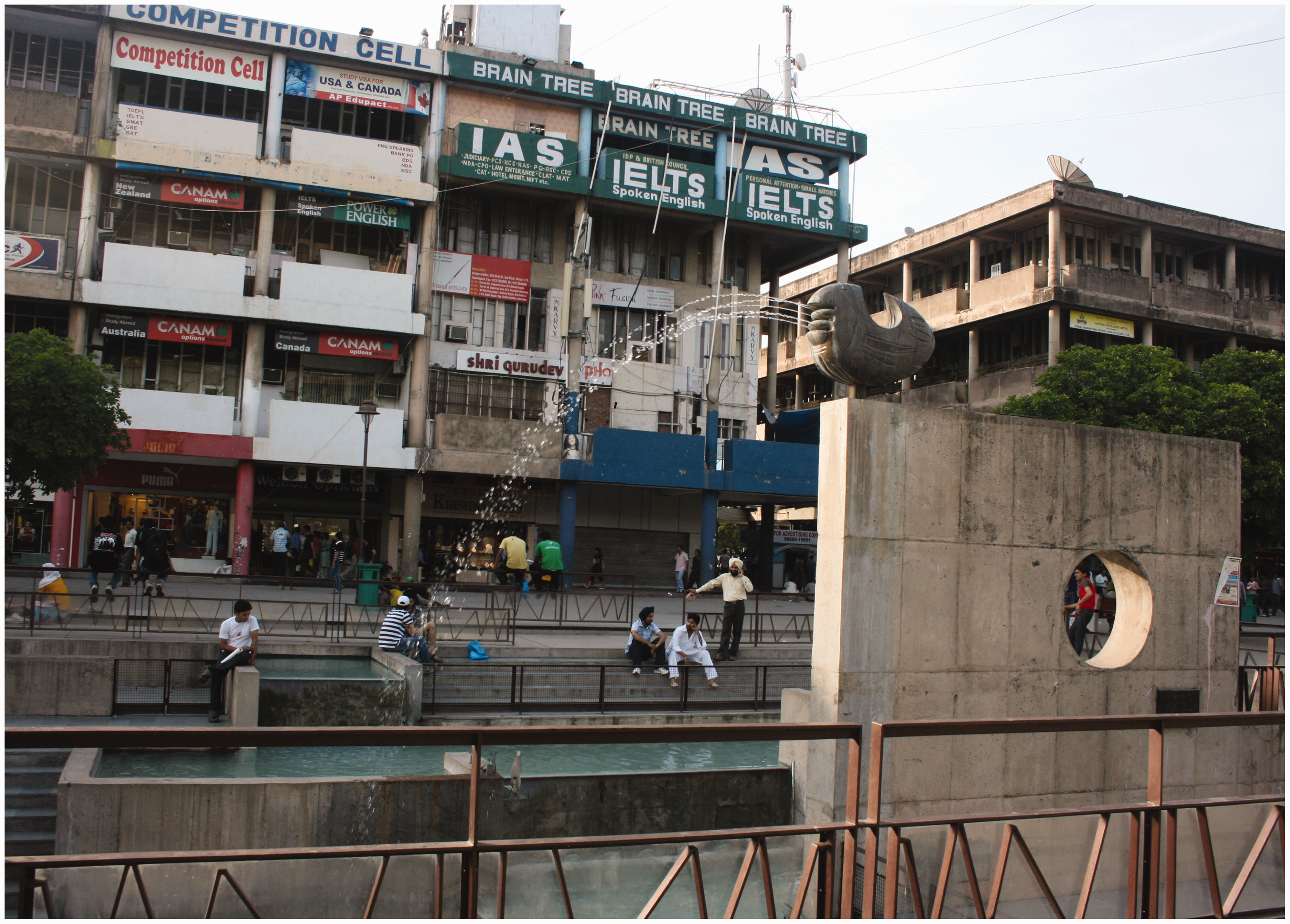
Section 17 Market, Chandigarh.
Like Gurminder, the decision to cut their hair upon arriving in Chandigarh is one that many Sikh migrants make as one of the initial steps toward becoming transnational. While the most common reasons for cutting hair include the fear of being discriminated against by visa adjudicators or perspective employers abroad, the matter of “convenience” and “appearance” often follows closely as other justifications. In focus group interview, while one young man lamented about the hours it took him to tie a turban given his “busy and hectic schedule,” another chimed in citing “the desire to appear modern or metropolitan” as a more influential factor motivating this trend. For many I interviewed, their hair-related practices also implicated their sexual identity and desires as they complained that the women in Chandigarh “preferred clean-cut guys over turbaned ones.” In the aggregate, the various justifications offered relating to personal preferences varied widely.
For Gurminder, cutting his hair freed him from the practical necessity of having to groom his hair and tie a turban daily, a time-consuming process that took up to an hour each morning. Despite being aware of the fact that his family and his community would regard his transgression with disappointment and scorn, he proceeded. Cutting his hair, in Gurminder’s case, had little to do with his commitment to his faith, rather it allowed him to feel liberated from the burdens and responsibilities that accompany having to be the “Complete (Sikh) Man.” His experience also illustrates how friends and peer play a vital role in making this consequential decision and in the overall development of Punjabi masculinity which occurs both within the egalitarian milieu of a peer group as well as passed down long patrilineal axis, from father to son (Chopra, 2004: 57).
It is no coincidence that along with the English-language institute that Gurminder attended, the barbershop where he got his first haircut is also located in the Sector-17 market. Like the airport and airplanes, Chandigarh’s Sector-17 market, where young men like Gurminder spend most of their free time hanging out, represents important transitory sites where formal and informal transformations necessary for becoming transnational are first undertaken. For most Sikh men who move to Chandigarh in hopes of emigrating aboard, foregoing their unshorn hair is just as much of a rite of passage (albeit informal) that they are compelled to undergo to become transnational as the turban-tying ceremony (the official Sikh rite of passage) that Sikh boys undergo to becoming men (Figures 2 and 3).
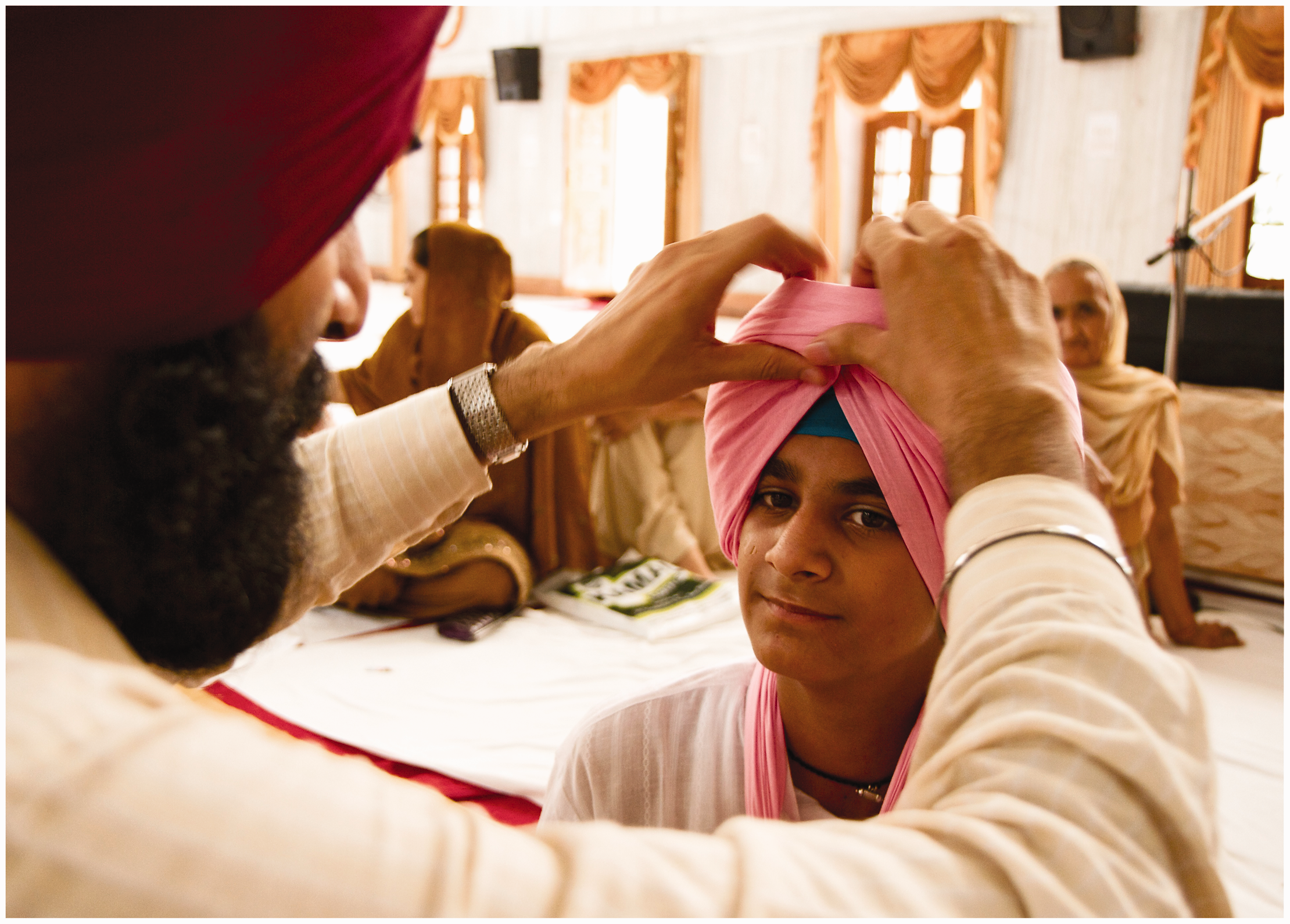
Young Sikh boy undergoes Dastaar Bandhi (the turban-tying ceremony).

Young Sikh man gets his first haircut in Sector 17, Chandigarh.
Despite repeated efforts, Gurminder was unable to pass his English proficiency exams required for a student visa. He grudgingly agreed to a marriage proposal his parents had arranged for him back in his village as he returned home to take up farming, the only reliable source of income available to him in Punjab. In light of Gurminder’s shortcomings, his parents started investing in his brother’s education, hoping for a different future for their younger son. Fourteen years after abandoning his unshorn hair, Gurminder now lives with his family in his village, looking after their land while his brother attempts to fulfill his dreams of securing a foreign study visa. When he leaves his house, he wears a turban. When I ask Gurminder if he has thought about re-growing his own hair, given his fleeting prospects of ever emigrating abroad, he smiles embarrassingly, “No … I haven’t given it much thought, but my mother keeps nagging me about it.” Following a short pause, he adds “I guess I’ll grow it out once I get settled in my life.” Struggling to articulate what he means by “getting settled,” Gurminder continues, I want my needs to be fulfilled first. I’ll feel settled once I am able to earn money on my own, not just from farming … enough money to do what I want, to travel abroad even just as a tourist. when I’m wearing a turban, the villagers refer to me as ‘sardar-ji’ (turbaned sir) instead of using my name … Punjab Police doesn’t even look at me if I’m riding my motorbike wearing my turban, otherwise they are constantly issuing traffic violations in hopes of extracting bribes.
The notion of “feeling settled” as a prerequisite for re-growing one’s hair is yet another common theme that emerges from the narratives I collected during my fieldwork. These themes echo the findings of Simeran Mann Singh Gell noting similar patterns among Sikh men in Britain who eschew the “Sikh look” at the beginning of their professional lives, and go onto readopt Kesh and turbans when they near retirements, having acquired financial success and stability (1996: 38). The decision to readopt unshorn hair (returning to being Keshdhari), along with taking up philanthropic activities that include devoting time and resources toward improving their communities and promoting the Sikh faith, is often viewed as a privilege by younger Sikh men. Like Swarn and his peer, the young men I spoke with too aspire to enjoy that privilege in the future, hopefully having achieved some level of financial success by accessing transnational mobility.
Through remittances and philanthropic initiatives, members of diasporic Sikh communities maintain an active relationship with their villages and their families back home (Dusenbery and Tatla, 2009). While giving back to one’s community in the form of doing “service” (sewa) has historically been an important feature of Sikh theology, today, in Punjab, being able to sponsor philanthropic initiatives is also regarded as a way of signaling one’s success as a transnational migrant to the community back home. Punjabi TV channels and news media regularly highlight “successes” of transnational migrants, underscoring the diasporic community’s involvement in improving their homeland. These representations further reinforce the centrality of transnational migration as one of the primary ways of accessing upwards class mobility. Much like the material symbols that the younger generation of returning migrants display as markers of success (gold chains, iPhones, and designer clothing), the choice to re-grow one’s hair and becoming more pious in middle age, which might have been given up in the initial process of becoming transnational, becomes yet another way of narrating successful migrant journeys, albeit at the end of their working lives. This public reclamation of religious piety and devotion through philanthropy that Swarn and his peers actively encourage as essential to be a “full” Sikh thus serves as a precursor to being recognized as “The Complete (Sikh) Man,” and thereby calling into question the masculinity of men like Jeet and Gurminder who have cut their hair.
Contrary to Swarn and his organization’s anxieties around the loss of religiosity, Gurminder and most other migrants’ decision to cut their hair rarely signals the loss of faith or religiosity in their own lives. Instead, for most Sikh migrants like Jeet and Gurminder, cutting their hair equates to ceasing to observe this one single, albeit significant, religious prohibition. Despite being aware of the gravity of such a transgression and the disapproval their actions might invite from their families and communities, most Sikh men who do choose to cut their hair in their 20s and 30s are also aware of the opportunities for redemption later on in life.
Dual identities
“I am retaining two identities right now, one as a full sardar (turbaned-man) and one as cutsurd (cut-haired-turbaned-man),” Palli confesses, hunched over his laptop switching back and forth between two browser windows displaying two different websites. “My Facebook profile only shows me as a sardar,” he explains showing me the images on his Facebook profile which represent him as a Keshdhari Sikh man, “because my friends and relatives on Facebook don’t know that I’ve cut my hair.” He continues, “whereas as on Orkut, 3 both the aspects of my identity are there … so my profile picture represents me as a cutsurd.” Tall, light-skinned, muscular, and overall conventionally handsome man in his mid-20s, Palli is routinely encouraged by his friends to pursue acting and modeling. Unlike his Facebook account, which he uses to socialize with his extended family and friends back home in his village, Orkut serves as a way of networking with individuals he meets at various social events in and around Chandigarh, where he has been living for the past three years. His Orkut network also includes individuals from the regional Punjab film and music industry, largely concentrated in and around Chandigarh. “As a model or an actor, one has to be versatile,” Palli explains, “by having short hair, more opportunities become available to me” (Figures 4 and 5).
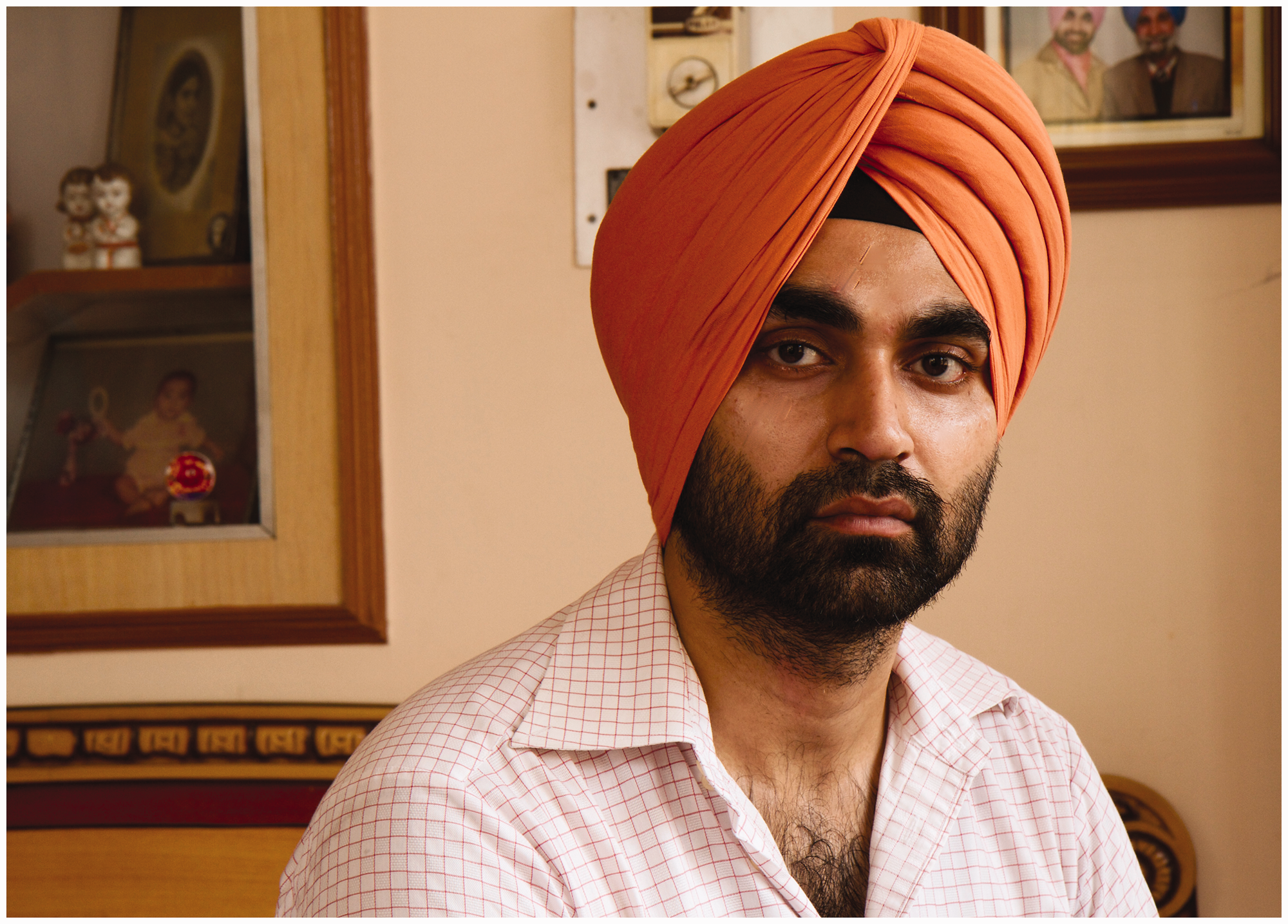
Palli at his parent’s house, in a village in Punjab.

Palli in Chandigarh, without his turban.
Palli grew up in a landed Sikh family in a village near Ludhiana, another major city in Punjab. After college, he secured a well-paid position at a multinational corporation in Chandigarh. Upon acquiring four years of experience (in 2009) Palli applied to immigrate to Canada on a Skilled Worker Visa. Like Gurminder, shortly after arriving in Chandigarh and before filing his visa application, Palli decided to cut his unshorn hair.
The decision to cut his hair was extremely painful and deeply disappointing to his parents, who continue to accuse him of having “committed a murder.” After his parents discovered his transgression, Palli was forbidden from returning home for several months. His exile ended when a childhood friend stepped in to facilitate a dialogue between him and his mother. “Sikhism is very important to them (my parents),” he goes on to explain, “my mother and father were deeply, psychologically affected by what happened in 1984, and opted to take Amrit (to become initiated),” Palli reveals, rationalizing their extreme response to his decision to forego his unshorn hair. Palli, who was born in 1988 and came of age in the late 1990s has no memory of that political turmoil that transpired in Punjab in the 1980s. Nor does he share a similar sense of obligation toward his faith and his parents’ anxieties around protecting Sikhism.
Palli’s trepidation around cutting his hair stemmed largely from the fear of disappointing his parents, especially his mother. For Palli’s mother, losing her son’s hair was a deeply traumatic experience. She recalls, “I would cry for hours, remembering his beautiful hair, and how lovingly I cared for them.” Palli’s father responded with anger and fury directed at his son. After nearly six months, Palli’s parents ended up forgiving their son, citing passages from the Sikh scriptures that implore Sikh mothers to forgive the sons’ transgressions.
Palli still considers himself a Sikh. He regularly visits the Sikh temple to worship and pray, and like Gurminder, remains open to the possibility of re-growing his hair and becoming more pious in middle age. Echoing other migrant’s experiences, Palli’s decision to cut his hair was rooted in anxieties about being racially profiled and discriminated against by non-Indians upon arriving in Canada. Yet, cutting his hair also freed Palli from the symbolic burden of representing his religious community and from having to conduct himself in accordance to social expectation associated with being a turbaned man in North India which he found onerous. “Being a sardar you have to be very conscious about whatever you do … you cannot be irresponsible anywhere, and people expect a level of wisdom and maturity out of you … you are basically bound to your turban,” explains Palli, struggling to articulate his conflicted relationship with this symbol he inherited from his father. “But after cutting my hair, it makes me feel more liberated!” Palli declares decisively, “I can do everything now. Everything!” He goes on to elaborate, “I can choose to tie a turban if I’m in the mood to do so, or I can go without. I can have both the profiles, as a cutsurd as well as a full sardar.”
Like Jeet, the student from Kansas returning to his village in Punjab, Palli also grows out his beard and ties a turban during routine visits to his hometown to see his parents. His reasons for tying a turban are similar to those of Jeet’s, “for those back home.” After Palli’s parents overcame their initial hurt and disappointment, they stipulated that their son had to cover his head with a turban during his subsequent visits home. “My mother said to me, ‘Palli, you do one thing, when you come home: try to present yourself just as you were before,’ this is sort of promise I have with them in exchange for their forgiveness,” Palli continues, “so when I am with them, I always tie a turban.”
By putting on the turban when heading home, Jeet and Palli’s actions are not motivated by the desire to “pass” as Keshdhari (unshorn) Sikhs, where traditionally the act of passing implies a level of deception. Rather, this performative practice more closely resembles “covering,” the deliberate toning down of aspects of disfavored identity to fit into the mainstream (Yoshino, 2006). This act of covering as undertaken by transnational migrants like Jeet and Palli does not refute the reality that they are no longer who Swarn would classify as “full” Sikhs, and thereby accepting a certain loss of status within their religious community. Yet, it offers a subtler way of downplaying this unsavory aspect of their migrant realities especially when visiting home or travelling through Punjab where it is more advantageous to embody the traditional aesthetics of turbaned Sikh masculinity. Similarly, the act of uncovering (cutting hair before applying for a visa or removing the turban before boarding an international flight) is metaphorically also an act of covering undertaken by transnational migrants as a way of downplaying this otherwise innocuous aspect of their religious identity that might mark them as “terrorists” or “religious extremists,” subjecting them to extraordinary monitoring and surveillance especially at security check-points and border-crossing when traveling abroad (Verma, 2006).
Given the prevalence with which young Sikh men forego their unshorn hair, there now exist widely (and globally) used formal categories of “sahejdhari (non-practicing)” and “mona (shaven)” Sikh, terms connoting more diminutive position within the community, deployed with derogatory undertones (Mooney, 2015: 115). More colloquially, in Chandigarh and in Delhi, I have noticed younger generation of Indians also refer to Sikh men like Palli as “cutsurds” (cut-haired-turbaned-men) that while acknowledging the altered state of their hair, still allows them to lay claim to the turban and associated hegemonic masculine status. While Sikh men like Gurminder and Palli (migrants and non-migrants alike) might give up Kesh (unshorn hair) in exchange for being liberated from the practical obligation of having to care for it daily, they remain deeply invested in their turbans, wearing them from time to time, harnessing the power and privilege this symbol represents in Punjab and across India. For Palli, the sense of feeling liberated entails being able to choose when to tie a turban, not giving up the turban altogether along with his Kesh (unshorn hair). Foregoing Kesh (unshorn hair) allows these men to meet the expectations and requirements of being part of the global labor economies, which necessitate that they exist as docile and mute service providers. The turban allows them to reclaim citizenship and gendered belonging within a social milieu back home in Punjab where the notion of successful manhood is defined through this landed-caste, heteronormative, patriarchal embodiment or what Swarn refers to as the “The Complete (Sikh) Man.”
Departures anxieties
Accessing transnational migrant flows involves figuring out both the formal and informal sets of requirements for how one moves across national boundaries without being profiled, questioned, surveilled, and/or detained. Upon learning that different travel itineraries necessitate different embodied practices and performances, what kinds of transformations do migrants undergo in preparing for these journeys? These practices and performances operate at both intimate and global levels—implicating their bodies, their relationships to their families, their religious piety, their sense of masculinity, their place and belonging within their communities, and their ability to access education and employment. They play out against, and often in response to, a constantly shifting backdrop of global discourses on immigration-related anxieties, racialized fear, and xenophobia, from which the voices of migrants themselves are largely excluded. To mitigate any challenges to their upcoming journeys, these processes of becoming transnational are often imbued with nearly as equal significance as the importance of procuring the official documents (visa, passports, plane tickets) needed to travel abroad. By exploring these processes of becoming, this article also attempts to shift the focus from the origin and the destination of their travels to thinking about how migrants experience the journey itself. Airports and airplanes, along with provincial cities like Chandigarh and the Sector-17 market, represent crucial nodal points in migrants’ journeys where practices including social and physical transformations related to migration are mobilized ahead of their upcoming relocation.
As these ethnographic accounts illustrate, Sikh men’s relationship with their hair, and what role this relationship plays in shaping their religious identities, changes over the course of their lives. The decision to maintain or forego Kesh (unshorn hair), for many young Sikh men (Jeet, Gurminder, and Palli included), is rooted in a sense of communal and familial belonging, more so than their religious identities. Their testimonies certainly parallel the accounts of diasporic Sikhs, many of whom view cutting hair as a “sacrificial act” born of the necessities of living in diaspora, yet their loss is not entirely irreversible as kesh (unshorn hair) can always be restored later in life along with the social and masculine status that being a “full” Sikh accompanies back at home (Mooney, 2015: 110).
These observations also illustrate how lived experiences for Sikhs in India differ significantly from the rhetorical claims deployed by those attempting to police the boundaries of Sikh identity. Sikh community’s singular fixation on encouraging Punjabi youth to keep Kesh (unshorn hair) and turbans diverts attention from more urgent issues like son-preference, dowry-related violence, gender and caste-based hierarchies, rampant alcoholism and prescription drug epidemic in Punjab—practices that are specifically outlawed within Sikh theology alongside cutting hair. For instance, in a later conversation with Palli, I eventually learned that his elder brother was disowned by his family for eloping with a lower-caste Hindu woman, a transgression unworthy of the kind of forgiveness that was extended to Palli.
This article also raises further questions about how the state sanctions and requires migrants to embody homogenized identity categories in times of heightened immigration-related anxieties and anti-immigrant rhetoric of the Trump administration. Contrasting the experiences of early travelers like Swarn with more recent migrations in the aftermath of 9/11, what are the implications of migrants like Jeet and Palli no longer choosing to (or being able to) confront and resist their racialization and subjugation, and instead opting to choose a more muted and less-resistant response of “covering”?
As I was finishing up my fieldwork research in Chandigarh, Palli called me with the exciting news that he had been granted his visa to emigrate to Canada. Shortly after, he booked his flight to Toronto on British Airways, departing from New Delhi with a brief layover in London. When we met to celebrate his upcoming journey, Palli appeared visibly distraught. While booking his ticket, he had failed to notice the significance of the date of his departure. Palli was scheduled to depart on the same day as the 12th anniversary of the 9/11 attacks, at a time when airports around the world are likely to be on a “high terror alert.” While Palli’s passport featured a photograph of him wearing an orange turban, his visa and related documents depicted him as a clean-shaven man with cropped hair. Noticing this discrepancy, Palli was faced with a conundrum—whether he should or should not wear a turban on the plane. I was going wear my turban because my parents are driving me to the airport. But now, because of 9/11, I don’t want them to think that I might be a terrorist or something like that … My passport shows me as a sardar, but my visa doesn’t … I don’t know what to do? I hope they don’t send me back to India before I even have the chance to set foot on Canadian soil.
Footnotes
Acknowledgements
I thank the following individuals for their feedback and guidance in developing this article: Attiya Ahmad, Radhika Chopra, Doris Jakobsh, Inderpal Grewal, Kira Hastings, Anneeth Hundle, Dipin Kaur, Nicola Mooney, Anne Murphy, Margaret Walton-Roberts, Sasha Sabherwal, Abhishek Sharma, Harleen Singh, Gaurav Sogi, Safina Uberoi, Preet Verdi, David Vine and Neha Vora. I also thank Adrienne Pine for introducing me to Edmund R Leach’s essay “Magical Hair” which served as the genesis of this article.
Declaration of Conflicting Interests
The author(s) declared no potential conflicts of interest with respect to the research, authorship, and/or publication of this article.
Funding
The author(s) received no financial support for the research, authorship, and/or publication of this article.
