




Abstract
The contribution of arts for development has recently received a great deal of attention from international donors ad organizations. The anthropology of art, however, has participated in a limited way in these debates. Borrowing theoretical tools from the socio-anthropology of development, this paper questions the politics of knowledge involved in the implementation of art projects in postcolonial context. Drawing on ethnographical research in Botswana on an art project opened by a NGO for the San people, it describes the ways areas of knowledge and non-knowledge have been attributed. It shows that the conceptions of knowledge at stake in the making of contemporary San art indirectly reproduce a Great Divide between modernity and tradition, which has direct impacts on the ways the practice is appropriated by local actors.
Keywords
Within the framework of the vast transfer of technologies and knowledge that followed colonization and then continued through development support programmes, many art projects were initiated worldwide giving rise to a multitude of new graphic forms. Since the publication in 1976 of Ethnic and Tourist Arts by Nelson Graburn (1976), a lot have been written on the production, circulation and reception of these indigenous arts in the global art worlds (i.e. Morphy, 2007; Myers, 2002; Phillips and Steiner, 1999; Rushing, 1999; Townsend-Gault et al., 2013; Wood, 2008). How art is transformed as it moves across different regimes of value (Appadurai, 1986; Myers, 2001)? How Western notion of art articulates with non-Western material production ( Barriendos, 2009; Errington, 1998; Harney and Philipps, 2018; Ingold, 1996; Price, 1989)? How artistic value is created and sustained through the actions of individuals and institutions (Clifford, 1988; Mullin, 2001; Steiner, 1994)? Movement and mediation have thus become key parameters for the analysis of the social and cultural transformations involved in the production of these new art forms.
Much work has focused on how values, status and objects are transformed while they move from places of production to places of exhibition and much less on how the transfer of persons, material and knowledge reciprocally structures and conditions locally the day-to-day production of art objects (but see Kasfir and Förster, 2013; Taylor, 1996). In particular, despite the fact that many art projects founded in postcolonial contexts are part of development activities, involving NGOs, external experts and foreign funding, few studies have taken a development perspective to question notably the technological and knowledge transfer involved in the production of these objects. While international donors and development organisations (UNCTAD, 2008; UNESCO and UNDP, 2013) take a growing interest in the cultural dimension of development, the complex relationship between art and development remains largely unexplored 1 (but see Mugovhani et al., 2018; Stupples, 2017; Stupples and Teaiwa, 2017).
Building on theoretical reflections conducted in socio-anthropology of development, I propose to question the implementation of art projects in postcolonial context and the consecutive emergence of new artistic forms as knowledge transfer involving politics of knowledge and non-knowledge. In comparison with the already existing literature on how teaching methods have historically been developed in art workshops founded and directed by outsiders in Africa and elsewhere, 2 the approach adopted here aims to pay particular attention to the “social life” of development projects (Long, 2001: 14–15) and to the creative ways local population respond to it.
In fact, one of the main ‘bringing-in’ of studies on technological and knowledge transfer is precisely to draw attention to the gaps that form over time between initial conceptions and their daily implementation. The use of the notion of “technological transfer” designates here a situation where “the future use of a technique or an object to design is different from the one that initially inspired it.” (Geslin, 2017: 9). In this respect, several authors have stressed the importance of not considering development as “a coherent set of practices but [as] a set of practices that produces coherence” (Yarrow, 2011: 6) and whose parameters are never known in advance (Mosse, 2013: 231). Given these understandings, knowledge is considered here not as something that is possessed, but as something realized in interaction (Marchand, 2010: 11), and transformed, while it circulates between different individuals and groups of actors (Long and Long, 1992: 274).
Moreover, recent studies in the anthropology of knowledge have stressed the importance of addressing not only the production of knowledge, but also its direct counterpart, namely the production and reproduction of “ignorance” or “non-knowledge” (Dilley, 2010; Dilley and Kirsch, 2015; High et al., 2012; Hobart, 1993). Indeed, while the transfer of technologies that characterizes development support programmes generally implies one or more knowledge policies, it also implies inextricably policies of non-knowledge, what Thomas Kirsch and Roy Dilley (2015) call regimes of ignorance. Attention paid to the production of knowledge should thus go hand in hand with an interest for the other side of knowing, that is the production “out of the infinite sea of things that people happen not to know, of culturally recognized and elaborated units, fields, and modes of ignorance.” (Mair et al., 2012: 16). In this perspective, ignorance or un-knowing has to be questioned not as a simple absence of knowledge, but as a social fact (Kirsch and Dilley, 2015: 15), involving acts of power (Hobart, 1993: 1) and resulting from discursive processes (Caduff, 2015: 32). My interest is, therefore, not to describe what is known or not, but to analyse how and by who areas of knowledge and areas of non-knowledge are defined and attributed, as well as how these two poles are interrelated.
Borrowing theoretical tools from the socio-anthropology of development, this article aims to provide a new perspective on the circulatory movements and cultural transformations involved in the making of contemporary indigenous arts. For this, I look at one particular art project: the Kuru Art Project in D’kar (Ghanzi district, Botswana). Founded by a local NGO in 1990, this project was the first art workshop specifically created for the San in Southern Africa and initiated an artistic movement on the international art markets known since the early 1990s as Contemporary San Art or Contemporary Bushman Art. Since “2010”, I have been following the chains of actions involved in the transfer – under Western impetus - of the concept of art in the Kalahari and the importation on the international art markets of paintings and prints sold as contemporary San art. Through long term and in-depth field observations in the workshop at D'kar and in exhibition venues, as well as through interviews with the multiple actors involved in the making of contemporary San art, I studied the transcultural politics of representation and the shifts in meaning, interests, values and goals generated by the transfer of artistic conventions in a postcolonial context (Baracchini, 2021).
Looking at how “art” – understood here as a socially and historically constructed category (Myers, 2002: 358) – came to people, objects and practices in D’kar, this article investigates the knowledge policies that have accompanied the creation of this art centre and their actual effects on people and practices. Using the case of the Kuru Art Project, this article explores first at an historical level the conceptions that have guided the introduction of the concept of art in D'kar and the definition of a certain learning philosophy. In particular, it retraces how the conception of knowledge applied to the Kuru Art Project has come, over time, to carry and reproduce an artificial separation between tradition and modernity. Then, it discusses how this approach to knowledge – based on representations, values and objectives developed by external actors – is interpreted and appropriated by local actors, whose values, concepts and interests differ. What is recognized and valued as knowledge? And who is considered as “expert”? But also how individuals negotiate their relationship between knowing and unknowing in order to be recognized as contemporary San artists?
An art project for the San
Located in the Kalahari desert, the Kuru Art Project is one of the development activities initiated by the Kuru Development Trust, the first “Indigenous People’s Development Organisation for the San in Botswana” (Le Roux, 1998: 6). Under the name of “Kuru” meaning “to do” or “to create” in the Naro language, 3 this NGO was founded in 1986 in D’kar, a mission of a few hundred inhabitants, with the aim of fighting poverty and encouraging San people to take control of their lives through a process of economic, social and political empowerment (Le Roux, 1998). With the support of expatriates and funding from Southern Africa, Europe and the United States, the Kuru Development Trust has implemented a series of development projects (agriculture, crafts, pre-school education, tannery, etc.) over the years (Letloa, 2007).
It is against this backdrop that the Kuru Art Project emerged in 1990, as the result of a desire expressed by the Naro community to start a cultural project and of the coincidental arrival in D’kar of Catharina Scheepers, a South African artist (Scheepers, 1991). The opening of an art project was then conceived as a particularly key step “toward the greater ideal of a “cultural healing process”” (Kuru Development Trust, 1990). At a time when the “San” in Botswana were still widely regarded as a minority “belonging to a primitive past” (Saugestad, 2001: 126), to provide a new room for self-expression and experimentation through art was seen as way to bring back pride, dignity, culture and empowerment to people that have been ill-treated by colonization and history, for them to renegotiate their place and role in the society (Le Roux, 2014).
As Southern African first San art workshop, the Kuru Art Project was to be followed by similar initiatives among other San communities. After her departure from D’kar, Catharina Scheepers first founded in 1993 the !Xun and Khwe Art Project in Schmidtsdrift (Kimberley, South Africa). At the request of the South African San Institute, she also organized, in 1999, art workshops in Welkom (Northern Cape, South Africa) with a group of ≠Khomani (Bregin and Kruiper, 2004; Rankin, 1997).
Several authors have since discussed the relationship between contemporary San art and the politics of identity, culture and indigeneity (Barnabas, 2010; Guenther, 2003; Stephenson, 2006). Some observed that while art provided the San new possibilities to formalize their own form of representation at local, national and global level, it was also likely to reproduce and strengthen stereotypical images of the pure and pristine Bushman hunter and gatherer. In this regard, the pictorial qualities of the artworks, often described as naïve, simplistic, child-like and untutored, have been analysed as one of the factors leading to encapsulating these objects into primitivism discourses (Guenther, 2003; Stephenson, 2013; van der Weg and Barnabas, 2011). Nhamo Mhiripiri (2009: 276) notably showed that to speak about Bushman art in terms of “inborn, instinctive talent” contributes to “ironically shuts the doors and opportunities for serious, aesthetic, historical and political cognitive discussions” and consequently called with others to go beyond these questions in order to engage with these realizations as Art through semiotic approaches (Barnabas, 2010; Mboti, 2014).
However, the mechanisms and negotiations that led to the establishment of a definition of this art as “naïve”, “child-like” and “untutored” are still poorly understood. In the light of the actual debates about the ambiguous effects of strategic essentialism and the NGO’s contradictory role in the construction of an indigenous identity (Koot et al., 2019; Robins, 2001; Sylvain, 2014), a better understanding of the processes involved in the making of contemporary San art allows new light to be shed on the ironies and contradictions, which condition the running of such a development project, moved by a desire to encourage empowerment and free creative expressions, but potentially generating effects of domination and restraint, and having the capacity both to open new means for securing recognition and to reinforce an essentialist conception of San identity.
An ideal of non-formation
The opening of the Kuru Art Project led to the introduction of new techniques and materials – such as oil painting, acrylic, gouache, canvases or brushes – hitherto unknown to the inhabitants of D’kar to create paintings, drawings and prints. Yet, the implementation of these materially, technically and conceptually new forms of expression required the set-up of a series of elaborate measures aimed at promoting rapid appropriation. Among these measures, a more or less formal training policy was developed. The basic principles of this approach consisted in making available infrastructure and materials to individuals without providing any art lessons in order to promote free and experimental self-learning (Scheepers, 1991).
This pedagogical philosophy, introduced in 1990 at the Kuru Art Project, is essentially the work of one person, Catharina Scheepers, who, by bringing her expertise to the art project, also instilled a certain conception of art, marked both by her former involvement in anti-apartheid movements and by her rejection of the norms of academism. Originally from South Africa, Catharina Scheepers studied art at the Cape Technikon. But rejecting the “demotivating and debilitating effect of teachers interrupting/interfering prematurely in the student's process”, 4 she dropped out of art school at the age of twenty. She found a job as a pre-school assistant where, inspired by Jung's writings on the archetypes and the collective subconscious, she became fascinated by the expressive freedom and creative spontaneity she discovered in the drawings made by young children.
After one year, she moved to Johannesburg where she became actively involved in the anti-apartheid movements that shook South Africa in the late 1980s and in which art in all its forms was used as a cultural weapon to spread political messages (see i.e. Tomaselli, 2019). It was by chance that six years later in 1990, she discovered D'kar and the Kuru Development Trust during a hitch-hiking trip around Botswana. There, she became interested in the various projects carried out by the NGO and decided to take the opportunity to start an art project.
Driven by ideals of freedom, spontaneity, integrity and individuality, Catharina Scheepers transferred these same principles into the Kuru Art Project. The absence of formal knowledge in art was thus positively conceived as a resource for action and as a means to restore an individuals’ self-confidence. As she explained to me: “It was my strong intuition right from the start that it was not necessary to rush things, or to imprint any particular visual style onto the artists. It was out of respect for the individuals that I refrained from interfering with their learning process.” “What I have witnessed at western-style art schools is that in obediently following someone else's program or trend, students lose their connection to their own inner source of inspiration and ability. It takes years to find one's own style and originality after that, and many never do recover […]. I thought it was kind to spare the D’kar artists such a fate. They could always later grow voluntarily in such a direction if they wished. Putting a year or a few years aside to just play and find/develop a unique personal voice is probably good advice for any artist. If I could do it again I would do it exactly the same way.”
The philosophy developed at the Kuru Art Project was then nothing new. On the contrary, similarly informal methods of training played a major role in many art workshops in Africa and elsewhere. 5 The interest here is to observe the relationship between the initial philosophy, the modalities of its concrete application and the ways it is interpreted and understood by the artists themselves.
Transformations: The construction of an authentic other
Catharina Scheepers only stayed at the Kuru Art Project one year, but the principles of direction she established have been pursued after her departure. However, from the very first exhibitions in 1991, a number of shifts in the values attached to the ideal of self-expression can be observed. Indeed, while Catharina Scheepers was primarily motivated by the “psychological and cultural benefits” of art, more than by its hypothetical economic benefits, the success encountered by the artists and the economic spin-offs that would follow significantly changed the objectives of the project. The income potential and the recognition of these graphic expressions as fine art would then become central goals as explains Tamar Mason, who succeeded Catharina Scheepers in 1992: “I wanted to create avenues for the artists to be taken seriously as contemporary artists” and “to help the artists to generate a decent income from their work” (Mason, 2014: 25).
Henceforth, the lack of artistic training would no longer be conceived solely as a guarantee of creative freedom, but also as an argument for the recognition of these paintings and prints as art by an external public. The self-taught quality of the artists and their anchoring in a San cultural tradition (notably rock art, see Baracchini & Monney, 2017) began then to be mobilized to promote the originality and uniqueness of this art (Scheepers, 1991). The lack of artistic training thus became not only an inseparable characteristic of the artists, but above all a condition for their success; the unmediated quality of the production of the work – presented as coming directly from the artists themselves – guaranteeing its authenticity and integrity: “Without any formal art training in the western sense, the Kuru artists’ perceptions and depictions of the world around them are unique.” (Brown, 2008: 17).
The approach adopted by Catharina Scheepers indirectly contributed to the construction of a certain definition of this art as realizations that are little or not codified, made by art world outsiders whose untutored naïve visuality was seen as a true and spontaneous expression. Paradoxically, while motivated by decolonial values, the choice to “preserve” an artistic expression “unspoilt” by western aesthetic codes found itself nurturing a fascination for other art forms untainted by outside influence and setting up the conditions for the emergence of an art that embodies precisely this image of an Otherness – Bushman or African – located out of the modern world.
Moreover, the concrete implementation of the ideal of non-formation would soon face a new reality. Indeed, while the first artists to join the Kuru Art Project in the 1990s either left school early or never attended school, 6 the arrival in the early 2000s of young educated persons already familiar with western modes of representations would be seen by the coordinators as a real challenge for the sustainability of the project. Hence, in the mid-2000s, the idea emerged that to not provide art lessons was no longer sufficient to ensure the originality of the artworks and that the possibility to become artist should be restricted to illiterate persons “unspoiled” by western schooling and/ influences.
Consequently, young educated artists were voluntarily kept out of the project. This led to the creation in 2005 of a new group of artists, called the non-traditional artists, composed of young people who, according to the coordinator, “have had to be rejected due to western influences through schools, media etc., resulting in their work not fitting the style for which the Kuru Art Project has become known.” (Kuru Family of Organisations, 2005: 36). Unlike the artists of the Kuru Art Project, this new group composed of nine men 7 between the ages of 20 and 45 years old was to benefit from a formal art training in the form of workshops organized by the former coordinator of the Kuru Art Project, Pieter Brown. In fact, if art created without any formal art training in the western sense was conceived as having a “directness, honesty and strength” that finds a direct resonance in the modern art history (Brown, 2014: 31), conversely, in the view of the coordinator, young educated people need to train in order to develop creative ways of expressing themselves.
Thus, in a few years, the values, goals and meaning of the principle of non-formal art-training changed radically. What had been conceived as an ideal of freedom intended to empower the artists, gradually came to embody values of purity and authenticity intended to promote the sale of the artworks and their recognition by an external public supposedly in search of a romantic and primitive image of the Bushman artist. Consequently, the conception of knowledge instituted at the Kuru Art Project had the effect, first, to place the value of artistic expression within the individual and not in an external knowledge system and, secondly, to give rise locally to the construction of a dichotomy between a “Kuru style”, artificially invented as a “tradition”, and a “non-traditional art”, associated with exposure to “western schools” and “influences”. These two aspects have direct impacts on the ways the Naro artists and the local people evaluate the project and respond to it.
Making art in D’kar: Appropriations
The separation established by the coordinators between academic knowledge and an “innate” creativity deeply rooted in traditional knowledge appears to be largely taken up by the local people. In this regard, the creation of the non-traditional artists group in 2005 seems to have validated the idea of a fundamental difference between the Kuru artists and young educated individuals. Although the creation of this group was initially a result of the policy of the art project’s coordinators, the idea of a binary opposition was reaffirmed during this study by all non-traditional artists, who painted a stereotyped vision of what they call the “Kuru art”. “Because, you know, there is “flat art”, that is the Kuru art. That is what the old ladies, who never went to school, are doing. Our art is something much more focused. Like I would take a picture of you and draw it as it is. At the end, it comes out just like a photograph taken by a camera. That’s what we are doing. But the support is only for the flat art made by the old ladies. That Kuru art is for the uneducated artists, like old, old, old people. Then, there is the educated art.” (Bob Moleele).
Conflict of values, doubts and accusations of ignorance
If the distinction between “Kuru art” and school knowledge was widely in use at the time of this study, the values associated to it by the artists and the local population were different than the ones upheld by the coordinators. On the contrary, what the coordinators conceived as art according to concepts and values inherited from Western art history were hardly shared by people who were not familiar with these concepts and values. The discourses of the artists thus let appear significant discrepancies between what they consider to be “beautiful drawings” and what they understand of the coordinators’ quality criteria. Xgaiga Qhomatcã, artist at the Kuru Art Project since 1997, expressed these frictions as follows: “On that time [when he arrived at the Kuru Art Project in 1997], they were not looking for people doing nice drawings, the one where you can recognise what the person drew. They were looking for people like myself, who never went to school. […] Qãetcao [Q. Moses] made beautiful drawings, so Catharina [Scheepers] said: “No, you have been educated to do good drawings. We don’t want that kind of art here.” Then Tamar [Mason]
8
told him just the same. Both of them are artists, so maybe they know well about it. They like the old ones, the ones showing stories, with things like Q’aru plant which could be at the same time a plant and a human being, or even sometimes animals being also a person. They thought that Qãetcao’s drawings would not go together with our drawings. So, Qãetcao started to diminish the quality of his drawings. He started to do weird things, to try to do like the rest of us.”
Although the absence of formal art training does not mean an absence of knowledge, it emerged from the discussions with the artists and their entourage that “Kuru art” is mainly conceived in terms of lack: lack of artistic expertise, lack of school knowledge and lack of technical mastery. The will of the coordinators to promote free and unmediated art thus seems to have fostered an understanding of the art studio as a space of expression and creation, rather than a space of knowledge-making. As a result, in D’kar, those who enjoy the status of “artists” are paradoxically not recognized as experts in art.
On the contrary, twenty-five years after, its inception, the non-training approach developed at the Kuru Art Project seems to no longer express adequately the experiences and the aspiration of change through modernity expressed by some of the local people who see naturalism as “modern” because it is foisted onto them by western education. The lack of realism in the choice of colours, proportions or perspectives associated with the Kuru art is therefore often a source of puzzlement within the D'kar population, who tend to evaluate contemporary San art against aesthetic criteria learned at school, in particular naturalistic realism, and to question the ability of the artists to make “good” drawings. “Leila, can I ask you a question? In art, is it possible for someone to just draw whatever he likes? This one [pointing at the Figure 1], we don’t even know what he wanted to show. It is a man, but it doesn’t look like a man. Is it what they like?”
In a context where school education is widely perceived as an indispensable resource for integrating into modern society and as a symbol of mastery of the codes of modernity, accusations of ignorance, by contrast, can suggest to the artists uncertainties about their skills: “We never went to school, that’s why our hands are not used to draw and that we draw things that have these funny, clumsy, shapes. I think, that what we are making is nice, but it is hard to make it, because we’ve never learned how to write.” (Cgoma Simon)
“Traditional knowledge” as area of expertise
The NGO's emphasis on the capacity of art to strengthen “San culture” is widely shared by local actors. Contrary to the doubts expressed on the technic, the meaning of the paintings and prints is not contested. For many, the meaning represents the main value of the “Kuru art”, as explained to me by one of the artists’ relative: “If you look at Xgaiga’s or any of these old persons’ drawings, they can be followed back, there will always be a story that goes with it. It tells us a story. If Xgaiga draws an eland [common eland, Taurotragus oryx], it is not just an eland. You know that with this eland, Xgaiga might think of one of the traditional dance that we have, of the ways to hunt an eland and so on. It has stories.”
To depict nostalgic veld scene from the past may thus be seen by the artists as a means to preserve and perpetuate a memory, to rediscover and remember what constitutes their identity – as well as their difference – historically and in the present and to redefine their relationship to the land, to their identity and to the modern society. In that respect, the representation for an external public of what is conceived as “Naro cultural knowledge”, may contribute, as Jan Tcega John explains, to transform positively the perception and definition of a San identity: “The reason why I am mostly drawing wild animals is because my mother told me that these animals are our animals. The other people living in the modern ways are the ones raising cattle and goats. But ourselves, we were staying with these wild animals. We know how and when to hunt them. We know when they are breeding. God even created us with those wild animals. They are our animals. That’s why I cannot forget them.”
In this perspective, to make art was seen as requiring a good mastery of “Naro traditional knowledge”. Unlike younger people, the Kuru artists were said not to need to get their inspiration from books, as “they know everything about their culture”. Their capacity to create was attributed to their vast knowledge and they were considered as a resource from which it was possible to “learn stories”. Conversely, the same knowledge was denied to the younger generations who attended school. In fact, school knowledge and traditional knowledge seem to be conceived in D’kar in an inverted relationship to each other: the knowledge of one of the systems involving reciprocally the lack or poor knowledge of the other.
Purification processes
To be (or to become) a contemporary San artist, in the sense of being part of the Kuru Art Project, is therefore seen as requiring the development of a particular relationship to school, artistic and traditional knowledge. Far from being simply a vision imposed from outside, the artists and the local community also play an active role in the construction and consolidation of an opposition between “traditional” and “modern” art through processes of claims to knowledge and accusation (or affirmation) of ignorance. Indeed, the principles initially introduced to increase self-confidence and creative spontaneity were interpreted both by the artists of the Kuru Art Project and by the non-traditional artists, who wished to be recognized as contemporary San artists, as a set of artistic prescriptions.
The appropriation “from below” (Robins, 2001) of the opposition between “traditional artists” and “modern artists” implies therefore a work of purification, in the sense given by Latour (1993[1991], p.10), namely a constant purification of the hybrids “to maintaining two entirely distinct ontological zones” (the Great Divide). As individuals find themselves not clearly fitting their own conception of what “Kuru art” should be, they try to adjust their art so that it embodies the values of authenticity connected with contemporary San art. As Jan Tcega John explained to me, to make “Kuru art” requires for him to deliberately put aside the knowledge acquired during the artistic training which he followed in 2006 together with the “non-traditional artists”: “In this art, the real art, I cannot represent things as I see them. If I want to draw a portrait of you, I cannot depict you as you really are, by reproducing for example shadows or facial features.”
Without this formal constraint having been explicitly defined by the direction of the project, the construction of the idea that the success of contemporary San art depends on a certain number of formal characteristics, brings the artists to try to comply with what they understood of the expectations and tastes of the coordinators and, by extension, of the public. In this sense, as Jan Tcega John highlights, to create “Kuru-like” artworks might come with a series of graphical restrictions: “Catharina [Scheepers] told us that an artist must be free to make whatever he want. […] Now, we are free, but there are things we cannot do.”
For the young educated people, this understanding of the Kuru style implies that it is necessary to replace a presence (school knowledge) by what is conceived as an absence (the ignorance of the artistic conventions learned at school). In other words, they need to learn to unlearn. This approach is not new in art, but requires in this specific context a purification of the signs and forms associated with modernity and the West. For young people, to join one of the most successful and income generating projects entails to move away from certain codes associated with modernity, that are otherwise yearned for as key elements to positively integrate the modern society.
This work of purification came particularly visible in 2014, during a painting workshop opened for both Kuru artists and non-traditional artists with the possibility at the end for the non-traditional artists to join the Kuru Art Project. After the workshop, one of them, Ronny Khãnx’a, decided to become part of the project. He then explained to me how he felt about it: Ronny Khãnx’a: - I have to draw some drawings, which are a little bit difficult to be realized. Maybe it is a bit difficult for me, because I am mostly used to this modern art of drawing. If I draw an animal, it should be like the real animal. But what I have learned is that I have to draw some animals that are said to be the animals while they are not the same on the drawings. L.B. –How do you feel about it? R.K. –It’s a bit difficult for me. L.B. –But you feel that you have to do it? R.K. –Yes, I feel that I have to do it. L.B. –For which reasons? R.K. –Because it is contemporary art. […] It is only that maybe I’m used to this modern art. Now I have to continue, so that I can drop my drawings from modern to the old hands drawings. […] I think that if I manage to make most of the paintings the way our coordinator would like them to be, then, maybe, I might have a bright future. As I’m still young, maybe one day I will be one of the artists who are chosen by the coordinator to visit outside Botswana. Yes, I think that I will be one of them some day.
Yet, Ronny Khãnx’a also points out that producing art in the “Kuru style” is not only about abandoning school knowledge, but requires a “difficult” learning process. Interestingly, his discourse introduces a shift of values that leads to a re-evaluation of the knowledge mobilised in art making. To learn to make “Kuru art” is in this view not perceived as a simple loss of quality, but as the apprenticeship of a pictorial style, that promises, unlike school knowledge, a commercial success and a worldwide recognition.
In this sense, the choice to voluntary adopt a number of pictorial characteristics related to the “Kuru style” can be seen as a form of strategic essentialism (Spivak, 1990: 11), through which an identity is performed for an external public on the basis of its codes and expectations for political or economical purposes, in this case ensuring “a bright future”. As it has been pointed out in other San art workshops (Barnabas, 2010), these essentialist strategies are not devoid of ambiguities. Indeed, the Naro artists strategize within a social universe that is, to a large extent, defined by others and which can become a constraint for individuals, who refrain from creating outside the “canons of contemporary San art” and who may find themselves stuck into the performance of a certain image of San-ness (Comaroff and Comaroff, 2009), which does not necessarily make sense with regard to their own experiences.
Conclusion
While more and more organizations and researchers are calling for increased investment in arts for development (i.e. Clammer, 2015; UNESCO and UNDP, 2013), anthropological studies on arts have either ignored the developmental issues or focused only on its structural and socio-economical constraints, leaving the question of knowledge transfer unaddressed. By exploring how areas of knowledge and non-knowledge have been defined within the context of the Kuru Art Project, I have tried to show that the production of (non-)knowledge in the context of arts in development has direct impacts on the modes of appropriation of the practice by the local people and on its potential for empowerment and self-representation. A better understanding of the “knowledge transfer” involved in its implementation thus sheds new light on the ambivalent effects generated by the implementation of a development programme intended to promote the emergence of an indigenous art that could be at the same time: an economical resource and a significant (cultural) expression, a sincere expression but conforms to an ideal of authenticity, a spontaneous creation but in a controlled setting.
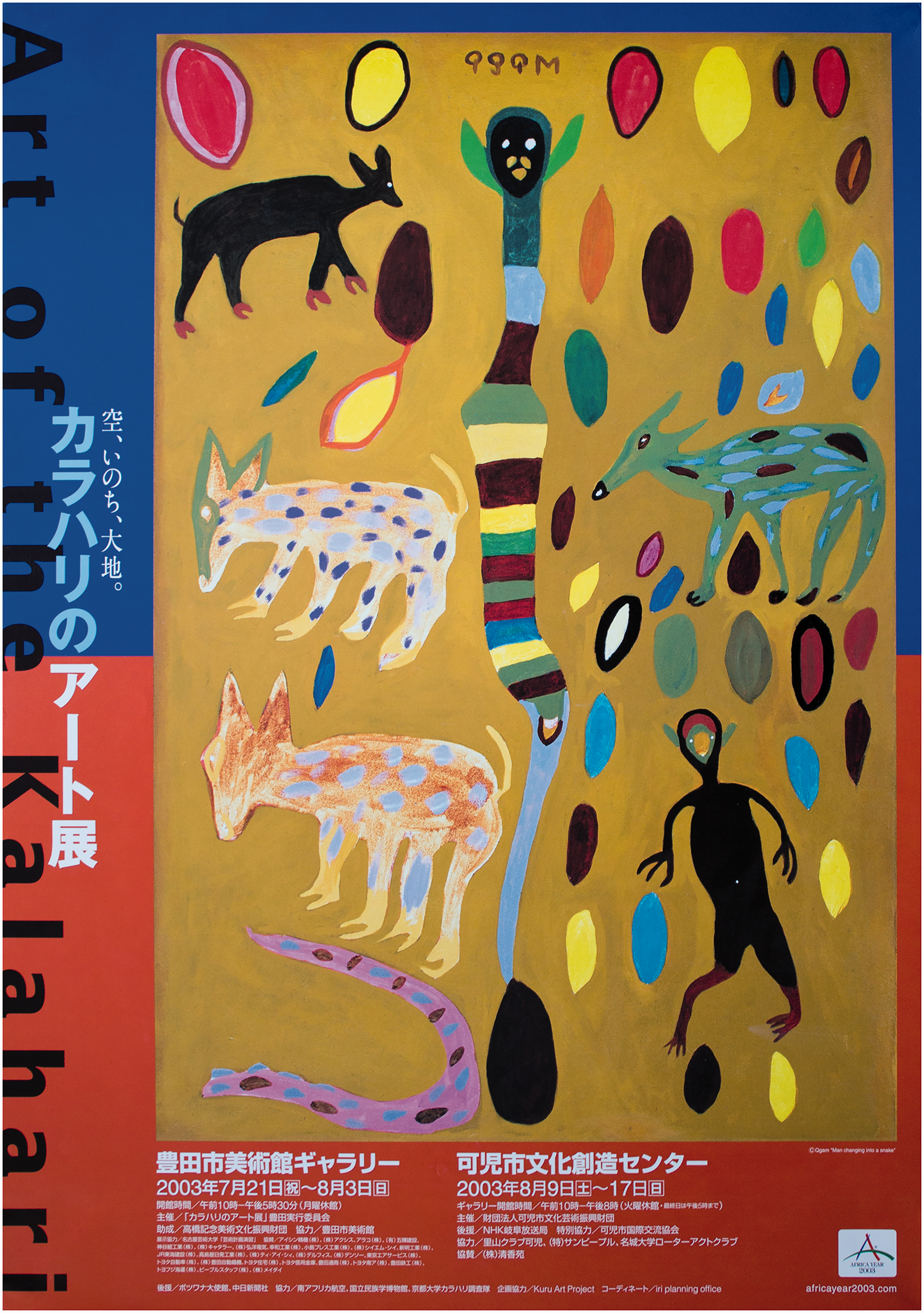
Exhibition poster Art of the Kalahari, 2003. Photo by author.
It emerges from this analysis that to make contemporary San art is far removed from the idea of a spontaneous creativity. Instead it involves processes of positioning (Li, 2000) oneself (or the Other) in relation to traditional, artistic and academic knowledge in order to produce an effect on the public. While coordinators’ discourses tend to strategically downplay the knowledge transfer involved in the production of contemporary San art and their own role in it, this analysis shows the need to look critically at the ways forms of knowledge and non-knowledge have been and are still attributed or claimed. It appears indeed clearly that knowledge policies applied at the Kuru Art Project have played a direct role in the emergence of a “Kuru style”, defined by a set of formal characteristics that reproduce and reinforce a certain image of the San, as untouched, pure, authentic and naïve.
But most importantly, it appears clearly that the reproduction of a Great Divide between modernity and tradition does not solely result from an imposed vision from NGO’s workers. It is also actively taken over, affirmed and performed “from below”; the artists becoming actors of the construction of Self as Other, with both prescriptive and instrumental effects on the practice. Even though claims to (non-)knowledge can be converted into a true cultural capital, the ambivalence of the reactions described unveils the tensions generated by a definition of contemporary San art in terms of absence of school education and art training.
In this sense, the main thrust of this analysis has not been to lay all the blame on the development workers or the NGO. On the contrary, I have tried to move beyond the notions of patronage or paternalism frequently used to describe the Kuru Art Project (Gollifer, 2005; Kasfir, 1999; Stephenson, 2006) and that carries a somehow schematic image of the coordinators as formatting agents and of the artists as naïve recipient. Hence, this article has attempted to show that the implementation of an art project in the Kalahari involves politics of knowledge, that are not simply transferred from one place to the other, but subject of redefinition, contestation and transformation within power-charged, unequal situations. The study of development practices offers a new way of examining the dilemmas of power and knowledge that structure the production of contemporary Indigenous arts. It notably illuminates the relational context and the dynamic ways in which a definition of Contemporary San Art are socially created and used within the art workshop and shows the complexity of the processes, interests and values that led to reproduce and mobilize a form of dualism between Modernity and Tradition.
Footnotes
Acknowledgements
I would like to thank the anonymous reviewers, as well as PHilippe Geslin, Mathias Guenther and Ann Gollifer, for their invaluable, generous and constructive comments and suggestions for how to improve my argument. I am grateful to the Ministry of Youth, Sport, and Culture of Botswana for their approval of my research permit. Ethics approval was granted by the University of Botswana Institutional Review Board (IRB). I wish to thank the Kuru Art Project and the San Research Centre for their considerable support during all the fieldwork.
Declaration of conflicting interests
The author(s) declared no potential conflicts of interest with respect to the research, authorship, and/or publication of this article.
Funding
The author(s) disclosed receipt of the following financial support for the research, authorship, and/or publication of this article: This project was largely funded by a grant of the Swiss National Centre of Competence in Research (NCCR) – Iconic Criticism.

Author Biography
Leïla Baracchini holds a PhD in Social Anthropology and Art Theory from the University of Neuchâtel and the EHESS. Her research focuses on the commodification of culture and identity and on the work of mediation and translation involved in the making of contemporary indigenous arts. Her doctoral thesis on contemporary San art was rewarded with the thesis prize of the Musée du quai Branly – Jacques Chirac 2019.