




Abstract
Gouren is a style of wrestling practiced in Brittany, France. It has been “sportised” during the last century, but it still represents an emblematic tradition for those people involved who exploit its ancient origins to describe it as a distinctive Breton activity. Following the same path of Breton “identity”—one that has been defined in opposition to hegemonic French identity—gouren is largely defined by its practitioners in opposition to the “hegemonic” wrestling style in France, judo, viewed as an epitome of globalized sports. Through their actions and narratives, Breton wrestlers shape an alternative (pre-modern) sporting culture, promoting non-aggressive, social, and non-hierarchical attitudes over radical competition, athletic performance and personal achievement. Accordingly, gouren is associated with “old-fashioned” ideas of masculinity, strength and related values, that serve to root the practice in the idealized past of Brittany—even now that women are actively involved in gouren.
Keywords
Gouren, a “traditional sport”
In Brittany, a region in the northwest of France, about 1600 people today participate in a wrestling tradition that boasts ancient origins in the area. Breton wrestling (gouren) is a local style of grappling practice that has been gradually “sportised” 1 starting in the late 1920s and early 1930s (Épron, 2008). It nonetheless retains a strong connection to its roots, which—according to popular belief—date back to the Celtic occupation of the Armorican peninsula between the fourth and sixth centuries. However, recent studies (Épron, 2008; Nardini, 2016a, 2020) suggest that this narrative is the functional result of a (re-)“invention of tradition” (Hobsbawm and Ranger, 1992) that took part in the last century, more than a precisely coherent re-enactment of it. As such, gouren is “traditional” in the sense that anthropologists use the term. In other words, its status as “traditional” reflects not only “transmission” and dogmatic reproduction of the activity as it was performed in the past, but also the active and not-strictly corresponding “reception” of it in the present (Lenclud, 1987; Shils, 1971).
In fact, gouren has been continuously transformed during the 20th century and subject to especially profound reform on two specific occasions. These patterns of change correspond with the main political and socio-cultural regional movements that transpired in Brittany during the 20th century. In the first case, Docteur Charles Cotonnec founded the first official gouren federation, the Fédération des Amis des Luttes et des Sports Athlétiques Bretons (FALSAB) in 1930. For Cotonnec and his contemporaries, a central federation was critical for adapting the old tradition to the modern sports model and transforming gouren into an attractive and pedagogical/hygienic discipline. 2 Cotonnec and the FALSAB endeavored to save and transmit Breton culture to the new generations, after a period—from the end of the 19th century to the first decades of the 20th—when the institutions of the Troisième République had strongly promoted a shared French consciousness, language and belonging over Breton specificities (Croix, 2008; McDonald, 1990). More specifically, Cotonnec sought to build the “sport national Breton,” 3 giving Breton people their own éducation physique that was adapted to their regional character and local heritage. Importantly, this practice was distinct from the gymnastique that the French state promoted in schools, in order to produce disciplined and salubrious French citizens and workers (Épron and Robène, 2006). 4
The second case of decisive transformation occurred in the 1960s and 1970s, when a young Breton wrestler named Patrig Ar Goarnig further adapted the practice. Goarnig’s efforts to reform gouren took place in the wake of the concurrent cultural and political movement for the revaluation of Breton culture (Le Coadic, 1998; Postic et al., 2003), and should be understood in this context. As Goarnig himself has observed, his changes aimed to emphasize the connection of gouren to its “ancestral spirit” (Goarnig, interviewed on 24 July 2012 by Dario Nardini) and its Celtic and regional roots. Through Breton wrestling tradition, he sought to resist the “cultural genocide France had imposed on Brittany” (Patrig Ar Goarnig, interviewed by Aurélie Épron on 16 May 2007).
5
He also wanted to organize a more structured and effective way of transmitting knowledge of gouren as, by the mid-20th century, local interest in gouren was waning (Épron, 2008; Jaouen, 2005). To address these challenges, Goarnig consciously blended traditional and modern elements. On the one hand, he fostered the connection of gouren with its past and Breton culture by giving Breton names to the gouren techniques, organizing a “bardic”/Celtic symbolic, and re-establishing a link to the rural past of Brittany with the so-called Mod Kozh—“old-fashioned”—tournaments (Épron, 2008; Nardini, 2016a, 2020; Philippe, 2005) (Figure 1). On the other hand, Breton wrestling adopted several features that were already consolidated praxis in other sports. For example, Goarnig adopted standardized teaching and training methods for gouren, and introduced colored strips on Breton wrestlers’ shirts to indicate their progressive technical level (Épron and Nardini, 2019). Both of these implementations were more or less explicitly inspired by the teaching methods and structure of Eastern martial arts, which were becoming more widely practiced in France in the same period. In particular, many innovations stemmed from judo, which was becoming the direct competitor of gouren in the region, as Ar Goarnig himself told Aurélie Épron (Patrig Ar Goarnig, interviewed by Aurélie Épron on 16 May 2007).
6
The “maout”, the trophy of the Mod Kozh tournaments (ph. Dario Nardini).
As these events demonstrate, Breton wrestling has undergone considerable changes in its rules, functions, structure, technique and symbols during the last century. Moreover, these changes have embodied the social, demographic, economic and cultural changes that affected the region and the nation in the same period, as well as reflecting the “sporting model” that has simultaneously inspired the reorganization of physical activities in France (Tétart, 2007). Nowadays, Breton wrestling is a traditional practice that has adopted sportive and contemporary features in order to survive those changes. As such, gouren’s organizers and practitioners have avoided converting it into an inert museum piece, as has happened to other Breton games from the past (Épron, 2008; Nardini, 2016a).
Innovation and “sportisation,” therefore, have been critical for the survival of the practice to the present day. However, and without contradictions, gouren still captivates its practitioners precisely because of its indelible associations with Breton culture and “identity.” In fact, “tradition” and innovations have been converging, constitutive driving forces for the vitality of the practice in the present. In this article, we show that gouren represents a way of “feeling Breton” in contemporary Brittany. First, we look at how Breton wrestlers collectively describe and perform gouren as an old, authentically Breton activity—including as it was developed into a modern sport. Then, we discuss how the origins of gouren help to reinforce and reproduce traditional masculinity in Breton wrestling today, even though women’s participation is significantly growing. We also describe how gouren’s “culture” and values are oppositional to other wrestling styles, namely judo, viewed as the epitome of globalized sports—and, indeed, the globalized world. Subsequently, we show how this narrative and performative sporting “frame” functionally depicts gouren as the product of a pre-modern, and therefore different (Breton), representation of strength, masculinity, and the body. Finally, we demonstrate why this link to regional identity is central in the ethnographic field and in the biographical trajectories of many gouren practitioners. People participate in Breton wrestling for various reasons: it is fun, healthy and social; it stimulates conviviality; and it can express virtuous sporting values. Yet inextricably, their involvement is also grounded in identity performance: gouren represents a living and engagingly carnal way of feeling Breton, and doing Breton-ness, in modern times. “I’ve done Breton dance before, a few lessons of Breton language, but what I felt different in gouren is that it is a living practice, while in dance you just need to learn fixed movements, that you reproduce in festivals, for tourists. […] The value of gouren is that it is a modern activity, but it has deep roots in the past” (A., interviewed by Dario Nardini on 26 June 2012).
Breton wrestling and Breton-ness
Breton wrestlers collectively define the meaning of their practice in relation (in opposition) to other “sporting cultures” (Bausinger, 2006), and especially judo. This can be seen by critically reflecting on the ambiguous ethnographic positioning of Dario Nardini, who approached the study of gouren while being a long-term judo practitioner. This process clearly embodies the historical definition of “Breton culture” as a relational (oppositional) reaction. In particular, Breton culture exists in opposition to political efforts to construct and popularize a common, shared French identity—efforts that commenced in the last years of the 19th century (Bertho, 1980; Le Coadic, 1998; Meyer, 2003; Simon, 1999). In fact, according to consistent ethnographic analysis on different European and French regions (Bourdieu, 1980; Bromberger and Meyer, 2003; Chevallier and Morel, 1985; Fournier, 2006; Macdonald, 1997), regional identities are understood here as “imagined,” relational and processual communities (Anderson, 1983) that are also defined in negative terms.
This “negative” identification has been particularly effective in Brittany, where local inhabitants have historically perceived the central Nation-State’s unifying actions as attempts to erase local traditions, costumes and practices (Bertho, 1980; Le Coadic, 1998; McDonald, 1990; Meyer, 2003; Postic et al., 2003; Simon, 1999). These suspicions precipitated the two main political and socio-cultural reactions in the region during the 20th century—to which have corresponded the main reforms of gouren as we described above. The first, more militant and conservative response, took hold in the inter-war period (Bougeard, 2002; Déniel, 1976). Conversely, the second response emerged in the 1950s and flourished more broadly in the 1960s and 1970s. This latter movement was more progressive, and generally focused on rediscovering Breton cultural distinctiveness—especially in music and dance (Geslin et al., 2010; Le Coadic, 1998). At present time, Breton culture and the representations linked to “Breton-ness” are more related to the free choice of a distinctive way of living. 7 This concept of “Breton-ness” is sensitive to the local dimensions, traditions, human relationships and emotions; it stands in contrast to a globalized world where economy, rationalism and consumption are perceived to control emotions and contractually orient relations (Delon, 2007; Nardini, 2016a; Simon, 1999).
From this perspective, Delon (2007) argued that we should view Breton-ness as a local means of re-enchanting the experienced world, in response to the disenchantment we are exposed to in late-capitalism. 8 Choosing to be Breton corresponds to the feeling of giving a deeper meaning to one’s relations—with other people, with what one does, and with the environment where one lives. Therefore, besides being defined in opposition to the French centralism and cultural hegemony, 9 Breton culture is now characterized in opposition to Western globalization, consumption and standardization. However, as Fournier (2006) showed for Provence, in Brittany this opposition is carried out in bivalent, apparently contradictory ways. Breton people are perfectly conscious to participate in both the French nation and Western capitalism. They do not see their Breton-ness as a radical, essentialist alternative to (or denial of) the national administration or globalized economy. Instead, being Bretons is a specific, virtuous way of being French in a globalized society.
This negative, but nonetheless ambivalent, dynamic also helps to define gouren’s “sporting culture” (Bausinger, 2006). Consider on the one hand a generalist emic representation of current sports, with judo as the epitome of this category. Breton wrestlers perceive these sports as expressions of the disenchanted globalized Western society. They seem to emphasize athletic performance over social relationships, competition over cooperation, personal achievement over social and cultural values, and vertical hierarchy over participation. Conversely, Breton wrestling is viewed—and lived—as an authentic and meaningful tradition. For participants, gouren is a practice through which human emotions and values, social relationships, cooperation, and a real sense of community are collectively built and conveyed.
As Bausinger (2006) showed, organized physical activities are cultural and historical products, that emerge from a certain social context and in a specific moment. As such, these activities inevitably reflect some aspects of the whole society. Simultaneously, however, they also act as relatively autonomous social fields, such that they contribute to producing culture—indeed, a “sporting culture.” Bausinger’s approach is apposite in the case of Breton wrestling. On the one hand, Breton wrestling represents an expression of contemporary Breton society, a culture with its specificities but which remains in all respects an integral part of French-European society. On the other hand, it constitutes a social environment where Breton culture—and the values and representations ascribed to it—are collectively defined and (en-)acted as fundamentally different from Franco-European values and representations. 10 In other words, gouren is an activity where difference is made, and belonging underpinned. Drawing on Herzfeld’s (1997) concept, Breton wrestlers dynamically contribute to strengthening Breton “cultural intimacy.” By performing, organizing, describing and interpreting their wrestling activities in particular ways, Breton wrestlers collectively participate in defining—and performatively doing—Breton-ness. This process takes place in a context where being Breton is not the consequence of significant structural (social and economic, or ethnic) distinctions from Paris and the Nation, but rather a choice. Breton-ness is therefore a political choice to adopt a specific way of being, one inspired by idealized and patrimonialised representations of the past and of cultural identity.
An old Breton tradition
While Dario Nardini was carrying out his fieldwork on Breton wrestling, 11 a long-term wrestler and teacher of the Rennes-based Club de gouren told him: “Look, this technique is called the ‘kliked,’ and it’s specific to gouren. You can’t find it in other disciplines.” He was teaching Nardini one of the fundamental movements of Breton wrestling, which consists in hooking the opponent’s leg, using your ankle and knee as leavers. Forbidden in other, similar grappling practices (such as judo), the kliked is considered an emblematic and distinctive technical gesture of gouren (using “distinctive” in the sense of Bourdieu, 1984).
During her fieldwork, Aurélie Épron has worked as a permanent (a salaried trainer and promoter of gouren) for the Morbihan Departmental Committee of the Fédération de Gouren. In this capacity, she took part in different federal meetings during the 2004–05 season in which kliked was the subject of discussion. The technique was reported to cause knee injuries, and indeed some members of the Federation considered it dangerous for the wrestlers’ safety. Other members, however, argued that the technique needed only to be ruled and controlled. Ultimately, this latter perspective carried the day: in a decisive meeting in 2005, the Federal Committee approved the maintenance of kliked in gouren competitions, for its distinctive and unique significance to the practice.
Kliked is a technical principle that can be applied in different situations, movements and directions in order to throw the opponent to the ground on his shoulder blades. Its successful execution marks a “lamm”—the equivalent of the ippon in judo—and wins the match. In each of these variations, it can be performed both in a dynamic and more static situation—that is, taking advantage of the opponent’s movement, or looking for a more stable stance in order to exert more strength. In this latter variation, kliked is called mod kozh, which means “old-fashioned” in Breton language. As the gouren teacher explained to Dario Nardini in the Club of Rennes, the static variation of kliked is called mod kozh because “you need strong lower-back muscles to perform this variation of the technique. The peasant wrestlers used to do the kliked this way, for they worked out their lower-back muscles on a daily basis working on the farms.”
This claimed agrarian association reflects an extensive mythologizing effort from the actors involved in gouren. The explanation of kliked’s heritage serves to root the practice in an idealized and ennobling past. Indeed, Breton wrestlers unhesitatingly place the origin of gouren within two different, not always historically precise but rhetorically converging moments: in the age of the Celtic migrations in the Armorican peninsula, between the fourth and sixth centuries; and in the rural environs of nineteenth-century Brittany, which still inspire most of the traits ascribed to the idea of Breton culture and identity. These narrative origins of gouren closely correspond to the historical and cultural construction of the “idea of region” (Bourdieu, 1980; Bromberger and Meyer, 2003) and a “regional culture” (Meyer, 2003) in Brittany. 12
Accordingly, the kliked narrative corresponds to the convenient idealization of the past of gouren. It is part of a collective “invention of [gouren] tradition,” a process that started in the late 1920s with the work of Cotonnec and is still ongoing. Through this process, gouren’s guardians have aimed to describe the practice as an indisputably old, authentically Breton activity—even as it was being transformed into a modern, competitive sport. The idealization of kliked sits uneasily alongside questions of contestant safety. Throughout its history—and in the present—the Federation has continually discussed and implemented safety measures. Within the “gouren family,”
13
moreover, trainers, referees and practitioners are responsive to questions regarding safety. They point to the control and lack of aggressiveness in Breton wrestling as a point of difference with judo and other sports. For all this openness and general appreciation of safety, however, kliked has remained. In spite of the potential danger it poses for athletes, it persists because it constitutes an invaluable “profit of distinction” (Bourdieu, 1984: 175) (Figure 2). A backward kliked (ph. Dario Nardini).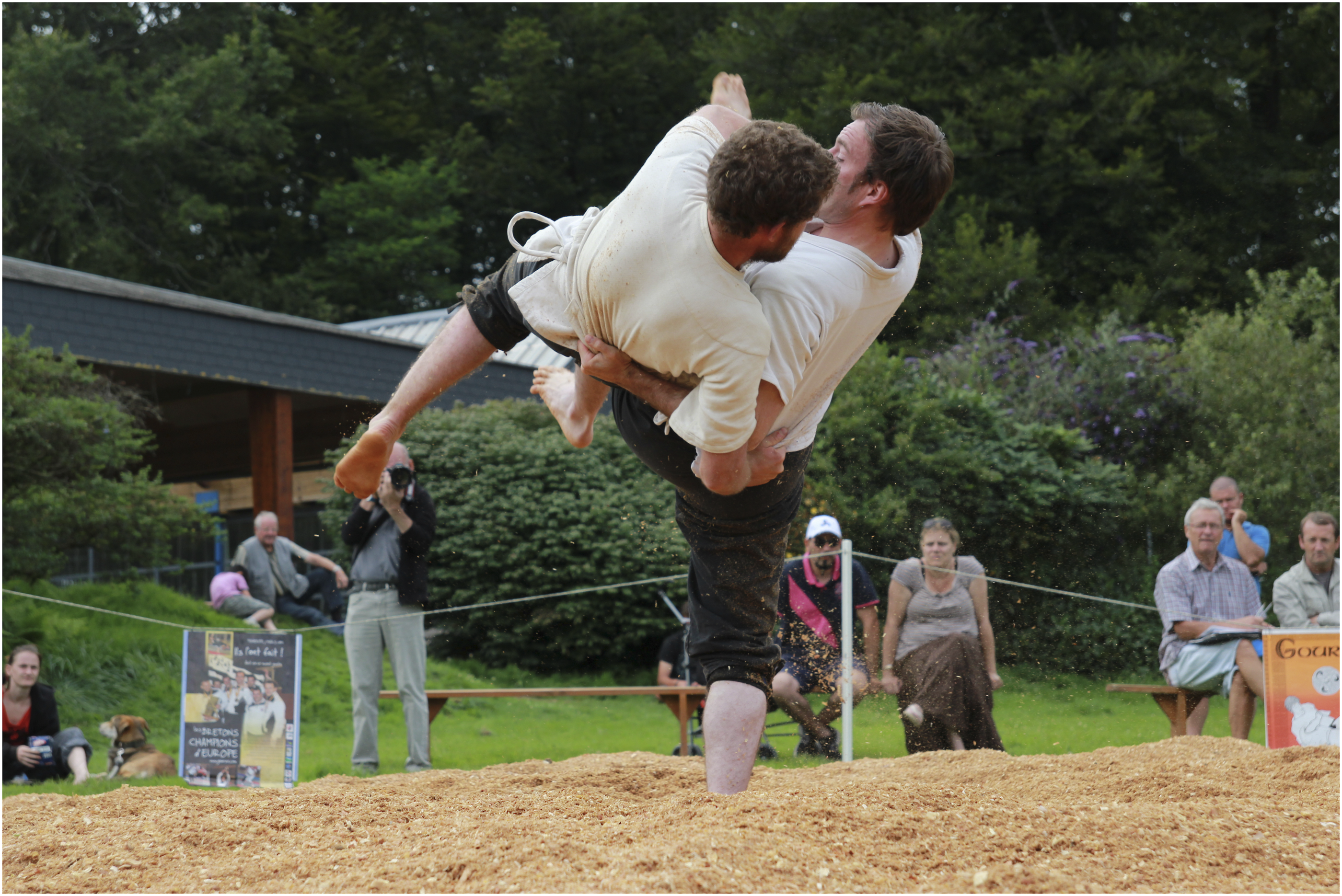
In this way, kliked is emblematic of both gouren and its associated meanings. In the sporting “frame” (Bateson, 1987) that characterizes gouren, a throwing gesture such as kliked becomes an essential, distinctive and valuable technical gesture. Indeed, these abiding associations are common to many other combat or wrestling practices. In the context of combat, sporting movements are not simply the most effective means of defeating an opponent according to the rules, but cultural gestures (Bruant, 1992), “techniques du corps” (Mauss, 1973), that gain their meaning within the sporting frame. In this way, a punch thrown in the boxing ring becomes a jab or an uppercut, rather than simply an act of aggression; a throw performed according to specific biomechanic and aesthetic standards becomes an ippon; and a leg-hooking technique carried out on a sawdust arena becomes a kliked. More generally, boxing has become the “noble art,” judo the “gentle way,” and Eastern combat systems have been called martial arts. It is not only the rules, or the biomechanics of a movement that ontologically render a sporting gesture “aggressive” or “not aggressive,” “dangerous,” or “safe.” As Scheper-Hughes and Bourgois (2004) showed for non-sporting contexts, equally important is the way this gesture is performed and received in the exegetical, performative and narrative “frame” in which it takes place. These acts of performing and receiving ultimately determine how the gesture is understood and interpreted—and consequently perceived and experienced—as dangerous or safe, aggressive or fair.
A male Breton tradition
While the discourse surrounding gouren’s ancient roots accentuates its rural, pre-modern heritage, it also has other significant effects. Notably, this narrative helps to reinforce and reproduce the traditional masculinity of Breton wrestling in the present day. In fact, gouren remained an exclusively male practice until the 1970s, when women first claimed an active—rather than ancillary—role within its structures (Épron, 2008; Épron and Jollivet, 2007). As a result, women have been afforded only a marginal role in shaping social and cultural representations of gouren. They struggled to find a legitimate position and recognition in the practice throughout the 1970s and 1980s, and in 2019/2020 still only represent 23–25% of the members of the Fédération de Gouren. Moreover, only one-third of them regularly take part in competitions, compared to 60% of the registered men. 14
Nor is participation the only sphere in which women remain at gouren’s margins. Women were under-represented in the official rhetoric and federal publications about gouren—notably magazines such as Gouren infos and Gouren mag, and later a website. 15 In this history of gouren, women have played subordinate and passive roles: rather than practitioners, trainers or administrators, they are spectators, supporters, or “ring girls” who carry the trophies (Épron and Jollivet, 2007). From the 1970s, women episodically took on administrative roles within the Federation, Clubs or competitions. Some accounts did note the influence of a few pioneering figures, such as wrestlers’ mothers, girlfriends or friends. Nevertheless, this acknowledged influence did not affect gouren’s heritage and representations at that time (Fraisse, 1999). In fact, women were not always explicitly, but firmly marginalized until the late-1980s, when gouren’s administrators and institutions finally started to gradually recognize women’s practice. While the FALSAB was enrolling women wrestlers during this period, it was not organizing their practice. There were no competitions, no weight categories, and no technical training for women. Simultaneously, the competing federation founded in the 1960s by Patrig Ar Goarnig was refusing to register women at all.
Since the 1980s, women have progressively claimed a position as active participants in Breton wrestling—albeit in often-circumscribed ways. In 1986, the Commission Feminine (Women’s Commission) of the gouren Federation was founded. To some extent, these concessions to women were linked to the contingent need to legitimate the practice in a changing social context. It is unlikely that society at large would have safeguarded, supported, funded and promoted a sportive activity where women were unreservedly excluded (Épron, 2008, 2012; Épron and Jollivet, 2007). Even so, ethnographic interviews with those involved and analysis of federal magazines confirm that the Commission’s influence remains limited. Notably, the Federation has encouraged its initiatives only when they are seen to support the entire gouren community. Even the roles women took on generally correspond to a gendered division of tasks: they are secretaries, assistants, and so on. Moreover, women have—for the most part—not reached the higher positions in the Fédération de Gouren, or in the Departmental Committees. This absence is not without exceptions, but—in gouren’s past and its present—women in leadership positions remain very much the exception. 16
Of course, women’s contingent role is not a specific trait of gouren. Instead, it is a common aspect of most sports traditionally considered as “male” activities in France (Baillette and Liotard, 1999; Mennesson, 2000, 2005a) and the (Western) world (Hargreaves and Anderson, 2014; Messner and Sabo, 1990). In this regard, gouren is not dissimilar to judo (Guérandel and Mennesson, 2007) and other “male” wrestling practices. Once again, the difference resides in the narratives that render gouren a traditional, “pre-modern,” rural—and therefore necessarily masculine—wrestling activity.
As a consequence of this construction, women do not possess any collectively defined female role models within the practice itself. Therefore, in defining themselves as women in a “male” practice, they have turned to the social patterns of sexual differentiation that exist outside of the practice. Accordingly, they have “tactically” (De Certeau, 1988) defined their gender identities in gouren according to “specific combination[s] of biographic and relational transactions” (Mennesson, 2005b: 64). These actions have resulted in the possibility of expressing several female identities in gouren, without disturbing its hegemonic definition as a male activity (Épron and Jollivet, 2007). However, ethnographic observation has demonstrated that gouren’s social context has shifted significantly in the last 20 years, and is still undergoing rapid change in the present day. The development of the competitive structure of gouren in the last 20 years has finally brought the technical knowledge and skills of men and women to an even level.
17
This development has in turn made it possible to evaluate women’s actions, style and means of involvement in gouren on the basis of their sporting efficiency, rather than their conformity to feminine roles and qualities (Figure 3). Women wrestling at the Monterfil Mod Kozh Trournament, 23rd July 2012 (ph. Dario Nardini).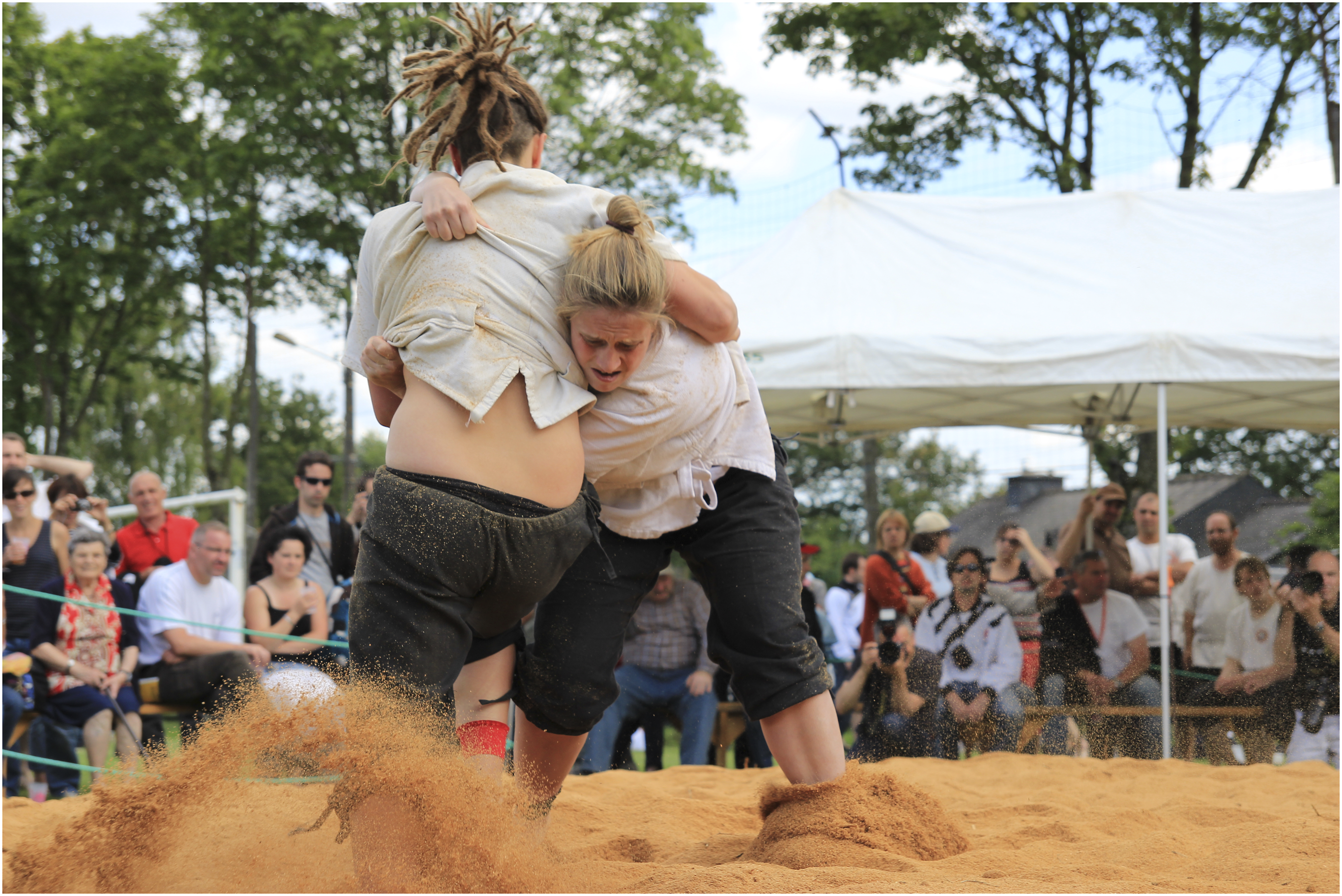
In spite of these changes, the masculine sporting model in gouren—one that prioritizes “old-fashioned,” functional strength—continues to be reproduced in recent years. For example, one of the most popular publications on Breton wrestling of the last 20 years, by Gourmelen and Bourdonnay (2005), included only seven pictures of women out of the 130 images printed. More importantly, these seven images emphasized the identifiably “feminine” social traits such as friendship, grace, and elegance; they avoided depicting “overly aggressive” or intense wrestling scenes in which women were protagonists. Instead, these silences demonstrate that the “masculine body” and masculine representations still constitute the normative measure against which “other” bodies should be compared to in Breton wrestling. Most actors involved in gouren—practitioners, as well as institutions, trainers, and so on—collectively contribute to reproducing this normative image. For instance, the Federal symbol portrays two wrestling figures engaged in combat, and emphasizes the power, dynamism and elevation of their movements. Conversely, the symbol of the Commission Féminine depicts, in a cartoon style, two infantilized women wrestling in a harmonious way. Indeed, their movements evoke dance more than wrestling.
As we have seen, the practice of gouren is deeply affected by the representations and narratives that outline its “imagined” tradition and history. For instance, men and women typically engage in a slightly different performance of the ritual oath—known as the Serment—and handshake they exchange at the beginning of each gouren competition. After pronouncing the Serment, wrestlers promise to “offer to my partner | My hand and my cheek.” The partners—they refer to one another as partners, rather than opponents—are therefore expected to exchange a handshake and a cheek kiss. However, while women do not hesitate to literally offer their cheeks to their partners, some men try to make this gesture more virile by avoiding kissing each other and reciprocally touching their foreheads (Épron and Nardini, 2019). 18
This gendered divide is also apparent in the practice of particular technical movements. In the gouren clubs observed, throwing techniques that require more strength than agility to be executed—such as the “old-fashioned” variation of kliked described above—are “naturally” considered by wrestlers as a male prerogative. Therefore, even if women and men exercise together and follow the same training methods, they actually perform their technical gestures according to the respective “role” (Goffman, 1959) and the expectations associated with being women in a “masculine” sport. Accordingly, only expert women that regularly compete and train in competitive-oriented clubs try “hard” (Mennesson, 2000) moves, while others believe such techniques are not suitable or even achievable. Instead, they conform to more “feminine,” graceful ways of wrestling. 19 In this way, women are implicitly excluded from the possibility of using gouren’s narratives to legitimate their engagement in the present (Rouquier, 2002). Being shaped as both a product and a field of reproduction of the traditional masculine characters, the gouren “tradition” has only constituted a heritage for men in the last century. In fact, notwithstanding the rapidly changing status of the practice in the past few decades, only men have had the opportunity to use gouren’s heritage “as a resource” (Hafstein, 2012: 503) to (re)produce normative discourses on what it means to be Breton wrestlers, and what it means to be (Breton) men.
The apparent inconsistency between a male tradition and women’s (welcomed) recent participation clearly highlights the ambiguous—and in some ways contradictory—nature of gouren as a “traditional sport.” As it has been described above, gouren is not a traditional game or a modern sport, but rather a traditional game and a modern sport. In fact, while the distinctive reference to the practice’s ancient origins designates men as the legitimate practitioners, the sportive normalization of gouren and the changed context in which it is practiced have led to women’s participation. These contradictory forces have changed the social composition of Breton wrestling, but not its gendered legacy and representations. The result is a sometimes-incongruous admixture of old-fashioned narratives and representations alongside an increasingly “modern” activity and social context.
An “alternative” sporting culture
Axiomatically, the Breton peasants to which the narrative of “old-fashioned” kliked refers to are self-evidently male peasants, 20 agrarian workers who would have confronted each other after daily work, or on the occasion of rural and religious celebrations. Accordingly, this narrative functionally depicts gouren as the product of a pre-modern and therefore different representation of strength and masculinity.
Representations of strength in Breton wrestling are rhetorically linked to a functional, incidental and not radically aesthetical conception of strength. This idea is supposed to derive from the idealized past of the practice, when physical strength was considered as both a tool for—and a consequence of—hard work, rather than a purpose intentionally and systematically pursued through rigorous training (Andrieu, 1988; Vigarello, 1988). In contemporary Euro-American society, the mise-en-scène of the athletic body has gained notable and evident aesthetic and sensual connotations (Bausinger, 2006; Le Breton, 1990). The narcissistic, sensual aspects of the fit and strong masculine body as an attractive body—epitomized by contemporary activities such as “fitness” (Sassatelli, 2010), crossfit (Yaniga, 2018), and others—is now part of the wider sporting phenomenon. 21
As is the case in other disciplines (see, for example, Sherouse, 2016), gouren essentially breaks out of this orientation, while rediscovering or reproducing—at least at the level of discourse—a different, “old-fashioned” representation of strength. This representation is linked to the idealized past of gouren, when—we are to suppose—the peasants involved in wrestling appreciated strength within the functionalist paradigm of instrumental effectiveness (Robène and Léziart, 2006: 13). These “pre-modern” representations of strength and the masculine body in Breton wrestling do not have clear and well-defined characteristics. Instead, they are more accurately imagined as the generic attribute of vigor stereotypically attributed to the Breton peasants. Indeed, these representations are mainly defined in opposition to those traits that are perceived—from an emic point of view—as the more “modern” features of modern sports. As previously discussed, these differences are most pronounced in the way narratives of gouren actively reject the aestheticization of the (male) athletic body that is prevalent in mainstream sports.
In light of the above, it is clear that—in the age of cultural hegemony of the aesthetic duty of a beautiful body—Breton wrestlers still emphasize the rural and popular values of a strong and productive body (Épron and Huruguen, 2008: 10). “Empruntant á la tradition des jeux populaires et résistant á l’uniformisation des pratiques sportives, [gouren fait] du corps, vu comme force, un instrument privilégié de l’expression de soi et du groupe social” (Guillou, 1985: 359). 22 In this sense, Breton wrestling extends to the present “l’ancien régime corporel de la ‘force rustique’” (Lacombe, 1993: 221; the bodily ancien régime of the rustic strength), or “force utile” (useful strength) as Guillou (1985: 360) defines it in her work on Breton games.
However, this enactment and reproduction of the past is mostly conducted at the level of narrative. Today, Breton wrestlers participating in gouren tournaments are not showcasing the skills and power they developed while working in the fields. Indeed, only a few of them actually earn a living as agricultural workers. Most Breton wrestlers are rather middle-class members of small cities and towns in Brittany—and in any case the link between gouren and agriculture is not structural at all. 23 The “old-fashioned” representations of strength that Breton wrestlers perform and claim today are therefore not exactly the same as the ones that Anne Guillou observed in rural Brittany the 1980s. On the contrary, they are retrospective ideas of those earlier representations, and these new representations in turn play a decisive role in the ongoing process of (re)inventing gouren tradition(s).
As it has been mentioned, this process of invention also holds within it an oppositional logic. Notably, Jean-Paul Clément observed this tendency to define one’s own practice against similar alternatives when speaking of combat and wrestling sports in France. Drawing on Bourdieu’s (1990) concept of the relational, distinctive value of sports, Clément (1983: 375) states: Le domaine des pratiques de combat apparaît donc comme un champ de concurrence spécifique, dans lequel chaque discipline […] s’impose (ou tente de s’imposer) en s’opposant aux autres, et plus particulièrement à celles qui lui sont techniquement les plus proches […] en proposant généralement une conception novatrice du combat (Clément, 1983: 375).
24
Frequently, the “concurrence” that Clément mentions is evidenced in the technical efficiency of each combat practice. In gouren, however, technical efficiency is not the point. While gouren practitioners are clearly concerned with the effectiveness of technical gestures, they are equally—if not more—preoccupied with the cultural, historical, and social value of what they do. Gouren works in this sense as a patrimonial object; a “cultural heritage,” as Hafstein (2012) describes it. 25 Following Hafstein (2012; see also Bendix, 2009), its cultural and historical aspects are actively mobilized as inherently instrumental resources.
The competitive, athletic, sporting features of gouren are still fundamental, in the bivalent logic of a “sporting tradition” that we have described above. The centrality of these features is evidenced, for example, in the enthusiastic participation of a selection of Breton wrestlers in the Championnat d’Europe des Luttes Celtiques. Nevertheless, when practitioners are asked why they practice gouren and not judo or any other activity, they stress its “traditional” relevance more than its “sporting” features. In fact, from the latter point of view, gouren cannot compete with other, more widely practiced activities that are structured through established international and professional competitive organizations. Compared to these other activities, however, gouren endorses an alternative sporting culture that promotes sociability over confrontation, fun over ascetic dedication and extreme athletic performances, and conviviality over personal achievements. To a large degree, these features explain its appeal. As an expert gouren practitioner told Nardini: A few years ago, while I was throwing my partner in the finals of the [gouren] Breton Championships, I heard him saying: ‘Well done!’ This is the gouren spirit, you know. When we wrestle, we spare no effort, it is still a competition, but we are able to acknowledge the other’s skills in gouren – and this is not necessarily true in other sports. […] We call our wrestling partners ‘émules’ [‘partners’], and not ‘opponents,’ because ‘émules’ are people that, even if they’re stronger than me, I’m grateful to them because I know they will help me to improve. Gouren is a community where we can improve together (G., interviewed on 20 July 2012 by Dario Nardini).
A judoka on the sawdust: The heuristic ambivalence of expertise
As previously mentioned, gouren has an ambivalent relationship with judo. On the one hand, judo has been the main reference point in gouren’s transformation into a competitive and institutionalized sport. Simultaneously, however, judo represents “the main competitor of gouren in the social and political struggle for the enrollment of practitioners, the allocation of public spaces and funding, etc.” (Nardini, 2016b: 20). This tension has emerged because judo was—and is—both the closest grappling style to gouren, and the most popular competitive martial art in France and Brittany. In fact, from a formal, bio-mechanical point of view, judo and gouren are remarkably similar. The one clear point of difference is ground-fighting, which is part of judo competitions but forbidden in Breton wrestling. This distinction notwithstanding, the commonalities are extensive. In both judo and Breton wrestling, competitors aim to throw the opponent on his/her back by grappling his/her jacket above the belt (with different scores for a throw depending on which part of the body first touches the ground, the fluidity of the motion, etc.). Both judo and gouren competitions are organized in age, skills and weight categories, and rules overlap in many points. Throwing techniques are also close—except for kliked. In fact, many Breton wrestlers are or have been judokas, and it is relatively easy to turn (and return) from one style to the other. The most successful gouren champion of recent years was a judoka when he was young. Dario Nardini, who was a competitive judo practitioner when he started his fieldwork, easily adapted his expertise in order to regularly train and compete with Breton wrestlers.
Nonetheless, people involved in Breton wrestling describe their practice—and the way it informs their lives—as being profoundly different from judo. As another gouren trainer told Nardini during an interview, Gouren is an activity that has roots. It has a meaning […]. Tradition is the sense of gouren. In the end, it is pretty similar to judo… but it also has something more! […] When I teach gouren, I also explain its history, and its peasant origins. Frequently, I explain that through the example of the prise du sac [the ‘bag move’], that is a gouren technique derived from the peasant-wrestlers’ way of carrying their working bags (A., interviewed on 26 July 2012 by Dario Nardini).
In light of this ambivalent attitude towards judo, the judo expertise of Dario Nardini was not always an advantage. On the one hand, it helped him to enter the practice of gouren and conduct what Wacquant (2006) called an “observant participation.” Conversely, it sometimes provoked wariness among the other social actors. In fact, judo is still the negative term that defines what gouren is-not in Breton wrestlers’ narratives. They describe it as an aggressive practice, while gouren is inclusive and more convivial. Moreover, the training routines and learning methods are seeing as collective activities in gouren, while judo’s hierarchic divisions are viewed as a despotic, authoritarian imposition. These attitudes are evident in interviews with participants. One interviewee suggested, “There is not a Master in gouren, as you have in judo. There is not the Big Black Belt that teaches. People are immediately involved in a collective situation of transmission” (A., interviewed on 26 July 2012). T., a judoka who had started to train in gouren, told Dario Nardini: “when I started to come here, I even struggled to understand who the teacher was, the trainer, the figure that supervises the training!” (interviewed on 1 July 2012). “I was happy to follow my son in this interest [in gouren], because I found it less risky than other disciplines such as judo, that is more focused on [athletic] performance” (P., interviewed on 24 June 2020).
Curiously, the values that gouren actors evoke to distinguish their practice, are often the same ones that judokas assert around the world. “Friendship and mutual prosperity”—a quotation from the founder of judo, Jigoro Kano—is adopted and repeated in most judo training halls. Similarly, many of the central values that the French judo federation and clubs promote—“L’amitié’ (friendship), ‘la sincérité” (honesty), “l’honneur” (honor), “le respect” (respect) and “le contrôle de soi” (self-control) 26 —are strikingly similar to those espoused in gouren’s Serment. Nor is this an isolated instance. The “Charte des valeur du gouren”—a kind of manifesto of the gouren spirit adopted by the gouren Federation—recognizes “l’honneur,’ “le respect,” “la solidarité” (solidarity), “le lien à la Bretagne” (connection with Brittany), “l’authenticité” (authenticity) and “tolerance et humanisme” (tolerance and humanism) among the central qualities of the practice. 27
What gouren practitioners are rejecting in judo, rather, is its supposed status as the epitome of global modern sports—albeit this is a characterization that does not necessarily correspond to reality. According to this perspective, judo exemplifies both French and Western globalized culture, to which Breton culture has historically referred in defining itself. More specifically, judo is framed as an expression of contemporary French culture and society, and as such it carries with it the values of globalization, standardization, individualism and so on. Conversely, gouren is understood as the epitome of a more authentic connection with history, as well as possessing a strong local dimension and links to the wider community.
Accordingly, the differences in technique between the two wrestling styles are held as proof of the judo’s aggressive “nature,” especially compared to the chivalric values that inspire Breton wrestling. Gouren is wrestling, its practitioners claim, rather than a brawl or fighting. According to Jaouen (2005: 22), an ex-wrestler who published many works on Breton wrestling, the absence of ground-fighting in gouren may originate from the code of chivalry, which prohibited attacking an opponent when he was on the ground. In this way, gouren techniques gain ethical value. They become the clear, undisputable proof that gouren is still a noble activity, uncorrupted by the decadence of modernity and the perils of modern sports. These techniques are seen as fundamentally un-modern and therefore evidence that gouren exists apart from modern sports’ competitive attitude and individualism, aggression, professionalism, money, doping, and corruption. “In gouren we have never wrestled on the ground, and this makes us pride, dignified. When our opponent is on the ground, we wait until [s]he stands up again. We don’t want to brutally assault him[/her]; this savagery is not part of gouren” (C., interviewed on 24 May 2012).
Ethnographic observation showed that all the people involved in the practice of gouren—notably practitioners, trainers, referees, federal members, spectators and institutions—actively and collectively strive to uphold these assertions through their own deeds. The atmosphere in the Club of Rennes—where Nardini has trained—is relaxed, participative and inclusive. While they engaged in their practice in a committed manner, there was not an extreme focus on the athletes’ performances. All the Club members, especially the more regular practitioners, always sought to promote social opportunities beyond training hours—dinners, drinks, events in which we took part together, and so on. With some exceptions when something very important was at stake (see, for instance, Nardini, 2016b), competitions often became opportunities for play and conviviality. This does not mean that winning or losing is not important to Breton wrestlers, of course; but competition and personal achievement are not collectively defined as the main goal in gouren. As such, those involved are collectively and consistently reproducing an alternative “sporting culture.” The distinctive value of this culture is dialectically established and reinforced through several interconnected mechanisms: through the narratives that explain and orient the practices; through the social environment in gouren clubs; and by the manner in which technical gestures—sometimes the same gestures that are performed in judo—are collectively taught, described, and performed.
In this way, Breton wrestling actors collectively participate in the process of building a performative and narrative “frame” (Bateson, 1987; see also Hamayon, 2016). This frame determines a particular “mode of action” (Houseman and Severi, 1998) in which Breton wrestlers’ actual gestures take on a particular meaning. Therefore, what is truly important in gouren is not the uniqueness of its techniques and rules, but rather the way that the people involved “appropriate” those rules and techniques (Wendling, 2002) and make sense of them.
Conclusion: Breton wrestling as a way of being Breton
Building on Joseph Alter’s understanding of (Indian) wrestling “as a system of meaning” (Alter, 1992: 4), in this article, we have interpreted Gouren as a “a dramatically public text” (Alter, 1992: 9) and a “medium through which [the people involved] think about themselves and […] make sense of their world” (Alter, 1992: 19). However, unlike Indian wrestlers, being a Breton wrestler does not imply strict adherence to a regimen of diet, exercise and abstinence. Nor, indeed, does it require the radical and ascetic commitment that many contemporary athletes display. Breton wrestling instead represents a political criticism of the French sporting system. For Breton wrestlers themselves, this system is understood as an expression of the disenchanted globalized Western society, in which personal athletic performance is valued over social relationships, competition over cooperation, and vertical learning over participation. In opposing these values, practitioners of gouren dramatically enact the “role” of the Breton wrestler—a role that draws on narratives progressively organized during the last century. In this way, Breton wrestlers are able to characterize gouren as a “traditional sport”—that is, both a modern sport and a traditional Breton game. They thereby contribute to defining both a Breton way of wrestling, and of being, in the present.
As Appadurai (1996: 12) has suggested, the concept of cultural difference should be viewed as “a contrastive rather than a substantive property of certain things.” In this view, “culture is a pervasive dimension of human discourse that exploits difference to generate diverse conceptions of group identity” (Appadurai, 1996: 13). Being Breton in contemporary France does not reflect any essential or hereditary character—be it geographical, ethnic, or linguistic. Breton-ness does not precede the process of self-definition; it is not something that is first inherited and then determines the way a person lives and thinks. On the contrary, it corresponds to a set of representative features that have been historically chosen as “identity marks” and are eventually re-enacted in the present. As a consequence, to be inspired (or not inspired) by these features, to live (or not live) as Bretons, is the consequence of a choice—a political choice, in the broader sense of the term. Exploiting the distinctive history and heritage of Breton wrestling, its practitioners enact, and simultaneously help to shape, diverse (Breton) conceptions of sport, sociability and Breton-ness. At the same time, moreover, they are performing, enacting and shaping identities pertaining to masculinity, strength, hand to hand confrontation, loyalty, “honor,” physical culture and sociability.
To conclude, Breton wrestling today constitutes a “community of practice” (Wenger, 1998). As people train and learn gouren together, they also identify the cultural attributes associated with Breton-ness. In this way, they learn how to be Breton (wrestlers) in globalized France. This learning takes place at various levels: knowledge is inscribed within the body (Wacquant, 2006), beneath the level of consciousness (Bourdieu, 1990), and within the habitus that athletes embody through training and dedication (García and Spencer 2013; Spencer, 2013). Yet equally, Breton wrestlers rely on an existent narrative plot. They (re-)enact this narrative as a legacy of the past, while they continue to adapt it to the evolving social and cultural context of contemporary Brittany. In this sense, Breton wrestling is—to evoke Clifford Geertz’s (1972: 26) influential expression—“a story [Breton wrestlers] tell themselves about themselves.”
Footnotes
Declaration of conflicting interests
The author(s) declared no potential conflicts of interest with respect to the research, authorship, and/or publication of this article.
Funding
The author(s) received no financial support for the research, authorship, and/or publication of this article.

Notes
Author Biographies
Dario Nardini, PhD in Cultural and Social Anthropology, is Research Fellow at the University of Pisa. His interests focus on physical activities, and their relation with belonging, representations, gender and cultural heritage.
Aurélie Épron is a lecturer and researcher in History and Cultural Anthropology at the University Claude Bernard Lyon 1. She is interested in the identity dynamics of ludodiversity (practice and representation) in traditional sports.