



Abstract
While increased gender diversity at operational and managerial levels in the hotel industry can be observed, women represent only a small minority in top management positions and at the highest levels of executive leadership. This paper explores gender compositions in executive management teams of hotel firms and provides comprehensive longitudinal empirical data, which shows how increases of female hotel executive managers impact the financial performance of their hotel organizations. The authors determine the threshold needed for the female managers to exert influence in their hotel-executive management teams and explore the different percentage ranges of gender diversity and their impact on hotel performances below and above the threshold or critical mass point. The findings of this study have implications for hotel firms in terms of making more informed decisions on gender diversity-related program and affirmative action policies.
Introduction
According to the latest International Labour Office report on the employment of women in the hospitality industry, the hotel sector is not only one of the largest and fastest growing (service) sectors worldwide, but with up to 70% female employees at regional levels, the hotel sector is also one of the leading employers of women (Baum, 2013). While throughout the last decade, significant progress has been made by hotel firms to move women into managerial positions (Pinar et al, 2011), due to structural and cultural barriers; however, women in top hotel management positions remain largely underrepresented. Baum (2013) argues that hotel firms need to address this gender unbalance at an executive level and that more women in top management positions are necessary to meet the future productivity requirements of the hotel sector. While he does not go into detail as to how greater gender diversity at a top management level influences productivity and firm performance, for Baum (2013), it is evident that a push for more women into leadership positions will have positive economic implications for hotel firms.
Current research on work group and gender diversity, however, has been less conclusive than Baum’s statement suggests when it comes to the effects of gender diversity on firm performance. One research perspective supports Baum’s view arguing that heterogeneous teams possess a wider range of task-relevant knowledge, competencies, and experiences that lead to greater creativity with regard to problem-solving and decision-making processes and to greater group performance than in homogeneous teams (see, for example, Arfken et al., 2004; Carter et al., 2003). At the same time, there are studies that put forward the argument that greater gender homogeneity within work groups leads to stronger group cohesion, greater member commitment, fewer interpersonal conflicts, and lower member turnover rates and, thus, to better group performance than does gender heterogeneity (see, for example, Jehn et al., 1999; Simons et al., 1999).
By providing comprehensive longitudinal data that show how increases of female hotel executive managers impact the financial performance of their hotel firms, this paper provides empirical evidence testing Baum’s statement and addressing the contradictory findings and conclusions proposed by the two research perspectives. By determining the threshold needed for the female managers to exert influence in their executive management teams and exploring the different percentage ranges of gender diversity and their impact on performance below and above the threshold or critical mass point, the authors address Krishnan and Park’s (2005: 1719) call for examining “performance differences between tilted, skewed, and balanced TMT (top management) groups to gauge the effects of diversity.”
So far, most studies have neither discussed absolute nor relative numbers defining the critical mass of women as minorities in male-dominated work environments (Torchia et al., 2011).
In subsequent sections, the authors will provide an overview of studies of gender diversity in the hotel industry, relevant research on gender diversity, and performance and present their research questions. Following, the authors will outline their methodological approach, and their assessment of relevant biographical panel data collected from publicly listed US companies in the hospitality industry and their executive management teams between 1992 and 2009 in Standard and Poor’s ExecuComp database. The authors then discuss the theoretical contributions of their findings and posit in the concluding part practical implications for hotel firms to make more informed decisions on gender diversity-related program and affirmative action policies.
Gender diversity studies in the hotel industry
Gender diversity in the hospitality industry – and more specifically in the hotel sector – has been researched from a wide range of angles and perspectives and within various different geographical settings. Several studies have criticized the occupational and vertical segregation of women in hotel firms (see Campos-Soria et al., 2011; Sehamovic et al., 2000) and highlighted pay inequalities between men and women (see Burgess, 2000; Iverson, 2000). Researchers have explored barriers preventing women from moving into positions of greater responsibility (see Li and Leung, 2001; Ng and Pine, 2003), discussed gender specific management styles (see Blayney and Blotnicky, 2011), and identified gender effects on employees’ perceptions of recruitment and earning potential decisions (Pinar et al., 2011).
While observers agree on the strong numerical representation of women at many operational and managerial levels within hotel firms (see Baum, 2013; Pinar et al., 2011), some of the most recent studies (see Ho, 2013; HVS Executive Search, 2013) have reported that women in the hotel industry continue to represent only a small minority in senior management positions and at the highest levels of executive leadership. Similar to other industries in which cultures, practices, and routines make it difficult for women to advance (Cappelli and Hamori, 2005; Ibarra et al., 2010), structural and cultural barriers continue to prevent women to move into top management positions in hotel firms: “These [barriers] include a highly variable demand cycle which imposes unsocial working hours on employees and can make shift patterns unpredictable, both of which are difficult to reconcile with family and care responsibilities. Seasonal work can demand very high levels of time commitment during some parts of the year, while offering little or no work during the off-season. Businesses can be located at some distance from residential areas, particularly in poorer countries and communities, imposing both travel and time costs on women who frequently have limited access to both financial and time-flexibility resources. In many countries, areas of HCT (Hotel, Catering, Tourism) work, notably hotel and restaurant kitchens, are traditional male preserves in terms of employment opportunity and work culture” (Baum, 2013: vii).
Gender diversity and performance
Studies on gender diversity and performance have arrived at often contradictory and incompatible findings and conclusions. A number of observers have found a negative relationship or no link at all between gender diversity and performance (see Böhren and Ström, 2010; Rose, 2007). Adams and Ferreira (2009: 291), for example, concluded that mandating gender quotas for directors could reduce firm value for well-governed firms. Researchers viewing the relationship between gender diversity and performance as negative argue that heterogeneity within work groups weakens group cohesion and member commitment and creates more interpersonal conflicts and higher member turnover rates. As a result, homogeneity leads to better group performance than does heterogeneity.
At the same time, a number of researchers have reported a positive relationship between gender diversity at a leadership level and organizational performance. Studies focusing on gender diversity in boardrooms (e.g. Campell and Minguez-Vera, 2008: 447) found that “the diversity of the board had has a positive impact on firm value” and concluded that “greater gender diversity may generate economic gains” (Campell and Minguez-Vera, 2008: 435). Minguez-Vera and Lopez-Martinez (2010) concluded that greater gender diversity in boardrooms positively influences companies’ return on assets (ROA), while the European Commission (2010: 56) suggested that female members of company boards “may also have a positive impact on financial reporting, auditing and the organization of internal controls.” Krishnan and Park (2005) found a direct impact of women executives in 679 Fortune 1000 firms on their organizations measured by their firms’ ROA averaged over a 3-year period (1998–2000).
Researchers who have found the relationship between gender diversity and performance to be positive frequently suggest that heterogeneous teams possess a wider range of task-relevant knowledge, competencies, and experiences, all of which lead to creative problem-solving and decision-making and to better group performance than does homogeneity (see, for example, Arfken et al., 2004; Carter et al., 2003). Krishnan and Park (2005) explained the positive impact female executives (could) have in top management teams by referring to works in social psychology and concluded that: “the challenges women face on their way up in organizations equip them with the necessary skills to cope with uncertainty in task environments (…) women have the advantage of having survived the effects of male hierarchies (which) may give women a psychological advantage and thereby improve their interactions with peers and subordinates (…) women are more likely to possess a ‘feeling’ cognitive style (which) is likely to enable women to inspire confidence among peers and subordinates, share information and power, bring people together, and respond to challenges” (Krishnan and Park (2005: 1713)).
By exploring executive hotel management teams and their influence on firm performance with comprehensive empirical panel data, the authors will not only address Dahlerup’s (2006: 512) appeal that “more research is needed on this theme” (critical mass), and Krishnan and Park’s (2005: 1719) call for examining “performance differences between tilted, skewed, and balanced TMT (top management) groups to gauge the effects of diversity,” but the paper will also shed light on Baum’s statement about female top managers and their positive economic implications for hotel firms. By answering the following research questions, this paper contributes to the limited research on gender diversity in top hotel management teams and firm performance:
Data and analysis
The data for our analysis comes from the Standard and Poors’ ExecuComp database. ExecuComp provides executive compensation data collected directly from each company’s annual proxy. Our sample runs from 1992 to 2008 and contains compensation and other information for the top 5 most highly paid executives (including the CEO) in a particular year for a company. The universe of firms covers the S&P 1500 plus companies that were once part of the 1500 plus companies removed from the index that are still trading. Out of which, we select 54 companies belonging to the hotel and restaurant industry (standard industrial classification codes 7011, 5810, and 5812). We take the managers reported in ExecuComp to be a firm’s top management team (Dezső and Ross, 2012). We gather other financial information from the S&P’s Compustat database. We use the CRSP database for information on the IPO date of each company and also their daily stock returns. Finally, we get the Gompers et al.’s (1997) index of corporate governance, available from Andrew Metrick’s website. We thus build a longitudinal time series shown in Table 1.
Summary statistics.

ROA: return on assets.
Female proportion
Previous studies, notably, Dezső and Ross (2012) have used a dummy variable of female presence in the top management team as well as the proportion of female executives in the team as proxies of female representation. However, since our research question focuses on the critical mass of female executives required for enhanced firm performance, we adopt a different strategy. We first calculate the proportion of females in the top management team for each firm for each fiscal year; we then use the following variables in our regressions.
FEMPROP0TO10 = female proportion if female proportion< 0.10,
= 0.10 if female proportion ≥ 0.10; FEMPROP10TO20 = 0 if female proportion< 0.10,
= female proportion minus 0.10 if 0.10 ≤ female proportion< 0.20, = 0.10 if female ownership≥ 0.20; FEMPROP20TO30 = 0 if female proportion< 0.20,
= female proportion minus 0.20 if 0.20 ≤ female proportion < 0.30, = 0.10 if female ownership ≥ 0.30; FEMPROPOVER30 = 0 if female proportion< 0.30,
= female proportion minus 0.30 if female proportion ≥ 0.30;
For example, when the proportion of female executives is equal to 0.37, we have FEMPROP0TO10 = 0.10, FEMPROP10TO20 = 0.10, FEMPROP20TO30 = 0.10, and FEMPROPOVER30 = 0.07. Using linear splines (as defined above) allows us to estimate the relationship between firm performance as a piecewise linear function, which is a function composed of linear segments. One linear segment represents the function for values of female proportion below 10%; another linear segment handles values between 10 and 20% and so on. This will shed light on the thresholds of female proportion in the top management team driving firm performance. Note also that by using the above specification, we are implicitly assuming that the relation between the proportion of female executives and firm performance is non-linear.
Our choice of the variables is inspired by Kanter (1977). Kanter (1977) identifies four types of groups uniform (with a male:female ratio of 100:0), skewed (85:15), tilted (65:35), and balanced (60:40). Given that we have information on average for just under six (5.89) top executives, we suitably adapt Kanter’s (1977) typology to fit our data. The FEMPROP0TO10 category reflects firms with no women top executives (see Table 1, Panel B) and corresponds to the uniform group. Similarly, FEMPROP10TO20, FEMPROP20TO30, and FEMPROPOVER30 are designed to reflect 1, between 1 and 2, and greater than 2 female executives, respectively. The preceding categories thus mirror skewed, tilted, and balanced groups.
Firm performance
We use Tobin’s Q as a proxy for firm performance, defined as the ratio of the market value of assets to their replacement cost. However, given data limitations, it is almost impossible to arrive at the estimates of the replacement cost. We therefore follow Kaplan and Zingales’ (1997) method for computation of Tobin’s Q. For each firm i and year t, we compute

Empirical analysis
To investigate our first research question on female critical mass and firm performance, we run the following regression, which is our base specification
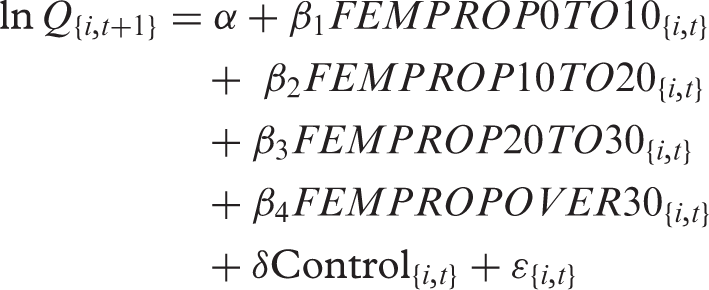
As controls, we use variables that are commonly used in research on top management teams: (a) size measured as the log of the book value of assets; (b) the numerator of Q will also reflect the capitalized value of growth options to control for these options we include the log of the ratio of R&D expenses to assets (Innovation intensity); (c) the log of the ratio of advertising expenditure to assets (Marketing intensity); (d) the log of the ratio of capital expenditure to assets (Capex intensity); (e) since our measure of Q may be sensitive to capital structure, we also include the ratio of long-term debt to assets (Leverage); and (f) finally, age of capital stock, which is measured as the log of the ratio of depreciation expenses to net property, plant, and equipment (Age of Cap Stock). If R&D expense or advertising expense is not disclosed by the firm, we impute the value of zero to it. We also use year dummies as controls to take into account unobserved time heterogeneity. Given the panel nature of our data, we run most regressions with firm-fixed effects to control for the omitted variable problem. Furthermore, we cluster standard errors at the firm level to account for within firm correlation.
Female proportion in top management teams and firm performance.

T-statistics (with standard errors clustered by firm) are in parentheses. ***, **, and * denote significance at the 1, 5, and 10% levels, respectively.
We also perform additional robustness tests by using alternative measures of performance, ROA, and return on sales (ROS). These variables unlike Tobin’s Q are based on accounting information and represent the efficiency of the firms operations. We run regressions using them as the dependent variables and female proportion variables along with other control variables as shown in equation (2). The results of these regressions are shown in Table 3.
Alternative measures of performance.

T-statistics (with standard errors clustered by firm) are in parentheses. *** and ** denote significance at 1, 5, and 10% levels, respectively.
Findings and discussion
This study has explored gender compositions in executive management teams of hotel firms and analyzed how increases of female hotel executive managers impact the financial performance of their organizations. The empirical findings based on 639 firm-year observations and piecewise linear regressions clearly show a relationship between the gender compositions of the sample executive management teams and firm performance with various turning points. We find that when less than 10% of executive managers are females, the impact on firm performance is negative. As stated earlier, most of the observations in this category (more than 65%) were firms with no female managers in their executive teams. Thus, the data of this study suggests that having no women in executive management teams is detrimental to the hotel firm’s performance. This “early” finding could be seen as challenging the work group diversity perspective stating that homogeneous teams outperform heterogeneous teams.
The finding that a female representation of 10–20% (on average, one woman per team) in the sample hotel management teams has a positive impact on firm performance contrasts previous studies within the critical mass literature. The empirical evidence of this study suggests that the critical mass point, at which a positive relationship between gender diversity and performance is observable, is reached between 10 and 20% and not at 30% – as Dahlerup (1988) and other studies have previously proposed. The findings of this paper support Grey’s (2006: 494) view that there “is little evidence that 30% is the magical cure-all.”
Studies within the critical mass literature (see Kanter, 1977) have argued that below the critical mass point, the few female group members are typically considered as tokens only representing their category and exerting no influence on the decisions made by the group. While this study has no empirical evidence negating the existence of categorizing practices, the positive relationship found between teams with very few hotel female executives and hotel firm performance shows that such practices do not necessarily lead to tokenism or the disregard of contributions made by female hotel executive managers. It could be argued that, as their numbers are very low, female hotel executives and their different task-relevant knowledge, competencies, and experiences might not be seen by their male counterparts as threatening the male dominance in the team, and, thus, female members can influence the decision-making process of the group at an early stage of group heterogeneity.
With 20% female managers, a tipping point is reached, at which the relationship between female managers and performance becomes negative. In line with the arguments above, the increase of female executive managers within the team could be viewed by their male counterparts as a threat to their (numerical) dominance, and male executive managers might become apprehensive and defensive, ignoring or invalidating contributions proposed by their female colleagues – or as Grey (2006: 495) suggests “the reaction to raising numbers of women in powerful positions may be hostile.” Furthermore, a potential lack of a “common frame of reference” (see Van Knippenberg and Schipper, 2007) could lead to misunderstandings, misinterpretations, and miscommunications between male and female hotel executives and affect the teams’ performances negatively.
Conclusions
The empirical findings of this study suggest not to pre-assume a consistent increase of performance in relationship to greater gender diversity and not to focus on a sole-tipping point. As Figure 1 shows, the different tipping points are not in line with other critical mass studies, which have proposed a linear relationship between gender diversity and performance.
Impact of female executive proportion on firm performance. This graph plots the impact of the proportion of female executives in top management teams on firm performance (measured by Tobin’s Q) based on piecewise linear regression. The numbers for the chart are drawn from Table 2.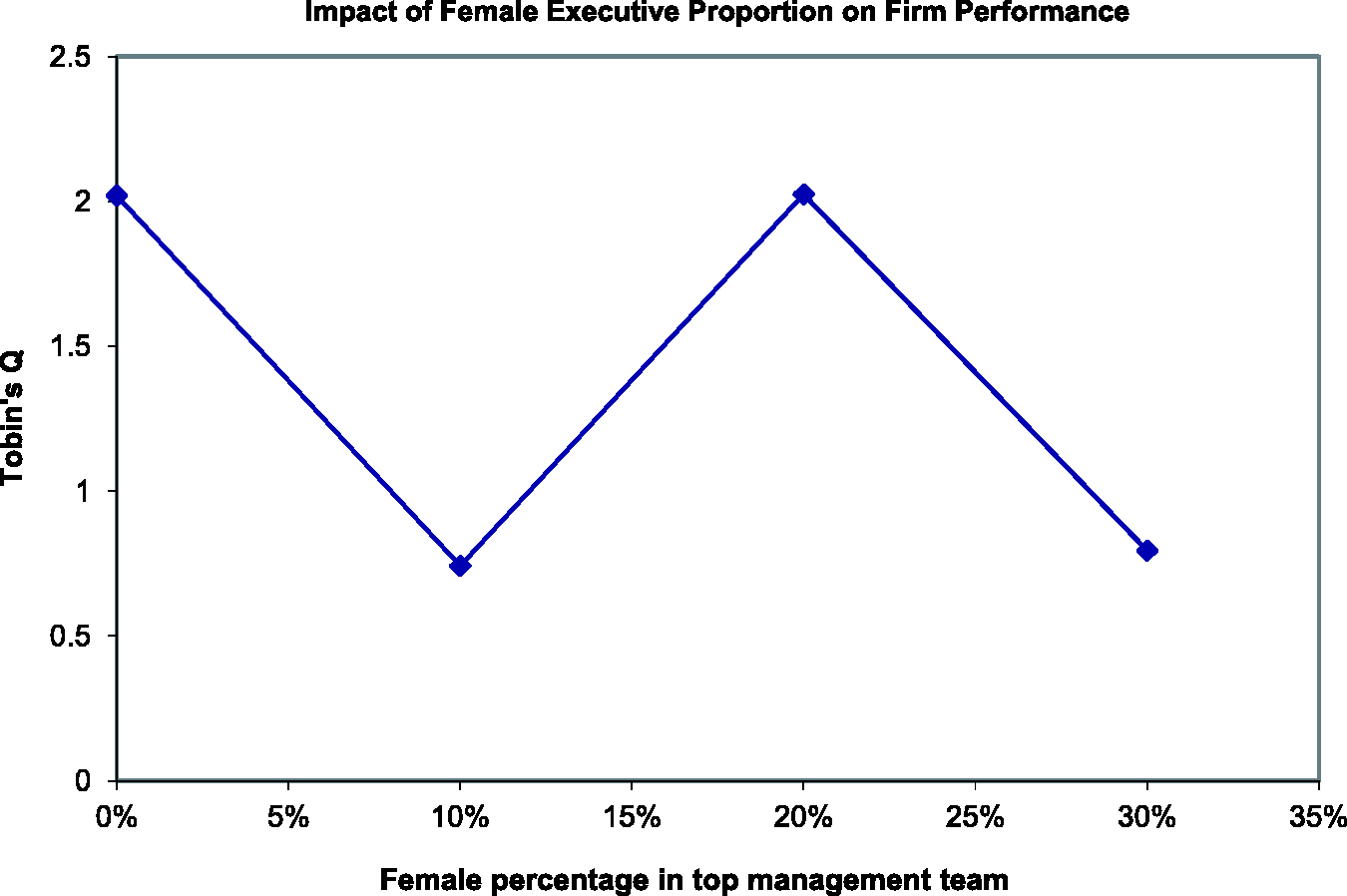
One reason for the inconsistencies between the findings of this study and other works on critical mass might be the different context in which much of the critical mass debate has taken place. Many studies on critical mass have focused on political institutions rather than on the private businesses. Within the institutional context, critical mass of women has often been about female parliamentarians being able to successfully act as advocates for women’s interests and concerns (Lovenduski and Norris, 2003) – a view or argument that is less pertinent to the business context. Thus, more empirical studies on critical mass could focus on the business context, and in particular on executive management teams and decision-making bodies, to provide more conclusive insights then there are currently.
Other, more practical implications of this study address hotel firms and their current policies and practices preventing female managers to progress into executive management positions. The study shows that the positive impact female managers can have at the top of hotel firms and the negative implications for hotel firms and their performance when employing homogeneous, male – only, executive teams. Hotel firms might want to reconsider their current recruitment and promotion policies and practices for top management positions and identify the causes of vertical segregation of female hotel employees. The findings indicate that executive management team members should not only be recruited or promoted due to their technical knowledge, skills, and abilities, but attention should also be paid to their interpersonal communication and relationship competencies.
The findings of this study show that there is a business case for progressing female managers into positions of leadership and decision making and confirm Baum’s (2013), suggesting that women in executive positions can have positive economic implications for hotel firms. While arguments based on principles of fairness and equality are important to highlight discriminatory practices in hotel firms, arguments based on performance could provide an alternative rationale for hotel leaders and other key stakeholders to engage in greater gender diversity at all levels of their hotel organizations.
Despite the comprehensive empirical data, the findings of this study are based on some of the explanatory arguments put forward in this paper could be supplemented and supported with qualitative studies of hotel organizations as well as other anecdotal evidence. As Dahlerup (1988) suggested, studies shifting their focus from critical mass points to critical acts could complement current research on critical mass and shed light into the dynamics of gender diverse teams and their interactions in hotel firms and organizations operating in other sectors and industries.