




Abstract
This study attempts to empirically investigate the marketing practices of the small- and medium-sized hotels in the United Arab Emirates, which has not been extensively researched in the context of the accommodation sector in Arab region. Findings from the survey and semi-structured interviews with owners–operators of small- and medium-sized hotels revealed that, to remain competitive in the hotel businesses, small- and medium-sized hotels owners–operators undertaken various marketing practices in terms of positioning, product, price setting, and promotional strategies. The research reported in this paper seeks to make a contribution to the understanding of marketing strategies in small- and medium-sized hotels specifically and, more generally, to the area of small- and medium-sized enterprises or entrepreneurial marketing.
Keywords
Introduction
The United Arab Emirates (UAE) or sometimes called the Emirates or the UAE is a federation of the seven Persian Gulf States which is located in the southwestern corner of the Arabian Gulf bordering Qatar to the west, Oman to the east, and Saudi Arabia to the south. Following the withdrawal of the so-called Trucial Agreements with Britain, the UAE was initially established in 1971 as a loose federation of six states, namely Abu Dhabi, Dubai, Sharjah, Fujairah, Umm al-Qaiwain, and Ajman, with Ras al-Khaimah joining in 1972 (Henderson, 2006). Each State or Emirate possesses a ruling family, whose head (or ruler) may make decrees that have the force of law. The UAE as a whole, with an area of 77,000 km2, is mostly flat, although mountainous to the south, and is 97% desert. Abu Dhabi, the largest and richest emirate, is the capital of the UAE. Abu Dhabi contributes 60% to the gross domestic product (GDP) of UAE (56% which is oil dependent), while Dubai contributes 30% (5% is oil dependent). Dubai contributes over 80% of the nonoil assets (UAE Interact, 2013). The UAE coast stretches for more than 650 km along the southern shore of the Persian Gulf. Most of the coast consists of salt pans that extend far inland. The largest natural harbor is at Dubai, although other ports have been dredged at Abu Dhabi, Sharjah, and elsewhere. The climate is subtropical and varies from hot humid summers, with temperatures rising to 50℃, to mild winters with average temperatures of 15℃. Average annual rainfall is just 42 mm, although the mountains receive up to 150 mm a year (Sharpley, 2008). The population was estimated at 9,368,283 in 2014 (World Population Review, 2014). A large percentage of the people living in the UAE are foreign workers, all drawn by the oil industry, construction, and commercial development. The official language of the UAE is Arabic with English used as a second language in business. Farsi, Urdu, and Hindi are also spoken. UAE is primarily governed by Federal laws that are uniform across different emirates. Companies based in any of the emirates can trade freely within the UAE and with neighboring Gulf Cooperation Council countries.
Tourism development has become one of a major focus of the UAE strategic policy for economic diversification. The UAE Tourism was positioned at the center of the diversification program alongside construction, telecommunications, media, real estate, and financial trading. The UAE government has placed tourism industry at the core of their economic development plans in order to diversify and strengthen their economies while decreasing their dependency on fluctuating oil prices (Davis, 2006; Flamos et al., 2013). The UAE is expected to emerge as one of the world’s most competitive landscapes offering value tourism to a worldwide customer base (Deloitte, 2010; Stephenson, 2013). The country has experienced rapid growth in tourism arrivals and is now widely acknowledged to be among the world’s leading international tourist destinations (MacDonald, 2000). Indeed, UAE is ranked seventh in the top 20 global destination cities in 2013 and retains the top rank in the Middle East and Africa region (Deulgaonkar, 2013).
The total income from tourism activities has risen dramatically over the past years, and can thus help to raise the national income, the level of employment, the balance of payments, foreign exchange rates, and sustainability of resources. The tourism industry is reported to have employed 294,000 individuals in UAE during 2006, and by the year 2016, this figure is expected to touch 376,000 (World Travel and Tourism Council, 2013). In 2011, 8.2 million overseas visitors sought out the UAE as a holiday destination, and a recent Dubai Chamber study reveals that UAE tourism sector foresees 6.5% annual growth during 2011–2021. The total contribution of travel and tourism to GDP in the UAE was US$47.6bn in 2011, equivalent to 13.5% of GDP. The figure is expected to grow to US$49.7bn by the end of 2012 and is then forecast to rise by 4.3% per annum to US$81.6bn by 2020, or 15% of GDP (Deulgaonkar, 2013; The National, 2012). The occupancy rates for hotels are higher because of the increasing number of tourists arriving annually. According to the Department of Tourism and Commerce Marketing, the emirates will have over 160,000 hotel rooms by 2020 and aims to attract 20 million tourists annually (Smith, 2013) represents a significant future challenge. The development is also supported by rich sources of tourism-related products, attraction, facilities, and activities such as those promoting culture and heritage, shopping, events, exhibitions, sports, and leisure. These places of attraction have provided opportunities for small- and medium-sized hotels (SMSHs) to flourish.
In spite of growing importance of UAE as travel destinations, the existing literature has few studies that have examined the marketing strategies of SMSHs, and to what extent, these SMSHs have managed to survive, grow, and succeed in this dynamic and ever-changing industry, or more specifically, how they make marketing decisions, promote their services, and remain competitiveness. Although the role of marketing in contemporary businesses is recognized and marketing philosophy is widely accepted, the tourism industry is one of the last to experience the change from a seller’s to a buyer’s market (Calantone and Mazanec, 1991); the hotel sector, particularly of SMSHs in developing country was slow to accept and implement the dynamic marketing concept (Au and Ekiz, 2009) and marketing aspects is rarely discussed in hospitality-related journals. Despite several researchers argue of complex and sophisticated marketing theories frequently have little meaning for the small business (Blankson and Stokes, 2002; Simpson and Taylor, 2002), however, its concept and practice are still relevant for the small business success. A knowledge and understanding of the marketing practices reduce risk and contributes to understanding customer needs. As most previous research on marketing in the tourism and hospitality field has been undertaken in developed countries, the amount of research on marketing practices in SMSHs in developing countries has been limited (Ahmad, 2014). According to Morrison and Thomas (1999), researchers engaged in hospitality management has largely overlooked small enterprises or arguably misunderstood their behavior by treating them as reduced versions of larger firms. In an effort to redress this knowledge shortfall, this paper explores the marketing practice of SMSHs in UAE and acknowledges the growth of the hospitality and tourism industry in the country as reflected by the increasing number of such facilities. In this paper, definition of SMSHs devised by Ingram et al. (2000) will be adopted. It refers to as small-sized hotel enterprises is one having up to 50 rooms, medium-sized enterprises hotel is one having 51–100 rooms, and a large hotel is one having over 100 rooms.
This study provides an insight for policy makers, marketing practitioners, researchers, and educators by providing a clearer view and deep understanding of the issues related to marketing aspects facing by small- and medium-sized enterprises (SMEs) as opposed to large companies, and to enable them to remain competitiveness in the future in the face of increased competition. The remaining sections of this paper are organized as follows. The paper will first review a relevant literature on SMEs in the hotel industry and marketing strategies of SMSHs. This is followed by explaining a research methodology adopted for this study—sampling, data collection, and questionnaire design. Next, the analysis of the study is presented. This paper concluded by discussing the research findings, limitations of the study, and avenues for future research.
Marketing aspects and the hotel industry
In an increasingly competitive industry, it is essential for SMSHs to implement effective way of marketing practice as part of the firm key business strategy success. Many studies have shown that competence in marketing is a key determinant for the success or failure of a small firm (Essawy, 2012). A conventional marketing practice involves the mixing of four common key aspects, the “4Ps”, product, price, place, and promotion (Kotler and Armstrong, 1996). Product is a physical object or service that consumers need or want. Place is to offer products at a convenient location for guests. Price refers to setting the products or services at a price that can both yield a profit and attract consumers to make a purchase. Finally, promotion is to let the prospective consumers know what is on offer by advertising, direct selling, or other marketing channels. In a modern marketing theory, Booms and Bitner (1981) has introduced additional aspects of marketing mix for assisting small- and medium-sized firms in their marketing strategy formulation, which included people, physical facilities, and processes and clearly intended the extended framework to be limited to services industry. The people element of the marketing mix includes all the staff of the enterprise that interacts with prospective customers. A physical facility is refers to the tangible component of the service offering, while processes are all the administrative and bureaucratic functions of the enterprises. The long-term survival of the hotel industry in a competitive business environment depends on its ability to satisfy customers’ demand efficiently and effectively (Ma et al., 2013; Osman et al., 2009). The marketing practice requires that SMSHs analyze the needs of their customers and make decisions to satisfy those needs better than the competition.
Marketing strategy of SMSHs
Marketing as a strategy emphasizes on how SMSHs competes in its markets and how it uses segmentation, targeting, and positioning. Marketing as tactics–methods focuses on the use of marketing mix; in other words, on the implementation of marketing strategy. SMSHs typically develop and implement marketing strategies within severe resource constraints, and with day-to-day pressures of business challenges, marketing may seem an unnecessary luxury. However, as the enterprise moves along the growth cycle, the pressure for systematic marketing planning, and the associated information needs increases. In their cross-country study of small service firm marketing strategies, Hultman and Shaw (2003) conclude that small firms may benefit by adopting a range of marketing practices. The use of proper marketing strategies can benefit small firms by securing transactions, while also producing a range of relational benefits including acquiring and retaining customers, generating positive word of mouth, and increasing the client base. The important issues for marketing in SMSHs are a focus on simple and workable approaches that are affordable and efficient and, most importantly, in line with their unique strategy and culture (Yolal et al., 2009). In many instances, SMSHs do not have the resources to gain new customers and therefore, only restrict themselves to either local or repeat business, rather than adopting integrated marketing or strategic planning approaches (Keller, 2002).
Much of the previous studies has found that word-of-mouth (WOM) communication is the strongest marketing channel for small hotels and guesthouses (Filieri and McLeay, 2014; Lee et al., 2003; Stokes and Lomax, 2002). Such communications exert a powerful influence on consumers’ purchase behavior especially in the presence of experience goods such as hospitality service (Zhang et al., 2014). Intangibles such as hotel services cannot be evaluated before the customers experience the process; therefore, purchasing intangible products and services brings a higher risk, so customers are more dependent on the interpersonal influence of WOM (Lewis and Chambers, 2000). According to a study done by Dichter (1966), positive WOM is likely to increase customers’ purchase intentions for new products because it reduces the risks involved in the purchase. Chaniotakis and Lymperopoulos (2009) indicated that positive WOM can help create a favorable image of the company and its brand and can eventually reduce promotional expenditures. Lee et al. (2003) observed that the marketing strategies used most frequently by small tourism operators in North America were word of mouth, followed by chambers of commerce, brochures, visitor and convention centers, websites, articles in newspapers and magazines, and finally guidebooks. It appears that word of mouth is the most often used marketing resource for both clients and owners. Therefore, a WOM strategy should be developed to promote customer loyalty, and more importantly, to minimize negative feedbacks, which will probably affect customer retention and customer acquisition (Stokes and Lomax, 2002). Recommendations from existing customers and the power of WOM influence repeat business (Nasution and Mavondo, 2008; Stokes, 2000). More recently, WOM has been expanded to include electronic WOM, synonymous with and on the back of social media (Litvin et al., 2008; Xiang and Gretzel, 2010), where the information is disseminate across electronic channels such as social networking sites, forum on the Internet, mobile technologies, and blogs (Eid and El-Gohary, 2013; Kaplan and Haenlein, 2010).
Hilmi and Ngo (2011) suggested that small hotel should advertised their services as advertising is one of the most important marketing tools used to attract customers. The marketing activity in the form of advertising helps to create intangible value to firms (Hsu and Jang, 2008). O’Neill et al. (2008) point out that advertising can enhance brand name and hotel recognition. Traditionally, advertising activities in small hospitality and tourism firms aim to create awareness and to persuade consumers by establishing brand identity, creating demand, and positioning the brand (Mittal and Baker, 2002). In a study by Yolal et al. (2009) found that 34.2% of SMSHs sample in Turkey rely on local and national advertising as their marketing tools to promote their hotels. According to Glancey and Pettigrew (1997), 28% of small hotel sector in the United Kingdom rely solely on the tourist board and 24% using three or more forms of advertising, such as specialized journals, newspapers, and brochures to promote their hotels. In a study of small accommodation businesses, Lubetkin (1999) has identified owner–manager perceptions of the usefulness of various types of advertising which were ranked as follows: (a) word of mouth, (b) brochures, (c) chambers of commerce, (d) mobile and American Automobile Association guidebooks, (e) Bed & Breakfasts (B&B) guidebooks, and (f) websites.
With the rapid growth of the Internet, SMSHs can exploit potential markets by having a website to promote and market their facilities and outstanding features in the quickest and most effective ways possible (El-Gohary, 2012). The Internet has decreased expenses and enabled small- and medium-sized accommodation businesses to carry out international transactions from home (Lituchy and Rail, 2000). The emergence of technology has enabled most businesses to offer significant advantages in the operational, tactical, and strategic management (Buhalis and Main, 1998). Law and Jogaratnam (2005), for instance, provided empirical evidence for continuous use of information technology (IT) for operational purposes, as opposed to strategic ones, in Hong Kong hotels. Mutch (1998) also agreed that small hospitality firms could gain significant advantage from similar IT applications. Gilbert and Powell-Perry (2000) assert that the relationship between hoteliers and customers can be enhanced by maximizing the Internet. The use of IT has not been fully utilized by many SMHEs in US in the 1990s (Li, 1997), but a study conducted in Italy by Yolal et al. (2009) showed a remarkable growth in the use of the Internet as a significant marketing tool for advertisement. Small- and medium-sized accommodation businesses operators currently advertise heavily on websites and thus showing their presence in the global market (Lituchy and Rail, 2000).
Collaboration in business is becoming common practice among tourism firms in order to overcome business challenges and capitalize upon regional strengths, and these collaborations can range and varies widely from informal relationships to more formal ones. At one extreme, collaboration such as alliances can be formed with clearly defined goals and relationships between members of the alliance. At the other, collaboration can represent a latent understanding among members with little formal specification of objectives or relationships. Collaboration between participants in tourism destinations is a prerequisite for sustainable tourism and its development (Beritelli, 2011; Bramwell, 2011). Many researchers suggested that there should be a strong collaboration on the development of business strategies between a tourism firm and other tourism entities and related organizations involved in tourism destination (Augustyn and Knowles, 2000; Jaafar et al., 2012; Medina-Munoz and Garcia-Falcon, 2000; Telfer, 2001; Tinsley and Lynch, 2001). Page et al. (1999) suggested that tourism firms should become members of tourism organizations and other business associations in order to effectively market their products. Halme (2001) adds that collaboration may vary according to organizational-type configuration, as is supported by Smith-Ring (1999) who recognizes that a key element is that of cooperation among business firms, governmental bodies, or organizations, persons, or other entities that are interconnected in various ways.
Marketing products of SMSHs
In any industry, a product is developed to meet the needs of potential customers. The development of the tourism industry has triggered the development of tourism products. In the relevant literature, there is no consensus definition of a tourism product, but there is a common understanding that such a product must appeal to travelers seeking either business or leisure activities (Xu, 2010). Medlik and Middleton (1973) conceptualize tourism products as a bundle of activities, services, and benefits that constitute the entire tourism experience. This bundle consists of five components: destination attraction, destination facilities, accessibilities, images, and price. Competitive tourism products can contribute to the success of a small tourism and hospitality enterprises. According to Christopher (2002), the first tourism product that needs to be sold is an entire city, or at least areas within the city that could attract customers. Although according to Ritchie and Crouch (2003), tourism destination policy is regarded to be under the responsibility of public sector actors whose aim would be to “create an environment that provides maximum benefit to the stakeholders of the region while minimising negative impacts” (p. 148), however, it cannot be achieved solely by the efforts of specific agencies. Tourism products are integrated together and all tourist service providers such as SMSHs should aim to satisfy their customers by offering excellent products and services (Cooper and Buhalis, 1992). In order to be able to focus on the competitive advantage of the destination, small- and medium-sized business perspective is required to be part of the system for the entire tourism industry (Komppula, 2014).
Target markets of SMSHs
Owing to the limited size of SMSHs, customers are mainly individuals and families instead of groups. Jaafar (2012) found that the top-ranking customers for SMSHs in East Peninsular Malaysia are families, business travelers, students’ school trips, and teenagers. Lee et al. (2003) study found that pleasure travelers, couples, and businesspeople are among the guests of B&B in Texas, USA. Similarly, survey results collected in Minnesota, USA, showed that the majority of B&B visitors were families in their 30s or 40s with children who had higher income levels and had graduated from college (Koth and Norman, 1989). The finding corresponds with several studies; for example, Law and Ng (2011) found that the target customers for small hotel in Hong Kong are couples, families, and groups of business customers. Chen et al. (2013) found that socialization and relaxation were the primary reasons for traveling for the majority of B&B guest in Taiwan. Yolal et al. (2009) study stated that most popular categories of tourist occupying Turkish SMSHs in urban areas are corporate individuals and group leisure travelers. Since these studies all pertain to Western and Southeast Asia countries, the current study seeks to investigate the marketing practices of running a SMSH and to provide recommendations for the future marketing practices of the hotel industry in the UAE.
Research methodology
Population and sampling
The broad aim of this research is to offer further insights into marketing aspects in small and medium-sized businesses, focusing specifically on one segment in the service sector, SMSHs. SMSHs that are located in these seven emirates operate in a highly competitive and dynamic environment. The sample consisted of 58 SMSHs certified operators in all UAE cities: Dubai (22 SMSHs), Abu Dhabi (11 SMSHs), Sharjah (8 SMSHs), Ajman (7 SMSHs), Fujairah (4 SMSHs), Umm al-Qaiwain (3 SMSHs), and Ras al-Khaimah (3 SMSHs). Conducting studies in the hospitality and tourism industry within Middle East region is challenging due to cultural sensitivity and educational background of the society. Many of the owners–operators who were contacted refused to participate. Those who chose not to participate typically gave reasons such as they were too busy or they never participate in surveys–interviews. Therefore, for the purpose of this study, the snowballing sampling technique had been found useful and was used to reach the participants. This convenience sampling method relies on referrals from initial participants to obtain additional participants. Snowball sampling is suitable for collecting data from participants who have specific knowledge or characteristics, but may be difficult to locate or contact (Cavana et al., 2001). The criteria for the sample selection included three main requirements: firstly, the business had to be independently owned; secondly, it had to be classified as a SMSH business (a business operation with maximum of 100 bedrooms); and finally, it had to be privately owned, and not part of a corporate group or government owned.
Data collection
Details of collection of data are explained as follows:
Quantitative method—The owners–operators of SMSHs were approached to participate in this study since it was believed that this would be the most appropriate person to provide a valid response to questions related to marketing aspects and business strategy (Aldehayyat and Anchor, 2010; Bart et al., 2001). The questionnaires were distributed and collected personally. The intention to self-administer the questionnaire is to increase the validity and reliability of the data collected (Hussey and Hussey, 1997). All participants were informed about the nature and purpose of the study and were also assured that confidentiality and anonymity would be maintained. Qualitative method—Of the 58 SMSHs owners–operators who were approached to participate in the study, 12 of them (i.e., three in Dubai; two in Abu Dhabi, Sharjah, and Ajman, and one in Fujairah, Umm al-Qaiwain, and Ras al-Khaimah) willing to cooperate for in-depth interviews and sought their consent to audiotape the interview with strict confidentiality. Interviews were in a conversational, relaxed, and informal environment at their premises for free expression between the researcher and participants. The questions were combination of semi-structured and open-ended formats and were used to direct the conversation while avoiding imposing any a priori categorizations, terminologies, or value sets. To ensure reliability and validity of the interview questions, a pilot test was performed with three SMSHs owners–operators (two hotel owners in Dubai and one in Abu Dhabi) before the data collection. Each of these face-to-face interviews took between 1 and 2 h to complete, and were audio recorded and later transcribed. The main reason for conducting these interviews was to ensure that the face-to-face administered questionnaires survey was comprehensive and captured all the relevant data. When the interviews were completed, the recordings were transcribed verbatim (Carson et al., 2001). A process of content analysis was applied to the data.
Questionnaire design
The results of the preceding SMSH operations literature review were used as the basis for the design of the questionnaire; particularly the marketing aspects items. Parts of scales were taken or adapted from various studies on marketing strategies (e.g., Blankson and Stokes, 2002; Chen et al., 2013; Dieke and Karamustafa, 2000; Friel, 1999; Jaafar et al., 2012; Morrison and King, 2002; Page et al., 1999; Simpson et al., 2006; Yolal et al., 2009). Given that marketing strategies of accommodation businesses in developing countries have been little studied, literatures from Western and Eastern context are also referred to in developing the survey instrument. The findings guided item development, and given the high degree of consensus in the literature, it is believed that content validity has been achieved. The questionnaire was divided into three parts. The first part dealt with the profile of the respondents, followed by the profiles of the SMSH premises. The last part was about the marketing aspects of the SMSHs. Wherever possible, items were made relevant to the conditions of SMSHs in the UAE. The questionnaire used a five-point rating scale where 1 = strongly disagree and 5 = strongly agree. The results based on the answers given in questionnaires were then analyzed descriptively using ***Statistical Package for the Social Sciences. Measurement reliability was evaluated using Cronbach’s α. The results showed that the Cronbach’s α of the items addressing all the marketing aspects ranged from 0.72 to 0.89 exceeded the recommended minimum level of 0.70 (Hair et al., 1998). Accordingly, the instrument in this research was shown to be reliable. The questions for qualitative methods were constructed after results from the quantitative data were obtained. The purpose of the interviews was to explore specific factors related to marketing aspect of SMSHs owners–operators. The following is an example of the questions asked in the interview: “What is the main promotion strategy adopted by your hotel?” and “Why do you choose those types of strategies?”
Findings
Characteristics of SMSHs in the UAE
The characteristics of the SMSHs surveyed.
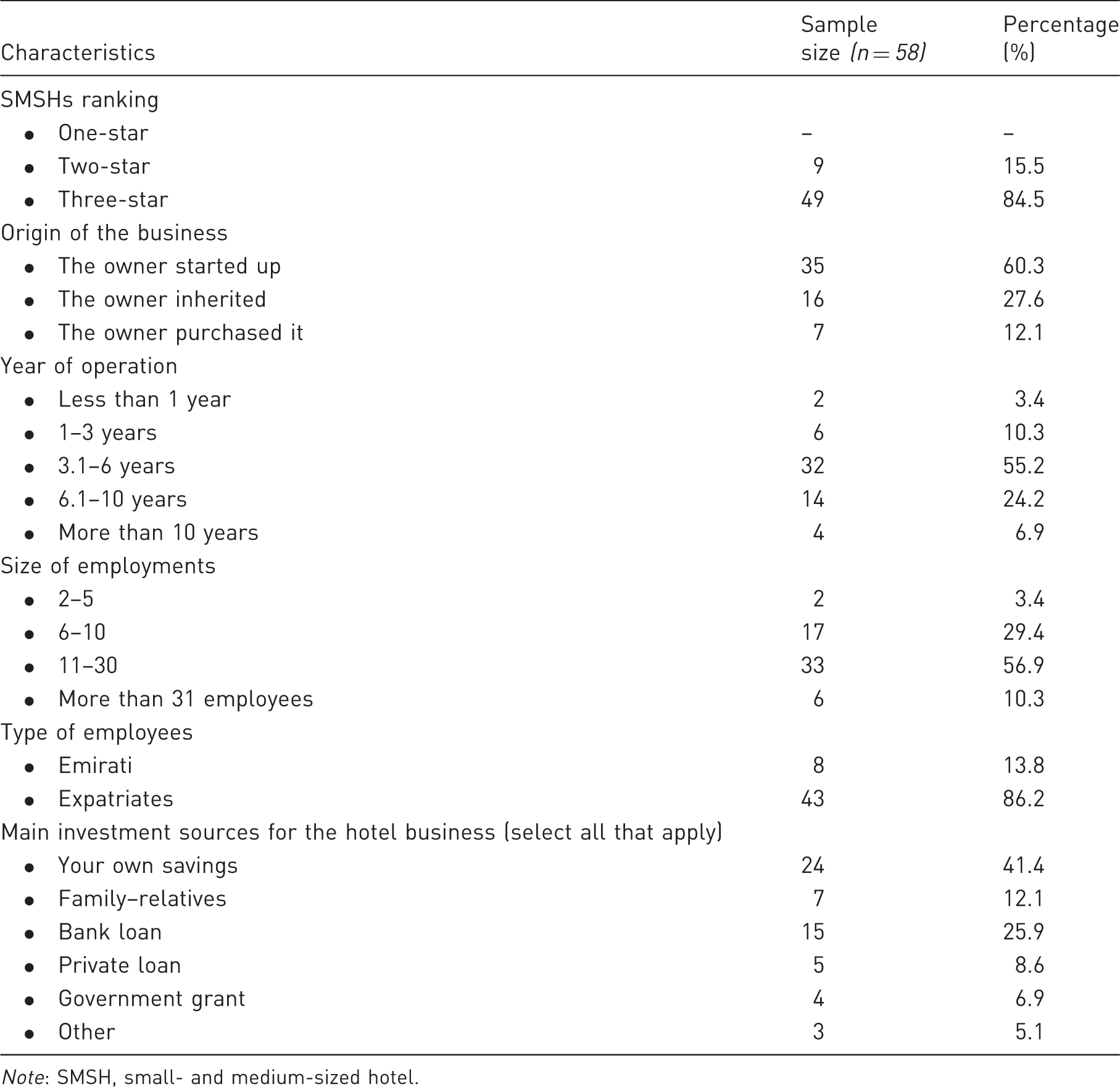
Note: SMSH, small- and medium-sized hotel.
Marketing strategies of SMSHs in the UAE
Marketing professionalism in SMSHs in the UAE.
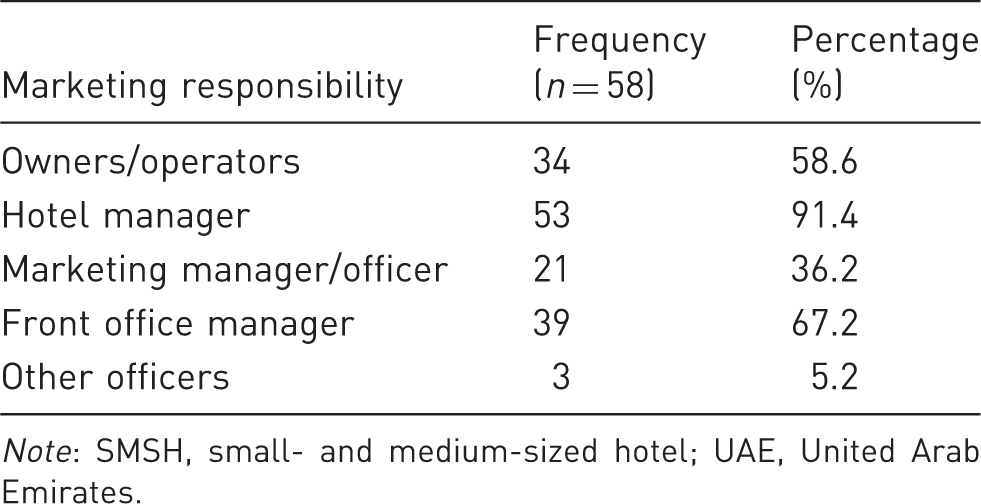
Note: SMSH, small- and medium-sized hotel; UAE, United Arab Emirates.
Marketing strategies for SMSHs in the United Arab Emirates.

Note: SMSH, small- and medium-sized hotel.
Meanwhile, the majority of SMSHs within the study formed alliance marketing with several private and public organizations for their promotional strategy. In total, 68.7% of the respondents formed alliance marketing with UAE Tourism Council, whereas 42.4% had an alliance with tour operators. Around 37.6 used collaborate with Tourism Authority for their marketing purposes, and 34.8 indicated that they had alliance marketing with Chamber of Commerce. As shown in Table 3, some of the SMSHs owners also claimed that they had formed alliance marketing with other private agencies to promote their hotel. These findings concur with the findings of Jaafar at al. (2012), which also highlighted that accommodation business in East Peninsular Malaysia chose to develop networking with several government and nongovernment agencies in promoting their accommodation services.
In hotels, technology is very significant because this service industry ensures sales by connecting and interacting with consumers across the globe (Braun, 2002). It was also found that SMSHs within the study were using technologies for their marketing strategy. Almost 87.3% of the SMSHs operators used Internet as a platform to market their hotels. Kasavana (2002) suggests that the use of technology as marketing medium is not just for big hotel chains and adds that the technology such as websites that are well designed and easy to navigate provide independent or small hotels with an inexpensive and effective platform for marketing and advertising, which potentially increase their competitiveness in the marketplace. As illustrated in Table 3, other equally important technologies were search engines (33.8%), company websites (18.2%), and Facebook (14.4%). What is interesting in these results is the use of Facebook for promotional purposes for some SMSHs in the UAE. According to one respondent who owned a hotel in Dubai mentioned that, “Facebook has emerged as a leading social networking site and it is a gathering place of a large pool of consumers. Our hotel has taken this opportunity via this platform to connect with international leisure travelers for the communication of marketing messages of our hotel.” Boyd and Ellison (2007) agreed that social networking platform such as Facebook can accommodate business firms through interaction with global consumers in real time. This platform is important for promotion because customers who need information on hotels may rely on social networking to obtain such information.
Marketing product for SMSHs in the UAE
Profile of tourists visiting the UAE.
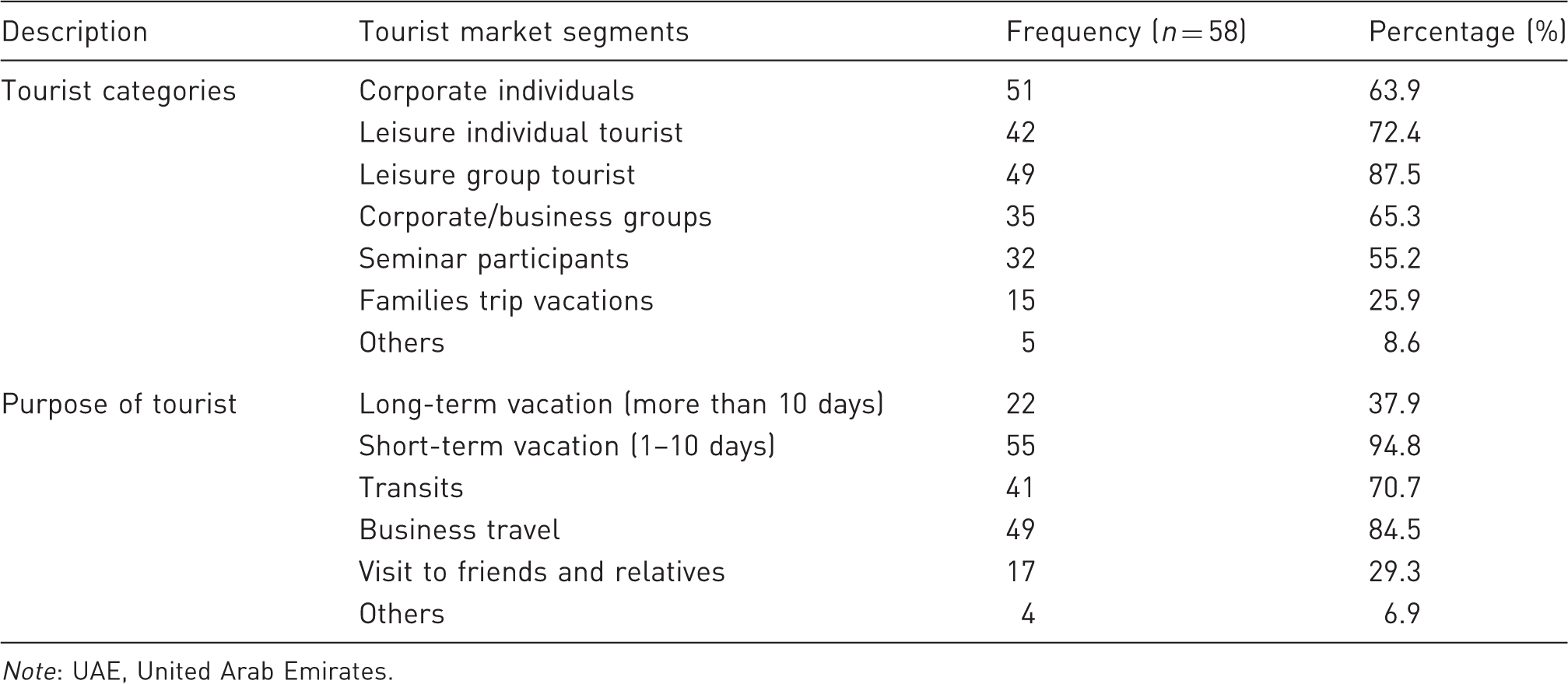
Note: UAE, United Arab Emirates.
Tourist attraction in terms of products offered.
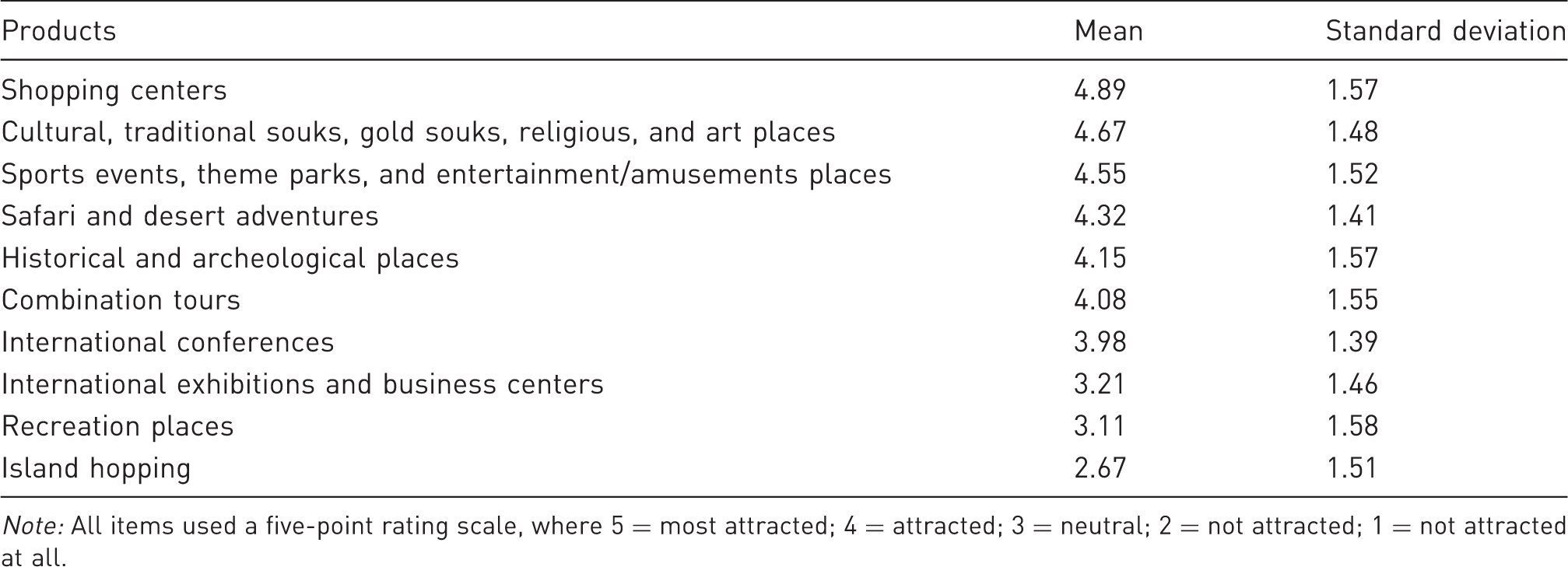
Note: All items used a five-point rating scale, where 5 = most attracted; 4 = attracted; 3 = neutral; 2 = not attracted; 1 = not attracted at all.
Discussion
The present study documents the SMSHs marketing practices in UAE. This is the first research of its kind conducted into marketing practices of SMHEs in UAE and it is hoped to contribute to scant empirical literature on small- and medium-sized firms in tourism industry. Based on the result of the quantitative and qualitative research, this study reveals valuable insights in order to understand the marketing practices of SMSHs in the country. In terms of demographic profiles, the findings reveal that SMSHs in the survey are majority rated three-star with only small number of SMSHs are rated two-star. The majority (60.3%) of the respondents started their respective businesses from scratch, while remaining either through inherited or purchased from previous business. The findings also revealed that the SMSHs in the study appeared to be in business for less than 10 years, hired an average of 17–30 employees, with majority of them are an expatriates from various Asian countries. Majority of respondents claimed that the main source of investments was derived from their own savings (41.4%) and financial institutions (25.9%), while a minority relied on family–relatives and government grants. Comparing the key demographic profile in this study with those in the general literature, as summarized in Chan and Quah (2012), it is found that consistent patterns: the small- and medium-sized accommodation businesses were either owners–operators start-up or inherited from family business. This study however, shown a minority of SMSHs in the UAE (12.1%) were purchased from the previous business owner.
Marketing managers have long been assigned to manage decisions related to the marketing mix and development of target marketing strategies and business strategies linked with marketing (Kotler, 2003). In terms of marketing responsibilities of the SMSHs in the survey, the findings reveal that the majority roles were undertaken by hotel manager, front office manager, and the owners–operators. They tend to be responsible for communicating about the hotel’s market offerings, managing relationships with various internal and external actors, distributing market knowledge, and developing or participating in marketing and business strategies while evaluating the performance of marketing practices. According to respondent in Ajman, “As a hotel manager, majority marketing decision is made by myself with the assistant of my other officers.” Yolal et al. (2009) agree that most marketing roles and professionalism have been taken by hotel managers. This may be explained due to insufficient financial and human resources budget to appoint professional marketing manager.
In regard to promotion methods through a conventional marketing technique, the finding of the study revealed that WOM marketing (89.5%) is the most effective marketing technique to attract customers. As revealed by one of the hotel manager in Dubai, “Most of our new customers get information about our hotel from their relatives, friends and someone those who have experience staying in our hotel. These people shared their destination holidays and there are the one who promote the stay here.” This finding is consistent with the work of Law and Ng (2011) in their study of small hotel in China. Through WOM recommendations, the existing client base can easily be increased to triple if those clients help promote the hotel business. According to Richard and Sasser (1990), for many industries, the profitability of a firm increased proportionally with the number of loyal customers, and up to 60% of sales to new customers could be attributed to WOM referrals. Another type of conventional techniques that are similarly important for SMSHs in the UAE is brochures, tourism guide book, local newspaper, and leaflets distributions. This finding is also consistent with that in the previous studies conducted in Malaysia (Jaafar et al., 2012), Turkey (Yolal et al., 2009), Hong Kong (Choi and Chu, 2001), and the UK (Thomas et al., 1997).
The majority of the respondents chose to collaborate various tourism-related groups and institutions for their promotional strategy. Most respondents choose the UAE Tourism Council, tour operators, and Tourism Authority as their most frequent strategic alliance partners. They were confident that the alliances with these agencies could create an extremely important synergy for their business development. Chand and Katou (2012) and Wong et al. (2010) in the sphere of cooperation between hotels and other related agencies, state that alliances are considered as critical for the success of the various partners. These finding highlighted the needs of both public and private organizations to work together to develop marketing strategies to develop a world-class tourist destination. However, during the survey, there are still a number of SMSH operators who are not interested in forging alliance marketing with any related agency as they tend to feel skeptical with the collaboration and that can potentially increase the conflict in alliances.
Regarding the usage of technology as a tool for marketing strategies, the study revealed that SMSHs in the UAE realized the importance of using technology as a medium to promote their hotel. The study revealed that Internet platform such as booking.com, hotelclub.net, and other hotel listed search engines were used as advertising and booking purposes. This is supported by responses such as “In order to promote our hotel internationally, we decided to use the Internet as a medium platform” (One of the hotel owners in Ras Al-Khaimah) and “The customer can easier make their online booking and take the advantage of discount offers if they using the Internet” (Owner of hotel in Dubai with five years of operation). This finding corresponds with several studies; for example Yolal et al. (2009) study found that SMSH operators in Turkey used similar method for marketing purposes. Jaafar et al. (2012) study stated that Malaysia SMSH operators were increasingly using the Internet in promoting their hotel. Around (33.8%) used Yahoo and Google search engines and 18.2% used company website. Buhalis and Main (1998), Buhalis and O’Connor (2005), and Ip et al. (2011) found that technology can serve as an effective marketing tool in tourism generally and SMSHs in particular.
The main market segments in the occupancy of the SMSHs in the UAE were leisure group tourists (87.5%) and leisure individual tourists (72.4%). According to several respondents, the most possible explanations for these categories prefer to choose SMSHs to stay compared to four- or five-star hotels are limited traveling budget, value for holiday household budget, easy accessibility and close to tourist destination, and travel arrangement and holiday packages offered. However, one of the main concerns for SMSHs is the level of security as some of these hotels are located in high-risk areas that would discourage to attract corporate businesses that are more concern on their safety. Safety is a major concern for tourists (Middleton, 1994). Heung et al. (2001) found that safety appeared to be the top priority for both Hong Kong and Taiwan travelers. Around 94.8% of the sample stayed to have a short-term vacation, visit tourist destination, shopping, or conduct business activities. Only 37.9% of the customers stayed for long-term vacation.
Accommodation business depends on the variety of components of tourism products to attract customer in the travel decision-making process (Jaafar et al., 2012). This study supports the variety of tourist destination in UAE developed by its variety of products it offered. The most popular destination ranked among by respondents for tourist destination are shopping centers, cultural, traditional and gold souks, religious, and art places. Sports events, theme parks and amusements place, safari, and desert adventures are also considered popular destinations among visitors in UAE. Several respondents acknowledged the importance of tourism products associated with tourists’ destinations choice for holidays.
Conclusion
The number of SMSHs in UAE has increased significantly in the past few years. The substantial increase in the number of tourists visiting Middle East in general, and UAE in particular every year provides good business opportunities for the SMSHs business. As reported, the UAE is the world’s 31st popular tourism destination and the most popular in the Arab world (Rahman, 2013). The development of the tourism and hospitality industry in the UAE has paved the way for proliferation of SMSHs in this country. However, due to stiff competition within the industry, the survivability of the SMSHs in the country is one of the key aspects that need to be emphasized and highlighted. The difference of marketing strategies among firm in the tourism industry is likely to have an impact on development plan and the distribution of resources. SMSHs that took part in this study have implemented marketing strategies using different level of marketing adoption. It appears that SMSHs have developed some strategic marketing planning in achieving the desired success criteria. Growing evidence in practice and academic research supports the idea that SMSH businesses need to implement effective marketing strategies in order to maintain competitiveness (Jaafar et al., 2012; Law and Ng, 2011).
With the shift of the government’s long-term economic development strategy from oil dependency to one emphasizing diversification of business and economic activities for additional income generating, policy makers deemed tourism as a potential source of earnings. The success of tourism sector is highly dependent on the crucial role played by the government, local authorities, its related agencies, small-, medium-, and large-sized businesses. Thus, in responding to this agenda, improvements can be done in relation to enhance the economic returns from tourism sector. This study suggests thorough review should be made by the government to support the progress and development of small- and medium- sized businesses in general and tourism sector in particular as they form an important part of the tourism economic sector.
Limitations
Despite that, as is the case with other research studies, this study also has a number of limitations, the mentioning of which can be valuable to future research. First, although this study adds new and useful information to the scarce literature on hospitality and tourism entrepreneurship in developing economies and provides cross cultural studies, it is also exploratory. Also the sample size has a certain level of representativeness; there is as usual need for caution when generalizing the results as it was based on small sample of firms. Furthermore, it is noted that the research context was imposed as a contextual parameter from which it may be difficult to generalize the research findings to other tourism and hospitality setting such as travel agents, tourism promotion business, restaurants, resorts hotels, chalets, ecolodge accommodation. Second, this study is a snapshot in time. The SMSHs in UAE is fast-changing businesses and the industry can alter quickly. Thus, the findings are liable to change over time. Thus, in order to challenge the obtained results, it would be useful to perform longitudinal research. A longitudinal research study would allow for testing of cause and effect relationships. Third, it is also recognized that there are other aspects that may influence SMSHs marketing practices and are not taken into consideration here, for example, the effect of firm marketing strategies and business performance.
Future research directions
Future research in this area can include a large-scale quantitative study of marketing strategies of SMSHs. Also, it suggests comparative work in a similar context in different countries to observe the different similarities and dissimilarities related to the marketing strategies would prove beneficial for the possible validation of the findings as SMSHs in other locations particularly in other Middle East regions may experience somewhat different business environments. Another suggestion would be to conduct some similar studies relating to other economic sectors, other types of enterprises, sizes, and location (i.e., urban and rural). The results of such studies could be compared with the results of this research. Much can be learned by investigating through cross-cultural study and comparisons with other types of business. Nevertheless, this study can be seen as a major step toward systematically examining the association between marketing practices of SMSHs in the United Arab Emirates, and thus adding knowledge to this important area of research.