



Abstract
This paper provides a critical longitudinal analysis of media representations of luxury in second homes in New Zealand and is designed to assess the validity of traditional definitions of second homes as anti-consumerist and the identification of ‘luxury’ second homes as a recent phenomenon. Using a thematic analysis of Home New Zealand magazine since its inception in 1936, this paper finds that second homes in New Zealand have always been sites for the consumption of luxury, as evidenced through representations of luxury in architectural design features, interior decoration and outdoor elements in the magazine. Generalised portrayals of second homes as anti-consumerist are therefore shown to be flawed. Furthermore, the paper finds that the architect-designed second home with its markers of luxury has existed since at least the mid-1930s in New Zealand and is therefore not a new phenomenon. The findings of this paper suggest that home and lifestyle magazines may be a valuable resource for second home research as they both influence and reflect societal values.
Introduction
The aims of this paper are twofold: to challenge the validity of popular definitions of second homes in New Zealand as anti-consumerist; and to assess the notion that the ‘luxury’ second home is a recent phenomenon. Archetypal second homes in countries such as the USA, Norway and New Zealand have been portrayed by the popular media and academic literature alike as sites for the cast-offs from the primary home – furnished with second-hand oddments and decorated with items found on the beach or in the forest (Abram, 2012; Kearns and Collins, 2006; Thompson, 1985). They are seen to be places where the notion of consumption is anathema. Indeed, Williams and Kaltenborn (1999: 228) state that ‘at the cottage one can stop consuming, one can stop “collecting signs” for a while’. Whereas the primary home has been a central site for consumption since at least the 1950s (Shaw and Brookes, 1999), the second home has been represented as exempt from consumption practices in general, and the consumption of luxury in particular.
More recently, however, the literature has begun to note the increasing consumption of luxury at the second home (Ellingsen and Hidle, 2013; Paris, 2011; Paris et al., 2009) and the increasing prevalence of (or perhaps return to) an elite second home landscape (Hall and Müller, 2004; Halseth, 2004). For example, the Danish and Norwegian literature has remarked upon an evolution in second home architecture, from the traditionally basic form to a modern form catering to a growing demand for physical comfort (Ellingsen and Hidle, 2013; Hjalager et al., 2011; Vittersø, 2007). The popular media and academic literature in New Zealand have likewise drawn attention in recent years to a trend of large, luxuriously appointed and architecturally designed second homes (Kearns and Collins, 2006; Keen and Hall, 2004). These ‘luxury’ second homes are frequently portrayed as an attack on the traditional New Zealand culture and values that the archetypal second home, reportedly lacking in luxury, is claimed to represent (Collins and Kearns, 2008; Keen and Hall, 2004). To date, however, there has been little research either in New Zealand or elsewhere directed specifically at luxury in the context of second homes.
This paper seeks to make three contributions to the literature: first, by enabling a fuller and more nuanced picture of luxury consumption in the context of the New Zealand second home culture over time to be appreciated; and second, by questioning the hegemonic construction and understanding of the social and cultural phenomena that is second homes. It is only through such challenges that mythologies such as the anti-consumerist nature of second homes may be identified and dispelled, or at the very least problematised and opened for discussion. Third, whereas much previous research into luxury has focused on how consumers perceive luxury (see, for example, Christodoulides et al., 2009; Vigneron and Johnson, 2004), this paper adopts an alternative approach and examines how the media represents luxury. It draws attention to the myriad ways in which luxury may be portrayed and in doing so reveals the highly nuanced nature of luxury which has been largely neglected in the past.
Luxury
The first writings on luxury came from the Greek philosophers Plato and Aristotle and were followed by those of Roman philosophers and moralists such as Cato the Elder (234 BC–149 BC) and Pliny the Elder (23–79 AD) (Aristotle, 1992; Kragelund, 2000; Plato, 1930; Sekora, 1977). Many more have written about luxury over the course of two thousand years, yet there has been little consensus as to what luxury is and, indeed, the slippery nature of luxury has often led to heated debate about how to define it (Baldwin, 1899; Berry, 1994; Brewer, 1998; Cautela et al., 2007; Dubois et al., 2005; Jennings, 2007; Orr et al., 2008; Wiedmann et al., 2009). Nevertheless, there are some commonalities in the conceptualisation of luxury. First, that luxury is fluid in nature, and it can and does change over time (Baldwin, 1899; Berry, 1994; Goody, 2006). Second, that luxury is highly subjective and what one person or society views as luxury, another may view as necessity (Baldwin, 1899; Christodoulides et al., 2009; Csaba, 2008; Mortelmans, 2005). Third, luxury is generally associated with pleasure and enjoyment, be it physical or sensory (Berry, 1994). Finally, luxury goods are usually exclusive objects of desire that are rich in meaning (Berry, 1994; Orr et al., 2008; Twitchell, 2002).
These commonalities highlight not only that the concept of luxury is socially constructed but also that luxury has an association with necessity; indeed, it is difficult to discuss what luxury means without reference to necessity. Luxury has often been defined, somewhat glibly, as anything that is not necessary for life (Berry, 1994; Christodoulides et al., 2009; Csaba, 2008; Dubois and Czellar, 2002; Mortelmans, 2005; Twitchell, 2002). Political economists Bernard Mandeville (in his infamous Fable of the Bees) and Adam Smith (in his treatise Wealth of Nations) in the UK in the late 17th and early 18th centuries, respectively, grappled extensively and provocatively with the luxury-necessity dichotomy (Mandeville, 1724; Smith, n.d.). Both referenced the relationship between luxury and desire, and the importance of social and cultural norms in defining both luxury and necessity.
These discussions of luxury and necessity have generally referred to the tangible, physical (or material) aspects of luxury, in areas such as clothing, housing or foodstuffs (Smith, n.d.; Twitchell, 2002). However, there are also intangible, metaphysical aspects of luxury that are multi-hued and nuanced. By way of illustration, these two forms of luxury may be represented in the context of second homes as follows: The physical or material nature of luxury: may be represented as expensive, rare, unique, exclusive, foreign (imported), large, ornate, modern, up-to-date and/or excessive; The metaphysical or immaterial nature of luxury: may be represented as sumptuous, comfortable, soft, opulent, tasteful, pleasurable, rich, warm, desirable and/or indulgent.
It is important to note here that both forms of luxury are subjective and are specific to the period, society and culture to which they belong. By its very nature then, luxury cannot be viewed as black and white but rather, must be viewed as a technicolour phenomenon. This research reflects and makes visible a nuanced understanding of both the physical and metaphysical luxury to be found in second homes.
Consumption of luxury at the second home
In many countries (such as Canada, Australia, Denmark and the UK), second homes and their associated consumption practices were traditionally the preserve of the social elite (Coppock, 1977; Selwood and Tonts, 2004; Tress, 2002; Wolfe, 1951). In New Zealand, however, the popular media has discursively constructed second homes as rooted in working class origins and traditionally representative of an ‘egalitarian’ society (Barber, 2005; Cox, 1995). In a somewhat nostalgic and romantic media discourse, the archetypal New Zealand second home of the 1950s and 1960s is often remembered as being filled with furniture oddments, with a basic kitchen, a bunkroom for the children and entertainment for inclement weather that consisted of cards, board games and old paperback books (see, for example, Cox, 1995; Grigor, 2008; Male, 2001). They tended to have a simple, lean-to form with a sloping single-pitch roof, and large picture windows in the lounge to appreciate the sea or beach view (Collins and Kearns, 2008; Mitchell and Chaplin, 1984; Peart, 2009). The archetypal second home in New Zealand has also been represented in the (albeit somewhat limited) academic literature as ‘modest, low-cost’ (Collins and Kearns, 2008: 2916), ‘authentic’ (Collins and Kearns, 2010: 443) and ‘the preserve of average New Zealanders’ (Freeman and Cheyne, 2008: 44).
The introduction of the neoliberal economic regime in 1984 was influential in ushering in a new phase of second home development in New Zealand. Many of the newly wealthy could now afford, both financially and socially, to build larger more expensive second homes than had existed in the past – and they did (McIntyre and Pavlovich, 2006; Thompson, 1985). Significantly for this paper, over the last decade, the consumption of luxury in the context of the New Zealand second home has been constructed in both the media and the academic literature as a new phenomenon, especially associated with architect-designed second homes: Fabulous million dollar holiday homes have hit Auckland’s Hauraki Gulf like a tidal wave. Ageing weekend [second homes] with [outside toilets] out back have been swept away by swank architect-designed mansions with Italian porcelain toilets … The luxury New Zealand bach
1
now is commonplace. (‘Bach gives way to seaside opulence’, 1999) … it is proposed that the bach is characterised by deprivation and lack. This has been somewhat contradicted by its recent [architect designed] manifestations. (Austin, 2006: 5)
Freeman and Cheyne (2008: 34) have called this change in second home consumption practice ‘arguably one of the most significant social and economic shifts in New Zealand’s coastal landscape’, yet academia in New Zealand has generally remained silent on the issue. Through discourses such as those discussed above, second homes have therefore been valorised as symbols of egalitarianism and sites for the non-consumption of luxury, and in direct contrast to the modern architect-designed luxury second home. The argument that ownership of even a modest second home is in itself a luxury – which has drawn heated comment in the UK (Monbiot, 1999, 2006; Shucksmith, 1983) – seems to have been largely overlooked in New Zealand. This paper uses a thematic analysis of media representations of luxury from 1936 to 2012 to challenge the popular perception of second homes as anti-consumerist and assess whether ‘luxury’ second homes are indeed only a recent phenomenon.
Methods
Since their conception, magazines have been used by cultural mediators as a vehicle to transmit knowledge of new consumer goods and lifestyles to which readers can/should aspire (Beetham, 1996; Bourdieu, 1984; Leonard et al., 2004). They have both influenced and reflected society’s changing notions of fashion, taste, desire and luxury in various areas including architecture and interior design (Osgerby, 2005; Perkins et al., 2008). Despite this, the architectural viewpoint on design and standards is one that Persson (2014) notes has rarely been employed in second home research. In New Zealand, magazines of the house, home and lifestyle genre are an important part of the culture (Leonard et al., 2004). They are easily accessible for the majority of New Zealanders through bookshops and supermarkets and also in public libraries (Leonard et al., 2004).
Name changes and frequency of publication of Home New Zealand magazine.
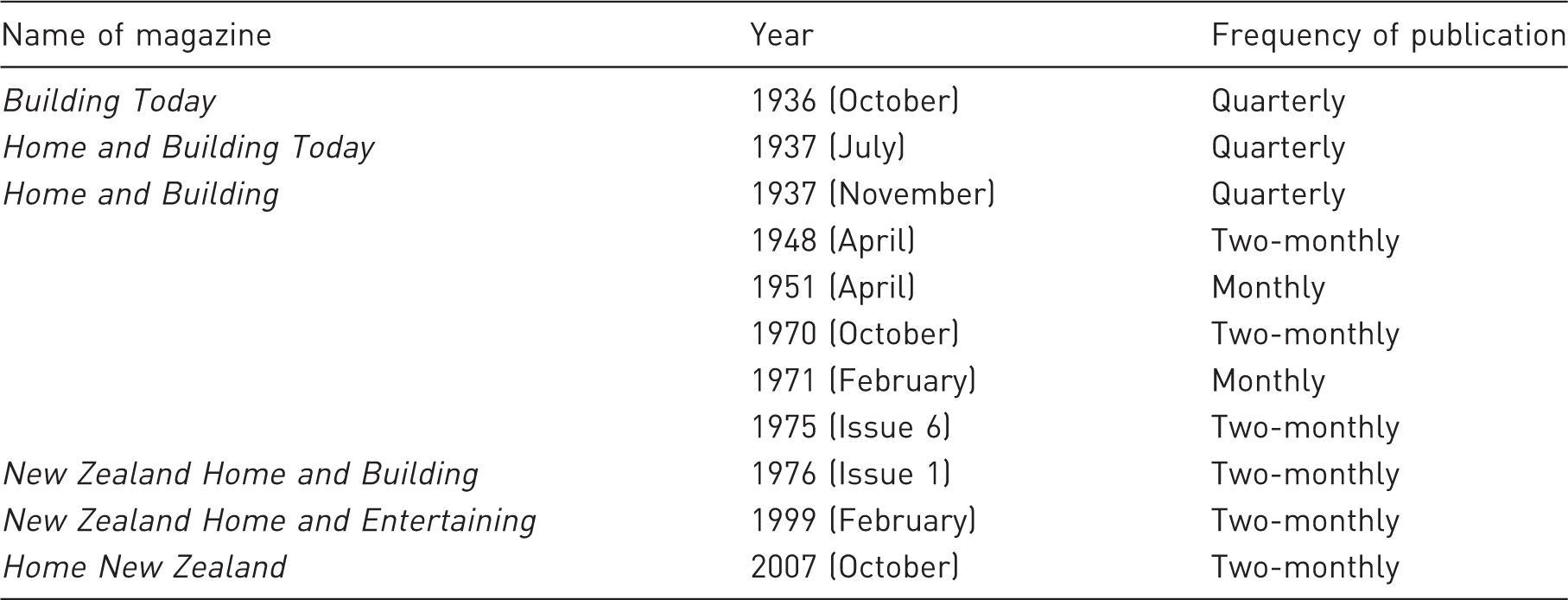
All issues of Home New Zealand magazine and its predecessors were read from cover to cover, and the empirical material in the form of second home articles was gathered. Over the period 1936 to 2012, a total of 266 second home articles were featured, comprising 1405 pages of material. The articles were digitally photographed and assigned a unique identifier number (year/month/image number) to facilitate ease of identification throughout the analysis. Qualitative analysis was undertaken which facilitated a nuanced understanding of the consumption of luxury in second homes. Thematic analysis was used to identify recurrent themes surrounding the representation of consumption of material luxury in the context of second homes (Attride-Stirling, 2001; Braun and Clarke, 2006). Three best practice articles by Attride-Stirling (2001), Braun and Clarke (2006) and Sather-Wagstaff (2011) were amalgamated and resulted in the identification of six phases for conducting thematic analysis of written and visual text.
Example of thematic analysis using an extract of Home New Zealand magazine text.

The third phase involved consolidating the codes into basic themes (or categories), by collating together all codes that seemed similar (Attride-Stirling, 2001; Braun and Clarke, 2006; Lincoln and Guba, 1985). In the fourth phase, the basic themes were then further condensed into higher level organising themes (Table 2), which were then clearly defined and named (Attride-Stirling, 2001; Braun and Clarke, 2006). Each of these organising themes was checked for coherence by reviewing the data extracts and examples for each code that made up the theme. With the visual text, this involved not only reading the written descriptions given in the coding phase but also reviewing the images themselves to check for unity. The fifth phase involved additional, deeper analysis revealing overarching global themes that could be derived from the organising themes (Table 2), whilst maintaining their internal homogeneity and mutual exclusivity (Braun and Clarke, 2006; Lincoln and Guba, 1985; Ryan and Bernard, 2003). This phase was iterative and organic and involved a ‘going back and forth’ between the codes, the basic themes and the tentative organising themes until a cohesive argument was made for each global theme, such that they could be defined and named (Braun and Clarke, 2006). Finally, the global themes were described, explored and analysed in detail, and are presented below.
Details of interview participants’ period of involvement with and contribution to Home New Zealand magazine.

Second homes as sites for the consumption of luxury
As stated in the introduction, the aims of this paper were to challenge the validity of popular definitions of second homes in New Zealand as anti-consumerist, and to assess whether the ‘luxury’ second home was indeed a recent phenomenon. Representations of the consumption of both physical and metaphysical luxury could be identified in the second home articles throughout the magazine’s publication. Three key themes that spoke of second homes as sites for the consumption of luxury are presented here: luxury in architectural design features; luxury in interior decoration and luxury in outdoor elements.
Architectural design features
Spaciousness was an important architectural design feature that contributed to the theme of luxury in the second home and was mentioned from the very first article: ‘The main feature of the house is its spacious living-room with large open fireplace and chimney’ (‘Planning for leisure’, 1937: 31).
Certainly this seemed to contrast with the second homes of the working classes on Rangitoto Island near Auckland in the 1920s and 1930s, which often started as cramped, single room buildings which were only extended as finances allowed (Yoffe, 2000).
During Second World War, legislation was introduced which prohibited the construction of second homes in New Zealand. In 1949, these restrictions were lifted, allowing second homes up to a maximum floor area of 400 square feet (37.1 square metres) to be built. At this point, the luxury of spaciousness and its association with comfort was particularly evident in the discourse: Next – and here is room for the controversy – it was considered advisable to have a large and comfortable living space and to economise on sleeping accommodation. This allows for entertaining and for comfortable relaxation during the greatest heat of the day or in bad weather. (‘A 400-foot holiday cottage’, 1949: 53)
Here, we see an explicit reference to comfort along with an implicit reference to indulgence, which speak of metaphysical luxury as discussed earlier in the introductory section of the paper. Furthermore, spaciousness was also constructed in the discourse as part of the attractiveness and allure of the second home: ‘Its appeal lies in its spacious interior’ (‘A country retreat’, 1962: 48).
In some cases, the dimensions of second homes and rooms were given, highlighting the luxurious size of the space. Likewise, representations of spaciousness in the accompanying images were enhanced by the lack of clutter.
Ironically, however, in recent years there has been something of a trend towards showcasing small second homes in Home New Zealand with nearly one-third of second homes (where the floor area was stated) since 2004 having a floor area of 75 square metres or less
2
: The house itself measures just 75 square metres, but the design creates an impression of a far bigger area. (Daniell, 2004/2005: 119) For a building that measures only 50 square metres, it boasts a remarkable variety of spatial experiences, giving the impression that is a far larger house. (Hansen, 2012: 27)
While not everyone would view such a small second home as a luxury, there was a sense that the ability to choose to live in a smaller space than would be the case at the primary home, albeit for just a short period of time while on holiday, was itself a luxury.
Along with spaciousness as a luxurious architectural design feature, there seemed to be an underlying luxury in the notion of simplicity of architectural design: The pair’s preference for classic styling (Billy’s other great love is France) shows through in the graceful proportions of the rooms and their uncluttered simplicity. (Millar, 1999: 108) The joy of this holiday home is its no-frills architectural simplicity. (McCall, 2008/2009: 102)
At first glance, this seemed to be self-explanatory; simple and simplicity were related to a structure or design that was plain, uncluttered, unadorned and basic. Nevertheless, a closer examination of the images associated with these articles suggested that ‘simple’ did not mean basic as in inexpensive, nor did it necessarily mean a lack of luxury. Rather, the notion of simplicity was constructed in the discourse as synonymous with taste and style: ‘Basic but with taste and design nous, for sure’ (Interview with Editor B, June 2013).
The financial and cultural capital of the second home owner was evident in the ideal of simplicity associated with exclusive, high-quality designer products (Leonard et al., 2004). For example, designer lightshades, an upper-end dishwasher and an espresso machine were featured in the photographs associated with an article about a simple second home.
As with spaciousness, these findings suggested that the luxury inherent in simplicity was related to the second home owners’ freedom of choice. This in turn was related to the level of both financial and cultural capital that afforded them the freedom and ability to choose simplicity. Indeed, both Chaplin (1999) and Williams and Kaltenborn (1999) noted that where modern facilities at the second home were lacking, this was as a result of a choice made by second home owners rather than born of necessity. One Home New Zealand editor stated: I think that’s probably quite a strong movement we’ve seen in New Zealand, particularly probably over the last 10-20 years, where you know, the definition of luxury has changed, umm, and it’s more … luxury is actually simplicity and luxury is more about the environment around you … (Interview with Editor A, March 2013)
And referring to an article published in the magazine in 2012 which featured a 40-square metre second home, Editor C stated: The fact that the owners of that were like, yeah fine, we can live like that on our holidays, is amazing I think, and, and that that is their definition of luxury, when they could have possibly used the same amount [of money] to get a much larger home that would have had a lot more stuff. (Interview with Editor C, March 2013)
So the owners had deliberately chosen simplicity over ‘stuff’, and to live in a restricted space for short periods while on holiday, where they would not choose to live like this permanently. In addition, note the reference to the expense involved in achieving such simplicity. Editor C coined the phrase the ‘luxury of deprivation’ to describe this recent trend towards choosing simplicity over convenience and comfort. All three of the editors interviewed believed that this move towards chosen simplicity and a more considered form of consumption at the second home was a luxury that could only be afforded by the wealthier sectors of society. This type of simplicity was perceived to be very different to that lived by others who, through circumstance, may have to live a permanently simple lifestyle forsaking modern conveniences through necessity rather than choice.
The longitudinal analysis resulted in the identification of three subtle but distinct phases in the discursive treatment of architectural features in the magazine, illustrating devolution in status from luxury item to convenience to necessity. When first introduced (the ‘luxury’ phase), architectural features were highlighted as special or unusual and were accompanied by some degree of explanation or definition. When more common (the ‘convenience’ phase), they were mentioned in the text only in passing. Finally, when very common (the ‘necessity’ phase), it seemed they were only drawn to the reader’s attention if there was something different or unique about them. These phases were especially evident in the discourse surrounding garaging (from a time when having one car was a luxury and a single garage was symbolic of that, to when having two cars was so common that double garaging was no longer commented on) and bathrooms (from when an indoor bathroom in a second home was a luxury, to when multiple bathrooms and ensuites were common practice).
Despite luxuries becoming necessities over time (Berry, 1994), there were always new luxuries appearing, with the latest in building materials and techniques, technology and domestic and international architectural trends being incorporated in the second home. For example, luxury building materials introduced over the years include external cladding products such as Fibrolite, 3 schist (a type of stone found in New Zealand only in the Central Otago district and in vogue from the 1990s), and monolithic cladding (a new building material in the early years of the 21st century). Furthermore, it contrasted with much of the literature, which held that second homes were mostly devoid of the modern materials and technology common in the primary home, at least until recently (Ellingsen and Hidle, 2013; Perkins and Thorns, 2006; Williams and Van Patten, 2006).
The adoption of the latest technology was also prevalent in the kitchen. From the 1980s, progressively more physical luxury features were noticeable in both the written and visual discourse about the kitchen, along with more subtle underlying representations of the metaphysical nature of luxury. Commonly encountered in the magazine discourse were explicit references to size, exclusivity, expense and implicit notions of taste that spoke of luxury: The German kitchen was an extravagance. (Copland, 1989: 120) The owners requested comprehensive cooking and entertaining space, so a 6.5-m-long concrete and fibreglass bench and a wall of cupboards provide all they need in the kitchen. (McBride, 2006/2007: 67)
The luxury apparent in the second home kitchens in the magazine again contrasted markedly with the academic literature. For example, Vittersø (2007) reported that while preparing food and eating together were important and enjoyable leisure activities for the Norwegian second home owners in his study, most lacked modern kitchen facilities – many cooked outdoors and without electricity and were happy to do so as part of what they considered to be an authentic second home experience.
Interior decoration
The interior decoration of the second home portrayed in the written and visual magazine discourse provided ample evidence of second homes as sites for the consumption of luxury in a variety of forms. There were abundant representations of physical luxury as expensive, unique, exclusive and imported, and of metaphysical luxury as tasteful and desirable. While present from the early 1950s, representations of luxury were more prevalent from the mid-1980s as the home (and by extension the second home) became increasingly commoditised as a site for consumption in New Zealand, as overseas (Brailsford, 2007; Gram-Hanssen and Bech-Danielsen, 2004; Paris, 2011).
Rather than the purchase of mass-produced items, the owners of second homes featured in the magazine seemed to prefer distinctive furnishings and accessories. Many had items specially designed, imported, brought back from overseas travels or sourced from exclusive designers: The actual colour of the leather furniture [in the lounge] was achieved by having a batch of leather especially dyed. It is aqua sea green and accurately reflects the colours outside … Pieces of art have been chosen carefully. A Zena Abbott tapestry commissioned especially. Door handles were imported from England and imported taps chosen for their function and because they remind [the owner] of birds. (McCarthy, 1986: 11, 13) Owner Jack Cooper reads in a Philippe Starck Costes chair, under [an artwork by] Delicia Sampero. Jack bought the zebra skin rug in South Africa. (Lewis, 2001/2002: 82)
Cost of items as a percentage of average weekly household income (before tax) in 2000 and 2012.

Income information sourced from Statistics New Zealand (2012).
Adjusted price calculated using Inflation Calculator from Reserve Bank of New Zealand (2013).
While the luxury in interior decoration was generally implicit and relied on the reading and interpretation of various symbols in both the written and visual discourse, on occasion it was explicitly pointed out to the reader: ‘Caption: Robyn’s choice of ultimate luxury – an Agape Spoon bath – drinks in the expansive rural views from the master bedroom. A Vola spout, Paini Cox mixer and Agape storage ladder finish off the look’ (Berryman, 2005: 114).
Again the magazine discourse provided readers with a sense of what constituted luxury and also how to achieve a similar look in their own home or second home.
In the 1980s, the reader’s attention was drawn to art and sculpture in second home interior decoration: Inside chipboard wall linings create a neutral background for the clients numerous pieces of art. (‘Retreat at Seaforth’s Peninsula’, Issue 1, 1983: 40) For their interior décor, [they] opted for pieces that were spare, modern and fitted well with the architecture … They had in mind various art and objects they had collected and wanted to bring to the house including, in the kitchen … an artwork by Pat Hanly … and a painting by Gretchen Albrecht in the bedroom. (Hansen, 2011: 80)
More often than not, the artists and sculptors were named; they were frequently well known and recognised New Zealand names that (today at least) commanded high prices for their work. While it cannot be certain that prices were high when the pieces were purchased, the naming of the artists and sculptors seemed to suggest that at the very least it was the case when the article was written. Alternatively, the naming of the artists implied that the reader should have known the artists even if they were not (yet) well known or expensive, thereby delineating the cultural capital of the reader.
Outdoor elements
The final theme contributing to the representation of second homes as sites for the consumption of luxury was that of outdoor elements. Many were related to specific recreation and leisure pursuits, which may in themselves have been deemed luxuries (see Walters, 2014), but some also carried with them a substantial requirement for space – for example, the inclusion of a tennis court or swimming pool in the grounds of the second home. Indeed, one of the first articles featured a second home with both a tennis court and a swimming pool (‘Planning for leisure’, 1937: 32).
It was not just the requirement for space that afforded swimming pools the impression of luxury; two of the 14 second homes that featured swimming pools were located on the beachfront. The element of luxury inherent in these pools did not necessarily lie in the idea of excess; that their beachfront location made them somewhat redundant (although it could be argued that this was the case). Rather, the swimming pool provided the second home owners with the ability to swim in private and to control their own sanitised swimming environment. In this manner, the second home owners were able to enjoy the luxury of a level of physical and psychological comfort that was not available to others who lacked a swimming pool. In addition, it afforded the owner the luxury of choice of where to swim.
Other outdoor luxury items over the years included outdoor fireplaces, boat sheds, roof terraces, barbecues, jetties, pizza ovens and spa pools. The interpretation of luxury relied heavily on understanding both the New Zealand context at the time of writing and the type of language used. For example: ‘Considering the enjoyment any family would get from [a portable barbecue] the cash outlay would be well justified. Barbecue “tools” are an asset too’ (Hoby, 1956: 15).
In mid-1950s, New Zealand the portable barbecue was a new consumer item, and in having one the second home owner was represented as an early adopter, implying the luxury of being up-to-date as discussed earlier with regards to architectural design features. A more subtle underlying message of luxury here was in the representation of being ‘cool’, of being a trend-setter. The need to justify the expense further emphasised that a barbecue was a luxury item at the time.
Landscaping was the final outdoor element that contributed to the representation of physical luxury in this theme. In the few Home New Zealand articles on archetypal second homes, the images generally depicted unkempt lawns and few plants and in this way mirrored the representations in the literature (Kearns and Collins, 2006; Mitchell and Chaplin, 1984). This was contrasted markedly with the images of architect-designed second homes in Home New Zealand magazine where the landscaping was portrayed as tasteful and often extensive. In addition, they were frequently specially designed to ensure a low-maintenance space and the work was carried out by professionals. Indeed, the very term ‘landscaping’ was suggestive of exclusivity. In this way, it spoke of the luxury of professional design and execution (Leonard et al., 2004) and was a language not seen in the articles about archetypal second homes.
Conclusion
The analysis of second home articles in Home New Zealand magazine presented in this paper has challenged the validity of the widespread image of second homes as anti-consumerist, finding that the New Zealand second home is, and always has been, a site for the consumption of luxury. The representation of the second home as a site for the consumption of luxury was evident as early as the 1930s and from the 1980s became increasingly prominent, mirroring a similar change in the role and status of the primary home in New Zealand during these periods (Brailsford, 2007; Mansvelt, 2005; Shaw and Brookes, 1999). It was evident through the representation of luxury in the architectural design features of the second home, in the interior decoration and in outdoor elements.
Furthermore, this paper has identified a longstanding historical representation of luxury second homes featured in Home New Zealand magazine. While the literature has referenced a ‘new’ luxury second home phenomenon over the last two decades, the findings presented here indicate that this is not at all new. The architect-designed second home with its markers of luxury has been present since at least the late 1930s; it is simply that we have not recognised them as our gaze was filtered through the lens of our current social, economic and cultural context. The second homes of those with more disposable income, those who could afford to employ an architect and other professionals, have always been more expensively and stylishly finished and furnished than others.
This research speaks of a specific genre of magazine (architecture/lifestyle), aimed at a specific reader demographic (higher than average income and education), in a specific place (New Zealand), during one specific period (1936–2012). As such, it is one perspective on second homes and may not represent the ‘average’ New Zealander or the ‘average’ second home; were a different magazine selected as the source of empirical material, the findings may have been different. However, it is through seeking to provide an architectural viewpoint that this paper makes a significant contribution to the literature regarding second homes as sites for the consumption of luxury. It has shown that generalised portrayals of New Zealand second homes as anti-consumerist are flawed and revealed that luxury second homes have always existed.
The relevance of these findings also transcends geographic boundaries and has implications for luxury consumption and second home research in contexts other than New Zealand. The findings of this paper suggest that home and lifestyle magazines may be a valuable resource for such research, and yet they are seldom utilised as sources of empirical material (with the notable recent exception of Persson (2014) and her research on advertising stories of second homes in a Swedish interior design magazine). In fact, despite the existence of magazines devoted specifically to second home lifestyles and their attendant consumerism in Canada, Finland and Norway (Abram, 2012; Luka, 2007; Pitkänen and Vepsäläinen, 2008), no research efforts have been directed at an examination of the messages contained therein. Future research endeavours using a thematic analysis of these magazines could be aimed at challenging other preconceived ideas or mythologies surrounding second home consumption practices, and it is argued that the research presented here provides a useful starting point for international comparative studies. An exploration of other architect-driven magazines and more generalist magazines would also yield valuable insights not only into similarities and differences in representations of second home culture around the world but also about the magazines themselves and the implicit messages about consumption practices that they are presenting to their audiences.