




Abstract
In the contemporary globalized world, tourist practices deal mostly with appropriated memory. Famous sights are arranged into classical routes proposed by guidebooks and guided tours presenting an official narrative of community’s collective memory. However, should a traveller step aside from major auto routes in Ukraine, direct liaison with the past at the forgotten historical sites is promised. A decade ago, Ukrainian travellers began to discover previously unknown to the public abandoned castles, palaces, manors, churches, cathedral, mills, etc. deep in the province and started to share travelogues after their quest-like trips around Ukraine. Sites that would be considered as heritage in the neighbouring countries, in Ukraine exist as ‘heterotopias’ (places outside usual society’s renderings). Based on the analysis of the Internet travelling community and author’s field trips, this article proposes to consider an alternative mode of tourism that provides potentially inclusive contact with the past.
In the contemporary globalized world, tourist practices mostly deal with appropriated memory. Famous sights are arranged into classical routes proposed by guidebooks and guided tours. They present a certain narrative supported by sights’ captions and information desks. Such mediated encounters with the past limit interaction with it to the official version of collective memory produced either by the collective where a visited sight is situated or by the community to which the visitor belongs. However, should a traveller step aside from major auto routes in Ukraine, direct liaison with the past at the forgotten historic sites is promised. A decade ago, information about previously unknown to the public abandoned castles, palaces, manors, churches, cathedral, mills, etc. deep in the Ukrainian province started to appear on the Internet. People began to share travelogues after their quest-like trips rediscovering Ukraine. Sites that would be considered as heritage in the neighbouring countries since most of them belonged to Poles, Hungarians, Austrians, Jews, or Germans, in Ukraine exist as places outside all places, as ‘heterotopias’. Based on the content analysis of the Internet travelling community and author’s field trips, this article proposes to consider an alternative mode of tourism that provides potentially inclusive contact with the past.
Michel Foucault used the concept ‘heterotopia’ in his lecture in 1967 as a general name for places where the apparent continuity and normality of everyday spaces is interrupted. Literally ‘heterotopias’ mean ‘other places’ aiming at the alterity that they insert into the ordinary flow of everyday life and common space. They are real places and exist in the founding of every society. These are places outside of all places; being absolutely different from the rest of society sites, they can reflect and manifest what lies in the basis of the latter. Foucault calls them counter-sites where all other ‘sites that can be found within the culture, are simultaneously represented, contested, and inverted’ (Foucault and Miskowiec, 1986: 24). Thus, heterotopias serve as a mirror for the usual places we occupy bringing out their invisible foundations. This article deals with travelling to heterotopia places in Ukraine as a looking glass for its official version of collective memory.
The Internet community ‘Ukraine. The Collection of Trips: Interesting travelling around Ukraine’ (Ukraїna. Zbirka Mandrivok, 2005) holds the second rank in LiveJournal community rating in Ukraine. It was founded on 9 January 2005. In first three posts, which were made on next day, people asked for advice about sites to visit and encouraged others to share information about places they live in and their neighbouring sights. The first participant wrote that, being from the Eastern Ukraine, he had not seen much except for steppe but had a desire to see parts of Ukraine where castles used to be and perhaps survived till the present day. So he was asking locals to share the information about interesting places around. The next participant proposed to use this community for exchanging information concerning places to stay in and options of self-organized tours to the sites where other members of the group live. However, during the first couple of months, this LiveJournal community was not rich with fresh and original information. The participants mainly asked what is worth seeing in some particular Ukrainian city or town and how to get to certain sites, while others posted singular pictures of places they visited without any accompanying information.
First reports with pictures and personal impressions of the travellers appeared in the late spring 2005 but have not become a dominant content of the site at the time. According to the statistics, on the sixth-month anniversary, most of the entries were dedicated to Lviv, Crimea, and Kyiv – the most popular tourist destinations in Ukraine. So by far, the members of the community explored only the well-known sites. However, starting from the second part of 2007, the community has been regularly enriched with travelogues to rarely known places, while most active participants compete in posting information about some site previously unseen by others. Thus, a mode of heterotopia travelling emerges.
Foucault proposes six principles of what he calls heterotopology, a simultaneous description, analysis, study, and reading of heterotopias. Further, I shall follow the sequence of these principles to unfold the functioning of ‘other places’ in Ukraine.
Types of heterotopias
The first principle states that heterotopias are a cultural constant. Every culture and every human group have its heterotopias. However, no universal form of heterotopia exists, so they vary significantly in different societies and different times. Foucault classifies two main categories of heterotopias: that of crisis and of deviation. The former are privileged, sacred, or forbidden places designated for people in crisis periods according to society terms, while the latter are destined for individuals whose behaviour deviates from the established cultural norm (Foucault and Miskowiec, 1986: 24).
For Foucault, heterotopias of crisis mainly exist in so-called primitive societies and are disappearing nowadays, though their remnants can still be found. Thus in Soviet times, a part of former palaces, manors, and castles were used as orphanages, boarding schools, military headquarters, hospitals for tuberculosis, or mental illnesses. For instance, in Lvivs’ka region, a former Groendl family palace in Skole was turned into a boarding school, a Jesuit collegium in Khyriv into a military headquarters, and Koniecpolski castle in Pidhirtsi into a tuberculosis sanatorium. Such establishments are usually separated from the rest of society in the name of safety either of people within the institution (as in case of orphanages and boarding schools) or of the rest of the society (when we deal with military headquarters, tuberculosis, and contagious diseases hospitals). However, it is presupposed that people placed into mentioned establishments are not there for life. Children from orphanages would be adopted or grow up; kids from boarding schools would graduate from them; young men called to military service would finish it, and those who proceed with military career are allowed to live the premises daily; finally, patients with long-term contagious diseases would be cured or die. Thus, all these people are isolated from the society only for a certain period that is regarded as a period of crisis.
While the phase of the crisis is temporary, the heterotopias of deviation are considered as a more or less final destination. Foucault names psychiatric hospitals and prisons as major examples of heterotopias of deviation. For both of these functions, aristocratic and bourgeois heritage was converted in the times of the USSR. One may say that most of the prisoners do not get life sentences and that people with mental disorders could be cured. The answer in the hypothetical mode would be affirmative while on practice committing a crime or being mentally different from the so-called norm was considered as a permanent mark. People who had gone through establishments of this kind were rarely easily accepted back into society and tended to find themselves in the same establishments again. That is especially true for the Soviet system where so-called correctional institutions were not designed to help people with a mental disorder or prepare prisoners for a proper life in the society but rather simply lock them up. Thus, even tuberculosis dispensaries were on the edge between heterotopias of crisis and heterotopias of deviation, since the disease was treated so poorly that it was close to a life sentence.
Though places taken into consideration are heterotopias regarding their social function too, here their mnemonic one is more vital since that is the reason that attracts to them travellers’ attention. Social exclusion makes these places isolated from the society. This isolation is only strengthened by the collective amnesia as they are mapped out from the official version of Ukrainian collective memory. Therefore, these spaces exist as memory heterotopias, and their exclusion has a long and complex history.
After the establishment of the USSR, the October revolution was regarded as a new beginning that broke up with the past starting the new time counting. It launched the process of rewriting history according to the new referential frames. The initial premise was stated in the ‘Communist Manifesto’ declaring that working class people had no motherland. Thus, in 20s and 30s Bolsheviks constructed their genealogy not on the territorial basis but as the culmination of revolutionary movements of all times in all countries starting with Spartacus uprising. It entailed applying a type of forgetting which Paul Connerton called constitutive in the formation of a new identity. It is a process of discarding memories that serve no purpose in the management of the current identity. Moreover, undesirable past stands in the way of the construction of a new set of memories as the latter is frequently accompanied by a chain of silences accepted by default. So pieces of knowledge that are not supposed to be passed on gain a negative significance by allowing other possible images of the identity to pass the threshold of audibility (Connerton, 2008: 62–63).
Thus, Proletcult declared that getting acquainted with national or worldwide bourgeois culture was considered redundant and malicious since the latter was ‘reactionary’ and alien to the interests of the people. They urged to ‘dumping from the ship of modernity’ everything that had been created before the revolution in order to provide space for the construction of a new socialist culture. So historic buildings were dismantled for the use of their material or restructured to ‘serve the needs of common people’ (Shcherbakivs’kyi, 1927: 98). As a result, dozens of old fortresses, aristocratic palaces, ancient churches and cathedrals in Ukraine were demolished.
Having gained independence in 1991, Ukraine started remodelling collective memory narrative around struggle for independence as its nodal point. It had a foundation in the period in the history of Ukrainian movement called a Ukrainian national revival of 19th century. In 1850–1880, Ukrainian patriots in the Russian Empire – public figures called ‘Ukrainophiles’ – created Ukrainian national myth as the counter-narrative to colonization discourse. The Russian Empire built its mythology according to Karamzin’s outline where historical continuity was identified with the monarchy. Meanwhile, Ukrainians were not allowed to create their own national institutions, therefore they were deprived of the possibility of identification with the genealogy of any political formation. Moreover, elements of the Ukrainian national myth were deliberately chosen as a demonstration of difference in opposition to the colonizer. As Yurii Yekelchyk’s study shows, national myths invented by the Ukrainophiles in the 19th century were formed as a bricolage of the culture of the Cossack period and peasant culture. The former was associated with the liberty spirit since Cossacks were the main force opposing to the Polish and Russian rein in Ukraine and even created their own state for a short period in 17th century. While appeal to the Cossacks had to prove historical continuity and legitimize Ukrainian national struggle, the peasants were considered to be the descendants of the Cossacks representing democratic values (Yekelchyk, 2010: 19–50). Therefore, the Ukrainophiles opposed Hetmanshchyna (Cossack state) to monarchy and empire as the predication of the existence of Ukrainian culture as a separate one that is significantly different from the colonizer.
Thus as the result of political circumstances, initial Ukrainian national myth was constructed on ethnic foundations. The latter were supplemented in the Soviet times by the class selectivity. Lenin summarized it stating that the general idea of national culture is false and malicious but ‘we take from each national culture only its democratic and socialist elements; we take them only and absolutely in opposition to the bourgeois culture and the bourgeois nationalism of each nation’ (Lenin, 1969–1975: 118). So even though Soviet official discourse stigmatized ‘Ukrainian bourgeois nationalism’, Soviet memory politics nevertheless tried to combine revolutionary class eschatology with the conservative imperial project of essentialist ethnic differences articulation. As a result, Ukrainian collective identity was and still is strongly tied with rural landscapes and a peasant way of life. Since the latter was destroyed by Soviet politics of collectivization in 20–30s, it has no material embodiment besides skansens, open-air museums, and ethno-parks established all over Ukraine since 60s. Such largest museums of folk architecture and life are situated in Pereiaslav-Khmel'nyts'kyi, Uzhhogod, Lviv, Kyiv, and Chernivtsi.
Though Ukrainian national narrative of the 19th century and Soviet memory narratives are to a certain extent antagonistic, they hold one thing in common. This is a motive of social struggle telling that the history of oppressed classes struggling against oppressing ones is a core of Ukrainian genealogy. Since the oppressing classes consisted mainly of representatives of nationalities other than Ukrainian (Polish, Russian, Hungarian nobility, etc.), this struggle combined both class and ethnic premises. In current official Ukrainian memory narrative, gaining independence in 1991 is regarded as a culmination of this centuries long combat for freedom. Consequently, the period of history embodied in places this article deals with do not fit into the current framework of collective memory in Ukraine since they are considered as remnants of the times of foreign rule and national oppression. Therefore, they are excluded as a case of structural amnesia when we tend to remember only those links in genealogy that are socially important at the present time (Connerton, 2008: 64).
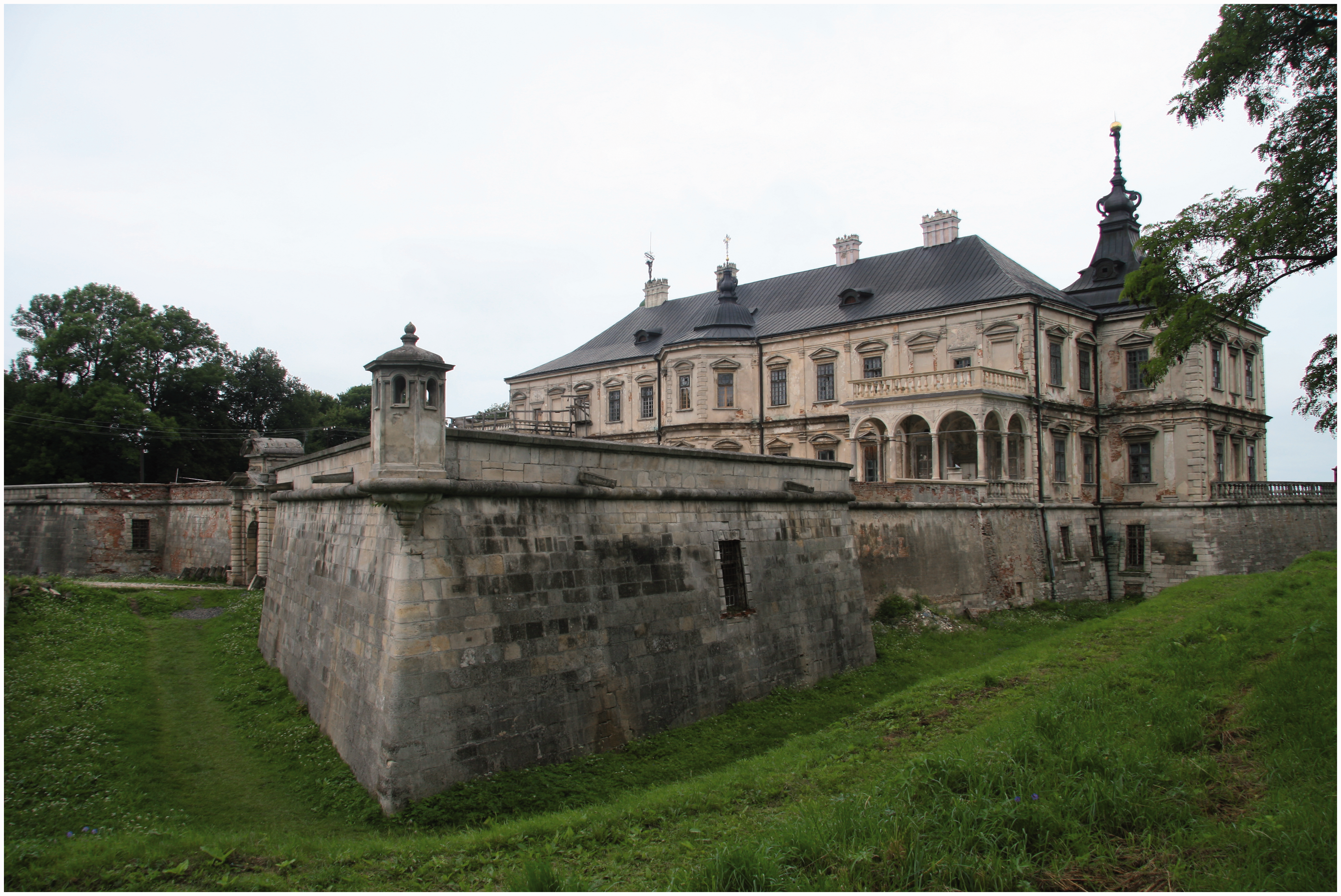
Current state of Pidhirtsi (Podhorcy) castle in L’vivs’ka region serves as an expressive example. It was built in 17th century by royal hetman Stanisław Koniecpolski as a palace-castle with a defensive function. At that time, it was considered to be one of the most spectacular magnate estate of the Polish–Lithuanian Commonwealth with its terraced gardens and a rich art collection. After the Second World War when these lands became a part of the USSR, the estate was used for the purposes of tuberculosis dispensary and suffered from a great fire that ruined the most part of its interiors in 1956. Though the castle became a part of Lviv art gallery in 1997, it remains unrestored and closed for public. However, organized groups of Polish tourists regularly come from Poland to see Pidhirtsi (Podhorcy) castle, as well as several other sites in the region that are connected with important figures or events of Polish history. Thus, Polish kings Władysław IV Waza and Jan III Sobieski set their feet at Pidhirtsi (Podhorcy) castle making the latter a prominent historical site. Instead, in current Ukrainian memory narrative, this period of history is associated with national, social, and religious oppression leaving material remnants of that times on margins of public attention.
Access system
Heterotopias presuppose a certain system of access that makes them isolated but not impenetrable. In contrast to public spaces, heterotopias are not usually freely accessible proposing some mode of opening and closing. Foucault mentions two main options: either entry is compulsory as it is in prisons or some mental institutions or a visitor has to undergo some rituals or purification procedures. So in order to obtain permission to get in, one must at first obtain a certain permission having performed certain gestures. Though, there is also a third possibility when heterotopias seem to be open or have a simple access, but that just hides peculiar exclusions (Foucault and Miskowiec, 1986: 26).
Since memory heterotopias are not supposed to be visited by the tourists, the access to them is complicated in several ways. The whole adventure of travelling to heterotopia destination resembles a quest. From the very beginning, a traveller encounters information shortage. In contrast to usual tourist infrastructure providing all possible guidance and support for the tourists, here travellers completely rely on themselves. Information about possible places to visit is mainly found on the Internet, where people share their travelling experience on personal pages and sites or special communities like the one that is analysed in this text.
In addition, after several years of popularity of heterotopias trips on the web, some publications dedicated to them started to appear in paper too. They are of three types. The first (see 500 charivnukh kutochkiv…, 2007; Udovik, 2007) consists of lists of sites with concise information about them, mainly a short historic note ending in the first quarter of the 20th century when the Soviets expropriated all the property. However, most of these publications do not provide pictures of all sites listed, as well as information about their state and accessibility. So using them for creating a travelling itinerary is risky unless combined with Internet sources.
The second type of publications (see Klochko, 2010; Udovik, 2012) has just recently appeared and includes large-scale gift albums with big photos of certain most picturesque and preserved sites accompanied with laconic texts of the same sort as in the previous type (since editors of these volumes are often the same people). No wonders that these expensive gift publication are of no use for travellers regarding their price, size, and information provided.
The third type of publications (see Antoniuk, 2008; Pustynnikova, 2009) is the most traveller friendly as they were written by the people from the mentioned Internet travelling community. In contrast to the authors of previous books, these people not only spend time in libraries combining information from scarce sources on heterotopia places but they also have visited them. Offering an advantage of practical experience, they share with the reader a narrative that resembles a combination of a guidebook, a travelogue, and a historical note. Giving its readers some practical advice about the route, how to get to the place or how to obtain the access, the authors, however, prepare future travellers that it would be nothing like the usual tourist tour, so one should perceive everything that he/she encounters during such trips as an adventure similar to those pioneers had in unknown lands.
So travellers construct an itinerary based on their research and counting on accessible means of transport and time. Regarding the later, LiveJournal travelling community members mainly design two kinds of routes. Weekend trips that presuppose returning home to spend the night and may be accomplished on the maximum 300 km distance from the place of residence, which are usually big cities like Kyiv, Lviv, Kharkiv, and alike. Another kind is a holiday trip when the travellers have enough time to reach distant regions and construct a transition route with several stops between main destinations. It can also be a circle trip that starts and ends at the same point taking different routes on the way to and the way back in order to reach more sights. Another option is a shuttle course when some town with sufficient infrastructure is chosen as the headquarters for day trips around it.
The last type of a route together with weekend trips is the most acceptable choices for travelling without a personal vehicle since the centralized long-distance public transport communication makes it harder to commute from one neighbouring village or town to another than from the regional centre to settlements around it. Nevertheless, transport connection in Ukraine is so thin that travelling without a car demands an inventiveness and more time. However, reaching heterotopias on a car is just another kind of adventure. With the poor quality of Ukrainian auto routes and nearly absent navigation regarding such destinations, the trip itself is far from being a transit process. Asking locals for directions and experiencing roads full of pits with no pavement en route turn tourists into a semi-anthropologist encountering parts of the country and people living there that they would never come across in the everyday life.
When a desirable heterotopia is finally reached, the last quest part comes into action. As it was noted earlier, most of the memory heterotopias are at the same time social heterotopias holding institutions with restricted access. Obviously, the latter does not foresee that some visitors would like to see the building due to their architectural or historical value. Moreover, local people are often unaware that the premise they are living nearby or working at has any value at all. At that point, every traveller uses his or her tactic how to get over the access constraints.
All entries dedicated to Les’kove in Cherkas’ka region in Ukraine in ‘Interesting trips around Ukraine’ community start with the words how one is unwelcome there. This little village is not even marked on all maps of Ukraine, so tiny and insignificant it is. Moreover, if one tries to reach it using one of the GPS programs, at one point it becomes convinced that no road at all leads to that destination. This village harbours the former military headquarters that happened to be situated in one of a few neo-gothic manors in Ukraine. This building has never been mentioned in none of the lists of state or local heritage and had been completely unknown to the general public until one of the most devoted travellers Iryna Pustynnikova (known as Kamienczanka or Blacky in the Internet community) accidentally found out about it from her train companion, a resident of Cherkas’ka region, in 2008. She also made the first historical note and the first visit there (Za Zbychy Mecht, 2008).
Back in the middle of the 19th century, it was a property of the old Polish noble family of Dachowski. Second generation of Les’kove owners were anglophiles so they ordered a family house to be designed in an unusual for these lands style of Tudor Gothic. After the Soviets had nationalized the property, it served as a pioneer camp, then it was turned into the medical warehouse and a military unit. The latter had been disbanded but still keeps the territory, so no one is allowed in. The travellers retell stories how guards did not allow them in and suggested that they followed official procedure. That entails going to another village to obtain permission from the head of that military unit, which is impossible on practice since this bureaucracy takes days and cannot be fulfilled during one trip. So travellers invent different ways to talk the guard into letting them in bypassing the formal procedure. Similar tactics work in most of the heterotopias with restricted access. Even if the territory around the sight has free access as it is with the majority of schools and technical colleges that use old buildings, the inside often hides some remnants of original interiors (like modelling, marble pieces, fireplaces, tile stoves, staircases, and so on). An access to them lies through a certain person in charge who is not obliged to let tourists in since the place is not a tourist destination. Despite the fact that some of the people working at institutions that are located in heterotopia buildings get used to occasional visits of strangers asking to let then in for tourist purposes, that does not change the general system and do not allow it in the open.
A part of memory heterotopia have a seemingly open access. These are mainly buildings in state of ruins that are in no way used by the locals. On the surface, nobody prohibits approaching them. However, visiting them distinguishes a visitor since he/she pays attention to the object that is usually far from being considered valuable by residents. The heterotopias visitor is immediately noticed as a stranger, tolerated as a rare guest in transit. However, often local authorities decide to shield half-ruined memory heterotopias with fences and boarded windows or even demolish them for different reasons. It is assumed that one of the reasons may be undesirable and inapprehensible attention of strangers to these objects.
Changing functions
In the second principle, Foucault suggests that each heterotopia has a precise function within a society, though as the latter undergoes changes, the mode of existing heterotopias functions can be shifted significantly. He illustrates it with the conversion of cemeteries relations with the rest of the city: starting from the immortal heart of the city, it ended being ‘the other city’ (Foucault and Miskowiec, 1986: 25). Thus, the function of a heterotopia is defined according to its relation with ordinary cultural spaces.
At their starting point, the places I discuss here represented the highest top of society rank. Aristocracy and rich bourgeoisie constructed paradise islands isolated from the peasant culture all around. Connected with each other by roads, these islands formed a separate map of distinguished points and land with no symbolic significance in between. Each castle, palace, or a manor served as symbolic mark for the whole area that was in possession of its proprietor.
For example, a history of Baturyn town in Chernihiv region was full of ups and downs. Founded by Polish king Stephan Batory and named after him, after joining the Moscovia in 1669, the town served as a residence for Ukrainian hetmans Demjan Mnohohrichnyi, Ivan Samoilovych, and Ivan Mazepa subsequently. In 1709 during the Great Northern War between Sweden and Russia, Ivan Mazepa chose the side of Swedish King Charles XII against Moscow. Having heard about that, Petr the Great gave an order to count Alexander Menshikov to conquer Baturyn. Having captured the city and having killed its defenders as well as almost all civilians regardless of age, Menshikov ground the town to dust. Even 17 years after the devastation, the town remained a deserted place associated with treason. As a description of Baturyn conducted in 1726 states, the survived residents settled only on the outskirts of the town (Lazarevskii, 1892: 117).
In 1750, Baturyn came into possession of the last Ukrainian hetman Kyrylo Rozumovs’kyi, who wanted to revive the town, to bring hetman capital back, and even to open a university there. These plans were never meant to happen since, in 1764, Russian emperor Catherine II cancelled Hetmanshchyna as an administrative unit. Rozumovs’kyi returned to Baturyn at the end of his life; in 1799, he started to build a new palace (by architect Charles Cameron) and a cathedral that was supposed to become a family burial vault. Rozumovs’kyi died before the works were finished, and the palace went into utter decay ending up being a ruin at the beginning of the 20th century.
From that point on, Baturyn has been no more than a mnemonic heterotopia like hundreds of other places in Ukraine that were connected with historical periods or events that were not a part of official history canon. For the Soviet memory canon, Baturyn was strongly connected with the personality of Ivan Mazepa who was stigmatized as a traitor since the times of the Russian Empire. This line of reasoning was continued by the USSR memory politics as Mazepa’s alliance with Sweden against Moscow subverted official memory narrative that declared centuries-old brotherhood Russians and Ukrainians and their eternal wish of a union within limits of one country. It was not until Ukraine’s independence when political career and philanthropic activity of this historic figure was unveiled; thus, he received an evaluation opposite to the previous one. Now Ivan Mazepa stands in a row ‘fighters for Ukraine’: statesmen and public figures of different centuries who are considered to struggle against foreign oppression for the sake of political and cultural self-determination of Ukrainians.
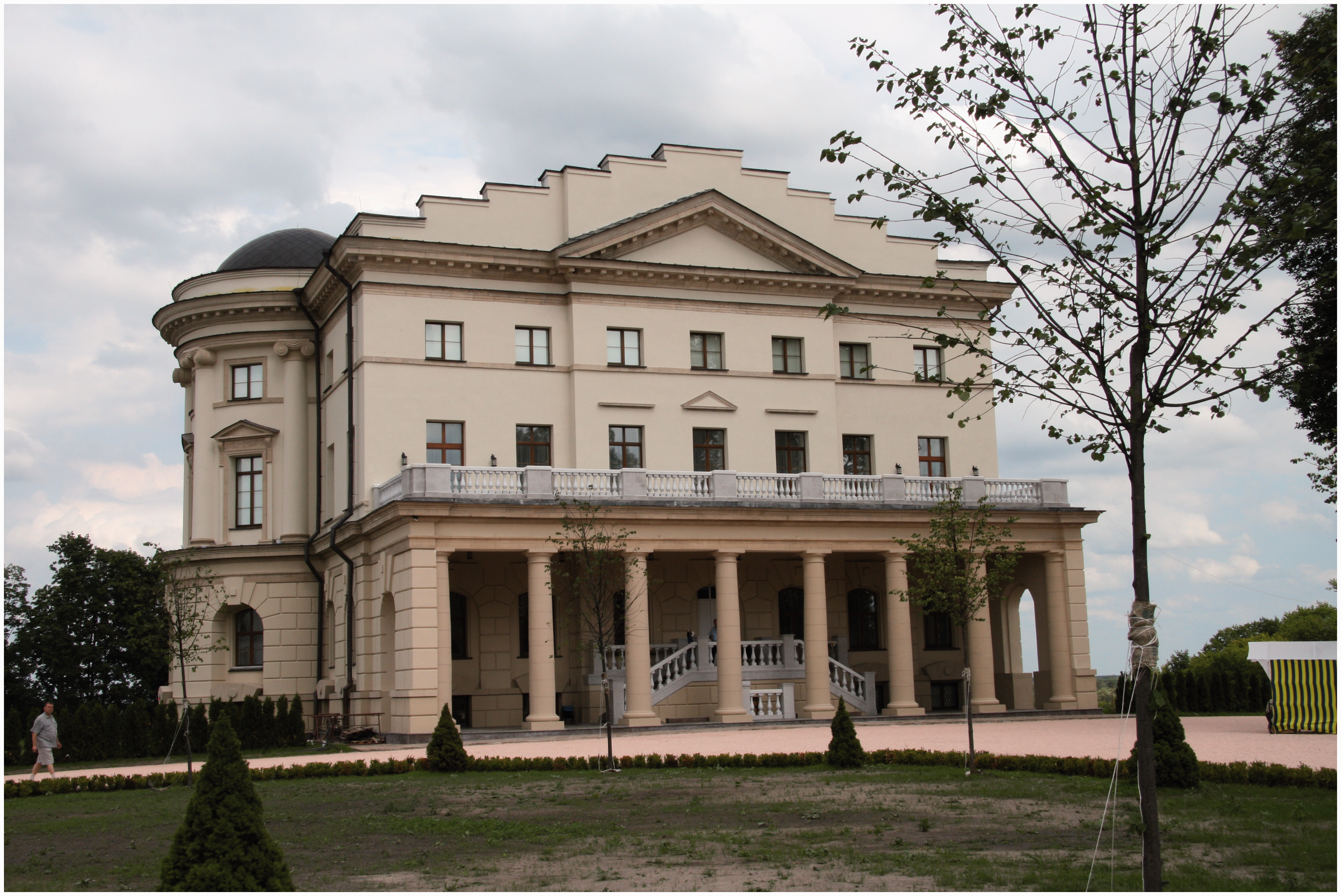
A similar rehabilitation happened with Baruryn since Ukraine gained its independence. Starting from 1993, it is a part of National Historical and Cultural Reserve ‘The Hetman Capital’. However, it was not until 2002 that real changes began when the project became a personal interest of Victor Yushchenko, the third president of Ukraine. Rozumovs’kyi palace was renovated and now holds a museum, as well as the house of the General Count of Left Bank Ukraine Kochubey, the Church of the Resurrection with the tomb of K. Rozumovsky. To add the grandeur, even the razed to the ground in 1708 citadel, a Baturyn fortress, was built anew.
That is an example how a function of heterotopia can be changed together with changes in the society of which it is a part. What used to be a ruin for more than a 100 years obtains a status of national heritage. What used to be on the margins of history becomes a part of official state memory canon. The project of renovating hetman capitals encompasses three towns Baturyn, Chyhyryn, and Hlukhiv, in none which historic environment preserved till the present day. That means that mostly artificial reproductions of lost material property and pseudo-historicization take place there. The project of renovation works explicitly states that the result of it aims at demonstrating ‘an outstanding role of these cities in the history of Ukrainian state’. These practices can be called ‘political musealization’ since they carry the purpose of representing in material forms the symbolic significance of these places (and periods of history with which they are connected) for the state historical narrative.
This example of heterotopia changing its function lies in the scope of complementary changes in society’s official discourse. Speaking about collective memory, discursive changes happen on the level of the official historical narrative of the state, while the level of microprocesses that do not reach (yet) the level of discourse are usually omitted since they are less visible and hard to grasp. Given the specificity of research and the original data available for them, changes in the collective memory that reflect or were inspired on the institutional level had always been more accessible for the analysis. However, studies of the external indicators of global changes in collective memory ignore the other end of the communication chain – the level of the recipient, though in the process of decoding, the message read by the recipient is not necessarily identical to the initial message sent.
As Michel De Certeau pointed out, along with a centralized, rational, expansive, and spectacular symbolic production of dominant structure, another kind of production takes place. It is usually referred to as ‘consumption’ because it draws its original material from products that have been imposed by the existing structure. This hidden ‘secondary’ production is developing in bypassing routes. Being dispersed, it can occur anywhere quietly and almost invisibly since it does not manifest itself through its products but rather through the ways of using the products imposed by the dominant economic order. As a theoretical model of this process, constructing individual sentences using the established vocabulary and syntax can be considered. One who speaks operates within the existing field of linguistic system but appropriates and re-appropriates the language establishing relations to time and space and postulating a contact with the other (interlocutor) in a certain network of places and relationships (De Certeau, 1984: хіі–хііі). That is why the analysis of representations (meanings produced by the system) and statistical analysis of consumer audience should be accompanied by the study of what the consumer makes of the proposed cultural representations.
Concerning former memory heterotopias renovated into governmentally sponsored tourist sites like Baturyn, Chyhyryn, or Subotiv, not much can be said about the perception of historic narrative they represent by the travellers. For instance, only in one entry of the Internet community ‘Ukraine. The Collection of Trips: Interesting travelling around Ukraine’ (Ukraїna. Zbirka Mandrivok, 2005) its author dealt with the controversy of the memory narrative. A regular author in this group in her text about Chyhyryn and Subotiv wrote about differences in interpretations of Bohdan Khmelnits’kyi as historical figure in Ukrainian, Polish, and Russian (Soviet) sources (Chyhyryn, 2008). Indeed, his politics in the 17th century led to such polar evaluations that Khmelnits’kyi fitted as a hero into such diverse historical narratives as The Russian Empire’s, the Soviet one, and the version of Ukraine as the independent state.
However, most of the entries dedicated to ‘Hetman capitals’ consist of listing pictures of separate buildings on the premises without reflecting on the narrative they represent. There is a certain difference between entries made by experienced travellers and by the beginners. The latter tend to uncritically reproduce official information and value the neatness of the renovated places, while members worldly-wise in voyages ask questions concerning expediency of developing historical sites starting from scratch. Some participants joke that the style of the renovated Baturyn palace should be called ‘oligarch’s dacha’ referring to the style of manors that contemporary Ukrainian oligarchs used to build across the country. Others refer the Chyhyryn buildings as ‘virtual reconstructions’ and use irony to underline how accurate can a reconstruction be when original building was demolished more than 300 years ago. It is worth mentioning that what travellers notice more than ideological impact of renovated sites are the material qualities of visited objects. Most of the experienced travellers note that they give a feeling of artificiality. Let’s consider why this feeling emerges.
While with self-reliant trips, a traveller is free in choice of a route and accompanying information (if any), at the site that had been turned into museum, a visitor is constantly guided through space and information. During organized tours, places are accompanied by descriptions constructed as a map (certain objects are situated in certain places) or as a tour (how one should proceed from one place to another). Either way, visited objects are arranged into a spatial narrative when, by the use of certain codes, established routes, restrictions, and prohibitions, regulations of the advancement in space are promoted. Thus, while having a tour, narrative functions as a spatial syntax that organizes space in linear or interconnected series. The chain of spatial operations produce representations of sites by appropriating and manipulating their ‘proper’ names. Therefore, genealogy, differentiation of places, and creating of boundaries between significant and insignificant lead to the establishment of a hierarchy and certain semantic order (De Certeau, 1984: 104–115).
Concerning official tourist sites, numerous travel publications accomplish a ‘reversion of the gaze’ of a future visitor offering in advance images of future trips. Then directly on the site, museums propose a visitor such pedagogical tools as audio guides and organized guided tours that would substitute direct presence here and now with light tourist information. That is why official topoi tend to turn into ‘non-places’, in Mark Augé’s terms. He writes about a negative quality of a place, about an absence of a place in itself caused by the name given to it. By the latter, ascribing a place to a certain category in social order is meant. Augé called non-places sites where the social is not being created since people there do not interact neither with each other, nor with the space. The organization system deals with visitors at the entrance and exit while inside the texts prescribe how to cooperate with the space and each other. So visitors have to interact with texts that are recommended to them not by other individuals but by authorities and institutions. This establishment can be directly stated on objects’ captions or be just guessed behind the support tools provided (signs, screens, posters, ads that became an integral part of the modern landscape) (Augé, 1995: 95). Either way, these institutions have the power of opinion leaders.
However, as De Certeau points out, redundancy in nominations can transform a place into the desert. That takes place when technocratic power takes everything under control and deprives the space of any ambiguity (De Certeau, 1984: 103). As a result, in regards to officially sacralized places, one cannot say anything besides repeating what has already been said by someone else earlier. Renovated former heterotopias or semi-historic sites that were built anew function as thematic parks detached from the space that surrounds them. These selected ‘historically valued’ towns in the middle of Ukrainian province were provided with repaired auto routes carrying to the destinations by omitting the usual local colour of pitted regional roads. Then directly on the spot, a visitor ends up spending time in the tourist bubble since secluded museum spaces stand out for surrounding infrastructure, maintenance, and look. Having added to this the supply of polished information, we receive an explanation why these sites are far from being the prior interest of the ‘Interesting travelling around Ukraine’ LiveJournal community members: only about 20 entries were dedicated to three renovated places all together.
Slices in time
Another point of description states that heterotopias are open onto heterochronies meaning that they are linked to slices in time. The functioning of heterotopia begins when visitors find themselves in the situation of an absolute break with their traditional time. Foucault presumes two types of such a relation to time. The first entails indefinite accumulation of time in a single immobile place like a library or a museum that strive for establishing a general archive of everything. The second type, on the contrary, is linked to the fleeting, precarious time as that in the festival mode (Foucault and Miskowiec, 1986: 26).
Memory heterotopias combine both types: accumulated time coexists there with the feeling of fleeting. Having arrived to such destination, a traveller lose ties with their usual chronotope. As most of the heterotopia travellers come from big cities, finding oneself in a village or a small town unaccustomed to tourist visits is already a break with their everyday time. However, this is not the main point of heterochrony, since memory heterotopias are in themselves directly connected with the pastness of time.
Memory heterotopia buildings are direct material traces of the past. If museums are a part of conscious and deliberate memory that frames the past into the present semantic structure of the social world, these traces resemble an involuntary memory that has not reached consciousness yet. As Aleida Assmann noted, traces combine remembering and forgetting. They witness how continuous lines of tradition, which were spread from the past through the present to the future, are torn apart resulting into the alienation of the past. Traces reveal a significantly different approach to the past, as they combine non-linguistic articulation of the past culture (ruins, relics, fragments) and remnants of the oral tradition (Assmann, 2011: 169–205).
The difference between official tourist sites and memory heterotopias resembles the opposition of texts and traces made by Jakob Burkhardt. By ‘texts’ he meant coded testimonies, conscious articulations of the epoch with all its (self)delusions, while ‘traces’ stand for indirect information in which non-stylized memory of the period, the memory that was not and could not be a subject to censorship or distortion is documented. Thus, traces are valuable due to the fact that silent and indirect testimonies stand out for the higher degree of veracity (Burckhardt, 1999: 173–184). Whereas writing is a coding of speech in the form of visual signs, a trace goes beyond the language and the symbolic process of encoding. Semiotically, it is read as an index sign, an evidence of the past at the basis of which there is no code. Since index signs signify through the kinship with their referent, they are perceived as direct imprints of what has passed. The transition from texts to traces marks the passage from intentional language signs to the evidence where there is no subject writing them, as if the past recorded itself. This part of the memory storage holds unrelated, uncoordinated by the narrative elements that are not requested by the official version of collective memory.
Architecture in the state of decay and destruction serves as direct remnants and traces of the past. Fascination with ruins ran all along the 18th and 19th centuries when it was a popular form of intensifying the presence of the past in the modern times. Georg Simmel describes the ruins as objects on the verge of nature and culture. They have a problematic, exciting, and often unbearable influence on the individual who contemplates something that slips out from an active life turning into its passive frame. An awareness of a distance, of a time gap comes through the material form of the ruin. Thus, the latter evokes memories of the past as it is a remnant of what have disappeared, which creates in the present a form of the previous life not by the content but by the past as such (Simmel, 1959: 259).
It seems that authentic ruins as they existed in the 18th and 19th centuries have no place in the late capitalism culture of commodity and memory obsession. Commodities do not possess the time to age. Having served their purpose, they are thrown away or recycled. Obsolete buildings are destroyed, while others are restored to function according to current demand. Thus, ruins of the past centuries are used as settings for concerts, conference sites, hotels, vacation rentals, or cultural centres. As the result, chances for a building to age naturally becoming a ruin have diminished (Huyssen, 2010: 19). Though Andreas Huyssen is convinced that since we live in times of preservation, restoration, and remakes that cancel out the possibility of authentic ruin existence, memory heterotopias prove the different. A lot of objects among them have reached the condition when future preservation becomes impossible. These buildings have been extensively exploited since Soviet times for the purposes they were not originally designed for and now have reached the age when their future use requires substantial financial investments. However, for the local authorities it is cheaper to construct new buildings to host schools, technical colleges, or hospitals. Therefore, the old ones are abandoned at mercy of natural decease.
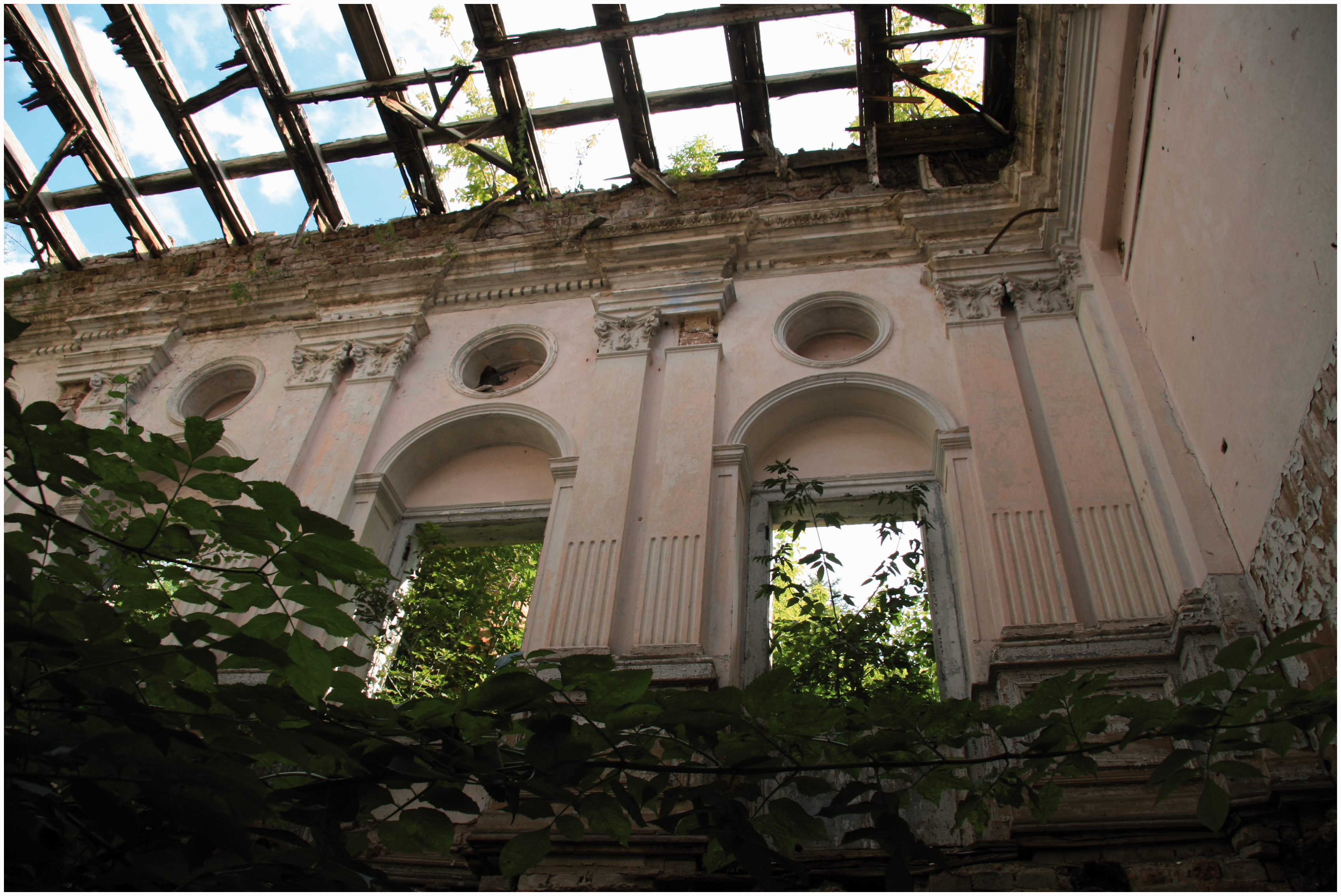
Among countless others, that is the case with the former palace (edge of 18th and 19th century) of Przyłuski family in Napadivka (Napadówka) (Vinnyts’ka region) that was bought in 1875 by Danish poet and translator Lange Thor. When in 90s, the local school had been transferred to the new building, the palace was abandoned at mercy of rains, snows, and local vandals. Parts of former wall and ceiling modelling lying on the floor remind the visitor of the fleeting time and temporality both of historical epochs and one’s own experience since one could always happen to be the last to observe that particular building.
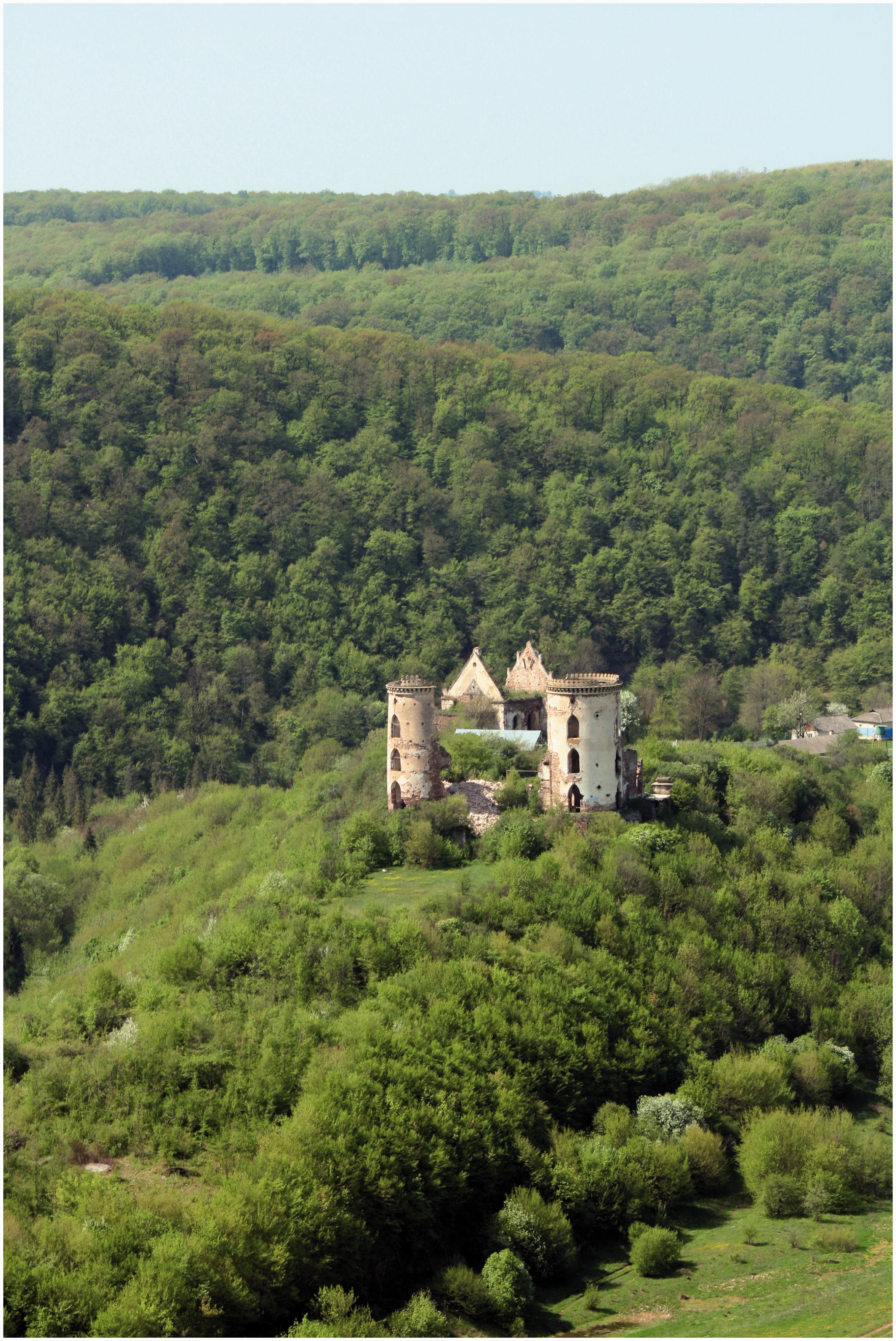
These were the emotions of a number of travellers when, in 2013, they found out that the tower of one of the most picturesque Ukrainian ruins Chervonohorod (Chervonohrad, Czerwonogród) caved in. It is a beautiful gully in Ternopil’s’ka region where a town, a fortress, and a castle used to be in the 14th–18th century. The latter was remodelled into a palace in 1820 with a cathedral and a waterfall nearby. The town vanished after the First World War, and the palace lived out as the ruin till the present day when it was discovered by heterotopia travellers. The mentioned earlier traveller Blacky was fascinated by the old picture of the castle–palace in one of Polish books and was determined to find the place if some remnants of it still existed (Chervonohrod, 2005).
Appeal of the ruins is connected to their capacity to provoke Johan Huizinga’s ‘ahnung’ (Ger. ‘presentiment’) – a contact with the past that is not reducible to anything outside itself, an entrance to the world belonging exclusively to the past. That deals with the notion of ‘sublime historical experience’ through which Franklin Ankersmit offers to oppose the hierarchization of the past reality. Historical experience is how we experience past at the moment of its simultaneous uncovering and renewal. It is the uncovering of the past as a reality that someday has detached from the present and now urges to restoration in the form of crossing the barrier between the past and the present (Ankersmit, 2005: 275–287). Certainly, that crossing of the frontier happens only in the traveller’s imagination; that takes us to the next point.
Juxtaposing spaces
The influence of ruins does not exhaust with the semantics of pastness. One more of Foucault’s heterology principles says that the heterotopia juxtaposes in a single real place several spaces that are foreign to one another (Foucault and Miskowiec, 1986: 25). Therefore, every memory heterotopia in Ukraine juxtaposes three different epochs represented by three types of spaces merged into one – time of the construction and original use of the building, Soviet conversion, and contemporary state.
Thus, each building functions as a palimpsest with three layers. All three times are reflected in the materiality of the object, its textures, colours, and condition so that visiting one building takes the traveller for a walk through the last two centuries. For instance, the village of Sharivka in Kharkivska region hides one of the biggest 18th century estates in Ukraine. Its several former proprietors left an ensemble consisting of a palace, a park, a conservatory, stables, an automobile garage, power station, workers’ housing, and alike. In 1923, the estate was converted into the tuberculosis sanatorium. The later was removed after Ukrainian independence, but the buildings have not been used since.
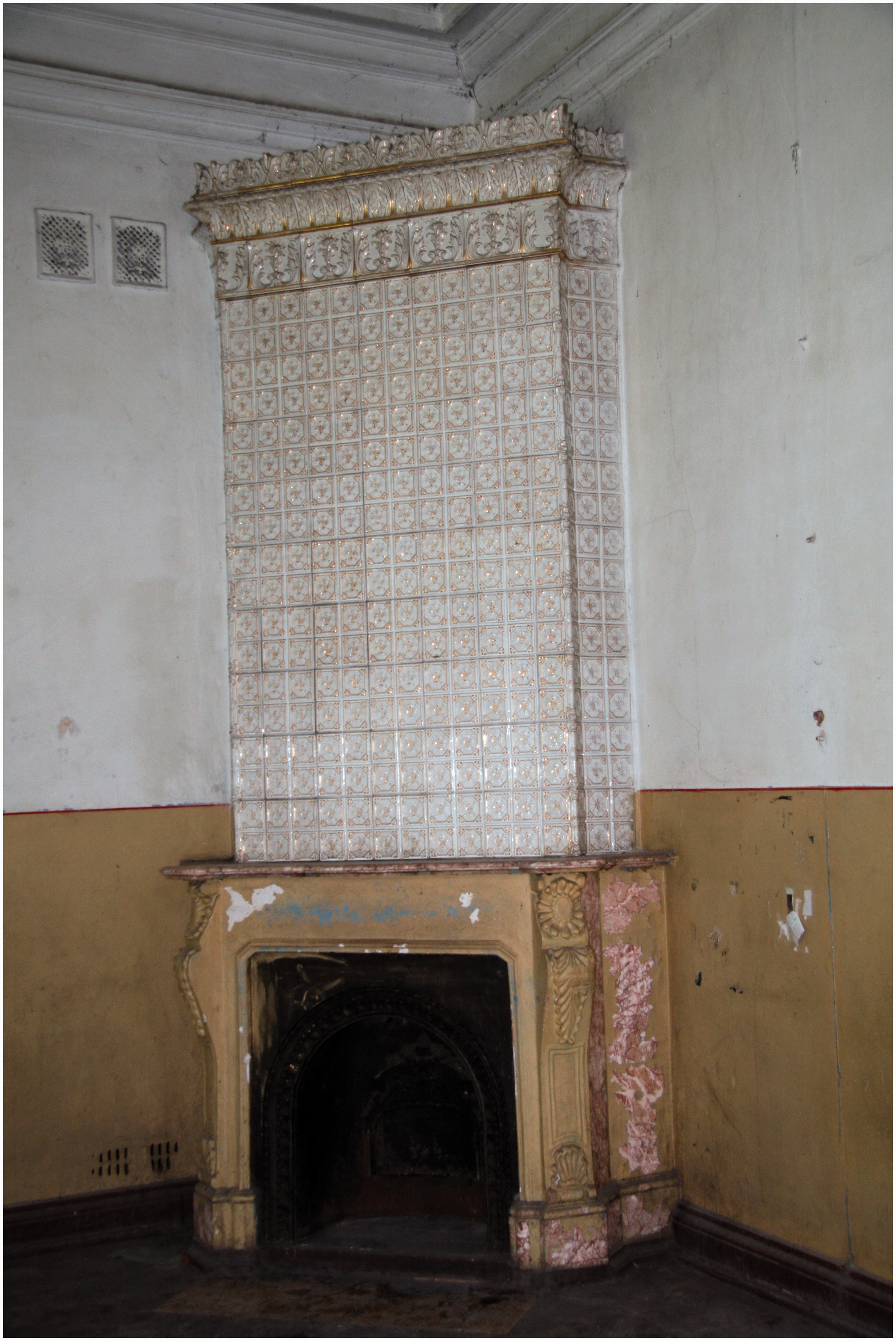
The palace functions as a lacuna in the middle of an overgrown park to which people living nearby come for a walk on weekends. Some of the inventive travellers were lucky enough to get inside the palace. As a former tuberculosis sanatorium that has not been disinfected, it is officially forbidden for visits, but a guard can be persuaded otherwise. If so, a traveller, cautioned against staying near the windows in order not give evidence that there is someone inside, would have a quick tour through three time layers. Preserved aged wood panelling, columns, wall paintings, and tile stoves remind of the grandeur at the cost of social inequality. Thus, one of the estate’s owners Leopold Kenig in 1903 forced a thousand of local peasants to move to Ufim province just because he desired to expand the property and refine the scenery. Peeled paint in typical Soviet establishments colours through the cracks of which original marble decor is seen tells a silent story of the promise of the communist golden age that started with expropriating palaces for the people and ended with prison-like hospitals with crowded wards like these former estate bedrooms. Finally, trying not to make deep breaths in case of tuberculosis coli, the visitor would embrace this empty, dusty space with remnants of old tracery parquet as the embodiment of the current status of memory heterotopia. Being suspended according both to functional use and historical interpretation, most of them have equal chances to dismantle or to be reframed into the new collective memory narrative.
Unlike the usual imaginary of the ruins that leads to positioning of origins and creation of a discourse that legitimizes the power claims of modern nation-states, heterotopia travellers’ narratives do not produce genealogy or nostalgia discourse. Their texts contain no notion of the glorious past or golden age, as well as no remorse for subsequent historical events. The only distress omnipresent as the background leitmotif is a pity about the ramifications of the Soviet period usage of these buildings that had led to irreparable losses. In general, entries on the ‘Ukraine. The Collection of Trips: Interesting travelling around Ukraine’ LiveJournal community do not usually deal with historical grand narratives so that information an author found about particular place is limited to local scale having more to do with recreation of the buildings’ original looks and purpose.
Huyssen evokes the paradox of the ruins: what seems present and visible when authenticity is claimed is, in fact, present only as an absence. That is the imagined present of the past that can now be grasped only in its decay. Thus, any ruin posits the problem of a double exposure to the past and to the present (Huyssen, 2010: 20). That said, it should be expanded how imagination comes into play within heterotopias travelling experience. Initially, an old mansion on the outskirts of a provincial Ukrainian district centre attracts attention of a foreigner as an object that is at odds with the general structure of a post-Soviet settlement. Then it becomes a time break that gives direct access to the past through the tactile time traces on it. Since it is the contact with the past that had not been incorporated into the modern collective memory narrative, it estranges the habitual official vision of the past and induces the work of traveller’s imagination.
Imagination privileges fragments, allegories, and collage since the work of imagination requires a distance. An object attracts by its inherent lack as a mechanism of seduction that lies in the basis of interest and is determined, according to Jean Baudrillard, by the vagueness. The seduction is a game of appearances that subverts systems of sense and power. It consists in expelling of one of the dimensions from the real space since redundancy blocks imagining, whereas lack stimulates it (Baudrillard, 1990).
When a memory heterotopia is in the condition of the ruin, it gives an extreme example of this mechanism. Thus, ruins of the 19th-century Sobański family palace in Obodivka (Obodówka), Vinnyts’ka region are close to the state of returning to the nature mentioned by Simmel. The roof and floors caved, and the walls are slowly dismantling in the weed-filled surrounding. It is impossible to conceive the general structure of the building anymore. It seems that the palace is at the edge of turning into simple building garbage unless suddenly, having rubbed through the shrubbery, one notices remnants of the wall modelling on the first floor. This partial object in the unconventional surrounding enacts imagination about its original context.
Therefore, in contrast to duplicating reality that takes place in museum spaces where surrounding is turned into the hyperreality (an absolute evidence to which it is impossible to add anything from yourself), memory heterotopias are always determined by lack and ambiguity as the result of information shortage and uncertainty of their current status. This incertitude of the framework is a fruitful ground for the work of imagination, as well as for occurrences of sublime historical experience that is more likely to appear outside any context. In such spaces, a traveller turns into a detective trying to reconstruct the past from the traces. The work of the imagination here is not less vital than archive research since the imaginary is not identical to fiction. It is a discovery, a production that can lead to unexpected results.
For instance, mentioned earlier picturesque ruins of Chervonohorod (Chervonohrad, Czerwonogród) in Ternopil’s’ka region are not only silent remnants of indefinite past that can provoke sublime historical experience, but they are also traces of a turbulent 20th-century history and of ethnic conflicts than took place on this frontier territory. Chervonohorod has never been mentioned in any official list of heritage neither in Soviet Union, nor in independent Ukraine. Now short historic notes are available both in print and on the web telling about the founding of the fortress town in 10th or 14th century, about its military past as a centre of Podilska province (Województwo podolskie), and its modification into a palace by new owners, the noble family of Poninski at the turn of 19th century. The demise of the town that led to its wiping from the map is described more than laconically. Some sources mention that it just disappeared during the First World War; others state that it was sacked by Russian troops (Ivchenko and Parkhomenko, 2009: 234). However, if a traveller, fascinated by mysterious ruins, applies to Polish sources, he/she would find a description of a tragedy when in 1945, troops of the Ukrainian Insurgent Army (UPA) killed up to 60 local dwellers during its attack on the town that was a residency of Polish self-defence (see Zbrodnia w Czerwonogrodzie).
The topic of massacres of Poles in Volyn’ and Eastern Galicia is still a marginal one in Ukraine. In 1943, about 60,000 of Poles were killed by the UPA in its attempt to make this territory mono-ethnic aiming at the potential post-war negotiations where ethnical structure of the population (there were 15% of Poles in this region at the time) could be a decisive factor for the state belonging of territories like it was after the First World War. While for Poland these events occupy an important place in collective memory narrative under the notions of ethnic cleansing and genocide, information about them in Ukraine lacks acuteness and takes form of generalizations and euphemisms. Ukrainian memory discourse has always been ambivalent about the UPA. It has never been officially acknowledged as a combatant of Second World War, but it was integrated into the dominant memory narrative as one of the links of Ukrainian struggle for independence. The situations are further complicated by political manipulations concerning these bloody pages of history. Political forces that voice opinions about UPA crimes combine it with glorification of Soviet army and brotherhood of nations in the USSR, while nationalistic discourse silences these events presenting the UPA as heroes of national liberation movement.
Since information about UPA massacres is used as a propaganda tool by radical forces positions of which are unacceptable of the majority of Ukrainian population, the topic of Ukrainian-Polish violence has scarce chances to receive an unbiased coverage starting from public discourse. However, testimonies that come bypassing political sources, such as a silent witness of Chervonohorod (Chervonohrad, Czerwonogród), can serve as an initial step to raising from oblivion events of contested past.
Mirror function
The final and the most embracing trait of heterotopias states that they have a function in relation to all the space that remains. It can be of two extremes. One creates the space that is other by being perfect and well arranged in contrast to the usual chaotic world. The other creates a space of illusion that exposes every real spaces inside which human life is partitioned as even more illusory (Foucault and Miskowiec, 1986: 27). Regarding the memory heterotopias we deal with the second type. As Walter Benjamin wrote comparing the power of the image to that of the material fragments, ‘Allegories are, in the realm of thoughts, what ruins are in the realm of things’ (Benjamin, 1977: 178).
Foucault left an assumption that between utopias and heterotopias some kind of a mixed experience is produced that serves as a mirror. The latter exerts a counteraction to the position of the one who is looking into it. Due to that, the viewer later directs the gaze towards oneself reconstituting his/her identity and a place in the usual surrounding that suddenly appears as absolutely unreal (Foucault and Miskowiec, 1986: 24). In case of memory heterotopias, the position that is seen in new light is the official state narrative of Ukrainian collective memory.
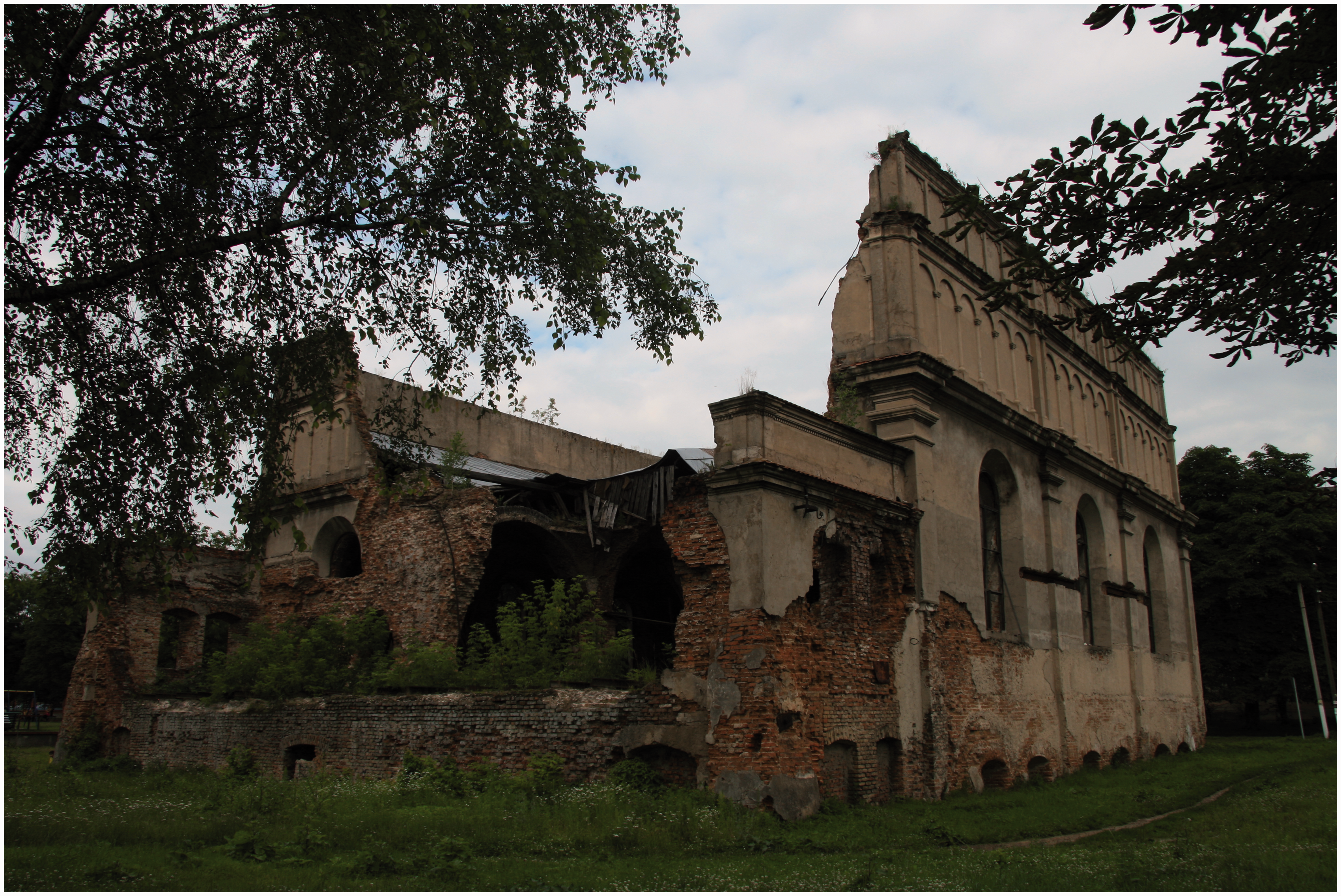
For example, once a traveller observes a half-ruined synagogue in the centre of the town Brody in Lvivs’ka region, it immediately attracts attention as an object that falls out from the ordering of the space. The traveller can’t stop wondering how did it happen that a ruin is situated right in the middle of the town’s public space. A quick web search would uncover a short history of the Grand Brody synagogue. Built in the middle of 18th century for the town where the majority of population was Jewish, the synagogue served as a setting for narrations about the founder of Hasidic Judaism Baal Shem Tov and the Jewish miracle-worker and Rabbi Shulim. The Jewish community of Brody was perished in the Holocaust, and the synagogue that used to be a centre of once vibrant community was remodelled into a storehouse in the 60s and abandoned later. Similar stories would tell remnants of Jewish cemeteries and synagogues in numerous towns in Western, Central, and Southern Ukraine thus unveiling a whole layer of history absent from Ukrainian collective memory narrative.
Here we see how during the stages of re-signification of the past, the objects with the zero-degree value serve as an indicator of changes. Creation of value systems is founded on the principle of limitations and borders implementing. That is why the category of waste gives an opportunity to consider transformations of utilitarian and symbolic attitudes to certain segments of material culture. The category of garbage is especially fruitful since rubbish is not a subject to control mechanisms and hence is flexible enough for new, unexpected functions that people attain to them (Tompson, 1979: 26). The objects of heterotopia trips could be regarded as historical rubbish since according to their treatment by official institutions, they have no value for the country.
However, function is a derivative of the object’s application, while the potential modes of objects’ use (that can be ‘proper’ and ‘improper’) have an infinite number of variations (Frow, 2003: 36). Thus, memory heterotopias in Ukraine are not considered as valuable objects and thereby are not intended to be tourist destinations, but their function is temporary changed each time a heterotopia traveller comes by. The practices performed by heterotopia travellers could be regarded as tactics in Michel De Certeau opposition of strategies and tactics. The former are the production practices of those in positions of power. A strategy implies a proper place that serves as a basis for generating relations with the outside world. The latter is regarded by those in authority as a target/client/object of study, hence, political, economic, and scientific rationality is constructed according to a strategic model (De Certeau, 1984: 25–43). Therefore, an official version of community’s collective memory embodied in tourist sights operates within the strategic mode, while heterotopia travellers practice certain kinds of tactics. The latter cannot rely on ‘proper’ places (spatial or institutional localization) since the place of tactics’ deployment belongs to the dominant ‘Other’. Tactics penetrate that place in fragments, without gaining it entirely, as well as without the ability of saving it afterwards. While strategies reign over the space, tactics rely on time: they are always searching for the opportunities of temporary reappropriation of a part of power space. Forced to use alienated means, tactics take place during favourable times, as a result of existing heterogeneous elements combinations. In the end, a witty synthesis of pre-given elements takes form not of a discourse but of the practice of using the occasion that occurs (De Certeau, 1984: 25–43).
Performing their travelling tactics, heterotopia rover gains anthropological experience of the country and its people. Having departed with the knowledge of official collective memory that is, as it was shown earlier, ethnically and class specific, the heterotopias travellers encounter another Ukraine during their trips. In Sent-Miklosh (Szentmiklós) castle in Chynadiievo, Zakarpats’ka region, one is told stories about Hungarian heroine in the struggle for national liberation Ilona Zrini. A distant village Verhivnia in Vinnyts'ka region would tell the story of love of the owner of local estate Polish countess Ewelina Hańska and Honore De Balzac, while in Berdychiv one can find Saint Barbara Cathedral where they wedded. Four former manors in Zhytomyrs’ka region are the remnants of activities of the Ukrainian Tereshchenko family famous for its charity and public engagement at the beginning of the 20th century. Abandoned protestant cathedrals in Mykolaivs’ka region tell about German colonies in Ukraine, while Tatar settlements and Karaites kenasas in Crimea, as well as remnants of Jewish synagogues all over Ukraine would remind that this land has always sheltered people of various ethnicities and religious denominations. Thus, pieces of Polish, Hungarian, German, Lithuanian, Russian, Austrian, Ukrainian, Jewish histories gathered by heterotopia travellers upon their trips subvert the exclusive approach of the official Ukrainian history.
An archive of the heterotopia traveller would consist of unordered name lists all of which could be summarized by the phrase, ‘And that is Ukraine too’. Quite similar to the enumeration of names in the preface of ‘Being singular plural’ by Jean-Luke Nancy, which he uses to signify the Earth and humankind. They seem an endless multiplication of centrifugal senses that lead to nothing but isolation and rejection. Ex altera parte, it is an illustration of the world’s ontology as a totality of singularities. Neither of these singularities was the source of others since from the very beginning there were ‘we’ embodying co-appearance as the original disposition. Thus, every community has a singular plural essence, and the sense of any community is deprived of substance, subjectivity, and personality being limited to coexistence (Nancy, 2000). The latter is best described by the notion ‘partager’ from the original that combines meanings of dividing and sharing.
Nancy’s approach proposes to step aside from a certain image of the community, from a certain identity since traditional forms of the latter personified in notions of people, nation, church, ethnic group, and roots are reactionary solutions. Instead of disposition and co-appearance they represent the desire of fixed position based on some initial roots deep in the past. Traditional approach to communities is founded on the impossible installation of unity while contemporary world demands to consider community as a fruitful endless diversity of coexisting beings (Nancy, 2000). Thus, social existence should be perceived as an eternal dialogue that does not regard reaching a consensus as its aim since the sole act of endless communication is the content of coexistence.
Things usually become visible when they are deprived of their objectification, when certain objects fall out of all value systems (Hawkins, 2006: 79). This is the case of heterotopias sites in Ukraine. Having no official status, as well as no place in official memory narrative, they serve as a threshold for discovering another history of Ukraine. In contrast to the exclusive narrative of Ukrainian nation that has always been a victim – a victim of ‘Polish nobility reign’, ‘Turkish-Tatar aggression’, ‘russification’, Nazi occupation, and communist terror – and struggled for its independence against representatives of other nations and religious denominations, heterotopias propose a glimpse of a different approach to the past. The one where contested memories are taken as a shared past, a territory of co-being of several subjects with mutual faults and responsibilities instead of eternal villains and victims positions. The very fact that such ‘rubbish’ objects as Ukrainian memory heterotopias have been noticed means that the hour for resignification has struck. Things and people are co-producing each other: the things are the products of social relations and are simultaneously influencing the later (Frow, 2003: 36). Thus, heterotopia sites in Ukraine serve as pieces of the multidimensional puzzle of the multicultural past of Ukraine that has yet to be assembled.
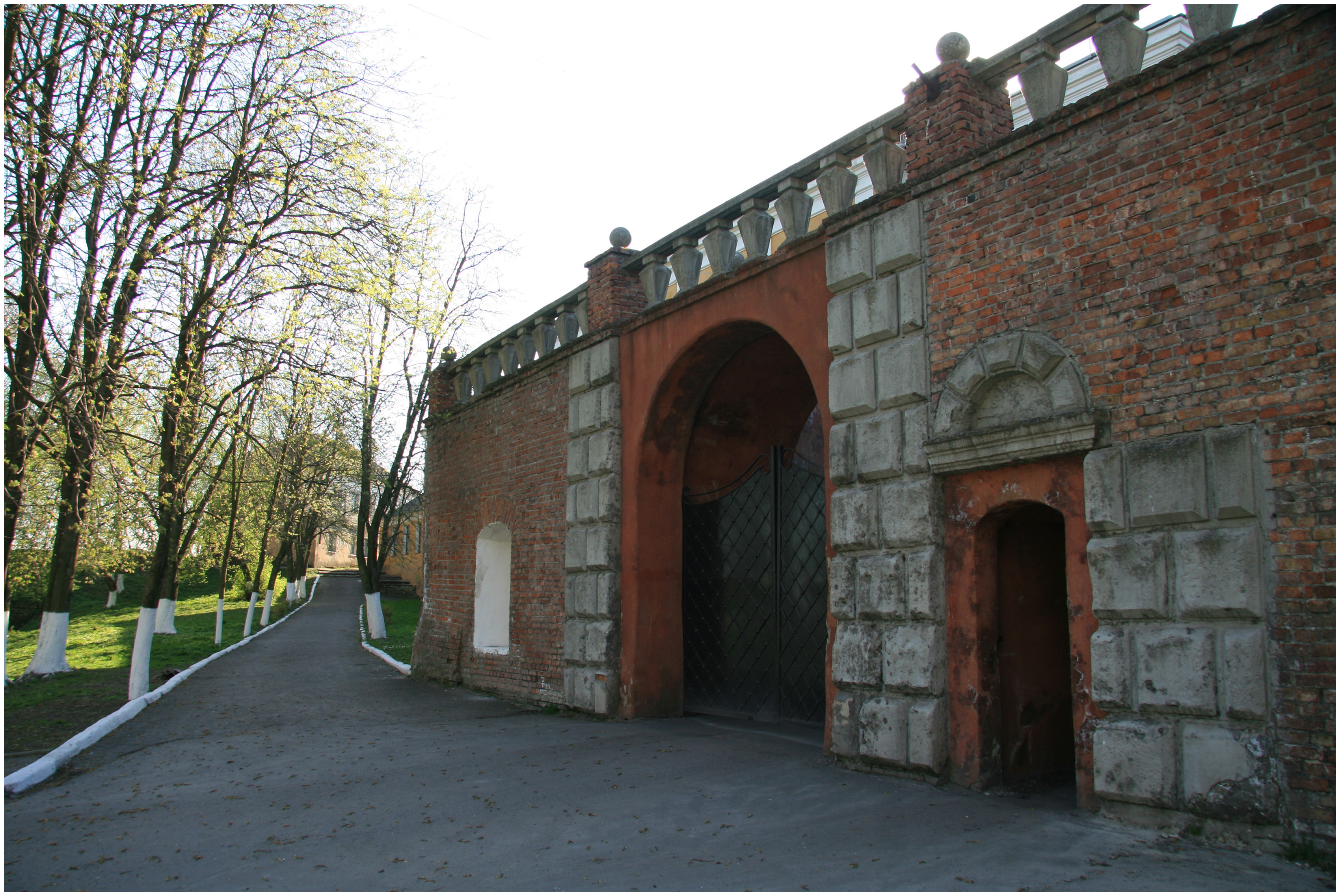
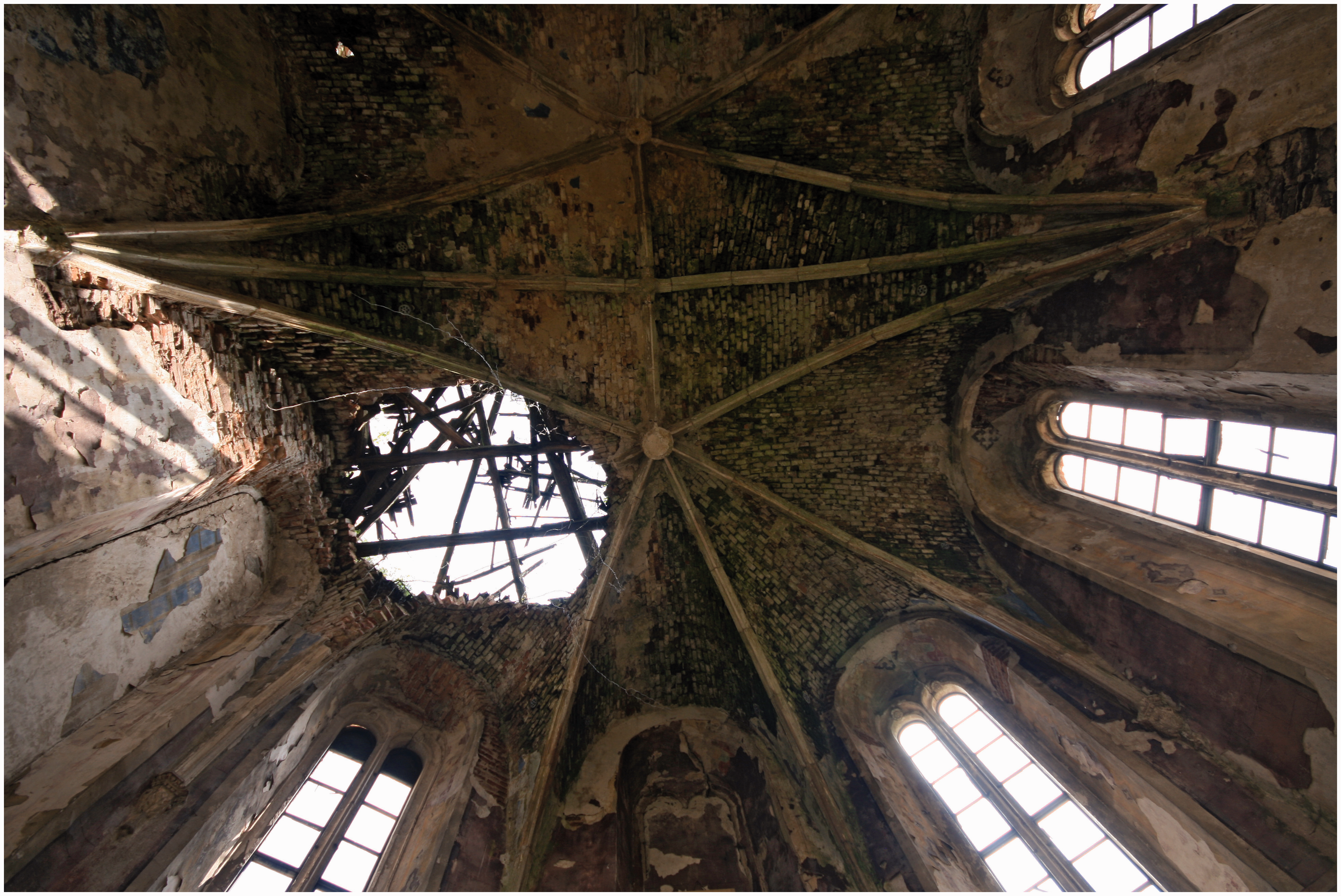
Tarakanivs'kyi fort, nineteenth century, Rivnyns'ka region, Ukraine. Gate of the former Lithuanian castle in Olyka (16th century, Volyns'ka region, Ukriane) used as an asylum for patients with mental disorders. Seventeenth century Pidhirtsi (Podhorcy) castle-palace built by Polish royal hetman Stanisław Koniecpolski in Lvivs'ka region, Ukraine. Les'kove manor in Cherkas'ka region, 19th century. Renovated 18th century Rozumovs’kyi palace in Baturyn, Chernihivs'ka region, Ukraine. Caved ceiling of the abandoned Catholic cathedral in Yazlovets' (Jazłowiec), Ternopil'sa region, Ukraine. Devastated Chervonohorod (Chervonohrad, Czerwonogród) castle in Ternopils'ka region, Ukraine. Pained over marble fireplace in Sharivka in Kharkivs’ka region. Remnants of the ruined manor the wall modelling in Obodivka (Obodówka), Vinnyts'ka region. Ruined Jewish synagogue in Brody, Lvivs'ka region.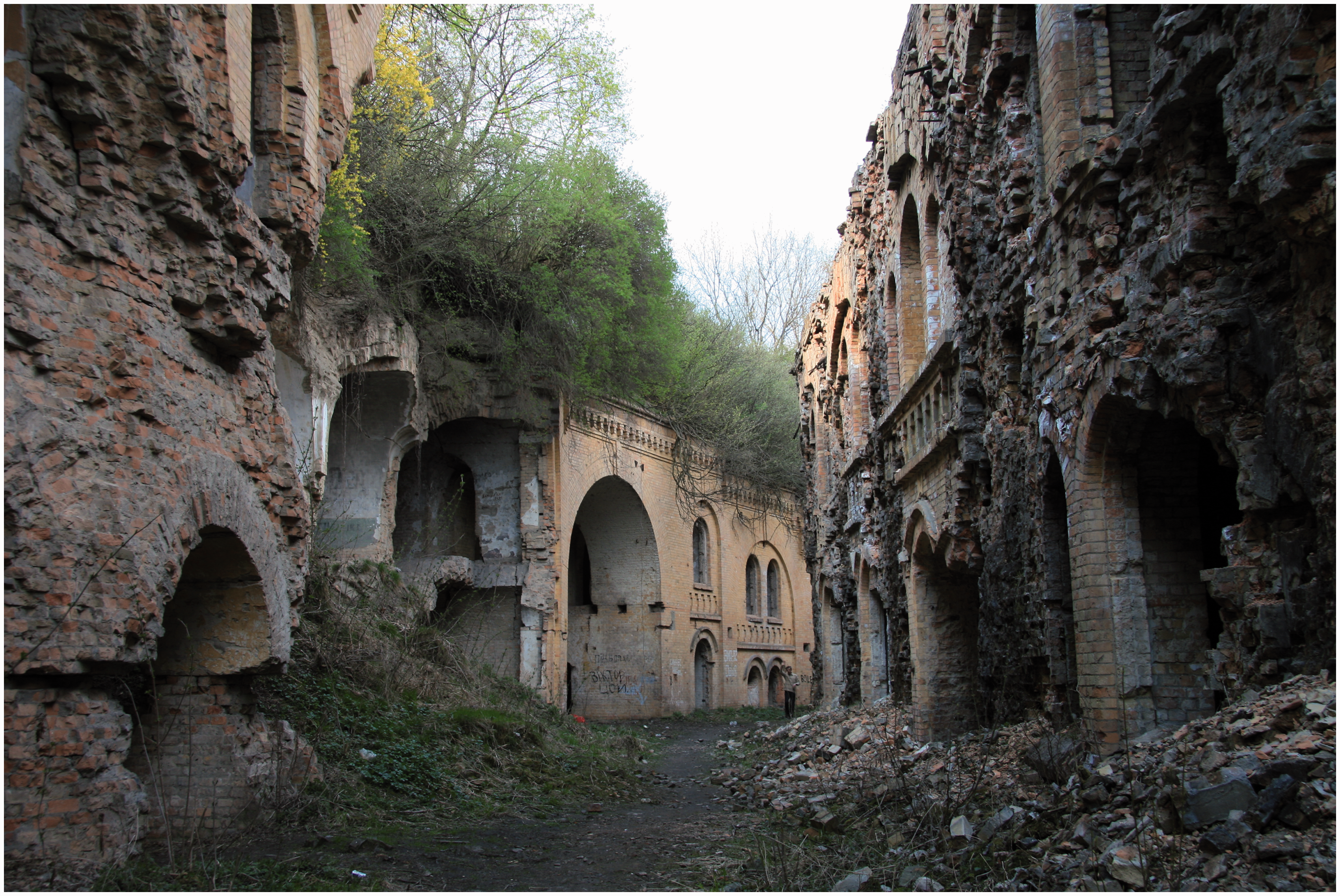

Footnotes
Declaration of Conflicting Interests
The author(s) declared no potential conflicts of interest with respect to the research, authorship, and/or publication of this article.
Funding
The author(s) received no financial support for the research, authorship, and/or publication of this article.