



Abstract
There is a conceptual gap in the marketing literature, as to date there has been no published empirical research on festival switching intentions, festival satisfaction, festival image, festival affective impacts, and festival quality that have focused in the context of food festivals. This study seeks to fill this conceptual gap by identifying the dimensions of festival quality and empirically examining the interrelationships among festival switching intentions, festival satisfaction, festival image, festival affective impacts, and festival quality. A multidimensional and hierarchical model is used as a framework to synthesize the effects of festival quality, festival affective impacts, festival image, and festival satisfaction on festival switching intentions. Statistical support is found for four primary dimensions and 13 subdimensions of festival quality for food festivals. The hypothesized paths between the higher order constructs—festival quality, festival affective impacts, festival image, festival satisfaction, and festival switching intentions—are confirmed. The results of this analysis contribute to the services marketing theory by providing additional insights into festival switching intentions, festival satisfaction, festival image, festival affective impacts, festival quality, and the dimensions of festival quality. The results of this study will also assist festival management in developing and implementing market-orientated service strategies to increase festival quality and festival affective impacts, enhance festival image and festival satisfaction, and decreasing attendees’ switching intentions to other food festivals.
Keywords
Introduction
The study of food festivals is now an important and prolific area of tourism research enquiry (Mohi et al., 2013). Lewis (1997) defines food festivals as “festivals that purport to center on and revolve around food” (p. 1). The growth of festival tourism in recent years has been accompanied by an increase in its diversity and popularity (Crompton and McKay, 1997; Gursoy et al., 2004). As competition increases, tourism businesses and organizations need to develop effective methods for being more responsive to peoples’ needs (Lee et al., 2007). There are, for example, about 5000 festivals and/or events held every year in China (Lu et al., 2009), where governments and non-governmental organizations at all geographical levels are attempting to use tourism, festivals, and events alike as tools in shaping their respective cultural identities (Yan and Bramwell, 2008). For centuries, Guangzhou in China has formed a unique food culture, and gained the reputation of “East and West, Cantonese food is the best” (Wu, 2015). Gourmets will enjoy attending the Guangzhou International Food Festival (GIFF). The GIFF celebrates China’s love of great food (Guangzhou Airport Hotels, 2015). The GIFF was founded in 1987 and, since then, has gradually become a famous tourism festival centered with food, mixed together with wonderful activities of entertainment, commerce, and tourism. The festival, as an annual eating event, attracts a large number of attendees both at home and from abroad every year. Attendees join the amazing food party to taste delicious food and to experience the unique dietary culture of the Lingnan area (Wu, 2015). The focus of this study is on food festivals. Like other leisure and tourism providers, festival managers are likely to contend that their primary goal is to provide high quality, satisfying experiences that attendees perceive to be good value in order to decrease the probability that the attendees will switch to other food festival (Lee et al., 2007). Customer switching in service environment means customer forsaking one service provider for another (Garland, 2002). It can be total or partial (Colgate and Hedge, 2001; Stewart, 1998). Total switching is usually easy to detect, since customers close all their accounts and switch their entire intention to another service provider (Boote, 1998). Partial switching is determined as a loss of any portion of a customer’s intention and is significantly more difficult to detect than total switching (Siddiqui, 2011). Therefore, in order to enable attendees to return or revisit the food festival again next year or the year after, food festival managers should focus on decreasing attendees’ switching intentions.
In services marketing literature, switching intentions remain prime focus in relationship marketing concept (Oliva et al., 1992; Reichheld, 1993). Numerous empirical studies reveal that satisfaction has a positive impact on different variables such as loyalty and recommendation behavior. However, customer switching intention is negatively influenced by satisfaction (Hennig-Thurau et al., 2002; Mittal and Lassar, 1998). Cheng and Liu (2011) indicate that a corporate image not only directly decreases customer’s switching intentions, but also mediates, as a “buffer”, the relationship between satisfaction and switching intentions. On the other hand, some researchers (Chen and Tsai, 2007; Cole and Illum, 2006; Srivastava and Sharma, 2013) argue that satisfaction completely mediates the relationship between quality attributes and switching intentions while others (Baker and Crompton, 2000; Chi and Qu, 2008) demonstrate that satisfaction only has a partial mediating role. Jiang and Wang (2006) and White (2010) argue that quality influences or precedes perceived affective impacts. The affective impact is an important aspect of consumption and it will be influenced by quality, resulting in satisfaction (Bagozzi et al., 1999; Westbrook and Oliver, 1991). The literature shows that existing studies generate quite different findings and incongruent conclusions regarding the relationship between affective impacts (pleasure and arousal) and quality evaluation and/or satisfaction (Jiang and Wang, 2006). Based on the aforementioned review, very little academic work focuses on the interrelationships between festival switching intentions and the other constructs related to switching intentions: festival satisfaction, festival image, festival affective impacts, and festival quality in a festival context (e.g. Chang et al., 2014; Song et al., 2015; Srivastava and Sharma, 2013; Wong et al., 2014; Wu et al., 2014c).
The primary and subdimensions of quality perceived by customers have been applied in different industries, using multidimensional and hierarchical modeling as a robust and testable framework (e.g. Brady and Cronin, 2001; Clemes et al., 2008, 2011a, 2011b, 2013a, 2013b; Dabholkar et al., 1996; Wu et al., 2014a, 2014b). However, Wong et al. (2014); Wu and Hsu (2012) and Wu et al. (2014c) indicate that very few studies focus on identifying the primary and subdimensions of festival quality using a multidimensional and hierarchical model for food festival attendees.
In this study, there are three research objectives. The first objective is to identify the dimensions of festival quality as perceived by food festival attendees using a multidimensional and hierarchical framework. The second objective is to examine the interrelationships between festival switching intentions, festival satisfaction, festival image, festival affective impacts, and festival quality as perceived by food festival attendees. The third objective is to identify the least and most important dimensions of festival quality as perceived by food festival attendees.
The contribution of this study is twofold. First, this study contributes to the marketing literature by providing an examination of several services marketing constructs. This is an important contribution because it provides a better understanding of attendees’ perceptions of festival quality, festival affective impacts, festival image, festival satisfaction, and festival switching intentions. Second, this study conceptualizes and measures attendees’ perceptions of festival quality using a multidimensional and hierarchical approach. This approach helps to overcome some of the weaknesses of traditional SERVQUAL (a disconfirmation-based measure of service quality), SERVPERF (a performance-based measure of service quality), and FESTPERF (a service quality measurement scale for festivals) scales and thus provides a more accurate approach to assessing attendees’ perceptions of festival quality in a food festival.
Literature review
Festival switching intentions
Sathish et al. (2011) refer to switching behavior as a consumer behavior where the behavior of the consumers differs based on the satisfactory level of the consumers with the providers or organizations. The concept of consumer switching behavior has been evolving through a multi-disciplinary perspective. In the early stage of development of the concept, many studies adopted a push and pull model based on human migration literature (Bansal et al., 2005) and also utilized grounded theory (Keaveney, 1995) on the consumer’s perspective and experience. Changing service providers has been considered to be the focal point as many pioneering researchers define it as the replacement or exchange of the current service provider with another service provider (Keaveney, 1995). More recently, Kim et al. (2010) explore a different concept of consumer switching and conceptually propose a more complex model that is modified from a general systems theory (Ackoff, 1981; Mabogunje, 1970). In addition to changing the current service provider, their definition of switching behavior contains the perspective that consumers’ decision to switch depends on a perceived set of values, which results in changes in the interactional system of the switchers (Lehto et al., 2015). Oliver (1997) describes behavioral intention as “stated likelihood to engage in a behavior” (p. 28). In contrast, switching intentions indicate negative consequences for a service organization, referring to the affirmed likelihood of exchanging the current service provider with another (Han et al., 2011). Based on the aforementioned review, this study proposes a novel construct—festival switching intentions, which are related to festival commitments and concerns. Han et al. (2011) and Song et al. (2012) refer to festival switching intentions as the customer stop purchasing the products or services provided being used instead to buy other products or services in a festival. For example, attendees may switch from one food festival to another if they are dissatisfied with the product or service the food festival provides at the first. Several researchers (Antón et al., 2007; Martins et al., 2013; Srivastava and Sharma, 2013) indicate that image and satisfaction are antecedents of switching intentions through quality. According to Martins et al. (2013), satisfaction has an inverse influence on switching intentions, suggesting that satisfied customers are less likely to switch than unhappy consumers after experiencing quality given by service providers. Han and Hyun (2013) indicate that image plays a key role in explaining switching intentions; quality components significantly mediate the influence of image factors on intention.
Festival satisfaction
Boshoff and Gray (2004) emphasize that satisfaction is not inherent in the product or service itself but, instead, satisfaction primarily consists in the consumer’s perceptions of the attributes of the product or service as they are related to that individual. Thus, different consumers will express varying levels of satisfaction for the same experience or service encounter (Ueltschy et al., 2007). Oliver (1997: 13) defines satisfaction as “the consumer’s fulfillment response”, a post consumption judgment by the consumer that a service provides a pleasing level of consumption-related fulfillment, including under or over-fulfillment. Based on Oliver’s (1981) point of view, satisfaction is the evaluation individuals make to a certain exchange, which reflects the relation of their expectations and perceptions to products and services they receive. Skogland and Siguaw (2004) define satisfaction as “the level of a person felt state resulting from comparing a product’s perceived performance or outcome in violation to his/her own expectations” (p. 221). It is important to know that satisfaction builds on the total consumer experience based on both quality attributes and information (e.g. advertising and price) under the provider’s control (Yoon et al., 2010). Specifically, festival satisfaction has been operationalized as overall satisfaction since satisfaction in this study is based on overall festival affective impact evaluated by the composite of quality dimensions (Wong et al., 2014; Yoon et al., 2010). McDowall (2011: 282) defines festival satisfaction as “a sum of the experiences the attendees had at the festival.” Alternatively, Yoon et al. (2010: 337) describe festival satisfaction as “overall festival value evaluated by the composite of quality dimensions.” Teas (1993) assumes that a customer’s overall satisfaction with a transaction is function of his or her assessment of quality. Baker and Crompton (2000) suggest that festival managers should focus their evaluative resources on assessing both perceived quality and the satisfaction level of attendees. In festival management studies, Lee et al. (2008) and Wu et al. (2014c) consider festival quality as a key factor influencing festival satisfaction.
Festival image
Image is a mental structure that integrates the elements, impressions, and values people project onto a specific place. This construct is based on the material knowledge and emotional perceptions of perceivers of places (Galí Espelt and Donaire Benito, 2005). Keller (1993) refers to image as perceptions of an organization reflected in the associations held in customers’ memories. Alternatively, image is defined as the “overall impression” left in the customers’ mind as a result of accumulative feelings, ideas, attitudes and experiences with the organization, stored in memory, transformed into a positive/negative meaning, retrieved to reconstruct image and recalled when the name of the organization is heard or brought to ones’ mind (Bravo et al., 2009; Dowling, 1988; Hatch and Schultz, 2003). In this study, festival image is defined as the sum of beliefs, attitudes, and impressions towards a food festival (Barich and Kotler, 1990). Wu and Li (2015) argue that image is mainly determined by customers’ overall evaluation of the services they receive. Nguyen and Leblanc (1998, 2001) argue that image results from customers’ overall consumption experiences.
Nguyen and Leblanc (1998) examine the relationship between quality and image and report that customers perceiving quality over repeated service encounters have an overall favorable image of the organization. Image is consequently assumed to have an impact on customers’ choice of an organization when quality attributes are difficult to evaluate. Wu (2013, 2014a) also reveal that, in addition to the effects of quality on satisfaction, image is another important determinant of satisfaction. Andreassen and Lindestad (1998) note that image has a strong influence on satisfaction, especially if the customer has little knowledge about the service. In the tourism sector, several researchers have empirically validated the positive impact of image on satisfaction (e.g. Ramseook-Munhurrun et al., 2015; Wong et al., 2014; Wu and Li, 2014; Wu et al., 2014a, 2014b, 2014c). However, Huang et al. (2010) and Wong et al. (2014) indicate the interrelationships between festival image, switching intentions, festival quality, and festival satisfaction remain scarce in the context of food festivals.
Festival affective impacts
Affective impacts can complement, deepen, or broaden theorizing in the context of social exchange, although rational and non-rational processes are intertwined (Lawler and Thye, 1999). Specifically, an affective theory of social exchange (ATSE) holds that people’s behavioral intentions are essentially driven by both cognition (reason) and affect (passion) (Lawler and Thye, 1999). While cognitive impacts include perceived benefits and costs, affective impacts involve feeling “pleasant or unpleasant”, “good or bad”, and the like (Lawler, 2001; Russell et al., 1981). Both cognitive and affective impacts are produced by social exchange processes (Lawler, 2001). While the majority of existing studies (e.g. Dai and Gai 2011; Gursoy et al., 2004; Lu et al., 2009) examine the cognitive impact of festivals (i.e. resident-perceived costs and benefits), this study additionally explores the festival affective impact. This provides the basis to view festivals using a wider lens in order to capture the dynamics of the phenomenon (Song et al., 2015).
Previous studies on services marketing have found evidence of the role that affective impacts play a key role in the overall evaluation of quality (Siu et al., 2012). For example, Richins (1997) recognizes the important role of feelings in consumers’ decision-making and develop a scale to measure the levels of emotion in consumption experiences. Understanding how customers feel about a service experience has little value in practice or theory without a context or outcome, and affective impacts have been examined in relation to satisfaction (Siu et al., 2012; Westbrook and Oliver, 1991), cognition in forming satisfaction judgments (Yu and Dean, 2001), the prediction of switching intentions (Song et al., 2015), and quality (Jiang and Wang, 2006). However, the link between affective impacts and perceptions of quality has not attracted as much attention, with many viewing quality as a largely cognitive concept (Oliver, 1994; Spreng et al., 2005). Also, the existing research has not captured the effect of festival affective impacts on satisfaction. Likewise, the favorable or unfavorable extent to which attendees have affective perceptions of a given festival is likely to result in favorable or unfavorable behavioral intentions to return or revisit that festival.
Conceptualization and operationalization of quality
The most common definition of quality is the traditional notion, in which quality is viewed as “the degree and direction of discrepancy between customer quality perceptions and expectations” (Parasuraman et al., 1985: 41). SERVQUAL is a scale developed by Parasuraman et al. (1985) and this scale focuses on the notion of perceived quality. This scale is based on the difference between consumers’ expectations and perceptions of quality. Exploratory research conducted in 1985 revealed that consumers judged quality by using the same general criteria, regardless of the type of quality. Parasuraman et al. (1985) capture these criteria using a scale which is composed of 22 items designed to load on five dimensions reflecting quality. The dimensions include assurance, empathy, reliability, responsiveness, and tangibles, respectively. Each item is used twice: first, to determine customer’s expectations about organizations in general, within the quality category being investigated; second, to measure perceptions of performance of a particular organization (Hudson et al., 2004). In response to certain criticisms regarding the measurement of expectations, a refined and sensitive measure of expectations covering minimum and desired levels of quality has been proposed by Parasuraman et al. (1994). However, Caruana et al. (2000) investigate the usefulness of the revised SERVQUAL scale, concluding that the addition of minimum expectations has added little that is of incremental value to the measurement of quality.
An alternative approach, a performance-based model of quality (SERVPERF), was developed by Cronin and Taylor (1992). They introduce the SERVPERF scale, arguing that customer preferences are more relevant to a long-term quality than impending differences in expectations and performance. Cronin and Taylor (1992) suggest that the performance-based scale SERVPERF is more efficient than SERVQUAL, since it reduces the number of items that must be measured from 44 to 22. However, Cronin and Taylor (1994) argue the dimensional instability of SERVPREF, suggesting that researchers confirm the dimensions of quality specific to their individual research settings. In addition, Van Dyke et al. (1997) reveal that the dimensions of SERVPERF are not stable across industries. Brady and Cronin (2001) recommend that there is no general agreement as to the exact nature or content of the dimensions while perceptions of quality are based on multiple dimensions.
Tkaczynski and Stokes’s (2010) result at an Australian Jazz and Blues Festival has resulted in the creation of FESTPERF, a three-factor solution that differs from the generic SERVPERF scale and has not replicated the SERVQUAL factors. However, this scale has been argued to focus only on one festival of a particular type, and the generalizability of its findings to multiple festivals and non-music festivals remains unexamined.
Several studies (Caruana et al., 2000; Tkaczynski and Stokes, 2010; Van Dyke et al., 1997) have identified that the existing measurement of quality using the SERVQUAL, SERVPERF, and FESTPERF scales is insufficiently comprehensive to capture the quality construct in the festival sector. It is therefore important to re-examine the dimensions of quality within the food festival sector. Several researchers (Mohi et al., 2013; Wong et al., 2014; Wong and Wu, 2013; Wu and Li, 2014, 2015) support the use of a multidimensional and hierarchical structure developed by Brady and Cronin (2001) and Dabholkar et al. (1996) in order to conceptualize and measure festival quality.
Dimensions of festival quality
Previous studies have focused on how to improve the quality and performance of festivals in order to provide attendees with satisfactory experiences and decrease their switching intentions (e.g. Baker and Crompton, 2000; Cole and IIIum, 2006; Crompton and Love, 1995; Yoon et al., 2010). The assumption is that if a festival maintains a high level of quality, there will be more satisfied attendees. For example, Crompton and Love (1995) took the initial step towards assessing festival quality, using 22 quality attributes in their study, though their work focused more on verifying the predictive validity of seven alternative quality operationalizations than it did on measuring the effect of quality on post-visitation behavior. Baker and Crompton (2000) later examined the relationships across festival quality, satisfaction, and behavioral intentions using four dimensions of festival quality: generic features (festival characteristics), specific entertainment features, information sources (e.g. printed programs and information booths), and comfort amenities for festival attendees. They found that information sources and comfort amnesties were hygiene factors, or a basic set of conditions, and that generic and entertainment features strongly motivated participants to return and provide a greater potential for increasing their satisfaction with the festival. Subsequently, Cole and Illum (2006) adopted Cole and Scott’ tourist experience model, which portrayed a sequential pattern among festival quality, experience quality/transaction level satisfaction, overall satisfaction, and behavioral intentions. In their study, festival quality included activities, amenities, and entertainment.
Yoon et al. (2010) identified five dimensions of festival quality as major contributors to festival value: information service, program, souvenirs, food, and facilities. Their findings suggest that festival quality positively influences both satisfaction and loyalty. In Son and Lee’s (2011) study, festival quality comprised general features, comfort amenities, and socialization. Wan and Chan (2013) indicated that festival quality consisted of location and accessibility, food, venue facility, environment/ambiance, service, entertainment, timing, and festival size. Wu et al. (2014c) found that festival quality was composed of interaction quality, physical environment quality, outcome quality, and access quality. Finally, Wong et al. (2014) identified the components of festival quality, including interaction quality, physical environment quality, outcome quality, access quality, and program quality, respectively. Based on the aforementioned review, festival quality has been considered to be a multidimensional construct.
In recent research, Lee and Beeler (2007) explore the effect of festival quality dimensions on festival satisfaction and switching intentions, comparing first-time attendees. Understanding festival attendees’ experience is imperative to festival management because attendees’ satisfaction directly influences the future of the festival. It is commonly believed that high levels of quality will generate satisfied attendees who are more likely to spread positive or negative word-of-mouth, and to be repeat or one-time attendees (Cole and Illum, 2006).
Research model and hypothesis development
The hierarchical model used in this study to examine the interrelationships among festival switching intentions, festival satisfaction, festival image, festival affective impacts, and festival quality in the context of food festivals is based on several researchers’ (e.g. Brady and Cronin, 2001; Dabholkar et al., 1996; Wong et al., 2014; Wu et al., 2014c) multidimensional festival quality model (festival quality, primary dimensions, subdimensions) and Srivastava and Sharma’s (2013) switching intention hierarchical model. There are 21 potential subdimensions that influence food festival attendees’ perceptions of the primary dimensions: interaction quality, physical environment quality, outcome quality, access quality, and program quality. The proposed subdimensions of festival quality in the research model have been identified by an extensive review of the existing services marketing literature and using the results obtained in focus group interviews. Participants in the focus groups were required to explain factors that contributed to their perceptions of festival quality. Following these discussions, the participants were required to place the factors under each of the five pertaining primary dimensions of festival quality.
Interaction quality
Interaction quality is the first dimension of festival quality. This dimension focuses on how the quality is delivered (Brady and Cronin, 2001; Czepiel et al., 1985; Wu and Li, 2015). The literature identifies four subdimensions of interaction quality: (a) attitude (Clemes et al., 2009); (b) behavior (Wu, 2014a), (c) expertise (Caro and Garcia, 2007, 2008); and (d) problem-solving (Wu and Ko, 2013). These subdimensions are assumed to have a positive influence on interaction quality. Therefore, the first hypothesis is proposed: H1: The interaction quality subdimensions (H1a–H1d) positively affect interaction quality.
Physical environment quality
The second dimension of festival quality is called physical environment quality. This dimension focuses on a constructed facility where quality delivery occurs, as opposed to the natural or social environment dimension (Bitner, 1992). The literature and focus group interviews identify six subdimensions of physical environment quality: (a) facility (Wan and Chan, 2013); (b) ambience (Wan and Chan, 2013); (c) design (Wu, 2013); (d) location (Wan and Chan, 2013); (e) environment (focus group sessions); and (f) signs & symbols (Clemes et al., 2009); These subdimensions are postulated to have a positive influence on physical environment quality. Therefore, the second hypothesis is proposed: H2: The physical environment quality subdimensions (H2a–H2f) positively affect physical environment quality.
Outcome quality
The third dimension of festival quality is called outcome quality. This dimension focuses on the outcome of the quality act, indicating what attendees gain from the quality; namely, whether outcome quality satisfies the attendee’s needs and wants (McDougall and Levesque, 1994; Rust and Oliver, 1994). The literature identifies three subdimensions of outcome quality: (a) social factors (Brady and Cronin, 2001); (b) valence (Wu, 2014a, 2014b); and (c) timeliness (Dagger et al., 2007). These subdimensions are assumed to have a positive influence on outcome quality. Therefore, the third hypothesis is proposed: H3: The outcome quality subdimensions (H3a–H3c) positively affect outcome quality.
Access quality
Chen et al. (2011) and Shonk and Chelladurai (2008) refer to access quality as the ease and speed with which attendees can reach their desired location. Four subdimensions making up access quality have been identified in the literature: (a) convenience (Clemes et al., 2014); (b) information (Wu and Cheng, 2013); (c) hotel (Shonk and Chelladurai, 2008); and (d) destination (Shonk and Chelladurai, 2008). These subdimensions are assumed to have a positive influence on access quality. Therefore, the fourth hypothesis is proposed: H4: The access quality subdimensions (H4a–H4d) positively affect access quality.
Program quality
The last dimension in the proposed model is program quality. This dimension is defined as the customer’s relative perception about the excellence of the program (Brady and Cronin, 2001; Howat et al., 1996). The customer’s perception is based upon their experience in a festival service. Program quality is defined by four specific attributes or subdimensions: (a) entertainment (Wan and Chan, 2013); (b) food quality (focus group sessions); (c) program (Yoon et al., 2010); and (d) souvenir (Yoon et al., 2010). These subdimensions are assumed to have a positive influence on program quality. As a result, the fifth hypothesis is proposed: H5: The program quality subdimensions (H5a–H5d) positively affect program quality.
Overall perceived festival quality
Several studies (e.g. Brady and Cronin, 2001; Chen et al., 2011; Shonk and Chelladurai, 2008; Wong et al., 2014; Wu et al., 2014c) indicate that overall perceived festival quality is influenced by five primary dimensions: interaction quality, physical environment quality, outcome quality, access quality, and program quality. The following hypotheses have been formulated to examine the effects of the primary dimensions on overall festival quality as perceived by food festival attendees. H6: Interaction quality has a positive effect on overall festival quality. H7: Physical environment quality has a positive impact on overall festival quality. H8: Outcome quality has a positive impact on overall festival quality. H9: Access quality has a positive impact on overall festival quality. H10: Program quality has a positive impact on overall festival quality.
The interrelationships among the higher order constructs: festival quality, festival affective impacts, festival image, festival satisfaction, and festival switching intentions
Previous studies on services marketing have found evidence of the role that affective impacts can play in service evaluation (Siu et al., 2012). As with other products or services, attendees visit a festival in the hope of receiving certain benefits from the service provider, of which pleasurable experiences are one component (Bigné et al., 2008). It is assumed that a favorable evaluation of overall perceived quality should result in a positive affective impact response. On the other hand, ATSE indicates that affective impacts should not be neglected in understanding people’s social exchange processes. Yet, the existing research has not captured the effect of festival affective impacts on festival satisfaction (Song et al., 2015). Thus, the following hypotheses are proposed: H11: Festival quality positively influences festival affective impacts. H12: Festival affective impacts positively influence festival satisfaction.
Several researchers (e.g. Lee et al, 2011; Wong et al., 2014; Yoon et al., 2010) indicate that festival quality is a key factor influencing attendees’ satisfaction. In this sense, Song et al. (2014) assume that in a festival, its quality is a required component influencing attendees’ satisfaction. Therefore, one hypothesis is proposed: H13: Festival quality positively influences festival satisfaction.
Ostrowski et al. (1993) examine airline quality, arguing that “positive experience over time (following several good experiences) will ultimately result in positive image” (p. 23). Image stems from all of a customer’s consumption experiences, and quality is representative of these consumption experiences. Hence, perceived quality directly affects image (Aydin and Özer, 2005). Clemes et al. (2009) and Wu et al. (2011) have confirmed that image positively influences satisfaction. As a consequence, the following two hypotheses are proposed: H14: Festival quality positively influences festival image. H15: Festival image positively influences festival satisfaction.
Several studies have accepted the crucial part of corporate image in the customer’s purchasing behavior (Zeithaml, 1981). Corporate image is related to customer retention likelihood (Ball et al., 2006; Nguyen and Leblanc, 2001). Han and Hyun (2013) indicate that establishing positive image plays a key role in decreasing customer switching, which is now considered to be one of the most critical challenges for restaurant operators, creating a distinct competitive advantage. As a result, the following hypothesis is proposed: H16: Festival image negatively influences festival switching intentions.
Gierl (1993) finds that the percentage of satisfied switchers is even greater than the percentage of switchers who are dissatisfied in the retail environment. However, dissatisfied customers may choose to stay because there are no better alternative providers (Bendapudi and Berry, 1997). In general, high satisfaction results in less switching behavior and vice versa (Srivastava and Sharma, 2013). Thus, the following hypothesis is proposed: H17: Festival satisfaction negatively influences festival switching intentions.
Importance of the dimensions of festival quality
Wong et al. (2014) and Wu et al. (2014c) demonstrate that food festival attendees perceive that the dimensions of festival quality are not equally important, and that some dimensions of festival quality are more or less important than others. The following hypothesis is designed to measure the comparative importance of the dimensions of festival quality: H18: Attendees’ perceptions of (a) each of the primary dimensions and (b) each of the subdimensions of festival quality differ in their importance.
The multidimensional and hierarchical model of festival quality presented in Figure 1 summarizes the hypotheses formulated to test each path in the research model.
A conceptual research model. AT: attitude, BE: behavior, EX: expertise, PS: problem-solving, FA: facility, AM: ambience, DE: design, LO: location, EN: environment, SS: signs and symbols, SO: social factors, VA: valence, TI: timeliness, CO: convenience, IN: information, HO: hotel, DES: destination, EN: entertainment, FQ: food quality, PR: program, SOU: souvenir.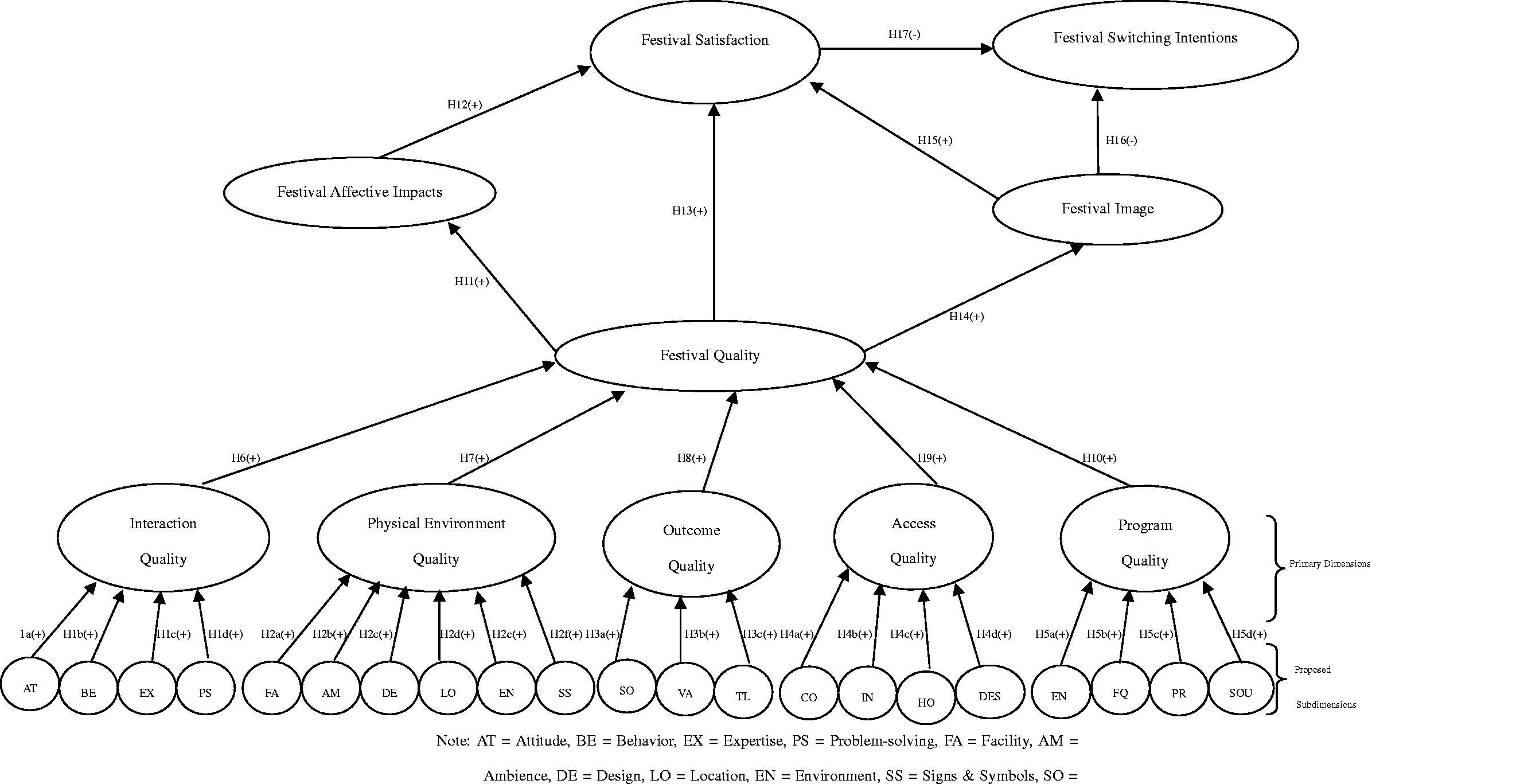
Research design and methodology
Questionnaire development
This study involves a two-stage design, consisting of focus group interviews and self-administered questionnaires. The first stage consisted of focus group interviews to gain in-depth insights into the attendees’ overall visiting experiences in the GIFF. Focus group interviews can be particularly helpful in gathering information before developing a survey questionnaire to see what topics are salient to members of the population, how people understand a topic area and how they interpret questions (in particular, how framing a topic or question in different ways may affect responses). For these types of focus groups, the moderator typically asks broad questions to help elicit unedited reactions from the group members, and then may ask more specific follow-up questions (Pew Research Center, 2015). Zikmund et al. (2007) suggest that a typical focus group should consist of seven to 10 participants. Following this recommendation, the researchers conducted three focus group interviews consisting of seven participants who were required to have been to the GIFF. These three groups were used to identify quality attributes specific to the food festival. The participants in the focus groups were recruited using a convenience sample drawn from the 2013 GIFF population of approximately 50 attendees who were required to have been to the GIFF. The 2013 GIFF was held in Guangzhou’s Panyu District. They were males and females of mixed age, represented several occupations, and had varying incomes. In addition, they were required to define factors shaping their food festival experience based on staff–attendee interactions, physical facilities, visiting outcomes, accessibility, and programs. They were also asked to indicate the factors they considered to be more important in determining perceptions of each of the five domains. After the focus group interviews were completed, the researchers identified two subdimensions of physical environment quality and program quality (food quality and environment) that were not identified in the literature review (see the sections of physical environment quality and program quality). The factors identified in the focus groups were combined with a review of the relevant literature to identify variables, assist in item generation, and recommend the dimensionality of festival quality in the GIFF. This process resulted in an initial pool of 67 items of festival quality.
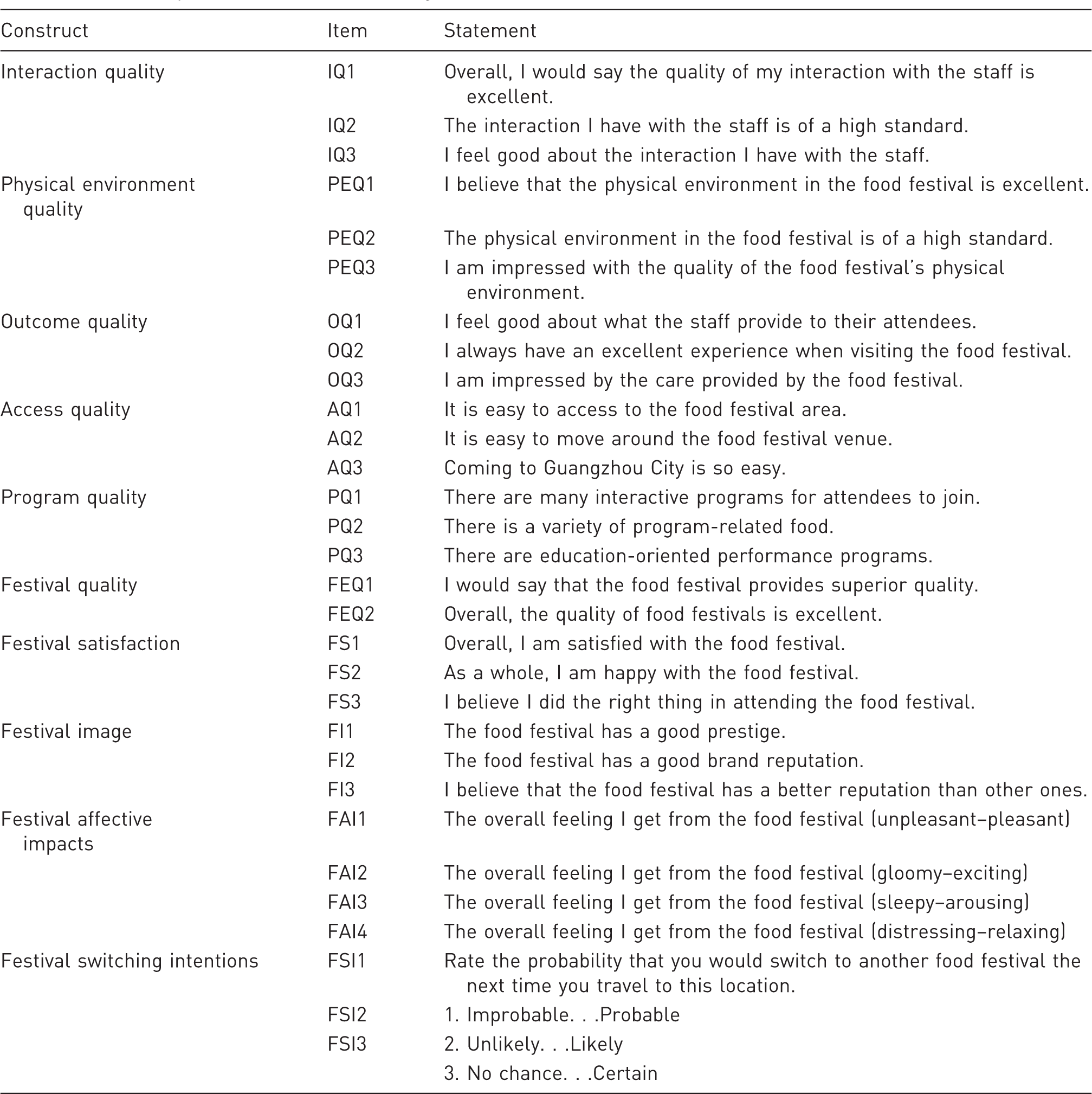
The second stage consisted of self-administered questionnaires to verify the dimensions of festival quality for food festivals (based on the findings of stage one), the variation of festival quality perception over time and the antecedents and consequences of quality for food festivals. The questionnaire consisted of seven sections. The first five sections included the statements of interaction quality, physical environment quality, outcome quality, access quality, and program quality. These items were grouped in accordance with each of the primary dimensions, as perceived by the focus group participants. The sixth section focused on the questions of festival switching intentions, festival satisfaction, festival image, festival affective impacts, and festival quality. The measured items of festival satisfaction, festival image, and festival quality used a seven-point Likert-type scale ranging from seven (strongly agree) to one (strongly disagree). The seven-point Likert-type scale is the most commonly used in services marketing (Driscoll et al., 1994; Gallarza et al., 2002). According to Finstad (2010), participants in the five-point Likert-type scale condition are more likely than those presented with the seven-point Likert-type scale to elicit interpolations in usability inventories, i.e. attempt a response between two discrete values presented to them. Interpolations provide evidence that five-point Likert scales may not be sensitive enough to record a usability which tests participant’s true responses to the survey. In contrast, a seven-point Likert-type scale appears to be sensitive enough to record a more accurate evaluation of an interface while remaining relatively compact. It also appears to be more suited to a surveyor’s distribution of usability inventories. The festival affective impact construct was measured using a five-item scale suggested by Song et al. (2015), which represented unpleasant–pleasant, gloomy–exciting, sleepy–arousing, and distressing–relaxing. A three-item propensity to festival switching intention scale was utilized, as suggested by Han et al. (2011). The final section collected demographic information. In order that all of the attendees could understand the content of the questionnaire, the researchers provided them with questionnaire versions in both English and Chinese. Therefore, the questionnaire was written originally in English and later translated into Chinese by the researchers. The questionnaire was developed by reviewing the related consumer behavior studies of other researchers plus advice from services marketing researchers and food festival managers in order to ensure its content validity. As the questionnaire was developed specifically for this study, a pre-test was conducted with 60 participants who had been to the GIFF in the past 12 months. A period of 12 months was chosen to provide a common time frame as well as to limit the time frame within the recall ability of most respondents, as suggested by Singh (1990). During the pre-test procedure, the respondents were encouraged to comment on any questions that they thought were unclear, ambiguous, or that they were unable to respond. Some minor grammatical changes were made to the questionnaire following the pre-test process.
Sample and data collection
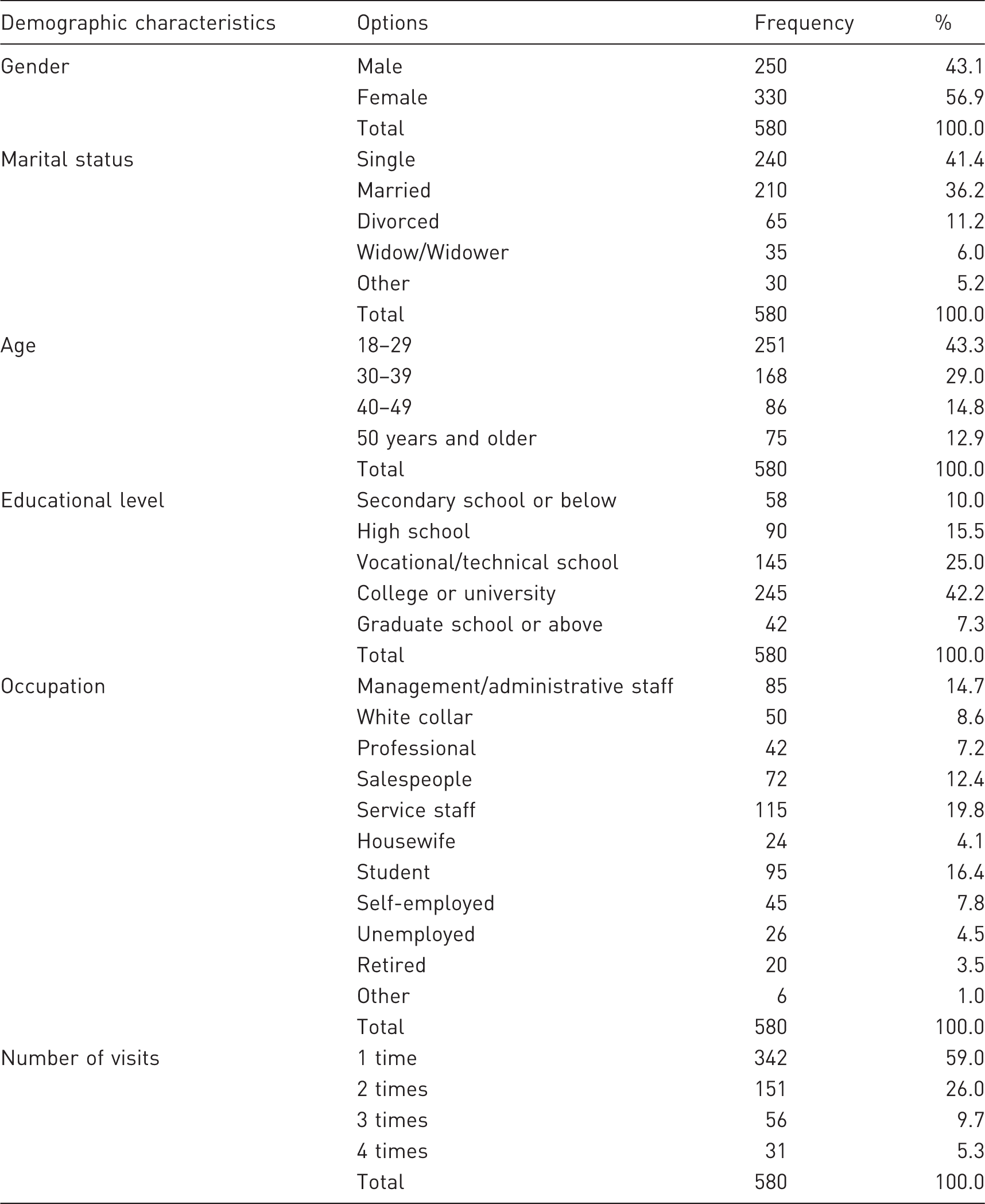
Due to limited time and manpower, data were collected using convenience sampling of respondents, aged over 18 years, who just completed visiting the 2014 GIFF which was held at Guangzhou International Gourmet Culture Plaza in Guangzhou’s Panyu District between 28 November and 7 December 2014. In order to obtain a representative sample, this study was conducted on Saturday night and Sunday afternoon because these two times were expected to attract the most attendees to the 2014 GIFF and, potentially, the greater variety of attendees. This also ensured that the sample was not biased towards a particular afternoon or evening. To acquire a representative sample, the head researcher and four assistants distributed the questionnaires to the respondents around the exit of Guangzhou International Gourmet Culture Plaza. A self-administered questionnaire was chosen as it has a high level of accuracy, limited cost, and responses remained anonymous (Malhotra, 2004). The students from one university in Guangzhou were recruited to work as surveyors and then trained to randomly ask whether respondents were willing to respond to the questionnaires distributed by the surveyors around the exit of the 2014 GIFF. The reason for choosing this festival for sample collection is that the number of attendees is large and it is suitable for measuring the respondents’ perceptions of festival switching intentions, festival satisfaction, festival image, festival affective impacts, and festival quality, as suggested by Wong et al. (2014) and Wu and Ko (2013). The coupons for a quick service restaurant were given to encourage participation.
Demographic profile of sample (N = 580).
Findings
Prior to conducting the factor analysis, four statistical tests were used to ensure the factorability of the correlation matrix: visual examination of the correlation matrix (mostly > 0.3), the anti-image correlation matrix (close to 0), Bartlett’s test of sphericity (BTS = 19,891.225, p < 0.000), and the Kaiser–Meyer–Olkin (KMO = 0.863) measure of sample adequacy. These results confirmed that the application of exploratory factor analysis (EFA) was appropriate.
Factor loadings, critical ratios, standard errors, and means of subdimensions of festival quality.

C.R.: critical ratio; S.E.: standard error.
Note: Dahses indicate that the items are fixed at 1.0.
p < .05.
Descriptive statistics and correlation matrix of latent variables.
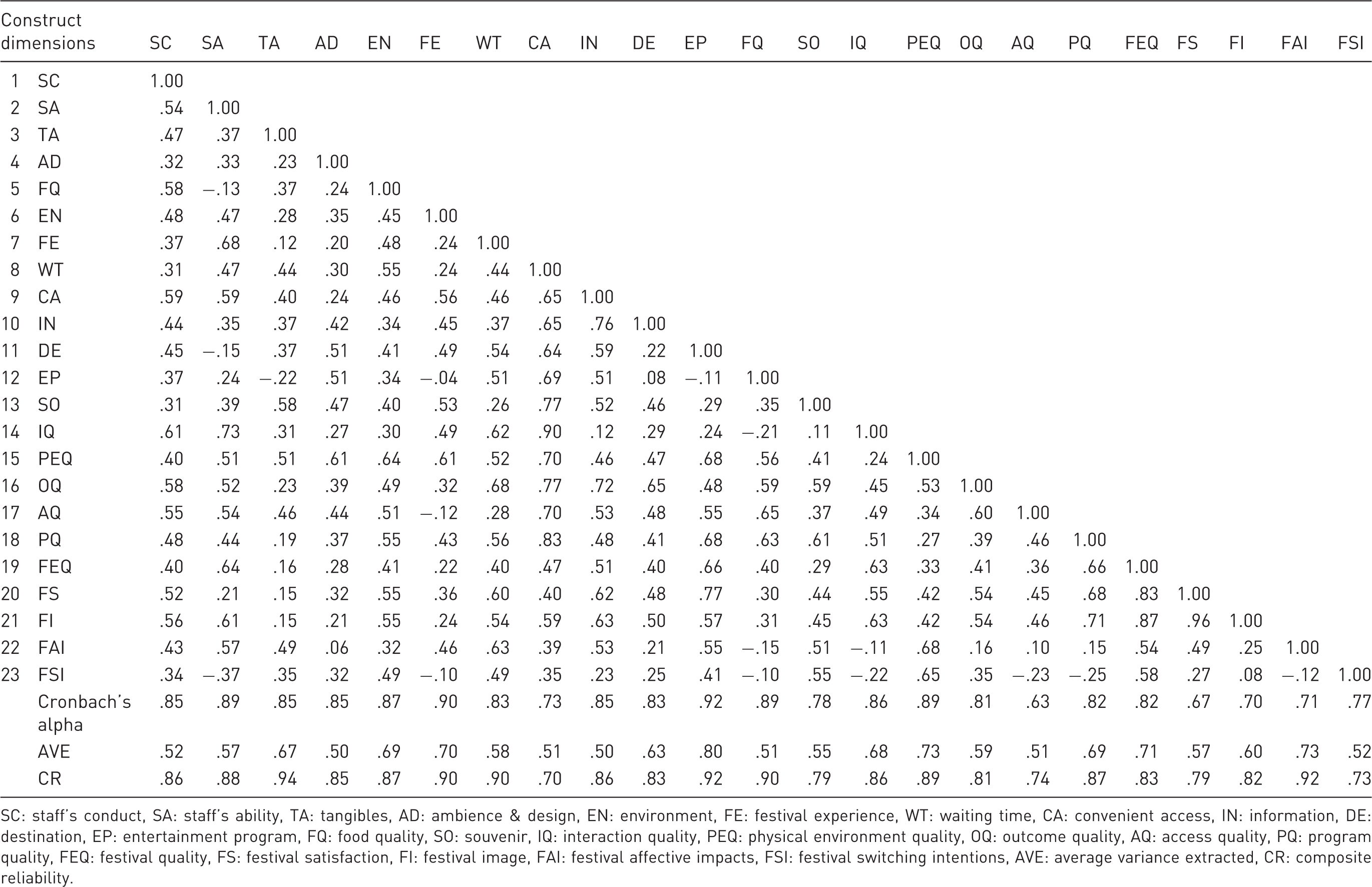
SC: staff’s conduct, SA: staff’s ability, TA: tangibles, AD: ambience & design, EN: environment, FE: festival experience, WT: waiting time, CA: convenient access, IN: information, DE: destination, EP: entertainment program, FQ: food quality, SO: souvenir, IQ: interaction quality, PEQ: physical environment quality, OQ: outcome quality, AQ: access quality, PQ: program quality, FEQ: festival quality, FS: festival satisfaction, FI: festival image, FAI: festival affective impacts, FSI: festival switching intentions, AVE: average variance extracted, CR: composite reliability.
Results of the measurement and structural model tests.

p: p value, RMSEA: root mean square error of approximation, SRMR: standardized root mean residual, CFI: comparative fit index, GFI: goodness-of-fit index, IFI: incremental fit index, NNFI: non-normed fit index, AGFI: adjusted goodness-of-fit index.
The overall fit measures of the structural model suggest that the hypothesized model provides an acceptable fit to the data (see Table 4). The chi-square difference test is used to examine the model difference between the two groups. The chi-square/df ratios (2.34) were lower than the threshold of 3.0, as suggested by Carmines and Mclver (1981). Therefore, the result indicates that there is no model difference between two groups (
Scaled items for primary dimensions of festival quality, festival quality, festival satisfaction, festival image, festival affective impacts, and festival switching intentions.
Hypothesis test results.
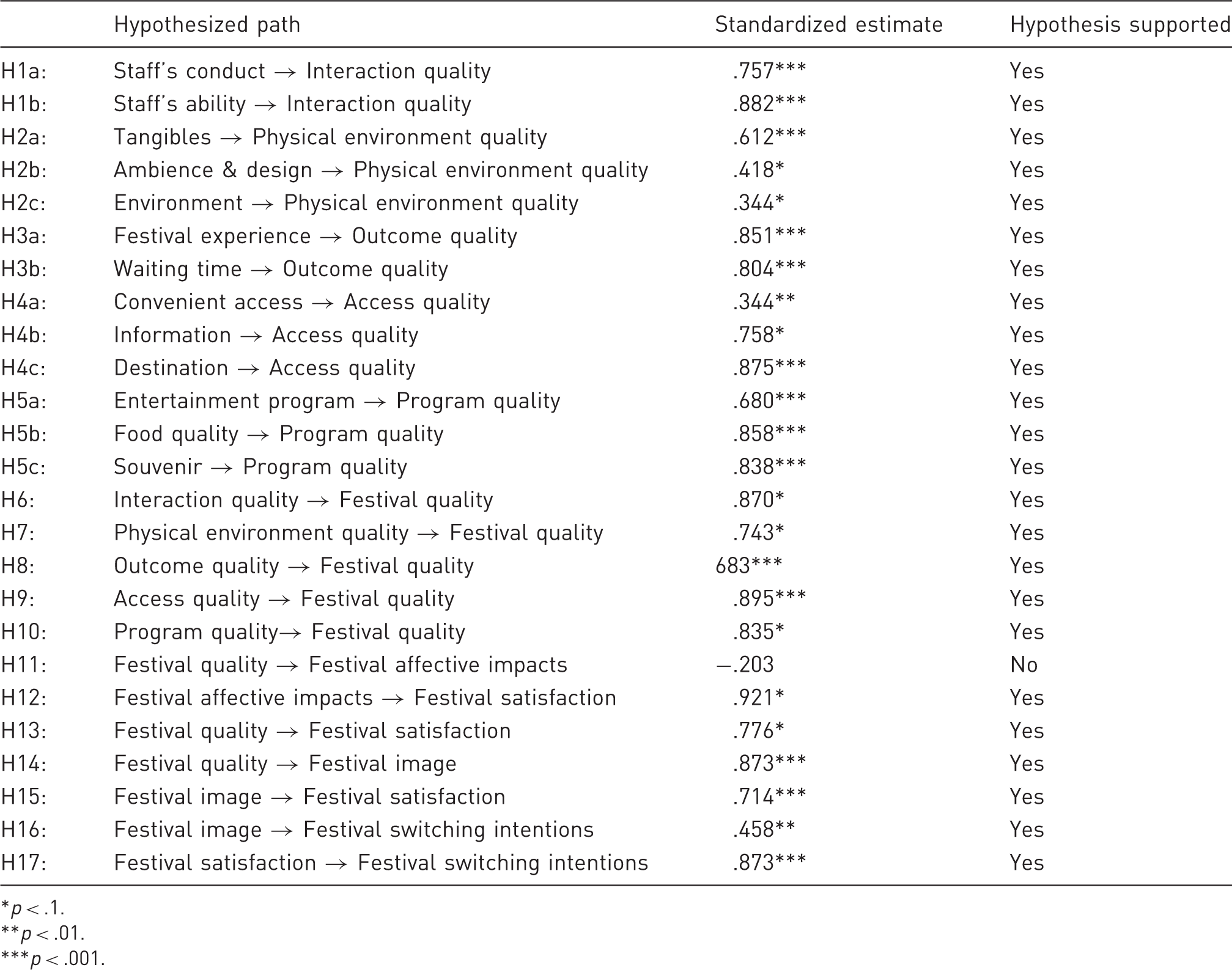
p < .1.
p < .01.
p < .001.
Each path estimate based on the interrelationships among festival switching intentions, festival satisfaction, festival image, festival affective impacts and festival quality, and primary and subdimensions of festival quality in the conceptual research model was subsequently tested using CFA to prove SEM built in Figure 2.
A path model. SC: staff’s conduct, SA: staff’s ability, TA: tangibles, AD: ambience & design, EN: environment, FE: festival experience, WT: waiting time, CA: convenient access, IN: information; DE: destination, EP: entertainment program, FQ: food quality, SO: souvenir.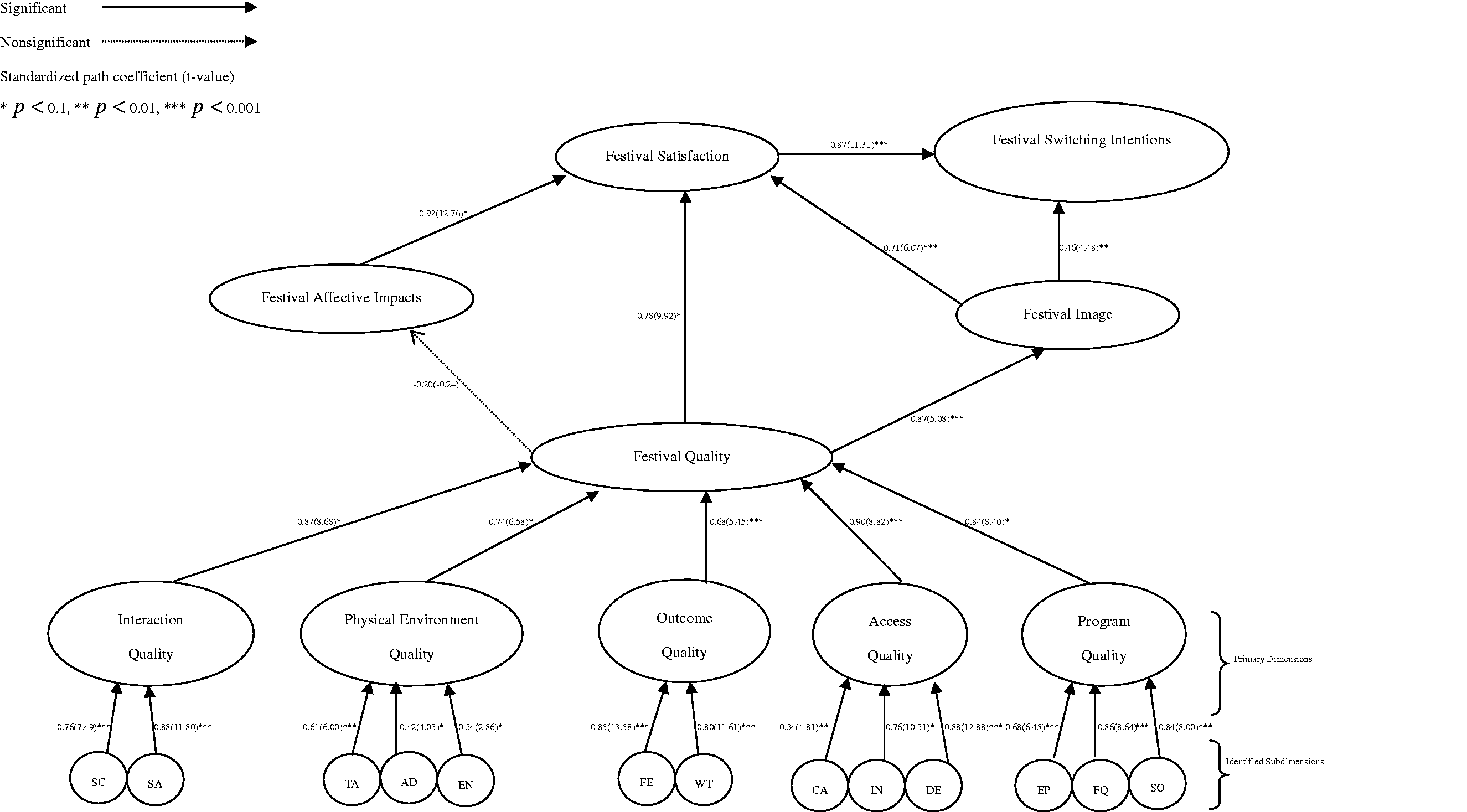
Discussion
The results for hypotheses 1 through 10 provide support for a multidimensional and hierarchical dimensional structure of festival quality (e.g. Brady and Cronin, 2001; Dabholkar et al., 1996; Wong et al., 2014; Wu et al., 2014c) as perceived by food festival attendees. The results for hypotheses 1 through 5 support the presence of 13 subdimensions of festival quality as perceived by food festival attendees. The results of hypotheses 6 through 10 substantiate the presence of five primary dimensions of festival quality: interaction quality, physical environment quality, outcome quality, access quality, and program quality in a festival context.
The hypothesized paths (hypotheses 11 through 17) relating to festival quality, festival affective impacts, festival image, festival satisfaction, and festival switching intentions in the conceptual model are confirmed. First, the result of this study indicates that festival quality does not positively influence festival affective impacts. One possible reason can be because the overall feelings the attendees receive from food festivals are not able to influence their perceptions of festival affective impacts. The other possible reason is attributed to the fact that there are competing influences of the two festival quality dimensions on the same festival affective impacts. As such, festival quality has given way to the other one competing influence. This finding is inconsistent with the contention of Oliver (1994) that quality evaluation has been considered to be more objective and will influence affective impacts. Second, the statistical results of this study reveal that festival affective impacts, festival quality, and festival image positively influence festival satisfaction. This finding does not agree with Song et al.’s (2015) result that affective impacts do not positively influence festival satisfaction. However, this finding supports the contention of Jiang and Wang (2006) that the effect of affective impacts on satisfaction depends on the hedonic or utilitarian service context. This finding supports the contentions of several researchers (e.g. Son and Lee, 2011; Wong et al., 2014; Wu et al., 2014c; Yoon et al., 2010) that quality has been considered to be a predictor of satisfaction in a food festival context. The result is consistent with several researchers’ (Jung and Kim, 2012; Wong et al., 2014) propositions that festival image positively influences festival satisfaction. Third, the statistical result of this study reveals that festival quality positively influences festival image. This finding supports the contention of Wong et al. (2014) that festival quality has been found to play a key role in increasing attendees’ perceptions of festival image. Finally, the results of this study show that both festival image and festival satisfaction negatively influence festival switching intentions. The finding of this study is consistent with Han and Hyun’s (2013) study, indicating that ideal image has been considered to be a great contributor in reducing switching intentions. Also, this finding agrees with the propositions of several researchers (Antón et al., 2007; Ganesh et al., 2000; Han and Hyun, 2013) that satisfaction has a negative influence on switching intentions.
The least and most important dimensions of festival quality, as perceived by food festival attendees, are identified. Each of the subdimensions varies in terms of their importance to the five primary dimensions (see Figure 2). Access quality is confirmed to be the most important dimension of festival quality perceived by food festival attendees. The result of this study is consistent with the contention of Mohi et al. (2013) that access quality has been considered to be one of the important attributes of festival quality. In this study, access quality is composed of three significant subdimensions, namely, convenient access (b = 0.34), information (b = 0.76) and destination (b = 0.88). Also, the finding of this study is consistent with the contentions of Chen et al. (2012) and Jung and Kim (2014) that convenience has been found to positively influence attendees’ perception of quality in a festival. In addition, the result of this study supports the propositions of earlier studies (e.g. Baker and Crompton, 2000; Chen et al., 2012; Lee et al., 2008; Wu et al., 2014c; Yoon et al., 2010) that information positively influences overall festival quality. In addition, the finding of this study agrees with Esu’s (2009) proposition that a festival has been considered to be a destination attraction and inadvertently shares some attributes that influence attendees’ decisions to attend such destinations.
Interaction quality is confirmed to be the second most important dimension of festival quality perceived by food festival attendees. This finding supports the contentions of Wong et al. (2014) and Wu and Ko (2013) that interaction quality is perceived as a determinant of overall festival quality. In this study, interaction quality comprises two significant subdimensions, namely, staff’s conduct (b = 0.76) and staff’s ability (b = 0.88). The result of this study agrees with Wu et al. (2014c), who indicate that staff’s professional conduct and skills play a key role in increasing food festival attendees’ perceptions of interaction quality.
Program quality is perceived as the third most important dimension of festival quality. This finding supports the contention of Wong et al. (2014) that program quality is perceived as the most important dimension when food festival attendees make their overall assessment of festival quality. In this study, program quality is composed of three significant subdimensions, namely, entertainment program (b = 0.68), food quality (b = 0.86), and souvenir (b = 0.84). The result of this study supports the contentions of several researchers (e.g. Baker and Crompton, 2000; Chen et al., 2012; Cole and Illum, 2006; Yoon et al., 2010) that the entertainment program has been found to positively influence perceptions of festival quality in a festival context. In addition, the result of this study agrees with the contentions of several researchers (e.g. Bitner, 1992; Cole and Illum, 2006; Crompton and Love, 1995; Wu et al., 2014c; Yoon et al., 2010) that food quality plays a key role in influencing the festival attendees’ perceptions of physical environment quality. Also, the finding of this study is consistent with the contentions of several studies (Chen et al., 2012; Lee et al., 2008; Yoon et al., 2010) that the souvenir has been considered to be an important component of program quality in a festival context.
Physical environment quality is confirmed to be the fourth most important dimension of festival quality perceived by food festival attendees. This finding supports Wong et al.’s (2014) contention that physical environment quality is perceived as a determinant of overall festival quality. In this study, physical environment quality comprises three significant subdimensions, namely, tangibles (b = 0.61), ambience & design (b = 0.42), and environment (b = 0.34). The result of this study agrees with the contentions of several researchers (Chen et al., 2012; Lee et al., 2008; Yoon et al., 2010) that the tangibles have been considered to be an important component of physical environment quality in a festival context. Also, the finding of this study is consistent with the propositions of earlier studies (Lee et al., 2008; Wu et al., 2014c) that the ambience & design has been found to positively affect festival attendees’ overall evaluations of physical environment quality. Furthermore, the result of this research is consistent with the contentions of earlier studies (Chen et al., 2012; Tkaczynski and Stokes, 2010) that the environment should not be ignored since it plays a key determinant of overall evaluation of physical environment quality in a festival.
Outcome quality is perceived as the fifth most important dimension of festival quality. This finding agrees with the contentions of several studies (Mohi et al., 2013; Wong et al., 2014; Wu et al., 2014c) that outcome quality has been seen as an important component of outcome quality in a food festival context. In this study, outcome quality is composed of two significant subdimensions, namely, festival experience (b = 0.85) and waiting time (b = 0.80). The finding of this study supports Wu and Ko’s (2013) contention that attendees’ visiting experience in a food festival positively influences their overall evaluations of outcome quality. Also, the result of this research is consistent with Jung and Kim’s (2014) proposition that waiting time is perceived as an important factor of overall outcome quality in a festival.
Theoretical implications
This study presents a thorough evaluation of food festival attendees’ perceptions of festival quality through developing and testing a comprehensive multidimensional and hierarchical model. The results of the measurement model tests indicate that all measurement models for measuring festival quality and its dimensions have a good model fit. In addition, the results of the reliability and validity tests indicate that the measurement scales for measuring festival quality and its dimensions reveal adequate reliability and validity. However, it should be noted that the five primary dimensions and 13 subdimensions of festival quality may not be generic for all service industries and cultures. Dimensional structures should be confirmed through the use of an appropriate qualitative or quantitative approach. It is also valuable to compare the derived importance of the primary and subdimensions in this study with new festival quality dimensions identified in future studies.
This study provides a theoretical framework for understanding the complex relationships among five important marketing constructs (festival quality, festival affective impacts, festival image, festival satisfaction and festival switching intentions). The result of this study reveals that festival quality has a direct and significant impact on festival image. The positive relationship that is identified between festival quality and festival image may be interpreted as the higher the quality as perceived by food festival attendees, the better impressions of the food festival that the attendees have in their minds. Festival affective impacts (b = 0.68) are the most important determinants of festival satisfaction, followed by festival quality (b = 0.56) and festival image (b = 0.71) based on the SEM results. This may be interpreted as festival affective impacts being the main driver of festival satisfaction compared with festival quality and festival image. Also, the positive relationship that is identified between festival quality and festival satisfaction may be interpreted as festival quality being an antecedent of festival satisfaction because festival quality is the driver of the food festival performance (Wong et al., 2014). In addition, the empirical result suggests that festival image has a direct effect on festival satisfaction. This may be interpreted as a better festival image that attendees have in their minds, the more satisfaction they have in a food festival. Furthermore, the negative relationship that is identified between festival satisfaction and festival switching intentions may be interpreted as dissatisfied attendees are more likely to generate higher switching intentions than satisfied attendees after experiencing a service failure in a food festival. Also, the result indicates that festival image has less influence on festival switching intentions than festival satisfaction (Chih et al., 2012; Wong et al., 2014). The negative relationship that is identified between festival image and festival switching intentions may be interpreted as a better festival image that attendees have in their minds, the less switching intentions they have in a food festival.
This study identifies the comparative importance of the 13 subdimensions in attendees’ overall evaluation of perceived festival quality. Among the 13 subdimensions, the staff’s ability is the most important subdimension of interaction quality and tangibles are the most important subdimension of physical environment quality. In addition, festival experience and destination are the most important subdimensions of outcome quality and access quality, respectively. Moreover, food quality is the most important subdimension of program quality. These five subdimensions seem to be important components of five primary dimensions of festival quality. When attendees evaluate their overall quality of visiting experiences in a food festival, they may consider these five subdimensions as parts of overall perceived evaluations of festival quality. Therefore, these five subdimensions should be seriously considered when researchers conduct similar studies of food festival attendees’ perceived festival quality.
Managerial implications
The results of this study provide festival management with valuable information about the complex relationships among festival quality, festival affective impacts, festival image, festival satisfaction, and festival switching intentions in the food festival sector. The information will assist festival management to develop successful services marketing strategies. For example, festival management should make continuous efforts to improve attendees’ perceived festival quality, as festival quality results in favorable perceptions of festival image. In addition, the results of this study provide festival management with an improved understanding of the effects of festival affective impacts, festival quality, and festival image on festival satisfaction, which in turn, results in festival switching intentions. The results in this study show that improving attendees’ overall evaluations of perceived festival affective impacts, festival quality, and festival image can effectively raise perceived festival satisfaction, and higher levels of perceived festival satisfaction and festival image should ultimately result in decreasing attendees’ festival switching intentions. In this vein, festival management should invest more efforts in providing a consistently reliable experience to satisfy its attendees’ needs and wants in a food festival.
However, the results of this study provide festival management with an improved understanding of the insignificant effect of festival quality on festival affective impacts. In order to increase attendees’ perceptions of festival affective impacts and provide attendees with good quality of visiting experiences in a food festival, festival management should improve interaction quality, physical environment quality, outcome quality, access quality, and program quality.
Festival management should be aware of the importance attendees place on each of the primary and subdimensions of festival quality. In addition, festival management should structure management strategies and resource allocation based on the relative importance of the festival quality dimensions of its particular target attendee market. In this study, access quality is the most important primary dimension for favorable perceptions of festival quality, followed by interaction quality, program quality, physical environment quality, and outcome quality. When designing a measurement to evaluate the attendee perception of festival quality, festival management should recognize that the order of importance of the primary dimensions of festival quality may vary across different food festival. In general, festival management should concentrate on the subdimensions under access quality and improve the performance of food festivals on the subdimensions according to the respondents’ responses to the survey in this study. However, the subdimensions of interaction quality, physical environment quality, outcome quality, and program quality should also be resourced, as attendees’ overall perceptions of festival quality while visiting food festivals do not only depend on the staff and attendee relationship, but also on the relationship between attendees and the service environment, outcome and program.
The staff’s ability is considered to be important for perceptions of interaction quality, thus particular attention should be paid to the training of the employees’ expertise and problem-solving skills, as suggested by Wu et al. (2014c). Tangibles have been considered to be important for attendees’ perceptions of physical environment quality. Festival management should allocate more resources to improve its tangibles, making an effort to provide a variety of tangibles to meet the attendees’ demands and understand what kinds of tangibles the majority of attendees prefer to see and use in a food festival. Festival experience has been identified to be important for perceptions of outcome quality. Festival management should realize that providing attendees with a pleasant visiting experience positively influences attendees’ overall perceptions of festival quality in a food festival. Destination appears to be important for the attendees’ perceptions of access quality. Festival management should provide attendees with a variety of public transportation (e.g. airplanes, buses, ferries and trains) in order to enable attendees to have easy access to the destination where the food festival is held. Food quality is identified as to be important for perceptions of program quality. Festival management should provide a variety of food to attract more people to visit a food festival.
Limitations and directions for future research
Although this study provides a number of important contributions to marketing theory and for festival management, there are some limitations. First, in spite of the amount of literature on festival quality, it has been difficult to offer a full description of the nature of the festival quality construct in the context of food festivals. Despite this difficulty, this study conducted in-depth focus group interviews to identify and examine all dimensions of festival quality as perceived by food festival attendees, because focus group interviews are believed to be more useful than relying on only a literature review. However, there may be some other primary and subdimensions of festival quality that have not been identified in the conceptual framework of this study. Future studies should seek to identify additional primary dimensions (e.g. accommodation quality, contest quality, venue quality, administrative quality and so on) and subdimensions (e.g. amenity, cleanliness, operating time, range of service, reliability, support and so on) of festival quality that significantly impact on attendees’ perceptions of festival quality that have not been identified in this study. Second, the survey was collected from the attendees who completed visiting the 2014 GIFF in Guangzhou only. However, the attendees’ perceptions of festival quality, festival affective impacts, festival image, festival satisfaction, festival switching intentions, and the primary and subdimensions of festival quality in Guangzhou may be different from attendees’ perceptions in the food festivals of other regions or countries. Therefore, the findings cannot be generalized for other regions or countries. When applying the results of this study to other regions or countries, future studies should seriously consider the attendees’ perceptual differences owing to the existence of cultural or regional issue. Finally, this study is limited to the effects of festival satisfaction and festival image on festival switching intentions since several researchers (e.g. Han and Hyun, 2013; Han et al., 2011; Martins et al., 2013; Song et al., 2015) claim that both of the festival image and festival satisfaction constructs should attract more attention in the tourism literature. It is likely that not all of the factors that influence attendees’ festival switching intentions have been included into the conceptual model of this study. Therefore, future studies should focus on other constructs which influence festival switching intentions (e.g. anger incident, core service performance, service encounter performance, involvement, customer value, price unfairness, low perceived commitment, trust, switching costs and barrier, attitude towards switching, subjective norms), as suggested by Antón et al. (2007) and Han et al. (2011).
Footnotes
Acknowledgment
The authors would like to thank the anonymous reviewers for their constructive comments on improving an earlier version of this article.
Declaration of Conflicting Interests
The author(s) declared no potential conflicts of interest with respect to the research, authorship, and/or publication of this article.
Funding
The author(s) received no financial support for the research, authorship, and/or publication of this article.