



Abstract
Recent investigations suggest that human resource practices influence organisational performance through their effect on key mediating variables. However, the link between human resource management practices and innovation performance is yet to be determined and little is known about the variables that can mediate this relation. The diverse results of studies in this field seem to suggest that the sector of activity may determine specific aspects of this relation. By analysing data from a single industry, this paper aims to increase understanding of the mediating role of human capital in the relation between human resource management practices and innovation. Data from a survey of 109 firms managing hotel establishments in Spain show that, in the hotel industry, some human resource management practices affect innovation through their influence on human capital. Recruitment and selection human resource management practices, however, do not enhance the level of human capital of the firms studied, although they do determine their innovation performance.
Keywords
Introduction
The earliest reflections on the strategic importance of innovation were made by Schumpeter, in the first half of the 20th-century. Schumpeter (1942) stressed the role of innovation as the main stimulus for growth, anticipating that new waves of technological revolution would bring an end to old industries and replace them with new industries in a process of ‘creative destruction’. For decades, Schumpeter’s theories were mentioned only occasionally in studies on business behaviour (Wiggins and Ruefli, 2005). However, the rise of highly changing and competitive environments in the 1990s meant that many authors have paid considerable attention to his approaches.
The literature highlights innovation as one of the most important factors affecting performance (Ottenbacher, 2007; Salem, 2014). It gives new entrants an opportunity to open up the market and gain a foothold in it (Wang and Ahmed, 2004); provides the basis for the success of firms by determining their level of competitiveness (Damanpour et al., 2009; Hult et al., 2004) and gives firms important opportunities in terms of growth, expansion into new business areas and enhanced profitability levels (Cho and Pucik, 2005; Qian and Li, 2003).
Several investigative studies have examined the impact of human resource management (HRM) practices on innovation performance. Within this line of research, some authors have shown that certain practices directly affect innovation performance (Beugelsdijk, 2008; Chand and Katou, 2007; Chang et al., 2011; Cho et al., 2006; Jiménez and Sanz, 2005; Laursen and Foss, 2003). However, a different group of researchers found that these practices affect innovation indirectly (Cabello et al., 2011; Chen and Huang, 2009; Collins and Smith, 2006; López-Cabrales et al., 2009). These authors support the idea that HRM practices influence innovation because they strengthen certain organisational variables. In particular, the review of the literature on hotel performance by Sainaghi (2010) suggested that, in this sector, the relation between HRM and performance is indirect.
Therefore, the link between HRM practices and innovation performance presents many unresolved aspects. First, some practices may directly affect innovation performance, whereas others affect it indirectly, i.e. by encouraging the development of resources and capabilities. Second, the explanation for the disparate conclusions reached may be that the empirical analyses were performed in different industries whose innovation activities can display varied behaviour. This aspect is extremely important when addressing questions associated with innovation, given that innovation involves very distinct processes in different economic activities. It may therefore be necessary to apply differentiated analysis in any attempt to study the factors that drive innovation. To rule out possible problems caused by using samples from various industries, this study focused on the hotel industry. The purpose is to evaluate how the specific characteristics of the hospitality context can determine a unique relationship among (human resource) HR practices, human capital and innovation.
Some studies have analysed the relation between HRM practices and innovation in the hotel sector (Chang et al., 2011; Martínez-Ros and Orfila-Sintes, 2012; Slatten and Mehmetoglu, 2011). Other authors have suggested the importance of human capital in innovation performance in firms from this sector (Dwyer and Edwards, 2009; Orfila-Sintes et al., 2005; Ottenbacher et al., 2006). This paper aims to evaluate the mediating role of human capital in the relation between HR practices and innovation. To reach this objective, the study is structured as follows. In the next section, the literature is reviewed and the research hypotheses are formulated. The subsequent two sections present the methodology, and the analysis and results, respectively. The article concludes by discussing the findings and their implications, as well as the limitations of the study.
Literature review and hypotheses
Strategic HRM and the resource-based view
The strategic perspective associated with HRM has grown out of researchers’ desire to demonstrate the importance of HRM practices for organisational performance (Delery and Doty, 1996). Adopting a strategic approach entails analysing a particular fit between various HRM practices and the competitive strategy of the firm (Bowen and Ostroff, 2004). This means that human resources must be appropriately managed so that their skills, abilities and conduct correspond to the objectives defined by the organisation.
The resource-based view (RBV) rose out of the belief that strategic actions require firms to possess specific resources, and the resources through which competitive advantages can be gained must be scarce, valuable and difficult to imitate or substitute (Barney, 1991). Thus, the RBV provides an explanation of competitive heterogeneity based on the premise that competitors differ in terms of the resources they own or control and similarly that these differences persist over time (Newbert, 2008). This heterogeneity among firms influences their chances of conceiving and implementing strategies, thus affecting their competitive advantages or disadvantages and therefore their performance (Ahuja, 2000; Ahuja and Katila, 2004; Helfat and Peteraf, 2003).
The idea that the members of an organisation are its main source of competitive advantage has been widely acknowledged in the literature, thus accounting for the interest in establishing a theoretical framework concerning the contribution of human resources to organisational efficiency and effectiveness (Carmeli and Tishler, 2004; Huselid, 1995; Lado and Wilson, 1994). Earlier studies acknowledged that human capital is a key resource for ensuring attainment of a series of capacities on which an organisation’s distinctive features are based (Chen and Huang, 2009; López-Cabrales et al., 2009; Youndt and Snell, 2004).
Various papers have suggested that HRM practices influence organisational performance by strengthening employees’ skills and behaviour or the capacities of the firm. In this line of research, studies have examined the mediating role of a number of variables. These studies have primarily focused on the manufacturing industry or analysed multiple sectors. Authors have highlighted the mediating role of turnover and productivity (Huselid, 1995), intellectual capital (Yang and Lin, 2009; Youndt and Snell, 2004), knowledge management capacity (Chen and Huang, 2009), organisational learning (Pérez-López et al., 2005), market orientation (Harris and Ogbonna, 2001), top managers’ social networks (Collins and Clark, 2003), social climate (Collins and Smith, 2006) and customer satisfaction (Chand, 2010). Empirical studies that have specifically analysed the mediating role of human capital in the relation between HRM practices and various measures of performance have primarily focused on the manufacturing sector, and little research has been applied to the field of services. In a broad group of organisations and industries, Youndt and Snell (2004) showed the mediating effect of human capital in the relation between HRM practices and performance (return on assets [ROA] and return on equity [ROE]). The studies by López-Cabrales et al. (2009) and Cabello et al. (2011) analysed the mediating role of human capital on innovation in firms from the manufacturing sector. Yang and Lin (2009) showed that it influences organisational performance, measured from a multifaceted approach, in firms in the healthcare industry. The meta-analysis by Jiang et al. (2012) found that human capital partially mediates the relation between HR systems and financial outcomes.
Human capital is particularly significant in performing activities that require interaction and communication with customers (Korczynski, 2002; Ployhart et al., 2009). It is therefore one of the most important resources in the hospitality industry (Kim et al., 2012; Kumar et al., 2008; Sainaghi et al., 2013). This distinctive feature suggests that human capital may play a different role in the hotel industry in comparison with its role in other sectors of activity.
HRM practices and human capital
The knowledge, skills and abilities of employees acquired in the education system and through work experience (Becker, 1964) constitute the human capital available in an organisation. Various investigative studies have shown that certain orientations in HRM practices are a fundamental way for firms to be able to influence the level of human capital (Lepak and Snell, 2002; Yamao et al., 2009; Youndt and Snell, 2004). In particular, it is reasonable to consider that a rigorous recruitment and selection process will mean the best candidates are found. Training and development practices may also improve the level of human capital in the firm (Liao and Chuang, 2004; Minbaeva et al., 2009). Additionally, the use of information technology (IT) increases the possibility of employees being exposed to diverse knowledge domains (Youndt et al., 2004), which can enhance the development of human capital. In this study, we therefore focus on the HRM practices of recruitment/selection, training/development and IT use as antecedents of the level of human capital in the firm.
Recruitment procedures that give access to a large number of qualified candidates, combined with an adequate candidate selection process, can influence the level of knowledge held by new employees (Huselid, 1995). Service firms must stress not only the level of knowledge and skills of candidates but also other features such as their potential, interpersonal skills and collaborative capacity. López-Cabrales and Valle (2008) showed that certain orientations in recruitment and selection practices can help to develop human capital. The empirical study by Youndt and Snell (2004) showed that investments made to attract the best workers are associated with the level of knowledge, skills and general experience. Yamao et al. (2009), however, found no support for this relation. This study proposes that organisations can increase their level of human capital through a rigorous recruitment/selection process that allows the best qualified candidates to be hired.
H1: Recruitment/selection HRM practices that include appropriate planning as well as rigorous hiring and selection criteria and high starting salaries are positively associated with the level of human capital in the firm.
The role of training in individuals’ acquisition of knowledge and skills is widely recognised (Becker, 1964; Youndt and Snell, 2004). Investments in training not only increase individual performance but also encourage employees to adjust their knowledge and skills to organisational needs (López-Cabrales et al., 2011). Additionally, as a complement to training, organisations can encourage professional development of their employees to help them build idiosyncratic knowledge, which will be more valuable for the firm than for its competitors (Lepak and Snell, 1999; López-Cabrales and Valle, 2008). Internal promotion policies allow firms to not only take advantage of investment in training but also incentivise employees so they develop firm-specific skills and knowledge (Youndt and Snell, 2004). Earlier studies showed a positive relation between organisational training and development efforts and the level of human capital (Yamao et al., 2009; Youndt and Snell, 2004). Consistent with these considerations, in this study we propose that training/development practices improve the level of knowledge, skills and abilities of employees.
H2: Training/development HRM practices are positively associated with the level of human capital in the firm.
The literature has traditionally associated human capital with recruitment/selection and training/development practices. However, in the development of knowledge, more recent studies have highlighted the important role of environments that encourage the acquisition, transfer and exchange of information and knowledge.
HR practices that encourage the use of IT are those that provide employees with accessible, user-friendly and integrated technologies (Youndt and Snell, 2004). IT enables a large amount of information to be accumulated and thus increases the speed of access to this information, which can facilitate knowledge and skills acquisition by employees. IT also provides a means of communication and interaction (Cerne et al., 2013). Creating groupware allows knowledge to be shared in time and space (Alavi and Leidner, 2001; Olivera, 2000), increasing the possibility of acquiring knowledge held by others. IT can therefore constitute a valuable tool for building relationships to facilitate the exchange of information and ideas among employees (Alavi and Leidner, 2001; Cross and Baird 2000; Laursen and Foss, 2003). This type of exchange can improve the level of knowledge, skills and abilities of employees, i.e. the level of human capital. Thus:
H3: HRM practices that encourage IT use are positively associated with the level of human capital in the firm.
Human capital and innovation
Human capital refers to the ‘set of knowledge, skills, and abilities that are embedded in the firm’s human resources’ (Lado and Wilson, 1994: 705). One essential element of knowledge is its association with human action. Thus, the creation of knowledge will be intrinsically associated with the level of human capital in the firm. One the one hand, individuals with high levels of knowledge, abilities and experience are a source of new ideas for organisations. In these types of employees, firms can find a wide range of skills, greater flexibility in acquiring new knowledge, and improved capacity to question prevailing norms in the organisation and originate new ways of thinking (Subramaniam and Youndt, 2005). On the other hand, the literature also shows that innovation activity can arise from exchanging and combining already existing knowledge (Dhanaraj and Parkhe, 2006; Kang et al., 2007; Molina and Martínez, 2010). Therefore, the greater the stock of human capital is, the greater the opportunities will be for these types of knowledge exchange and combination processes to occur (Wu, 2004).
Various scientific studies support a direct relation between the education level of employees and the organisation’s ability to innovate. Smith et al. (2005) demonstrated a significant relation between education level and the rate of new product and service introduction. For Hayton and Kelley (2006), individuals who have more resources to draw upon in the form of cognitive ability, education, training and practical experience are more likely to be innovative. Bantel and Jackson (1989) concluded that the higher education level of top management teams gives them greater cognitive capacity and, as a result, they generate more original and creative organisational outcomes. Similarly, various studies indicate that employees with wide-ranging experience will have more relevant knowledge to exchange and combine and will therefore contribute more to the firm’s innovation performance (Kimberly and Evanisko, 1981; Smith et al., 2005; Taylor and Greve, 2006).
Despite the numerous advantages involved in having high levels of human capital, Subramaniam and Youndt (2005), analysing a broad group of organisations and industries, and Tzabbar et al. (2008), in the field of biotechnology companies, suggested that this may present certain negative aspects. These considerations lead us to believe that major differences could exist among different economic activities. In physical product and technology firms, the task of innovating is typically assigned to one particular unit, such as research and development or product development (Lyons et al., 2007). However, in the service sector, organisation of the innovation process is normally less systematic and more global and complex, generally involving more departments and teams in the innovation process (Hipp and Grupp, 2005; Sundbo, 1997). Innovation in the field of services is therefore not centred on one particular group of employees but is affected by the behaviour of a much wider range of people (Kattara and El-Said, 2013; Lyons et al., 2007). As a result, in the sector under study here, we propose that human capital has a positive influence on innovation.
H4: The level of human capital has a positive influence on the firm’s innovation.
The mediating role of human capital
Although some investigative studies have shown direct links between certain HRM practices and innovation (Beugelsdijk, 2008; Chang et al., 2011; Laursen and Foss, 2003), one assumption underlying research on strategic HRM is that rather than exerting a direct effect, these practices could affect innovation performance through their influence on certain organisational variables. Within this line of research, López-Cabrales et al. (2009) and Cabello et al. (2011) argued that HRM practices enhance human capital and this resource, in turn, has a positive effect on innovation performance. Chen and Huang (2009) also noted that knowledge management activities mediate the relation between HRM practices and innovation. This paper proposes that recruitment/selection, training/development and IT HRM practices influence the level of human capital, which in turn gives firms greater ability to develop innovations. To build this framework, this study draws from the literature on strategic HRM and RBV of the firm. According to the RBV, HR practices contribute to the attainment of sustainable competitive advantages through the development of firm-specific assets (Lado and Wilson, 1994). In particular, HRM practices can contribute to firm performance by leveraging human capital (Bowen and Stroff, 2004; Takeuchi et al., 2007). In this sense, Jiang et al. (2012) suggested that HR practices constitute an investment in firm-specific human capital, and when organisations have higher quality human capital, they are more capable of achieving innovation performance. Taking these approaches into account, this paper proposes the following hypothesis.
H5: (a) recruitment/selection, (b) training/development and (c) IT HRM practices influence innovation through the mediating role of human capital.
Methods
Data collection and procedure
The methodology applied was a cross-sectional survey conducted via self-administered questionnaires. The measurements instruments were pretested with five professionals from the sector being studied to ensure respondents would understand the questionnaire correctly. The study target population comprises firms managing hotel establishments in Spain with three or more stars and at least 50 employees. As the second largest tourism destination in Europe and the third largest in the world, Spain received 65 million visitors in 2014 (World Tourism Organization, 2015). Companies running establishments with this rating were chosen because they were better suited for testing the model proposed. Higher rating hotels are run by more professional firms that are concerned about innovation activities as a way to maintain the level of quality necessary to keep their rating (Ordanini and Parasuraman, 2011; Pikkemaat and Peters, 2005). Firms with fewer than 50 employees were excluded from the population to avoid the inclusion of very small organisations with no formal HRM procedures in place (Collins and Smith, 2006; Huselid and Becker, 1996; Lepak and Snell, 2002; Youndt and Snell, 2004).
Information on the hotel accommodation firms was taken from the 2011 Hostelmarket Annual Report on hotels, restaurants, tourism and leisure. A population of 523 firms remained after the database had been refined. It was decided that all the sampling units would be studied and the questionnaire was sent to all the firms in the population. Data gathering was conducted from September 2011 to March 2012. Firms in the population were contacted six times during this period, both by email (four times) and post (twice), until an acceptable number of answers was obtained. Of the 112 questionnaires received at the end of the data gathering process, 109 were considered valid. This corresponds to a response rate of 20.84%, indicating a sampling error of 8.4%. The professional and demographic variables contained in the questionnaire show that most respondents held general management positions, had been employed in the firm for more than 10 years, and had received higher education. The Kolmogorov–Smirnov test was used to compare the cumulative frequencies of the number of accommodation units, the number of employees and the sales figures in the population and the sample. The results lead to the conclusion that no significant differences exist between the population and the sample, indicating that the sample accurately represents the population being studied.
Measurement
Likert scales were used to measure all variables. Respondents were asked to indicate their level of agreement with the items, within a response range from 1 = strongly disagree to 7 = fully agree. The IT practices were adapted from the empirical study by Youndt and Snell (2004). Recruitment/selection and training/development practices are based on research by Collins (2000) and Collins and Smith (2006). Appendix A reports all the items for these variables. Following the procedures used by Youndt and Snell (2004) and Yamao et al. (2009), HRM practices were constructed as an additive index. ‘An additive approach to combining HR activities implies organisations can improve their effectiveness either by using individual practices in a more comprehensive manner or by increasing the number of practices they employ within the system’ (Youndt and Snell, 2004: 348). Unlike a latent construct, additive items need not be highly correlated with each other and therefore Cronbach’s alpha is not a suitable measure and neither is factor analysis an appropriate procedure (Delery, 1998). Other researchers measured HR practices within a specific group of employees who perform similar tasks in the firm (Collins and Smith, 2006; Delery and Doty, 1996; López-Cabrales and Valle, 2008; Youndt et al., 1996). These studies are based on the idea that most firms make distinctions in the methods used to manage different types of employees (Lepak and Snell, 1999). In this study, due to the strategic importance given by the literature to front-line staff in the sector in question, we measured practices used for employees in the firm as a whole. However, because certain practices cannot be applied to all employees in this sector, for items HRS_2 and HRS_6 a specific group of employees was indicated. In this task we were assisted by the head of human resources at a large firm involved in running hotels, allowing us to first fit the research items as a way to determine the sector-specific practices. Appendix B shows the items used to measure the latent variables. Human capital was measured by adapting the scale proposed by Youndt and Snell (2004). The innovation scale was obtained from Nasution et al. (2010).
The effect of two variables, firm size and firm age, was statistically controlled. Although research on the relation between firm size and innovation is disparate, in the hospitality industry, the literature is virtually unanimous in revealing a positive association between firm size and innovation results (Jacob and Groizard, 2007; Martínez-Ros and Orfila-Sintes, 2009; Orfila-Sintes and Mattson, 2009; Pikkemaat and Peters, 2005). We therefore expect to find this positive relation. On the other hand, in the goods industry and in stable environments, experience with a series of organisational routines can give consolidated firms greater efficiency in executing routines and improved competence to produce innovations (Sorensen and Stuart, 2000). Nonetheless, hotels with a longer history may have greater resistance to adopt innovation (Tajeddini, 2010). We therefore expect to find a relation associating newly created firms with greater innovation activity. Firm size and age were measured by transforming the number of employees and the years since the firm had been founded into a natural logarithm.
Analysis and results
Measurement information: mean, standard deviation, correlations.

Note: n = 109.
Correlation is significant at the 0.01 level (two-tailed). *Correlation is significant at the 0.05 level (two-tailed).
Table depicts square root of AVE on diagonal and correlations on off-diagonal.
Result of regression analyses of human capital.
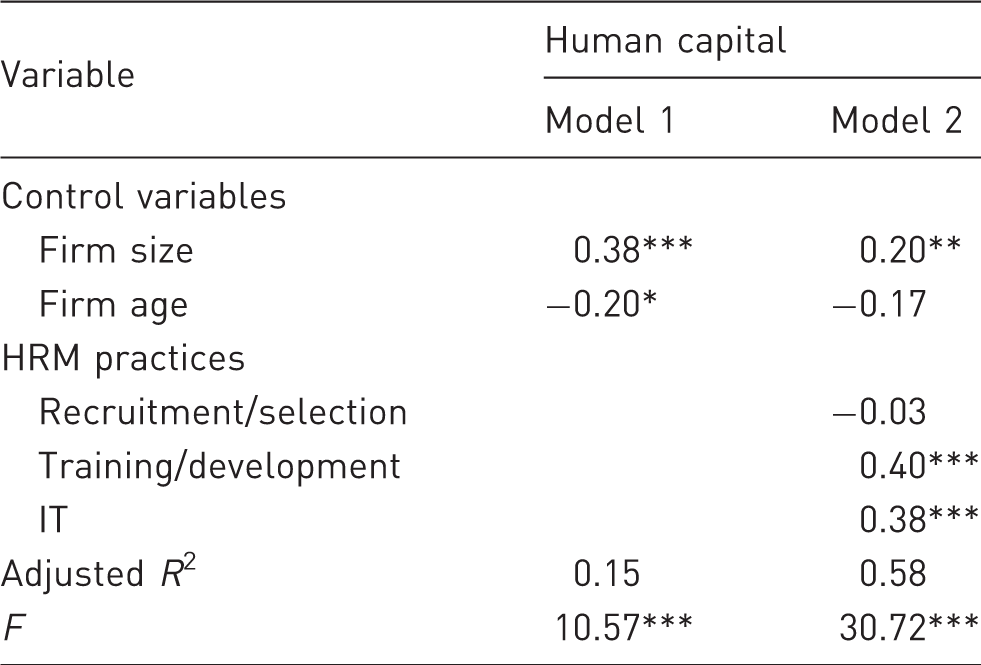
HRM: human resource management; IT: information technology.
Note: n = 109.
p < 0.001; **p < 0.01; *p < 0.05.
Result of regression analyses of innovation.

HRM: human resource management; IT: information technology.
Note: n = 109.
p < 0.001; **p < 0.01; *p < 0.05.
This paper follows Baron and Kenny’s (1986) procedure for analysing the mediating effect of human capital in the relation between HRM practices and innovation. The first step is to analyse the relation between HRM practices and innovation. As model 4 in Table 3 shows, the three HRM practices analysed are significantly related to innovation. The second step consists of examining the effect of HRM practices on the mediating variable. The results of model 2 in Table 2 indicate that training/development and IT practices are positively and significantly related to human capital, but recruitment/selection practices are not. The third step involves analysing the relation between the mediating variable and the dependent variable. Model 5 in Table 3 shows a positive and significant relation of human capital to innovation. The fourth step is to include the mediator variable, human capital, in the models, to examine whether it reduces the effects of HRM practices to non-significance. As model 6 shows, the coefficients are positive and significant for the relation between human capital and innovation. Moreover, including the moderating variable in the model makes the relation between training/development and IT practices and innovation non-significant. Human capital therefore plays a mediating role between HRM training/development and IT practices and innovation. However, human capital does not mediate the relation between recruitment/selection practices and innovation. Recruitment/selection practices have a direct, positive and significant relation to innovation.
Discussion and conclusions
This paper analyses the role of human capital in the relation between HRM practices and innovation in hotel firms. In addition to the HRM practices that the literature traditionally associates with human capital (recruitment/selection and training/development), an attempt was made to assess the influence of IT practices, as they encourage knowledge transfer and exchange among members of the organisation.
Contrary to expectations, the results obtained do not support a relation between recruitment/selection practices and human capital. Firms in the sector analysed in this study are characterised by the low level of employees’ qualifications and a high degree of job turnover (Chang et al., 2011; Kattara and El-Said, 2013; Walsh et al., 2008). Therefore, it seems logical for companies to devote resources to attracting and selecting candidates only when they intend to hire qualified personnel, who normally hold positions of responsibility and make up a minority within the organisation. In these circumstances, recruitment/selection practices may attract individuals with talent to work in specific positions, but they do not improve the overall level of human capital in the organisation. This result is an important finding because it shows that applying rigorous recruitment/selection practices does not improve human capital in firms in this industry, although it does directly influence their innovation performance. It points out, therefore, the importance of adequate planning to develop innovations in the sector in order to facilitate the hiring of the most suitable people, in addition to exhaustive selection criteria and high initial salaries to attract the best candidates. It is quite likely that these practices would allow companies to count on the most appropriate and talented people, and they would be a valuable asset for introducing innovations in the organisation. These findings are consistent with the arguments made by Chen and Huang (2009), for whom an effective selection process allows the company to attract employees with talent, and they can become an important source of new ideas for the innovation processes. Along the same lines, Chang et al. (2011) suggest that, due to the important tacit knowledge required in jobs in the tourism sector, the necessary skills to develop innovations may be difficult to achieve through training. Therefore, companies prefer to attract and hire qualified people from outside to stimulate their innovations. The data seem to indicate that applying recruitment/selection practices for hiring managers improves the introduction of innovations in hotel firms. In fact, the managers of hotel firms represent the main source of knowledge for developing innovations in the hotel sector (Cotec, 2007). The results of this study could be an indication that the HR practices in the hospitality sector must be analysed by considering the possible existence of different practices for the different categories of workers. Lepak and Snell (1999) state that the majority of the companies make distinctions in the way they manage the different types of employees. The data from this paper show that additional research is necessary to further examine the possible differentiated practices applied in hotel firms. Studies of this type will lead to a better understanding of the link between HR practices and human capital in the sector.
In terms of the relation between training/development practices and human capital, the results obtained confirm the existence of a positive and significant relation. These data support the suppositions of the theory of human capital initially developed by Becker (1964, 1993), who regarded training as a form of investment that leads to higher individual productivity. They are also consistent with the results of other authors who found that organisational efforts in training and development are an investment in assets rather than an expense (Chang et al., 2011; Yamao et al., 2009; Youndt and Snell, 2004).
The results provide empirical evidence of the positive effect of practices encouraging IT use on the level of human capital. Therefore, IT not only constitutes a tool for strategic planning and decision making (Leung and Law, 2013) but also allows development of human capital. As well as constituting an essential infrastructure for knowledge management, IT has now become an element that fosters a high level of interaction among individuals, departments and areas of the firm. It therefore seems reasonable to assume that when firms encourage the use of IT at all levels of the organisation, they are fostering information exchange between individuals with different levels and types of knowledge. This kind of exchange increases the chances of the various members of the firm acquiring new knowledge, which can improve the level of human capital within the organisation.
The findings also show that human capital enhances innovation performance. Other investigative studies applied to the hospitality industry have shown that employees are a critical element in generating innovations in the sector (Ordanini and Parasuraman, 2011; Ottenbacher et al., 2006; Walsh et al., 2008). In this field, many innovative ideas arise out of the interaction between employees and customers. It is therefore likely that a higher level of human capital will make it possible to capture and use such ideas more efficiently so they can become innovations.
Academic and practical implications
This study has added knowledge to an ongoing debate in the literature about the possible existence of variables that intermediate in the relation between HRM practices and innovation performance. It suggests that, in the sector studied, some HRM practices help to improve innovation performance through their effect on the firm’s human capital. However, human capital does not mediate the relation between recruitment/selection practices and innovation. Comparison of the results of this paper with earlier studies suggests possible differences between industries in terms of the effect of recruitment/selection practices on human capital that appear to require separate analysis for each type of industry. Future empirical research in the field of the hospitality industry must confirm or refute the results obtained here.
As regards the practical implications, the results show that, in the sector studied, recruitment/selection practices do not appear to constitute an alternative to training/development and IT practices to improve the firm’s level of human capital. This means that if a firm does not have sufficient resources, it must clearly identify which variables are most relevant to the organisation and dedicate its efforts to the appropriate practices. This study suggests that firms which conduct a rigorous recruitment/selection process are not dedicating resources to improve their levels of human capital, although they do attract employees who encourage the introduction of innovations. However, firms could also choose to develop human capital through training/development and IT practices to indirectly achieve innovation performance. Focusing only on making a major effort to select and attract qualified individuals from outside the firm is a much riskier strategy that can lead to short-lived innovation performance. One of the most important implications of this study is that innovation performance can be achieved by internally developing human capital rather than making a major effort purely to select and attract talented individuals from outside the firm.
Limitations and future research
This paper has limitations that suggest future research possibilities. One limitation stems from the use of the key informant methodology. We tried to mitigate perceptual bias by ensuring, to an acceptable degree, the reliability of the answers. Because of this, we highlighted general managers as preferred questionnaire respondents. A further limitation of the study is the generalisation of its conclusions. The hospitality industry is made up of a group of firms with different characteristics, making it difficult to generalise the results obtained. Nonetheless, the results can be extrapolated to the field of the study target population, i.e. to firms managing hotels with a minimum of 50 employees and a rating of at least three stars. Thus, it could be worthwhile applying the model to other non-knowledge-intensive service firms and conducting comparative studies between them. Future research could incorporate other HRM practices not included here, such as participation, empowerment or retention, which could provide greater explanatory power in relation to human capital or firm innovation capacity. In addition, the possible mediating effect in the relation between recruitment/selection HRM practices and innovation of other variables, e.g. learning capability, sensing capability or social networks, could be studied.
Footnotes
Declaration of conflicting interests
The author(s) declared no potential conflicts of interest with respect to the research, authorship, and/or publication of this article.
Funding
The author(s) received no financial support for the research, authorship, and/or publication of this article.