




Abstract
The study examines the effect of market intelligence practices on firm performance in the small- and medium-sized tour operators in Malaysia. Specifically, a conceptual model is developed which hypothesizes that firm innovativeness relates positively to market intelligence acquisition and market intelligence utilization which, in turn, affects firm performance. A self-administered questionnaire survey is used to garner responses from a sample of 81 tour operators. The findings indicate that firm performance is positively related to market intelligence practices both in terms of market intelligence acquisition and market intelligence utilization. In addition, it also shows that the relationship between firm innovativeness and market intelligence acquisition is stronger than the relationship between firm innovativeness and market intelligence utilization. These findings may imply that even though market intelligence practices are more prevalent among larger firms, small- and medium-sized tour operators may also benefit from having formal information processing systems and in particular in terms of acquiring and utilizing information. The limitations of the study and recommendations for future research are also discussed.
Keywords
Introduction
Firms with high level of innovativeness tend to regularly scan and monitor their business environments in order to find and exploit new market opportunities, provide early warning of threats, identify blind spots, and more importantly to be able to sustain their competitive positions (Kohli and Jaworski, 1990; Moorman, 1995). While large firms typically have the resources to organize formal information processes to collect information on customers, competitors, and market place, it is not clear if small- and medium-sized firms do the same, i.e. formally acquire and utilize market information and whether such practices did affect their performance positively. Most prior studies on market information acquisition and utilization are conducted on large and established firms (Adidam et al., 2012; Jaworski and Kohli, 1993; Matsuno and Mentzer, 2000; Yap and Md Zabid, 2011), related to new ventures success (Song et al., 2009, 2010), or new product performance (Droge et al., 2008). Apart from the evidence provided by Keh et al. (2007), there is a limited amount of empirical evidence on formal market information processes among small- and medium-sized firms. Small- and medium-sized firms may be able to improve their ability to survive and increase their success rate by having formal information processing management systems but the constraints they face may lead to a variety of innovative initiatives and information processing behaviors. This study focuses on the market intelligence practices of small- and medium-sized firms and aims to examine the following relationships: (1) between firm innovativeness and market intelligence practices, (2) between market intelligence acquisition and market intelligence utilization, and (3) between market intelligence practices and firm performance.
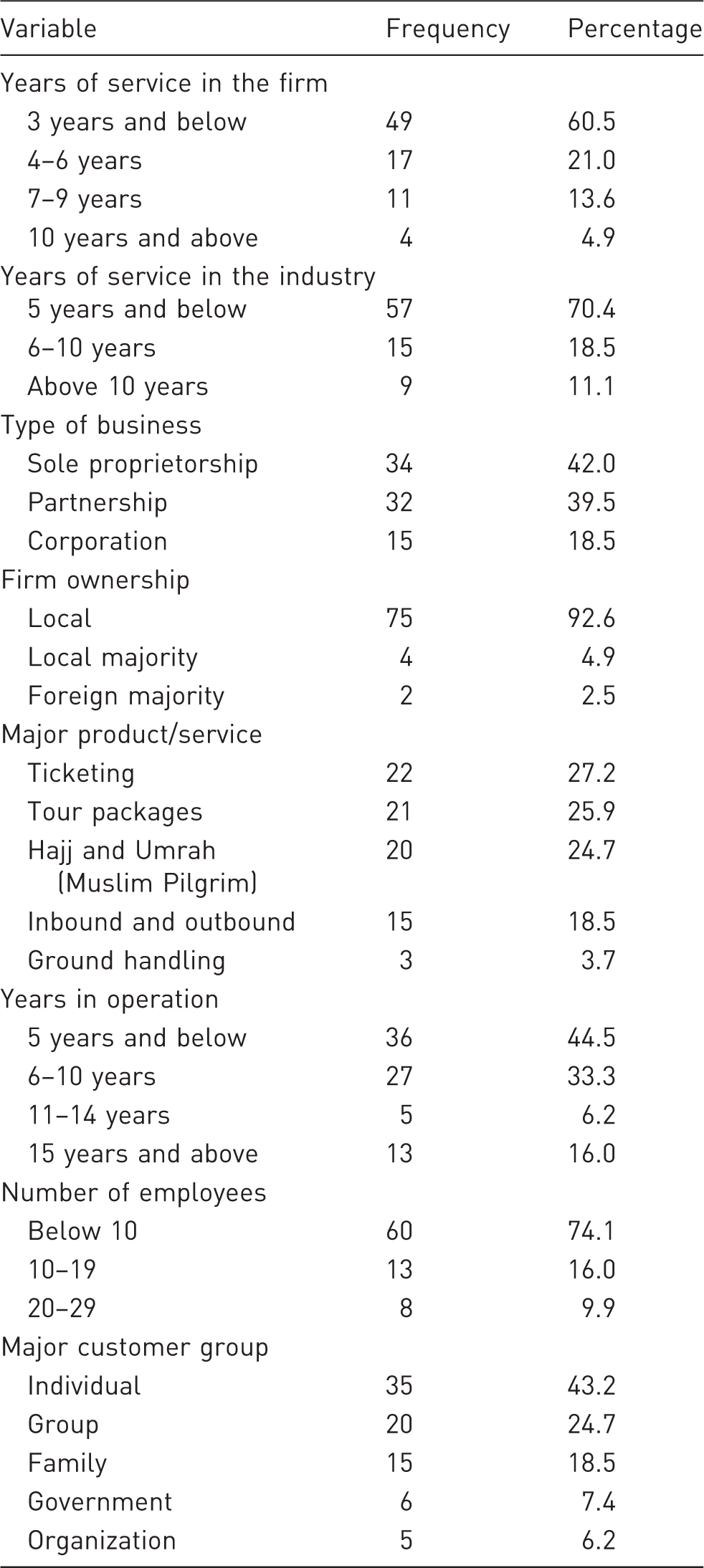
The tourism industry was selected in this study as it is one of the 12 National Key Economic Areas under the Economic Transformation Program in Malaysia which is expected to make substantial contributions to the nation’s economic performance and will receive prioritized public investment and policy support. The tourism industry is also directly affected by the aviation incidents in 2014 (i.e. the disappearance of Flight MH370 while on its way from Kuala Lumpur to Beijing and shooting down of Flight MH17 over the sky of Ukraine) and the uncertainty of Goods and Services Tax implementation in 2015. This paper reports the research findings on tour operators who play an important role as the connector between the supply and the demand for tourism services (Budeanu, 2005). Hence, by providing empirical evidence from the context of an emerging economy, this study hopes to contribute to both literature and practice by examining the relationships between innovativeness, market intelligence practices, and firm performance and providing insights to the local small- and medium-sized tour operators as well as those from other emerging economies. Overall, data were collected using a self-administered questionnaire survey via online and direct visit to 81 tour operators registered with Malaysian Association of Tour and Travel Agents (MATTA).
This paper unfolds as follows. The following section reviews the concept of market intelligence practices and develops a conceptual framework of this study and outlines its respective hypotheses. “Method” section explains the sampling procedures and operationalization of variable. “Results and discussion” section discusses data analysis and results of hypothesis tests. The paper ends with a discussion on the results, implications, limitations, and recommendations for future research.
Literature review
Market intelligence practices
Existing literature on marketing and information science provides several definitions of market intelligence. Marketing literature defines market intelligence as a dimension of market orientation. A market-oriented firm gathers information from the marketplace and has a formal process in place by which this information is used in devising strategies related to market opportunity, market penetration, and market development (Droge et al., 2008; Kohli and Jaworski, 1990; Kotler and Armstrong, 1997). In general, market intelligence can be viewed in two ways. On one hand, it is a comprehensive process of acquiring, sharing, and utilization of market and customer information to enhance a firm’s marketing planning, implementation, and control (Helm et al., 2014; Tan and Ahmed, 1999), and on the other hand, it is considered as a type of competitive intelligence focusing on the market and marketing perspective of business (Rouach and Santi, 2001). Market intelligence involves the processes of intelligence identification, acquisition, analysis, dissemination, and use in organizations. Intelligence is distinguished from information as the former emphasizes the conversion of information into actionable intelligence and its dissemination to the intended users for decision making. Market intelligence is distinguishable from industrial espionage as the former has ethical codes of conducts and information are gathered from diverse and publicly available sources such as industry reports, government reports, feedback from customers, suppliers, as well as competitors. Industrial espionage tends to involve using unethical and illegal method of sourcing of private and confidential data such as through break-ins, information theft, hacking computer systems, secret photocopying of documents, and interception of electronic communications (Crane, 2005; Prescott, 1999).
Academic empirical research on market intelligence practices in business organizations is considered limited and particularly lacking in theoretical grounding. A number of consulting firms such as Global Intelligence Alliance (GIA), McKinsey, and Frost & Sullivan have conducted surveys on market intelligence practices worldwide. In a study by GIA (2011), it was found that that over three quarters of 989 firms (including large- and medium-sized firms), who took part in the survey, have systematic market intelligence practices within their firms and the majority of them agreed that those practices offered substantial benefits and that their investment had been paid off. Nonetheless, this kind of studies is descriptive in nature and did not offer insights on the potential factors affecting market intelligence practices and their relationships with firm performance; a gap which motivates the authors of this paper to conduct this study.
Innovativeness and market intelligence practices
As environmental uncertainties can suppress the success of a firm, it is very important for firms to be innovative and competent. Droge et al. (2008) defined innovativeness as acting proactively and strategically despite the condition of the environment to achieve success. Meanwhile, Damanpour (1991) described innovativeness as a means of changing a firm, whether as a response to changes in its internal or external forces or as a preemptive action to influence the environment it operates in. There are tremendous forces from the environment which are capable of diminishing a firm’s performance. According to the studies conducted by Calantone et al. (2003) and Hurley and Hult (1998), these forces can be overcome by exhaustive competencies which enable a firm’s access to new ideas, products, or processes as well as increase its likelihood of implementing strategies that had been planned. These exhausted competencies are further divided into three dimensions, which are as follows: ability to make good decision, ability to grab the opportunities available in the market, and always be optimistic to generate new products regardless of the turbulence of the environment (Droge et al., 2008; Miller and Friesen, 1982).
The intensity of the market turbulence cannot be withstood by having only innovative competency— a firm must also have the capability to nurture innovativeness and exploit market information. Droge et al. (2008) asserted that a business unit has to possess superior market intelligence gathering technique and be innovative in order to survive in the highly uncertain environment. Both capabilities are seen as boundary-spanning activities which enable a firm to sense, respond to, and later alter the market accordingly (Day, 1994; Moorman, 1995). When compared to firms with a low level of innovativeness, innovative firms are more likely to perform efficient market intelligence practices. Moreover, in order to formulate high-quality marketing decisions, firms have to acquire valuable information and utilize it to develop marketing strategies. Market intelligence practices are considered as one of the key proficiencies of firms in acquiring, disseminating, and utilizing market information (Glazer, 1991; Moorman, 1995). These proficiencies serve as one of the crucial components of competencies a firm must have to achieve success.
Based on a review on related empirical studies, this study argues that an innovative firm’s prime focus will always be on finding ways to explore new products and market opportunities (Jiménez-Jiménez and Sanz-Valle, 2011; Song and Montoya, 1998). Given the constraints small- and medium-sized firms have on financial and human capital, innovations which they wish to initiate most likely would involve substantial effort and expenditures. In view of that, small- and medium-sized firms are likely to feel encouraged to utilize market intelligence in decision making. Firm innovativeness promotes creative behaviors among firms, in which they constantly scan and monitor their business environments, encourage active exchanges of information, and increase information flows. Learning and changes are necessary for firms to become more innovative and this could be done through market information processing (Ottum and Moore, 1997; Wong and Tong, 2012). Accordingly, it is postulated that firm innovativeness has positive relationships with both market intelligence acquisition and market intelligence utilization. H1: Firm innovativeness relates positively with market intelligence acquisition. H2: Firm innovativeness relates positively with market intelligence utilization. H3: Market intelligence acquisition relates positively with market intelligence utilization.
Market intelligence practices and firm performance
By implementing market intelligence practices, a firm is likely to be more prepared to translate the information gathered into actionable intelligence for decision making. Droge et al. (2008) found that market intelligence is positively related to new product success in the low turbulence firms. Moreover, Brockman and Morgan (2003) reported that a firm with higher level of efficiency in acquiring new information is positively related to new products performance. This finding is consistent with study by Moorman (1995) which underscores the importance of market intelligence in creating new market and in identifying creative segmentation opportunities. Additionally, a study conducted in Singapore found that acquisition and utilization of market information in marketing mix decisions are positively related to firm performance among SMEs (Keh et al., 2007). On investment decision, Song et al. (2009) reported that formal market information acquisition and information utilization has direct and positive impact on Chinese new ventures. The study found that formal processes to acquire market information have higher impact on firms serving the emerging market, while the formal processes to utilize market information have higher impact on firms serving the established market. Parry and Song (2010), drawing from the same sample, concluded that formal market information acquisition is equally important to both market-driven firms and technological-driven firms. However, formal processes for using market information have a greater impact on market-driven firms than technology-driven firms. The researchers also conducted a similar study among new ventures in the USA and found that formal processes of using market information are positively associated with formal processes of acquiring market information, and this relationship is stronger among firms serving the established market. New venture performance is found to be positively related to formal processes for utilizing market information and this relationship is also stronger in the established market (Song et al., 2010).
In the context of an emerging economy, a study on Malaysian public listed companies showed that the relationship between competitive intelligence and firm performance is positive (Yap and Md Zabid, 2011). Moreover, the performance of firms with a formal competitive intelligence practices outweigh the performance of those firms without a formal competitive intelligence practice. Correspondingly, a study conducted in India also produced a similar finding which showed that competitive intelligence activities are positively related to firms’ financial performance (Adidam et al., 2012). Both studies reported that among the various types of competitive intelligence, acquisition of customer intelligence was ranked the top by the respondents. In addition, Cooper and Kleinschmidt’s (1986) study concluded that having formal information processes improves a firm’s likelihood of achieving a supreme performance and the firm has to become innovative in adapting to the environmental uncertainty.
Diamantopoulos and Souchon (1999) argued that the information collected will not be meaningful to organizations unless it is put to use in decision making. Marketing decisions are viewed by small firms as the most important decision ahead of finance and human resources. Thus, small firms spent more time to search for information about marketplace than their larger counterparts (Johnson and Kuehn, 1987). Given that marketing decisions will influence firm performance, it is postulated that a positive relationship exists between market intelligence utilization and firm performance.
Collectively, this study postulated that market intelligence acquisition and market intelligence utilization have a positive relationship with firm performance. H4: Market intelligence acquisition relates positively with firm performance. H5: Market intelligence utilization relates positively with firm performance.
Method
This study adopted a quantitative approach and used cross-sectional survey for data collection. The unit of analysis is the organization—small- and medium-sized tour operators in Malaysia.
Sample and sampling procedures
The population of this study consists of organizations in the Malaysian tourism industry, specifically tour operators. Tour operators act as the connector between the supply and the demand for tourism services (Budeanu, 2005). The information about the tour operators was obtained from MATTA web portal. As of 31 June 2014, about 2900 tour operators registered with the association and are listed according to 13 states and three federal territories in Malaysia. The samples were selected from 1200 tour operators located in Klang Valley, a major business hub in Malaysia which consists of Kuala Lumpur, Selangor, and Putrajaya.
Data collection method
The data were collected using a self-administered questionnaire survey via Google Docs and direct distribution to selected tour operators’ office in Klang Valley. The inclusion of the latter approach was to complement the online survey approach, knowing that the response rate via online survey in Malaysia would be low. Questionnaire survey using closed-ended questions is an economical and efficient way of collecting primary data across tour operators in Klang Valley.
Variables and measurement
Firm innovativeness
The construct was operationalized as having three items which were exploring new products/services, discovering market prospects, and ability to do something new. All of the items were adapted from the survey instrument developed by Droge et al. (2008) and Miller and Friesen (1982) and were measured along 5-point Likert scale from 1 = Strongly Disagree to 5 = Strongly Agree. Sample item includes “Our firm has marketed many new lines of products/services in the past five years”.
Market intelligence acquisition
Five items were adopted from Moorman (1995) and used by Song et al. (2009) to measure market intelligence acquisition. The respondents were asked to indicate their level of agreement about their firm having formal processes to acquire information about customers, competitors, external experts, and other sources. All items were measured using 5-point Likert scale from 1 = Strongly Disagree to 5 = Strongly Agree. Sample item includes “Our firm is continuously collecting information about competitors’ activities.”
Market intelligence utilization
Parallel to market intelligence acquisition, the five items for market intelligence utilization were also adopted from Moorman (1995) and used by Song et al. (2009). These items measured the formal procedures used by a firm to solve specific problems, make decision, assess project outcomes, and provide feedback. Respondents were asked to indicate their level of agreement to each items ranging from 1 = Strongly Disagree to 5 = Strongly Agree. Sample item includes “Our firm relies heavily upon market information to make decisions.”
Firm performance
Abundant of measures for firm performance exist in the literature, for instance, financial performance and market performance (Moorman and Rust, 1999; Wang et al., 2012). All items for firm performance were adopted from Moorman and Rust (1999) and Wang et al. (2012). The six items included were customer satisfaction, loyalty, lifetime value, and retention level, as well financial performance in terms of market share growth and sales growth. All the six items were measured using 5-point Likert scale from 1 = Strongly Disagree to 5 = Strongly Agree. Sample item includes “Our sales are growing.”
Results and discussion
Sample profile
Sample profile (n = 81).
Hypothesis test
To test the research hypotheses, partial least squares path modeling (PLS-PM) with R (Sanchez, 2013) was used. PLS-PM is a multivariate statistical technique that enables simultaneous evaluation between multiple variables. The analysis technique was adopted because of its ability to obtain parameter estimates at relatively lower sample sizes (Gefen et al., 2011). PLS-PM involved two-stage analysis: evaluation of measurement model and structural model. Measurement model assessed the reliability and validity of the items and constructs while structural model assessed the effect size, direction, and significance of the hypothesized relationships.
Correlation matrix.
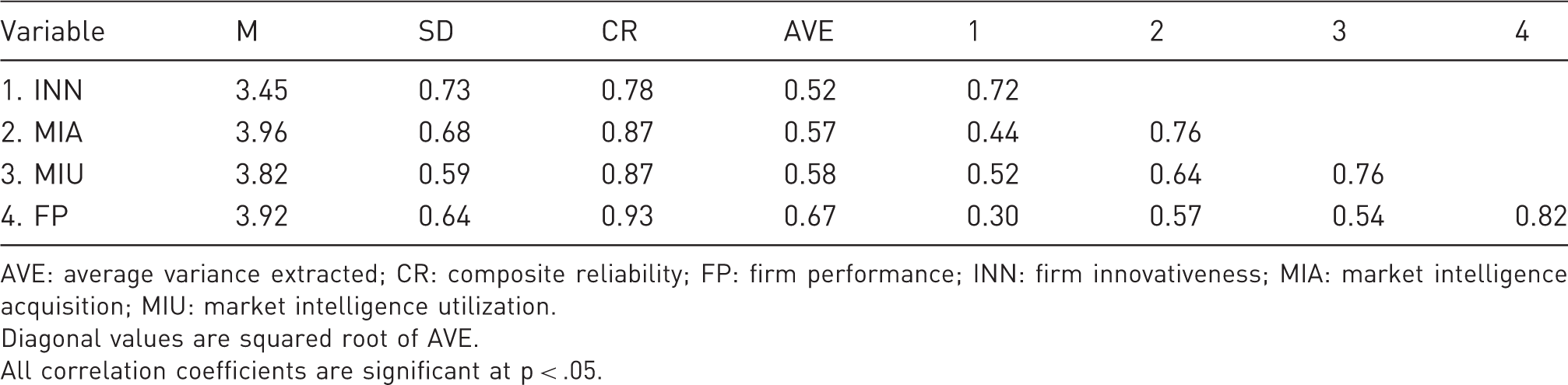
AVE: average variance extracted; CR: composite reliability; FP: firm performance; INN: firm innovativeness; MIA: market intelligence acquisition; MIU: market intelligence utilization.
Diagonal values are squared root of AVE.
All correlation coefficients are significant at p < .05.
Factors loading and cross loading.
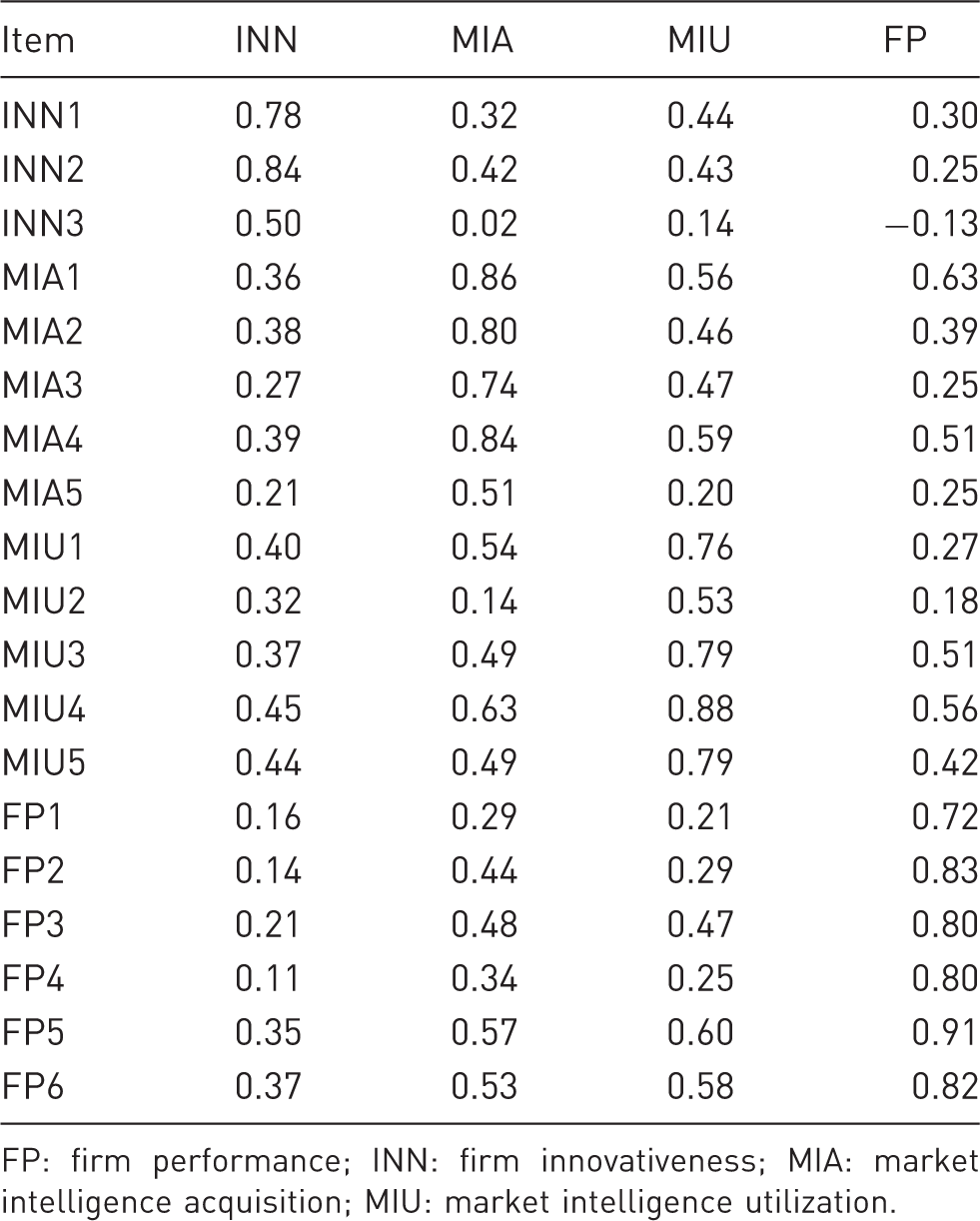
FP: firm performance; INN: firm innovativeness; MIA: market intelligence acquisition; MIU: market intelligence utilization.
The first hypothesis test concluded that firm innovativeness has a positive and significant influence on market intelligence acquisition (β = 0.44; t = 4.29; p < .001). The second hypothesis test also revealed a positive and significant relationship between firm innovativeness and market intelligence utilization (β = 0.30; t = 3.30; p < .001). However, the strength of relationship is lower than that of with market intelligence acquisition. The third hypothesis test showed that the relationship between market intelligence acquisition and market intelligence utilization is positive and significant (β = 0.51; t = 5.62; p < .001). The fourth hypothesis test suggested that market intelligence acquisition has a positive and significant relationship with firm performance (β = 0.38; t = 3.26; p < .01). The last hypothesis test showed that the relationship between market intelligence utilization and firm performance is positive and significant (β = 0.30; t = 2.57; p < .05). Collectively, the study found support for all the five hypotheses and both market intelligence acquisition and utilization explained 38% of the variance of firm performance in the structural model. Figure 1 reports the parameter estimates and significance levels for each hypothesized relationship in the structural model.
Structural model.
This study found that firm innovativeness has a positive and significant effect on market intelligence practices, both in terms of market intelligence acquisition and market intelligence utilization. The findings provided further support for relevant literature (Droge et al., 2008). However, the stronger relationship between firm innovativeness and market intelligence acquisition than the relationship between firm innovativeness and market intelligence utilization indicates that firms with higher level of innovativeness may acquire more market intelligence but not always the same level of market utilization. Furthermore, this study found that market intelligence acquisition has a positive and significant relationship with market intelligence utilization (Kettinger et al., 2013). Thus, firms that acquired more market intelligence are more likely to utilize it in marketing strategies and decision making compared to firms who do not. Furthermore, the findings are consistent with prior research indicating a positive and significant relationship between market intelligence practices and firm performance, both in terms of customer’s perspective and market performance (Yap and Md Zabid, 2011).
Conclusion
Implications
The contribution of the study is twofold: (1) the empirical examination of the effect of firm innovativeness on market intelligence practices; and (2) the confirmation of the positive relationship between firm innovativeness and market intelligence practices as well as between market intelligence practices and firm performance in the context of small- and medium-sized tour operators. Based on the findings of the study, tour operators should instill innovativeness culture among the marketing personnel in their firms. Tour operators with high innovativeness may cultivate formal information processes in market intelligence acquisition and utilization. Small- and medium-sized firms with limited resources need to be more innovative in their business processes, specifically the information processes. This can be achieved by helping the marketing personnel become more aware of the availability of public sources of market intelligence such as social media, main stream media, industry and regulatory bodies, suppliers, customers, and even competitors. For the decision makers, they need to be aware of what market intelligence is acquired by the firm and how to utilize the market intelligence in marketing strategy and decisions in an efficient manner. Consequently, as market intelligence practices have a positive impact on firm performance, small- and medium-sized tour operators may need to initiate a systematic and organized system in dealing with acquisition and utilization processes of market intelligence.
Limitations and recommendations for future research
There are several limitations affecting the generalizability of the research findings. First, this study focused merely on two aspects of the market intelligence practices which were acquisition and utilization, which inhibit this study to capture the complete domain of market intelligence practices. Second, the findings cannot be generalized across the population of tour operators in Malaysia due to small sample size. Third, the data were collected from a single informant. As such, the responses especially about the criterion variable of firm performance may be bias.
Since this study focused on two aspects of the market intelligence practices, it is suggested for future research to incorporate other aspects, for instance, planning, dissemination, and sharing of market intelligence to better understand the insights of market intelligence practices. Second, future research is recommended to obtain a larger sample size to improve the generalizability of the findings. Third, future researchers may collect data about the criterion variable from different sources such as customers to minimize single informant bias. Besides, it is recommended to future researchers to examine a larger set of antecedents to market intelligence practices as well as potential moderators, such as employee innovativeness and information systems resources and capability. The similar study may also be extended to other industry sectors, for instance, pharmaceutical, banking and financial services, and aviation where market intelligence practices are prevalent.
As a whole, it can be concluded that highly innovative tour operators acquire market intelligence and utilize it in marketing strategy and decisions in order to react to and anticipate the industry development and subsequently to sustain in the competitive environment. To sum up, this study managed to achieve the research objectives and provide some preliminary insights to small- and medium-sized players in tourism industry in relation to innovativeness, market intelligence practices, and firm performance.
Footnotes
Declaration of conflicting interests
The author(s) declared no potential conflicts of interest with respect to the research, authorship, and/or publication of this article.
Funding
The author(s) disclosed receipt of the following financial support for the research, authorship, and/or publication of this article: This research is funded by the Fundamental Research Grant Scheme, Ministry of Higher Education, Malaysia (FRGS/1/11/SS/UNITAR/03/2).