



Abstract
Bangkok, Thailand is in a unique position to benefit economically and has become one of the world’s most popular tourist destinations, due to its function as a hub for international travel in Southeast Asia. Thus, this study examines how past experiences, age, income, gender, education level, occupation, and regions affect international tourists’ reasons to visit Bangkok. After conducting chi-square analysis on 400 participants, significant differences were found among the varying income levels, occupations, education levels, and regions of origin and their reasons for visiting Bangkok. However, no significant differences were found based on age and gender regarding reasons to visit Bangkok. As far as regions of origin, Europeans were most likely to visit Bangkok as a stopover in route to another destination. This lays the foundations for further research focusing on what Bangkok can do to increase their status as a destination for European travelers.
Introduction
Due to its range of exquisite natural landscapes and rich cultural life, Thailand has become one of the world’s most popular tourist destinations. Bangkok, the capital and most populous city of Thailand, is one of the key international travel hubs in Southeast Asia (Cripps, 2012). As such, the tourism industry in Bangkok sees this traffic as a prime opportunity to gain business from international travelers. Tourists flowing through Bangkok have been increasing annually for the past 15 years and the number of international tourists arriving in Thailand has risen from approximately 10 million in 2000 to about 26.74 million in 2013 (Trading Economics, 2015). As a result, Thailand’s tourism sector accounts for the most valuable annual output to the country’s economy (Central Intelligence Agency, 2015).
Thailand’s tourism industry is deeply infused with the nation’s economy as it not only affects the hotel and resort businesses but also has an immeasurable effect on the local shop owners, street venders, and transport services. According to the World Travel and Tourism Council (2013), Thailand’s tourism industry accounts for approximately 13% of the total economic employment. Although Bangkok may lack the attractions some travel to see, it has vast amounts of cultural and entertainment pulls that are available to travelers. Bangkok would greatly benefit by knowing how tourists think and what makes this destination attract tourists to visit. Therefore, in order for Bangkok’s tourism industry to encourage more tourist traffic, tourism officials must determine international travelers’ motivations as well as their behavioral and consumer characteristics.
The purpose of this study is to analyze the relationship between the tourists’ sociodemographic/travel characteristics and their purpose of visiting Bangkok. First, this study is designed to investigate how past travel experience influences tourists to revisit Bangkok as a tourist destination. It also aims to investigate the effects of sociodemographic characteristics of tourists on their motivations to visit Bangkok as their travel destination. The sociodemographic characteristics of tourists that are the focus of this study include age, total household income, occupation, gender, educational level, and region. For this research, tourists’ purposes of visiting Bangkok include three main reasons: (1) professional visit, (2) leisure visit, and (3) stopover in route to another destination (Suttikun et al., 2015). Each category is defined as follows:
1. Professional visit: A person visiting Bangkok for work via self or company sponsor. 2. Leisure visit: A person visiting Bangkok for vacation, to visit friends and family, or to escape from cold weather, etc. 3. Stopover in route to another destination: This includes stopovers in route to other provinces in Thailand as well as in route to other countries.
Literature review
Motivations and past experience of tourists
Motivation is a pertinent factor behind tourist behavior (Baloglu and Uysal, 1996) and helps to explain the process of decision making when preparing to travel (Chen and Chen, 2015). Chen and Chen (2015) explained that there are two main reasons motivating people to travel consisting of “psychological forces” and “environmental features.” For psychological forces, tourists may decide to travel because they would like to get out of their routines, make new friends, discover more about themselves, and relax in a nice environment. Environment features of a tourist destination (e.g. natural environment, historical places, events, and plane ticket promotions) can also encourage people to make a decision to visit a specific destination. Tourists may visit a destination based on an environment motivated by internal desires such as relaxation and adventure (Kim et al., 2003). For this study, motivations to visit Bangkok are categorized into three fundamental reasons as mentioned earlier: (1) professional visit, (2) leisure visit, and (3) stopover in route to another destination. Therefore, motivation is considered a vital factor, which influences tourists to select a particular destination (Leiper, 2004). Li and Cai (2012: 475) stated, “travel motivation has always been considered as the essential part of the dynamic process of tourist behavior.”
Even though tourists make decisions to travel from a variety of sources such as advertising and word of mouth, past experience is one factor that may impact tourists’ decisions to travel to a particular destination in the future (Huang, 2006). Huang (2006) mentioned that previous experience allows tourists to compare their perceptions of a tourist destination before and after they visit the destination. Tourists also use their past experience to evaluate other destinations and make decisions whether they will visit or not. Song et al. (2014) supported that the intentions of revisiting a destination can be predicted from tourist satisfaction of past experiences. The researchers mentioned that there are three main motivations that drive tourists to revisit a destination including: (1) tourists do not want to be disappointed with new places, (2) they would like to gain more experiences than they attained during their initial visit, and (3) they are impressed with local people and environmental surroundings at a destination. For this study, past experience is used to examine if international tourists who have and do not have previous experience of visiting Bangkok tend to have the same motivations to go to Bangkok as their tourist destination. The following hypothesis is suggested:
H1: Tourists with past experience in Bangkok will have different motivations for visiting Bangkok as a tourist destination than tourists without prior experience.
Sociodemographics of tourists
Due to the competitive nature of the tourism industry, travel destinations must regard potential tourists as individuals with personal characteristics. Even without being privy to a destination’s features, tourists’ individualities aid in predicting intentions to visit. When tourism officials or affiliated marketers represent tourist destinations, they must appeal to potential tourists by focusing on individuals’ personal characteristics, including age, gender, occupation, and education (Stabler, 1988; Um and Crompton, 1990). Extant research regarding tourists’ intentions to visit destinations and personal characteristics has predominantly focused on perceived image. A few studies have assessed the perceived image of certain destinations and how this relates to personal characteristics when intending to visit and revisit (Chon, 1990; Court and Lupton, 1997; Joppe et al., 2001).
Age, income, occupation, gender, and education
Various authors have addressed age, income, occupation, gender, and education as determinants of perceived image and the intention to visit a destination (Beerli and Martin, 2004; Um and Crompton, 1990; Walmsley and Jenkins, 1993). Gibson et al. (2008) measured the effects of five sociodemographic components, including gender, age, household income, and university class standing, assessing their influence on U.S. young adults’ perceived image of China as a tourist destination. Baloglu (1997) determined that though no significant differences existed between German tourists’ perception of U.S. image, there were significant differences between the perceptions of age and occupation with sociodemographic factors, including income, gender, and education.
Tourists’ age and education affected image perceptions of tourist destinations (Baloglu and McCleary, 1999), along with gender, age, level of education, occupation, income, marital status, and country of origin (Walmsley and Jenkins, 1993), though there lacked differences with regards to gender and income (Baloglu, 1997). Iyiola and Akintunde (2011) later assessed sociodemographic variables including gender, age, education, income and occupation, and their effect of tourists travel intentions to Nigeria. The study of tourist destination intention to visit, and its relationship to determinants influencing this outcome, has concentrated on sociodemographic characteristics of the individual tourists.
Tourists’ sociodemographic characteristics, such as their age, income, occupation, gender, and education affect perceptions of destinations (Gibson et al., 2008; Um and Crompton, 1990; Woodside and Lysonski, 1989). Ng et al. (2007) and Yoon and Uysal (2005) suggested that age and income determine people’s choice of destination. Walmsley and Jenkins (1993) determined that the perceptions toward New South Wales, Australia, significantly differed by age and gender. In a study of perceptions toward the state of Pennsylvania, USA, tourists’ age failed to affect the state’s image, while income did affect the state’s image (MacKay and Fesenmaier, 1997). As sociodemographic personal characteristics are important factors to motivate tourists to visit the destination, this study examines these factors (i.e. age, income, occupation, gender, and education level) as antecedents of tourists’ motivations to visit Bangkok.
Gibson and Yiannakis (2002) incorporated The Levinson’s adult life cycle model, and was integrated in determining tourists’ age and gender throughout the course of life, as differences existed between younger respondents who were more likely to explore adventurous destinations, while younger women were more likely to travel in large, organized groups (Gibson and Yiannakis, 2002; Levinson, 1996). Valuable insights further aid marketers and governments of tourist destinations in developing adequate strategies. Though conflicting results concerning the significant personal characteristics are gathered from the existing literature, it is apparent that sociodemographic characteristics, including age, income, occupation, gender, and education, deem relevant when determining international tourists’ perceptions and intentions to visit Bangkok, Thailand.
Regions of origin and travel intentions
People with different nationalities tend to have different destination images and motivations to visit places (Beerli and Martin, 2004; Prayag and Ryan, 2011). Ng et al. (2007) supported that national culture has a significant influence on tourists’ travel patterns. Japanese tourists prefer a short holiday, while European tourists tend to have long vacations. German travelers enjoy resort type locations, which provide them with activities such as golf, tennis, and skiing. While American tourists like to engage with other people from different cultures or nationalities, Japanese tourists prefer not to socialize with other nationalities (Ng et al., 2007). Demographics and nationality have an impact on people’s different perceptions of push and pull factors (Kozak, 2002; Martin and Del Bosque, 2008; Prayag and Ryan, 2011). Lam and Hsu (2006) mentioned that tourists from different regions such as Eastern and Western regions tend to have different perceptions of travel motivations based on their cultures resulting in different traveling preferences.
International business tourism merges a professional trip with leisure-tourism activities found in the destination of the trip (Kulendran and Witt, 2003). The concept of business tourism has been identified from previous researchers as an important element of international tourism and provides evidence that international business tourism heavily relies on the business relationship the countries have with one another (Kulendran and Wilson, 2000; Kulendran and Witt, 2003; Morley and Sutikno, 1991; Witt and Witt, 1992). For professional tourism to take place, inbound business arrivals would generally come from major trading partners of the host country (Kulendran and Witt, 2003). From a previous study by Suttikun et al. (2015), the literature identified regions such as Asia, New Zealand, America, Europe, and Australia as providing most of the travelers to Thailand. A similar study by Kulendran and Witt (2003) equally identify the United States, the United Kingdom, Japan, and New Zealand as trading allies with Australia; therefore, the majority of business tourism came from these four countries. Business tourism trends play a huge role in tourism growth within certain countries; however, the professional relationship one country has with another is at the forefront of why business tourism occurs (Smeral, 2012). As Thailand begins to develop into a safe and enjoyable country for tourism, it is vital to understand why individuals travel to Thailand and the relationship between the purpose of their trip and their regions of origin (Chon et al., 1993).
As identified in previous literature, many international visitors to Thailand have different drives to experience Thailand’s tourism activities (Suttikun et al., 2015). The various leisure activities that Thailand has to offer attract many individuals from across the world. Guests who are in close proximity to Thailand would rarely participate in stopover tourism due to the type of flights they will take. In contrast, tourists’ who travel from across the globe would likely participate in stopover tourism due to the airline’s policy to stop and refuel.
Recognizing the importance of understanding tourists’ characteristics, researchers have explored how demographics and culture affect tourists’ travel decisions (You et al., 2000). For example, one study comparing Japanese tourists and tourists from the U.K. found that “U.K. travelers viewed knowledge enhancement about places, people and things, as being more important than Japanese travelers” (You et al., 2000). Japanese tourists reported that getting physical rest, getting a break from work, and having fun were more important. As far as pull factors, the same study reported that tourists from the U.K. gave more importance to personal safety and interaction with local people, while Japanese tourists preferred beautiful scenery and historic buildings (You et al., 2000). Knowing these types of variations in travelers’ motivations can inform a particular destination of services and amenities to offer for a broad range of tourists. Demographic statistics are valuable to the travel destination. A number of studies (MacKay and Fesenmaier, 1997; Yoon and Uysal, 2005) have shown that age, gender, and annual income highly affect travelers’ perceptions of a destination, thus affects their decision to visit. This information is useful when creating an image for the destination as part of a marketing plan.
To test the relationship between tourists’ sociodemographic characteristics and their purpose of visiting Bangkok, the following hypothesis was proposed:
H2: There is a statistically significant relationship between international tourists’ a) age; b) income; c) occupation; d) gender; e) education; (f) regions and their travel intention to Bangkok.
The objectives of the study
This study is designed to investigate whether international tourists with different past experience and sociodemographic characteristics will have different travel motivations and purposes for traveling to Bangkok as their tourist destination. The conceptual framework for this study is proposed as follows (see Figure 1).
The framework of the study.
Methodology
Sampling method
The subjects of this study are 400 international tourists selected conveniently from tourists who visited Bangkok at four places including The Grand Palace, Wat Phra Kaeo, Wat Pho, and Khao San Road. The researchers selected these four tourist destinations because they are famous attractions in Bangkok, as well as places where international tourists are more likely to visit when traveling to Bangkok (Tourism Authority of Thailand, 2014). The questionnaires were collected from 100 participants at each attraction in December which is a peak travel period in Thailand (Pacific Asia Travel Association, 2015). This allows for the sample to be more representative of the general international tourist population.
A criterion was also created to recruit prospective participants. Participants who could take part in this study had to be international tourists (i.e. not living in Thailand) and 18 years of age or above. Using this criterion, the researchers asked potential participants whether they are international tourists or if they live permanently in Thailand. Only those not living in Thailand were able to take the survey. Therefore, 400 international tourists 18 years old or above participated in this study.
Research instrument
The independent variables in this study include past experience, age, income level, occupation, gender, education level, and region while the dependent variable includes tourists’ reasons for visiting Bangkok as a tourist destination (Suttikun et al., 2015). The questionnaire includes three sections. One section includes information about age, income level, occupation, gender, education level, and regions of origin. The second section includes questions about motivations for visiting Bangkok. The third section includes questions asking if they have been to Bangkok before and if their past experience affected their decision to travel to Bangkok this particular time. All questions were developed based on Pojsoontorn (2008).
Pilot study and data analysis
Fifty questionnaires from international tourists were collected for the pilot study in order to check understanding to improve the questionnaire. The data were analyzed using Statistical Package for the Social Sciences (SPSS). A chi-square (χ2) was used to test the relationships between the independent variables and the dependent variable for two hypotheses.
Results
Past experiences and travel motivation
H1: Tourists with past experience in Bangkok will have different motivations for visiting Bangkok as a tourist destination than tourists without prior experience.
Chi-square (χ2) results of decision making of international tourists by past experience. Note: **p < 0.01.
Sociodemographics and travel motivation
H2: There is a statistically significant relationship between international tourists’ a) age; b) income; c) occupation; d) gender; e) education; (f) regions and their travel intention to Bangkok.
Chi-square (χ2) results of international tourist’ sociodemographic characteristics. Note: *p < 0.05, **p < 0.01.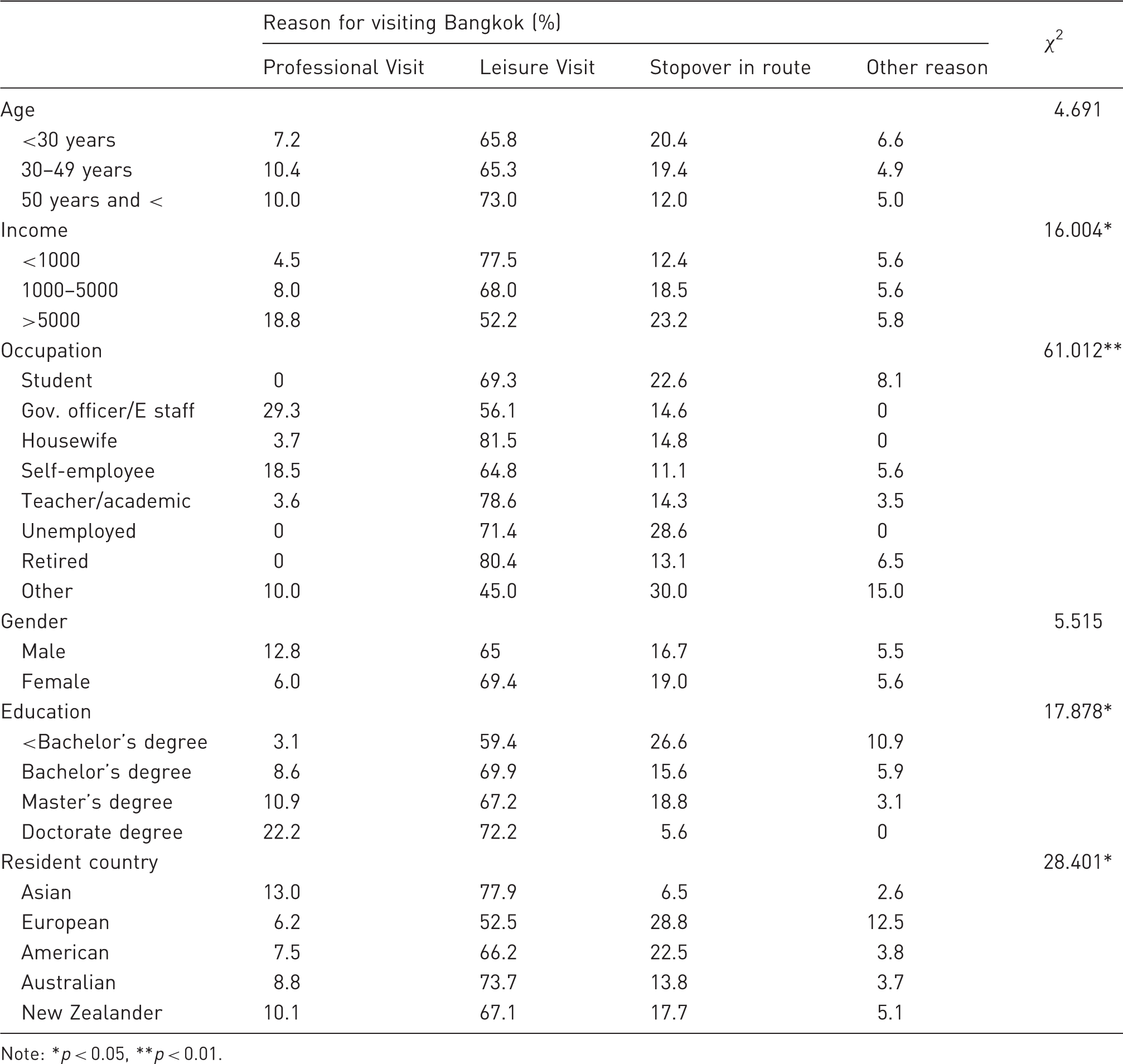
Chi-square analysis reveals that there is a significant relationship between the international tourists’ monthly income and their reason to select Bangkok as a tourist destination (χ2 = 16.004, p < 0.05). The results indicated that each income level visits Bangkok for leisure purposes: less than $1000 US per month (77.5%), between $1000 and $5000 US (68.0%), and more than $5000 US per month (52.2%) (see Table 2). However, tourists earning more than $5000 US per month have the highest percentage of professional visits to Bangkok as well as stopover visits in route to another place (18.8%).
Chi-square analysis reveals that there is a relationship between the international tourists’ occupation and their reasons to select Bangkok as tourist destination (χ2 = 61.012, p < 0.01). The results indicated that each occupation visits Bangkok for leisure purposes: housewife (81.5%), retired tourists (80.4%), teacher/academic tourists (78.6%), unemployed tourists (71.4%), student tourists (69.3%), self-employed tourists (64.8%), company employee tourists (57.9%), and government officer/enterprise staff tourists (56.1%) (see Table 2). Government staff has the highest percentage of visiting Bangkok for professional purposes (29.3%).
Chi-square (χ2) was used to analyze the hypothesis as depicted in Table 2. Chi-square analysis revealed that there is no relationship between the international tourists’ gender and their reasons to select Bangkok as a tourist destination (χ2 = 5.515, p > 0.05). Both male and female tourists came to Bangkok for leisure (65.0 and 69.4%).
Chi-square analysis revealed that there is a significant relationship between the international tourists’ education level and their reason to select Bangkok as tourist destination (χ2 = 17.878, p < 0.05). The results show that each education level visits Bangkok for leisure purposes: doctoral degree (72.2%), bachelor’s degree (69.9%), master’s degree (67.2%), and less than a bachelor’s degree (59.4%) (see Table 2). However, tourists with doctoral degrees had a higher percentage of professional visits to Bangkok than other education levels (22.2%). Tourists with less than a bachelor degree have a higher percentage of passing through Bangkok on their way to other places (26.6%). These tourists are most likely still in college and they more often go to the islands for vacation.
Chi-square analysis revealed that there is a significant relationship between the international tourists’ regions and their reason to select Bangkok as a tourist destination (χ2 = 28.401, p < 0.05). The results indicated that tourists from each region visit Bangkok for leisure purposes: Asia (77.9%), Australia (73.7%), New Zealand (67.1%), America (66.2%), and Europe (52.5%) (see in Table 2). Asian tourists have the highest percentage of visiting Bangkok for professional purposes (13.0%). Tourists from Europe and the US are more likely to stopover in Bangkok before visiting other provinces in Thailand or other countries (28.8 and 22.5%, respectively).
Additional findings
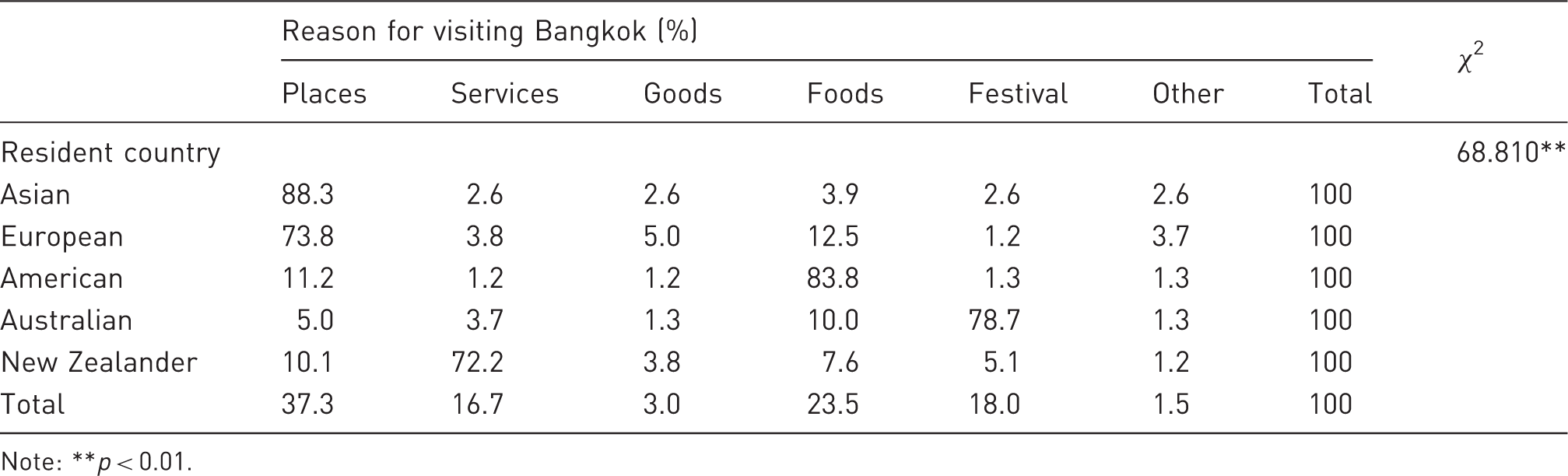
There is a relationship between resident country and type of tourist attractions that attract international tourists to Bangkok.
Chi-square (χ2) results of international tourist’ preferences of tourist attractions.
Note: **p < 0.01.
The results indicated that Asian tourists were attracted by places to visit Bangkok the most (88.3%) and European tourists second (73.8%). Most American tourists were attracted by food to visit Bangkok (83.8%) while most Australian tourists were attracted by festivals (78.8%). New Zealanders were attracted by services to Bangkok (72.2%).
Discussion and conclusions
This research found that tourists’ past experience of visiting Bangkok and their characteristics affect their reasons for visiting Bangkok as a tourist destination. As Lee and Allen (1999) analyzed the relationship between past experience and tourist attractions, it was concluded that if tourists are satisfied with a destination, they may be encouraged to travel to that destination again. On the contrary, if the tourists feel dissatisfied with a particular tourist destination, they may not want to revisit. Thus, this study determined that past experiences affect tourists’ intentions to revisit a destination.
The results of this study showed international tourists’ motivations to choose to visit Bangkok as their travel destination based on their demographic. All proposed hypotheses were supported except hypotheses 2a and 2d. The findings indicated that tourists with and without past experience tended to have different patterns of traveling (H1). For example, international tourists who visited Bangkok with previous travel experience were more likely to visit Bangkok again for leisure purposes. However, the number of international tourists passing through the city to go to other provinces was higher for those of who have never visited Bangkok before. Even though there were no significant relationships between international tourists’ intentions of visiting Bangkok and age (H2a) and gender (H2d), the results showed that there were statistically significant relationships between international tourists’ income (H2b), occupation (H2c), education (H2e), regions (H2f), and their travel intention to Bangkok.
Testing the first hypothesis showed that more than half of the respondents had previously visited Bangkok, and their past experience pushed them to travel to Bangkok again. However, tourists without past experience tend to stopover in Bangkok before visiting other provinces or countries. This could be because the tourists do not know whether Bangkok has a variety of tourist attractions or activities. Therefore, the Tourism Authority of Thailand (TAT) should create a more rigorous advertising campaign to promote Bangkok’s tourist destinations and activities on the TAT website to motivate international tourists to travel to Bangkok. The TAT has created a variety of campaigns to attract international tourists to visit Thailand such as Amazing Thailand, Unseen Thailand, and Miracle Thailand (CNN Travel, 2011). The TAT should also create marketing strategies that build a positive first impression so tourists are more likely to revisit. However, the TAT may need to create more activities to motivate international tourists to spend more time in Bangkok before they travel to other provinces in Thailand or countries. In addition, the study shows that most international tourists preferred to travel to Bangkok again, and they preferred to recommend Bangkok as a tourist destination to their friends and relatives. On the other hand, there were some respondents who did not want to travel to Bangkok again because they desired to visit other provinces or countries, as they had visited Bangkok frequently.
Spotts et al. (1998) stated that images of tourist destinations are in the minds of return visitors, present visitors, and potential visitors. Tourists often choose their destination based on these perceived images. Spotts et al. (1998) also stressed the importance for destinations to encourage repeat visits. The investment to generate repeat visits is relatively low, compared to the investment that is needed for generating first time visits; it takes less investment to convince visitors to return if a destination is capable of providing a high-quality tourism experience. The relatively high investment to generate first time visits is worthwhile, as it creates positive images of the destination in people’s minds.
This research not only investigates how past experience affects tourists’ reasons for visiting Bangkok, but also tests how tourists’ sociodemographics influence their reasons for visiting Bangkok. Sociodemographics influence how tourists perceive a destination image (Iyiola and Akintunde, 2011). This study identifies sociodemographics as factors motivating international tourists to visit Bangkok including gender, age, income, occupation, education level, and region. This could lead them to have different reasons to visit a tourist attraction. Leiper (1997) suggested that tourism can be defined in behavioral terms as persons who travel away from their normal residential region for a temporary period of at least one night. Their behavior involves a search for leisure experiences from interactions with features or characteristics of places they choose to visit.
Testing the second hypothesis showed that the education level, occupation, monthly income, and regions of origin of international tourists affect decision making to select Bangkok as tourist destination. These results support the previous studies of and Yoon and Uysal (2005) which show that age, regions of origin, occupation, educational level, and income also determine people’s choice of the destination. Additionally, Yavuz (1994) argued that socioeconomic, demographic, and behavioral indicators are commonly used to profile tourists by age, gender, income, marital status, occupations, education, or ethnic background in tourism research.
This research found that tourists with higher education degrees (e.g. doctoral degrees) were more likely to visit Bangkok for leisure and professional purposes. Most participants in this group were likely to be professors and perhaps travelling for vacation or to attend a conference. Also, international professors sometimes travel to Bangkok to teach at universities that offer international programs to students for short periods after which they travel back to their home country. Tourists with an income of less than $1000 per month seemed to travel more to Bangkok for leisure purposes compared to other groups with higher income levels. However, tourists who had an income of more than $5000 per month were more likely to visit Bangkok for professional reasons and only stop in Bangkok to transfer to other provinces or countries. Thus, this group of tourists could be business travelers who did not have time to travel around in Bangkok.
In terms of occupations, housewives and retired people tended to travel more to Bangkok for leisure purposes compared to tourists with other occupations, such as government employees, students, and the self-employed. This may be due to these groups having more time and money to spend for a vacation. It also shows that there were no retired tourists who came to Bangkok for professional reasons. This supports the finding of the previous research (i.e. Rodríguez et al., 2004) that retired people who have a good and stable income are looking to visit a destination with “recreational” and “service resources.” On the other hand, tourists who were government staff were more likely to visit Bangkok for professional purposes.
This research found that Asian tourists are more likely to visit Bangkok for leisure and professional purposes. European and American tourists appeared more often to stopover in Bangkok before visiting other places. Therefore, the TAT should recognize the importance of the sociodemographic characteristics pertaining to international tourists in order to present promotions that are suitable for them.
The results of the relationship between regions of origin and the forces that pull them to Bangkok indicate that Asian and European tourists were attracted by the location. However, the number of Asians tourists was higher than the number of European tourists. The Asian tourists prefer to visit Thailand’s cultural places, such as temples, and European tourists try to escape their winters. Pull factors, such as leisure activities tend to be the predominant attraction of individuals to Thailand, regardless of where the tourist comes from.
Additional findings show that most American tourists were attracted by food. Most Australian tourists were attracted by festivals. There are many festivals in Thailand such as the Songkran festival, which is a popular event attracting tourists to take part. Most New Zealand tourists were attracted by service, such as Thai spas in Bangkok. These results can help tourism marketers better understand what international tourists might enjoy and thus improve activities and facilities supporting each target market, and in turn, this can aid in increasing the income of Thailand.
Limitations and future research
This study has some limitations and suggestions for future research. This study only focuses on five regions of travelers. Thus, future research with travelers from different regions will be needed. Also, other personal factors, such as values and personality, can be studied as antecedents of travel motivations. Another limitation may be due to the limited areas where data were collected. Only four places were used to collect the data and due to their nature might not represent a broad variety of tourist types. Future research could thus expand the area of data collection to include a wider range of tourist types. As this study focuses only on Bangkok, future research may employ this same strategy to other regions in Thailand including the North, Northeast, East, Central, and South. All of these regions offer numerous natural, historical, and cultural attractions that may benefit from a further understanding of how travelers decide where to go (Tourism Authority of Thailand, 2015a). Specifically, Chiang Mai in the North offers a unique experience combining ancient ruins and temples alongside more modern Thai culture (Tourism Authority of Thailand, 2015b). Another possible area of future research may lie in developing a better understanding of domestic tourists in Thailand and their motivations to attend numerous cultural festivals year round.
Footnotes
Declaration of conflicting interests
The author(s) declared no potential conflicts of interest with respect to the research, authorship, and/or publication of this article.
Funding
The author(s) received no financial support for the research, authorship, and/or publication of this article.