



Abstract
Film-induced tourism has various socio-cultural, economic and environmental impacts on local destinations. Considering that destination managers and tourism development authorities aim to plan for optimal tourism development, and at the same time wish to minimize the negative impacts of this development on the local communities, monitoring residents’ opinions of perceived impacts is a good way of incorporating their reaction into tourism planning and development. This study’s main objective is to explore residents’ perceptions of film-induced tourism and the impacts of filmmaking on the development of a destination. Specifically, the research examines residents’ perceptions of filmmaking impacts on two Portuguese municipalities (Arcos de Valdevez and Estremoz) given their features in two popular television soap operas. Data is collected by means of an Internet survey, in which residents’ perceptions of these impacts are solicited. Residents generally agree that the recording and exhibition of the television soap operas are important to the municipality, and contribute to the increased number of tourists. Given that residents consider that the positive impacts are more significant than the negative impacts, they would support the recording of other television series in their municipalities. Although perceptions of residents from Arcos de Valdevez and Estremoz were similar, some significant differences were found.
Introduction
In certain countries, regions and cities, filmmaking has been increasingly used as a marketing tool for tourism destinations. Destination marketing organizations and tourism promoters acknowledge the value of film on the formation of destination image (Hudson and Ritchie, 2006). Film-induced tourism has various socio-cultural, economic and environmental impacts on local destinations (Hudson and Ritchie, 2006; Tooke and Baker, 1996; Riley et al., 1998). This study’s main objective is to explore residents’ perceptions of film-induced tourism and the impacts of filmmaking on the development of a destination. Residents’ perceptions are important for the development of local policies and for the optimal tourism planning and management of a given destination. Although film-induced tourism has been the object of vast international empirical research, in Portugal there is a scarcity of studies on this subject. Hence, this study seeks to provide further insight with regard to film-induced tourism, based on a Portuguese case study. Specifically, the research examines residents’ perceptions of the filmmaking impacts on two Portuguese municipalities, Arcos de Valdevez and Estremoz, given their features in two popular television soap operas.
Data were collected by means of an Internet survey, during the month of April 2014, in which residents’ perceptions of the impacts induced by the recording and exhibition of the soap operas were solicited. The residents’ perspectives of the importance to the municipalities of the recording and exhibition of the soap operas and their impact in attracting more tourists are analysed. The positive and negative impacts are then ranked and t-tests are used to investigate differences in the perception of positive and negative impacts among residents that live in or near the recording locations and residents that live far from those locations. Finally, using the same procedure (t-tests), differences regarding perceptions of residents working in tourism-related activities and residents working in other sectors are examined.
This article is organized as follows. After the introduction, a brief literature review on film-induced tourism and its impact on tourism destinations is presented. The methodology is described in third section, and the results are summarized and analysed in the fourth section. The main findings and policy implications are presented in the last section of the article.
Film-induced tourism and its impacts
The role of image in the promotion of a tourist destination is extremely important in the competitive market of destination marketing. According to Tuclea and Nistoreanu (2011), tourism literature has widely recognized that destination image greatly influences tourist destination choice, and the more favourable image of the destination, the greater the probability of it being selected as a destination choice. Beeton (2005) considers that image is a key element in destination branding and is responsible for the awakened interest in visiting a given destination.
The effects of film on the development of destination image are widely recognized (Hudson and Ritchie, 2006). Campo et al. (2011) consider that film has a significant role in destination image formation and in consumer decision-making. Film can influence travel decisions and entice consumers to visit certain destinations they have seen on the screen. Hence, consumers may make their destination purchasing decisions as a result of what they have seen on film (Bolan and Williams, 2008; Riley and Van Doren, 1992; Riley et al., 1998; Tooke and Baker, 1996).
In order to capture additional promotion, visitor awareness and visitor numbers, film tourism initiatives by destination marketing organizations and economic development organizations is notable in an increasingly global context. Some of the world’s largest tourism destinations, such as the United Kingdom, United States of America, Korea, Australia and New Zealand, use film related aspects in marketing campaigns (Connell, 2012). In Portugal, the Lisbon Film Commission is an organisation aimed at promoting the city of Lisbon as a preferred destination of filming and photo shoots at the national and international levels (Câmara Municipal de Lisboa, 2014).
The term ‘film-induced tourism’ has been used to explain tourism influenced, directly or indirectly, by film, including movies, series, soap operas, cartoons, etc. (Beeton, 2004, 2005, 2010; Connell and Meyer, 2009; Hudson and Ritchie, 2006; Kim et al., 2007). Film-induced tourism has been the object of empirical research by various authors at the international level (Beeton, 2001, 2004, 2005, 2010; Busby and Klug, 2001; Connell, 2012; Frost, 2006; Gjorgievski and Trpkova, 2012; Hahm and Wang, 2011; Ji and Beeton, 2011; O’Connor et al., 2008; Riley and Van Doren, 1992; Riley et al., 1998; Shani et al., 2009; Su et al., 2011; Tooke and Baker, 1996; Tuclea and Nistoreanu, 2011). In Portugal, the scarce studies on this subject are centred on the effects of film on destination image (Carvalho et al., 2014; Duque, 2013; Figueira et al., 2014).
A variety of impacts are linked to film-induced tourism. These impacts are commonly grouped into socio-cultural, economic and environmental categories (Hudson and Ritchie, 2006; Riley et al., 1998; Tooke and Baker, 1996). According to Riley and Van Doren (1992), it is possible to identify three types of benefits associated with film-induced tourism: awareness of the tourist; attractiveness of the destination; and tourism viability of the destination. However, this perspective is challenged by more recent empirical research that shows that film-induced tourism may also entail costs for destinations (Beeton, 2001, 2005, 2008). While some destinations have higher benefits than costs, others have more significant costs (for tourism and community) than benefits. Security issues, overcrowding, traffic congestion and related problems, derived from the fact that destinations are not prepared for the sudden influx of tourists, are problems that are most often mentioned in case studies on the topic (Beeton, 2001, 2005, 2008; Busby and Klug, 2001; Connell, 2012), and that most often bring the most undesirable consequences. In their studies on film-induced tourism, Riley et al. (1998), Tooke and Baker (1996), and Tuclea and Nistoreanu (2011) consider negative impacts that this type of tourism may have on certain destinations. Riley et al. (1998) conclude that films can attract the merely curious but also heavy drug users. The increase in the price of goods and services also stands out as negative impact of film-induced tourism (Riley et al., 1998; Tuclea and Nistoreanu, 2011). Tooke and Baker (1996) explain that although film-induced tourism may be beneficial to business, it may not be beneficial for residents. These authors also use the filming of the television series Heartbeat in the village of Goathland to illustrate how certain destinations may suffer from film-induced tourism. This village, which was once considered a retreat for tourists, has become a tourist attraction for one-day visits, with subsequent traffic increases and pedestrian congestion. The filming of this television series changed the nature of the tourism destination. Although the number of visits to this locality increased to 1.1 million annual visitors, the hotels have registered a lower occupancy rate since the success of this television series (Demetriadi, 1996, cited in Beeton, 2001). Hence, the results of the investigation show that these changes were harmful to tourism in Goathland.
It is important to emphasize that films may cause impacts on destinations at two levels: at the tourism level, given that it affects the existing type of tourism, and at the resident level, given that it causes changes in the local communities. The residents’ perceptions are important for determining local policies, planning and management of the tourist development of a destination. If theses perceptions are not considered, substantial support for tourism development may be lost (Jimura, 2011; Kim and Petrick, 2005). It is the local residents who ultimately decide which impacts brought about by tourism are acceptable and which are not (Jimura, 2011), although sometimes they are more expectant of the benefits of economic impacts, including the possibility of extra monetary gains, the increase of jobs or the improvement of infrastructures (Jimura, 2011; Kim et al., 2006), and less concerned with the social and environmental costs (Kim et al., 2006).
Methodology
This study explores residents’ perceptions of film-induced tourism and the impacts of filmmaking on the development of a destination. Specifically, the research examines residents’ perceptions of the social, economic and environmental impacts on two Portuguese municipalities, Arcos de Valdevez and Estremoz, given their features in two popular Portuguese television soap operas. According to Beeton (2004: 4), when popular television and film sites are in small communities, particularly in rural/regional areas, film-induced tourism is of particular interest and concern. This is the case of Arcos de Valdevez and Estremoz, two small rural villages in Portugal. Considering the scarcity of studies on this subject in Portugal, the use of case studies is particularly appealing, providing depth and comprehensiveness to understand new situations.
Arcos de Valdevez is a municipality located in northwest Portugal. It is divided into 36 parishes, covering an area of 447.60 km2, and is seated by the town of Arcos de Valdevez. The municipality has a total resident population of 22,847 inhabitants, of which 10,429 are men and 12,418 are women (INE, 2012b). It is limited in the north by the municipality of Monção, northeast by Melgaço, east by Spanish Galicia, south by Ponte da Barca, southwest and west by Ponte de Lima, and west by Paredes de Coura (NERSAV, 2008). Although Arcos de Valdevez is the largest municipality in area of the district of Viana do Castelo, its population density has fallen over the years. From 2001 to 2011, the population density fell from 55.4 inhabitants per km2 to 51.0 inhabitants per km2 (INE, 2002b, 2012b). With regard to the distribution of the resident population by age group, a large proportion of individuals are aged 65 and older. Agriculture is one of the main economic sectors in Arcos de Valdevez. However, it is not a wealth generating activity since it is closely linked to family subsistence and supported by an ageing labour force. The most productive structure of the municipality is predominantly from the tertiary sector (trade and services) According to the Social Diagnosis of Arcos de Valdevez (NERSAV, 2013), tourism is one of the potential development factors of this municipality. A wide range of natural/environmental, heritage, cultural and human resources, such as the Peneda-Gerês National Park, allow the municipality to distinguish itself and to be competitive in tourism development.
In 2009, the Portuguese television channel TVI chose the town of Arcos de Valdevez to record the soap opera Deixa que Te Leve. A total of 283 episodes were displayed from 11 May 2009 until 21 March 2010, with an average audience of 14.2% and a share of 39.5%.
Estremoz is a municipality located in the Alentejo region, in southern Portugal. It covers an area of 513.80 km2, and has a population of 14,318 (INE, 2012a). The municipality is composed of nine parishes, and is seated by the city of Estremoz. Geographically, it is limited in the north by the municipalities of Sousel and Fronteira, northeast by Monforte, southeast by Borba, south by Redondo, and west by Évora and Arraiolos. Economically, the municipality is dominated by activities related to the tertiary sector, followed by activities of the secondary, with the food and extractive marble extraction industries, and primary sectors.
In 2013, the city of Estremoz was chosen as the location site for the recording of another TVI soap opera. Belmonte debuted on 22 September 2013. A total of 259 episodes were displayed until 5 September 2014, with an average audience of 12.1% and a share of 28.6%.
Questionnaire and data collection
Data for this study were collected using an Internet survey applied to local residents of Arcos de Valdevez and Estremoz. Despite the fact that Internet surveys require participants with access to computers and Internet, these are often the least costly and fastest option for data collection. Additionally, respondents have time to consider their answers and regard them as anonymous (Fowler, 2002; Robson, 2011). To fit the desired sample, the city councils of Arcos de Valdevez and Estremoz were contacted. The purpose of the study was explained and collaboration in the disclosure of the questionnaire was requested. The city council of Estremoz responded immediately, showing interest in the study. The questionnaire was placed on the city council’s website and residents were requested to collaborate in filling it in. No reply was obtained from the city council of Arcos de Valdevez. Simultaneously, groups of residents of the two municipalities were searched on Facebook. Messages were sent to these groups, explaining the purpose of the study and requesting the completion of the questionnaire.
Prior to data collection, a pilot test was conducted to ensure the comprehensiveness, clarity and reliability of the questionnaire. The research acquired a sample of 10 residents of an Arcos de Valdevez Facebook group. Minor changes, mostly related to the clarity of the questions, were included in the final questionnaire. The questionnaire consists of three main sections. In the first section, some questions are asked about the television soap opera, its importance for the municipality, and its impact on the increase in the number of tourists. The second section is dedicated to the perceptions of residents with regard to impacts induced by the recording and exhibition of the soap opera in the municipality. In the final section, information on socio-demographic characteristics of the residents, such as age, gender, marital status, education, occupation and residence, are collected.
The questionnaire was available online during the month of April 2014, having been collected 345 survey questionnaires (170 from Arcos de Valdevez and 175 from Estremoz). However, 10 questionnaires were excluded: one due to a large percentage of missing values, and nine due to respondents that were unaware that the television soap opera had been recorded in their municipality. A total of 335 questionnaires were analysed in this study, 162 questionnaires from Arcos de Valdevez and 173 from Estremoz.
Data analysis
The data analysis in this study consisted of four stages. First, the local residents’ perspectives regarding the importance for the municipality of the recording and exhibition of the soap operas and its impact in the increase of tourists were analysed. Second, positive and negative impacts of the recording and exhibition of the soap operas were ranked, highlighting the most important and the least important for both Arcos de Valdevez and Estremoz. Third, independent sample t-tests were used to examine the differences regarding positive and negative impacts between the residents that live in or near the recording locations and residents that live far from those locations, in both municipalities. The mean scores of positive and negative impacts were compared to understand what impacts were perceived more important for residents considering the place of residence. Finally, the same procedure (t-tests) was used to investigate if there are any differences in the perceptions of those working in the tourism-related activities and those working in other sectors. Data were analysed using the Statistical Package for the Social Sciences (SPSS), version 21.0.
Results
Sample profile
Samples profile.

Source: Authors’ own survey data.
The majority of the respondents (58.9%) in Arcos de Valdevez lives far (more than 3 km distance) from the locations where the soap opera was recorded, whereas 69.1% of the survey sample of Estremoz lives in or near the recording locations. A total of 46.3% of respondents in Arcos and 53.8% in Estremoz do not depend directly from tourist activities.
To test the representativeness of the population (Sharma and Dyer, 2009), the proportion of responses from Arcos de Valdevez and Estremoz was compared with the proportion of the population in those locations (INE, 2012a, 2012b). In what regards age and education, the proportion of respondents differed from the proportion of the population. Older people and residents with primary education are underestimated in our sample. These segments of the population are less probable to have access to a computer and Internet. That is clearly a limitation of the study and a future research should use more representative samples.
Importance of the recording and exhibition of the soap operas
Perception of the importance of the soap operas, for the municipality and for tourism.

Percentage of respondents that agree are those that answered 4 or 5 on the 5-point Likert scale.
Scale ranges from 1 = totally disagree to 5 = totally agree.
Source: Authors’ own survey data.
It should also be noted that in both Arcos de Valdevez and Estremoz, 84% of the residents claimed to be in favour of a new investment to bring the recording of another soap opera to their municipality.
Ranking of perceived impacts
In the second part of the questionnaire, residents were asked to indicate to what extent they agree/disagree with the impacts that the recording and exhibition of the soap operas may have in their municipality based on the 5-point Likert scale (1 = totally disagree; 2 = disagree; 3 = neutral; 4 = agree; 5 = totally agree).
No item shows an average above 3.9 or below 1.7, revealing that the residents demonstrate some moderation in their responses (neither a complete agreement nor complete disagreement). With regard to the positive impacts, residents show higher agreement with ‘contributed to strengthening the beauty of the city’ (3.73 in the Arcos and 3.87 in Estremoz) and ‘increased the pride of the municipality’ (3.53 in the Arcos and 3.67 in Estremoz). These results are in line with the perceptions of DMO’s respondents in the Hudson and Ritchie (2006) study that considered preservation of sites one of the main benefits of attracting film tourists to their destinations. They are also consistent with Jimura’s (2011) research, where 64.0% of the respondents think that the level of their pride in the village has increased. On the other hand, the residents have proved to be very sceptical about the fact that the recording and exhibition of the soap operas have ‘contributed to the increase in the level of family income’ (2.07 in the Arcos and 2.05 in Estremoz). Regarding the negative impacts, ‘contributed to the increase in the price of many goods and services’ (2.44 in Arcos) and ‘the increase in traffic congestion and related problems, such as parking’ (2.54 in Estremoz) stand out. The former result is consistent with Riley et al. (1998) and Tuclea and Nistoreanu (2011). In the latter case, the result is similar to Beeton (2005), Busby and Klug (2001), and Tooke and Baker (1996). Residents of Arcos and Estremoz show disagreement concerning the possibility of the recording and exhibition of the soap operas having contributed to ‘the increasing use of drugs and alcohol’ (1.87 and 1.75, respectively). Also in the Hudson and Ritchie (2006) study, the respondents were notably less concerned about the negative impacts of film tourism.
Place of residence comparison on positive and negative impacts
Comparison of impacts by place of residence.
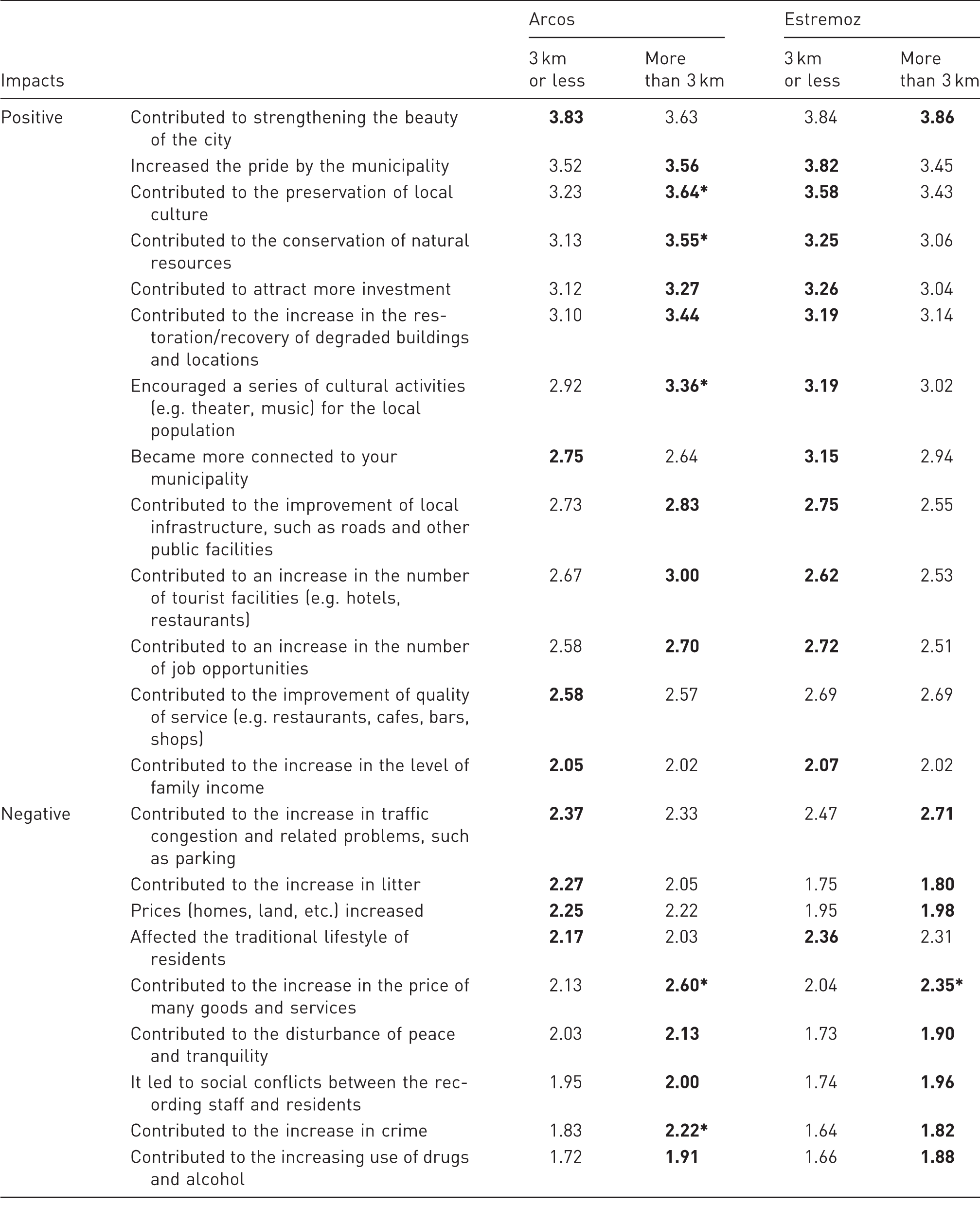
Note: Numbers in bold correspond to the highest values observed for each factor.
p < 0.05.
Source: Authors’ own survey data.
Residents living far from recording locations in Arcos de Valdevez have higher averages in nearly all positive impacts (9 in 13 items) and in most negative impacts (5 in 9). T-test results indicated, however, that only three positive impacts present differences statistically significant at the 0.05 level: ‘contributed to the preservation of local culture’ (‘near’ M = 3.23; ‘far’ M = 3.64; t = −2.169; p < 0.05); ‘contributed to the conservation of natural resources’ (‘near’ M = 3.13; ‘far’ M = 3.55; t = −2.300; p < 0.05); and ‘encouraged a series of cultural activities (e.g. theatre, music) for the local population’ (‘near’ M = 2.92; ‘far’ M = 3.36; t = −2.370; p < 0.05). Regarding the negative impacts, only two items presented differences statistically significant: ‘contributed to the increase in the price of many goods and services’ (‘near’ M = 2.13; ‘far’ M = 2.60; t = −2.553; p < 0.05) and ‘contributed to the increase in crime’ (‘near’ M = 1.83; ‘far’ M = 2.22; t = −2.328; p < 0.05).
In the case of Estremoz, residents living near the recording locations associate more positive and less negative impacts on the recording and exhibition of the television series than residents living far from there. However, only the negative impact ‘contributed to the increase in the price of many goods and services’ shows differences statistically significant: (‘near’ M = 2.04; ‘far’ M = 2.35; t = −2.036; p < 0.05).
These results indicate that residents living far from recording locations link more positive and negative impacts to the recording and exhibition of the soap opera than residents living near those places, in the case of Arcos de Valdevez. Considering Estremoz, residents nearby the recording locations associate more positive impacts to the recording and exhibition of soap opera, whereas residents living far from those places associate more negative impacts.
Economic dependency comparison on positive and negative impacts
Comparison of impacts by economic dependency on tourism.

Note: Numbers in bold correspond to the highest values observed for each factor.
p < 0.05.
Source: Authors’ own survey data.
Conclusions and policy implications
This preliminary study had two objectives. First, it aimed at analysing local community perspectives of the importance of the recording and exhibition of the soap operas Deixa que Te Leve and Belmonte for the municipalities of Arcos de Valdevez and Estremoz, as well as for the attraction of more tourists. Secondly, the objective was to analyse the residents’ perceptions with regard to economic, social and environmental impacts, both positive and negative, induced by the recording and exhibition of the soap operas, as well as to assess differences in these perceptions among residents (considering the place of residence and economic dependence on the tourism sector).
The main findings of this study reveal that local residents of both municipalities (Arcos de Valdevez and Estremoz) have a strongly positive perception of the recording and exhibition of the soap operas. The vast majority of residents considers that the recording and exhibition of the soap operas had a positive effect on tourists attraction and would support a new investment to bring other soap opera to their municipality.
The comparison of the mean scores of the positive and negative impacts across residents living near and far from the recording locations reveals that the impacts most valued and least valued are common to all residents, in both positive and negative impacts. However, residents living far from recording locations, in Arcos de Valdevez, had higher averages in nearly all positive impacts (11 in 13 items) and in most negative impacts (five in nine items). In the case of Estremoz, residents living in or near the recording locations associated more positive and less negative impacts on the recording and exhibition of the soap opera than residents living far from there. t-Test results indicated, however, that few impacts present differences statistically significant at the 0.05 level.
When comparing the mean scores of the positive and negative impacts across residents employed in tourism-related activities and residents employed in other sectors, both groups of residents, in both municipalities, rank ‘contributed to strengthening the beauty of the city’ as the most important positive impact and consider ‘contributed to the increase in the level of family income’ to be the least decisive impact among the positive impacts. With regard to the negative impacts, ‘contributed to an increase in the price of many goods and services’ is valued the most important in Arcos de Valdevez, and ‘contributed to the increase in traffic congestion and related problems, such as parking’ is the most important in Estremoz. Residents economically dependent on tourism had higher means in most positive and negative impacts; however the differences were not statistically significant, with only one exception, in Arcos de Valdevez: ‘contributed to the increase in the level of family income’.
In such a context, it is crucial that Arcos de Valdevez and Estremoz tourism planners and managers keep a close awareness of the local populations’ perceptions towards the importance of the recording and exhibition of soap operas for their municipalities, as well as for the attraction of more tourists. Based on this information, they should incorporate residents’ concerns in their policy decisions.
Considering the empirical results, it is obvious that there is space for action to be taken towards providing the residents of Arcos de Valdevez and Estremoz with a clear picture of the contribution that the film industry, and consequent tourism development, can provide for their economic prosperity.
Furthermore, the managers of the destinations and the local authorities involved in tourism development should be aware of the benefits of using positive destination images in films, soap operas or other television series. The results of this study may provide useful information to ensure this and to help develop more informed decisions, taking into account the impacts that the attraction of this kind of events can bring to their territories.
Footnotes
Declaration of conflicting interests
The author(s) declared no potential conflicts of interest with respect to the research, authorship, and/or publication of this article.
Funding
The author(s) received no financial support for the research, authorship, and/or publication of this article.