



Abstract
In contrast to the reflective perspective of service quality measurement used in the existing literature, this paper proposes a multi-dimensional model for measuring service quality in hot spring resorts, based on a formative perspective. The formative measurement approach aims to explore how the service quality of hot spring resorts is formed. To achieve this purpose, an exploratory research study was conducted using partial least squares structural equation modelling method. A hot spring resort located in southern China was chosen as the research site to obtain the original data, by surveying customers with spa experience at the resort. Concurrently, service quality was investigated as a second-order construct using a reflective–formative model. Theoretically, this reflective–formative model provides a more comprehensive understanding of service quality in hot spring resort domains. Finally, this study confirmed the following six components of service quality for hot spring resorts: water quality, customer service, facilities, surroundings, alternative activities and convenience. The results show that these six components form service quality in hot spring resorts and may influence consumers’ attachment to such places.
Keywords
Introduction
With the present global boom in the service industry, a service-oriented economy has become increasingly popular in China, and it has become more common for tourists to relax and improve their health through wellness travel (Goodarzi et al., 2016). Many hot springs have a rich history and are located in picturesque places across China, making them attractive destinations, and some have claimed to produce health benefits. Due to such health benefits and sightseeing appeal, hot spring consumers like to relax at hot spring destinations. The number of spa visitors, calculated as number of consumers, has reached 120 million people. Moreover, direct sales revenue has reached RMB 22 billion, boosting economic growth in related industries to RMB 150 billion in 2013 (China Hot Spring Tourism Association, 2014). In reality, China’s hot spring industry has continued to grow steadily since 2005, a promising prospect for the industry (Tanyatanaboon and Penkar, 2016). Owing to an increasing demand for hot spring tourism, original mineral spas and some undeveloped hot spring areas have made a number of changes to enable them to serve as resorts and tourist destinations (Wang and Yamamura, 2000). Due to the development of such hot spring resources, changes to the economy and tourism policies, and increasing leisure time for the population, China has been developing a huge service-oriented hot spring industry. Consequently, the industry needs to focus on its service quality to retain loyal customers (Ahrholdt et al., 2016; Su et al., 2016).
Service quality plays an important and strategic role in the hot spring resort industry. Service quality measurement which occurs through a proper evaluation approach serves as the beginning of successful service quality (Tseng et al., 2012). It was also suggested by Law and Yip (2010) that, as one of the most essential factors, service quality wields an enormous impact over the success of the hot spring industry, resulting in further exploration and research on the topic. Many prior researchers have studied service quality issues. However, few studies have focused specifically on service quality in hot spring resorts, which is an emerging hospitality industry in China (Lo et al., 2015). Meanwhile, in the field of hot spring resorts a hierarchical, multi-dimensional service quality modelling approach with reflective constructs has been adopted by some researchers (Hsieh et al., 2008; Snoj and Mumel, 2002). Based on a reflective judgment, service quality has been conceptualised by a number of studies (Collier and Bienstock, 2009).
Traditional service quality measurement models typically use reflective constructs to evaluate the quality of the service. Existing literature argues that service quality may be regarded as an alternative perspective called ‘formative measurement’, to uncover the formation of the construct (Carlson and O'Cass, 2011; Collier and Bienstock, 2006, 2009; Miranda et al., 2012; O'Cass and Carlson, 2012; Shareef et al., 2014). However, as a service-oriented industry, few articles explore how service quality in hot spring resorts is formed. Most of the existing studies regard service quality in hot spring resorts as a reflective construct. The major contribution of this paper is to construct a higher-order measurement model of service quality in hot spring resorts, from a formative perspective, to assist the industry in their efforts to construct a service quality index. The findings of this paper will illustrate how service quality in hot spring resorts is comprised of different components.
Theoretical background
Service quality
To discuss the concept of service quality, the first challenge is to establish a common meaning of service (Titz et al., 2001). In the service industry, people regard the SERVQUAL model proposed by Parasuraman et al. (1988) as a classical measurement method. SERVQUAL is a multiple-item scale for measuring service quality, and proposes the following five dimensions: tangibles, reliability, responsiveness, assurance and empathy. According to the SERVQUAL model, perceived service quality is determined by the gap between expectations and perceptions of performance. The SERVQUAL model provides a beneficial perspective for service quality studies. Based on special industrial characteristics, researchers have modified the SERVQUAL model so that it is suitable for different industries.
Through qualitative and empirical research, Brady and Cronin Jr (2001) found that a third-order factor model interprets the construct of service quality. In their model, service quality perceptions connect outcome, interactions and environmental quality – the so-called distinct and actionable dimensions. Employing a multi-dimensional and hierarchical method based on Brady and Cronin Jr’s previous research, Wu and Ko (2013) conceptualised and measured hotel service quality based on customer perceptions. They found that service quality is a global dimension consisting of three primary dimensions: interaction quality, environmental quality and outcome quality (Wu and Ko, 2013).
The weaknesses of traditional measurement methods can be overcome by adopting a multi-dimensional approach, such as SERVQUAL, SERVPERF (Cronin, Jr and Taylor, 1994), LODGQUAL (Getty and Thompson, 1993), HOLSERV (Wong Ooi Mei et al., 1999), LODGSERV (Knutson et al., 1990) and HISTOQUAL (Frochot and Hughes, 2000). Thus, in the hotel sector, a more conceptually effective method for measuring service quality has been developed by scholars. This is based on existing service quality models and is from the viewpoints of hotel managers and guests (Luo and Qu, 2016). For the package groups field, Yan et al. (2013) filled the gap in service quality measurement using a mainland student package groups sample. Snoj and Mumel (2002) also proposed that we should measure the quality of health spa services multi-dimensionally. Moreover, some scholars have investigated service quality across sectors in tourism, such as Attallah (2015) who examined hotels, airlines and travel agencies in Egypt. The above studies have contributed to the understanding of service quality from a multi-dimensional perspective.
Only a few articles have studied service quality factors for hot spring resorts in detail. Chen et al. (2013b) performed an exploratory and confirmatory factor analysis and presented seven customer service factors: health promotion treatments, mental learning, experience of unique tourism resources, complementary therapies, relaxation, healthy diet and social activities. Lee and Chen (2006) found that to enhance consumer satisfaction, it is helpful to promote the surroundings of hot spring hotels and their decorative elements. Snoj and Mumel (2002) measured the significance of 23 components of health spa service qualities, classified into five universally adopted SERVQUAL dimensions. According to their study, spa guests considered empathy and reliability as the two most important quality dimensions. Tseng et al. (2012) employed SERVQUAL to present service quality expectation criteria for 21 hot springs. According to Tseng et al.’s study, the primary criterion among the researched 21 criteria is additional services provided by the hot spring, e.g. massage, physical therapy, accommodation and food service. The most important criterion was that ‘the employees are courteous, polite and respectful’ (Tseng et al., 2012: 2360). Additionally, in Taiwan, Weijaw (2007) classified the hot springs tourism service quality statement into four dimensions based on modification of the SERVQUAL model. These dimensions were ‘empathy and assurance’, ‘responsibility’, ‘tangibility’ and ‘reliability’. Recently, Lo et al. (2015) also revised the SERVQUAL model to assess customer perception of service quality in resorts within the specific contextual setting of spas. Their results showed that all dimensions of the SERVQUAL were supported in spa resorts, but also that ‘some items and corresponding expressions varied depending on the context under investigation’ (Lo et al., 2015: 170).
In summary, the majority of service quality studies in the hot spring industry focus on the application of the SERVQUAL model, and regard quality of service as a reflective construct which is measured through a multi-item reflective scale (Law and Yip, 2010; Snoj and Mumel, 2002; Tseng et al., 2012; Weijaw, 2007). As the right specification for a measurement model is essential for assigning meaningful relationships within the model framework, the difference between formative and reflective measures is of great significance. Service quality studies which adopt a reflective view provide a perspective on how the dimensions are manifested by the service quality construct. The SERVQUAL’s first-order sub-dimensions of tangibles, reliability, responsiveness, assurance and empathy, are actually reflections of service quality (i.e. a second-order dimension). Previous research based on the SERVQUAL model shows that strong collinearity can be expected between the five first-order sub-dimensions. Nevertheless, when indicators are formative, a significant problem for the measurement model may be caused by multicollinearity among indicators, which is a merit when indicators are reflective (Jarvis et al., 2003). Moreover, the construct of service quality in hot spring resorts cannot cause changes to water quality, facilities and surroundings, rather, the opposite relationship exists. The dimensions such as water quality, facilities and surroundings shape the overall evaluation of the customer’s judgment of quality.
Rossiter (2002) believed service quality to be an example of a formed attribute. From the perspective of rating, service quality is a formed attribute on the condition that the experts insist that it must be possible for the target-raters to make such summative types of judgment. Recently, scholars have argued that service quality may be better measured by formative rather than reflective indicators (Collier and Bienstock, 2009; O'Cass and Carlson, 2012). Collier and Bienstock (2009) conducted a study on e-service quality and compared both a formative conceptualization and a traditional reflective conceptualization. Their results showed very different managerial conclusions for the two specifications. They also showed that the formative approach could aid in understanding the concept of service quality.
It is very important for hot spring resort managers to understand where to concentrate their resources and efforts. Therefore, this paper discusses how service quality is formed in hot spring resorts. The formative model provides a more comprehensive, theoretical understanding of service quality in hot spring resorts and elucidates how service quality is formed in the hot spring service domain.
Place attachment
Place attachment conceptualisation derives from a number of psychological theories (e.g. theories of attraction and interdependence) (Loureiro, 2014). Having been adapted to various disciplines, the construct of place attachment refers to the study of human thoughts and behaviours which are related to the physical environment (Lee et al., 2012). In the field of destination study, place attachment is a basic element which helps people to understand human–place relations (Huang et al., 2016). Place attachment occurs if people feel an emotional tie with a place, and if they have some meaning related to a place, based on their social interactions within that place.
According to Kyle et al. (2003), leisure research has traditionally combined factors from geography and environmental psychology to study place attachment from the perspective of two concepts: place dependence and place identity. Given an existing range of alternatives (e.g., ‘how do the surroundings compare to my other favourite locations?’), place dependence refers to how well a setting serves in the achievement of a goal (Jorgensen and Stedman, 2001). Regarding emotional attachment to places, which contributes to place identity, a place may also be regarded as a necessary part of one’s self (Kajan, 2014).
Moreover, research has shown that place attachment plays a key role in managing natural area tourism destinations. For example, Tonge et al. (2015) found that place identity directly influences visitors’ pro-environment behaviours, which assists in sustainably managing a nature-based destination. Adopting a covariance structure analysis, Su et al. (2011) analysed the relationship between service quality and destination loyalty. Their empirical results supported the service quality–satisfaction–loyalty model. They found that the effects of service quality on place dependence, place identity and behavioural intention were completely mediated by tourist satisfaction.
Furthermore, the literature shows that service quality, as an antecedent of place attachment, can influence place attachment in the context of hot spring resorts and skiing destinations (Alexandris et al., 2006; Su et al., 2011; Theodorakis et al., 2009). In this study, we used the endogenous construct (place attachment) to test the predictive effects of the original service quality measurement model. By studying place attachment, this study can develop a more in-depth understanding of the implications of different service quality dimensions for hot spring resorts.
Higher-order constructs
Higher-order constructs are a type of multi-dimensional construct which has hierarchical components. Either reflective or formative in its lower-order constructs, a higher-order construct is regarded as a general concept. The relationship between lower-order and higher-order constructs is therefore not causal. The reason for this is that without its lower-order constructs (i.e. dimensions), there is no basis for the higher-order construct, to exist as the general concept. When the general concept is represented by latent dimensions, a reflective higher-order construct emerges. In addition, when unobserved dimensions constitute a general concept, a formative higher-order construct emerges (Becker et al., 2012).
Generally, four types of hierarchical component models appear in the literature: reflective–reflective, reflective–formative, formative–reflective and formative–formative models. The most popular type in MIS Quarterly partial least squares structural equation modelling (PLS-SEM) applications are reflective–formative hierarchical component models (Ringle et al., 2012). In not sharing a common factor but instead forming a general concept, lower-order constructs are reflectively measured constructs in reflective–formative hierarchical component models (Becker et al., 2012; Chin, 1998). Therefore, when more than one dimension of a construct exists at the same time, these dimensions are identified by a reflective measure, and the model should be considered a reflective–formative model. Furthermore, Henseler et al. (2009) suggested including at least one reflective latent variable in the formative structure model. Thus, the present study added one reflectively measured endogenous variable, place attachment, to the original research model.
A formative measurement approach
There are two types of measurement approaches: reflective and formative. The present study measured a latent variable, using formative indicators when the observed indicators caused the latent variable. In contrast, when reflective indicators were used, it was supposed that the observed indicators reflected changes in the latent variable. To assess whether a measurement model should be formative or reflective, Coltman et al. (2008) provide a set of theoretical and empirical considerations. For service quality, based on the use of formative (cause, causal) indicators, an alternative measurement perspective involves the creation of an index instead of a scale (Bollen and Lennox, 1991; Diamantopoulos and Winklhofer, 2001). Specifying constructs as formative or reflective is crucial for construct measurement because construct validity serves as a foundation for theory development and testing (Murphy et al., 2009). Adopting a reflective versus formative perspective for construct measurement could lead to different results and conclusions. In fact, the content, parsimony and criterion validity of the derived coordination measures are all influenced by measurement perspective (Diamantopoulos and Siguaw, 2006).
Methodology
Although some previous hot spring studies have examined service quality using a reflective assessment model, little research has investigated service quality in a hot spring resort using a formative measurement approach. This means that the present study is exploratory research. PLS-SEM (also called PLS path modelling) is primarily used to develop theories in exploratory research (Hair, 2014). PLS-SEM and covariance-based SEM (CB-SEM) are alternative methods, though they have similar structural modelling specifications. CB-SEM is a covariance-based approach for theory testing, while PLS-SEM explains variance in a manner similar to ordinary least squares regression (Battour et al., 2017). The PLS-SEM method concentrates on accounting for the variance in the dependent variables (Hair, 2014). Meanwhile, PLS-SEM can deal with the formative constructs that are not suitable for CB-SEM. This study analysed the survey data with SmartPLS (http://www.smartpls.com/), which is software for the application of the PLS-SEM method.
Study site, sampling and data collection procedures
The data were collected from a hot spring resort located in southern China (Zhuhai City, Guangdong province). The service quality of this hot spring resort is famous in the industry. Questionnaires were distributed to consumers who had participated in hot spring activities in these resorts from October to December 2015. The questionnaires were placed at the front office, in hotel rooms, hot spring pool areas and public areas of the resort. Prior to finalising the formal questionnaires, a pilot test was conducted to examine the wording and meaning of the scales using 80 undergraduate students and 120 visitors from a hot spring resort as participants. Of the 300 formal questionnaires distributed, 232 of the returned questionnaires were considered valid after data cleaning. The sample of respondents was chosen from guests who met the following criteria: (1) having experienced at least one bath at the hot spring resort and (2) are an adult (over 18 years of age). Of the respondents, 51.3% were male and 48.7% were female. In terms of the respondents’ main purpose for visiting the resort, 43.2% were on vacation, 35.3% were visiting for leisure, 9.5% were sightseeing, 4.3% were attending a conference and 7.7% were there for other reasons. Thus, the majority of respondents were visiting the hot spring resort for vacation and leisure purposes.
Research instruments
The questionnaire included sections about service quality, place attachment and demographic information. The construct ‘service quality’ was operationalised by a list of attributes of the hot spring resort, which were selected based on a scale developed from previous research (Chang and Chen, 2011; Chen et al., 2013a, 2013b; Hsieh et al., 2008; Tseng et al., 2012; Weijaw, 2007), and extended based on suggestions from 26 hot-spring resort managers. To cover the domain of service quality in hot spring resorts, we analysed the interview records from these managers and reviewed existing literature. The managers of the hot spring resorts paid more attention to alternative activities. The items were measured on a seven-point Likert-type scale, anchored with ‘strongly disagree’ (1) at one end and ‘strongly agree’ (7) at the other. A factor analysis of the samples resulted in the reduction of the number of items to 18, which were assigned to six dimensions: water (three items), customer service (three items), facilities (three items), surroundings (three items), alternative activities (three items) and convenience (three items).
From the items on the scales used in previous research (Alexandris et al., 2006; Lee et al., 2012; Su et al., 2011), the measurement of place attachment included two dimensions: place identity and place dependence, encapsulated by five questions. We adopted these questions for the measurement of place attachment in the hot spring context.
Data analysis techniques
We predicted that service quality in the hot spring resorts may be a multi-dimensional construct, which consists of the reflectively measured first-order constructs and the formatively measured second-order constructs. In this research, the dimensions of water quality, customer service, facilities, surroundings, alternative activities and convenience are manifested by their respective underlying item measures. At the same time, the six dimensions, which do not share a common cause, capture the conceptual domain of service quality in hot spring resorts. The relationship between first-order constructs and second-order constructs belongs to the category of the reflective–formative hierarchical component model.
This study estimated the parameters in both the first-order reflective model and in the second-order formative model using a path weighting scheme. A repeated indicator approach was used to estimate the second-order reflective–formative model. Representing all the manifest variables of the underlying lower-order latent variables, a higher-order latent variable was constructed by specifying a latent variable with the repeated indicator approach. To avoid interpretational confusion, the repeated indicator approach was used to estimate all variables and indicators at the same time (Becker et al., 2012).
Evaluation of first-order constructs
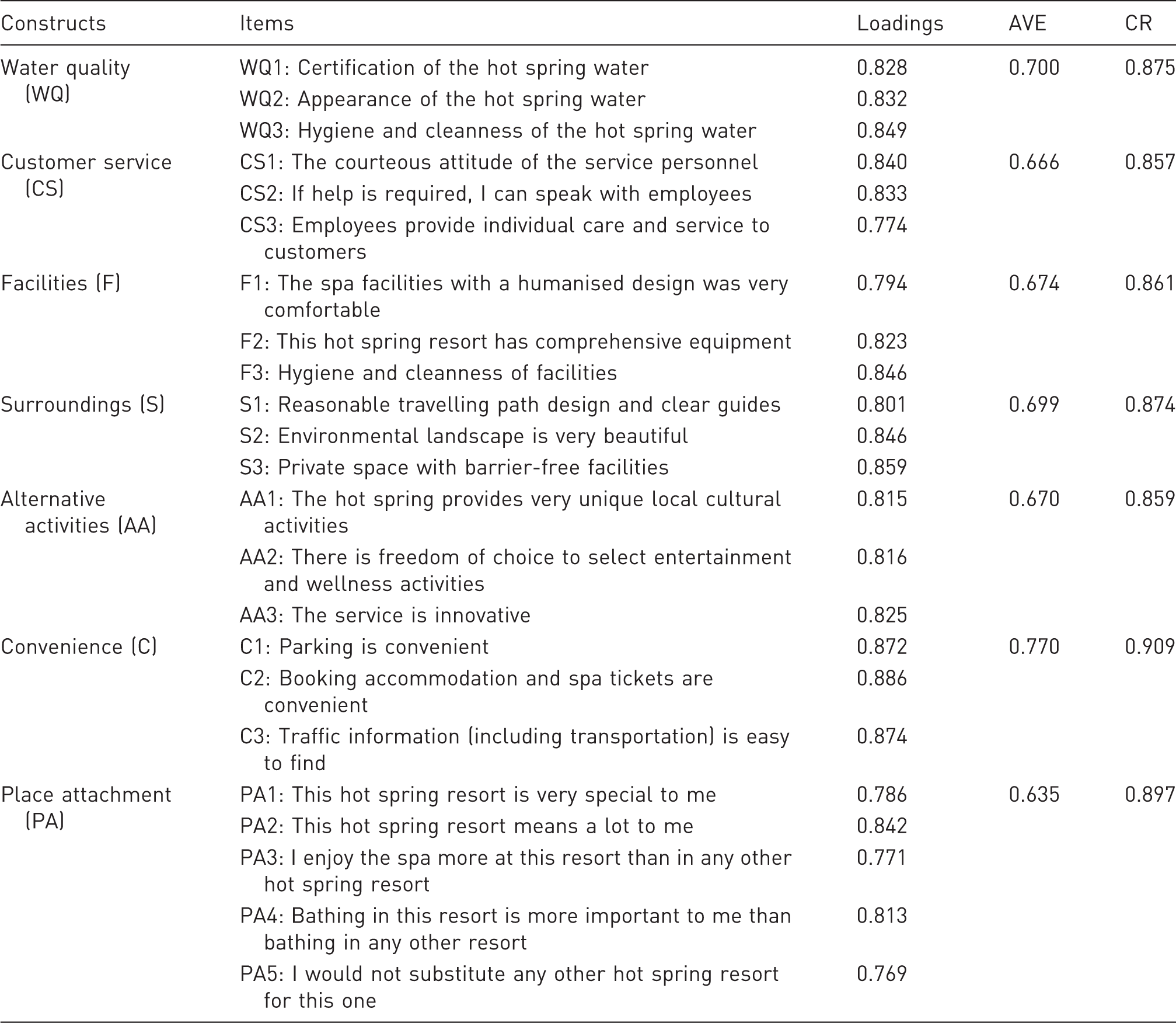
The parameters, including indicator loadings and the average variance extracted (AVE), were estimated to evaluate convergent validity at the first-order construct level. Composite reliability (CR) was also estimated to evaluate internal consistency, individual indicator reliability and discriminant validity (Hair, 2014). ‘Indicator loading’ refers to the correlation between an indicator and its reflective items. AVE is a common measure used to establish convergent validity at the construct level. An AVE value of 0.50 or higher indicates that on average, the construct explains more than half of the variance of its indicators. CR refers to a measurement of internal consistency, which does not assume equal indicator loadings, unlike Cronbach's alpha. The CR value should be above 0.70 (in exploratory research, 0.60 to 0.70 is considered acceptable). Discriminant validity refers to the degree to which a construct is truly different from other constructs. If the square root of each construct's AVE is greater than its highest correlation with any other construct, discriminant validity exists (Hair, 2014).
Evaluation of second-order constructs
To ensure that the content of the focal construct is sufficiently captured, the literature universally acknowledges that consideration of the scope of coverage is essential when specifying formative indicators (Diamantopoulos, 2011). Before empirically evaluating formatively measured constructs, researchers should concentrate on establishing content validity. A literature review of service quality in hot springs attempted to cover the main content mentioned in prior studies (Chang and Chen, 2011; Chen et al., 2013a, 2013b; Hsieh et al., 2008; Law and Yip, 2010; Lo et al., 2015; Snoj and Mumel, 2002; Tseng et al., 2012). At the same time, an in-depth interview with six managers from different hot spring resorts ensured the measurement in the present study covered the main content regarding practical management.
At the second-order construct level, the parameters were estimated, including indicator weights, significance of weights and the multicollinearity of indicators. In the evaluation of the formative measurement model, weights were adopted to measure the contribution of each formative indicator to the variance of the latent variable. Using a bootstrapping procedure, the outer weights in formative measurement models were tested to see whether they differed significantly from zero. Random subsamples of bootstrapping are typically about 5,000. Thus, t values were calculated to assess each indicator weight’s significance.
When two indicators are highly correlated, collinearity arises. This is considered to be multicollinearity when more than two indicators are included. As it may be challenging to separate the influence of the individual dimensions on the construct, high multicollinearity among indicators makes a formative measurement model problematic. Defined as the reciprocal of the tolerance, the degree of multicollinearity among the formative indicators was estimated with a variance inflation factor (VIF). A recommended VIF value (3.33) was employed as the cut-off criterion (Diamantopoulos and Siguaw, 2006).
Evaluation of the structural model
The coefficient of determination (R2 value) is the most commonly adopted measure to assess the structural model. R2 in this study measured the model’s predictive accuracy, which is calculated as the squared correlation between a specific endogenous construct’s (place attachment) actual and predicted values. At the same time, Stone-Geisser's Q2 value, an indicator of the model’s predictive relevance, was also examined. If Q2 values are larger than zero for a certain reflective endogenous latent variable, this indicates that the path model’s predictive relevance for this particular construct exists (Hair, 2014).
Results
Results of the evaluation of the first-order construct level
Parameter estimates (reflective) of the first-order model.
Discriminant validity assessment. a
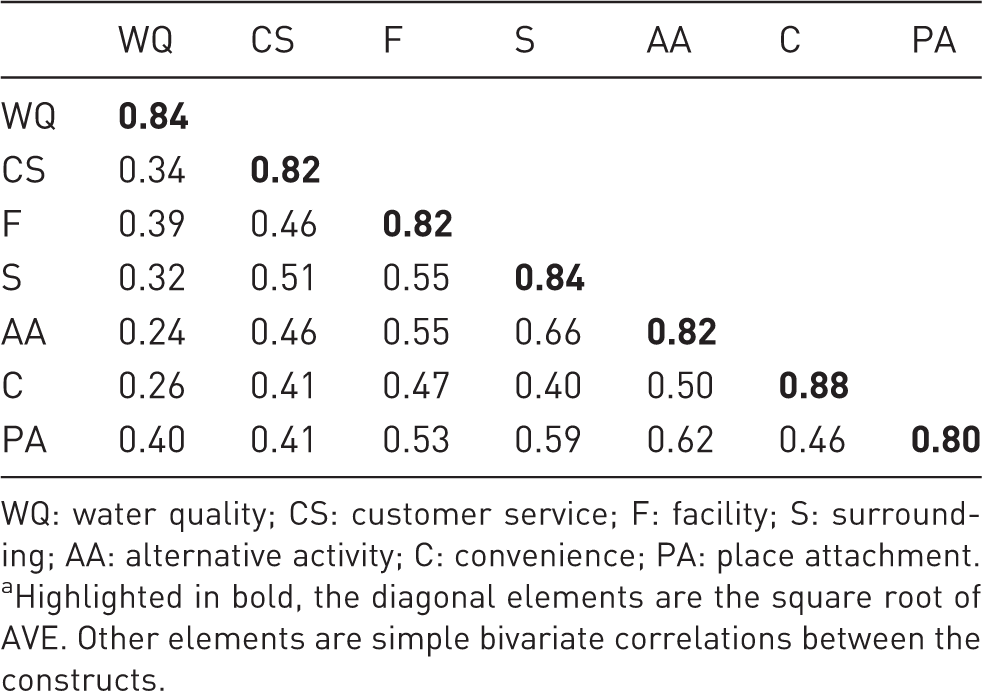
WQ: water quality; CS: customer service; F: facility; S: surrounding; AA: alternative activity; C: convenience; PA: place attachment.
Highlighted in bold, the diagonal elements are the square root of AVE. Other elements are simple bivariate correlations between the constructs.
Results of the evaluation of the second-order construct level
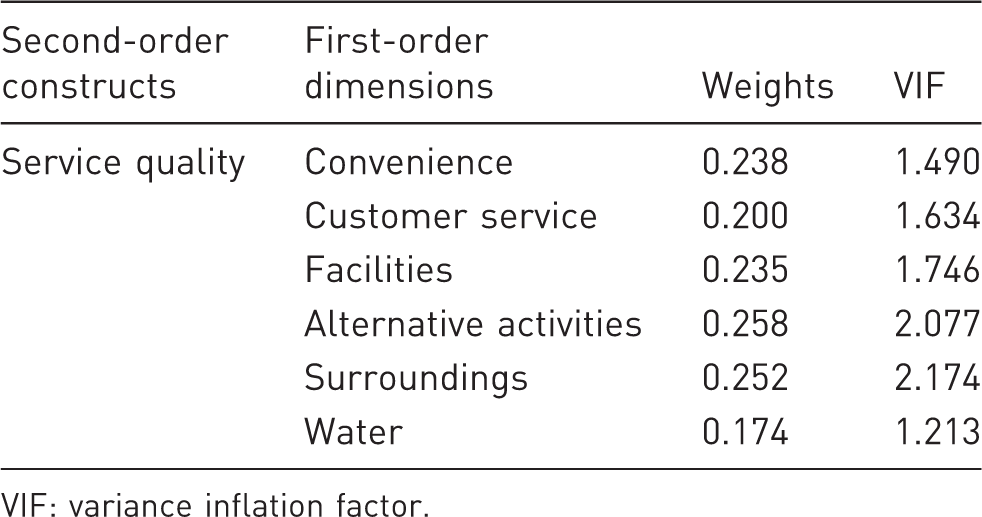
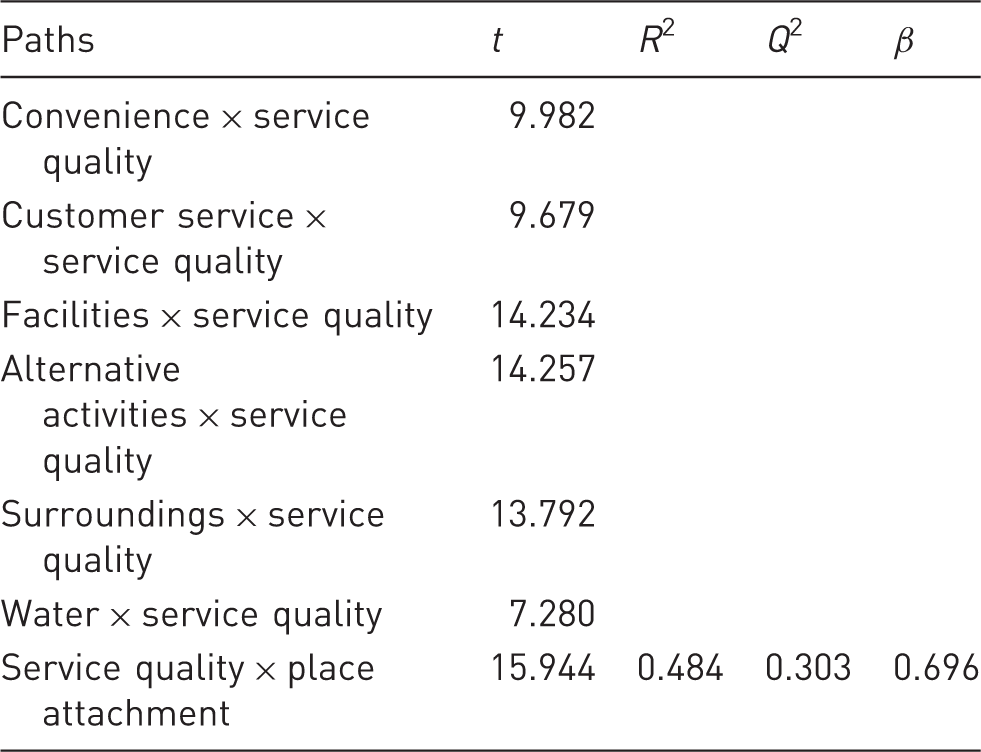
The VIF indicates to what extent an indicator’s variance is explained by other indicators of the same construct (Thien et al., 2014). Table 3 presents the VIF values of each first-order construct. Many researchers consider the acceptable value for VIF to be <3.33. As shown in Figure 1, the weight of the first-order constructs is over 0.1 or 0.2, which conforms to the idea that the recommended indicator of the weight should be higher than 0.1 (Lohmöller, 1989) or 0.2 (Chin, 1998). Table 4 shows that the t values of indicator weights are all over 1.96, indicating that all of the first-order constructs were significant at the 0.05 level.
Results of the reflective–formative measurement model by partial least squares structural equation modelling (PLS-SEM). Parameter estimates (formative) of the second-order model. VIF: variance inflation factor. Standardised results of the structural model.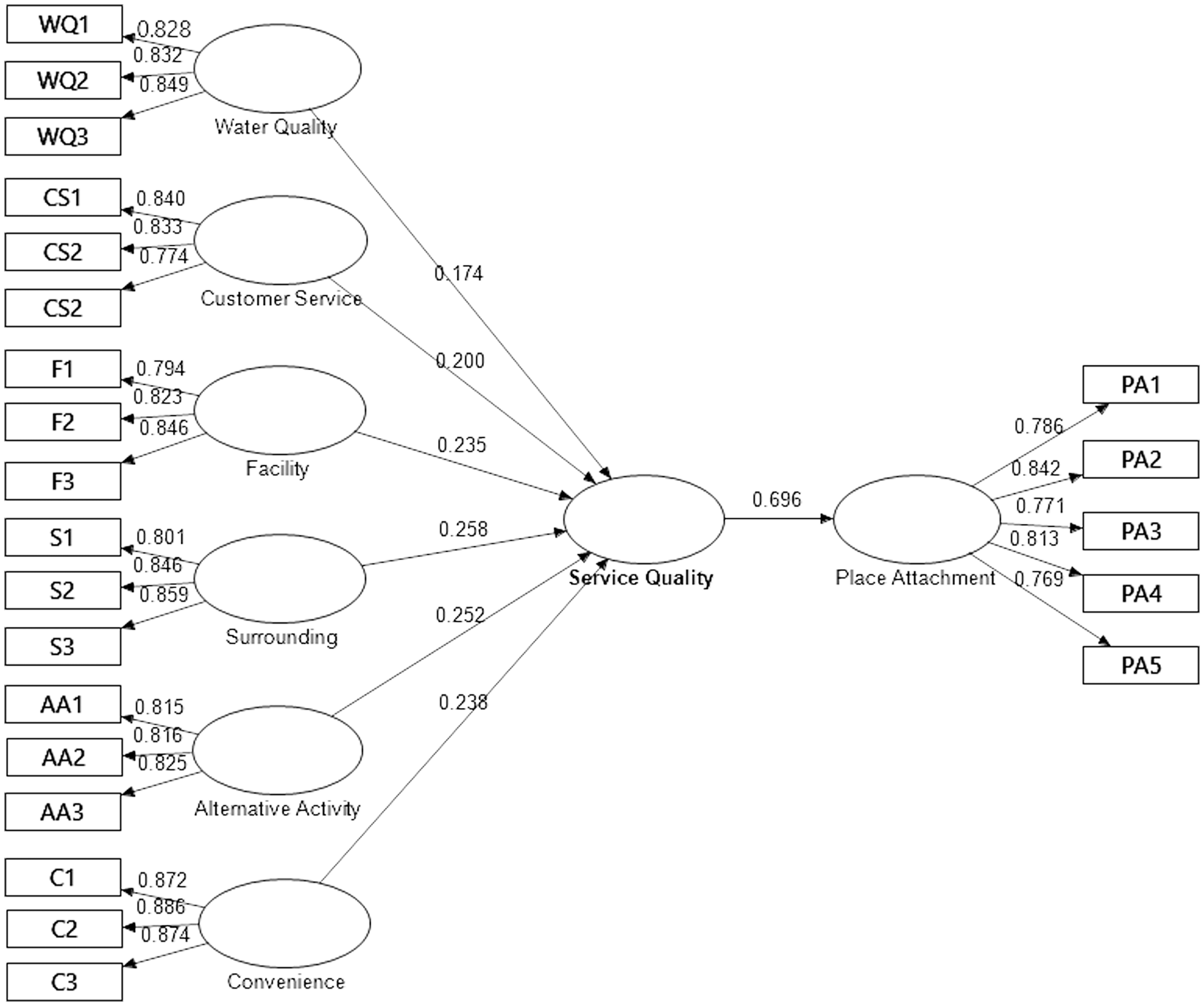
Evaluation of the structural model
According to Hair (2014), to meet nomological validity, the needs of the model are suggested in PLS-SEM, which includes at least one reflective latent variable in the structural model. The literature confirms the relationship between service quality and place attachment (Alexandris et al., 2006; Su et al., 2011). Accordingly, this study added one reflectively measured endogenous variable; place attachment, to the original measurement model. The coefficient of determination (R2) was 0.484, indicating that service quality influenced consumers’ place attachment to some extent.
The path coefficient from service quality to place attachment was 0.696, which was significant at the 0.05 level based on the bootstrapping method (t value = 15.944). The model illustrates sufficient predictive relevance with Q2 (0.303) above zero.
Discussion and conclusion
This study measured service quality for hot spring resorts based on a formative perspective. At the same time, a reflective–formative research model was proposed. The present study argues that the industry needs not only to evaluate service quality as per the SERVQUAL model, but also to recognise the actual components of service quality in hot spring resorts. The reflective–formative model helps to determine how service quality is formed in hot spring services. The results of this study deepen our understanding of service quality from a formative perspective.
The present findings confirmed that there were six components of service quality for hot spring resorts: water quality, customer service, facilities, surroundings, alternative activities and convenience using a PLS-SEM method was used to test the reflective–formative model. This is in line with the conclusions drawn by Alén et al. (2012) in their thermal establishment research. Their findings indicated that thermal establishments should focus on issues such as ‘the provision of a wide range of products, services and activities, all of outstanding quality’ To apply this conclusion, owners and managers of hot spring destinations should focus on the service construction of the six components as the foundations of service quality. In particular, the dimensions of water quality and alternative activities, which has been insufficiently addressed in prior studies, are significant for the formation of service quality.
Surroundings, alternative activities and convenience are the top three most important dimensions of service quality for hot spring resorts, based on their high weights in the model (0.258, 0.252, and 0.238, respectively) shown in Table 3. Such high weights denote that these indicators are important components that managers need to address (Wong, 2013). First, the physical environment, where hot spring services are located, is quite critical for service quality. In other words, managers should consider the service-scape (Chua et al., 2015; Dong and Siu, 2013) of hot spring resorts. Hot springs which are well designed for visitors, have a beautiful environmental landscape, and private space are better able to satisfy customers. Second, as suggested by industrial experts during interview, the customers like to engage in the alternative activities provided by hot spring resorts, such as traditional fairs, fireworks shows and night parties. Thus, to improve service quality in hot spring resorts, it is important to offer clients various activities (Lee et al., 2012). Third, convenience with regard to parking, booking and access to the area can result in positive perceptions of service quality. Managers should therefore provide convenience for customers in these areas, in line with Kim et al.'s (2016) study on service quality at festivals. Discussion of these three important dimensions is extended in greater detail below.
Surroundings
Based on the findings, the dimension ‘surroundings’ is the most important element of service quality for hot spring resorts. The site where the research site was conducted is located in the natural landscape of farmland, which matches the typical Chinese-style pastoral landscape paintings. The linkage of the hot spring to the surrounding natural environment creates a poetic world within the hot springs, which may encourage visitors to return. The atmosphere surrounding the hot spring can also strengthen place attachment in the visitors. Therefore, it is worthwhile for managers to pay sufficient attention to understanding this concept of service quality.
Resorts may create open-air hot springs which have unique humanistic temperament through the use of environment-conscious construction skills which may be applied to the vegetation, rocks and buildings. The surrounding may be developed in a European style, in an ancient Chinese style, or a combination of these Chinese and western styles. For the layout of the space, the hot spring space may be self-contained, e.g. independent of the open-air hot spring pool with brick and grey eaves, lined on the inside by trees. Resorts may also establish temples in the surrounds with religious activities, so that guests can worship or engage in an incense ceremony before bathing in the hot spring. Further, resorts may also be arranged according to gender, set up with a separate male and female pool, which creates a different atmosphere for men and women.
Alternative activities
The results revealed that the dimension ‘alternative activities’ was the second most important dimension for perceived service quality. The experiences that customers have at hot spring resorts refer not only to bathing or showering in the hot spring water, but also involve activities provided by hot spring resort. In this way, hot spring resorts may create a unique combined experience of health and leisure, which brings a full range of enjoyment for tourists.
The hot spring resort that the study investigated provides a full range of alternative activities for its customers. A series of folk cultural activities are held in the different seasons, such as the Spring Festival, the Mid-Autumn Festival, the Dragon Boat Festival, etc. Consumers can experience traditional Chinese culture and engage in enjoyable activities. Alternative activities turn the resort into a live ‘culture museum’. The resort also includes a post office and mailbox inside the public area and provides postal services including envelopes, letterheads, stamps and pens, so that visitors can send letters to their friends and relatives during their stay. The resort also has a message wall so that guests can leave a record of their dreams, their intention to begin dating someone, a statement of their mood, random musings, or a blessing on the wall. The rules of the message wall do not limit the number of words or place restriction on the content of message, thus, guests can say what they want. A lot of tourists use their mobile phone cameras to take photos after their leaving words on the wall, then post these on their online social network.
If hot spring resorts develop their own entertainment resources or pursue strategic alliances with local entertainment service providers, they can offer diverse activities to their visitors. This is a good way to produce place attachment for such visitors. The range of these activities is very wide, and can include golf, skeet shooting, hunting in the wild, boating and fishing, riding, temple praying activities, etc. As long as these activities are matched with the resort’s culture and characteristics, they can strengthen the visitors’ place identity and place dependency the destination as a whole and, in turn, enhance customer loyalty.
Convenience
Convenience is not only an important dimension of service quality, but can also produce place attachment. Many hot springs resorts are located in the suburbs, so can consider providing access to their facilities, such as through the provision of direct transportation and sufficient parking places. Through their website, such resorts may also provide information about what the resort offers overall. With regard to customer interactions, a variety of drinks and cigarettes could be offered for free in the open-air hot spring area, and free fruit, bread, coffee, tea and other food be made available in the rest hall. The establishment of an independent area with a locker room may also be provided through a 24-hour paid service. These measures could be very helpful for strengthening convenience.
At the same time, although it was not weighted the highest in the model, water quality was also a significant factor. This is because it is a basic requirement for customers bathing in hot springs (Choi et al., 2015; Lee, 2010). Without certified and hygienic hot spring water, customers cannot feel satisfied. The results also indicated that two traditional dimensions (facilities and customer service) were important components of service quality in hot spring resorts, which is consistent with the findings of prior studies (Albayrak et al., 2016; Chen et al., 2013a, 2013b).
Moreover, the present study also showed that service quality significantly influenced the place attachment construct; the better the service quality, the higher the place attachment. Previous research showed that destination loyalty was significantly predicted by the dimensions of place attachment (Alexandris et al., 2006). To retain customer loyalty, resorts should focus on methods that improve the levels of place attachment. In this study, the results showed that service quality is a key antecedent of place attachment. These findings further indicate the importance of understanding the formative dimensions of service quality.
Implications for industry
The present study suggests that the management of hot spring resorts should carefully and systematically investigate how service quality form, from the point of view of the visitors. The formation of service quality is a multi-dimensional construct which should consider multiple service quality cues and move beyond examining single cues in isolation (Jill et al., 2016). Based on this, the results suggest that lacking a holistic understanding of service quality in hot spring resorts may result in the problem of place detachment.
The present research demonstrates a useful approach for hot spring resort practitioners to measure service quality from a formative perspective. Instead of using the traditional reflective model, practitioners may invite visitors to assess service quality from ‘an operational perspective that monitors operations performance to ensure conformance to service specifications’ (Luo and Qu, 2016: 314). Such a formative measurement approach is operable for understanding real formation of service quality because the important components can be identified through this approach. As a result, hot spring resorts’ practitioners can focus on the foremost important service quality cues. These findings are consistent with other studies that also emphasise formative service quality in restaurants (Jill et al., 2016) and event settings (Ahrholdt et al., 2016).
The results indicate that hot spring resort practitioners can invest in specific service quality dimensions and items linked to such dimensions. As service quality has a positive effect on place attachment, a suitable understanding of what forms service quality is helpful. Using a formative measurement approach for service quality at a hot spring resort, managers can identify which specific service quality dimensions are important and could affect place attachment positively, and ultimately improve customer loyalty (Lee et al., 2012). The present study demonstrates that, considering the total effect of place attachment, the most important service quality features to be delivered with high quality by practitioners of hot spring resorts are surroundings, alternative activities and convenience. Thus, practitioners in the hot spring resort industry can benefit from improving their service quality by designing an appropriate variety of services, linked to the identified service attributes.
Limitations and future research
The present study was limited in that it explored only one research site in a single season, which may thus not be representative of the operational issues facing hot springs as they operate over four seasons. In the future, a longitudinal study should be conducted over the course of a year. At the same time, a cross-regional study of different locations may also contribute substantially to this research topic. Understanding the differences in perceived service quality in different hot springs may help managers to improve their customers’ place attachment. Moreover, the relationship between service quality, satisfaction, place attachment and loyalty may be discussed to improve the model.
Footnotes
Declaration of Conflicting Interests
The author(s) declared no potential conflicts of interest with respect to the research, authorship, and/or publication of this article.
Funding
The author(s) disclosed receipt of the following financial support for the research, authorship, and/or publication of this article: University of Macau through research grant ‘MYRG2014-00054-FBA’.