



Abstract
The Middle East is one of the fastest growing tourism regions in the world. Especially Dubai (since the 1980s) and Abu Dhabi (since the 1990s) have invested heavily in tourism development to firstly enhance their recognition as international destinations and secondly to diversify their economies away from the oil production. Surprisingly, there is a lack of academic published articles on those two emirates’ international destination image. This paper attempts to fill this gap by studying and comparing the images of Abu Dhabi and Dubai amongst potential first-time visitors from one of their main source markets – Germany. An empirical study amongst 300 respondents from North-Rhine Westphalia, Germany, was conducted to reveal the cognitive image attributes of Dubai and Abu Dhabi for non-visitors. Despite both places having a similar basis for destination development, their images differ. Thus, Abu Dhabi and Dubai are not seen as competitors on the tourism market, instead they could even increase the mutual benefits through highlighting specific images more distinctly. Further, the research identified a missing fit between the desired tourism destination image for both destinations and the perceived destination image. This is especially significant for the aspect of sustainability, which both emirates try to promote. Potential tourists rather perceive both emirates as unsustainable and not environmentally conscious.
Keywords
Introduction
Globally, there is a high growth in locations offering tourism products to an increasing international tourism market. This has led to greater competition between places (United Nations World Tourism Organization (UNWTO), 2015). On the supply side these destinations compete for tourists. On the demand side potential tourists have more destinations to select for their travels. One of those ‘new’ destinations is the Middle East. As a rather late arrival region on the international tourism market it showed the worldwide strongest growth in arrivals of international tourists between 1990 and 2010 (UNWTO, 2015). In particular, two of the seven emirates of the United Arab Emirates (UAE), Abu Dhabi and Dubai, have established themselves as international tourism destinations.
Abu Dhabi City and Dubai City are the capital cities of the emirates with the same name. In general, emirates in the UAE are federal states but with a higher political control and independence than federal states in Germany or the USA for example. Apart from the capital cities, Abu Dhabi and Dubai also include desert landscapes and farms as well as other cities and villages. Especially, the city Al Ain in the emirate Abu Dhabi needs to be mentioned because of its UNESCO Cultural World Heritage Sites (UNESCO World Heritage Centre, 2015). The tourism marketing agency of Abu Dhabi also markets the city Al Ain. As Abu Dhabi and Dubai both promote themselves as emirates and not as cities each emirate will be considered as one destination throughout this research.
Dubai has started targeting tourists in the late 1980s and experienced strong tourism growth in the 1990s. Abu Dhabi followed this development approximately 10 years later (Sharpley, 2002). Amongst many other international destinations, both have played an important part in the aforementioned increase in competitiveness in the tourism industry. Abu Dhabi and Dubai are investing heavily in tourism as part of an economic diversification process away from oil dependency (Low, 2012). Importantly, each of the seven emirates in the UAE have individual economic development plans and policies. Therefore, the different emirates are responsible for their individual tourism development and marketing strategies that could focus on different target groups. However, based on their location they have similarities in climate, culture and nature. According to Sharpley (2002) these similarities result in related tourism development strategies, which in turn leads to strong competition between the emirates as they address very similar target groups. Destination marketers from both emirates, however, state Abu Dhabi and Dubai not to be competitors. Instead both see the emirates as beneficiaries for one another, as tourists visiting one emirate may also visit the other emirate during the same trip (personal communication).
Amongst tourism researchers there is general agreement on the importance of destination images in the destination choice process of tourists and accordingly for destination marketers (e.g. Baloglu and McCleary, 1999; Echtner and Ritchie, 1993; Fakeye and Crompton, 1991; Pike, 2008). However, no academic published destination image studies have been conducted on Abu Dhabi or Dubai. Only Govers (2012), Govers and Go (2005) and Ryan and Ninov (2011) studied parts of the tourism destination image of Dubai. Further, Tourism Competitive Intelligence (2013) questioned international travellers on destinations on the Arabian peninsula in 2013. They found respondents to be more aware of Dubai followed by Saudi Arabia and Abu Dhabi. A holistic empirical study on the destination image of Abu Dhabi and Dubai amongst international travellers may be useful as previous destination image studies have demonstrated their relevance for destination marketers, tour operators and travel agents working on their relevant regions (Baloglu and McCleary, 1999). Furthermore, destinations compete for tourists through images (Pike and Ryan, 2004). The images destination marketers try to promote, the self- or desired images, need to fit to those perceived by potential tourists (Pearce, 2005; Pike, 2004).
Images on tourism destinations can vary significantly between various source regions, depending on factors such as geographical distance or cultural differences (Hunt, 1975; Steinecke, 2013). Research on other source regions could therefore bring significantly different results. Therefore, tourism destination image studies commonly include a defined source region. For this study North-Rhine Westphalia (NRW) is chosen as the source region, representing Germany as its most populous federal state (Statistisches Bundesamt, 2015). The German outbound tourism market is identified as an important source market for tourists visiting Abu Dhabi and Dubai. This market is the third biggest in the world based on international tourism receipts (UNWTO, 2015). Further, the third most international visitors to Abu Dhabi (Tourism-Insider, 2014) and the sixth most international visitors to Dubai are from Germany (Tourism-Insider, 2013). The study intends to answer the following two research questions: RQ 1: Are Abu Dhabi and Dubai competitors for tourists on the German market through their tourism destination image? RQ 2: Do the desired images of Abu Dhabi and Dubai fit to the perceived images of potential first-time visitors from Germany?
Tourism destination image and perception
The first tourism researchers to undertake destination image research were Gunn (1972), Hunt (1975) and Mayo (1973) in the 1970s (Pike, 2008). In his review of the 23 most cited papers on destination image, Chon (1990) found the impact of images on the choice process of tourists’ to be one of the most popular topics in tourism literature. In particular the intangibility of tourism services increases the importance of images for the destination choice process (Crompton and Ankomah, 1993). The potential tourist cannot try out the tourism product before purchase. Therefore, the potential consumer only has limited access to information and an increased risk in the destination choice process. Consequently, tourism researchers agree on the important role of image in the destination choice process (e.g. Baloglu and McCleary, 1999; Echtner and Ritchie, 1993; Fakeye and Crompton, 1991; Pike, 2008).
Definitions of destination image (own illustration based on Gallarza et al., 2002; Pearce, 2005).
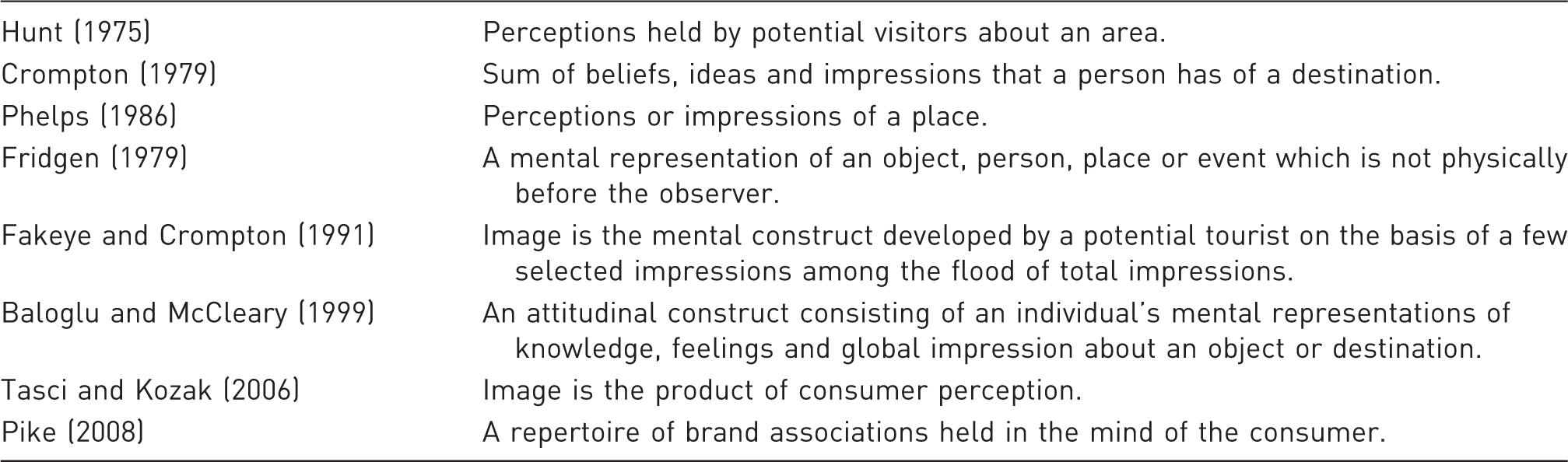
It is not only the term image which is vague, but also the relation of image to terms used in the same context. These terms are perception and impression. The term perception is frequently used for the explanation of image. Scholars use phrases like images being perceived (Hunt, 1975; Phelps, 1986; Prebensen, 2007; Tasci and Kozak, 2006), or images being impressions (Baloglu and McCleary, 1999; Crompton, 1979; Fakeye and Crompton, 1991). An answer to the link between perception and image is given in articles by Hunt (1975) and Tasci and Kozak (2006). In both articles image is seen as the product, or in some way the summary, of all perceptions. Out of the perceptions a tourist or potential tourist has of different features of a destination, or simply the destination overall, a general image of this destination is created in the mind of this tourist. That goes along with the definition of image given by Crompton (1979: 18) as the “sum of beliefs, ideas and impressions.” The definition recommended by Echtner and Ritchie (1993: 3) complies with destination image being “composed of perceptions.” Furthermore, Baloglu and McCleary (1999), Fakeye and Crompton (1991), Fridgen (1979) and Pike (2008) agree that image is in some way a mental construct or something that is developed in the mind of the tourist. Taking into account some important considerations by different researchers discussed above, a summarizing definition of tourism destination image was developed:
The image of a destination is the sum of all perceptions, impressions, feelings and attitudes a tourist has in his/her mind of a destination.
This cognitive component includes the awareness, knowledge and beliefs of a tourist about a destination. This contains everything a potential tourist knows about a destination (Pike and Ryan, 2004). In the past, destination image studies have mostly considered only cognitive perceptions (Pike, 2002). Affect is comprised of an individual’s feelings towards the destination. These feelings are judgemental, so the destination is valued emotionally (Gartner, 1993). This emotional response of potential travellers is analysed by the affective component of image (Baloglu and Brinberg, 1997). The cognitive and affective components of destination image are interrelated. Most researchers mention the affective reactions to be the result of cognitive perceptions (e.g. Anand et al., 1988; Erickson et al., 1984; Gartner, 1993; Holbrock, 1978; Llodrà-Riera et al., 2015; Pike, 2016; Stern and Krakover, 1993). However, Kim and Chen (2016) see the affective reaction to be developed simultaneously with the cognitive image development.
Some destination image studies only consider image to have cognitive and affective components (Baloglu and Brinberg, 1997). However, attitude also has a behavioural component. This is accounted for in the conative part (Pearce, 2005). This part is based on the other two components. For instance the affective variables mentioned above can give a strong indication if the potential tourist is likely to visit a destination (Pike and Ryan, 2004). Baloglu and McCleary (1999) concluded their study stating a positive influence of cognition and affect, on the final intent to visit a destination (conation).
Characteristics of destination images for non-visitors
The strongest influence on cognitive, affective and conative images occur through direct visitation of a destination (Gunn, 1972). Because these strong impressions impact the image of potential repeat visitors, tourism researchers separate between visitors and non-visitors in destination image studies. Amongst others, Fakeye and Crompton (1991), Giraldi and Cesareo (2014) or Liu et al. (2012)found significantly different tourism destination images between first-time and repeat visitors. In their review of empirical studies on image changes through visitation of a tourism destination, Kim and Morrsion (2005) found different perceptions between pre- and post-visitors in every research article they analysed. Mostly, a previous visit to a destination affects the attitude towards a destination positively (Prebensen, 2007). Hence, in destination image studies respondents need to be separated according to their possible previous visits to the targeted destination.
Images are formed by various image formation agents. Authors such as Fakeye and Crompton (1991), Gartner (1994) and Gunn (1972) have developed typologies of image formation agents. A general separation is made between organic images, from non-touristic information sources, and induced images, from touristic marketing efforts (Gunn, 1972). For this study the modified-induced image formation through direct personal communication (Prebensen, 2007) is not a relevant influencing factor as only visitors without a personal experience in Abu Dhabi or Dubai are studied.
One major difference identified between non-visitors and visitors is stated by Cialdini et al. (1981) and Lin et al. (2012). They claim that affective image attributes have a higher importance for repeat visitors. Whereas cognitive images, as presented mostly in promotional materials, are more important for first-time visitors. As soon as a tourist is familiar with the destination, convincing her or him of a repeat visit is more dependent on an emotional connection (Baloglu and McCleary, 1999; Gunn, 1972). Furthermore, potential visitors have difficulties stating affective responses distinctly (Lin et al., 2012). Additionally, Baloglu and McCleary (1999) found cognitive images to be the differentiating factors for non-visitors. Hence, the likeliness of non-visitors to mention affective image attributes is lower as they are only influenced by secondary sources. Therefore, tourism destination image research on potential first-time visitors should focus on cognitive and tourism destination image research on potential repeat visitors should focus on affective images. A clear separation between the analysis of images by potential first-time visitors and images of possible repeat visitors has to be made. For destination marketers this implies that they need to adjust their marketing strategies depending on whether they want to attract first-time or repeat visitors to their destination. For the methodology of this research the review of literature reasons the focus on cognitive image attributes.
Hypotheses
For tourists to develop an image and an interest in Abu Dhabi and Dubai, the first step is to acknowledge their existence (World Tourism Organisation, 1979; as cited in Milman and Pizam, 1995). In the second step the tourists need to perceive the places as potential tourism destinations. Govers (2012) conducted a study on Dubai and other competing tourism destinations in the Middle East. Therefore, he undertook a content analysis of social media and news coverage of Dubai, Abu Dhabi, Qatar and Bahrain. Undoubtedly, Dubai attracts the most attention in the internet and is the most famous place in the region (Govers, 2012). In the first quarter of 2016, 171,000 visitors from Germany travelled to Dubai (Center, 2016) and 41,000 visitors from Germany travelled to Abu Dhabi (Dhabi, 2016). To test this statement for the German market the following hypothesis was set out: Hypothesis 1: Dubai is better known as a tourism destination than Abu Dhabi amongst potential first-time visitors from Germany. Hypothesis 2: Abu Dhabi is perceived to offer mainly cultural attractions and Dubai is perceived more as a shopping tourism destination with architectural highlights. Hypothesis 3: Abu Dhabi and Dubai are not connected to sustainability and environmental awareness in the minds of potential visitors from Germany.
Methodology
This empirical research focuses only on cognitive image attributes. Here a quantitative approach is appropriate as the previous literature review indicated a higher importance of cognitive image attributes for first-time visitors. The target is to identify how potential first-time visitors from Germany perceive the image of Abu Dhabi and Dubai as tourism destinations and how this perception fits to the image Abu Dhabi and Dubai want to transfer and if this makes Abu Dhabi and Dubai competitors on the basis of their images. A survey was chosen as research strategy to assess the perception of many different people and to make these perceptions measurable. Critics might argue that surveys can only generate superficial information on tourism destination images. However, surveys are useful for a deductive approach to gather many responses and to statistically describe the results (Saunders et al., 2009). Data were collected to answer the three previously explained hypotheses.
Research design
To confirm or disprove these three hypotheses primary research was required as no empirical evidence existed. To gain high validity for the research population NRW, a quantitative structured survey, with standardized answers and two open-ended questions was conducted. Pike (2002) reviewed 142 papers on destination image. Of these papers 114 attempted to operationalise destination image. Despite reoccurring criticism on the usage of an attribute list there is no accepted alternative to measure destination image (Pike, 2002). This attribute list consists of 11 tourism related attributes with a positive connotation. The choice of attributes derives from information on the emirates marketing presented on their official websites. Each question was asked twice, once for Abu Dhabi and once for Dubai, on the same questionnaire. This was done to encourage respondents to compare their answers for both destinations, as comparing the emirates is one goal of the research.
Out of these attributes a 4-point Likert scale was developed. Likert scales are commonly used in market research and have been tested many times in social sciences (Garland, 1991), are frequently used to measure psychological characteristics (Maeda, 2015) and have been used frequently in tourism destination image studies (Pike, 2016). The middle-point was excluded to force the potential tourists to make a decision (Garland, 1991). The ratings four to one show the connection the respondent perceives between the attribute and the destination. Hereby, four represents a very strong mental connection and one a non-existent mental connection. Further, demographic information of respondents, their visit intentions to the region, their estimated levels of knowledge on Abu Dhabi and Dubai and the respondent’s sources of information for this knowledge were asked.
Research procedure
Prior to the empirical research stage a pre-test was conducted with 15 people between 11 and 31 of October to ensure the reliability and practicability of the questionnaire. After minor changes to the questionnaire the data collection stage was executed from December 2014 until the end of March 2015. The answers of 300 surveys were evaluated. Starting in December questionnaires were distributed throughout NRW. All surveys were conducted on paper via face-to-face. The interviewer in person directly contacted people on the streets, in trains and at home. The respondents were asked if they had ever visited Abu Dhabi or Dubai and then the survey questions were read out to them one by one. This method was chosen to reach a wider age group and achieve a higher response rate. Further, it is possible to validate the answers given by respondents by sensing their honesty (Denscombe, 2010).
The chosen sampling method was a combination of snowball sampling and purposive sampling. Participants were asked to nominate other people who could participate in the survey. The snowball sampling method is especially advantageous here as the sampling frame, German adults that have not visited Dubai nor Abu Dhabi, is not quantifiable (Denscombe, 2010). Hereby, the compatibility of snowball and purposive sampling was used. Respondents were asked to only recommend people who had not been to Abu Dhabi or Dubai before. Furthermore, to achieve a balanced age group distribution via purposive sampling, respondents were asked to recommend others in a specific age group. Respondents were also asked to suggest people living in other places in NRW to reach a geographic distribution among NRW. The survey was conducted in German as not all Germans are comfortable answering questions in English. For the evaluation all results were translated into English. Because of the standardisation of the questions and answers for the survey this translation was not problematic.
Results and discussion
The results of the survey were analysed using the statistical analysis programme SPSS. This allows the author to enter the answers of all respondents and analyse the data with a set of statistical tools. These range from simple frequency scales, cross-tabulation, Chi-square tests to variance analyses. The significance of crosstabs is controlled through execution of Chi-square tests. According to Morgan et al. (2013) the Chi-square test is the appropriate inferential statistical test to compare counts of independent unordered variables. Hereby, the significance value of 0.05 needs to be achieved for a meaningful relation of the two components. SPSS calculates this significance value. However, the Chi-square test does not indicate a direction of dependence between the two tested variables. This has to be concluded from the variance statistic. Hypothesis 1: Dubai is better known as a tourism destination than Abu Dhabi amongst potential first-time visitors from Germany.
A variance analysis was executed to find out the relation between the knowledge of potential tourists on a destination and the perception of this place as a holiday destination. The variance analysis allows a comparison of group mean values. One variance analysis was conducted for each destination. In both cases SPSS showed a significant result of an approximated 0.0% and 0.01%. According to these values the probability of people from all different knowledge levels to indicate the same connection of Abu Dhabi and Dubai to a tourism destination is almost 0%. Instead the perception of Abu Dhabi and Dubai to be tourism destinations increases with the knowledge respondents have on the destinations. The exception of this observation is the category “very high” level of knowledge on Dubai. The three respondents in this category indicate a lower perception of Dubai as a holiday destination than respondents stating a “high” knowledge on Dubai (Figure 1). However, the low number of respondents in the category “very high” requires its exclusion for the interpretation as the perception of only three people does not allow for any conclusions to be drawn. Additionally, it remains questionable why respondents feel they have a very high knowledge on a destination without actually having visited this destination.
Perception of Abu Dhabi and Dubai as holiday destinations depending on the level of knowledge (own illustration).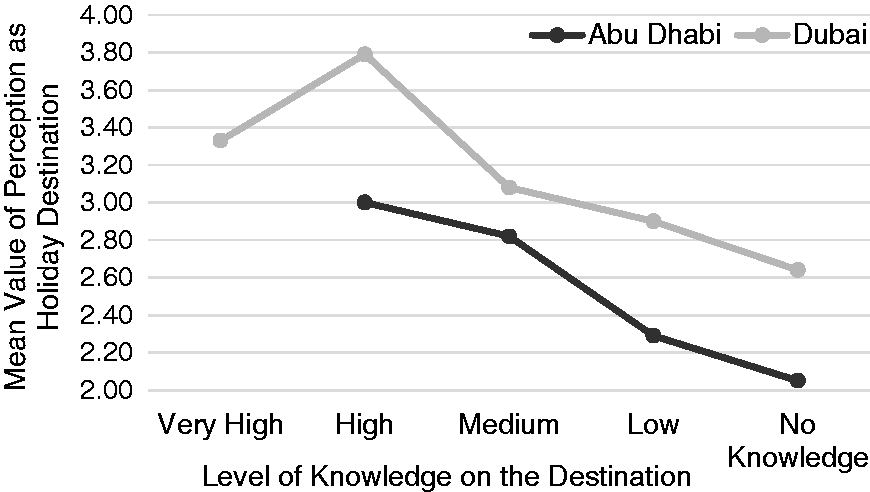
Importantly, for Abu Dhabi and Dubai this relation shows that the more people know of the destination, the more they perceive it to be a holiday destination (Figure 1). This does not mean these potential tourists are directly interested in visiting the destination if they know more about Abu Dhabi and Dubai. However, it could influence visit intention positively. Overall Dubai is better known than Abu Dhabi and also more connected to a holiday destination in the minds of potential tourists. Hypothesis 2: Abu Dhabi is perceived to offer mainly cultural attractions and Dubai is perceived more as a shopping tourism destination with architectural highlights. Mean value of cognitive image attributes (own illustration).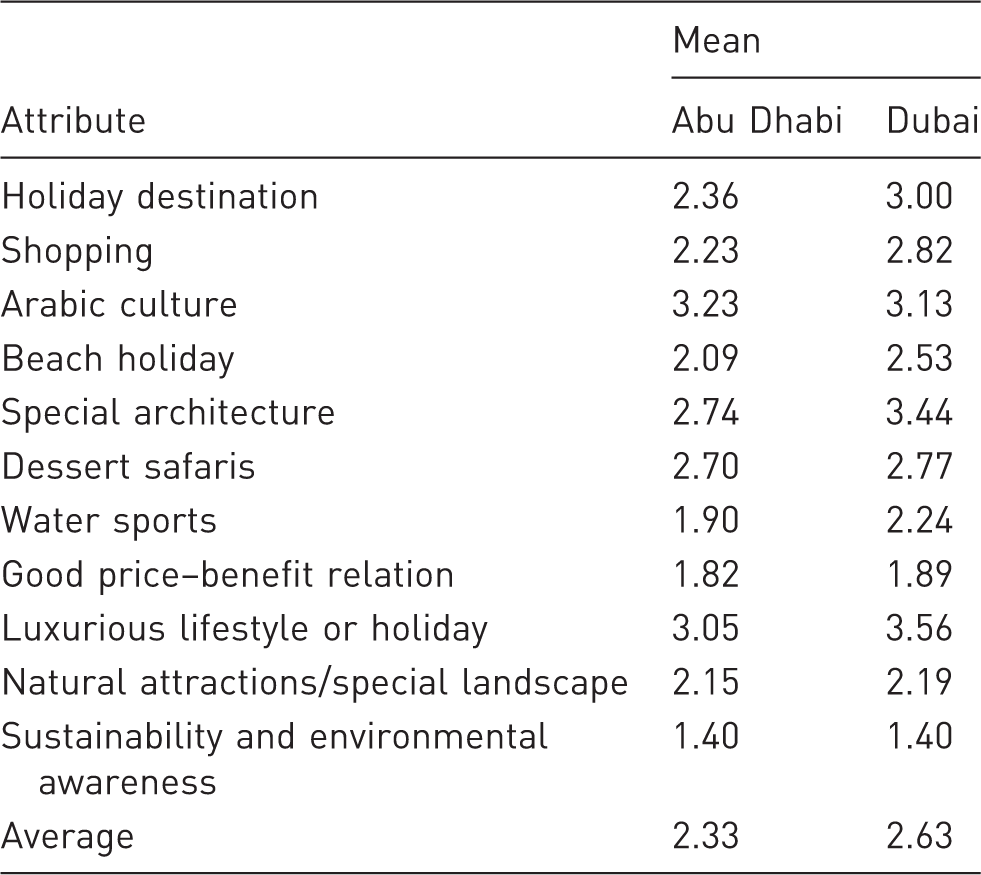
Based on the definition of tourism destination image the average perception would then be the sum of all perceptions, impressions, feelings and attitudes the respondents have in mind of Abu Dhabi and Dubai. Hence, Dubai (2.63) is perceived as slightly more attractive, for these touristic attributes, than Abu Dhabi (2.33). The individual mean values show how much potential tourists from Germany connect Abu Dhabi and Dubai to the listed attribute, attraction or activity.
Neither destination is perceived to have a good price-benefit relation nor are they connected to water sports or natural attractions. Instead, both are perceived as luxury destinations, Dubai (3.56) even more than Abu Dhabi (3.05), despite the most hotels in Dubai being one-star hotels (Jürs, 2014). Furthermore, potential tourists associate Abu Dhabi (3.23) and Dubai (3.13) with Arabic culture. In contrast to the mean values of all the other attributes, the perception of Abu Dhabi as offering cultural attractions is distinctly higher. The first part of hypothesis 2 can hereby be confirmed. However, the focus on local Arabic culture by Abu Dhabi currently does not offer differentiation potential to Dubai. Though in contrast, potential tourists seeking culture and intercultural exchange have a higher tendency to visit Abu Dhabi. The Chi-square test confirmed a significant relation between the preferred travel destination and the importance of intercultural exchange (p = 0.015). Potential tourists stating a very high importance of intercultural exchange for their travel decision are more interested in visiting Abu Dhabi, compared to those who stated a lower importance of cultural exchange. For Dubai the opposite is observed. Potential tourists valuing cultural exchange as less important prefer visiting Dubai as opposed to Abu Dhabi. These results add to Frías et al. (2012) statement that culture has a moderating effect on pre-visit image formation. Culture is a vital component of destinations images previous to the first visit.
The second part of hypothesis 2, assuming Dubai to be mostly associated with shopping tourism and special architecture, can only partly be confirmed. The association of Dubai with shopping is only slightly above the average perception of Dubai as a tourism destination and lower than the association of Dubai with a luxurious lifestyle or holiday, Arabic culture and special architecture (Table 2). Hence, a focus on shopping tourism is not apparent for the respondents. In comparison to Abu Dhabi, however, Dubai is linked to a shopping tourism destination considerably more. This perception may change in the following years because in Abu Dhabi the second largest mall of the UAE, the Yas Mall, recently opened on 19 November 2014. Within the first year, Yas Mall is expecting 20 million visitors (Yas Mall, 2015). The association Dubai has with special architecture (3.44) shows a significantly higher mean value than the overall average. Besides the perception of luxury, special architecture is the outstanding image component of Dubai. Conclusively, hypothesis 2 can be confirmed with the exception of the part assuming Dubai to create the image of being a specific shopping tourism destination.
Related to the first research question, if Abu Dhabi and Dubai are competitors based on their tourism destination image in the German outbound market, no clear answer can be found. On the one hand, especially Dubai shows significantly higher values for attributes such as luxury, shopping, architecture and beach holidays. On the other hand, in terms of the other aspects, especially the cultural attribute, Abu Dhabi does not have a clearly differentiated image from Dubai. The results indicate the possibility for two destinations with very similar backgrounds and traditions to create supplementary images in the minds of potential visitors. For this to be achieved Abu Dhabi has to differentiate itself as a culturally interesting destination more distinctly. Clearly, the emirate has intensified this idea through opening museums and inviting and organising famous performance acts in recent years.
The analysis of the second hypothesis also shows implications for the second research question of this study. For the attributes culture for Abu Dhabi and architecture for Dubai a fit between the desired image by destination marketers and the perceived image by tourists was identified. However, Dubai is also seen as a destination offering Arabic culture as an attraction. Surprisingly this was not found out with the expected high number for the shopping aspect. A reason might be that shopping is only interesting for a specific group of tourists. As many of the respondents were not well informed about the destinations, some might have not heard about the shopping centres and the shopping festival in Dubai. Hypothesis 3: Abu Dhabi and Dubai are not connected to sustainability and environmental awareness in the minds of potential visitors from Germany.
Related to the second research question, the results of this analysis show that the desired image of Abu Dhabi and Dubai as being sustainable, do not fit to the perceived image of both destinations not showing environmental awareness. This indicates that projects such as Masdar City in Abu Dhabi have not influenced the perception of the destination among potential first-time visitors from Germany, yet. Instead both destinations are perceived to be extremely unsustainable leaving destination marketers and city planners with the difficult task of turning an image around.
Conclusion
The research was set up to explore and compare the tourism destination image of Abu Dhabi and Dubai. Only potential visitors from Germany that had never visited the emirates Abu Dhabi or Dubai before were considered. The review of touristic literature and interviews with destination marketers from Abu Dhabi and Dubai lead to the development of a questionnaire to find answers for two research questions. The first research question is aimed at identifying if Abu Dhabi and Dubai are competitors based on their tourism destination image, or if destinations with a similar background and similar circumstances can develop supplementary images. The second research question is directed at the congruence between the intended image by destination marketers and the images perceived by potential tourists from Germany.
Overall the study presents six theoretical and practical implications and contributions. Firstly, the results confirmed that Dubai is better known than Abu Dhabi. More respondents stated a high knowledge level on Dubai. Further, more respondents perceive Dubai as a holiday destination compared to Abu Dhabi. Hereby, the relation of knowledge on the perception of both emirates as holiday destinations was identified. The perception of Abu Dhabi and Dubai to be tourism destinations increased with the knowledge each respondent had of the respective destination. The results cannot prove a direct influence of knowledge on visit intentions of the potential tourists. However, it does indicate that better known destinations have a higher chance of being perceived as a place for holidays. This implies that marketing efforts may already be useful if they simply increase the potential tourists’ knowledge on a destination.
Secondly, Dubai in particular is very closely associated with a luxurious holiday in the minds of potential tourists. However, both destinations are working to target an additional group of tourists by constructing more and more middle-class hotels (Jürs, 2014). This development away from the high end luxury market might influence the image of both destinations in the next few years. As the luxury segment was identified as an important image for both destinations, the aspired addition might appear to bruise this special image.
Thirdly, tourists interested in Arabic culture show a higher interest in Abu Dhabi than in Dubai. However, Dubai was also closely linked to Arabic culture reducing the potential of Abu Dhabi to positioning itself as the unique culture destination in the region.
Fourthly and unexpectedly, the connection of Dubai as a shopping tourism destination was not far above the average perception measured through the overall results in the attribute table. This does not fit with the strong shopping tourism focus of the emirate. Recently, Yas Mall was completed in Abu Dhabi, thus increasing competition between Abu Dhabi and Dubai for the attraction of shopping tourists. Alongside the developments on the hotel market, with both attracting middle-class hotels, the construction of Yas Mall in Abu Dhabi indicates a similar tourism development strategy, thereby threatening to reduce differentiation potential and possibly marketing success. Though, both destinations could instead profit from differentiation in their tourism development and tourism marketing strategies. Hereby, the identified and aspired perceptions of Abu Dhabi as culture destination and Dubai as luxury, architecture and shopping destination, would need to be highlighted even more and as complementary to each other. Thus, destinations with similar backgrounds and conditions do not have to compete based on their images. Instead Abu Dhabi and Dubai show the possibility of developing supplementary images. However, as discussed above they still do compete on certain levels.
Fifthly, neither Abu Dhabi nor Dubai is perceived to be sustainable or environmentally friendly by potential first-time visitors from Germany. A detailed analysis of this perception could be important for Abu Dhabi and Dubai if they want to maintain their focus on sustainability. Potential tourists hardly differentiate between Abu Dhabi and Dubai on environmental aspects. Here the strongest difference between aspired perception of the destination by marketers and the image in the mind of potential tourists is identified. In practice, Abu Dhabi and Dubai’s sustainability marketing plans have not reached the minds of tourists in Germany and require an improved approach. A gap between desired image and self-image is found, especially for the aspect of sustainability. Understanding the gaps between images destination marketers intend to promote and images potential tourists develop in their minds would be valuable for tourism destination marketing.
Sixthly, the study confirms the importance of studying the cognitive images for potential first-time visitors. The attribute table focusing on cognitive image perceptions was identified as the most efficient destination image analysis tool. For potential repeat visitors an assessment of the affective image dimension is more relevant.
Limitations and research suggestions
Four major limitations in this study need to be acknowledged and considered when interpreting the results. Firstly, the sample is not representative of the whole of Germany or North-Rhine-Westphalia. Accordingly, the relations of the statistical results need to be interpreted cautiously. A statistical significance and correlation indicates a certain dependence of variables. The statistical relation, however, can have other reasons than examined in this study. Secondly, different countries as source markets could yield significantly different results on the image of Abu Dhabi and Dubai. Hence conclusions are limited to the German market.
Thirdly, one apparently negative image that was not explicitly mentioned in the study was the political, human rights and in particular foreign guest worker situation in Abu Dhabi and Dubai because this paper had a different focus. A negative perception of these aspects can also influence the image of a destination, such as the guest worker situation in Qatar (Govers, 2012). An inclusion of other competitors in the region such as Qatar, Bahrain and Oman, or the other emirates could benefit a tourism destination image study on Abu Dhabi and Dubai. In general, the development within the region requires on-going research as changes potentially influencing the tourism destination image are occurring very fast.
Fourthly, face-to-face interviews, as opposed to surveys would have brought deeper insights on how Germans perceive Dubai and Abu Dhabi, why they have this perception and if there is any sentiment against the Middle East. However, this study did not intend to gain deep knowledge on the feelings of individuals but to compare the overall image of Abu Dhabi and Dubai.
Nevertheless, qualitative research could benefit this study and the overall knowledge on the image of Abu Dhabi and Dubai as this allows deeper insights into peoples’ motivations and feelings towards the region and potential travel to the region. Further research should also investigate whether Abu Dhabi and Dubai are perceived as emirates or cities because the perception of the emirates as only cities could change their image. This question arose throughout the paper. Additionally, the results on hypothesis 2 indicate the necessity of a more specific analysis on the perception of shopping tourism in Dubai as the findings are surprising. The results indicated a gap between the perceived image of the destinations and the desired image by destination marketers. The effect of this gap should be studied in more detail.
Footnotes
Declaration of Conflicting Interests
The author(s) declared no potential conflicts of interest with respect to the research, authorship, and/or publication of this article.
Funding
The author(s) received no financial support for the research, authorship, and/or publication of this article.