



Abstract
Despite consumers declared interest, bookings of sustainable tourism products remain low. The key to bringing together supply and demand of tour-operator products is effective sustainability communication. Therefore, the aim of this study is to analyse the role of sustainability communication in the attitude–behaviour gap; little is known of theoretically and empirically. Semi-structured interviews were conducted in an ex-post investigation with customers of certified tour-operators. The participants neither perceive, recognise nor comprehend the sustainability characteristics of the products. To analyse the reasons, we use the value–belief–norm theory to depict how and why these customers process sustainability messages. The driving and impeding factors of successful sustainability communication are derived, and ways to improve the uptake of sustainability information are developed.
Keywords
Introduction
The tourism industry has become increasingly aware of the need to be more sustainable (Global sustainable tourism council (GTSC), 2016; Pomering et al., 2011). As a consequence, tourism companies have advanced their sustainably managed product lines both in quality and quantity (Schwartz et al., 2008; Wehrli et al., 2014). This development helps mitigate the negative impacts of tourism resulting from the sector’s extensive growth in recent years (Pomering et al., 2011). In addition, tour-operators in general, and specialist tour-operators in particular, seek to develop competitive advantages in the market place (Schwartz et al., 2008). Their sustainable tourism products are managed in such a way that environmental, social and economic sustainability attributes are positively integrated into the journey to meet visitors’, the industry’s and the host communities’ needs (UNWTO, 2013; Wehrli et al., 2014). Their specific attributes can only become relevant for purchase decisions when they are recognised and well understood by tour-operator customers as added values (Mcdonald and Oates, 2006). Therefore, tour-operators need effective sustainability communication to successfully direct the consumer’s attention to these newly developed sustainable travel options and their product attributes as added value (Belz and Peattie, 2012). Although such products are readily and increasingly available and consumers report positive intentions to book sustainable products, actual bookings remain low, leading to an attitude–behaviour gap in sustainable tourism (Budeanu, 2007; Wehrli et al., 2014). This raises the question as to whether consumers actually perceive the availability, the value and distinctiveness of sustainable tourism products.
National surveys indicate an issue with sustainability communication. A recent survey of the German market, for instance, indicates that consumers complain of a lack of sustainability information (43%) and demand that sustainable tourism products be made more visible and accessible (42%) (FUR, 2014). Findings from research confirm that it is necessary to investigate the roles of communication, awareness and behaviour in sustainable tourism (Khoo-Lattimore and Prideaux, 2013). For example, Becken (2007: 356) comments ‘tourists expressed the need for more information’, with reference to climate change issues. Similarly, Miller et al. (2010) identify that consumers show a deficient understanding of what the conception of ‘sustainable tourism’ stands for. Khoo-Lattimore and Prideaux (2013) underscore that there is a noticeable gap between awareness and eventual change in travel behaviour which has yet to be fully explained. Therefore, research is needed on actual sustainability behaviours in tourism (Budeanu, 2007; Gao et al., 2017) and how perceptions of responsibility influence behavioural change (Gao et al., 2017).
A deeper understanding of the attitude–behaviour gap, and how to bridge it, is therefore relevant for both tourism researchers and practitioners. Nevertheless, research on the attitude–behaviour gap in sustainable tourism and its theoretical and empirical foundations remains scarce (Antimova et al., 2012; Cohen et al., 2014) with only few publications. Hibbert et al. (2013) and Cohen et al. (2013) analysed the problem from a sociological perspective, proposing that travellers live different self-identities that vary depending on the context, and accordingly, pro-sustainable everyday behaviours are not necessarily translated into travel choices. Juvan and Dolnicar (2014) employ cognitive dissonance theory. The authors identify several explanations which reveal why the gap occurs among environmental activists.
While this handful of studies have investigated some of the interpersonal and intrapersonal influences on consumer behaviour in sustainable tourism, the influence of contextual factors, such as sustainability communication in the attitude–behaviour gap, has yet to be researched (Tölkes, 2018). Accordingly, little is understood about the underlying beliefs that influence consumer perception and understanding of the sustainability product attributes of travel products at the booking stage. Therefore, additional research is required on which attributes are positively perceived and how these perceptions and understandings of sustainability translate into a travel decision.
In the present study, we use the value–belief–norm (VBN) theory of environmentalism (Stern et al., 1999) to explain the information processing of sustainability information among tour-operators’ customers. For the first time, a social–psychological theory is used to investigate information processing of sustainability advertising in the attitude–behaviour gap in sustainable tourism. Given the lack of theoretical background on sustainability communication and on the gap, the VBN theory has the potential to offer a deeper understanding of how consumers process the sustainability information provided by tour-operators to eventually make the decision to purchase.
The research questions are:
What is the role of sustainability communication in the attitude–behaviour gap? How can information processing of sustainability information be explained? (Which are the drivers towards, and barriers to, effective information processing?) Which sustainability product attributes are seen, recognised, understood and translated into a booking? And why?
Theoretical framework
The VBN theory of environmentalism (Stern et al., 1999) proposes a causal chain which links general value orientations with beliefs about the human–nature–relationship which consecutively influence people’s beliefs about the impacts of environmental behaviour and their responsibility for, and for mitigating, these problems (Steg et al., 2005). Thus, the VBN is different from the theory of planned behaviour (TPB) (Ajzen, 1991), a framework commonly used to explain decision-making in the context of environmentally sustainable tourism (e.g., Han et al., 2010; Kim and Han, 2010; Lee et al., 2010). While the TPB is based upon rational choice considerations, the VBN does not propose the full consideration of all potential factors (Stern et al., 1999) but emphasises the role of values and moral norms in specific beliefs and behaviours (Stern and Dietz, 1994; Stern et al., 1993; Stern et al., 1995)
The basic formulation of the theory (Stern et al., 1993) distinguishes three principal value types that influence the beliefs linked to environmentally significant behaviours: altruistic, biospheric and egoistic values. Accordingly, people who demonstrate altruistic value orientations show their concern for the well-being of other people while biospheric values refer to a concern for the ecosystem. In contrast, egoistic value structures mean that people attempt to increase their personal benefits through their behaviours (Stern et al., 1993). There is empirical proof that self-transcendent values are positively related to engagements in pro-environmental behaviour while egoistic values show a negative correlation (Stern, 2000; Stern et al., 1999). These value orientations affect people’s (environmental) worldview which is an expression of people’s beliefs about the human–environment relationship represented in the constructs of the New Environmental Paradigm (Dunlap et al., 2000).
Furthermore, the VBN links to the NAM (Schwartz, 1977) by drawing upon the role of activated personal norms of pro-environmental actions. These personal norms are triggered by the belief that things people value are threatened, such as other humans, species or the environment, so that people feel a moral obligation to take (pro-sustainability) action that might alleviate the damage to the threatened objects and restore these values (Stern, 2000; Stern et al., 1999). Awareness of the consequences of one’s behaviour (AC beliefs) can lead an individual to recognise their contribution to undesirable outcomes and to attempt to mitigate the impact of that behaviour (AR beliefs). Such AR beliefs and AC beliefs are closely intertwined with people’s worldviews (Steg et al., 2005). Consequently, the more an individual believes that he or she can take action to alleviate the potential damage to the things valued, the greater the probability that the individual will undertake pro-environmental action (Snelgar, 2006). However, this is not always the case; some people also deny such responsibilities (Stern et al., 1999).
While the NAM proposes a focus on altruistic values, the VBN refers to human beings, other species and the ecosystem as a whole (Stern et al., 1999), so that AR and AC beliefs relate to any valued object (Stern, 2000; Stern et al., 1999). Apart from an individual’s value orientation, Stern et al. (1999) also address certain capacities and constraints, such as limited social or financial resources, that affect the efficacy of a person in undertaking a behaviour (Stern, 2000; Stern et al., 1999). Sustainable tourism choices can be classified as ‘private-sphere environmentalism’ according to the different types of behaviours Stern et al. (1999) distinguish.
Despite the considerable power of the VBN to explain sustainability behaviours in tourism, its application has been scarce: While Choi et al. (2015) explain hotel guests’ intentions to visit green hotels in terms of the causal VBN chain, van Riper and Kyle (2014) verify this effect for pro-environmental behaviours of National Park visitors. Han and Hwang (2016) focus on the effect of emotional processes on moral norms in the choice of sustainable cruise products. Han (2014) also demonstrates the importance of moral norms in convention travellers’ decision to attend green conventions as opposed to conventional ones. Gao et al. (2017) found that the more tourists perceive the negative consequences of tourism, the more they feel they should act responsibly.
However, none of these studies investigates the role of contextual factors in influencing environmental decisions although the VBN addresses the role of persuasive communication and advertising as important determinants (Stern, 2000; Stern et al., 1999). However, information may have different meanings and effects for different individuals depending on their belief and value structures (Stern, 2000). In one of the few studies on the effect media, Lee (2011) found that environmental content in mass media messages relates positively to young people’s biospheric values to motivate private sphere environmental behaviours. Yet, while this research relates to mass media, the role of company-related marketing strategies (Lee, 2011), in tourism in particular, has not yet been researched.
Against this backdrop, we seek to contribute to knowledge by drawing upon the VBN theory to study the information processing of sustainability information in a tourism context and to investigate the link between beliefs and values with regard to the perception and reception of such sustainability messages. Unlike previous research, this article concentrates on travellers’ decision-making with regard to bundled tour-operator packages, which are more complex tourism products (Sigala, 2008) than hotel bookings (Han, 2014) or national park visits (van Riper and Kyle, 2014).
Methodology
Research on sustainability communication and on the attitude–behaviour gap phenomenon in sustainable tourism is largely unexplored territory that requires further theoretical understanding. Therefore, this study uses a qualitative research strategy, since qualitative methods are particularly useful in revealing the complexities of a new field (Miles et al., 2014) and producing rich descriptions that afford deeper insight into experiences, views and meanings that are so important for theory building (Mintzberg, 1979; Yilmaz, 2013). As part of this strategy, we use semi-structured interviews which are suitable for investigating beliefs, meanings and understandings of phenomena (Yilmaz, 2013) as well as situations where declared intentions and behaviours deviate (Belk et al., 2005). Moreover, qualitative research is particularly useful for studying how consumers process travel information, capturing their mental models of sustainable tourism, and their perceptions of sustainability information (Wolf and Moser, 2011; Yilmaz, 2013). Additionally, this research strategy is chosen to move away from the positivist-quantitative approaches that dominate consumer behaviour research. Their vulnerability to social desirability and the measurement of hypothetical decisions limits our understanding of the gap (Auger and Devinny, 2007; Miller, 2003).
The study conducted 20 in-depth telephone interviews with customers of sustainability-certified German tour-operators. Since the customers were resident in different parts of Germany and in Austria, telephone interviews were used to cater for the geographically dispersed sample of travellers (Sturges and Hanrahan, 2004). Furthermore, telephone interviews can reduce social-desirability effects by encouraging frank responses (enhancing data quality), especially to sensitive questions, as the interviewer is not present in person (Bryman, 2012; Sturges and Hanrahan, 2004). Bryman (2012) underlines that telephone interviews can as well produce the rich and comprehensive responses typically associated with qualitative research techniques.
To maximise the effectiveness of this research, an ex-post approach to purposive sampling (Miles et al., 2014) was applied to focus on actual purchases. Ex-post investigations measuring actual behaviour are needed in research on the attitude–behaviour gap in tourism (Budeanu, 2007; Juvan and Dolnicar, 2014, 2016) to exclude social desirability effects (Fisher, 1993) and to ensure that study participants can be categorised as pro-sustainable (Juvan and Dolnicar, 2014). As the gap among the customers of certified tour-operators was assumed to be particularly minor and more information is needed about what motivates pro-sustainable choices (Wolf and Moser, 2011), these customers were selected for the interviews. The selection of such ‘theoretically useful cases’ (Eisenhardt, 1989: 533) seems particularly appropriate for this study’s theory development goal (Miles et al., 2014). Instead of determining the sample size in advance, sampling continued until theoretical saturation was achieved after 20 interviews (Glaser and Strauss, 1967).
Study participants were recruited by contacting several tour-operators that were members of Forum Anders Reisen, a German association of small and medium-sized special interest tour-operators which are certified for sustainability (Tourcert). Their customers were assumed to represent a special interest group of sustainability-aware travellers. Five different tour-operators declared their willingness to support this research project, each of which specialised in a different sustainable product segment (trekking, ayurveda, educational tours to South America or Africa and general educational tours). These specialist tour-operators all offer bundled package tours in their segment that show the same kinds of sustainability attributes (ensured by their certification scheme and the sustainability criteria set by Forum Anders Reisen). To secure a sample of sustainability customers, these tour-operators contacted their customers. Participants were asked to name the last tour booked with that certified tour-operator. Selected participants had different demographic backgrounds, educational levels and destinations and had booked different kinds of tourism product. Participant profiles are given in Table 1.
Participant profiles.
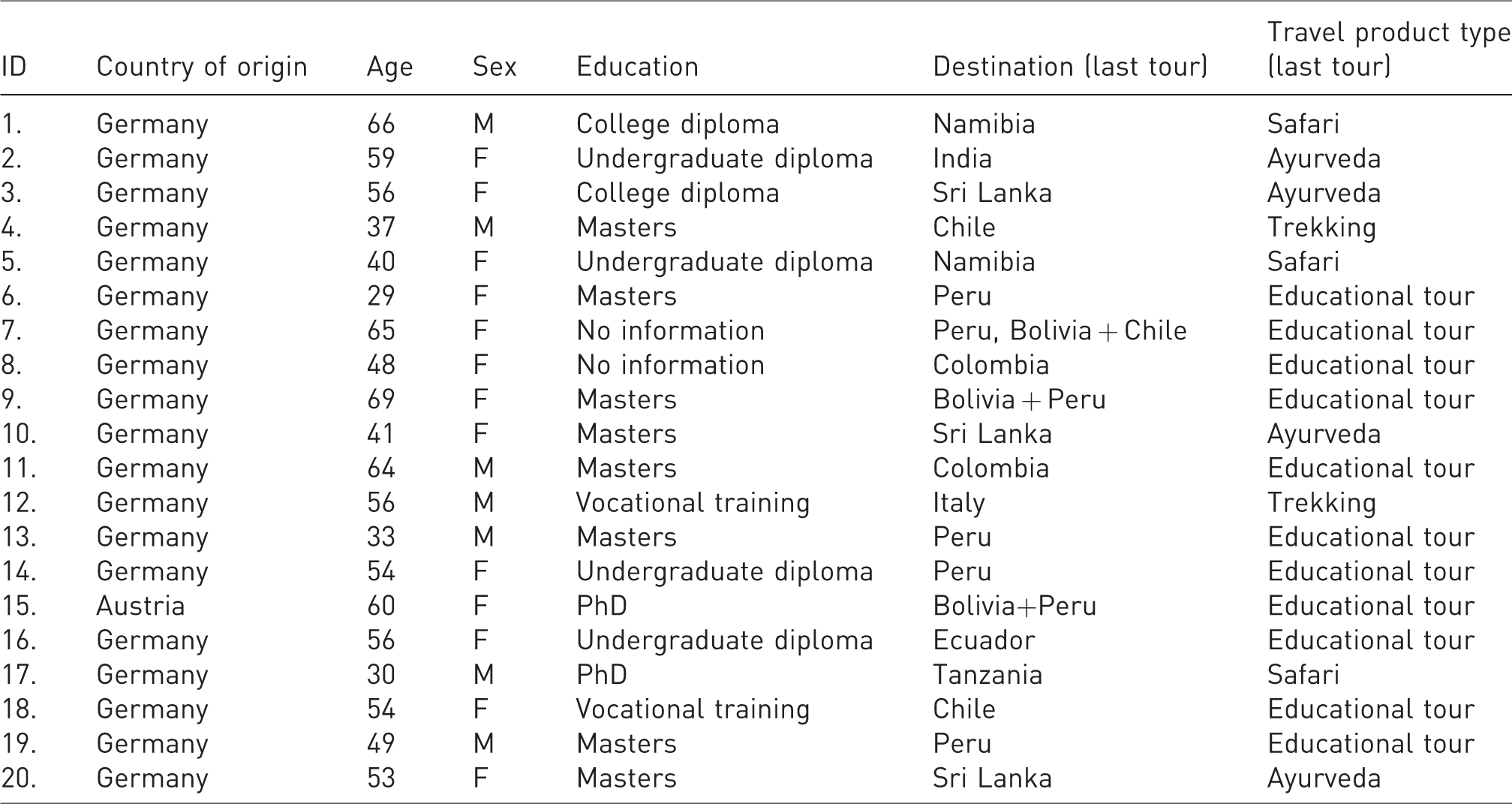
To improve the interview guidelines, we tested them in a pilot study of five participants and adjusted them according to the results, for example, in terms of the formulation of the questions. The actual interviews were conducted by telephone in Germany during summer and autumn 2016 and lasted 25–65 minutes. Each interview was audio-recorded, when permission was given, and subsequently transcribed.
The interviews were conducted following a semi-structured guideline, which advanced the questions from the general to the more detailed (Bernhard, 1988). Open-ended questions were used to encourage unbiased answers and to measure real behaviour (Woodside and Lysonski, 1989). At first, participants were asked about their priorities when going on holiday. More specific questions followed, which asked which were most relevant to them when choosing their most recent tour with that specialist tour-operator. Further, the respondents were asked what sustainable tourism meant to them. Prompted questions assessed the different sustainability attributes, their importance for the person at the point of booking and the customer’s perception of this attribute and of the sustainability certification. The sustainability criteria were taken from the GTSC guidelines (GTSC, 2016) and oriented towards the Forum Anders Reisen members’ code of conduct (Forum Anders Reisen, 2014). They included all dimensions of sustainability:
Environmental criteria (atmosfair, rail and fly, balance between travel duration and distance, water and energy saving) Cultural criteria (respect for the local culture) Socio-economic criteria (local food, local employees, fair employment) Sustainability certification (TourCert)
At the beginning of the interview, participants were informed that it would centre on holiday decision-making. The real topic of the investigation was avoided to reduce biased responses, but clarified in a debriefing. Juvan and Dolnicar (2014, 2016) were among the first studies conducted in the field suggesting this logic to avoid social desirability when studying environmental sustainable behaviour.
During the interview, notes were taken on people’s reactions to sustainable tourism and to determine what was important to them. This measure facilitated the comparison between different cases and compensated for the lack of body language (Bryman, 2012; Eisenhardt, 1989).
To analyse the data, we defined the constructs of the VBN theory a priori to guide the coding of the material. In addition, the data was coded inductively to generate an understanding of the extent to which the consumers processed the sustainability attributes. In both approaches, cases were checked to identify similar and dissimilar occurrences. Codings were matched with the data and iteratively refined (Miles et al., 2014).
Results
The following section relates the interview findings to VBN theory (Stern et al., 1999) to illustrate that this consumer segment represents a sustainability special interest group. Then, we elaborate upon the characteristics of the attitude–behaviour gap and the role of sustainability communication within it.
Characteristics of the special interest customers
The following quotations set out the different types of beliefs which shape these customers’ sustainable worldviews as postulated by the new environmental paradigm in the VBN (Stern et al., 1999): ‘We human beings must learn to live with nature and the animals. This is sustainability’ (unprompted, female, 54 years old). ‘We all live on one planet […] some people simply don’t get that we’re running out of resources’ (unprompted, female, 65 years old).
These quotations demonstrate that these people view the world as a place of limited (natural) resources and acknowledge that humans do harm to the environment in a way that might end in ecological catastrophe unless we change our behaviour (Stern et al., 1999). This environmental worldview (Dunlap et al., 2000) is closely linked to biospheric values which evolve around the preservation of nature and respect for the earth (Stern et al., 1999).
However, there were also participants who showed altruistic values reflected in a concern that the weak should have equal opportunities (Stern et al., 1999) when referring to a holiday in a third world country: ‘I think it is a good thing [to have local employees] because we can guarantee the local people a future’ (unprompted, female, 65 years old). ‘When I travel, I want to get to know everything, also the local food and they should benefit [economically] from our travelling activities’ (unprompted, female, 29 years old).
Additionally, the consumers ascribe responsibility (AR beliefs) to themselves for alleviating harm to the things they value, irrespective of other people or the biosphere, resulting from their awareness of the (potentially negative) consequences (AC beliefs) of human agency (Stern et al., 1999). In response to such AC beliefs, people feel a moral obligation to take pro-environmental action to protect the environment from negative impacts: ‘Travelling always has an environmental aspect such as the ecological footprint, especially with long-distance travelling. Then, it is important not to waste water resources and to adapt to the living conditions’ (unprompted, female, 40 years old). ‘To me it is important that I behave responsibly, that I don’t throw things away, that I’m considerate’ (unprompted, female, 69 years old).
In summary, these statements indicate that participants demonstrated all dimensions of the VBN theory (Stern et al., 1999) as well as their sustainability-mindedness.
The role of sustainability communication in the attitude–behaviour gap
Surprisingly, the study participants were largely unaware of having booked a certified sustainable travel product.
The following quotations demonstrate the difficulties people had when asked to identify the sustainability attributes of these tours, indicating a major communication problem between tour-operators and customers: ‘We did not know about any special sustainability attributes until the tour-guide told us. There was nothing about it in the travel description’ (unprompted, female, 54 years old). ‘I am not really conscious of the sustainability product attributes of this tour and of the characteristics of this type of tourism […]. To me, what was so special about them was invisible at the point of booking’ (unprompted, female, 56 years old).
Another customer explicitly addressed a problem of ineffective sustainability communication: ‘I think that it needs more advertisement…When it comes to buying food and other things I am generally more aware of organic alternatives and I watch for labels. But with travelling…it simply did not come into my mind that there were sustainable tours' (unprompted, female, 29 years old).
More specifically, there seems to be an issue with the respondents’ priorities for choosing that holiday which are primarily quality-related aspects or to do with the tour-operators’ excellence as specialist: ‘To me it is very important that the tour is well-organised. I wanted to travel to Namibia […] and have an extended stay at Victoria Falls. There were not many tour-operators which offered this’ (unprompted, male, 66 years old).
In terms of the attitude–behaviour gap, it is a novel finding that the gap characterises differently from other studies: Since these special interest customers obviously did not intentionally book sustainably, we may derive they have no detectable attitude towards the behaviour. In contrast, research on the gap has reported a lack of attitude-consistent behaviours (e.g., Juvan and Dolnicar, 2014). In the same way, it is a new finding that a communication problem between tour-operator and customer is a major reason for the gap. Therefore, the next section takes a closer look at the reasons behind the communication problem.
Groups of beliefs: Explanations of information processing
The interviews reveal a range of beliefs which explain, in terms of VBN theory, why these consumers process sustainability information at the point of booking. The degree to which these beliefs enabled consumers to perceive, recognise and understand certain sustainability aspects, and to which they motivated the consumer to take action, is indicated within each group.
Group 1: I can take responsibility (A fully activated VBN chain)
See, recognise, understand, action (advertising effect)
This group represents a full VBN chain which leads to effective processing of sustainability information: ‘The donation for the charity project.
‘The very first thing I do is to book the atmosfair payment[…] My tour-operator indicates the emissions in the travel documents in great detail […]
These respondents show altruistic values in the former two cases and biospheric ones in the latter which are closely associated with a pro-sustainable worldview (NEP). The results suggest that tour-operator sustainability information attracts people’s attention and motivates them to act pro-sustainably when it is congruent with their values and so appeals to their concerns in a personally relevant way. Consequently, these people feel that they can proactively make a difference (AR beliefs), supporting social justice, equal opportunities or mitigating environmental damage, respectively (AC beliefs). This study’s findings indicate that a fully activated VBN chain is the key to successful information processing of tour-operator sustainability product attributes when a personal norm is stimulated to lead to ascribed feelings of responsibility. Similarly, biospheric value was found to be significant for green hotel choice (Choi et al., 2015) and environmental household behaviour (Steg et al., 2005). Van Riper and Kyle (2014) and Han (2015) show that the variables of the VBN chain lead to pro-environmental behaviour of national parks visitors and green hotel choices, respectively. However, none of these studies have examined information processing.
Group 2: I don’t want to take responsibility
Do not see, recognise, understand, no action (no advertising effect)
In contrast to the majority, two participants emphasise the role of personal benefit both in general terms and with reference to their travel decision. Consequently, they do not develop AR and AC beliefs which explains why these two people do not perceive any of the sustainability attributes: ‘
The original proposition of Stern et al.’s VBN is that egoistic values are negatively correlated with all other variables in the value–belief chain (Stern et al., 1995; Stern et al., 1999). Our results contribute to an understanding in a communication context.
Group 3: External attribution – ‘I cannot help’
See, recognise but do not understand, no action (no advertising effect)
As opposed to the previous group of beliefs, these customers recognise sustainability attributes but they do not understand their effectiveness: ‘I realised this, but I don’t think this helps the local people,
While the theory suggests that norm activation requires at least some sense of recognising the implications of measures (Schwartz, 1977), this statement reveals a strategy of responsibility denial (Schwartz, 1977) because the customer develops a feeling of helplessness in mitigating climate change. Since the results of sustainability action remain invisible, this customer does not develop AR beliefs that stimulate a personal norm so that this customer does not fully process sustainability information. The next quotation demonstrates that invisible (potential) results also cause feelings of distrust that neutralise personal norms to act: ‘I never pay atmosfair because I
We may conclude that information processing has been ineffective as sustainability communication has failed to make these customers aware of the consequences of their behaviours for other people or the biosphere (AC beliefs). When travellers perceive the detrimental effects of tourism, they develop a sense of responsibility. A similar behaviour has been observed by Gao et al. (2017) for tourists at world heritage sites. Therefore, we suggest that tour-operators should improve their communications to enhance customers’ understanding of these effects and how they can make a difference.
Group 4: External attribution of responsibility – ‘You can directly see’
See, recognise, understand, action (advertising effect)
The fourth group of beliefs again relates to externalised responsibilities. The statement illustrates that visibility (of sustainability effects) is associated with trustworthiness, another important criterion for communication if it is to achieve persuasive effects: ‘This is what I like about this tour-operator, that you visit a charity project as part of your holiday experience and
Group 5: Denial of responsibility to respond
Do not see, recognise, understand, no action (no advertising effect)
These respondents show a denial of responsibility to respond, which means that people begin to develop justifications for refraining from an action by ascribing the impacts for behaviours away from themselves and thereby deactivating any moral obligation to take action which complies with the theory (Schwartz, 1977; Stern et al., 1999). This is another explanation of why customers do not effectively process sustainability information, as indicated by the following two statements: ‘No, [I didn’t pay attention to atmosfair]. I am not willing to pay any extra fees. Airlines earn a lot of money and
The first study participants show personal normative beliefs (Stern et al., 1999) that the tourism industry is responsible for taking sustainability action. While displacing responsibility to the industry has prevented environmental action in tourism (Gössling et al., 2009), in our case, it impedes effective information processing. Whereas the next participant has difficulty to understand the complex processes of the tourism value chain. ‘It is like that, they don’t have the same wages in India as in Germany.
Group 6: Capabilities and constraints
Do not see, recognise, understand, no action (no advertising effect)
Stern et al. (1999) mention that personal capabilities and constraints affect the efficacy of behaviours. This customer addresses a lack of financial resources, a constraint that led her to overlook the atmosfair attribute at the point of booking: ‘No, I did not take notice of this [atmosfair]. In general, to me environmental protection is important but this tour was extremely expensive,
Another constraint that is apparent from this quotation is a lack of behaviour-specific knowledge and skills (Stern, 2000). Better sustainability communication would have conveyed to this participant that the payment is flexible and therefore also affordable with a small budget, so she might have considered this option. Van Riper and Kyle (2014) similarly report that financial constraints prevent national park visitors from volunteering. Given the little research on the role of such constraints overall (Choi et al., 2015; Stern, 2000) we contribute to their understanding concerning the information processing of tour-operator sustainability information.
Group 7: Misperceptions – ‘Nothing special’
Do not see, recognise nor understand the attributes as sustainable, action (advertising effect)
In some cases, interviewees act sustainably but do not recognise the product attributes as particularly sustainable or added value. The theoretical framework has its limitations here. Instead, explanations can be found in the tourism product type, customer characteristics and aspects of convenience that explain why these sustainability attributes are interpreted as
The first two quotations indicate that the sustainability attribute is inherently related to the
In comparison, in the next case, the personal characteristics of the customers are important. The next participant’s level of travel experience explains why he takes things for granted. ‘I think it is important to respect the local culture. There are some brochures which explain a code of conduct.
Third, repeat customers may interpret a sustainability product attribute such as the provision of local food as part of the tour-operator experience. ‘I regularly travel with this tour-operator, so
Finally, there were some cases in which sustainability product attributes were misinterpreted as
To summarise, these beliefs demonstrate the limitations of the theory in explaining specific product and customer-related factors.
Group 8: Misconceptions
Do not see, recognise nor understand the sustainability attributes, action (advertising effect)
This set of beliefs can neither be explained by VBN. It encompasses a range of different customer
Her disappointment is the result of a communication problem: ‘Once a tour-operator selected their hotels well because they were equipped with renewable energies or used special heating practices, such as
Despite her explicit intention to find a sustainable tourism product, her very
Another form of misconception was that some customers perceived only a
Group 9: Lack of knowledge
See or do not see, recognise or do not recognise, but do not understand the sustainability attributes, no action (no advertising effect)
The next quotes illustrate a problem with
The second customer, however, reveals in the interview that she is well-informed about the concept but unacquainted with the wording ‘sustainable tourism’: ‘I know what sustainability is.
These two statement support Miller et al.’s (2010) finding that the general public has an information deficit regarding sustainable tourism. Our study shows that this lack of knowledge is also present among sustainability-aware tour-operator consumers. As the following statement shows, the travellers further lack knowledge of what sustainability certifications stand for. This however cannot be explained within the framework of the VBN. ‘I knew they were certified but, I’m afraid,
Other studies also report that consumers have difficulties to interpret sustainability labels (e.g., D’Souza, Taghian & Lamb, 2006). The cited statements show that the sustainability communication of these tour-operators needs to be improved to increase knowledge of content and wording regarding sustainable tourism and to educate consumers about their sustainability certifications.
Conclusion
Specialist tour-operators are at the forefront of sustainability tourism by offering travel products (Schwartz et al., 2008) which are ‘ecologically maintainable, economically viable and ethically and socially just’ (Forum Anders Reisen, 2014: 3). Effective sustainability communication is the key to selling these products successfully. Their special sustainability attributes can only be considered in the purchase decision when they are perceived and understood by the prospective customer (McDonald and Oates, 2006). Despite the industry’s communication efforts and customers’ positive intentions, purchase rates remain low (Budeanu, 2007). To understand this attitude–behaviour gap, it is important to explore the role of tour-operators’ sustainability communication in their target market. Since the crucial point of effective communication is that the message is received by its addressee, this study focuses on the information processing of the advertised product attributes by the customers of sustainability-certified specialist tour-operators. We conducted semi-structured interviews with special interest customers who are particularly sustainability-minded.
The main finding of this study is that the communication of sustainability features is largely ineffective as the interviewed customers show difficulties in processing tour-operator sustainability information. More specifically, consumers have difficulties to realise, recognise and understand the sustainability attributes of the products they had booked. In the context of attitude–behaviour gap research, it is a novel finding that a communication problem between tour-operators and their customers explains the gap and that consumers did not show an attitude towards purchasing sustainably but unintentionally did so.
We employed the VBN theory (Stern et al., 1999) to explain the information processing of sustainability information and advertising effects in a tourism context. Since research on sustainability communication and the attitude–behaviour gap is in its infancy, with little theoretical understanding (Wehrli et al., 2014), this study contributes to tourism research by a focus on a contextual factor. The results show that this theory is well-suited to explain how special interest customers process sustainability information. The study identifies nine groups of beliefs which explain why participants process different sustainability attributes.
The first group of beliefs indicates that people process tour-operator sustainability information successfully when they feel they can ‘take responsibility’ and a VBN chain is fully activated (cf. Chapter 5). Accordingly, sustainability attributes feel personally-relevant when the information is congruent with consumers’ biospheric and altruistic values and worldviews that guide their perceptions. Then, a personal norm is stimulated, and people begin to ascribe responsibility to themselves for mitigating potential adverse consequences of valued objects (AR beliefs), which in turn, leads to sustainable action (AC beliefs). In contrast, respondents overlook sustainability attributes because egoistic values negatively correlate with other variables of the VBN (group 2). Beliefs in group 3 identify that participants realise and recognise sustainability features but do not understand their impact. Consumers feel they cannot help and do not develop AR and AC beliefs stimulating a moral norm but develop a strategy of responsibility denial, which impedes information processing. In contrast, beliefs in group 4 indicate that customers fully process sustainability information, when both AR and AC beliefs are activated. When the positive consequence of sustainability engagements becomes visible, information is received as personally relevant and trustworthy. Group 5 refers to different forms of responsibility denial which lead to the deactivation of a moral obligation to act sustainably. Consequently, consumers displace responsibilities to the tourism industry or claim to lack insight into the tourism value chain and, therefore, do not process the sustainability attributes. Furthermore, customers overlook attributes when they are constrained by limited financial resources or behaviour-specific knowledge (e.g., knowledge about the atmosfair options). For the remaining groups of beliefs, the VBN cannot fully explain information processing. Instead, personality factors, product characteristics and aspects of convenience explain why people misperceive the sustainability attributes as ‘nothing special’ (group 6). For group 7 misconceptions of sustainability and for group 8 a lack of knowledge of sustainable tourism explain the misalignments.
This study reveals to specialist tour-operators that their sustainability communication is not as effective as it could be. Given that communications are particularly effective when they are theory-led and target causal determinants of behaviour (Michie et al., 2008), tour-operators can draw upon on the constructs of the VBN to improve the effectiveness of their sustainability messages. Designing sustainability messages to be value-congruent, personally relevant and visible helps bridge the gap to more fully exploit the market potential of the sustainability segment.
Footnotes
Declaration of Conflicting Interests
The author(s) declared no potential conflicts of interest with respect to the research, authorship and/or publication of this article.
Funding
The author(s) received no financial support for the research, authorship and/or publication of this article.