



Abstract
This paper examines the choice of affiliation or no affiliation to a large hotel chain from the viewpoint of luxury hotel property owners in Germany. Grounded in transaction cost theory, this study identifies how uncertainty and frequency influence the owners’ choice of unaffiliated operation and affiliation. The study augments the traditional governance literature in the field of the hotel by shedding light on the market/hierarchy decision of property owners rather than on the market entry strategies of international hotels firm. Through a multiple regression analysis on a sample of 122 existing five-star hotels in Germany, this study provides new empirical evidence that a frequent contract conclusion with the same hotel chain and a “hotel unrelated” background of the owner increases the likelihood of affiliation. In contrast to what transaction cost theory traditionally predicts, our results reveal that uncertainty is not influencing the owners’ market/hierarchy decision.
Introduction
Notwithstanding the challenges posed by political uncertainty and the perceived terrorist threats across Europe, the hotel industry continues to demonstrate remarkable resilience (Organisation for Economic Co-operation and Development (OECD), 2016). Hotels have been proven to be one of the most attractive markets in Europe with high levels of liquidity, strong market fundamentals (Raimundo et al., 2016; Watson Farley and Williams, 2016) and a remarkable growth. However, the hotel industry is also facing the challenge of guests’ expectations which are looking more for the personalised and unforgettable experience than standardised services (Deloitte Center for Industry Insights, 2017; Cavin, 2016). Where once affiliation to a hotel chain was perceived as a reliable guarantor for the personalised and memorable experience, properties owners and investors see themselves confronted with the decision to either affiliate or not affiliate to a chain of hotels. In this light, a significant number of studies has been focused on the performance differences between affiliated and not affiliated hotels (Carlbäck, 2011; Carvell et al., 2016; Enz et al., 2013; Kim and Kim, 2005; O’Neill and Carlbäck, 2011; O’Neill and Mattila, 2010; Praporski, 2008).
Although researchers have discussed the advantages and drawbacks of affiliated and unaffiliated operations, and the interest in this question does not seem to wane (Bailey and Ball, 2006; Lomanno, 2010), the choice whether to affiliate or not to affiliate to a hotel chain was so far scrutinised from the perspective of the international hotel chain. Research on the point of view of hotel owners is lacking, except for one study by Dahlstrom et al. (2009) who has analysed factors influencing the governance choice of hotel owners in Norway by applying principal–agency perspective. However, their study provides an initial explanation which makes ‘further theoretical and empirical contributions to this important managerial decision’ necessary (Dahlstrom et al., 2009: 847).
Earlier studies have shown that business decisions are influenced by conditions under which transactions take place, and transaction cost theory (TCT) is considered being one of the most elaborate explanatory theory of arrangements existing in organisational reality (Ebers and Gotsch, 1995; Masten, 1984; Masten et al., 1991; Monteverde and Teece, 1982a, 1982b; Walker and Weber, 1984; Williamson, 1973, 1979). According to TCT, the choice between developing in-house (hierarchy solution) or buying something from the market (market solution) results from the aim to minimise related expenses (Williamson, 1973). Eventually, every hotel owner must choose between market and hierarchy solutions like a make-or-buy decision (Krzeminska and Mellewigt, 2008). In this light: (a) make implies a hierarchical form of governance and indicates that the owner keeps the hotel unaffiliated; (b) buy signifies a market governance model choice in which the owner assigns to a hotel chain (e.g. through a management contract) the operational control over the hotel property (affiliated). Consequently, deciding between being unaffiliated or affiliated, hotel owners need to weight costs arising when affiliating to an existing chain of hotels (transaction costs), against the expenses which occur being unaffiliated (coordination costs) (Krzeminska and Mellewigt, 2008).
In addition to the behavioural assumptions on opportunism and bounded rationality, Williamson (1991, 1988, 1979) assumes the specific level of costs of each transaction being affected by three dimensions of the transaction: asset specificity, uncertainty and frequency. Considering that asset specificity has been subjecting to many hotel business-related studies analyzing make-or-buy decisions (De Vita and Tekaya, 2015; Espino-Rodríguez and Lai, 2014; Espino-Rodríguez and Rodríguez-Díaz, 2017; Han, 2009; Roper et al., 2017), our research instead, applying four binary linear regression models, focuses on understanding the impacts of uncertainty and frequency on the hotel owner’s choice between hierarchy and market in luxury hotels.
Thus, the research takes place in the hotel industry, which has experienced growth in the luxury segment (Beck Dinesen and Saetre, 2018). Moreover, the industry was threatened by the competition from low-fare flights to European cities and, even if the threat is still relevant, however, today more people are willing to spend money on luxury, if it represents quality and value for money (Beck Dinesen and Saetre, 2018). Specifically, the study focuses on the German luxury hotel market, proven to be the most attractive market in Europe, addressing domestic and international as well as private and institutional investors. If especially foreign investors base their choice of governance on factors which may not necessarily differ within the European market, Germany can be considered exemplary for determinants which are influencing owner’s decision to either affiliate his hotel property or not. Since previous research suggests a more excellent stratification of the different hotel types (Tanford et al., 2012), we initially focus on the luxury hotel sector, which has an extremely significant standing as a segment of the general tourism and hotel industry.
The paper is structured as follows; the next section describes the underlying theory, namely TCT, which is supported by the hypotheses based on transaction dimensions, influencing the level of transaction costs and ultimately the decision to either make or buy. The third part is devoted to the methodology and describes how the data was collected and analysed. The following paragraph contains the empirical analysis and presents how uncertainty and frequency influence hotel owner’s governance decision. A summary of the main findings and a discussion of the practical implications arising from the study are presented in the fifth section.
Theoretical background and hypotheses
Hotel industry
Nowadays, the European hotel industry continues its growth and forecasts a compounded annual growth rate of 3.29% towards 2020 (MarketLine, 2016). The hotel industry has experienced a consolidation the last decades, with the large groups now dominate the European market (Beck Dinesen and Saetre, 2018), and thus finds itself in a globalised, dynamic business environment where tourism is changing (Pereira-Moliner et al., 2010). Hotels’ owners are facing the challenge of guests who are looking more for personalised experiences (Deloitte Center for Industry Insights, 2017). Consumers, in fact, use brands as cues to infer specific product attributes, such as quality, and it also happens in the hotel industry (Onkvisit and Shaw, 1989).
The importance of affiliations has been remarked in the literature related to the development and growth in the hotel industry (Bailey, 2007; Bailey and Ball, 2006). Specifically, the market for luxury hotels is growing, and the analysis of Beck Dinesen and Saetre (2018) indicated that the main value drivers for luxury hotels are quality, service and brand affiliation. This leads hotels to consider the choice of entering a hotel affiliation chain seriously. To be affiliated adds values that come from the experience of the brand, such as familiarity, reliability and reduction of risks (Carlbäck, 2016). Moreover, affiliation to a hotel chain and the establishment of strategic alliances works as a provider of new knowledge (Marco-Lajara et al., 2018). Researchers have discussed the advantages and drawbacks of being affiliated versus being unaffiliated, pointing out mixed results. For instance, Ingram and Baum (1997) found that branded hotels have higher survival rates than unaffiliated hotels, Hanson et al. (2009) pointed out that the performance improvements occur for hotels that rebrand to a more upper market segment, and O’Neill and Carlbäck (2011) that brand-affiliated hotels have significantly higher average occupancy rates than unaffiliated hotels. However, a study in the USA showed that unaffiliated hotels produced a better profit than did the outlets belonging to the various chain (Mieyal Higgins, 2006).
Researchers have analyzed that a fundamental decision for hotel developers and owners is whether it is best to contract with a brand and open an affiliated hotel or whether it is best to open an unaffiliated hotel, but the broad spectrum of opinions and conflicting findings on this topic calls for a more comprehensive study of the performance of branded hotels in comparison with unaffiliated hotels (Carlbäck, 2016).
Transaction cost theory
One of the essential aspects of lying in the choice between affiliation and not affiliation is cost. There is a cost perspective embedded in the selection process associated with affiliation, and the costs could make the prospects less attractive. It is reasonable, for instance, to expect that prestigious brands would command greater royalties and fees than do their competitors. According to Rushmore (2004), great caution must be taken and careful calculations must be done to establish the feasibility of joining an affiliation, as this is not just a ticket to success: the non-monetary costs (loss of freedom, increased control and administration, increased possibility for obtaining financing) could outweigh the benefits. However, as in all economic decisions, the choice of the hotel owner depends upon the expected benefits relative to the anticipated costs (Carlbäck, 2016).
Since the choice between developing in-house (hierarchy solution) or buying from the market (market solution) results from the aim to minimise related costs (Williamson, 1973), TCT is considered to be well suited to investigate the factors influencing hotel owners’ fundamental decision to whether contract with a large hotel chain or operate as unaffiliated hotel (Augusto and Souza, 2015: 173; see also: Masten, 1984; Masten et al., 1991; Monteverde and Teece, 1982a, 1982b; Walker and Weber, 1984). This theory has been employed in several studies on the lodging industries and, although TCT was developed in the context of manufacturing firms, Erramilli and Rao (1993: 33) conclude that ‘existing theories could be employed, with suitable adaptations, to investigate issues related to multinational service enterprises’. Later Ramon Rodrı́guez (2002) examined the factors for expansion entry choices in the hotel industry, and relied on the TCT as an underpinning theory, while Lee et al. (2011) analysed its international expansion, more specifically about US restaurants. However, as highlighted by Song et al. (2012), despite the use of TCT, to date, this approach has not been widely used in analysing the behaviour of tourism firms.
The perspective of this study is that the critical step in the execution of expansion is in the hands of the owner and consists of the decision to either affiliate or not affiliate the hotel to an existing large chain. This decision was so far scrutinised from the perspective of international hotel firms, while, to the best of our knowledge, no analysis has yet considered the point of view of hotel owners. Dahlstrom et al. (2009) analysed factors influencing the governance choice of hotel owners in Norway, but applying principal–agency perspective, and only providing an initial explanation which makes ‘further theoretical and empirical contributions to this important managerial decision’ necessary.
The issue of affiliation could in many ways relate to the mindset of the owner, based on whether the business of the owner is oriented to lifestyle or profit and growth. Webb et al. (2010) describe the process as a balancing act for the owner: an act of exploiting the opportunities at hand or exploring new possibilities.
According to Williamson (1991, 1988, 1979), the specific level of costs of each transaction is affected by three dimensions of the transaction: asset specificity, uncertainty and frequency. Asset specificity has been the subject of many hotel business related studies analysing make-or-buy decisions (De Vita and Tekaya, 2015; Espino-Rodríguez and Lai, 2014; Espino-Rodríguez and Rodríguez-Díaz, 2017; Ghorbal-Blal, 2011; Han, 2009; Roper et al., 2017) and Harrington and Kendall (2006) call for future researches that test the impact of perception of uncertainty. Our focus is primarily that of generating insights for a better understanding of the effects of uncertainty and frequency on the hotel owner’s choice between hierarchy and market in luxury hotels, rather than on building TCT. Several data nuances relating to the binding interactions between asset specificity and the other two determinants of transaction costs, uncertainty and frequency, are left outside the scope of our investigation.
Uncertainty and affiliation
Most researchers agree that uncertainty is a significant determinant of hierarchy/market decisions (Balakrishnan and Wernerfelt, 1986; Porter, 1980; Rumelt et al., 1991; Williamson, 1973). Uncertainty in the foreign markets increases the firm ex ante and ex post transaction costs, especially search, information processing and adaptation costs (Williamson, 1991). TCT identifies two types of uncertainty: parametric and behavioural (Williamson, 1985). Parametric uncertainty refers to uncertainty about future environmental conditions which may influence the transaction. Due to bounded rationality, economic actors are not able to predict the future state of such determinants and integrate them into contracts (Baumüller, 2007). Moreover, behavioural uncertainty refers to the possible opportunistic behaviour of the respective partner, fostered by existing information asymmetries. To avoid the risk of opportunistic behaviour and costly unforeseen contingencies, TCT predicts that with high degrees of uncertainty, firms favour hierarchical governance over sourcing from the market (Ebers and Gotsch, 1995; Holcomb and Hitt, 2007; McIvor, 2005; Williamson, 1973, 1985).
Uncertainty plays a significant role in the hotel industry mainly because hotels are being increasingly affected by periods of uncertainty and instability. Results of previous studies, which have analysed the relation of tourism demand and uncertainty, have shown that political and economic uncertainty has a negative impact on the number of tourist arrivals (McKercher and Hui, 2004; Tangvitoontham and Sattayanuwat, 2017; Tekin, 2015; Oaten et al., 2015). Also, recent research on entry mode choices of international hotel firms found an elevated level of behavioural uncertainty positively related to hierarchical governance (Jell-Ojobor and Windsperger, 2014; Shin, 2003; Zamborsky and Kruesi, 2016). Also, this positive relationship was found to be even stronger under high environmental uncertainty (Jell-Ojobor and Windsperger, 2014). Studies on the Turkish tourism industry likewise support the TCT by having investigated the impact of environmental uncertainty as an operation characteristic on contractual completeness. The results predict that designing complete contracts is costlier under bounded rationality and uncertain business environment than its potential savings due to reduced opportunism risk (Gurcaylilar-Yenidogan et al., 2011).
Other researches, however, emphasise the importance of a large hotel chain brand in uncertain times (Carvell et al., 2016; O’Neill and Carlbäck, 2011). Carvell et al. (2016) focused on performance differences between affiliated and unaffiliated hotels and revealed that affiliating, as a signal of quality and service, reduces customer’s risk and uncertainty. A strong brand, therefore, may lower the hotel owner’s uncertainty and favour his decision to contract with a well-known hotel chain. Nevertheless, the hypothesis that affiliated hotels benefit from occupancy rate advantages because of reduced risk and uncertainty for the customer does not hold true for the luxury hotel segment.
It is supposed that high-priced unaffiliated properties have more well-established web presences, which lead to lower search costs and less uncertainty regarding the quality of the unaffiliated hotels (Carvell et al., 2016: 199). The uncertainty perceived by the customer consequently does not seem to influence the owner’s governance decision decisively. Having considered research and industry perspectives we expect, by TCT, uncertainty affecting hotel owner’s governance choice insofar as affiliating will be preferred only in times characterised by low uncertainty. As soon as the level of uncertainty increases, owners will instead favour the hierarchical form of governance (unaffiliated). Hypothesis 1: The higher the level of uncertainty, the lower the likeliness of the “market” as the hotel owner’s preferred governance model.
Frequency and affiliation
Frequency is a critical dimension influencing transaction costs and relates to the degree of repetition by which transactions are undertaken (Williamson, 1985). According to TCT, the increase in the frequency of exchange is a determining factor in choosing to integrate rather than maintain a market transaction. Hotel developers interpret frequency as the number of contracts which can be signed with a business partner. Although, empirical literature has given substantially less attention to transaction frequency in comparison to asset specificity and uncertainty (Rindfleisch and Heide, 1997), a considerable body of evidence exists in supporting the TCT central hypothesis that higher levels of transaction frequency result in increasingly complex governance structures (Bell, 2010). Williamson (Williamson, 1985: 60) argues that ‘the cost of specialised governance structures will be easier to recover for significant transactions of a recurring kind’. However, studies on TCT have been mostly unsuccessful in confirming the hypothesised effects of frequency. In fact, several studies have failed to find any positive association between transaction frequency and hierarchical governance (Plunket et al., 2001).
Tourism and hotel related research, which focused on investigating the influence of frequency on hierarchical/market decisions, faced similar problems. Literature has mainly given attention to asset specificity. Thus, uncertainty and frequency have often not been taken into consideration (De Vita and Tekaya, 2015). Those researchers who addressed spectrum as a critical determinant influencing hotel market decisions, either arrived to the same results as TCT, namely that activities conducted frequently tend to be performed in-house due to efficient internal production (Lamminmaki, 2007; Promsivapallop, 2009) or failed to demonstrate statistical significance (Roper et al., 2017).
Contrary to the literature on TCT, relational contracting treats frequency and hierarchical governance as substitutes. Instead of limiting opportunistic behaviour by implementing formal control mechanisms, relational contracting theory instead relies on easy controls, such as social norms and the context of the relationship (Miller, 2008). Accordingly, repeated interactions may improve the perception of trust and thus favour successive transactions between specific trading partners. The aim to preserve reputation thereby limits opportunistic behaviour and removes the need for excessive formalisation (Dyer, 1997; Hill, 1990; Langfield-Smith and Smith, 2003; Mayer et al., 1995).
Ghorbal-Blal (2011) scrutinised how developers in multinational hotel corporations select hotel projects when implementing expansion strategies. She defined frequency ‘as the number of contracts which can be signed with a business partner’ and emphasises that an increase in the number of transactions results in reduced information search costs and inherent uncertainty related to the deal (Ghorbal-Blal, 2011: 276). Consequently, to hotel expansion strategies, high-frequency flavours market, instead of hierarchy governance.
Taking into consideration that TCT hypothesis, we argue that due to reduced search costs, the possibility to reuse previous contracts, and the chance to benefit from cooperative business relationships, the frequency will lead to market governance. In fact, also Williamson acknowledges that, if good cooperation characterises the transactions, an increasing transactional frequency can strengthen reputation effects (Williamson, 2002). We, therefore expect that iterated interactions like, for instance, the repeated formation of management contracts with the same hotel chain, or the renewed collaboration with partners from related business, allow for cost reduction (e.g. reduction of search and information, bargaining and decision costs) and lead to market governance as the preferred model choice. Hypothesis 2: The higher the level of frequency, the higher the likeliness of the “market” as the hotel owner’s preferred governance model.
Methodology
Data sample
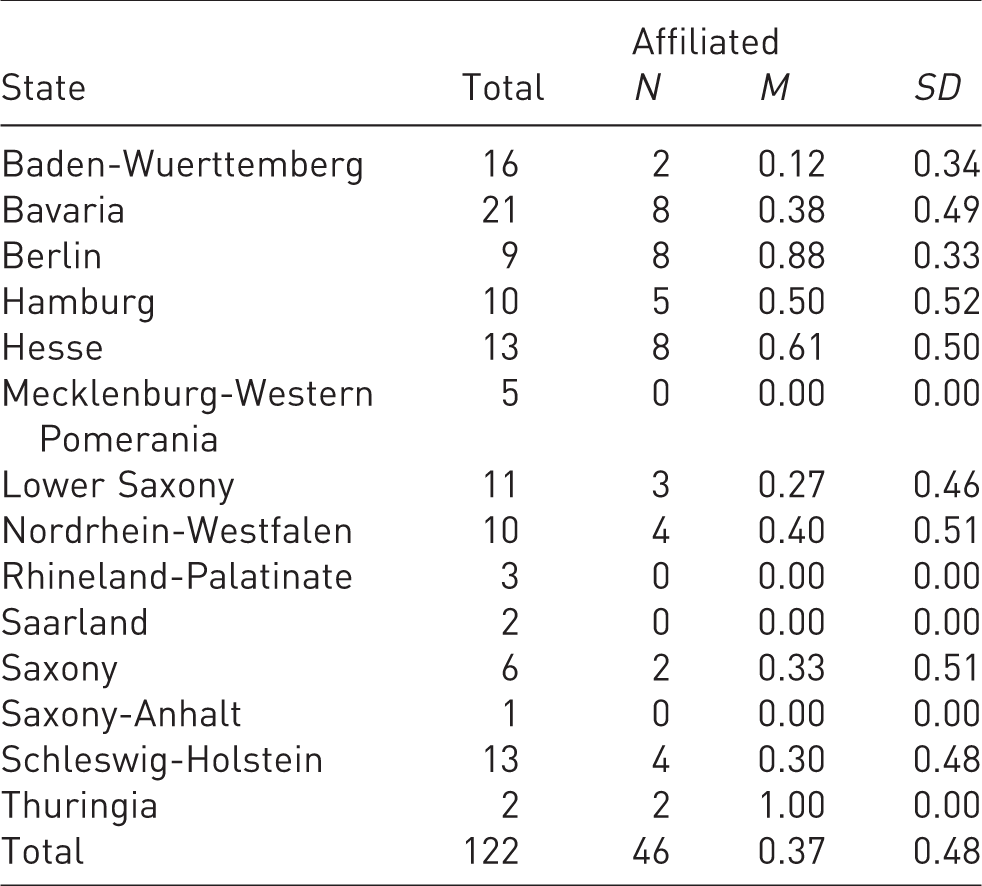
The population of this study includes all the 122 hotels which, according to the German Hotel Classification GmbH (DEHOGA, n.d.), (a) operate in Germany and (b) currently fulfil the criteria of the five-stars category. As Table 1 shows, most hotels in this category are operated without affiliation (n = 76) whereas just 37% of the hotels are affiliated (n = 46). While most observations could be made in the states of Baden-Wuerttemberg and Bavaria, the smallest number of our sample is in Saxony-Anhalt (one hotel). It should also be noted that Thuringia does not have one unaffiliated hotel within the five-star category, whereas Berlin Germany’s capital city represents 88% of the densest concentration of affiliated luxury hotels.
Characteristics of the sample: Affiliated hotels in Germany.
Measures
Sources of measures consist of different secondary data gathered from press releases, journals, and websites, related to our hotel sample. To guarantee causal direction we measured the dependent variable in 2016 and we collected data on independent variables associated with the previous year.
The dependent variable of our research is the AFFILIATION. To measure this variable, we followed the methodology used by Enz et al. (2013). We developed a dummy variable that takes the value of 0 for individually operated (unaffiliated) hotels, and value 1 for hotels which are affiliated by a chain (affiliated).
The choice between these two hotels’ operating forms was based on the analysis of the sample hotels’ websites.
Earlier authors stated that uncertainty and frequency are multidimensional concepts related to various disciplines such as organisational sociology, economics or organisational economics (Shin, 2003). For this reason, we decided to use more than one indicator to assess different dimension of both uncertainty and frequency. We measured the market, economic and social aspects of uncertainty. Following earlier studies (McKercher and Hui, 2004; Tangvitoontham and Sattayanuwat, 2017) to measure the uncertainty of the market we introduce the variable Tourists-Intensity Increase (TII).
The TII was measured as the percentage variation year over year of tourism intensity, which measures the volume of tourism in proportion to the number of city inhabitants or to the overall city area.
This is a measure of the growth of tourists’ flows in the geographical area of the analysed hotel in the last 10 years and data were gathered from the Eurostat database. A low level of uncertainty is thereby assumed to be caused by a high value of TII and vice versa.
Gross domestic product (GDP) growth is an establish measurement to assess the level of uncertainty from an economic point of view (Cornec, 2014; Laurent and Koźluk, 2012; Lindén, 2003). Following Chen and Dimou (2005) and Oaten et al. (2015), we used the variable GDP Increase (GDPI) developed by the Federal Statistical Office (Destatis) in Germany to assess the economic development of the geographical area in which the hotel is based in the last 10 years. We expect a low level of Uncertainty to be caused by a high value of GDPI. Moreover, evidence was found that increased crime has an asymmetric effect on growth depending on the prospects of the economy as reflected in the degree of social uncertainty (Goulas and Zervoyianni, 2012). Although Goulas and Zervoyianni’s study focuses mainly on the determinants of economic growth, it still reveals the relationship between uncertainty and crime. For verification of social uncertainty we, therefore, introduce Number of Offences Increase (NOI), representing the percentage increase in the number of offences registered by the police for each state in the last 10 years, as a proxy variable to our models. Based on Goulas and Zervoyianni’s (2012) results of their study, we assume a low increase in NOI is indicating low social uncertainty.
To measure different dimensions of frequency we used three variables: the size of the owner’s hotel portfolio (NUMBERH), the presence of an affiliated hotel in the owner’s portfolio (SCH), and the owner’s relatedness with the hotel industry (RELATED). We were able to gather this information through the analysis of hotel’s websites. In addition, to test the reliability of the data we collected we managed a set of telephonic interviews with the owners of each hotel included in our sample.
Since the lower risk and the chance to benefit from economies of scale and scope may represent an incentive for creating a broad real estate portfolio (i.e. carrying out frequent hotel-related business transactions) we extend our models by adding a continuous variable measuring the number of hotels an owner/investor holds, to our models (NUMBERH), serving as a proxy to explain frequency (Byrne and Lee, 2001; Miles and McCue, 1984). The broader the portfolio, the more frequent the owner undertakes and negotiates hotel-related transactions, and the higher is the frequency. In this regard, researchers emphasised that real estate portfolios of larger sizes tend to have lower risks than smaller sized portfolios and consequently, the higher the number of hotel real estate properties in the owner’s portfolio, indicating a regular performance of hotel business operations, the lower the risk for the investor/owner. We assume that a high value of NUMBERH means recurring transactions and therefore increase the frequency of the transactions performed by the proprietor.
Additionally, several authors from different fields have examined the importance and determinants of long-term business relationships (Canevello and Crocker, 2010; Dagger et al., 2008; Doma SSBA, 2013; Ellram and Edis, 1996; Harrison, 2004; Ulaga and Eggert, 2005), concluding that frequency directly influences the quality of the relationship. Repeated interactions can thus improve the perception of trust between the trading partners and strengthen reputation effects (Miller, 2008; Williamson, 2002). Having considered the relational aspect is influencing the level of frequency, we enrich our models with an additional binary variable. The variable which identifies if the owners’ portfolio includes hotels affiliated by the same chain (SCH), allows us to draw inferences about how often the owner has signed similar contracts with the same hotel chain. Value 1 of the variable SCH indicates recurring transactions with the same business partner and therefore an increased frequency of operations performed by the owner in the field of hospitality. The last proxy variable for frequency based on theory, confirms that related diversified firms outperform separate ones (Amit and Livnat, 1988; Bettis, 1981; Markides and Williamson, 1994). We assume that those performance advantages can be traced back to a more frequent engagement in industry standard transactions and that owners with a background related to the hotel have certainly undertaken more hotel industry–related transactions than owners for whom the hotel is an entirely unrelated business. As Cheng et al. (2019) stated, hotels play a vital role in the tourism industry and, since the development in tourism and hotels go hand in hand, as they are mutually dependent on each other, the authors stress the attention on the importance of knowing the industry and reconsidering the business strategies to sustain hotels. Due to valuable business networks and already established partnerships, transactions can be realised more easily by owners having industry-specific knowledge. Chen and Dimou (2005) revealed that the international experience of a hotel affiliated influences its entry mode decision. By adding the binary variable, RELATED to our regression model as a proxy to measure frequency we likewise want to figure out if the owner’s relatedness to the hotel business ultimately influences his market/hierarchy decision. The variable thereby identifies the owners’ previous experiences associated with the hotel sector, such as food and beverage, the hotel business or the experiences related to the cruise line industry. We consider that, having a related background, impacts favourably the frequency, with which owners are undertaking hotel business related transactions.
Table 2 summarises the primary explanatory variables, expected signs of the coefficients and the relation to the associated unobserved explanatory constructs.
The tested hypotheses.
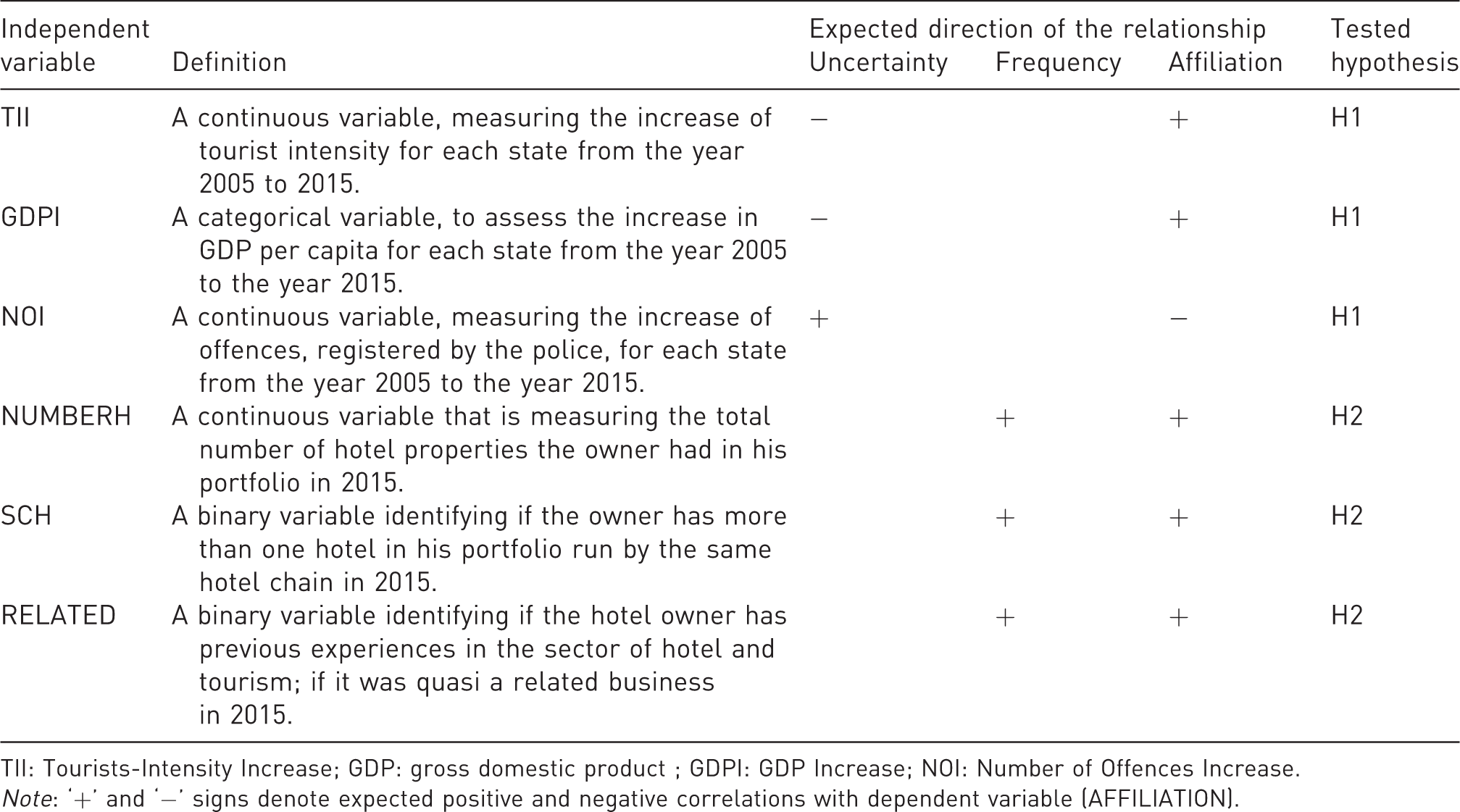
TII: Tourists-Intensity Increase; GDP: gross domestic product ; GDPI: GDP Increase; NOI: Number of Offences Increase.
Note: ‘+’ and ‘−’ signs denote expected positive and negative correlations with dependent variable (AFFILIATION).
Additionally, four control variables were considered, all reachable from the hotels’ website. One refers to the offer the hotel provides to its guests (OFFER). The variable is a product of two variables which identify the hotels offer regarding leisure facilities and above category. Ongori et al. (2013) ascertained that the performance of hotels relies on providing unique quality services. One could assume that a full offer and the award of a superior category already attracts enough guest so that a robust affiliated name which promises high quality based on its reputation, is not necessarily needed. To verify this presumption and to test the influence on owners’ decision to affiliate their property, we introduce the variable OFFER as the first control variable in the models.
The second control variable refers to the location of the hotel (LOCATION), which is composed of the variables ‘the Seaside [0;1], Countryside [0;1], Outskirt [0;1], City [0;1] and takes final values of 0 if the hotel is located in the seaside, 1 if it is a countryside hotel, 2 if it is located in the outskirts of a city and 3 if it is situated in the town’. Previous studies on internationalisation strategies for international hotel firms emphasise the importance of location-specific factors when choosing the appropriate governance model (Chen and Dimou, 2005; Schlup, 2004). It may be that also the hotel owner takes different market/hierarchy decisions based on the location the property is located. Hence, this assumption should be tested, and the effect is controlled by including LOCATION in the regression models.
The third control introduced variable is based on internationalisation literature which emphasises size as being a significant determinate of internationalisation (Chen and Dimou, 2005; Woodside and Martin, 2007). Chen and Dimou (2005) suggest that the bigger the hotel property, the more likely that a hierarchical model will be used for its development. To test if the hotel size is likewise affecting the property owners’ governance decision, we considered the control variable SIZEH. It is the product of two binary variables, which identify if a hotel has a business and a wellness area and by the continuous variable which measures the number of rooms, a hotel offers to its guests. The outcome of the variable SIZEH can be interpreted as follows: the higher the final value, the bigger the hotel.
The variable DISTANCE controls the ultimate effect, measuring if the owner’s place of business is influencing his decision to affiliate the property. Thereby, value 0 of the variable, indicates that the owner’s home or business is located abroad, whereas value 1 stands for a location in Germany. Previous studies reveal that the distance influences the expansion strategies of international hotel firms to the place where most of the other properties are located. Accordingly, firms tend to choose a lower control mode when the property is developed in a country where the brand has most of its operations (Chen and Dimou, 2005). Repetitively, these results are best applied to studies aiming to investigate the internationalisation of hotel firms. Nevertheless, it leads to the assumption that the physical distance of the owner to his property might play a role in deciding to whether affiliate his property or not. Consequently, the effect of DISTANCE is likewise controlled.
Analysis and results
To test our hypotheses, we applied four binary logistic regression models specified in Table 3.
Regression models’ details.
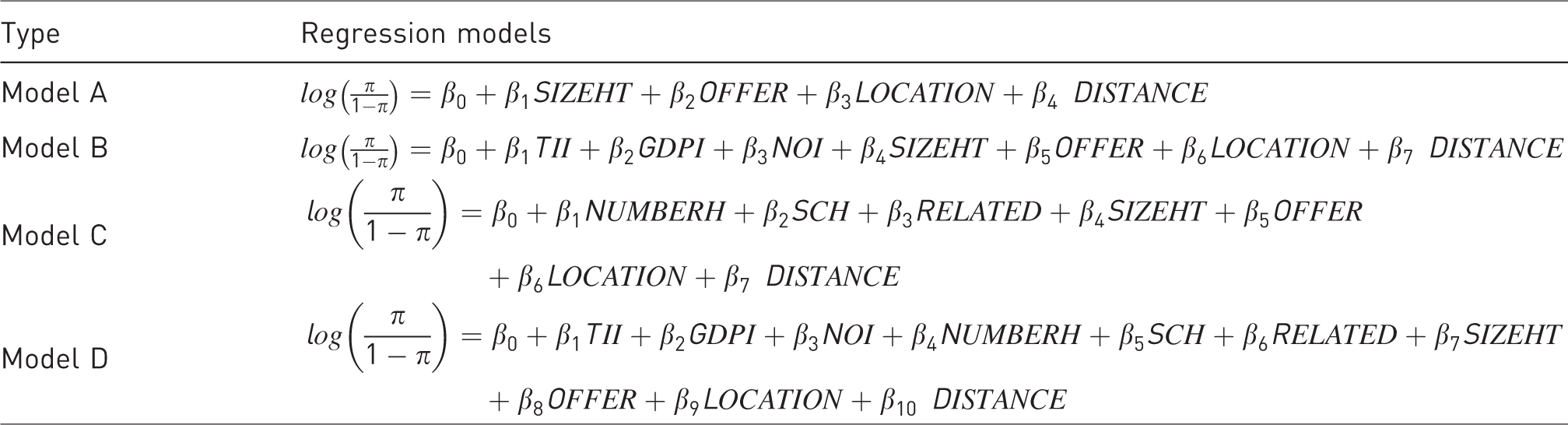
Model A is a control model that represents the baseline of our analysis, including control variables only. Model B consists of three independent proxy variables, aiming to identify the relevance of uncertainty to predict the dependent variable and control variables to avoid biased results. Model C includes independent variables measuring the effect of frequency on the owner’s choice of governance, and likewise control variables to prevent biasing the results. The final regression model (Model D) consists of all explanatory variables, including the four control variables.
Table 4 presents descriptive statistics and correlations for all variables used in the regression analysis. The statistics reveal that 37% of the hotels are affiliated, which implies that the owners chose ‘market’ as the preferred governance model and assigned a hotel chain to take on the operational control over hotel property. The owners, for whom 48% hotel is a related business, hold on average five hotels. However, only 4% of them have hotels affiliated with and managed by the same chain. The 122 hotels included in our sample have, on average, 130 rooms, and in 92% of the cases, the owner operates from domestic offices.
Descriptive statistics and correlations.
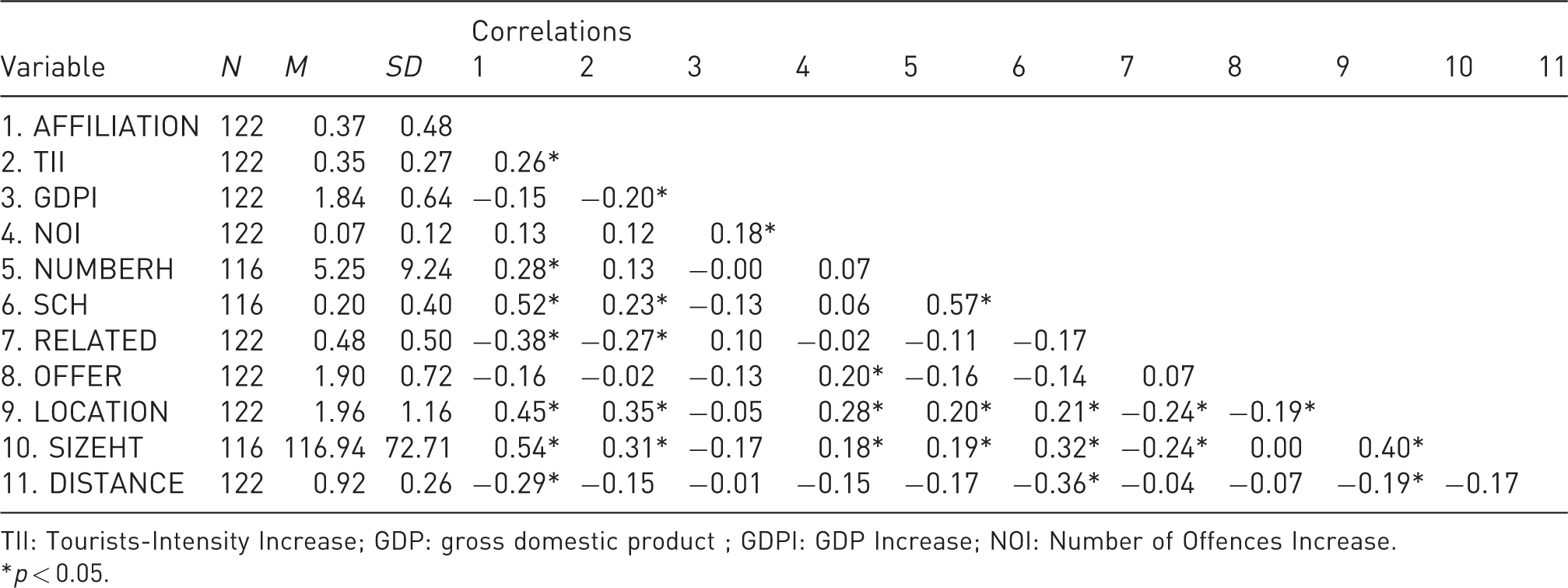
TII: Tourists-Intensity Increase; GDP: gross domestic product ; GDPI: GDP Increase; NOI: Number of Offences Increase.
*p < 0.05.
Analysing the standard deviation, to measure the variability (Isotalo, 2014: 34; Kerns, 2010: 38), it is conspicuous that the variables SIZEH and NUMBERH (σ = 9.24932) exhibit the highest standard deviations of the sample. On closer inspection, it is striking that the variable SIZEH has an extensive range in which we must expect outliers. Tukey (1977) introduced the box plot as a graphical display on which outliers can be indicated. The boxplot and the histogram of the variable SIZEH confirm us that some outliers exist. Using the standard deviation–based rule to trim data; according to a commonly used method to eliminate outliers (Field, 2013; Grafarend, 2006; Kazmier, 2009; Turkiewicz, 2017), we reduce the effects of the tails of the SIZEH distribution by neglecting all observations, which do not lie within the range of [μ − 2σ; μ + 2σ]. By implication, a decrease in the number of observations from 122 to 116 was not avoidable. To ensure that the trimming does not affect the overall assertion of the variable, the regression analysis of both – the trimmed and untrimmed – variables are compared one with another. The results show that the trim causes an increase in observations in three models and an improved pseudo R2-value for all four regression models. Hence, the elimination of the outliers is legitimated by the fact that the variable remains significant even after trimming.
The correlation of the variables, likewise reported in Table 4, show that the independent variables SIZEHT, SCH and LOCATION are positively moderated and significantly associated with the dependent variable AFFILIATION. The variables RELATED and DISTANCE also indicate significance but are instead weak negatively correlated with AFFILIATION. All of it was to be expected and consistent with prior research (Chen and Dimou, 2005). Surprisingly is, however, that AFFILIATION and NUMBERH, as well as AFFILIATION and TII, display indeed a significant, but only weak, positive linear relationship.
Having analysed the correlations among the independent variables, it should be noted that SCH, as expected, displays a positive correlation to NUMBERH. A weak negative linear relationship can be reported between SCH and DISTANCE. This relationship indicates that that owner with a foreign place of business tends to have more than one hotel run by the same chain; this meets our expectations. A positive correlation between TII and LOCATION seems reasonable and meets our expectations and findings of prior research (Nolan, 2004) likewise. As multicollinearity is a central problem in regression models, the correlation coefficients are the first indication of a relationship between two variables (Albers, 2009). No correlation coefficient exceeds 0.8, which is considered as a classic symptom of the harmfulness of multicollinearity (Gujarati and Porter, 2008; Kennedy, 2008; Maddala and Lahiri, 2009). The variance inflation factors (VIF) are moreover examined for each independent variable to preclude that multicollinearity biases the data. Stevens (2002) identified VIF-values greater than ten as indicative of multicollinearity and in all models no multicollinearity emerged.
To identify the model that best fits our data a procedure of hierarchical regression was employed. This commonly used form of multiple regression allows for building successive regression models, each adding more predictors based on theoretically grounded decisions (Petrocelli, 2003; Wampold and Freund, 1987). Table 5 provides the result of this analysis.
Multiple regression analysis’ findings.
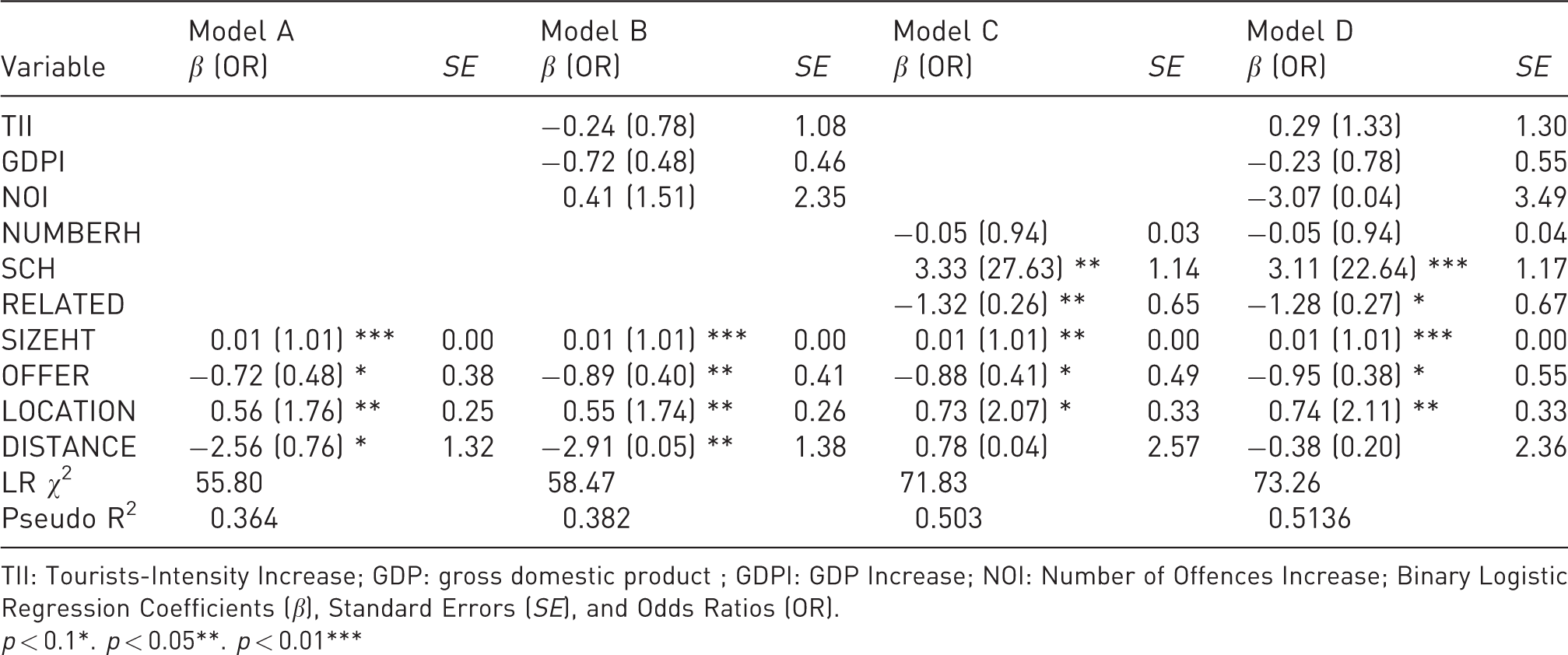
TII: Tourists-Intensity Increase; GDP: gross domestic product ; GDPI: GDP Increase; NOI: Number of Offences Increase; Binary Logistic Regression Coefficients (β), Standard Errors (SE), and Odds Ratios (OR).
p < 0.1*. p < 0.05**. p < 0.01***
Model A is the base of our analysis and includes control variables only, namely variables identifying the hotel's location, size, and offer as well as if the owner’s place of business is in Germany. The model shows that the coefficients of all control variables are statistically significant. The next regression model analysed (Model B) consists of three independent variables and aims to identify the relevance of uncertainty to predict the dependent variable AFFILIATION. The regression results do not show evidence of a relationship between the independent and the dependent variables considering the control variables, which were all found to be statistically significant. However, adding the three proxy variables for uncertainty, the model fit improved with pseudo R2 = 0.382. Model C, which displays a renewed improvement of model fit (R2 = 0.503) includes additional proxy variables, to measure the effect of frequency on the owner’s decision to affiliate his property. Here as well, the control variables have been included to avoid biased results. The regression results reveal that two independent variables influence the owner’s governance decision significantly. The variable SCH (β = 3.33, p < 0.05**) demonstrates a positive and statistically significant relationship to the dependent variable, whereas the variable RELATED (β = −1.32, p < 0.05**) exhibits a statistically significant but negative correlation to AFFILIATION. The decrease in some observations is explained by missing values of the variables NUMBERH and SCH, which mainly concern data of hotels owned by institutional investors, who do not provide detailed information about their hotel property portfolio.
Model D consists of all explanatory variables, including control variables to avoid biased results. It is the regression model that best fits the data (Pseudo R2 = 0. 5136; LR-χ2 = 73.26). Equally to the regression results of the previous models, the coefficient of the variables TII, GDPI and NOI do not show any statistical significance, suggesting that uncertainty does not affect the hotel owner’s governance decisions. This result is opposite to what is indicated by Hypothesis 1.
Two of the three coefficients of the variables associated with the unobserved explanatory constructs frequency, turn out to be statistically significant. Accordingly, the variable SCH is positively related to the dependent variable AFFILIATION and highly statistically significant (β = 3.11, p < 0.01***). The coefficient of the variable RELATED is also statistically significant but negatively correlated with the dependent variable (β = −1.28, p < 0.1*). The ratio of NUMBERH shows a negative relation to the dependent variable but is not statistically significant. Thus, frequency influences the owner’s governance decision in so far that, the probability of affiliating is 22.64 times higher than non-affiliating when the owners hold hotels run by the same hotel chain. Nevertheless, the result of the variable RELATED contradicts the hypotheses that affiliation is more likely when hotel owners can look back on experiences related to the hotel business. Consequently, the results only provide partial support for Hypothesis 2.
The control variables SIZEH and LOCATION seem to have a positive effect on the decision to affiliate the hotel property, suggesting that a significant size and urban locations increase the probability of market governance choices. The negative statistically significant coefficient of the variable OFFER indicates that the lower the supply of the hotel, the higher the likelihood of affiliating. The variable DISTANCE turns out to not be significant in the final regression model, which implies that the owner’s place of business does influence his decision of governance.
Discussion and conclusion
The goal of this research was to gain an understanding of determinants related to the hotel owners’ governance decision in the hotel luxury industry. More precisely, this study examined factors influencing the property owners’ market/hierarchy decision on affiliation to an existing chain and thereby contributes importantly to the current literature by applying a theoretical framework grounded in TCT. The results indicate that uncertainty does not influence hotel owners’ market/hierarchy decision, while the hypothesis, that frequency favours affiliation, found out to be partially true. An overview of the results can be consulted in Table 6.
Results of hypotheses tests.
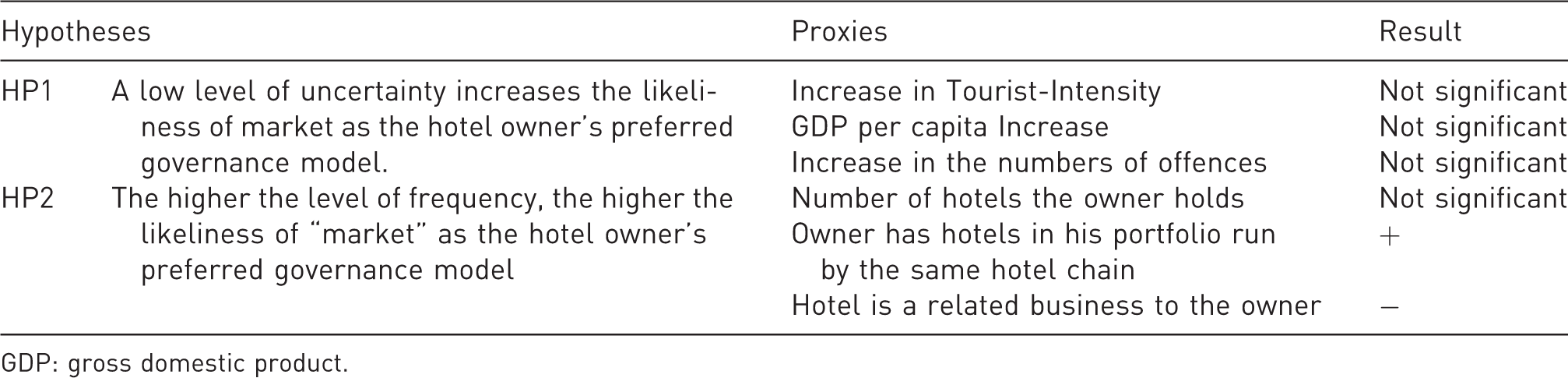
GDP: gross domestic product.
It is surprising that neither an increase in tourist intensity nor GDP per capita for an increase in crime appears to have an influencing effect on the owners’ decision to assign a hotel chain to take on the operational control over the property. It may be that the German economy, which is viewed as being stable and safe at a time of wider European political and economic uncertainty, generally radiates low levels of uncertainty. Germany, perceived as a safe harbor for investors, by offering consistently high levels of liquidity and strong market fundamentals (Raimundo et al., 2016; Watson Farley & Williams, 2016), might therefore increase owners’ trust and thus lead them to not take uncertainty into considerations when deciding on either affiliate or not affiliate their property. Although many researchers have proven that doubt does influence foreign market entry strategies of international hotel firms (Jell-Ojobor and Windsperger, 2014; Shin, 2003; Zamborsky and Kruesi, 2016), the results of this study reveal that uncertainty does not affect the governance decision of hotel property owner.
Our research, surprisingly, pointed out that the total number of hotels an owner holds does not affect his market/hierarchy decision. It might suggest that each decision is looked at in isolation and that the owner tries to base his/her choice on dominant rational factors only. However, the likeliness of affiliation increases substantially if the owner is in possession of more than one property affiliated with a large hotel chain. The initial rational decision is now also influenced by previous experiences and good cooperation with former business partners. Reduced search costs, the possibility to reuse already existing contracts, and the chance to benefit from trustful relationships, seem to increase the owners’ willingness to partner up with a hotel chain, rather than operating his property individually. It also appears that owners, less equipped with hotel experience, tend much more to affiliate their property than keeping it unaffiliated. This result, at first sight, seems surprising considering that we expected relatedness being a proxy for frequency increases the likeliness of affiliating. However, a closer look reveals the sense behind it. TCT suggests activities conducted frequently tend to be performed in-house due to efficient internal production. But not having any experiences in undertaking such activities yet, one is dependent on help from outside, the market. The same logic can be applied to new hotel owners who have not established any competencies in the field of hotel thus far. For those owners, assigning a hotel chain which then takes on the operational control over the hotel property seems to be the best and most efficient solution.
Although the results of this study only provide partial support for Hypothesis 2, claiming that frequency increases the probability of affiliating, it still supplements existing literature on make-or-buy decision, especially in the field of hospitality, which neither has considered the perspective of hotel owners yet, nor were the majority able to found statistical evidence of the postulated relationships between transaction frequency and hierarchical governance (Plunket et al., 2001). This study, however, has shown that TCT can only partially explain the factors influencing the market/hierarchy decisions of hotel property owners within the hotel luxury market.
The results of this study furthermore reveal that hotel size and urban locations increase the probability of affiliation. This result exposes differences between the governance choices of expanding hotel firms and the market/hierarchy decisions of hotel property owners. While bigger sized hotels lead international hotel firms to choose the hierarchy model, hotel property owners prefer market governance instead. Not surprising and consistent with our assumptions is the result that the likeliness of affiliating increases the offer’s smallness the hotel provides to its guests. The results indicate that the owners of hotels, providing a broad spectrum of leisure facilities and the award of a superior category, do not feel the need to be supported by strong affiliations which promise high quality based on their reputation. This result supports the assumption of Ongori et al. (2013) emphasising that the competitive advantage of most hotels rely on offering unique quality services. It has moreover found that the location of the owner’s place of business does not play a role in his decision to affiliate or not affiliate a hotel.
The findings of this study, however, offer new insights into the market/hierarchy decision of hotel owners and provide further support to our current knowledge on governance model choices in the hotel sector. By pointing out the differences in the development strategies of hotel owners and large hotel chains by applying TCT as a theoretical foundation, this study shows how meticulously the two perspectives (owner and hotel firm) need to be distinguished from one another.
Besides new empirical insights, this research also provides managerial implications and offers practical recommendations for action. By knowing which factors are influencing owners’ decision to affiliate a property, hotel chains can address real estate owners and investors optimally and offer customised solutions to take on the operational control over the property. Also, this study reveals common practices and provides valuable insights into the hotel and tourism sector and allows investment management companies and consulting firms to offer profound advisory services for institutional as well as for private investors.
The study incorporates logic from the TCT to implicate governance decisions. Despite providing some support for this rationale, one crucial transaction dimension remained disregarded when examining factors influencing hotel owners’ market/hierarchy decision. Future studies should, therefore, augment the analysis by focusing on asset specificity as another potential factor influencing that decision. As stated previously not all determinants derived from TCT proved to be sufficient to contribute to the explanation which factors influenced hotel owners’ market/hierarchy decisions.
More research, both regarding theory development and concept validation will, in fact, be necessary to refine and further elaborate our novel findings. Apart from considering several other factors not included in this model, we furthermore suggest examining potential differences in the decision making between institutional and private real estate investors/owners. An expansion of the sample size, including hotels from more than one country and within different hotel star categories is moreover required to verify the application of the Germany hotel market as an important benchmark for the European hotel and real estate market (McKercher and Hui, 2004; Tangvitoontham and Sattayanuwat, 2017).
Footnotes
Declaration of Conflicting Interests
The author(s) declared no potential conflicts of interest with respect to the research, authorship, and/or publication of this article.
Funding
The author(s) received no financial support for the research, authorship, and/or publication of this article.
Author Biographies
 , the Postgraduate School of Business and Society at the same university, an international research and education centre for the study and promotion of a responsible and competitive business culture. He is involved in research projects on corporate social responsibility, social entrepreneurship, sustainability reporting and strategic management.