




Abstract
Job satisfaction is a key concept in the organizational literature, as satisfied employees allow organizations to achieve desired work-related outcomes. Nevertheless, more research is needed to understand what organizational and individual variables shape the job satisfaction of employees from the hospitality sector. This study assesses the role of organizational variables (perceived organizational support and organizational health) and individual variables (positive psychological capital and creative personality) as possible determinants of job satisfaction. A total of 504 hotel employees from the Algarve region, the main Portuguese tourism destination, participated in this study. Structural equation modeling with latent variables was used to evaluate the proposed model. Results showed that perceived organizational support was the most important predictor of job satisfaction, followed by organizational health. Organizational health also predicted positive psychological capital, which, in turn, was significantly associated with job satisfaction. These results have important practical implications for human resources management in the hospitality industry.
Keywords
Introduction
Job satisfaction is a widely addressed construct in the organizational literature, especially if we consider that human beings spend a considerable amount of their day at the workplace (Hantula, 2015; Kong et al., 2018). This construct, the most important job attitude, can be defined as “an evaluative state that expresses contentment with, and positive feelings about, one’s job” (Judge and Kammeyer-Mueller, 2012, p.347). This definition, adopted in the present study, combines two components, cognitive and affective. Other conceptual definitions and measures have neglected the importance of the affective component, emphasizing solely the role of cognitive processes in satisfaction (Judge and Cl Dalal, 2011). However, an employee evaluates if he/she is satisfied with his/her job (cognitive component) and, depending on this evaluation, he/she will develop a set of affects, positive or negative, about it (affective component). Accordingly, these two components of job satisfaction must be jointly considered.
Overall, satisfied workers are an added-value for their organizations, reporting increased physical and psychological health (Hantula, 2015; Judge and Kammeyer-Mueller, 2012). In the hospitality literature, this concept is also of great importance (Appiah, 2019; Kong et al., 2018). Dissatisfied hotel employees provide a low-quality service, which may negatively influence the business unit performance (e.g. decrease in the number of costumers and negative word of mouth; Li et al., 2017; McPhail et al., 2015). Furthermore, hospitality workers who are not satisfied present decreased morale and high turnover rates (Meng and Han, 2014). Therefore, hotel managers must guarantee that their workforce is satisfied, which will bring benefits for employees and hotels, as well as for the economic development of a country and/or region.
Given the central role of this concept in the organizational context, it is important to understand how it can be fostered (Daskin, 2019). For example, it may be useful to explore some of the antecedents, individual and organizational, of job satisfaction. The literature on the antecedents of this construct, in the general working population, is diversified. Previous studies (e.g. Judge and Bono, 2001; Judge and Kammeyer-Mueller, 2012; Judge et al., 2000) demonstrated that individual factors, as well as aspects from the social environment of organizations, and organizational practices, are among the most studied topics. In addition, past meta-analyses and literature reviews (e.g. Avey et al., 2011; Liu et al., 2016; Newman et al., 2014; Riggle et al., 2009) showed that satisfaction can be predicted by individual resources and organizational-related concepts. Despite the bulk of research, the empirical evidence on the antecedents of satisfaction in hospitality is still reduced, thus it is relevant to assess the predictors of this construct in this context. To conduct this study, some antecedents of job satisfaction were considered, namely organizational health, perceived organizational support, positive psychological capital and creativity.
A study performed with Portuguese employees from the public sector demonstrated that two organizational health indicators, one internal (referring to the organization itself) and another external (referring to the environment where the organization is integrated), were positively and significantly related with the satisfaction that employees felt with their occupation, organization, and tasks performed (Viseu et al., 2015). Organizational health is an organizational-related variable aimed at understanding, from the point of view of employees, how effectively an organization performs. In terms of the social context of organizations, the role of perceived organizational support, which is based on the assumptions of social exchange and reciprocity, must be underlined. When a worker feels that an organization is concerned about his/her well-being and that there is an appreciation about his/her contributions and suggestions, the worker will act reciprocally, e.g. by helping the organization to achieve its goals (Stinglhamber et al., 2020). Moreover, the literature review of Newman et al. (2014), with the objective of analysing the developed research on positive psychological capital (PsyCap), observed that this construct promotes desirable job attitudes. Thus, individuals with high PsyCap will feel more confident, optimistic, hopeful, and resilient. As such, they will put more effort in the tasks performed, resulting in increased job satisfaction. Moreover, creative employees, e.g. those who seek novel solutions for work-related problems and procedures, present more positive affects at work, i.e. job satisfaction (Kim et al., 2009; Tavares, 2016). These arguments suggest that satisfaction is better perceived if individual and organizational-related variables are simultaneously considered.
Some of these concepts and the relationships established between them have also been studied in the context of tourism and hospitality, namely in terms of the occupational well-being of hotel employees (e.g. Akgunduz et al., 2018a; Karatepe and Karadas, 2015; Paek et al., 2015). Akgunduz et al. (2018a) underlined that perceived organizational support and proactive personality predicted creativity in a sample of Turkish hospitality employees. In turn, Karatepe and Karadas (2015) and Paek et al. (2015) observed that PsyCap promotes job satisfaction, work engagement, and workforce morale. These studies addressed some of the concepts mentioned earlier, namely perceived organizational support, PsyCap, creativity, and job satisfaction. However, they did not consider the role of organizational health, one aspect that underlines the relevance and innovative character of this study.
The main objective of this research is to understand what factors contribute to the job satisfaction of Portuguese hotel employees from the Algarve, the most important tourism destination in Portugal (Turismo de Portugal, 2018). Over the last years, the tourism indicators of the Algarve (e.g. overnight stays) have been higher than the Portuguese average. For example, in 2018, the Algarve registered the highest rate of overnight stays (30.2%) comparatively to Lisbon (25.9%) and the North of Portugal (14.5%; Statistics Portugal, 2019). In addition, there has been an increase in the business volume, directly or indirectly, related to tourism in this region (Statistics Portugal, 2019). According to Andraz et al. (2015), tourism in the Algarve contributes significantly to the regional economic development, being only surpassed by Lisbon. However, this situation only occurs because Lisbon is the Portuguese region with greater economic activity, not being a mature tourism destination, like the Algarve (Andraz et al., 2015). The empirical evidence has also showed that the Algarve is a studied destination regarding tourists’ experiences, satisfaction, and loyalty (e.g. Agapito et al., 2017). Other studies observed how tourism is affecting the residents of this region (e.g. Vargas-Sánchez et al., 2015). However, as far as we could identify, there are no studies about employees in the tourism industry, particularly regarding their job satisfaction. Thus, this study will overcome an important research gap in an important mature destination, which can potentiate further research in other similar contexts. Specifically, the theoretical model proposed assesses how individual characteristics (PsyCap and creative personality) and organizational-related variables (perceived organizational support and organizational health) predict the job satisfaction of hotel employees from the Algarve. Considering the relevance of this construct to hospitality, it is important to identify the weight that each of these determinants have on workers’ satisfaction in order to develop a set of proposals to promote it, benefiting employees, hotels (e.g. increased customer satisfaction), and the country/regional economy (e.g. higher gross domestic product).
Literature review
Job satisfaction: Definition, measurement, and importance
Job satisfaction is the most important job attitude and one of the main research topics in the organizational literature (Akgunduz et al., 2018b). This construct relies on an assessment that an individual performs regarding the tasks accomplished, work conditions, and work environment (Judge and Kammeyer-Mueller, 2012). If the individual evaluates these aspects positively, then he/she will be satisfied with his/her job. However, if the result of this evaluation is negative, the worker will be dissatisfied. Therefore, we can affirm that this concept has two components, cognitive and affective (Judge and Kammeyer-Mueller, 2012). The cognitive component is related with the assessment of work-related aspects (e.g. tasks, conditions, and environment) and the affective component refers to the affects that emerge from this assessment, positive (i.e. employees are satisfied with their job) or negative (i.e. employees are dissatisfied with their job; Judge and Kammeyer-Mueller, 2012). Also, the analysis of one’s satisfaction is an individual process. For example, two individuals may perform the same tasks, have the same work conditions, and share the same work context; however, one of them may be satisfied and the other may be dissatisfied (Brown et al., 2012). Another question regarding job satisfaction is how this construct is measured. According to Judge and Kammeyer-Mueller (2012), there are two ways of assessing it: unidimensional (i.e. job satisfaction is perceived holistically) or multidimensional (e.g. satisfaction with promotion prospects, colleagues, and/or with benefits). In the literature, the unidimensional perspective has gained more relevance, especially because the multidimensional framework is associated with the momentum. At a given moment, a worker may be dissatisfied with the benefits package, but at a later moment, the same worker may reach a satisfaction level (Judge and Kammeyer-Mueller, 2012; Judge and Bono, 2001; Judge et al., 2000).
Organizations must be interested in fostering the job satisfaction of their employees, since satisfied workers are more engaged and committed, have increased physical and psychological health, and present lower absenteeism and turnover intention rates (Hantula, 2015; Southgate and Mondo, 2017). Despite the importance of its outcomes, it is essential to understand the individual and organizational-related mechanisms that allow the achievement of a satisfied workforce (Daskin, 2019).
Organizational variables as predictors of job satisfaction
This study considers two organizational variables, perceived organizational support and organizational health, as predictors of job satisfaction. Perceived organizational support refers to the employees’ perceptions of the importance that an organization confers to their contributions and is concerned with their well-being (Eisenberger et al., 1986; Riggle et al., 2009). In a meta-analysis, Riggle et al. (2009) observed that perceived organizational support was positively and significantly associated with job satisfaction. The review of Park et al. (2019) underlined that this concept plays a crucial role for hospitality employees. For example, Cheng and O-Yang (2018), in a study conducted with Taiwanese frontline hotel employees, observed that perceived organizational support was positively related with job satisfaction. The same study showed that this construct moderated the association between an ill-being indicator (burnout) and job satisfaction (Cheng and O-Yang, 2018). According to Eisenberger et al. (1986) and Stinglhamber et al. (2020), perceived organizational support is based on principles of social exchange and reciprocity. In the case of hospitality, an employee who perceives that there is a concern with his/her well-being and that there is an openness by management to analyze his/her contributions and/or suggestions to improve the operation of the hotel unit, will present increased job satisfaction and other desired work-related outcomes (Park et al., 2019). In addition, when an employee perceives that the relationship with the hotel is positive, he/she will feel obligated to help the organization to achieve its goals. Finally, the association between employee–hotel unit will contribute to the development of a sense of belonging. Taking these aspects into account, it is critical to understand how hotel units and their managers can improve perceived organizational support (e.g. what human resources management practices or procedures could be implemented) to promote job satisfaction. Thus, the following hypothesis is proposed:
Individual variables as predictors of job satisfaction
This study considers two individual variables, PsyCap and creative personality, as predictors of job satisfaction. PsyCap is a construct from the positive organizational behavior framework and is composed by four dimensions, self-efficacy (i.e. have confidence to achieve the proposed objectives), hope (i.e. try to attain the proposed goals and, if necessary, develop alternative strategies to accomplish them), optimism (i.e. make positive attributions about the present and future), and resilience (i.e. ability to resist the adversities that emerge at the workplace and overcome them; Youssef-Morgan and Luthans, 2015). Two characteristics of this construct must be highlighted. The first is that PsyCap possesses a state-like nature, i.e. it can be developed through training programs. The second is that it promotes desirable job attitudes and behaviors, decreases the impact of undesirable job attitudes and behaviors, and positively influences job performance (Luthans et al., 2015). For example, PsyCap promotes organizational health, job satisfaction, work engagement, organizational commitment, employee creativity, organizational citizenship behaviors, and job performance and decreases distress, depression, burnout, absenteeism, and turnover (Avey, 2014; Viseu et al., 2015). These aspects make this construct an added-value for organizations (Avey et al., 2011; Newman et al., 2014; Youssef-Morgan and Luthans, 2015).
The relationship between organizational health and PsyCap has already been addressed in the general working population. Viseu et al. (2015), in a study with public sector employees, showed that a healthy organization reinforces the positive psychological resources of employees. As such, workers who perceive that their organization is performing well on the internal and external dimensions will (a) be more confident about their skills, (b) develop a positive perspective regarding the present and future, (c) create paths for goal-achievement, and (d) be prepared to face adverse situations when they arise. So, the following hypothesis is proposed:
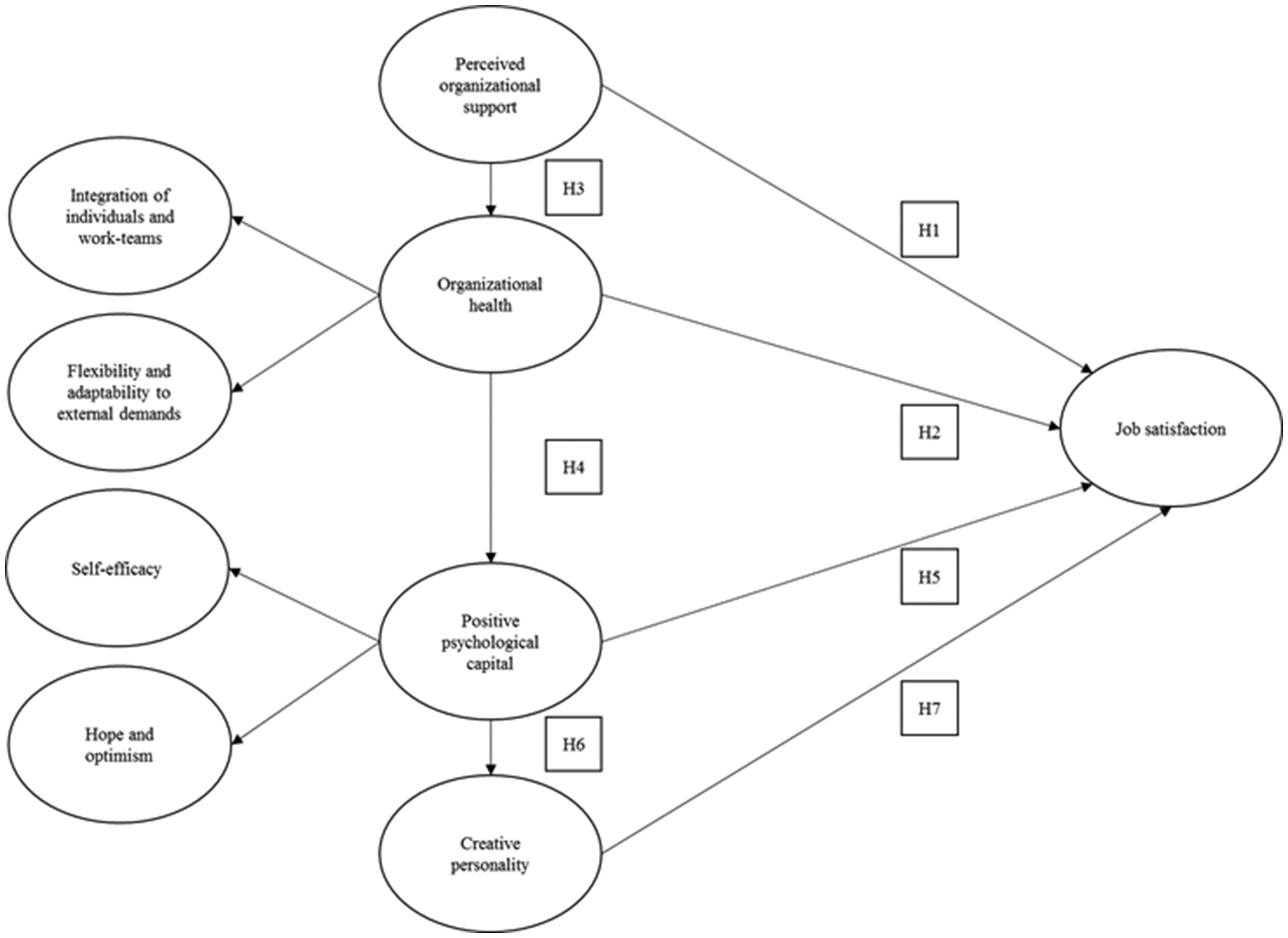
Theoretical model proposed.
Research methodology
Data collection and analysis
Hotel directors from the Algarve region (Portugal) were contacted in order to understand if they were available to participate in this study. In total, 40 hotel establishments were contacted, and from these, 18 participated in this study (8 four-star hotels and 10 five-star hotels). Each hotel that accepted to participate in the study received as many questionnaires as the number of employees. The hotel directors were asked to explain the objectives of the study in a staff meeting and distribute the questionnaires to the heads of department who would hand them over to the corresponding employees. The questionnaires were accompanied by a blank envelope where they should be placed after completion. Data were collected from February to May 2014. Before completing the questionnaire, participants were asked to read and sign an informed consent statement, which guaranteed the complete confidentiality and anonymity of the collected data. Furthermore, respondents were informed that they could withdraw their participation at any time and that there were no rewards for participating, monetary, or otherwise. Of the 1675 paper-and-pencil questionnaires distributed, 567 were returned (33.85% response rate). After a thorough analysis, 504 questionnaires were considered valid.
Firstly, this study used SPSS 24.0 to describe the collected data and test the potential existence of common method bias (CMB). Accordingly, the Harman’s (1967) single-factor test was implemented, following the procedure proposed by Roni (2014). This procedure implies running an exploratory factor analysis with all items loaded on a single factor. A total explained variance inferior to 50% means that CMB is not prejudicing the data set. Then, structural equation modeling (SEM) analysis was implemented with AMOS 18.0 to test the proposed conceptual model and hypotheses. Simulation studies showed that the most applied estimation method in SEM, the maximum likelihood method, produces biased estimates when data significantly departures from a multivariate normal distribution. This occurs when skewness and kurtosis coefficients are higher than 2 and 7, respectively (Finnley and DiStefano, 2006). In our study, we verified that all items presented absolute values for skewness and kurtosis inferior to 1.2 and 1.9, respectively. Before testing the hypotheses, an overall evaluation of the model was performed. Then, the measurement and structural models were individually assessed.
Measures
Job satisfaction was assessed by the Job Satisfaction Scale (Lima et al., 1995) composed by eight items (e.g. Satisfaction regarding promotion prospects) measured in a seven-point Likert-scale (1 – Extremely dissatisfied; 7 – Extremely satisfied). Organizational support was analyzed by the Portuguese version (Santos and Gonçalves, 2010) of the Perceived Organizational Support Scale of Eisenberger et al. (1986). This scale has eight items (e.g. the organization values my contribution to its well-being), measured with a seven-point Likert-scale (1 – Totally disagree; 7 – Totally agree). Organizational health was assessed by the Portuguese version of the Organizational Health Perception Scale (Gomide Júnior and Fernandes, 2008; Jesus et al., 2016). This scale has 26 items (e.g. Individuals are aware of the goals that the organization aims to achieve) measured with a five-point Likert-scale (1 – Totally disagree; 5 – Totally agree). Organizational health is considered a multidimensional latent trait, comprising the dimensions “integration of individuals and work-teams” (18 items) and “flexibility and adaptability to external demands” (eight items).
PsyCap was analyzed by the Portuguese version of the Psychological Capital Questionnaire-12 (Luthans et al., 2007; Viseu et al., 2012). This scale presents 12 items (e.g. I feel confident in representing my work area in meetings with management) measured with a six-point Likert-scale (1 – Totally disagree; 6 – Totally agree). PsyCap is a multidimensional latent trait, aggregating four dimensions, self-efficacy (three items), hope (four items), resilience (three items), and optimism (two items). For the use of this measure, authorization was requested to the organization who owns its copyright (www.mindgarden.com). Creative personality was evaluated by the Creative Personality Scale (Garcês et al., 2015). This scale has 30 items (e.g. I like to perfect my ideas until they are well defined) measured with a five-point Likert-scale (1 – Totally disagree; 5 – Totally agree).
In this study, only Portuguese-language instruments were used. When the original instruments were in English, the authors used the validations studies of those instruments for Portuguese working samples (e.g. Santos and Gonçalves, 2010; Viseu et al., 2012). Past studies using the measures mentioned above demonstrated that they possess good psychometric qualities in terms of validity and reliability. Questions regarding socio-demographic attributes were also included in the survey questionnaire (gender, age, educational background, professional occupation, and job tenure).
Our model was firstly estimated with all items from the scales. Then, some items needed to be deleted in order to achieve acceptable levels of reliability and validity. Table 1 contains the final set of items used to measure the latent constructs of the proposed model.
Results for the measurement model.
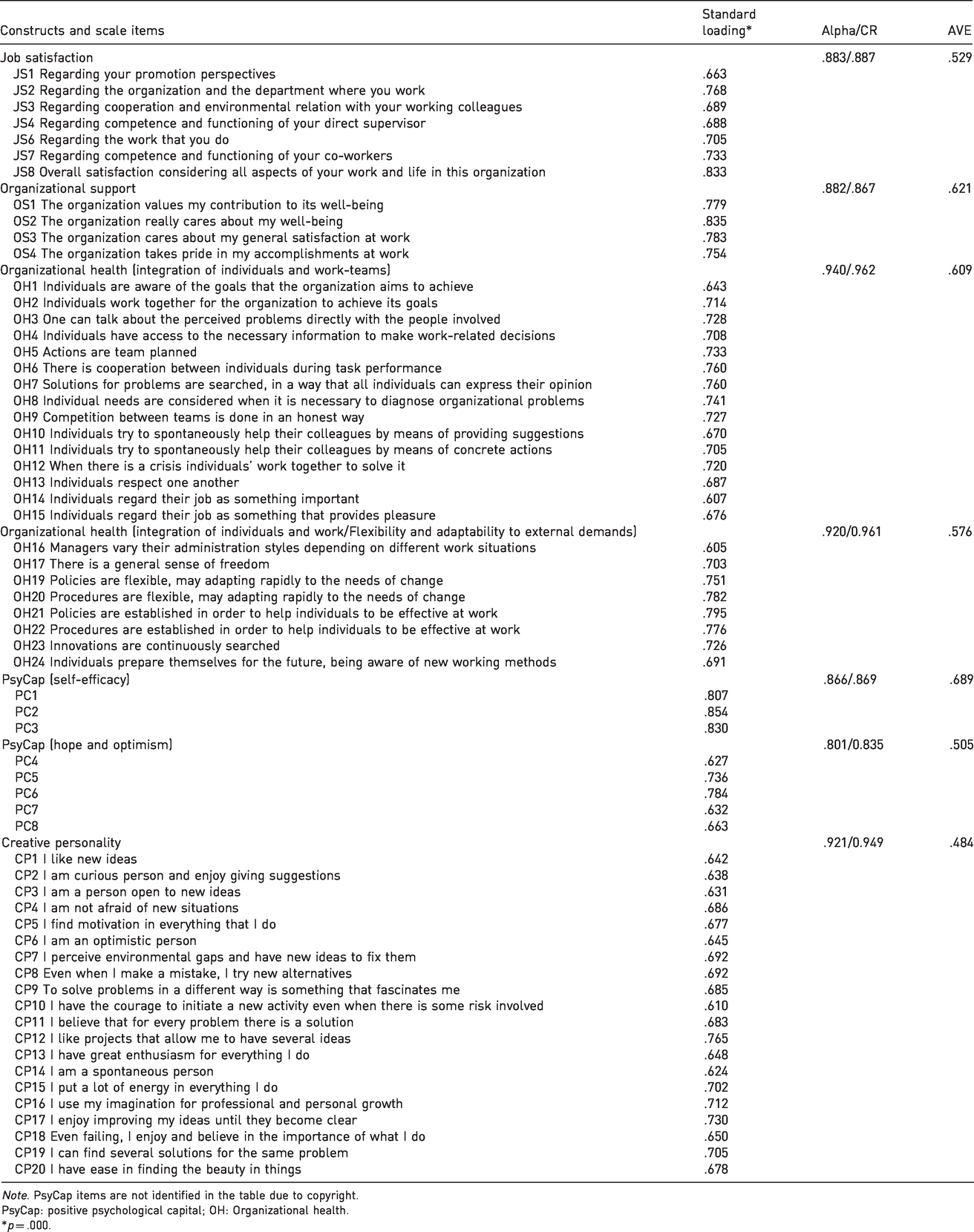
Note. PsyCap items are not identified in the table due to copyright.
PsyCap: positive psychological capital; OH: Organizational health.
*p = .000.
Results
Participants’ characteristics
A total of 504 hotel employees from the Algarve (Portugal) participated in this study, 50% were males and 50% females. The age of the participants varied from 16 to 69 years old (M = 39.48; SD = 11.98). The age group with the largest number of workers was between 36–45 years old (27.8%), and the age group with the lowest number of workers was between 66–70 years old (6%). Regarding the educational background, 12.5% had the basic education (fourth grade), 26.2% of the respondents had the ninth grade, 36.5% the twelfth grade, and 19.4% had a college degree. The participants’ average job tenure was 11.13 years (SD = 11.20). Lastly, the professional occupations with more representation were waiters (7.1%), cleaning personnel (8.1%), kitchen staff (8.9%), and receptionists (13.5%).
Testing for CMB and assessing overall model fit
The common factor solution applied to the items in Table 1 showed a total variance of 26.1%, meaning that CMB is not a problem in our data. Then, the Chi-squared goodness-of-fit test was used as the first fit index: χ2 = 2751.29 (p = .000). However, because it is very sensitive to the number of cases under analysis and model complexity, other indexes were observed (Hair et al., 2010). These were the relative chi-squared (χ2/df; <2 suggests a good fit), the Root Mean Square Residual (RMR; <.08 suggests a good fit), the Root Mean Square Error of Approximation (RMSEA; <.05 suggests a good fit), the Goodness of Fit Index (GFI), the Adjusted Goodness of Fit Index (AGFI; >.80 suggests an acceptable fit), the Comparative Fit Index (CFI), the Tucker-Lewis index (TLI), the Incremental Fit Index (IFI; CFI, TLI, IFI >.90 suggests a good fit), and the Parsimonious Comparative Fit Index (PCFI; >.80 suggests a good fit). Overall, our results suggest an adequate data fit: χ2/df = 1.63, RMR = .056, RMSEA = .035, GFI = .851, AGFI = .828, CFI =.947, TLI = .940, IFI = .947, PCFI = .843.
Assessing measurement model fit
Measurement model evaluation focuses on the reliability and validity of the constructs included in the model. Table 1 presents the results regarding the constructs’ reliability and validity for the final set of items included to measure the constructs. An attempt at using all items in the original scales showed to compromise convergent validity. In the final model, the composite reliability (CR) coefficients and Cronbach’s alpha ranged from .80 to .98, all above the minimum required value of .70, suggesting a good internal consistency (Bagozzi and Yi, 1988; Hair et al., 2010). Furthermore, the average variance extracted (AVE) of each construct was higher than the threshold value of .50, suggesting convergent validity. Regarding factor validity, Table 1 shows that all loadings surpassed .60 and were significant at the .01 level (all p = .00).
As for discriminant validity, the correlations between constructs were compared with the constructs’ AVEs (Fornell and Larcker, 1981). As Table 2 shows, the squared root of each AVE, in the principal diagonal, exceeds the correlation between each pair of variables, providing evidence for discriminant validity. To note that, in the final model, PsyCap was assessed as a second-order construct comprised of two first-order constructs: (a) self-efficacy and (b) hope and optimism. In the same way, the construct organizational health was also evaluated as a second-order construct. This concept was measured by two first-order constructs: (a) flexibility and adaptability to external demands and (b) integration of individuals on work-teams. These solutions ensure that these constructs report adequate levels of reliability and validity.
Correlations among latent variables.
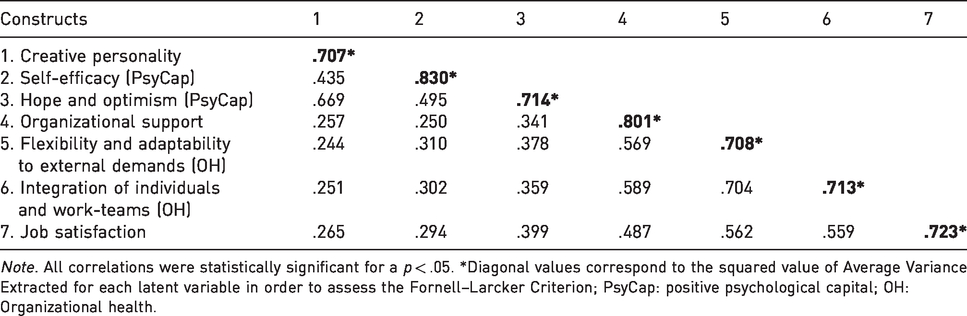
Note. All correlations were statistically significant for a p < .05. *Diagonal values correspond to the squared value of Average Variance Extracted for each latent variable in order to assess the Fornell–Larcker Criterion; PsyCap: positive psychological capital; OH: Organizational health.
Tests of hypotheses
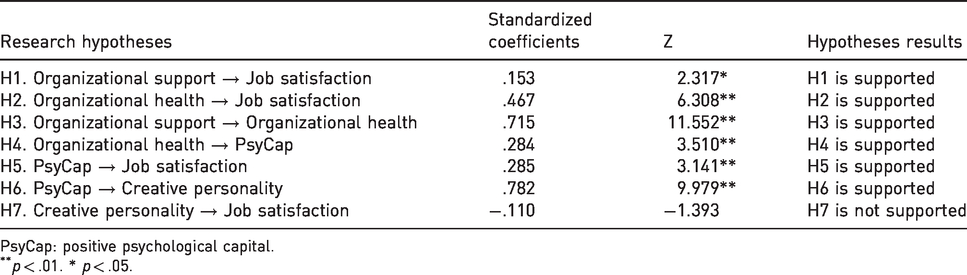
The hypotheses were tested by observing the signal and statistical significance of the estimated path coefficients (Table 3). From the seven initial hypotheses, six of them (
Structural model results.
PsyCap: positive psychological capital.
**p < .01. * p < .05.
AMOS also indicates the path estimates of the second-order constructs, PsyCap and organizational health. Regarding PsyCap, results highlighted the relevance of the dimension hope and optimism in forming the construct, in comparison to the weaker importance of the dimension self-efficacy (β1 = .968; β2 = .611; p = .000). Concerning organizational health, the two dimensions, flexibility and adaptability, on one hand, and integration of individuals on work-teams, on the other hand, reported similar weights (β3 = .926; β4 = .94; p = .000).
Also, the squared multiple correlation coefficients for the latent dependent constructs, PsyCap, creative personality, organizational health, and job satisfaction, were calculated. These values were of .165, .612, .512, and .494, respectively. In the latter case, this means that the proposed model explains 49.4% of the variance of job satisfaction. Total effects on job satisfaction can complement this analysis. AMOS also produces these results. Based on them, we can verify that the strongest predictor of job satisfaction was organizational support (βT2 = .528), followed by organizational health (βT1 = .524) and PsyCap (βT3 = .199).
Discussion and conclusion
Our study aimed to understand how different organizational (organizational health and perceived organizational support) and individual (PsyCap and creative personality) determinants predicted job satisfaction of hotel employees working in the Algarve (Portugal). All the relationships proposed, except one (the relationship between creative personality and job satisfaction), were corroborated by the obtained results.
The first aspect to note is that perceived organizational support and job satisfaction are positively associated (
Another aspect to note is that perceived organizational support was significantly associated with organizational health (
As demonstrated in past studies (e.g. Viseu et al., 2015), organizational health promotes PsyCap (
Also, PsyCap promotes the creativity of employees and their job satisfaction (
The only hypothesis that was not confirmed established a relationship between the creative personality and job satisfaction (
Implications for practice
The results of our study have implications for the hospitality industry. Hotel managers should seek to value the contributions of their employees and demonstrate concern about their well-being, which will develop positive perceptions regarding organizational functioning. For example, hotel managers can improve the quality of their feedback, by recognizing workers’ positive contributions and suggestions for hotel functioning and, when necessary, help them to improve their work skills. For this to occur, it is necessary that managers show openness toward employees to receive new contributions/suggestions. Managers can also try to create a supportive environment for employees, which will promote occupational well-being (Paek et al., 2015). Nevertheless, this supportive environment should not seek to solely improve that relationship between employees, but also between employees and managers. Internal studies may also be conducted to assess employees’ well-being levels, which will allow, in case of need, the adoption of human resources management measures aimed at increasing the occupational well-being of the workforce. Lastly, another way to foster organizational support is through the implementation of training programs, with an individual or professional focus, and design of promotion policies based on the merit of workers (Akgunduz et al., 2018a).
Positive perceptions of organizational health will lead to greater satisfaction with work, tasks performed, and work environment. Two strategies may be used to increase organizational health: (a) the creation of work-teams that promote a positive work environment and (b) the development of effective methods to detect (or anticipate) changes in the hospitality sector (Viseu et al., 2015). In addition, it can be useful to define how the different work teams can interact during the work schedule, to perform the usual tasks in hotel operation and/or to solve possible problematic situations. Regarding the flexibility and adaptability to external changes, it is necessary to underline that this sector of activity is influenced by changes in economic cycles and seasonality. By knowing the hotel’s policies, practices, and procedures, employees will develop a more complete understanding of the functioning of their organization. Thus, when facing situations of change, employees will already know the tools they have available to deal with them.
The emergence of job satisfaction, a work-related positive affect, is crucial for the increase of employees’ morale and decrease of absenteeism and turnover intention rates (Meng and Han, 2014). From a business perspective, satisfied employees lead to better service quality, which will contribute to increased customer satisfaction (Li et al., 2017). The fact that PsyCap promotes the creativity and job satisfaction of hotel employees makes it a valuable construct, since there are training and intervention programs destined to foster this individual variable (e.g. Psychological Capital Intervention [PCI]; Luthans et al., 2006). Through the PCI, employees develop strategies aimed at improving their PsyCap levels. It must be emphasized that when intervening in one dimension, the other dimensions will also suffer the positive effects of the intervention. For example, at the end of the intervention and relatively to the hope dimension, an employee must be able to define which work-related goals are more important for him/her (Luthans et al., 2006). These goals should be clear, measurable, and, when necessary, be divided into subgoals (Luthans et al., 2006). Regarding the optimism dimension, workers should identify possible adverse situations and create alternative strategies to minimize their effects (Luthans et al., 2006). In turn, the promotion of self-efficacy, through social persuasion, aims at helping individuals in the definition of plans and in the identification of the resources needed for goal achievement (Luthans et al., 2015). Lastly, at the resilience level, employees must think about previous negative situations and how they were overcome, considering the options available to act and that there are aspects that cannot be decided by an employee (e.g. due to reduced decision latitude; Luthans et al., 2006). Recently, Luthans and Youssef-Morgan (2017) proposed four actions to foster PsyCap (a) establish work goals that are clear and measurable, (b) define alternative methods for problem-solving, (c) try to receive constructive feedback from managers, and (d) think about past adverse events and reflect on how they were overcome.
Theoretical contribution
Theoretically, this paper provides new insights on the relationship between constructs and corroborates past research. For example, past works (e.g. Avey, 2014) addressed the need to investigate the possible antecedents of PsyCap. As in the work of Viseu et al. (2015), this study demonstrated that organizational health could be an antecedent of PsyCap. Furthermore, given the need to address the outcomes of organizational health, it was also registered that job satisfaction is one of the consequents of this construct. Moreover, the association between perceived organizational support and organizational health underlined that when employees feel that their organization value their contributions and well-being, then they will develop positive perceptions about organizational functioning. Therefore, the analysis of this relationship allowed the identification of a new antecedent of organizational health. Lastly, our study did not allow advances on the relationship between creativity and job satisfaction. In this study, it was defined that employees who can act creatively at their workplace will present greater job satisfaction, situation that was not confirmed.
Limitations and future research
This study has limitations worth considering. Firstly, our study solely considered hotel employees from the Algarve, which influences the possibility of generalizing our results to the Portuguese context. Moreover, the cross-sectional design of our study prevented the inference of causality, which would be useful to clarify the direction of the relationship between creativity and job satisfaction (e.g. creativity as a predictor of job satisfaction, job satisfaction as a predictor of creativity, or bidirectional association between creativity and job satisfaction). Future studies should consider hotel workers from other regions of Portugal and use a longitudinal design, which would allow the inference of causality.
Footnotes
Declaration of Conflicting Interests
The author(s) declared no potential conflicts of interest with respect to the research, authorship, and/or publication of this article.
Funding
The author(s) disclosed receipt of the following financial support for the research, authorship, and/or publication of this article: This paper was financed by National Funds provided by the Portuguese Foundation for Science and Technology (FCT) through the project UIDB/04020/2020.
