




Abstract
Drawing on the Situational Crisis Communication theory (SCCT), this study recapitulates the initiatives, practices, and responses of the Egyptian government and chain-managed five-star hotels during the COVID-19 global health pandemic. Subjective and objective content analysis is employed in this study. Subjective content analysis is employed to examine newspapers, magazines, T.V channels, and official pages on Facebook to determine the initiatives and practices adopted by the Egyptian government. Objective content analysis is further used to determine the COVID-19 hospitality practices adopted by 22 chain-managed five-star hotels by examining their official websites. Thematic saturation was attained when observations and analyses exhibited no new themes. Findings indicated that the Egyptian government and chain-managed five-star hotels implemented a number of initiatives and practices focused on financial policies, health and hygiene, workforce and training, marketing, domestic tourism, booking flexibility, cancellation policies, community support, vacations, and contracts. This study contributes to crisis management research by being one of the first studies to explore governments and hotel operations practices and initiatives during the COVID-19 using Egypt as a case study. We discuss the theoretical and practical implications during and post the COVID-19.
Introduction
SARS-COV-2 virus was discovered in Wuhan, China in December 2019. Declared as a global health pandemic, it has brought a noxious economic impact all over the world (Higgins-Desbiolles, 2020; Wright, 2020) with unmatched universal travel restrictions since World War II (Gössling et al., 2020). Tourism plays a significant role in the development of several economies of the globe (Senbeto and Hon, 2020).
Inevitably, the pandemic has had a strong negative effect on travel and hospitality businesses with enforced restricted mobility and social distancing measures (Gössling et al., 2020; Ramkissoon, 2020a) adopted across the globe. Border closure of several countries have led to disruption in leisure, business, and pilgrimage travel impacting severely on livelihoods (Majeed and Ramkissoon, 2020; Ramkissoon et al., 2020). Governments across nations are struggling about how to assist the tourism sector to operate during COVID-19 (DeWit et al., 2020). The gross domestic product of travel and tourism has been slumped by $2.1 trillion in 2020, a 23% contrast to 2019. Travel and tourism jobs have been slashed by up to 75 million jobs in 2020 (World Travel & Tourism Council (WTTC), 2020). The global economic influence of the new coronavirus COVID-19 is harder than the 2008 global financial crisis with the virus’s impacts visible in nearly all sectors of the hospitality value chain. Attractions have been closed, events cancelled, and shops and restaurants have not been operating over long periods of time. The accommodation sector continues to suffer a tremendous impact with little or no business (Business Insider, 2020; Gössling et al., 2020). The World Travel and Tourism Council predicts global unemployment rate is predicted to raise by 2.1 percentage points directly emanating from travel and tourism job loss (WTTC, 2020).
Crises have prompted managers to take decisions rapidly with insufficient information (Stafford et al., 2002). Following the September 11, 2001 tragedy, some evidence shows hotel managers reduced employees’ hours, while adjusting marketing strategies, and delaying capital improvements (Taylor and Enz, 2002). Resources allocation and past crisis experience were argued as predictors of crisis planning and communication procedures (Pennington-Gray et al., 2011) with top management playing a vital role in having an effective strategy in place. In the current SARS-COV-2 pandemic, Chen et al. (2020) report that China’s hospitality industry participated in the control of the virus as part of its social responsibility; hotel owners provided free accommodation services for medical staff who contributed to the COVID-19 treatment. The researchers indicated that several tourism businesses are providing a full refund to tourists who have had to revisit their travels as a consequence of the pandemic. Hotel managers implemented remote working, paid and unpaid leave, and reduction of a permanent and temporary salaries in a few destinations (Haak-Saheem, 2020).
Several studies (e.g., Israeli et al., 2011; Lai and Wong, 2020; Sager and Mavrot, 2020; Sanfelici, 2020) have investigated the practices availed by governments and hotel operations during periods of crisis management. While there is a plethora of COVID-19 studies, scholars note the need for more research on crisis management (Ramkissoon, 2020a, 2020b), how hotels have/are responding effectively to infection diseases, exploring their hygiene and health care practices during COVID-19 (Jiang and Wen, 2020). There is a need for more studies utilizing the huge secondary data of COVID-19 pandemic (Hasab et al., 2020; Jiang and Wen, 2020). Liu-Lastres et al. (2020) affirmed that there is a critical need for further research on crisis management and organizational resilience in the tourism industry. It is vital to investigate how tourism organizations can manage crises and risks (Majeed and Ramkissoon, 2020; Paraskevas and Quek, 2019).
Stakeholders including employees, the local community, suppliers, customers and others are often negatively influenced by crises. This study draws on the Situational Crisis Communication Theory (SCCT) through the lens of the situational crisis in the COVID-19 pandemic. SCCT is considered as one of the most implemented theoretical frameworks in crisis communication (Kim and Sung, 2014). SCCT indicates the importance of analysing negative impacts of crises and applying strategies and practices to protect an organization’s reputation. SCCT focuses on how to use crisis response strategies to protect an organization's reputation from negative impacts (Coombs, 2007). Based on Kim and Sung (2014), crisis response has two principal elements: (a) base crisis response (i.e., guiding information and modifying information) and (b) reputation management crisis response. SCCT recommends that guiding and modifying information are base responses needed for all crises (Sturges, 1994). Recently, Liu-Lastres et al. (2020) stated that creating effective crisis responses has a profound importance.
Across the globe, many governments and co-actors are working on preventing the spread of COVID-19 with a number of coping strategies being implemented (Hao et al., 2020). Stimulus packages and government interventions will play an important role in combatting the harmful impact of COVID-19 on jobs and the economy (Higgins-Desbiolles, 2020; Wright, 2020). This exploratory study, using Egypt as the research context draws on SCCT theory and contributes to hospitality management literature spotlighting government and hotel operations practices and initiatives during the COVID-19 global health pandemic. Based on data from the Central Agency for Public Mobilization and Statistics (CAMPAS), there are 7,82,900 employees in accommodation and food services in Egypt (CAMPAS, 2020). Tourism has constantly been subject to periodical downturns during COVID-19 (Organisation for Economic Co-operation and Development (OECD), 2020). In March 2020, with rising COVID-19 cases in Europe, tourism decayed distinctly in Egypt, with 70 and 80% of hotel bookings being cancelled (Egyptian Center for Economic Studies, 2020). The virus has shut down Egypt's tourism sector, leading to losses estimated at one billion U.S. dollars monthly (CGTN, 2020). The circumstances remain to worsen as global travel continues to be restricted across the globe. A further loss in tourism revenues over the next few months, probably lasting until the end of 2021 and perhaps beyond is anticipated. The main objectives of this study represent in (1) How the Egyptian government managed the COVID-19 global health pandemic to support its hospitality industry? (2) How chain-managed five-star hotels in Egypt responded to the COVID-19 global health pandemic?
Literature review
Government’s response to COVID-19
At the beginning of COVID-19 pandemic, the vaccine was expected to take at least 18 months as advised by experts (Elmousalami and Hassanien, 2020). Recently, there are many vaccines against COVID-19 in development (Reiter et al., 2020). However, some segments of communities seem to be quite hesitant in getting vaccinated (Chou and Budenz, 2020). It is recommended that governments embrace a multi-stakeholder approach (Nunkoo and Ramkissoon, 2016; Ramkissoon, 2020a) to enable businesses to start getting back to a ‘new normal’. There is an urgent need to ensure that the key stakeholders are consulted including the local community (Hassan and Ramkissoon, 2020; Ramkissoon and Sowamber, 2020) whose voice is often not adequately listened to.
Some countries and regions such as Singapore, Taiwan, and Vietnam managed COVID-19's spread building on the 2003 SARS experience (DeWit et al., 2020). With a view to protect businesses over the long term, governments are working on nationalising or renationalising airline assets (see Baum and Hai, 2020). Fiscal stimulus packages were implemented by governments to protect public health and provide more income stability to residents (DeWit et al., 2020). For instance, the Chinese government has set fiscal and financial policies, provided special fund support, reduced tax and rent cost, and provided services electronically (Chen et al., 2020). In Dubai, the government provided international workforce with the permission to stay until the end of 2020, for those who lost their jobs as a consequence of the pandemic (Haak-Saheem, 2020). The Indonesian government worked on the reallocation of fiscal policy, labour protection, rescheduling of loan repayment from SMEs, and tax incentives policy (DeWit et al., 2020). The Moroccan government invested in awareness campaigns sensitizing people about the harmful impact of COVID-19 (De Freitas and Stedefeldt, 2020).
There are restrictions set by many countries to avoid social congregations (Seetharaman, 2020). The government in Rwanda postponed commonwealth heads of government meeting and provided funding to support all businesses highly impacted by the global COVID-19 health pandemic (Rwigema, 2020).
As for Egypt, tourism is a dominant sector. The 2018/19 earnings from tourism provided USD 12.6 billion (4.2% of GDP) to the economy (Central Bank of Egypt, 2020). Egypt has had more than its fair share of crises. Based on Radwan and Radwan (2017), during the Egyptian crises such as the political turbulence in 2011 and the Russian aircraft crash crisis in Sinai in 2015. The majority of four and five-star hotels in the Sharm El-Sheikh and Hurghada cities of Egypt were not very satisfied with the support provided by the governmental bodies to allow their business to sustain in the marketplace. In particular, they were not satisfied with financial and technical support, and with initiatives taken to promote domestic tourism by the government. In addition, there were no incentives including tax exemption, revoking due debts, minimizing loan interests, and insurance.
Even though the revolution of the 25th of January 2011 and the financial crisis of 2008 had witnessed demand downturn for hotels and other tourist facilities in Egypt, official bodies did not handle these crises effectively to mitigate negative impacts. Strategies implemented for crisis management included undertaking marketing campaigns, providing technical and financial support for individual hotels, providing proper security service, encouraging domestic tourism, participating in international tourist exhibitions, and hosting international events (Mohammad et al., 2016).
In the COVID-19 context in Egypt, government has suspended all flights and locked hotels, restaurants and cafes since March 2020 (CGTN, 2020). The Egyptian government had set regulations following the recommendations of WHO. In addition to its tourism and hospitality sector, COVID-19 also had a harmful effect on Egypt’s manufacturing and foreign financial sectors. The Egyptian government implemented some procedures to help small and medium enterprises (El-Khishin, 2020). It has provided extra human and financial resources needed to prevent the outbreak of the virus (Hasab et al., 2020).
Tourism and hospitality businesses’ response to COVID-19
September 11 terrorist attacks in 2001, SARS pandemic in 2003, and the global economic crisis in 2008 are some well documented crises which impacted on global tourism (Gössling et al., 2020; Henderson and Ng, 2004; Leung and Lam, 2004). Content analysis of newspaper and television coverage in 2009 was employed to explore the coverage of the SARS pandemic in the media in the Netherlands. Media coverage was described as exhaustive and disturbing, and alarming (Vasterman and Ruigrok, 2013).
The media and academic literature also documented that COVID-19 continues to impact tourism and hospitality (Deb and Nafi, 2020), evidenced by job loss in some of the large chain hotels e.g., Marriott and Hilton (USAToday, 2020), and airlines (e.g., British Aiways, Qantas). Gössling et al. (2020) highlighted that tourist attractions and the accommodation sector proclaimed the greatest slump in their staff figures. In March 2020, Hilton Worldwide advised lenders to get a discreet $1.75 billion under a revolving loan to save money and to sustain elasticity “in light of the dilemma in the global markets” (Skift, 2020).
The pandemic has had a destructive detrimental effect on the hospitality industry globally (Gössling et al., 2020; Majeed and Ramkissoon, in press). Moreover, firms reduced employees' salaries, had staff laid off, and implemented work from home (Jasmine, 2019). Wang et al. (2020) argue marketing innovation strategies need to be properly implemented during this pandemic e.g., reservations cancellation due to COVID-19 crisis. Vardarlıer (2016) recommends avoiding dismissing employees during a crisis by rearranging wages, reorganizing hours of work, and abrogating bonus and rewards payments. Moreover, it remains critical for hotels to carry out emergency procedures, cleanliness and sanitation practices, and health screening of personnel to manage crises related to infectious illnesses (Henderson and Ng, 2004). Te health and safety of staff remains paramount in the COVID-19 pandemic (Rosemberg, 2020) and other crises.
Several small businesses impacted by COVID-19 have opted for employees’ layoffs (Bartik et al., 2020). Seetharaman (2020) highlighted organizations have had many employees’ hours reduced as a consequence of the virus. A number of restaurants continue to mitigate the negative effects of this pandemic by local food delivery and using online sales tools to provide their services and products (Jones, 2020).
Restaurants try to build resilience in the COVID-19 pandemic by implementing sanitary legislation and food safety practices, training their staff on hygiene and sanitation, and using social media to announce implementation of health and hygiene to build consumers’ trust in food and beverage services (De Freitas and Stedefeldt, 2020). The survival of hospitality businesses is based on increasing the demand for their services and products (Gursoy and Chi, 2020). Additionally, digitalization in delivering products and services, redesigning products, innovative delivery channels, designing alternative digital products and services, and participating with specialists in ecosystem are some of the important strategies to face this pandemic (Seetharaman, 2020). Hao et al. (2020) exhibited that the hotel industry in China adopted innovative measures to revitalize performance and protect employees and customers via implementing social responsibilities. Moreover, Elbaz et al. (2020) investigated the influence of work–leisure conflict (WLC) on the performance of employees in Egyptian hotels and travel agencies through the mediating role of employee burnout related to emotional exhaustion, cynicism and professional efficacy.
According to Radwan and Radwan (2017), as a result of the Arab Spring and the political turbulence in 2011, the tourism and hospitality industry in Egypt had witnessed a demand downturn minimizing employees’ wages. In November 2015, several countries including Russia and Britain stopped their international flights after the Russian aircraft crash in Sinai, Egypt. This led to a great decrease in hotel room sales, hospitality services, and hosting of events. Consequently, the Egyptian hotels implemented marketing strategies targeting new market segments, promoting marketing, and advertising campaigns, providing more discounted rates, providing special offers on services and products, focusing on loyal customers, using electronic marketing and distribution channels, and building social customer relationships (Dewnarain et al., 2019a, in press). In addition, hotels carried out practices associated with the workforce such as reducing employees’ wages and pay rates, giving staff mandatory vacations, reduced staffing, requiring employees to undertake additional duties, replacing permanent employees with part-time employees, communicating regularly with all personnel, and training and developing employees during a crisis (Radwan and Radwan, 2017).
Despite tourism being a prominent industry in Egypt, only few studies have explored COVID-19 impacts on its tourism and hospitality sectors (El-Khishin, 2020). During COVID-19, hotels implemented layoffs practices, rooms cancelation, closures, and focused on safety and hygiene (Selim et al., 2020). Ministries of tourism and health decided that it is mandatory for hotels to follow health and safety practices (SIS, 2020).
In conclusion, based on reviewing the literature on governments’ response and tourism and hospitality businesses’ response to crises and specifically the current COVID-19 health pandemic, scholars argue that government intervention and collaboration with businesses are critical to enabling businesses to survive (Majeed and Ramkissoon, 2020; Ramkissoon, 2020a, 2020b). Some countries are struggling to keep businesses afloat. This may be due to a lack of proactive and effective strategies to face crises; they may not have encountered previous crises. As for the Egyptian government, it faced several serious political and economic crises in years of 2008, 2011, 2013, and 2015. It is critical to explore how hotels in Egypt; specifically, chain-managed five-star hotels, responded to COVID-19.
Methodology
This research employs content analysis to explore (1) How the Egyptian government managed the COVID-19 global health pandemic to support its hospitality industry? and (2) How chain-managed five-star hotels responded to the COVID-19 global health pandemic? Content analysis, one of the most important research techniques in social sciences to analyse data within a specific context (Krippendorff, 1989) is employed in this study. Content analysis is “a research method that provides a systematic and objective means to make valid inferences from verbal, visual, or written data in order to describe and quantify specific phenomena” (Downe‐Wamboldt, 1992: 314). Specifically, it is used to analyse the content of magazines, books, comics, films, T.V programs among others. It is considered as a quantitative method, because it can be used to identify the statistical frequency of thematic or rhetorical patterns (Boettger and Palmer, 2010). Also, it is a widely used qualitative research technique (Hsieh and Shannon, 2005) to explore group, individual, societal, or institutional attention (Weber, 1990). This method is important to understand the content of newspapers, websites, and Facebook pages and groups (Salem and Čavlek, 2016). The current study analyses the initiatives, decisions and policies taken and implemented by the Egyptian Government (the Egyptian Cabinet and the Ministry of Tourism and Antiquities) and chain-managed five-star hotels to manage the impact of COVID-19 in Egypt.
Sampling and data collection
A non-probability purposive sampling technique was used in the present study. Purposive sampling is typically used in qualitative research and is based on selecting elements of the study according to the defined criteria (Alvi, 2016). We selected information sources of our study according to the defined criteria indicated in 2 phases, namely phase 1 (subjective content analysis) and phase 2 (objective content analysis). Data was collected from 28/03/2020 to 14/05/2020. This period witnessed a large spread of the Coronavirus, resulting in many decisions by the government and chain-managed five-star hotels in Egypt. Meaning-orientated analysis known as subjective content analysis, and form-orientated content analysis referred to as objective content analysis (Creamer and Ghoston, 2013) were employed. In both analyses, we categorized or “coded” words, themes, and concepts within the texts and then analyzed the results.
Coding scheme
We developed a number of keywords for conducting the content analysis based on analyzing eight communication tools drawing on previous studies (e.g., Israeli et al., 2011; Israeli and Reichel, 2003), the Youm7 newspaper, the official page of the Egyptian Cabinet, Arab Magazine for Tourism, Sky News Arabia T.V Channel, the official page of the Ministry of Tourism and Antiquities, Tourism Daily News, and the official websites of 22 chain-managed five-star hotels.
A feature common to the estimation of qualitative research quality is the need to assess the saturation of a data set, implying that the data includes all information required to answer the research questions (Lowe et al., 2018). If the code definitions are precise and subcategories do not overlap, then two rounds of independence coding should generate roughly the same results. Thematic saturation was reached when observations and analyses exhibited no new themes (Faulkner and Trotter, 2017). We have chosen a new information threshold of ≤5% to indicate we attained sufficient saturation. Along with evidence of the base, runs, and saturation points (Guest et al., 2020). With thematic saturation (Guest et al., 2020), ten keywords (financial policies, health and hygiene, workforce and training, marketing, domestic tourism, booking flexibility, cancellation policies, community support, vacations, and contracts) were used for analyzing the communication tools we propose.
The first step was to detect the number of distinctive themes for the base. We began by looking at the first eight communication tools conducted and summing the number of distinctive themes recognized. The resulting sum, 10, is the denominator in our equation. A coding scheme was collected after the first round of revisions and then filtered throughout the following round until no more adjustments were required. The second step is to calculate the saturation ratio. We split the number of fresh themes in this run (0) by the number of distinctive themes in the base set (10). The quotient exhibits 0% new information. This is under our ≤5% threshold, so we hold hereafter eight communication tools and have a reliable sense that the number of new information is declining to a level where we could say saturation has been attained built on our subjective metric of ≤5%. Following Guest et al. (2020) study, we utilized ten existing thematically coded qualitative datasets generated from eight-selected communication tools to validate our method. Accordingly, our results align with Guest et al. (2020) findings. For more clarification, in employing content analysis, it is significant to verify the validity and the reliability of the distinctive themes (Milne and Adler, 1999). The concepts of reliability and validity were thoroughly examined and proved in this study. Validity was verified through peer debriefing on a weekly basis during the coding process and by steps taken to establish inter-rater reliability. Inter-rater reliability attained the level of 100% in the two rounds of coding. This is more than the accepted standard of 60% for the data (Landis and Koch, 1977). One further step was needed to illustrate validity prior to finalizing the coding scheme. The expertise of a third reviewer was sought in the coding process, inter-rater reliability was ascertained to be also 100% between the third reviewer’s codes and the final coding agreed upon by the first and second authors. A manual-based content analysis was used since it is more accurate than the use of automated methods that have reliability problems (Salem et al., 2013).
Procedures: Phase 1 (subjective content analysis)
Within the tourism industry, news coverage plays an important role (Chen et al., 2020). Subjective content analysis was used to determine the initiatives or practices of the Egyptian Government (the Egyptian Cabinet and the Ministry of Tourism and Antiquities) through various information and communication sources as mentioned earlier. The reasons for using the selected information sources for our data collection were as follows: Youm7 newspaper has many followers; it is a newspaper which is well trusted by followers making it one of the daily active sources of information in Egypt (ARADO, 2016). Arab Magazine for Tourism is considered as the best magazine in the Arab world and deeply focuses on tourism news (Alshreif, 2016). Sky News Arabia T.V channel is perceived to provide unique content and comprehensive coverage of the Arabian region and the world news (SNA, 2020). The official pages of the Egyptian Cabinet and the Ministry of Tourism and Antiquities regularly announce decisions and policies taken and implemented by the government since the COVID-19 outbreak on Facebook.
Procedures: Phase 2 (objective content analysis)
Objective content analysis was used; firstly, to determine the initiatives or practices of chain-managed five-star hotels by examining the official websites of 22 chain-managed five-star hotels in five main tourism areas; South Sinai, Cairo, Alexandria, Red Sea, and Upper Egypt. We selected 22 popular chain-managed five-star hotels, since they all had well-designed websites where news and initiatives are regularly updated. These hotels have a good reputation in the Egyptian market regarding their facilities and services. We analyzed the websites of 22 five-star hotels from different hotel chains located in Egypt and the determined Facebook group using coding scheme. The basis of analysis is (0 = not existence; 1= existence).
Our study is also based on objective content analysis to examine 1,350 posts and 9,405 comments of managerial and entry-level employees published on one of the newly created groups on Facebook, which is called 'Rights of Tourism and Hotels’ Employees'. The key purpose of this group is to discuss all issues and topics related to tourism and the hotel industry. Our aim was to explore both senior management and entry-level employees’ perception of COVID-19 crisis management. This group has around 20,000 employees from the tourism and hospitality operations in Egypt. The most important resources for all firms are their employees including entry-level ones (Elkhwesky et al., 2018, 2019; Hanaysha and Tahir, 2016). It is vital to ensure their well-being, especially during crisis times (Ramkissoon, 2020a; Ritchie and Jiang, 2019) and encourage them speaking up about work-related problems (Wang and Hsieh, 2013) to achieve job satisfaction and organizational success (Alfayad and Arif, 2017; Ramkissoon et al., 2020).
Results
To answer the 1st question, our study findings show the practices of the Egyptian Government (the Egyptian Cabinet and the Ministry of Tourism and Antiquities) in managing COVID-19 and supporting its hospitality industry.
Financial policies
The Egyptian Cabinet postponed payments of all tourism and hotel operations without any delay benefits or fines for three months. In addition, it absolved all the cafes and bazaars in the archaeological sites from paying the rent during this pandemic time. It postponed private airlines and tourism operations' payments of utility. It has provided support to hotel and tourism operations minimizing the real estate tax for 6 months. The Egyptian Central Bank provided tourism operations with low-interest funds, especially for paying employees' salaries. It launched a 50-billion-pound support to the tourism industry, lowering the interest rate from 10% to 8%. Furthermore, the Egyptian Cabinet provided temporary employees with financial support of 500 EGP for three months.
Health and hygiene
The Egyptian Ministry of Tourism obliged hotels located outside the tourist governorates for sterilization and disinfection, demanding that the organizations report it periodically.
Workforce and training
The Ministry of Tourism and Antiquities illustrated that it trained employees in the tourism and hotel operations about precautionary and preventive practices, how to protect themselves, and how to deal with emergencies according to the recommendations of the World Health Organization and international firms, such as “Preverisk” and “CDC”. It also provided employees with a hotline to handle complaints. In addition, it stated that strict penalties will be carried out against hotels that treat employees in an illegal manner.
Marketing
The Egyptian Cabinet agreed to introduce a new initiative by providing entry fees discounts to historical sites, and motivate people who enjoy travelling, during June, July, and August, to travel to Upper Egypt. It offers discounts on visa fees upon arrival at Airports. The Ministry of Tourism and Antiquities launched an online campaign on its websites and social media platforms entitled “Experience Egypt from Home”, where it published virtual tours inside some museums and archaeological sites in Egypt every day. This reflects the emerging trends in museums with virtual and augmented reality applications to optimize visitor satisfaction (Hassan and Ramkissoon, 2016) and promoting the authenticity (Ramkissoon and Uysal, [2014] 2018) of the place.
Domestic tourism
The Egyptian Cabinet has set critical rules, in collaboration with the Egyptian Ministry of Tourism and the Egyptian Ministry of Health, that must be implemented by each hotel separately. These rules include; a hotel must have a clinic with a doctor, personal protective tools and sterilization materials must be approved by the Ministry of Health, it is forbidden to hold any parties, weddings, and night activities, a hotel must specify a floor(s) to quarantine suspected and confirmed cases, installing a sterilizing device at a hotel entrance, completing check-in procedures for guests electronically or using single-use pens, sterilizing luggage of guests before arriving and leaving a hotel, measuring temperature for all guests when entering a hotel each time, providing a hand sanitizer in the reception area and various facilities, and cleaning all public areas regularly. We note that many of these practices are also being implemented across several other hospitality organizations (see Jain, 2020).
We further explored and answered the 2nd question “how chain-managed five-star hotels managed the COVID-19 global health pandemic”. Our findings are based on examining the official websites of 22 chain-managed five-star hotels, within the Egyptian context from 28/03/2020 to 14/05/2020.
Health and hygiene
The total sample of 22 (100%) hotels exhibited that they contracted high-qualified doctors from the Ministry of Health to handle any infection case. In addition, they provided employees in the workplace, with socks, medical masks, and gloves. All these hotels developed and implemented the best cleanliness standards and disinfection practices, in collaboration with international experts in hygiene, handling infection, food and water safety, and hospitality management, to protect both customers and employees. In addition, they changed health and safety procedures and food and beverage safety programs in accordance with current food safety recommendations.
The majority of hotels (77%) installed new cleaning technologies, such as electrostatic sprayers with disinfecting mist and ultraviolet light that allow for touchless disinfecting capabilities. Moreover, these new technologies were used to sanitize surfaces and objects. In addition, these hotels provided all guest rooms with disinfecting wipes. They used signage as information cues for social distancing (see Ramkissoon, 2020) in lobbies. All 22 hotels did not install electronic disinfection gates.
Only 4 out of 22 hotels (18%) reduced services in restaurants and bars providing alternative guest room furnishings and/or amenities. Only one hotel from the total sample of 22 hotels indicated that, as a result of one positive case of COVID-19 being detected, all guests and staff were confined inside the hotel for 14 days. The latter were requested to stay in their rooms for their safety. Food and beverage were provided by room service, they were informed that the management is available around the clock to provide all people with any assistance regarding the global pandemic (see Figure 1).

Numbers and percentage of chain-managed five-star hotels regarding health and hygiene practices.
Booking flexibility and cancellation policies
All 22 hotels (100%) implemented the following policies: allowing guests to cancel existing reservations for any future arrival date without a charge until 24 hours before arrival; provided guests with the possibility to change reservations at any time; customers can cancel reservations easily and the refund was processed without delay. These hotels also cancelled applying additional fees resulting from cancellation of reservations. Only 4 hotels (18%) provided guests with the possibility of booking with pay later because pre-paid policies were removed. Events and meeting dates could be changed to another time (see Figure 2).
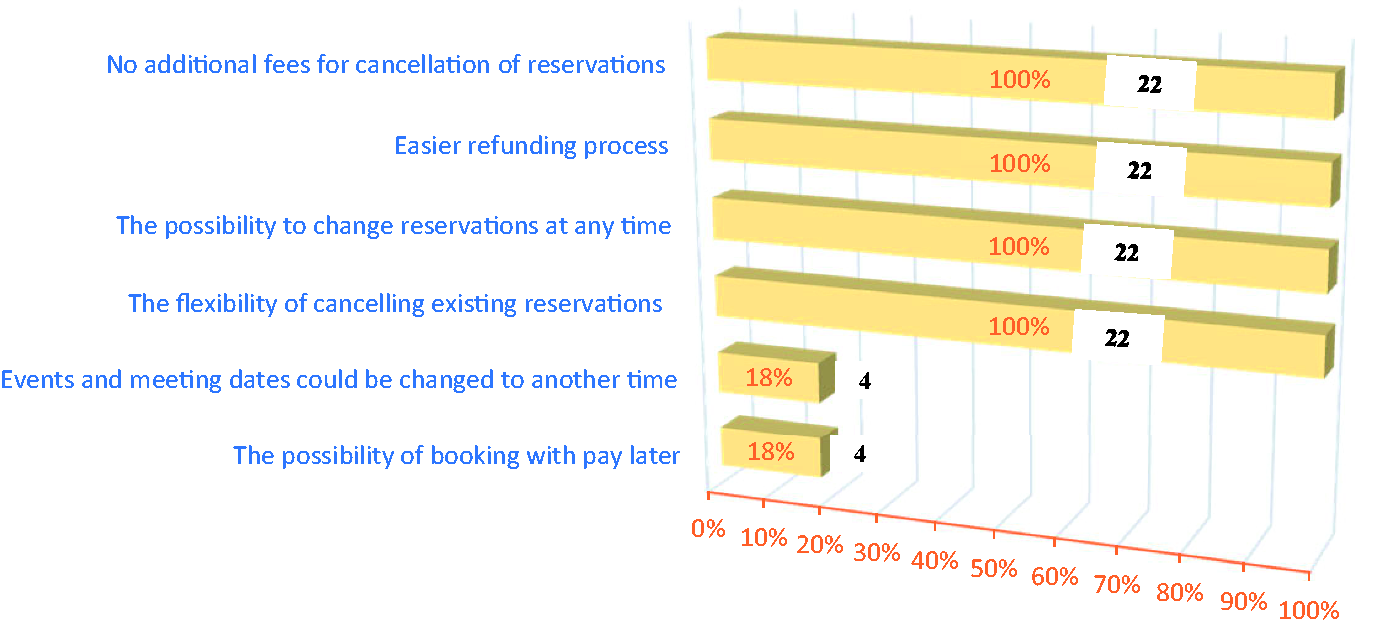
Numbers and percentage of chain-managed five-star hotels regarding booking flexibility and cancellation policies.
Workforce and training
All 22 hotels carried out employees' training regarding new cleanliness standards, infection prevention, and safety procedures according to the World Health Organization recommendations. Only (77%) trained food supervisors and handlers about how to prepare food and beverage and offer services safely. Only (27%) implemented self-inspection in the food and beverage departments following food safety standards. Furthermore, they modified the operational practices related to in-room dining and buffets (see Figure 3).
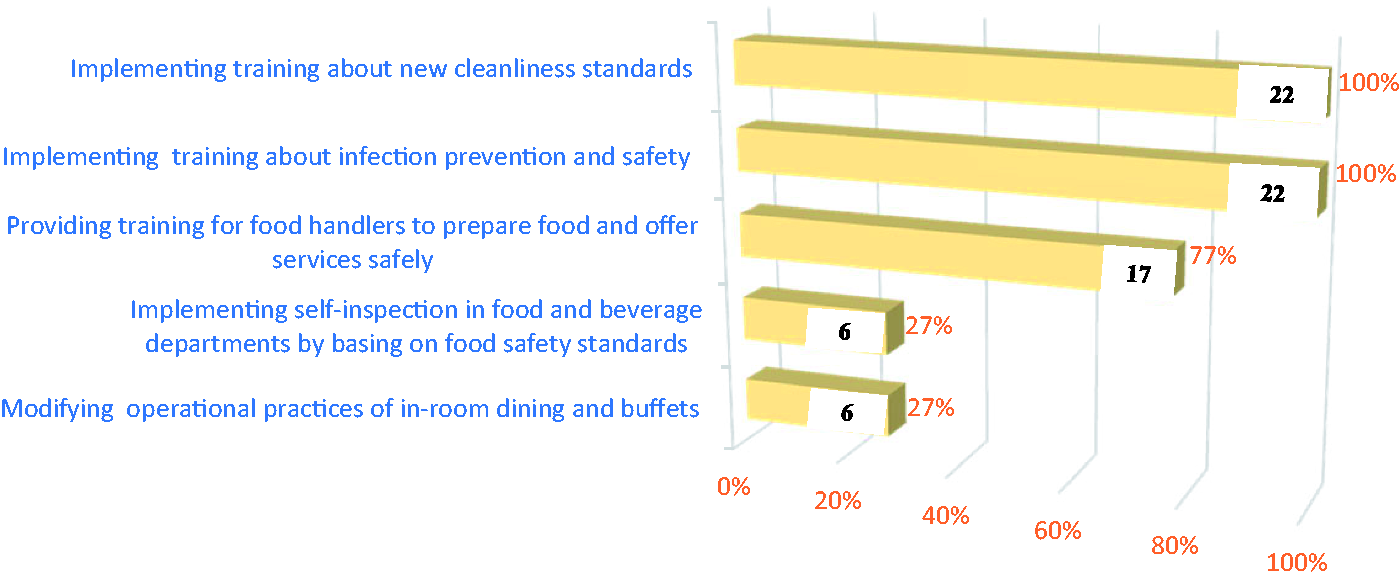
Numbers and percentage of chain-management five-star hotels regarding workforce and training practices.
Marketing
At the start of the COVID-19 outbreak, only (50%) offered discounts and competitive prices. In the last days of the period selected in our study, the same number of hotels developed new standards for cleanliness and disinfection in collaboration with firms such as Dettol. These practices were applied in front of guests to reassure them they will enjoy a cleaner and safer stay (see Figure 4).

Numbers and percentage of chain-managed five-star hotels regarding marketing practices.
Community support
95% donated cooked meals and critical supplies, such as anti-microbial wipes, masks, gloves, shower caps, sanitizers, and cleaning products to medical and other frontline personnel. Only 4 of 22 hotels (18%) provided doctors with free nights as a part of their social responsibility during the pandemic (see Figure 5).
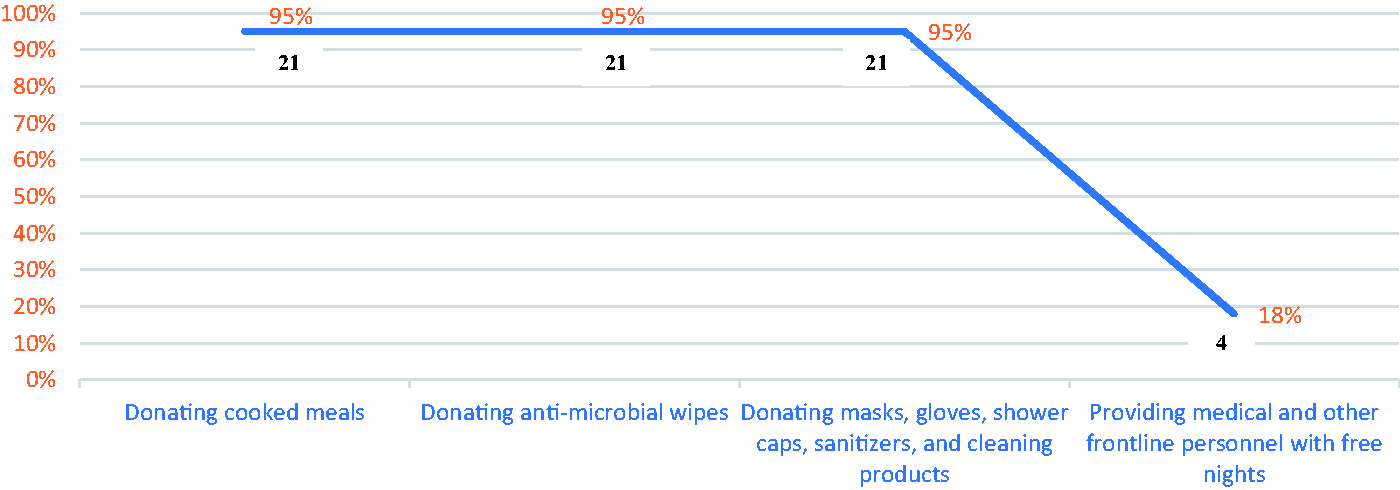
Numbers and percentage of chain managed five-star hotels regarding community support practices.
Based on 1,350 posts and 9,405 comments of managerial and entry-level employees from one of the new created groups by employees on Facebook since the start of COVID-19, our findings show the following chain-managed five-star hotels practices.
Financial policies, vacations, and contracts
Only 1200 of 20,000 employees (6%) illustrated that chain-managed five-star hotels implemented practices such as retaining full-time staff, payment of salaries and service commission, providing them with paid vacations, and renewing all temporary contracts. 7800 of 20,000 employees (39%) affirmed that chain-managed five-star hotels asked them to take time off without pay, instituted layoffs, terminated their contracts, stopped the renewal of contracts, applied non-payment of salaries, cut salaries, deducted taxes and insurance from salaries, frozen rewards and service commission, and implemented non-payment of benefits. Additionally, 5200 of 20,000 employees (26%) recommended that laws and regulations must be controlled, and punishments against chain-managed five-star hotels that terminated contracts and frozen salaries must be implemented by governmental authorities (see Figure 6).

Chain-managed five-star hotels practices related to financial policies, vacations, and contracts as indicated by employees.
The following sentiments were expressed by employees.
‘‘The dismissal of workers is a continuous process at 5-star hotels, we need the intervention of the Egyptian president’’ (department manager).
‘‘I appeal to the Egyptian president and the government to set strict laws towards five-star hotel management to save employees from cutting salaries and layoffs during crises’’ (porter).
‘‘I am a high qualified and permanent employee; however, the hotel where I work asked me to take time off without pay or terminate my work’’ (housekeeper).
‘‘The five-star hotel where I work mentioned to all staff that there will be no service commission and salary, I have been working there for four years’’ (waiter).
Discussion
The findings of our exploratory study contribute to a deeper understanding of government and chain-managed five-star hotel practices and initiatives during COVID-19 within the Egyptian context. Our results suggest that the Egyptian government had set a great example in dealing with COVID-19 by taking a number of critical decisions and implementing practices or initiatives related to financial policies, health and hygiene, workforce and training, marketing, and domestic tourism to cope with the pandemic. Our findings are consistent with Kumar et al. (2020) indicating that the governmental support may include tax allowances and the provision of credits or loans. Further our findings exhibit government support is important (Nunkoo et al., 2009, 2012; Nunkoo and Ramkissoon, 2012; Ramkissoon, 2020a, 2020b) in combatting the destructive effect of Covid-19 on jobs and the economy (Wright, 2020). In addition, the tourism industry needs stimulus packages and interventions from government (Higgins-Desbiolles, 2020), to survive during this pandemic.
Even though the best effort of the Egyptian government and its financial support for the tourism and hospitality industry related to postponing different payments, low-interest funds, and credit facilities, many chain-managed five-star hotels had salary cuts and applied layoffs. This is in line with Selim et al. (2020) who exhibited that layoffs practices are implemented by Egyptian hotels during COVID-19. This finding is inconsistent with Tse et al. (2006) who exhibited that financial support from government can assist hospitality operations to reduce costs without staff layoffs during a crisis. El-Khishin (2020) highlighted that the Egyptian government provides financial incentives to retain employees in the hospitality and tourism industry. The best effort of the Egyptian government is consistent with the Rwandan government that provided funding to support businesses (Rwigema, 2020).
Our findings are also in line with Vaccaro et al. (2020) who recommended that hotels avoid staff layoffs during this pandemic, because rehiring them would incur higher costs (Mitchell et al., 2001). On the other hand, Pappas (2018) pointed out that hotels implement staff layoffs because of poor financial aspects during crises. The demand of a grace period on local payments from government can be one of the solutions (Israeli and Reichel, 2003) in alleviating impacts. Our findings related to implementing staff layoffs, unpaid vacations, and frozen salaries are consistent with Henderson and Ng (2004), Leung and Lam (2004) who revealed that during SARS pandemic, hotels terminated employees’ contracts, implemented unpaid leave, and had salaries reduced.
Recognizing the importance of health and hygiene in the workplace (Elkhwesky et al., 2019), our results illustrate that the Egyptian government has set rigid policies for implementing cleanliness and sterilization practices in all hotels. This finding is consistent with SIS (2020) suggesting that ministries of tourism and health recommended that health and safety precautions are to be followed by hotels in Egypt. The importance of collaboration between government and the hotel industry has been stressed by Hung et al. (2018) who highlighted its significance in pandemic times to control infectious diseases through a regular check of health and hygiene at hotels. Ramkissoon (2020b) further emphasized on the need for these behaviours to become habitual for long-term behaviour change to promote healthier societies.
Our findings are in line with Selim et al. (2020) who argued that safety and hygiene practices are being implemented by Egyptian hotels during COVID-19. Even though many hotels implemented health and hygiene practices, few of them reduced services in restaurants and bars. These hotels may have few customers, so they don’t need to minimize services provided in their restaurants. This finding is in line with Henderson and Ng (2004) arguing that hotels can implement such practices as safety and well-being of staff, activation of emergency procedures, health screening of staff, and cleanliness and disinfection. In addition, restaurants try to build resilience in the COVID-19 pandemic by implementing sanitary legislation and food safety practices (De Freitas and Stedefeldt, 2020).
Our results revealed that there are no disinfection gates installed in hotels. Disinfection gates may be expensive, so hotels prefer to use other alternatives to reduce costs (Bartik et al., 2020). As recommended in a few studies (e.g., Hoefer et al., 2020; Rosemberg, 2020), hotels also need to provide employees and guests with personal protective requirements and masks, implement ongoing cleaning procedures, and the best hygienic practices.
Our findings further highlighted that the Egyptian government has provided hotels with health and hygiene training about precautionary and preventive practices. In this regard, safety and health authorities support through setting guidelines is vital for hotels to safeguard the health and safety of their employees (Rosemberg, 2020). Our study exhibited that hotels implemented safety and hygiene training for their staff. This concurs with De Freitas and Stedefeldt (2020) who claimed that restaurants try to build resilience in the COVID-19 pandemic by training their staff on food safety and hygiene and sanitation.
It is conceivable to look at the COVID-19 pandemic crisis as a great opportunity for innovation in marketing strategies. The Egyptian government agreed to introduce a new initiative to motivate its people to travel to Upper Egypt during the summer months. It launched an electronic campaign on websites and social media to provide people in their homes with virtual tours inside museums and archaeological sites. These initiatives can be useful for the future to attract new customers and travelers, especially with travel restrictions that were imminent.
Most five-star hotels donated cooked meals, anti-microbial wipes, masks, sanitizers, and gloves for medical staff. Few of them provided medical employees with free nights. This practice may be implemented and not announced by hotels on their official websites. Benitez et al. (2020) argue it is important for hotels to announce their social initiatives showcasing their contributions to society. Our findings revealed that the majority of hotels provide guests with the opportunity to change and cancel reservations without additional fees.
Conclusion and implications
Conclusion
The purpose of this research was to recapitulate the initiatives, practices, and responses of the Egyptian government and chain-managed five-star hotels during the COVID-19 pandemic. To achieve this aim, subjective content analysis is employed to examine newspapers, magazines, T.V channels, and official pages on Facebook to determine the initiatives and practices adopted by the Egyptian government. Objective content analysis is further used to determine the COVID-19 hospitality practices adopted by 22 chain-managed five-star hotels by examining their official websites.
The results have shown that the Egyptian government has set a good example in managing COVID-19 and supporting its hospitality industry through a number of initiatives and practices. These include postponing payments, cancelling benefits or fines, lowering the interest rate, providing financial support, providing hotels with sterilization and disinfection guidelines, providing training about precautionary and preventive practices, and launching an online marketing campaign on social media to support the tourism and hospitality sector. These are in line with previous studies (e.g., El-Khishin, 2020; Hasab et al., 2020; Higgins-Desbiolles, 2020; Kumar et al., 2020).
Our findings further reveal that chain-managed five-star hotels managed the COVID-19 global health pandemic through a number of serious practices that include implementing the best cleanliness standards and disinfection rules, installing new cleaning technologies, flexibility of booking and cancellation policies, providing employees with training concerning new cleanliness standards, infection prevention, and safety procedures, offering discounts and competitive prices for customers, and donating cooked meals and critical supplies for the community. However, these hotels implemented a number of practices regarding employees such as asking them to take time off without pay, layoffs, stopping the renewal of contracts, applying non-payment of salaries, cutting salaries, deducting taxes and insurance from salaries, and non-payment of benefits. Findings show that employees are greatly dissatisfied with the management. Scholars continue to argue that employee satisfaction remains key to the financial sustainability of businesses (Dewarain et al., in press; Ramkissoon et al., 2020; Ramkissoon and Mavondo, 2016) yielding to broader societal benefits aligning with the sustainable development goals (Ramkissoon, 2020a; Ramkissoon and Sowamber, 2020). The locals’ voices have to be listened to (Aleshinloye et al., in press; Megeirhi et al., 2020) for sustainability outcomes (Ramkissoon, 2020b). These outcomes hold important theoretical and practical implications for practitioners, policymakers, and the research community.
Theoretical implications
Our exploratory study, using Egypt as our research context draws on SCCT theory and contributes to hospitality management literature spotlighting government and hotel operations practices and initiatives during the COVID-19. It contributes to the initial series of studies exploring government and hotel operations practices and initiatives during the COVID-19.
This study contributes to tourism and hospitality crisis literature in several ways. First, this contextual study provides source information regarding government policies and initiatives undertaken in Egypt. This information serves as a guideline for governments of other nations in similar contexts on initiatives that can be adopted during and post the COVID-19 and other health crises that may arise in future. Second, this study shows how hotel practices and initiatives are published on their websites. Third, this study explored perception of adopted practices of chain-managed five-star hotels from managerial and entry-level employees by examining 1,350 posts and 9,405 comments on Facebook. Fourth, this study identified official pages of the government on the Facebook that provide abundant information which could be followed by other nations to extract knowledge on adopted initiatives and policies.
Management implications
Our study has useful implications for practitioners and policymakers. The intervention of governments is critical to mitigate the effects of any pandemic (Duan and Zhou, 2020; Ramkissoon, 2020a) on tourism and hospitality businesses through initiatives, policies, and practices related to finance, health and hygiene, workforce and training, marketing, and domestic tourism. This intervention should be a continuous process post the pandemic (Ramkissoon, 2020b). The Egyptian cabinet needs to create a committee responsible for crisis and disaster management engaging important stakeholders (Naumov et al., 2020). It is important for the ministry of tourism to collaborate with Egyptian tourism and hotel academic institutions to share knowledge about implementing more innovative practices and entrepreneurship practices in dealing with crises (Salem and Mubarak, 2019).
Employees are the cornerstone for any organization in normal circumstances (Dewnarain et al., 2019b; Elkhwesky et al., 2018, 2019); organizations must retain their services and support them in hard times. Recommended practices may include minimizing benefits and service commission, reorganizing working hours, and revoking rewards and bonus payments. This suggestion is consistent with Vardarlıer (2016). If hotels are struggling to keep salaries and rewards, they may discuss alternative solutions with employees. This practice could be useful to maintain their job satisfaction and commitment. For example, providing incentives and promotional opportunities may satisfy employees even if salaries and rewards were minimized or frozen. Post the pandemic, hotels need to be proactive in saving their financial resources to have cash flow to be used for handling drops during crises and emergencies (Le and Phi, 2020; Ramkissoon et al., 2020).
Due to the importance of social media and internet in the hospitality and tourism sector (Frias et al., 2008; Mehraliyev et al., 2020), our results suggest that hotels look after their staff’s needs during the pandemic failing which they may run the risk of having bad publicity online by the staff which may affect the reputation of the hotel. Effective communication with employees is vital for their satisfaction (Elkhwesky et al., 2018, 2019). The government and hotels should listen to employees’ opinions on Facebook because many of them have innovative practices to mitigate the harsh impacts of COVID-19.
In promoting domestic tourism, it is further recommended for chain-managed hotels to implement rules and policies set by government while maintaining effective collaboration with the health authorities to control the spread of the virus (Jamal and Budke, 2020). Services in restaurants and bars of hotels need to be reduced and replaced by other services and amenities in rooms to protect individuals from the coronavirus infection. Digitalization is important (Seetharaman, 2020) in delivering products and services. Post the pandemic, hotels can invest in adopting robots to improve safety and contamination practices.
Recent technologies are important to reduce the cross-contamination risk and interpersonal contact, and enhance customer’s trust in the service environment, such as smart control (e.g., access, lights, air conditioner, speakers, and TV), self-check-in and checkout, room service and food delivery robots, mobile payment, face and voice recognition, and self-service kiosks. Intelligent services are also critical to enhance hotels' operational efficiency and save costs (Hao et al., 2020).
Health and hygiene procedures need to be regularly upgraded based on the current pandemic situation in collaboration with local authorities. Hotels can expand their collaboration with firms e.g., Dettol to make them enjoy a safe accommodation. This practice can be implemented to achieve a competitive advantage during this infection. To motivate customers for longer hotel stays, the management may need to redesign their rooms with virtual and augmented reality technologies (Hassan and Ramkissoon, in press). Hotels need to regularly update information on their websites about how services are safely provided for guests.
It is critical for hotels to implement online training courses for employees to develop their skills during the pandemic. For instance, they can be trained on digital transformation using video conferencing to be able to work efficiently post the pandemic. Our study findings recommend operational policies shifting to only in-room dining, offering new furnishings, rearranging tables, drawing one-way aisles, and using signage cues. Based on new food safety standards, hotels need to implement ongoing self-inspection of their food and beverage outlets. Our study results recommend that hotels do offer free nights for medical staff as a part of their corporate social responsibility. Our findings would encourage countries and destinations with similar economic, social, and tourist circumstances to reflect on how they could further address COVID-19 challenges to assist in the recovery of the hospitality sector.
Research limitations and suggestions for future research
The first limitation of our study is with the generalizability of the results and sampling methods. A quantitative or mixed methods approach will further elucidate the role of government in supporting the hospitality industry during and post crisis. In addition, it is necessary to test the impact of governments’ practices on hotels’ support for employees during COVID-19 across a range of contexts. Our exploratory study is contextual; although our study has relevance to Egypt, its results can inform research in hospitality across a range of destinations as this pandemic is global. A cross-country comparative study will shed further light on crisis management in the hospitality sector (Le and Phi, 2020). As a result of the distinctive features of COVID-19 when compared to other crises, COVID-19 may last much longer (Hu et al., 2021), another route for continued research relates to the significance of considering a longitudinal approach (Sobaih et al., 2021) to compare hotels’ and governments’ responses over time and capture changes regarding the level of threat perceived and the responses undertaken. Further studies need to involve a much deeper understanding of post pandemic policies in the hospitality industry.
Further, we note it will be interesting to explore practices and strategies utilized by different classifications of hotels (see Le and Phi, 2020) (e.g., local hotels, urban vs. highway hotels, upscale vs. budgetary hotels, chain vs. independent hotels, small and medium-sized hotels, family owned and operated hotels) to manage the COVID-19 pandemic. Comparisons of challenges faced, and coping strategies adopted, by such hotels could offer meaningful insights (Smart et al., 2021). We also encourage research to include restaurants to compare with our results in view of their importance for economic growth (Tibon, 2014) and employment (Gheribi, 2015).
Footnotes
Declaration of conflicting interests
The author(s) declared no potential conflicts of interest with respect to the research, authorship, and/or publication of this article.
Funding
The author(s) received no financial support for the research, authorship, and/or publication of this article.
