



Abstract
Coastal and marine tourism offer various topics discussed within social media communication during a pandemic. The present study analysed the discussion topics in the popular Twitter's tourism hashtags during the COVID-19 crisis related to coastal and marine tourism. The objectives were to (i) determine the discussion topics, (ii) identify the discussion topics of greater hierarchy, and (iii) determine the tourist destinations discussed. The data were collected from Twitter between March and April 2020. A total of 269,722 tweets were extracted in different languages and globally through the Twitter API of popular tourism hashtags about the COVID-19 pandemic using big data software. The word associations technique was used to process the Twitter data. The discussion topics were ‘travel’, ‘beach’, ‘cruise’, ‘sea’, ‘ocean’, ‘nature’, ‘sun’, ‘coast’, and others. The discussion topics of greatest hierarchy were ‘travel’, ‘beach’, ‘sea’, and ‘cruise’. These topics refer to the motivational dimensions‘ ‘escape’, and ‘sun and beach’. The geographic locations discussed were Spain, Canary, Hawaii, Australia, Caribbean, Bermuda, Florida, California, and others. The findings will contribute to the relationship of the topics with the tourist motivational dimensions, and the destinations discussed about marine and coastal tourism in the time of crisis in the COVID-2019 Pandemic in Twitter's tourism hashtags, and companies will also be able to improve their communication strategies and develop post-pandemic products.
Introduction
At present, tourism has been hit hard, and millions of jobs are at risk in one of the most labour-intensive sectors of the economy (UNWTO, 2020a). This is a consequence of the global pandemic known as COVID-19 that plagues the world in 2020, where humanity has entered into a major economic and health crisis. This disease, which is a pneumonia of unknown cause detected in Wuhan, China, was first reported to the World Health Organisation (WHO) in China on 31 December 2019. Thus, Guo et al. (2020) characterised COVID-19 as an emerging acute respiratory infectious disease spread mainly through the respiratory tract by droplets, respiratory secretions, and direct contact. This pandemic caused a crisis in the tourism sector. In fact, on 26 March 2020, UNWTO (2020b) announced that the United Nations' specialised tourism agency expects international tourist arrivals to decrease by 20% and 30% in 2020 compared to 2019 figures due to the COVID-19 pandemic. On 7 May, the UNWTO (2020a) announced that international tourism contracted 22% in the first quarter and could fall as much as 60%–80% in the year as a whole. In this sense, the COVID-19 crisis currently presents the opportunity to reconsider the transformation of sustainable tourism globally (Gössling et al., 2021). In this way, the pandemic crisis of COVID-19 can offer a rare and invaluable opportunity to rethink and restore tourism to a better path for the future (Higgins-Desbiolles, 2020).
For the fight against the economic crisis, tourist destinations have natural and cultural resources that may be suitable for tourism activities to boost the economies of the countries; for example, the coastal and marine space is home to an increasing number of human activities and facilities, the most important being those related to coastal and marine tourism (Papageorgiou, 2016). For this reason, the World Tourism Organisation (UNWTO) estimated that, of the one billion international tourists registered in 2012, a third of these tourists visited the coast (UN, 2014), indicating that coastal and marine tourism is important in relation to the tourism sector in general and is an important source of income and foreign exchange earnings in the places and countries where the coastal and marine sites are located. This highlights the importance of developing these types of destinations.
Yu et al. (2020) argue that future tourism studies should examine how health crises affect the quality and efficiency of services provided by companies in the sector: the performance and image of the destination and the mediation of tourist emotions expressed in the social networks. Social media has emerged as an important area of crisis communication research (Zeng and Gerritsen, 2014). However, few studies have considered Twitter as a means of communication during crises (Barbe and Pennington-Gray, 2018; Schultz et al., 2011).
In this framework, Twitter is considered an efficient means of communication during crises in social media, since it allows interactive dialogues, and it is especially important because it allows immediate reactions to crisis situations (Schultz et al., 2011). Networked crisis communication theory considers that crisis communications distributed by social media can provoke different responses, which can be affected or impacted by the medium used, the type of crisis, and people's emotions (Schultz et al., 2011; Utz et al., 2013).
In this context, to date, no academic studies have been carried out that address the perceptions that are discussed in the communication on the different types of tourism using popular hashtags on Twitter using the word associations technique. In light of this research gap, this study has the following objectives: (i) determine the discussion topics related to marine and coastal tourism in popular Twitter's tourism hashtags during the COVID-19 crisis; (ii) identify the topics of discussion of greater hierarchy related to marine and coastal tourism, in the popular Twitter's tourism hashtags durig the COVID-19 crisis; and (iii) determine the destinations related to marine and coastal tourism discussed in the popular Twitter's tourism hashtags during the COVID-19 crisis. The findings will contribute to the academic literature to analyse communication in tourism and propose strategies before, during, or after a crisis. Tourism companies in the sector, including tourism operators, will be able to develop tourism packages and post-pandemic communication plans based on these results.
Theoretical background
Twitter as social media
Twitter, is a medium where users and consumers express their emotions about products and services (Geetha et al., 2017; Rathore and Ilavarasan, 2020). It is a social media platform that during disasters and emergencies presents convenient ways to share and consume information (Zahra et al., 2020). It can be used to rapidly distribute critical information and mitigate the impact during emergencies by influencing public reactions (Panagiotopoulos et al., 2016). Twitter is a medium that users generally use as the first source of online information, as well as a means of links to other media for additional information (Barbe and Pennington-Gray, 2018). Therefore, Twitter has been used as an information hub during disasters (Schwarz et al., 2016).
Tourism is one of the areas that has gained the most with Twitter and social networks, especially in observing consumer behavior, planning, and development of marketing strategies (Zeng and Gerritsen, 2014). Travelers usually look for information on social networks to make decisions about which destinations to visit, the company or airline, and the hotel to choose. This activity is done because they generally must hire the service before visiting. They find motivations to use social media and see the benefits of the information on tourist sites (Amaro et al., 2016). The activity on Twitter with comments about tourist destinations can affect the hotel occupancy of tourist destinations on tourist vacations (Bigné et al., 2019).
Through social media travelers share their travel experience with other tourists (Amaro et al., 2016). Social media is a powerful force to promote travel planning and decision-making about trips to tourist destinations because travelers have access to relevant information created by other travelers which is considered reliable when planning a trip (Fotis et al., 2012).
Factors related to the tourist offer (quality, resources, destination environment, infrastructure) can influence the motivation, satisfaction, and the tourist's decision to visit a destination and his intention to return (Yoon and Uysal, 2005). The attractions of a tourist site can be seen through Twitter. In this way, motivation can be influenced (Bassolas et al., 2016).
The tourist's behavior and purpose of the trip can be inferred through the Twitter data (Nozawa et al., 2016). Travelers have different reactions to the information from social networks regarding travel planning (Zeng and Gerritsen, 2014). Twitter allows obtaining consumer perception, popular words, and emotional state in comments (Park et al., 2016a). Consumer preferences can be identified by analyzing Twitter data, which can help service providers to plan more personalized services (Sinha et al., 2018). Through the processing of Twitter data, the main topics examined by tourists and emotional expressions can be identified (Park et al., 2018), a better understanding of the attitudes and behavioral results of tourist experiences can be obtained, especially motivations (Gilbert, 2016; Park et al., 2016b).
Twitter data in text form are unstructured; it is a data repository from which content can be extracted through text analysis (Geetha et al., 2017). In the field of social media research, the word associations technique serves to find syntagmatic relationships between the terms or words that make up texts (Correia et al., 2018) and seeks knowledge derived from patterns and relationships that can reveal facts, trends, or constructs. This technique can be used for exploratory analysis or as a test of hypotheses or interrelationships between constructs (Harlow and Oswald, 2016).
Coastal and marine tourism
Marine tourism encompasses a wide range of activities that take place in the deep oceans, the most predominant being cruises and sailing (Diakomihalis, 2007; Honey and Krantz, 2007). Other activities related to the coast likewise cover marine tourism, such as diving, spearfishing, water skiing, windsurfing, excursions to sea parks, and observation of wild mammals (Diakomihalis, 2007; European Commission, 2014). For Hall (2001), coastal tourism is very closely related to marine tourism (as it covers activities that take place in coastal waters as well), although it also encompasses beach tourism and recreational activities, such as swimming, sunbathing, and coastal walks (Diakomihalis, 2007; Honey and Krantz, 2007). Coastal tourism acts as a factor that includes a wide variety of activities, such as sports, wellness stays nature and wildlife observation, and volunteering and educational activities (Orams and Lueck, 2016). In this sense, for Carvache-Franco (2020a), coastal and marine destinations can offer a wide range of activities for tourists, including visits to local communities, water sports, sightings of marine flora and fauna, ecotourism, and local cuisine.
To establish the importance of marine and coastal tourism and its positioning within social media, this study asks the following research question: RQ1. What are the topics of discussion on coastal and marine tourism during the COVID-19 Pandemic in Twitter's tourism hashtags?
Motivations in coastal and marine tourism
Tourist motivation is considered as a factor that rationalises tourist behaviour (Chang et al., 2014). Several previous findings have been made on motivations in coastal and marine destinations; for example, Kruger and Saayman (2010) found six reasons to travel for tourists visiting Tsitsikamma National Park, located in the Indian Ocean in South Africa: search for knowledge, experience of nature, photography, escape and relaxation, attributes of the park, and nostalgia. The study by Koutra and Karyopouli (2013) in Cyprus explored the motivations of visiting tourists to establish whether they perceived Cyprus as a tourist destination throughout the year. Research indicated that the image of the sun and the sea prevails and determines the visits, but seasonality neglects the idea of Cyprus as an attractive destination throughout the year.
Rid et al. (2014) who carried out a segmentation by motivations in The Gambia, found the following motivating factors: heritage and nature, authentic rural experience, learning, sun and sand. Using another model, Sastre and Phakdee-Auksorn (2017) studied the travel patterns of British tourists visiting Phuket, Thailand. The push motivations were have fun, rest and relaxation, and escape from the daily routine and the environment; the main motivations for attraction were natural landscapes and landscapes, beaches and hospitality, and kindness of the people. In another study, Güzel et al. (2020) in Antalya on the Mediterranean coast of southwestern Turkey, identified six factors: curiosity, relaxation, escape, sport and active life, extravagance, and travel boast. In a study on the west coast of Ireland, Pafi et al. (2020) identified five landscape experiences: well-being experiences, conscientious travel experiences, nature experiences, coastal change experiences, and cultural experiences. In the city of Salinas in Ecuador, Carvache-Franco et al. (2020b) determined six motivational dimensions: authentic coastal experience, heritage and nature, learning, novelty, and social interaction, physical activities, and sun and sand. The authors argue that all dimensions are related to the sun and the beach, nature, culture, and social life. In a more current investigation, in the Galapagos Islands in Ecuador, a destination with a coastal marine reserve, the academics Carvache-Franco et al. (2020c) found six motivational factors: learning, heritage and nature, sun and beach, sports, authentic coastal experience, novelty, and social interaction.
Several factors have been found from the study in situ, such as sun and beach, nature, escape, and novelty. All dimensions cover coastal and marine tourism, but no studies relate the factors of the existing literature with the topics discussed using social media during a pandemic. For this reason, this study poses a second research question: RQ2: What are the greater hierarchy discussion topics related to marine and coastal tourism during the COVID-19 Pandemic in Twitter's tourism hashtags?
It is important to know that there are destinations positioned as coastal or marine among consumers, audiences, and organisations of which this audience has commented on during the crisis. For this reason, the present investigation raises a third investigation question: RQ3. What coastal and marine destinations are discussed during the COVID-19 Pandemic in Twitter's tourism hashtags?
Methodology
Techniques for data analysis
In recent years, the technique of analysing Twitter's big data through word associations has emerged. It is a technique of finding syntagmatic relation between the terms or words used in tweets. This technique is used in research to process communication data on marine and coastal tourism in the popular Twitter's tourism hashtags during the COVID-19 pandemic.
The word associations technique is used to find syntagmatic relationships between terms or words when they appear together in a context (Correia et al., 2018). By analyzing word frequencies and hashtags, topics, and keywords relevant to tourism can be identified (Park et al., 2016b). In the association of terms, knowledge is derived from patterns and relationships that can reveal facts, trends, and even constructs.
In the word associations, a quantitative approach is used to analyze more significant volumes of texts. It helps discover knowledge by increasing the volume of the analyzed text (Kobayashi et al., 2018). This technique is useful when large volumes of data are available; it is used to classify or group and explain using existing knowledge (Harlow and Oswald, 2016).
Data collection
Twitter hashtags
The use of hashtags to collect information is currently considered helpful because it allows concentrating the opinions of a specific sector or the dialogues on a specific community issue (Fatanti and Suyadnya, 2015). The data from Twitter allow identifying communication patterns and information dissemination of communities through hashtags (Park et al., 2016b). Hashtags are commonly used in crisis communication in tourism, and during the crisis, there is usually an associated hashtag that allows users to obtain relevant information (Barbe and Pennington-Gray, 2018).
Data
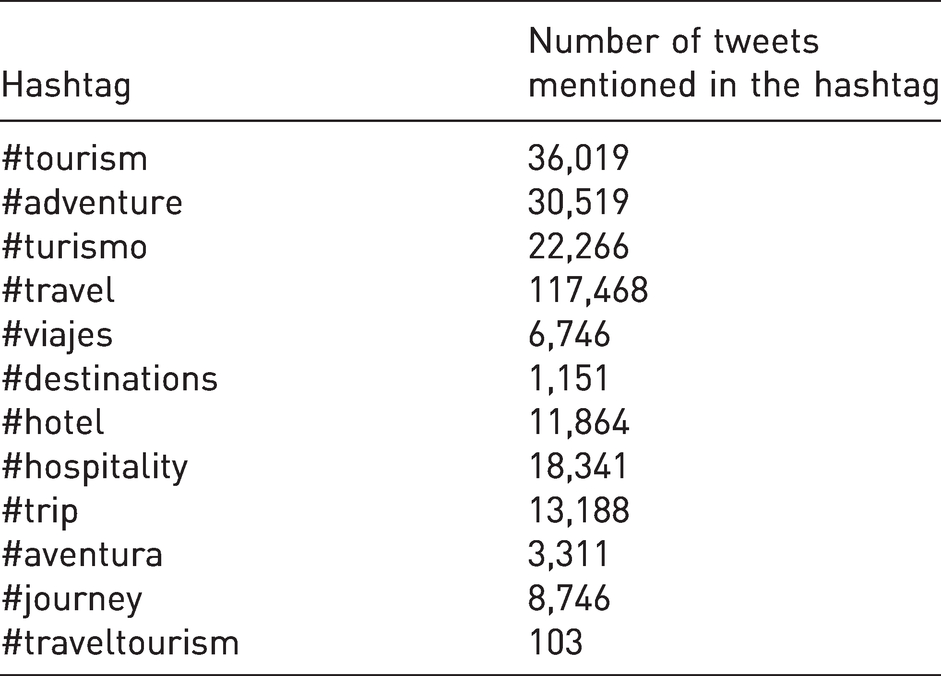
The data were collected from Twitter between March and April 2020 using the Mozdeh big data text analysis, for which a group of popular tourism hashtags was identified, as shown in Table 1. The data were collected through the Twitter API using big data software. The tweets' extraction was carried out in different languages and globally — that is, from different countries — managing to extract 269,722 tweets that fulfilled the condition that each tweet in its text could have one or more of the popular hashtags in tourism.
Popular tourism hashtags used in Twitter data collection.
As part of the processing, the data analysis followed the following steps:
First, the data were cleaned by removing duplicate tweets.
Second, the word associations technique was used to obtain the words associated with marine and coastal tourism in the collected Twitter data. For the search, a group of terms related to coastal and marine tourism was identified. Since the data were extracted from popular tourism hashtags, users referring to this type of tourism have directly used the terms' marine ‘tourism’ or ‘coastal ‘tourism’ or terms related to coastal and marine tourism. Table 2 details the terms used in the search.
Terms used in the search.

For the process of association of terms, a quantitative method of data was employed, using the Pearson's chi square statistical test, derived from a 2 × 2 contingency table with a critical threshold value of 3.841. To reduce the risk of falsely believing that a term is significant when examining multiple chi-square values, the method of Benjamini and Hochberg (1995) was used, which tests all words at once and shows all results. This method controls the risk of false positives when running multiple tests. The analysis was performed using Mozdeh big data text analysis software.
Results
Through the results of the word associations in the tweets of the popular tourism hashtags, the most used topics or words in the examined tweets were obtained. Table 3 shows the results of the association of terms. The ‘Match' column displays the percentage of tweets that contain the word that matches the terms about marine and coastal tourism. The ‘No match' column displays the percentage of tweets that contain the word that does not match the data collected with the search terms about coastal and marine tourism. The ‘Matches' column is the number of tweets that match the word with the terms about marine and coastal tourism. The ‘Total' column is the number of tweets that contain the word. The ‘DiffPZ' column is the difference in proportion z. The ‘Sig' column shows if the relationship was significant to the Chisq test performed.
Word associations with coastal and marine tourism.

Table 3 shows that the topics discussed during the communication related to coastal and marine tourism found in Twitter's tourism hashtags were ‘travel', ‘beach', ‘cruise', ‘sea', ‘ocean', ‘nature', ‘sun', and ‘coast', among others. These topics demonstrate the existence of communicated coastal and marine tourism at the time of the COVID-19 pandemic crisis, which is discussed by consumers and organisations. Because Twitter allows multi-voice communication between organisations and consumers, the terms also represent consumer-to-consumer communication, which includes multiple types of responses influenced by the Twitter medium, as it is considered an information hub and influenced by their consumer sentiments.
These topics could be used by destination managers to create marketing plans or position a coastal and marine product. Based on these results, the first research question (RQ1) is answered: What topics are discussed about coastal and marine tourism during the COVID-19 Pandemic in Twitter's tourism hashtags?
A dendrogram of clusters was performed, shown in Figure 1, which represents a hierarchical classification of the topics for discussion based on the number of tweets that match the search terms for marine and coastal tourism. It shows that the topics of greater hierarchy were ‘travel', ‘beach', ‘sea', and ‘cruise'. These topics refer to the motivational dimensions ‘escape' (by the topic ‘travel') and ‘sun and beach' (by the topics ‘beach', ‘sea', and ‘cruise'). Results also answer the second research question (RQ2): What are the greater hierarchy discussion topics related to marine and coastal tourism during the COVID-19 Pandemic in Twitter's tourism hashtags?
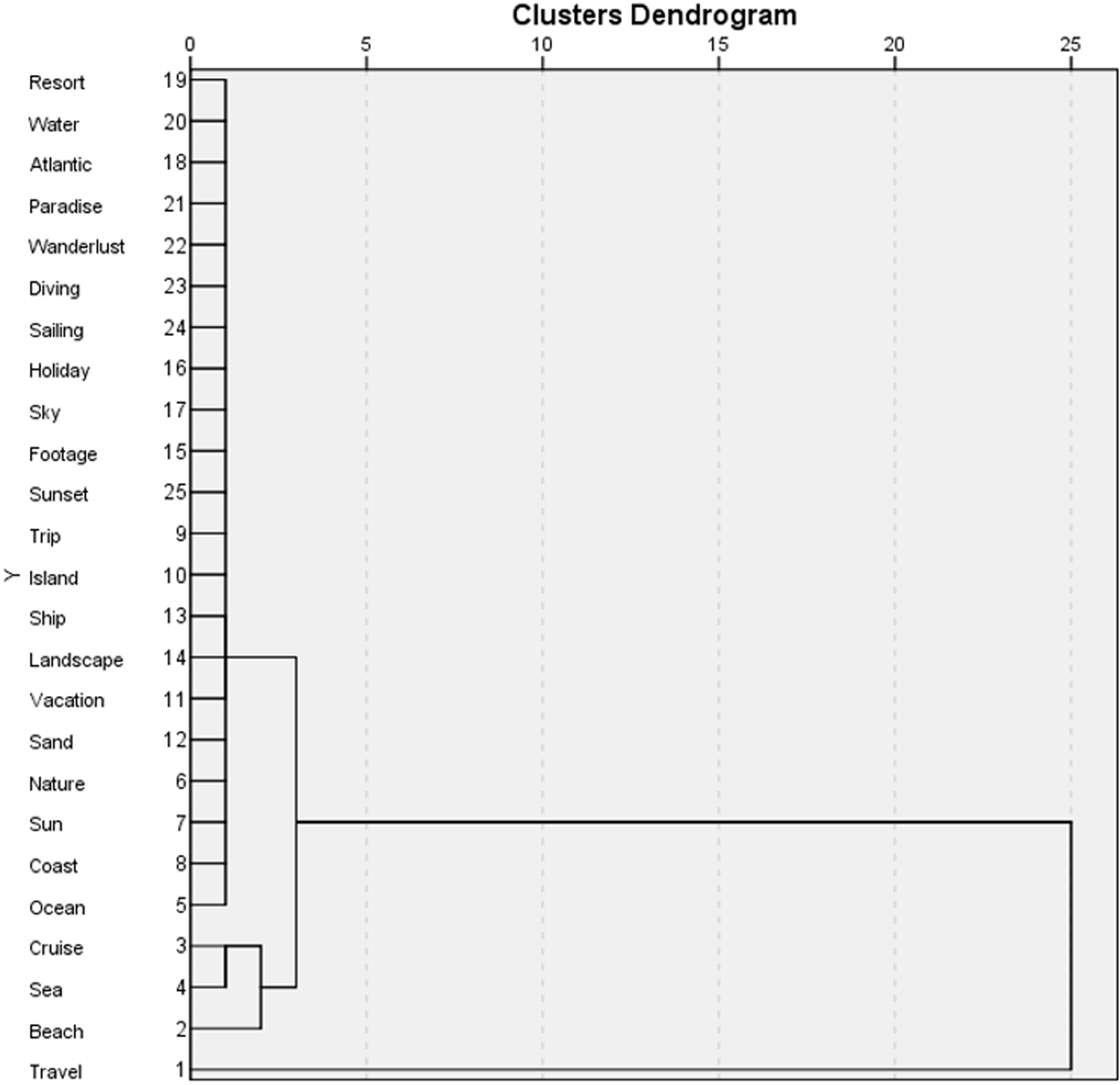
Clusters dendrogram.
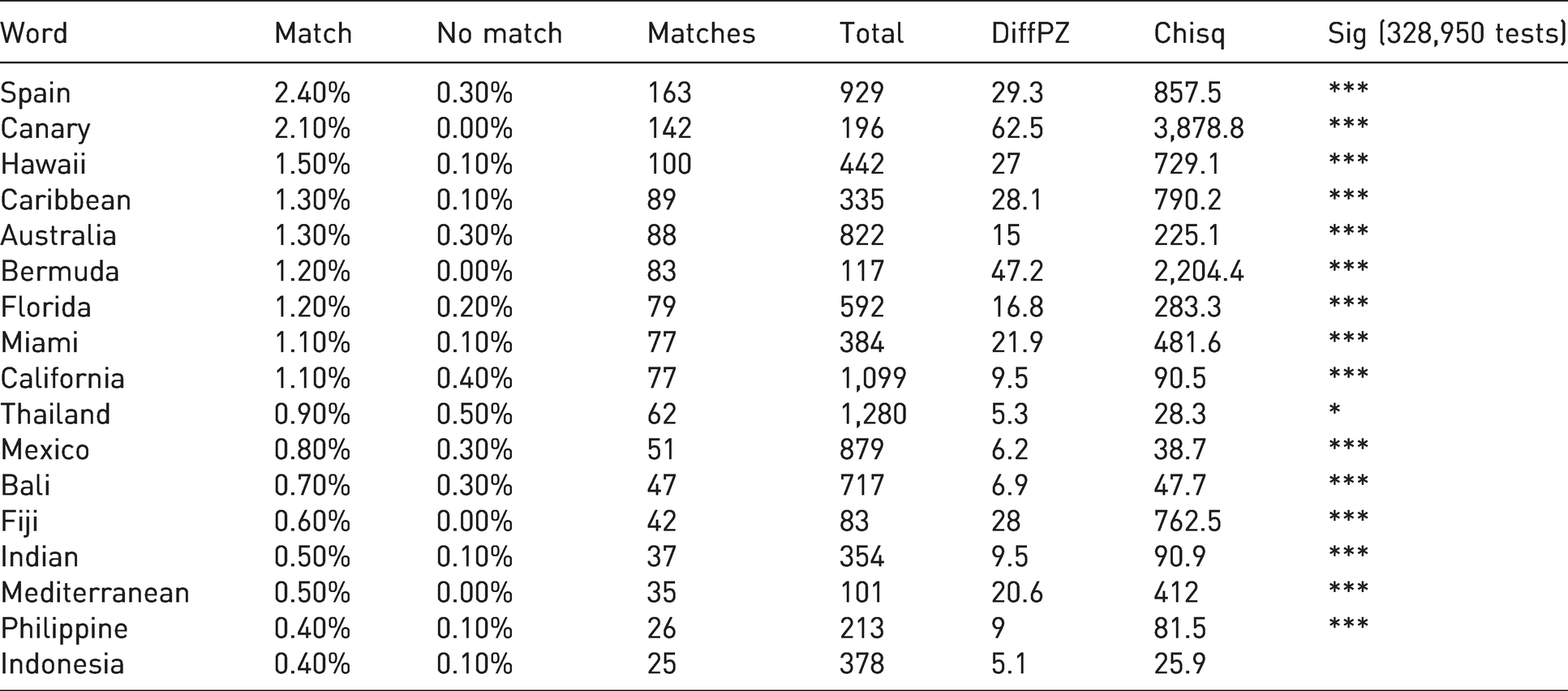
Table 4 shows that the destinations reported at the time of crisis related to coastal and marine tourism globally were Spain, Canary, Hawaii, Caribbean, Australia, Bermuda, Florida, Miami, California, and others. These results contribute important information for tourism operators to create products and promotions related to these sites and create public policies to improve the positioning of these destinations as places for coastal and marine tourism. In this way, the results show the answers to the third research question (RQ3): What coastal and marine destinations are discussed during the COVID-19 Pandemic in Twitter's tourism hashtags?
Destinations.
Discussion
One of this study's objectives is to identify the different topics discussed in popular tourism hashtags on Twitter during the COVID-19 crisis related to coastal and marine tourism. Regarding the first research question (RQ1: What topics are discussed about coastal and marine tourism during the COVID-19 Pandemic in Twitter's tourism hashtags?), the results show that the topics discussed were ‘travel', ‘beach', ‘cruise', ‘sea', ‘ocean', ‘nature', ‘sun', ‘coast', and others. As a contribution to the literature, the study represents a new finding on coastal marine tourism's theme on topics reported in times of crisis on coastal and marine tourism. Definitions of coastal and marine tourism have been written (Carvache-Franco et al., 2020a; Diakomihalis, 2007; European Commission, 2014; Hall, 2001; Honey and Krantz, 2007; Orams and Lueck, 2016), but to date this topic has not been addressed from the perspective of topics that are communicated in a pandemic crisis.
The study presents a second objective: to establish the topics of greater hierarchy of marine and coastal tourism in popular Twittter tourism hashtags during the COVID-19 crisis. For this reason, a second research question was asked: RQ2: What are the greater hierarchy discussion topics related to marine and coastal tourism during the COVID-19 Pandemic in Twitter's tourism hashtags? The results show that the highest-ranking themes were ‘travel', ‘beach', ‘sea', and ‘cruise.' These topics refer to the motivational dimensions ‘escape' (by the topic ‘travel'), factor identified by several authors (Güzel et al., 2020; Kruger and Saayman, 2010; Sastre and Phakdee-Auksorn, 2017) and ‘sun and beach,' (by the topics ‘beach', ‘sea', and ‘cruise'), factor argued by academics (Carvache-Franco et al., 2020b, 2020c; Koutra and Karyopouli, 2013; Pafi et al., 2020; Rid et al., 2014; Sastre and Phakdee-Auksorn, 2017), showing the importance of these dimensions. This study contributes to the academic literature by finding the most discussed topics in social media in this type of tourism.
The research presents a second objective: to determine the destinations that are discussed in the popular Twitter's tourism hashtags during the COVID-19 crisis related to coastal and marine tourism. For this, a third research question was asked: RQ3: What coastal and marine destinations are discussed during the COVID-19 Pandemic in Twitter's tourism hashtags? The results show that destinations such as Spain, Canary, Hawaii, Caribbean, Australia, Bermuda, Florida, Miami, California, and others are discussed. What is a new contribution to the scientific literature? Currently, there is no study that addresses the main coastal and marine destinations discussed globally in times of pandemic crisis. All these findings present a model to determine aspects related to the different types of tourism when humanity is in crisis, which will have theoretical and practical utility.
Twitter is an effective means for communication and dialogue on disasters and emergencies (Zahra et al., 2020). At the same time, it is a means through which consumers express their emotions (Rathore and Ilavarasan, 2020). In a pandemic, such as Covid-19, the comments are related to quality, resources, the destination environment, and the destination’s infrastructure. These statements are connected to the tourist offer that may be affected during the pandemic. This influences the motivation and satisfaction of the tourist. Given that tourists share their emotions and travel experiences through Twitter (Amaro et al., 2016), it is justified because they emerge as the main topics of conversation. Topics such as ‘travel', ‘beach', ‘cruise', ‘sea', ‘ocean', ‘nature', ‘sun', ‘coast', and conversation destinations such as Spain, Canary, Hawaii, Australia, Caribbean, Bermuda, Florida, California that are related to the motivational factors that tourists feel to visit and return to those destinations.
Conclusions
Coastal and marine destinations have a variety of activities related to their natural and cultural attractions that are part of communications during the COVID-2019 pandemic crisis in Twitter's tourism hashtags. Twitter is an efficient means of crisis communication in social media and allows one to find discussions and comments related to different types of tourism. The application of the word association technique demonstrated efficiency in finding results on Twitter in the field of tourism.
The study contributes new knowledge regarding coastal and marine tourism on the topics discussed at this time — namely, ‘travel', ‘beach', ‘cruise', ‘sea', ‘ocean', ‘nature', ‘sun', ‘coast', and others. It also contributes with the topics of discussion on marine and coastal tourism of greater hierarchy in times of pandemic — namely, ‘travel', ‘beach', ‘sea', and ‘cruise'. These topics refer to the motivational dimensions of ‘escape', and ‘sun and beach'. Likewise, geographical places that are discussed within coastal and marine tourism are identified in Twitter's tourism hashtags: Spain, Canary, Hawaii, Caribbean, Australia, Bermuda, Florida, Miami, California, and others.
As theoretical implications, the study contributes by finding the discussion topics, the topics of greater hierarchy in the discussion, and the relationship of the topics of greater hierarchy with the motivational dimensions, and the destinations discussed about marine and coastal tourism in the time of crisis in the COVID-2019 Pandemic in Twitter's tourism hashtags. The theoretical implications for the scientific literature on communication in a pandemic era in social media using big data are an evident contribution of the present study.
As practical implications, having found the topics will allow communication campaigns related to the sale and positioning of tourist products to be related to the topics found. The most hierarchical topics for discussion during the pandemic era serve to enable companies to position products according to these topics and to create coastal and marine tourism activities based on the ‘sun and beach' factor. These activities have to do with recreation on the beach, water sports, sailing, and beach events, among others. Having identified destinations with coastal and marine characteristics at a global level is of great practical contribution so that the DMOs of these places can position the image of their destinations and create their post-pandemic promotion plan based on these results. Also, travel agencies will be able to create coastal and marine tourism products in these international destinations.
Companies in the tourist destinations can organize communication plans during pandemics and disasters based on the topics and motivational factors found to mitigate the impact on tourist destinations and aim to preserve tourists' intention to return and travel to tourist destinations. Knowing that the ‘escape' and ‘sun and beach' dimensions of coastal destinations are the most associated in times of crisis allows tourism companies and destination managers to create promotion plans related to these motivations, highlighting the importance of sports in the sun and beach provoking family or friends getaways. Ecotourism activities at the beach would also be essential to promote because environmental care is typical of times of health crisis. If hiking, flora and fauna sighting, environmental education, contact with the community are created, tourists will want to purchase these products with due security and care in times of pandemics.
Finally, the present study's main limitation was the period in which the sample was taken (March to April 2020) because the crisis period is longer. As a future line of research, it would be interesting to replicate this study in other tourism modalities in order to create management and marketing plans in the different tourist destinations globally.
Footnotes
Declaration of conflicting interests
The author(s) declared no potential conflicts of interest with respect to the research, authorship, and/or publication of this article.
Funding
The author(s) received no financial support for the research, authorship, and/or publication of this article.
