




Abstract
Online communities have brought major changes in the behaviour of consumers in the travel and tourism industry. Travellers frequently rely on the User General Content (UGC) to make their travel-related decisions. Avid travellers join travel communities and actively look for unbiased information, and share their own experiences. This paper explores the predictors of consumer attitude and intention to follow UGC posted on online travel communities. Further, this study attempts to analyze the influence of Customer Value Creation (CVC) on attitude and traveller’s intention to adopt UGC posted on online travel communities. Data collected from 246 members of online travel communities were analyzed using Structural Equation Modelling. Empirical results show that CVC has a significant direct and positive impact on travel information adoption intention and indirect influence through attitude. This study is among the few on the impact of CVC on attitude towards UGC posted on an online travel community and advances the literature on the subject by explaining the relative impact of CVC on attitude from a different theoretical perspective.
Keywords
Introduction
With an upsurge in the number of Internet users, social media is being widely used not just by individuals but also by organizations as a marketing tool (Andersson & Wikstrom, 2017; Elena, 2016). Across the industries, companies use social media-based channels to reach both potentials as well as existing customers (Ebrahim, 2019; Ibrahim, 2021). These channels provide them with a platform to interact and engage with their customers and build long term relationships. In the last few decades, the internet has made a remarkable impact on people’s lives. The internet has caused an unparalleled proliferation of online communities across the globe (Andersen, 2005; Du Plessis, 2017), internet has become a credible and reliable on source of information as compared to the offline sources (Gao et al., 2012; Johnson and Kaye, 2004; Yen et al., 2011). Growing number of social media users having similar interests join to form virtual communities (Fotia et al., 2017; Pai and Tsai, 2016). These communities serve as a platform which facilitates the interaction and sharing of information, which can be useful for both, the customers and for the company with whom they engage (Blanchard, 2008; Hajli et al., 2017; Koh & Kim, 2003; Tonteri et al., 2011). These virtual communities can provide information about companies and their offerings, organizations can build their brands, can build customer engagement and loyalty by managing dialogues with the customers, increase profitability and can build long term mutually satisfying relationship.
Tourism companies promote their offerings through social media platforms, and travellers use these to share their experiences and feedback, while prospective travellers use the information in their travel planning (Wang et al., 2012). The online travel communities act as an important platform in which people with similar interest join to discuss, share, and interact, and pose a lot of opportunities for the travellers to search for information about various attractive travel destinations and facilities (Kamboj & Rehman, 2017; Qu & Lee, 2011). These communities provide a distinctive platform to both the tourism marketers and travellers to exchange views, experiences, information (Kim et al., 2004; Kamboj & Rehman, 2017; Kamboj et al., 2018), foster social relationships, maintain connections, interact with likeminded people, and finally take travel related decisions (Jiang et al., 2008; Wang et al., 2002). These online travel communities have brought a major shift in the way travellers communicate on travel related topics. They explore and discover travel options that were once unknown to them. On virtual communities without any restriction of time and distance they can provide and get travel suggestions, find travel companions, seek clarification, build relationships with fellow members, and share their experiences with others (Arsal et al., 2010; Daniel, et al., 2018; Jiang et al., 2008; Kim et al., 2004; Sanchez-Franco & Rondan-Cataluña, 2010).
Previous research has attempted to explore various facets of online customer behavior, such as information sharing and problem solving (Mathwick et al., 2008; Oliveira, et al., 2020; Wasko & Faraj, 2005), information seeking and social exchanges through online communities (Bagozzi & Dholakia, 2002; Belanche et al., 2019; Yi & Gong, 2013). However, scarce research is available on the value that customers derive from an online travel community and what impact does the value have on attitude of the customers and their intention to adopt travel related information.
Hence, this research explores the antecedents of consumer attitude and intention to follow the UGC posted on online travel communities, and examines whether the CVC dimensions (i.e., Functional Value, Hedonic Value and Social Value) as value perception of an online customer, determine their consumption behaviour (Carlson, et al., 2018; Hirschman & Holbrook, 1982). The theoretical contribution of this research is that it provides greater clarity on impact of customer value creation on information adoption. However, earlier research in the area is ambiguous and had a fragmented focus (Rouibah et al., 2021). Moreover, this study attempts to support the proposed model through a well-established theoretical framework.
This paper relies on Stimulus-Organism-Response (S-O-R) Model (Mehrabian & Russell, 1974) to analyze the role of attitude as a mediating variable between CVC and Travel Information Adoption (TIA). The study has important managerial implications in that it can help marketers by providing them deeper insights into the value that customers co-create on an online travel community and how this value affects their information adoption intention.
Theoretical framework and review of literature
According to S-O-R Model of Mehrabian & Russell (1974), an individual’s perception of a stimulus influences the affective and cognitive state (Organism) and results into a behavioural consequence (Response). Considering the S-O-R Model, we predict that CVC dimensions i.e. Functional, Hedonic and Social Value (Stimuli) affect the TIA (Response) through attitude (Organism). The specific contribution of this paper to the tourism literature is the empirical testing of a conceptual model that explains the process by which CVC dimensions affect the TIA.
Stimulus and organism
Customer value creation and attitude
In an online brand community customers integrate their cultural, social and physical resources when they interact with each other (Ha, 2018; Wang et al., 2011). By integrating their resources and interacting with each other they co-create value through developing relationships and utilize this value for consumption. (Kamalpour, et al., 2021; Laud et al., 2015). Value can be created both in online and offline settings. Any face-to-face encounter where customers witness the physical presence of other customers such as restaurants, zoo etc. is a face-to-face CVC (Gruen et al., 2007; Grönroos, 2017). People’s interactions into virtual value networks have got redefined with the advent of social media and smartphones (Brodie et al., 2011). Customers, users, travellers, businesses and others participate and interact to create value on SNSs which serves as platforms for value co-creation. In case of a social networking site or an online platform, value comes from the presence of number of users and their active interactions with each other (Lin & Lu, 2011). These interactions become the basic mechanism of value creation.
Functional value and attitude towards user generated content
The various dimensions of perceived value are functional, social, and emotional values (Sweeney and Soutar, 2001) while hedonic and utilitarian are most used facets in literature (Li, et al., 2020; Park, 2004; Voss et al., 2003; Zheng et al., 2019). The utilitarian value is functional and cognitive in nature (Ryu et al., 2010) and its value arises when the user gathers information or seeks advice from other customers/users to resolve an issue. Potential users/customers require information about product attributes, features, comparisons with other products, products alternatives etc. (Urbany et al., 1989). Even the present customers may search for information through online channels to solve usage related issues and for taking suggestions regarding products maintenance and repair (Andreassen and Streukens, 2009).
The posts and comments posted by other customers offer a wide array of information to resolve doubts and issues (Coelho et al., 2018; Dholakia et al., 2009; Dwityas & Briandana, 2017), lowers the uncertainty related with the purchases (Coelho et al., 2018; Dowling and Staelin, 1994; Zhang & Pennacchiotti, 2013) and prevents negative consumption experiences (Amblee and Bui, 2008). As utilitarian function is positively related to the attitude towards UGC, and is a predecessor of behaviour, we predict:
Functional value is significantly and positively related to attitude towards the UGC posted on an online travel community.
Hedonic value and attitude towards UGC
As per Chung et al. (2008), hedonic value is an important factor influencing user’s attitude towards an online travel community. Davis et al. (1992) in his motivation theory suggests that Internet users behave differently based on whether they are motivated by extrinsic or intrinsic factors. Extrinsic motivation drives behaviour with a motive of realizing certain goals (Deci & Ryan, 1987; Lin, 2007); whereas intrinsic motivation is related to the fun aspect of exhibiting a certain behaviour (Moon & Kim, 2001; Vallerand, 1997) and has a positive relation with customer’s attachment and cognitive absorption to the online platform (Kang et al., 2014; Kaur et al., 2018; Weniger & Loebbecke, 2011). Hedonic value through internet stimulates excitement, enjoyment, positive feelings, and satisfaction (Kang et al., 2014; Wang and Fesenmaier, 2004; Zaglia, 2013). As per Mafe et al. (2016), emotions incited have a direct impact on consumers’ attitude towards the content posted on an online travel community.
Travellers use UGC posted on various websites not just for its functional value but also for the perceived enjoyment linked with the sharing and reading of information on such websites (Chung and Buhalis, 2008; Razi et al., 2016; Wang & Fesenmaier, 2004). The hedonic value associated with the interaction in an online travel community is particularly strong because of continuous supply of several motivations directed towards positive experiences and affective responses (Chung and Buhalis, 2008; Li et al., 2019; Wang & Fesenmaier, 2004). Thus, the following hypothesis was framed:
Hedonic value is significantly and positively related to attitude towards the User Generated Content posted on an online travel community.
Social value and attitude towards UGC
Online communities provide social values by allowing the members of the community, who share similar interests to interact and socialize. The purpose of these communities is to exchange information or to engage in social interactions with the peers (Luo et al., 2019; Kozinets, 1999). The UGC can also help in the reinforcement of customers’ social orientation as it shows how their usage of the product is seen by other members of the community. As per Tafel and Turner (1986), the identity of the group is defined by the opinion of the group members on the product.
Social motivations for participation in an online community are like those relating to “real life” social networks and includes making new connections and maintaining links with current friends. Online travel communities provide a platform for building and keeping ties with the members of the community (Luo et al., 2019; Wang, and Fesenmaier, 2002). Some researchers believe that psychological needs are an important motivation for joining the online communities (Bressler and Grantham 2000; Ben-Shaul & Reichel, 2017). As per Sun et al. (2017), the need for developing social relations is a key reason to join the SNS platforms. Thus, we predict:
Social value is significantly and positively related to attitude towards the User Generated Content posted on an online travel community
Organism and response
Attitude on travel information adoption
Consumer attitude can be defined as a favourable or unfavourable evaluation the consumers make of a behaviour (Dillon & Morris, 1996; Wu & Chen, 2005); or of the information obtained from an online travel community (Thorson & Rodgers, 2006). Attitude of the consumer towards eWOM communication is an important determinant of consumer’s response to the information (Jalilvand and Samei, 2012).
In online settings, several researchers have analyzed the role of attitude in determining conumers’ behavior. Available literature points towards the impact of attitude on internet usage behavior (Porter & Donthu, 2006), virtual communities (Bagozzi & Dholakia, 2006), purchase intentions (Hausman & Siekpe, 2009) travel intention (Rizky et al., 2017) etc. This shows that attitude plays a particularly important role in depicting online consumer behaviour.
Many researchers have attempted to investigate the role of attitude on consumer decision making in the context of product purchases (Cheung and To, 2019; Dellarocas and Narayan, 2007; Kozinets, 2002; Taylor & Todd, 1995). However, present research follows a different approach and tries to understand the influence of attitude towards UGC (Bagozzi and Dholakia, 2006) and the intention to follow the suggestions posted on the social media-based travel communities. Thus, the following hypothesis was framed:
Attitude is significantly and positively related to Travel Information Adoption posted on an online travel communities.
The mediating role of attitude
Many social media based studies have examined the role of attitude as a mediator between various variables such as website usage and satisfaction (Luo, 2010); perceived ease of use, perceived usefulness and online shopping intention (Ashraf et al., 2014); Customer motivation and SNS usage intention (Chiang, 2013). In this study, we propose that attitude mediates the relationship between various dimensions of CVC (Functional, Hedonic and Social value) and TIA, as we have hypothesized that CVC dimensions are related to both the variables, which may result into TIA.
According to Hypotheses 5 to 7, CVC dimensions have a indirect impact on TIA through attitude. The proposed conceptual model of this study is shown in Figure 1. Thus we hypothesize: . S-O-R model. 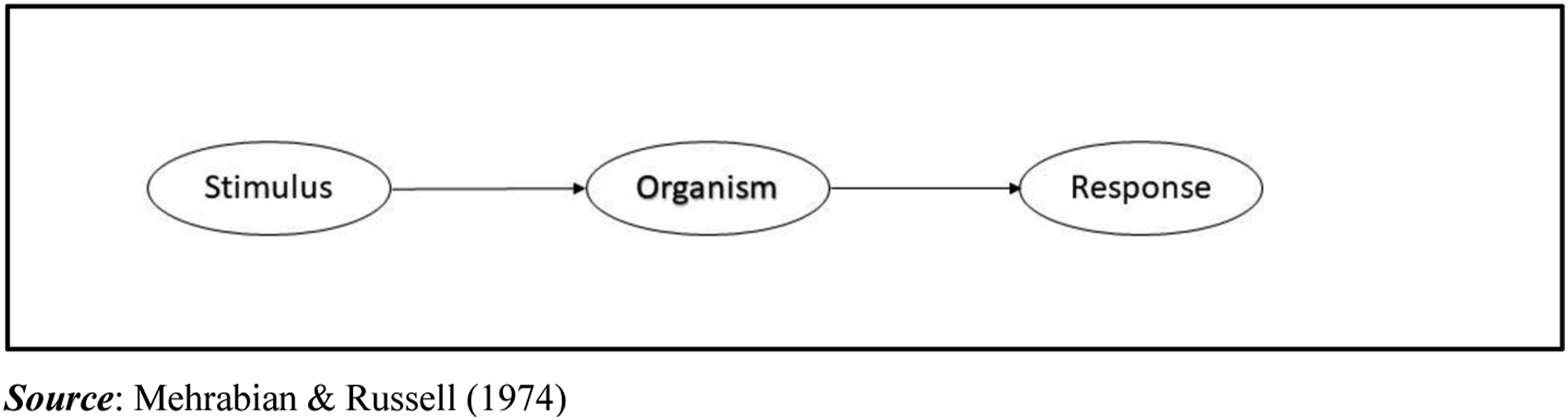
Attitude mediates the relationship between Functional Value and Travel Information Adoption.
Attitude mediates the relationship between Hedonic Value and Travel Information Adoption.
Attitude mediates the relationship between Social Value and Travel Information Adoption.
Research methodology
Measures
The research instrument for the study has been adapted from the scales used by (Jahn & Kunz, 2012 (Functional Value); Rehman et al., 2017 (Hedonic Value); Zhang et al., 2016 (Social Value); Zainal et al., 2017 (Attitude); Sussman & Siegal, 2003 (Travel Information Adoption). The responses were collected on 5-point Likert Sale (1 = Strongly Disagree and 5 = Strongly Agree), to measure the impact of the three CVC dimensions (functional benefits, hedonic benefits and social benefits) on customers ‘attitude and on TIA.
Data collection
The research instrument was administered on members of a facebook based travel community. The community was specifically chosen for the study as the community is one of the largest travel communities with over 1 lac members. Respondents were asked to give their responses on the statements for the measurement of variables in the study. The questionnaire was hosted on Google forms and the link was shared with the members of the online travel community. This method of online survey is comparable to the data collection approach used by Casalo et al. (2011) and Zainal et al. (2017). During the first iteration, the research instrument was improved based on inputs from five (05) active members of travel community. During the second iteration, pilot testing of the instrument was done on another set of 30 members of the travel community. During this stage, further modifications, that included rephrasing of some of the scale items, were made and the instrument was finalized for the study.
Responses from 258 patrons of the travel community were received from October 2020 to February 2021. After removing 12 responses that were incomplete in various respects, feedback from 246 patrons was found complete in all respects and considered for further analysis. As per Hair et al. (2010), the sample size of 246 was appropriate for employing structural equation modelling techniques since the sample size falls within the range of 5i ≤ n ≤ 10i (where i = items in the questionnaire).
Sample characteristics
The sample had a representation of 68% males, while female representation was around 32%. Most respondents were from the age group of 18–25 years (32%), followed by 36–45 years (26%), 26–35 years (24%) and 46–55 years (18%). Around 41% respondents held a post graduate degree, followed by graduates (33%), undergraduates (23%) and doctorates (3%). Most respondents (47%) had an annual income of less than Rs. 5 Lacs; and 49% respondents were member of the travel community for 12–24 months.
Tests for potential biases
Non-response bias
As per the recommendations of Armstrong & Overton’s (1977), the research assessed non-response bias by taking responses of early respondents (questionnaire filled in Oct- Dec) and late respondents (filled in Dec-Feb) and comparing them. T-test was applied on both these groups, and no significant differences were found in their responses (Wilk’s Lamda = 0.49, p = 0.001).
Common method bias
CMB exists if a sole factor contributes more than 50% to the total variance indicating that one factor contributes dominantly in the study (Podsakoff & Organ, 1986). To assess the Common Method Bias which is quite common in case of self-reported data, Harman’s single factor test using Exploratory Factor Analysis was employed in the study. Findings revealed that no single dominant factor exists in the study, as highest co-variance explained by single factor was 17.326% which is less than 50% of the total variance (Podsakoff & Organ, 1986). Thus, common method biases were not expected to contaminate study results.
Data analysis
Exploratory factor analysis
Screening and purification of the items for internal consistency was done through EFA (Churchill & Brown, 2007). The technique is used for identifying the basic structure of the constructs. Varimax rotation was used for factor inclusion. Loadings of all factors was greater than 0.5 and significant at p < 0.001, ruling out the concern of multicollinearity (Yoon and Uysal, 2005). Eigen value of above 1, extracted five factors, and the factors explained 73.631% of total variance. Each factor had a reliability ranging 0.77–0.94 and is more than the suggested threshold of 0.6 and thus the internal consistency is good (Bagozzi & Yi, 1988; Hair et al., 2003).
These values were indicative of a highly consistent and reliable research instrument. The variables used in the research instrument were also high in content validity as the instrument was designed by reviewing the available research.
Measurement model
Confirmatory factor analysis:
Results of Confirmatory Factor Analysis, Percentage of Variance and Cronbach’s alpha.
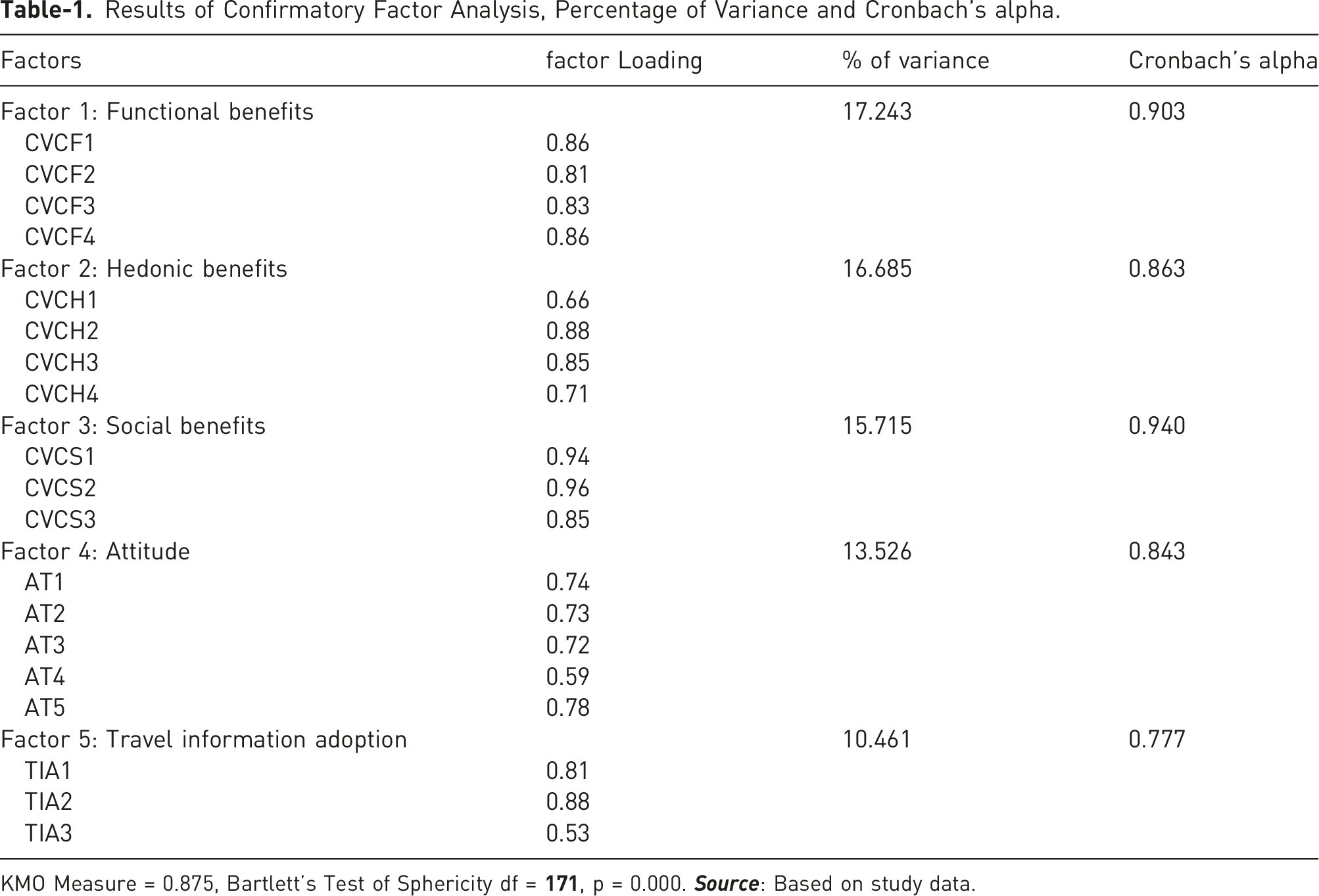
KMO Measure = 0.875, Bartlett’s Test of Sphericity df =
Assessment of discriminant validity.

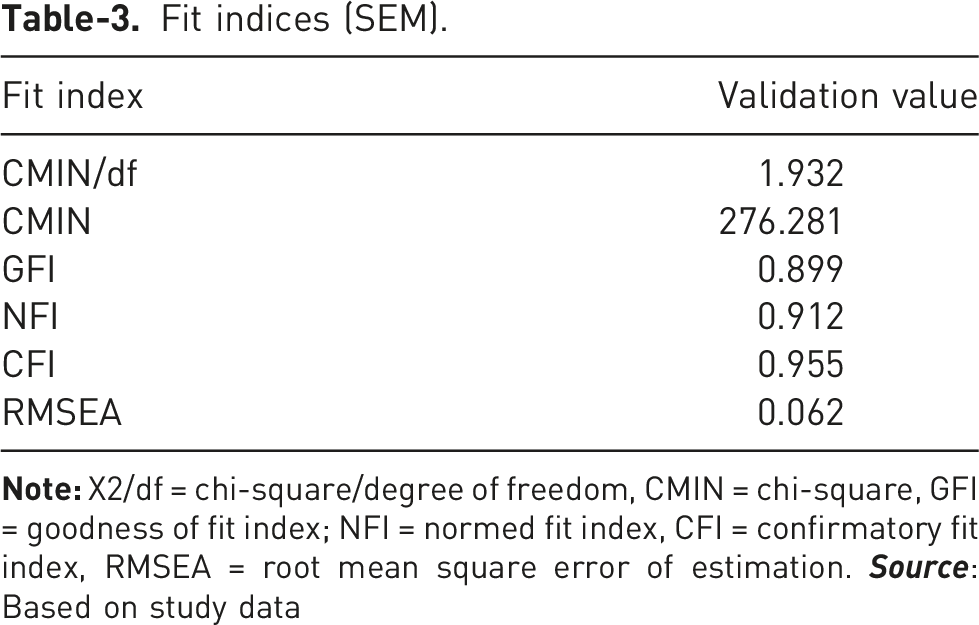
Table 2 shows the assessment of discriminant validity in which the diagonal elements in bold represent the square roots of the AVE for each of the construct, which is greater than the off-diagonal elements. This indicates that each construct shares more variance with its measures than with other constructs. Hence, the measurement model is as per the study assumptions. Indices such as Chi-square/df; Chi-square; GFI, CFI, NFI and RMSEA were considered for assessing the model fit. The value of the indices indicated modest model fit to (χ2/df = 1.864; χ2 = 260.911; GFI = 0.899; CFI = 0.959; NFI = 0.917 and RMSEA = 0.059).
Structural model
Fit indices (SEM).
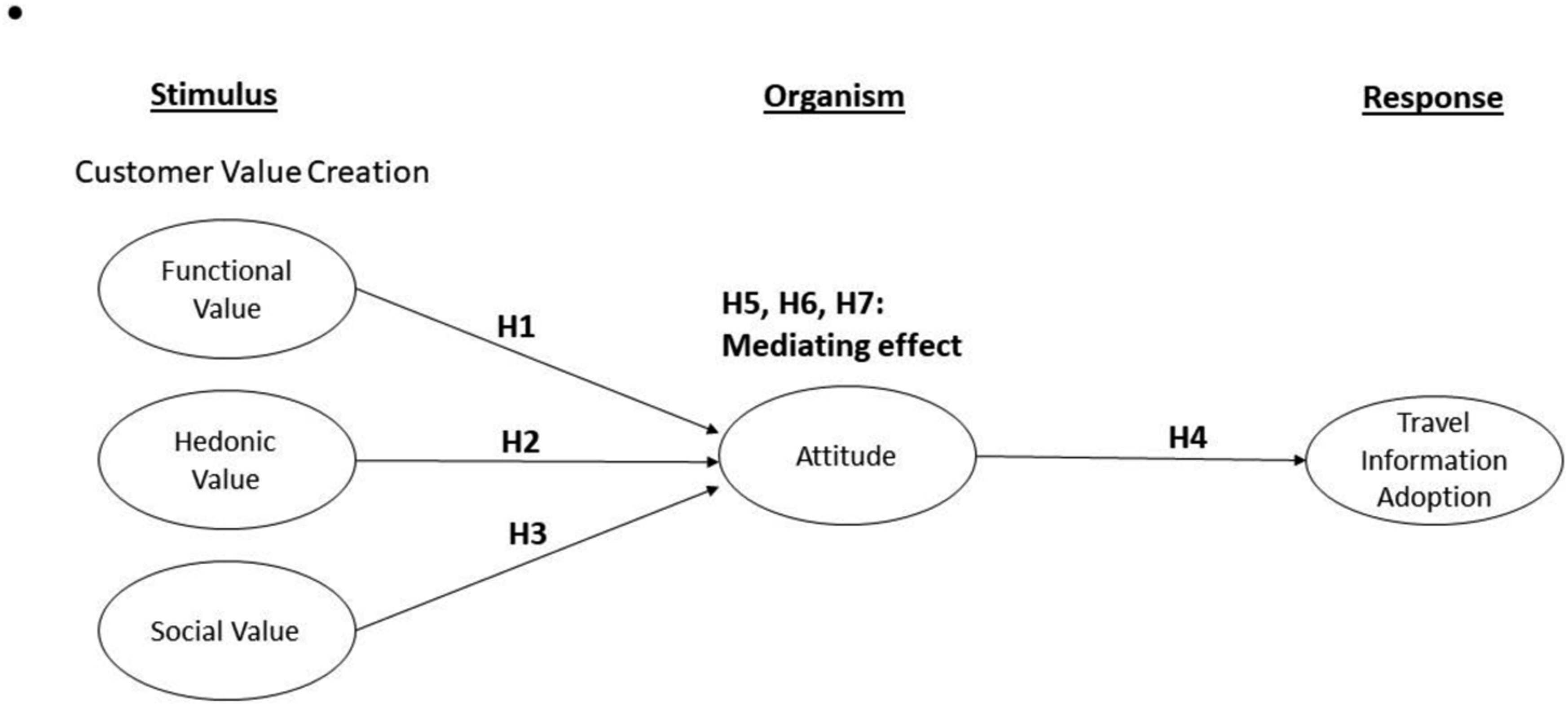
Proposed study model.

Results of structural modelling.
Hypothesis Testing
Result of hypothesis testing.
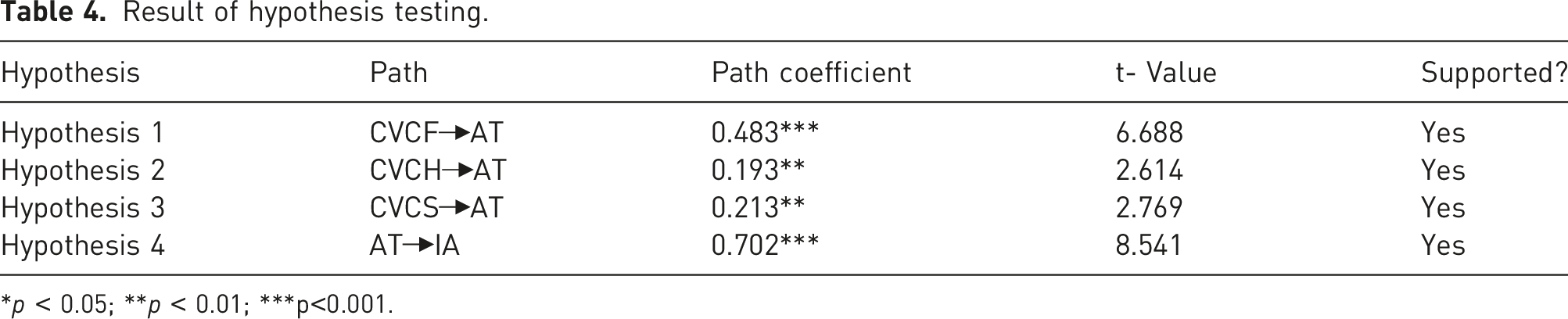
p < 0.05; **p < 0.01; ***p<0.001.
Result of hypothesis testing (mediation).

p < 0.05; **p < 0.01; ***p<0.001.
Research findings and conclusions
The internet has empowered the customers in their ability to use and spread information. The consumers can now easily access UGC and can interact with people across the globe. Social media based communities further facilitate the flow of content among members sharing similar interests. These communities attract UGC in which people post their experiences, share reviews, and interact with each other.
The impact of eWOM on behavioural intentions have been extensively researched (Chan & Ngai, 2011; Park et al., 2007; Zhang et al., 2010). However, as already discussed the study relies on S-O-R Model (Mehrabian & Russell, 1974) to analyze the role of attitude as a mediating variable between CVC and Travel Information Adoption (TIA). Results from the structural equation model indicate that CVC dimensions have significant effect on attitude towards UGC and TIA. In line with the S-O-R Model, the results revealed that attitude fully mediates the impact of Hedonic and Social value and partially mediates the impact of functional value on TIA.
This study is among the scant research available on the impact of CVC dimensions on the attitude. It has been observed that members of the travel community do not just interact with each other for the utilitarian/functional purpose but also for the joy (hedonic) and social interactions (social value), they continue interacting with like-minded people. In this paper, we examined the impact of CVC dimensions on TIA with attitude towards user generated content as a mediator. Study findings show that all CVC dimensions influence the attitude towards the UGC. However, for the members of the travel community, functional value was found to be more important than hedonic and social value which shapes the attitude towards the online content posted on travel community which leads to adoption of the information in the travel planning process.
Relationship between customer value creation and attitude
The findings showed that CVC has a significant and positive bearing on the attitude towards user generated content. The functional value derived from user generated content posted on online communities is a strong determinant of attitude. In other words, functional value that people get while interacting with the members of an online community forms their attitude towards the User Generated Content (UGC).
The outcomes of this study are consistent with the past research by Reichelt et al. (2014) wherein the researcher posited that the utilitarian/functional value and social value derived from the online content has a significant impact on attitude towards the eWOM. Interestingly, study findings are at variance with the observations by Povry et al. (2012), as per which utilitarian information search does not have any significant impact on eWOM usefulness.
Relationship between customer value creation and travel information adoption
In case of members of online travel community, CVC has a significant positive relationship with the TIA. Here members create value (functional, hedonic and social) as they interact and engage with the other members of the community. These value dimensions have a strong impact on TIA, while attitude mediates the relationship between CVC dimensions and TIA.
Theoretical & managerial implications
The study contributes to the literature on User Generated Content and Online Communities in several ways. First, although previous researchers have studied Generated Content and the predictors influencing its usage; the impact of customer value creation on travellers’ attitude and intention to adopt TIA had rarely been examined. Thus, the current study is unique in that it attempts to examine the relationship between CVC dimensions and attitude, more particularly in the context of Online Travel Communities. Second, this study used S-O-R Model to describe the impact of CVC dimensions on attitude and TIA.
This study has important marketing implications as it provides travel and tourism organizations with deeper insights on how to use social media-based communities as a marketing tool. The results show that users (i.e. customers) co-create value on online communities. This value can be social, hedonic, and functional value. However functional value tends to play the most important role in shaping the travel attitude towards the UGC. Marketers thus may design content and motivate the reviewers/users to post content which is high on utilitarian aspect and is reliable and up-to date. Similarly, the hedonic value affects the attitude towards UGC. Therefore, tourism marketers and travel communities should encourage members to create and share content with a high hedonic value (multimedia content) as this will shape a positive attitude towards the user-generated content (UGC) posted on the community. Marketers should further incentivize customers to encourage them to share their experiences, as active participation in a community result in the creation of value through social interaction. By active interaction and engagement with online communities’ firms can enhance customer loyalty thereby resulting in increased satisfaction and thereby profits (Wang & Fesenmaier, 2004b).
The present study also provides inputs to the marketing managers about the significant determinants of information adoption in travel planning process. Study findings can be of immense help in designing as also dovetailing the strategies to better leverage on online communities by designing content that may be of functional, hedonic, and social value for the patrons (i.e., Travellers). Travellers should be motivated to write reviews and share their experiences on social media, so that other members of the community derive functional, social, and hedonic value from the UGC and may adopt it in their travel planning behaviour.
Limitations and avenues for future study
There are a few limitations of this study, that may suggest avenues for future research. Firstly, the study only tested CVC dimensions to explore the UGC usage for travel planning. It is expected that future researchers might delve into additional factors to describe the relationships among constructs in our pursuit to identify the predictors of UGC usage in travel planning behaviour. Secondly, the study is limited to a Facebook based travel community, and thus the findings may be generalized with caution vis-a-vis other online travel communities and social networking sites. Future researchers may examine other communities and social networking platforms. Thirdly, as the present study has explored the factors affecting usage of UGC on a travel community, future studies may explore the factors affecting the adoption of Marketer Generated Content that may provide valuable theoretical and managerial insights. Fourthly, this research did not consider the impact of diverse demographics on value creation and TIA and thus future researchers may test the proposed model by using demographic variables like age group, gender etc. and their impact on value creation and TIA. Future research could be conducted using data from patrons with diverse demographic background obtained from other websites such as TripAdvisor, Expedia, Trivago for validating the proposed model.
Footnotes
Declaration of conflicting interests
The author(s) declared no potential conflicts of interest with respect to the research, authorship, and/or publication of this article.
Funding
The author(s) received no financial support for the research, authorship, and/or publication of this article.
