




Abstract
Homeschooling families typically have the freedom to plan educational road trips without the constraints of a traditional school calendar. For this study, a total of 21 web pages were selected using ‘roadschool’ – a term that has recently emerged to describe such trips – as a keyword. A web content analysis revealed that this option is perceived as an opportunity for family bonding and is mostly popular among homeschooling families who own recreational vehicles and consider themselves digital nomads. Furthermore, it was observed that roadschooling parents often exhibited personality types that enhanced the overall learning outcomes and experiences of their trips. Implications and future research directions are discussed.
Introduction
In recent years, the number of homeschooling families worldwide has grown considerably. In the US, homeschooling was already considered the fastest growing form of education before the COVID-19 pandemic started (Ray, 2016). However, according to the US Census Bureau (2021), the number of families that opted for homeschooling in response to the pandemic (i.e. either because of fear of the virus or due to disagreeing with the policies put in place by school districts and/or State mandates) was such that the percentage of households with children being homeschooled has doubled (i.e. from 5.4% during the 2019–20 school year to 11% in 2020–21). Furthermore, a significant growth has been observed in the demographic diversity of these families in terms of religion, political viewpoints, socioeconomic levels, educational background and race/ethnicity (Ray, 2016). For instance, among Black households, homeschool families increased from 3.3% to 16.1% in the last year (Heuer and Donovan, 2021). While each family has its own reasons for homeschooling (Redford et al., 2017), a particularly common factor is an appreciation of the freedom and autonomy that homeschooling provides as it allows families to personalize the curriculum and learning environment for each child and redesign learning pathways using diverse pedagogical approaches with the aim of acquiring better academic results (Hirsh, 2019). Such freedom also allows homeschooling parents to plan trips unhindered by the school year, thereby enabling them to take trips as often and for as long as they wish.
Contrary to what many believe regarding education happening primarily in the classroom, it is well known that learning can occur in many contexts such as while travelling (Stone and Petrick, 2013). Thus, for many parents travel opportunities represent a critical component of their children’s education (Fu et al., 2022; Wen, 2020). In fact, Pomfret (2019) argued that the richest family holiday experiences are those where education and other three elements (i.e. entertainment, escape and aesthetics) are combined. Therefore, as suggested by Lee et al. (2008), motivations and activity preferences of visitors who travel with a child are significantly different from those who travel without children, as nature centres and historical sites which offer educational value seem more attractive to the first group.
Educational tourism has largely been explored in terms of its social and economic benefits (Hussein et al., 2021; McGladdery and Lubbe, 2017; Tang, 2020). However, in recent years within educational tourism, more specific niches related to homeschooling – which remain underexplored – are starting to emerge. For instance, worldschooling allows participants to experience the world as their classroom (Ferraro, 2016; Riley, 2017). According to Molz (2021), parents who choose this lifestyle want to enjoy time with their children while giving them opportunities to experience the major cultures of the world, learn multiple languages and become world citizens. Similarly, the term ‘roadschooling’ has recently gained popularity among homeschoolers who want to plan family road trips while continuing to cover academic topics as planned. Therefore, they use trip adventures for complementing the learning process by making their trips naturally educational. These experiences are usually considered an alternative for those unable or unwilling to travel abroad. However, some families choose roadschooling while visiting foreign countries (Cowley, 2016). Therefore, besides visiting local attractions, some families use more tourist services than others (e.g. hotels, Airbnb and camping sites) (Oaks, 2020). Even though some books and guides about roadschooling have been published (Calapp, 2017; Cowley, 2016; Oaks, 2020; Sathre-Vogel, 2014), and a plethora of testimonies and resources can be found online, roadschooling and its advocates seem to possess characteristics that need to be better understood from an academic perspective. This study thus aims to explore the definition of this term and determine the main personality features of the parents/caregivers that incorporate this practice in homeschooling.
Materials and methods
Data were collected through text-based data mining in June 2021. First, Semrush software was used to identify all web pages containing the keyword ‘roadschool’. The US was identified as the country with the largest number of web pages containing this keyword (240 pages). Consequently, the US was selected in the ‘Topic Research’ function to display pages in the descending order of importance according to the indicator ‘Total Shares’ detected by the software. A total of 21 web pages were then selected, after confirming that they contained the necessary information to fulfil the study objectives (i.e. definitional information about roadschooling and/or personal testimonials of roadschooling families).
For the web content analysis, the first step was to use Voyant Tools software to enter links to 18 websites, with 43,775 total words, containing definitional information about roadschooling. Through an automatic process, the most used terms – including the links among them – and phrases were identified. For the later analysis, a total of 8647 phrases containing at least three words were examined and corresponding descriptive ideas were manually selected. Finally, to fulfil the second objective, Apply Magic Sauce software was employed to develop a psychographic profile of the parents/caregivers; this profile was based on a reinterpretation of the Myers–Briggs Type Indicator from the perspective of the five-factor (or Big 5) model (McCrae and Costa, 1989), comprising openness to new experiences, conscientiousness, extraversion, agreeableness and neuroticism. For this purpose, paragraphs of between 107 and 190 words from 14 websites containing personal testimonials of roadschooling families were analysed.
Results
Most repeated describing terms and phrases.

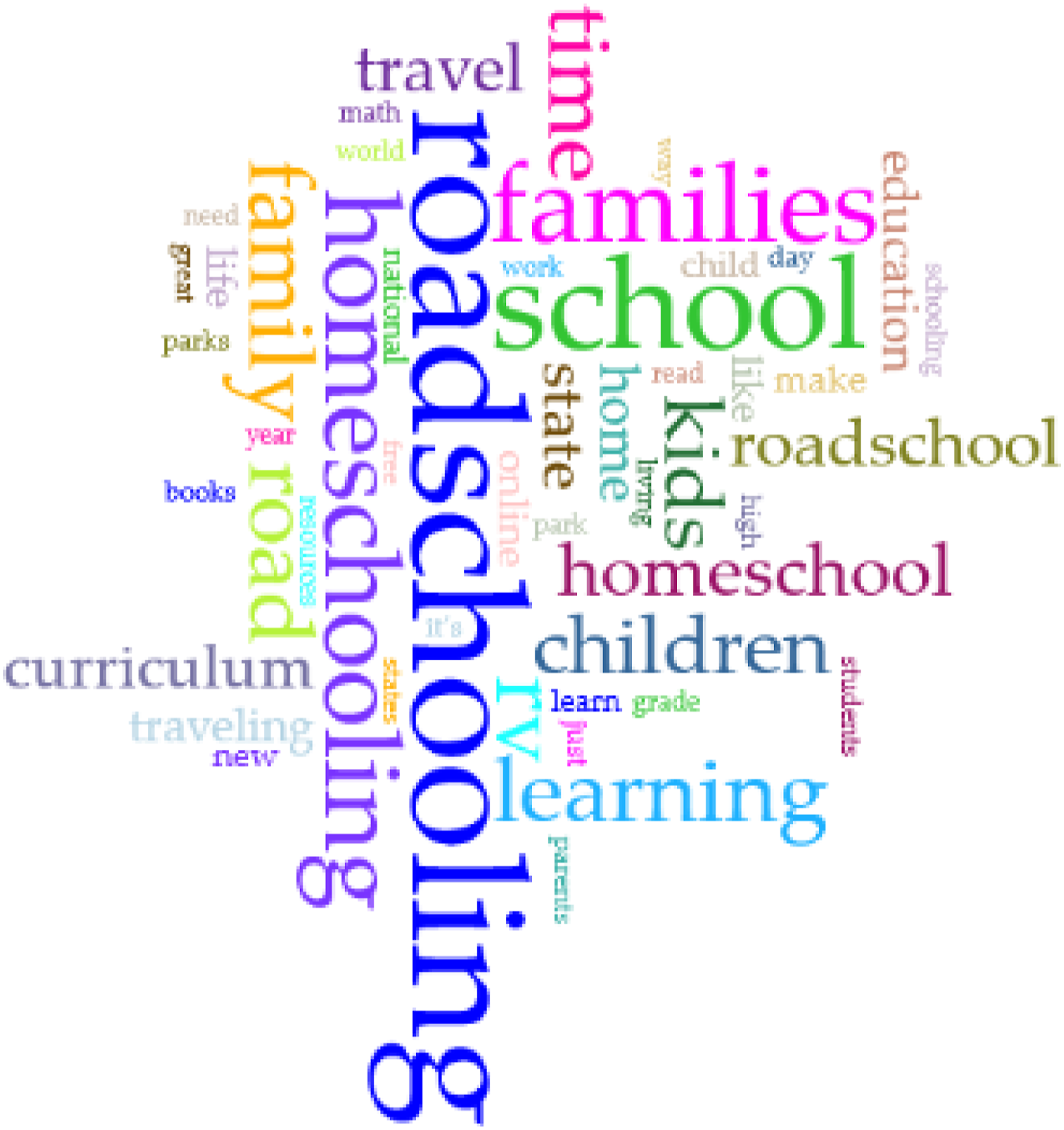
Visual representation of the most repeated describing terms.
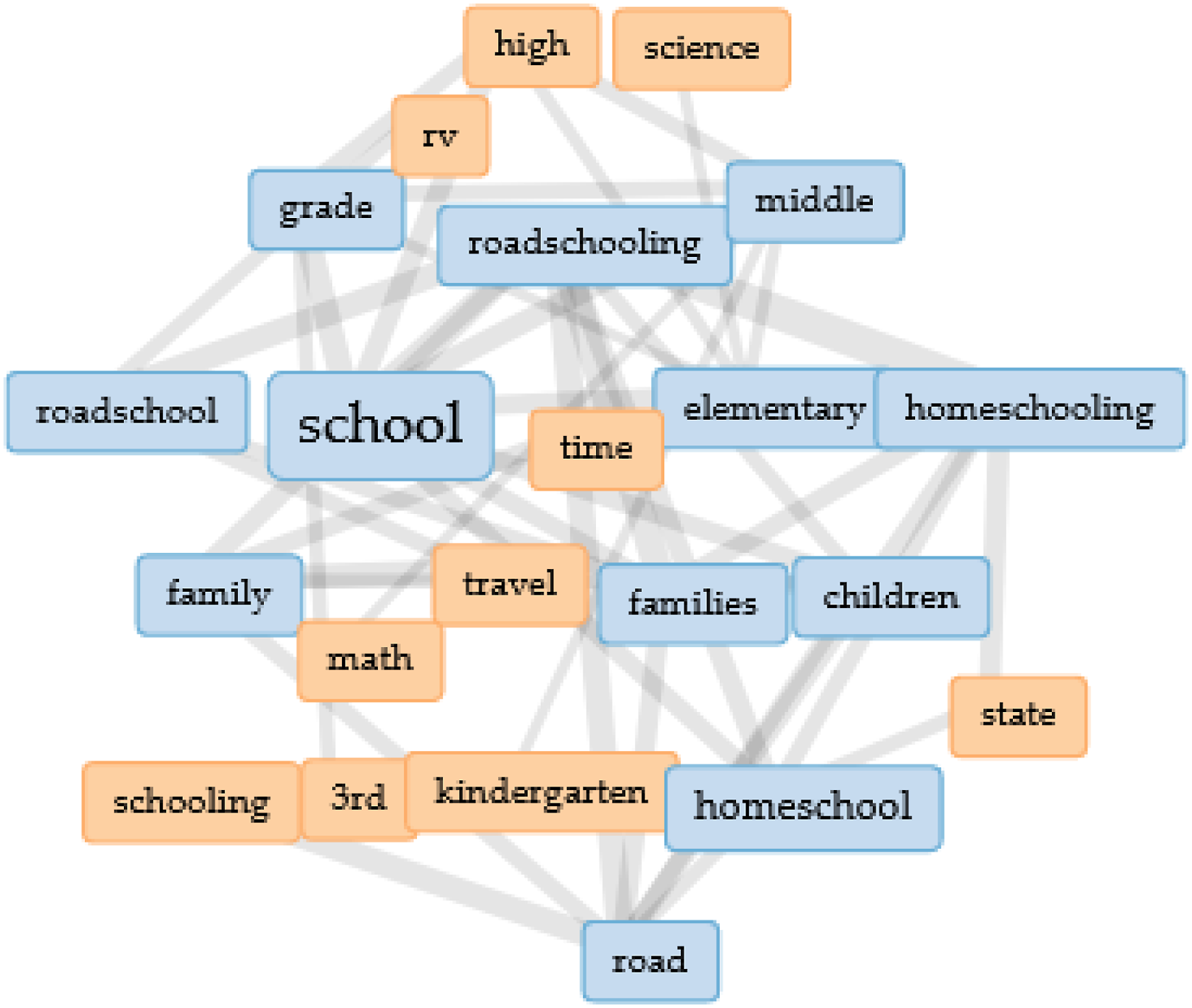
Links among the most repeated describing terms.
Regarding the psychographic profiles of parents/caregivers on the ‘extraversion’ dimension, all appeared to be more contemplative and to prefer their own company rather than engaging with the outside world. For the ‘conscientiousness’ dimension, 12 parents were found to be more organized and hardworking rather than being impulsive and spontaneous. For the ‘openness to new experiences’ dimension, 11 were more liberal and artistic rather than having a conservative and traditional approach. Similarly, for the ‘neuroticism’ dimension, 11 were more laid back and relaxed rather than being easily stressed and emotional. Finally, for the ‘agreeableness’ dimension, 10 parents were observed to be team workers and trustful rather than being competitive.
Distribution as per the personality types.

Discussion
The present exploratory study reveals the main characteristics of roadschooling and roadschoolers and is intended to establish a basis for further exploration of the topic.
The study findings suggest that just as with worldschooling, one of the main advantages of roadschooling is that families can spend time together, connecting and bonding in a special way (Haverly et al., 2020). However, unlike worldschooling, which can be done alone, with friends or more formally through an organized programme (Riley, 2017), roadschooling is done exclusively as a family. Particularly, this option seems to be gaining popularity among those homeschooling families who own an RV. This finding supports the idea that even though active seniors are still the majority of RV users, Gen Xers and Gen Yers are starting to feel attracted to a mobile lifestyle given that thanks to the internet they may now work and educate their kids on the road while staying connected with family, relatives and the rest of the world (Landin, 2015). Not surprisingly, findings also suggest that roadschooling families refer to themselves as digital nomads, a modern term that refers to remote workers who use telecommunications technologies to earn a living while travelling to different locations instead of being confined to a workplace (Müller, 2016; Thompson, 2019). Therefore, it seems that roadschoolers – like worldschoolers – perceive themselves as pioneers of an increasingly mobile holistic lifestyle characterized by comprehensive freedom (Molz, 2021; Reichenberger, 2018).
According to the study findings, roadschooling can be understood as a lifestyle choice for homeschooling families whose children are at any school level – especially but not exclusively for those who own an RV and fall into the category of a digital nomads – who want to experience a prolonged family road trip adventure while following an organized but flexible curriculum that incorporates visits to settings where different study subjects can converge. This kind of approach has been suggested to offer unique opportunities for social and personal development of children (Ferraro, 2016). In regard to the main personality features of the roadschooling parents/caregivers, these appeared to exhibit independence of thought, strong individualism and creativity. The latter – combined with an overall laid back and relaxed attitude – is a key element in ensuring learning effectiveness, as children (and adults) learn more effectively when enjoyment and passion are involved (Haverly et al., 2020).
Future examination is needed to better understand this lifestyle from an academic point of view as it has the potential of becoming a growing tourism niche. This is especially important considering that nomadic lifestyles entail becoming free, both from geographical constraints and from the world of consumption by giving up a long-term home and selling, storing or giving away all household possessions (Landin, 2015); therefore, this people focus on spending most of their money on the travelling experiences. Durko and Petrick (2013) highlighted that there is still room to better understand the effects of travel on children’s education and family cohesion. In particular, further exploration is needed regarding the short term and long-term benefits that roadschooling opportunities may bring for the children’s overall development.
In addition, further research is needed to unveil the particular needs and expectations of roadschoolers regarding their experiences while visiting different types of tourist attractions. For instance, Hardy and Kirkpatrick (2017) found that there is a need for different types of overnight parking facilities to fulfil expectations of diverse types of RVers. It would be interesting to confirm if one of these types are roadschoolers to further build up on the work of Fu et al. (2022) who recently explored pretravel motivations, activities undertaken during travel and posttravel transformative learning among Chinese RV user families. Similarly, it would be recommended for future research to explore the application of approaches like neo-tribalism and/or narrative communities which have been previously shown to be useful tools for understanding RVing experiences. While the first was used by Hardy et al. (2013) was applied to determine the motivations, behaviour and needs of RVers in Canada, the later was used by Pearce and Wu (2018) to identify common themes in the public discourse among RVers in Australia. Moreover, future research could also compare roadschoolers who choose different types of vehicles, adding to the work done by Gretzel and Hardy (2019) who contrasted different aspects of RVing/camping versus #vanlife. This research branch could add important insights regarding the tourist service preferences of each group as while RVers need special campsites to spend the night, families travelling in a van or car could spend the night in a hotel, Airbnb or else and may have more flexibility in other aspects of the visit as well. Another comparison study could aim at identifying differences between permanent and temporary (e.g. those who opt for it during a family gap year) roadschoolers.
In sum, many argue that homeschooling parents in general deserve recognition and more support from districts and states regarding the direction and information they need (Heuer and Donovan, 2021). This is especially true for homeschoolers subgroups such as roadschoolers, whose specific needs are yet to be understood in order to help authorities as well as tourism practitioners and attraction managers designing or adapting their offers accordingly.
Footnotes
Declaration of conflicting interests
The author(s) declared no potential conflicts of interest with respect to the research, authorship, and/or publication of this article.
Funding
The author(s) received no financial support for the research, authorship, and/or publication of this article.

Author Biography
Sandra Sotomayor is a researcher and teacher for the Tourism Management Department at Universidad San Ignacio de Loyola (Lima, Peru). She conducts research on different tourism-related topics, mainly focussing on the impacts of tourism in rural and nature settings. Her main research interests include sustainable tourism development, destination image and promotion, niche tourism, and the tourism sector workforce; topics that she examines using qualitative and quantitative approaches. She has participated in various local and international conferences, both in the United States and Latin America. She also has extensive experience in tourism development gained in the public tourism sector.