



Abstract
The literature on ethics research in hospitality has significantly expanded in recent years. The objective of this study is to present a comprehensive overview of ethical research in the field of hospitality literature. This will facilitate insight into future developments by examining the past. A two-step approach is employed, comprising citation analysis, a bibliometric analysis technique, and a systematic review. The former is used to identify themes, which are then discussed in the latter. The citation analysis revealed five main themes of the domain: environmental concerns, organisational citizenship behaviour, reputation management and ethical leadership. Environmental concerns were examined from two perspectives: the viewpoint of hotels and the environmental behaviours of tourists and consumers. Subsequently, a systematic review was conducted using the TCM framework (theory/context/methodology) with the objective of identifying the most prominent theories, contexts, and methodological issues associated with each theme. The issue has predominantly been discussed using quantitative analysis and social-based theories. Research has been mainly conducted in the US and the EU. Environmental ethics is likely to remain a significant area of concern in the future. This study offers a perspective that can aid researchers in developing future studies on ethics and help practitioners enhance the ethical climate of the industry.
Keywords
Introduction
Ethics is a hotly debated topic that affects all levels of an organisation, from top to bottom. As a result, ethical or unethical behaviour affects numerous organisational issues such as product performance, leadership, corporate culture, employee productivity, employee turnover, and others (Myung, 2018). The adoption of ethical practices can have a positive impact on customer loyalty, trust and value co-creation. As a result, it is essential for professionals, managers, and practitioners in all industries and organisations to assess the ethical characteristics of their decisions and actions (Köseoglu et al., 2016).
Furthermore, while ethical considerations are of paramount importance in any sector, they assume particular significance in the hospitality industry for a number of reasons (Polat and Köseoglu, 2023). Firstly, hospitality employees are required to manage the dual pressures of simultaneous production and service delivery, demanding customers, and changing customer demands (Hoang et al., 2023). Secondly, hospitality employees are exposed to pressures stemming from uncertainty, job insecurity, hostile work climate, and high performance expectations from managers (Chong et al., 2024; Darvishmotevali and Ali, 2020). This increases the probability of unethical conduct by hospitality employees, resulting in an increasing number of ethical violations such as sexual harassment, racial discrimination, and disability discrimination across the sector (Dimitriou, 2022; Hoang et al., 2023). As in other business sectors, unethical practices have a negative impact on brand reputation and value. They also have a negative effect on individual and team performance, undermining staff wellbeing and impairing operational efficiency. Furthermore, they threaten the customer experience, which in turn has an adverse effect on profitability and competitive advantage (Kassem, 2024).
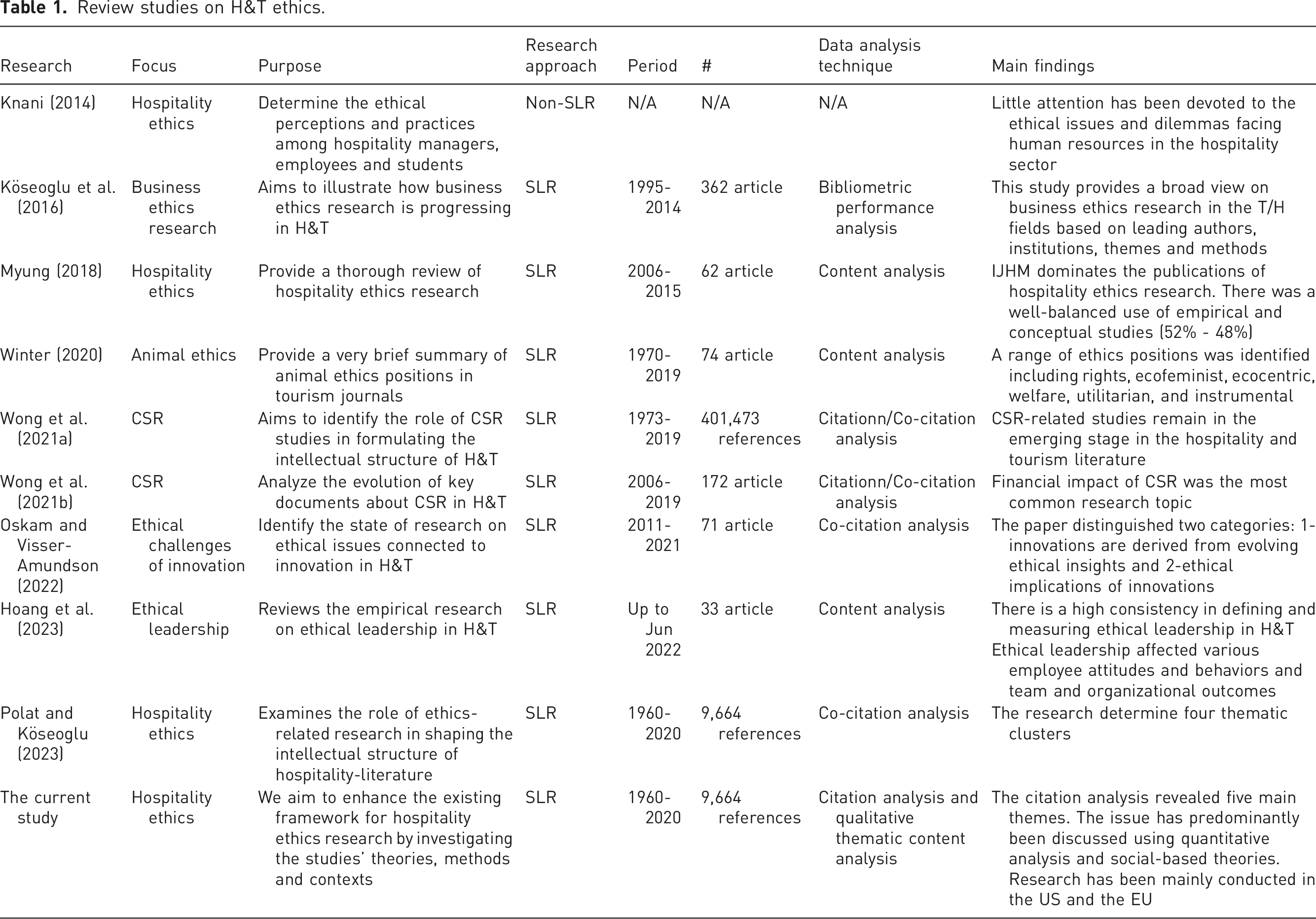
Review studies on H&T ethics.
Specifically, we determine the most significant papers related to ethics in hospitality literature via citation analysis. Second, a systematic review of the sub-themes is conducted in accordance with the TCM framework, in response to a call for framework-based reviews (Paul et al., 2021). This enabled us to categorise the literature according to the following three criteria: theory, context and methods. In accordance with the aims, three research questions (RQs) were formulated. (RQ1): What are the core themes that emerge from the citation analysis? (RQ2): What are the principal theories, methodologies and contextual frameworks informing hospitality ethics research? (RQ3): What is the future research agenda for hospitality ethics research?
This study contributes to theory and practice in several ways. The paper begins with an overview of the field of hospitality ethics research over the past six decades. Secondly, a two-step methodological procedure is employed, which facilitates methodological triangulation and proves to be a more effective approach than a single method of analysis (Chandra and Walker, 2019). Thirdly, we classified the diverse literature into theory, context, and methodology. The consolidation of fragmented knowledge enabled a more rigorous identification of gaps. Fourth, we objectively explored the themes and identified key knowledge gaps to enhance theoretical understanding. This will provide future directions for scholars and implications for practitioners, helping them to gain evidence-based knowledge.
Literature review
Ethics is a widely discussed subject in academic literature. Its scope is challenging to define (Polat and Şahin, 2016). However, in a broad sense, ethics involves a systematic effort to integrate personal and social moral encounters into an organized and rational framework. This effort establishes standards for differentiating acceptable from unacceptable forms of human behaviour (Dimitriou, 2022). Business ethics concerns the ethical interactions and relationships between an organisation and the government, suppliers, shareholders, customers, employees, and media. It is important that these interactions take place within a moral framework (Teng et al., 2020). Ethics serves as a foundation for employee pride and motivation and plays a crucial role in creating and maintaining customer satisfaction (Weeden, 2002).
These characteristics are particularly relevant to tourism organisations. The relationship between tourism organisations and the external environment is often the driver of tourism, making ethics a critical issue for such organisations (Jamal, 2020; Oskam and Visser-Amundson, 2022). This study focuses on hospitality organisations, which also have a close and critical relationship with ethics. The hospitality sector relies on environmental factors such as water and food for production, as well as employees for business and production processes. Additionally, due to the constant 24/7 nature of business-customer interactions, ethical standards are enforced by hospitality organizations (Dimitriou, 2022; Holden, 2019; Walle, 1995). Moreover, ethical concerns pertaining to hospitality employees have been identified as a key issue, as previously stated. These include excessive workloads and low wages, workplace bullying, uncertainty, job insecurity, fluctuating customer demands, and pressure to perform and deliver services simultaneously (Hoang et al., 2023). It is important to address these issues objectively and with a balanced approach. Whitney (1990) provided a categorisation of the primary ethical challenges encountered by employees in the hospitality sector. These include ethical problems related to marketing activities such as ‘overbooking’, kickbacks and gifts from suppliers, and hiding income from tax authorities. The second issue is ethical violations against customers, such as behaviour that harms alcoholic customers. The third issue is ethical problems related to the food and beverages served in the establishment, such as non-standard products in terms of quality, quantity, preparation method, etc.
Research suggests that the ethical values of firms can impact various aspects, including firm success (Kincaid et al., 2008), employee-organization fit (Jung et al., 2010), job satisfaction, organizational commitment (Kim and Brymer, 2011), turnover intention of employees (Cheng et al., 2013), and customer satisfaction (Dimitriou and Schwepker, 2019). Furthermore, industry professionals still consider ethics to be an important concern (Gursoy et al., 2012). It is evident that research on hospitality ethics is currently undergoing a period of significant expansion, with new insights emerging from a range of perspectives. The present study offers a comprehensive review of the literature from the past 60 years.
Methodology
We employed a two-step methodology consisting of citation analysis and qualitative thematic content analysis, as these approaches are advantageous for researching an expanding field.
Citation analysis
In this study, we employed citation analysis to enhance the objectivity of conclusions from large datasets. Citation analysis is a valuable and objective method for evaluating references within a particular field. It identifies influential studies and offers insights into the past of the specific field to comprehend its intellectual dynamics. According to Zupic and Cater (2015), this analysis is past-oriented and cannot detect the impact of new publications, as they do not receive high citations in a short period of time. However, researchers can use it to track the development of important references over a long period and measure progress by identifying significant papers in the field (Arici et al., 2021).
Bibliometric studies of the hospitality literature have been conducted, with some focusing on the intellectual structure of a single journal. However, this approach may overlook important ideas and concepts in other journals. To address this shortcoming, this study has been expanded to include some of the top journals in the hospitality field. We excluded tourism and other business journals for three reasons. Firstly, the study primarily focuses on hospitality ethics. Secondly, a broad focus can lead to a loss of focus and potential issues (Kenworthy and Verbeke, 2015). Finally, it should be noted that studies on hospitality ethics are primarily published in hospitality journals (Polat and Köseoglu, 2023). To this end, the entire corpus of seven leading hospitality journals was considered: Journal of Hospitality Marketing and Management (JHMM); International Journal of Hospitality Management (IJHM); International Journal of Contemporary Hospitality Management (IJCHM); Cornell Hospitality Quarterly (CHQ); Journal of Hospitality and Tourism Management (JHTM); Journal of Hospitality and Tourism Research (JHTR); International Journal of Hospitality and Tourism Administration (IJHTA). The initial stage of the selection process entailed a comprehensive examination of the impact factors and citescores associated with the journals under consideration. Subsequently, journal lists from other bibliometric studies were considered (Arici et al., 2021; Polat and Köseoglu, 2023; Wong et al., 2021a). Given the esteemed reputation of these journals, it is reasonable to conclude that they are capable of establishing a dominant position within the field of hospitality ethics, particularly in comparison to their competitors.
All peer-reviewed articles in English published in these journals were received up to December 2020. The entire period from 1960 to 2020 was analysed, encompassing 10,782 articles and 306,701 references. We relied primarily on references for our analysis. After acquiring the articles, we individually screened the titles of 306,701 references to determine their relevance to ethics by using specific keywords ‘corruption, morality, ethical decision-making, business ethics, codes of ethics, corporate ethics, reputation management, insider trading, white-collar crime, glass ceiling/gender equality, environmental issues (natural environment), corporate citizenship’, according to studies (Köseoglu et al., 2016; Polat and Köseoglu, 2023; Robertson, 2008; Sehitoglu et al., 2017). Two options are available for selecting keywords in review studies (Chen and Xiao, 2016): (1) using all keywords to identify structural features of domain knowledge at the macro level, and (2) using ‘important’ keywords to explore major research topics and their relationships at the micro level. The latter option is more commonly used for review studies as many empirical studies are conducted at the micro level. However, the practice of selecting only ‘important’ keywords that are frequently used in the field has long been questioned. This is because analysing only ‘important’ keywords may lead to overlooking innovative trends related to any topic or field. Therefore, in this study, we also included some low-frequency keywords to select relevant references in order to analyse hospitality ethics at a macro level. This approach aims to identify new concepts or issues emerging in hospitality ethics.
Traditional citation analysis involves searching databases for studies on hospitality ethics using relevant keywords. The most cited articles are then identified by analysing the reference lists of these studies. This study has adopted a revised approach as done by recent bibliometric studies (Arici et al., 2021; Köseoglu et al., 2022; Polat and Köseoglu, 2023). The first step involved downloading all articles published in the selected journals from the first issue until December 2020, including those unrelated to ethics, along with their references. Next, we analysed the references related to ethics. Our dataset only includes references related to ethics. Therefore, we have excluded references to other topics, such as methodological citations, as in traditional analysis. Only references related to ethics were evaluated.
The two authors individually reviewed the references (N = 306,701) to guarantee consistency, validity, and attain unanimity. The reference title was analysed based on the previously mentioned keywords. If there was any uncertainty regarding the ethical relevance of the reference, the full text was analysed. All references were labelled as “related” or “unrelated.” The authors debated any discrepancies in ethics-related references, ensuring an absolute consensus was achieved. Additionally, the researchers collaborated to review all references and guarantee that all references on ethics were accurately identified. In this process, we included articles and reviews published in journals as they are considered to be ‘certified knowledge’ (Polat et al., 2023). Editorial notes, book reviews, and comments were excluded to maintain consistency. After this process, the references’ authors’ names, publication years, titles, journal names, issues, and page numbers were matched to provide the standard in citations. Subsequently, a frequency analysis was performed, and the citation styles of references were aligned with APA standards to ensure consistency. Ultimately, a dataset comprising 9,664 unique references on ethics was obtained. All procedures were manually performed using Excel.
Systematic review
In order to gain further insight, a systematic review of the full text of the references was conducted. A systematic review is an approach that identifies, analyses and evaluates all data on a particular research topic in an objective and reproducible manner (Çelik et al., 2023). The combination of citation analysis with systematic review can address some of the limitations of citation analysis, facilitate a deeper comprehension of a research domain, identify gaps in knowledge, and offer insights into prospective advancements within the field (Köseoglu et al., 2022).
Given the impracticality of subjecting 9,664 references to systematic review, a cut-off point was deemed necessary. However, there is no precise measure of what this cut-off point should be. Nevertheless, it has been observed that this threshold is typically set at 100 in similar studies (Arici et al., 2021; Çelik et al., 2023; Polat et al., 2024), and we have elected to adopt this approach. Consequently, 102 articles, each with a minimum of 14 citations, were identified and subjected to an in-depth systematic review.
Qualitative thematic content analysis was employed to analyse and interpret articles within the identified themes. This analysis identifies, analyses and reports themes based on the data set reviewed in the studies in question (Çelik et al., 2023). Furthermore, it identifies the most- and least-developed areas in the literature, thus facilitating future agenda setting (Polat et al., 2023).
The content of the studies within the identified themes was defined by all authors through a process of reading, analysis and coding in Microsoft Excel. Subsequently, as a quality control measure, the codings were reviewed and discrepancies were discussed until a consensus was reached. This approach is consistent with the principle of reproducibility, which necessitates concordance between multiple coders when evaluating the same study content (Polat et al., 2024). Themes were analysed in accordance with the TCM framework, in response to the call for a framework-based review. The TCM framework classifies scattered literature into theory, context, and methodology, which consolidates fragmented knowledge and identifies gaps (Polat et al., 2023). Furthermore, a research agenda for future researchers was established on the basis of this framework. The complete procedure is illustrated in Figure 1. The review process and the analysis strategy of the research. We generated this figure inspired by (Çelik et al., 2023).
Findings
The publication outlets
The publication outlets of the most cited articles.
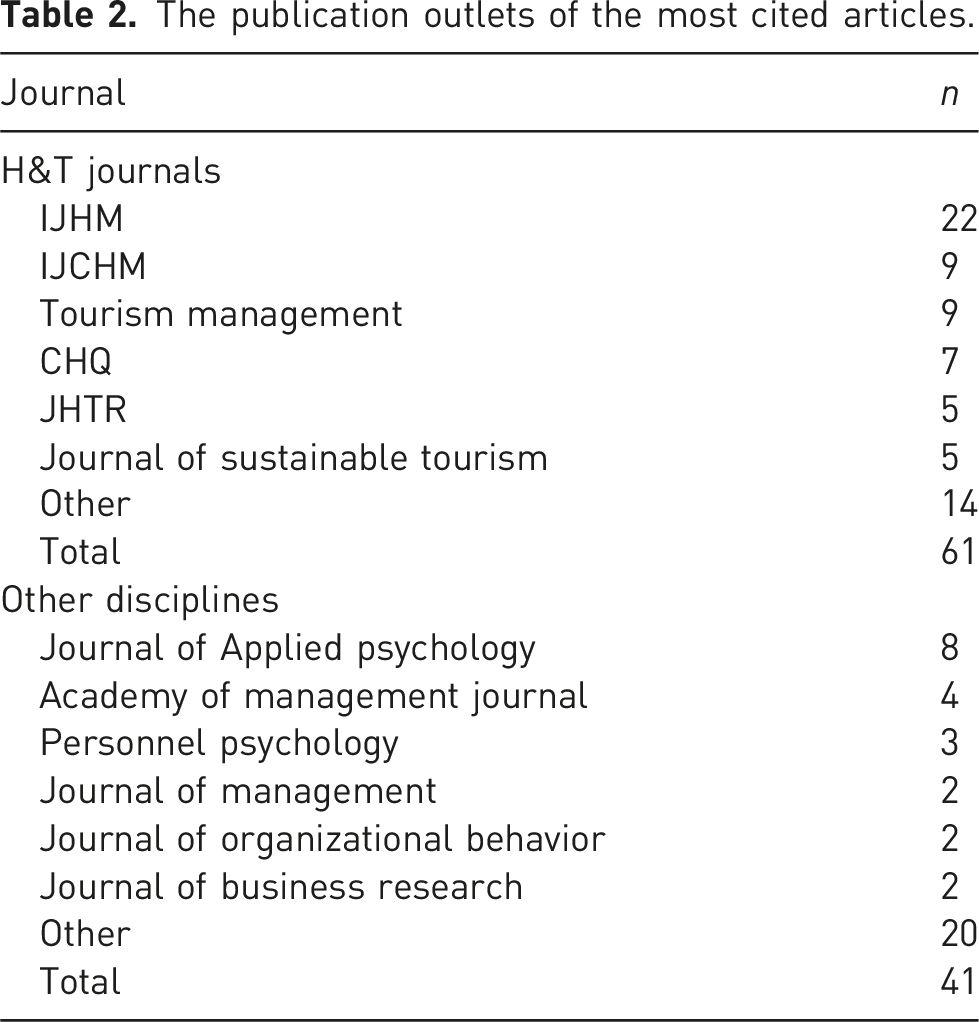
In terms of H&T journals, IJHM (n: 22) is the most prominent and influential journal in hospitality ethics research. Additionally, the majority of the journals that stand out in this section are also hospitality journals. When journals in other disciplines are examined, psychology and business management journals are more prominent. The most cited journal is the Journal of Applied Psychology (n: 8). It should also be noted that other journals in this section are largely cited in the theme of organisational citizenship behaviour (OCB).
Citation analysis
The findings reveal five distinct theme which reflect the hospitality-ethics literature: (1) OCB (38 references), (2) Environmental concerns in hotels (39 references), (3) Environmental behaviours & attitudes of guests (16 references), (4) Reputation management (seven references), and (5) Ethical leadership (two references). We made significant inferences by analysing the thematic areas.
Environmental issues are receiving attention in the field of business ethics (BE). Researchers reviewing ethics-oriented articles in the Journal of Business Ethics (JBE) (Calabretta et al., 2011; Collins, 2000) and the Strategic Management Journal (Robertson, 2008), and H&T journals (Köseoglu et al., 2016; Sehitoglu et al., 2017) point out that environmental issues are one of the most researched topic. This research also announces a similar result: the most cited studies in ethics-oriented articles in the hospitality literature mainly (53.9%) focus on environmental issues.
Studies examining environmental issues are diverse. Studies have looked at hotels’ perspectives on environmental issues or which types of hotels are more likely to do so. Results show that chain hotels are more aware of this issue (Mensah, 2006), while it is also reported that this issue takes a back seat to operational concerns (Bohdanowicz, 2005; Graci and Dodds, 2008; Kirk, 1998). One explanation could be the lack of environmental awareness and attention of hotel managers, based on studies conducted in Ankara/Turkey (Erdogan and Baris, 2007) and Hong-Kong (Chan, 2008, 2011). However, the implementation of environmental protection programs (EPP) improves overall- (Claver-Cortés et al., 2007; Rodríguez and Cruz, 2007) or financial-performance (Gil et al., 2001), reduces costs, and increases the success of marketing efforts (Kirk, 1995).
Another group of articles related to environmental issues examined the willingness of tourists/consumers to pay more for environmentally friendly products and their behaviour in response to environmental stimuli. Consumers who were unwilling to pay extra for green products in the 1990s (Kirk, 1995) continued to do so in the early 2000s. Because 73.4% of customers are unwilling to pay more for such products, as determined by Laroche et al. (2001). Han (2015) emphasized that tourists’ willingness to pay extra can be increased by making green hotels more attractive than non-green hotels. Achieving this is critical because human behaviour must first be changed to protect the environment (Bohdanowicz et al., 2011). Appropriate stimuli can activate behaviour. Goldstein et al. (2008) found that instead of descriptive norms (e.g., ‘the majority of guests reuse their towels’), normative messages (e.g., ‘the majority of guests in this room reuse their towels’) that are relevant to people’s current situation and make them feel part of a social group increase behaviour.
The third theme in the hospitality-ethics literature is OCB. Collins (2000), who investigated JBE in different periods, identified this title as one of the most cited topics. However, this topic did not receive much attention in previous reviews of H&T literature (Köseoglu et al., 2016). As a consequence, it can be deduced that OCB has become one of the key subjects in the hospitality ethics literature. Articles dedicated to this topic primarily focus on individual-level studies (e.g., Nadiri and Tanova, 2010; Williams and Anderson, 1991), with much less research carried out on unit-level cognitive studies (e.g., Ehrhart, 2004). Their contribution to the hospitality literature diverges from mainstream ethics research by linking ethics to other management problems, and by testing hypotheses.
Reputation management is the fourth theme most cited in the hospitality-ethics. Although reputation management has attracted attention in BE literature in previous years (Collins, 2000; Robertson, 2008), it has been less explored in the hospitality-ethics. The research results show that the reputation management has developed as an influential theme in the hospitality-ethics literature in the last 10 years. Two study (Ert et al., 2016; Yacouel and Fleischer, 2012) investigated which variables affect reputation at the enterprise level. In addition, Loureiro and Kastenholz (2011) investigated the effect of the hotels’ reputation on the attitudinal results of the customers.
Finally, the ethical leadership is the fifth theme in the hospitality-ethics literature. Two papers represent this theme. Brown et al. (2005) developed the construct of ethical leadership; Kim and Brymer (2011) investigated the effects of the ethical leadership.
Qualitative thematic content analysis
To deepen our understanding of relevant information and research components, identify knowledge gaps, and make predictions about the field’s future development. We reviewed the references on theories, contexts, and methodologies with the TCM framework.
First theme: OCB
As expressed, OCB studies contribute to hospitality-ethics literature by bridging ethics, OCB, and other management topics and testing contemporary theories rather than mainstream ethics research. The OCB is repeated frequently when the keywords are examined (n:18). Others are as follows: hotel industry/hotel (n:6), service quality (n:4), employees (n:4), job satisfaction (n:3), organizational support (n:3), organizational behaviour (n:2), employee attitudes (n:2), work engagement (n:2), organizational effectiveness (n:2), organizational identification (n:2), extra-role behaviour (n:2), meta-analysis (n:2).
Theoretical framework
Social-based theories are present in 60.5% (23/38) of the theoretical frameworks concerning OCB. These theories are commonly utilized while studying the antecedents of OCB. Social exchange theory (n: 15) is the most notable one. According to this theory, which is based on reciprocity, when employees are satisfied and supported by their leaders or co-workers, they respond with behaviours that benefit the organization, such as OCB. For example, the effect of variables on OCB as antecedents, such as organizational support and psychological empowerment (Chiang and Hsieh, 2012), organizational justice (Ehrhart, 2004), co-worker or customer-employee exchange (Ma and Qu, 2011) were examined in light of social exchange theory and positive effects were found. Additionally, social learning theory posits that people acquire new attitudes, values, and behaviours by observing and emulating dependable role models, without subjective evaluations. Consequently, the learning process may lead to employees exhibiting OCB. Walumbwa et al. (2010) utilized this theory to investigate how servant leadership behaviours influence OCB.
Motivation-based theories become visible in the theoretical framework after social-based theories. For example, Lyu et al. (2016) used the conservation of resources theory while investigating the effect of mediator variables on the relationship between abusive supervision and OCB. According to the theory, which argues that individuals seek to preserve and protect valuable resources when they perceive an actual or threatened loss of resources, the researchers examined that employees with abusive supervisors focus on protecting their resources and abandon OCB. Raub (2008) used the theory of reasoned action, which states that intentions and norms determine behaviour. Accordingly, a bureaucratic perception of the organization hinders the development of behavioural intentions for OCB.
Leader-member exchange (LMX) is another prominent theory. LMX posits that the leader can establish relationships with followers at different levels of distance and quality, and that followers with close and high-quality relationships will exhibit higher performance. Studies have shown that LMX increases OCB (Kim et al., 2010; Ma and Qu, 2011).
Because cultural structure is also effective in the development of OCB, several studies have examined this issue. These studies used structures that cannot be fully classified as theories. For example, Moorman and Blakely (1995), who investigated individualism-collectivism as an estimator of OCB, used the individualism-collectivism construct developed by Parsons and Shills in 1951 and found that collectivist values or norms increase OCB. Farh et al. (1997), while investigating the role of cultural modernity and tradition in the relationship between OCB and organizational justice, used the Chinese individual modernity and traditionality scale introduced by Yang and friends in 1989 and found that cultural structure affects the relationship between variables.
Context
Articles were classified according to their geographical focus to assess the research area of OCB studies. Except for five meta-analyses, all articles were conducted in a specific geographical region. Farh et al. (1997) focused on more than one country. The USA was the most studied country (n: 21). China (n: 4), Taiwan (n: 3) and South Korea (n: 2) were studied in more than one study. This shows that scientific production on OCB is largely based on examining “mainstream” countries.
Methodological approaches
First, we examined the articles in terms of measurement scales. Smith et al. (1983) were interested in behaviours that are not part of the official job duties, that are beneficial to the organization, and that are mostly altruistic in nature, and revealed two dimensions for this. First, altruism is to give complimentary support to others within the organization; second, generalized compliance means that the employee accepts and abides by the rules. However, as studies progressed, other dimensions were revealed. For example, Organ (1988) showed a five-dimensional structure: altruism (narrower than Smith et al.’s concept), conscientiousness (a similar and limited form of generalized compliance), sportsmanship (not grumbling about minor issues), courtesy (e.g., consultation with others before action), and civic virtue (commitment to the organization or being concerned with the organization’s operation). Podsakoff et al. (1990) were among the first researchers to use this structure. This structure has been used in many studies within the theme (Bell and Menguc, 2002; Chiang and Hsieh, 2012; Stamper and Dyne, 2001, 2003).
There are also several structures related to OCB (Dyne et al., 1994; Dyne and LePine, 1998). Some of these, which emerged later and have been given different names, are similar to Organ’s (1988) scale (LePine et al., 2002). For example, in Dyne et al.’s (1994) scale, the social participation dimension overlaps with altruism and courtesy, loyalty overlaps with sportsmanship and partially with civic virtue, and the obedience dimension overlaps with civic virtue and conscientiousness.
As research progressed, scholars began to think that the OCB dimensions could be conceptually combined into different subgroups (LePine et al., 2002). For example, Williams and Anderson (1991) suggested that citizenship behaviours towards individuals (OCB-I) and towards the organization (OCB-O) are different. In this context, altruism and courtesy dimensions suit OCB-I; sportsmanship, civic virtue, and conscientiousness dimensions suit OCB-O. This conceptualization can be seen as the second important step toward OCB (Podsakoff et al., 2009).
Traditional OCB measurements might not be appropriate for service businesses (Ma and Qu, 2011) because these businesses differ from others. For instance, employees establish a closer relationship with customers and represent the organization outside (Bettencourt et al., 2001). Service-oriented OCB is a concept that was introduced in response to this need. Bettencourt et al. (2001), who made one of the first definitions for this, developed the three-dimensional service-oriented OCB scale by combining the previous OCB scales with the service quality scale. The loyalty dimension is the representation and protection of the company’s products and services as well as its image to outside; the service delivery dimension is the fulfilment of the promises of the enterprise by the employees in a reliable, sensitive, and courteous manner; the participation dimension is the taking initiative of the employees and especially their communication with the business and co-workers to increase the service quality (Bettencourt et al., 2001; Tang and Tang, 2012). Some of the studies used specific OCB scales; OCB-I and OCB-O (Buil et al., 2016; Cropanzano et al., 2003; Kim et al., 2010; Ma and Qu, 2011); service-oriented OCB (Ma and Qu, 2011; Sun et al., 2007; Tang and Tang, 2012).
Second, we examined the articles in terms of methodology. Two articles are prepared as SLR. Podsakoff et al. (2000) showed that 30 potentially different citizenship behaviours had been described in the literature. Since they conceptually overlap in several ways, they are grouped under seven common themes: (1) helping behaviour, (2) sportsmanship, (3) organizational loyalty, (4) organizational compliance, (5) individual initiative, (6) civic virtue, and (7) self-development. Podsakoff and MacKenzie (1997), on the other hand, by examining the articles on the effect of OCB on organizational performance, discovered that helping behaviour increases organizational performance the most.
Other articles (n: 36) were prepared empirically. Five of these are meta-analysis studies. Some of meta-analysis investigated the relationship of a specific variable with OCB. For example, the LMX-OCB relationship (Ilies et al., 2007); co-worker effects on OCBs (Chiaburu and Harrison, 2008). LePine et al. (2002) investigated the relations of OCB’s dimensions with different variables (job satisfaction, organizational commitment, fairness, trait conscientiousness, and leader support) separately. Organ and Ryan (1995) examined the antecedents of OCB and found that job satisfaction is the strongest predictor. Podsakoff et al. (2009) investigated the outcomes of the OCB and found that the strongest was reward recommendation at the individual level and unit performance at the organizational level.
Overview of the main features of the clusters.
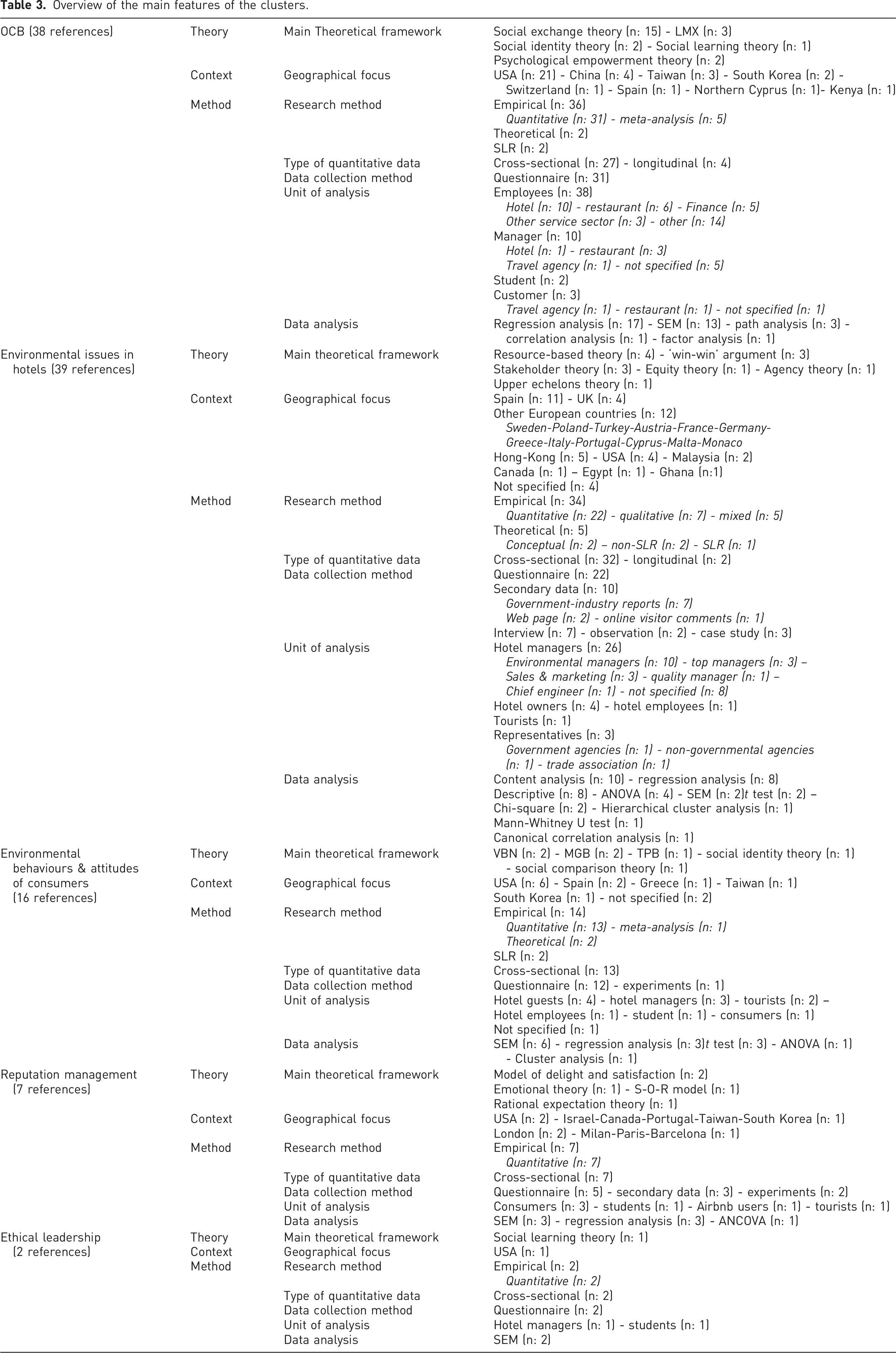
Since there were no qualitative studies among the studies, only quantitative data analyses were used to test the hypotheses. 17 studies used regression analysis and 13 Structural Equation Modelling (SEM). In addition, five studies were meta-analyses; path analysis (n: 3), correlation analysis (n: 1), and factor analysis (n: 1) were the other techniques used.
Second theme: Environmental issues in hotels
This theme includes topics related to identifying hotels’ EPPs; motivating factors for implementing EPPs; the results of applying EPPs; barriers to participation in EPPs. When the distribution of keywords is examined, the picture is suitable with this (words that repeat more than once are shown): hotel(s) (n:27), keywords related to environmental issues (n:15) (certification: 3, strategies: 3, attitudes: 3, initiatives: 2, sustainability: 2, reporting: 2), environmental management (n:12), performance (economic/financial/general) (n:6), Spain/Spanish hotel industry (n:5), ISO 14001 (n:5), environmental management system (n:4), the eco-management and audit scheme (EMAS) (n: 2), environmentalism (n:4), barriers (n:3), energy conservation (n:2), Europe/EU (n:2), small- and medium-sized enterprises (SMEs) (n:2).
Theoretical framework
In the theoretical framework, resource-based theory (n: 4) is standing visible. (e.g., Carmona-Moreno et al., 2004; Russo and Fouts, 1997). This theory assumes that in-house knowledge and skills are the primary sources of competitive advantage. Accordingly, it has been stated that EPPs lead to positive outcomes. In addition, the skills developed with EPP can provide various benefits for companies to gain a sustainable competitive advantage (Graci and Dodds, 2008).
Other noteworthy theories or approaches include stakeholder theory (n: 3) and the win-win argument (n: 3). Stakeholder theory assumes that organizations will consider the needs of their partners when arranging their activities because this is how they can get the support they need to survive in the long run. In this context, businesses exposed to the effects of various pressure groups (e.g., public organizations, society, and shareholders) may be more willing to initiate EPPs (Ayuso, 2006; Carmona-Moreno et al., 2004; Dief and Font, 2012). Park et al. (2014) used the upper-echelons theory similarly. However, this theory mainly focused on the point of view of top managers and assumed that managers, as powerful actors, would affect the strategic choices of organizations. These include the decision or form of implementation of EPPs.
The win-win argument discusses the benefits of environmental management for businesses. It argues that innovative solutions that support environmentalism and industrial competitiveness are critical to firm success (Porter and Linde, 1995). Accordingly, it has been stated that EPPs can increase hotel performance with cost advantage and differentiation (Kasim, 2007; Tarí et al., 2010). However, Kasim (2009) argues that this may be on the agenda of larger companies and may not be convincing for tourism businesses in developing countries, the majority of which are SMEs.
Context
This theme also differs from the first in its geographical distribution because European countries have a significant weight. For example, Spain (n:11), the UK (n:4), other European countries (n:14) has important positions. In addition, Hong-Kong (n:5), the USA (n:4), and Malaysia (n:2) were selected as geographical regions in more than one study. In this context, it can be said that in addition to “mainstream” countries, developing countries such as Turkey, Ghana, Egypt, and Malta have also contributed to the body of knowledge on environmental ethics.
Methodological approaches
Five of the 39 articles are theoretical, and 34 are empirical. Two of the theoretical papers provide information at the conceptual level; the others are SLR. Of the conceptual studies, Hassan (2000) stated that one of the determinants of market competitiveness in the sustainable tourism industry is environmental commitment; the other, Font (2002) noted that the primary use of environmental certificates in the hospitality industry is recognition and acceptance. Of the SLRs, Graci and Dodds (2008) demonstrated the advantages of EPPs in Canada. Stipanuk (1996) examined the environmental practices of hotels in USA in three periods. Hillary (2004) examined the antecedents, outcomes, and entry barriers of EPPs in SMEs.
Of the empirical articles, 22 were quantitative, seven were qualitative, and five were mixed-designs. One collected longitudinal (three-waves, 6-months), and the others collected cross-sectional data. The questionnaire/survey category (n: 22) stands out concerning the data collection method. Seven studies collected data through interviews and two by observation. In addition, in three studies, we see case studies. Finally, 10 studies used secondary data.
We analysed the sample or unit of analysis of articles. There is a considerable variety in this regard. The most popular sample group is hotel managers (n:20). In some studies, environmental (green & sustainability) managers (n:10) were contacted directly. This result is expected because collecting and presenting information about hotels’ EPPs is the primary purpose of the research. Others can be seen in Table 3. The results of the data analysis are different from the first theme. Eight research are descriptive. Others included content analysis (n: 10), regression analysis (n: 8), ANOVA (n: 4), SEM (n: 2),t test (n: 2), and chi-square (n: 2).
Third theme: Environmental behaviours & attitudes of consumers
This theme mainly examined consumers’ or tourists’ environmental behaviours or attitudes. The distribution of keywords in the articles is as follows: hotel industry/hotel (n:6), keywords related to environmental behaviour & attitude (n:6) (pro-environmental intention: 3, green consumerism: 1, eco-friendly behaviour: 1, willingness to sacrifice: 1), environmental proactivity/issues/constructs (n:5), green-environmentally-responsible hotel (n:4), business/organizational performance (n:4), environmental management (n:3) & marketing (n:2), cost- or differentiation-competitive advantage (n:3), consumer behaviour (n:2), values (n:2), model of goal-directed behaviour (MGB) (n:2), theory of planned behaviour (TPB) (n:2), value-belief-norm theory (VBN) (n:2).
Theoretical framework
In studies focusing on human behaviour, theories that predict consumer behaviour at the micro- and macro-level come forward (Myung et al., 2012). TPB (Han, 2015) and its expanded and deepened version MGB (Han and Yoon, 2015; Song et al., 2012) or interdependence theory (Rahman and Reynolds, 2016) at the micro-level; VBN (Chou, 2014) and social comparison theory and social identity theory (Goldstein et al., 2008) are examples of macro-level theories.
TPB is primarily used to examine the ‘intention’ of environmental behaviour, but as mentioned earlier, there is a gap between intention and actual behaviour (Chou, 2014). In this context, Stern et al. (1999) proposed the VBN theory to describe and predict environmental behaviour using the moral norm-activation theory. Han (2015), on the other hand, combined TPB and VBN and presented a new model to develop a more comprehensive understanding of environmental-friendly behaviour intention. It has been determined that the new ‘combined’ model has superior and comprehensive predictive power compared to the existing theories.
Rahman and Reynolds (2016) proposed a new theoretical approach, drawing on the interdependence theory, which examines the structure of interpersonal relationships, and the model of commitment, which explains how commitment is formed while demonstrating a commitment to the environment. Accordingly, people are more likely to create environmental commitment because it responds to individual needs. In addition, with this theoretical model, the probability of people concerned about the environment making sacrifices towards green hotels, their intention to visit and willingness to pay more was successfully predicted.
Context
The results mainly reflect US consumers’ environmental-friendly attitudes/behaviours since the USA has a large weight (n: 6) in geographical distribution. Spain, Greece, South Korea, and Taiwan were examined once each. Therefore, investigating the attitudes/behaviours of consumers from different cultures increase the validity of the results.
Methodological approaches
Of the 16 studies, two were SLR, and 14 were empirical. With regard to SLRs, Chan and Hsu (2016) analysed 149 articles published between 1993 and 2014 on the environmental management of hospitality establishments. Researchers determined that environmental policies and practices (1993-99), sustainable tourism development (2000-09), and environmental benchmarking (2010-14) have gained weight in different periods, and issues such as green marketing, environmental technology, and employees’ green behaviour can be investigated more. Myung et al. (2012) reviewed 58 articles published in hospitality journals between 2000 and 2010. Accordingly, environmental policies and practices were determined as the most researched subject.
One of the empirical articles is meta-analysis. Gao et al. (2016) investigated how the categories of ‘internalized perceptions’ and ‘perceptions of the firm’ affect consumers’ behavioural intentions towards green hotels/restaurants. It was seen that both categories had a positive and strong relationship with behavioural intentions, and the ‘perceptions of the firm’ (r = 0.42) had a larger effect than the other (r = 0.31). The other 13 empirical articles are in quantitative design. The data were collected by questionnaire (n: 12) or experiments (n:1).
As analysing human behaviour is predominant, the unit of analysis is also in line with this. In this context, the dominant sample group is hotel guests (n: 4). Hotel managers (n: 3) and tourists (n: 2) are the other prominent samples. These studies have collected cross-sectional data. SEM (n: 6) was mostly used in data analysis. Regression analysis (n:3) and t test (n: 3) were the other prominent techniques. Furthermore, one study is experimental (Goldstein et al., 2008) and examines the participation rates of individuals in an environmentally-focused programme with varying messages.
Fourth theme: Reputation management
This theme focuses on reputation management in tourism, including its antecedents and outcomes. Studies in this theme were published in the last 10 years. Therefore, it can be said this subject has gained attention recently. The distribution of keywords is as follows: keywords related to reputation (corporate-, website-, personal-reputation) (n:5), customer satisfaction/satisfaction (n:4), customer loyalty/loyalty (n:3), [sharing economy, Airbnb, trustworthiness/trust, electronic word-of-mouth, decision making, quality, marketing/Internet marketing] (n:2).
Theoretical framework
Except for two of the studies, different theories were used in the others. Yacouel and Fleischer (2012) simplified Tirole’s basic reputational model and developed a mathematical model showing that online travel agencies generate a price premium for high-quality service compared to traditional travel agencies. In two studies (Loureiro and Kastenholz, 2011; Selnes, 1993) used Oliver and friends’ model of delight and satisfaction. This model has a path from satisfaction to post-experience attitude (e.g., reputation). Thus, the satisfaction obtained after consumption affects the reputation (Selnes, 1993). Loureiro and Kastenholz (2011) added corporate reputation to this model as an antecedent variable affecting perceived quality, satisfaction, and loyalty, enriching the model.
In Plutchik’s emotional theory, delight is expressed as a mixture of joy and surprise. Loureiro and Kastenholz (2011) detected that reputation indirectly affects loyalty through satisfaction, not delight. Thus, reputation can make customers loyal with satisfaction, not pleasant surprise and fun. In future studies, the position of the emotional theory in the relationship between reputation, delight, and loyalty can be re-examined. Reputation, as an external factor, affects customer behaviour or attitude. Chang (2013), using the S-O-R (stimulus-organism-response) model, determined that reputation works as a stimulus and affects perceived value and trust, which is an organism, and satisfaction, which is a response.
Context
Regarding the geographic locations in which the studies were organized, countries other than the USA (n:2) were surveyed once: Israel, Canada, Portugal, Taiwan, and South Korea. Studies that collected secondary data used data from hotels in London (n:2), Milan, Paris, and Barcelona.
Methodological approaches
All seven studies were prepared empirically, with a quantitative design and cross-sectional data. Therefore, there is little diversity regarding the method. Data were collected through questionnaires (n:5), secondary data (n:3), or experiments (n:2). For instance, Ert et al. (2016) and Park and Lee (2009) collected data in two ways: questionnaire and experimental design. Studies using secondary data used websites such as booking.com (Yacouel and Fleischer, 2012) or Airbnb (Ert et al., 2016; Mauri et al., 2018). In the data analysis, SEM (n:3), regression analysis (n:3) and ANCOVA (n:1) were used.
Studies have also examined how reputation is measured. Questionnaires were used in five studies. Selnes (1993) developed a two-item questionnaire that measures one item positively or negatively on overall reputation and the other relative to competing brands. Loureiro and Kastenholz (2011) created a three-item questionnaire by adding an expression with the concept of ‘trust’. This scale was also used by Chang (2013). Consumers were chosen as the units of analysis in three studies, while one study each focused on students, Airbnb users, and tourists.
Studies using secondary data measured reputation with different variables. Yacouel and Fleischer (2012) considered hotels’ staff scores (on booking.com), size, and chain affiliation. Accordingly, the increase in the first two variables and the presence in the third increase the reputation. Of the two studies that collected data from Airbnb, Ert et al. (2016) relied on hosts’ review scores; Mauri et al. (2018) additionally relied on the following variables: superhost, connected accounts, number of references, storytelling, personal photos, verified, response rate, response time.
Fifth theme: Ethical leadership
There are two articles within this theme. Brown et al. (2005) proposed that ethical leadership is a feasible construct. Kim and Brymer (2011) conducted a study to investigate the influence of executive managers’ ethical leadership on the emotional commitment and job satisfaction of middle managers and reported favourable outcomes. The keywords of the articles are as follows: ethics, leadership, ethical leadership, construct development, job satisfaction, affective organizational commitment, extra effort.
In terms of theoretical framework, Brown et al. (2005) utilized social learning theory to empirically uncover the structure of ethical leadership. Kim and Brymer (2011), on the other hand, based their research on the consequences of ethical leadership on Brown et al.’s model of ethical leadership.
As for context, a study was organized in the U.S. (Brown et al., 2005), but Kim and Brymer (2011) did not specify the scope. In terms of methodology, both studies were based on empirical evidence, utilizing a quantitative methodology and cross-sectional data (see Table 3 for details).
Discussion
Ethics is a contentious matter that impacts and concerns organizations of all levels. Its effects extend beyond the organization, influencing and shaping the environment. This is especially pronounced in the hospitality industry, which has significant input-output relationships with numerous sectors. This topic will continue to be important in future projections. There are still areas of hospitality-ethics that require investigation (Jamal, 2020). This study highlights the essential research pertaining to hospitality-ethics, including sub-fields, as well as their theoretical, methodological, and contextual status.
Citation analysis shows that the hospitality-ethics studies have lower citations than the general BE literature (Ferrero and Sison, 2014; Ma et al., 2012). However, this finding does not indicate that ethics is not critical in hospitality domain. Because the number of studies is increasing, especially since 2010 (Köseoglu et al., 2016). Thus, despite the low citations, ethics has a vital role in hospitality research.
The citation analysis showed that the influential studies in hospitality-ethics concentrated on environmental topics, OCB, reputation management, and ethical leadership, in alignment with previous research (Hultsman, 1995; Myung, 2018; Polat and Köseoglu, 2023). The persistence of these issues under discussion may be attributed to a number of factors, including (1) the extensive scope of the issues themselves, as well as the varying global and local priorities that emerge in response to them. The intricate and multifaceted nature of ethical issues necessitates a comprehensive understanding that may take many years to attain. Furthermore, they may be subject to shifts in global or local policy priorities. For instance, interdisciplinary issues such as tourism and environmental ethics may necessitate a comprehensive review in accordance with global or local policies, given that they encompass tourism, ethics and environmental sciences. (2) Changing socio-cultural and economic conditions: Alterations in the circumstances of all stakeholders in tourism on occasion render research outcomes obsolete, necessitating the undertaking of new research. For instance, the emergence of novel and disparate demands on hospitality employees may occasion the prioritisation of alternative leadership styles, such as ethical leadership. (3) The advent of new technologies may require the investigation of ethical issues from the vantage point of these technologies.
The results indicate that the most cited studies are those that address environmental ethics, as in CSR (Wong et al., 2021a, 2021b). Since the continuity of the tourism system depends on natural resources, the increasing pressure and influence of the system on these keeps environmental ethics to the agenda with management issues. Furthermore, given the expanding spatial boundaries of tourism and the growth in global demand, ethical issues over its interaction with nature are expected to proliferate in the future (Holden, 2019). Nevertheless, the adoption of an environmental ethic within H&T may prove to be a lengthy and complex process. Furthermore, despite the proximity of the UN Sustainable Development Goals to be achieved by 2030, it is contended that the most that can be expected is incremental change, rather than transformational change, in terms of climate action. A further issue is the lack of engagement from all stakeholders in the tourism industry, who should collectively adopt ethical consensus and climate action in order to safeguard people, the environment and the tourism sector (Becken and Loehr, 2024).
Two distinct themes have appeared regarding environmental ethics (see Table 3). The large one examined the environmental perspectives of hotels, and the small explored tourists and consumers behaviours. The financial, organizational, and competitive benefits of EPPs increase the probability of hotels utilizing them, and many studies showed this (Acampora et al., 2022). In the future, research focusing on tourists’ environmental behaviour, and attempts to elucidate the reasons for the attitude-behaviour gap and to test hypotheses in real touristic environments, will contribute to the field of environmental management and enhance the success of EPPs.
OCB is another topic in hospitality-ethics that has attracted attention in recent years. Indeed, OCB is regarded as a reflection of ethical conduct in the workplace. Upon examination of the statements included in the OCB scales referenced in the study (e.g., Dyne et al., 1994), it becomes evident that the statements pertaining to ethical conduct are expressed at the organisational level (e.g., “follows work rules” and “does not waste organisational resources”). However, the two are not synonymous. For example, utilitarian ethical theories posit that an action is ethical if it produces happiness for others. However, OCB is not concerned with the subjective experience of happiness; rather, it assesses the value an individual brings to the organisation (Turnipseed, 2002).
Furthermore, the current competitive landscape necessitates the recruitment of employees who exceed the prescribed job requirements, thereby placing ethical leadership at the forefront of organisational agendas due to its facilitating role. However, further research is needed to determine how and when ethical leadership influences the level of OCB of employees, as well as the boundary conditions that may influence this.
The results of the citation analysis indicate that the theme of reputation management remains underdeveloped, as does that of ethical leadership. Nevertheless, this theme is more developed in the BE field (Collins, 2000; Robertson, 2008). The concept of reputation management is inextricably linked with that of ethics. It can be argued that every ethical decision made by businesses and individuals has the potential to impact the reputation of the entity in question. Managers are in a position to influence the perceptions of a multitude of stakeholders, including employees, customers, suppliers, the media and the general public, through the implementation of internal and external communication strategies and policies that align with ethical principles. Reputation serves to attract and retain the most suitable employees and suppliers from within the organisation, while simultaneously attracting the most desirable customers and fostering customer loyalty from external sources. Consequently, “ethical reputation management” can be considered as the transmission of signals that convey information about businesses (Farmer, 2018). However, the results of our analysis indicate a dearth of empirical evidence concerning the impact of such management on the reputation of businesses in the hospitality sector.
Future research agenda
Theory
This research has revealed that existing studies in the field largely lack theoretical underpinning. The practice-oriented and hypothesis-testing character of research has often prevented the discovery and development of specific theories or theoretical frameworks specific to the field. Therefore, theoretically, a more precise and detailed effort is needed to strengthen hospitality-ethics. Although the reviewed literature addresses 20 different theories, nine were examined only once. This leaves the theoretical foundations relatively limited, and the field can be seen as suffering from a lack of scientific robustness.
The most used theories in ethics research have been identified as social exchange theory (first-theme), resource-based theory (second-theme), VBN and MGB (third-theme), and model of delight and satisfaction (fourth-theme). In future studies, the utilization of artificial intelligent (AI) systems by tourists (such as chatbots, social service robots, etc.) should be scrutinized from an “ethical” standpoint. This implies that ethical considerations should underlie the inquiry into how tourists perceive AI systems and their behavioural intentions towards the products presented via these technologies. Presently, there is a dearth of empirical research on this subject in the hospitality literature. In this instance, one can incorporate ethical considerations as an antecedent variable into Gursoy et al.’s (2019) AI device use acceptance model and assess its impact on the utilization of AI-supported systems. Although this model is frequently utilized within the tourism literature (e.g., Alsaad, 2023; Ladeira et al., 2023; Lin et al., 2020), ethical concerns have not been analysed for their effects. Another theory applicable in this context is Westaby’s (2005) “behavioural reasoning theory”. In this theoretical framework, ethical considerations may impact the connections between “reasons against usage” and global motives and intentions. While previous research explains the behaviour and attitudes of tourists in the context of AI-enabled systems, it falls short of understanding the impact of ethical understandings or concerns.
Method and context
The results showed that researchers mostly (91.1%) adopted empirical analysis for examining hospitality-ethics. The survey/questionnaire technique (72%) has been overwhelmingly used for data collection. Most of the research collected data from employees and/or hotel managers (Table 3). This choice may have been a natural reflection of the study topic or research questions. However, we promote qualitative, mixed-design, scenario-based, or experimental studies to go further than descriptive studies and develop the theoretical foundation of hospitality-ethics. This can increase the breadth and depth of existing knowledge and provide new insights. For example, studies should be done to understand the attitude-behaviour conflict more deeply and develop more concrete suggestions. On the other hand, the number of studies utilising cross-sectional data is greater than that of studies employing longitudinal data. This represents a notable limitation. Given the significance of the subject matter, its expansive scope, and the frequency of shifts in perspective, there is a clear need for long-term studies that gather data from a range of time points.
We also analysed the geographical focus of the articles. The USA is the most prominent country in studies on OCB and environmental attitudes of consumers/tourists, and Spain in EPP research. However, these two countries are not solely responsible for the emergence of ethical problems, nor is research conducted in these two countries alone sufficient to solve them. Moreover, the understanding of ethics is influenced by cultural context. For such reasons, conducting studies in other countries would clarify the current situation worldwide. We also recommend cross-country analysis and comparison of findings for a group of countries or two countries with similar or different characteristics.
When investigating the geographical distribution, another aspect that draws attention is the harmony between the geographical focus of the research and the countries where the researchers exist. In addition to revealing the regionalism of research, this can also be interpreted as closeness/collaboration between universities and enterprises. This cooperation can be an essential tool for better embedding ethics in organizations.
Agenda for various ethical topics
It is seen that various sub-themes of hospitality-ethics still have gaps. Although it is the most researched area, we anticipate that environmental ethics will remain current in the long-run. Because we are all aware of environmental degradation and the sector’s contribution to it. In this context, animal rights and welfare literature has a significant gap.
Second, a limited number of studies have been done on glass ceiling/gender equality, ethical decision-making, white-collar crime, and insider trading, which are search terms. Among them, gender equality is as important as economic and social sustainability (Araújo-Vila et al., 2021) and is also included in the UN Sustainable Development goals. In addition, gender inequality is discussed more than gender equality in H&T (Araújo-Vila et al., 2021) requires that the issue be handled with an ethical dimension.
Third, ethical decision-making is a crucial issue because the employees’ approach in this context affects all organizational decisions and the relations with its internal and external stakeholders. This is one of the most researched subjects in BE (Lehnert et al., 2015; Ma, 2009); however, it has attracted limited attention in hospitality-ethics. Accordingly, the issue should be examined from a multiplicity of perspectives, including the individual characteristics of leaders (e.g., age, cognitive moral development, education, biases, gender) or organisational factors (e.g., size, external environment, codes of ethics, ethical climate).
Fourth, a gap exists in hospitality-ethics education. Hultsman (1995), Walle (1995) stated that ethical issues in hospitality education are taught from general business subjects, and in this case, exceptional cases related to tourism can be overlooked. The Tourism Education Futures Initiative has identified five value-based principles that will guide the future of tourism education. One of these principles is ‘ethics’, in which definitions, discussions, and practices unique to hospitality are made (Sheldon et al., 2011). In addition, there are studies proposing discipline-based education models that can be used in H&T (Horng et al., 2019) or culinary (Shani et al., 2013) ethics education or examining which cases should be included in the education content (Yeung, 2004). However, in addition to the general principles, it is unclear which case-based applications that exemplify the situation in the field are included in the training or which cases should be given weight. This gap offers essential opportunities to researchers.
Implications and limitations
Implications
The study offers a comprehensive review of hospitality ethics and proposes that sensitivity to ethical principles can be an effective means of promoting positive outcomes at the individual, team and organisational levels. Primarily, our study can assist managers in identifying and comprehending this literature, thereby facilitating more efficacious decision-making on managerial issues by directing them to articles that are more pertinent to the specific challenges they encounter.
Secondly, hospitality organisations should endeavour to educate managers at all levels in order to facilitate the development and adoption of ethical principles. Training programmes can be an effective means of ensuring that managers are aware of the importance of ethics and of developing appropriate behavioural patterns in their daily practices. Thirdly, businesses may wish to consider incorporating personality traits that have been identified as predictors of ethical decision-making into their recruitment processes. These include an individual’s level of moral development, moral standards, moral courage (Balaji et al., 2022), their approach to defining and evaluating ethical issues (Valentine et al., 2014), and their trustworthiness (Farmer, 2018).
Limitations and future research
This research is not free from limitations. First, the scope of this study is limited to articles and reviews in seven journals. Future research can overcome this limitation by including other journals in H&T or different domains, as well as conference papers, books, and dissertations. Second, this research did not analyse trends. This restriction demonstrates the necessity for future studies in which the research period is subdivided to see periodic variations. Third, we attempted to develop a broad list of keywords to provide a comprehensive perspective of research on hospitality ethics. Still, this list may need to be updated in the future according to developments in human life. The fourth limitation arises from the technical limitations of citation analysis. New publications do not have as much time to be cited as older ones. Therefore, citation analysis may not indeed reveal the impact of all publications.
The review revealed that a multitude of variables were examined in the studies included. Therefore, a SLR to identify the most researched variables and their interrelationships with ethics in future studies would be a valuable contribution to the field. An in-depth analysis of the antecedents, consequences, mediators, and moderators of hospitality ethics can enhance our understanding of this complex subject. Furthermore, it is worth noting that our review period concludes in 2020. Subsequent review studies may examine trends and issues in hospitality ethics that have emerged since that time.
Footnotes
Declaration of conflicting interests
The author(s) declared no potential conflicts of interest with respect to the research, authorship, and/or publication of this article.
Funding
The author(s) received no financial support for the research, authorship, and/or publication of this article.

Appendix
The most frequently cited references.
Code
Article
Citation
1
Bohdanowicz, P. (2005). European hoteliers’ environmental attitudes: Greening the business. Cornell hotel and restaurant administration Quarterly, 46(2), 188-204.
70
2
Ert, E., Fleischer, A., & Magen, N. (2016). Trust and reputation in the sharing economy: The role of personal photos in Airbnb. Tourism MManagement, 55, 62-73.
70
3
Bohdanowicz, P. (2006). Environmental awareness and initiatives in the Swedish and Polish hotel industries—survey results. International Journal of Hospitality Management, 25(4), 662-682.
55
4
Nadiri, H., & Tanova, C. (2010). An investigation of the role of justice in turnover intentions, job satisfaction, and organizational citizenship behavior in hospitality industry. International Journal of Hospitality Management, 29(1), 33-41.
54
5
Michel, L., Jasmin, B., & Guido, B. F. (2001). Targeting consumers who are willing to pay more for environmentally friendly products. Journal of Consumer Marketing, 18(6), 503-520.
54
6
Williams, L. J., & Anderson, S. E. (1991). Job satisfaction and organizational commitment as predictors of organizational citizenship and in-role behaviors. Journal of Management, 17(3), 601-617.
50
7
Donavan, D. T., Brown, T. J., & Mowen, J. C. (2004). Internal benefits of service-worker customer orientation: Job satisfaction, commitment, and organizational citizenship behaviors. Journal of Marketing, 68(1), 128-146.
49
8
Kirk, D. (1995). Environmental management in hotels. International Journal of Contemporary Hospitality Management, 7(6), 3-8.
48
9
Gil, M. A., Jiménez, J. B., & Lorente, J. C. (2001). An analysis of environmental management, organizational context and performance of Spanish hotels. Omega, 29(6), 457-471.
45
10
Rodríguez, F.J.G., & Cruz, Y. (2007). Relation between social-environmental responsibility and performance in hotel firms. International Journal of Hospitality Management, 26(4), 824-839.
45
11
Erdogan, N., & Baris, E. (2007). Environmental protection programs and conservation practices of hotels in Ankara, Turkey. Tourism Management, 28(2), 604-614.
44
12
Bettencourt, L. A., Gwinner, K. P., & Meuter, M. L. (2001). A comparison of attitude, personality, and knowledge predictors of service-oriented organizational citizenship behaviors. Journal of Applied Psychology, 86(1), 29-41.
38
13
Mensah, I. (2006). Environmental management practices among hotels in the greater Accra region. International Journal of Hospitality Management, 25(3), 414-431.
37
14
Podsakoff, P.M., MacKenzie, S.B., Paine, J.B., & Bachrach, D.G. (2000). Organizational citizenship behaviors: A critical review of the theoretical and empirical literature and suggestions for future research. Journal of Management, 26(3), 513-563.
37
15
Tang, T.W., & Tang, Y.Y. (2012). Promoting service-oriented organizational citizenship behaviors in hotels: The role of high-performance human resource practices and organizational social climates. International Journal of Hospitality Management, 31(3), 885-895.
37
16
Chiang, C. F., & Hsieh, T.S. (2012). The impacts of perceived organizational support and psychological empowerment on job performance: The mediating effects of organizational citizenship behavior. International Journal of Hospitality Management, 31(1), 180-190.
37
17
Han, H. (2015). Travelers' pro-environmental behavior in a green lodging context: Converging value-belief-norm theory and the theory of planned behavior. Tourism Management, 47, 164-177.
34
18
Kirk, D. (1998). Attitudes to environmental management held by a group of hotel managers in Edinburgh. International Journal of Hospitality Management, 17(1), 33-47.
32
19
Kim, W.G., & Brymer, R.A. (2011). The effects of ethical leadership on manager job satisfaction, commitment, behavioral outcomes, and firm performance. International Journal of Hospitality Management, 30(4), 1020-1026.
32
20
Chan, E.S. (2008). Barriers to EMS in the hotel industry. International Journal of Hospitality Management, 27(2), 187-196.
31
21
Hsieh, Y. C. J. (2012). Hotel companies' environmental policies and practices: a content analysis of their web pages. International Journal of Contemporary Hospitality Management, 24(1), 97-121.
29
22
Chan, E. S. (2011). Implementing environmental management systems in small-and medium-sized hotels: Obstacles. Journal of Hospitality & Tourism Research, 35(1), 3-23.
29
23
Goldstein, N. J., Cialdini, R. B., & Griskevicius, V. (2008). A room with a viewpoint: Using social norms to motivate environmental conservation in hotels. Journal of Consumer Research, 35(3), 472-482.
28
24
Raub, S. (2008). Does bureaucracy kill individual initiative? The impact of structure on organizational citizenship behavior in the hospitality industry. International Journal of Hospitality Management, 27(2), 179-186.
28
25
Claver-Cortés, E., Molina-Azorin, J. F., Pereira-Moliner, J., & López-Gamero, M. D. (2007). Environmental strategies and their impact on hotel performance. Journal of Sustainable Tourism, 15(6), 663-679.
28
26
Graci, S., & Dodds, R. (2008). Why go green? The business case for environmental commitment in the Canadian hotel industry. Anatolia, 19(2), 251-270.
28
27
Bohdanowicz, P., Zientara, P., & Novotna, E. (2011). International hotel chains and environmental protection: an analysis of Hilton's we care! programme (Europe, 2006–2008). Journal of Sustainable Tourism, 19(7), 797-816.
27
28
Yacouel, N., & Fleischer, A. (2012). The role of cybermediaries in reputation building and price premiums in the online hotel market. Journal of Travel Research, 51(2), 219-226.
27
29
Organ, D. W., & Ryan, K. (1995). A meta-analytic review of attitudinal and dispositional predictors of organizational citizenship behavior. Personnel psychology, 48(4), 775-802.
26
30
Loureiro, S. M. C., & Kastenholz, E. (2011). Corporate reputation, satisfaction, delight, and loyalty towards rural lodging units in Portugal. International Journal of Hospitality Management, 30(3), 575-583.
26
31
Ehrhart, M. G. (2004). Leadership and procedural justice climate as antecedents of unit-level organizational citizenship behavior. Personnel Psychology, 57(1), 61-94.
26
32
Kasim, A. (2009). Managerial attitudes towards environmental management among small and medium hotels in Kuala Lumpur. Journal of Sustainable Tourism, 17(6), 709-725.
25
33
Smith, C. A. O. D. W. N. J. P., Organ, D. W., & Near, J. P. (1983). Organizational citizenship behavior: Its nature and antecedents. Journal of Applied Psychology, 68(4), 653-663.
25
34
Jung, H. S., & Yoon, H. H. (2015). The impact of employees’ positive psychological capital on job satisfaction and organizational citizenship behaviors in the hotel. International Journal of Contemporary Hospitality Management, 27(6),1135-1156.
24
35
Chan, E. S., & Hawkins, R. (2010). Attitude towards EMSs in an international hotel: An exploratory case study. International Journal of Hospitality Management, 29(4), 641-651.
23
36
Myung, E., McClaren, A., & Li, L. (2012). Environmentally related research in scholarly hospitality journals: Current status and future opportunities. International Journal of Hospitality Management, 31(4), 1264-1275.
23
37
Bateman, T.S., & Organ, D.W. (1983). Job satisfaction and the good soldier: The relationship between affect and employee “citizenship”. Academy of Management Journal, 26(4), 587-595.
23
38
Yoon, M. H., & Suh, J. (2003). Organizational citizenship behaviors and service quality as external effectiveness of contact employees. Journal of Business Research, 56(8), 597-611.
23
39
Leonidou, L. C., Leonidou, C. N., Fotiadis, T. A., & Zeriti, A. (2013). Resources and capabilities as drivers of hotel environmental marketing strategy: Implications for competitive advantage and performance. Tourism Management, 35, 94-110.
23
40
Ma, E., & Qu, H. (2011). Social exchanges as motivators of hotel employees’ organizational citizenship behavior: The proposition and application of a new three-dimensional framework. International Journal of Hospitality Management, 30(3), 680-688.
23
41
Stern, P.C., Dietz, T., Abel, T., Guagnano, G. A., & Kalof, L. (1999). A value-belief-norm theory of support for social movements: The case of environmentalism. Human Ecology Review, 6(2), 81-97.
22
42
Lyu, Y., Zhu, H., Zhong, H. J., & Hu, L. (2016). Abusive supervision and customer-oriented organizational citizenship behavior: The roles of hostile attribution bias and work engagement. International Journal of Hospitality Management, 53, 69-80.
22
43
Tarí, J.J., Claver-Cortés, E., Pereira-Moliner, J., & Molina-Azorín, J.F. (2010). Levels of quality and environmental management in the hotel industry: Their joint influence on firm performance. International Journal of Hospitality Management, 29(3), 500-510.
22
44
Ayuso, S. (2006). Adoption of voluntary environmental tools for sustainable tourism: Analysing the experience of Spanish hotels. Corporate Social Responsibility and Environmental Management, 13(4), 207-220.
21
45
Gustin, M. E., & Weaver, P. A. (1996). Are hotels prepared for the environmental consumer?. Hospitality Research Journal, 20(2), 1-14.
21
46
Han, H., & Yoon, H. J. (2015). Hotel customers’ environmentally responsible behavioral intention: Impact of key constructs on decision in green consumerism. International Journal of Hospitality Management, 45, 22-33.
21
47
Walumbwa, F. O., Hartnell, C. A., & Oke, A. (2010). Servant leadership, procedural justice climate, service climate, employee attitudes, and organizational citizenship behavior: a cross-level investigation. Journal of Applied Psychology, 95(3), 517.
21
48
Podsakoff, P.M., MacKenzie, S.B., Moorman, R.H., & Fetter, R. (1990). Transformational leader behaviors and their effects on followers' trust in leader, satisfaction, and organizational citizenship behaviors. The Leadership Quarterly, 1(2), 107-142.
21
49
Selnes, F. (1993). An examination of the effect of product performance on brand reputation, satisfaction and loyalty. European Journal of Marketing, 27(9), 19-35.
20
50
Hassan, S. S. (2000). Determinants of market competitiveness in an environmentally sustainable tourism industry. Journal of Travel Research, 38(3), 239-245.
20
51
Bonilla Priego, M. J., Najera, J. J., & Font, X. (2011). Environmental management decision-making in certified hotels. Journal of Sustainable Tourism, 19(3), 361-381.
20
52
Fraj, E., Matute, J., & Melero, I. (2015). Environmental strategies and organizational competitiveness in the hotel industry: The role of learning and innovation as determinants of environmental success. Tourism Management, 46, 30-42.
20
53
Carmona-Moreno, E., Céspedes-Lorente, J., & De Burgos-Jiménez, J. (2004). Environmental strategies in Spanish hotels: contextual factors and performance. The Service Industries Journal, 24(3), 101-130.
19
54
Sun, L. Y., Aryee, S., & Law, K. S. (2007). High-performance human resource practices, citizenship behavior, and organizational performance: A relational perspective. Academy of Management Journal, 50(3), 558-577.
19
55
Chan, W. W., & Ho, K. (2006). Hotels' environmental management systems (ISO 14001): creative financing strategy. International Journal of Contemporary Hospitality Management, 18(4), 302-316.
19
56
Park, C., & Lee, T. M. (2009). Information direction, website reputation and eWOM effect: A moderating role of product type. Journal of Business Research, 62(1), 61-67.
19
57
Cho, S., & Johanson, M. M. (2008). Organizational citizenship behavior and employee performance: A moderating effect of work status in restaurant employees. Journal of Hospitality & Tourism Research, 32(3), 307-326.
19
58
Gao, Y. L., Mattila, A. S., & Lee, S. (2016). A meta-analysis of behavioral intentions for environment-friendly initiatives in hospitality research. International Journal of Hospitality Management, 54, 107-115.
18
59
Bell, S. J., & Menguc, B. (2002). The employee-organization relationship, organizational citizenship behaviors, and superior service quality. Journal of Retailing, 78(2), 131-146.
18
60
Park, J., Jeong Kim, H., & McCleary, K. W. (2014). The impact of top management’s environmental attitudes on hotel companies’ environmental management. Journal of Hospitality & Tourism Research, 38(1), 95-115.
18
61
Enz, C. A., & Siguaw, J. A. (1999). Best hotel environmental practices. Cornell Hotel and Restaurant Administration Quarterly, 40(5), 72-77.
17
62
Dief, M. E., & Font, X. (2012). Determinants of environmental management in the Red Sea Hotels: personal and organizational values and contextual variables. Journal of Hospitality & Tourism Research, 36(1), 115-137.
17
63
Font, X. (2002). Environmental certification in tourism and hospitality: progress, process and prospects. Tourism Management, 23(3), 197-205.
17
64
Kassinis, G. I., & Soteriou, A. C. (2003). Greening the service profit chain: The impact of environmental management practices. Production and Operations Management, 12(3), 386-403.
17
65
Chang, K. C. (2013). How reputation creates loyalty in the restaurant sector. International Journal of Contemporary Hospitality Management, 25(4), 536-557.
17
66
Podsakoff, P. M., & MacKenzie, S. B. (1997). Impact of organizational citizenship behavior on organizational performance: A review and suggestion for future research. Human Performance, 10(2), 133-151.
17
67
Ilies, R., Nahrgang, J. D., & Morgeson, F. P. (2007). Leader-member exchange and citizenship behaviors: a meta-analysis. Journal of Applied Psychology, 92(1), 269.
17
68
Walz, S. M., & Niehoff, B. P. (2000). Organizational citizenship behaviors: Their relationship to organizational effectiveness. Journal of Hospitality & Tourism Research, 24(3), 301-319.
17
69
Pereira-Moliner, J., Font, X., Tarí, J. J., Molina-Azorin, J. F., Lopez-Gamero, M. D., & Pertusa-Ortega, E. M. (2015). The Holy Grail: Environmental management, competitive advantage and business performance in the Spanish hotel industry. International Journal of Contemporary Hospitality Management, 27(5), 714-738.
17
70
Bonilla Priego, M. J., & Aviles Palacios, C. (2008). Analysis of environmental statements issued by EMAS-certified Spanish hotels. Cornell Hospitality Quarterly, 49(4), 381-394.
16
71
Chan, E. S., & Hsu, C.H. (2016). Environmental management research in hospitality. International Journal of Contemporary Hospitality Management, 28(5), 886-923.
16
72
Chan, W.W. (2009). Environmental measures for hotels' environmental management systems: ISO 14001. International Journal of Contemporary Hospitality Management, 21(5), 542-560.
16
73
Brown, M. (1996). Environmental policy in the hotel sector:“green” strategy or stratagem?. International Journal of Contemporary Hospitality Management, 8(3), 18-23.
16
74
Molina-Azorín, J. F., Claver-Cortés, E., Pereira-Moliner, J., & Tarí, J. J. (2009). Environmental practices and firm performance: an empirical analysis in the Spanish hotel industry. Journal of Cleaner production, 17(5), 516-524.
16
75
Mauri, A. G., Minazzi, R., Nieto-García, M., & Viglia, G. (2018). Humanize your business. The role of personal reputation in the sharing economy. International Journal of Hospitality Management, 73, 36-43.
16
76
Rahman, I., & Reynolds, D. (2016). Predicting green hotel behavioral intentions using a theory of environmental commitment and sacrifice for the environment. International journal of hospitality management, 52, 107-116.
16
77
Koys, D. J. (2001). The effects of employee satisfaction, organizational citizenship behavior, and turnover on organizational effectiveness: A unit-level, longitudinal study. Personnel psychology, 54(1), 101-114.
16
78
Peiró-Signes, A., Segarra-Oña, M. D. V., Verma, R., Mondéjar-Jiménez, J., & Vargas-Vargas, M. (2014). The impact of environmental certification on hotel guest ratings. Cornell Hospitality Quarterly, 55(1), 40-51.
16
79
Cropanzano, R., Rupp, D. E., & Byrne, Z. S. (2003). The relationship of emotional exhaustion to work attitudes, job performance, and organizational citizenship behaviors. Journal of Applied psychology, 88(1), 160-169.
16
80
Stipanuk, D. M. (1996). The US lodging industry and the environment: An historical view. Cornell Hotel and Restaurant Administration Quarterly, 37(5), 39-45.
16
81
Kim, S., O’Neill, J. W., & Cho, H. M. (2010). When does an employee not help coworkers? The effect of leader–member exchange on employee envy and organizational citizenship behavior. International journal of hospitality management, 29(3), 530-537.
16
82
Russo, M. V., & Fouts, P. A. (1997). A resource-based perspective on corporate environmental performance and profitability. Academy of management Journal, 40(3), 534-559.
15
83
Kasim, A. (2007). Corporate environmentalism in the hotel sector: Evidence of drivers and barriers in Penang, Malaysia. Journal of sustainable Tourism, 15(6), 680-699.
15
84
Segarra-Oña, M. D. V., Peiró-Signes, A., Verma, R., & Miret-Pastor, L. (2012). Does environmental certification help the economic performance of hotels? Evidence from the Spanish hotel industry. Cornell Hospitality Quarterly, 53(3), 242-256.
15
85
Buil, I., Martínez, E., & Matute, J. (2016). From internal brand management to organizational citizenship behaviours: Evidence from frontline employees in the hotel industry. Tourism Management, 57, 256-271.
15
86
Chou, C. J. (2014). Hotels' environmental policies and employee personal environmental beliefs: Interactions and outcomes. Tourism Management, 40, 436-446.
15
87
Moorman, R. H., & Blakely, G. L. (1995). Individualism-collectivism as an individual difference predictor of organizational citizenship behavior. Journal of Organizational Behavior, 16(2), 127-142.
15
88
Stamper, C. L., & Van Dyne, L. (2003). Organizational citizenship: A comparison between part-time and full-time service employees. Cornell Hotel and Restaurant Administration Quarterly, 44(1), 33-42.
15
89
Song, H. J., Lee, C. K., Kang, S. K., & Boo, S. J. (2012). The effect of environmentally friendly perceptions on festival visitors’ decision-making process using an extended model of goal-directed behavior. Tourism Management, 33(6), 1417-1428.
15
90
Lee, T. W., Mitchell, T. R., Sablynski, C. J., Burton, J. P., & Holtom, B. C. (2004). The effects of job embeddedness on organizational citizenship, job performance, volitional absences, and voluntary turnover. Academy of Management Journal, 47(5), 711-722.
15
91
Foster, S. T., Sampson, S. E., & Dunn, S. C. (2000). The impact of customer contact on environmental initiatives for service firms. International Journal of Operations & Production Management, 20(2), 187-203.
15
92
LePine, J. A., Erez, A., & Johnson, D. E. (2002). The nature and dimensionality of organizational citizenship behavior: a critical review and meta-analysis. Journal of Applied Psychology, 87(1), 52.
15
93
Peterson, D. K. (2004). The relationship between perceptions of corporate citizenship and organizational commitment. Business & Society, 43(3), 296-319.
15
94
Stamper, C. L., & Dyne, L. V. (2001). Work status and organizational citizenship behavior: A field study of restaurant employees. Journal of Organizational Behavior: The International Journal of Industrial, Occupational and Organizational Psychology and Behavior, 22(5), 517-536.
15
95
Chiaburu, D. S., & Harrison, D. A. (2008). Do peers make the place? Conceptual synthesis and meta-analysis of coworker effects on perceptions, attitudes, OCBs, and performance. Journal of Applied Psychology, 93(5), 1082.
14
96
Hillary, R. (2004). Environmental management systems and the smaller enterprise. Journal of Cleaner Production, 12(6), 561-569.
14
97
Straughan, R. D., & Roberts, J. A. (1999). Environmental segmentation alternatives: a look at green consumer behavior in the new millennium. Journal of Consumer Marketing, 16(6), 558-575.
14
98
Brown, M. E., Treviño, L. K., & Harrison, D. A. (2005). Ethical leadership: A social learning perspective for construct development and testing. Organizational Behavior and Human Decision Processes, 97(2), 117-134.
14
99
Farh, J. L., Earley, P. C., & Lin, S. C. (1997). Impetus for action: A cultural analysis of justice and organizational citizenship behavior in Chinese society. Administrative Science Quarterly, 42(3), 421-444.
14
100
Podsakoff, N. P., Whiting, S. W., Podsakoff, P. M., & Blume, B. D. (2009). Individual-and organizational-level consequences of organizational citizenship behaviors: A meta-analysis. Journal of Applied Psychology, 94(1), 122.
14
101
Bienstock, C. C., DeMoranville, C. W., & Smith, R. K. (2003). Organizational citizenship behavior and service quality. Journal of Services Marketing, 17(4), 357-378.
14
102
Kasim, A. (2004). Socio-environmentally responsible hotel business: Do tourists to Penang Island, Malaysia care?. Journal of Hospitality & Leisure Marketing, 11(4), 5-28.
14
Author Biographies