




Abstract
• Applications: The findings are significant in casting light on the complex range of factors that present barriers to the robust and consistent implementation of legal rules in social work. They have implications – in particular for the role of organizational management in the audit, development and supervision of practice – that are particularly topical in the context of the work in England of the Social Work Reform Board.
Introduction
Legal rules, in setting out duties and powers for investigations, assessments and services, make explicit how social workers may intervene in certain situations and how they must act in others. Equally, they regulate the conduct of decision-making by setting out principles and processes to be followed. An accurate understanding of the law, therefore, is one crucial component of social workers’ knowledge and in the UK is embedded in requirements for initial qualification training (Care Council for Wales, 2004; General Social Care Council, 2002; Northern Ireland Social Care Council, 2003; Quality Assurance Agency, 2008; Scottish Executive, 2003). The stakes are high, because poor decisions can cause harm and have tragic consequences (Duffy & Collins, 2010). Ofsted (2009a), for example, reviewing the factors contributing to child deaths and serious incidents, found ample evidence of non-compliance with statutory guidance. Their lessons for future practice explicitly emphasize the importance of following legal requirements.
Social work has been relatively unsuccessful in articulating the complex, sophisticated professional judgements that underpin practice (Lymbery, 1998), and decision-making studies have not focused specifically on the role of law but rather on the use of knowledge more broadly (for example, Drury-Hudson, 1999; McDonald, Postle, & Dawson, 2008). There is little literature on how legal knowledge actually informs decision-making in practice, although some studies have explored the use of procedural knowledge (MacIntyre & Green Lister, 2010; Sheppard & Ryan, 2003), within which legal literacy is included. Research into the relationship between law and social work has focused on how law is taught and assessed in academic curricula and practice placements (Braye & Preston-Shoot, 2005; Braye, Preston-Shoot, & Thorpe, 2007), on working relationships between lawyers and social workers (Dickens, 2008), and on critical analysis of the legal rules (Braye & Preston-Shoot, 2010), rather than upon practice decisions.
The present article, then, draws on a small-scale study designed to seek preliminary answers to the question, what role does legal knowledge play in social workers’ understanding of situations referred to them and in their decisions about interventions? This overdue focus is topical, given renewed policy scrutiny of how social workers exercise professional judgement in complex situations involving harm and safety (HM Government, 2010; Social Work Taskforce, 2009). Implementation of law is seen as problematic; Laming (2003, 2009), for example, joins earlier commentators (Ball, Harris, Roberts, & Vernon, 1988; Blom-Cooper, 1985) in assuming deficits relate to professional knowledge and application. But how straightforward is the application of legal knowledge to everyday situations? How do social workers balance their legal mandate alongside professional values and other sources of knowledge within their agency context? These are important questions if social work is to articulate the complexity of its task.
The research project
Determining the research design
Getting to the heart of what happens in social work decision-making is a methodological challenge. Hypothetical case vignettes have been used by Landau (1999) to explore decision-making orientations and ethical judgements, Drury-Hudson (1999) to investigate the types of knowledge deployed in practice, and Sheppard and Ryan (2003) to uncover social workers’ use of process knowledge. By contrast, others (Hawkins, Fook, & Ryan, 2001; McDonald et al., 2008; Osmond & Darlington, 2005; Osmond & O’Connor, 2004) have used real cases to explore what knowledge influenced social workers’ understanding, what affective and cognitive components were significant in decision-making, and what barriers impeded knowledge use.
One advantage of vignettes is that researchers can design scenarios that illuminate particular aspects of practice. However, using a constructed case invites the possibility that what social workers say in this context does not reflect how they think and make decisions about their own work (MacIntyre & Green Lister, 2010; Taylor, 2006). Respondents do not have all the information they would have in a real case. The vignette places reliance on looking at the facts, but reaching judgements and making decisions rest on more than fact-finding. Emotions, the agency context, and the possibility of collaborative decision-making with service users, will mean that the social worker is not solely in control of how situations are defined and tackled. By contrast, using known cases foregrounds the lived experience of work, emotional and personal responses to situations (McDonald et al., 2008), the speculations and the implicit knowledge, the influence of time and evolving scenarios on interpretation and judgement, and the impact of anxiety on analysis. Nonetheless, there are disadvantages also. Further reflection or the desire to avoid discomfort may invite rationalization, tidying up the messiness of reality (Taylor, 2006), which may only be discovered through triangulation with case records or observation. Presenting actual performance and thought directly to researchers may be affected by the level of trust that can be built, the prompts that are used, and whether participants perceive the interview as a kind of test. Nygren and Blom (2001) adopt a different tack, using written narratives to study how social workers tell their experiences. They debate whether what is written, as opposed to what is spoken in an interview, produces deeper, more structured understanding, superficiality or over-interpretation of experience.
The present study moved beyond the use of either case vignettes or researcher-led interviews, and instead invited participants to discuss their own recent casework with their peers – in what Hamilton (1996) calls ‘peer interviews about complex events’ allowing participants to determine what is of interest rather than the focus being determined by the researcher – coupled with a follow-up interview with a researcher, based around a transcript of the earlier peer discussion. The approach was designed to capture authentic practice pictures, with explicit knowledge, including of the legal rules, emerging from the cases and how they were narrated. It combines the merits of interactive oral interviews with use of written transcripts to develop reflection and understanding.
The methods
Six social workers were involved, three from each of two local authorities in England, with equal numbers of practitioners from children’s and adult services. The practitioners were all white women aged between 30 and 45, professionally qualified for between four and 20 years. They responded to an invitation sent through their corporate director, and were involved in a two-stage research process (with the right to decline and/or withdraw at any point). It is not claimed of course that the practitioners were in any way representative of the department in which they worked, or of others elsewhere. The study was designed in part as an exploratory pilot to explore ways of illuminating lived practice. The research team comprised three researchers, one of whom led on the interviews, and was joined by two others (with specialist knowledge of law and social work) for reviewing and interpreting the data.
Stage 1
The social workers worked first in pairs, each telling the other the story of a recent referral and answering any questions asked about their response to it. Children’s workers from Authority A worked with adult services workers from Authority B, and vice versa, an arrangement designed to minimize the likelihood of taken-for-granted knowledge remaining unexpressed in the story-telling and to make explicit any differences arising from the different organizational contexts. The conversations, which were recorded on MP3 players operated by the participants, took place at a neutral venue with one researcher available at the start and close of the session to debrief, but otherwise not present. The recordings were transcribed, sent to the participants, and reviewed by the researchers to identify aspects of the story that engaged legal rules and the extent to which these were explicit in the discussion, and to determine the lines of enquiry to be pursued in stage 2.
Stage 2
The second stage involved an interview between the researcher and each participant, to review the transcript, identifying any changes the practitioner wished to make on reflection to the ‘story’, and to explore (through consideration of areas that were more or less emphasized, or omitted in their story-telling at stage one) the role of legal knowledge in how the work was approached. Finally, reflections were gathered on the content and process of both stages. These follow-up interviews were useful in identifying the types of knowledge used, exploring interpretation of the data, and tracking whether/how practitioners’ thinking had changed over time.
Analysis
Volume of references to categories of influence on decision-making

Two researchers then re-read and coded each of the transcripts. The team then reviewed how each had categorised the data and discussed emerging themes. Nygren and Blom (2001) refer to this process as moving from naïve reading of narratives to an interpreted understanding of meanings. The emphasis was descriptive, namely on how decisions were made, rather than either normative or prescriptive (Taylor, 2006).
Ethics
The study was approved by a university research ethics committee and through the governance arrangements within the participating two local authorities. All service user details remained anonymous; no reports were provided to the participating agencies, thus participants’ identity remained protected. Practitioners were informed about the two-stage process of the research but were not told at stage 1 that the purpose specifically involved identification of what/how legal knowledge was used. The covert nature of this aspect to the research was designed to avoid prejudicing the outcomes of the study by foregrounding law and was approved as meeting the standards of beneficence (net benefit) and non-maleficence (Butler, 2002).
Critical discussion of the findings
Nygren and Blom (2001) suggest that analysis can focus either on understanding individual narratives as separate wholes or on combining cases into a common frame of reference. Here the approach was to tease out themes from the six cases as an integrated whole, whilst identifying individual distinctions where significant. The findings from the content analysis, reported first, are then interpreted in the context of the existing literature to identify emerging themes that add to current understandings of the role of law in social work decisions.
Content analysis
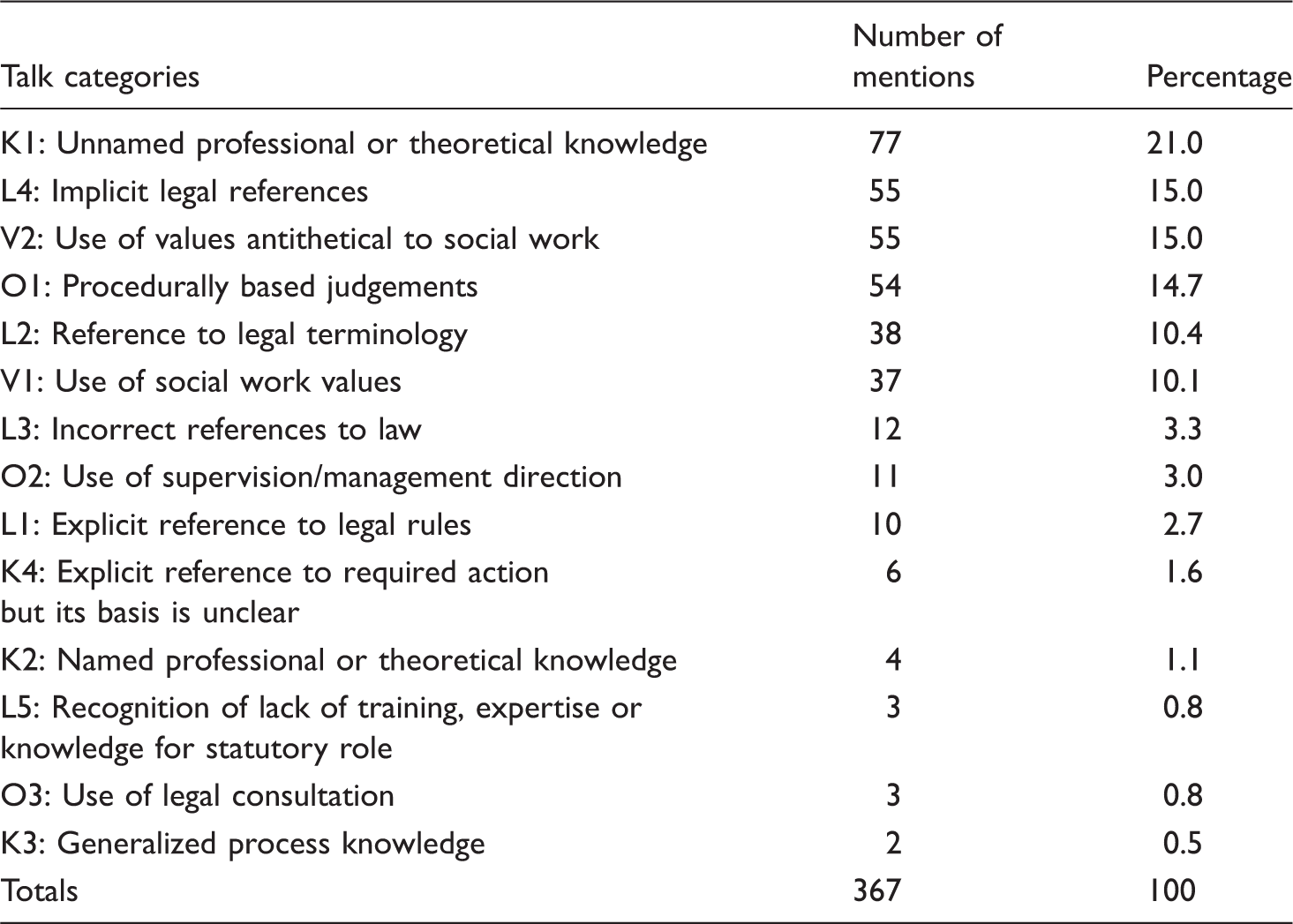
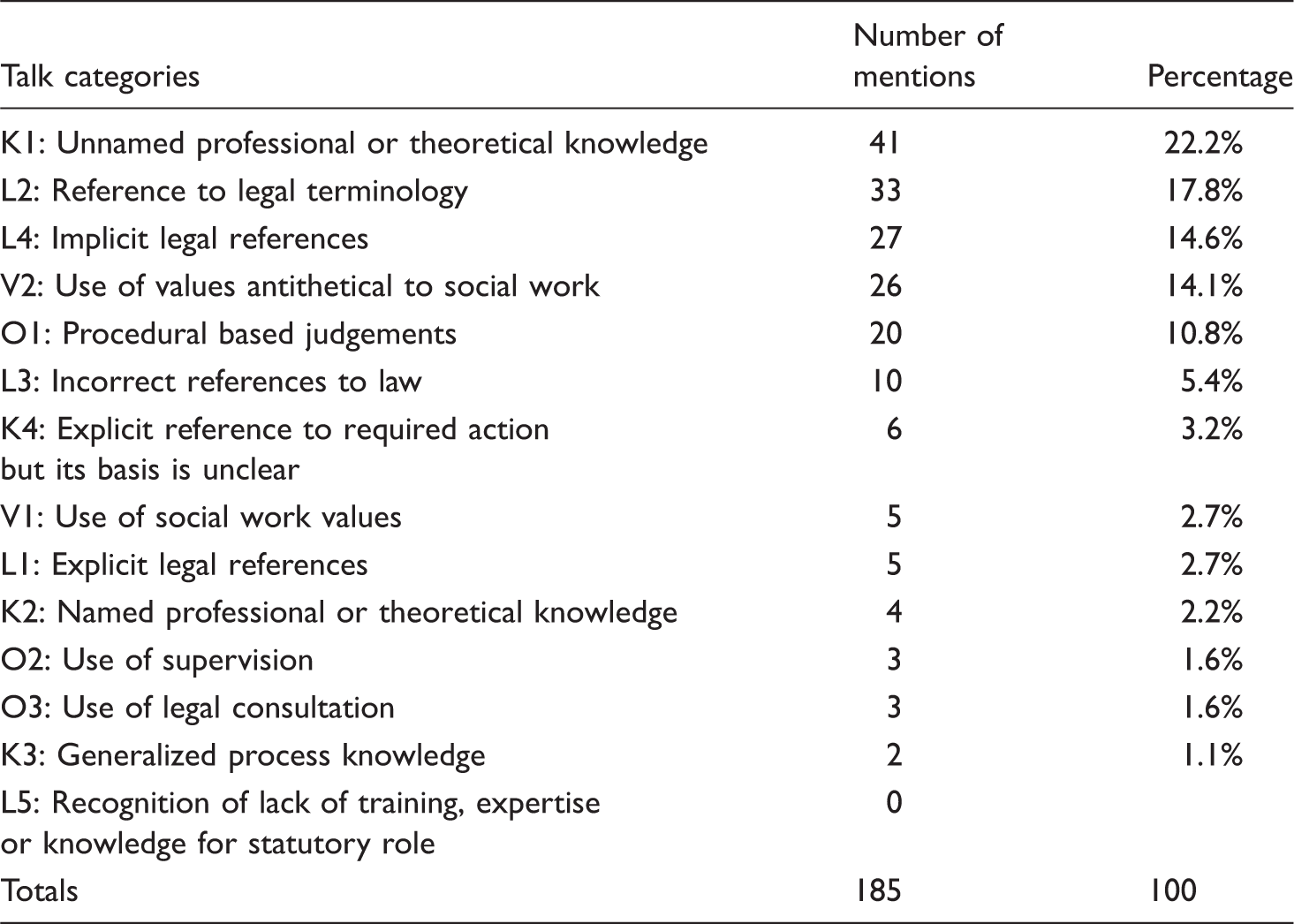
The children’s workers spoke about cases involving substitute care, care proceedings and domestic violence. Adults’ workers all spoke of situations where residential care was being considered for older people. In one case there were also adult safeguarding concerns; the two others concerned hospital discharge planning, mental capacity and competing family perspectives. References to influences on decision-making fell into four groups – law talk, values talk, organizational/procedural talk and knowledge talk. Table 1 defines, and quantifies the volume of references to each distinct coded theme within each of the groups.
Law talk is more frequent than any other category, although references to legal terminology are more often implicit than explicit. There are differences between children’s and adults’ practitioners, the former having a higher volume of law talk than of values, organizational/procedural or knowledge talk, whilst for the latter social work values, and procedurally based judgements were more apparent. There were, however, differences within each group of practitioners. One adult sector practitioner referred much less to law than the two others, and the few legal references were implicit. Two of the children’s workers were more likely to refer to legal terminology than the third, whose references were implicit. One practitioner accounted for over half the incorrect references to law.
Frequency list – children’s and adults’ practitioners combined
Frequency list – children’s practitioners
Frequency list – adults’ practitioners

Unnamed professional knowledge emerges as the most dominant feature, but the disaggregated tables show most clearly the different positioning of explicit and implicit legal references. Whilst not the specific focus of this research, one feature to emerge was the nature of values talk, with a relatively high volume of references, particularly from children’s practitioners, to values that appeared inconsistent with professional codes of ethics. Organizational/procedural talk overall was less dominant than the other categories, but for both groups of practitioners was close to the top of the frequency chart.
Volume of missing references
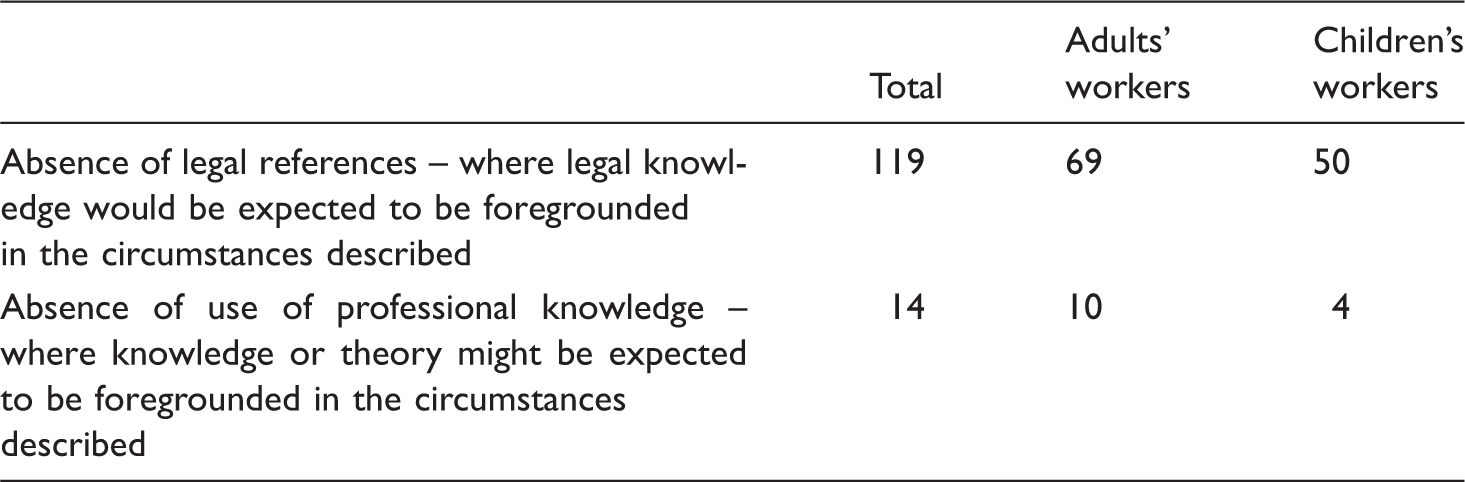
The social workers may have underplayed law in their stories. Judging from the subsequent researcher interviews, in which law was specifically probed, some drew on more explicit legal knowledge than surfaced in the paired peer discussions. At follow up, for example, two of the children’s practitioners clearly articulated subtle distinctions between different legal mandates and presented a far stronger grasp of legal issues. Two adults’ practitioners too offered more explicit legal references in response to specific probes from the researcher. There were fewer occasions where references to law might have been expected but were omitted, but incorrect references to law increased.
Interpreting the data
Explanatory themes emerging from the interviews suggest several possible reasons for this picture, which are explored below.
Knowledge and confidence
First, practitioners appeared to lack knowledge about legal rules, and/or of confidence in using them. One adults’ worker commented that she was ‘the only one in the team that has a good working knowledge of the Delayed Discharge Act’. She was ‘not completely sure’ about the legal basis for safeguarding adults or Independent Mental Capacity Advocates and, whilst aware that adults could in extreme circumstances be removed from their own homes, could not specifically name the legal provision. ‘Legally, I’m not sure’ was her conclusion on whether allocation panels were based in law or agency procedures and whether they could lawfully overturn her service recommendations simply on resource grounds. Another struggled with the distinction between consent and lack of objection to residential care and, whilst motivated to do ‘the right thing at the time’, lacked awareness of principles within the Mental Capacity Act 2005: ‘I think she could make decisions but whether they were the right ones, I don’t know’. Two of the three adults’ practitioners were uncertain how to evaluate decision-making competence and capacity. In relation to children witnessing and their mother experiencing ongoing domestic violence, one practitioner appeared powerless, failing to consider relevant statutory provisions: ‘all we can do is relay concerns to mother’.
Uncertainty about legal rules can undermine confidence in using them proactively, and this certainly appeared the case. Lack of confidence was one (but not the only) reason for one practitioner’s lack of clarity in assessing the suitability of a placement, for another’s assessment of children’s safety, and for another’s evaluation of risk in discharging an older person home. One worker was aware of the risk at night to people with dementia because of ‘huge resource issues’, which meant that ‘what we are able to provide to somebody in their home is minimal’ and ‘we’re resource-led … . we have no night care at all’. She felt that panels ‘get in the way of us being able to meet [assessed] needs’ and that, correctly, ‘it was illegal for them to decide purely on finance’. However, she could not develop this critique of unease by using the legal rules to challenge how the authority responded to eligible need. She remained uncertain to what degree panels could lawfully decide how much care people received. Another practitioner wanted but didn’t know how to challenge a blanket policy that restricted personal care services to ‘a maximum of four calls a day’ on grounds of resources.
The law was experienced as difficult to interpret. One children’s practitioner found it ‘very difficult to differentiate between’ children in need and children at risk. Another felt deskilled in terms of assessments for court: ‘there are some people who are much more competent than I am. I would need a lot more training to do some of the assessments that are required.’ Several social workers bemoaned the low level of continuing professional development. Of the three adults’ workers, one noted that she had not ‘done any training in protection of vulnerable adults’; a second had had training on mental capacity but had not been able to apply it; the third would have liked to have annual legal updates.
The literature reports that perceived difficulty in using law lessens the impact of legal rules on practice. Perkins et al. (2007) report that the relevance of some legislation may not be understood, with practitioners and managers unclear about the status of central government guidance documents, and consequent impacts on departmental and inter-agency working in safeguarding. Legal requirements on information sharing and inter-agency collaboration are not well understood (Laming, 2009). The breadth of legal knowledge required includes direct mandate legislation (from which social work draws its powers and duties) and underpinning foundations that apply to all organizations performing a public function, for example, human rights, data protection and equalities. The interface between these is in itself complex and the degree to which practitioners explicitly consider the underpinning frameworks, in particular, is variable (Braye & Preston-Shoot, 2005; Doel et al., 2010; Hawkins et al., 2001).
The focus on continuing professional development is also mirrored in the literature. The Social Work Task Force (2009) found that practitioners take on unrealistically complex tasks early after their initial qualification whilst lacking ongoing professional development. There is evidence also of practitioners lacking confidence in multi-disciplinary exchanges and unable to articulate the reasons for their decisions (Braye et al., 2007; McDonald et al., 2008; Osmond & O’Connor, 2004; Preston-Shoot, Roberts, & Vernon, 1997). Practitioners also struggle with what are in any event difficult balancing acts between orientations to practice (Dickens, 2007; Duffy & Collins, 2010; Spratt, 2001), between interventions informed by principles of autonomy or protection in adult safeguarding (Braye, Orr, & Preston-Shoot, 2011), and between legal rules and ethics where these point in opposing directions (Preston-Shoot, 2010).
Given their apparent uncertainty, practitioners in the present study made surprisingly little mention of supervision, and views were mixed. One experience was that supervision in children’s services was ‘bang, bang, bang’; by contrast an adults’ worker had ‘a fantastic experience of supervision’. Practitioners appeared acutely aware of their isolation in interpreting their responsibilities. There was also little sense of sharing responsibility with other professionals, even when case conferences or network meetings were described.
There was surprisingly little mention of seeking legal advice, even in quite complex cases, possibly because access to lawyers is tightly controlled (McDonald et al., 2008). One children’s worker was critical of the adversarial nature of care proceedings, with lawyers attempting to ‘wrong foot’ social workers all the time. Difficulty with legal rules may indeed be compounded if relationships between social workers and lawyers are strained and leads to reluctance to engage in legal proceedings (Dickens, 2007) and safeguarding strategies may not always be informed by timely legal evaluation and advice (Corby, 2003; Ofsted, 2009b).
The impact of organizational context and procedures
A second apparent theme is that social workers conflate law and agency procedures, failing to differentiate legal rules from agency translations of the statutory framework into organizational policy. This conflation emerged when one adults’ practitioner, in response to the comment from her child care discussant ‘everything we do in children’s services, you’ve continually got the law’, observed ‘with your job you’ve got procedures to follow whereas in our job, there’s no real clear rules’. One children’s practitioner saw assessment of potential foster carers as local procedures rather than derived from national guidance. Another commented that ‘there’s almost a template of what will happen, what needs to happen, and you follow it because there’s no choice’. The third saw initial assessment and the need to speak with children as ‘the way we work’ rather than explicitly rooted in legal frameworks. Of the adults’ practitioners, one saw community care eligibility criteria as ‘our local thing’, whilst another referred to reviews of care plans as something procedural rather than legal. For the third, reference to procedures substantially replaced legal references. Children’s workers were much more likely to refer to primary legislation. For two, primary legislation offered the means to effectively safeguard children but they rarely referred explicitly to secondary legislation or to policy guidance. None openly questioned whether their departmental procedures were accurate interpretations of the legal rules.
One possible explanation for the greater reliance on procedures by adults’ practitioners is the difference between the legal frameworks for children’s and adults’ services. The former provides a more consolidated, coherent mandate, largely contained within one widely recognized statute that supports a staged approach to intervention. The latter is dispersed across a range of sources of law, all of which must be held in mind from the start, and thus procedures may be seen as providing a more accessible guide through this complexity. But the differences between practitioners in the same sector make it more likely that the differences between the two legal frameworks are less significant than, for example, practitioners’ legal literacy or their experience of supervision.
The conflation between law and procedures is, startlingly, apparent also in inquiries into social work practice. Laming (2009) and Ofsted (2009a), in presenting evidence of lack of compliance, refer interchangeably to policies, procedures and legislation without clarification on whether they are referring to requirements in statutory guidance or local agency interpretations. The House of Commons Select Committee (2009) also concluded that social workers may not adhere to legally compliant practice because local authorities foreground their own procedures. Research amongst practice teachers and students on placement has found that practice is shaped by agency procedures rather than legal rules (Braye et al., 2007). Drury-Hudson (1999) also concluded that novice practitioners were unclear about the difference between policy, procedures and legislation.
It is important to tease out whether lack of reference to legal knowledge arises from unconscious competence, where knowledge has been assimilated to the degree that it is no longer thought about, or denotes unconscious incompetence (Reynolds, 1965) – real gaps compensated for by a dependence on procedures and routines (McDonald et al., 2008). Knowledge may be synthesized and not always formally articulated (Osmond & O’Connor, 2004). As one adults’ practitioner commented: ‘I think that sometimes as workers, that have been doing it for a little bit longer, just maybe get into a routine of what they expect to happen … you just sort of go into normal mode for a while.’ As others have reported (Preston-Shoot & Wigley, 2002), practitioners may fall back on the legal rules when cases become difficult. One adults’ practitioner commented: On a daily basis I don’t think about these Acts because I know what my role is. I think it is only if you come across something that isn’t the norm, or you’re not sure what to do, that’s … when one would normally search back and see how the legislation could help us to help this person.
But the organizational context, its rules and expectations, are extremely powerful factors, as exemplified by one children’s practitioner who was reflectively critical of her agency. The ‘management support we get is just not enough’; (there is) ‘a lot of stress’ arising from colleagues’ sickness, large amounts of paperwork, and unreliable new computer systems and electronic files. Her focus was ‘on just getting through the bureaucracy’. She also noted that the nature of the work had changed: ‘the number of cases we are working with on a family support basis is ever decreasing; funding is down to the absolute essentials’. Managers were clearly influential. For example, the continued optimism with which one children’s practitioner viewed the viability of family care, despite repeated departures from agreed plans, was sustained partly because her manager did not suggest alternative approaches. One of the adults’ practitioners viewed staff locking an older person in an annexe as a safeguarding issue, but ‘having discussed it with my manager, they felt it wasn’t institutional harm or abuse, [so] we didn’t go down that line’. One manager’s initial attitude toward delayed discharge was described as ‘this is your job, this is what you need to do now, we don’t want any delayed discharges, so this is what you have got to go in and do’.
The narratives were marked by an acceptance of agency practice, although scepticism may be justified. Analysis of judicial reviews and Ombudsman reports (Preston-Shoot, 2010) found evidence of local authorities seeking to avoid their legal duties, taking unlawful resource-driven decisions, and accepting plans flawed by failure to follow requirements in statute or policy guidance. Dickens (2007) found that decision-making was affected by a complex interweaving of organizational priorities to deliver high quality services within limited resources. Practitioners may search for security behind agency procedures even though this might mask the needs of individuals and lead to ritualistic interventions (Beckett, McKeigue, & Taylor, 2007; Taylor, Beckett, & McKeigue, 2008). Inquiries have found evidence of inadequate supervision and an absence of support for front-line staff, unrealistic expectations on newly qualified practitioners, high caseloads and long working hours, lack of effective management action, and lack of resources to cope with the volume of demand (HM Government, 2010; Laming, 2009; Social Work Task Force, 2009). Organizations also have orientations towards the management of decision-making. Spratt (2001) identified organizational cultures on family involvement, internal blame, and approaches to community need. Others have found that hierarchical structures and emphasis on formalized procedures, with practitioners fearful of blame, and supervision not routinely addressing practice dilemmas, create difficulty in articulating a professional rationale for work undertaken (Lymbery, 1998; McDonald et al., 2008).
Perceptions of the relevance of legal rules
A third theme is the perceived relevance of law, with evidence of an assumption there is more law governing child care than adult social care, and a related under-emphasis on legal rules as the driver for action in adults’ cases. One practitioner commented: ‘we don’t use that much legislation. It’s procedures that we work under the restraint of, and funding budgets.’ One children’s worker suggested, ‘I have the law. I think there are legal grounds to do this, this and this. You [the adults’ peer interviewer] are far more guided by your feelings from a number of conversations.’ Ignorance about policy/practice guidance and case law emerged when an adults’ worker reflected on ‘the different ways that we reach decisions. I would think in [child care social work] there is more guidance than there is in my job … they’ve got procedures to follow in certain things like child protection but we haven’t got any written procedures on how to make a decision’ and, whilst aware that legislation might underpin her work, she did not think that it directed her work. On the Human Rights Act 1998, for example, ‘it’s around but I wouldn’t say that I would think ‘‘oh, the Human Rights Act’’, but … it would probably kind of cross my mind but I probably wouldn’t be thinking it’. Another struggled with determining decision-making capacity and balancing service user and family carer views about residential care. She was aware of the importance of determining capacity but made no reference to government guidance that might have assisted. In fact, the Mental Health Act 2007, Mental Capacity Act 2005 and policy guidance in relation to safeguarding adults and assessing people’s need for community care services should all have influenced explicitly the approach adopted by the adults’ practitioners. One practitioner recognized that more explicit use of this legislation ‘would have helped me to be much clearer about whether she had capacity’. Even where legal rules were recognized, there was ambivalence about them. One children’s practitioner saw law as ‘just jargonistic’ and court processes as sometimes curtailing her autonomy and rendering her powerless: ‘you’d ask me about why decisions were made and I actually didn’t know either … the court had made the decision and we could not understand why they’d come to that decision’.
Individual practice orientations
A fourth theme to emerge from the narratives is the significance of individual orientations to practice. As one children’s practitioner observed: ‘we have different, totally different approaches; we’re all evaluating risk but it’s at what point the law comes in’. Other decision-making research has identified individual practice patterns too, with workers for instance focusing on practicalities rather than therapeutic and interpersonal transactions (McDonald et al., 2008). In the present study, the observable patterns/models of practice could be characterized by:
Risk aversion, with decisions such as admission to residential care guided pragmatically by the family’s rather than the older person’s wishes or assessed needs. Awareness of the likelihood and possible severity of adverse outcomes was exemplified by one adults’ practitioner: ‘I was thinking very much about risk and I was thinking, oh dear, if she goes home and she has a really serious fall, and what are the dangers?’ This appeared to overrule consideration of whether the service user had capacity to make her own decision. The adults’ practitioners tended to adopt broader, family-oriented approaches to decision-making, marginalizing service users, and displayed little awareness that this could breach their rights to private and family life, even if motivated by wanting to ensure their best interests.
Equally amongst the children’s workers, when the court refused to make a care order, a children’s practitioner continued with a child protection orientation as she considered risk too high. Equally, awareness of risk to others was persuasive. A very public (at a nursery) breach of a child’s plan triggered child protection rather than ongoing child-in-need interventions: ‘it’s not just now mum and child in the family home, this is an environment where there are other young children coming and going, and if he is angry … we have to think of the safety of others’.
The literature confirms that decision-making engages anxiety about the management of risk (Spratt, 2001; Taylor, 2006). It has also been suggested that social work’s confidence in its decision-making has been undermined by high profile tragedies, by uncertainty about the outcomes of intervention, and by increasing regulation through protocols, performance indicators and procedures (Braye & Preston-Shoot, 2010; Duffy & Collins, 2010; Lymbery, 1998). As Spratt (2001) discovered in children’s services, views about risk can outweigh ethical principles.
Proceduralism, working within but not challenging a system to give a higher profile to legal rules that might support users’ rights. Adults’ practitioners commented ‘not a lot of people know about the Delayed Discharge Act and they don’t know they’ve got rights’; ‘I had to put people in places that I don’t know whether they are suitable. I’ve had real qualms about having to do that.’ Amongst the children’s practitioners too there was strong observance of procedures in guiding practice. ‘I don’t know if anything can be done (about speaking with a child alone) if mum was very adamant, because we are still only in ‘‘child-in-need’’, all we can do is explain to mum the reasons why we see them on their own and just hope that she would be in agreement with that.’ The exercise of professional discretion, akin to the notion of street-level bureaucracy (Lipsky, 1980), in the ability to bypass procedural rules. ‘Once I found my feet working in hospital, I knew the questions to ask, so if I needed to play for time I would do what I thought was best for the person … it was about learning ways to work around the system’. Again, ‘our presentations to panel to get the resources, we will often word it because we know what we are looking for and that’s about working the system’. Knowledge of specific legal rules, such as those relating to delayed discharge, helped to consolidate confidence: ‘it took me a while to build the confidence to be able to do that … what I have developed over time is negotiation skills … built up the experience and confidence to back what I am saying’. Legal literacy could, therefore, override an organizational procedural orientation; this may particularly be the case where a shared loyalty to professionalism as counterpoint to managerialism is embedded within local management culture (Evans, 2011).
The literature confirms that individual practitioners, and managers too, will bring their own orientations to decision-making. Landau (1999) refers to four – compliance with agency procedures, promotion of client self-determination, a combined approach, and a preference for deferred/non-intervention – with organizational demands influential in determining which is adopted. Braye and Preston-Shoot (2010) have described three approaches to applying the law that prioritize either technical/rational knowledge, ethical principles, or rights, each making a justifiable contribution to how issues are perceived and practice conducted, but at times overlayed with a fourth, agency-driven orientation.
Conclusion
Social workers need a sound understanding of law in order to implement and defend their use of powers and duties. Indeed, the ability to articulate practice knowledge more broadly is essential to accountability and quality service delivery (Osmond & O’Connor, 2004). The evidence on the extent to which this is achieved is mixed. Duffy and Collins (2010) suggest that policy and legislative imperatives do impact on social workers’ decision-making. Sheppard and Ryan (2003) conclude that legal knowledge is a constant reference point, embedded in how social workers think about cases. MacIntyre and Green Lister (2010) found that students paid appropriate attention to law when discussing vignettes. There is clear evidence of strong engagement with mental health law by Approved Social Workers 1 (Braye & Preston-Shoot, 2005; Evans et al., 2005; Hatfield, 2008; Johns, 2004). Conversely, social workers may only turn to the legal rules when other approaches fail to deliver sought-after outcomes (Preston-Shoot & Wigley, 2002). Drury-Hudson (1999) found that novice social workers reported little knowledge of legislation; they did not take legal rules, or the evidence requirements for court, into account when making decisions. Even for more experienced practitioners legal rules were not necessarily a primary influence on their decision-making.
The pilot study reported in the present article, despite its small number of respondents and findings that are purely illustrative, casts light on the complexity of the range of factors that present barriers to the robust and consistent implementation of legal rules. It moves on from a focus on the acquisition of legal knowledge through professional education (Braye, Marrable, & Preston-Shoot, 2011) to consider in more depth than has been done before the factors at work in the practice environment – the impact of knowledge and confidence, of organizational context and procedures, of perceptions of the relevance of legal rules, and of individual orientations to risk, procedures and discretion.
The two-stage research process illuminated the degree to which legal knowledge is embedded in practitioners’ thinking. Overall, a variable picture emerges of the law as influential in seeking resolution of dilemmas encountered in practice. For some participants, the peer interview was their first opportunity to narrate the case, and they were thinking on their feet about their rationale. With a poor experience of supervision, one found the process ‘terribly therapeutic’. Participants could be ‘quite nervous at first’ but later ‘it felt as if I was talking to a colleague’. The interview could then feel valuable: ‘what I found really interesting is that you’d ask me about why decisions were made and I didn’t actually know either’. The value of pairing social workers from different sectors emerged: ‘I kept saying ‘‘how did you do that, why did you do that?’” This challenge to taken-for-granted assumptions meant that implicit knowledge had to be made explicit: ‘initially I might have given less detail because I kind of automatically assumed that they understood a lot of the processes’. Using actual cases appeared to inject authenticity into practitioners’ decision-making accounts, but it could equally be perturbing: ‘I suppose I had, and I guess to a certain extent still retain, an anxiety. Whenever you look back over a case you wonder whether or not you’ve done the right thing, made the best decision at the best time in the best way.’ The empowering potential of opportunities to exchange reflections on casework has to be tempered with recognition of anxiety about the judgements that others might reach when practice is exposed.
Notwithstanding these caveats, the analysis here extends understanding of the approach taken by experienced practitioners, and suggests a more nuanced picture than that which has emerged previously about law in practice, where law either is (Sheppard & Ryan, 2003) or is not (Drury-Hudson, 1999) a primary reference point for decision-making; in which practitioners are slow to revise their hypotheses (Sheppard & Ryan, 2003) and where risk to the public dominates decision-making and social work becomes service oriented rather than person-centred (McDonald et al., 2008). The present findings suggest a more complex interplay between knowledge, confidence, organizational context and individual orientation, and the need therefore for more nuanced solutions.
The implications of the findings suggest that greater levels of legal literacy in practice are necessary, and indeed the need is urgent if the interests of service users and carers are to be protected and agencies are to strengthen their lawful and ethical responses to complex and challenging needs. Initial qualification education and continuing professional development can play their part in building stronger knowledge foundations, but the development of mature legal literacy must take account both of the individual’s attitudes, beliefs, knowledge and skills, and of the organizational and service environment. Thus greater emphasis on setting and auditing standards for observation of legal rules, and the role of managers in supporting and supervising this aspect of practice, is vital. Legal literacy, properly nurtured, can play a key role within professional decision-making; in identifying the significance in legal terms of the unique circumstances of any individual situation it assists in managing the complexity of competing perspectives, limited or conflicting information and contested outcomes. Such literacy supports practitioners in asking challenging questions, in evaluating needs, risks and options, and developing an explicit rationale for subsequent practice. Further research on the specific features that facilitate and sustain a higher profile for legal rules in decision-making, using refinements of the methodology piloted here, will strengthen understanding and provide models for implementation.
Footnotes
Acknowledgements
The authors are grateful for the participation of the authorities, teams and practitioners who took part in the study.
Funding
This research received no specific grant from any funding agency in the public, commercial, or not-for-profit sectors.