



Abstract
Summary
Policy practice is a core element of social work practice. The rationale for this type of practice and its key strategies and methods has been discussed at length in the literature. However, insights from public policy theories have not been employed in order to better understand the ways in which social workers can influence social policy formulation. This article seeks to broaden and enrich the theoretical foundations of policy practice by incorporating knowledge from two leading frameworks of the policy process – the Multiple Stream Framework (MSF) and the Advocacy Coalition Framework (ACF) – into the policy practice discourse.
Findings
This article underscores the potential contribution of these frameworks to the engagement of social workers in the policy process by discussing the practical implications of their theoretical insights upon the roles and tasks of social workers engaged in policy practice. It does so by employing the frameworks to better understand the roles and the tasks of social workers in three streams in the policy process: problems, policy and politics. It also underlines social workers’ potential role of policy entrepreneurs.
Applications
The insights emerging from the MSF and the ACF can guide social workers in their efforts to influence the policy process. By drawing upon these frameworks, social workers will not only be able to see the wider policy picture but they should be better able to identify possible roles and relevant tasks for themselves in order to influence this process.
Policy practice, the involvement of social workers in the policy process, enjoys growing recognition and attention within the social work discourse in different countries (see, for example: Gal & Weiss-Gal, 2013; Jansson, 2008; Mendes, 2007; Rocha, Poe, & Thomas, 2010; Simpson & Connor, 2011). Policy practice refers to activities that are carried out by social workers as an integral part of their professional work and which is aimed at influencing the development, enactment, implementation, modification or preservation of social policies, at the organizational, local, national, or international levels (Jansson, 2008). The goal of such activities is to further policies that contribute to social justice and which better address service users’ problems (Cummins, Byers, & Pedrick, 2011; Ellis, 2008; Hoefer, 2012). Within the social work discourse, there is an emerging consensus that policy practice cannot be limited to a small number of social workers who are policy experts or engaged in macro practice. Rather it is relevant to the ongoing practice of social workers engaged in diverse fields of practice and levels of intervention (Haynes & Mickelson, 2003; Jansson, Dempsey, McCroskey, & Schneider, 2005).
Though policy practice is intended to influence public policies, the impact of theoretical developments concerning public policy-making has been surprisingly limited in social work literature dealing with policy practice. While some social work scholars have drawn upon theories of policy-making in their work (Cummins et al., 2011; Haynes & Mickelson, 2003; Jansson, 2008), these have generally been peripheral to their discussion or employed as a vehicle for analyzing social policy, but not as a means upon which to base interventions in the policy arena (O’Connor & Netting, 2011). Insights from the work of public policy scholars can offer social workers a theory-based practice that may enhance understanding of their potential role and tasks in the policy formulation process. Given that policy practice implicitly assumes an intersect between social work and public policy, this behooves that social work scholars move beyond the traditional confines of social work scholarship and integrate into their analyses conceptualizations that have developed in the policy studies literature.
This article seeks to bridge the intellectual chasm between social work and public policy by integrating insights from theories of public policy into thinking about how social workers can influence policy. It discussed the relevance and implications for social work policy practice of two frameworks that have dominated public policy discourse in recent decades: the Multiple Stream Framework (MSF) and the Advocacy Coalition Framework (ACF).
The article consists of five sections. The first presents the rationale for choosing the two frameworks as a basis for policy practice. The second and third sections describe the key arguments of the MSF and the ACF. The fourth section presents insights from the MSF and the ACF that highlight tasks and activities that are relevant to social workers seeking to influence policy. Finally, the conclusion summarizes the contribution of the two frameworks to policy practice and to social work education, and discusses their constraints.
Why are MSF and ACF relevant to policy practice?
Public policy analysis deals with the diverse ways that policies are formulated and changed (John, 1998). Students of public policy seek to understand how policy decisions are made and the causes for these. This body of knowledge focuses upon the processes and actors involved in policy decisions and it studies policy outcomes and their consequences for the publics that consume and appraise them (John, 2003). Public policy is typically defined as consisting of political decisions for implementing programs to achieve societal goals (Cochran & Malone, 1995). Social policy, which seeks to address social problems through collective strategies (Jansson, 2008) is the focus of social workers’ policy practice. It is one of the key domains of public policy and, as such, frameworks for analysis of public policy-making can apply to it (Kraft & Furlong, 2007).
In the 1980s and the 1990s, public policy scholars became dissatisfied with the stages heuristic, the most predominant theory of the policy process at that time, arguing that it lacked causal mechanisms for explaining the policy process (Sabatier, 2007). In response, diverse alternative models and frameworks of the policy process attempting to cope with the multilevel nature of policy change and variation were developed (Nowlin, 2011). Among the more prominent of these were John Kingdon’s Multiple Streams Framework (MSF) and Paul Sabatier’s Advocacy Coalition Framework (ACF), which continue to dominate the discourse in this field (Real-Dato, 2009; Weimer, 2008). Real-Dato (2009) contends that the basis of the success of the MSF and ACF is that they seek to reveal the underlying generative causal processes that constitute the drivers of policy dynamics. Both frameworks have proved to be applicable to various substantive topics, across various geographical areas, cultures and governance systems (Nowlin, 2011; Weible, Sabatier, & McQueen, 2009; Zahariadis, 2007).
Other models and frameworks of the policy process tend to focus their analysis of the policy process on specific attributes, components or parts such as institutions, actors’ behavior, framing processes of target populations, networks, diffusion of policy innovation, information processing, or attention and policy choice by governments (for a detailed description and overview of existing models, see Nowlin, 2011). The MSF and the ACF aspire to be more comprehensive in their view of the policy process so as to explain not just parts of the process, but how their interactions produce policy outcomes. They consider the policy process broadly, rather than how it operates within specific institutions. In addition, the MSF and the ACF offer a comprehensive conceptualization of the relationship between five core casual processes in policy-making: institutions, networks, socioeconomic processes, choices and ideas (John, 1998; Parsons, 2005).
Despite their widespread acceptation, these two frameworks have been challenged (for detailed criticism of the MSF, see Zahariadis, 2007 and for the ACF, see Sabatier & Weible, 2007). In brief, it has been claimed that the two frameworks have only a limited predictive capacity as they offer generalizations instead of a clear focus on specific processes within the policy process (Weimer, 2008). Second, they pay scarce attention to micro level processes, that is, the way participants’ actions affect the policy process (Real-Dato, 2009). Third, the two frameworks accord limited treatment to institutional constraints that shape participants’ behavior in the policy process (Real-Dato, 2009; Weible, Sabatier, & McQueen, 2009). Fourth, it has been claimed that there is weak theoretical articulation of the relationships between policy subsystems and their environment, and particularly to the mechanisms through which causal influences traverse subsystem boundaries both inwards and outwards (Real-Dato, 2009). Finally, critics have underscored the limited explanatory scope of the two models in the sense that each one of them tends to favor a particular causal path of policy change (John, 2003).
As the goal of this article is not to employ these frameworks to analyze a specific policy process, we are less concerned with the frameworks compatibility for research and analysis. Rather these frameworks are used as a heuristic theoretical tool to identify and discuss possible ways in which social workers can influence policy (Jansson, 2008). As the two frameworks offer insights into the nature of the policy process, they can underscore the varied roles and tasks that social workers as policy actors can play in this process.
The Multiple Streams Framework (MSF)
In Agendas, Alternatives and Public Policies, John Kingdon (1995) takes the very messiness of the policy process with its complexity and apparent unpredictability as a baseline. Policy formation is seen as the result of a flow of three sets of processes or streams: problems, policies and politics. First, ‘problems’ are public matters requiring attention that may or may not get defined as important. Second, ‘policies’ are proposals for change based on the accumulation of knowledge and the development of interest among specialists in a policy sector. Highly motivated policy entrepreneurs propose solutions to policy problems. They mobilize opinion and institutions seeking to ensure that the solutions remain on the public agenda. These policy entrepreneurs can be politicians, bureaucrats, analysts, professionals, consultants, journalists or academics. Third, ‘political processes’, such as election results and swings in the popular mood, influence how the media and other opinion-makers define public problems and evaluate potential solutions.
Each of these processes acts as an impetus or a constraint on public policy by placing a proposal on, or removing it from, the agenda. Identifying the conditions under which these three streams combine to make a policy happen is the principal goal of Kingdon’s research. He argues that agendas are not an automatic reflection of the power of participants in the policy process. Rather, the contingency of the interactions between the streams can cause discontinuity or sudden agenda change. An idea often catches on and moves rapidly onto the political agenda, especially when there is a ‘policy window’, which offers an opportunity, such as a new policy problem or a new government in power, for policy advocates to press their ideas. Windows are either opened by the appearance of compelling problems or by events in the political stream. These windows may not be open for long, so participants in the policy process must act swiftly before the opportunity is lost. Because of boredom, symbolic political actions or the natural course of the issue attention cycle, the windows often close as rapidly as they open.
Kingdon employs a version of Cohen, March, and Olsen’s (1972) ‘Garbage Can’ model of organizational choice to understand the way the streams join together. He applies the idea to the wider political process that has the characteristic of ‘organized anarchy’. This process of continual change and the intermittent involvement of diverse policy makers, whether politicians, bureaucrats or others, is the base point for a policy system that is far removed from the traditional sequential model of policy-making.
The MSF celebrates the importance of ideas in public policy, but also seeks to explain how ideas emerge through their adoption and rejection by policy makers. Institutions are also important, specifically in shaping change and the evolution of policies and policy problems, particularly when they are highly fragmented and allow for the flow of ideas. Although in the early version of his book (1984), Kingdon referred mainly to processes of agenda setting and alternatives selection, in a later version (1995) he extended the framework to include the analysis of the whole policy process including processes of implementation and evaluation. Other authors, such as Zahariadis (2007) and Ness (2010), extended and developed the framework to cover the entire policy formulation process. Figure 1 presents the major components of the MSF.
Diagram of the Multiple Streams Framework.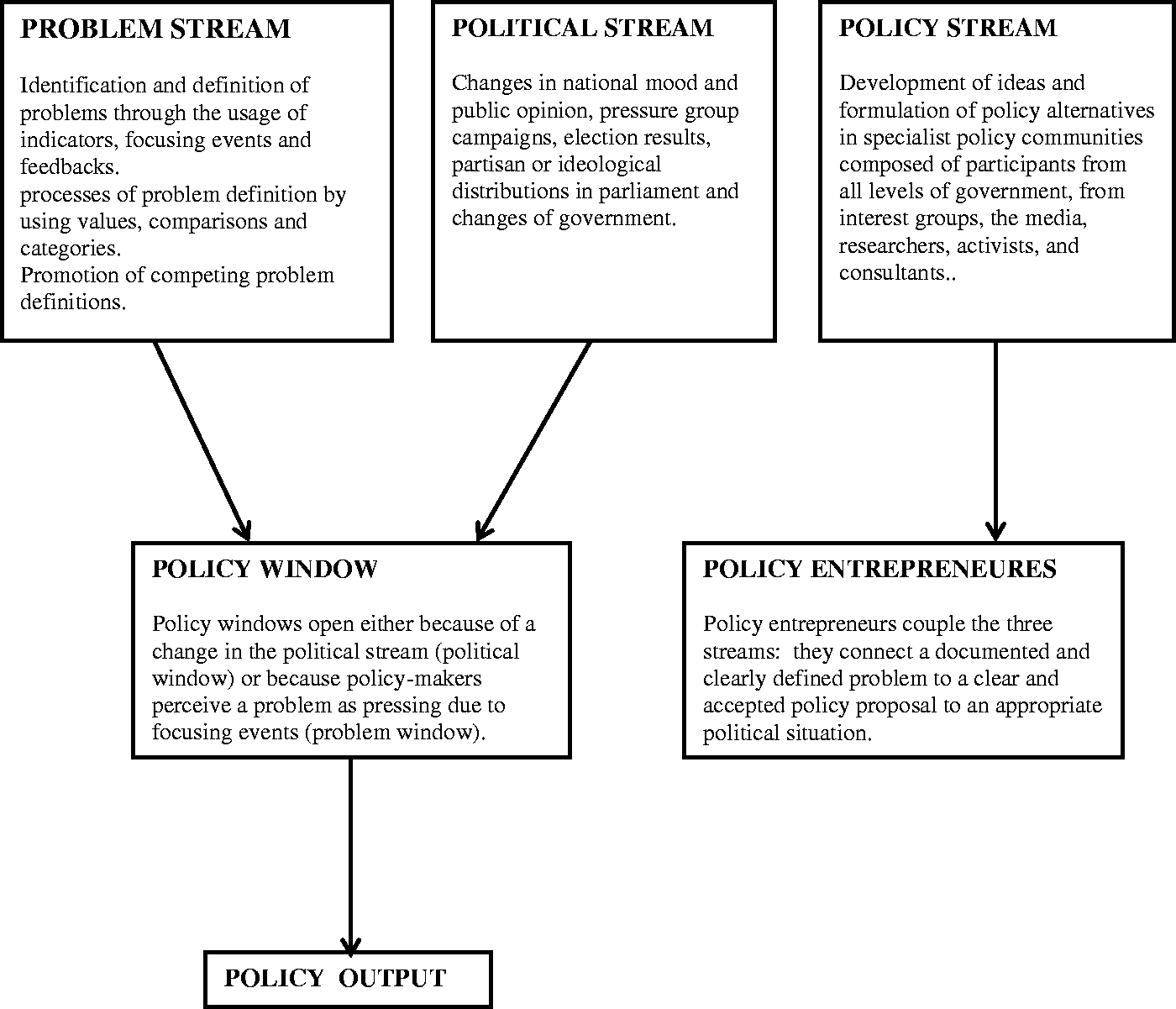
The Advocacy Coalition Framework (ACF)
The starting point for the ACF, formulated by Sabatier and Jenkins-Smith (1993, 1999), is the importance of policy subsystems in policy formulation and implementation. Here relationships within policy sectors are the key to understanding how decision-making works. The ACF regards policy-making as a continual process with no strict beginning or end. In the ACF a coalition is an alliance of actors holding the same ideas and interests for the purpose of arguing against other coalitions within the same policy sector. Coalitions can include journalists, policy analysts, professionals and researchers as well as the more familiar bureaucrats, politicians and interest group representatives. They all play a role in the dissemination of ideas. Participants bargain and form alliances within networks. The ACF does not assume policy-making systems are consensual or are dominated by stable crosscutting elites.
Sabatier and his associates employ their framework to explain policy change. They assume that commonly two to four competing policy advocacy coalitions, each with its own ideas about policy content, compete for dominance in a subsystem. Knowledge is crucial because the coalition is a reflection of ideas and interests concerning a set of policy issues. The analysis, while appears to be about relationships, is in fact about values and conceptions. The ACF distinguishes between major and minor policy change. Major policy change refers to subsystem-wide alternations of policy (changes in policy core aspects of the subsystem). Minor policy change is defined as changes of a specific subcomponent of the policy subsystem (changes in secondary aspects of the policy subsystem). Minor policy changes occur more frequently and have smaller magnitude.
The ACF assumes that individuals have a three-tiered hierarchical belief system. The top tier comprises deep core beliefs that are fundamental beliefs, which span multiple policy subsystems and are very resistant to change. In the middle tier are policy core beliefs; these are normative empirical beliefs that span an entire policy subsystem. While resistant to change, policy core beliefs are more pliable than deep core beliefs. Policy core beliefs are comprised of categories, such as the perceptions of the severity and causes of subsystem-wide problems, orientations on basic value priorities directly related to the policy subsystem, the effectiveness of policy instruments and the proper distribution of authority between the market and government. On the lowest tier are secondary beliefs that are empirical beliefs and policy preferences, which relate to a subcomponent of a policy subsystem. An example of secondary beliefs is policy participants’ preferences for specific government tools for achieving objectives. Of the three layers of beliefs, secondary beliefs are most susceptible to change in response to new information and events. A key dimension of the framework is that participants learn over time. Policy change, it is argued, needs to be observed over a decade or more to find out how policy analysis shapes the agenda and learning takes place.
In the ACF advocacy coalitions typically form in a particular policy domain when groups coalesce around a shared set of core values and beliefs. These groups engage in policy debate, competing and compromising on solutions based on their core values and beliefs. Competition between coalitions is mediated by policy brokers who have a stake in resolving the problem, either on substantive grounds or because of their interest in maintaining political harmony in the system. Figure 2 presents the major components of the Advocacy Coalition Framework.
Diagram of the Advocacy Coalition Framework. Source: Adapted from Sabatier & Jenkins-Smith, 1999, p. 121.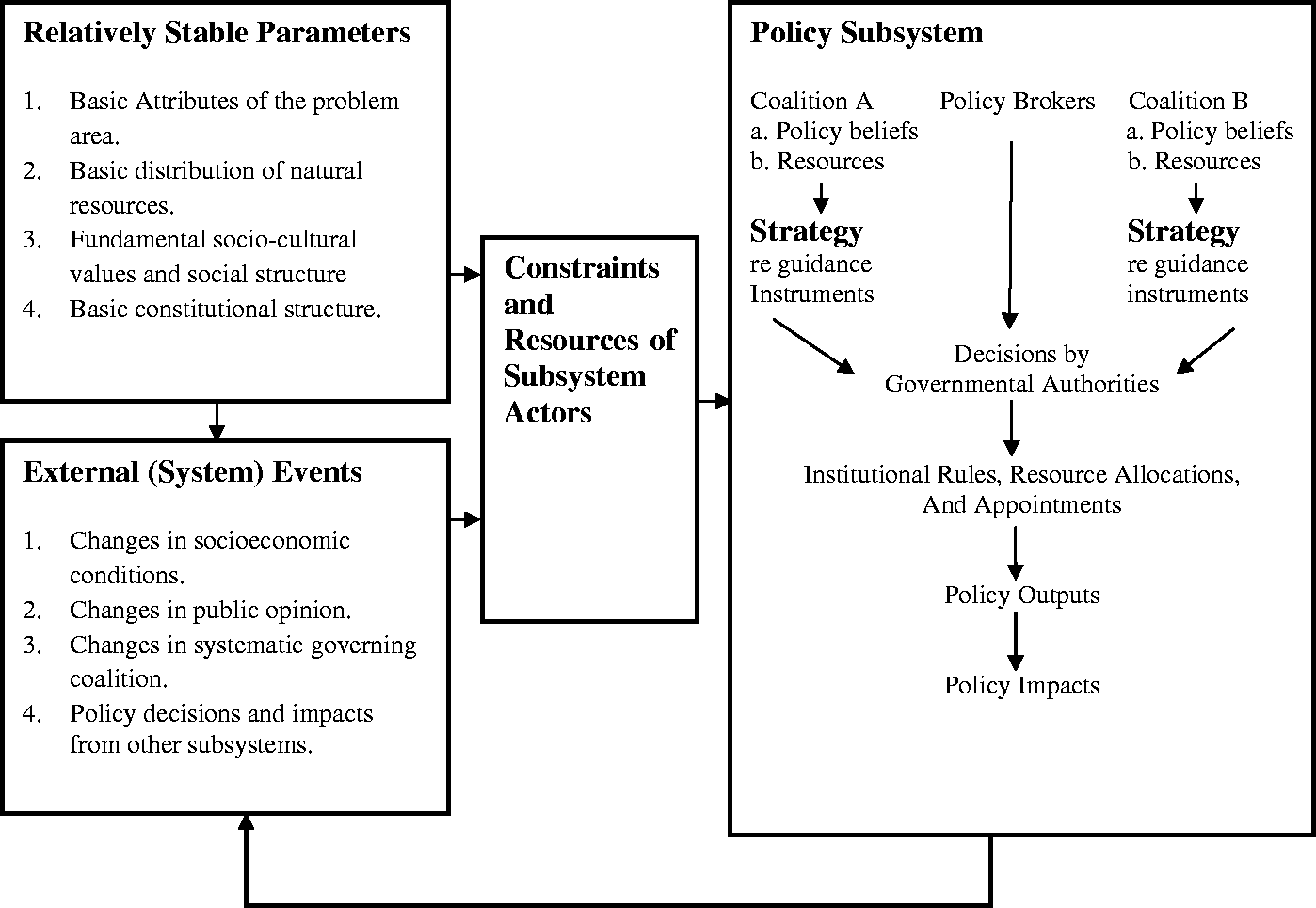
The MSF and the ACF: Implications for social work practice
How are ideas and insights from the MSF and the ACF relevant for social workers engaging in policy practice? Our underlining assumption is that in order to influence policy social workers can be active in all of the three streams, in a single one of them, or can undertake a single task in one of these streams. In addition, they can serve as policy entrepreneurs who play a major role in the coupling of these streams when windows of opportunity open. The activities and tasks in each of the streams are presented below.
Social workers in the problem stream
Since that at any given time, policy makers focus their attention on certain problems and not on others, the crucial tasks in the problem stream are identifying and defining problems, and convincing policy makers of the existence and importance of these problems. Kingdon suggests that this can be done by using indicators, focusing events and feedbacks.
Employing these insights, social workers who wish to impact policy can create social measures or employ different indicators to systematically measure social phenomenon. Policy makers employ indicators to either assess the magnitude of a problem or to follow changes in the problem. Therefore, social workers need to stress the magnitude of a problem related to the indicator and the changes that have occurred in it. They can do so through direct communication with policy makers or through the media (Chandler, 2009), by way of testimonies in legislative committees (Weiss-Gal & Gal, 2014), by inviting policy makers to visit sites of social problems, and by writing letters to policy makers and engaging in protest actions (Kaufman, 2004). The MSF also emphasizes that data obtained from indicators often needs a ‘push’ to gain the attention of policy makers in and around government. That push may be provided, according to Kingdon, by ‘focusing events’ such as crises or disasters (such as a girl murdered by a relative), a powerful symbol (starving children), or by the individual experience of a policy maker (parenting a child with special needs or elderly parents unable to receive nursing care). Social workers should be aware of the potential of these focusing events and can approach policy makers who have personal experience with the problem. As providing first-hand information to policy makers is important, social workers have an advantage and important role in light of their immediate familiarity with various problematic social situations and their ability to provide first-hand knowledge about such situations (Jansson, 2008).
Kingdon notes that crises, disasters, symbols and other focusing events only rarely suffice to ensure policy agenda prominence for an issue. Additional steps are needed, such as linking the crisis or disaster to a problem and to data, or to similar previous focusing events; indicating the problem that causes these events’ occurrence or actions making sure that the focusing event will not be forgotten. Social workers should track these events, publicize them and bring them to the public and policy makers’ attention, make a connection between these and other events and assert that they reflect an ongoing serious problem, which requires a change in policy.
Problems also arise on the agenda or occupy the attention of policy makers through feedback on existing programs and policies. The feedback, transmitted through various channels, often brings problems to policy makers’ attention that are a consequence of programs not working as planned, implementation that does not square with their interpretation of the legislative mandate, new problems that have arisen as a result of a program’s enactment, or unanticipated consequences that must be remedied. Social workers may act as feedback providers by engaging in systematic research, monitoring or supervision. They can also promote the provision of such feedbacks by other institutions and encourage clients to issue complaints to policy makers about problems in service provision or existing policies.
The MSF also emphasizes the importance of problem definition processes. Conditions become defined as problems when we come to believe that something should be done about them. As Kingdon argues, problems are not simply the conditions or external events themselves: there is also a perceptual and interpretative element in their definition. Processes of problem definition and struggles over definition have significant implications for how policy makers would deal with the problem (Poindexter, 1999). Kingdon presents three key ways through which problems are defined: values, comparisons and categories.
The values an individual brings to an observation play a substantial role in problem definition. A mismatch between the observed conditions and one’s conception of an ideal state becomes a problem that requires intervention by government. If, for example, a problem is defined through the value of ‘rights’ or a situation where there is a violation of rights, then this definition requires, essentially, state intervention to safeguard this right. This understanding should lead social workers to pay attention to the ways in which they define problems and to the use of the values and the rights discourse when presenting problems (for example, how the lack of shared residential settings for people with mental disabilities violates the right to marriage and sex life).
Problems are also defined through comparisons. If a person is not achieving what others are achieving, and if one believes in equality, then that relative disadvantage constitutes a problem. Thus the fact that some individuals enjoy high quality medical care while others do not will be regarded as a problem because of the comparison involved. Comparisons can become a powerful argument, when comparing the treatment of the problem with the way it is dealt with in other countries. As such, social workers can use comparisons when they define problems and they should seek information about policies elsewhere to define the situation as a problem. Finally, problems are also defined by using categories. People will see a problem quite differently if it is put into one category rather than another. Thus, much of the struggle over problem definition centers on the categories used and the ways they are employed. A category will construct people’s perception of different dimensions of the problem. For example, it matters whether an issue is discussed as part of education, health or welfare policy or whether the problem, say, of accessibility of people with disabilities, is categorized as a ‘civil rights’ issue or a ‘transportation’ issue.
Problem definition is an ongoing political process where problems are not objective entities in their own right, but are analytic constructs or conceptual entities (Rochefort & Cobb, 1994; Weiss, 1989). Hence, ‘problem definition’ is a process whereby political actors seek to promote the definition they favor and influence the definitions that will eventually emerge from the political process (Dery, 2000). They do so by acting strategically in different ways. Here the quality of arguments, the ability of the participants to argue, use rhetoric and marshal evidence are perceived as ways to advance ideas and definitions (John, 1998; Weiss, 1989).
Kingdon argues that getting people to see new problems, or to see old problems in one way rather than another, is a major conceptual and political accomplishment. Thus, the MSF directs social workers to think of the ways they define problems, to understand the need to invest efforts in defining situations as problems and to promoting these definitions strategically to policy makers against competing problem definitions (Poindexter, 1999).
Social workers in the policy stream
Both the MSF and the ACF refer to policy specialists, communities or policy subsystems as the venue in which policies are discussed, developed, changed and improved. The policy community (or subsystem) is composed of participants from all levels of government, interest groups and the media, as well as researchers, planners, activists, and consultants. The members of the policy community usually specialize in a given policy area. Thus, both frameworks direct social workers who wish to influence policy to become an integral part of a policy community/subsystem engaged in development of policy proposals. In particular, they highlight the need to connect to other participants in the community and to learn about their ideas and proposals. Social workers should realize that their activities within the policy community are important because of their unique position as professionals who have daily encounters with social problems. This enables them to contribute ideas, information and suggestions for policy changes, that are grounded in ‘real life’ and to influence proposals which are formulated within the policy community.
There are four crucial aspects to which social workers should pay attention in the policy stream:
First, social workers should know that specialists in the policy community are involved in processes of raising ideas, formulating them into policy proposals and changing them according to reactions of other participants in the community. Kingdon (1995) mentions three criteria for the survival of a policy proposal that need to be taken into account when developing policy proposals: technical feasibility, value acceptability and anticipation of future constraints, especially budget constraints. According to Kingdon (1995), the policy community will eventually produce, by way of an ongoing selection process, a relatively short list of proposals. Most of these will not be new but rather a recombination and variations of old ideas and proposals. He argues that after a subject has been through the lengthy gestation period of most major issues, the alternatives become familiar, the options narrow to a few well-understood possibilities and a limit is reached on the ability to introduce new material. Advocates pull old proposals out of drawers, cut and paste them, rehashing old ideas in response to new demands. (Kingdon, 1995, p. 149)
Second, in the process of alternative selections Kingdon highlights the importance of ideas and the formulation of ideas into policy proposals. Participants in the policy community encounter ideas and proposals, evaluate them, argue with one another, marshal evidence and arguments in support or opposition, persuade one another, solve intellectual puzzles and become entrapped in intellectual dilemmas. This mode of working through problems and proposals in contrast to working through them by lobbying muscle or mobilization of numbers of people, characterizes the policy community in the MSF (John, 1998). Thus, social workers should realize that the ways in which they articulate and frame their ideas are crucial and could determine their ability to influence the process of policy alternatives selection.
Third, social workers seeking to promote specific policy proposals should be aware that if their policy proposals are to win support and be considered as serious by others, ‘softening up’ processes are needed (Kingdon, 1995). They need to employ a variety of resources and look for potential arenas within which they will have an opportunity to promote their ideas and to influence beliefs. This can be done through the media, presentations in conferences, publication of articles in academic journals, position papers, participation in legislative committee discussions, and making a personal connection with legislators and with government officials. They should convince others in the policy community about the advantages of their proposals, examine the responses to their proposal, reformulate it and to bring it to discussion within the policy community again. Through these processes the policy proposal will become familiar to the public and to experts in the field. Thus, when an opportunity arises to push the proposal onto the policy makers’ agenda, and the general public, the experts and the policy makers will already have been softened up. Social workers need to understand that even if their proposal is not considered or discussed by policy makers at one point in time they need to invest efforts in keeping it alive. A window of opportunity may still open and therefore it is important that the proposal gains public awareness.
Fourth, according to the ACF the policy subsystem is set within, and affected by, a broader societal context which is comprised of relatively stable parameters and external events. While external events often cannot be foreseen, the first group of parameters is stable over long periods of time and important because they structure the nature of the problem, constrain the resource available to policy participants, establish the rules and procedures for changing policy and reaching collective decisions and broadly frame the values that inform policy-making (Weible & Sabatier, 2005). Social worker participants in the policy subsystem need to be aware of these parameters and analyze their effects on the policy process. For instance, socio-cultural values regarding the unemployed or people living in poverty often frame the discussion regarding problems related to unemployment and poverty and limit the possible policy alternatives for these problems.
Social workers in the political stream
The political stream is composed of public mood, pressure groups campaigns, election results, partisan or ideological distributions in the parliament and changes of government. These events occur quite apart from events in the specialist community, and from defining problems. However they have a powerful effect on the problems and policy streams, and on the policy-making process in general (Kingdon, 1995).
Social workers should be aware of these events. They need to study and analyze them and employ them strategically in order to promote their policy proposals. First, social workers need to be able to diagnose and analyze the national mood and be able to trace changes in this mood. This diagnosis will help them identify when their policy proposals are likely to garner more attention and support from the public, as well as from policy makers, who are more easily persuaded to support a policy proposal when it is in line with this mood. The ACF refers to major socio-economic changes that often shift public opinion (and hence resources) towards or away from issues, policy subsystems, or specific policy alternatives. These changes should also be taken into account when analyzing the national mood (Sabatier & Weible, 2007).
A second element in the political stream is organized political forces, the activities of interest groups, political parties and political elites. People in and around the government estimate the degree of consensus that exists among these forces and are influenced by this estimation. The important question is how policy makers interpret the power relations between the organized forces because their interpretation will affect their actions. Often policy makers base their estimation of power relations on the intensity and prevalence of the messages and information they receive (Kingdon, 1995; Zahariadis, 1999). Thus, social workers can influence the perception of policy makers by convincing them that powerful or influential organized political forces support a proposed policy proposal. Furthermore, it is possible to affect power relations and to change them through the persuasion of certain political forces (such as interest groups) to support a specific proposal, or by changing the position of a political party regarding the issue. Zahariadis (2007) underlines the importance of political parties’ ideology in the political stream. In countries with relatively centralized political systems, political parties tend to dominate the political stream and exercise considerable control over the shape of policy choice. Thus, the ideology of the governing party (or coalition) shapes the kinds of issues that will rise to the agendas and demarcates the solutions available for adoption.
The third major component of the political stream is composed of events within government itself that affect the policy-making process. These events include the turnover of key personnel that can bring new ideas and agendas. It also includes changes in the composition of the parliament and of parliamentary committees, which create new opportunities to promote certain policy proposal and to halt others. Finally, it includes government offices and parliamentary committees that struggle to influence the decision-making processes and to leave their mark on the agenda (Kingdon, 1995).
Social workers should be aware of the impact of these events on policy-making. More specifically, social workers should track changes in staffing of political positions and the government bureaucracy, and acknowledge that new people usually bring with them new priorities. Social workers ought take advantage of these political events and promote their proposals among new officials. In addition, they should strive to create a dialogue with government officials and try to influence the way they perceive the problems at hand.
Finally, social workers should be aware of the ways in which consensus is formed in the political stream. Kingdon (1995) argues that consensus between political forces is formed in the political stream, but unlike the policy stream where the consensus is based on persuasion, in the political stream consensus building is governed by bargaining. Here, coalitions are built through the granting of concessions in return for support for the coalition, or as actual or potential coalition members make bargains. Joining coalitions occurs because one fears that failure to join would result in exclusion from the benefits of participation.
Social workers, policy windows and policy change
The MSF contends that policy change will occur when the three streams are coupled. The coupling is critical and usually possible for a short and limited amount of time when a window of opportunity opens. When this occurs, policy advocates have an opportunity to couple the three streams and to advance their policy proposals. In other words, when the policy window opens there is an opportunity to connect a documented and clearly defined problem to a clear and accepted policy proposal and to an appropriate political situation. Sometimes these windows open quite predictably (such as at the scheduled renewal of programs) while at other times it happens unpredictably (such as unexpected change in national mood or crisis situations). If policy advocates do not seize the opportunity created by the window opening, they will have to wait until the opening of a new window. When the window opens, policy advocates must be prepared, with their proposal at the ready and their special problem well documented (Kingdon, 1995).
Policy windows can be of two types depending on the cause of their opening: a policy (or a political) window and a problem window. Policy windows open because of changes in the political stream, such as changes in government or in the political composition of a parliament or a shift in national mood. For example, a personnel change in a government ministry can create a window of opportunity for policy advocates. A problem window opens when policy makers perceive a problem as pressing. This perception creates an opportunity for advocates to attach their policy proposals to the problem. A problem window can be opened also due to focusing events, such as accidents or disasters (Zahariadis, 2007). Thus, social workers should identify expected policy windows and be prepared for them. They need to be prepared with a well-documented problem and a detailed policy proposal prior to the opening of the window. Social workers also need to identify the opening of unexpected policy windows and seize the opportunity in order to promote policy proposals. Events that social workers encounter on a daily basis, such as evictions of residents from their apartments due to failure to pay their rent can be defined as ‘focusing events’ that lead to the opening of a problem window, and can be an appropriate time to promote different policy programs.
When the window opens the coupling of the three streams is critical. If one of the three elements is missing – if a solution is not available (policy stream), a problem cannot be found or is not sufficiently compelling (problem stream), or support is not forthcoming from the political stream – then the issue’s place on the decision agenda will be fleeting (Kingdon, 1995). Thus, social workers need to recognize that policy windows open only for a short time and they thus need to act quickly to promote the proposed policy alternative to a particular problem.
‘Policy entrepreneurs’ who facilitate the coupling of the three streams are advocates who are willing to invest their resources – time, energy, reputation and money – to promote a position in return for anticipated future gains in the form of material, purposive or solidarity benefits (Kingdon, 1995). Policy entrepreneurs are found in many locations. They can be members of parliaments or lobbyists, academics, senior officials, heads of committees and social workers. Policy entrepreneurs take a key role in promoting policy proposals to the decision agenda. They often wait for an opportunity, namely for the opening of a window that will allow them to couple the stream. As Zahariadis (2007) notes, they are more than mere advocates of particular solutions; they are power brokers and manipulators of problematic preferences. They employ various strategies to join the streams together, including manipulation of dimension, agenda control and strategic voting. However a change of policy is a result of both structural and personal factors. A window of opportunity opens because of structural factors which are beyond the realm of the individual policy entrepreneur, but from the moment it opens, the individual takes advantage of the opportunity. Thus the workings of the policy entrepreneur may determine the outcome.
Social workers in any position can act as policy entrepreneurs. However, since the more successful entrepreneurs are usually those who have greater access to policy makers and have more resources, such as time, money and energy to push their proposals (Zahariadis, 2007), it is more likely that most social workers will work with other policy entrepreneurs. Hence, it is essential that social workers recognize policy entrepreneurs (who can be from within or outside of government), and join them in an attempt to promote policy changes.
In order to win this support and to promote their proposals, the ACF suggests that policy participants seek out allies with similar policy core beliefs and coordinate their actions with these allies in advocacy coalitions (Sabatier & Weible, 2007). Social workers aiming to change policies need to look for allies who share their core beliefs, form coalitions or join existing ones in order to broaden the support for their policy proposals. The ACF also reminds us that one mechanism leading to policy change is a hurting stalemate. The basic precondition to successful negotiations is a situation in which all parties involved in the dispute view the continuing of the status quo as unacceptable and run out of alternate venues to achieve their objectives. When both coalitions are out of options and dissatisfied with the current situation, they may be willing to compromise and negotiate major policy change (Weible & Sabatier, 2005). Social workers, like other participants in advocacy coalitions, need to be able to compromise and to understand that in most cases policy change will involve negotiations, concession and compromise.
The ACF refers to belief change through policy-oriented learning from the gradual accumulation of information, such as scientific study or policy analysis, as one of the mechanisms that may lead to minor or major policy changes. The ACF defines policy oriented learning as ‘relatively enduring alternations of thought or behavioral intentions that results from experience and /or new information that are concerned with the attainment or revisions of policy objectives’ (Sabatier & Jenkins-Smith, 1999, p. 123). Policy-oriented learning affects the beliefs of actors within the policy subsystem, which can lead to minor and even major policy change. Social workers need to be aware of the importance of information in general and of information grounded in the field (or in their daily work) in particular, as a resource that can lead to a policy change. They should invest efforts in collecting information about clients’ needs and documenting their own work as well as collecting information about clients’ perceptions, definitions of problems and proposed solutions regarding the issues that they wish to promote. This unique and scarce information is a policy instrument that can be directed to exert influence in the policy-making process.
Overall the ACF assumes that it is more likely to expect minor policy changes than major ones. Both deep core beliefs and policy core beliefs are highly resistant to change (Sabatier & Jenkins-Smith, 1999). Although it is hard to change value priorities and orientations, social workers should not relent on promoting ideas of social justice and equality even if these values are unpopular at a given moment. Rather, they should develop their ideas and supply new information to policy makers that could change their perceptions through policy-oriented learning. Processes of change through the gradual accumulation of knowledge may last a long time and require successful policy entrepreneurs to be patient and persistent (Kingdon, 1995). Finally, even if major policy changes are not achieved, minor policy changes are very important and should be regarded as an eminent accomplishment. Policy changes of specific government tools or changes in components of welfare programs have a major impact on people’s life. Therefore, social workers should not be discouraged by the difficulties in achieving major policy changes and should invest efforts in working towards minor changes. Minor changes accumulate and the achievement of a number of minor changes may well promote major change.
Figure 3 summarizes the major events and activities of social workers in policy-making processes in the three streams as they emerge from the insights of the MSF and the ACF.
A model for social work engagement in policy-making processes based on the MSF and the ACF.
Conclusion
This article endeavors to enrich the policy practice discourse in social work by incorporating insights from theories of the policy process. It offers heuristic tools for understanding the complexity of the policy process and describing how ideas from the Multiple Streams Framework and the Advocacy Coalition Framework can serve as a means for better understanding the policy process and as tools that can guide social workers in their efforts to influence this process.
However, there are some issues that need be considered by social workers when drawing on these frameworks. First, while the conceptualizations of these two frameworks certainly enrich knowledge of this process, there are competing explanations to the policy process that focus on different components of it, such as institutions and micro-level processes (Real-Dato, 2009). These may offer additional theoretical bases for social workers’ policy practice and can be explored in future scholarship. Second, social workers should acknowledge that policy processes take place in specific cultural and national contexts. These must be taken into account when they seek to employ the insights from the two frameworks when engaging in policy practice. Third, while these two frameworks offer a lens that explains how policies are made by national governments they may be less applicable to local government, which is one of the targets of the policy practice of some social workers. The identification of useful frameworks for policy practice on this level should be the subject of additional research.
Despite these caveats, the MSF and the ACF can be useful tools in social work practice and education. The advantage of these frameworks is that they offer a wide perspective on the policy process and identify the very diverse forces, interactions and processes that comprise the formulation of social policies. By employing these frameworks, social workers can identify the roles they can play in the various streams that comprise the policy process. The article emphasizes that specific actions undertaken by social workers at diverse points in this process can contribute to the furthering of social policies that better serve the needs of service users. Social work educators can employ these frameworks in efforts to make the policy process more accessible to students and to underscore their potential role in it. By drawing upon these frameworks when seeking to understand the dynamics of the policy process, social workers will not only be able to see the wider policy picture but they should also be better able to identify the tasks that can be undertaken in order to influence social policy.
Footnotes
Funding
This research received no specific grant from any funding agency in the public, commercial, or not-for-profit sectors.