



Abstract
Summary
The article attempts to characterize social work students in higher education institutes in Israel, regarding professional socialization and the development of commitment to the profession during their BA (undergraduate) studies, lasting three years. This longitudinal study included a sample of 450 students in four social work schools. Data was gathered throughout four time periods: during the first two weeks of the academic year and at the end of each academic year.
Findings
Students, during the first academic year, harbor certain misconceptions about the profession, leading to a sharp decrease in their commitment to the profession. However, it seems that supervisors, teachers and decisionmakers in social work schools somehow manage to bring the fantasies entertained by students at the beginning of their studies into line with reality, leading to both higher and stronger commitment to the profession by the time they complete their BA degree.
Applications
The article discusses the findings and their implications on the social work profession, in general, and on social work training, in particular, regarding the development of commitment to the profession over the years.
Introduction
In an era when social work schools assimilate new reforms and strategies aimed at adjusting themselves to new challenges and environmental changes, it is evident that students’ commitment to the profession is imperative, in addition to the acquisition of professional knowledge, skills and values (Loewenberg & Balalty, 1989). Supposedly, high commitment to the profession is a precondition for an eagerness to cope with the complex tasks currently demanded from social workers (Arkin, Freund, & Saltman, 1999). The article discusses social work students’ perceptions of training processes. That is, their notion of the teaching, training and fieldwork program, and how they affect the development of commitment to the profession. Study findings may contribute to increasing social work students’ commitment to the profession, and will most likely affect their considerations regarding the basic requirements demanded from social work applicants.
Choosing the social work profession
Choosing a profession is an important decision one makes over time. The individual tries to coordinate between his or her self-perception, interests, attitudes, characteristics of the profession, and personal prospects, while also taking into consideration the normative and structural restrictions of society (Enoch, 1993).
The decision to study the social work profession derives from a wide range of personal and social factors. Some are related to the person’s needs and beliefs, while others are associated with the environment (Cory & Cory, 1998; Lou, Pearson, & Wong, 2012; Stevens et al., 2012; Wilson & McCrystal, 2007). Bar-Gal (1978) found that pre-training variables such as religiosity, personal openness and choosing a profession are all related to the development of values throughout one’s academic studies (Kenny & Briner, 2013). Research has shown that student religiosity and family background based on religious values are related to choosing the social work profession (Albek, 1987; Rompf & Royse, 1994; Wilson & McCrystal, 2007). Regarding the student’s social background, research studies consistently point to a characterization between previous experience in a social work-like field and the desire to study the profession. Enoch (1993) related to the relationship between behavioral indicators prior to choosing the social work profession, such as participation in a youth movement, playing a leading role, and engaging in military functions involving contact with people (Nazalin, 2002; Weiss-Gal, 2006). In the Israeli Defense Forces (IDF), soldiers’ personal, psychological, economic, and family problems are many times dealt with by commanders, in addition to those whose duty is to take care of soldiers’ issues.
Students who have selected the social work profession are found to be consistently driven by two types of motivation: personal development and altruism (Albek, 1987; Bar-Zuri, 2004; Weiss-Gal, 2007). Students pointed to motives stemming from their personal qualities suiting the profession or from their expectations that social work studies would contribute to their personality, while their main focus was to gain vocational training, acquire professional skills and achieve personal growth (Furness, 2007; Hackett, Kuronen, Matthies, & Kresal, 2003). Additional studies support the fact that the desire to produce a positive outcome in people’s lives, as well as social and political motives, is a major factor guiding social work students (Duschinsky & Kirk, 2013; Furness, 2007; Hackett et al., 2003).
Commitment to the profession
Commitment to the profession is defined as the measure of relative outstanding attitudes toward the profession, expressed by the extent of mental, conceptual, and emotional efforts invested by employees in their professional development (Kanungo, 1982). It points to professional autonomy demanding activity based on a conventional social mandate of professional ethics, colleague identity, and identification with the values leading the profession (Lafleur, 2007; Lawler, 2007). High commitment to the profession is illustrated by a committed employee, who is eager to invest a great deal of personal resources in order to enhance his or her field of action, often at the expense of other commitments in the organizational environment (Cappelli, 2000).
Recent research on professional commitment relates to the large-scale effects of work outcomes (Whiting, Podsakoff, & Pierce, 2008). This commitment is also highly important in professional socialization processes (Coetsee, 1999) and has implications on professional development processes (Lawler, 2007). Social work schools attempt to qualify students for the therapeutic profession appropriately and professionally (Freund, 2005). The research literature indicates that high commitment to the profession enables the realization of training goals and contributes to the development of a clearer professional identity in students (Neale & Griffin, 2006).
Development of commitment to the profession as a part of professional socialization
Social work, as a profession, has been defined throughout the years for the sake of social workers and students, affecting the professional identity of those engaged in this discipline, as well as that of students engaged in training processes (Lafleur, 2007). Hence, the development of an identity founded on the recognition of professional ethics and values is essential for those engaged in social work. Despite the vast importance of commitment to the profession in both professional selection and socialization processes, nearly no reports were found dealing with the influence of commitment to the profession in regard to either choosing the profession or professional development processes (Lawler, 2007).
The present research recognizes the vast influence of commitment to the profession on training processes and work outcomes (Arkin et al., 1999). Although the main objective of social work schools is to train students to deal with the profession properly and professionally (Freund, 2005; Lafleur, 2007), almost no studies were found dealing with students’ commitment to the profession.
Socialization to social work and its relation to commitment to the profession
Socialization to social work in Israel involves three years of study for a Bachelor’s Degree. During this period, students are exposed to theoretical studies, practical experience in welfare centers and third-sector organizations, and supervision in private and community practice.
Studies on the influence of socialization to social work on students show that it is varied, some presenting a negative influence of training on attitudes, professional perceptions, and assimilation of professional values (Bogo, Michalsk, Raphael, & Roberts, 1995; Jack & Mosley, 1997; Weiss & Kaufman, 2006). These results are supported by research conducted by Leichtentritt, Davidson-Arad, and Wozner (2002). Accordingly, freshmen students perceived the profession from a macro-social perspective, while this approach is less prominent during socialization.
Efforts invested in social work training and the argumentation presented in study findings require a deep analysis of the factors leading to a desirable change in the students’ attitudes and development of commitment to the profession (Weiss & Kaufman, 2006). That is, the literature dealing with socialization processes to social work does not distinguish among the different factors associated with learning processes: theoretical teaching, practical training and supervision (Limb & Organista, 2006). Barretti (2004) claims that there is more to professional learning processes than meets the eye. On the other hand, Weiss, Gal, and Cnaan (2004) state that the heterogeneous results reflect the difficulty in getting clear cut, unequivocal responses regarding the effects of training on students’ values and professional perceptions (Klaussner, 2014).
The present study presents perceptions of freshmen undergraduate social work students, while distinguishing and mapping the factors contributing to the development of commitment to the profession in future social workers.
Research aims
The study is based on two aims: the first is to identify motivating or inhibiting factors about how commitment to the profession is perceived by students at the end of their studies, and at the onset of their professional life. The study attempts to answer the question of how clinical supervision, instruction, and practice are related to commitment to the profession. This objective was achieved through a correlative field study based on three research hypotheses: (1) A positive correlation is expected between private/community practical experience and commitment to the profession at the end of the students’ studies. That is, the more positive the experience, the higher the commitment to the profession. (2) A positive correlation is expected between private/community supervision and commitment to the profession at the end of the students’ studies; meaning, the more positive the perception of supervision, the higher the commitment to the profession. (3) A positive correlation is expected between private/community teaching perceptions during the students’ studies, and commitment to the profession at the end.
The second aim of the research is to examine the development of commitment to the profession over a three-year period. We assume that students’ commitment to the profession at the beginning of their studies, and that commitment developing over the years, will have a greater effect at the end of the students’ studies than variables such as instruction, clinical supervision or practice. This leads to the fourth hypothesis, stating that commitment to the profession measured at a given time will have a greater effect than that of commitment measured earlier or those variables previously mentioned, measured at the same time or earlier. Finally, we assume that the longer the time period between variable measurements, the slighter the effect of commitment to the profession at the end of the students’ studies. Hence, the fifth hypothesis claims that the shorter the time periods between measurements, the stronger the correlation between instruction, supervision, practice, and commitment to the profession at the end of the students’ studies.
Research method
The study was performed based on a longitudinal research design over the three years of BA studies at social work schools of four higher education institutions in Israel: University of Haifa (including the Haredi (ultra-Orthodox) College in Bnai Brak, professionally affiliated with the University of Haifa); The Hebrew University of Jerusalem; Tel-Hai College; and Ariel University Center. In all of these institutions (with minor differences), first year social work students have an initial encounter with social work practice. In the second and third years, the students engage in structured field practice, part individual- and part community-practice. In all of that, they are supervised by experienced, specially trained social workers.
Data was gathered at four time periods: during the first two weeks of the first academic year; eight months later, during the last two weeks of this year; 12 months later, during the last two weeks of the second academic year; and another 12 months later, during the last two weeks of the third academic year. Hence, a moving cohort for data collection was created, involving the same research sample at regular intervals for each phase.
A self-administered questionnaire was distributed to novice social work students at the beginning of the academic year in the higher education institutions previously mentioned. The students were notified that questionnaires were anonymous and that data would be used for research purposes only. In certain institutions, the research went through a formal approval procedure by the Ethics Committee, based on internal policies.
Phase 1: Data gathering during the first two weeks of the first academic year toward the BA degree
Subjects were required to express their attitude through a 1- to 5-point Likert scale response: 1 = “to a very small extent/do not agree at all,” expressing a low level of agreement to 5 = “to a very large extent,” expressing a high level of agreement. Later, students were required to respond to sociodemographic characteristics.
This measure consisted of two scales: Community—including 10 statements, which related to community activities held by social workers. For example: “development of community/social enterprises” and “group counseling and community/social organization.” The score included average values assigned by participants for such items (α = .86). Individual—including five statements expressing the social workers' activities related to individual intervention, such as “clinical social work” and “economic assistance to the client” (α = .69).
Characteristics of participants.

Phase 2: Data gathering during the last two weeks of the first academic year toward the BA degree
The first academic year involves theory only. Therefore, the questionnaire was divided into two sections. Each section included statements for which the participants expressed their agreement according to a 1- to 5-point scale: 1 = “do not agree” (low level of agreement); 5 = “totally agree” (high level of agreement). Later, the subjects responded to several demographic questions.
Phase 3: Data gathering during the last two weeks of the second academic year toward the BA degree
The second academic year involves theory, practical training and supervision in welfare centers. Therefore, the research questionnaire that surveyed these areas was divided into sections. Each section included statements to be graded by the participants according to a 1- to 5-point scale; 1 = “do not agree at all,” expressing the lowest level of agreement, while 5 = “totally agree,” denoting the highest level of agreement. The students then responded to demographic questions.
Positive experience in field work—community and individual, based on an earlier measure of the positive perception of experience (Zaichkowsky, 1985). The tool is composed of 14 words/phrases—7 reflecting a positive perception, such as important, beneficial, and appealing, and 7 reflecting a negative view, such as missing the target, boring, and irrelevant. The students were required to express the degree to which each word/phrase reflected their experience in community (α = .93) and individual field work (α = .82).
Supervisor’s support in field work—community and individual based on Dore, Epstein, and Herrerias’s (1992) model of the components of supervision and adapted for the supervisor’s support in areas related to community and individual work. The tool includes eight items, such as “the fieldwork supervisor enhanced my ability to develop personal skills related to community work” (α = .95). and “the fieldwork supervisor helped me benefit from and become more familiar with my individual resources” (α = .92). The students were required to express their level of agreement with each statement.
Phase 4: Data gathering during the last two weeks of the third academic year toward the BA degree
The third academic year is very similar to the second. It also involves theory, practical training, and supervision in welfare centers. Therefore, the research questionnaire surveyed these areas and included four groups of statements. As mentioned previously, the students were required to grade their level of agreement to the statements according to a 1- to 5-point scale: 1 = “do not agree at all” expresses the lowest level of agreement; 5 = “totally agree” indicates the highest level of agreement. Participants then responded to demographic questions.
Research limitations
The study presents several limitations. Firstly, not all social work schools in Israel were included in the research. Some of those that were not included in the study were invited to join the experimental group, but refused to do so for their own reasons. However, the collaborating schools represented diverse statuses, geographic locations (center vs. periphery) and socio-political belongings, adding significant power to the research and its results.
As in similar studies dealing with attitudes, the present research involves a limitation regarding social desirability that might interfere with the way students filled in the questionnaires. Anonymity attempted to minimize this effect on study findings.
Additionally, not all students filled in the questionnaires as they were not required to participate in the research. This limitation is explained as part of the research ethics. Another limitation concerns the diverse student compliance in each school. This is partially explained by the fact that the questionnaires were available in a large range of courses. In general, the high percentage of student participation from all the institutions included in the study, and the overall amount of students in the sample, serve to strengthen and reinforce both the study and the validity of its findings.
Results
Intercorrelations among four survey administrations (reliabilities in parentheses).

At Time 1, commitment to the profession significantly correlates with perceptions about the profession—community (p > .001), motives for choosing the profession (p > .001), and desire to bring about social change (P > .001).
At Time 2, commitment to the profession correlates with orientation scale of theoretical studies—community (p > .01), and with orientation scale of theoretical studies—individual (p > .01).
At Time 3, commitment to the profession correlates with positive experience in field work—individual (p > .01), and supervisor’s support in field work—individual (p > .01).
Similar to Time 3, at Time 4 commitment to the profession correlates with positive experience in field work—individual (p > .01), and supervisor’s support in field work—individual (p > .01).
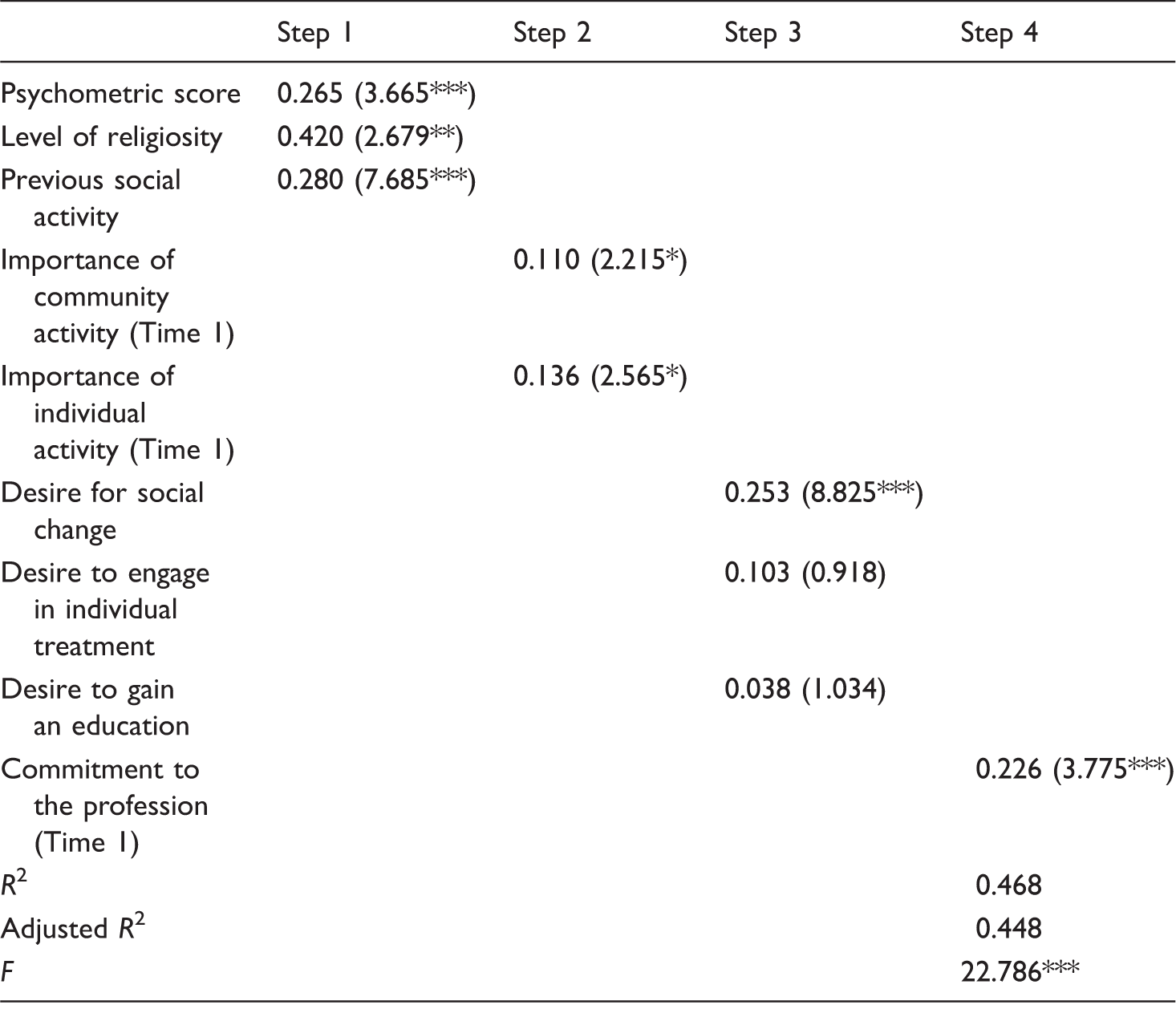
Hierarchical regression analysis (standardized coefficients) of commitment to the profession (Time 4) on perceptions of the profession; motives for choosing the profession and commitment to the profession (Time 1).
Note. N = 429–451.
p ≤ .05, **p ≤ .01, ***p ≤ .001.
In Table 3, commitment to the profession at Time 4 correlates with students’ attitudes at Time 1 and commitment to the profession at Time 1.
Hierarchical regression analysis (standardized coefficients) of commitment to the profession (Time 4) on control variables, and multiple commitments (Time 2).

Note. N = 429–451.
p ≤ .05, **p ≤ .01, ***p ≤ .001.
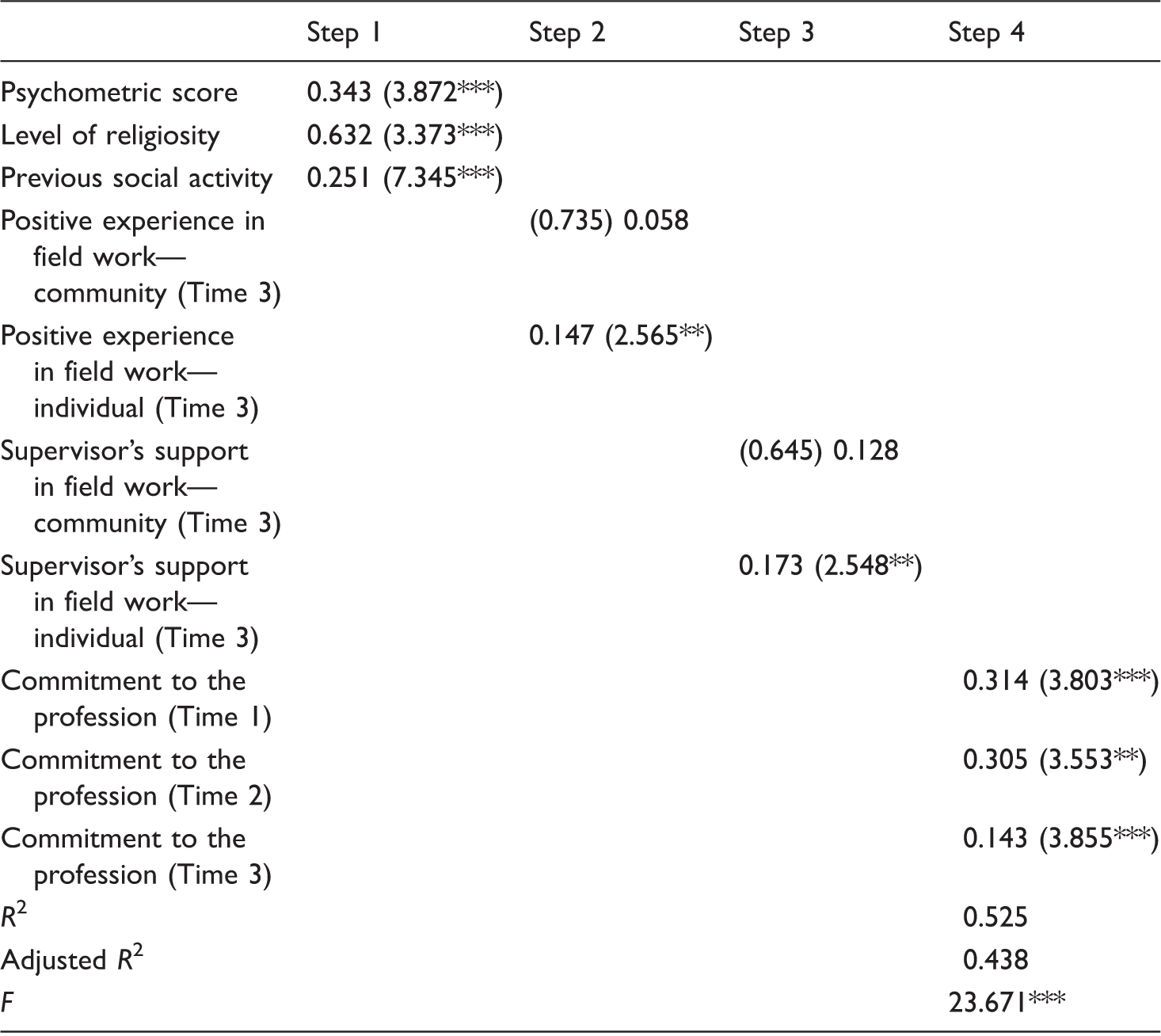
Hierarchical regression analysis (standardized coefficients) of commitment to the profession (Time 4) on control variables, and multiple commitments (Time 1).
Note. N = 429–451.
p ≤ .05, **p ≤ .01, ***p ≤ .001.
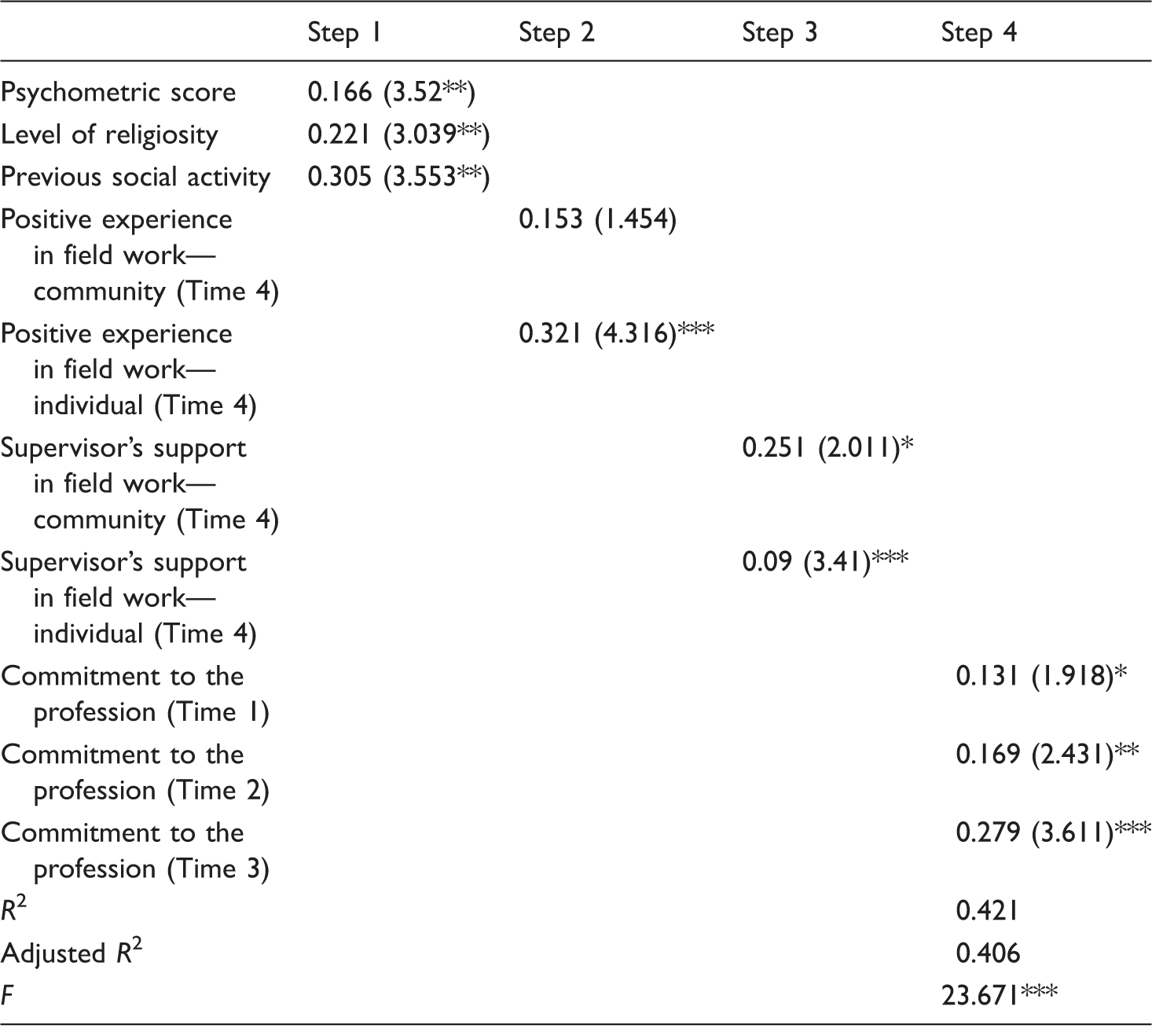
Hierarchical regression analysis (standardized coefficients) of commitment to the profession (Time 4) on control variables, withdrawal cognitions (Time 1) and multiple commitments (Time 1).
N = 429–451.
p ≤ .05, **p ≤ .01, ***p ≤ .001.
In Table 6, commitment to the profession at Time 4 correlates with students’ attitudes at Time 4 and commitment to the profession at Time 1, Time 2, and Time 3.
To conclude the Results section, we will briefly address the hypotheses of the study.
A positive correlation is expected between private/community practical experience and commitment to the profession at the end of the students’ studies. That is, the more positive the experience, the higher the commitment to the profession. The findings partly supported the hypothesis, for private practical experience and commitment to the profession only. A positive correlation is expected between private/community supervision and commitment to the profession at the end of the students’ studies; meaning, the more positive the perception of supervision, the higher the commitment to the profession. The findings partly supported the hypothesis, for private supervision and commitment to the profession only. A positive correlation is expected between private/community teaching perceptions during the students’ studies, and commitment to the profession at the end. Commitment to the profession measured at a given time will have a greater effect than that of commitment measured earlier or those variables previously mentioned, measured at the same time or earlier. The findings supported the hypothesis for all the research variables. The shorter the time periods between measurements, the stronger the correlation between instruction, supervision, practice and commitment to the profession at the end of the students’ studies. The findings generally supported the hypothesis, but for Step 2.
Discussion
The present study provides a broader understanding of commitment to the profession in social work students. It examined two major factors of commitment to the profession: novice students’ attitudes toward the profession and development of these attitudes throughout students’ studies. As a therapeutic discipline, based on knowledge and values, social work must meet professional standards and requirements founded upon ethics, professional commitment and values. The research shows that students hold distinct social and political perceptions and come from different backgrounds. Thus, social work schools are challenged to develop in students and future social workers a high commitment to the profession, a clear perception of professional values and the motivation to provide social assistance to disadvantaged groups in society (Barretti, 2004).
The first model shows that social work students come from many different backgrounds. Politically speaking, the current student body is heterogeneous. The research sample included the same number of left and right-wing students. Interestingly, most students are localized at both ends of the political spectrum, as opposed to the center.
Only 30% of the students in the research sample had no or almost no previous experience in this area. Research performed by Enoch (1993) also indicates a correlation between previous behavioral variables and choosing social work, among them participation in a youth organization, engagement in guiding and leading roles, and military functions involving contact with people (Kaufman & Mansbach, 2002). The study provides additional information about the fact that experience prior to studies predicts commitment to the profession. This data enhances professional training.
Surprising additional evidence relates to the correlation between the psychometric test score and commitment to the profession. The psychometric is a mandatory entrance examination and a precondition for admission to all academic institutions in Israel. One can reasonably speculate that a higher psychometric test score increases students’ admission prospects; therefore, those scoring high on the psychometric exam most likely choose social work based on a deep social commitment. The results support the approach demanding a high psychometric test score for admission to social work studies. It is important not only for academic reasons or due to professional academic status, but in light of the linkage to professional commitment as well.
Among the three motives for choosing the profession, the desire to bring about social change is the only variable that is significantly correlated with commitment to the profession. These data indicate that the students, who choose social work based on their desire to bring about social change, are the most committed to the profession, at least at the beginning of their studies (Stevens et al., 2012). Yet, the fact that desire to engage in individual intervention and the importance of private professional practice are correlated, while the latter correlates with commitment to the profession, and the existence of novice students who distinguish between the importance of private and community practice, may explain those who use social work as a comfortable means to improve their education and economic status. This issue reflects the importance of students’ commitment to the profession during their studies, and upon completion of their BA studies, in particular.
The research shows a significant correlation between students’ perception of the importance of individual practice and their understanding of the importance of community practice, while both perceptions correlate with commitment to the profession upon completion of their studies (Makaros & Itzhaky, 2013). Those findings follow other articles showing the importance of private and community practice (Segal-Engelchin & Kaufman, 2008). Professional dual core has been a major issue affecting the development of social work and is now reflected in novice students’ perceptions. Apparently, this evidence reinforces the success of social work in unifying its professional programs and areas of action into an integrative definition of this discipline (Dominelli, 2004).
An analysis of the entire model for predicting commitment to the profession in novice social work students at the end of their studies indicates that, among the variables predicting this commitment in students starting their career, commitment to the profession is strongest at this stage. Furthermore, the desire to bring about social change, as well as the perception of the importance of private and community practice, contribute toward predicting commitment to the profession at the end of students’ studies beyond the desire to bring about social change. These findings show that the combination of the desire to bring about social change, together with a wide perception of micro and macro social work practice, contribute to increased commitment to the profession (Segal-Engelchin & Kaufman, 2008). This model analysis further indicates that the desire to gain an academic education is a significant factor in students motivated by their goal to engage in individual intervention. However, these elements do not contribute to commitment to the profession.
The second model shows that commitment to the profession in the first academic year has the strongest effect on commitment to the profession at the end of studies. In addition, there is a cumulative effect of background variables and the perception of teaching in the first academic year. These findings indicate that students have a relatively high level of social and ethical sensitivity, and that a basic positive attitude toward social issues is an integral part of students’ perceptions. This is an encouraging piece of data reflecting a basic level of commitment to the profession. Actually, such an understanding allows for a smoother assimilation of commitment to the profession. Yet, results point to a strong and significant decrease of commitment to the profession throughout the first academic year.
This phenomenon may be explained by the fact that novice students are led by a fantasy regarding their encounter with disadvantaged populations, known in literature as the “rescue fantasy.” During the first academic year, students are exposed to the social reality, on the one hand, and their ability to cope with changing processes on the other. This encounter probably leads to a more focused understanding of the often limited abilities to bring about social change, affecting students’ perception of commitment to the profession (Leichtentritt et al., 2002; Marston & McDonald, 2012). Although commitment to the profession at the end of studies is lower than at the beginning, this attitude is more realistic and still high. Another explanation may be that first year students learn many courses and subjects they initially do not see as relevant to their future work, such as economics and research methods. It might distance them from their original thoughts about the essence of the profession. In the second and third years, students learn courses that are more related to students’ initial perceptions of themselves as social workers. Therefore, we can determine that social work schools play a balancing and appropriate function in qualifying the next generation of social workers.
The third model shows a significant effect of background variables and field work experience (Jack & Mosley, 1997) on commitment to the profession upon completion of studies. However, students’ commitment to the profession is the most significant. Furthermore, the data showed that the shorter the length of time between measurements of commitment to the profession, the stronger the effect.
Interestingly, despite the fact that commitment to the profession decreases over time, results reveal that this commitment tends to increase between the end of the first and second academic years. This fact may probably indicate that after the initial shocking encounter with social work as a social discipline taking place during the first academic year, the experience of theoretical studies and field work during the second year contributes to increasing the students’ feeling that they can actually have an influence. This is an encouraging finding, indicating that the social work training process led by universities produces a positive experience, which contributes to increased commitment to the profession in future social workers (Duschinsky & Kirk, 2013).
The fourth model shows that the combination of motives for choosing the profession, and a positive experience of theoretical and field studies throughout the years, plays a significant role in producing committed social workers at the end of their studies. That is, commitment to the profession based on positive attitudes in novice students and their identification with social and professional perceptions throughout their years of academic study will maximize the universities’ ability to develop commitment to the profession at the end of studies.
Furthermore, this model shows that commitment to the profession developing over the years has a significant effect on commitment to the profession at the end of studies. This data sheds light on the need to constantly develop and foster commitment to the profession both during and after studies. Social work involves burnout at different levels. Over the years, social workers become aware of their limited professional autonomy and ability to generate real change processes. Therefore, it is imperative to connect social workers with professional ethics and values over the years in order to increase their commitment to the profession.
In summary, the research data reveals several interesting conclusions: firstly, novice social work students have a diverse range of opinions and previous experiences. They are characterized by high social awareness and strong commitment to social and therapeutic practice with disadvantaged groups in society; secondly, students are shocked by their encounter with reality during the first academic year, leading to a sharp decrease in their commitment to the profession; thirdly, despite the sharp decrease in commitment to the profession during the first academic year, it seems that supervisors, teachers, and decision makers in social work schools manage to bring students’ fantasies at the beginning of their studies down to earth and reality, leading to higher and stronger commitment to the profession; fourthly, despite the increase in commitment to the profession over the years, it needs to be constantly maintained and developed throughout the social worker’s professional life. This supports the evidence that the shorter the length of time between measurements of commitment to the profession, the higher its effect.
Implications of the research
Results on heterogeneity of novice students have several implications on professional training and its future. The academic staff will have to cope with different cultural backgrounds in classrooms and field work settings more than in the past. This heterogeneity of students with different values will compel the academic staff in charge of training to examine the core values leading the profession, and the cultural values related to the identity of professionals who have introduced this profession into the academy. The wide divergence of participants in the research intensifies questions asked by Neikrug (1977) regarding behavioral deviations in the training system and what can or cannot be accepted: Questions on the contribution of students’ cultural divergence and how this should be accepted and even encouraged; and questions dealing with teachers’ ability to use divergence as a tool which enhances the training process. These questions are more relevant than ever when it comes to shaping commitment to the profession in these students (Eran & Lev-Sadeh, 1993).
The evidence that most students had previously engaged in social activity related to social work (Neale & Griffin, 2006) involves two aspects: In the first place, this fact contributes to the profession, since this type of prior experience enhances maturation, and develops communication and aiding skills. Secondly, provided that this previous experience did not include professional training, the teaching staff is compelled to cope with re-socialization processes, which are more complex than socialization processes. This is not a new phenomenon, but added to the cultural divergence of the student body and the variety of aiding approaches, the training staff must cope with a more complex and difficult task (D'Aprix, Dunlap, Abel, & Edwards, 2004). In any case, the research findings indicate that previous social experience predicts commitment to the profession at the beginning and the end of studies; therefore, it is an admission advantage for students (Falck, 1988).
Social work students’ desire to bring about social change reinforces the approach that views social workers as social change agents. As a result, social work is identified within a different niche than that of psychology (Marsh, 1988), emphasizing the function of this discipline as a “social supervisor,” expecting social workers to go through socialization processes with clients, in an attempt to show that they “fit in” with society (Weiss-Gal, 2006). It seems that the social work field should continue to reinforce the perception that social workers are social change agents, even if this places social workers in conflict with social and institutional functioning. Therefore, professionals should keep developing training programs aimed at providing knowledge and tools to cope with social conflicts, such as exclusion, neglect, abuse of disadvantaged groups, and hostility in order to create a more just society (Payne, 2005; Ratner, 1985). The more institutions training social workers in Israel manage to develop and emphasize these professional aspects, the more they will meet the needs of students who choose this profession, based on their desire to bring about social change. In the final analysis, according to the research findings, these students are ultimately more committed to the profession (Specht, 1999).
The issue of increasing the variety of students choosing to engage in social work will probably continue to pose a problem for this profession in the future. The existence of future social workers with diverse background variables will be a benefit to society, as these social workers will be capable of approaching different kinds of groups, while fostering their trust in professionals and social work as a whole and increasing the relevance of this profession. Commitment to the profession allows for the consolidation of divergence into one common goal; therefore it becomes more imperative than ever in and after the training process. The research findings indicate that students’ identification with the desire to bring about social change, together with the desire to assist individuals and families and deal with community practice, maximize commitment to the profession. These facts reflect the need to assimilate commitment to the profession by operating clear programs to broaden the perception of the profession, focusing on the desire to bring about social change through private and community practice (Falck, 1988).
Social work schools focus on developing commitment to the profession and professional identity in social work students within training processes. These goals, together with socialization processes, are intended to strengthen social commitment and moral social perception in novice social work students. Furthermore, professionalization and classification processes of future social workers are directed towards the promotion of learning aims based on these components. The present research examined initial attitudes and basic stages of professionalization. The results reflect the initial socialization process of social work students, although changes might take place in readiness and socialization effectiveness, due to learning processes and professional adjustment occurring during first degree studies.
Footnotes
Ethics
The study has been approved by the Faculty Board of Ethics.
Funding
The author(s) received no financial support for the research, authorship, and/or publication of this article.