




Abstract
Summary
Stress and satisfaction have long been topics of research and interest in public child welfare, particularly in relation to their links with retention. Fewer studies have focused on specific facets of stress and satisfaction among public child welfare workers. In this sample of 160 retained specially-trained former students, sources of stress and satisfaction were examined three and five years after the conclusion of the students’ work obligation.
Findings
With regard to stress, paired t-tests revealed that while workload stress increased from Year 3 to Year 5, child-related stress went down. The same downward movement was also noted for the work–life flexibility aspect of job satisfaction from Years 3 to 5. Additionally, regression analyses indicated that higher workload stress at Year 3 was predictive of diminished satisfaction with client relationships.
Applications
The findings suggest that even among retained staff, workload stress can be caustic, diminishing job satisfaction with client relationships. Implications for public child welfare agencies, and the importance of going beyond retention as a final measure for worker success are explored.
The public child welfare (PCW) profession is, perhaps, simultaneously one of the most stressful and one of the most satisfying professions. Demanding caseloads, insufficient training, and low pay, juxtaposed with the opportunity to make a significant difference in the lives of children and families are all associated with a career in PCW (U.S. General Accounting Office [GAO], 2003). It may come as no surprise that child welfare workers seem to join the field for altruistic reasons, such as the opportunity to improve the lives of children and families (Dickman, 2016; Stevens et al., 2012) and a desire to make a difference (Ellett, Ellis, & Westbrook, 2007). Despite their good intentions in joining PCW, however, retention continues to be one the most significant problems facing the child welfare workforce (Benton, 2016; Cahalane & Sites, 2008; Rosenthal & Waters, 2006), as covered extensively in almost 40 years of PCW literature.
Cost of turnover and importance of retention
The causes of turnover are multifarious. While debate continues over which demographic characteristics, worker perceptions, organizational factors (DePanfilis & Zlotnik, 2008; Mor Barak, Nissly, & Levin, 2001), and macroeconomic conditions are most predictive of turnover, the implications of staff attrition for public agencies federally mandated to foster a child welfare system built on safety, well-being, and permanency are costly at multiple levels. The monetary losses of PCW staff turnover are estimated to be between one-third and two-thirds of a PCW worker’s annual salary (Social Work Policy Institute, 2010), which can have enormous fiscal consequences for agencies’ already tight budgets. Additionally, turnover can have negative workflow and emotional consequences. Overextended staff are often required to add to their caseloads, creating possible disruptions to services provided to families, contributing to declining staff morale, and ultimately perpetuating the cycle of turnover (Social Work Policy Institute, 2010). Attrition of PCW staff can also lead to the premature promotion of unprepared frontline staff to supervisory roles (GAO, 2003; McArthur, Thomson, Barker, & Winkworth, 2012), which can further destabilize agencies (Strand & Dore, 2009; Westbrook, Ellett, & Asberg, 2012). Moreover, perhaps most damaging, staff turnover is thought to be linked to increased rates of maltreatment (GAO, 2003; Wagner, Johnson, & Healy, 2009), more time spent in care, decreased rates of family reunification (Ryan, Garnier, Zyphur, & Zhai, 2006), and lower rates of permanency (Flower, McDonald, & Sumski, 2005; Wagner et al., 2009) for families served.
While some studies explore how possible antecedents to turnover (e.g., stress, dissatisfaction) impact performance and/or client outcomes, most stop at assessing turnover, and equate higher turnover with poorer outcomes. As the ultimate goal of the PCW system is to improve outcomes for children and families, the factors that affect turnover need to be understood in their relationship to service delivery as well. The current study explores the notion that staying or leaving a job might not in and of itself be reflective of binary (i.e., good or bad) client outcomes, and contributes to this area of focus through an investigation of job stress, job satisfaction, and client relationships over time in a sample of retained workers.
Three overarching groups of turnover antecedents have emerged from the literature: workers’ organizational conditions (e.g., work demands; Mor Barak et al., 2001) cognitive appraisals/reactions (e.g., stress), and demographic characteristics (e.g., age). Researchers are still fine-tuning the complex interplay of these predictors. Challenging though it may be to apply the findings in child welfare agencies, it is pertinent to understand how certain predisposing factors, such as demographic variables and/or organizational conditions, can develop or aggravate negative workplace appraisals and, in turn, predict exit-seeking outcomes (Deery-Schmitt & Todd, 1995).
Job stress has also been examined through the psychological construct of burnout, characterized by emotional exhaustion, depersonalization, and diminished personal accomplishment (DePanfilis & Zlotnik, 2008; Maslach, Schaufeli, & Leiter, 2001). The empirical research reveals a fairly well-established relationship between the dimensions of burnout and intent to leave among child welfare workers (DePanfilis & Zlotnik, 2008; Kim & Stoner, 2008; Lizano & Mor Barak, 2012). Research that attempts to parse out the antecedents to burnout suggests that job stress is a likely culprit (Demerouti, Bakker, Nachreiner, & Schaufeli, 2001, Lee & Ashforth, 1996; Maslach, 1998; Maslach et al., 2001; Travis, Lizano, & Mor Barak, 2015). In a longitudinal study by Travis et al. (2015), in which exit-seeking behaviors in child welfare workers were predicted from individual dimensions of job stress, role conflict (a dimension of job stress) significantly predicted emotional exhaustion (a dimension of burnout), and burnout significantly predicted exit-seeking behaviors. Thus, job stress is posited to be a direct (Mor Barak et al., 2001; Mor Barak, Levin, Nissly, & Lane, 2006) and an indirect (Travis et al., 2015) predictor of intention to leave in PCW workers, likely moderated through burnout.
While the existing body of research examining the relationship between job stress and retention has grown, this relationship requires additional scrutiny (Benton, 2016; Boyas, Wind, & Kang, 2012; Weaver, Chang, Clark, & Rhee, 2007). In some studies, job stress has been predictive of worker turnover or intent to leave (Boyas et al., 2012; Deery-Schmitt & Todd, 1995; Demerouti et al., 2001; Mor Barak et al., 2001; Robin & Hollister, 2003), but not in others (Weaver et al., 2007). Differences in findings across the literature may be limited due to the various models and definitions that operationalize these constructs, including stress (Boyas et al., 2012; DePanfilis & Zlotnik, 2008). Some researchers have measured the components of job stress by relying on inventories of stressful situations and asking workers to indicate the degree of stress elicited (Travis et al., 2015). Others, such as Beatty (1996), use scale-based items to assess conflict between work and family demands. These distinctions are important to identify; generic job stress as opposed to specific facets of job stress may evoke different outcomes (e.g., Beatty, 1996; Jones & Okamura, 2000; Travis et al., 2015).
Prior to resulting in a PCW worker’s turnover, job stress also likely affects worker performance. Depersonalization, a dissociated response toward clients and a facet of burnout, has been observed to a greater degree among PCW workers than in other types of social workers (Kim, 2011). This is a particular cause for concern, given the known importance of client relationship and trust in supporting positive client outcomes in other helping professions (Leach, 2005). Kim (2011) calls for greater understanding of how aspects of depersonalization toward clients manifests in PCW workers, particularly those new to the workforce.
Age, on the other hand, is emerging as one of the most consistent demographic predictors of PCW worker job stress, burnout, and retention, with younger workers reporting higher levels of job stress and emotional exhaustion than their older counterparts (Boyas et al., 2012). Most of the literature examining demographic differences focuses primarily on retention at the outcome measure and less so on attitudinal aspects such as workers’ satisfaction or stress.
Taken as a whole, the body of past research consistently implicates job satisfaction, job stress, and burnout as among the most significant predictors of PCW turnover. As discussed in previous sections, one of the shortcomings in the existing literature is the use of generic measures of job satisfaction and job stress, and insufficient exploration of their relationship. Another shortcoming is that an inordinate amount of attention has been devoted to retention and not enough to client engagement or outcomes. The present study examines the degree to which job stress and job satisfaction interact in Title IV-E graduates over time, and extends previous research considerably by looking at specific aspects of stress and satisfaction on the job among retained former Title IV-E graduates. Particularly, this study examines satisfaction with client relationships as an outcome among emerging PCW workers, and incorporates less prevalent variables like role overload or the stress experienced by the volume and intensity of responsibilities (Dobreva-Martinova, Villeneuve, Strickland, & Matheson, 2002; Travis et al., 2015), caseload (DePanfilis & Zlotnik, 2008), and client-related stress (e.g., home visits, child removal, or client death; Benton, 2016) as predictors. The authors believe that attempting to understand specific facets of stress and satisfaction will yield valuable data, which would be highly applicable to agencies plagued by high turnover and its associated costs.
The main questions guiding this study were as follows:
How do job stress and job satisfaction in PCW workers change from Year 3 to Year 5? Does stress at Year 3 predict job satisfaction of Year 5? What is the relationship between job stress at Year 3 and perceptions of caseload at Year 3?
Method
Description of the three-year and five-year follow-up studies
The sample included past recipients of the California Social Work Education Center (CalSWEC) Title IV-E Program, which incentivizes the attainment of social work degrees and provides students with specialized field internships and curricula with the goal of strengthening and professionalizing the child welfare workforce (National Association of Social Workers, 2004). Specifically, stipend recipients receive federal Title IV-E financial support for their bachelor of arts in social work (BASW) and/or master of social work (MSW) education in exchange for completing a work obligation at a PCW agency.
Since its creation in 1989, CalSWEC’s mission has been to professionalize the social work workforce through the promotion of partnerships between the schools of social work, public human service agencies, and other related community-based and private professional organizations to ensure effective, culturally competent service delivery to the vulnerable children and families of the state of California. The CalSWEC Title IV-E Stipend Program seeks to do this by increasing: (a) the numbers of current county/state child welfare workers who return to school to obtain their MSWs; (b) retention among PCW workers; and (c) the ethnic proportion of child welfare workers who represent the children and families who use this system.
Beginning in 1993 and continuing each year with funding from the federal Title IV-E grant, CalSWEC has offered stipends to MSW students at its participating schools (currently numbering 22). Receipt of the stipend contractually obliges the recipient to work in a PCW (county, state, or tribal) agency upon graduation for a period of time at least equal to the period for which she or he received support.
The five-year follow-up surveys were first implemented in 2008 in two phases. In Phase 1, called the Retrospective Study, surveys were sent to any CalSWEC MSW who was at least five years postgraduation. In the Phase 2, each year following the Retrospective Study, the next cohort of graduates at five years postgraduation was sent a survey. In all, a total of 3277 MSWs were sent surveys; of these, 460 surveys were returned as undeliverable or could not be tracked. As of May 2014, 1307 MSWs (40%) had responded to the five-year survey.
Both the three-year and five-year surveys took approximately 15–20 minutes to complete and were reviewed and approved by the Office of Human Protection of Subjects.
Measures
The current study was focused on specific aspects of the job that child welfare workers find most and least stressful, and most and least satisfying. Several psychometrically sound measures of stress and job satisfaction abound in the literature on the conditions of the workplace. These include global and multidimensional instruments, and stress and satisfaction scales designed for workers in specific fields (e.g., Beasley, Kern, Howard, & Kolodner, 1999; Locke & Dunnette, 1976) such as doctors, nurses. While commonalities between these work spheres do exist, PCW is very unique in its duties and scope. As the authors wanted to better understand the specific aspects of PCW work that were stressful and rewarding, very specific items that were relevant to PCW practice in California were developed. Feedback was solicited and incorporated from former PCW workers who reviewed items for relevance and understanding.
Sources of job stress and job satisfaction were both captured using multiple separate but related items on the three-year and five-year follow-up surveys.
Summary of exploratory factor analysis results for child welfare worker sources of stress (Year 3) using maximum likelihood estimation (N = 160).
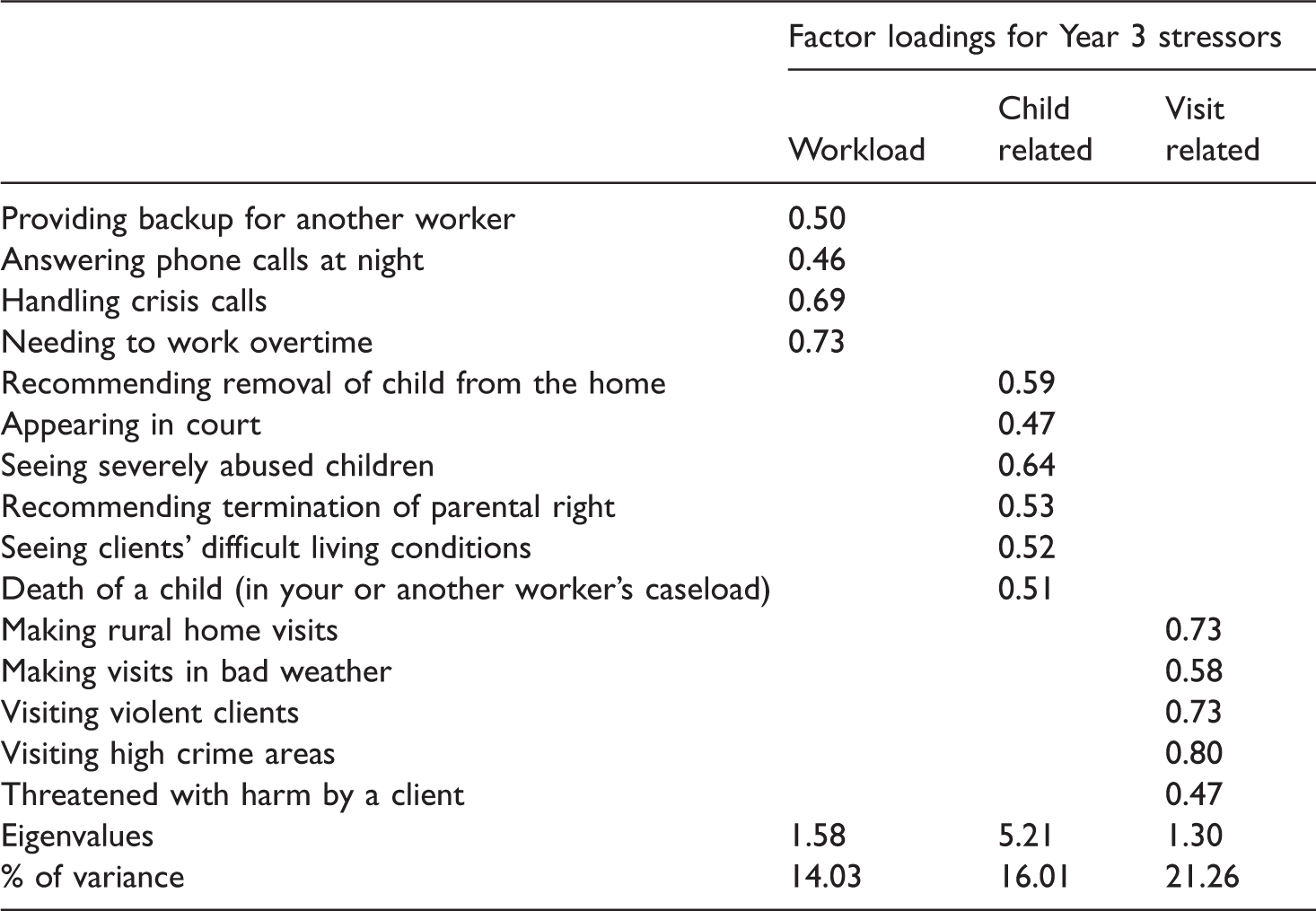
Note: Factor loadings over .40 are included.
Summary of exploratory factor analysis results for child welfare worker sources of job satisfaction (Year 3) using maximum likelihood estimation (N = 160).
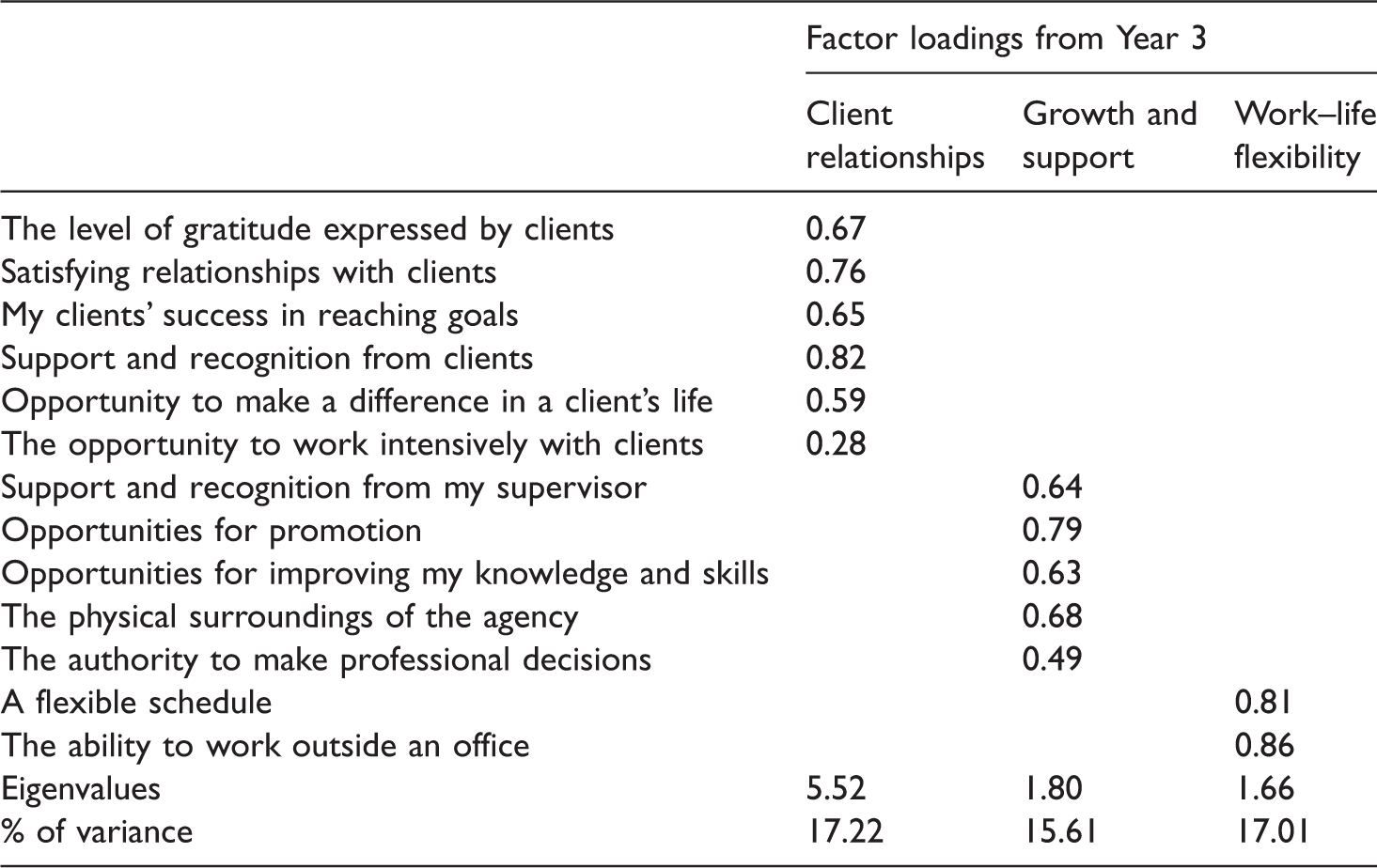
Note: Factor loadings over .40 are included; one item below .40 was included as it was conceptually related to the construct being measured.
Description of 3-Year and 5-Year variables (N = 160).

*p < .01.
Data analysis
Results
Demographics
The matched sample (N = 160) was 85% female, 48% Caucasian, 29% Hispanic, 10% African American, 9% Asian, and 2% American Indian. A total of 36% were bilingual, and the mean number of years in PCW was 2.22. At Year 3, the mean age of sample was 35.14 years, ranging from 26 to 59.
FA and reliabilities
Two sets of FA using varimax rotation were run on the Year 3 sources of stress to identify any underlying factors. Additionally, reliability analyses were conducted on component factors. In the Year 3 sources of stress FA, three strong components emerged (see Table 1). The first component, labeled visit-related stress, was defined by the items: (a) visits to violent clients, (b) high-crime area visits (c), rural home visits, (d), threatened with harm, and (e) visits in bad weather (Cronbach’s alpha of 0.84). The component/item loadings ranged from 0.58 to 0.80, which explained 21% of the variance. The second component, labeled child-related stress was comprised of: (a) seeing severely abused children, (b) appearing in court, (c) death of a child (in your or another worker’s caseload), (d) seeing clients’ difficult living conditions, (e) recommending termination of parental rights, and (f) recommending removing a child (Cronbach’s alpha of 0.69). The component/item loadings ranged from 0.47 to 0.64, which explained 15% of the variance. A third component, workload stress, consisted of: (a) providing backup for another worker, (b) answering phone calls at night, (c) handling crisis calls, and (d) needing to work overtime (Cronbach’s alpha of 0.68; component/item loadings ranged from 0.46 to 0.73, which explained 14% of the variance). While common convention prescribes having Cronbach’s alpha reliabilities of 0.70 or higher (e.g., Nunnally, 1978), the authors kept two factors that had reliability values that fell slightly under this well-used benchmark. The reasons for this are as follows. Alpha values are affected by factors such as dimensionality of the items and the raw number of items on a given scale so an absolute interpretation of alpha must be adopted with caution (Cortina, 1993). George and Mallery (2003) suggest that while alpha values of 0.50 and lower are clearly unacceptable, values of 0.60 are questionable but usable in some situations. As these same factors were consistent in the Year 5 sample—with coefficient alphas well above 0.70—and the conceptual value of these factors was useful, the decision was made to keep these factors.
In the Year 5 sample, the survey included no visit-related stress items. A confirmatory FA with the remaining Year 5 stress variables supported a two-factor solution with child-related stress (Cronbach’s alpha = 0.81) and workload stress (Cronbach’s alpha = 0.74).
A second FA with varimax rotation on the sources of satisfaction resulted in a robust three-factor solution (see Table 2). The first component, called work–life flexibility, consisted of two items: (a) The ability to work outside an office and (b) A flexible schedule. Factor loadings were 0.86 and 0.82, respectively, explaining 17% in the variance (Cronbach’s alpha = 0.80).
Client relationships, the second factor, was defined by the following items: (a) the level of gratitude expressed by clients, (b) satisfying relationships with clients, (c) clients’ success in reaching goals, (d) support and recognition from clients, (e) opportunity to make a difference in a client’s life, and (f) the opportunity to work intensively with clients (Cronbach’s alpha of 0.77). The component/item loadings ranged from 0.28 to 0.84, which explained 17% of the variance. One item—the opportunity to work intensively with clients—did not fall cleanly into any of the factors. Despite its 0.28 factor loading, however, this item was included with the client relationship factor, as it was conceptually related to the other items. Indeed, its inclusion did not significantly affect reliability, which only dropped slightly by 0.03 (i.e., Cronbach’s alpha without the item was 0.80). The third and last factor, growth and support, included the following items: (a) support and recognition from my supervisor, (b) opportunities for personal growth and development, (c) support and recognition from coworkers, (d) opportunities for promotion, (e) the authority to make professional decisions, (f) the physical surroundings of the agency, and (g) opportunities for improving my knowledge and skills (Cronbach’s alpha of 0.76). The component/item loadings ranged from 0.49 to 0.79, which explained 16% of the variance.
As in the case of Year 5 stress factors, Year 5 satisfaction factors held together well, as indicated by healthy reliability scores for all three satisfaction factors (client relationships Cronbach’s alpha = 0.86; growth and support Cronbach’s alpha = 0.84; work–life flexibility Cronbach’s alpha = 0.77).
Changes in stress and satisfaction over time
Examination of demographic differences in stress and satisfaction factors revealed two significant differences. First, at Year 3, women experienced significantly higher visit-related stress (M = 3.86) than men (M = 2.18; (t[94] = 6.04, p < .01). Second, African Americans (N =
Predicting Year 5 satisfaction from Year 3 stress
Three separate multiple regression analyses were run to predict Year 5 satisfaction (client relationships, work–life flexibility, and growth and support) from the Year 3 stress factors (visit-related, child-related, and workload stress), holding race, age, and years in PCW constant (see Table 4). Workload stress at Year 3 was significantly predictive of satisfaction with client relationships at Year 5 (b = −.24, t(90) = −2.04, p < .05), with every 1 point increase in workload stress decreasing satisfaction with client relationships by 0.24. Additionally, workload stress at Year 3 was significantly predictive of satisfaction with work–life flexibility at Year 5 (b = −.47, t(90) = −2.22, p < .010). The other two stress variables, child-related and visit-related stress, were not predictive of any aspects of satisfaction at Year 5. No significant effects for race, age, or years in PCW were noted.
Regression analysis on Year 3 stress factors.

Note: Age, race, gender, and years in public child welfare (PCW) were held constant.
*p < .05.
Finally, a correlational examination of Year 3 stress variables with perceptions of caseload proved nonsignificant. That is, stress did not covary with perceptions of caseload.
Discussion
This study extends considerably the previous research in the area of stress and satisfaction among PCW workers. Some research has underscored the importance of stress in relation to job satisfaction (e.g., Siefert, Jayaratne, & Chess, 1991) and later retention in PCW jobs (Cahalane & Sites, 2008; Jones, 2003; Mor Barak et al., 2001; O’Donnell & Kirkner, 2009). Simply put, higher stress translates into shorter tenure at the agency and the ensuing disruption of services to clients and concomitant cost to the agency. However, this study shows that even the “retained” are not immune to the damaging effects of job stress. Leaving the agency has clear and calculable costs, which have been described elsewhere in the literature. However, these results show costs occur to the agency, clients, and workers themselves who stay and deal with job stress.
Our finding that early workload stress is predictive of lower satisfaction with client relationships is important to the field for a number of reasons. First, most studies focus exclusively on retention as a proxy measure of success in PCW (DePanfilis & Zlotnik, 2008; Williams & Glisson, 2013). While that is an important metric to focus on for a variety of pragmatic reasons, treating it as the be-all and end-all is shortsighted. As this study shows, even among retained and motivated staff, quality of work—as reflected by the client relationships—might still suffer. It is important to note that workers’ perceptions of client relationships (which are captured in this study) are not the same as clients’ perceptions of those identical relationships; the field needs to do more to understand how actual client perceptions of satisfaction link to outcomes.
Given the implication workload stress has in affecting satisfaction with client relationships and workers’ own work–life flexibility, it is increasingly important from the outset to identify the organizational conditions and interventions that help prevent stress and worker disengagement (Boyas, Wind, & Ruiz, 2015; Etimadi, 2016) and to understand the impact these conditions have on service delivery, as well as outcomes for children and families (Leung & Willis, 2012; Yoo, 2002). Serving families, children, and youth in vulnerable circumstances requires a high degree of sensitivity and intentionality (De Boer & Coady 2007; Hall & Slembrouck, 2009), one of the many reasons relationship building has been emphasized as a key foundational skill in human services (Denby, Gomez, & Alford, 2016; Orlinsky, Ronnestad, & Willutzki, 2004). Callous or cynical attitudes toward clients may compromise client–worker relationships, quality of care, and client outcomes (Azar, 2000; Mullins, 2011).
For the most part, workload stress is within agency control; the knowledge that workload stress negatively affects client relationships (even though such a relationship was absent with perceptions of caseload) is powerful reason for agencies to attempt to address and alleviate it. The workload factor included items that focused chiefly on staffing and workload, common concerns at most child welfare agencies. One recommendation then, however trite, would be for agencies to closely monitor work overload for all staff, not just those at risk of leaving, and actually identifying ways of easing it. The authors recognize that this is easier said than done; however, the knowledge that increased workload stress is predictive of significantly lower-quality client relationships (and possibly client care) should give agencies some pause for thought. Our recommendation is in line with those of other researchers who recommend optimal staffing (Kaye, Shaw, DePanfilis, & Rice, 2012) and manageable caseloads (American Federation of State, County, and Municipal Employees [AFSCME], 2015; GAO, 2003; Social Work Policy Institute, 2010) for the achievement of stronger outcomes for children and families, such as fewer removals and shorter lengths of stays in the foster care system (McDonald, 2003; Social Work Policy Institute, 2010). For PCW workers, this could result in less stress, job burnout, job dissatisfaction, and turnover (Mor Barak et al., 2001).
In addition to staffing, attention has been paid to how PCW workers might be better recruited, trained, and primed for long careers in child welfare (e.g., Gansle & Ellett, 2003; Smith, Prichard, & Boltz, 2016). While some worker-centric strategies, such as providing realistic job preview trainings (Earnest, Allen, & Landis, 2011), have been linked to retention, it is increasingly clear that implementing organizational strategies and interventions conducive to retention play a critical role as well (Kim, 2011; Kruzich, Mienko, & Courtney, 2014; Smith et al., 2016; Strolin-Goltzman, 2010; Williams and Glisson, 2013). Of course, such strategies are challenged by agencies’ limitations of time and budgets, and the lack of validated interventions present in the research (Collins-Camargo, Ellett, & Lester, 2012).
Secondly, in terms of the merit of these findings, for which the authors feel relatively optimistic, the only source of stress in this study that was predictive of satisfaction at Year 5 was workload stress not child-related stress nor visit-related stress. Child-related stress and visit-related stress are integral to a child welfare worker’s job; it is highly unlikely that significant changes could be made to those aspects without major policy and societal changes. Paradoxically, child-related stress might actually serve as a motivation for workers to continue in child welfare. Previous qualitative research conducted with these data by Jacquet and colleagues among leavers and stayers indicated that the top reason for staying among the stayers was serving the children (Jacquet, Clark, Morazes, & Withers, 2008). Also, Jacquet (2012) found that IV-E students reported that they were more motivated to serve others and to work with the poor and at-risk children and families than were non-IV-E students. This is consistent with work by Morazes, Benton, Clark, and Jacquet (2010), who, in a qualitative analysis of specially trained Title IV-E, noted that the top theme among stayers was commitment to clientele (i.e., working with children and families) and a desire to make a positive impact.
In reviewing the longitudinal trends of stress and satisfaction, it was distressing to observe that while workload stress ticked upward, child-related stress trended downward. One possible explanation is that as workload stress increased, workers became more inured to the harrowing aspects of child-related stress, which is why their ratings declined regarding how stressful those situations were. This downward movement in child-related stress from Year 3 to Year 5 is conceptually consistent with our findings that higher workload stress is predictive of decreased satisfaction with client relationships. One likely mechanism at work here, drawing from the literature on burnout and depersonalization, might be that workers deal with the extreme stressors of the job by disassociating and depersonalizing, which, while serving to protect workers, might be to the detriment of the children and families they serve. Again, this is yet another reminder for agencies to monitor and alleviate stressors even among the longer retained. These workers might continue to languish on the job, providing services while being emotionally disconnected from their clients, or they might burn out and leave the workforce entirely. Neither outcome is desirable.
Two of the demographic findings deserve further mention. One is that women experience higher visit-related stress. Currently, the research on gender differences in the workforce has focused primarily on retention; there is no clear interaction between gender and stress in the child welfare workforce. It is reasonable to hypothesize that women have greater concerns for their personal safety and consequently experience more visit-related stress. With the child welfare workforce in the U.S. being predominantly female (Barth et al., 2008), this is an important issue, so agencies might consider ways to ensure that female workers feel equipped to deal with visit-related stress. The other demographic finding of significance was that African American workers express more satisfaction with their client relationships than their Asian American counterparts. While the sample size for African Americans in this sample was very small (N = 15), the differences between them and their Asian American counterparts do raise some interesting possibilities. The research on African American workers and retention is mixed (e.g., Jones & Okamura, 2000; Weaver et al., 2006), but there is a dearth of literature on differences in other attitudinal areas, such as job satisfaction by ethnicity. One possible explanation might be a greater level of match (at least, based on ethnicity/race) between client and social worker leads to more trust in services provided and greater job satisfaction for the worker. Although less prevalent in PCW research, some evidence suggests that an ethnic/racial match can have positive impacts in therapist–client interactions (Vasquez, 2007). A meta-analytic review of the effects of matching clients and therapist by race/ethnicity revealed strong client preferences for therapists who ethnically matched them and moderately favorable perceptions of therapists who matched clients ethnically/racially, but no impact on treatment outcomes across a diverse array of clients (Cabral & Smith, 2011). When observed on their own, however, African American clients demonstrated the highest effect sizes in all three areas; not only did African American clients strongly favor the ethnic/racial match of their therapist, but their outcomes tended to be mildly better as well (Cabral & Smith, 2011). With a disproportionately high number of African American families and children in the child welfare system (e.g., Hill, 2007), it is possible African American PCW workers experience more positive preferences, perceptions, and outcomes with their African American clients, which, in turn, may positively affect their job satisfaction. While the examination of the caseloads of African American workers to disconfirm this hunch is beyond the scope of this study, future research is needed to investigate it further.
Limitations
One shortcoming of this study is the limited generalizability of this sample. Data are drawn from a sample of former Title IV-E Stipend Program graduates; because of the large investments already made in their careers (e.g., stipend, obligatory payback period at work agency), this population may be different from the broader population of PCW workers. Indeed, research indicates that Title IV-E stipend students tend to have higher levels of commitment to child welfare (e.g., Jacquet, 2012; Morazes et al., 2010), are more likely to have their tenure past their employment obligation predicted by organizational commitment, a desire for mission-driven work, and concern for clients (O’Donnell & Kirkner, 2009). Additional differences in terms of performance, knowledge, and skills between specially trained Title IV-E workers and their counterparts also exist. Previous findings demonstrate Title IV-E-trained social workers are more competent (Gansle & Ellett, 2002; Jones & Okamura, 2000) and have better case outcomes (i.e., fewer instances of recurrence of maltreatment and improved stability in foster care, Leung & Willis, 2012). However, given the large public investments in Title IV-E and its use as a recruitment strategy, the authors believe that ongoing attempts to better understand Title IV-E stipend recipients’ work experiences and outcomes are strongly justified.
While this study contributes to the field by examining client relationships among the retained, it falls short by capturing the sources of satisfaction and client relationships solely from the worker’s standpoint. More accurate appraisals of client relationships would necessitate the inclusion of client perspectives, which the field sorely lacks and which would have bolstered this study.
Another shortcoming is that this study included workers who had not left their original payback agency, thereby retaining a sample of highly committed PCW workers. As stated before, retention is a positive metric, much aspired to at PCW agencies.
Conclusion
These findings suggest that the focus needs to go beyond retention. Early workload stress is detrimental to later client engagement, even in this motivated group of child welfare workers. It is likely that these relationships might well be amplified in the larger child welfare worker population. While retention should continue to be a worthy outcome that agencies strive for, findings from our study suggest that agencies would do well to go beyond retention and seek out more nuanced measures of worker success, including satisfaction with clients and workers’ own well-being. Parsing these different yet related concepts will aid the child welfare field and researchers in piecing together the complex jigsaw that is healthy retention.
Footnotes
Ethics
This study was approved by the University of California, Berkeley’s Committee of Human Protection of Subjects Institutional Review Board process (Protocol ID 2010-04-1368).
Funding
The authors disclosed receipt of the following financial support for the research, authorship, and/or publication of this article: This work is based upon evaluations performed as a part of the Title IV-E Social Work Training Program supported by the California Department of Social Services, Agreements 16-IA-00775 and 15-IA-00850.
Acknowledgements
The authors gratefully acknowledge CalSWEC’s 22 partner schools for gathering data from their Title IV-E recipients as well as the assistance of Susan Jacquet in building CalSWEC’s Title IV-E database.