



Abstract
Summary
One major effect of the demise of the welfare state on public social services is increased heavy workload which leads to stress, burnout, and compromised well-being among social workers. Less explored are the ways in which heavy workload shapes the helping relationship between social workers and clients. Extrapolating from the narratives of 14 Israeli social workers who participated in an institutional ethnographic study, this paper offers a nuanced understanding of the toll that heavy workload takes on the helping relationship.
Findings
Results showcase heavy workload as a ruling relation, an organizational reality outside the control of social workers and clients. The damaging effects of heavy workload on the helping relationship as well as on the social workers were apparent: social workers expected to slice themselves thin and deal with frustration and guilt in the face of an organizational reality that deters them from investing in their clients the time and energy required to cultivate helping relationships.
Application
The helping relationship has been paramount to social work throughout the history of the profession. This research contributes to this longstanding focus with a renewed understanding of the helping relationship in public social services as a political and public encounter between social workers and clients, one that is governed by extra-local relations of ruling. Heavy workload is one such ruling relation that organizes the helping relationship. As such, this organizational reality can be reorganized to eliminate, or at least reduce, the toll that heavy workload takes on the helping relationship.
There has never been a greater need for a critical qualitative inquiry that matters in the public sphere. We live in the audit cultures of global neoliberalism. The politics of evidence that define the audit culture marginalize critical inquiry. Our challenge is to push back, to resist. … This is a call for interpretive, critical, performative qualitative research that matters in the lives of those who daily experience social injustice. (Denzin, 2017, p. 8)
The research portrayed in this article is our attempt to “push back” and resist a neoliberal agenda that has taken over the welfare state in many Western countries, with effects on the helping relationship so central to social work practice. Using Israel as a case example, we wish to bring about interpretive and critical inquiry that matters for practitioners, welfare-reliant clients, policy makers, and scholars in social work and beyond. Thus, through the lens of institutional ethnography we sought to articulate the mechanisms that shape the helping relationship between social workers and clients. Metaphorically, we questioned “who else is in the room” where social workers and clients meet (Sinai-Glazer, 2016)? Thus, we understand the helping relationships between social workers and clients as a public and political, rather than a private, phenomena.
In this article we query the effects of organizational structures and constraints as evidenced by heavy workloads on the helping relationship, and ask: how do social workers navigate the helping relationship with their clients amidst ever increasing heavy workloads? This article adds nuance and clarity to better understand heavy workload as a ruling relation that takes a toll on the helping relationship between social workers and clients.
Conceptual framework: Institutional ethnography and ruling relations
Institutional ethnography explores what “actually happens” within institutional practices and how they coordinate and/or regulate the everyday activities of people (D. E. Smith, 2002). This particular article focuses on uncovering the organizational reality of heavy workload as a ruling relation that organizes the helping relationship between social workers and their clients. Smith (1987) used the concept of “problematic” to “direct attention to a possible set of questions that may not have been posed … but are ‘latent’ in the actualities of the experienced world” (p. 91). The “problematic” in this study is twofold: the impact of the heavy workload on the helping relationships and heavy workload as a ruling relation.
Ruling relation is the “conceptual heart” of institutional ethnography (Bisaillon, 2012, p. 619), used to portray the “socially-organized exercise of power that shapes people’s actions and their lives” (Campbell & Gregor, 2002, p. 32). However, ruling relations are more than an imposition of rules. They rely on people knowing how to take them up and act in the appropriate manner. Revealing how ruling relations operate in people’s lives is key to understanding the social organization that coordinates people’s actions, often without their full acknowledgment. Altogether, “Institutional ethnography is the empirical exploration of ruling relations” (D. E. Smith & Turner, 2014, p. 7); in this manuscript we empirically explore and map heavy workload as one of the ruling relations that coordinate the helping relationship of social workers and their clients amidst the decline of the welfare state. Understanding the helping relationship in social work as a political and public encounter thus calls for a deeper understanding on how these relationships are socially organized. Rendering visible the social organization of the helping relationship in social work necessitates mapping the ruling relations that coordinate the helping relationship, and in this manuscript we outline heavy workload as one such relation of ruling.
The decline of the Western welfare state and increased workload among social workers
Across Israel (e.g. Doron, 2001), Canada (e.g. McBride & Whiteside, 2011; Stoney & Krawchencko, 2013), the USA (e.g. Lobao & Adua, 2011), and the UK (e.g. Ridge, 2013), to name a few Western societies, ongoing cuts to government expenditures and the restructuring of welfare state programs reflect an increasingly pervasive residual approach to public health and social services. In these times of austerity and social welfare retrenchment across Western societies (Korpi & Palme, 2003; Pierson, 1994), when social rights and benefits evaporate and inequality is on the rise, the dilemmas and tensions faced by public social services providers intensify (e.g. Cohen et al., 2016).
One major effect of the decline of the welfare state on public social services is an increased workload: “in the case of social workers, [workload] would cover pressures placed upon the individual social worker, such as unmanageable caseloads, time pressure, working with deadlines that are too tight or being asked to take too much responsibility” (Blomberg et al., 2014, p. 2019).
Work overload and work-related stress in general are well explored in public social services (i.e. Balloch et al., 1998; Collings & Murray, 1996; Lloyd et al., 2002). Blomberg et al. (2014) compared workload between social workers in four Nordic countries: Sweden, Finland, Denmark, and Norway. Their results point to the heavy workload social workers face: in Finland, 61% of the social workers reported experiencing heavy workloads, while the corresponding figures for Norway, Sweden, and Denmark are 33, 36, and 42%, respectively. Taken together, the results indicate frequent job stress in all four countries, most pronounced in Finland.
In the UK, Baginsky et al. (2010) reported the results of a survey on social workers’ workload. Respondents (n = 1153) kept a time diary for a week. The researchers commented on the complexities in measuring workload in terms of number of cases given varying definitions of a “case,” the complexity of cases, and the intensity of different cases. Yet, social workers pointed to smaller caseload as a significant factor that would make a difference in their professional lives. Notably, one in seven social workers commented on the adverse impact of organizational factors on the services they offered to clients.
Tham (2006) surveyed 309 Swedish child welfare social workers about their intention to leave their current occupation. Forty-eight percent replied that they were fairly or very likely to actively seek a new job within a year, even though 54% of respondents had been employed for less than two years at their current workplace. Tham found that, when compared to social workers who intended to remain, those who intended to leave described quantitative demands (i.e. heavy workload), role conflicts, and exposure to threats and violence as significantly higher than those who did not intend to leave. Tham suggested that aspects of organizational conditions seem to be of greatest importance for intention to leave.
The negative influence of organizational factors, such as heavy workload, on the well-being of service providers has also been well-demonstrated. Based on 243 social workers in England, Collings and Murray (1996) examined the perceptions of stress and factors contributing to levels of stress. The researchers found that high levels of measured stress are significantly associated with heavy workload. Moreover, organization-related stressors appeared to be more significant in contributing to stress than individual factors. In a more recent review of studies assessing emotional exhaustion (burnout) and job satisfaction among child welfare social workers, Stalker et al. (2007) came to similar conclusions: while personal characteristics may contribute to emotional exhaustion in some child welfare workers, emotional exhaustion can be predicted best by organizational variables, including workload, role conflict, role ambiguity, variables related to agency change, and lack of job challenge.
To conclude, it is well documented that social workers face increasingly heavy workloads which have adverse effects on social workers’ job satisfaction, stress levels, and burnout. What might be the ramifications of increased workload on the helping relationship between social workers and clients? In this article we seek to explore just that. In this institutional ethnography we underscore heavy workload as a ruling relation that coordinates helping relationships to occur as they do beyond the control of those most implicated in the helping relationship. Our focus on the social organization of the helping relationship in social work stems from the immense importance the relationship between practitioners and clients have in the helping professions, as we will now explore.
The importance and effectiveness of the helping relationship
The discipline of social work pays special tribute to the relationships between social workers and clients. These relationships have been described as the “heart,” the “core,” the “soul,” or the “steering wheel” of the profession (Biestek, 1957; Perlman, 1979; Richmond, 1899). While the importance of the helping relationship is undisputed, its erosion has been unequivocally noted. Marketization and managerialism, “the twin forces” of neoliberal agendas that merged in the West during the 1980s, veered the profession away from being client-centered and relationship-based (Coady, 1993; Ruch, 2010, p. 22). Scholars have claimed that the move away from the helping relationship has been detrimental to the profession and its clientele (e.g. Coady, 1993; Dybicz, 2012; Murphy et al., 2013).
The helping relationship is repeatedly found to be fundamental in promoting desired outcomes among clients (e.g. Horvath, 2001; Marsh et al., 2012; Marziali & Alexander, 1991). Yet, scholars have highlighted the many professional, organizational, institutional, and structural challenges to establishing and maintaining the helping relationship (e.g. Alexander & Charles, 2009; Bell, 1999; Broadhurst & Holt, 2010; Dumbrill, 2006; Fargion, 2014; Gladstone et al., 2013; Platt, 2008; Steens et al., 2018). This study pays particular attention to heavy workload as a ruling relation that coordinates the helping relationship between social workers and clients, thus contributes to the important body of scholarship that highlights the complex interconnections between the helping relationship and the organizational, professional, institutional, and political contexts within which the relationship is taking place. Starting from the everyday experiences of social workers, we ask how do social workers navigate the helping relationship with their clients amidst ever increasing heavy workloads?
Methods
This study followed the ontological and epistemological tenets of institutional ethnography, a conceptual and methodological approach to inquiry developed by Canadian sociologist D. E. Smith (2002, 2005): The overall aim of institutional ethnography has a double character. One is to produce for people what might be called “maps” of the ruling relations and specifically the institutional complexes in which they participate in whatever fashion. People’s knowledge of their everyday world is thereby expended beyond the scope of what can be learned in the ordinary ways we go about our daily activities. … Like the map of the underground mall, with its arrow pointing to a particular spot accompanied by the words YOU ARE HERE! Institutional ethnographies are designed to enable people to relate the locus of their experience to where they may want to go. (D. E. Smith, 2005, p. 51)
Data collection
The data called upon for this article are derived from an institutional ethnography based on fieldwork carried in a social services department in Israel during September–December 2016. The larger study entailed interviews with all 14 staff members and 20 clients who are mothers, daily participant observations, and analyses of organizational, local, and national texts. As textual analyses were central to this institutional ethnography, this feature of data collection is presented in more detail later.
This article reports on the accounts of social workers in relation to the heavy workload they face and how this organizational context shapes and governs their helping relationships with their clients. Social workers were recruited to participate in this study during a staff meeting in which the first author introduced the research. All 14 staff members in the social services department participated in this study. Interviews were carried by the first author, took place at the social services department during working hours, lasted an hour to two and a half hours, and were recorded and transcribed in Hebrew. Interviews centered on laying out the process through which a mother becomes a client and how policy and regulations at the national and municipal levels shape their everyday experiences of helping relationships with their clients. Consent forms were signed by the participant and the first author at the onset of all interviews.
Of the 14 staff members who participated, 13 were social workers and one was the administrative assistant. Two participants identified as male; 12 as female. Six of the social workers completed a Master’s degree in social work. The average total number of years of social work practice was 14.5, with an average of 10 years working at this particular social services department. The participants ranged in age from 26 to 67 (mean = 42). One staff member was single and one divorced; the rest were married. All but one had children (mean no. of children = 3).
Data analysis
In institutional ethnography, “the point of the analysis is … to pry open the operations of an institutional complex” (Grahame, 1998, p. 354). “Prying open” the institutional complex enables charting a map that produces “awareness that enables us to find our bearings” (Grahame, 1998, p. 357). Our goal was to chart the institutional map of increasingly heavy workloads in relation to helping relationships through the explication of social workers’ everyday experiences. Campbell and Gregor (2002) continually refer to “explication,” reminding the institutional ethnographer of her mission of “identifying, tracing, and describing the social relations that extend beyond the boundaries of any one informant’s experiences (or even of all informants’ experiences)” (p. 90).
All interviews were recorded and transcribed verbatim. Each was read and reread line by line while listening to the recording to correct any errors in transcription and add notations to signify pauses in speech, laughter, changes in the speaker’s volume (e.g. whispering), changes in tone, and emphasis on certain words or phrases. This process involved multiple, meticulous readings of the transcripts and repeated listening. A brief summary for each interview was composed. All final transcripts were uploaded to Dedoose, qualitative analysis software, and coded into units of meanings, such as “guilt,” “overburden,” “professionalism,” “conflict,” and so on. Each interview yielded 25–50 codes. The next analytical step included sorting the codes into larger units of meaning and striving to connect those units of meaning in ways that made sense and correspond with the epistemological and ontological approach of institutional ethnography (DeVault & McCoy, 2002; Rankin, 2017). We paid particular attention to how these codes gave meaning to institutional practices in the social organization of everyday experiences as they related to the helping relationship. We looked especially for the ways in which heavy workload comes about as a relation of ruling that organizes the helping relationship between social workers and clients. This was an ongoing process, performed by the first author and repeatedly reviewed by the second author, infused by much theoretical and methodological reading and long discussions between the co-authors.
Textual analysis
Texts are central to mapping how the ruling relations operate across various local sites, and how they are hooked up to translocal relations of ruling (D. E. Smith, 2002, 2005). Legislation and regulations that constitute and regulate the profession of social work and social workers in Israel were analyzed. These included The Welfare Services Act 5718-1958, The Social Workers Act 5756-1996, Social Workers Code of Ethics, and 263 regulations that are attached to the above-mentioned laws and are dedicated to regulating social workers’ practices in social services departments across Israel. These texts are public and accessible online at the Ministry of Labor, Social Affairs, and Social Services (molsa.gov.il). While not consulted on a regular or daily basis, these texts mandate and shape social work practice. We looked closely to discover and render visible “just how texts enter into, organize, shape, and coordinate people’s doing as they/we participate in the objectifying relations of ruling” (D. E. Smith & Turner, 2014, p. 5).
Campbell and Gregor (2002) emphasized that “more frequently in institutional ethnography, rather than being used as sources of factual information, texts are relied on as crystalized social relations” (p. 79). As such, the goal of reading and analyzing texts in this study was to locate the often invisible ways in which the texts mediate and organize the helping relationship to occur as it does. We paid particular attention to the discourse between the experiences of heavy workload among social workers, and the texts that regulate the profession of social work in Israel to unpack and map how the heavy workload comes about as a ruling relation.
All names and locations presented in this article have been changed to ensure participants’ anonymity and confidentiality. All participants are presented as females to reduce the likelihood of identifying the two male-identified social workers who participated in the study.
Results
While social workers were never asked about their workloads, this theme persistently pervaded. Following our participants’ narratives and experiences, in this article we draw attention to the intricacies of heavy workload. The results are presented in two closely related sections: the first section grounds heavy workload as a ruling relation that coordinates the helping relationship between social workers and clients. Social workers’ narratives, the first author’s field notes, and textual analysis of relevant policies and regulations are used interchangeably. In the second section of the results, using mainly social workers’ narratives, we explore the effects of heavy workload on the helping relationship. We present the emotional burdens that result from the heavy workload and the ensuing effects on social workers’ relationships with their clients. Tensions, conflicts, and feelings of guilt permeate their accounts. Ultimately our purpose here is dual: to demonstrate how we have come to understand heavy workload as a ruling relation that has far reaching effects on the helping relationship, and to highlight some of the ramifications that heavy workload have on the helping relationship.
Heavy workload as a ruling relation: “How thin can a social worker slice herself?”
All the social workers who took part in this study had more tasks than time in which to do them. A feeling of stress pervaded the social services department with an ever growing to-do list that all the social workers talked about among themselves and during interviews. One particularly poignant field note captured well the stress permeating the hallways at the social services department: I am sitting here for over half an hour already; our meeting was supposed to begin now. The day just started and already things are a mess. Hannah [one of the social workers] is on the phone regarding a very urgent matter that requires her immediate attention … I hear another social worker on the phone saying, “I really wanted us to meet today but I am stuck in a meeting 9–11am … ” That meeting she refers to as being ‘stuck in’—well, that is the meeting with me! [at the same time] Rachel calls one of the [other] social workers as she walks into the department; she still has her bag on one shoulder and she is already being showered with a list of tasks to be done ASAP. Hectic! (27 September 2016) In her full time position she is divided 50% with the after school programs and 50% with families. So put the first 50% position aside, in the remaining 50% she is a social worker for 120 families. How can she, how? … How many can she divide herself between?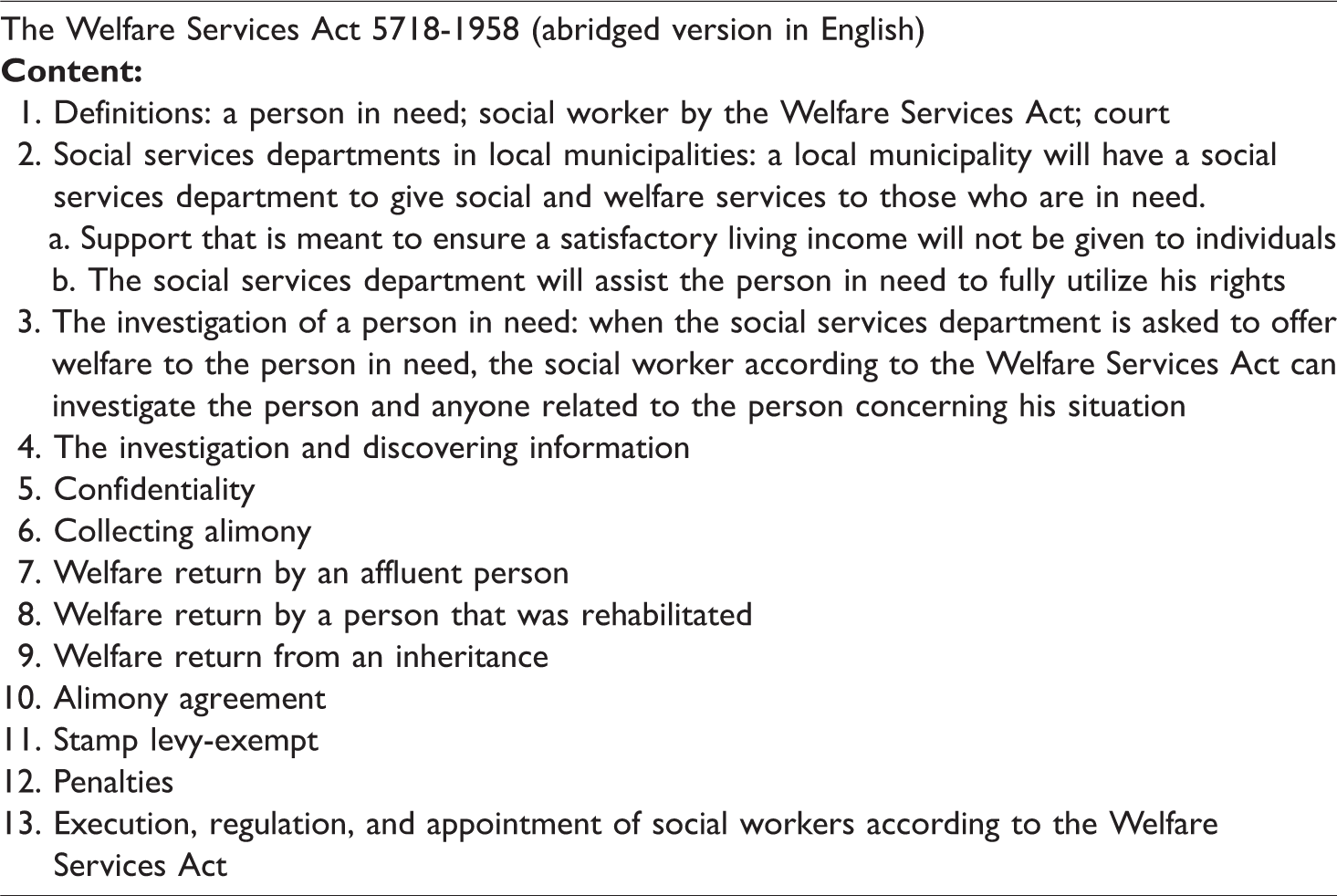
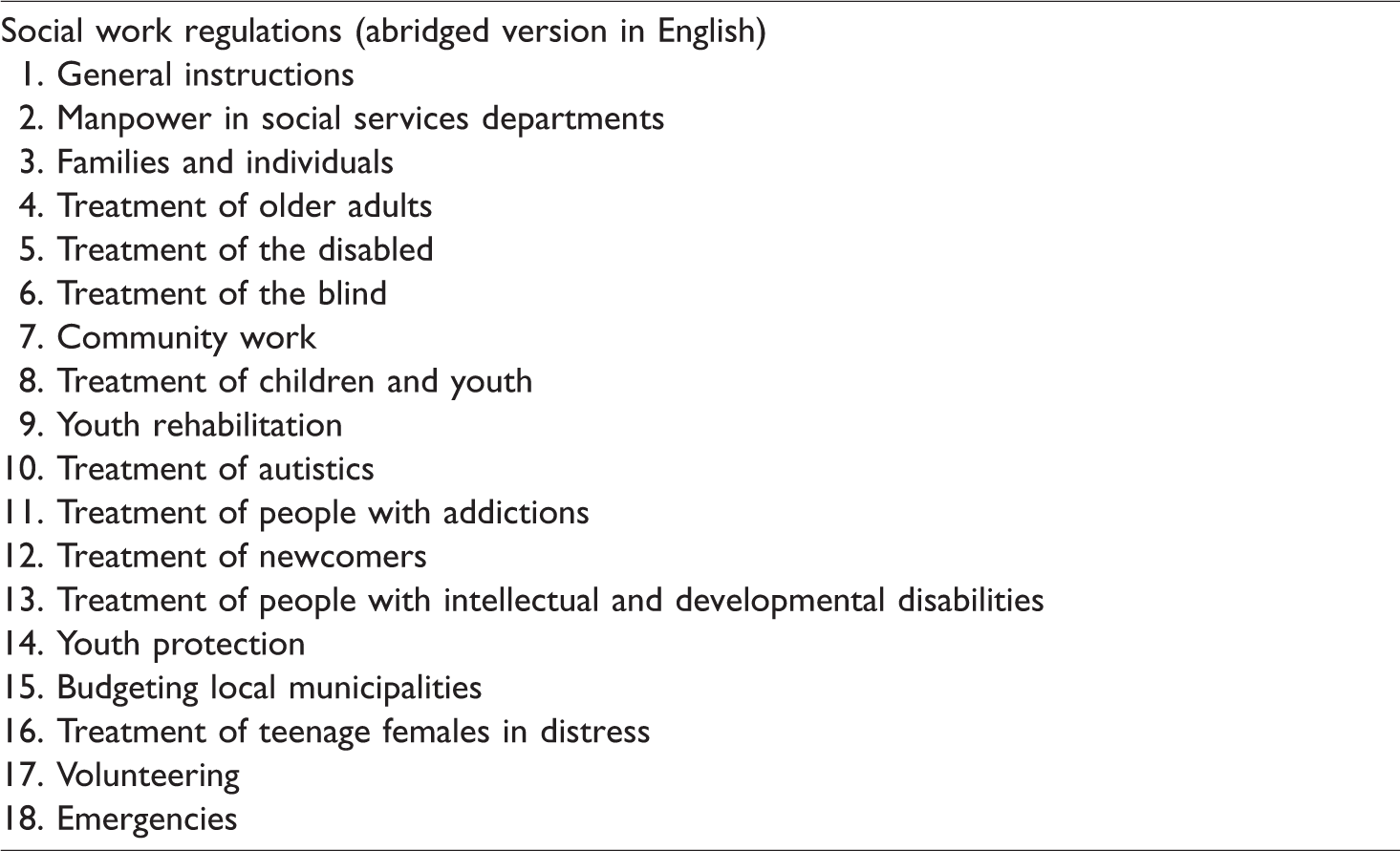
Of the 18 chapters of regulations, reference is made to the standardization of clients per social worker both explicitly and implicitly, but at no point in these chapters is a quota identified for the number of clients per social work to achieving meeting client needs. For example, Chapter 2 is dedicated to “manpower in social services departments,” outlining various roles social workers can occupy, and under what conditions certain types of positions can be filled (i.e. a supervisor can be employed full-time only if there are 6–8 fulltime direct social work positions in the department). Standardization thus refers to how many social work positions can be occupied at a given social services department. Chapter 15, devoted to “budgeting local authorities,” lays out a complex formula of how the Ministry allocates budgets to the local authorities. Some of the variables to consider are the total number of citizens in a local authority, the number of children, elderly and newcomers, the percentage of unemployment, whether the local authority is urban or rural, and more. What this chapter suggests, then, is that workload is based on a formula with predetermined demographic variables and not on client needs, social workers’ mandate, and the pursuit of “treatment.”
Reflecting on Hannah’s question as to “how thin can a social worker slice herself?”, it appears rhetorical. The absence of any reference to workload is remarkable as a feature of how texts shape institutional practices. These documents define helping relationships between clients who meet prescribed notions of need and social workers mandated in particular ways to respond, and at the same time, these documents shape the helping relationship by failing to recognize—and articulate—that workloads matter. Heavy workload is a real concern among social workers that undermines their ability to establish nurturing helping relationships, yet the documents that constitute the profession seem to ignore this issue all together. The absence is striking—not the absence of quota (i.e. how many clients should a social worker have), rather the absence of any acknowledgment of the ways in which workloads as ruling relation coordinate practice.
During interviews, social workers were asked to suggest a policy change that would benefit the helping relationships with clients. Most social workers spoke of the need to decrease the heavy workload so they could allocate more time to each client: “First of all, I would deal [with] the heavy workload and would change the ratio of how many clients per social worker” (Rina, Social Worker); “First and foremost, I would change the standardization of clients per social workers. I would get many more social workers, less cases per social worker” (Dana, Social Worker). Hannah offered a clear rationale as to why fewer clients per social worker would be beneficial: First … I would reduce the number of clients [per social worker], really. We need to treat our people with respect. It’s unacceptable that a client will come and I’ll tell him I can see him [sic] in a month because I have 80,000 things I need to do. First of all, I would enable the social worker to work in a humanistic environment … 30–40 families in her case load. She’ll be able to build an intervention program tailored to their needs—because she’ll have a deep understanding for their needs [and] she’ll be in touch with others in the community, she’ll be able to actually help bring the family to a different [better] place in their lives.
Dana also spoke about heavy workload, but from a therapeutic perspective: How many people can you contain in yourself? You have a quantity … of space inside the soul, inside the head … [If] … you really want to do your job from a place of thinking … what does he [the client] need now and what can I give him … [then] how many like this can you do without exploding?
Heavy workload is a pervasive ruling relation that coordinates social workers’ everyday experiences of the helping relationship with their clients. Social workers’ acute awareness to the increased heavy workload they face does not lend itself to an ability to change that ruling relation or act differently in relation to it. Next we explore how the ubiquity of heavy workload as a ruling relation shapes and governs the helping relationship, dictating to a great extent what can and cannot happen in the helping relationships cultivated between social workers and their clients. We examine how social workers navigate the increased heavy workload they face and analyze the professional and personal costs of heavy workload on the helping relationship.
The costs of heavy workload: Tensions, conflict, and feelings of guilt among social workers
Heavy workload is an unavoidable organizational reality that exacts a toll on the well-being of social workers and, in particular, on helping relationships with their clients.
Dana illustrated the existential tension/conflict that results from heavy workload. During the interview she spoke about how, “with the wisdom that comes with age and practice,” she has come to “know [her] place.” By this, Dana was referring to a transition that happens with time and experience when one realizes the limits of her ability to help people: “by the end of the day, clients decide for themselves … eventually they will decide.” Acknowledging clients’ authority over their lives, Dana further elaborated: “but at least you’ll know you did everything you can for, the maximum … .” While realizing her limitations as a social worker, Dana spoke to the importance of at least doing the best you can for all the clients. But, Dana stressed, “there is no way you can do the maximum with everybody. No way. No way. No way.” The tension Dana illustrated is between the desire to do everything she can for her clients and the organizational structure of an ever-existing heavy workload that makes this mission unachievable.
Noa highlighted another tension she faces as a result of heavy workload: There needs to be some kind of load to get ourselves moving, but have it only to a degree so I know I have time [for] each client., also part of the difficulties in the relationship with clients is about, uh, … I feel I need to protect myself. I need to be able to do all the tasks that unfold in front of me, and that is why I will not take on some tasks that the family would really want me to and that I could really help there.
Dana and Einav offered a glimpse into the conflicting feelings that are part of the everyday experience of heavy workload: When you say [to yourself], ‘Gosh I wish they wouldn’t come now to the meeting [that we scheduled], because I have to write a report’, it’s bad to feel this way … and then you hear the beep at the door, and … I hope I know how to get myself together in those two minutes and be there 100%. I want to believe that you can’t be more present than I am; but yes, it’s a really bad feeling. I keep thinking, ‘Would you want someone to feel like this about you?’ … But that’s the reality. Whoever denies it is falsifying. I am sometimes happy that a family doesn’t come because then I have this pocket of time that became available that I can do a thousand other things. And it’s, it’s not, it hurts me, [because feeling this way] it’s not something that’s supposed to happen.
Eden examined critically how heavy workload contradicts the very essence of social work: I think that if we had fewer cases we could have really done significant work. It is pure disrespect towards our clients that we don’t have a minute to devote to them … so what are we even doing here? What am I doing here if I can’t give decent services? … It frustrates me. It makes me feel bad. What can I do? At the end of the day I love what I’m doing. Systemic constraints prevent me from doing it in the best possible way, but that’s the best I can do under the given conditions. So, again, I’d rather think about it as little as possible because it doesn’t do me good. The purpose [of social work] is not to perpetuate people’s distress, but rather to find ways out. There are chronic cases where there’s nothing I can do about it, it’s a complex combination of health, mental health, and socio-economic issues, … but there are occasions that I know that if I had the resources and the time and the availability to really do something with them [the clients] we could have found ways out [of the distress]. It could have happened but it won’t happen. … I mean, does the Ministry of Welfare and Social Services actually have expectations that we [social workers] will carry out significant processes with clients when a full-time social worker has 100 and something families? Really, what does the Ministry expect of us?
The heavy workload prevents social workers from establishing helping relationships with all of their clients. Building helping relationships takes time, effort, and consistency. The heavy burden social workers face detracts from their ability to cultivate helping relationships. While helping relationships are the bedrock of the profession, the social organization of the helping relationship prevents social workers from establishing such relationships with their clients. Thus, social workers are facing an impossible situation. As one of the social workers echoed, “All of us here are in a difficult position. I think that every one of us wonders, at least once a month, whether she is doing what she wishes to be doing (Or, social worker).”
Limitations of the study
Institutional ethnographers start from everyday experiences in order to make visible the often unquestioned ruling relations, but, as Smith (1987) noted, we face the conundrum of our limited abilities to actually see the taken for granted. This research study is no different. Research, undertaken with multiple institutional contexts, requires timelines to be met, procedures to be followed, and funding limitations. All of these, as well as other institutional considerations, came into play and shaped this study and findings. As such, we understand that this ethnography—like all ethnographies—is partial (Clifford, 1986). Against this backdrop, we reflect on two particular constraints, one methodological and the other theoretical.
The data for this research were collected from a single social services organization. Many times, we marveled at the truly full participation of all professionals at the organization but, when it came time to analyze excerpts in their unique contexts, we came to understand that we could not explicitly link particular participants’ accounts to their specific facets of identity and social locations. The results are arguably reductionist because we could not sacrifice confidentiality for more complex, located analyses.
Theoretically, the first author collected incredibly rich accounts from social workers and clients who were mothers. With our focus on actual everyday experiences and texts and their coordination of the social, we did not aim to unravel key elements of participants’ life stories. Thus, how clients and social workers spoke about the psychosocial consequences that led them to become welfare clients or social workers was, for the most part, left outside of this research.
Discussion and conclusions
This study rendered visible increased heavy workload as a ruling relation that organizes helping relationships to occur as they do, while also exposing adverse effects on the helping relationship. The materialist mode of institutional ethnography strives at opening up the “black box” so that we can see the interior workings of the ruling relations and find out empirically how things are organized to occur as they do (G. W. Smith, 1990, p. 634). In this study, opening up the black box meant looking into how social workers navigate the helping relationship amidst the decline of the welfare state and the resulting increased workload.
The damaging effects of heavy workload on the helping relationship as well as on the social workers were apparent: social workers were expected to slice themselves very thin and deal with frustration and guilt in the face of an organizational reality that deters them from investing in their clients the time and energy required in order to cultivate helping relationships. Although the issue of work overload has been explored in social work (i.e. Barak et al., 2006; Shim, 2012), this study portrayed heavy workload as a ruling relation and emphasized the direct cost of increased heavy workload on the helping relationships. Heavy workload as depicted by these social workers extended well beyond a lack of time to do what they need to do; it is a mental state and an emotional burden that social workers carry wherever they go and whatever they do.
The helping relationship has been a central feature of the profession of social work throughout history. The research documented in this article contributes to a renewed understanding of the helping relationship in public social services as a political and public encounter between social workers and clients, one that is governed by extra-local relations of ruling. The heavy workload is one such ruling relation that organizes the helping relationship to occur as it does. Understanding heavy workload as a ruling relation suggests that those most afflicted by heavy workload and its adverse effects have limited control, if any, on how this relation of ruling organizes and coordinates their everyday experiences of the helping relationship despite experiencing the effects individually and internally. Thus, mapping the ruling relations is useful for providing groundwork for grass-roots political action (G. W. Smith, 1990).
The organizational reality of heavy workload is one that can be reorganized by public and political actions at the local and national levels. At the local level, and as a preliminary start, we wish to render visible the institutional dissolution of the helping relationship; this act alone might relieve social workers of their experiences of guilt and despair in their best efforts to engage in helping relationships with their clients in ways they regard as fit. As well, social workers might join hands with clients, encouraging them to not settle for less than what they deserve in the helping relationship. This can take many forms, such as writing letters to the Ministry, signing petitions, and organizing demonstrations. We recognize that such political activities place a great deal of responsibility and additional burden on social workers. The increased workload social workers face is not of their own making, and they should not be held responsible for untangling this relation of ruling. That being said, such political actions might be effective in bringing about desired change. Another venue for local action that social workers could pursue is writing the heavy workload and its adverse effects into their file notes and reports. For example, when writing a report for a client for other agencies and governmental offices, social workers could note the ways in which increased workload prevented the social worker from providing better services and nurturing stronger helping relationship. Writing the institutional into their reports, social workers are using their power to render visible some of the challenges they encounter in their everyday work.
On a national level, we hope and expect that those in charge of the ways in which the helping relationship is organized—namely policy makers—would embrace a conception of the helping relationship in social work as political and public phenomena. From such vantage point, policy makers could act to create better conditions for social workers and clients to establish and nurture a helping relationship. Such actions could include re-writing of regulations so as to liberate the helping relationship in social work from the increased workload social workers are forced to navigate. For example, The Welfare Services Act 5718-1958 cited earlier constitutes the legal basis for social services operation. While this Act makes no mention of clients per social worker we wonder if policy makers might rethink—and insert—overarching principles that are based on the importance of the helping relationship in the provision of social services. We imagine a prologue that features the helping relationship in social work and might serve as a lens through which to consider the interpretation and delivery of services. Thus, regulations are to be understood not only as means to regulate the provision of social services, but also to support the helping relationship between social workers and their clients.
Working for changes requires knowing how things are organized and operated, and this article offers a nuanced understanding of the inner operation of increased heavy workload as a ruling relation and its ramifications on the helping relationship between social workers and their clients. The experiences of social workers with regard to the increased heavy workload they face and the prices they pay—professionally and personally—due to the organizational reality of heavy workload could guide an informed decision making toward solutions that will eliminate, or at least reduce, the cost of heavy workload on the helping relationship.
Footnotes
Ethics
Ethical approval for this project was given by McGill University Research Ethics Board (REB file number: 174-0916).
Funding
The author(s) disclosed receipt of the following financial support for the research, authorship, and/or publication of this article: This research was supported by scholarships and awards from the School of Social Work at McGill University, The Jenny Panitch Beckow Memorial Scholarship, and The Memorial Foundation for Jewish Culture.
