



Abstract
Summary
Anger, hostility and mistrust towards refugees, asylum-seekers and immigrants (hereafter migrants) are increasing across most Western societies. Media discourse, tough migration laws, and the escalation of right-wing views across Europe, all manifest a desire to exclude those who are seen as a threat to national interests and identities. The literature repeatedly confirms that discrimination has a harmful impact on the general well-being of migrants, while often weakening their trust on helping professionals. Social workers are among the professionals most often in contact with migrants, making them important actors in the field of migration.
Findings
This qualitative study was conducted in Madrid (Spain) and follows the interpretative phenomenological analysis approach. Findings revealed that Muslims and Blacks are the groups facing the most intense racial hostility. Emotions like fear, sadness, learned helplessness, frustration, rejection, anger, and general mistrust were underlined by participants. Some migrants highlighted negative coping mechanisms like isolation, aggressive impulses, approaching mafias, and risk behaviours, leading to further rejection from host societies, and thus initiating a vicious circle of hostility.
Application
These findings constitute a modest contribution to the literature, as they result from an integration of migrants’ and helping professionals’ perspectives. Several suggestions are put forward for social workers and other professionals. The two most significant suggestions are that professionals (a) use their field experience to raise awareness about racial hostility towards this population, and (b) help identify migrants who may rely on negative coping strategies and so prevent adverse consequences for both migrants and host societies.
I feel pain, and also anger … very angry, very strong anger for those lies [against Muslim faith] … Nowadays, we are living in a crazy world, we are in the mouth of a volcano … If we continue like this, we will create a very, very dangerous fear, very serious … that will be like a bomb here, in the Spanish society … the volcano … (Salah, 63, Syrian refugee).
Anger, hostility and mistrust are among the many negative consequences of Western societies’ overt or subtle attitudes of discrimination towards refugees, asylum seekers and immigrants (hereafter migrants) (Borders & Liang, 2011; Williams & Mohammed, 2009; Williams et al., 2012). In fact, labels such as ‘refugee’, ‘asylum-seeker’ or ‘immigrant’ are used in Western countries mostly for political reasons (Crawley & Skleparis, 2018), often not reflecting the real trajectory of people searching for safety or better opportunities in Western societies. These often vulnerable people may have different pre-migration experiences and residence status, which might give them more or less state protection; however, in host countries they seem to undergo similar forms of hostility and mistrust in societal and institutional contexts.
Whether discriminatory acts are intended or just perceived by excluded ethnic groups, the literature has repeatedly underlined that they have the potential to seriously harm the psychosocial well-being of those who suffer from them (Agudelo-Suárez et al., 2011; McLeish, 2005). Such experiences, oftentimes quite extreme, violate the rights and dignity of those affected, resulting in feelings of sadness, anxiety, hopelessness, powerlessness, isolation, anger, frustration and mistrust (Lyons-Padilla et al., 2015; Polanco-Roman & Miranda, 2013).
Moreover, discrimination experiences often force migrants to employ coping strategies that can either be positive – spiritual beliefs and practices, support from family and friends, cognitive reframing, identity reinforcement (Khawaja et al., 2008), or negative – for example, the tendency to segregate in disadvantaged areas (ghettoisation), which are often the only places where migrants find support for their basic needs. According to the literature (Kruglanski et al., 2009; Lyons-Padilla et al., 2015), such settings can become fertile ground for radicalisation, which offers a sense of belonging, identity and life purpose to those who feel that they have nothing to lose. Although religious extremism and radicalisation are more of a social issue and cannot in principle be associated with birth place or religious/cultural factors, there are factors affecting migrants’ lives in host countries that could make them more vulnerable to radicalisation (Bull & Rane, 2019).
The literature highlights that migrants in general experience discrimination in host countries, although Blacks and Muslims seem to be the two groups that suffer most from contempt and hostility (Alcalá et al., 2017; Spruyt & Elchardus, 2012). Regarding Latinos (another well-represented group in some Western countries), the level of discrimination seems to depend on the country they reside in. For example, a large study conducted by Yemane and Fernández-Reino (2019) in the US and Spain concluded that while discrimination towards Latinos was present in both countries, it was much higher in the US than in Spain.
Political discourse, media reporting and social media
Media coverage of migration issues can have a major impact on influencing political agendas, defining migration policies and developing social views, more often negative than positive towards migrants (Berry et al., 2016). The literature has repeatedly highlighted the fact that hostile media discourse and political decisions like the approval of tough migration laws, often accompanied by hostile messages in social media, have a strong negative impact on societies’ views and attitudes towards migrants (Konitzer et al., 2018; Larchanché, 2012; Leudar et al., 2008). Despite this empirical evidence, current political and media-prejudiced discourses are increasing quickly in many Western countries, and seem to be even stronger towards migrants from Arab countries, who are often associated with Muslim religion and culture (Adida, Laitin, & Valfort, 2014a; Adida, Laitin, & Valfort, 2015; Alcalá et al., 2017; Bennet et al., 2011).
Feeling despised or excluded on the basis of race often leads to negative emotional states like frustration, anger and hostility, which are strong sources of acculturation stress (Chng & Tan, 2017). The use of social media, in turn, has been highlighted as a strong coping mechanism to deal with acculturation stress (Park et al., 2014), making some of these persons more exposed to extremist views or affiliated with fundamentalist groups.
Social workers and helping professionals providing services to migrants
According to the literature, the presence of hostile messages in media and in political and social contexts strongly affects migrants’ well-being, undermines their resilience levels (Williams & Mohammed, 2009), reduces their trust in public services (Cavazos-Rehg et al., 2007; Sládková et al., 2012), weakens their willingness to seek support from psychosocial services and erodes their trust in helping professionals (Da Silva Rebelo et al., 2018; T. Hynes, 2003; Pollock et al., 2012; Renzaho et al., 2013). In their study, Pollock et al. (2012) interviewed 26 immigrants and refugees and concluded that those migrants who feel discriminated against in care services tend to display higher levels of distress, have more difficulty building a therapeutic relationship and often totally refuse to seek the necessary care.
Social workers, along with other helping professionals, are among those most frequently in contact with migrants in both governmental and non-governmental settings (Finch et al., 2019). For this reason, and because these professionals may be seen by migrants as part of the host society system, they need to be particularly sensitive in their service to this population. In this process, it is important that social workers and other helping professionals who attend to migrants grow in cultural competency, self-reflection, capacity to be empathic with people from ethnic minorities and willingness to search for social justice alongside those whom they support (Hagues et al., 2019).
Moreover, it is essential that academics and professionals from health, social justice and human rights fields engage in interdisciplinary projects that can provide input for policy makers and social actors, especially regarding the damaging consequences of strict migration laws and policies (Willen et al., 2011), anti-migration media coverage (Ogan et al., 2014), and societal and institutional discrimination.
The present study
Helping professionals and social workers who provide services to migrants are challenged to actively confront unjust migration policies and to contribute to the promotion of justice for migrants (Haidar, 2017). Moreover, based on their professional experience with these populations, they have the authority to advocate for social change; therefore, it is important that their voices be heard, as a means to raise awareness regarding the impact of migration policies, and societal and institutional discrimination towards migrants. Moreover, the input from these professionals may be of great value as a complement to migrants’ perceptions of racial hostility, its harmful effects on psychosocial well-being and, especially, the potentially damaging consequences at the individual and societal levels.
Having this in mind, a literature search was conducted to find studies that combined the views of helping professionals with those of migrants on these issues. Although numerous international studies were found that investigate the impact of discrimination on the well-being of migrants and on coping strategies used by this population (Cobb et al., 2019; Ferdinand et al., 2015; Jang et al., 2008; Khawaja et al., 2008; Pascoe & Richman, 2009), there seems to be a scarcity of studies that compare and contrast the views of migrants with those of helping professionals working with them. Similarly, although in Spain the prevalence and effects of discrimination have been investigated to some degree (Sevillano et al., 2014), there were no qualitative studies found that combined the input of migrants and professionals or that focused on exploring coping strategies used to deal with racial hostility. This study, therefore, was conducted with the following objectives:
To explore migrants’ experiences of discrimination expressed through overt or subtle manifestations of hostility, anger and mistrust from society, social institutions and helping professionals. To explore the impact of those experiences on migrants’ psychosocial well-being. To explore coping strategies used by this population, whether these are healthy or unhealthy, and what consequences they might have for migrants and society. To assess whether the views of helping professionals provide support to migrants’ perspectives.
The study used qualitative methods, since they are identified as the best option upon which to build a theory of human living experiences and to enrich the understanding of migrants’ narratives of their personal and social life in host countries (Khawaja et al., 2008; Schweitzer et al., 2011). Data from clients were contrasted and compared with information gathered from helping professionals providing support to migrants.
Methodology
Design
The study’s design followed the interpretative phenomenological analysis (IPA) approach. This methodology joins the experience of the participant and the interpretative work of the researcher, whose job is to uncover the feelings and thoughts that underlie participants’ words (Smith et al., 1999; Smith, 1996).
IPA procedures were used in the study: defining the research questions, constructing the semi-structured interview, establishing sampling procedures, gathering data, transcribing and analysing data after each interview, finding themes and searching for meaning underlying participants’ discourse, continuing the interviews, writing up the results and making meaningful conclusions. A journal was used during each element of the process, and memos were written after each interview and during the data analysis.
Setting
The study was conducted in Madrid, a city with over six million inhabitants. Over 13% of Madrid’s population come from non-EU countries, especially Latin America and Morocco (Observatorio de Inmigración, 2017). According to the European Border Control Agency (FRONTEX, 2017), people from countries torn by war or extreme poverty (Syria, Pakistan, Senegal, Guinea Conakry, Mali, Somalia) continue to look for protection or a better life in Spain, despite all the barriers that have been built up to keep them away from Europe.
Recruitment and sampling
Inclusion criteria were being a migrant from a developing country, aged 18–65 and being in Spain for less than 10 years. Although the nine-year range of time in the country seems quite wide, the literature reveals that experiences of discrimination and hostility at societal and/or institutional levels are strongly related to life dissatisfaction, which increases with time in the host country (Safi, 2010). Migrants who participated in the study were identified through contact with nine NGOs and two public institutions; of the latter, one did not respond, and the other was not willing to participate. Of the nine NGOs, one refused to participate and two did not find any potential participants. Therefore, clients were recruited from six NGOs that provided services to migrants in the centre of Madrid. In one NGO, participants were approached by the main investigator in the waiting room, whereas in the others, clients were invited to participate by professionals who worked with them. Clients were free to participate or not and were assured that their acceptance or refusal would in no way influence the services they received from the NGO.
To recruit the professionals, the same NGOs and public institutions were contacted, but professionals from only five NGOs agreed to participate. All those who refused mentioned workload reasons.
Participants
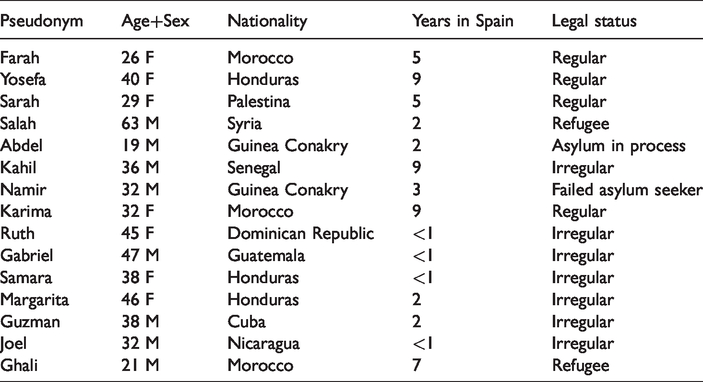
As shown in Table 1, the study included 15 migrants from 10 nationalities. Participants’ mean age was 36.2; only 26.7% had family members in Spain. Two migrants lived in shelters, one was homeless, and the others lived with their families or shared a rented room or flat. Two had been in detention centres and one had lived for some years in a centre for unaccompanied minors.
Participants’ description – Migrants.
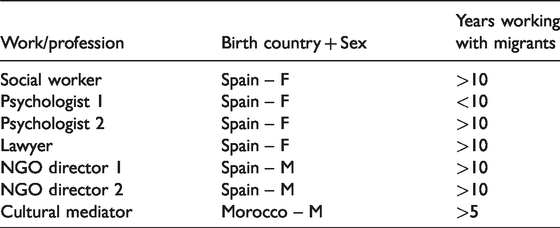
Concerning professionals (Table 2), all had extensive experience working with migrants, and only two had worked for less than 10 years with this population. All were of Spanish nationality, except for the cultural mediator, who was a Moroccan.
Participants’ description – Professionals.
Instrument
Semi-structured interview guides with open-ended questions were designed by the researchers. Despite having a guide, however, most control was given to respondents during the interviews, allowing for new themes to emerge and to deepen the understanding of the participants’ inner experiences (Noon, 2018). For migrants, interview themes included general feelings towards the host society, main difficulties encountered, experiences of discrimination or racism, feelings elicited by those experiences, coping strategies used, experiences when approaching care services and suggestions for improving services. An example of a probe for the migrants was: ‘When you had to approach helping services, how were your experiences?’. The sample was quite heterogeneous, which indicated a need to investigate whether experiences of hostility and discrimination were present, despite participants’ demographic differences.
For professionals, the interview guide included: major difficulties encountered by migrants, whether migrants experienced discrimination and in what areas it was most evident, the consequences on their psychosocial well-being, the degree of trust on services and on helping professionals, major difficulties encountered in providing help for migrants, and suggestions to improve services and provide better integration for them in host societies. An example of a probe was: ‘In general, what are the opinions of society, media and public services towards migrants?’.
Ethical considerations
Considering the sensitivity of conducting research with migrants, special care was taken regarding ethical matters. A detailed description of the project was submitted to the ethics committee of a university for approval. Special care was also taken in the recruitment phase. Professionals received a detailed description of the project to assure that ethical issues were addressed and clients were protected. Before the interviews, participants were clearly informed about the project’s objectives, were assured anonymity, were asked verbally and in writing for their consent to be interviewed and audio recorded, and assured that participation in the study would not affect the services they received from the NGOs.
Data collection
The interviews were conducted in Spanish by the first author (a transcultural clinical psychologist) and lasted between 30 and 60 minutes each. One interviewee asked not to be recorded but allowed detailed notes to be taken. One interview was conducted with an Arabic translator, as the participant did not know either Spanish or English. The interviewee appeared to be comfortable with both translator and interviewer, and spoke freely. Special care was taken in translating the content of the interviews to English to safeguard the meaning and connotation intended by the participants. This process was performed by an English- and Spanish-proficient speaker and checked by the second researcher. To maintain confidentiality, the names of participants were changed. A journal was kept alongside data collection and memos were written immediately after the interviews, which were transcribed and coded within 2–3 days. Adjustments were made to the interview guide and selection of participants, according to the constructs and meanings that were emerging from the analysis.
Data analysis
Data were analysed using Atlas.ti software and followed the IPA approach: the transcripts were read, annotated and re-read to access the depths of the message and bring up major themes. Participants’ discourse was analysed taking into account the words used and feelings expressed both verbally and non-verbally, how the narrative was done and what it actually revealed about participants’ experience (Noon, 2018). Some themes that were highlighted included experiences of discrimination; hostility; and anger and mistrust from society, social institutions and helping professionals. Triangulation was used by comparing and contrasting professionals’ views with migrants’ discourse. This contributed to exploring professionals’ views and to assessing whether these views corroborated migrants’ experiences of hostility and discrimination. Several qualitative strategies were applied for validity and rigor: reflexibility was used in all processes of data collection and analysis, saturation of data and of main categories was achieved, dependability and confirmability were done by a second author who reviewed all the analyses to prevent biases in the interpretations of the first author, and credibility was assured by journaling and memo writing in the software.
Results
Most migrants interviewed, regardless of origin, time in Spain, gender, legal status or age, expressed that they had experienced some sort of discrimination. These experiences were described as directed towards themselves or towards others from the same ethnic background. Moreover, discrimination was experienced through overt or subtle manifestations of hostility, anger or mistrust from society in general, social institutions and/or helping professionals.
In the presentation of findings, quotes from participants are included to provide a greater richness to the themes found in the study. In these quotes, migrants are identified by a pseudonym to maintain confidentiality (see Table 1), whereas professionals are identified by their working role (see Table 2).
Actual discrimination: Not just perceptions
In the sample it was clear that Muslim and Black migrants were the two groups experiencing the most hostility and discrimination. Skin colour or dressing in a manner associated with the Muslim religion led to strong experiences of rejection from society. This rejection was observed in social contexts in general, as highlighted by a professional: ‘Nowadays there is a great rejection towards Moroccan population. Many people easily say: I am not racist but I cannot tolerate Moroccans’ (lawyer). This was strongly expressed by a Moroccan woman: ‘They [the Spaniards] do not swallow a woman in veil’ (Karima), meaning that Moroccans often experience hostile attitudes or behaviours towards them, not because of what they do, but simply as a result of strong racial or religious prejudice in society. A young Moroccan man expressed: I tell you that if a Moroccan is sitting on a bench and someone is passing by, I am going to show you how they do [gets up and holds his bag] … They are going to make you feel that you are a robber … let you know that your presence frightens them … or he might wish you bad luck … or say: ‘that Moro [pejorative expression for Moroccan] is a robber’ … Do you get what I mean? This affects us a lot. … (Ghali)
Experiences of discrimination were not limited to those in social contexts, as migrants and helping professionals spoke of examples of xenophobic messages, or even hostile mistreatment in basic services like housing, work, health and social services. Renting a house was often a source of despair and powerlessness: ‘I went to many houses searching for a room, but all doors were closed … I felt very, very frustrated [crying] … I knew I was going to pay the rent … ’ (Yosefa); and the same was true when there were problems of abuse from house owners: ‘They call the agency and they don’t care, call the house owner, and he mistreats them … ’ (social worker). Unfortunately, xenophobic messages regarding house renting seem to have become a common procedure in house renting advertisements: ‘house for renting … abstain foreigners’ (lawyer), revealing an underlying normalisation of discrimination in society.
Discrimination examples went even further, as some participants spoke of being treated with subtle hostility when going to health care centres, for example: ‘Sometimes they [front desk attendants and health professionals] don’t even look at you … I feel bad … I always feel that they despise you for being an immigrant’ (Gabriel). This treatment was in line with what professionals highlighted with regards to treatment of migrants by personnel from social services: ‘Several clients mentioned to me that, at some stage the social worker asked: why don’t you go back to Morocco?’ (cultural mediator); or ‘In social or health services … at the smallest difficulty, the one attending might say: I don’t know why you complain, this is not your country anyway … ’ (lawyer).
Prejudiced attitudes and behaviours such as these are often inflamed by anti-migration political discourse and official or unofficial media content. As mentioned by a young Palestinian woman, ‘I cannot watch channel 24 because they are all the time telling the world that we are bad … ’ (Sarah); or a professional interviewed, ‘Social media and TV news in general, lead to high levels of distrust towards Muslims and those who are different. People become alarmed with every single movement of a refugee or an immigrant’ (cultural mediator); or another who mentioned, ‘If there is a robbery, the media makes a point to say that the robbery was committed by someone from Venezuela, Equator, Romania. … Just to highlight that criminals are not from here’ (social worker). Examples such as these show how easy it is to feed a spiral of hostility and anger from host societies towards migrants.
Impact on well-being
A sense of control over one’s life is an important mediator between perceived discrimination and psychological well-being (Jang et al., 2008). In most clients interviewed, however, this sense of control was very much absent, irrespective of their time in Spain or their legal status. Verbally and non-verbally, many of them revealed strong negative feelings and emotions as a consequence of prejudice and discrimination.
Most common feelings and emotions expressed
Regardless of country of origin, age, gender/sex, legal status or even time in Spain, most participants highlighted a range of negative emotional states resulting from overt or subtle experiences of discrimination and prejudice. Anger, grief and loss, sadness, isolation and strong emotional pain were among the emotions most frequently mentioned.
Deep sadness or even despair was frequently expressed by Black participants as they faced situations of racial hostility: ‘It’s very, very painful … Sometimes you want to cry … to scream very loudly for pain to go out of your heart … ’ (Namir). Feelings of powerlessness mixed with strong emotional pain were expressed by several participants, regardless of country of birth. A young man from Morocco who had been living in Spain for seven years described how being repeatedly treated with hostility due to colour or country of origin led to high levels of despair: For the Spanish, there are people who if they see you a black they will say I don’t know what … if they see you a Moro they’ll say you are a robber or a Jihadist … and then, there’s a point in which you begin to eat your brain with negative thoughts … you begin to go and see things … go around and around, trying to forget those thoughts … and reaches a point when you begin thinking … that’s enough, I’m going to throw myself from that house or under that car … you simply begin to die. … (Ghali) Just because I’m black … this is always the problem … people look at a black person and think something else … only you know what happens to your head. … I can be very angry because, you know, you live two years or three years very difficult, and another person thinks something else of you … they say: you shut up! If people talk bad to you … you just stay with your objective, you do not become violent at people … you only think of your life … you know … because I am a foreigner. (Abdel)
Interviewed professionals confirmed that migrants frequently experienced strong fear: ‘The people with whom I work are scared, very scared … They feel that the Spanish are always angry [because they speak loudly] … ’ (social worker); and feelings of loneliness and isolation: ‘Many of these people have nobody to support them and to listen to them and their problems, and this is going to undermine their well-being’ (psychologist 2).
Coping factors
Most coping factors referred by participants were positive, although a few mentioned some negative strategies when handling discrimination effects. Coping factors most commonly highlighted were spiritual beliefs and practices, support to or from family and friends, reinforcement of cultural or religious identity, and cognitive reframing. Several participants mentioned that their main way of coping with a hostile society was the use of self-talk strategies and cognitive reframing, which involves finding meaning in a negative situation and taking some good out of it in order to protect oneself (Gladden, 2012).
For example, a Moroccan woman excused prejudiced comments about Muslims as ignorance: ‘I tell myself, they don’t know anything about our religion [Muslim] … they think we are all the same … it’s their problem … ’ (Farah). Or, a young African man recalled past negative experiences to cope with present pain: ‘You only think … when I am [was] in Morocco … life in Morocco very, very, very difficult … you know? I work with my head … ’ (Abdel).
An important coping mechanism observed especially in Moroccan women was identity reinforcement. This strategy was underlined by professionals as positive on one hand, and potentially negative on the other: ‘Instead of an adaptation to the host context, or a natural sharing of customs and cultures … they are fortified in cultural variables which become even more stereotyped … ’ (psychologist 1). This was clearly illustrated by comments from Moroccan women, for example: ‘You know, before I did not wear the veil, but now I wear it and I feel good’ (Karima).
Along with positive coping factors, there were several negative strategies used by participants to cope with discrimination, mistrust and hostility from the host society. These included denial, aggressive impulses (towards self or others), approaching mafias (groups of organised crime), risk behaviours like alcohol and drugs abuse, and in some cases, passive suicidal thoughts. Various of these were highlighted by helping professionals, especially those who worked with young migrants, for example: ‘[Discrimination and hostility] may lead to ghettos, religious fanaticism … also, serious psychological problems may arise leading to an escalation of negative behaviours like alcohol consumption, helplessness … These aspects feed on each other … ’ (psychologist 1).
Risk behaviours can be even more extreme, as mentioned by a young participant who referred to behaviours taken by his friends: There are people who don’t care about their life … They do other kinds of things like doing business with mafias, killing people, or taking their own life … and you cannot tell them, don’t do that … because if you do, they will tell you their despair and you think, f____ this kid. … (Ghali)
Discussion
The aims of this study were to explore migrants’ experiences of discrimination from society, social institutions and helping professionals; the impact of those experiences on migrants’ psychosocial well-being; coping strategies used by this population, whether healthy or unhealthy; and the consequences from all the above that may result for migrants and society. The study also aimed to assess whether the perspectives of helping professionals provided support for migrants’ views.
The findings show that, depending on personal and contextual factors, and on the support they may or may not receive, discrimination acts experienced by migrants have a negative impact on these persons’ well-being by generating negative feelings and emotions, and in some cases may lead migrants to resort to coping strategies that may attract more rejection from host societies. The present study makes a positive contribution to the literature by comparing the views of migrants and professionals in the same study.
Participants stressed that hostility, mistrust, anger and/or indifference were present in society in general and in basic areas like work, housing, social services and even health care. Political discourse and media content appeared to feed negative social views and, consequently, damaged relationships between migrants and host societies. Previous research reached similar conclusions in different Western countries (P. Hynes, 2009; Pollock et al., 2012; Rhodes et al., 2015), indicating that migrants’ life in host countries is often a struggle for survival in unfriendly environments (Larchanché, 2012).
Both migrants and professionals in the present study agreed that hostile discourse and prejudiced attitudes and behaviours towards migrants were increasing rapidly in Spain, and were strongest towards Muslims and Black people – a trend frequently underlined in the literature (Alcalá et al., 2017; Spruyt & Elchardus, 2012). In our study, participants from African background and those wearing external indicia associated with the Muslim religion spoke of recurrent experiences of discrimination and even hostility in social contexts and in basic services.
Latin participants (who comprised almost half of the sample) also reported some cases of discrimination regarding job searching and work exploitation, house renting and social services; however, they expressed more acceptance from Spanish society than the other two groups. The somewhat lower degree of discrimination expressed by Latins, compared with Blacks and Muslims, could be related to the historical connection between Spain and Latin America, associated with similarities regarding language, religion and cultural values (Lancee, 2019). Language and cultural proximity is not the case for Latins in the US, which could to a certain extent explain Yemane and Fernández-Reino’s (2019) conclusions.
Consistent with previous studies (Kirmayer et al., 2011; McLeish, 2005; Pascoe & Richman, 2009; Rhodes et al., 2015), it was found that discrimination and hostility led migrants to experience negative emotional states like isolation, grief and loss, sadness, anger, frustration, fear, insecurity, helplessness and mistrust. The present findings further revealed that racism and discrimination are among the factors that most damage migrants’ sense of self-worth, often leading to negative consequences for self and others (Lyons-Padilla et al., 2015). Although those affected are never immune to the negative impact of racism and discrimination, the degree of harm caused may depend on an individual’s circumstances and resilience levels, or on the coping mechanisms used by those undergoing such experiences.
In our study, participants often relied on positive strategies such as spiritual beliefs and practices, support from family and friends, cognitive reframing and identity reinforcement to cope with mistreatment. Negative ways of coping, however, were also reported by migrants and confirmed by professionals who accompanied them. These included denial, passive resignation, social isolation, aggressive tendencies towards self or others, risk behaviours, ghettoisation or joining mafias. Along similar lines, a study conducted by Bull and Rane (2019) also concluded that while radicalisation and extremism may be more a consequence of personal characteristics than of social or cultural aspects, there are socio-economic factors like being socially or culturally alienated, which can make some young migrants more vulnerable to being targeted by extremist groups.
Being emotionally vulnerable as a consequence of discrimination and hostility seems to place migrants at risk of employing coping mechanisms that are harmful to themselves: isolation, rumination, substance abuse, suicide ideations (Gomez et al., 2011); or to others: anger, hostility, aggression (Borders & Liang, 2011); or to search for life-meaning by joining mafias or other organised groups (Kruglanski et al., 2009; Lyons-Padilla et al., 2015). As highlighted in previous literature, stereotyped messages and hostile attitudes from society, social media, political figures and helping services, not only harm the psychosocial well-being of migrants, but also damage their trust in helping professionals (Da Silva Rebelo et al., 2018; Douma, 2014; Rhodes et al., 2015; Sládková et al., 2012) and thus compromise possible interventions to reduce the risks for self and others.
A few migrants in our sample revealed a fairly high level of despair as they shared repeated experiences of discrimination, while mentioning a tendency to resort to strategies and behaviours that were potentially harmful towards self or others. This could be the case for those who resort to religious fanaticism or radicalisation, which may be a consequence of undergoing ethnic hostility and contempt, a situation often experienced by migrants belonging to the Muslim faith (Adida, Laitin, & Valfort, 2014b). In fact, anti-Muslim political and media discourse, along with social contempt, has the potential to lead to feelings of social marginalisation, which constitutes an environment for radicalisation (Bull & Rane, 2019). This spiral of social mistrust and hostility seems to reveal the presence of a vicious circle, which brings negative consequences to both host societies and migrants.
Although these results seem to be promising in identifying a possible upward spiral of hostility from both sides, they need to be interpreted with caution, considering the small size of the sample of migrants: seven Latins, three Africans and five from Arab countries, and its nature with regards to legal status and time in Spain (details are shown in Table 1). These results, however, reveal the need for helping professionals and academics to work towards preventing societies’ racial hostility towards migrants, and addressing the harmful consequences on those affected.
This can be a major challenge, especially for those social workers providing services in governmental organisation and who, in some Western countries, are given responsibility to help preventing radicalisation (Finch et al., 2019). According to Finch et al., such requests often compromise the standards of the profession, which is concerned with promoting human rights and caring for the welfare of those in need. These situations have the potential to bring up feelings of ambivalence in the professional and trigger feelings of mistrust in the migrants they care for.
Unfortunately, the two public institutions contacted by the researchers did not agree to participate in this study, either for interviews with migrants or with professionals. However, even though interviews were only conducted under the auspices of NGOs, all participants interviewed (migrants and professionals) reported first hand experiences with public institutions, especially regarding social or health care services. Some migrants and professionals interviewed referred to cases of discrimination and hostility encountered in public services, like ‘why don’t you go back to Morocco?’ (cultural mediator), or ‘go away from here if you don’t have means to live on … ’ (lawyer). These expressions, discussed in the ‘Results’ section, were highlighted as being said by helping professionals from public services. Therefore, it would be important to conduct a future investigation with migrants and professionals in the context of public institutions. This step would be particularly important because social workers and other helping professionals are in a privileged position to develop and implement strategies that can promote migrants’ social integration. In this way, Western societies can grow towards rich multicultural environments.
Implications
At least four recommendations for social workers and other helping professionals can be drawn from the present results:
That they engage in ongoing development of cultural competences, especially cross-cultural awareness and skills, and use professional supervision (National Association of Social Workers, 2015) as a means to deal with work overload and the feelings of powerlessness that may emerge from the rising numbers of migrants in need of psychosocial support. That they invest in developing the necessary sensitivity to be able to identify the various coping strategies used by migrants as they deal with ethnic hostility, in order to promote positive strategies and help migrants to integrate negative feelings and emotions that may be damaging to themselves or others. That they share their valuable experience working with vulnerable migrants with other professionals and institutions, using it to build advocacy actions to influence key policy makers and social actors. This would contribute to the development of more humane migration policies, to raise awareness about the damaging power of media and to work towards the development of better intercultural environments. That they investigate the circumstances in which migrants may resort to negative coping strategies, and to develop tools to identify the existence of aggressive tendencies towards oneself or others. This would enable the development of interventions to counteract migrants’ negative feelings and behaviours and promote the well-being of those most affected.
Limitations
This work has at least three limitations. First, the sample was fairly heterogeneous regarding legal status, nationality and time in Spain. Although experiences of hostility and discrimination appeared to be more related to membership to certain ethnic groups (ex. being Muslim or Black) than to other variables, the results may not apply to the whole population. Second, participants were approached by professionals from NGOs who provided support to them, leaving out those who might have had negative experiences and were not willing to speak about these. Finally, all migrants were beneficiaries of NGOs, and no interviews were done either with professionals or migrants from public organisations. They were approached and invited to participate but declined, alluding to workload reasons. Having clients and professionals from public institutions could have added valuable information to the topic. Despite these limitations, the results from the present work add a positive contribution to the literature, as some relevant implications can be drawn for professionals and academics working with migrants.
Conclusions
The present study offers a modest contribution to the literature, as it combines the views of helping professionals along with those of migrants in exploring both the impact of ethnic discrimination on the psychosocial well-being of, and the type of positive or negative coping mechanisms used by, migrants experiencing racial hostility. In line with previous findings, our study concludes that prejudice and discrimination, expressed through hostile behaviours and feelings of anger and mistrust, negatively affect the well-being of migrants. Political discourse, migration policies and media content tend to inflame negative perceptions of those who are different, especially Muslims and Black people. Latin migrants also experienced some level of discrimination and racism when seeking basic services like work, house renting, social services and health care facilities, although it seemed less pronounced than with the other two groups.
The negative impact on well-being was expressed by migrants through various negative feelings and mental states. Those affected mentioned healthy coping strategies like spiritual beliefs and practices, support from family and friends, identity reinforcement and cognitive reframing. Negative coping factors were also highlighted and were quite concerning: ghettoisation, joining mafias, or resorting to harmful behaviours towards self (risk behaviours or suicidal thoughts) or towards others (aggressive behaviour). Considering that discrimination and hostility from host societies negatively influence migrants’ willingness to seek support from services and to trust helping professionals, we hope that the insights gained from this study will encourage social workers and other helping professionals to value ongoing development of cultural competence, grow in the capacity to identify the types of coping mechanisms used by migrants, use their clinical experience to influence more humane migration policies, and thus make important contributions to the development of healthier relationships between cultures.
