




Abstract
Summary
This article explores social workers’ perceptions of their colleagues’ professional mistakes, and the influences of those opinions. Vignettes in a factorial survey helped to determine whether certain variables related to the social worker or the situation influenced the perception of others’ professional errors and ethical violations. The changed variables included personal characteristics of the offending social worker such as perceived race, gender, and sexual orientation of the social worker, and characteristics of the situation, such as the length of time involved in unprofessional behavior.
Findings
Licensed social workers in six U.S. states (n = 5596) read vignettes based on real cases brought before licensing boards (n = 22,127) and assigned levels of seriousness and importance to discipline. The vignettes rated most highly involved perceived harm to a client or other vulnerable individual. Those on the lower end of seriousness and importance to discipline were those violations against the profession of social work. Analysis of changed variables indicated respondents’ ratings were influenced by several situational factors, but not by personal characteristics of the social worker involved in the vignette.
Applications
Our findings provide some insight into the decision-making factors important to social workers. The results may be helpful to licensing boards considering the contextual factors of unprofessional behavior and whether to discipline certain actions.
Keywords
Introduction
More than 30 years ago, Pope et al. (1987) published their seminal study of psychologists’ beliefs about what actions they considered to be ethical. The study participants (n = 456, 45.6% response rate) examined 83 behaviors, including physical touch with clients, changing diagnostic codes to meet insurance requirements, and engaging in sex with supervisees. Participants rated them by the extent to which they engaged in the behavior and whether they believed the behavior was ethical (Pope et al., 1987). Their findings indicated a correlation between belief and behavior in nearly all areas; yet 90% of the respondents reported engaging in some of the 83 behaviors (i.e. self-disclosure as a technique, telling a client you are angry with him/her, accepting a nominal gift from a client) (Pope et al., 1987).
Numerous studies have been conducted to build on these findings, several involving social workers. Borys & Pope (1989) found psychologists, psychiatrists, and social workers (who made up 30.8% of the sample) shared similar viewpoints of what constituted unethical practice in most areas. Social workers were, however, found to be more rigid than psychiatrists and psychologists in accepting gifts or invitations from clients. Pomerantz et al. (1998) found agreement among professionals working as therapists except in the areas of disclosing confidential information, neurocognitive testing procedures, using involuntary hospitalization, and using first names with clients. Bernsen et al. (1994) found social workers 2.5 times more likely to consult with a supervisor if they felt sexual attraction toward a client than were psychologists. Most recently, Schwartz-Mette & Shen-Miller (2017) duplicated Pope et al.’s study with several hundred psychologists 25 years later to determine whether perceptions had changed over time. Their results indicated viewpoints about what is ethical and what behaviors they engage in themselves are much more conservative today than in the past. In a study using a different scale, DiFranks (2008) found a positive relationship between social workers’ beliefs and behaviors, but it was not significant. The methodology in these studies relies on self-report, measures often associated with social desirability bias (Zhang et al., 2017). This study assesses social workers’ perceptions using real-life vignettes to reduce the limitations of these previous studies.
Licensing board complaints
In the United States, each state has a licensing board that assigns a licensure level (i.e. qualification) to a social worker based on educational attainment and years of experience. While some estimates indicate as many as 10% of social workers engage in unprofessional and/or unethical behavior that violates the standards of care (Magiste, 2020), the number of professionals engaged in unethical behavior may be decreasing (Schwartz-Mette & Shen-Miller, 2017). Conversely, claims of wrongdoing are reported on 1–2% of all licensed professionals (Magiste, 2020; Van Horne, 2004), though reports of the number of social workers in this category is increasing (Reamer, 2015). Licensing boards set standards of care, broadly defined by Reamer (2016) as “what ordinary, reasonable, prudent practitioners with the same or similar training would have done under the same or similar circumstances” (p. 150). These standards may be interpreted differently from one jurisdiction to another.
This difference in interpretation causes a significant variation in the number of social work violations reported to social work licensing boards from state to state (Boland-Prom, 2009; Daley & Doughty, 2006; Strom-Gottfried, 2000). Complaints to the licensing board arise out of mistakes and oversights … Other complaints and lawsuits arise from social workers’ deliberate ethical decisions … Some … are the result of practitioners’ ethical misconduct, such as sexual relationships with clients or fraudulent billing for services. (Reamer, 2016, p. 132)
Only a handful of studies have examined these complaints; however, the collected data spans reports received from 1955 to 2013 (Boland-Prom, 2009; Boland-Prom et al., 2015; Daley & Doughty, 2006; Magiste, 2020; Strom-Gottfried, 2000). The most common violations reported in these claims nationally are license-related problems (e.g. failure to meet continuing education unit (CEU) requirements) and dual relationships (Boland-Prom, 2009; Boland-Prom et al., 2015). Magiste’s (2020) study examined the complaints from one state (Ohio) from 1985 to 2013, and found similar categories: licensing issues, standards of care, boundary violations, breaches of confidentiality, fraud, and legal issues. These more recent results indicate that the issues reported to licensing boards have not changed substantially over time.
For corroborated reports of social workers’ professional wrongdoing, disciplinary action may include such sanctions as public reprimand, fines, required continuing education, or suspension/revocation of license (Association of Social Work Boards (ASWB), 2011; Boland-Prom, 2009; Boland-Prom et al., 2015; Strom-Gottfried, 2000). Just as the number of violations can differ from state to state, so do the penalties and their severity (Boland-Prom, 2009; Strom-Gottfried, 2000).
Some have criticized social work licensing boards for overreach, specifically placing too much of a focus on creating a single image of who a social worker is and what a social worker does, creating an unnecessary fear of liability or sanctioning (Floyd & Rhodes, 2011). Board members act as investigators and judges and may lack training in maintaining objectivity in adjudicating cases, which can lead to biased decisions (Gunther, 2014).
Influences on beliefs
Some factors upon which people base their judgments are not always known to them, factors commonly described as heuristics and cognitive biases. Heuristics are the mental shortcuts that allow people to make quick, efficient judgments, and provide a helpful context for understanding the influences on our decision-making (Bowes et al., 2020; Shah & Oppenheimer, 2008). They are commonly organized into three categories: availability, representativeness, and anchoring and adjustment.
The availability heuristic proposes that people make judgments based only on the information available at the time (Croskerry, 2002; Shah & Oppenheimer, 2008). The representativeness heuristic allows people to judge whether an example belongs to a given category (Bowes et al., 2020). In clinical settings, this heuristic can play out in diagnosing similar, but not identical, clinical presentations with the same diagnosis. The representativeness heuristic can also cause people to make judgments based on race and gender stereotypes (Bowes et al., 2020). Bisking et al. (2003) (as cited in Salvador, 2019) found that when individuals are involved in enacting sanctions on someone perceived to have engaged in misconduct, their decisions are influenced by characteristics of the offender such as gender. The anchoring and adjustment heuristic, also known as focalism or priming, reveals that people form judgments largely based on the first piece of information they receive and weigh it against all other information (Bowes et al., 2020). Focalism can help to explain why misinformation can be difficult to disprove.
Other more specific heuristics involve decision-making as well. For example, the outrage heuristic helps people to consider how reprehensible an action is to administer a punishment (Shah & Oppenheimer, 2008). This shortcut means that people may lean toward harsher penalties for a person who mugged someone to buy illegal drugs and more lenience toward a person who mugged someone to buy food.
Reliance on heuristics can lead cognitive bias when left unchecked (Croskerry, 2002). Mattison (2000) determined internalized stereotypes and biases influence professional conduct and decision-making. Common cognitive biases surrounding decision-making include implicit bias (stereotypes based on social group qualities) (FitzGerald & Hurst, 2017); confirmation bias (paying attention to information that confirms current beliefs); fundamental attribution error (judging others on their perceived character, but themselves on the context of the situation); and in-group bias (automatically favoring those who are like us) (Croskerry, 2002).
The personal characteristics and the culture of the practitioner can also affect how social workers and other helping professionals make their practice decisions (Mattison, 2000). Not surprisingly, the contextual factors involved in the situation also play a role in decision-making (DiFranks, 2008; Mattison, 2000). Ingram (2013) indicated the presence of a “cognitive process at play which helps us determine what elements of an event are important, and in turn, what is potentially at stake” (p. 7). This article examines which elements are perceived to be important in determining the seriousness of social workers’ unprofessional behavior.
Materials and methods
Participants
This study was approved by the Institutional Review Board of Hood College (#1819-25), and electronic consent was obtained from all participants prior to the start of the survey. In July 2019, online surveys were emailed to active licensed social workers in six states in the U.S., for a total of 56,131 possible respondents. These states were selected based on the free or reasonably priced availability of email contact lists: Ohio (26,433), Minnesota (13,874), Florida (10,435), Oklahoma (2503), Oregon (1615), and Rhode Island (1271). The survey software disqualified 1279 social workers’ email addresses. An additional 697 (1.27%) potential participants had automatic settings opting them out of the survey, or their invitations were bounced back due to invalid addresses. These exclusions resulted in a total of 54,155 emailed invitations. One reminder went out two weeks after the initial invitation, granting survey access for a total of four weeks. Participants were eligible to enter to win one of two gift cards by providing their email address after the survey.
Study design
This study used vignettes in a simplified factorial survey to determine variables involved in evaluating social workers’ beliefs about unprofessional behavior. Vignettes that simulate true to life situations provide opportunities to get an impression of how study participants’ decision-making processes are affected by various factors (Evans et al., 2015). Evans et al. (2015) describe the construction of a vignette as involving three aspects: (1) experimental, manipulated components that assess effects on dependent variables; (2) controlled, consistency across vignettes to eliminate unnecessary variance; and (3) contextual, nonessential details that make the vignette subjects more realistic. Attention to these three factors, Evans et al. report, help researchers accomplish “vignette equivalence” (2015, p. 162).
To establish whether bias influenced the opinions of the respondents, we designed a factorial survey (Ganong & Coleman, 2006). In this survey design, participants are randomly sampled and are presented with brief vignettes in which one or more independent variables have been changed (Ludwick & Zeller, 2001). Considered an experimental method because variables can be controlled, the factorial survey allows researchers to identify the effects of changed characteristics on respondents’ perceptions in large, representative samples (Ganong & Coleman, 2006). Because of these reasons, the internal and external validity increase in a factorial survey.
Vignettes
Vignettes based on realistic individuals and situations are the most effective to elicit useful responses (Evans et al., 2015). To find realistic situations, we searched publicly available disciplinary reports from states that were not included in this study’s sample to reduce the potential for familiarity with a specific case. We then selected cases that fit into one of eight categories of violations cited as most frequent in the most recent national study of social workers (Boland-Prom, 2009): (1) dual relationships (borrowing money from a client); (2) license-related problems (practicing without a license); (3) crimes (committing Medicaid fraud); (4) poor basic practice (asking client to lie to cover mistakes); (5) below standards of care (failing to report); (6) irregularities in billing (billing for activities that did not occur); (7) impaired social worker (abusing substances); and (8) supervision below standards of practice (engaging in sexual relationship with student intern). The category numbers align with the number of the vignette created for the survey. To protect the privacy of the individuals involved in the real reports, we left out identifying information. Each vignette was written using the same pattern of information (Atzmüller & Steiner, 2010): (1) level of licensure, (2) length of time in practice, (3) official allegation, and (4) individual’s reaction to allegation (admitting guilt, resignation, and maintains innocence).
Factorial surveys
This study used a simplified version of the factorial survey. Due to the limitations of the survey tool available for this research, the variables in the vignettes were limited to one per vignette. Three of the vignettes’ variables were based on perceived personal characteristics of the social worker: gender (Vignette #4), race (Vignette #6), and sexual orientation (Vignette #8). For example, the pronouns of the social worker involved in the vignette were changed, but all other details remained the same. In the remaining five vignettes, a variable regarding the situation’s context was changed. In Vignette #1, the social worker requested a loan from a client, or the client offered to lend the social worker money. In Vignette #2, a social worker practiced without a license for seven months or five years. In Vignette #3, the social worker was convicted or accused (but not yet charged) of Medicaid fraud. In Vignette #5, the social worker failed to report threats of violence from a male toward a female or a female toward a male. In Vignette #7, the social worker’s addiction to methamphetamine or alcohol caused problems at work. See Table 1 for the vignettes used in the survey.
Survey vignettes with changed variable.

aEmphasis added.
Rather than risk the respondents losing interest in evaluating eight vignettes (Hughes & Huby, 2004), we used a mixed experimental design and separated the vignettes into two surveys (Atzmüller & Steiner, 2010). Survey 1 included Vignettes 1, 2, 3, 5, and Survey 2 included Vignettes 4, 6, 7, 8. Since one factor was changed in each of the 8 vignettes, a total of 16 vignettes became the units of analysis.
Responding to the vignettes
Factorial surveys collect data from participants by asking them to rank or rate the vignette on different factors (Ganong & Coleman, 2006; Mumford et al., 2006). In this study, we put respondents in the role of “disciplinary decision maker” (Salvador, 2019) by asking three Likert scale questions about the vignettes, the results of two are included in this article. The first question after each vignette was: “How serious is this incident in your opinion?” Available responses were on a 0–7 Likert scale ranging from “Not serious at all” (0) to “Extremely serious” (7). The second question was “How important is it for the licensing board to discipline this social worker?” Again, we used a 0–7 Likert scale, and respondents were able to select “Not at all important” (0) through “Extremely important” (7).
After assessing the four vignettes in their survey, participants were then asked to select the vignettes they considered “most troubling” and “least troubling,” and identify a statement that supported their decisions. The statements were based on the Moral Foundations Questionnaire, a validated tool that assesses social attitudes and behaviors (Graham et al., 2011). Graham et al. (2011) grouped these statements into categories of concern: Harm/Care (“Caused emotional suffering to another person”), Fairness/Reciprocity (“Treated some people differently than others”), Loyalty (“Betrayed profession or professional standards”), Authority/Respect (“Action caused chaos or disorder”), and Purity/Sanctity (“Action unnatural/disgusting”).
Results
A survey was complete when 80% of questions were answered, including at least one demographic question. Once the survey closed, 702 surveys were filtered out as incomplete. The overall response rate was 10.33% (n = 5596). Participants were randomly assigned to a version of the survey, and 50.6% of the sample (n = 2831) completed Version 1 while 49.4% (n = 2765) completed Version 2. The survey took respondents an average of 11 minutes, 40 seconds to complete.
Participant characteristics
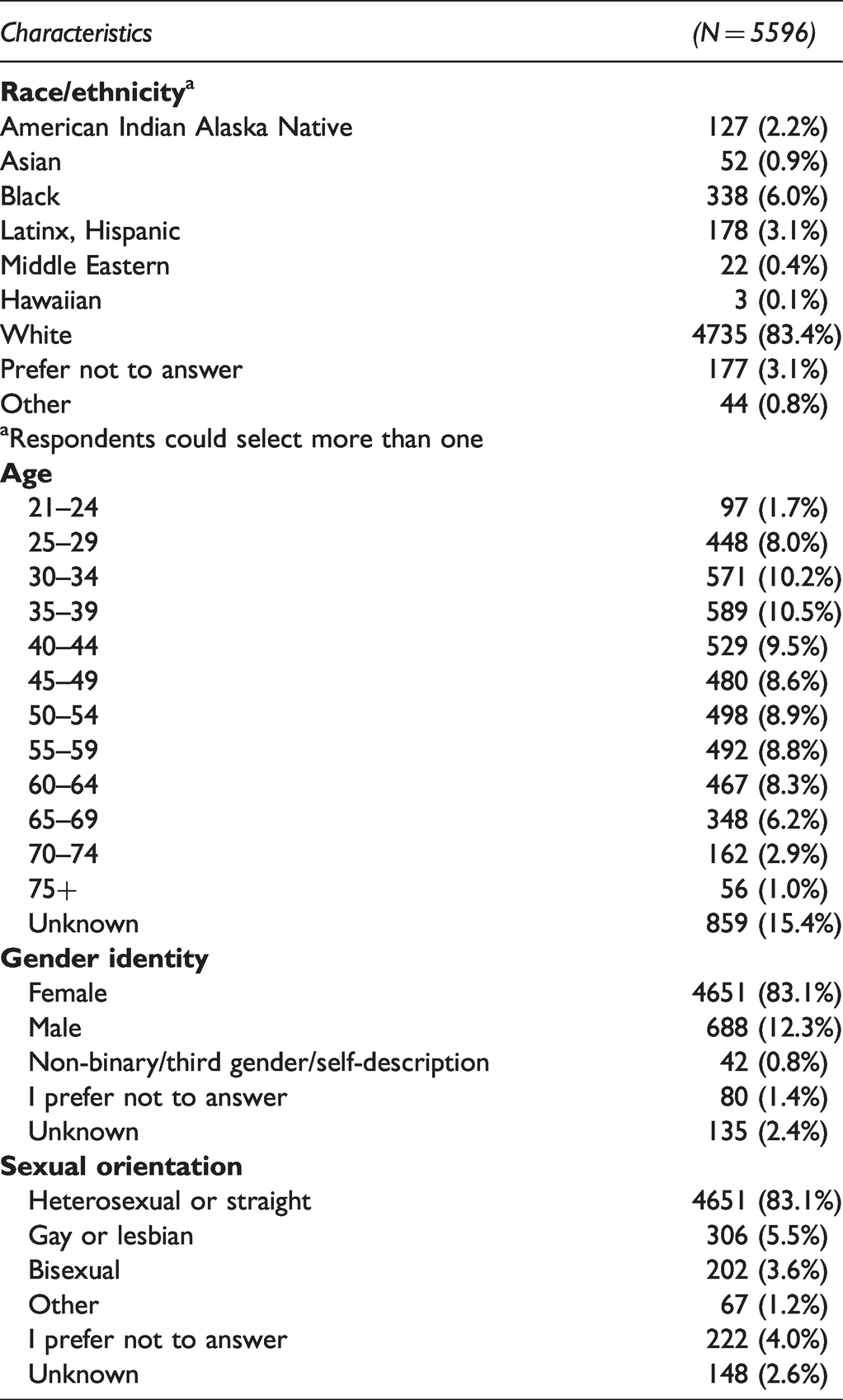
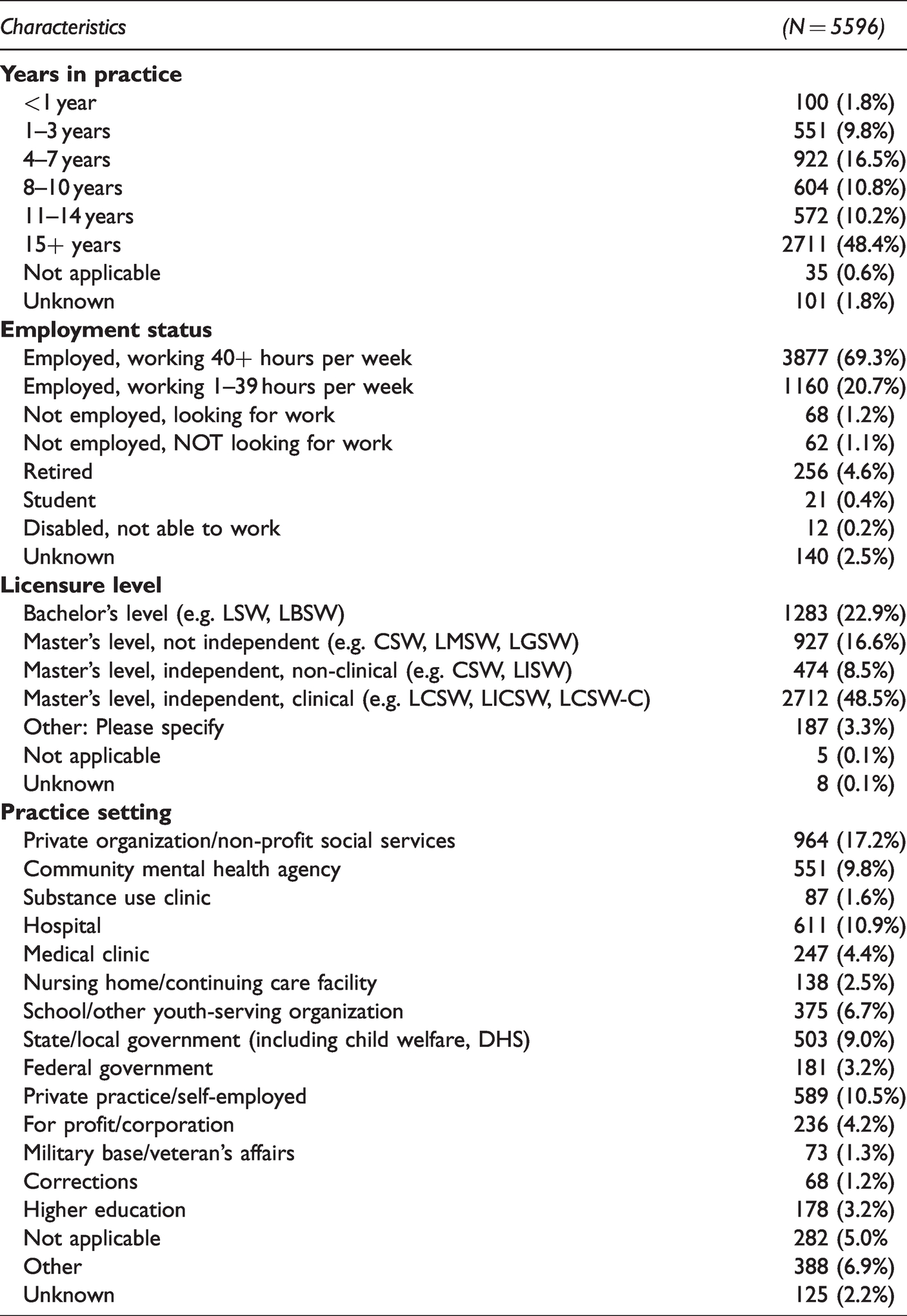
Respondents provided demographic information: licensure level, years in practice, employment status and setting, gender, age, sexual orientation, and race/ethnicity. Most respondents identified as White (83.4%), female (83.1%), and heterosexual (83.1%). More than two-thirds reported being employed full-time (69.3%) and 48.4% reported practicing in the field for 15 or more years and were licensed at the clinical level (48.5%). Age and practice settings varied. See Tables 2 and 3 for additional demographic information.
Personal demographics.
Professional demographics.
Responses regarding beliefs
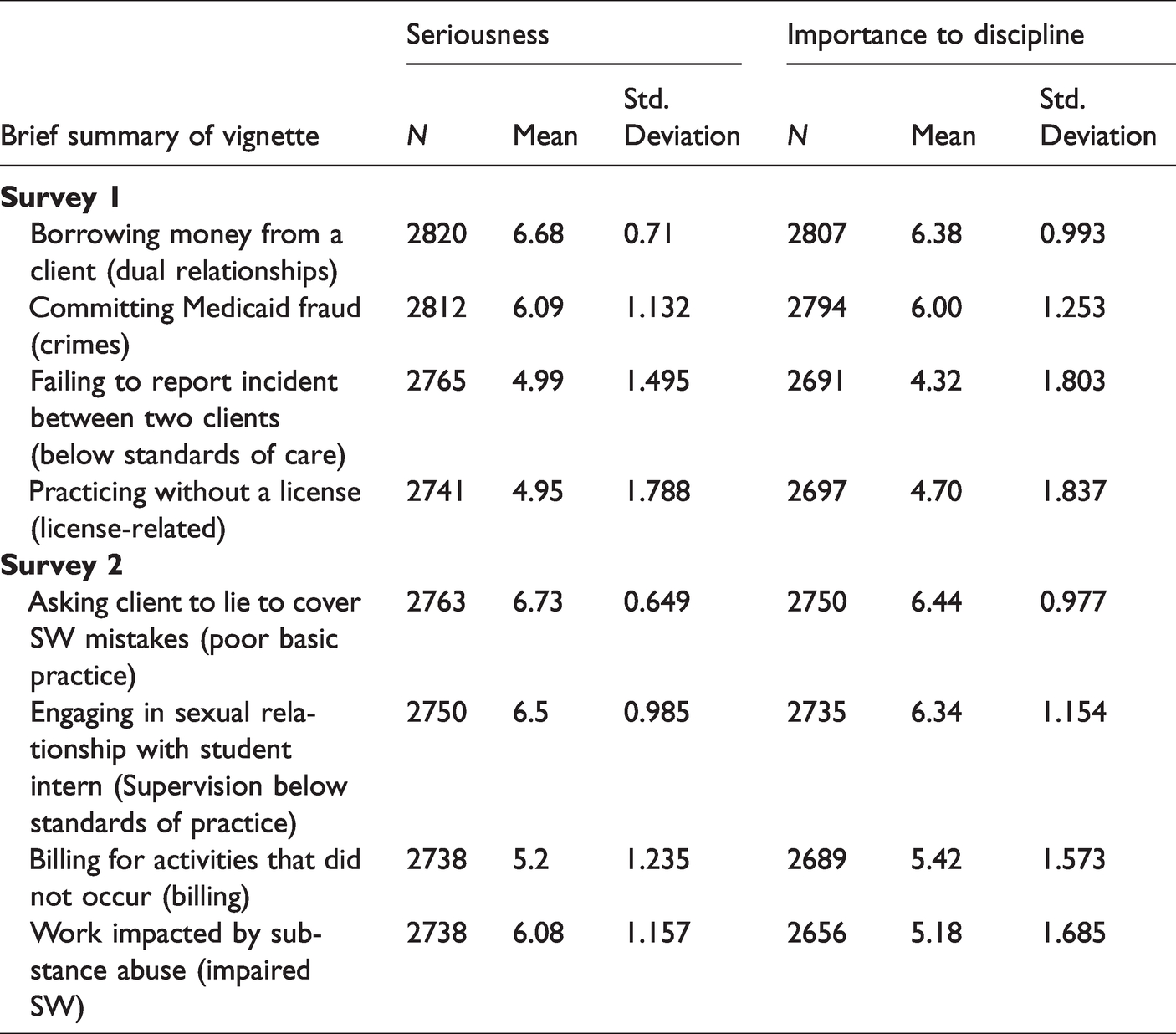
In total, 22,127 vignettes were provided as the unit of analysis, as some respondents did not complete every vignette. Descriptive statistics on each of the vignettes are available in Table 4. The mean response for all vignettes of seriousness was 5.99 (on an eight-point scale where 0 = not serious and 7 = extremely serious) (SD = 0.84). Vignette #4 wherein the social worker asked a client to lie for her to cover mistakes, had the highest average, and the least variability (M = 6.73; SD = 0.65; range 0–7). The same vignette was also the most important to discipline (6.44; SD = 0.98). The mean response for importance to discipline across all vignettes was 5.60 (0 = not important, 7 = extremely important) (SD = 1.00; range 0–7). Vignette #2, practicing without a license, resulted in the most variability for seriousness (M = 4.95; SD = 1.79) and importance to discipline (M = 4.70; SD = 1.84). Vignette #5, our example in the “below standards of care” category involved a social worker failing to report a threatening incident between two clients. This was deemed the least important to discipline (M = 4.32; SD = 1.80).
Perceived serious and importance to discipline by type of vignette.
Strong positive correlations were found between the perceived seriousness of the incident occurring in the vignette and the importance to discipline. As might be expected, as the perceived seriousness of the action increased so did the perceived importance to discipline the action. The strongest positive correlation was found in Vignette #8 involving a social work supervisor engaging in a sexual relationship with a current student intern (r = 0.79). A moderate positive linear relationship was found in the vignette of a social worker who worked while impacted by substances (Vignette #7, r = 0.60).
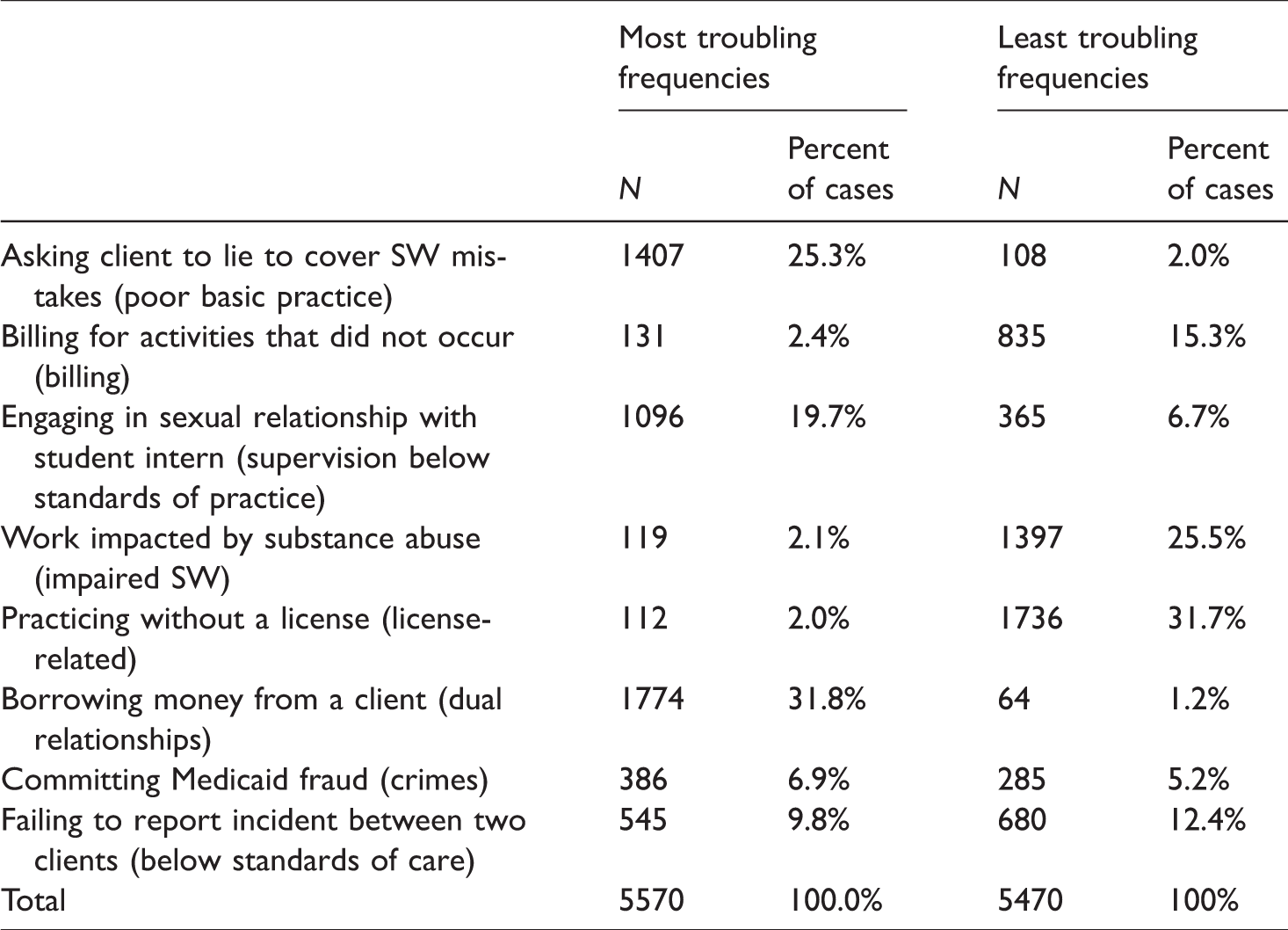
Respondents were asked to determine which of the four vignettes they reviewed was the “most troubling” in their opinion. Survey Version 1 respondents (n = 2817) first identified borrowing money from a client as most troubling (Vignette #1; 63.0%; n = 1774), followed by failing to report (Vignette #5; 19.3%; n = 545); committing Medicaid fraud (Vignette #3; 13.7%; n = 386); and practicing without a license (Vignette #2; 4.0%; n = 112). Survey Version 2 respondents (n = 2753) identified the most troubling case as asking a client to lie to cover the social worker’s mistakes (Vignette #4; 51.1%; n = 1407), then engaging in a sexual relationship with a student intern (Vignette #8; 39.8%; n = 1096), followed by billing for activities that did not occur (Vignette #6; 4.8%; n = 131), and abusing substances (Vignette #7; 4.3%; n = 119).
Respondents then selected the “least troubling” case, and the reverse was found for all cases in Survey 2, and in Survey 1, the first and last, but the middle two remained the same. In Survey 1 (n = 2753), practicing without a license (Vignette #2) was selected by 62.8% (n = 1736) of respondents, followed by failing to report (Vignette #5; 24.6%; n = 680); committing Medicaid fraud (Vignette #3; 10.3%; n = 285); and borrowing money from a client (Vignette #1; 2.3%; n = 64). In Survey 2 (n = 2705), abusing substances (Vignette #7) was identified as least troubling in 51.6% (n = 1397) for the respondents, then billing for activities that did not occur (Vignette #6; 30.9%; n = 835), engaging in a sexual relationship with a student intern (Vignette #8; 13.5%; n = 365), and asking a client to lie to cover mistakes (Vignette #4; 4.0%; n = 108). See Table 5 for the combined results of the two surveys.
Most and least troubling categories.
Respondents were asked “Consider the vignette you marked as ‘[most/least] troubling.’ Which of the following considerations is most relevant in your opinion?” Overwhelmingly, Graham et al.’s (2011) category of Harm/Care was identified as the rationale for the most troubling cases (n = 5564), with 65.5% of responses from both versions of the survey (n = 3643) falling into that category, followed by Loyalty in 25.0% (n = 1393) responses, Authority/Respect in 6.0% (n = 335), Purity/Sanctity in 3.1% (n = 170), and 0.4% (n = 23) selected Fairness/Reciprocity. For the cases identified as least troubling (n = 5424), statements from the Loyalty category were selected in 55.5% (n = 3008) responses, Authority/Respect in 27.0% (n = 1464), Harm/Care in 6.9% (n = 376), Purity/Sanctity in 5.7% (n = 308), and Fairness/Reciprocity in 4.9% (n = 268).
Impact of changed variables
Paired-samples t-tests were conducted to compare the changed variables in each vignette. The gender of the clients involved in Vignette #5 where they were swapped made a difference in the way respondents considered the seriousness of the violation for the social worker. If the social worker failed to report a threat to a female client by a male client, respondents rated the violation as more serious (M = 5.16, SD = 1.46) than if the threat came from a female client directed at a male client (M = 4.81, SD= 1.51); t (2763) = 6.22, p = 0.00. When considering the importance to discipline, the same differences emerged for threats from a male client (M = 4.50, SD = 1.78) and threats from a female client (M = 4.12, SD = 1.81); t (2689) = 5.45, p = 0.00).
See Table 6 for results of additional comparisons. These results indicate situational considerations (e.g. length of time, criminal conviction, substance used) impact how respondents perceived the unethical behavior/action in terms of seriousness and importance to discipline while the perceived personal characteristics of the social worker (e.g. race, sexual orientation, gender) do not.
Effect of changed variables on vignettes.

aEqual variances not assumed.
bSignificant at .05 level.
Discussion
Quantitative research has tended to focus on the attitudes and beliefs of social workers regarding what constitutes ethical and unethical behavior, but the research has been mostly limited to exploratory data collection through self-report surveys. This study’s use of a factorial survey extends the descriptive nature of previous studies by introducing a quasi-experimental design to examine different variables. From the results, we understand some of the characteristics influencing perceptions of those who have engaged in unprofessional conduct.
Perceived seriousness and importance to discipline
The findings have several implications for research on how social workers perceive unprofessional behavior. When provided a set of vignettes to evaluate, participants tended to agree with the licensing boards’ assessments that all the situations were at least moderately serious and important to discipline. While a strong positive correlation exists between seriousness and importance to discipline, participants typically rated vignettes higher in seriousness than in importance to discipline. Since all vignettes were based on cases that resulted in disciplinary action from state licensing boards, these findings cautiously imply that typical social workers take a more forgiving approach to wrongdoing than members of licensing boards.
While still considered a serious violation worthy of disciplinary action, practicing without a license resulted in the greatest difference among respondents (M = 4.495; SD = 1.79). The length of time practicing without a license (7 months vs. 5 years) was a statistically significant consideration in the perceived seriousness and importance to discipline. Because all sample participants were licensed, it was not possible to determine whether in-group bias influenced the ratings of this vignette (Croskerry, 2002), However, the number of respondents who selected a lack of loyalty as a relevant consideration for this violation may provide some evidence.
While the Code of Ethics does not assign a level of seriousness to its classifications of ethical behavior, social workers are advised to “rank order” values, principles, and standards when they conflict (National Association of Social Workers (NASW), 2017). One tool commonly used for ranking is the Ethical Principles Screen which places least harm above all other principles present in the study vignettes, including quality of life, privacy and confidentiality, and truthfulness/full disclosure (Dolgoff et al., 2012). The social workers in this study selected their “most troubling” vignette as being harmful, implying support for the Dolgoff et al. (2012) model.
The vignettes considered “most troubling” involved perceived harm to a client or other vulnerable individual and could be categorized further as an abuse of power in the relationship. The vignettes considered “least troubling” could be categorized as violations against the profession of social work or regulating bodies. This may suggest social workers see their commitment to clients as taking priority over the commitment to the profession. The findings of this study seem to support Banks’ (2009) statement that understanding professional ethics “means broadening the scope of focus from codes, conduct and cases to include commitment, character and context” (p. 58).
Code of ethics
It is worth noting that, for some of the vignettes created for this study, the NASW Code of Ethics provides clear guidance about what is expected of a social worker. For example, Section 2.06 of the Code of Ethics states that social work supervisors should not have sexual relationships with supervisees (NASW, 2017). Survey respondents tended to agree, as Vignette #8 garnered 39.8% of the “most troubling” responses, and was judged as “extremely serious,” ranking 6.50 out of 7, regardless of the sexual orientation of the supervisor. Despite the perceived seriousness, however, 13.5% of respondents identified this same vignette as “least troubling.” These results seem to align with Schwartz-Mette and Shen-Miller (2017) who found that 85.1% of their respondents deemed sexual contact with a supervisee as “unquestionably not” ethical.
Similarly, the Code of Ethics Section 3.05 outlines social workers’ responsibility to bill accurately for services (NASW, 2017). Nearly one-third (30.9%) of the respondents chose the corresponding vignette as “least troubling.” This seems to reflect a decreased sense of obligation to one ethical standard when faced with a decision that more closely aligns with the social workers’ beliefs and support the Dolgoff et al. (2012) model, which places truthfulness/full disclosure as the lowest priority in ethical decision-making.
One of those situational factors with a statistically significant difference in participants’ perceptions was the type of substance being abused by an impaired social worker. Where the substance was indicated as alcohol, participants viewed the circumstance as less serious and less important to discipline than if the substance was methamphetamine. The Code of Ethics recommends that social workers who become aware of their colleagues’ impairment assist that colleague (NASW, 2017), which may explain why participants deemed this vignette as serious (M = 6.08; SD = 1.16), but the least important to discipline (M = 5.18; SD = 1.69). Overall, the results seem to suggest a need for more guidance in ranking ethical principles found within the Code of Ethics or add weight to previous research that suggests the Code of Ethics is not a useful tool for providing clear direction (Bowles et al., 2006).
Heuristics and biases
Participants were asked to make judgments based on the brief vignettes provided to them, an instruction driven by the availability heuristic (Croskerry, 2002; Shah & Oppenheimer, 2008). The representativeness heuristic may help to explain the consistency in the ratings of seriousness and importance to discipline across vignettes. Upon reading their first case, respondents may have been primed to associate all as belonging to the category of “unprofessional behavior” (Bowes et al., 2020). It is also possible that the ratings about the perceived actions of the social worker are due to a sense of moral outrage. This response was cued at actions involving harm to another person or a perception of a lack of loyalty, supporting the theory of the outrage heuristic (Shah & Oppenheimer, 2008).
The fundamental attribution error may explain the differences in ratings for seriousness and importance to discipline Vignette #6 (billing for activities that did not occur). Participants may see something in the social worker’s character that is fundamentally different than themselves, whereas the tendency to rate other vignettes’ seriousness higher than importance to discipline may reflect an in-group bias, compassion for or personal experience with the situation.
The results of this study do not appear to support previous literature about implicit bias related to the perceived gender, race, or sexual orientation of the social worker (Salvador, 2019). In all vignettes where a situational factor was changed, though, the results were statistically significant. This suggests that context matters more than any personal characteristic of the offender supporting previous findings (DiFranks, 2008; Mattison, 2000). Furthermore, this may provide evidence that the profession is taking the necessary steps to reduce bias among social workers.
Strengths
This is the first known factorial survey to examine the perceptions of others’ unprofessional behavior in social work. By using the factorial survey design, several data points could be analyzed. The total number of responses (n = 5596) and units of analysis (n = 22,127) can be considered robust. We used a census, rather than a subset sample, for our data collection (Dillman et al., 2014). All licensed social workers with email addresses in the six states were invited to participate in the study. The study had good generalizability with a representative sample of the profession; demographics collected from respondents mirror the U.S. social work workforce for gender, race, age (Salsberg et al., 2017), and includes different practice settings and regions of the country.
Randomization was used in the survey design. Participants were randomly assigned to one version of the survey, and the vignettes within each survey were randomized. This attention to randomization can reduce question order bias (Dillman et al., 2014). Use of vignettes in research has been criticized as not being representative of the way people would behave in a real-world situation (Killick & Taylor, 2011; Ludwick & Zeller, 2001); however, by asking social workers to reflect on their peers’ behaviors rather than their own, we believe this critique is at least partially mitigated in the present study.
This study produced a large dataset and many angles of analysis. For example, the extent to which the personal characteristics of the study participants (e.g. gender, age, U.S. state, years in practice) influenced their ratings are forthcoming in a separate article (Gricus, unpublished).
Limitations of the study
No study is without limitations. Every U.S. state social work licensing board was contacted for this survey; however, not all licensing boards collect or provide licensees’ email addresses. For those states where email addresses were available, several were cost prohibitive for the study’s budget. In all, six states were included in the sample, and represented the Midwest, South, East, and West, though the number of social workers with active licenses in these states varies greatly and is not necessarily representative of populations in these regions of the country. No paper version of the survey was developed, potentially limiting the response rate. The study’s budget also limited the choice of survey tool available. A more powerful survey tool would have allowed us to create one version of the survey and several additional variables to analyze.
Given the size of the population surveyed, we opted not to include any open-ended questions, limiting the number of fill-in responses. In doing so, we forced responses from a limited list, which may have resulted in respondents skipping questions for which they did not locate a satisfactory response, or not having a space add an explanation. Some respondents appeared to navigate away from the survey on one required question that needed exactly three responses to continue, reducing the number of surveys we could count as complete. It is possible that the people who opted out of the survey or did not complete the survey felt as though their opinions would not influence the outcome, or were not aligned with other social workers’ perceptions, which Dietrich (2010) contends is a significant factor in decision-making.
In her research examining licensing board decisions, Boland-Prom (2009) indicated consistent information is not collected across states regarding the details of the violation or even the basic information about the social worker (e.g. years in practice). In our initial search for actual cases upon which to base our vignettes, we found similar inconsistencies, and selected only those cases where enough details were made available to construct a brief vignette. Writing vignettes in a way that genuinely represents the situation being explored is the most challenging threat to validity in a factorial survey (Wilks, 2004). Finally, the study’s scenarios were limited to one variable change and involved only one area of ethical violation. A review of publicly accessible state licensing board records indicates many cases involve two or more violation categories.
Conclusion
Social workers are guided by ethical standards and values that help them determine what to do in their own practice. Through use of a factorial survey, this study sheds light on some of the factors influencing social workers’ beliefs about their peers’ unprofessional behavior. It also generates several questions: At what point do contextual factors start to make a difference in how social workers perceive an action? Why does the Code of Ethics encourage social workers to rank order the principles, but provide no guidance for such ranking? What is the relationship between licensing board regulations and the Code of Ethics in practitioners’ decision making?
Study participants’ opinions of seriousness and importance to discipline were based on situational factors related to each case, not the personal characteristics of the social worker involved in the action. While other heuristics and biases may be involved in decision-making, implicit bias was not found in our results. Overall, the study demonstrates that social workers have high standards for what constitutes professional behavior, and place risk of harm to others over all other considerations.
Footnotes
Ethics
Ethical approval for this project was given by the Institutional Review Board of Hood College in Frederick, Maryland, United States (Reference #1819-25).
Funding
The Hood College Summer Research Institute grant provided funding for a research assistant to work on this project.
