




Abstract
Summary
This article explores how political fluctuations can negatively affect young adults’ psychosocial well-being, by using the case of Hong Kong's Anti-Extradition Law Amendment Bill Movement. The study included both individual and focus group interviews to collect the experiences and perspectives of 25 youths, 13 teachers, and 12 social workers within a qualitative paradigm. The data were coded independently by the author and research assistant.
Findings
Four major themes related to young adults’ psychosocial well-being: (a) mental health deterioration, (b) tension in family relations, (c) problems in peer relations, and (d) decreasing trust in teachers and social workers. The findings not only reveal the relevance of political issues to contemporary youths’ well-being, but also display a possible vicious circle among negative psychosocial environment, psychosocial strain, and poor environment.
Applications
There is a pressing need for social workers to be better prepared for dealing with young adults’ psychosocial issues that arise from political conflicts. This article contributes to the literature by considering the role of psychosocial factors in maintaining or reinforcing youth participation in protests. Unconventional strategies should be developed by social workers to reach youth activists and help relieve emotional and psychological pressures caused by political unrest. Suggestions for fostering post-conflict reconciliation in the community are also offered.
Introduction
It has become common for young adults across the world to participate in political protests (McDonnell, 2018; Ting, 2017). Taking to the streets as a demonstration of solidarity is popular among young adults because many of them perceive that there is a lack of opportunity to express their views through conventional channels (Organisation for Economic Co-operation and Development [OECD], 2019a). The psychosocial aspects of political participation have been receiving increased research attention in recent years. As suggested in a frequently cited paper written by Jasper (1998), emotional engagement is a necessary element of social action. Protesters usually experience various kinds of negative emotions such as anger, frustration, and disappointment toward the government (van Troost et al., 2013). Anger and frustration can be regarded as motivators of aggressive behavior, including violent acts (van Stekelenburg & Klandermans, 2010).
In addition to the emotional aspects of a social movement, the interpersonal aspect is vital. A social movement, by definition, is a collective action that involves a group of people (van Troost et al., 2013). As Gamson (1992) suggested, anger itself does not lead to a social movement but it occurs when a group of people's anger is united. Although some research has been directed toward identifying how psychosocial factors may correlate with young adults’ participation in protests (van Troost et al., 2013), far less attention has been given to understanding the psychosocial impact of the protests on young protesters (Ni et al., 2020a).
There has been a growing concern about the impact of political violence on youth (Barber, 2001, 2009). Evidence has shown that exposure to political violence leads to negative psychological effects (Wessells & Kostelny, 2009). Recent evidence shows that exposure to armed conflict violence may lead to mental health problems, including psychiatric symptoms (Slone & Shoshani, 2021). Although protest movements do not necessarily involve violence, the negative psychosocial consequences associated with the participation of these movements deserve attention. A recent literature review of collective actions and mental health conducted by Ni et al. (2020a) showed that protests can lead to mental health difficulties such as depression, though not all mental health outcomes following collective actions are negative. After an extensive review, Ni et al. (2020a) concluded that the impacts of collective actions on mental health can be “comparable to natural disasters, terrorist attacks or armed conflicts” (p. 240).
Social actions are often regarded by social workers as one of several intervention methods (Noble, 2015). As Gray et al. (2002) found, a variety of roles can be played by social workers in social movements, including communicator, advocate, voter, lobbyist, persuader, collaborator, campaigner, individualist, witness, and activist. Still, the roles social workers play in addressing the psychological problems caused by social movements remain to be elucidated (Aaslund & Chear, 2020). In addition, although there is vast literature explaining the causes of social movements from a psychosocial perspective (van Stekelenburg & Klandermans, 2013), it seems worthwhile to pay more attention to the psychosocial consequences caused by social movements.
Conceptually grounded in a psychosocial perspective, this qualitative study was conducted to gain a better understanding of the experiences of young protesters in Hong Kong's Anti-Extradition Law Amendment Bill (Anti-ELAB) Movement. A quantitative study done by Hou et al. (2021b) indicated that civil unrest, coupled with the COVID-19 pandemic, created significant mental health challenges for Hongkongers. Likewise, another quantitative study conducted by Ni et al. (2020b) also revealed that mental disorders or emotional distress were caused by political conflicts in Hong Kong. However, relatively few qualitative studies explore the mental health issues facing young protesters. Hence, this study was an attempt to offer an analysis of the psychosocial consequences on young adults from participating in street protests. It aimed to obtain insight into protesters’ psychosocial needs and services for them. Through listening to these protesters’ first-hand stories and the observations made by teachers and social workers, this study reveals the psychosocial problems as reported in their participation in the Anti-ELAB Movement.
Background
In Hong Kong, social protests in 2019–2020 were triggered by a proposal for a bill that would amend the city's extradition laws. The protests are commonly known as the Anti- ELAB movement, in which many young, highly educated people stood on the front lines (Yuen, 2019). They considered themselves the “chosen generation,” those who are responsible for making sociopolitical changes for Hong Kong. Besides peaceful protests, some confrontational actions were used. The force used by the police escalated as a result (Lee et al., 2019). Disputes and mass protests lasted for several months and intense clashes occurred on university campuses. Among the 8,981 people arrested, 5,640 were aged between 18 and 30 years old (Arranz, 2020). The Anti-ELAB Movement was not merely a political crisis but also a crisis affecting young adults’ psychosocial well-being (Hou et al., 2021a; Ni et al., 2020b).
Methods
Participants
In-depth, semi-structured interviews were conducted individually with 25 young adults who reported that they had participated in the protests. Four collaboratively facilitated focus groups were conducted with 13 teachers and 12 social workers who served young adults in their work positions. Snowball sampling, as a nonprobability sampling technique, was employed to recruit young protesters because this is regarded as an effective method to access hard-to-reach populations (Sadler et al., 2010). The inclusion criteria for individual interviewees were that they perceived themselves as participants in the social movement and have participated in at least one protest in 2019. Teachers and social workers who were teaching or serving young adults were recruited via professional groups as well as the author's professional network.
Of the 25 young interviewees, nine (36%) were aged 18 to 22, 15 (60%) were 23 to 27 and the remaining interviewee (4%) was 28 to 30. Thirteen were females and 12 were males. They were either referred from the author's professional network or by the interviewees themselves. Ten were working youth, five were recent university graduates, eight were university or post-secondary students, and two were secondary school students. Of the teacher participants, two of them worked in a primary school, ten worked in secondary schools, and one worked in a university. Six were females and seven were males. Seven of the 13 teachers had 10 or more years of experience in their current position, one had 5 to 10 years, two had 2 to 5 years and three had less than 2 years of experience. All the teachers (except one university instructor) mainly served students under the age of 18, although some of them kept contact with recent alumni. The social worker participants mainly worked in youth centers, outreach services, and schools. Of the 12 social workers, eight were females and four were males. Eight of them had less than 2 years of practice experience, two of them had 2 to 5 years’ experience, and two had more than 10 years. They provided services mainly for people between the ages of 12 to 24.
Procedure
Face-to-face interviews were conducted with 19 interviewees starting in May 2020. But due to the outbreak of the third wave of COVID-19 in Hong Kong in mid-July, all focus groups and six interviews were conducted through Google Meet starting in mid-July 2020. All interviews and focus group sessions were arranged at a mutually agreed date and time. Informed consent was obtained from all participants. The anonymity and confidentiality of all participants have been protected.
All individual and focus group interviews took place only after obtaining ethical approval. The interview and focus group schedules were developed in accordance with the study's objectives. All interviews were conducted by the research assistant, who had more than 10 years of social work experience. Each individual interview was conducted in Cantonese and lasted approximately 60 minutes, whereas focus group discussion sessions lasted approximately 90 minutes each. A HK$100 gift voucher was given to all interviewees and discussion participants. Wearing masks was allowed during interviews for both face-to-face and online sessions. Strategies included building rapport, encouraging using self-disclosure, and facilitating a comfortable environment and good timing per the recommendations of Elmir et al. (2011). Sample interview questions included: “What were your thoughts and feelings at the time you were participating?” and “How do the social incidents affect your relationships with others?” Before ending the interviews, participants were invited to give any additional information that may be relevant to the study's purposes. Member checks were done after the interviews to verify the trustworthiness of the data (Birt et al., 2016).
All focus groups were moderated by the author, who had previous experience conducting focus groups with teachers and social workers. The research assistant notated process features of participant interactions and provided technical support as needed. Each group session was conducted in Cantonese and lasted approximately 90 minutes. The size of each group was six or seven, with reference to the recommendations of Krueger and Casey (2000). The moderator followed a predetermined focus group schedule to invite group members to discuss the causes of youth participation in protests and the psychological and social consequences of their participation. Sample questions included: “How do you explain the active participation of youth in the recent social movement?,” “How, if at all, are their emotions influenced by the recent social incidents?,” and “What interpersonal issues did you identify when serving your students/clients?.”
Analysis
All transcripts were recorded, professionally transcribed, and checked by the author and the research assistant. All data collected from the individual interviews and inquiry groups will be imported into NVivo 12 for storage and management. An inductive thematic analysis, as proposed by Braun and Clarke (2006), was adopted to systematically organize, condense, and refine the qualitative data collected from both individual and focus group interviews. Analysis was undertaken by collating all the codes. To ensure inter-rater reliability, initial codes were generated after repeated independent readings of the transcripts by the author and the research assistant. Consensus was reached through a discussion between the author and the research assistant. Reference to the transcripts was made as needed. Possible themes related to this study's objectives were recorded. For data collected from individual interviews, themes across the 25 interviewees were identified. Likewise, for data collected from focus group interviews, themes across the four sessions were identified. The themes were reviewed and renamed for meaning before writing this paper.
Results
Overall, participants reported various psychosocial challenges for young adults involved in protests. Four main, interrelated themes about the psychosocial impacts of their protest participation were identified, including mental health deterioration, tension in family relations, problems in peer relations, and decreasing trust in teachers and social workers.
Mental health deterioration
Whether young adults were intensively involved mentally or actively participating in protests, varying signs of deteriorating psychological states were observed among them. Symptoms ranging from fast heartbeat to insomnia were reported by young protesters: I have insomnia and found it difficult to fall asleep. It took at least an hour, half an hour, or 2 h to go to bed. Maybe … I don't even know why. Perhaps I have a lot of thoughts and feelings. Anyway, I ‘block’ myself, and I do not have peace of mind and cannot sleep. (Interviewee 2, female, university student)
Some of the participants recalled that they often could not stop checking the protest-related news frequently, which left them struggling with upsetting emotions. In the past half a year, from June to December, I have at least three times experienced depression in one week. I was so obsessed with watching news, I could not stop myself from watching news or current affairs analysis. After that, I felt very upset and cried. (Interviewee 6, female, working youth)
A social worker reported that young protesters with post-traumatic stress disorder symptoms were fairly common. [Young adults with] post-traumatic stress disorder symptoms sought help from various platforms. Their situations were similar, suffering especially from insomnia, being restless all the day, and experiencing flashbacks. (Participant 21, male, outreaching social worker)
Based on some teachers’ observations, emotional disturbance was common among higher-form students who in general had higher participation in the protests. Students in higher forms were affected more. [Students in] Form 3 and Form 4 were not sure what happened, although there were a few cases. But for [students in] Form 5 and Form 6 the situation was more serious. The higher form the students were from, the more emotional disturbance they had due to more participation [in the protests]. (Participant 12, female, secondary school teacher)
Tension in family relations
When young adults joined protests in the social movement or had a very different political stance from that of their parents or family members, this would trigger relationship breakdowns. Negative labels such as “useless middle-aged” and “Hong Kong pig” (people who are politically apathetic) were used to describe family members who did not support the movement. At the same time, young protesters were labeled “rioters” by parents: My father is a ‘useless middle-aged person,’ and my mother is a ‘Hong Kong pig.’ My father did not like the government, considering that there were problems with governance. However, they considered me a rioter. As I joined [the protest on] 9 June, he immediately said I would soon become a rioter. (Interviewee 13, female, recent university graduate)
Young adults could have conflicts with their family members about what TV channels should be watched: I really wanted to ask them not to watch TVB [which is often perceived as a government-friendly broadcaster] news anymore. It was so annoying. Especially after the incident [of a serious clash between police and protesters] at Chinese University, I became keen on asking them to watch other channels. But they considered them acceptable, as they were able to distinguish right from wrong. I did not think so. The reports [made by TVB news] were completely different from my understanding. (Interviewee 12, female, recent university graduate)
Relationship breakdowns were serious when young adults had a police officer in their family. One of the teachers reported that: In the school where I am teaching, there are many students whose parents are police. But, many among these students had a high level of participation [in the movement]. Because of that, there were many family relationship breakdown cases there. (Participant 13, male, secondary school teacher)
Due to the different political viewpoints among family members, conflicts were common. These young adults would distance themselves from family members to avoid conflicts or reprimands. One of the strategies young adults used was to avoid mentioning protest-related issues in front of their family members: In the beginning phase of the movement, they talked about their opinions, and then I argued with them. Our relationship became very poor. One day, I thought I’d better pretend to know nothing. For instance, they said this and that, and then I replied: ‘what? I didn't see anything.’ (Interviewee 7, male, university student)
Although some young adults might not dare stir up further quarrels and choose to shut down communication, direct conflicts could not be avoided in other cases. When they perceived the differences as irreconcilable, some even left their family. As I had a quarrel with my family members, I left home for a long time, nearly half a year. (Interviewee 12, female, recent university graduate)
Poor family relationships were considered a maintaining factor of the protest activities, encouraging young adults to further participate in the movement. Some of them were driven away [by parents, and hence] could not go home. I had a case: her father hit her head … hence, this conflict led her to take part in the movement without being able to withdraw. It was because she did not have support from people around her, no home to go to, so only could be ‘all in’ the movement, and people like her became more and more involved in the movement. (Participant 15, female, social worker)
Problems in peer relations
Young adults used to communicate with and befriend each other over a wide range of aspects or topics. But differences in political stance became a common reason for peer group division. One of my friends was my good classmate for a few years and we passed the exam together. But it turned out he supported the opposite side, and the reason was unfounded. I felt sad at the time when I realised that, because I lost a friend who knew me well and was familiar. Although he wanted to make amends, I believe we cannot return to the past. (Interviewee 18, male, recent university graduate)
Some youth protesters had chosen to only bond with peers of a similar political stance or perspective on the social movement. At the beginning of the semester, I realized many of my classmates were ‘Hong Kong pigs’ [politically apathetic], and hence, I was simply angry with them. There were a lot of interpersonal problems, and then I felt a lot of pressure and got mad. (Interviewee 10, male, secondary school student)
Teachers reported that it was common for students to have relationship breakdowns due to different political orientations. One example was in the basketball team. There were students with different political stances. Because of that, they ended their friendship, even though they used to have gotten along with each other at recess and after school. They pretended as if nothing happened, but they now have no communication at all. Although some of them are not in the same class, they avoid communicating with each other. (Participant 7, male, secondary school teacher)
A yellow ribbon symbolizes support for the protest movement, while a blue ribbon symbolizes a pro-government stance. An us–them demarcation has formed between two opposing groups among Hong Kong youth: The gap between classmates became greater. In the past, it was unnecessary to consider political orientation in making friends, no need to consider if one is ‘yellow-ribbon’ or ‘blue-ribbon’; but now it is a must [for the students] to take this into consideration. (Participant 13, male, secondary school teacher)
Based on teachers’ reports, political arguments often occurred among students in the senior forms. But in some schools, differences in political stance led to tense relationships among junior form students too. One teacher described his school's situation: In fact, significant friction developed between peers. I personally think it has something to do with the age. Students in the senior forms had opportunities to express their different opinions: yellow or blue [pro-democracy or pro-government]. They might have arguments in online platforms, and some of their words were sarcastic. But it has been rare for them to have face-to-face arguments or even become violent. However, junior form students… based on my observation, might not be able to deal with these interpersonal situations. (Participant 9, male, secondary school teacher)
For young adults with family members in the police force, tensions might build, as they were torn between contesting values from their peers. Young adults might experience bullying due to having different political views. Hence, some worried that their family's background information was exposed or even that they were being stalked. I know some of them were being tracked, yes, that is the case … they felt someone was tracking them, they thought that their information has been posted on the Internet, getting nuisance calls, their address known. (Participant 24, female, youth outreaching and school social worker)
Decreasing trust in teachers and social workers
Some students avoided discussion on the recent social movement and their participation in it with teachers. Certain students showed decreased trust toward their teachers and some worried whether their information might be exposed or whether sharing their issues would place the teachers in trouble. They [students] may consider that teachers are preaching. The close student–teacher communication we had no longer existed. In addition, they might find that what [teachers] taught often is to not fight anymore. This is just the opposite of what they look for. Hence, I have gradually felt that we have distanced from each other. (Participant 1, male, secondary school teacher)
Likewise, some young adults also reported that they tended not to trust social workers or counselors and worried confidentiality might be compromised. They [university's counsellors] are indeed a part of the government's system. I worry that they will break the confidentiality and send the records of my counselling sessions to the government, when they are asked to do so. (Interviewee 17, female, university student)
Discussion of political issues seemed to become taboo. Some students were of the opinion that certain constraints prevented their teachers from mentioning their political stances because the topic had become sensitive: I guess the school discourages teachers from disclosing their political stance [in front of students]. Nowadays teachers are stressed, worrying that disclosing their political opinions will have consequences, creating trouble or risk to their jobs. (Interviewee 7, male, university student)
Discussion
The present study attempted to examine the psychosocial risks associated with young adults’ protest participation. Even before the Anti-ELAB Movement, the OECD’s (2019b) Programme for International Student Assessment showed that the level of life satisfaction among Hong Kong students was below the OECD average. The mass protests and conflict in Hong Kong made the situation worse and created a public mental health crisis. In this study, four major issues were identified: (a) mental health deterioration, (b) tension in family relations, (c) problems in peer relations, and (d) decreasing trust in teachers and social workers.
Although it is not directly indicated from the findings, we may suspect the latter three issues listed above may create a poor support network for young adults, creating a negative psychosocial environment (see Figure 1), as mental health problems are known to correlate with poor social support (Bauer et al., 2021). As shown in the findings, lack of trust of adults (parents, teachers, and social workers) was expressed by many young adults in the study, indicating that conventional support networks might not work well for helping young adults to overcome their psychosocial difficulties related to the protests. In addition, hostile relationships were developed toward others who opposed the movement. Therefore, people involved in political arguments might be less able to receive information and consider ideas different from their own. It could create another vicious circle, as negative messages may generate more grievances among people with a similar political ideology (Opp, 1988). This situation may be particularly pertinent for young adults who often receive information from like-minded “netizens,” likely reinforcing their preexisting ideological values (Barrett & Pachi, 2019).
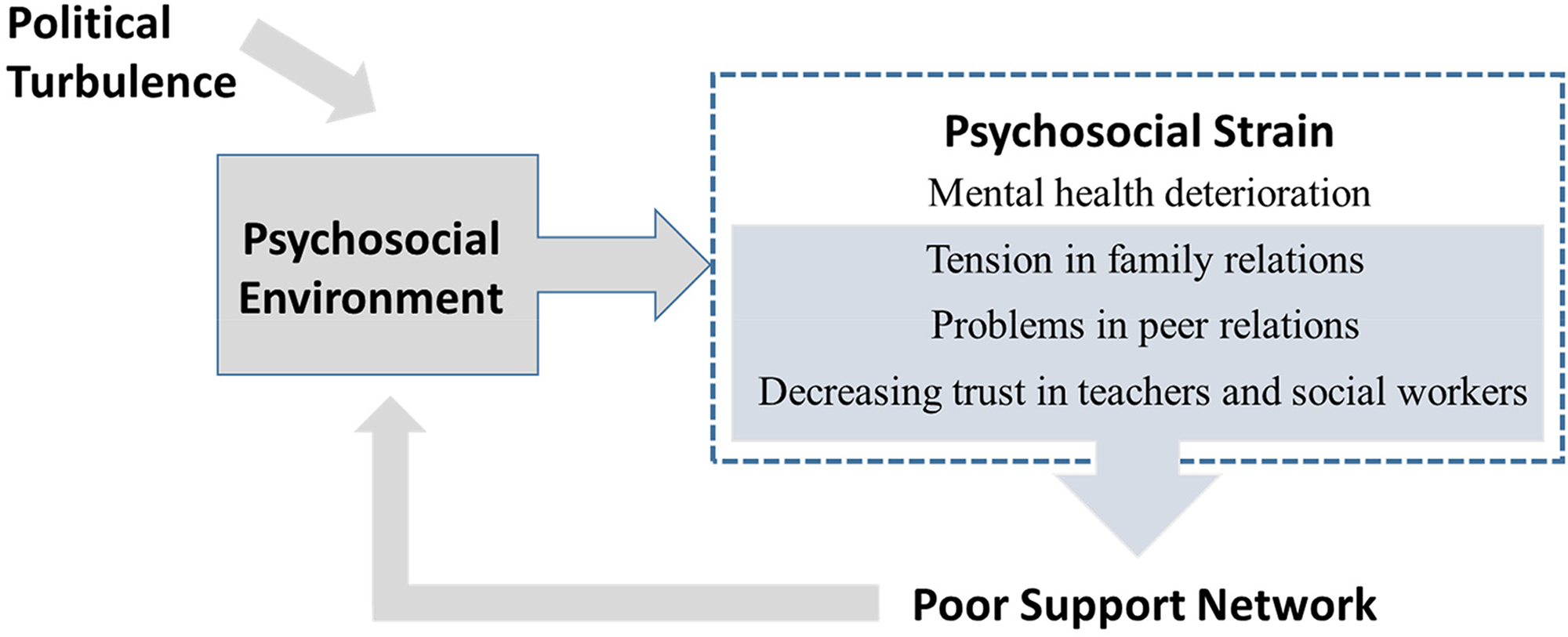
A vicious cycle of poor psychosocial status.
In the case of Hong Kong's Anti-ELAB Movement, psychosocial problems encountered by youth protesters might indeed maintain or exacerbate the crisis. The continuance of grievances made a partial contribution to the sustained pattern of protests. After the government formally withdrew the bill, the conflict between the protesters and police became a significant source of negative emotions. The handling of the protests by the police was a matter of contention, generating angry criticism from the protesters and their supporters. It is worth noting that the conflict is not only among young adults, the government, and the police, but also among generations and family members with different political stances. Political disagreements within society present an additional mental health challenge, dividing some young adults’ families and weakening their support networks. People may have deep-seated anger toward opposing factions.
In order to break the vicious cycle of poor psychosocial status, appropriate support services should be available for young protesters. It would be preferable to have a specialized team for this function. The team may need to use unconventional strategies to reach potential service users and help relieve the emotional and psychological pressures caused by political unrest. Given its sensitive nature, social workers of this kind of service should not only be experienced in dealing with emotional crises but also be politically sensitive. However, this kind of specialized service is not commonly available in Hong Kong. Social workers are less prepared to deal with politically-induced issues, and lack intervention strategies for supporting young adults who are affected by political conflicts. To prevent protest-linked suicides, some informal groups were formed to provide emotional support on an ad hoc basis to those who had suicidal tendencies or were experiencing emotional distress. However, given that these services were provided on a voluntary basis, the quality of support was not assured, and the duration of the support was short. As political stress can lead to suicidal thoughts (Smith, 2022), the assessment of suicide risk should be carefully conducted for young adults who experience this kind of stress. Risk factors including social fragmentation, social isolation, and unemployment should be thoroughly considered (Button, 2016).
As revealed by the findings, young adults who were struggling with political stress tended to be skeptical of formal organizations. They tended to not disclose their situations to those who were informed about the political climate. Indeed, it may be very difficult for social workers to enter the world of service users if they lack a thorough understanding of the users’ circumstances (Baum, 2006). To effectively reach this group of young adults, social workers should be able to identify underlying mental health difficulties and empathize with their experiences without imposing their own political ideologies (Ramon et al., 2006). Professional supervision should be provided to help social workers recognize possible political biases and avoid countertransference (Shamai & Boehm, 2001).
Teachers and social workers should play an active role in supporting the youth protesters to overcome their psychosocial difficulties. Still, they need to be aware of the tensions caused by dual responsibility to clients and to the state (Ramon et al., 2006). Given that political issues can bring forth sensitive reactions for many people, teachers, and social workers have avoided mentioning protest-related issues to prevent being accused of inciting young adults to inappropriate actions. It might be particularly germane after the national security law was implemented in the region. Although social work and education are part of the social control mechanisms of the state, it is important to stress that providing emotional support for those who participate in protests and inciting people to participate in protests are two very different things. Sufficient autonomy should be available to ease the worries of teachers and social workers and protect them from inappropriate allegations when performing professional duties.
Besides short-term remedial measures, society at large should promote a healthy psychosocial environment for young adults. NGOs and schools could help develop social reconciliation in the community (Betancourt et al., 2013). One helpful way to re-establish relationships among people with different political orientations is to promote perspective-taking, which refers to “the ability to reason about the ideological values of themselves and others” (Easterday et al., 2017, p. 41). Perspective-taking is relevant when solving the above-mentioned political conflicts because it may allow for a “greater overlap in mental representations of self and other” (Todd & Galinsky, 2014, p. 380). To achieve perspective-taking, a person is required to gain information about the opposing side (Muradova, 2020). As proposed by Muradova (2020), storytelling is a promising approach to facilitate perspective-taking. Similar interventions can be adopted by NGOs (such as youth organizations) under the Chatham House Rule to allow people from different backgrounds to share their perspectives in safe and respectful environments. Of course, these initiatives should be conducted skillfully and after careful assessment.
Last but not least, in order to effectively engage young adults and encourage them to participate in constructive and civilized conversations, trust should be urgently established. To facilitate an environment that is favorable for young adults’ psychosocial well-being, the government and government-related institutions may need to offer concrete and successful participation experiences to enhance youth's trust in institutions (Barrett & Pachi, 2019).
Limitations of the study
As with the majority of research studies, the design of the current study is subject to limitations. The study was based on the perspective of young protesters, teachers, and social workers in Hong Kong. Given that the research topic can be politically sensitive, there were difficulties in recruiting young protesters to participate in the study, especially after passing the new national security law in Hong Kong. More than 20 potential participants refused to take part in it. Therefore, this study might be less able to capture the experiences of those who had particular concerns about privacy or wanted to avoid getting into political trouble. Without a control group in this study, it is hard to conclude that the youth who participated in the protests are worse off than those who did not. Although the findings may also provide insights into understanding young protesters in other societies, the results of the present study may not directly generalize to other societies.
Conclusion
The psychosocial problems caused by or related to protests deserve the attention of researchers, practitioners, and policymakers. The present study showed how young adults experienced emotional distress during the 2019–2020 political crisis. Political disagreements within society present additional mental health challenges, dividing some young adults’ families and weakening their support networks. It is worth noting that these psychosocial problems might reinforce further participation in political activist movements, especially if such problems have not been properly addressed. To break this cycle, appropriate interventions should be offered to young protesters. Aligned with this approach, protections should be given to teachers and social workers so that they can provide psychosocial support to young protesters without fear of getting into trouble. In the long term, different parties in society should join hands to promote social reconciliation and mutual understanding within the community.
Footnotes
Ethics
Ethical approval for this project was given by the Human Subjects Ethics Sub-Committee, City University of Hong Kong (ref number H002155).
Funding
The author disclosed receipt of the following financial support for the research, authorship, and/or publication of this article. This work was supported by the Public Policy Research Funding Scheme from the Policy Innovation and Co-ordination Office of the Government of the Hong Kong Special Administrative Region (grant number SR2020.A1.03).
