



Abstract
Summary
The use of humor in social work is an underrecognized and underexplored area of practice despite its potential to heal, harm, and complicate communication. To date, very minimal scholarship has been published on humor in social work. Therefore, this qualitative study sought to examine how social workers use, perceive, and experience humor. Data were gathered from 22 participants who identified as social workers via an online survey. Data also included learning artifacts (e.g., discussion board posts, humor therapy treatment plans) from 19 graduate-level social work students who completed a humor in social work course in the northeast region of the United States. Both datasets were analyzed thematically.
Findings
Participants perceived social workers as using humor in clearly distinct ways, as a tool to promote generative growth, and as a weapon to harm already marginalized populations. In total, participant responses highlight the complexities of humor, including its subjective and dynamic nature, which can lead to multiple and sometimes conflicting experiences.
Applications
The findings suggest that social workers view humor positively, yet they engage in its use without adequate training, strategy, and reflection, sometimes violating professional ethics. Results further indicate that social workers will continue to employ humor in their professional work to the benefit and detriment of those around them. To support reflective and informed practice, additional research is needed on the use and misuse of humor in social work.
From Freud's (1905/1989) theorizing of humor as a temporary psychic release to Norman Cousins’ (1979) use of humor to alleviate pain, people have employed humor as a healing tool for over a century. When used in social work practice, humor has the potential to “transform, to emancipate, and to innovate” (Longo, 2010, p. 125), yet the social work literature on humor is sparse (Siporin, 1984; Witkin, 1999). This is significant because humor is not always helpful; it can also be used to shroud oppressive statements and reinforce societal stratification (Meier & Medjesky, 2018). Thus, within this article, we first review the existing literature on humor including its potential to heal and harm within the helping and social work professions. We then share our qualitative study exploring social work practitioners’ and students’ experiences with humor to inform future socially just practice and research.
Background
The potential of humor to help
The limited research on humor indicates its use is associated with many positive effects. For instance, humor presents an opportunity to be mindfully engaged in the moment and cognitively process multiple types of transmitted information between the joke teller and the joke receiver (Mayo, 2014; Young, 2020). As the brain processes a joke, it typically moves through two stages (a) surprise and (b) coherence. This “frame-shifting” is pivotal to cognitive processing to engage in humor (Coulson & Kutas, 2001, p. 71). This process can lead to a long-lasting shift in perspective, or in some cases, humor may create temporary or fleeting moments of happiness (Young, 2020). Humor is social and can create a common connection for individuals to bond (Aaker & Bagdonas, 2021; Christensen, 2020; Cormack et al., 2017). Humor can also serve as a resource for hope, to accept pain, and to cope with reality and having a sense of humor could be viewed as a protective factor similar to being financially stable (Julien-Chinn & Hayes Piel, 2019; Kuiper, 2012; Siporin, 1984; Witkin, 1999).
Humor in helping professions
Researchers have also investigated the use of humor in the helping professions. When individuals engage in formal humor training programs (i.e., teaching clients how to use humor as a tool) implemented by psychologists or nurses, experimental groups experienced a significant increase in resiliency and well-being and significant decreases in behavioral problems and perceived stress, depression, and anxiety compared to control groups (Crawford & Caltabiano, 2011; Sim, 2015). Family therapists have found that humor can be used as an assessment, intervention, coping skill, and alliance-building tool with youth, adults, and families (Fox, 2016) and that shared laughter in couples can indicate positive associations with relationship quality, closeness, and social support (Kurtz & Algoe, 2015). Communications, psychology, and humor studies research indicates that one's humor style (e.g., aggressive, affilitative) can determine the positive or negative impact of humor on all involved and that humor may exacerbate negative emotional states in general, in relationships, and in the workplace (Cann et al., 2014; Dionigi et al., 2021; Frisby et al., 2016; Geisler & Weber, 2010; Martin et al., 2003; McCosker & Moran, 2012). Research on humor in the helping professions generally documents that professionals use humor strategically with clients and spontaneously with colleagues to reduce negative emotions, enhance resilience, and shift perspective (Fogarty & Elliot, 2020; Gilgun & Sharma, 2012; Rowe & Regehr, 2010). Helping professionals also use humor to discuss service users in a derogatory manner which could lessen burnout but enhance the divide between service providers and users (Fogarty & Elliot, 2020).
Humor in social work
While the humor literature broadly provides some insights into its use, there is a dearth of research in social work journals on humor, including its benefits and pitfalls (Christensen, 2020; Fogarty & Elliot, 2020; Gilgun & Sharma, 2012). The limited social work research on humor indicates that social workers use humor with clients to humanize themselves, reduce threat perceptions, and ultimately form meaningful connections (Jordan, 2017). These important bonds have also been initiated by using improv (i.e., acting without prior planning) as a social work group activity, creating opportunities for clients to engage in mutual aid, active listening, risk-taking, and individual growth (Steitzer, 2011). Social workers have additionally used humor and dark humor to avoid burnout under increasingly challenging, limiting, and disempowering circumstances and to form a collective identity (Jordan, 2019; Morriss, 2015; van Wormer & Boes, 1997). Because of social work's specific focus on social systems of oppression, unlike other helping professions, there is a need to further explore the potential use and misuse of humor in social work, and the ways it can reinforce discrimination or work toward social justice.
The social justice aspects of humor
Beyond the positive impact humor can have on individuals, humor can encourage insights into hypocrisy, unearned privilege, life's absurdities, and it can shift social power and address inequities (Christensen, 2020; Cormack et al., 2017; Westwood, 2004; Willett & Willett, 2019; Witkin, 1999; Young, 2020). Marginalzied communities often use humor as a form of coping and resistance, including people with disabilities (Anesi, 2018; Milbrodt, 2018), Black individuals (Outley et al., 2021), and youth living in residential facilities (Christensen, 2020). Furthermore, it can be used as a tool of nonviolent resistance against oppression and dictatorships (Sorensen, 2008). While potentially playful in its approach, satire is an attack—asking the audience to laugh at itself, others, institutions, and systems, often with the judgment of how these entities need to do better (Young, 2020). Many comics view their work as focused on social change even if they do not view themselves as social activists and believe it is vital for audiences to laugh and think (Borum Chattoo et al., 2020). Given social work's commitment to anti-oppression and anti-racism, we need to critically appraise all communication in social work including those that involve humor to ensure we are consistently enacting our values.
The potential of humor to harm
Unfortunately, humor can also serve as a cloak for marginalization and make it more challenging to address biased remarks (Harlow et al., 2020; Mallett et al., 2016; Meier & Medjesky, 2018). The difference between reinforcing oppression and creating a space for resistance is a complex and dynamic interplay between the joke teller's and the joke receiver's power, context, tone, delivery, and positionality (Green & Linders, 2016). When humor is used to marginalize, there are effective ways to address it, for instance, replying with confusion and asking the joke teller to explain the joke (Ajayi Jones, 2021). In the helping professions, when humor is unsuccessful, used against clients, or professionals do not understand the cultural meaning of the exchange, it can reproduce power disparities and permanently sever the helping relationship (Mik-Meyer, 2007; Sørly et al., 2021).
The complexities of humor
Humor is complicated, multifaceted, and contextually situated. Therefore, to argue it is always good or bad is to oversimplify a very complex process (Gouin, 2004). Similarly, we need to hold multiple truths simultaneously in social work and acknowledge that the humorous and the serious can coexist (Witkin, 1999). Humor can potentially break the tension, cause feelings of exclusion, and shift power (Christensen, 2020). However, much of the existing research on the use of humor fails to explore the nuances, including the range of positive, negative, and mixed experiences and outcomes (Cann et al., 2014; Kuiper, 2012). Clients can vacillate between grief, laughing, and anger in a clinical session—all of which are normal and healthy experiences of the human condition yet these emotional states cannot always be anticipated (Moon et al., 2023). To use humor ethically, social workers must assess if the humor is neutral, doing harm, or doing good (Gilgun & Sharma, 2012), and they need to possess a comprehensive mastery to use humor with precision as a tool to enhance one's health and well-being (Frisby et al., 2016). Since the rules and values for humor can vary in families, cultures, and regions, the opportunities for misinterpretation are vast (Julien-Chinn & Hayes Piel, 2019; Yue et al., 2016). In other words, humor and its associated complexities are challenging to identify and tease out (Christensen, 2020).
In summary, the existing research literature on humor appears promising yet inconsistent. Humor is not singularly good or bad, and it can be used to empower or to oppress. Despite social work's commitment to social justice, the literature on the use of humor in social work is limited. It is unclear how social workers use humor among themselves and with clients. A better understanding of social workers’ perspectives of humor could inform its purposeful use and future training on humor as a practice skill. Therefore, further investigation is needed into how humor manifests in the social work profession and practice.
Research question
To explore the phenomenon of humor in social work and to expand the social work literature focused on humor, we investigated the following research question: How do social workers perceive, experience, and use humor in their practice?
Methods
We conducted a qualitative interpretive description study to investigate our research question. Interpretive description provides an organizing logic rather than prescribed steps to follow; therefore, multiple techniques can be used with clear documentation of method selections (Thorne, 2016). Interpretive description was developed specifically for scientific inquiry in applied disciplines and allows for scientific rigor and reflexivity to investigate understudied phenomena (Thorne, 2016). We used interpretive description to build a descriptive understanding of the use of humor in social work and to begin to fill the gap in the literature. This research was approved by our university institutional review board.
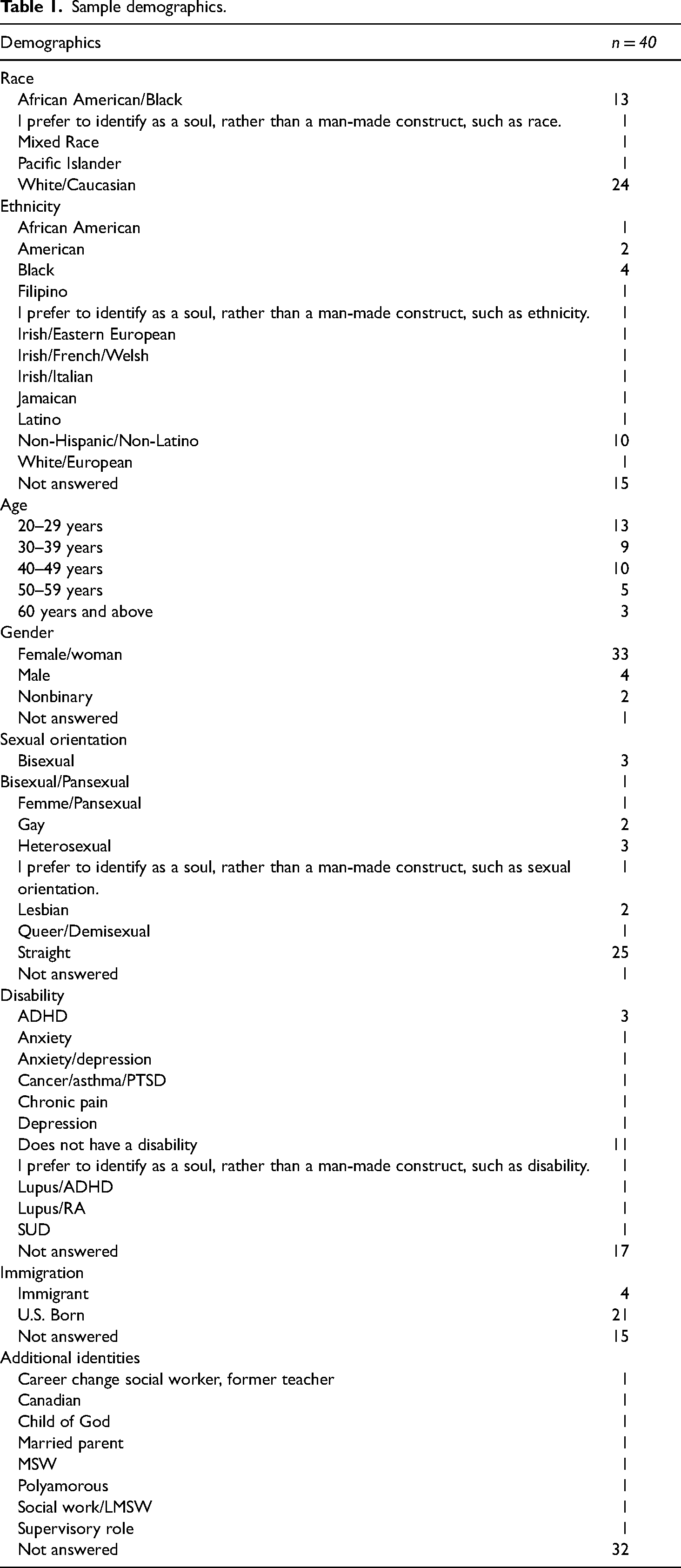
We sought participation in two forms (a) an online survey of social work practitioners and (b) student permission to use their learning artifacts from a graduate-level course on humor in social work. For the online survey, we recruited participants through social media, professional networking discussion boards, and our professional networks during the Fall of 2021. For the learning artifacts, the professor of the humor course (Mia) recruited social work graduate students after their final grades posted for the Fall 2020 and Fall 2021 semesters (Donette was a student course Fall 2021). Within the student informed consent, they granted permission to use their learning artifacts in the study. A total of 40 people participated in this research (n = 19 from the course and n = 22 from the survey; 1 participant completed both). After all participants consented to the research, an online survey prompted them to self-select a pseudonym and share demographic information via open-ended prompts (Table 1). Most participants were U.S. born, straight, White women aged 20–49 but a range of identities were endorsed across the sample. We included a prompt about military service, but no participants endorsed an active military or veteran status. There was no compensation for participating in this research.
Sample demographics.
The survey responses and course learning artifacts served as our data. We developed a survey of eight open-ended prompts, including, “Please describe something that made you laugh in social work and include relevant details so we can laugh too,” and “Please describe ways you currently use humor in social work and include specific examples.” The survey was anonymously completed one time by participants. The learning artifacts were derived from multiple assignments in a graduate-level humor course offered virtually at a university based in the northeast region of the United States. The learning artifacts included discussion board posts, humor therapy treatment plans, progress reports, and reflections. Unlike the survey data that were collected from participants at one moment in time, the learning artifacts were multiple documents submitted throughout a seven-week course. To protect participant confidentiality, Mia downloaded the learning artifacts from the learning management software, removed identifying information, and input participants’ self-selected pseudonyms. She then uploaded both the survey data and learning artifacts data to Dedoose software for team (Donette and Mia) coding.
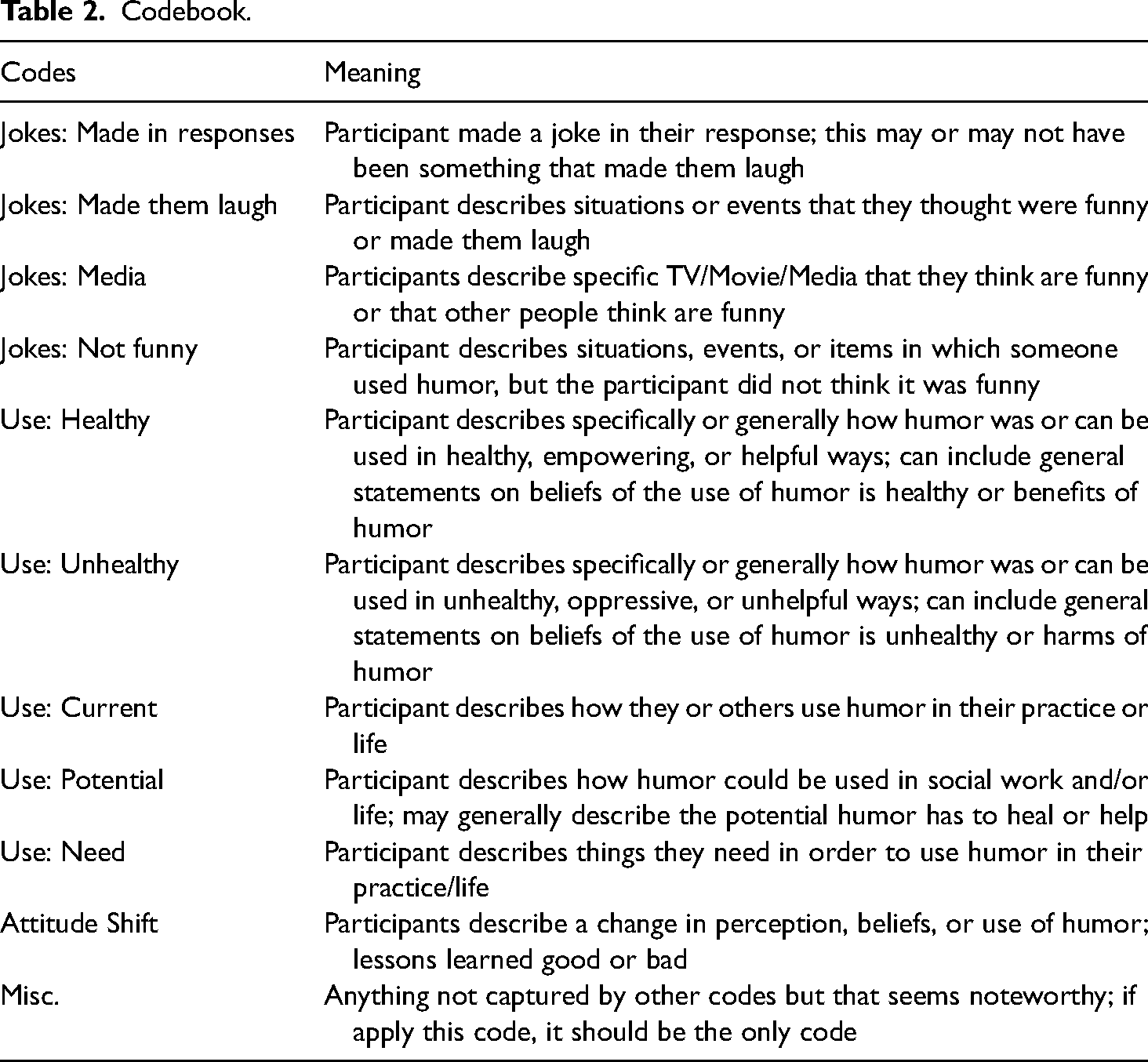
We created an initial codebook based on the research question and the existing literature. It included general codes to identify how participants engaged in or witnessed humor in social work (Use: Current), descriptions of how humor can be used in unhealthy or harmful ways (Use: Unhealthy), experiences that participants found humorous (Jokes: Made them laugh), attempts at humor that participants did not find funny (Jokes: Not funny), among others. As a team, we coded a sample of the data (two participants from the survey and two participants from the course). Next, we discussed the coding schema seeking a way to efficiently reorganize the raw data, and we revised and finalized the codebook based on the data (Table 2) (Spencer et al., 2003). We then recoded the initial data and worked in tandem, alternating as first and second coder and discussing any discrepancies until we coded all the data. Next, we worked to move data from codes to categories (Saldaña, 2013). We first categorized a set of coded data together, specifically the “Jokes: Made in Responses” code. Then we worked independently to create categories and emerging themes for the additional codes, sharing our thoughts during bi-weekly team analysis meetings. We sought to challenge the categories, emerging themes, and each other's thinking to eliminate redundancies and gaps and ultimately develop answers to our research question (Miles & Huberman, 1994). Additionally, we shared a copy of our manuscript with a few known participants to conduct member checking. Participants shared they believed our findings were reflective of their perceptions, and they highlighted areas for further clarification. We made additional edits based on their feedback and finalized our results.
Codebook.
Results
Rather than solely discrete themes, participants’ shared perceptions and experiences are most accurately conceptualized on a continuum. At the one end, humor was unequivocally perceived as a tool that helped, and at the opposing end of the spectrum, humor was unmistakably perceived as a weapon that harmed. Within this section, we will discuss these two distinctly defined themes and a third, murkier space—humor as complex.
To increase transparency, we listed participants’ pseudonyms and (course) or (survey) with their excerpts to denote where we drew their data from. Indeed, there were differences in depth and breadth of the data between the course (i.e., longitudinal and multiple learning artifacts) and survey (i.e., one-time data collection). However, there were no significant differences in perspectives or experiences across the datasets and participants. While the American Psychological Association recommends including participants’ quotes sparingly, we carefully and consciously selected a quote from every participant to include in our results. Our goal was to create a space in the social work research literature where participants could identify themselves and challenge normalized research practices that can reinforce the divide between the researcher and the researched.
Humor as a tool
Participants viewed humor as a helpful tool or resource in a variety of ways. Genevieve (course) put it directly, “Humor is an Omni-tool. It can be versatile and adapt to any given situation for many different purposes.” Mary (survey) shared an example of humor in action to illustrate its usefulness: I was observing an intern while she made her first client call. When she connected with the client, her voice started to quiver something awful, and her hands were shaking. As she finished the task, she said, “OMG, Ms. Mary, I thought I was going to die.” Oh, my goodness, we both broke out in laughter, with tears rolling down our faces. After we re-grouped, we talked about the process and yes, she did an awesome job with the client. (Mary, survey)
To build relationships
Participants shared how they use humor as a tool to build working relationships with service users and colleagues. Gary (survey) shared that he believed humor can help “to bond, create a sense of safety and approachability through this informal kind of communication….” Many participants believed that given the power differential between workers and clients, humor has the potential to humanize the social worker, who can be perceived as intimidating to clients and present an opportunity to connect with diverse colleagues. Janine (course) explained, “Humor is a way to help us engage with coworkers and clients that we might not be able to find connection with otherwise and I believe [it] also gives social workers a sense of humanity that clients may not see.” Simone (survey) expounded: Using humor in social work can break the ice. Social workers have a certain austerity about them, I think it's from the profession's long history of policing oppressed populations and responding to crises and everything being so heavy all the time. With humor, we connect with others. We find common ground. We allow for vulnerability. (Simone, survey) I use humor to poke fun at myself when building rapport with teens. If we can both laugh at how uncool I am (ex, “I definitely don’t know about [insert rapper or TikTok trend], but are we really surprised?”), it can level the power dynamic and put my clients in the expert role. (Hazel, survey)
Participants commonly viewed humor as “a relational tool to connect people across differences” (Dana Scully, survey) and “to disarm and put people at ease” (Judy, survey). Generally, participants believed humor has the potential to foster relationships by allowing people to share complex emotions, build common ground, and de-escalate conflicts.
Bridget (course) employs humor regularly to facilitate their clinical social work practice: I believe to have a strong connection with clients you need to have room for humor. I think it is important to understand your audience before inserting humor into the conversation and understand what avenue of humor to use. I mainly work with individuals and small groups, but humor has a strong presence in my social work practice. Talking about addiction and mental health can be difficult. If I were to go into a session or group with rigid rules and a serious demeanor, the entire time my clients would not feel comfortable. I try to open every session or group with light conversation, usually using sarcasm, to let them relax. (Bridget, course)
To shift perspectives
According to participants, humor has the potential to help people reframe their experiences and shift their perspectives. This included taking a broader view of an individual's presenting circumstance, holding multiple truths simultaneously, and challenging dominant narratives related to marginalized identities. These shifts in perspective can result in improved mood or outlook on life's many challenges. Jazz (course) believed, “Humor can be universal in making people pause, laugh, and regroup during tough situations.” Taking just a moment to observe a challenging circumstance from a different angle and inserting humor appeared to allow individuals to move forward in more productive ways rather than remain stuck in them. Marine (survey) explained how humor can help that shift take place, “A lens that takes on a light of humor might help move from the so serious nature that surrounds ‘serious mental illness’ to the yes, I have some challenges but I’m OK.” Similarly, Lindy (survey) believed humor was “great when it could be used as a learning experience.”
Some participants endorsed that humor helped them personally disrupt negative emotions such as anger, grief, anxiety, or sadness. Johnny D (course) described, “When I am in an abnormal frame of thinking, funny and positive thoughts always bring me back.” Simone (survey) noted that social workers also need to employ humor to maintain a healthy perspective of everything that comes with being a social worker, “I think sometimes social work presents some absurd and ridiculous situations. I think humor and laughing are physiologically important in combatting a lot of the stress that social work brings.” Being able to objectively identify the ridiculous rather than getting caught in it appeared to be an important way to shift a social worker's perspective on their work.
Participants shared that humor also creates an opportunity to shift how we view power and all the societal isms. Christine (course) shared, “Humor can be empowering in the way of rewriting the narrative around a situation.” When used judiciously, humor can be used to educate and elevate lesser-known perspectives and experiences. In doing so, respondents believed humor can be a powerful tool for liberation, providing a medium for people to tell their stories, reclaim personal power, highlight inconsistencies between policy and people's lives, and create space for counternarratives. For instance, Maggie (course) explained how she believed humor can be used across settings to challenge, unite, and empower people: It is definitely refreshing to see when humor becomes a tool to foster understanding of people's diversity rather than a device to exploit people's differences in order to oppress. It can be a powerful tool especially for people who were once the victims of those oppressive jokes in the past, like people with a disability and other marginalized groups. Humor then becomes a therapeutic device aside from being an advocacy tool. It kind of serves as a way of reclaiming those harsh jokes to a point where it can no longer be used to oppress others. (Maggie, course) Agencies need to accept their oppressive histories and make changes. However, they will never be able to make changes if they are not able to have the conversation. For myself when we are having policy meetings when people attempt to continue to use old oppressive thinking, I attempt to first use humor to joke about how archaic that thinking can seem. A lot of times people do not want to challenge power because they are afraid of how people with power could respond with anger or consequences. I find humor to be very disarming. Knowing how to blend humor and combining it with violating the norm can be a way of making change and getting people to talk about a topic. (Trent Edwards, course)
Trent described how he used humor to speak truth to power. In this situation, he described the requirement to possess certain skills and take a risk to effectively expose antiquated yet normalized policy and prompt change talk. Asha (course) similarly viewed humor as a tool to use with legislators to reframe how policy and its impact are conceptualized to enact change. She described effective and ineffective ways to approach:
Humor, when used effectively, can cause policymakers to think about inconsistencies between policy guidelines and desired outcomes. Some types of political humor can be useful in educating the public about policies. Humor that ridicule politicians does nothing more than entertain but jokes that identify and analyze systems and social justice issues will educate. (Asha, course)
To care for oneself
Participants also believed when used appropriately humor was a form of physical, emotional, and psychological self-care. Participants commonly described humor as providing a moment to breathe and destress. Tabby Crawford (survey) highlighted the power of just one high-quality moment of laughter, “A good laugh can release endorphins and change a person's entire disposition.” Many specifically named the physical benefits of humor. Doey John (survey) noted, “Humor can reduce one's blood pressure,” and Charlotte (course) described humor as “the best form of medicine.” Participants also consistently noted the emotional benefits of humor. They described it as “vital in combating burnout” (Genevieve, course), “a safety bridge” (Jazz, course), and “protection while we recover from painful and stressful situations” (Pumpkin, course). Chanel Dior's (survey) sentiment was reflective of the views of many participants, “At all times we must laugh to keep from crying—This profession is tough, so humor is good for the soul!” Ms. Diva (survey) essentially created a slogan, “laughter, it makes you forget about all the negative that's around you,” and Mrs. Apple (survey) sums up the momentary relief humor can bring to ultimately reenergize social workers: Laughter can reduce feelings of stress, worry, and anxiety, no matter how briefly. A good laugh ought to be prescribed, especially for those who work in highly stressful, demanding, and taxing jobs. This can lower the gauge on our stress/anxiety scale. While the issues still exist, our mindset and spirit are lightened, if only for a moment, giving us what we need to go back in and finish the job. (Mrs. Apple, survey) I have used humor throughout most of my life to overcome some of the most traumatic situations. Maybe not initially, but I have found adding a little observational humor to not-so-humorous situations has helped me cope and get ready for the next unfortunate event. Observational humor has pulled me out of some dark times and has decreased my mental health issues immensely. (Makenna, course)
Humor as a weapon
Respondents also perceived social workers as using humor to oppress, alienate, and demean. Participants reported they witnessed other social workers using humor to reinforce harmful stereotypes, to desensitize others to the needs of specific groups, and to hinder progress that could address serious societal issues. Participants did not share examples of when they themselves weaponized humor, only when they perceived other social workers as using humor in a harmful manner. Kate Stevens (survey) shared, “People will make jokes about something stereotypical, and it can actually further bias or contribute to harmful narratives,” and Willow (survey) noted an important distinction specific to harmful humor, “Humor that is used to make fun of people at their expense. They aren’t sharing in the joke or humor.” Participants consistently shared examples of how social workers made fun of people specifically noting disability, accent, and race. Many felt strongly this behavior should not be tolerated. Lucy (survey) shared, “I heard someone ‘joke’ about disabilities, and I was offended and defensive. And angry at the person for a very long time.” Shelia (course) shared her experience with and definition of oppressive humor: Humor becomes oppressive when one uses their power to dominate. Many people when confronted after saying something offensive, usually claim it was joke. I previously experienced oppressive humor in the workplace. I was discussing with a few colleagues how stressful all our workload was but somehow, I was singled out. I was told by one of my colleagues that the workload might’ve been too much for me and I should’ve considered the janitor position instead. Everyone laughed and after they noticed I wasn’t laughing there was an awkward silence in the room. That joke was not funny and uncomfortable for me because I was the only African American amongst my colleagues in that setting. I felt as though that joke could’ve been targeted at anybody but because he made sure he said it to me I felt as though he wanted to single me out because I was a part of the non-dominant group. My thought on oppressive humor is a humor style where people express how they really feel but use the excuse of it being a joke, so they’re not viewed or judged negatively by the way they feel. It's an excuse to say and do inappropriate things. (Shelia, course) I have (in more than one work setting) heard coworkers imitate or even mock a client's accent (ex, Haitian, or Korean) and laugh about it. This was never in the presence of said client, but still felt inappropriate, racist and disrespectful to me. (Hazel, survey)
Respondents understood the use of humor to destress but also had concerns about desensitization to clients’ needs. Jo Webb (survey) explained, “I appreciate that sometimes a person is trying to blow off steam, but I never see humor in imitation unless the person is present and aware of the jovial nature.” These are perhaps different examples of how humor can humanize social workers—demonstrating we are human and thus fallible.
A key difference between when humor was perceived as a tool and as a weapon was when, “practitioners make light of or find humor in clients’ pain or adversity, that is, laughing *at* them versus laughing *with* them” (Gary, survey). Participants believed this can reinforce the power differential and relegate the clients’ suffering to entertainment for the social worker. Additionally, Chanel Dior (survey) described this as a missed opportunity, “Talking down on others and laughing at their pain, instead of helping to uplift and inspire them to be great.” Participants also reported social workers made jokes focused on colleagues that made them uncomfortable. Doey John (survey) explained how once an inappropriate joke is made, everyone in the room bears some responsibility, “Humor initiated by making fun of someone can cause sadness and anxiety if you are the one being made fun of and the bystander who doesn’t prevent it.”
Humor as complex
Ultimately participants’ responses revealed that humor in social work is a complex phenomenon that could be interpreted or misinterpreted depending on many contextual factors. Many participants believed humor was universal but not one-dimensional. They described it as a shared experience but unique to an individual. Vivian (course) aptly and concisely described it, “…humor is a contradiction; it is both simple and complicated.” Sue (course) noted a single joke “could have multiple meanings.” Dick Magee (course) explained the duplexity of humor, “Humor can be used to empower and oppress, to make others feel included or to make them feel excluded, to make fun of one's plight or to help them through it.” As described in the previous sections, participants shared situations where humor was perceived discernibly as a helpful tool or a harmful weapon. These dichotomous good or bad categorizations are helpful for an initial orientation to the research findings. However, in social work, there is a more elusive tipping or sliding point where humor could shift unintentionally or intentionally between these extremes into a gray area.
This speaks to the sophistication of humor, yet many respondents shared how social workers are not using humor strategically with any regularity. Maggie (course) believed humor was present in the profession but a bit under the radar, “…we unconsciously use humor in our work without realizing it because we are in this mindset that social work is serious work with no place for humor.” Jenny Jones (survey) shared that humor should be used “sparingly or in moderation…to stay present and talk about difficult topics.” Perhaps because there is limited to no professional guidance on the use of humor, Lola Lou (survey) has not found humor to be a thoughtful or pleasant experience with colleagues: There has been a lot in our current and recent society related to politics. Often, I am around co-workers who laugh and joke about one leader or another and their joking and laughing make me uncomfortable. Not because I don’t necessarily agree (or even disagree), but the joking gets to be too much. Also, it makes me feel uncomfortable because there are so many assumptions that everyone feels the same as the person(s) making the jokes…there is an underlying assumption that everyone in the room is on the same page…or should be. (Lola Lou, survey)
Within humor is complex, we developed three subthemes: social workers interpreting a joke, social workers assessing clients’ use of humor, and social workers’ interest to learn more about how to effectively use humor in social work. Each of these are briefly detailed with supporting quotes.
Interpreting a joke
Humor is a dynamic interaction with an opportunity for (mis)interpretation. As with any joke, there can be a difference between the joke teller's and the joke receiver's perception. Using humor in social work is no exception. Participants described the importance of understanding how a joke might be understood and considering who should take responsibility for the interpretations. Jenny Jones, (survey) noted the importance of “knowing your audience, so to speak.” Sue (course) believed the responsibility to thoughtfully engage in humor rests with the social worker, focusing on impact rather than intent: One has to consider how humor is used as a tool and how it may not translate well cross-culture. There could be implications as it relates to diversity. Humor could do more harm than good, even though a therapist may have good intentions. (Sue, course) When people joke at another person's expense (or their own). Putting oneself or others down isn’t helpful/funny. However, at the same time, I cannot be solely responsible for how someone interprets my joke; it is dynamic. Discerning whether a joke is genuine, healthy, & uplifting vs. unhealthy or oppressive depends upon one's intention for sharing the joke. And no one is aware of this except the person making the joke. So, clear communication (asking questions) is warranted. Also, if someone's feelings become hurt, then that person needs to look within their own psyche to discern why this hurts their feelings. For instance, I’ve been teased/called names before, and it didn’t faze me. However, someone joked about my appearance, and I was triggered. This distinction illustrates the importance of taking ownership of one's feelings rather than avoiding one's shadow self and blaming others. (Albus Dumbledore, survey)
Assessing the use of humor
Further complicating humor in social work is our second sub-theme that social workers assess clients’ use of humor. Participants discussed entering social work with different experiences and beliefs about humor and that social workers are not typically offered additional educational opportunities on how to effectively assess the use of humor as helpful or harmful. Jennifer (course) described the hesitancy some social workers may feel about assessing clients’ use of humor and the need to explore the nuance: Some clinicians argue humor is used to avoid dealing with real issues which I agree to an extent, but I also believe that using humor and laughing during difficult situations can help someone get through whatever they may be going through. (Jennifer, course) On one occasion, “John”, aged 5 at the time, told a story about how he woke up “Sam”, aged 6 at the time, up from a nap. This was something he found funny, as did Sam, but it was something that I could not laugh at with them. (Tyler Kate, survey)
Tyler Kate described how the clients wanted to engage in humor related to their experience, but she felt humor was not appropriate given the situation. Tyler Kate further described what John did and said:
“Sam was sleeping and I wanted to play, so I woke him up by putting a cigarette out on his [body part].” As he walked closer to Sam, who was pretending to be asleep on the living room couch, he pretended to grab a cigarette from the table with one hand, and a lighter with his other hand. “I went like this, see?” John began to use his hand with his make-believe lighter to light his pretend cigarette, flicking his thumb and making “pfft, pfft, pfft” noises with his mouth as if the lighter was failing to light on the first attempt. As he did this, Sam could be seen smirking before covering his mouth and trying to muffle his giggling with his shirtsleeve… “Then, I took the cigarette and did this!” He quickly pressed his index finger to John's [body part], where a pink, circular scar remained. John began to laugh along with Sam, both boys giggling and pushing each other playfully. “Yeah! He did do that, and I still have the spot on my [body part]! See?” (Tyler Kate, survey)
This is one example of how clients initiate humor in social work practice, and social workers must be prepared to directly address it in the moment. Tyler Kate continued:
John walked over to show me the scar, and as he did, he realized I wasn’t laughing. “What?” he asked. I had to tell the boys that I loved to hear their stories, and I love it when they share their thoughts with me, but I was worried that John had hurt his [body part] and that Sam used fire without an adult at home. We talked about safety, and we shared our thoughts about how to be kind to each other, and later they told me more stories that I was able to laugh along with. (Tyler Kate, survey)
Likely most social workers would argue that reinforcing humor based on burning a sibling with cigarettes is not acceptable. However, addressing this behavior without removing an immediate survival skill or shaming the children and productively engaging in a dialogue about harm is a complex set of actions that needed to happen spontaneously in the moment for Tyler Kate.
Social workers are required to determine when humor is being used as a coping or avoidance mechanism or perhaps as both within the same interaction. Maggie (course) shared how a client's use of humor could be viewed as a detriment or a form of resilience depending on one's perspective: I had an experience before where a client and I were making fun of the inadequacies of the public welfare system regarding whether they qualify for assistance or not. It was a way to find a break from the stress, but also a way to challenge our views towards a flawed system. That little cathartic moment reminded me that changes needed to be made and I cannot always be compliant with the broken system we have. I have to advocate for change. While the example I have above can be an example of a client avoiding their problems by making fun of them, I also want to argue that it was also their way of facing the problem. My client knew that throwing a fit because of the flawed system was not going to solve their problems but laughing about it helped them move onto alternative ways to address their problem. It is definitely hard to think when you are stressed. However, laughter can be a way to alleviate stress in order to calm down, be able to think clearly, and address the problem. (Maggie, course)
Asha (course) appeared more comfortable than most participants to use humor as an assessment tool and believed humor could be used to better understand a client's insights and ability to move into problem-solving, “Finding humor in situations shows that there may have been some in-depth examination. This examination may also allow us to understand issues better, making it easier to find practical solutions.”
Interest in learning more
The final sub-theme is that participants expressed an interest in learning more about how to effectively use humor in social work. Many participants noted the importance of thoughtfully and strategically using humor or omitting its use in social work practice, and they expressed their desire for education on how and when to use humor. Genevieve (survey) explained this could be an area for growth: Honestly, I don’t think this [humor] is something that social work does very well. I have been a social worker for many, many years… Maybe social work as a field [needs] to accept humor—it doesn’t really have much of a sense of humor and takes itself really seriously. (Genevieve, survey) I want to learn more about when the jokes and humor is not funny and it's intended purpose is a complete failure, how to recover from that, for example if the nervous laugh doesn’t work, I wouldn’t want to offend my clients or family members due to a botched joke. (Pumpkin, course)
Marie (course) explained the necessity of effectively engaging in humor with a foreboding warning, “If not used appropriately, it [humor] can ruin the relationship with the client and possibly the career of the social worker.”
Discussion
Our research findings help fill the literature gap on the use of humor in social work. Like prior research, participants endorsed the positive physical, psychological, emotional, and social aspects of humor (Cormack et al., 2017; Julien-Chinn & Hayes Piel, 2019; Sim, 2015). They also described how humor could encourage positive reframing and provide a momentary break from the present bleakness one might face (Coulson & Kutas, 2001; Young, 2020). Further, participants believed social workers could use humor as one of many resources and resiliency tools. Many shared how it helped them connect with clients, enhance clients’ and their own mental well-being, and curb symptoms of burnout. Additionally, participants like Mrs. Apple found humor provided a sense of control in situations where social workers and clients had very little or none. However, none of the participants were delusional that humor would cure any and everything. Instead, they found it could offer a reprieve and an opportunity to change directions.
Beyond humor's positive attributes, participants shared their perceptions of its complexities which complements and expounds upon the existing research (Christensen, 2020; Gouin, 2004). Participants viewed humor as complicated, universal yet individualized, and impossible to get right every time with everyone. They believed the dynamic nature of humor and the interplay of power and positionality often shaped the interpretation of humor which also aligns with existing research (Green & Linders, 2016). Therefore, moving from the general understanding of humor into social work practice, participants believed social workers must take care of the who, what, where, culture, values, and power variables when they engage in and assess humor. Our research indicates that social workers understand humor and its dynamics to a degree, but not everyone who uses humor in their practice does so intentionally or thoughtfully.
Our research also contributes novel findings to the social work humor research literature. Participants perceived social workers as weaponizing humor and contributing to the oppression of already marginalized populations. Participants shared examples in which they witnessed social workers use humor to engage in racism, ableism, accent bias, and other discriminatory practices. Unlike the humor as complex theme where misinterpretation could occur and social workers may have been well-intentioned, humor as a weapon included examples of tropes (e.g., Shelia's colleague who told her, as the only African American in the room, she should consider being a janitor instead of a social worker) that regardless of intent are dangerous. Social workers are expected to possess a basic understanding of how societies denigrate specific populations. Using humor to make marginalization more palatable normalizes the behavior, and consequently the unconscious belief remains unquestioned or worse reinforced. Consistent reflective practice is salient to social work, and there is a need to thoughtfully identify the ways in which social workers can harm others including through the use of humor. In other words, social workers should be advocating against these unethical uses of humor, not engaging in them (Gilgun & Sharma, 2012). This research finding is an unfortunate but fundamental reality to face as a profession.
Our results have important practical implications for social workers. All participants in the study described situations in which humor was used in social work. Therefore, it appears it is a question of when not if humor will come up in interactions with colleagues and clients in social work. Social workers need to understand and respect many boundaries with clients and colleagues, including the line between laughing at and with others and between being professional and being human. Additionally, given social work educators’ and practitioners’ prioritization of anti-oppressive practice generally and anti-racism specifically, it is important that we facilitate discussions in supervision and the classroom on the role of power in humor and communication. To do that effectively, additional research is needed to develop professional guidance on the effective use of humor, and participants expressed an interest in additional training on the use of humor and its incorporation into a formal treatment model. Future research could also tease out the nuanced differences in the use of humor at various levels of practice as well as from clients’ perspectives. Relegating humor to an afterthought rather than an intentional tool appears to be a missed opportunity for our profession and those we purport to serve.
Limitations
Our findings should be interpreted with consideration of our methodological limitations. A lack of diversity may be a limitation in this study. For instance, our sample was comprised of mostly women and primarily of Black and White people which limits the perspectives and experiences gathered. Additionally, soliciting participation partially via a course on humor in social work at a singular institution likely influenced the number and type of participants recruited. Lastly, in some cases, we had to decipher and interpret participants’ responses since the answers were asynchronous and there was no opportunity for follow-up questions or to clarify. Interviews in future research could explore the use of humor in more detail. Despite these limitations, our research adds to the existing gap in the literature on the use of humor in social work.
Conclusion
Social workers are certainly not stand-up comics, yet whether we acknowledge it or not, social workers are using humor in helpful, harmful, and murky ways. Indeed, when our findings are understood in totality, they are simultaneously promising and deeply concerning. Our research found that social workers, coworkers, and clients initiate humor and that social workers are interested in but have little to no formal training on its use, interpretation, and evaluation in social work settings. Regardless, social workers endorse the many positive benefits of humor they have experienced professionally and personally. They shared that they engage spontaneously in the use of humor to the benefit and detriment of others. Moving forward, social workers must remain cognizant of how humor can be weaponized to exert power over others in direct opposition to our professional commitment to social justice and the ways it can empower, shift narratives, and enhance relationships all of which are salient to success in our discipline.
We cannot continue to overlook the phenomenon of humor in the social work profession. We need to thoughtfully engage in its appraisal, study effective ways to administer it as a tool, provide informed training on its implementation, and halt its misuse in social work.
Footnotes
Ethical approval
Ethical approval for this project was given by West Chester University Institutional Review Board (Protocol #20210304B and #FY2021-193).
Funding
The authors received no financial support for the research, authorship, and/or publication of this article.
Declaration of conflicting interest
The authors declare that there is no conflict of interest.
Acknowledgements
First, we want to thank the participants who generously trusted us with their perceptions and experiences. We also want to acknowledge and express our gratitude to Melissa Hirschi, Kasey Wilson, and Damian Hawkins for their support, encouragement, and feedback throughout our study and to write this article.
