



Abstract

The World Development Report 2012: Gender Equality and Development presented an excellent detailed analysis of Gender in Employment (Chapter 5). It did not limit itself to looking at women’s labour force participation but went on to analyse how gender differences affected productivity and earnings. ‘All over the world, women are concentrated in low-productivity, low-pay jobs. They work on small farms and run small firms, they are over-represented among unpaid workers and in the informal sector, and they rarely rise to positions of power’ (WDR 2012: 239). I would like to focus on how the gender differences in the rural context affect women’s productivity and earning capacity.
In fact, recent data collected by the UN Interagency Task Force on Rural Women indicate that in most countries, with a few exceptions, rural women are farthest from meeting the UN Millennium Development Goals (MDGs). In the progress made towards MDG targets, rural women lag behind when compared with their male counterparts and with men and women living in urban areas. Some progress has been made in specific sectors and countries: for example, in Bangladesh, Kenya and Uganda, the rural attendance rates are similar to the urban (UNESCO, 2007: 18) but rural women remain in the least favourable situation and face unique challenges – challenges and contexts that men in rural areas and women in urban areas are less likely to encounter.
How are rural women faring? What are the constraints particularly challenging for rural women? I propose to take a look at obstacles rural women are faced with in comparison with men in the rural context and urban women and men, clarifying and highlighting linkages between some of the elements presented in the WDR.
Though most would endorse women’s rights, there is still a profound tacit inclination to leave things as they are. ‘Gender segregation in employment that is persistent (over time) and consistent (across countries) points toward structural causes rooted in economic and institutional systems, both formal and informal – with much commonality across countries at different levels of development and in different social settings’ (WDR 2012: 215).
Some may benefit from maintaining the existing power relation between women and men while others may treat the current power relation as an issue to avoid. Women’s status is still low in many countries and rural women find themselves struggling not only for the daily subsistence of their families, but also grappling with customary and formal institutions to gain recognition for their rights as spelled out in the Convention for the Elimination of All Forms of Discrimination Against Women (CEDAW). Traditions and customary law are followed more closely in remote areas, where remedial help may not be accessible. ‘For poor women in poor places, sizable gender gaps remain. And these disparities are even larger when poverty combines with other forms of exclusion, such as remoteness, ethnicity and disability’ (WDR 2012: xxi).
Girls in rural areas are also more at risk of missing school or dropping out than boys. The 2010 MDGs show that rural children are twice as likely to be out of school as children living in urban areas and that the rural–urban gap is slightly wider for girls than for boys (United Nations, 2010: 18). Poverty is an important cause for children to enter paid employment or become unpaid family workers. Some 60% of child labourers (5–17 years old) work in agriculture compared to 7% in industry, 26% in services and 7% in other sectors (ILO, 2010: 10). Boys in rural areas are mainly involved in agriculture, while girls are more involved in household activities and as family workers.
Rural women are more inclined to go through different types of employment and move in and out of the formal and informal economy. Rural employment is multidimensional and often leads to precarious, temporary work related to seasonal agricultural activities. Women tend to be more present in rural employment (which includes non-agriculture activities). Various factors, such as HIV/AIDS, migration, food/fuel crises, which are affecting various countries in many different ways contribute to the increase in women’s participation (FAO, IFAD, ILO, 2010: 30). In fact, men’s participation in agriculture has declined over the recent years, while agricultural work is still a main source of livelihood for rural women. Women in agriculture, working on family land, often work on land they do not own or have control over and lack the necessary collateral to access credit. Various overlapping legal, customary and religious systems are unfavourable to women on family and inheritance laws. In Kenya, for example, only 5% of registered land titles are held in women’s names (UNWomen, 2011: 40). Time women spend working in family business may not be accounted for in the National Accounts as women themselves do not identify it as work and undervalue the time spent. Though we lack recent data, trends seem to indicate that in most countries, women’s share of rural employment is higher than men’s, as shown in Figure 1 (except for Mauritius, Egypt, Morocco and Botswana). One contributing factor is rural–urban migration of men. ‘Migration can alleviate pressures on local labour markets, land, and natural resources, but it may also create labour shortages in rural communities, pushing women and children to replace absent young men, thus lowering household productivity and exacerbating risks of child labour’ (ILO, 2011b: 1). Women have less opportunity to migrate and have less mobility because of family responsibilities and social constraints only women face (travelling alone and violence against women). Even though women’s share of rural employment is higher than men’s their productivity is lower, the WDR identifies various contributing factors, including less access to resources (particularly land and credit) (WDR 2012: 202).
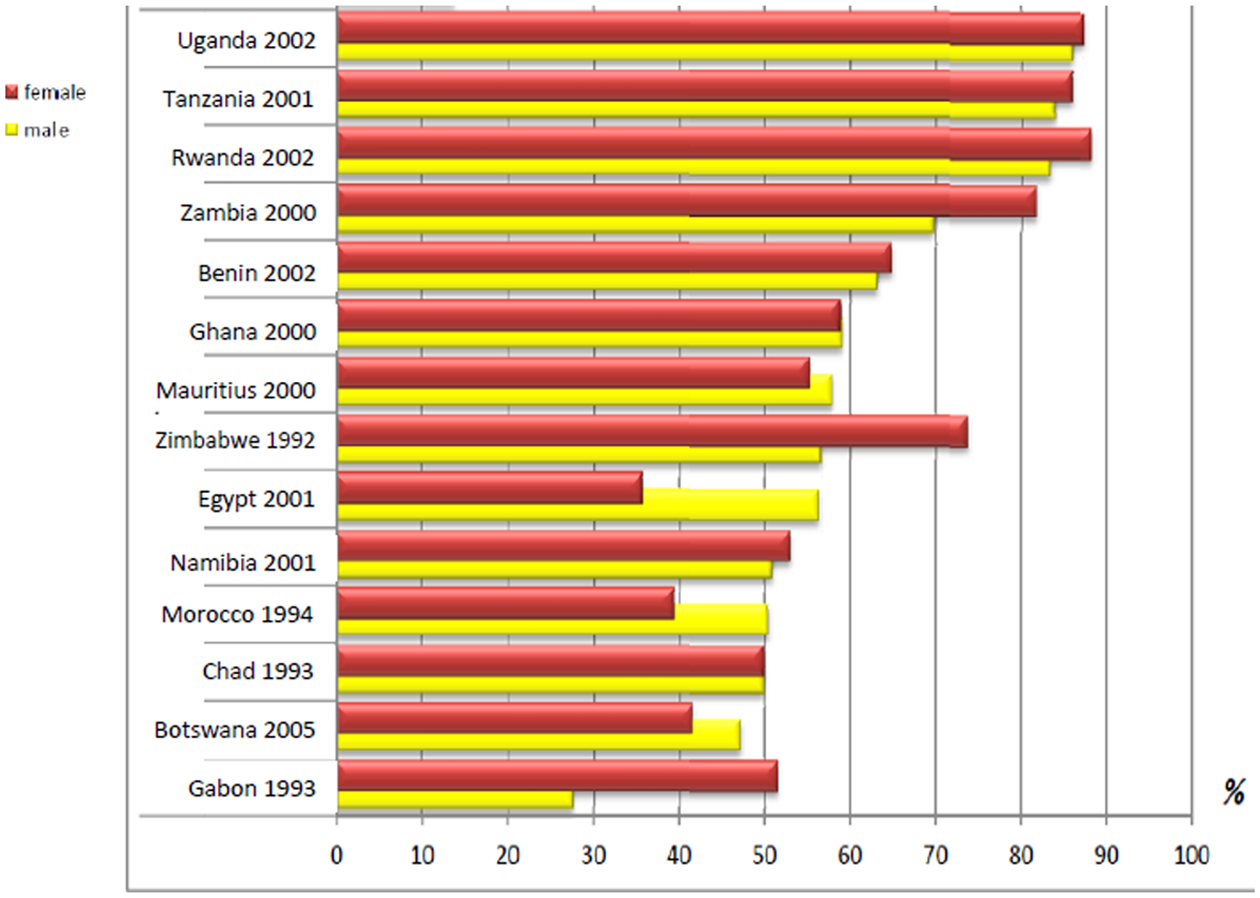
Share of rural employment in total employment, by gender.
Consequently, women find themselves overburdened in peak agricultural seasons while still carrying on household and care work. In India, rural women spend 33.95 hours in care and household work (SNA [System of National Accounts] beyond production) compared to 3.74 hours for rural men, as shown in Figure 2. When all production activities are combined rural women end up working 56.48 hours (compared to rural men: 46.05 and urban men and women: 45.60 [ILO, 2011a: 4]). Time-use survey and related methodologies are gaining acknowledgement from development partners and decision-makers as an important tool for policy-making and greater impact. ‘There is a strong case for expanding the statistical paradigm (i.e. the way the national economic system looks at the socio-economic life of people) to include unpaid non-SNA work into national databases for integrating this work into macro policy making’ (ITC-ILO, 2011: 24).
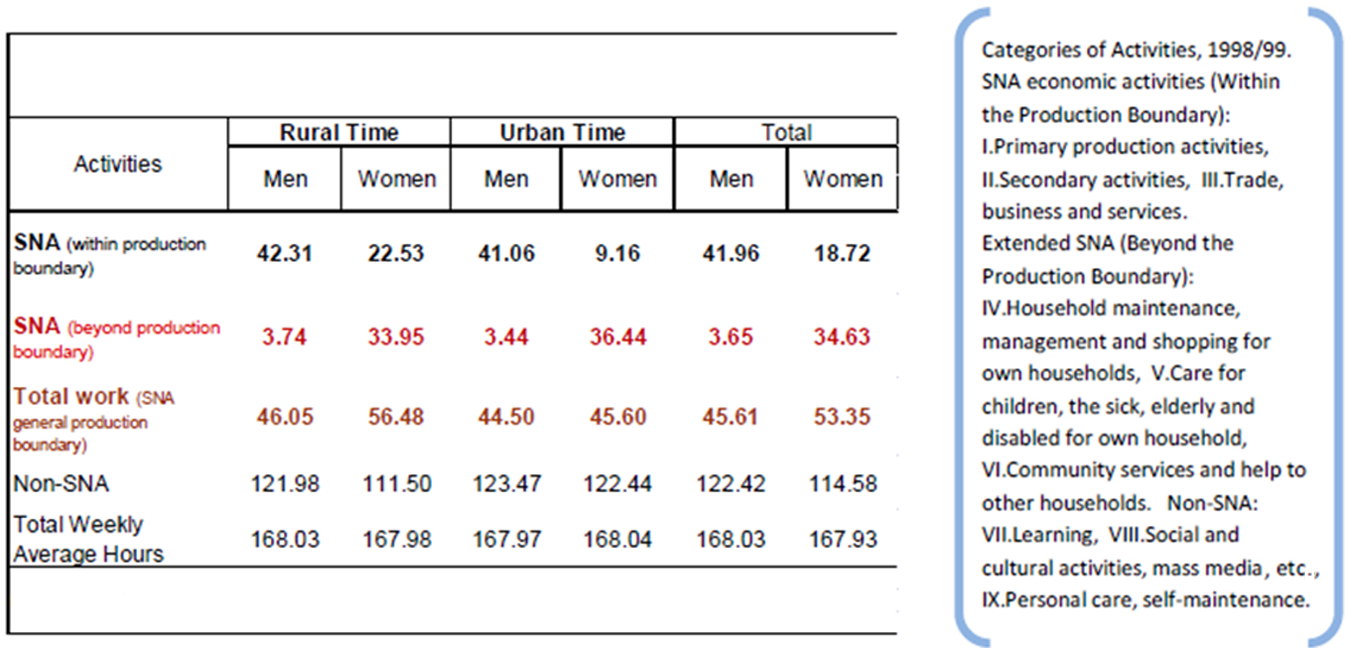
India time-use survey data for six states.
Nevertheless, the role of rural women and their contribution to their community livelihood is still not fully understood or recognized by national and international stakeholders and decision-makers. Not only do we lack data, but the nature of the data available does not show the full picture. On that front as well things are improving.
Time-poor rural women have little time for getting involved in local decision-making structures. That women are perceived as vulnerable, dependent and needing protection, plays an important role in determining how women can become part of the decision-making process. Labelling women as a ‘vulnerable’ group can be counter-productive as it conjures up images of helplessness. It is the context that brings the vulnerability, in particular the rural context with a chronic structural, social and political situation unfavourable to women. In fact, rural women have demonstrated how resourceful and savvy they are in facing the food crisis, migration of men to cities, globalization, epidemics and pandemics, to name a few of the most recent challenges.
To reach the MDGs for rural women, a multidimensional approach is needed as the WDR suggests. Key elements of such an approach include equal access to means of production and reform of formal (policies) and informal work (networks) for rural women. In addition, we need to move away from the label of ‘vulnerable’ and the ‘needs’ approach towards a human-rights based approach which goes ‘beyond the notion of physical needs and include[s] a more holistic perspective of human beings in terms of their civil, political, social, economic, and cultural roles’ (Kirkemann Boesen and Martin, 2007: 10). Recourse to the human-rights based approach, using MDG targets as well as tools such as the time-use survey, can help change perceptions and behaviours towards women’s role (and men’s role in the family), and achieve a wider acceptance of women’s position in the public sphere and men’s role in the private sphere.
Footnotes
Biographical note
Johanne Lortie is Senior Programme Officer at the Gender and Non Discrimination Programme of the International Training Centre, International Labour Organization ( ). She designs and runs training programmes and capacity building programmes for the ILO, social partners and for the UN agencies on gender mainstreaming, ILO participatory gender audits and organizational change. She is a member of the UN Inter-Agency Task Force on Rural Women. Johanne is also an expert on knowledge sharing facilitation techniques and open space methodology.