



Abstract
Nation states, networks and international organisations provide huge amounts of quantified information on all fields of international politics. This is done in an effort to regulate them. Besides the increase of numbers, recently, pictures emerge as visual practices of regulations. Parts of the political effort of the International Labour Organization (ILO) to abolish forced labour build a valuable example. The ILO publishes both estimates on forced labour and Global Reports. In addition, illustrated narrations on how a person is trapped in forced labour are provided at its website. Hence, the decent work discourse on regulating forced labour as a Core Labour Standard (CLS) no longer exclusively draws on texts, but increasingly includes image representations. Thus, the article asks how quantitative knowledge on forced labour is produced and visualised as a mode of regulative governance. In order to understand the content of the ILO’s discursive regulative governance, its strategic alignment and to infer on its possible strengths or weaknesses, discursive and pictographic practices are made accessible.
Keywords
Introduction
Since the 1980s, the worldwide enforcement of calculative forms of governance is prevalent (Rottenburg and Merry, 2015: 3). Today, every major field in international politics has ‘been pulled into this politics of numbers’ (Broome and Quirk, 2015b: 814). The International Labour Organization (ILO) as a global monitoring regime provides huge amounts of institutional, quantitative informed material on those issues it is mandated to regulate. The ILO’s strategic shift via the Declaration on Fundamental Principles and Rights at Work (the Declaration) and the Decent Work Agenda (DWA) led to an ever increasing quantification effort. This resulted in additional monitoring and surveying of the four Core Labour Standards (CLS; Weisband, 2000: 647). The norm against forced labour is codified in international law by Conventions C29 and C105. However, as one of the CLS, it is also part of market-based, discursive forms of governance by the ILO. They include estimates under the DWA (ILO, 2012, 2014a), and Global Reports as follow-ups of the Declaration (ILO, 2001, 2005, 2009). Moreover, ‘InfoStories’ (ILO, 2016b) as interactive online documents narrate fictitious individual life stories, that is, how a person is trapped in forced labour (ILO, 2016a). Despite this increased effort to eradicate forced labour, including educational strategies and awareness raising through pictures, more than 20 million people are affected. The prevalence of the problem is specifically high in the field of economic labour exploitation with 16 million affected people (ILO et al., 2017). This discrepancy is in need of an explanation.
Hence, the article analyses the ILO’s capacity to foster progress on the elimination of forced labour by increasing its outreach via an illustrated discourse. It is argued that this capacity depends on the conceptual and causal ideas on which the ILO’s strategy is based and thus, how forced labour is depicted. The research question, therefore, is as follows:
In order to answer this question, the article reconstructs the ILO’s governance strategies of (a) producing quantitative knowledge about forced labour and (b) rendering the phenomenon visible. It maps out, if there are systemic misrecognitions and if so, how these are visually translated. From these argumentative and visual constellations, the article infers on the possible strengths or limits of the ILO’s governance approach.
In order to analyse the production of knowledge in terms of numbers and visibilities, a theoretical framework is developed in section ‘Regulation via discourse: the production of knowledge’. Based on these assumptions, section ‘Methods’ shortly introduces Critical Discourse Analysis (CDA) and picture analysis. In the subsequent sections, CDA will be applied to the following documents: the Conventions (C29 and C105), legal clarifications by the Committee of Experts on the Application of Conventions and Recommendations (CEACR), the Global Reports (ILO, 2001, 2005, 2009) and three estimates (ILO, 2012, 2014a, ILO et al., 2017). 1 Consequently, not only legal communicative events but also educational–political communicative events are analysed. Section ‘Description: the social field of global labour governance’ depicts the discursive practice of the ILO’s regulative approach, while section ‘Analysis: making forced labour visible’ applies the method of picture analysis to the ‘InfoStories’, making the practice of image visualisation accessible. Since pictures are powerful sources of citizens’ knowledge about the world and are widely used in political strategies, it is significant to understand their creation and effects on the societal problem they are created to eliminate. The article concludes with implications for the discursive regulatory approach of the ILO in terms of its strengths and weaknesses.
Regulation via discourse: the production of knowledge
In accordance with the developments addressed above, social sciences engaged with calculative practices and knowledge technologies in the fields of governance and law in the 1980s. This process accelerated with the beginning of the 21st century (Rottenburg and Merry, 2015: 21). While sociology and the cultural studies mainly considered how a societal order in terms of hegemonies or ideologies is reproduced by discourses or images (Brighenti, 2010; Jeacle and Miller, 2016; Miller, 2001; Miller and Rose, 1994; Rottenburg et al., 2015; Starr and Alonso, 1987). The article studies discourse, and numbers therein, as a form of regulation. Numbers have been enhanced by and vice versa have enforced ‘non-state market-driven governance systems’ (Cashore, 2002). The production of knowledge to promote defined goals constitutes an intentional exercise of power (Göhler et al., 2010). Consequently, I assume the ILO’s increased discursive efforts since the late 1990s to constitute a political strategy to regulate labour in the global arena. I accordingly expect these efforts to influence political outcomes either by identifying the problem (via quantification) or, if applicable, by defining solutions (legal enforcement).
Numbers
The production of quantitative knowledge renders social phenomena visible that are otherwise not observable for individuals due to spatial separation and time lag. Quantification allows the translation of complex phenomena into simplified numerical representations that make modern forms of governance possible. It plays out as a threefold process which as a meta-discourse organises corpuses of knowledge. It comprises of (a) creating equivalences across different cases, (b) developing categories and (c) coding individual phenomena into categories (Rottenburg and Merry, 2015: 12–13).
As a result, numbers provide an effective ‘meta-code’ (Rottenburg and Merry, 2015: 11) that is applicable across cultural, political and social boundaries. Hence, knowledge becomes comparable. Moreover, ‘realities’ are constituted by numbers as ‘novel epistemic objects of regulation’ (Rottenburg and Merry, 2015: 5; see also Luke, 2000: 307; May, 2015: 769; Rose, 2008: 197). Domains such as ‘the poor’ or ‘the economy’ are displayed as internal homogeneous fields with prescribed external borders. Even though, a great variance of cases is subsumed. However, these techniques allow to identify commonalities, and thereby influential factors, for example, on poverty, which might have explanatory power.
It is through this radical reduction of issue complexity (Broome and Quirk, 2015a: 821) that numerical representation influences ‘how people think about things and how information moves around the world’ (Nelson Espeland and Sauder, 2012: 91). Numbers assign ‘fixed and unproblematic meanings’ (Broome and Quirk, 2015b: 814) to highly contested and contextual concepts such as freedom or autonomy (Broome and Quirk, 2015a: 821). Imposed as unbiased facts, they are powerful instruments of control (Fioramonti, 2014).
Still, ‘what to measure, how to measure it and how to present and interpret the results’ (Starr and Alonso, 1987: 3) are outcomes of political decisions. That is why, it is important to consider the following set of problems when it comes to quantification strategies: (a) numeric representations can be ontologised as social facts via the meta-discourse of quantification. Numbers then play out as the actual representation of the world (Fairclough, 1995). Furthermore, this meta-discourse can imply or lead to a (b) marketisation of complex, social and normative relations. Quantification strategies are legitimised as providing the most economical solution to societal problems and facilitate ‘politics of ethics’ (Rose, 2008: 199, 232). This includes the application of efficiency standards to normative questions. This logic of ‘demand-and-supply mechanisms’ operates within all social spheres, even in those to which it does not or should not apply (Rottenburg and Merry, 2015: 3). Finally, quantification can imply (c) authoritative and flawed attributions of responsibilities (Broome and Quirk, 2015a: 831; see also Hobson, 2004).
Visibility
Similarly, visualisations can be understood as results of multilevel institutionalised orders of discourses (Fairclough, 1995, 2004; Fairclough and Wodak, 2009). Pictures are expressions of explicit and implicit orientations, they are shaped by and vice versa shape discourses (Dörner, 2012: 294). The visual compounds fulfil designated social and cultural functions classifiable as artistic–individual, scientific–epistemic and public–explanatory (Faßler, 2002: 159). Visibility is strategic; it is intentionally operated to achieve concrete social goals, such as recognition or control (Brighenti, 2010: 45–50, 52). Thus, within visibility, the intentions of its very own existence are dispositioned. It is created to depict or to communicate something, to make it detectable in a specific way, to determine what there is to be known (May, 2015: 759). The notion of visibility regime ‘account[s] for these systematic and routinary [sic!] (i.e. invisible) set-up of visibilities … as well as their contingent compositions’ (Brighenti, 2010: 39). These arrangements determine what is allowed to be seen, what needs attention or what is not safe to see. Simultaneously, the regime settles many normative questions implicitly (Foucault, 2010: 37–39).
The technical (re)production of visibility allows to coordinate masses of people, even though ‘physically absent from one another’ (Giddens, 1997: 17). Social relations are disembedded from the local context and are transnationally recombined (e.g. the individual as consumer). Hence, pictures not only operate through the reduction of complexity but also operate through visual cognisance (Faßler, 2002: 25). The effect that specific visual compounds (images) and impressions are coupled in accordance with perceptions of reality to render abstract social phenomena thinkable. Accordingly, societal reality can be assumed to be visually represented and constituted (Mitchell, 2007: 41). As parts of atheoretical knowledge (‘atheoretisches Wissen’; Mannheim, 1980: 157ff., 272), pictures structure habitual behaviour, because the world is understood through a picture. However, the understanding about the picture draws on communicative–generalizable knowledge (Mannheim, 1980) via the medium of language. The latter refers to actors that interpret in a generally understandable way (common sense) the (communicative) actions of others (Dörner, 2011: 168).
It is not assumed that modern forms of labour regulation within the international political economy can be considered a strategically operated arcana imperii (Brighenti, 2010: 45–50; Canetti, 1973: 17, 20; Horn, 2012: 103). Nonetheless, routinely constructed problem definitions outline which aspects of forced labour are rendered visible and which aspects keep unenlightened.
Methods
Within the following section, a methodical framework is developed that draws on CDA as put forward by Fairclough (1995, 2004). CDA considers the texts or images (the communicative event), the order of discourses (discursive practice) and the social field. It uses textual analysis, namely, systemic functional linguistics (SFL), as a method for social scientific research. The article further applies documentary picture analysis. Picture analysis within the social sciences is mainly oriented along the methods of science of art and art history, namely, approaches developed by Erwin Panofsky and Max Imdahl. These differentiate between pre-iconographic, iconographic, iconological aspects (Panofsky, 1978: 36–67) and an iconic level of meaning (Imdahl, 1994: 300). This multisided methodical design provides the possibility to include a variety of regulative discursive practices and to outline topographically the place and role of illustrations within these discourses.
The analysis will be organised in line with Pauwels’ (2008: 158) scheme of a ‘conceptual framework for assessing representations for scientific purposes’ which identifies three interrelated groups of variables (A–C). (A) is the referent object, the very issue that shall be visualised. It partly prescribes (B) the social and technological production process. Furthermore, detailed aspects of the visualisation’s (C) functions, audiences and uses are to be considered. (C) engages with the intentional nature of visibility.
The referent object (A) is forced labour. Forced labour is a social phenomenon. Individual cases are directly observable. However, the global event is non-visual and is based on aggregated data gathered through empirical observations of single cases. The perceived global phenomenon is, therefore, build upon conceptualisations about the world and the social relations in it. These conceptions are to be found in communicative events that manifest either as texts or as visual compounds.
SFL focusses on revealing biases such as processes of responsibilisations or nominalisations in seemingly transparent events of language use, for example, the legal language on forced labour. It does so by identifying actor, process, goal and circumstances of texts (O’Halloran, 2011: 448–450). A pre-iconographic examination describes what is visible in the picture: lines and colours, figures and their relation to each other. This includes considering those people or objects that are pictured, those people that create the picture or have these pictures created and the topography of the pictures (Dörner, 2011: 169). SFL and pre-iconography are descriptive operations and help to identify constituent parts of the social and technological production process (B) of a non-visual transcription. This process is determined by discursive practices: institutionalised ways of putting language and pictures into use, including normative choices, aspects of common sense and power, which determine the translation of concepts and numbers into images.
Therefore, first, iconographic interpretation drawing on ‘visual cognisance’ is applied to interpret the actual and expressive figures as anecdotes or allegories. Second, pictures are iconologically interpreted as forms of expressions of historically presupposed mind-sets. Third, the meaning that is created by formal compositions of visual compounds is analysed as the iconic level of meaning (planimetry, perspective, scenic choreography).
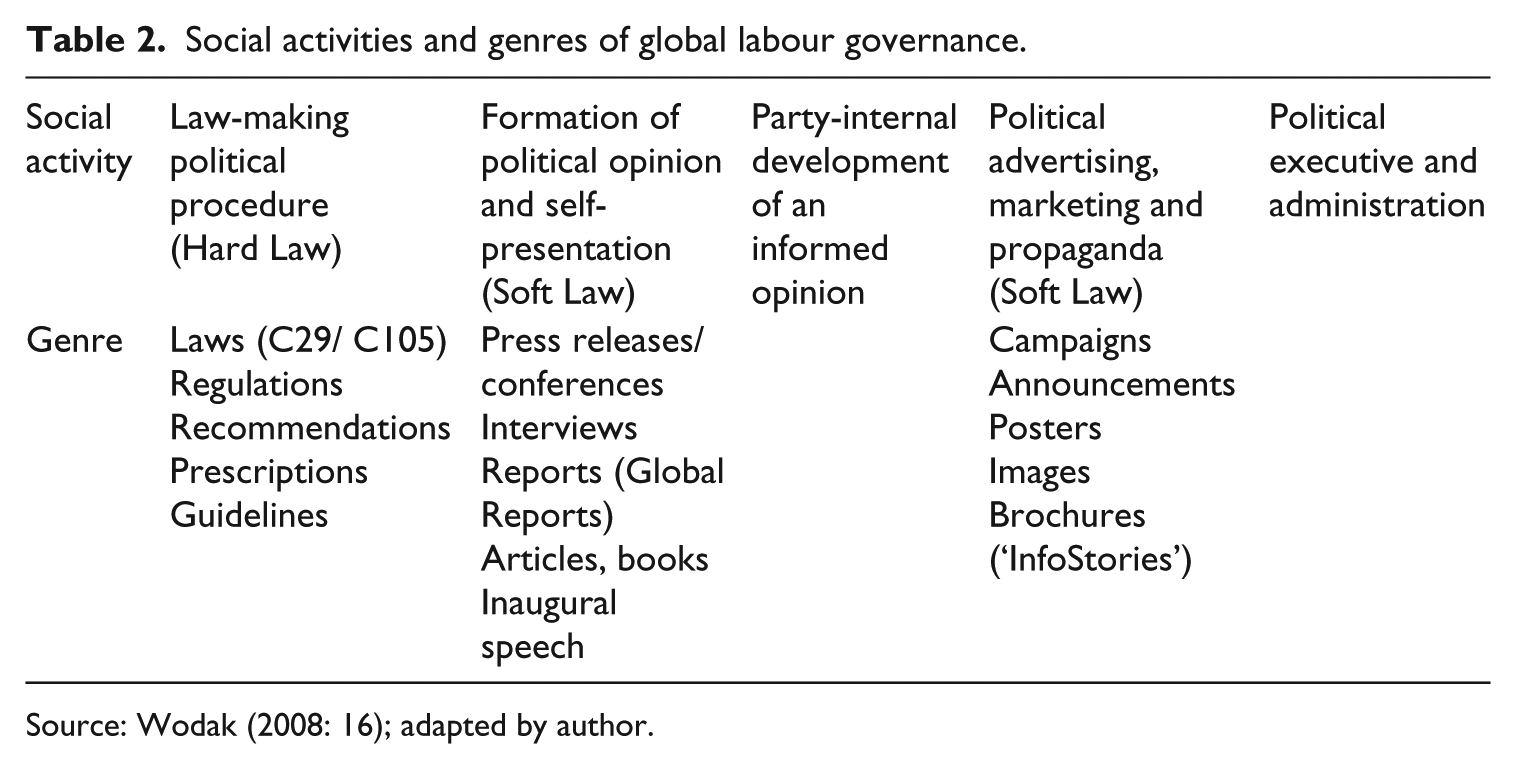
A visual’s designated functions, supposed audiences and uses (C) are prescribed by the social field. The social field delineates the broader sociocultural and political context in which the discursive practice of forced labour regulation unfolds (Banta, 2013: 393). That is why it prescribes the specific social activity the text has to perform (Young, 2011: 631). Social activities are summarised in Table 2 below. For a text being recognisable as a specific social activity, it answers to a certain culturally and politically defined genre (Wodak, 2008: 17). Genres prescribe the ‘socially ratified way of using language in connection with a particular type of social activity’ (Fairclough, 1995: 14). Parliamentary resolutions as a genre, for example, are stated in declarative mode, constitutions, however, draw on legal language.
The text and picture analyses are used to map out possible discursive manifestations of (a) ontologisation, (b) marketisation and (c) responsibilisation within the discursive regulation of forced labour via numbers and its visualisations. Consequently, the article draws upon process-produced data that are generated within the social field of global labour governance (exemplified below in section ‘Description: the social field of global labour governance’). The material is analysed in applying the theoretical assumptions on numbers and visibility outlined above. This allows the article to deduce on the ILO’s strategies’ strengths and weaknesses.
Description: the social field of global labour governance
The following section aims at illustrating the social field that advocates the different texts and images that build the ILO’s strategy to render forced labour visible. The ILO’s monitoring regime draws on practices of social learning via ‘benchmarking’, ‘responsiveness’ and ‘shaming’ (Weisband, 2000: 644). It obliges signatory states to promote prescribed normative or legally mandated practices via Conventions and to participate in the respective procedures. Despite these binding instruments that are subject to ratification, non-binding instruments such as Recommendations and Declarations are at the ILO’s disposal (Maupin, 2003; Stübig, 2015: 68). The ILO has further engaged in the development of guidelines that take the form of CLS.
The crafting and supervision of labour legislation and the examination of the Global Reports is the task of the annual International Labour Conference (ILC). 2 The creation of problem definitions, Conventions and standards within the ILC is a highly political process in which strategic interests, ideas about appropriate behaviour and moral claims are put forward. 3 The consensus reached prescribes how the Office can measure, describe and visualise forced labour, especially in contexts of the Global Reports.
The major development, in terms of global labour regulation of forced labour, is the creation of the four CLS, including Freedom of Association, Abolition of Forced and Child Labour and the Prohibition of Discrimination (ILO, 1998; Senghaas-Knobloch, 2010: 9; Standing, 2008; Vosko, 2002). The ILO has not replaced legislation with new forms of governance, on the contrary, the CLS are still informed by the respective Conventions codified in international law (Block et al., 2001). However, the standards certainly differ in terms of actors addressed, which are firms, civil society actors and the broader public (e.g. as consumers) and in terms of voluntary observance (Hassel, 2008: 233; Pearson and Seyfang, 2001). The Office drafts Global Reports on a yearly basis to cover the CLS and presents these to the ILC for examination. In 2001, 2005 and 2009, the reports addressed forced labour. It furthermore, authorises so-called ‘InfoStories’ as interactive surfaces. One story narrates deceptive recruitment practices into forced labour. The increase in image representations created an illustrated discourse (Dörner, 2011: 171, 2012: 293). Forced labour has been re-identified as object of regulation within the DWA. Thus, the ILO emphasises that ‘[d]ata collection and analysis lie at the heart of sustainable action to combat forced labour’ (Special Action Programme to Combat Forced Labour [SAP-FL], 2012: 7).
Accordingly, the ILO quantitatively increased its engagement in terms of estimates, reports and institutional developments via the establishment of the SAP-FL and the Branch Fundamentals and qualitatively in terms of constantly revising the estimates and methodology in close consultation with academics and practitioners. Considering the prevalence of the phenomenon despite the amplified efforts of the ILO, this soft power approach might suffer not only from its non-binding voluntary character but also from unidimensional definitions applied to render forced labour visible. These conceptions have been and still are contested, for example, during the ILC negotiations of C105 (Ollus, 2015) or by critical approaches to global political economy, business, law and criminology. These approaches take structural conditions (e.g. migration regimes) that create specific individual vulnerabilities into account (Allain et al., 2013; Davies, 2018; Ollus, 2016). The social field is characterised not only by the historical development of the definitions, their contemporary contestation and new forms of global labour governance but also by its entanglement in a variety of inter-institutional relations. Decent work is part of a broad inter-institutional discourse and of differing argumentative constellations (Di Ruggiero et al., 2015: 121; Frey and McNaughton, 2016b; Hauf, 2015; on the co-production of knowledge and policies, see St Clair, 2006).
Analysis: making forced labour visible
Forced labour as the referent object (A) has certain attributes that influence the process of visualisation (B) as explained above. The meta-discourse of quantification and a picture’s designated functions also determine its creation. Hence, the following sub-sections examine conceptions of forced labour, the influence of the meta-discourse of quantification and reconstruct the designated functions of the respective pictures.
Definition and concepts of forced labour – a textual analysis (SFL)
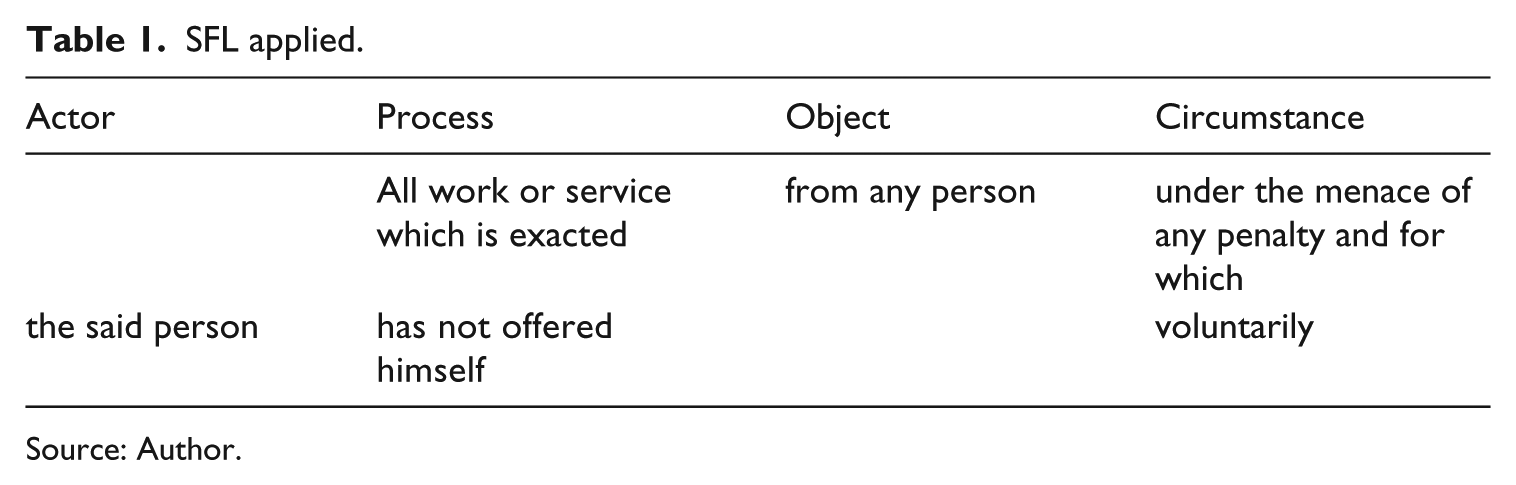
The conception of forced labour that constitutes the basis of the ILO’s quantification strategies is still the legal definition as formulated in C29. The CEACR’s (2007) General Survey on forced labour and the Forced Labour Protocol 4 (ILO, 2014b) affirm this definition. C29 says that ‘the term forced or compulsory labour shall mean all work or service which is exacted from any person under the menace of any penalty and for which the said person has not offered himself voluntarily’ (ILO, 1930a: Art. 2.1). The display in the scheme of SFL shows that forced labour is understood as an interpersonal relation (Table 1). The passive voice of ‘is exacted’ does not allow an interference with who exacts forced labour. Furthermore, the circumstances are only referred to as penalty.
SFL applied.
Source: Author.
The CEACR (2007: 19–21) affirms this definition by emphasising the three elements of forced labour: work or service, menace of any penalty and voluntary offer. However, it clarifies that penalties can include the loss of rights and privileges.
The ILO (2012) points out that the use of coercion only refers to direct either legal, political or economic coercive means. ‘This means that, for example, working for low wages is not considered forced labour unless it results from coercion applied by the employer or recruiter’ (CEACR, 2007: 21; ILO, 2014a: 4–5). The interpersonal conception of forced labour neglects economic pressures or missing de facto exit options. 5 Coercion does not include ‘situation[s] of people being forced into dangerous or difficult work by economic circumstances or other impersonal forces’ (Craig et al., 2007: 13).
Agency and, therewith, responsibility comes into play when the definition turns to the person being affected by forced labour. The passive voice of the definition does justice to the fact that forced labour can be exacted by various actors and further for different reasons. 6 Textual analysis shows that the conceptualisations and ideas through which forced labour is transcribed are flawed towards individualisation. This implies a tendency of attributing individual responsibility to those affected.
Even though structural conditions of forced labour, such as the unfair distribution of social resources that is reinforced by economic policies, are mentioned within the broader discussions of the Global Reports, these are not considered as a complementary part of a definition of forced labour. These are rather addressed either as individual vulnerabilities or as a broader ‘legislative and practical framework’ (CEACR, 2007: 20) without clarifying what is meant by these.
In fact, from a legal perspective, it has been argued that it is the legal sanction for the non-performance of labour which distinguishes forced or compulsory labour from voluntary labour (ILO, 1930b: 136–137). Thus, if there is no legal sanction for the non-performance of the labour, it is either voluntary or it is exacted illegally under circumstances which would probably constitute an offence and would be punishable in any case. The ILO considers these direct coercive means (e.g. wage withholding) as constitutive for forced labour and, thereby, constitutes the direct coercive interpersonal relation as a sufficient condition of forced labour. This builds on a neo-classical understanding of labour as an a priori factor of production with given characteristics and of a ‘freely concluded labor contract as judicially constitutive of the relations between capital and labor’ (Mezzadra and Neilson, 2013: 100). Brass (1997) even attests neo-classical approaches an epistemological neglect of unfreedom. At least, it can be highlighted that this neo-classical understanding obstructs the view on the complexity of the phenomenon in terms of its structural embeddedness and explanations.
Transcription of non-visual phenomena
The transcription of a non-visual phenomenon such as forced labour as a specific social relation leads to constructions of correlations that have no pre-existence in the physical world. Consequently, visual ‘representations are not so much “depictions” of phenomena in the real world as conceptual translations of aspects of it’ (Pauwels, 2008: 150). As the knowledge of forced labour depends on data gathered in empirical observations, specific technical and structural constraints need further considerations. In 2002, the ILO started to develop statistical indicators for the measurement of decent work and forced labour as one form of work that should be abolished (Anker et al., 2002; ILO, 2008; ILO and EU, 2012). Correspondingly, forced labour is referred to as the antithesis of decent work and is measured under the DWA. In 2002, it has been recommended to exclude forced labour from core indicators to measure decent work (ILO, 2012: 112) because it is extremely difficult to detect. It is ‘hidden …, illegal and immoral’ (Anker et al., 2002: 20). In surveys, it will be systematically underreported. Furthermore, ethical considerations are to be taken into account concerning data gathering techniques. While some people might be fearful and experience surveys as a second victimisation process, others might perceive surveys as instruments to regain agency.
Nonetheless, the ILO generally identifies two methods to collect quantitative data on forced labour: (a) interviewing individuals (identified victims or perpetrators) or (b) extrapolation from statistical data collected via surveys. Yet, much lesser work has been done on the second method, for the same reasons mentioned above (this changed with the current estimate; ILO et al., 2017). The major constraints are secrecy, criminality, people affected might be unwilling or unable to acknowledge their situation and workers might be hidden populations that require specific sampling techniques to be discovered (SAP-FL, 2012: 7–8). Even though the ILO (2014a) signalises that it wants to discuss ‘how [the definition of forced labour] may affect estimates of its extent and the profits generated through exploitation and loss of freedom’ (p. 3), it does not so coherently.
The discursive and pictographic practice of knowledge production
The cultural and social production of visibility in the form of numbers and their illustrations can be analysed as a specific discursive practice, determining what there is to be known or seen. The discursive practice manifests via a meta-discourse of quantification and via designated strategical functions of the communicative event.
Quantification as meta-discourse
The ILO compares rates of forced labour across countries, it, therefore, has to (a) establish equivalence between many different forms of working relations (Rottenburg and Merry, 2015: 12). However, ‘[e]very economy has a combination of different labour forms, and … they are not always distinct’ (Taylor, 2014: 133–134). This includes productive, ‘unproductive’ and reproductive labour, (in)formal labour in realms of both national as well as international capital. Accordingly, the commodification process cannot be reduced to contracted wage labour 7 (Van der Linden, 2008: 23). Nonetheless, many different forms of living labour are seen as manifestations of the same thing either free or unfree labour (Steinfeld and Engermann, 1997: 108).
This already refers to processes of categorisation (b). Working relations are either free or unfree as mutually exclusive categories. Rottenburg and Merry (2015: 13) refer to Theodore Porter (1995) to emphasise that even though it is necessary to question, whether these categories are an order of nature or whether these are mental constructions, it is reasonable to pursuit ‘objectivity in science and public life’. Thus, conceptualisations that consider broader or different layers of unfreedoms still need to identify a threshold value that differentiates free from unfree labour as well as acceptable from unacceptable work. Both differentiations are not without problems (O’Connell, 2015). It is not clear, which attributes constitute unfree labour, if all attributes need to be fulfilled, and if not so, which attributes need to be fulfilled, and ultimately, to what extent, these attributes need to be fulfilled. Moreover, formulations such as ‘acceptable’ might obstruct the view on the need to morally strictly condemn an incidence of abusive work or forced labour. This is further reflexive for the fact that creating categories is characterised by interpretative work, shaped by ‘pre-existing categories, theoretical concerns and practical purposes’ (Rottenburg and Merry, 2015: 14).
The coding of individual phenomena (c) downplays certain aspects of a case and highlights others. Only those dimensions of a phenomenon that are encoded become ‘real’ (Rottenburg and Merry, 2015: 15). This can be mistaken as natural properties of specific types of labour (Steinfeld and Engermann, 1997: 108). Hence, forced labour ‘becomes’ an individual, interpersonal relationship decoupled from the socioeconomic context, unfreedom or macroeconomic coercion. It is created as a criminal aberration from an otherwise correctly operating economy.
Social activities and strategic visibility
The process produced texts and images of the Conventions, the Global Reports, the estimates of forced labour, and the ‘InfoStories’ fulfil different social activities and overall purposes. These texts and images can be ascribed to the aforementioned types of social activities and according genres as shown in Table 2 below. The first row categorises the social activity pursued by the communicative events, while the second row differentiates the according genres. Furthermore, it indicates that specific social activities are entwined with either traditional or rather new forms of global labour governance. The latter oscillate between political self-representation and marketing. In terms of intertextuality, the Global Reports on one hand draw on the legal and interpersonal definition of forced labour as defined in C29 and provide, on the other hand, estimates and numbers for visualisation strategies within the ‘InfoStories’. The findings of the Global Reports and estimates of forced labour are intentionally reprocessed as political advertising and marketing strategies.
8
These aim at raising public support and awareness. In the ‘InfoStories’ self-disclosure, it says [t]he InfoStories platform offers beautiful interactive narratives built around research findings from the International Labour Organization (ILO). Each InfoStory offers a unique perspective on a labour-related theme, told through a narrative enriched with interactive data visualisations, videos, maps and case studies. (ILO, 2016b: n.p.)
Social activities and genres of global labour governance.
Source: Wodak (2008: 16); adapted by author.
Since it draws heavily on quantitative knowledge depicted in charts and figures as well as integrated video tutorials of experts, its communicative intent is both scientific–epistemic and public–explanatory. Visibility further functions as recognition in acknowledging that people are affected by forced labour. However, specific contextual dimensions of the phenomenon remain invisible. Hence, visibility further controls, especially in the sense of arcana imperii, by leaving aspects of forced labour invisible that lie beyond ‘an individual relationship of domination’ (LeBaron and Ayers, 2013: 874). This obstructs the view on the complex structural contexts in which forced labour can thrive.
Understanding through and about the picture?
The plot is about a person who enters a working relation on the grounds of deceptive recruitment. The story goes ‘when a person migrates to look for work, their chances of finding decent work are very low. How do those searching for legitimate employment become entrapped in forced labour?’ (ILO, 2016a: n.p.). In iconotopic terms, the ‘InfoStories’ are embedded in different ILO webpages dealing with CLS. The reader navigates (by scrolling down) through an interactive html format that resembles a kind of timeline that can be followed in a column on the right side. The storyline refers to the following coercive means applied: deceptive recruitment, retention of passports, debt bondage and wage withholding.
The narration of these materials has severe implications on our understanding of forced labour and the respective regulative steps that are to be taken. In the end of the ‘InfoStory’ it is legal enforcement that is narrated as the answer to the problem of abusive labour exploitation. This neatly fits the legal understanding of forced labour put forward by the ILO. Those aspects that are not ascribed to forced labour, those that remain invisible, are either not perceived as requiring regulation or not wanted to become domains of regulation.
The fourth and fifth pictures in the narration refer to the recruitment process. 9 The fourth picture (Figure 1) includes a description of recruitment agencies that operate illegally or semi-legally. As there seldom is additional information accessible for migrants, it is ‘easy for [recruitment agencies] to lie about the nature of jobs and conditions of work’ (ILO, 2016a).

The recruitment process.
The next picture (Figure 2) is titled as ‘Impunity and profits’ and also provides additional information on the vast profits corporations can make by resorting to forced labourer.
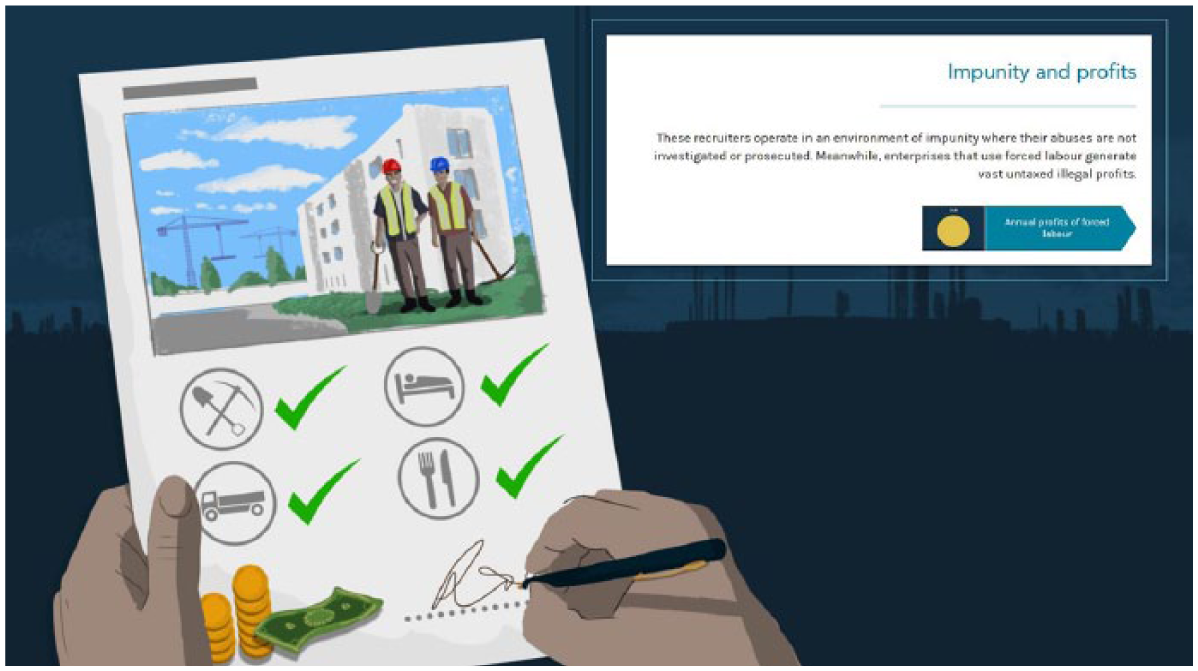
Impunity and profits.
Iconographically speaking, this resembles a situation of negotiating the nature of the job and the working conditions. It shows that two individuals agree upon the terms and conditions under which the migrant sells his labour force (Figure 1). These are described in images on the contract that the migrating person signs in the next picture (Figure 2). He thereby agrees to work on a construction site (emblems of dumper truck, tools) in exchange of a wage, accommodation and food (money displayed below, bed, knife and fork).
Panimetrically, the pictures are not very dynamic (i.e. there is no downwards or upwards dynamic), yet, certain colours coin the visual depiction. The space or time, in which these actions take place, is unrecognisable. The first picture adumbrates that it shows some kind of shady office, an impression which is enforced by the variations in dark grey used to show the interior. The people are dressed casual Western, whereby the worker’s outfit (brown trousers, off-white shirt and brown shoes) seems to be inspired by political pictures of the working class in work of art. We could name here Giuseppe Pellizza da Volpedo’s Il Quarto Stato which first referred to workers as possessing agency or Walter Dötsch’s Brigade Nicolai Mamai in which the industry worker is exemplified in its Marxist–Leninist conceptions (ideologically coined in the GDR).
The scenic choreography in the first picture focuses on the two protagonists, agreeing upon the conditions under which labour force is sold. The surroundings blur and are diffuse. It shows a friendly and respectful cooperation in a shady, non-visual surrounding. The second picture contradicts the dark and shady backgrounds from before and draws a bright future on the contract (light colours used to describe the construction site). The perspective of the first picture enforces the impression of two equal negotiating partners that willingly agree on a working contract. The same is true for the second picture. The dark shadows of a construction site build dark foreshadows of the future contrasting those promises made in the contract. This sharply contradicts with the subsequent pictures. Therein, the person affected by forced labour is no longer wearing his shirt, but instead is only apparelled by an undershirt. This might be translated as no longer being a worker in the sense of neo-classic as well as Marxist conceptions.
Hence, forced labour is displayed as the result of individual criminal behaviour. It further indicates that the living standards of those dependent on their labour power shall be solely reliant on the conditions under which they sell or sold their only commodity (see contract). Furthermore, the vulnerability of the migrating person to forced labour is rather depicted as an inherent quality of the person than as embedded in restrictive migratory regimes or labour market conditions. The latter probably creating the need to leave his country of origin in the first place. It is especially apparent that these pictures gain authority by referring to scientific data. This constructs the illustrations as visual representations of real phenomena.
Implications
The ILO successfully applies quantification and visualisation schemes to render forced labour visible and to raise awareness. The latter is realised by providing educational material in the form of narrated picture stories that appeal to reader’s emotions of justice and empathy. Based on a recent study (Pühringer et al., 2017: 552–553) about unidimensional study material, we can assume that causal constellations transmitted via pictures influence people’s perceptions. Thus, visuals are not only derived from definitions but, furthermore, contribute to people’s acceptance of certain explanations of the world. These new forms of governance are able to raise public attention and might empower people affected by forced labour through recognition. Furthermore, consumers and firms seem to be viable norm addressees. Since, the object of Conventions C29 and C105 is not exclusively state behaviour but the behaviour of non-state actors carrying out economic activities. Hence, the broadening of the regulative strategy in the form of an addition seems convincing. Possible limits of this discursive approach, namely, (a) ontologisation tendencies, (b) marketisation and (c) flawed attributions of responsibility might impede the strategy’s effectiveness.
The findings of the article translate into two, interconnected mis-recognitions: the ontologisation and the responsibilisation of forced labour relations. 10
One problematic conception is the ontologisation of forced labour. Since, there are no naturally given characteristics of certain types of labour (Steinfeld and Engermann, 1997: 109), defining attributes are ascribed to the phenomenon. The ILO’s material suggests that work was not subject to macro-economic coercion. Politico–legal and physical coercion in an individual relationship is exclusively acknowledged. Consequently, de jure free labour is constructed as de facto free labour (Steinfeld and Engermann, 1997: 108–109). Forced labour is reduced to an individual relationship between employer and employee. Forced labour’s structural dimension of economic uncertainty, dependency and unfreedom (LeBaron and Ayers, 2013: 875) remains invisible. Despite the increased acknowledgement of the phenomenon’s structural embeddedness, individual characteristics of people affected and perpetrators (e.g. moral shortcomings, greed) are portrayed as sufficient explanations of forced labour. Tendencies of marketisation have not been detected in these specific documents. Yet, in other contexts, for example, the Worst Forms of Child Labour Convention, the ILO is using efficiency arguments to initiate progress (Ulbert, 2005).
Within the ILO, there is some room of manoeuvre to emphasise structural vulnerabilities within the illustrated story – especially in the realm of non-binding instruments. However, it is bound by the consensus reached within the ILC on how forced labour has to be defined, eventually. The according individualistic approach is shared by organisations such as the International Monetary Fund (IMF), yet is not the only perspective on labour, the ILO promotes. This becomes apparent in the negotiations of Sustainable Development Goal 8 in the 2030 Agenda during which the ILO advocated decent work as a stand-alone goal. 11
In conclusion, the article maps out systemic misrecognitions in the production of global quantitative knowledge and its visual translation. These partly problematic conceptions counteract the strategies’ potential to foster progress on the abolishment of forced labour by insufficiently describing the problem. This diminishes the extent to which discursive forms of governance can alleviate forced labour and partly explains the phenomenon’s prevalence. What effects the ILO material has on peoples’ perceptions could be subject of a follow-up study that presents the according material to students in civic education settings. Future studies of effectiveness could draw on the labour concepts carved out by this article. In sum, the article not only provides important insights into how problem definitions decrease regulatory impact but also generates the possibility of follow-up studies on the outcome of these governance strategies.
Footnotes
Funding
The author(s) received no financial support for the research, authorship, and/or publication of this article.