



Abstract
The Talking Dads Project brought together young fathers, an NGO and university researchers to explore the experiences of young fathers in a UK seaside city. Young fathers took a lead role in developing the content of, and conducting, interviews with peer participants. Drawing on an analytical framework derived from participatory research literature, this article provides an analysis of five critical processes that created intense debate and became sites for negotiation of the delicate balance of powers between participants. These included young fathers’ initial engagement, the translation of their research ideas into research tools, research ethics such as confidentiality and duty of care, the academic researchers’ role in making adjustments to facilitate comprehensive, in-depth data collection, and the differential impact of the research on the lives of all involved. The learning emerging from this evaluation of the research process contributes to the understanding of the challenges of participatory research and the value of flexibility in responding to challenges and constraints.
Introduction
This article explores the processes and power dynamics within a participatory research project designed to investigate the experiences of young fathers in a seaside town in the UK. The focus is on what may be learnt about participatory research approaches in practice from a critical reflection on the design and methods employed during the project. This introduction will explain the project itself, providing a context for the methodological discussion that follows. In the main body of the article, working from a perspective that foregrounds power dynamics between researchers and participants as co-researchers, we will identify a series of critical processes in the research, during which conflicts of interests and perspectives required a renegotiation of the delicate balance of powers between those involved. In developing the analysis, we have used a conceptual framework drawn from the participatory research literature to evaluate our experience.
The rationale for research into young fatherhood
Fathers, fathering and fatherhoods are increasingly visible within political and academic domains, with recognition that a ‘turning point’ has been reached in both societal and personal expectations (EOC, 2006; Henwood, 2005; Sheldon, 2007). Fathers’ visibility in policy documentation in the UK is high, with clear targets for inclusive family life (DCSF, 2008, 2010a), although local services may not match up to the national policy rhetoric (Page et al., 2008). At the same time, there is a growing policy focus on young parents (DH/DCSF, 2007; DCSF/DH, 2010), in particular those who are teenagers themselves. Duncan et al. (2010), noting that young parenthood is often pathologised within policy and media contexts, argue that it is moral, social and economic costs that are at the heart of these problematising discourses, ignoring the benefits that may be produced by young people becoming parents. As fatherhood research unfolds, however, emerging evidence justifies a more positive view of young fathers than stereotypes sometimes allow (Quinton et al., 2005).
It was these two policy contexts combined – fathering and young parenthood – that framed our research with young fathers. In common with other researchers (Duncan et al., 2010; Ross et al., 2009), we did not approach young fathers with a ‘problem-attributing’ or ‘problem-solving’ agenda. Our interest was to place centre-stage the experiences of young fathers themselves, with the core objective of exploring what contribution those experiences might make to the knowledge and understanding of young fatherhood.
The rationale for the research approach taken
A key element of the research design was to integrate the expertise of young fathers, community practitioners and university researchers. The university researchers had backgrounds in social work, law and sociology. We shared interests in family issues and a commitment to participatory research that stems from a frame of mind, prioritising ‘respect, genuineness and a good dose of openness to experience’ (Kidd and Kral, 2005: 188). As Cornwall and Jewkes (1995) note, the attitudes of the researchers are determinative of how, by and for whom research is conceptualised and conducted. The community partner, a community worker in a voluntary organisation engaged with young fathers, shared the commitment to supporting young fathers’ ownership of the research process and their development of new skills through their participation as peer researchers in the project.
The involvement of a community partner and of young fathers themselves as ‘peer researchers’ was facilitated by the funding body, which supports partnerships between communities and universities to develop projects in which real community issues are tackled through knowledge exchange, with an expectation of capacity building on all sides. The ethos of the funding organisation thus had a good ‘fit’ with the commitment to participation and power-sharing. The project received ethical approval from the university’s research ethics committee.
A brief résumé of the project
In essence, the project sought to illuminate young fathers’ (defined as 25 and under) experience of being fathers in their locality, through group discussions and interviews, with young fathers themselves taking the lead in deciding what questions should be asked, in training to be interviewers, and then in interviewing each other and other young fathers in their networks. The project was advertised through parenting networks, newspapers, recreation and shopping centres, inviting young fathers to open meetings to decide whether to become involved. Three young fathers then undertook 3 training sessions of 2 hours each, learning the skills needed to conduct peer interviews, and helping to decide what questions should be asked. Subsequently over a period of 3 weeks, 9 peer interviews were conducted and recorded (and later transcribed). The ages of the participants ranged from 15 to 25 years; they were of white British origin, and had 15 children between them; two fathers did not live with their children. All participants were paid for their time, plus travel costs during the course of the project.
After each interview, the peer interviewers participated in a debriefing session with either the university researcher or the community partner. The university researcher listened to the recordings and gave feedback in group discussion, resulting in adjustments to content and style in later interviews. Preliminary data analysis identified broad themes, and the peer interviewers attended a further group discussion to review the early findings and to reflect on their experience. Following this, after a pause to accommodate the maternity leave of the university researcher, the interview and group discussion data were analysed using NVivo (a qualitative data analysis computer software package), extracting themes of identity transition, and the affective and practical experience of being fathers, and eliciting key messages for policy makers and practitioners.
The findings, which identify a much more positive engagement by young fathers with the experience of fatherhood, and with their role as fathers, than has been apparent in the policy discourse identified above, are reported elsewhere (McDonnell et al., 2009). The focus in this present article is upon evaluation of the methods employed, and in particular the exploration of five ‘critical processes’ – points at which divergence of interests created challenges to the participatory model. But first we identify some of the underpinning concepts that inform our approach.
Participation in research: establishing a framework for reflection on the Talking Dads project
Terminologies used to describe participatory research approaches are complex and frequently overlapping; the literature variously covers participatory research, partnership research, community-based research, action research, participatory action research, action-oriented research, to name but a few terms commonly used to describe approaches which involve a range of stakeholders as participants in the planning and conduct of research, and in the knowledge development that arises from those shared processes. As Dick (2009: 424) observes, ‘the boundaries are fuzzy and, I suspect, becoming fuzzier’. Stoecker (2009) settles on the phrase ‘participatory and action-oriented forms of research’ as one that captures the common essential features of participatory inputs and action outcomes.
Reason and Bradbury (2006: 1), in their overview of action research, propose as a working definition that it ‘seeks to bring together action and reflection, theory and practice, in participation with others, in the pursuit of practical solutions to issues of pressing concern to people, and more generally the flourishing of individual persons and their communities’. Its defining feature is a participatory world view which is fundamentally different from the positivist world view of modernism, being grounded rather in a constructionist paradigm of seeking meaning through experience, and placing ‘human persons and their communities as part of their world … embodied in their world, co-creating their world’ (2006: 7). Thus, it is rooted in both new epistemologies of practice and theories of liberation. They consider that ‘all action research is participative research and all participative research must be action research’ (2006: 2).
Others are not quite so categorical. Greenwood et al. (1993), for example, argue that in the US context, much action research is not necessarily participatory and that therefore the two should be distinguished. Small (1995), whilst classing both as action-oriented models that share epistemological assumptions and methodological strategies, similarly separates the two. Action research prioritises the goal of addressing practical concerns, although knowledge development is also sought and valued; participatory research majors on the goal of empowerment and social justice and is explicitly political, seeking to challenge oppression and inequality. Hooley (2005: 70) develops this line of reasoning, proposing that ‘action research can be described and enacted in technical, practical or emancipatory terms, and to move along this continuum seems to necessitate an increasing participation’.
Frankham traces the development of participatory approaches since the 1970s, similarly noting differences between ‘participation’ and ‘emancipation’ (related to whether the locus of control resides with the researcher or with the participant whose situation is the focus of study), and the emergence of the term ‘partnership research’, ‘where the emphasis is on shared control of ideas, processes and outcomes’ (2009: 3). Within the social policy field, there is particular emphasis on ‘user’ involvement, where ‘user’ signifies use of a public service (health, education, housing, income support or social care), and where involvement in research is part of a broader trend of public participation. Central here is a valuing of experiential knowledge, derived from first-hand experience of disability or other oppressions (Beresford, 2007) and a quest for credibility and legitimacy to be accorded to knowledge claims arising from that experience (Glasby and Beresford, 2005). From this perspective, understanding of a particular phenomenon is incomplete without the perspective of the critical group for whom it is a lived reality (Genat, 2009).
Kidd and Kral (2005: 187) consider that participatory action research is less a method than the creation of a context in which knowledge and action might develop – put simply, ‘you get the people affected by a problem together, figure out what is going on as a group, and then do something about it’. The means of pursuing the inquiry – its methods – can be eclectic and diverse, essentially formed around the problem. Cornwall and Jewkes (1995: 1667) make a similar point that participatory research ‘is not about the methods, but the methodological contexts of their application’, methodological choices being influenced by both personal and political concerns. Eclecticism and disciplinary diversity are essential in order to research ‘a social reality that is itself complex, multi-causal web of forces’ (Greenwood et al., 1993: 178). For Small (1995) action-oriented research is located in a post-positivist paradigm, acknowledging the reactivity inherent in the research process, the moral nature of solutions to social problems and knowledge created within its specific, present context rather than universal laws. Despite its challenge to a positivist world view, however, participatory action research also rejects purely relativist construction, seeking rather to draw on and integrate both paradigms, recognising both ‘the deeper structures of reality’ or ‘real reality’ (Reason and Bradbury, 2006: 7), and the co-authored, relational nature of the experience of that reality.
Benchmarking our participatory research project
In this section we use five critical processes that emerged in our research to interrogate the key features of participatory research identified in the literature – action-orientation, cooperative enquiry, action-reflection cycle, power shift and breadth of epistemology. We also reflect on the extent to which these features were embedded in our work, so there is a benchmarking process as well as a questioning one. The analysis demonstrates how challenging and significant the negotiation of powers that lies at the heart of participatory research in practice is. As this article discusses methods rather than findings, it is important that the points of difference are read and understood in the context of the research process in which they are temporally and substantively located; thus, they are identified within excerpts from the story of that process. This is the story from the university researchers’ perspective, although it is shaped by what happened and was discussed within the research partnership; quotes from the group discussion held at the end of the data collection have been used to give voice to the peer researchers.
Participatory research as action-oriented
The first key feature is that participatory research is an action-oriented activity ‘in which ordinary people address common needs arising in their daily lives and in the process generate knowledge’ (Park, 2006: 83); this capacity for agency is seen as an ‘ontological given’ of human existence (Reason and Bradbury, 2006: 8). The inquiry may be either informative (descriptive and explanatory) or transformative (oriented to practical change) in its intention (Heron and Reason, 2006), but the focus is essentially social action and the notion of utility and benefit to participants is central to the approach. The situated nature of the action is also important, recognising and valuing the significance of locality, and ‘includes not only applied action that makes a difference to the situation … but also the production of local knowledge regarding how [the] participants interpret and understand their own situation’ (Genat, 2009: 103).
This key feature of an action-orientation provides the context for evaluating our first critical process in the Talking Dads project – engagement in the research process. In relation to social change goals, it is certainly the case that the researchers’ awareness of problematising discourses on young fathers informed the initial objective of eliciting the lived experience of young fatherhood; as such, the social change sought might be construed as changes in social attitudes and expectations, informed by greater awareness of that experience amongst policy-makers and practitioners. Locality was certainly important; at the time of data collection rates of teenage pregnancy were higher in the research city than in England overall (DCSF, 2010b), and a number of local factors relating to youth employment, transitions and health required particular strategies by local service agencies. Thus, the experiences of young fathers in this context were thought to be of potentially high impact for local policy makers, whilst also offering potential for learning that could be translated elsewhere. Equally, however, there were limits to the degree to which this particular ‘social change’ agenda grew from within the project itself. It was essentially the researchers’ agenda at the outset; achieving engagement and participation from young fathers was a challenge.
Critical process 1: Engagement with the value of research as contributing to social action
So that young fathers could set the research agenda from the beginning, and identify the issues relevant to them, we set up two open meetings, using the community partner’s extensive networks and widespread advertisements. In the end, despite the investment of time and resources, only two fathers attended one of these meetings. We knew from the community partner that issues arising from young fatherhood were pertinent for young fathers in the locality, but we had to question the extent to which participation in research was seen as a means of effecting change. We were unable to engage as many young fathers as we hoped, despite having chosen what we perceived to be more attractive and value-adding research methods as well as offering a fee for time spent in the research.
From both the university’s and community partner’s points of view, researching young fathers’ experiences by using peer interviewers was viewed positively as a catalyst for change at individual and collective levels. We saw research as a valid and useful process and thought that participatory methods would make it more attractive and useful to young fathers. This was our first point of difference – our differential engagement with and investments in the idea of a research process, at least at first. Whatever our personal and professional views of the value of what we do as researchers, there was clearly a large gulf between the value given to the social change potential of research by ourselves and by young fathers – particularly younger fathers contending with a variety of more complex issues at a personal rather than a collective level.
Participatory research as cooperative enquiry
Participatory action research is essentially co-operative inquiry between people who have similar concerns and interests, and this is the second key feature used as a benchmark here. Participants are not passive subjects but active agents, leaving behind the traditional roles of researcher and subject: ‘In co-operative inquiry these exclusive roles are replaced by a co-operative relationship so that all involved work together as co-researchers and co-subjects’ (Heron and Reason, 2006: 144). Thus, the sociopolitical and role assumptions embedded in traditional research designs are reconstructed in a challenge to exclusive academic ownership of methods of knowledge production (Kidd and Kral, 2005). Knowledge exchange is central to the process and it is this ‘symmetrical dialectic tension’ (2005: 190) that is, they argue, a powerful source of new knowledge. Changing the role of the researcher from director to facilitator is central to the process (Cornwall and Jewkes, 1995), and participants are ‘active, self-reflective collaborators who play a critical role’ (Small, 1995: 949). Reason and Bradbury (2006) argue that action research is only possible through the involvement of all stakeholders in questioning, sense-making and action, in what Genat (2009) describes as an interacting system of social worlds, each inhabited by a particular stakeholder group invested in particular discourses. This points to what Wadsworth (2006: 322) terms ‘the deeply inter-subjective nature of truth construction’. But to what extent was this possible?
Critical process 2: Embedding young fathers and their ideas within the research
We hoped that young fathers and their ideas and concerns would become embedded in the research through three main avenues for co-operative enquiry: the open meetings discussed above, peer interviewer training, and the guided process of conducting peer interviews.
The two young men who attended the first open meeting had a breadth of experience and opinion to share and became key drivers in the research, participating in an initial group interview, in peer interviewer training, as peer interviewers, and as interviewees. The project grew from their very particular contexts and concerns as young, full time, resident fathers with small children. Grant and Jim were both 20 years old. Jim’s baby was 6 months old and had a serious genetic disorder and Grant’s 2 children were both under 2. They were both from a white British background and had poor education experiences, leaving school without many qualifications. Both were receiving welfare benefits. Grant and Jim were joined by Joe, who was 16 and had recently had his first child, for the peer interviewer training, the purpose of which was to support their development of skills in interviewing other young fathers.
To devise the interview schedule, a range of issues and topics raised in the initial group interview with Grant and Jim were extracted by the university researchers and discussed during the peer interviewer training. Additional topics of concern were added through discussion, and the university researcher used these to design the schedule, which was amended again in a subsequent training session and piloted by the young fathers with friends and family. Their feedback was that the schedules were overly long and repetitive; adjustments were made, but clearly the translation of live issues and topics of concern to the young men into a viable research tool was not easy for either the university or the peer researchers and was a point of difference requiring investment of time and energy as well as compromise over content and form.
It was also very difficult to recruit young fathers to the peer interview training. The training covered a lot of complex material in a short amount of time: communication skills; respecting differences and acknowledging own positions; ethics and sensitive issues; rights of interviewees; question styles; and interview protocols. In designing and delivering the training there were many competing issues to consider: project timelines; not making the training too onerous; and, most importantly, enabling the young fathers to become research interviewers. Although the feedback on the training was positive, we clearly asked a lot of the peer researchers and perhaps too much. We had condensed and essentialised the material but there just wasn’t enough time for things to sink in:
‘… we had so much to cram in, I liked all the exercises and that we done but I really would have wished … the thing I didn’t like was I felt pressured that I had to get so much into that 2 hours to remember and go home, and try and remember when I go home to come back with and remember again, it was just so much information my head wanted to explode at one point …’ (Peer researcher)
Thus, whilst the principle of co-operative enquiry was recognised and accepted, the mechanisms for achieving it were more difficult to operationalise.
The action/reflection cycle and shifts in power
The third key feature of centrality to the participatory research process is the action/reflection cycle, which moves through phases of planning, experiencing/gathering data, reflecting on experience, refining and re-launching the enquiry (Heron and Reason, 2006) in a reflexive, flexible and iterative process (Cornwall and Jewkes, 1995), designed to facilitate knowledge exchange from the different participant perspectives (Kidd and Kral, 2005). It is also a key element in the theory building process; from the action-reflection cycle emerges the framework of understandings constructed, trialled and refined by the participant group, or what Genat (2009: 107) calls ‘their local theory of their situation’.
The action-reflection cycle in the Talking Dads project threw up challenges for the research partnership, particularly in terms of data collection, where the iterative nature of measures taken to improve, refine and build on prior action were experienced as intrusive by the peer researchers rather than a natural part of the process.
Critical process 3: Controlling data collection processes
As a way of monitoring the quality of the data collected in the nine interviews and facilitating development of the peer interviewers’ skills, the university researchers listened to each of the tape-recorded interviews soon after it was completed. This also fulfilled our duty of care to peer interviewers, interviewees and any other relevant person such as a child. In the first interviews, it was clear that some of the peer researchers were rushing the questions and not letting participants answer. We responded to this by adding more probe questions and additional structure to the schedule. We also discussed interviewing style as well as stressing how we needed data to make the research worthwhile: we needed to have something to say, and in interviews of less than 10 minutes this was less likely to emerge.
Thus, from the university researchers’ point of view, there were issues about the quality of the data collected; we had to reflect on whether this would have been different if we had done the interviews, or did it really matter? Were natural data more valuable? Was it the research process or the research outputs that should be privileged? From the peer researchers’ perspectives, the intervention from the university researchers to adjust the schedule and the interviewing approach represented a loss of power, the very thing we were attempting to share. In wresting control on the issue at this point, we demonstrated our power base, which was to have a definitive say about data quality/research issues, when the peer researchers did not have an equivalent power base from which to claim the final say. The question here is how research expertise and participant expertise should be written into or written out of participatory models.
‘When you made the changes to the interviews and that, I remember saying to you, cause I felt like we’d lost the power to it because I was, like, we done this; like that first one, I remember we did it all ourselves, we didn’t have no help from you and I know…yeah you worded it for us so they made sense … But uhm, and I felt, and I said to Jim we’ve lost that power that we had; like the first one I was so happy with and when we got to the second interview I was a bit like, oh we’ve lost that, we’ve lost what we’ve had this whole time.’ (Peer researcher)
Another unanticipated issue was difficulty with collection of in-depth data. For professional researchers, our job is to gain understanding of another’s experiences, perceptions and motivations through sensitive interviewing techniques, including rapport building and in-depth exploration. For our peer researchers, exploring and probing felt like prying – a clearly negative construct implying an exceeding of what is acceptable or reasonable.
‘… we thought you’d just wanted us to ask the questions, them give the answer like a normal typical interview is based around, so we thought that was it; question, answer, done, not depth, just a good answer, just a couple of sentences then it’s perfect, move on and that’s how I felt, and every time I got that I thought that was fine and I could move onto the next question … I didn’t realise you wanted us to pry and get as much information as possible.’ (Peer researcher)
The issue of prying was further actualised in the debriefing issues (discussed in the next section) when it transpired some peer interviewers were rushing interviews so that the interviewees would not reveal too much, and thus the interviewers wouldn’t have to break confidence with them.
Power shifts
Critical process 3 above also raised issues around a fourth key feature of participatory research – the power shifts that it involves. These operate at different levels – first within the research project itself, between the parties involved in ‘democratic, peer relationships’ in which researchers exercise power with rather than power over (Reason and Bradbury, 2006: 10), and second between project participants and their broader environment, where the research is construed as ‘a social practice that helps marginalised people attain a degree of emancipation’ (Park, 2006: 83). The belief that involvement in research can be personally transformative and that such empowerment can create further transformation in the social world is a defining feature (Frankham, 2009). This realignment of power differentiates participatory research from conventional approaches (Cornwall and Jewkes, 1995). Indeed, as Mallan et al. (2010: 257) observe: ‘Participatory research aims to avoid the problem of theoretical and researcher distance from the phenomena being studied, and attempts to establish non-exploitative relations between the research team and research communities’.
Did we think our research would be transformative or that it could be transformative? We certainly didn’t make such an assumption. We thought that we could facilitate new skills in all of us (though whether this is change or transformation is debatable) and ideally our findings could be put out in the social world as an object/thing with some power. From the initial conception of the Talking Dads project, the researchers’ intention was for control over the research content and process to be shared within the partnership. An associated aim was to support the young fathers in learning new skills and applying them in a context related to their own lived experience. Equally, a more externally oriented empowerment goal was to stimulate change in the policy and practice environment by bringing young fathers’ perspectives to the attention of those providing services.
Political challenges were a pivot for several of the critical processes explored above. Critical process 4 adds a further, less anticipated dimension relating to the power dynamic between the peer interviewers and their young father interviewees.
Critical process 4: Ethics in practice
As part of our commitment to all involved in the research, the university researcher or the community partner provided for the peer interviewers a debriefing session after each interview. Debriefing had multiple purposes: to make sure the interviewers were not burdened or upset by the material; to make sure that any concerns around real or potential harm to a child could be addressed; and, as a mark of good research practice, to identify key issues for reflection and any which required adjustments to the interview schedule. Debriefing provided a valuable safety net but in retrospect it seemed we didn’t explain to the peer interviewers well enough its purpose, the fact that it was obligatory and was part of our ultimate responsibility for the interviews. We had taken for granted their understanding of the concept and practice.
‘I agree cause like obviously we knew that if there was anything serious we had to talk to you about it … but we didn’t know that we were sort of going to have to talk about every interview after every interview, which we didn’t know, I don’t think that was explained enough … like the risk of harm of the children and that, then to talk to you but we didn’t know we’d have to self evaluate every interview, we didn’t know that that was involved …’ (Peer researcher)
Discussing their interview content sometimes felt for the peer researchers like breaking interviewees’ confidentiality, and of course the identity lines between researcher and researched were much less clear for our peer researchers – whose side were they on? Had they ‘gone to the other side’ (Young People in Focus, 2010)? This was particularly important in one interview where a difficult scenario was described in which a couple was physically fighting in front of a child. An additional complication was that one of the interviewers had been told an important secret in the past that he wished he had told someone about.
‘The fact that we were divulging information from …, cause somebody had trusted us, you know it’s kind of like a …, for me it took me back to when I was working and I was doing interviewing – I couldn’t divulge any information unless it was to my superior and there was only one person above me … it hadn’t been explained to me that you two were like a line management … you know I was very much like, well no one said to me I had to talk to you to about the personal stuff that’s been said cause it’s even more personal than when you are working … And you know that was the whole thing with me, was just the fact that he’s trusted me with something and I didn’t want to say it, you know, all personal and that’s between me and the person I interviewed. That was my problem with the whole thing.’ (Peer researcher)
Another issue that emerged for the peer researchers was the temptation to give advice to the young dads they interviewed. We rehearsed that it was not their role in this context and how advice given here might be taken as expert advice that none of us were in a position to give within the interviews, but it was clearly difficult to maintain this.
‘… you know what I mean, I want to give advice and I can’t and I think I must have, it might help them and I think to myself well I’ll tell them after the interview and then once the interviews done you kind of say thank you very much and then you sort of leave it, but the … you know what I mean: you think when someone comes into the interview if you do this, it sort of goes through your head, oh I can give you advice on that and you can’t and its weird you know.’ (Peer researcher)
A broad epistemology
The fifth and final key feature of participatory research explored here is that it requires a broad view of epistemology, an acceptance that different kinds of knowledge are produced within the research process. In part this is founded upon the argument that those on the inside of an issue have a different epistemology, which can and should inform what is known and how it is known (Frankham, 2009). But the interactive and iterative processes of participation are also productive in themselves. Park (2006) tackles the question of the status of the knowledge produced through co-operative, action-oriented inquiry. He calls for a broadening of epistemological horizons to recognise the value of forms of knowledge that go beyond objective knowledge to engage with knowledge that emerges from affective connections between people, or what Reason and Bradbury call new forms of understanding which ‘start from a relationship between self and other’ (2006). Genat (2009), whilst recognising limitations on the generalisability of relational knowledge beyond the time and place in which the interaction occurred, also emphasises its value to others with whom it may resonate.
In the Talking Dads project, the researchers started from a realist position that assumed there are realities of young fatherhood that are ‘knowable’, but that these realities are constructed through the experiences of those involved; therefore knowledge about young fatherhood is enhanced by young fathers bringing their experience to the development and conduct of the research, and acting on its findings in such a way that it can make a difference. Knowledge developed through relationships and shared experience was also a key feature. The young fathers speak movingly in the example of the impact for them personally of engaging as peer researchers with others’ experience (see Critical process 5). Equally, the connectedness that evolved between the university researchers and the peer researchers through the process of co-operative enquiry, and the assumption that this connectedness led us, as university researchers, to make about ongoing collaboration over the longer term research outcomes, created some challenging processes to be negotiated.
Critical process 5: The impact of the research and the passage of time
At the end of the data collection process, we reflected with Grant and Jim on their experience. (Joe had recently got work and could not attend.) The discussion generated much evidence that, at that point in time, being involved in the research had been positive for the peer researchers. As well as learning practical skills around interviewing that Grant had used in a recent job interview, both had found the interviews interesting from a parenting point of view, as Jim expresses:
‘… especially the different variety of people we’ve interviewed in the last sort of couple of weeks has been interesting, to see if from people even younger than we are …, I felt was really insightful to interview people that are younger and see how they coped with it really and then seeing people with bigger families than we’ve got as well and seeing how they coped and it was generally, yeah I took a lot out of it, I found it really … trying to think of the word, insightful I suppose would be the word.’ (Peer researcher)
Grant was particularly touched by the intimacy of the research interview and how interviewees trusted him enough to disclose personal information:
‘Like I said, that whole feeling of like, you’re taking a secret out of that room that they’ve given you and they, you know, that’s precious to you and that person and nobody else and they, they’ve had the confidence in you to share that question with you and they’ve obviously been comfortable enough to share that secret and that’s what’s been so overwhelming knowing that we’ve taken so much that no one will ever know about, only us and yeah for me that’s what’s been overwhelming.’ (Peer researcher)
Both Grant and Jim wanted to see something come out of the research, for it to make a difference in some way linked to challenging negative stereotypes about young fathers:
‘I think I’ll enjoy it if I see something happen from it … I’ll enjoy to walk down the street in 3 years time and see the full publication on a poster …’ (Peer researcher)
Working on the project had further increased Jim’s confidence in his listening and advising skills – he was considering taking this further and looking into training, etc:
‘Just, you know, just the whole interviewing process: talking to people, listening …, I’ve always done it with all my mates. They’ve always come to me and talked to me about their problems and I’ve helped them and then doing this interviewing thing, it’s just like another step up really from mates to people you sort of don’t know. It’s like, wait a minute I can still do it, even if it’s people I don’t understand, I can still give you this advice and maybe you’ll listen to it … you know it’s just gone into my head: if I can do that (…) in another couple of times I can get qualifications and a job out of it, so that’s what’s really gone through my head.’ (Peer researcher)
From a participatory research point of view, perhaps the greatest achievement was that Grant saw his contribution in terms of work, and that we were working in some sense as a team:
‘I don’t know if you felt it but I felt it’s been really good to not have to feel like you’re having to tell us how to do it. We’ve felt as much as though it’s been a job for us rather than a lesson … it’s been more like we’ve worked all together, not us having to work for you or you working for us. We work together … as a team which is what I’ve enjoyed as well.’ (Peer researcher)
Beyond this point and past the potential elation of finishing the data collection, it is difficult to know how being peer researchers impacted on the young fathers’ lives. Despite many attempts to contact them, both to agree transcripts and then when one of the university researchers had returned from maternity leave, we were unable to reconnect. Additionally, at the same time as the university researcher went on maternity leave, funding for the community partner/young father’s worker was cut, leaving a significant gap as the young fathers had had a lot of contact with him and he played an important role in connecting them with the university researchers. We had hoped to involve them in paid data analysis and to assist with findings dissemination, for example through the report and a workshop presentation. It was disappointing not to have the young men involved in the final phase of the project as they had expressed such interest at the time. Of course, their circumstances may have changed, especially around paid work commitments, and it would be a good thing for them to have moved on from the project in the intervening months – to work or to other new horizons. We are left recognising that time might move at different rhythms in the lives of all those involved, and that the peer researcher role was for these young fathers a subsidiary engagement in the context of their own personal agendas.
Thinking about the impact of the project more broadly – in terms of knowledge generated and disseminated as a consequence of the research – we developed a 16 page accessible report on the findings, professionally designed by someone experienced in designing for young people. The document, designed around quotes from the fathers involved has been widely disseminated and the messages within that document are directly related to what was said to the peer researchers in those interviews. The report offers a different, more complex view of young fatherhood; prospective and new fathers can read a relatively positive and nuanced view of their new role as parents, as experienced by the young fathers involved in the research.
Thus, the ‘partnership’ was short-lived, and the research project, having started with the academic researchers’ agenda, and moved through a cycle of shared ownership, was in effect returned to them at the end, following the passage of time and the life trajectories of those involved. As a result we are much clearer about the utility to us of what we now know about young fatherhood, and about the broader contribution the co-created knowledge makes to understandings about young fatherhood, than we are about how participating in that knowledge development has impacted upon the lives of young fathers involved.
Concluding discussion
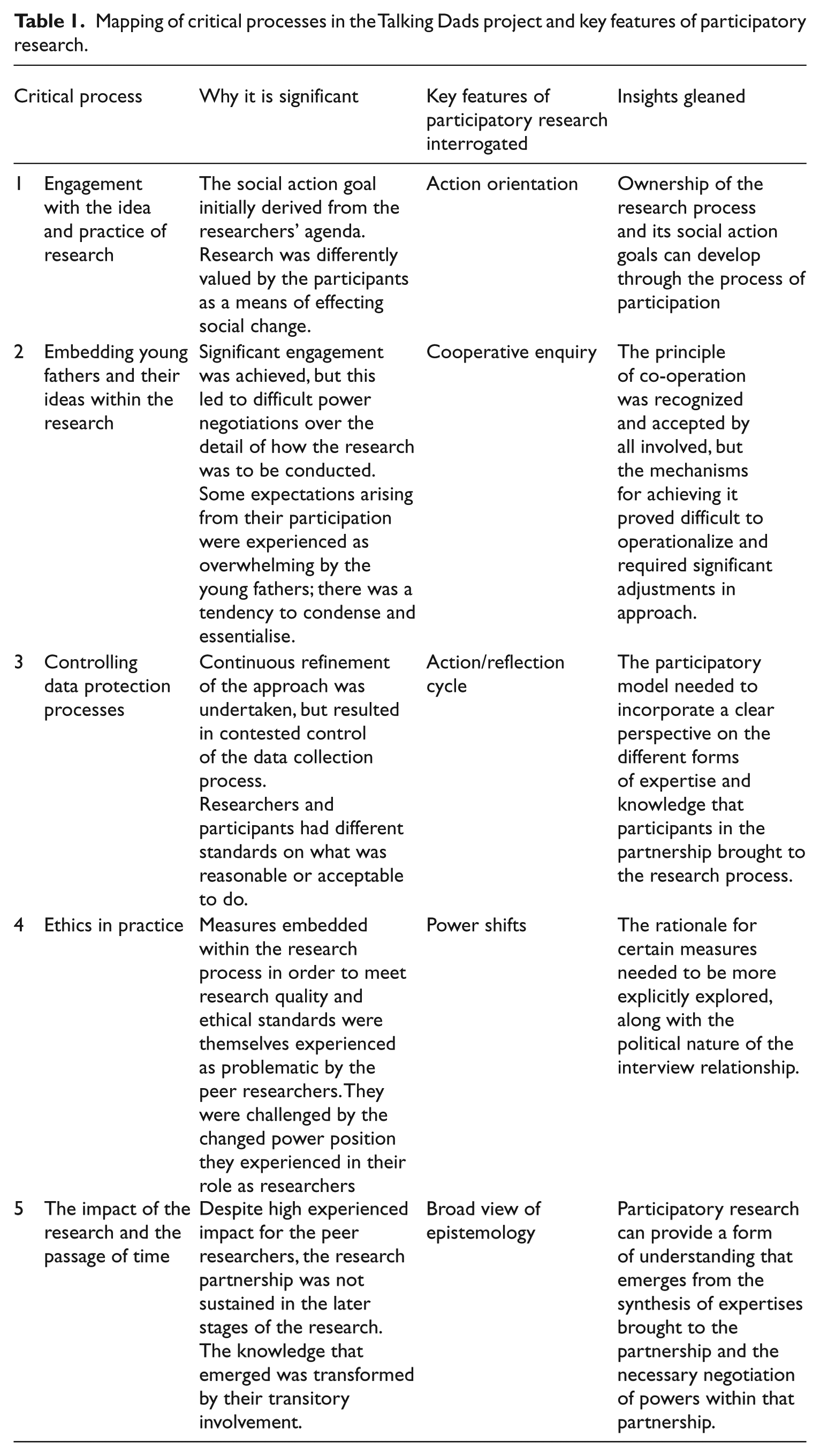
The above analysis has identified key challenges from the reality of conducting participatory research in practice. The significance of the critical processes is summarised in Table 1, along with the key insights gleaned.
Mapping of critical processes in the Talking Dads project and key features of participatory research.
The core features of participatory research, used to contextualise and illuminate our experience, may be argued to form an ‘ideal type’. In the light of our experience, it is perhaps comforting that others acknowledge there may be some distance between the intention and its operationalisation, or, as Stoecker (2009: 386) puts it, between the talk and the walk. He attributes this to the lack of a ‘coherent theoretical model of participatory and action-oriented research that can support effective practice’, and considers that more nuanced understandings of the social relations of knowledge production, and of the transforming potential of the knowledge/power nexus, are necessary. Mallan et al. (2010: 268) similarly identify ‘the crack that separates intention from action’, and note that this disjuncture can arise for institutional, generational, ideological, and practical reasons, all of which were present in the Talking Dads project.
A number of challenges are identified in the literature. Minkler et al. (2002), whilst making the point that participatory action approach is particularly suited to controversial issues, identify that as a result complex ethical issues can arise, and that principles of respect for self-determination, liberty and action for social change may be challenged by the heterogeneity of the community involved. Whilst the Talking Dads project was not made up of a pre-existing community, but a group brought together expressly for the purpose of the research, nonetheless the ethical issues encountered by the peer researchers were onerous for them, as discussed above.
Kidd and Kral (2005), whilst pointing to the benefits of engagement with communities who might be inaccessible to more traditional research methods, identify potential challenges from disagreement about the focus and process of the research, loss of motivation and commitment from those involved, power dynamics within group processes, and difficulties of achieving a fit with academic expectations, orthodoxies and timescales. Frankham (2009) similarly rehearses challenges associated with recruitment, negotiations over power and control, research capacity, and ethics. It is certainly likely that the material accessed through the approach taken in the Talking Dads project would have been less accessible to researchers who did not have the peer perspective. But equally, engagement and motivation were problematic, and the negotiation between academic and peer researcher expectations not straightforward. This is consistent with Bourke’s (2009: 465) experience that ‘PR was not a fluid process, but required difficult negotiations, decisions inconsistent with usual PR approaches, and, at times, challenges to the integrity of the research process’. She notes in particular challenges to received orthodoxy that higher levels of participation are ‘better’, demonstrating how some participants preferred to maintain the confidentiality and anonymity implicit in more traditional approaches, and exemplifies how shared decision making can pose risks to research integrity. This speaks directly to our experience of negotiating access to data with our peer researcher participants, and the tension between academic expectations about research quality and issues of concern to the peer researchers. As Smith et al. (2010) note, academic researchers in particular grapple with expectations and orthodoxies that pose challenges, notably to the tasks of creating respectful, collaborative relationships and of sharing power.
One key difference from much of the literature is that we were not, in the Talking Dads project, working with a pre-existing community; nonetheless our experience reflects critical components identified by Lencucha et al. (2010). Principles such as building on strengths, co-learning and co-construction of meaning guided our work with the group of young fathers; equally the impact of processes (such as time) and structures (such as meetings and mechanisms for feedback) that facilitate collaboration and power sharing have been evidenced in the critical processes recounted above.
The challenges that emerged within the project are perhaps also illuminated by a more fundamental critique of the concept of participation itself. Cornwall and Jewkes (1995) point out that participation can vary in the degree of power-sharing it affords, with shallow or deep participation reflecting the degree of control held or relinquished by the researchers, a notion consistent with established understandings of graduated involvement (for example, Arnstein, 1969; Pretty et al., 1995). Patterns can be uneven, with greater or lesser degrees of participation at various stages. Despite the best of intentions, the Talking Dads project certainly experienced difficulty securing engagement initially, and continuity suffered in the later stages of the project.
Greenwood et al. (1993: 188) note that participation cannot be imposed on research, but should rather be seen as an emergent process, developing from the interaction between the problem, the environment, and the aims, capacities and skills of those involved; they comment that ‘completely realised participatory action research processes are rare … because many research situations do not permit full-scale participatory action research to emerge’. Jacobs (2010) draws attention to the different interpretations of the notion of participation from different participants, identifying the nuances of meaning which variously prioritise empowerment (in the sense of giving voice), academic quality (in the sense of the methodological contribution made by participation) and utility (in the sense of producing practical outcomes). Tensions between these were apparent in the Talking Dads project, for example, between giving voice and preserving academic quality. The notion of participation as essentially a contested field is taken up by Cornwall (2008: 276) whose description is instantly recognisable from our own experience: ‘participation as praxis is, after all, rarely a seamless process; rather, it constitutes a terrain of contestation, in which relations of power between different actors, each with their own ‘projects’, shape and reshape the boundaries of action’.
Finally Frankham’s (2009: 16) problematisation of participatory research facilitates the interrogation of our experience. First, the process of privileging personal experience in knowledge creation risks creating ‘new essentialisms’ based on that experience, through an assumption that experience equates with understanding and that ‘personalised’ knowledge is protected from interrogation. Whilst recognising this as a danger in relation to the young fathers’ experiences within our project, we do not seek to place that knowledge beyond interrogation, and indeed the peer researchers themselves, whilst respectful and at times protective of their interviewees’ data, did not seek to accord it any priority status as an expression of truth. Second, Frankham questions the coherence of what is learnt in research partnerships through an assumed process of assembling particular, unique knowledges which may in fact not be compatible, and suggests that both the processes and the outcomes are considerably more complex. This certainly mirrors our experience, given the diversity of experience within our small cohort of 9 young father interviewees: whilst common themes emerge, there was much that separated young fathers, and neither we nor they would wish to claim coherence in the knowledge that we have brought to light from their lived experience. Third, she questions the orthodoxy that service users will or can be empowered through participating in research and identifies the considerable barriers to the realisation of user-led agendas. It must be acknowledged that the Talking Dads project was not a ‘user-led agenda’, particularly at the start and the end of the process, but the examples in our critical processes above attest to the empowerment experienced by those involved.
The factors that make this account of our project of use and interest to others are also those things we would want to do differently next time. The Talking Dads Project demonstrated that it was possible to do research differently, using participatory processes within the confines of a conventional research scenario (where there was not much time, not much money and without the community development work it needed). Against the odds, Talking Dads did many of the things it aimed to do and reached audiences in the academic, professional practitioners’ and young people’s worlds. As a research team, we were adaptable and flexible, changing our methods and processes as different issues emerged; for example, in the absence of an open meeting we switched to an interview that became a starting point for the interview schedules. We had to be practical and get with the job, knowing the imperfections of the process, and have shown that going some way is achievable and possible, that taking principles from participatory approaches brings added value from participant and others’ perspectives – arguably a good compromise. A further contribution is the exposure to critical analysis of the points of tension between model and practice in ways that emphasise the importance of forming the approach around the problem. If we had our time and (more) funding again, we would extend the development phase significantly, developing community stakeholders and taking some time to identify and build ownership of the research issue. We would build in longer training, and consecutive time and payment for participation in analysis and writing up, and would invest more in our peer researchers, prioritising the directions they wished to pursue rather than formal research enquiry and outputs.
Like many accounts in the literature, the story of these processes illustrates that participatory research is not easily achieved and that ‘making a difference’ requires negotiation of multiple and varied obstacles (Schostak and Schostak, 2008). However in our aspirations to do research differently, we worked towards the principles enshrined in the model and this article emerges from a critical, reflective consideration of our work that in itself is driven by adherence to its high standards. The research team did not want simply to reduce real lives to material for the knowledge-building industry (Skeggs, 1997); rather we hoped to make a small difference by engaging in research that potentially facilitated change during the research process (for the young fathers involved) as well as through its outcomes in dissemination and in our own learning. We sought to generate knowledge which could create change in the lives of those involved through processes of relational participation in which different ways of knowing contribute to processes and outcomes. The testimony of our participants indicates that at an individual level at least, those relationships developed, and such change took place.
Footnotes
Acknowledgements
The authors acknowledge with gratitude the support of the community knowledge exchange organisation that provided the funding for the study, the active involvement of the community partner and the participation of the young fathers who took part. We all contributed and learned a great deal from each other; the interpretations in this article remain the authors’ own and we recognise that they are therefore only one of many possible reflections on our joint action.
Funding
This study was supported by the community knowledge exchange organisation.