



Abstract
Meta-narrative review developed by Greenhalgh and colleagues is a new interpretive systematic review approach within an expanding portfolio of evidence synthesis methods that focus on context, meaning and process. Informed by Kuhn’s notion of scientific paradigms, the method seeks to develop storylines of how research on a given topic unfolds over time, highlighting key discoveries and insights. This article reports how we drew on the meta-narrative approach in a review that examined the changing and contested nature of ‘community’ as understood across disciplines and research traditions. We discuss the challenges that arose in our review and the strengths and limitations of our approach. We conclude that the meta-narrative approach provides a useful framework for making sense of the multiple and changing conceptualisations of community while accounting for historical context. We recommend that an avenue for further development of the method is to consider Foucault’s sociological approach to tracing knowledge.
Introduction
Research synthesis is the art and science of collecting and organising information from research literature in order to arrive at a more comprehensive picture of the topic being studied than is possible from examining individual studies (Gough et al., 2012). In principle there are many ways of combining studies in a synthesis and different methods will be appropriate in different circumstances. Methods are well developed for systematic review and statistical meta-analysis of trials evaluating the effects of interventions. In recent years, there has been growing interest in interpretive approaches to the synthesis of diverse research types including the many types of qualitative research (Barnett-Page and Thomas, 2009; Hannes and Macaitis, 2012; Harden and Thomas, 2010). Interpretive approaches to reviewing fall at the idealist end of the realist–idealist continuum and, in contrast to traditional systematic reviews, explicitly adopt an iterative approach with fewer a priori procedures (Barnett-Page and Thomas, 2009).
One such interpretive approach – and the focus of this paper – is the meta-narrative review, which was first developed by Trisha Greenhalgh and colleagues in the course of conducting a review to address the question of how innovations in health service delivery and organisation can be spread and sustained (Greenhalgh et al., 2004; Greenhalgh et al., 2005b). This method of research synthesis places at centre stage the importance of understanding a complex topic area critically and across many areas of research (Gough et al., 2012; Greenhalgh et al., 2005b; Wong et al., 2013). Recognizing that much of the illuminating research literature may have been conducted in many different fields, not just in healthcare, Greenhalgh and colleagues started with an initial search to map the diversity of perspectives and approaches. This search was primarily guided by intuition, informal networking, ‘browsing’ and tracking references of references and aimed to identify relevant seminal studies. Seminal studies – contributions that are of central importance to a research tradition because they report a major breakthrough, insight or a new synthesis of ideas – were used to identify 13 ‘storylines’ of research on the diffusion and spread of innovations. The unfolding ‘storyline’ of a research tradition was taken as the unit of analysis. The key features of each research tradition were mapped by their historical roots, scope, theoretical basis, research questions asked, methods used, empirical findings, historical development of the body of knowledge, and strengths and limitations of the tradition. Primary studies were then critically appraised for their validity and relevance to the review question, key results were extracted and comparable studies were grouped together resulting in seven key themes of the diffusion of innovations which were synthesised in a narrative account. Recommendations for research and practice were then developed via reflection, multidisciplinary dialogue and consultation with the intended users of the review.
The meta-narrative review might be best characterised as a method for sense-making of complex topics where there is dissent about the nature of what is being studied (Greenhalgh et al., 2005a). The method was informed by Thomas Kuhn’s 1962 book The Structure of Scientific Revolutions, where Kuhn proposes (using historical examples from the physical sciences) that groups of researchers view the world through a particular lens or ‘paradigm’ – which is a set of common beliefs and agreements about how problems are understood (Kuhn, 1962). These agreements guide research efforts of the group for a period of time (referred to as ‘normal science’), before anomalies appear and put the paradigm in crisis, where we then see new concepts, methods or understandings emerge (referred to as a ‘paradigm shift’). According to Greenhalgh and colleagues (Greenhalgh et al., 2004; 2005a; 2005b; 2009; Wong et al., 2013: 6), the ‘meta narrative’ is the shared set of concepts, theories and preferred methods taken on by a group of scholars who form a research tradition. ‘Meta-narratives’ are storylines that unpack how research unfolds and changes over time within a research tradition ‘in such a way that a “plot” emerges, in which key scientific discoveries and insights lead to further work that adds pieces to an agreed jigsaw or, less commonly, to work that shakes the foundations of the prevailing paradigm’ (Greenhalgh et al., 2005a: 427).
The review discussed in this paper focused on unpacking concepts of community in light of the central role the term community has taken in the rhetoric and agenda of policy makers in recent years, particularly the UK coalition government’s flagship ‘Big Society’ programme, which proposes to shift the balance of support provided by government to community and voluntary action (House of Commons, 2011). This political discourse resonates historically in Europe and internationally where there has been a shift in the relationship between government and citizens, placing welfare at the ‘community’ level (Ishkanian and Szreter, 2012). We found that while the term ‘community’ has been adopted and appropriated by those working in policy and practice as a tool and metaphor for an improved way of life, the meaning of the term as conceptualised in the academic literature is highly contested and continuously changing. We thus endeavoured to use a meta-narrative approach to investigate the question: how has community been conceptualised across time, disciplines and research traditions?
In this article we will discuss the processes and challenges of applying a meta-narrative approach in our review. The full findings of the review are reported elsewhere (Bertotti et al., 2012). We report here on how we applied and adapted Greenhalgh’s steps to the meta-narrative review and the challenges that arose at each point. We also discuss the strengths and limitations of the approach we took and consider new avenues for methodological development.
The review process
Different review methods are underpinned by various epistemological positions (Barnett-Page and Thomas, 2009). The meta-narrative review has been categorised as a highly constructivist approach to knowledge or what Spencer et al. (2003) term ‘subjective idealist’. In other words, it proposes there is no shared reality that exists independently of human constructs. Rather, knowledge is a product of its disciplinary paradigm. In our endeavour to conduct our meta-narrative review therefore, we began by adopting a critical stance towards the literature and neither sought, nor expected, to find one final non-contestable answer to our review question (Gough et al., 2012).
As a starting point we used the process outlined in Greenhalgh et al.’s (2005a) study of diffusion of innovations in health research, which outlines the following phases of a meta-narrative review: a) planning; b) searching; c) mapping; d) appraisal and synthesis; and e) recommendations. We describe the steps we took in our review according to these phases (Figure 1), reflecting at each step, the challenges that arose and ways in which our approach differed from Greenhalgh and colleagues. As noted above, interpretive reviews tend to be iterative in nature so whilst we present a linear set of steps and phases, we often went back and forth in the process. A key over-arching difference between our approach and that outlined by Greenhalgh and colleagues was that because our research question was concerned with the conceptualisation of a term we were primarily interested in analysing concepts, theories and metaphors within the literature. In contrast, Greenhalgh and colleagues analysed concepts, theories, as well as preferred methods, including identifying quality criteria against which empirical research was judged. We did not extract data relating to methodologies of the texts we synthesised and we did not embark on a critical appraisal of studies and thus our findings do not capture the differing methodological approaches favoured in different research traditions. Assessing the quality of theories and concepts derived from research is a contested area, and we did not have the resources to conduct a meaningful appraisal. Conducting such an appraisal would be a useful extension to our work in this review. In addition, while the authors we included adopted a variety of theoretical and philosophical positions in our review, we did not systematically extract data related to these positions as we found that categories (e.g. positivist, interpretive, critical, recursive) overlap considerably and authors often resisted categorising their own theoretical position. Another key difference was our synthesis approach. Our map identified 10 ‘meta-narratives’, which we then synthesised to develop a rich narrative text of how the research on community unfolds over time across all meta-narratives. Unlike previous meta-narrative reviews, our synthesis focuses on the historical context of the meta-narratives, particularly drawing on how knowledge is embedded in real social and political relations. Thus, our theoretical perspective shifted accordingly towards a more realist position. This is elaborated on in our discussion section.
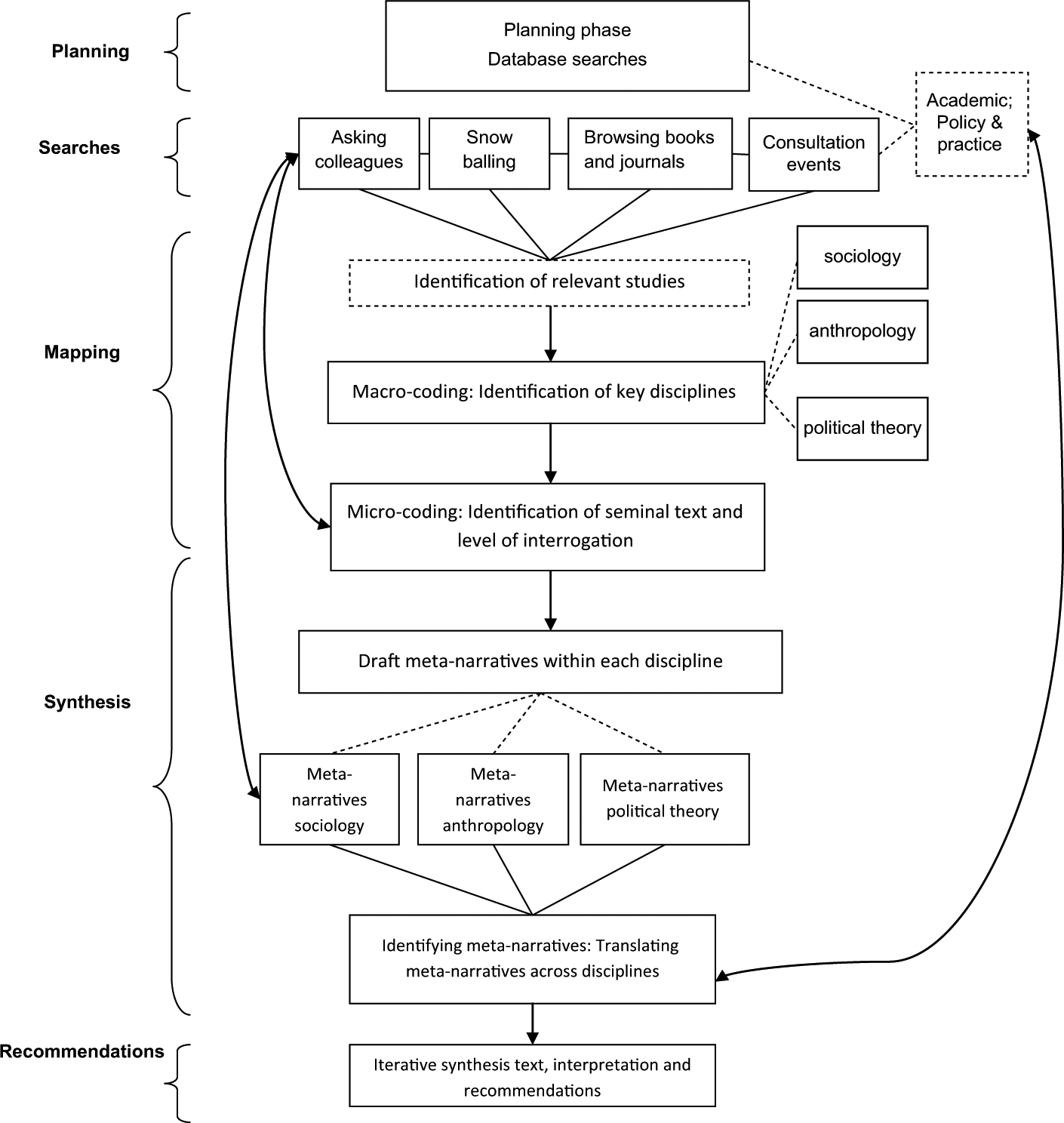
Meta-narratives in a wider social context.
a) Planning phase
The first step in a meta-narrative review is to determine if the review topic is a ‘good fit’ for a meta-narrative approach. An important question to ask is whether the topic has been studied by scholars working across different disciplines of study and whether different methods, philosophical approaches and/or understandings have changed over time. With respect to our research topic, ‘community’, we found that though the term has been used widely both in academia and policy, the meaning of community is highly contested (Hillery, 1955). For example, Williams (1976) famously argued that community is treated almost universally as positive. However, many scholars have disputed this understanding, noting the darker side of communities relating to exclusion, inequality, oppression and social divisions (Crow and Maclean, 2006; Hoggett, 1997). The research literature on communities therefore covers multiple research traditions across a range of disciplines of study with different underlying philosophical assumptions and methodological approaches: the topic is thus well suited to a review using a meta-narrative approach as the research literature is diverse, heterogeneous and has changed over time.
Our research question was phrased as ‘what are the conceptualisations of community within and across disciplines of study?’ Since the aim of the review was to track how the concept of community had changed across traditions and over time, we did not develop a working definition of the term ‘community’ at the outset, so as not to restrict the parameters of our search and our thinking more generally. We sought very broadly to identify literature that explored the meaning and conceptualisation of the term ‘community’. Previous meta-narrative reviews similarly found that setting clear inclusion criteria was not possible early on as definitions were fuzzy and contested (Greenhalgh et al., 2004).
We set up two stakeholder groups that we could draw on for consultation and reflection throughout the review process. One group was comprised of academics with an interest or expertise in research on community drawn from different departments at the University of East London, where this project was based, including Sociology, Cultural Studies, Education, Health, Sport and Bioscience, Psychology, Architecture and Environment Science. The second group was comprised of people working in policy and practice and was set up to better understand how community was conceptualised for those people that work with or for communities in the real world setting. This group included representatives from local authorities, housing associations, local and national charities, community networks and neighbourhood groups. Stakeholder consultations were useful at this stage to get a sense of the various contested definitions and meanings of community and the various ways people draw on, work with or develop communities in policy and practice. This confirmed that our research question and synthesis approach were appropriate.
b) Search phase
We used several methods to search for literature. As well as informal browsing and targeted searches of electronic databases (Jstor, Science Direct, Eric, IBSS and Medline) using search terms for ‘community’ combined with search terms for ‘concepts/theories’ (which yielded 216 texts after removing items not relevant based on titles), we also utilised informal networking with colleagues and experts, and requested references from both our academic and policy and practice stakeholder groups. We also used ‘snowballing’ techniques such as reference searching. This is an effective method for identifying relevant literature as it is common practice among scholars to engage with the existing research landscape and reference key texts in order to position their own work and contribution in a publication. Sources from our database search were inputted and managed by the systematic review software tool, Eppi Reviewer 4 (Thomas et al., 2010) and other sources were manually handled.
We found that browsing, informal networking and snowballing yielded the most relevant texts. Stakeholder consultations were less useful as a resource for identifying specific texts that might be included in the review. Similar to previous meta-narrative reviews (Greenhalgh et al., 2009), we found that texts from electronic database searches were a useful starting point for reading and ‘snowballing’, but were mostly not relevant for our review, with only three texts from these searches included in our synthesis. Electronic database searches tended to pick up empirical studies published in journal articles, and much of the relevant literature for our review had been published as books. The latter are not well indexed on bibliographic databases, which are focused on cataloguing the content of journals. Bibliographic databases are also relatively recent and were not useful for locating older texts.
c) Mapping phase
Through searching, we got a feel for the range of literature ‘out there’. We found that the literature related to the conceptualisations of community was produced across a range of different academic disciplines. The central task of the mapping phase is then to identify the seminal studies. As noted earlier, seminal papers are contributions that are of central importance to a research topic because they report a major breakthrough, insight or a new synthesis of ideas. Seminal studies also plant the seeds for future work in a given area.
Mapping was undertaken in the following steps:
(i) Our first step was to code texts based on their academic discipline in order to produce a map of the range of academic disciplines represented among studies in our database. We developed an initial list of academic disciplines, 1 which was discussed among members of the research team and circulated to the academic stakeholder group to ensure that it was comprehensive and appropriate. Texts were then divided among three members of the research team who assigned each text to a discipline on the list. Prior to individual coding the research team collaboratively coded 10 random studies so as to ensure consistency. We found, as others have previously suggested (Abbott, 2001), that disciplinary boundaries are at times arbitrary and ambiguous. It was decided that coding would therefore not be mutually exclusive so a text could potentially be characterised as both ‘sociology’ and ‘anthropology’. From the results of the coding, we found that most texts were concentrated in the disciplines of sociology, anthropology and political theory: these became the disciplines of focus for our review. The process of assigning disciplinary frames to the literature has not been explicitly explored in other meta-narrative reviews, perhaps because they have usually not been as broad in scope as our review.
(ii) To identify seminal texts, all sources in our database were assessed according to the following criteria, adapted from Greenhalgh et al. (2009): Is the paper part of a recognised research tradition? That is, does it draw critically and comprehensively upon an existing body of knowledge and attempt to further that body of knowledge? Does the paper make an original contribution into the meaning or conceptualisation of community? Has the paper subsequently been cited as a seminal contribution by researchers in that tradition?
Two reviewers (MB and FJ) completed this assessment for an initial sub-set of texts working independently at first and then meeting to compare assessments. Once the reviewers had reached a broad agreement on how to assess texts according to the criteria, studies were divided between the reviewers. On reflection during this process, the way in which we applied the criteria was too inclusive. Studies that passed the criteria reported they were making an original contribution and many were subsequently cited by other scholars, however the degree to which their work actually shifted the understanding or approach in a research tradition varied considerably and we were unable to capture such variation by these criteria. We hence re-assessed our texts to identify those texts that could be considered to be foundational in that they set the groundwork for an entire research agenda. Such texts are continuously cited in published work on the topic of community and the authors were major contributing scholars both on the topic of community but often also commonly identified in later works as foundational to the discipline to which they belonged. Many of these studies go back to the 19th and early 20th centuries, or even further: for example, foundational authors in sociology include Ferdinand Tönnies, Karl Marx and Émile Durkheim. The identification of our seminal studies was unavoidably somewhat subjective; as recognised by previous researchers, picking out story threads from a mixed bag and broad mass of knowledge often involves choices that are “irrevocably subjective and negotiable” (Greenhalgh et al., 2005a: 427). Having now identified our academic disciplines of focus and seminal studies, we requested suggestions for further references from colleagues working in the field and checked the reference lists of our included texts in order to identify further texts in order to build up detail for each study.
(iii) For each of our seminal works we extracted information related to: a) the historical roots: the preceding ideas, historical time period and theories or orientations which the study builds on; b) the scope: the aims, parameters or assumptions taken as a starting point; and c) the conceptualisation of community proposed. These extracts were grouped according to academic discipline and reviewers then read and re-read extracts within the grouping. Interpretive methods were used to identify a draft set of storylines or meta-narratives within each discipline. This was done by linking studies that generally shared a set of concepts, theories and/or preferred methods. A draft set of meta-narratives was identified corresponding to each of our academic disciplines.
(iv) Reviewers circulated a list of meta-narratives corresponding to each academic discipline among the team and then met to discuss them. At the first meeting each reviewer described the meta-narratives according to their reading of the literature. This was debated, discussed and the meta-narratives and their associated texts were refined and developed over several days. At a second all-day workshop, reviewers aimed to identify meta-narratives that seek to illustrate how community has been conceptualised across all our disciplines of focus: anthropology, sociology and political theory. We began by producing a matrix where meta-narratives within each research discipline were juxtaposed in order to identify commonalities and differences. This was essentially a thematic synthesis of themes. We finally identified 10 meta-narratives (which 41 seminal texts are mapped on), which are summarised in Table 1 and organised by: a) the relevant academic discipline(s) the meta-narrative draws from; b) historical roots; c) scope; d) conceptualisation of community; and e) a selection of key authors.
Meta-narratives identified in a review of the conceptualisations of community.

d) Synthesis phase
We then looked across disciplines to develop a narrative text addressing the question: ‘How has research across the meta-narratives unfolded over time?’ We present in Table 2 a summary version of our ‘big picture’ narrative on how community has been conceptualised across disciplines.
Summary of narrative tracing the conceptualising of community across anthropology, sociology and political theory.

Developing meta-narratives within each discipline and then looking across all disciplines and over time was useful because it allowed for highlighting similarities and conflicts in the conceptualisations. Looking across disciplines also highlighted where disciplinary boundaries diverged and merged. For example, it seems that there was a disciplinary turn in anthropology where it became synonymous with a method of conducting research (i.e. ethnography) and thus many scholars, for example from the Chicago School conducting field work in US neighbourhoods, could not be identified as either anthropologists or sociologists. Greenhalgh and colleagues (2005a) have stated that this sort of ‘double-handling’ was crucial in their review because it enabled them to highlight conflicting findings which could then be explored in terms of contestation between incommensurable paradigms. In our review, we did not feel that conflicting conceptualisations could be attributed to any incommensurability between paradigms. Rather, we felt that different conceptualisations of community emerged at different historical periods. The conflicts between conceptualisations were thus likely more attributable to the different social, cultural or economic shifts taking place in the world, which influenced the writings of scholars at a specific time. This is an important contribution as it suggests not only which studies ‘link-up’, but also meaningfully suggests how they do so by drawing out the potential influences around the forming of different research traditions. Therefore, by outlining the historical context of the meta-narratives, our review explicitly accounts for the wider social dimension of knowledge. Figure 2 illustrates how the meta-narratives can be mapped within a historical context.
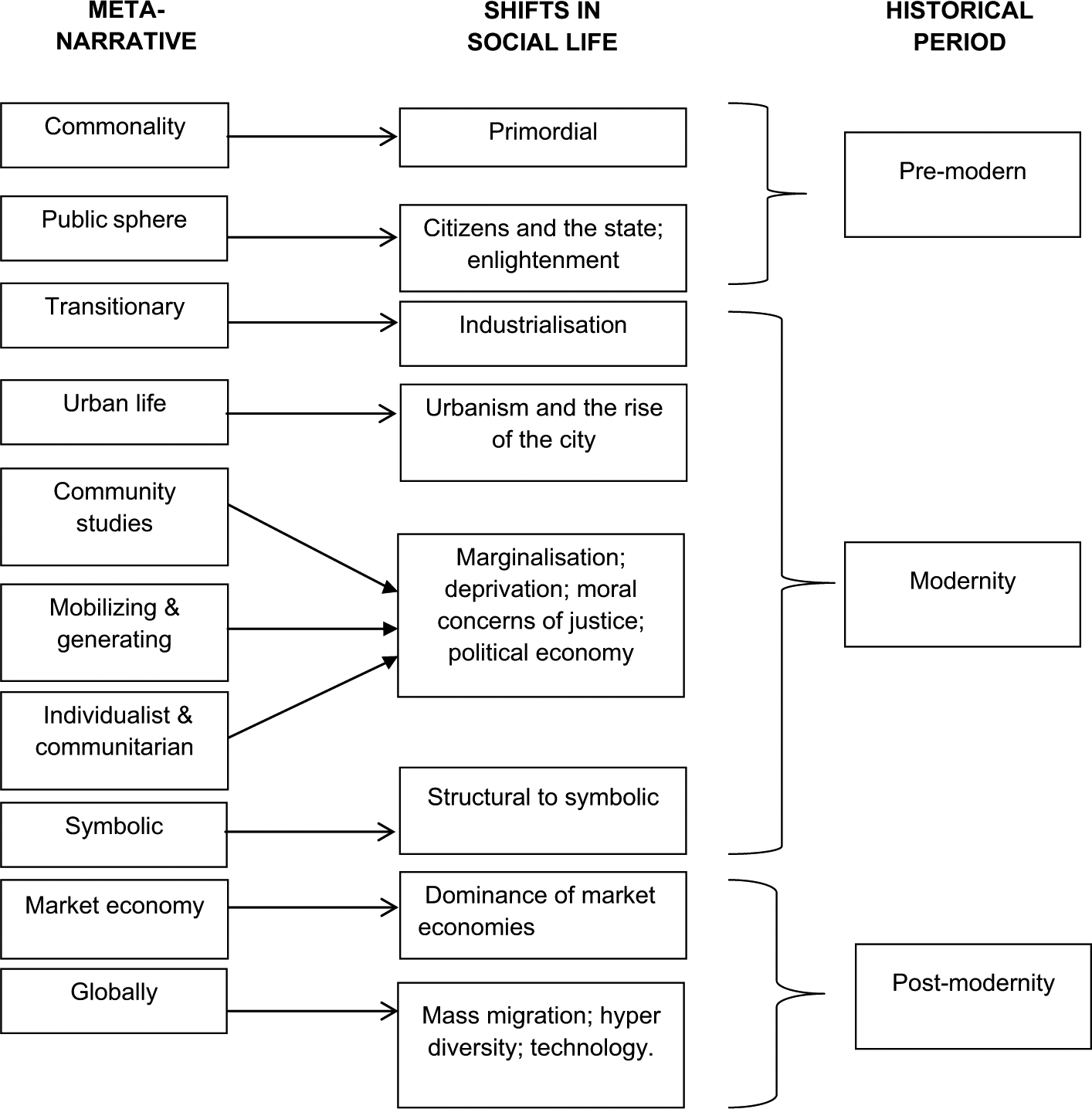
Mapping meta-narratives in a social-historical perspective.
e) Recommendations phase
At this stage we convened a seminar inviting both our academic and policy and practice stakeholder groups to help verify and interpret our findings. We asked stakeholders to comment on the comprehensiveness of our results and the usefulness of the synthesis in helping to make sense of the complex and diverse literature.
Stakeholders agreed that the 10 meta-narratives produced were a crucial resource and suggested that they appropriately outlined the trajectory of research across our focus disciplines. They noted that the pragmatic approach of looking at early ‘foundational’ scholars was appropriate as this laid the groundwork of conceptualising community and that many of the questions posed then, continue to inform research agendas on community today.
Stakeholders broke off into smaller working groups where they discussed how our results might help in informing practical work related to community. It was concluded that the results broadened perspectives about what a community is beyond a simply geographical notion of a group of people who live close to one another, which was almost always the default definition. Our findings also suggested that the assumption that communities exist and are a requisite function of social life should not be taken as common sense. Practically, this means for example that a community may need to be built (via creating common imaginaries or sentiments for example) before being appropriated for intervention. Our stakeholders said that by taking a historical approach to reviewing the literature they could better grasp how community is a continuously changing concept. One working group at our seminar likened our meta-narratives to a tool-kit of the many ways we can conceptualise community and that this sort of conceptual tool-kit is valuable to draw on for developing policy or intervention that is informed by theory. As communities are the site for many public health and social policy interventions, an avenue for future research might also be to map practices of community engagement interventions against our meta-narratives to consider whether the full range of conceptual approaches has been used and where innovation in policy and practice might be identified.
Discussion
Unlike traditional reviews that are often conducted in a series of linear and sequential steps, derived from an a priori protocol, this review involved continual iteration and retracting of steps. The review process is best described as ‘feeling your way’ through the literature, moving between searching for studies, immersing in text, focusing the review, extracting data, synthesis and interpretation in several cycles. This process of continual iteration is appropriate for interpretive reviews and has been effective for the purposes of making sense of highly complex topic areas, across many areas of research.
By taking a meta-narrative approach to reviewing the conceptualisations of community within and across disciplines we were able to identify a set of narratives outlining the scope and roots of different conceptualisations of community which resonated with both academics and professional groups. The meta-narrative approach gives us the capacity to investigate how seminal books and papers on a given topic inspire programmes of theory building and empirical research. It also allows us to compare and contrast the literature in a structured way. Take for example, Benedict Anderson’s (1983) seminal text Imagined Communities. In this book, Anderson presents a conception of the nation as a community that is socially constructed or ‘imagined’. It is imagined because, according to Anderson, it is not possible for every individual to know and relate to everyone else, but in the minds of each individual is the image of their comradeship. Anderson’s conceptualisation emphasises the role of constructing symbols and representation in community formation. In a similar vein, seminal author Anthony Cohen (1985) encourages a shift away from the traditional sociological preoccupation with the ‘structure’ of community to an emphasis on ‘a symbolic community which provides meaning and identity’ (Cohen, 1985: 9). For Cohen, community is symbolically constructed by codes and values that provide members with a sense of identity. We see both Anderson and Cohen belonging to the meta-narrative: ‘symbolic approaches’. We can contrast this wave of scholarship which looks to illuminating the process of creating and embodying the meaning of community in the hearts and minds of individuals to previous conceptualisations that focused on functionality and locale as central to its definition. The ‘symbolic approach’ has then paved the way for other scholars to conceive of new forms of community in an era of globalisation and hypermodernity that look beyond the limits of physical spaces (for example, virtual communities, and diaspora communities). Therefore, by adopting a Kuhnian approach, we are able to identify a number of key texts that shift the direction of thinking around community and inspire new scholarship, and by mapping these texts, are able to identify the attachments and developments that gave the ideas prominence.
In our review, the historical dimension and in particular the breadth of chronological scope, allowed us to consider what external factors in social, economic or political life might influence the emerging narratives. We find that the key strength of the meta-narrative approach is that it works in making sense of complex and diverse literature. Some may consider our handling of this literature reductionist or simplistic. Arguably, however, the simplification of this material may be valuable. Conceptual and theoretically oriented literature is often dense, complex and uses an internal jargon to the discipline in which it is conceived. By simplifying this knowledge, we feel that wider audiences can potentially draw on it for research or practice. We suggest therefore that the meta-narrative approach to reviewing is usefully applied to this type of literature. As already suggested, this approach may help to bridge gaps between academic theorists on the one hand, and practitioners and policy-makers, or researchers in more applied fields, on the other. It may also be of value in the process of theory development itself, in drawing together insights from a broad range of different fields and disciplines.
Our approach, while closely following existing guidance on meta-narrative reviews (Greenhalgh et al., 2005a; Wong et al., 2013), also diverges somewhat from the approaches adopted by Greenhalgh and colleagues. Most obviously, the scope of this review is considerably broader than most published meta-narratives, with respect to both the range of conceptualisations and to the historical periods covered. As already suggested, this may have meant that key texts and concepts were covered in insufficient depth in order to translate concepts across studies to identify storylines. Another difference is that because our research question was concerned with the conceptualisation and theorisation of a term, we focused primarily on analysing higher order abstractions, that is, concepts, theories and metaphors within the literature and did not examine methodologies or empirical results of seminal studies in depth. Our approach is novel in seeking to relate meta-narratives, and the shifts and contacts between them, to the concrete social, economic and political changes underlying the different theoretical approaches. Much existing work in meta-narrative review as described by Greenhalgh and colleagues (2004, 2005a, 2005b) focuses on the internal theoretical coherence of narratives, rather than their embeddedness in real social and political relations. It also tends to reinforce the traditional dualism of critical qualitative research and positivist quantitative research (Greenhalgh et al., 2005a) as narratives tend to collapse in this dichotomy, which is increasingly questioned by social theorists (Latour, 1993). By contrast, our approach seeks to re-situate theoretical meta-narratives within their historical context, and to provide a more sociologically grounded description of the evolution of paradigms. As already suggested, much previous work on meta-narrative reviews rests on a constructivist theory of the social. By contrast, our findings indicate that the multiplicity of narratives about community is at least partly driven by real historical changes in society itself. This suggests that this multiplicity could be accounted for within a realist ontology of the social (i.e. view that theories refer to real features of the world, but that our knowledge of the world is inevitably interpretive and provisional rather than representational), without invoking idealist or constructivist meta-theories.
We suggest that a promising avenue for the further development of meta-narrative methods could draw on Foucault’s sociological and historical approach to the relationship between power and knowledge (Foucault, 1972). Take for example Foucault’s seminal book Madness and Civilization (1965) on the way that ‘madness’ is constructed by society and its institutions. Shifts in the conceptualisations of ‘madness’, for Foucault, don’t represent a sense of progress of knowledge but changes in discursive relations and a given time period. This approach stresses how claims to truth are claims to power and how the exercise of power is legitimised in terms of knowledge.
We discuss Foucault’s approach to knowledge as it has implications for how we develop a synthesis method that seeks to essentially capture the history of knowledge on a given topic. Taking a Foucauldian logic, a concept such as community, for example, is not one whose history can be neatly unfolded in a progressive accumulation, but is better understood as a product of wider relations in social life. If we had considered a Foucauldian approach to understanding complex and heterogeneous literature we thus may have been able to give even more consideration to the wider social, economic or cultural determinants that shape knowledge in a given topic area. If we take a Foucauldian approach to reviewing we may ask a different set of questions such as: what are the processes in which topics become known? How do these topics become established and used? The emphasis on the review then is highlighting the practices that introduce topics to the knowledge sphere. In other words, how do disciplinary practices operate in order to create knowledge-power?
Conclusion
The meta-narrative review as first developed by Greenhalgh and colleagues is a worthwhile approach to add to the economy of review methods available. The meta-narrative approach provides reviewers with a framework that allows us to navigate through complex literature in an organised manner while also being flexible enough to adjust according to individual review questions. We commend Greenhalgh and colleagues for drawing attention to the need to take account of the historical and philosophical context of studies. We recommend that a crucial avenue for methodological development however is to begin thinking beyond the ‘Thomas Kuhn logic’ which informed Greenhalgh’s method and consider for example, Foucault’s sociological and historical approach to the relationship between power and knowledge.
Footnotes
Acknowledgements
We thank our colleagues Kevin Sheridan, Lori Atim and Gail-Burrow Guevara for their insight and for organising our stakeholder consultations. We also thank our academic and policy and practice advisory group members for their collaboration; and the RAMESES meta-narrative group (realist and meta-narrative evidence synthesis: evolving standards).
Funding
This work was supported by the Arts & Humanities Research Council [AH/J500018/1].