




Abstract
Current theories in psychology conceptualize self-transcendence as a personality trait, a developmental construct, and a particular class of anomalous experience. Despite extensive research on self-transcendence, the process, outcomes, and nature of self-transcendent experience (STE) remain elusive. This study focused on the self-reported narratives of STE in 15 healthy adults. Accounts were collected in face-to-face interviews, transcribed, and thematically analyzed using grounded theory methodology. Qualitative results were recursively examined to construct a preliminary mid-range theory of STE in healthy adults. Three major theme areas emerged from interview data. These were (a) context, (b) phenomenology, and (c) aftermath of STE. Each of these major themes was further divided into distinct sub-themes, including setting, perceptual alterations, and long-term effects. The resulting interpretation of STE is discussed in light of current literature and directions for future research.
Keywords
Introduction
The term self-transcendence has been used widely in philosophical and psychological literature to refer to a host of related concepts and phenomena (Garcia-Romeu, 2010). Cloninger et al. (1993: 975) considered self-transcendence as a measurable personality trait in their seven factor psychobiological model of temperament and character, defining self-transcendence as ‘the extent to which a person identifies the self as … an integral part of the universe as a whole.’ Levenson et al. (2005) conceptualized self-transcendence as a key component of wisdom that is proposed to derive from aging and development across the lifespan (Tornstam, 1996). Research among aged and ailing populations has informed a detailed nursing theory of self-transcendence as an important developmental resource in later life (Reed, 1991, 2003). Additionally, contemporary theorists in the psychology of consciousness have treated the topic of self-transcendence as a developmental milestone related to the upper echelons of psychospiritual growth and maturity (Wade, 1996; Wilber, 2000).
Prior to these more recent formulations of self-transcendence, early existential and humanistic psychologists Frankl (1966) and Maslow (1966, 1969) considered self-transcendence a key factor in human development and meaning making. In his article examining the various meanings of transcendence, Maslow (1969: 66) offered this definition:
Transcendence refers to the very highest and most inclusive or holistic levels of human consciousness, behaving and relating, as ends rather than means, to oneself, to significant others, to human beings in general, to other species, to nature, and to the cosmos.
Despite the accumulation of theoretical literature and empirical research on self-transcendence, the process, outcomes, and nature of self-transcendent experience (STE) have remained elusive at best (Akyalcin et al., 2008; MacDonald and Holland, 2002a). For the purposes of this study, STE was defined as any instance of feeling ‘connected to something larger than or outside of your everyday sense of self,’ or as one participant described it, ‘suddenly having an awareness of the wholeness of myself and how I fit into the bigger part of the Cosmos and the universe, and what is my purpose.’ In order to address shortcomings in our current understanding of self-transcendence in the experiential domain, this study focused on participants’ descriptions of STE as the primary topic of interest, with the expressed purpose of developing a preliminary mid-range theory 1 of the process and outcomes of self-transcendence in healthy adults.
This study was purposely confined to the examination of self-transcendence in healthy volunteers, with a focus on ramifications for personal growth and well-being. This is in keeping with the orientations of humanistic, transpersonal, and positive psychology, which primarily emphasize the development of well-adjusted, high functioning individuals, as opposed to clinical approaches that generally focus on the identification and treatment of mental disorders (Hartelius et al., 2007; Jourard and Landsman, 1980; Seligman and Csikszentmihalyi, 2000). Furthermore, the authors’ own experiences in natural settings and during meditative practice provided an initial framework for exploring self-transcendence as a potentially beneficial and transformative phenomenon.
There is evidence to suggest that self-transcendence as measured by the Temperament and Character Inventory (TCI) (Cloninger et al. 1993) is associated with particular psychopathological profiles in clinical populations, especially in combination with other personality traits such as harm avoidance or novelty seeking (e.g., bipolar disorder, substance dependence, dissociation, compulsive gambling; Grabe et al., 1999; Harley et al., 2011; Koller et al., 2011; Martinotti et al., 2006; Spalletta et al., 2006). Furthermore, it is important to acknowledge the potential for spiritual bypass, wherein individuals may focus narcissistically on their spiritual or transcendent experiences as a validation of their uniqueness, thereby avoiding other, more difficult developmental issues that may need to be addressed (Cashwell et al., 2007; Welwood, 2000). Although a detailed discussion of the pathological dimensions of self-transcendence lies outside the scope of the current paper, interested readers may refer to these articles for more information (Garcia-Romeu, 2010; Cashwell et al., 2007; Cortés et al., 2009; Daneluzzo et al., 2005; MacDonald and Holland, 2002a; Smith et al. 2008).
Research questions
This study addressed three basic questions: (a) What are the contexts or situations that tend to elicit STE? (b) How do participants describe STE?, and (c) What are the perceived outcomes of STE?
Methods
This exploratory research study employed grounded theory as the primary methodological framework (Corbin and Strauss, 2008). Qualitative data collection and analysis took place over the course of multiple iterations until the researchers deemed sufficient conceptual saturation (i.e., no novel thematic content was emerging from interview data).
Data collection
Healthy, English-speaking adults (18–70 years), with some history of STE (defined as ‘any instance when you felt connected to something larger than or outside of your everyday sense of self’) were recruited locally in the San Francisco area using flyers advertising a study of self-transcendence. Exclusion criteria were substance dependence, violent criminal activity, or hospitalization for any severe physical or psychiatric illness within the past 6 months.
Fifteen individuals were enrolled and completed in-person interviews using a semi-structured qualitative interview questionnaire that was collaboratively designed by the authors. All interviews were conducted and transcribed by the authors, and audio-recorded with participants’ consent. Interviews occurred at a mutually agreed upon time in a private, neutral location (e.g., in a meditation room at a local psychology graduate school). Interview items asked participants: (a) to describe a STE from their own lives; (b) whether they had other such experiences; (c) whether these experiences had in any way affected their worldview, religious or spiritual orientation, daily life, or relationships; and (d) the meanings attributed to these experiences. Interviews lasted between 25 and 75 minutes, and demographic information was collected with a brief questionnaire. This study was approved by the Research Ethics Committee of the Institute of Transpersonal Psychology, Palo Alto, CA, and all participants provided informed consent.
Data analysis
Data were collected, coded, and thematically analyzed in iterative stages in accordance with the grounded theory method (Corbin and Strauss, 2008). To begin the data collection and analysis procedures, each researcher conducted one interview. After transcription, data from these initial three interviews were pooled, and interview texts were examined individually by each researcher, who generated memos identifying recurring concepts and patterns observed within the dataset. Open line-by-line coding was performed by each researcher towards the development of preliminary convergent themes, which were then corroborated between researchers. These themes were used to guide further analysis of subsequent interviews.
After additional interviews were conducted and transcribed, these data were again pooled, and each researcher created a new qualitative codebook, consisting of the most prominent features across participant accounts of self-transcendence (e.g., religious settings, perceptual alterations). These codes were then merged into a final group codebook through collaborative axial and selective coding processes. Finally, an initial conceptual framework describing the process and outcomes of STE was then created based on participants’ collective responses, and the researchers’ collaborative interpretations of these data.
Participants
Participants were 15 healthy adults (9 males, 6 females) agreeing to undergo a face-to-face interview regarding prior STE. Participants were 28 to 69 years of age (M = 39.4 years), ranging in highest level of education from Bachelor’s (n = 1; 7%), to Master’s degree (n = 9; 60%), to Ph.D. (n = 5; 33%). Racially, the sample was largely homogeneous, consisting of 12 (80%) White interviewees of European descent. Three (20%) represented non-White racial backgrounds, including one participant from West Africa, one Hispanic participant of indigenous Mexican heritage, and one Middle-Eastern/South Asian interviewee. Participants’ self-identified religious and spiritual traditions included: Christianity (n = 6), Buddhism (n = 4), Hinduism (n = 3), Neo-paganism (n = 3; 20%), Spiritual but not religious (n = 3), and Judaism (n = 1). Six (40%) self-identified with more than one spiritual tradition or practice. Fourteen (93%) reported some form of regular contemplative or meditative practice, and eight (53%) reported regular attendance at spiritual or religious services. Eight participants (53%) reported prior experience with psychedelic substances (e.g., LSD, psilocybin), ranging from minimal experience (< 3 encounters) to ‘frequent and varied’ experiences with at least 10 different hallucinogens. Five participants (33%) reported having had an out of body experience (OBE).
Results
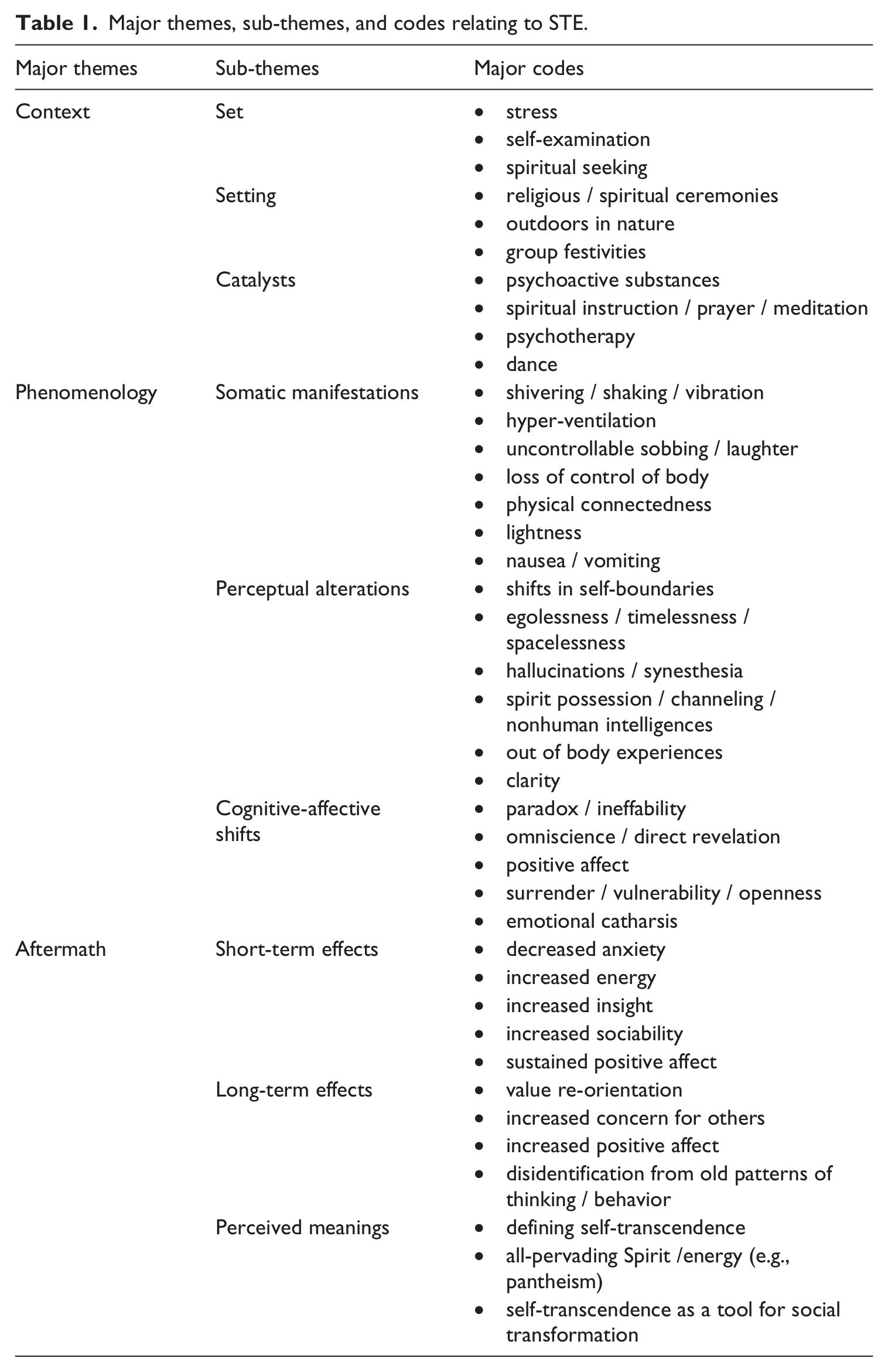
Three major themes emerged from interview data: context, phenomenology, and aftermath of STE. Each of these was further divided into distinct sub-themes (Table 1). Contextual sub-themes included set, setting, and catalysts. Phenomenological sub-themes were somatic manifestations, perceptual alterations, and cognitive-affective shifts. Aftermath sub-themes included short-term effects, long-term effects, and perceived meanings. Eleven participants described more than one STE from their lifetime. In the sections below, themes and sub-themes are defined and illustrated using participant quotes from all reported experiences. Afterwards, a preliminary model of STE is presented.
Major themes, sub-themes, and codes relating to STE.
Major theme 1: Context
Context is defined as the set, setting, and catalysts surrounding STE. These were often described as the initial conditions leading up to experiences of self-transcendence. Participants’ overall life situation, and mental and emotional states at the time of these experiences were designated as the set (Fadiman, 2011; Leary and Clark, 1963). Relevant characteristics regarding the time, place, and social situation within which these experiences occurred constitute the sub-theme of setting. The catalysts sub-theme referred to identifiable triggers that may have precipitated STE.
Sub-theme 1: set
The set, or inner-world of the individual in the time surrounding STE, played an inextricable role in their occurrence. Participants often described their life situations in great detail, with the most commonly reported sets being periods of stress, self-examination, and spiritual seeking. One participant described an experience during early adulthood:
Leading up to this I was kind of experiencing a dark night of the soul where I was having panic attacks, really intense panic attacks, and I had gone on Zoloft for a few days and I had a violent reaction to it.
Six other participants described their experiences as occurring around significant conflicts with loved ones (e.g., parents, spouses). One recounted, ‘My marriage of quite a few years was over … it had just been a very frustrating experience, because I felt in that relationship that I was alone.’ In contrast to such stressful situations, four participants reported STE occurring during peaceful states of self-examination, usually in the context of a structured contemplative practice such as meditation, or while in a reverie.
Sub-theme 2: setting
Setting included times, locations, and social situations surrounding participants’ STE. These experiences were reported to occur from 31 years prior to the interview to one week before the interview, and most occurred during adulthood. However, one participant described a STE at age seven, and two others reported experiences during adolescence (ages 14 and 17). The STE (though often referred to as possessing a ‘timeless’ quality) were described as lasting anywhere from a few seconds to two months, and in a few cases were reported to be ongoing. One participant, describing a STE of spiritual awakening said, ‘Well, it never really stopped … the shift is permanent.’
Regarding the social and physical locales where these experiences occurred, the most prominent were religious or spiritual ceremonies (e.g., rituals, meditation retreats; n = 8), outdoors in nature (n = 6), or at group festivities (e.g., concerts, raves; n = 3). One participant described the setting of his STE as, ‘the Good Friday and Saturday before Easter. It was a 2-day festival at the Church I go to,’ and remarked, ‘we’re all here for the same reason, to sing praises to God and with the expressed purpose of being part of this larger community, to transcend our individual thoughts and desires.’ Another participant recounted her experience in a natural setting: ‘I spent 2 days driving around the mountains and getting out and walking up to waterfalls.’ Other settings included large group festivities (e.g., Burning Man).
Sub-theme 3: catalysts
In some reports of STE, participants described specific catalysts, such as psychedelic drugs, or intentional meditative practice. However, in other cases no obvious catalyst could be pinpointed by the participants or researchers. Such experiences are referred to as ‘spontaneously occurring’ (Vaitl et al., 2005: 99), and generally elude precise causal explanation. Of the overt catalysts of self-transcendence, the most common were psychoactive substances (e.g., Ayahuasca, LSD, MDMA; n = 4), instruction from a spiritual teacher (n = 3), dance (n = 3), meditation (n = 2), psychotherapy (n = 2), and prayer (n = 2). One participant described this experience with a spiritual teacher during a three-day meditation retreat:
I sat and was looking up at this guy, and he looked at me kind of very sharply, and he said, ‘How big are you?’ And in that moment something shifted. It was like my normal sense of being in the body went away, and all of a sudden I was not the body and I was looking at the body from a place that was behind my head and up, I don’t know, back maybe nine inches and up a little bit. And I could feel my whole body from there, but I could also feel all the space around the body that wasn’t any different than the body. And I said, ‘I have no size.’
Theme 2: Phenomenology
The phenomenological qualities of STE varied widely, falling into three main sub-themes: somatic manifestations, perceptual alterations, and cognitive-affective shifts. Somatic manifestations are defined as physical or embodied reactions during STE. Perceptual alterations refer to changes in the ways participants perceived themselves and/or their surroundings. Cognitive-affective shifts were defined as marked changes in participants’ emotional states or thought processes during STE.
Sub-theme 1: somatic manifestations
A number of somatic manifestations and embodied physical sensations were reported, including shivering, shaking, and hyper-ventilation (n = 4), uncontrollable sobbing and/or laughter (n = 4), temporary loss of control of one’s body (n = 3), a sense of physical connectedness (i.e., through touching other people or natural objects such as trees; n = 3), feelings of lightness (n = 3), nausea and/or vomiting (n = 2), feelings of ‘vibration’ (n = 2), glossolalia (i.e., speaking in tongues; n = 1), and what one participant described as a ‘full-body orgasm.’
One participant described a STE in the wake of a powerful psychotherapy session, saying, ‘I felt like when the wind blew, it blew through me, and everything was light, and I remember feeling light and a lot of warmth. So I guess it was really physical.’ Another participant reported a spontaneously occurring STE as she sat in quiet contemplation in her home and felt warm sunlight on her skin, noting:
Sunshine quiets the mind because it brings you into your body, and if you can go into your body, it is the portal to this. And I didn’t realize any of that when I was going through it, but now looking back on it, the body is the portal.
Sub-theme 2: perceptual alterations
Perceptual alterations involved changes in the nature of sensory experience, and were largely consistent with other altered states of consciousness, entailing marked qualitative differences between these states and normal waking consciousness (Garcia-Romeu and Tart, 2013; Ludwig, 1966; Tart, 1969). The most commonly reported perceptual alterations included shifts in perceived self-boundaries (e.g., unity, expansiveness; n = 9), egolessness (n = 6), timelessness (n = 6), hallucinations (n = 5), experiences described as spirit possession, channeling, or the presence of nonhuman intelligences (n = 5), synesthesia (n = 3), out of body experiences (n = 3), and extraordinary perceptual clarity (n = 3).
Shifts in self-boundaries
Expansive shifts in self-boundaries are perhaps the crux of STE, and have been referred to as a sense of, ‘Unifying Interconnnectedness’ (UIC; MacDonald and Holland, 2002a: 1013). One participant stated, ‘I had the expansive sense that somehow that wall between me and the world had come down … it was the breakdown of the boundary of what had normally been myself.’ Another participant remarked, ‘I felt the intrinsic unity of all, the interdependency of everything, I got that. I just got it, just implicitly I understood it.’ Another participant, describing a spontaneously occurring experience in nature said, ‘Everything is as it’s supposed to be, and I’m part of all of this. I’m part of the plants and part of the sun and part of the ground, and I’m part of this big living entity.’
Timelessness and spacelessness
Sensations of timelessness and spacelessness were commonly reported features of STE. One participant described her experience during a religious ceremony, saying, ‘I totally lost all sense of time and space.’ These qualities did not always coincide, but are congruent with classical accounts of transcendent and mystical experiences (James, 1902). One participant remarked, ‘I like the idea thinking back on it, that it was timeless. That it didn’t have a beginning and middle and end, and how much can happen, and how much I can change in the blink of an eye.’ Another participant noted this marked alteration in the passage of time:
It’s funny … I would say it lasted probably about 10 seconds, and it felt like four hours. It was like a tiny little opening that lasted, it was miniscule, and it opened up for me and was vast. So it was like a doorway into something bigger than itself, that felt like it lasted a long time and yet I would say in clock time it lasted maybe, just that moment of connect was about maybe 10 or 15 seconds.
Anomalous spatial experiences were also reported. One participant recounted that while sitting in a restaurant after hearing a profound spiritual teaching earlier in the day, ‘my whole being-consciousness was exploded into radiant energy throughout everywhere. It wasn’t locatable in my body; it was just everywhere.’ Three participants reported experiences of being out of the body (OBE) in relation to self-transcendence. One interviewee who had traveled to volunteer at a 10-day meditation retreat reported:
As I was sitting I experienced that I was leaving my body or something. I literally felt like I was losing control of who I am, and I got really scared because I’d never had such a strong sensation before … I couldn’t stay near the floor, it was like I was flying or something, and I opened my eyes to try to control it, and I couldn’t even open my eyes.
This account also illustrates the somatic manifestation of loss of control of one’s body (reported by three participants), which tended to occur in conjunction with OBE or experiences of channeling, discussed in the next section.
Channeling and spirits
Five participants mentioned channeling in their accounts of STE, either they themselves being the channel, or being in the presence of someone else who was described as the channel for nonhuman ‘entities,’ or ‘spirits.’ One participant described this experience:
Something just opened before me, above my head. It was like a tunnel. Call it energy, I don’t know, it was just like my consciousness and that which was coming from above became the same, and I couldn’t speak myself, it was like what I was saying was just transferred to me.
This same interviewee also reported that in the aftermath of another STE, he felt that his awareness of, ‘beings that are not from this world began to increase. I couldn’t see them with my eyes, but I could feel them all around.’
Hallucinations and clarity
Hallucinations and clarity are treated together here in order to juxtapose these seemingly opposing forms of perceptual alteration. Hallucinations are defined as sensory perceptions without corresponding external stimuli (American Psychiatric Association, 2000). Five participants reported some form of hallucination (e.g., visual, auditory, tactile), and these were often related to mythical, spiritual, or religious figures. One participant describing a STE under the influence of MDMA at a group festivity said:
I felt the presence of the Goddess. I saw Isis, who was – the story is she cries when her husband dies, Osiris, and her tears make the Nile River flood, and I could see that, and I just felt these waves of water and I started crying, and I grieved out a lot of stuff that I had been carrying and I saw myself die. It was weird. I saw my body on a pike with blood coming out. But I didn’t look like myself. I looked really pale.
In contrast to such frank hallucinations, three interviewees described their STE as possessing a quality of extraordinary perceptual clarity. One participant described a STE in the midst of a group dance ritual when she was seven years old:
The most strong was the sense of illumination and clarity, just crisp clarity … it was like a slowing down, so it just felt very progressive, like sand or mud falling to the bottom of a water glass, until there is just the clarity of the water.
Sub-theme 3: cognitive-affective shifts
Cognitive and affective shifts comprised marked changes in thoughts or emotions. Cognitively, participants described a sense of paradox or ineffability (n = 6), as well as omniscience or direct revelation (n = 3) during their experiences. Affectively, STE was consistently described as evoking positive emotional states (e.g., joy, love). Reports of surrender, vulnerability and openness were also common (n = 9), as were experiences of emotional catharsis (n = 4). Perceptual alterations and cognitive-affective shifts were often reported together as parts of the same experience. Take this account for example:
There was nothing that led up to it. There was no beginning, and it grew and grew and all of a sudden I was in this connected place. It felt like I was in my body, in the world, and then just in a flash I was in a different environment, and a different experience. Visually, I could see it, but I could feel it as well. I was in a light, and it just had a hint of shimmer, and a hint of yellow in it. It filled everything. It went forever. It wasn’t blinding – it felt like it engulfed me. The body experience I had was that there was no body. It felt normal that I had no body, and it felt normal that this white light was there. The emotional feeling that I had was that there was so much love, that there’s almost no words for it. It was thousands of times more love than I’ve ever felt. And then I realized I wasn’t feeling love, I was love.
Cognitive-affective shifts fell in four broad categories: positive affect, vulnerability and openness, paradox and ineffability, and emotional catharsis.
Positive affect
All participants reported some form of positive affect regarding their STE, including feelings of joy, love, compassion, forgiveness, wonder, and freedom. One participant, describing an OBE at age 14, said she felt, ‘contentment and peace and totally just free and taken care of, like nothing was bothering me.’ Other participants described more intense feelings such as ‘bliss,’ ‘euphoria,’ and ‘ecstasy.’ Peace was commonly reported, sometimes occurring in the midst of chaotic situations. One participant described this experience during a confrontation with a hostile crowd in a foreign country:
All of a sudden, a kind of peace came to me – a peace that brought such confidence that nothing would happen, I could even feel it through my bones, that yes, I am not alone here. There is something bigger. And everything was in such an exaltation.
In addition, feelings of love were often described. One participant recounting an experience during a ritual dance at age seven recalled, ‘feeling so much wanting to pour out love for this other being. Just that love flowing in between, like a fountain of love.’
Surrender, vulnerability, and openness
Cognitive-affective shifts involving feelings of surrender, vulnerability, and openness were commonly reported. One participant recounted his experience at a two-day Ayahuasca ceremony with a Santo Daime Church congregation. He described the first day of the process as physically and mentally painful, and said it was ‘the worst experience I have ever had there.’ However, after a 12-hour break, at the beginning of day two he reported, ‘I made a real conscious effort to let go, to let go of my desires, my expectations about how this thing is supposed to happen, and it was awesome.’ This conscious effort to surrender precipitated a pronounced shift in the participant’s experience of the ceremony, which was subsequently described as, ‘the best one [Ayahuasca ritual] I’ve ever had,’ with deep feelings of group cohesion and connectedness to a greater whole.
Vulnerability and openness in the form of emotional catharsis was an important aspect of STE. One interviewee described this incident during a romantic relationship:
I had a cathartic experience of tears and love opening toward her and toward myself, toward life. I think I shed a layer back then of some kind … I was told that I seemed like a really, a whole different person after that because I was so much more open and vulnerable.
Another participant said that after an emotional catharsis during a profound psychotherapy session, ‘I felt like I didn’t have to worry about anything, and I didn’t have to have any walls up. The best word I have for it is vulnerability, utter vulnerability … I felt invulnerable because I was so vulnerable.’ This quote additionally illustrates the following sub-theme, paradox.
Paradox, omniscience, and ineffability
Paradox, omniscience, and ineffability share the common principle of being beyond rationality and everyday conceptualization. One participant reported this paradoxical realization while under the influence of LSD in a natural setting: ‘the feeling of not only being part of all creation, but being the creator.’ This participant also described a sense of omniscience or direct revelation during the experience:
I came into the part of myself that knows everything, is timeless, and is not limited by space or matter, and it said to me, ‘You haven’t a possible scintilla of a hope of really knowing this level of reality, so you can stop fussing about trying so hard.’
Such accounts also involved a sense of ineffability regarding indescribable features of STE. One interviewee stated, ‘It gives an understanding that is non-conceptual. There’s something that’s changed that the mind can’t really wrap itself around.’ This quality was consistently reported as a major difficulty in providing an adequate account of STE. Another participant remarked, ‘Part of the experience for me is how words don’t even begin to capture … how in a way language and words themselves are born of this duality that kind of falls away.’ Similarly, another interviewee explained, ‘The mind is trying to explain this to you, but it’s not a mind thing. The minute you come out of it, you’re already suffering with trying to explain it through the apparatus of the mind.’
Theme 3: Aftermath
The three major themes derived from the interview data were structured in part according to their temporal dimensions, ranging from initial conditions and context, to phenomenology, and concluding with the aftermath, outcomes, and repercussions of STE. These consisted of short and long-term effects, and meanings attributed to these experiences in retrospect. Short-term effects ranged from a few hours, to as long as two months after STE, and were described as consisting mainly of decreased anxiety, increased energy, insight, sociability, and sustained positive affect. Long-term effects were largely related in terms of enduring transformation and impact, (e.g., ‘it completely reorganized my life’). Perceived meanings portrayed participants’ thoughts about these experiences, and how they made sense of them in the greater overall scheme of their lives.
Sub-theme 1: short-term effects
Short-term effects immediately following STE lasted on average approximately two to four weeks. One participant described his STE and its aftereffects as, ‘a peak and a tail.’ After ingesting Ayahuasca at a Santo Daime Church ceremony, another interviewee said, ‘I was feeling really good for about four weeks … There was just this sustained aftereffect and so for weeks I just felt happy and social and energetic, like a larger worldview.’ A participant recounting an experience at a 10-day meditation retreat and the period afterwards, said:
I was extremely full of energy, I was smiling, I was happy, I was almost kind of guessing what was needed for everything, it was like a perfectly aligned moment, every single moment … The peace stayed with me for probably the next two weeks, but there wasn’t this strong connection, or this strong happiness anymore, but some kind of peace remained with me.
Short-term effects tended to fall within a fixed period, as opposed to long-term effects that were generally described as persisting.
Sub-theme 2: long-term effects
Most participants (n = 14) reported long-term effects attributed to their STE. These lasted years or decades, and included transformations in worldview, self-concept, and value-orientation. Consistent with this finding, these experiences were described as entailing a high degree of psychological impact, e.g., ‘it probably was the most profoundly influential experience I can put my finger on.’ Another interviewee stated, ‘There was something imprinted on me from those experiences that I carried with me from then forward.’
Two participants reported short-lived STE seen as transient and not profoundly transformative, one being an experience of spacelessness and immense light during a rock concert, and another being the occurrence of glossolalia, or speaking in tongues during Christian prayer. Such instances suggest the necessity of proper integration for transformative meaning-making to occur, and also highlight the distinction between temporary altered states of consciousness, and persisting shifts in individuals’ attitudes and behavior. Nevertheless, it is important to note that STE is not a definite means of achieving personal growth, but represents one potential avenue among many that may lead to positive transformation.
Aside from these two experiences, and another that had occurred just one week prior to the interview, all other instances of STE were reported as occasioning significant long-term effects falling in these broad categories: value re-orientation, increased concern for others, increased positive affect, and disidentification from old patterns of thinking or behavior.
Value re-orientation
Participants reported shifts away from conventional and materialistic values, towards more personally meaningful, existential, and spiritually oriented concerns. One participant said that after a powerful psychotherapy session, ‘it was like a veil was lifted and I’ve been facing that direction ever since. I’ve been trying whatever I can do to go back to that.’ As a result, this individual reported initiating a regular meditation practice that has been ongoing since the experience (> 9 years). Another participant stated, ‘The experience induced a shift within me, a shift in how I perceived myself and how I perceived reality, like I had a new vision, new eyes. My perception became more expanded. My spiritual interests and explorations deepened.’ Additionally, three interviewees reported that their STE played a significant role in precipitating later career changes.
Concern for others
Increased empathy, compassion, and altruism were reported as an important outcome of STE. One participant described her experience as leading to, ‘more clarity, less anxiety, and more compassion.’ Such shifts also seemed to result in improved relationships. One participant, reporting a STE at a religious ceremony with her sister, stated, ‘I think it changed the way my sister and I treated our mother, with more respect.’ Another participant remarked,
They’re really sort of gateways in a process of self-healing, and finding ways to be of more service to other people. It’s shifted my political views. It’s shifted my relationships. It’s shifted who I am in the world in very significant ways because of having that lived experience of connectedness, but not connectedness in a sort of neighboring sense, but connectedness in the sense that we’re really all woven out of the same fabric.
Positive affect
Positive affect was a recurring theme in descriptions of STE, appearing prominently within phenomenology, short-term, and long-term effects. Words such as ‘joy,’ ‘peace,’ and ‘love’ were remarkably common in participants’ narratives. One participant reflected, ‘It’s given me a joy that is sometimes very overt and powerful, and sometimes it’s this deep hidden joy that’s not anything the mind can really grab onto, but it’s like an empty serenity that is always there amid everything.’ Feelings of enduring peace and decreased anxiety were also reported. For instance, one participant summarized the long-term effects in this way: ‘I’m not afraid anymore. I’m not afraid of death, but even more important for me, I’m not afraid of life.’ Another participant noted of her experience, ‘I felt like a vehicle for love. It helped me to love myself more and exude more love.’
Disidentification from old patterns
Another class of long-term effect involved disidentification from old patterns of thought and behavior. This manifested in a variety of ways, from letting go of particular emotional patterns and ways of relating, to a wider transcendence of prior self-concepts. Regarding the former, one participant held that her STE ‘helped me to release my anger.’ Another reflected, ‘The way I used to be was dying, of being the dutiful daughter. I’m done with that, and I need to worry about me and my life and let my parents figure things out for themselves.’ Hence, STE provided insight regarding prior ways of thinking and being, allowing individuals greater breadth to redefine themselves in healthier ways. Another participant stated, ‘It was a shift out of that mental identity that I had believed in before.’ Still another interviewee, recounting a STE on LSD, said, ‘A self transcended can never re-stuff itself back in the box. Humpty Dumpty can’t get put back together again because he’s really been let out of the egg.’
Sub-theme 3: perceived meanings
Most of the experiences reported in this study occurred more than five years prior to the interview. In retelling these stories, participants were asked about any novel insights regarding self-transcendence, or lessons they attributed to these experiences. After recounting three incidents of STE from his life, one participant reflected:
To live is to struggle, and to survive is to find meaning and hope and great joy in the epic struggle of all of that. And the meaning is connected to relationships between people, you know, the care that people have for others, and there’s something self-transcendent in that. That I go beyond myself to the need of the other, and others go beyond themselves to the needs of others around them, so there was a self-transcendence in that. We live not just for ourselves, but for others, and that somehow makes a difference.
Other perceived meanings involved: proposed definitions of self-transcendence, the presence of an all-pervading Spirit or energy (e.g., pantheism), and the potential usefulness of self-transcendence as a tool for social transformation.
Self-transcendence defined
Several participants offered their own definitions of self-transcendence in the context of their narratives and the surrounding discussion. One stated: ‘Self-transcendence is a kind of movement beyond the confines of the self to a larger whole of which the self is a part,’ a definition which closely parallels those in the theoretical literature (Cloninger et al., 1993; Reed, 2003). Another said that for her STE comprised, ‘wake-up moments where we get more of a vantage point on our patterns, and that flips the meaning of everything – it calls into question what’s meaningful. Those experiences were most meaningful because they were outside the normal pattern.’ Another participant described self-transcendence in this way:
I feel that whenever one experiences a shift in the experience of oneself, of life, of how reality is, you’re transcending that old thing, so that in itself is the kind of opening through consciousness to more, different experiences of life, broadening the capacity.
Pantheism and spirit
The perception of an all-pervasive Spirit or energy (e.g., pantheism; Levine, 1994) was another topic that emerged regarding the meaning of self-transcendence. One participant stated his experiences led him to believe that, ‘Divine energy is at the heart of everything, and life is organized around that energy.’ Echoing this stance, another interviewee concluded:
In the ultimate perspective, we’re all, everything is either part of God or part of God’s plan, I’m not really sure if there’s a separation or not, if it’s theism or pantheism, but I’ve come to think, mainly through this experience that there is a higher structure or order to things.
Another participant, describing a shift in his religious worldview after a STE said, he afterwards identified as,
A pantheist, which is that if divinity is in everything, then everything is divine. To worship one thing as a way of not worshipping another is a mistake. It’s as if I’m in love with a woman, but I’m not in love with her left arm … There’s something fundamentally bizarre about that because it’s ignoring the obvious unity.
Although not all participants explicitly used the term pantheism in their accounts, the common theme of an all-pervasive energy was consistent across a majority of the participants, and identifiable in a number of responses, e.g., ‘the rocks were just as alive as this tree too – everything was alive and part of it. So it was less like I’m a human and that’s a mountain, and more like all as a kind of bubbling or vibrating.’
Self-transcendence as social good
The final cluster of perceived meanings focused on the potential usefulness of self-transcendence in occasioning widespread social transformation. One interviewee stated, ‘My feeling is that self-transcendence is a social good … It should be encouraged, and the educational system should be geared around it.’ Other participants reaffirmed this position. One said, ‘We need to talk about this, because we need to have these pointers to show us where we’re going.’ Another mentioned the difficulty of social stigma around such experiences, saying, ‘For many years I didn’t tell anyone about this other than my priest. I am ready now to talk about this. Thank you for the opportunity.’ Recounting narratives of STE provided participants with an opportunity for self-reflection that often evoked positive emotional states in the moment. As the primary interviewer, the first author experienced a palpable ‘after-glow’ from hearing participants’ accounts, and feeling a concurrent sense of elevated mood and interconnection. It is possible that participants’ positive feelings were transferred to the interviewer, and potentially carried beyond the immediacy of the interview, congruent with research on emotional contagion (Pugh, 2001). One participant reflected:
Self-transcendence is probably happening all over the place you know, and for many in very hidden, quiet ways, so it would seem that this kind of extraordinary stuff is happening that we need to tune into. And if there was a kind of a shared sense of the collective of all of that, what that might mean for the world.
Another observed, ‘all this suffering business is a product of not knowing how one we are, or allowing ourselves to experience the oneness that’s always happening.’
Building a preliminary model
The present study was conducted towards constructing a preliminary model of STE in healthy adults (see Table 1). Our findings suggest the following. First, certain contexts are associated with STE. These include mental sets of marked stress, self-examination, or spiritual seeking, natural settings, or spiritual/religious ceremonies, and the presence of particular catalysts such as meditation, prayer, psychotherapy, or the ingestion of psychoactive substances (though in some cases no catalyst was identifiable). The terms set and setting were first introduced in the psychological literature surrounding psychedelics such as LSD and psilocybin (Leary and Clark, 1963), wherein these drugs were directly implicated in the alteration of consciousness. However, the results here suggest that other non-drug factors may also elicit STE, hence our introduction of the broader term catalyst.
Second, the phenomenology of STE as described in this study largely parallels existing accounts, including ineffability, insight, loss of self-control, unity, positive affect, vulnerability, and timelessness (Garcia-Romeu and Tart, 2013; Beauregard, 2011; Levin and Steele, 2005; Reed, 2003; Waldron, 1998). A range of somatic manifestations (e.g., shivering, lightness) were also reported, representing an area that is not well-documented in the literature, but remains open for further exploration (Hartelius, 2007; Waldron, 1998). It should be noted that although positive affect is often reported concurrent with STE, other aspects of the phenomenology of STE may be frightening or otherwise disorienting, including hallucination, and OBE.
Third, these experiences occasioned both short- and long-term effects, including increased energy, positive affect, and concern for others, decreased anxiety, value re-orientation, and shifts in worldview and self-concept among others. These results were also congruent with literature on transcendent and mystical experiences (James, 1902; Levin and Steele, 2005; Waldron, 1998). However, findings on perceived meanings, especially regarding pantheism and transcendence as a tool for social transformation were relatively novel, and though tangentially represented in other models (Graves, 1981; Laszlo, 2008; Levine, 1994; Murphy, 1969; Wade, 1996; Wilber, 2000), also bear further investigation.
Finally, the current findings are generally congruent with Waldron’s (1998) model of a continuum of transcendent experiences, positing that such experiences fall on a spectrum ranging from ordinary consciousness, to mild transcendent experiences such as flow states (Csikszentmihalyi, 1990), and progressing to more intense transcendent experiences including mystical and ‘ultimate level’ (Waldron, 1998: 110) experiences. Similarly, one participant remarked, ‘When I think of transcendence, I think of a movement beyond one space to another space, and that there’s somehow a connection between both, so it’s not a split, but there’s kind of a continuum.’ Participant accounts varied in intensity, and possessed features similar to flow states, psychic phenomena (e.g., channeling, OBE), and mystical experiences, indicating the possibility of various classes of STE. However, situating such subtle and complex experiences along a static linear continuum may be inaccurate and misleading. Conceptualizing different classes of STE as nearby countries on a map, rather than ascending rungs on a ladder, may allow theorists to envision a more multidimensional classificatory approach (Ferrer, 2001).
Several themes and sub-themes in this preliminary model contain some overlap. For instance, set and setting are often greatly interrelated. One participant recounted a STE involving a high-stress emotional state (set) during a confrontation with an angry mob in a foreign country (setting). To divorce the set and setting would be a misleading and incomplete representation of the total context. The sub-theme of positive affect also takes multiple roles as part of the phenomenology and aftermath of STE. The narrative properties of qualitative data provide richly complex and descriptive accounts of subjective experience that are open to multiple interpretations, and less amenable to precise, straightforward analysis. However, distinctions have been made as parsimoniously as possible given the interview data and current state of the literature. In keeping with this caveat, it seems appropriate to conclude this section with a participant’s account of a STE occurring during a destructive monsoon in a foreign country:
That it was the most profound experience of meeting God in this chaos and in this mess and a sense that everything in my life had prepared me for that moment, and that woman was the catalyst, you know, in her circumstances. So I guess for me that was a kind of self-transcendent experience in the most unlikely place, in mucky muddy sewage rainwater. It wasn’t a blissful experience. It was like the opposite. And in that there was an incredible sense of unity with everyone, with the people who were struggling there and able to transcend it, able to rise beyond it … I guess the feeling that remained with me was immense gratitude and awe and joy. It wasn’t happy, happy stuff, but it was a deep joy and a deep sense of connectedness with everything, and with God being at the heart of everything. Everything, and the people, and just a deep sense of joy, and indeed, that happened I think in 1991, that’s about 20 years ago now, and it’s still one of the things I would say is a milestone time of my life, it’s a landmark time. So it was that important.
This account demonstrates how in one brief paragraph so many disparate themes from setting and catalyst, to phenomenology and effects can be present, and so intimately intertwined. It also exemplifies the profound significance and transformative potential of STE.
Discussion
This study proposes a preliminary model of STE based on qualitative interview data in a sample of healthy English-speaking adults. These findings are limited in their generalizability due to the small, homogeneous, and geographically confined participant sample. Cross-cultural research has found variability in measures of self-transcendence across samples of differing nationalities, suggesting culture as a potential mediator of the construct (e.g., Farmer et al., 2003). Future research in larger and more diverse populations is warranted at this time.
Because no outside observers were interviewed, this study design cannot provide external validation of participants’ first person accounts of aftereffects. However, recent research found that psilocybin-occasioned mystical experiences did result in notable positive changes in volunteers’ attitudes and behaviors as confirmed by community observers (Griffiths et al., 2006, 2011). Future research may benefit from inclusion of third-party data to evaluate the objective validity of participants’ first-person accounts.
The phenomenology of STE can be vastly complex and varied, and therefore necessitates further investigation to better define STE and its outcomes in the context of individuals’ lives. This includes ongoing investigation of the pathological manifestations of self-transcendence as well as its potential role in promoting enhanced well-being in healthy individuals. Along these lines, the American mythologist Joseph Campbell remarked, ‘The psychotic drowns in the same waters in which the mystic swims with delight’ (cited in Grof, 2000: 136). It is therefore important to remember that STE is not categorically pleasant or positive in nature, and can sometimes be associated with trauma and/or dissociation (e.g., Grabe et al., 1999).
In the five-factor model of personality, NEO openness has been characterized as a personality dimension related to ‘permeability of consciousness’ (McCrae and John, 1992: 198), and has exhibited significant correlations with TCI self-transcendence (MacDonald and Holland, 2002b). Measures of NEO openness have demonstrated significant and persisting increases after psilocybin induced mystical-type experiences (MacLean et al., 2011). Similarly, investigating the effects of psychoactive substances, meditation, and prayer on trait measures of self-transcendence could provide useful information regarding the efficacy of such techniques in eliciting lasting shifts in self-concept and worldview. While such research does not amount to an endorsement of recreational drug use, it is congruent with a growing body of evidence suggesting that psychedelics, when administered to carefully screened and well-prepared individuals in controlled settings, can provide a relatively safe and reliable method of inducing profound, transcendent altered states of consciousness that may hold considerable therapeutic potential (Gasser et al., 2014; Griffiths et al., 2006, 2008, 2011; Grob et al., 2011; Johnson et al., 2014; Krebs and Johansen, 2012, 2013; MacLean et al., 2011; Moreno et al., 2006).
Research exploring the neural and genetic bases of self-transcendence will continue to inform our understanding of relevant biological mechanisms related to STE, and other spiritual experiences, as well as psychosis (Garcia-Romeu, 2010). Furthermore, the role of self-transcendence and STE in development remains an area open for further study at this time (Erikson and Erikson, 1998). Such investigations would benefit from interdisciplinary methods incorporating biological (e.g., neuroimaging) and psychometric data with qualitative analyses of first-person experiences to provide a more comprehensive understanding of the phenomena in question (Lutz and Thompson, 2003; Varela, 1996), as well as perspectives from integral and systems approaches (e.g., Wilber, 2000).
Effects of STE on health and well-being, as well as ecological attitudes and behaviors may provide important inroads towards promoting social cohesion, peaceful resolution of conflicts, and ecologically sustainable behavior (Levin and Steele, 2005). Some theorists have suggested that at this point in history, nations at the leading edge of technology and education must make an effort to move away from isolationist views of the self, towards more interconnected, self-transcendent worldviews which take into account the plight of developing nations, ecological systems, and the cosmos at large (Graves, 1981; Laszlo, 2008). The cultivation of STE might indeed be a useful tool towards achieving these ends through raising awareness of the inherent unity that exists between all life (Murphy, 1969; Walsh and Vaughan, 1993). Therefore, a more extensive appreciation of this topic may help promote further sustainability and collective advancement in contemporary society.
Footnotes
Acknowledgements
The authors would like to thank Christopher Dryer PhD, and Christine Brooks PhD for their guidance on this project.
Funding
Funding for this research was provided in part by National Institute on Drug Abuse Grant T32DA07209.
Notes
Author biographies
