




Abstract
This article presents a qualitative research method, Visual Network Analysis (VNA), which is theoretically situated within the relational turn, and more particularly within sociomaterial and sociotopological approaches. Both approaches consider both human and nonhuman entities in social practices, and adopt a relational perspective in order to study these practices. VNA provides innovative tools for qualitatively analyzing social situations by constructing, analyzing and interpreting visual networks based on tailored observatory and/or interview techniques. To that effect, VNA adopts the notion ‘network’ as a method (rather than as a structural representation of social life) that allows to trace the complex entanglements by means of which specific practices are constituted. The article presents the process of conducting VNA by focusing on four key steps: collecting and coding relational data; visualizing network diagrams through software; analyzing the form of these diagrams; and interpreting the resulting visualizations by offering narrative readings of these forms (focused on the effects they generate). The article concludes with some reflections on the assets and potential of the method proposed.
Keywords
Introduction
Network discourse has become increasingly prevalent in various areas of social science. Over the last decades, various approaches have proliferated that seek to scrutinize the unique characteristics and properties of networks (Castells, 2010; Latour, 2005; Scott, 2017). These approaches have emerged both from quantitative and from qualitative orientations. First, from a quantitative point of view, Social Network Analysis (SNA) is perhaps the most renowned. This approach focuses on analyzing the structural properties of a social network of interconnected members (a family, a school, a company, etc.). Within formal SNA, the majority of studies focuses on the mathematical qualifications of these networks in order to account for structural aspects of social life (Borgatti et al., 2009). As an effect, qualitative research in SNA has remained relatively scarce, but is nevertheless sometimes deployed (Contandriopoulos et al., 2017; Crossley, 2010; Heath et al., 2009; Knoke and Yang, 2008).
The qualitative approach, secondly, largely originated from the ethnographic tradition of social anthropology (Knox et al., 2006). At present, networks are deployed within a variety of currents such as Science and Technology Studies; Actor-Network Theory; governance studies; assemblage studies; and so forth. Even though largely differing in aims and scope, many of these studies adopt networks neither to focus on discovering social structure, nor do they consider networks to be blueprints of how social life is organized nowadays. Rather, qualitative approaches largely adopt the notion ‘network’ as a method that allows to trace the complex entanglements by means of which specific practices are constituted (Attride-Stirling, 2001; Knox et al., 2006). Furthermore, these approaches are equally claimed to adopt more open, flexible and descriptive methodologies as compared to the more formalistic methods deployed in SNA (Gamper et al., 2012). However, despite the observation that the potential of using networks as methods in qualitative inquiry is increasingly being recognized, relatively little attention has been given to how to construct, visualize and analyze networks as integral part of the research design (Fenwick and Edwards, 2010; Venturini et al., 2016).
This article aims to provide some tools that allow to address this gap, by presenting a comprehensive method for the visualization and interpretation of qualitative data by means of network diagrams. More specifically, the method proposed in this article is a further, qualitative elaboration of Visual Network Analysis (VNA; Latour et al., 2012; Venturini et al., 2016). The prime aim of VNA is to come to an integrated understanding of the relational composition of a particular practice under investigation, and of the effects that these compositions generate. In doing so, VNA is concerned with the visual rather than the structural (social) properties of networks and offers a conceptual toolkit to analyze and interpret these visual properties (and more particularly the concrete form of specific networks) in a qualitative manner (ibid.).
The structure of this article is as follows. Since VNA is explicitly based on theoretical premises of recent developments in the social sciences and humanities that are characterized by relational thinking, and more particularly of sociomaterial and sociotopological approaches, we start with a concise overview of the main features of these approaches and this sort of thinking. After that, we present two methods for collecting and coding qualitative data in a relational manner. The article proceeds with elucidating how to compose and visualize network diagrams out of these data, moves forward to presenting a heuristic overview for analyzing and interpreting the form of network diagrams in a visual way, and concludes with some reflections on the method proposed.
Theoretical premises of Visual Network Analysis
It should be clear from the outset that VNA is not meant to be generically applicable to each and every qualitative research project. Theoretically, VNA is situated within principles that developed out of the ‘relational turn’ (Dépelteau, 2013). This relational turn is currently being developed in various areas of social sciences and the humanities, including – but not limited to – sociology, anthropology, geography, philosophy, and education. Emblematic of these developments is that they afford ‘primacy, both ontological and methodological, to interactions, social ties (‘relations’) and networks’ (Crossley, 2015: 66). Relationalism rejects dualistic distinctions between individual and society, micro and macro, and agency and structure. In contradistinction to individualist approaches, relationism stresses that individuals cannot be isolated out of the various practices in which they act and operate, and hence, that a singular focus on an individual’s intentions, emotions or experiences eschews the crucial point that individuals are shaped by, and become social actors within, interaction (Crossley, 2015: 66). At the same time, however, relationalism is not to be equivocated with holism. Contrary to holistic approaches, relationalism contends that humans are not singularly determined by social structures: such structures are not to be situated on some ‘higher level’, entirely distinct from human interactivity, let alone one-directionally (deterministically) influencing such activity. In addition hereto, it is important to emphasize that relationalism equally does not denote a form of ‘co-determinism’, in which structure and agency are taken together: relationalists ‘do not think human beings interact with social structures because, for them, this is logically and empirically impossible. . . . The relations between . . . social patterns and individuals are complex, and they cannot be explained with the idea that large “social structures” interact with individuals’ (Dépelteau, 2013:179; Packer, 2018).
Instead of exploring these issues extensively, we limit ourselves to a presentation of relationalism’s distinct features. One of its most salient characteristics is the notion of interdependency, that is, the tenet that no individual’s actions can be reduced to its own capacities. Briefly stated, relationalism contends that actors cannot do what they do without taking into account the relations they establish with other actors: all capacities and actions always happen in relation to – and by means of – other actors (Dépelteau, 2015; Latour, 2005). Thus, relationalism adopts a flat ontology in which social practices are characterized by emergent interactions between various actors. Its main focus, then, is both on disentangling which relations are established between which actors and on tracing the effects that such patterns of relations generate, such as the formation and transformation of social practices (Crossley, 2015). Whilst there exist various forms of relationalism (Dépelteau, 2013), the method proposed in this article is specifically informed by sociomaterial and sociotopological approaches. Common to most relationist tenets, both approaches analyze the settings they investigate in terms of the relations between various actors populating these settings. Specific to sociomaterial and sociotological approaches, however, is the assertion that in order to fully apprehend the relational composition of the settings studied, nonhuman actors need to be taken into account as well (Decuypere and Simons, 2016a).
First, ‘sociomaterial approaches’ attempt to understand ‘the constitutive entanglement of the social and the material in everyday . . . life’ (Orlikowski, 2007: 1438). Rather than being an explanatory theoretical framework, sociomaterial approaches should be conceived as offering sensibilities that stand central in the effectuation of a particular study (Fenwick and Edwards, 2010). One key sensibility is that of symmetry, which comprises that taken-for-granted distinctions between the social and the natural, the human and the material, etc., should be suspended and can only constitute a possible end result (rather than the starting point) of inquiry. This amounts to analyzing research settings as distributions of actors and relations ‘in which all entities are initially (only initially) equal and indeterminate’ (Law, 2006: 88). The symmetrical sensibility, hence, does not contend that humans and non-humans are the same, but rather aims to place both of them in the same aforementioned, flat, relational field (Payne, 2017). Hence why many sociomaterial studies adopt the generic term ‘actor’: the notion pertains to each and every entity that is capable of exerting some form of agency upon other entities (Latour, 2005). Actors, being fully dependent on one another, are furthermore considered to be the result of the interdependent relations they uphold with other actors (Decuypere and Simons, 2016a). In that sense, sociomaterial approaches do not take the individual or the group as unit of analysis, but focus on the level of practice, and more especially on how practices are relationally composed and enacting particular sorts of actors (Gherardi, 2012; Law, 2009). It is this distribution of actors, relations, and agency that is designated as a network. In that sense, networks act and function as tools that enable to present the relational distribution of what is being scrutinized: a network is ‘a concept, not a thing out there. It is a tool to help describe something, not what is being described’ (Latour, 2005: 131). Slightly rephrased: networks are methods that assist in giving an account of a particular practice under investigation.
Second, in conceiving of networks as tools that assist the researcher in describing the relational composition of practices, sociomaterial approaches share many similarities with sociotopological approaches. Inspired by mathematical topology, sociotopology is centrally interested in how social practices are distributed in a topologically heterogeneous manner, thereby enacting not only particular sorts of actors, but equally particular sorts of spaces and times (Martin and Secor, 2014; Mol and Law, 1994). As such, sociotopology is often invoked to analyze the multiplicity of spaces and times, which are considered to be concrete effects of the processual relational constellation formed within a particular practice (Decuypere and Simons, 2016a). To that effect, sociotopological approaches stress the notion of form: the way a practice is constituted, and the relational distributions present within this practice, enact a specific form that might shift depending on the relations established between different actors. As far as the notion of ‘network’ is concerned, sociotopology not only asserts that network forms might transmute over time, but equally that the very constitution of this form is what provides particular networks their specificity (Hinchliffe et al., 2013; Law, 2002). Hence, sociotopological approaches assist us in comprehending that social practices should not only be thought of in relational terms (i.e. relations between actors), but equally that these relational compositions enact highly specific (and mutable) forms of time and space.
Drawing on the general tenets of relationalism and more particularly on these two approaches, VNA conceives of networks as tools that enable to present (rather than to represent) how a practice is relationally composed by heterogeneous actors. Networks, hence, assist the researcher in coming to a visual understanding of such compositions in order to focus on the specific effects that these compositions entail. In this regard, VNA does not aim to explain practice by focusing on its function or goals, but rather to understand and explore practice by looking – through networks – at mechanisms that emerge out of a particular composition (Decuypere and Simons, 2014a). In what follows, and based on these theoretical premises, we will outline the different steps involved in conducting a qualitative VNA. Drawing on the work of Venturini and colleagues, the method has been successfully developed and tested within the scope of a research project that sought to account for the role of digital devices in contemporary academic life (Decuypere and Simons, 2014b). Instead of focusing on the macro (e.g. overarching structures or societal evolutions) or micro (e.g. academics’ self-understanding) level, the project scrutinized the level of academic practices as assemblages of interactions between human and nonhuman actors. More specifically, the project inquired about the very specific roles and operations that human (such as professors, PhD students), material (such as paper, blackboards) and digital (such as word processors, web browsers) actors perform in contemporary academic practices. In the next sections, we will exemplarily draw upon the project’s methodological endeavors and results.
Step 1: collecting and coding relational data
VNA offers qualitative researchers tools to conduct a visual analysis of networks that are constructed out of relational data. Accordingly, the process of data collection is of central importance: all subsequent steps are dependent on its quality, systematicity and comprehensiveness. In line with the theoretical premises outlined above, the methodological project of VNA in first instance amounts to following the actors present in a particular practice as they establish relations with other actors in their daily activities (Latour, 2005). Rather than invoking contextualizing and/or explanatory factors, the aim of this following is exclusively situated at the level of describing how a practice is composed precisely – something that has been referred to as trying to keep the level of data collection as flat as possible (Latour, 2005; Venturini, 2010). As such, this closeness to the level of practice is reminiscent of the tradition of ethnography, which equally emphasizes everyday actions, activities and behaviors of human and non-human actors (Fenwick and Edwards, 2010).
Even though different methods of data collection have been suggested by scholars deploying VNA, most of them are presently focused on digital, computerized, and often automated ways of collecting data (for instance by harvesting webs of hyperlinks, analyzing the co-occurrence of words and expressions within texts) (Latour et al., 2012). Collecting data in a qualitative manner is effectuated far less. This is surprising, given the central interest of sociomaterial and sociotopological approaches in the level of practice and the concrete ways in which agency is distributed within practice: How do actors relate to each other on a daily basis? With which actors do they relate the most? Which sorts of actors and relations are decisive in performing a particular activity? These sorts of questions can be productively investigated by means of qualitative data, which allows in turn for the extension of the possible fields in which VNA could be deployed (Venturini et al., 2015). In this section, we present two different ways of collecting relational data on a qualitative basis: one based on observations, and one based on interviews. Both ways have the same overall aim of following the actors and relations present in a particular situation as closely as possible, and to describe these actors and relations as accurately as possible.
Collecting and coding relational data through observations
A first way to obtain insight in the relational composition of a particular practice is by means of structured observations. These observations could be circumscribed as ethnographic detective work (Latour, 1996), where the researcher maps as many actors and relations between these actors as possible. Naturally, the concrete modalities are dependent upon the specific research project, but as a general guideline, strategies might include:
Focusing on a particular (group of) actor(s), and following this actor, and the relations this actor establishes with other actors, through the course of a particular activity or for a certain amount of time (a day, a week, …)
Focusing on a particular type of relation, and scrutinizing when this relation occurs (and between which actors)
Focusing on a particular activity, and mapping each actor and interaction taking place within this activity
A combination of the above
Irrespective of the focus adopted in a particular observatory activity, one can rely on the well-known ethnographic notion of thick description, in as far as the notion of ‘thickness’ is understood in a very specific way: rather than referring to in-depthness and the inclusion of contextual information, thickness here refers to flatness where a maximum amount of concrete actors and actions are being taken into consideration (Decuypere and Simons, 2014a; Latour, 2005). In order to do so, researchers can make use of a notebook in which they record their observations and in which they enclose information regarding each interaction that takes place between two or more actors. The jotting down of actors, relations and additional information is greatly facilitated with the usage of a structured observation protocol. In Table 1, we offer one example of how such a protocol might look like (and again to be adapted in view of the specific research project).
Instance of an observation protocol for collecting and coding relational data.
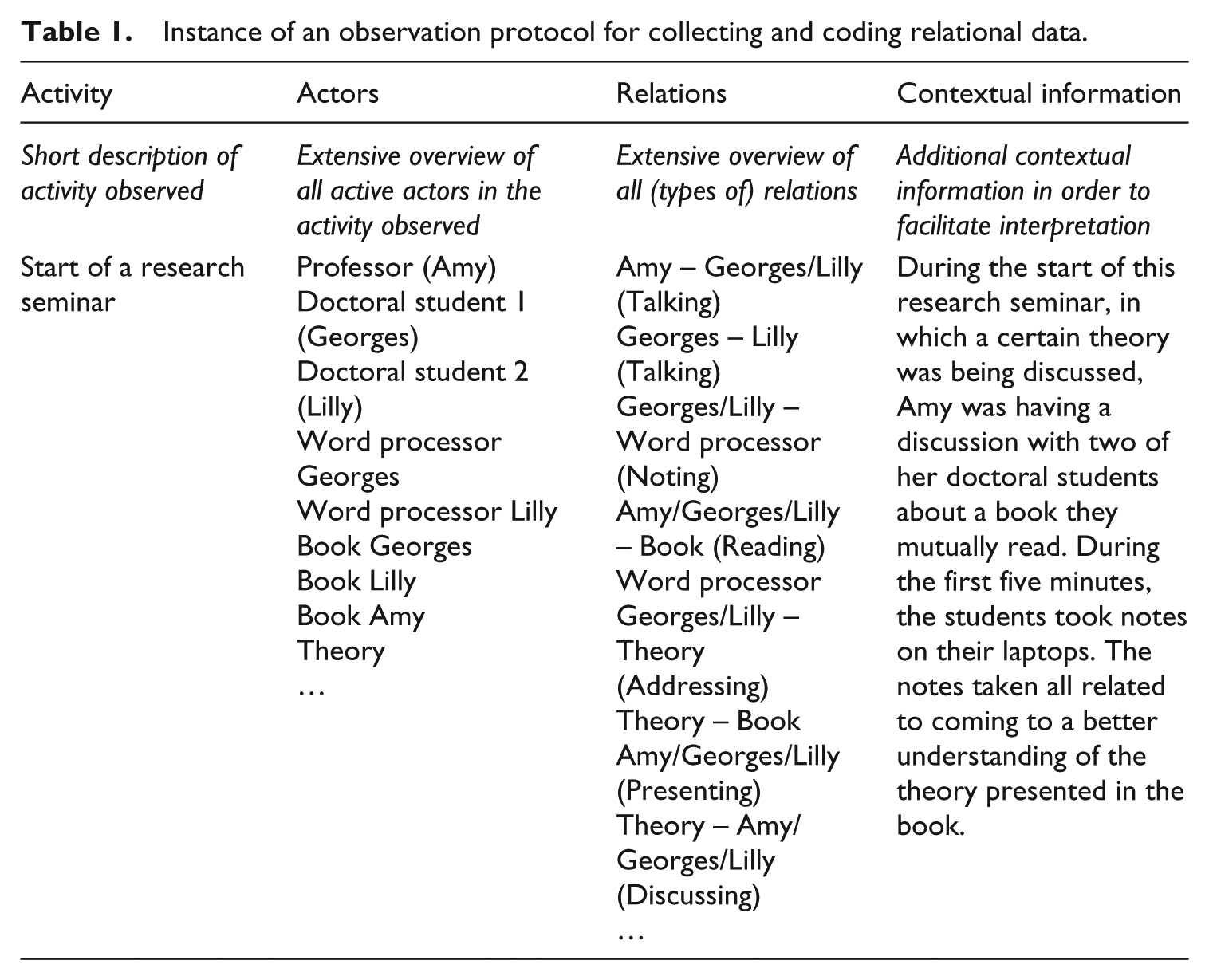
In this (fictional) instance, where the notes of a researcher observing the beginning of a research seminar are presented, focus lies upon the observation of a particular activity, where each actor is taken symmetrically into account. These protocols should, furthermore, be combined with more comprehensive field notes that contain additional information, for instance in the form of a logbook of observed events and of a notebook containing trials that give preliminary accounts of these observations (Decuypere and Simons, 2014a; Latour, 2005). The data eventually gathered will not only allow to construct visual networks, it will equally allow to subsequently analyze and interpret the visual properties of these networks.
It might be clear from the outset: even though this observation method conveys some sense of Arcadian simplicity with respect to its central principles, the requirement of registering each and any actor present and interaction taking place very quickly results in a plethora of information. In that sense, the use of systematized observation protocols attuned to the study under effectuation is crucial (Fenwick and Edwards, 2010). It is important to stress here that such observation techniques are not entirely coalescing with traditional notions of fieldwork, for instance conceived as participatory observation. That is to say, even though the presence of the researcher is very much acknowledged, the central aim of these observations is not to gain access to the field in order to faithfully observe (and subsequently represent) what happens in a particular practice through fieldnotes, but rather to trace and present the work and entanglements that go into producing and sustaining a particular practice; to ‘step into the flux, trace links and connections as they are forged and then dissolved, and study unfolding practices and processes’ (Packer, 2018: 315).
Collecting and coding relational data through interviews
In some cases, observations might not be feasible or even desirable. Depending on the specific area of investigation, ethnographic detective work might be expected to be too intrusive or simply not feasible. For instance, in our own research project, we suspected that participatory observing of academics and their digital devices would prove to be difficult, given the fact that digital devices are constantly used both for professional as well as for personal purposes. This made us not only very doubtful whether or not academics would be willing to be observed both in their professional as well as in their personal activities, it made us equally aware of the desirability (and ethical ramifications) of intruding so profoundly into peoples’ lives (and especially vis-à-vis the people ‘at the other side’ of the observed screen). To that effect, we developed a relational interview technique that can best be described as a hearing (Decuypere and Simons, 2014a). Conform to the general theoretical aim of sociomaterial and sociotopological approaches, the hearing interviews were not primarily focused on the contents of a particular activity or on the experiences and/or feelings of academics about these activities, but rather on all interactions that took place during the course of one day (and this from the moment of waking up till the moment of going to sleep). Designed as a less obtrusive and more indirect alternative for observations, and similar to the more well-known interview to the double (Nicolini, 2009), hearing interviews allow to collect relational data on a flat level, and with a very high amount of detail (obtained by a constant probing in view of the participant’s account of the day). As such, interview questions in hearing interviews are abundant but very short (‘How?’; ‘With whom?’; ‘What did you use then?’; ‘Whom did you talk to’; etc.), rather than a crafted preselection of wide-ranging questions about participants’ experiences or opinions regarding a certain phenomenon. In this regard, the hearing interview can best be conceived as a technique by means of which respondents reflect upon the activities they conducted, and the various actors that needed to be mobilized in order to be able to effectuate this activity, in that way. For that reason, hearing interviews ideally take place shortly after a particular activity took place. After transcribing each interview, the researcher is then able to map actors and (types of) interactions in a similar fashion as introduced above. It should be noted that the traditional and commonly adopted semi-structured interview protocol is again transformed by the objective of producing and visually analyzing networks: in order to be able to follow actors and interactions constituting practice, the interview protocol needs to be devised in such a way that both interviewer and interviewee are constantly focusing on such actors and interactions (rather than on personal experiences or processes of meaning-giving). At the same time, the interview protocol should equally offer specific prompts that might facilitate or stimulate this somewhat counterintuitive interview design (Decuypere and Simons, 2014b).
In sum, embedded within the theoretical premises of relational thinking, both procedures enable to come to an extensive mapping of the actors present and relations established within a practice under investigation. Irrespective of the procedure adopted, attention should be paid to rigorously defining what counts as an ‘actor’ and what counts as a ‘relation’ in a particular study: even though what might count as actor/relation is supple and dependent on the purpose of the investigation, uniformity is required throughout the course of the study (Venturini et al., 2015). Additionally, another crucial point refers to where to ‘cut’ the network, and hence, to the issue of when to stop tracing interactions between actors (Heath et al., 2009; Strathern, 1996). By conceiving of networks as method rather than as veracious representation of the structure of social life, VNA adopts a largely pragmatic approach: a network can be cut at any point in time, depending on the data that have been collected (Latour, 2005; Dépelteau, 2015). Since qualitative data collection techniques do not regularly start from delineated (automated) datasets, in principle networks could be infinite and, quite literally, borderless. However, the very act of visualizing networks implies (and necessitates) a cutting of the network where the data end themselves, that is: when the observation notes, interview transcripts, etc., stop to convey any further information. As a consequence, the question of where to cut the network is a methodological choice that should be reflected upon before the conduct of a study. In the case above: the network is limited to the direct sphere of interaction of the academic and does not aim to extend any further than this sphere.
Step 2: visualizing network diagrams
The second step is to visualize networks out of the collected data. At this point VNA differs from the majority of other qualitative approaches to network analysis, which either don’t visualize networks or merely include them as a representational overview of the web of relations between actors that research has unveiled (Attride-Stirling, 2001; Ball and Junemann, 2012). As stated, VNA deploys networks in order to analyze and interpret the topological forms that these networks uphold. This has directed consequences for how to visualize these networks.
Since the data gathering methods of VNA generally result in large datasets of actors and interactions, drawing networks by hand is often neither possible nor desirable. Yet, in order to construct network visualizations, different software packages are available (Kumu, Gephi, Cytoscape, SocNetV, Graphviz, Pajek, …). In principle, any of these packages is able to visualize networks based on the thus gathered qualitative data. Here, we focus on Gephi. Gephi is somewhat atypical in the sense that it is an open source platform constructed in order to visualize networks, rather than being primarily directed at exploring its structural properties (Bastian et al., 2009). As such, Gephi allows for treating networks as visual devices that enable to prompt insight and/or suggest particular findings.
All coded data gathered through interviews or observations (actors, relations, type of relations, contextual information) can be inserted into the Gephi software, much in the same way as qualitative data can be inserted into traditional qualitative research software packages. After inserting the data into the software, a crucial points follows, namely the spatialization of the topology of the network. In order to obtain an interpretable visualization that spatializes the network in a uniform manner, Gephi offers an algorithm that is consistent with the theoretical premises of sociomaterial and sociotopological approaches. The algorithm is called ForceAtlas2, and its core feature is that it shapes networks starting from the relations between different actors (Jacomy et al., 2014). At this point, it is crucial to apprehend the working operations of the algorithm, in order to obtain a full awareness of what it does and how it shapes a particular view on practice (Beer, 2017). Briefly, the algorithm operates as follows: [The] algorithm works by attributing a repulsive force to nodes and an attractive force to links. Once the algorithm is launched, it changes the disposition of nodes until reaching the equilibrium that guarantees the best balance of forces. Such equilibrium guarantees that if two nodes are close . . . they are connected directly or indirectly (connected to the same set of nodes). (Severo and Venturini, 2016: 1620)
In other words, Gephi spatializes practice based on a continuous interplay between forces of attraction and repulsion, where the importance of relations between actors prevails above the assumed relevance of these actors themselves. Hence, the topological form of the visualized networks is conform with the theoretical tenet that it are precisely relations that make what actors are, do and can do themselves (Latour et al., 2012). Accordingly, Gephi allows to stress particular visual properties of these networks. For instance, actors that interact to a greater extent with other actors might be proportionally visualized. Let us return to the fictional example of the seminar. Figure 1 portrays how a visualization of this short scene might look like.
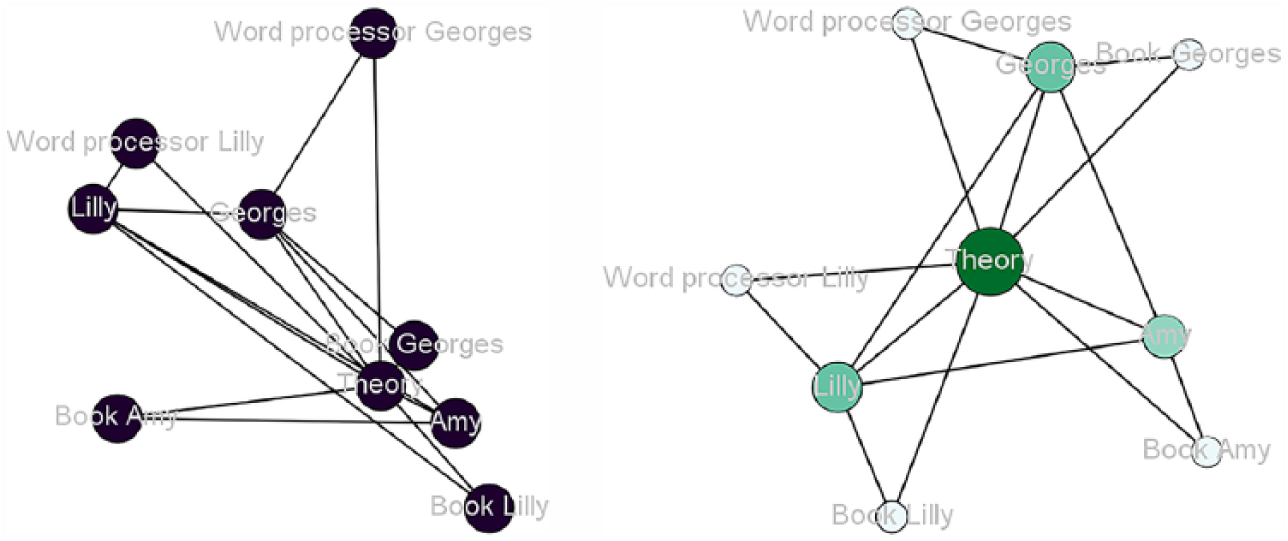
Randomized (left) and formatted (right) network visualization.
As can be seen, the topological visualization of this scene presents a flat surface in which one actor, the discussed theory, adopts a central position. Even though this is a minor example, we can start to apprehend how these visualizations concretely assist in displaying one of the central features of relational thinking, namely that actors that heavily interconnect with other actors are being rendered important (Latour et al., 2012). When approaching practices symmetrically, no one actor has power by means of its presupposed status, societal position, etc. Rather, actors gain authority – and hence become a center in the network – when other actors heavily relate to them. Analyzing network visualizations likewise, constitutes the third step of VNA.
Step 3: analyzing (the form of) network diagrams
In the third step, the central challenge is to make sense of the visual networks thus generated. Of course, matters complicate very quickly when we visualize networks that are significantly larger in size: some actors will be positioned closely together; others will be very far away; the network visualization might display distinct clusters or rather be scattered throughout; etc. Figure 2 presents the topological distribution of a network that is based on the working day of one professor (forming what is often called an ‘ego-network’).

Visual network of the working day of one academic (Mary). Left: The network visually analyzed according to its regions (manually added and no part of the algorithm). Right: The network visually analyzed according to its infrastructure (Digital actors colored red). Note that Mary’s central position is a direct consequence of the adopted data gathering method (hearing interview). Source: Decuypere and Simons, 2014a.
How to read networks as the one portrayed in Figure 2? As far as the qualitative analysis of network design is concerned, most literature is rather limited and does not detail how to conduct a qualitative, visual analysis: at present, we lack conceptual toolboxes that enable to think about the visual design of networks, and how to analyze and interpret various areas in network visualizations (Venturini et al., 2016). Furthermore, the concepts that are available are largely rooted in mathematics (e.g. ‘clustering’) and geography (e.g. ‘bridging’) (Venturini et al., 2016: 1–2). The following heuristic overview presents some of the most salient topological dimensions of networks that might be analyzed from a visual perspective (Venturini et al., 2016: 1–2; Decuypere and Simons, 2014b: 120):
Analyzing the form of a network likewise only makes sense if one continuously oscillates between the visual characteristics (topological dimensions) of the network and the contextual information that was gathered during previous steps of interviewing or observing: the topological reading of the network is entirely co-dependent on the thick descriptions generated in these previous steps. At the same time, however, these networks should be considered as being thick descriptions themselves: they describe the relational distribution of the practice under investigation in a comprehensive manner that equally tries to keep the level of analysis as flat as possible (i.e., without having to invoke structuring, superjacent clarifications). In the next section, we turn to the question of how to interpret these results with the assistance of the contextual information gathered: what can one make of visual networks?
Step 4: interpreting (the form of) network diagrams
Whereas the preceding section offered some heuristic tools to analyze how practices are relationally composed by exploring the form of network diagrams, the fourth and last step focuses on the interpretation of these network forms. The importance of the fourth step is situated at coming to an ‘adequate account’ of those diagrams by presenting an integrated understanding of the effects that a relational composition generates (Latour, 2005). More specifically, the aim of the fourth step is to provide a narrative interpretation of the generated networks. This is based on the insight that these visual presentations serve a double finality: on the one hand, they possess an explorative function that allows to scrutinize how a practice is composed precisely (step 3); on the other hand, networks equally possess a narrative function that allows to construct particular stories or anecdotes out of the formed networks (Offenhuber, 2010; Segel and Heer, 2010). Hence, network visualizations are to be conceived as active devices that produce a very specific (flat, relational) sort of reality (Decuypere, 2016b; Deleuze, 1988). Of course, the specific effects that will be narrated will always be partly dependent upon the specific research project and concomitant research questions. Therefore, the step from network visualizations to stories/anecdotes about these visualizations constitutes a complex process that cannot be proceduralized into neatly delineated substeps (Savage, 2009). Nevertheless, some notes on how to proceed from the analysis of the form of a network to the interpretation of this form (and its sociomaterial and topological effects) may serve as guiding orientation points for the reader.
In sociomaterial and sociotopological literature, particular attention is paid to effects on actors in relational compositions as well as to the inauguration of highly specific spatiotemporal constellations (Thompson and Cook, 2015). It is important to stress here that the topological visualizations constructed in the previous steps enact performative understandings of space and time. First, as far as time is concerned, visual networks do not operate according to traditional (i.e., linear and chronological) conceptions of time. Since these diagrams present the relational distribution of the relations that are established between actors, they in a certain sense fold temporality: an actor might connect with another actor at a certain point in time, and with yet another actor at another point in time (Deleuze, 1988). The crucial point here is that networks extend singular linear progression by equally presenting a multiplicity of ways of dealing with temporality that can be narrated by the researcher (cf. Sheail, 2017). By not visually presenting chronological time, networks afford to state something about specific other sorts of time that are equally relationally enacted within the confines of the visual network. In Figure 2, for instance, all regions are connected with each other. This implies that, at the interfaces between regions, performing one activity at the same time implies to perform another activity or, stated otherwise, that many different things might occur at once in one delineated area of the visualized network. As a (performative) effect, then, it can be narrated that time comes into being as a processing of whatever tasks flows in. As such, drawing on the network visualization and further exemplified by interview material, time can be interpreted here as being something plastic rather than only chronological, making that these relations allow the academic to constantly refigure the present and adapt to the situation at hand.
A similar argument can be made with respect to space: constellations of actors generate specific sorts of spaces that are not confined to physical and/or bounded understandings of spatiality, and network diagrams are capable of presenting how these different spatial forms are enacted into being (Crossley, 2015; Fenwick et al., 2011). For instance, as Figure 2 demonstrates, the network of this academic is, in no way, singularly confined to the physical buildings of the university. Complementing these visual insights with interview or observatory material, it can be argued that what is presented here is the enactment of a sort of malleable space, where most academic activities can take place in any kind of place (e.g. because of a scattered infrastructure that establishes mobility of many actors and that does, consequentially, not require particular mobility of the academic herself). Hence, these network diagrams can be used to narrate how specific (i.c. academic) spaces are being enacted in and through established relations.
Thirdly, as far as effects on particular actors is concerned, and as we have seen, actors’ agency is conceived to be interdependent with other actors in the network of relations in which they are embedded. As such, constructing visual anecdotes around actors of interest will always depart from the relations these actors uphold with other actors, with particular attention for the ambiguity, complexity and irreducibility of any actor’s position in the network (Erikson, 2013; Latour, 2005). In the specific instance of Figure 2, we can state that, in a certain way, it is the whole of the relational composition of this network that shapes and enables what it is to be an academic in the course of one day. Additional interpretations might be directed at specific actors in the network, such as the centers positioned at the interfaces of regions: in acting as relays, and because of their central position in the network, it can be argued that and narrated how these boundary actors might serve as typical academic actors, in the sense that these actors associate academic practice and bring it into union. Yet, which actors and relations to focus on will always be dependent on the specific research design adopted.
Clearly, the notes above are orientational and only give some basic indications pertaining to which aspects of network forms could be interpreted precisely. It is beyond the scope of this article to give a fully fleshed-out interpretation of this particular diagram, or of how this diagram relates to other diagrams – for instance, of other academics or other working days. The crucial point here was to make an argument for the narrative function of network diagrams, and how this potential might aid in interpreting specific spatiotemporal and actor effects. Thus, in VNA network diagrams should be conceived as pragmatic exercises that assist in finding out what is of central importance or precisely put into the margins, which sorts of space and time that are generated in doing so, etc. (de Freitas, 2012).
Conclusion
This article presented a step-by-step guide to conduct a Visual Network Analysis based on qualitatively collected data. This requires the design of specific data gathering and coding methods, such as interview techniques and observation protocols tailored to the theoretical premises of VNA. Furthermore, the steps of data analysis and interpretation are centered around these networks as visual tools that are able to present the relational composition of a particular practice. This implies to adopt proper techniques that enable to focus on the effects that such compositions generate: not only techniques of visualization, but equally techniques that allow to analyze the form of these networks and narrate about the effects that such forms generate (Savage, 2009). We presented only a fraction of the narrative potential generated by network visualizations here: studies adopting VNA tend to deploy various network diagrams (Decuypere and Simons, 2014b; Severo and Venturini, 2016). Making use of multiple diagrams has various advantages. First, it allows to discern how networks evolve over time (e.g. analyzing academic networks over a longer period of time than just a single day). Second, it allows to compare (the form of) different network diagrams with each other: which similarities and/or differences are there to be found in different diagrams (e.g. different networks of different academics)? Does this entail different spatiotemporal and/or actor effects? Third, it allows for a more profound and integrated understanding of the various dimensions of networks: Are there similar centers of importance in various networks? Is network infrastructure different in different practices? Etc. Related hereto, and fourth, is the role and status of VNA within a broader research project: results of such analyses can be fed back to and discussed with participants, but can equally be deployed as a stepping stone towards other studies, where actors and relations that uphold a crucial position in the network are further observed or interviewed. As such, VNA can equally function as an analytical technique that exploratively charts the practice under investigation and gives insight into what matters (most).
Conclusively, this article illustrated the potential of deploying networks as methods that present the relational constitution of social practices. First, embedded within broader strands of relational thinking, it offers the possibility to scrutinize and visualize practices without giving (causal) powers to social structures. Instead, it allows to present how practices are constant effects of relations, without having to invoke holistic or individualistic explanations (Packer, 2018). Second, and related hereto, VNA allows to trace and present the relational form of practices, and hence, to come to an empirical understanding of typical forms, for instance of academic life. This presentation and analysis of the typicality of different forms might provide a fruitful counterweight to essentializing and absolutist takes that mold social life in predesignated social categories (Erikson, 2013). A main asset of relational approaches and their associated methodologies is precisely that they eschew external forces, and this in favor of descriptions of associations between human and non-human actors into such forms (Latour, 2005; Dépelteau, 2015). As such, and thirdly, by analyzing social practices in terms of their relational constitution, these approaches allow us to see social life in more realistic ways and, by doing so, assist in showing what we are talking about precisely when we often unreflexively designate a practice as being, for instance, academic, educational, juridical, economical, etc. In sum, by adopting VNA as a comprehensive method in specific research designs, researchers can fruitfully deploy the theoretical premises of relational approaches – which are deemed to be very promising for qualitative research, but which are equally deemed to lack methodological consideration and guidance (Sayes, 2014). Making this process of conducting a qualitative Visual Network Analysis intelligible and explicit will assist researchers in effectuating sound qualitative research in accordance with these theoretical premises.
Footnotes
Funding
The author(s) disclosed receipt of the following financial support for the research, authorship, and/or publication of this article: Funding agency KU Leuven Internal Funds Grant No. C14/18/041.
