



Abstract
Recently social constructionist and poststructuralist theories, and the methodologies they have informed, have been criticised for focusing excessively on human discourse and human action whilst overlooking the importance of the material and non-human world. Alongside these critiques we have witnessed the emergence of new-materialist theories and methodologies that attempt to address the perceived shortcomings of social constructionism and poststructuralism. This article aims to make a small contribution to these developments by introducing an experimental new-materialist method for analysing narrative data. The method, which was developed during a qualitative research project exploring the treatment of sexuality within a disability service, borrows from established methods of poststructuralist discourse analysis whilst also seeking to remain attentive to the material, affective and non-human forces that shape and affect the stories people tell.
Keywords
Introduction
In this article, I outline an experimental method for analysing narrative data, namely assemblage analysis. The method was developed during a qualitative research project that sought to explore the treatment of sexuality within a particular community based service for adults with intellectual disabilities in the Republic of Ireland. I begin the article by introducing the project, which initially adopted a social constructionist epistemology and a methodology of discourse analysis. I then describe how problems emerged with this approach and I suggest these problems resonate with recent academic critiques of social constructionism and the emergence of new-materialist ontologies. At this stage I turn my attention to how, in this particular case, a Deleuzian materialist ontology was adopted and used to inform a creative new-materialist method for analysing stories about disability and sexuality. I conclude by arguing that this method of narrative analysis, which is attentive to both discursive and material forces, can enable us to notice new things about a social problem. This, in turn, can lead to new suggestions for interventions designed to ameliorate the problem. I also suggest that, whilst in this article the method was explicated with reference to a specific research project regarding sexuality, it can potentially be used to map an infinite range of social issues and I invite other to take up, adapt and alter the analytic tools described for their own purposes and in their own projects.
About the project
Compared to most Western nations, the Republic of Ireland continues to treat sexuality and intellectual disability in a deeply conservative fashion. To begin, it has not ratified the United Nation’s (2006) Convention on the Rights of People with Disabilities. Moreover, although legislative change is forthcoming, current Irish law effectively criminalizes consensual sexual intercourse with and between ‘mentally impaired’ people (Law Reform Commission, 2013). Meanwhile public support for equal sexual rights for adults with intellectual disabilities is marginal at 51 percent (National Disability Authority, 2011:10). 1
Prior to becoming a full-time academic, I worked as a social worker in intellectual disability services and frequently provided counselling for adults who were experiencing problems around sexuality. Over time I came to see that for these adults, for many reasons, finding love or leading a sexual life was an extremely difficult thing to do. I became interested in, and eventually decided to do my PhD on, the treatment of these adults’ sexuality. My research came to focus on a particular intellectual disability service called Rathbeg Services (pseudonym) that encompasses a series of day centres distributed across the suburbs of a city and some of its satellite towns. I had worked in this service and was familiar with its people and practices. My primary method of data collection was in-depth narrative interviews with a strategic sample of service providers – including frontline service providers, a clinical professional, and a service manager – and of service users that attended a variety of the service’s day centres. The sampling strategy sought to include what Mason (2002: 124) calls a relevant range of perspectives without claiming to be directly representative or generalizable.
The in-depth narrative interview schedule followed established guidelines for in-depth interviews (Johnson, 2002), whilst borrowing specific techniques from Holloway and Jefferson (2000) for eliciting narratives. Participants were invited to tell stories about the treatment of sexuality within the service and this process led to the collection of a large number of stories, told from a multiplicity of perspectives.
Moving on from discourse analysis
My initial research plan borrowed a theoretical framework from Michel Foucault and Judith Butler, adopted a social constructionist epistemology and proposed using a method of poststructuralist discourse analysis borrowed from Willig (2008), Jager and Maier (2009) and others. The method, in short, involved identifying discourses and exploring their implications for sexual subjectivity with the service. It should be noted that this type of discourse analysis does not discount the material world or embodied experience. However, it does privilege the importance of discourse over other aspects of existence and, arguably, downplay the importance of materiality and embodied experience.
As I began the process of coding and arranging my data, problems began to emerge and I became increasingly frustrated with my proposed analytic procedure. As an insider researcher reading stories about colleagues and clients, it was not just discourses and subject positions I saw but rather, and in my mind’s eye, familiar faces and actual places. While it was apparent to me that discourses were important it was equally clear that other forces – including materiality and embodied experience – were also highly significant.
Regarding materiality, as I read and re-read the narrative vignettes, I noticed that, to take just one example, the architecture of the institutional building a story occurred within (e.g. whether it had enclosed spaces such as storerooms) seemed to profoundly affect the kind of illicit sexual incidents that could occur within it and the kind of stories that could told about these incidents. Indeed, in some stories, the positioning of a concrete wall or window within a daycentre or residential house seemed just as important as the discursive frameworks the narrator understood the world through.
Similarly, regarding embodied experience, many of the stories collected featured vivid description of bodies experiencing sensations and emotions including ‘fear’, ‘shame’ and so on. It was not simply that powerful discourses triggered embodied sensations and experiences (for example, a person might describe blushing and experiencing shame when caught violating a discursive norm); it was also the case that embodied sensations and emotions seemed to shape the discourses participants adopted and the stories they told.
In many ways these specific problems - encountered in the context of a qualitative research project that adopted a social constructionist/poststructuralist epistemology – reflect broader frustrations with the limitations of these theories and the methodologies they have informed. Some of this frustration relates to their failure to acknowledge the importance of materiality. For example, Blaise (2013: 92) points to recent critiques of poststructuralism, which charge it with ‘neglecting material or nonhuman forces’; Lather (2016) notes widespread disillusionment with intensely language-oriented social theory; and Alaimo and Hekman (2008: 2–3) suggest that: In their zeal to reject the modernist grounding in the material, postmoderns have turned to the discursive pole as the exclusive source of the constitution of nature, society, and reality. Far from deconstructing the dichotomies of language/reality or culture/nature, they have rejected one side and embraced the other.
Further frustration relates to these theories’ difficulties in discussing the material body and embodied experience. Fox (2016: 67) for instance notes that ‘in post-structuralism, texts and textuality became the object of inquiry, while the biological body appeared to recede beyond the analytical purview of the post-structuralist social scientist’.
The perceived shortcomings of social constructionist and poststructuralist theories have led to a number of theoretical attempts to reengage with the material, as well as the discursive aspects, of existence. These developments have been grouped together under an assortment of labels including ‘the material turn’, ‘the ontological turn’, ‘the affective turn’, ‘the posthuman turn’ and ‘the non-human turn’. To offer some specific examples, the actor-network-theory of Latour and others (see Latour, 2005), the agential realism of Barad (2007) and the assemblage theory of Deleuze and Guattari (2004) and DeLanda (2006) can all be seen as attempts to reengage with materiality and recover ‘footing in a mind independent reality’ (DeLanda, 2010: 47). However, as noted in this journal, these putative turns have not been about a complete rejection of language oriented theory and, indeed, have ‘built upon the foundations of the linguistic [turn], rather than represented a departure from them’ (Editorial, 2016: 4). These theoretical developments have also, in-turn, inspired methodological experimentation and innovations within qualitative research. For example, Barad’s agential realism inspires: Taguchi and Palmer’s (2013) diffractive analysis of Swedish schoolgirl’s well-being; Pienaar et al.’s (2017) diffractive analysis of personal accounts of addiction; and Allen’s (2015) mapping of a new ontology of sexuality at school. Meanwhile DeleuzoGuattarian theory informs: Renold and Ivinson’s (2014) affective analysis of teenage girls’ feelings of fear, risk, vulnerability and violence in an ex-mining Welsh valley community; Alldred and Fox’s (2015) analysis of young men and sexuality; and Fox and Bale’s (2017) analysis of young people’s sexual practices.
Returning to my own study, I too needed a theoretical and methodological framework that would allow me to consider the importance of materiality and material embodiment without rejecting the importance of discourse. One option at this point would be turn to critical realism but – in not fully rejecting essentialism – this approach is arguably problematic from a disability studies perspective (Feely, 2016) Instead, I began experimenting with a Deleuzian ontology and the DeleuzoGuattarian concept of the assemblage and thinking through how this might inform a method of narrative analysis that would remain attentive to material as well as discursive forces. Before detailing this method, however, it is necessary to offer a brief and necessarily reductive introduction to the Deleuzian materialist ontology and the assemblage concept.
The Deleuzian ontology and Deleuzian materialism
While many poststructuralist theorists problematize ontology (because discourse is assumed to constitute what it presumes to describe), Deleuze finds a way to embrace it. To do this he collapses the discourse/matter divide that structures much poststructuralist thought and suggests that both material entities and discursive statements are real, in that they both have effects in the material world and they both affect each other. In short, for Deleuze, material and semiotic entities ‘have the same ontological status’ (Grosz, 1994: 167). Thus existence becomes a flat ontological plane populated by different but mutually affecting material and semiotic entities, as illustrated in Figure 1.
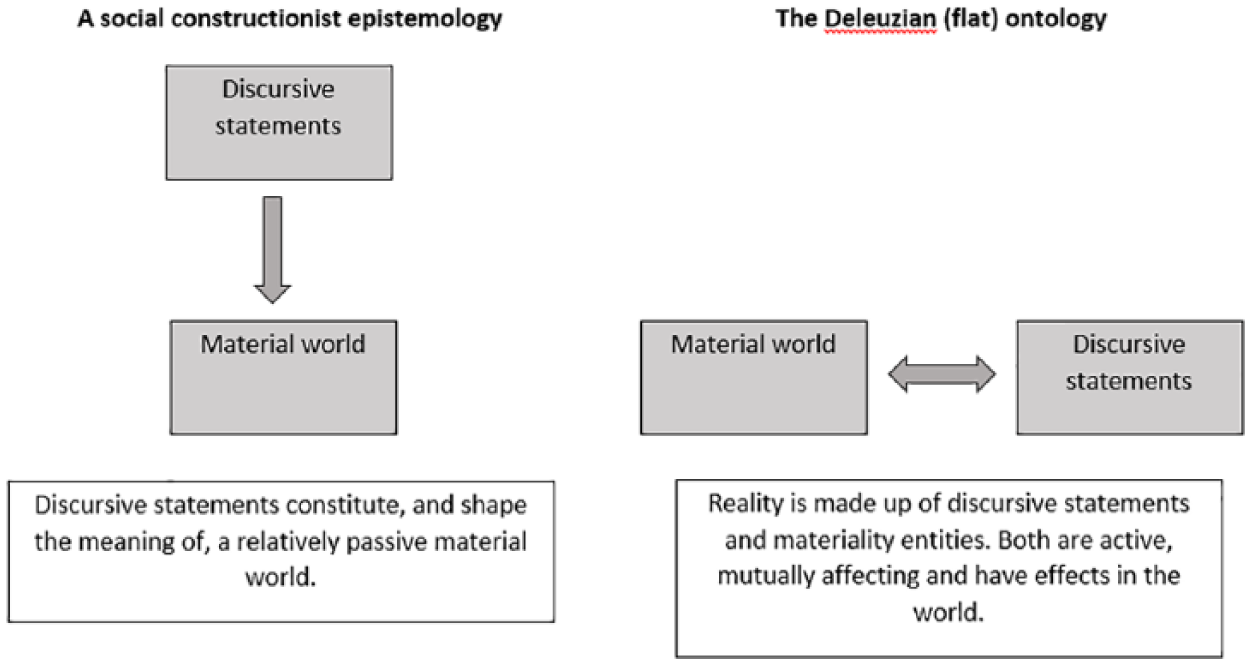
The difference between a social constructionist epistemology and a Deleuzian ontology.
Within this ontology, all entities are assumed to be in process rather than fixed, ceaselessly becoming at different rates of speed and slowness. This applies equally to material entities (carbon becoming hot and pressurised the lithospheric mantle of the earth, becoming part of a magma flow through a volcanic pipe, becoming diamond targeted by prospectors, becoming status symbol of high monetary value, becoming engagement ring belonging to a celebrity, becoming loot in a heist in a luxury Paris apartment) and to discursive entities (stories about a man called Jesus passed in an oral fashion for decades, becoming multiple written accounts of the life of Jesus, becoming four gospels, becoming sacred texts, becoming the official religion of the Roman Empire, becoming the predominant religion in North America, becoming a comforting thing to think about for a bound and gagged celebrity who suspects she is going to die during a heist in a luxury Paris apartment). Because entities are temporary becomings rather than fixed beings they can have no eternal essences. Therefore, we should avoid the traditional preoccupation with ascribing entities fixed identities (i.e. we show not ask ‘what is a diamond?’ or ‘what are the gospels?’). Instead we should speak about entities simply in terms of their context dependent capacities to affect and be affected (i.e. we should ask ‘what can a diamond do?’ or ‘what can the gospels do?’). Any list of an entity’s capacities to affect and be affected will necessarily be ongoing as its capacities will change in different contexts (i.e. a diamond can refract light waves, it can signify wealth, it can be used as a blade and so on). Put differently any entity’s capacities will change as it enters in and out of relations with other entities.
The Deleuzian concept of affect, then, should not be understood as synonymous with human emotions. Rather it provides a way of thinking about all entities’ context dependent capacities to affect and be affected. This said, within a Deleuzian ontology, emotions can be thought of and treated as any other type of entity with their own ongoing lists of context dependent capacities to affect and be affected (see Fox, 2015). For example, ‘anxiety’ enabled early humans to avoid predators in the context of the savannah. Later, however, in the context of 1980s America, ‘anxiety’ contributed to the emergence of new psychiatric diagnoses such as ‘generalised anxiety disorder’.
Assemblages
It is the preceding materialist ontology that underpins Deleuze and Guattari’s (2004) concept of the assemblage. An assemblage consists of heterogeneous components or forces, belonging to orders of existence often considered separate (for example, the architectural, the technological, the emotional and the discursive) whose unity comes solely from the fact that they work together as a whole to produce something. For example, a disability service assemblage might encompass components including buildings, bodies, emotions, discourses that create subject positions, and service rules and policies. These components work together and affect each other in a complex, multidirectional (or what Deleuze and Guattari term rhizomatic) fashion to produce the disability service.
DeLanda (2006) suggests that any assemblage will be both composed of smaller assemblages and a component of larger assemblages. To explain, an assemblage, such as the disability service above, will be made up of smaller assemblages (e.g. individual daycentre assemblages) and will also be a component of larger assemblages (e.g. the nation health service assemblage). As scale increases, each assemblage will possess emergent properties that simultaneously enable and constrain its components (e.g. the body assemblage enables and constrains what its blood can do, a daycentre assemblage enables and constrains what its human bodies can do, the Rathbeg Services assemblage enables and constrains what its daycentres can do and so on). It is also important to note that no assemblage is a seamless whole – it is always possible to take a component out of one assemblage and plug it into another assemblage. The disability service assemblage might, for example, sell one if its older institutional buildings to a property developer, who might re-develop it as apartments, at which point it would become part of a residential property assemblage.
An assemblage should not be understood as fixed entity because it is always in a process of becoming. Its diverse components come together over time; work together for a time to produce something; and, in time, will fall apart. For example, the disability service assemblage’s components (e.g. buildings, bodies, policies) came together over time, are currently working together to produce the service, and will eventually fall apart. This means that valid questions about an assemblage should relate not to its essential identity but rather how it works to produce something. In Youdell’s (2011: 46) words, analysing an assemblage involves exploring the ways that ‘apparently inchoate elements come together to form a particular whole’. To help us with this task, Deleuze and Guattari (2004: 3–28, 552–67) offer some additional concepts. Specifically, they suggest we can identify and arrange an assemblage’s component along a material/semiotic continuum; map flows of heterogeneous substances within the assemblage; and consider forces of continuity and change within the assemblage along a deterritorialisation/reterritorialision continuum.
Using the Deleuzian ontology to inform a method of narrative analysis
It was the DeleuzoGuattarian ontology and their concept of the assemblage that informed an experimental alternative to discourse analysis. The large collection of narratives regarding the treatment of sexuality within the disability service were sorted into themes including ‘sexual surveillance’, which I will focus on in this article. Sexual surveillance was treated as an assemblage and the research question became ‘How does sexual surveillance work within the service?’ Answering this question involved drawing upon Deleuze Guattari’s (2004) concepts for exploring how an assemblage works in what became a three-stage analytic process.
Before outlining this, it is important to stress that while in this instance I analyse primarily narrative data (and also draw on my knowledge of, and experiences of working in, the disability service), this is certainly not the only suitable form of data for assemblage analysis. In their review of new-materialist research approaches, Fox and Alldred (2015) show that many new-materialist researchers have continued to draw on traditional modes of data collection including ethnography and in-depth interviews. However, given that new-materialism seeks to be attentive to material, embodied and non-human forces, alternative forms of data also become relevant. For instance, Allen (2015) analyses photo-diary data collected by school students; Renold and Ivinson (2014) mix data from photographs, films and walking tours with interview data; Taguchi and Palmer (2013) add their own affective responses and memories to their mix of sources; and Henriques (2010) draws on music and sound data to study Jamacian nightlife. In short, and in assemblage analysis, one is invited, indeed encouraged, to experiment and innovate with a multiplicity of relevant data sources. With these points noted, let’s turn our attention the narratives in question in this particular case and to the first step of analysis.
Stage one – identifying components or relations
This stage involves identifying the disparate components, forces or relations that make up the phenomenon of sexual surveillance. Following Deleuze and Guattari (2004) our assumption is that sexual surveillance is a material-semiotic phenomenon that could potentially be affected by a whole range of material, embodied, economic and semiotic forces. Identifying what these forces are involved reading all the narrative vignettes relating to sexual surveillance whilst continuously asking the question: What material and/or semiotic forces are affecting this story? The effect of this question is to open stories up to complexity, showing them to be shaped by a myriad of unpredictable forces. To explain by example, let’s turn our attention to a story told by Grace, a frontline social care worker, in one of the service’s daycentres:
Emm, there was an incident one day where a staff member walked into the storeroom.
Yeah?
And there were two males: one with hands where they shouldn’t be.
Okay.
And, em, there was kissing and it was, well, hot and heated.
Right
And these two, after that incident, they were very, very, very embarrassed by it and now no longer speak.
Really?
Yeah. And you can see that there’s like a tension there between the two of them like (…). [[But one of them]], Barry, would be like kind of one of our older service users and he was very embarrassed by the thought that the staff members had seen him with a man and not a woman.
Right
And he was very afraid. That the staff would ring his Mam or his Dad
Right
And say that it was a male that he was with in the store room and not a girl. You know what I mean? (…)
And what did happen about it? (…)
His parents were informed. And they actually were fine about it. They just kinda like, y’know, they were more upset that he was doing it in work. Whatever he wants to do, well that’s fine. But in the centre here, this is treated as like a workplace.
Tasked with identifying the most pertinent material-semiotic forces affecting this narrative vignette, we might start with material forces including the physical architecture of the daycentre, specifically the presence of a ‘storeroom’ which affords – or in this case fails to afford – a private space for intimate moments to occur. In addition, we might recognise the importance of embodied sensation and emotion. Firstly, the shame or ‘embarrassment’ that the men are said experience when caught kissing, which acts to shut down communication between them and keep them apart. Secondly, the experience of ‘fear’ that Barry experiences in relation to being outed. While these material and embodied forces are important, the story can simultaneously be seen as shaped by discursive forces. These include widely differing constructions of same sex encounters, namely Barry’s construction of his actions as shameful and his parent’s construction of his actions as ‘fine’ but occurring in the wrong context. We might also see the story as affected by service rules and policies. For example, service rules (explained elsewhere by Grace) that forbid physical affection within the men’s daycentre and policies (formal or informal) around sharing sensitive information concerning adult service users with their parents. Finally, because researchers inevitably become inextricably entangled in the assemblages they study (see Coleman & Ringrose, 2013) we might also acknowledge that the researcher also affects this story. For example, stories like this are co-constructed in specific intersubjective contexts. The interviewer’s and interviewee’s subjectivities (relating to age, class etc.) or, more importantly, how they read each other’s subjectivities, will necessarily affect what, and how, stories are told.
As this process was repeated with all the narratives relating to sexual surveillance certain material-semiotic forces emerged time and again (although there always remained the possibility of noticing a new and surprising force). As such these forces could be seen as playing a significant role in the phenomenon of sexual surveillance. In this case, the prominent components or forces within the sexual surveillance assemblage were identified and arranged along a material/discursive continuum as illustrated in Figure 2.
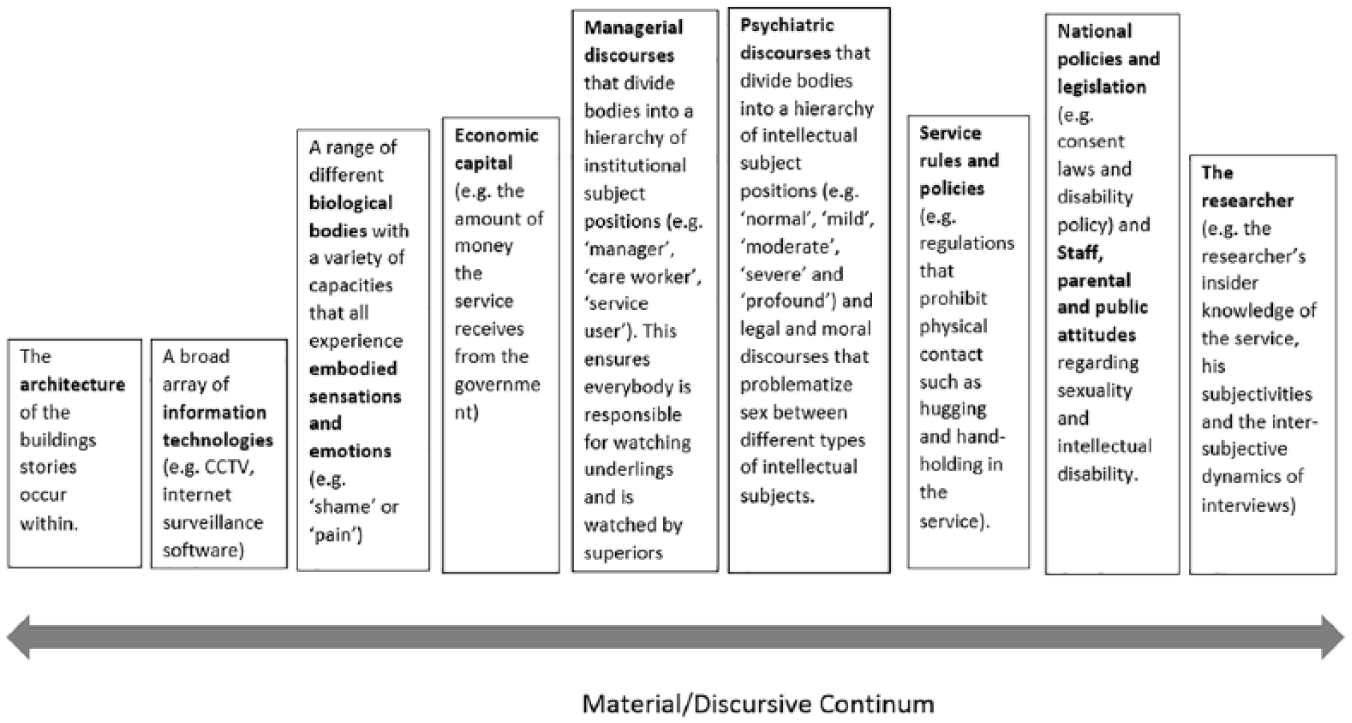
The sexual surveillance assemblage’s component along a material/semiotic continuum.
In presenting simple diagrams such as this, it is important to note the impossibility of fully separating material from discursive forces. The material/semiotic continuum is intended to provide a practical way of identifying relevant forces rather than a definitive statement of where the material ends and the discursive begins. It is also important to note that while this example relates to sexual surveillance, the process for identifying assemblage components described above could potentially be used in studying narratives about infinite range of phenomena.
Stage two – mapping flows
All assemblages are made up of, and act upon, flows of substances belonging to multiple orders of existence: ‘An assemblage, in its multiplicity, necessarily acts on semiotic flows, material flows, and social flows simultaneously’ (Deleuze and Guattari, 2004: 25). The job of the assemblage analyst is to map these flows. For example, an analyst might be interested in mapping material flows of human bodies within, between, and in and out, of the service daycentres. Equally, they might look at discursive flows such as how new national policies relating to disability service provision flow into and are and communicated to various groups within the service. In all cases the assemblage will act to enable flows in certain directions and constrain flows in other directions (think of blood coursing through the arteries, veins and capillaries of a human body assemblage). Haggerty and Ericson (2000: 609) suggest that, in social assemblages, power can act to direct flows in ways that serve the interests of certain groups and allow them to dominate other groups. For example, in studying flows of capital into and within disability services, we might note that the overwhelming majority of public funding for disability services is actually used to pay service providers’ salaries (see, for example, Department of Health, 2012). In this particular research project, I had been struck by the detailed knowledge participants possessed regarding the sexual lives of adults with intellectual disabilities (both inside and outside of the service) and I became interested in how sexual surveillance data was collected and flowed within, and in and out, of the service. Exploring this involved reading all stories relating to sexual surveillance whilst continually asking a new question: Where has this narrator got their information from?
When one reads the narratives in this way, an intricate picture begins to emerge of flows of sexual surveillance data within the service’s physical territory. Take for example, this story, told by the frontline worker Oisin about a female colleague. Oisin’s colleague is working an evening shift in a respite residential house and, on her rounds, she pauses outside the door of two young men whom, we are told, have Down syndrome:
She overheard… She went to check on them, that evening and was at the door. Whether she should have been eavesdropping or not is not the issue for this conversation. (…) That’s another day’s discussion. She, ah… It was a discussion and it was very interesting. [There was] one individual who’s been going out with his girlfriend for ages. In fact, says he’s engaged to her (…). And the second young man would be going out for a short time with a young lady from here [[the daycentre]] but was questioning whether he wanted to go out with her anymore. (…) The other guy was then giving him advice on how to break up with her. (…) And the advice was quite sound. The young man giving the advice was telling him what you say when you do that. Emm, it was overheard then, that, the, the young man receiving the advice said to the young man: ‘I want to kiss you. Is that okay?’ To which the young man said: ‘No that’s not okay, I have a fiancé.’ To which the other man said: ‘Okay. That’s OK’
Right
And nothing more was said of it. It wasn’t… As far as I recall, the staff member didn’t, you know, barge in any way.
And so, in this narrative, information regarding the two men’s intimate lives has been collected by a staff member through eavesdropping. The sexual story she hears then flows, in an oral fashion, to another staff member (or staff members) within the service. The men in question remain unaware that staff are aware of this incident.
The stories suggest that reach of the reach of the surveillance assemblage also extends far beyond the physical boundaries of the disability service. In this case the narratives suggest that – in addition to flows of sexual surveillance data within the service – data is continually flowing in and out of the service as it makes temporary connections with, and trades data with, other institutions (for example, the police, service users’ family homes, and the business that employ services users on supported employment programs in the mainstream community). In order to offer a concrete example of these processes in action, let’s turn our attention to a story shared by the frontline service provider Katie about a service user called Tommy, whose sexuality has become a source of concern for staff within the service:
The sister ((Tommy’s sister)) came up to his house one day and went in to clean his bedroom.
Yeah.
And underneath the bed, there was about 40 bras (giggles).
Ah okay: he has a bra collection.
And they couldn’t figure out where he got them. They thought he might have robbed them off clothes lines. . . . And lots of them were pre-teen bras. It was like: ‘Eeew: that’s a bit worrying as well’. And then Helen [[Katie’s colleague]. You know the way she’s from around the neighbourhood? She said like loads of the girls in the neighbourhood, they’d go: ‘Oh there’s Tommy’. And in the summer time, when everyone would be sunbathing, they say he goes out on his bike, kind of perving on the girls, you know?
Reading this narrative vignette whilst asking where the narrator got their information from, suggests that data flowed into the service sexual via Tommy’s family assemblage. To be specific, Tommy’s sister has told staff in the service about his bra collection, which features ‘pre-teen bras’. This prompts discussion amongst staff who – working in a post-institutional, community based service – often live alongside service users. The staff member Helen then shares some gossip she has heard regarding Tommy ‘perving on’ sunbathing girls, opening up another flow of sexual surveillance data from the mainstream community into the service. These flows, which he remains unaware of, contribute to Tommy’s growing reputation among staff as a potential sexual threat.
Our analysis of both the preceding examples is complicated further if we consider how these stories later flowed, again in an oral fashion but this time in the context of a research interview, to a researcher, who eventually included an edited version of the stories in a journal article, opening up new transnational flows of the story to an international readership that includes you, the reader. We are all necessarily implicated in the practices of surveillance we discuss and read about. Additionally, we need to consider issues of verisimilitude. All of the stories presented in this article have been passed along complex chains of narrators both human (service providers, service users, the researcher and so on) and non-human (CCTV systems, service user case files, a Dictaphone, word processing software). All narrators, both human and non-human, are necessarily unreliable. All narrators edit and alter the data they receive and pass on, including certain details, omitting others: the CCTV camera excludes the contextual details that exist outside the camera frame just as the researcher excludes lengthy sections of interview transcripts deemed irrelevant from their analysis. Stories passed in this fashion are perpetually morphing, mutating, differing from earlier incantations. Indeed, within the data collected for this project it is possible to locate very different – even contradictory - stories about the same events. This does not have to be a product of dishonesty, it is simply the way narratives travel through space and time. In short, the relationship between the stories presented here and actual events in the disability service remains inescapably problematic.
With these complexities and considerations recognised, by applying the analytic procedure outlined above to all narratives relating to sexual surveillance, it is still possible to map flows of sexual surveillance data within, and in and out, of the service. Within the service surveillance data is collected and continually flows through practices including: staff watching and following service users; internet surveillance software which monitors service users’ and service providers’ searches; staff and service users reporting incidents to authority figures; eavesdropping; staff keeping casefiles on service users; and ubiquitous sexual gossip. But the reach of the sexual surveillance assemblage actually extends far beyond the disability services walls. Data continually flows in and out of the service as sexual information is received from, or traded with, other actors and institutions including: service users’ families; the local police; bus companies; and scandalised members of the public. These flows enable the service to gain information about, and intervene in, service users’ sexual lives both within the service and the mainstream community.
When using assemblage analysis, it is perhaps useful to map these flows in a visual, as well as verbal, manner, as illustrated in Figure 3.

Flows of sexual surveillance data.
Again, as with identifying components, whilst the example provided here is specific, the procedure can potentially be adopted and altered to study a whole range of flows in an infinite number of contexts.
Stage three – exploring processes of reterritorialisation and deterritorialisation
The final stage of our analysis relates to regulatory processes of reterritorialisation (that serve to stabilize and maintain order within an assemblage) and subversive processes of deterritorialisation (that destabilize order and allow for change, creativity and novelty within the assemblage). In this particular case I was interested in using the stories to explore, on the one hand, the processes that regulate and normalize sexuality within the assemblages and, on the other, the processes that enable regulations to be subverted and allow new sexual relations to emerge. It is important to recognize that, within an assemblage, moments when sexuality is regulated, or moments when these regulations break down, should not be understood as produced solely by human agency or intentionality. Rather these moments should be understood as the emergent products of complex interactions amongst material-semiotic forces. As such, the task in this stage of analysis is to explore how these complex combinations of disparate forces and flows allow for moments of reterritorialisation/deterritorialisation.
Reterritorialising sexuality
To offer an example of reterritorialisation, let’s turn our attention back to the frontline worker Grace. At multiple points during her interview, Grace expresses strong support for the sexual rights of adults with intellectual disabilities and profound dissatisfaction with service policies and national legislation. Nonetheless, she also shares multiple stories about times when she was involved in preventing sexual relationships. For example, when asked about challenging incidents involving sexuality Grace tells us about a service user called Cian who – due of flows of sexual surveillance data both within and in and out of the service – she understands to be a promiscuous individual who impregnated a former partner:
Cian O’Donoghue is one to watch. He would… He’d get up on anything. ((Laughing)) I have to be perfectly honest.
This leads Grace to a story about a specific instance of reterritorialising sexuality. The story begins with Grace watching and Cian, and his then partner Niamh, while on duty in a crowded and understaffed daycentre:
Anyway, you know we’re short staffed ((the study took place in the depth of the Irish economic recession when daycentres were regularly short staffed)). I just caught in the corner of my eye… I was on my own, on duty and I was sitting at the staff table and you know the way you can see up the hall? ((The staff table is at the top of an open-plan canteen. It allows service providers view the whole canteen and also see down a hallway which leads to classrooms, toilets etc.)) Whatever way I turned, I just looked and I seen Cian and Niamh heading down this hallway.
Okay.
And I don’t know why… I said to myself…
‘There’s something going on here.’
Something going on here. And, emm, like, normally you’d miss something like that. So I says: ‘Right, I’m going to give them a minute; I’m going to give them a minute’. Now I was in the canteen on my own with everybody else in the canteen. But the two of them are playing on my mind.
In analysing this initial segment of the story, our assumption is that the instance of reterritorialisation described will be the emergent product of complex array of material-semiotic forces. In exploring what these forces are and how they work to reterritorialize sexuality we might start by considering the position in discourse Grace occupies. To elaborate, from a Foucauldian perspective, Grace is not a unitary subject but rather one who occupies a range of subject positions and experiences a range of associated subjectivities. In this particular story Grace is ‘on duty’ and, as such, occupies the subject position of frontline care worker, which brings with it a particular set of responsibilities. While Grace may express support for sexual rights and freedoms for adult with intellectual disabilities whilst occupying other subject positions (e.g. ‘research participant’), in this particular context it is her job to watch adults with intellectual disabilities and to uphold service policies that forbid ‘on-site’ intimate relationships. Put simply, Grace’s position in discourse means that she does not have to want to prevent intimate relationships to play an active role in doing just this.
Following a rhizomatic link from the realm of discourse to the realm of economics, it quickly becomes apparent that economic conditions may play a role in this instance of reterritorialisation. To explain, the story occurs during a major recession which led to cuts in funding to, and reduced staffing of, disability services. It is in this context, that Grace describes being alone, ‘on duty’ in a short staffed daycentre. Grace is watching the mass of service users congregated in the canteen when she notices Cian (whom believes to be highly promiscuous) and a young woman called Niamh leaving the canteen and heading down a corridor. This creates a professional dilemma for Grace: should she stay and watch the mass of service users (which is part of her job) or should she leave to follow the couple and prevent a potential incident (which is also part of her job). Grace’s dilemma reminds us that, by reducing surveillance and opening spaces where service users can enjoy fleeting moments of privacy, an economic recession could play a role in deterritorialising sexuality. However, in this particular instance, Grace opts to leave the mass and follow the unlucky couple:
So I walks down the hallway anyway and I looked into the glass thing there ((points to a circular window in the door of the day centre room where our interview is taking place)). And there was no sign of them in here. (…)So I’m going round the building, going round the building, going round the building, looking for them. ((Louder)) I walked out the back door. I walked out, like outside.
Yeah, yeah. (…)
There is the two of them: snog, snog. Like, I mean, talk about having a wear? ((Irish slang for French kissing. Short for ‘wearing the faces off each other’)) My God! (…) It was hot n’ heavy (…) And I went over and I was like: ((Loudly)) ‘What’s going on here?’ You know, like that?
In analysing the final section of our example, we might take a final rhizomatic link to the realm of materiality and the analytic order of physics and note that in addition that, in addition to the discursive positioning of our protagonist and the economic conditions of the time and place, reterritorialisation is made possible by the architecture of the building and by linear optics, specifically the capacities of the human eye, concrete, timber and glass to absorb, refract and reflect light waves. To explain, it is the open plan layout of the canteen and the positioning of ‘the staff table’ within it that allows Grace to watch the mass of service users and to notice the couple disappearing down the corridor. In other instances this warren of therapeutic spaces, classrooms and toilets might have offered the couple sanctuary from surveillance but, again, in this particular instance they are unlucky: Grace follows them. As she searches the maze of institutional corridors, glass portals in the doors of classrooms and therapeutic rooms enable her surveillant gaze until, eventually, she finds the couple, outside the building, kissing. Their intimate moment is swiftly aborted and sexuality is reterritorialized within the service.
Studying Grace’s story as an incident of reterritorialisation within an assemblage opens it up to complexity. The incident described can no longer be understood as simply a product of the protagonist’s intentionality. Neither can it be seen as caused by any one of the factors analysed (Grace’s discursive positioning, prevailing economic conditions, and linear optics within an architectural structure). Rather it is understood as the emergent product of all these forces (and, no doubt, a myriad of other forces outside the text).
Deterritorialising sexuality
While the section above described an instance of reterritorialisation, at other times complex interactions of material-semiotic forces can, of course, produce moments of deterritorialisation. To illustrate this, let’s turn our attention to a series of stories shared by both staff and service users about a particular room found within many of the daycentres: the Snoezelen© room, quiet room or relaxation room. These rooms – which feature soft furnishings, lava lamps, and relaxing music – are marketed to disability services as therapeutic spaces that ‘empower’ disabled people to ‘to enjoy a range of sensory experiences – either actively or passively – which enhance therapy, learning and relaxation’ (Snoezelen©, 2013). However, within a Deleuzian ontology, a material entity like a quiet room has no essence and its capacities can be creatively re-appropriated in a myriad of ways. Indeed, this is exactly what we find in the stories told about this space. Here, for example, the service user William and his interview support person (his friend and fellow service user Stephen) offer a succinct account of how this space is used by both staff and service users:
The only private space ((in the training centre)) is the quiet room
Yeah
The quiet room? What’s the quiet room?
The quiet room is where people go to have break.
Yeah, to cool down if they’re angry during class.
But the quiet room is not just a place that staff can direct troublemakers who disrupt class towards. William alludes to another use:
((Tone dripping with sexual innuendo)) Yeah, but I didn’t use it to cool down.
((Gentle chuckle)).
William is not alone in recognising the quiet room’s subversive potential. Grace tells this story about working with a male service user that does not speak:
He will… He will come over to you. He’ll look at you.
Yeah.
And he’ll get really close to you. And he’ll, kind of like, rub off the side of you and stuff?
Okay.
And then he’ll be found twenty minutes after he’ll have done that. You’ll find him in the relaxation room.
Right
I am not being vulgar here ((laughs))
Yeah, yeah, right
Basically, with his hand down his trousers. And there would be semen everywhere.
Katie, a staff member with international experience, also shares a story about the relaxation room. This story gives us reason to suspect that the subversive use of relaxation rooms as sexual spaces is a transnational phenomenon:
In England there used to be the ((sleazy voice)) ‘relaxation room’.
((Laughing))
And that was a hot spot. ((Laughs)) I don’t know if there was much relaxation going on there. You would knock for ages before going in there (…) or you could walk in on anything.
Again, in analysing these three stories, we start with the assumption that the instances of deterritorialisation they document are the emergent product of multiple material-semiotic forces. Beginning with the material, while institutional architecture can, and does, facilitate surveillance it can also, it seems, act to thwart it. In these instances the material capacities of the relaxation room – which William identifies as ‘the only private space’ – act to produce a blind spot in the surveillant gaze of staff members. Moreover, despite its official purpose, the material qualities of the relaxation room – its bean bags, soft lighting, and quiet music – mean it has the capacity to become a perfect ‘make out’ spot. Moving from the material to the realm of embodied sensation and emotions, these stories are also filled with allusions to embodied states of sexual excitement and arousal: William didn’t use the relaxation room to ‘cool down’; after an instance of frottage, Grace finds the man in question in the relaxation room ‘with his hand down his trousers’ and ‘semen everywhere’; Katie calls this space ‘a hot spot’. Arguably, material and embodied forces are most explicit in these stories but a broader consideration of how the relaxation room works to deterritorialise might also look to economic and discursive forces such as the highly successful marketing of Snoezelen© rooms to disability services around the world and the discourses around therapy and rehabilitation adopted in this marketing.
As before, within an assemblage account, these deterritorialising events in the relaxation room should not be understood reductively – as a product of the intentionality of the individuals in question - but rather as the emergent product of all the architectural, material, embodied, economic and discursive forces mentioned, and undoubtedly many other forces, working in concert.
Conclusion
In this article I have sought to outline and explicate an experimental new method for analysing narrative data about a social assemblage. In remaining attentive to both material and discursive forces, the method can allow us to produce complex – but never fully complete – maps of how the social assemblages works. But the point of analysis is not simply to produce a rich description, and a richer understanding, of an assemblage. Analysing how a problematic social assemblage works in the present can also allow us think about ways to alter the assemblage and to make it work differently. In Nail’s (2017: 37) words we must understand how an assemblage works before we intervene ‘to direct or shape the assemblage toward increasingly revolutionary aims’.
In the case of the sexual surveillance assemblage, a variety of subjects (service users, disability activists, policy makers, disability professionals and so on) might be interested in how this assemblage works in the present and how it might be made work differently. However, while changing an assemblage maybe possible, intervening in a complex system is fraught with dangers. Unintended consequences are likely, so interventions will be tentative, continually observed and altered as needed.
Those who adopt an assemblage approach to studying a social problem are likely to propose different recommendations for change than those following a phenomenological/humanistic or social constructionist approach. To explain, if studying a social problem from a humanistic perspective we focus on human beings, human actions and human meanings. Consequently, when suggesting ways of ameliorating the problem we are likely to suggest changes targeted at humans. Similarly, if studying a social problem from a social constructionist perspective, we focus on how the problem is constructed in discourse and we might go on to offer suggestions as to how it could be constructed differently. In keeping with this, if we review the existing literature in relation to sexuality and intellectual disability, we find that much of it is underpinned (implicitly or explicitly) by humanistic or social constructionist theory and the recommendations for change focus primarily on human practices and discourse. For example, calls for education for service providers and service users around sexuality or calls for changes in policies and legislation (for a review see Feely, 2014).
In taking an assemblage approach, by contrast, social problems are understood to be produced by both human and non-human, and both discursive and material, forces. This is likely to lead to a different set of recommendations for change. In the specific case discussed in this article – sexual surveillance – suggested interventions might echo the existing literature in calling for interventions related to humans and discourse (e.g. education and new policies and legislation). However, suggested change might also relate to non-human forces and the material environment. For example, changes in service architecture (e.g. private spaces and rooms for couples within residential facilities) and technology (e.g. ensuring everyone has at least some access to the internet that is not subject to service surveillance).
For reasons of clarity, this article sought to elucidate assemblage analysis with reference to a specific research project and a specific issue (narratives about sexual surveillance in a disability service). However, the analytic strategies described could potentially be used to explore a whole range of social issues. Moreover, they do not have to be applied to narrative data and could be adapted for use with more experimental forms of data. Finally, these strategies should not be understood as a linear series steps to be followed faithfully. Deleuze was keen to stress that his theoretical concepts were ‘like a box of tools’ (Foucault and Deleuze, 1977: 208) and encouraged others to take up, adapt and alter his tools to suit their own practical purposes. Readers of this article are invited to treat the analytic tools described in the same way and to reject, adopt or alter elements of the method in their own projects and for their own purposes.
Footnotes
Acknowledgements
Thank you to the reviewers for their valuable input and for spotting some potentially embarrassing mistakes, to my friend Jonathan Mitchell for his knowledge and advice on all things Deleuzian, to Margrit Shildrick and to all the research participants.
Funding
The author(s) disclosed receipt of the following financial support for the research, authorship, and/or publication of this article: This PhD was funded by a studentship from the Department for Education and Learning, Northern Ireland.