



Abstract
Community-engaged research takes place at a complex social site that has both a history and a future as well as encompassing the project activities of the researchers and community members. We argue that a crucial methodological aspect of undertaking such research is the development of trust relationships between researchers and community. We propose that for each research project, this relationship can best be understood as a ‘sphere of engagement’, after Ingold’s ‘sphere of nurture’, and that trust and care are emergent and binding qualities of this sphere. Tracing the development of trust relationships in a case study, using the idea of security-based trust and harmony-based trust, we conclude that trust, and the related concept of care, bind together people, events, histories and futures beyond the dichotomous and time-delimited relationship of a research contract, and carry the sphere of engagement of researchers and community beyond the life of any one project.
Introduction
This paper argues that a crucial methodological aspect of undertaking community-engaged research is the development of trust and care relationships between researchers and community. We propose that for each research project, this relationship can best be understood through centring the relationship between community and researchers within a ‘sphere of engagement’, rather than focusing on ‘links’ or ‘common aims’ between two or more separate entities. We argue that trust and care are emergent and binding qualities of this sphere, which is co-constituted by shared activities, the relationships within it and its interactions with the forces that impinge upon it. Trust and care also help to overcome the dichotomy constructed by standard contractual relationships. Moreover there is a deep temporality to the sphere, in that it is enmeshed in history and the future as much as the activities and relationships it encompasses in the present.
Community engagement, a sphere of engagement
Community-engaged research can take many forms: participatory action research (PAR) projects initiated by a source external to the community, which have a community development outcome in mind; or community-initiated projects that seek external expertise to help design, implement and evaluate a project. In many such projects ‘research’ and ‘community development’ are closely linked, and may be distinguished by a difference in emphasis and intent rather than practice (Smyth and Whitehead, 2012).
Intentions themselves can also overlap, for example in situations where researchers become active advocates for community outcomes (Palmer et al., 2014a; Mackie, 2013). In these cases, research is carried out in an effort to effect change and researchers may look to publish or present their work to lay, professional or policy audiences (Giacomini, 2004; TallBear, 2014). In the case study of the South West Queensland Indigenous Cultural Trail project described in this paper, community and university have worked together to co-present at community workshops as well as at conferences involving policy-makers and researchers (Palmer et al., 2017a, 2017b). A large part of the material gathered by researchers during fieldwork was incorporated directly into a public website and brochure for tourists to the region (www.swqict.com).
We use the term ‘sphere of engagement’ analogously to Ingold’s ‘sphere of nurture’ (Ingold, 2000: 144), which he uses to frame the complex and intergenerational web of relations that ‘grows’ and supports each new generation. The context in which Ingold uses the term makes it clear that he is describing a deep, complex and continuing field of relationships that changes over time and that results in a form of kinship (Ingold, 2000: 144), a ‘likeness’ between people that supersedes race or ethnicity: ‘Common involvement in spheres of nurture, rather than a principle of shared descent, creates likeness’ (Ingold, 2000: 148). In this paper, we take the idea of the sphere as a complex assembly of relationships that may or may not cross generations or create the kind of likeness or kinship described by Ingold. The sphere of engagement that we describe establishes a field of relationships built on mutual trust, and interests that, if not identical, converge around a certain set of activities where researchers’ and participants’ ‘respective paths cross or commingle’ (Ingold, 2000: 145).
The sphere of engagement for the purpose of the case study in this paper is a web of relations that emerges when an institution like a university begins to work with a community. It develops, we propose, as a site of care and trust that must extend beyond the envisaged tasks if it is to build relations for the future, and it must also hold the promise of this future extension in order for shared tasks in the present to be successfully completed. It could be described as an emergent ‘social site’ (Marston et al., 2005): sites that come into being through practices and interactions, and which are ‘the very places where ideas are formed, actions are produced, and relationships are created and maintained’ (Marston et al., 2005: 427). We reframe the social site as a sphere of engagement where researchers, community, activities, economics, history and culture, globalization, colonization, cultural or religious practices and intergenerational trauma, as well as aspirations, plans and commitments for the future, all interact, to produce not only project outcomes but something that transcends any of them. In a sphere of engagement, researchers and community members, who may also be partners on paper in a signed contract, co-produce and become entangled in all aspects of the social site where they work together.
The authors
This paper arose out of a conference presentation by the authors on paths of convergence between community-led Aboriginal cultural heritage projects and university research (Palmer et al., 2017b). The presentation focused particularly on the South West Queensland Indigenous Cultural Trail, a project initiated by Angelia Walsh, which is described in more detail later in this paper. Walsh, who passed away in September 2018, was an Aboriginal woman of Kamilaroi descent, whose story, told in part below, was the foundation for our discussion on engagement. Jane Palmer is a non-Indigenous researcher who had previously worked with Aboriginal communities in northern Australia as an architect and project manager, and who has since worked on ethnographic projects with marginalized communities in Australia and Indonesia. Lorelle Burton is a non-Indigenous researcher in psychology who has authored textbooks that address specific issues for Indigenous peoples, and who has for many years worked closely with marginalized groups in communities.
Exley et al. (2018: 530) describe their position as non-Indigenous researchers working with Indigenous people as follows: We do not construct ourselves as experts on Indigenous education or as a voice for the experiences of Indigenous peoples, but rather as typical of “well-intended but still needing to learn” mainstream Western educators working in contexts with Indigenous students.
Both Palmer and Burton have regarded the Cultural Trail project as a special opportunity to put commitment into practice: that is, to learn more about an often denied post-contact Aboriginal history, while also supporting a project that addresses this invisibility.
The path to these authors’ involvement in the Trail project is described later in this paper, and indicates the value of Aboriginal-led, researcher-responsive projects in meeting the goal of ‘a relational, ethical, reciprocal, beneficent approach to inquiry with Indigenous peoples’ (Exley et al., 2018: 530). Some of these terms – such as ‘relational’, ‘reciprocal’ – will be revisited later in the paper, but first we want to pursue the ideas of trust and care that we came to see as important in the work we undertook on the Trail.
Constructing trust and care
[O]nce an actor has identified with a group because of some perceived salient similarity . . . trusting others in the group to pursue the group’s interest is little different from trusting oneself to do so. (Braithwaite, 1998: 51)
In the case of engagements that bring together community members and university researchers, the construction of trust occurs at least at the two levels described by Nooteboom (2008: 250): institution-based trust that relies on the norms, values, reputation and standards of the organization (in this case the university), also called ‘thin trust’; and the ‘thick trust’ that characterizes personal relationships and is based on factors such as empathy, routinization, benevolence, identification, affect and friendship. (Routinization refers to repeated demonstrations of trustworthiness over time (2008: 252).)
A cross-cutting distinction is that between security-based trust and harmony-based trust (see Table 1). Braithwaite (1998: 51) argues that security-based trust relies on the ability to predict and influence outcomes. Harmony-based trust on the other hand is a by-product of shared understandings and goals, and involves ‘mutual feelings of responsibility for the other’s well-being’ (Braithwaite, 1998: 52). Security-based trust and harmony-based trust align with two different ways in which ‘the other’ is conceptualized. Where co-operation with the other is seen as a form of exchange, ‘benefits are given to repay debts created by benefits previously received or in anticipation of receiving payment in the future’ (Braithwaite, 1998: 51, 52). However from a communal perspective, trust is a by-product of shared interests and values. Sánchez Laws (2015: 190–191) notes that:
Forms of trust.
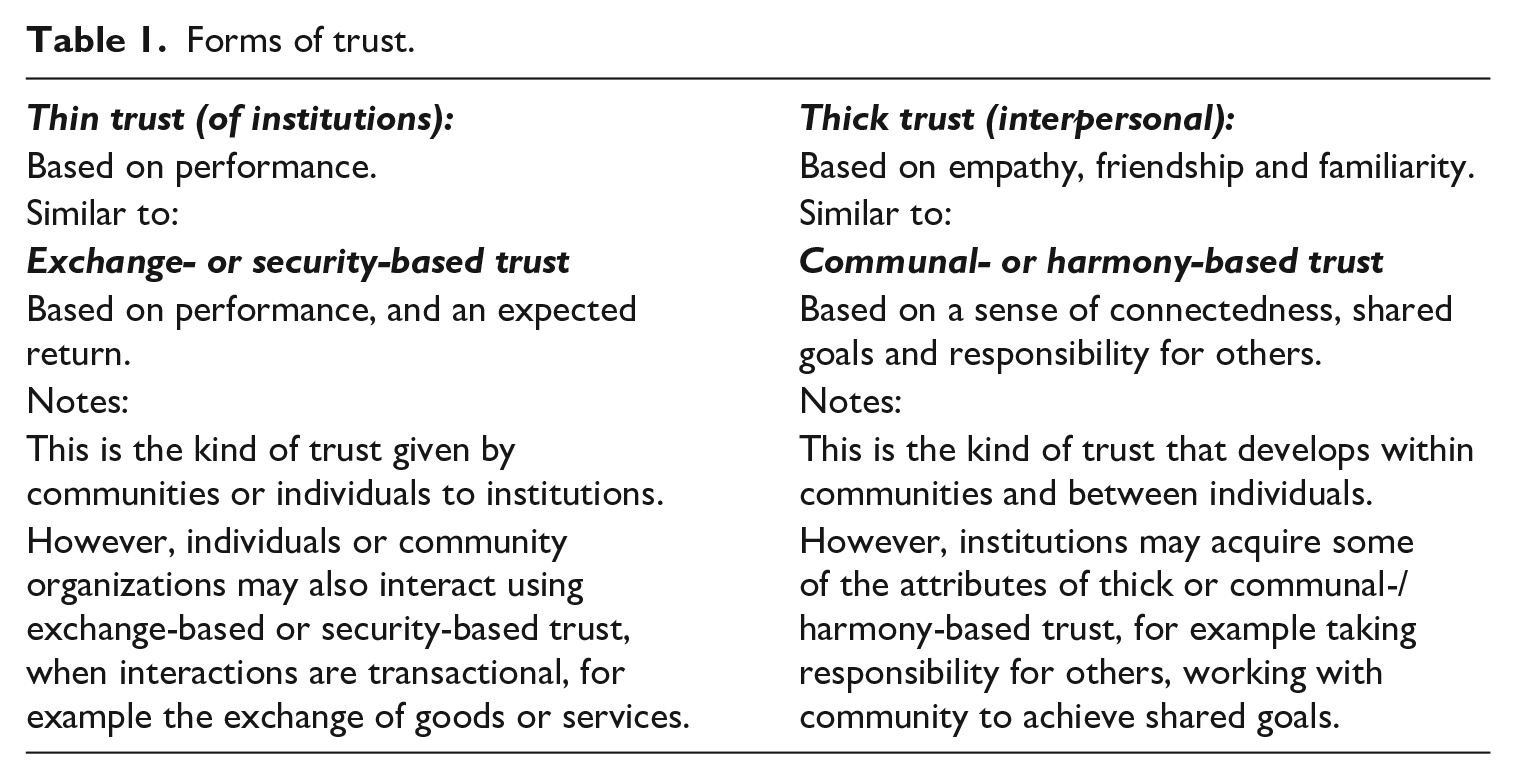
Communal trust norms have to do with harmony and with feelings of connectedness. For organisations, when they are perceived to share the values of the community and to care for the well-being of community members, they are appealing to types of communal trust that are found in the family.
We suggest that while an institution might never be seen as a community member, that is as part of a ‘family’, its care for the interests of a community can give it some of the attributes of a community member: familiar, understood as acting with benevolent intent and out of a sense of care and responsibility for community. Similarly, non-Indigenous researchers working with Indigenous people need not attempt to claim they are a member of the same community, but can achieve over time some of the qualities that this would entail: familiarity, and an alignment of their own interests with those of the community. This may, of course, begin with an exchange-based trust in which an institution, or a research team, prove their reliability and competence. Indeed we would suggest that without this form of ‘thin’ trust, it would be very difficult for a form of communal, or ‘thick’ trust, to develop.
In our case study below, we envisage the research team as in a position analogous to that of the institution in the above typology of trust: the researchers needed to demonstrate professional performance and value to the community (thin trust), before developing relationships based on a demonstrated caring about community goals and taking responsibility for supporting those goals (thick trust).
The descriptions above suggest that harmony-based or communal trust is closely connected to the idea of care. Braithwaite’s empirical study in Australia found, for example, that the High Court, while presumably also the subject of institutional trust based on qualities such as impartiality, was also trusted as having ‘a commitment to, and understanding of, and a concern for the well-being of ordinary Australians’ (Braithwaite, 1998: 65). Trust in this case was based in part on the communal value of concern or care, a concept we now examine before using our case study to suggest that trust and care are an integral part of a sphere of engagement encompassing researchers and community.
We adopt here María Puig de la Bellacasa’s idea of ‘practices of care’ based on her study of the permaculture movement, where care is not a feeling or attitude, but ‘an everyday doing’ grounded in ‘concrete relationalities . . . rather than moral norms’, and one that acknowledges the connection between the individual and the collective (2010: 152). Care in this sense ‘holds together the world as we know it and allows its perpetuation’ through an awareness of society as a series of interwoven interdependencies (Puig de la Bellacasa, 2010: 164). Especially in the case of neglected groups, caring for society as a whole requires ‘a commitment to render visible dismissed or marginalised experiences’ (Puig de la Bellacasa, 2010: 165).
Indeed care is a necessary activity but its actualisations are always specific . . . In every context care responds to a situated relationship. (Puig de la Bellacasa, 2010: 166)
Care then, is a set of practices performed in actual situations, and consciously as a contribution to the good of the wider collective, aligning with Braithwaite’s idea of harmony-based trust that also consists of acts performed for the greater good. It has a clear resonance with Ingold’s ‘sphere of nurture’ for new and future generations. Puig de la Bellacasa uses the example of permaculture as a set of practices of care, and it could be argued that the practice of permaculture creates its own sphere of nurture. The idea of care as a ‘doing’ is reflected in Liboiron’s (2016) description of care as ‘another call to intervention, whether in the “everyday labor of maintenance” for mundane relations . . . or in settings of scholarship and public life’ (69, citing Martin et al., 2015).
Trust relations also have a historicity, traceable not only in the often slow process of developing trust over time, but through their dependence on other histories that precede them. Sánchez Laws (2015), in discussing the role of the new Museo de la Libertad y la Democracia in Panama, notes that community trust in the museum depends on its symbolic value in combatting the apparent impunity of many perpetrators for abuses committed under the previous dictatorship, and its practical value in conserving heritage that could become evidence in legal prosecutions. In the case study below, the historical context of Indigenous/white settler relations is both background and a deep factor in the process of developing trust and care.
A sphere of engagement has a continuity not only with history; it is also connected to the future. As noted above, when care includes nurture, the focus is on the future. Ingold centres ‘place’ within each sphere of nurture in his discussion of Aboriginal connection to land: ‘it is essential to “look after” or care for the land, to maintain in good order the relationships it embodies: only then can the land, reciprocally, continue to grow and nurture those who dwell therein’ (Ingold, 2000: 149, italics added). Martin and Mirraboopa (2003) have defined this as an overriding goal of research with and for Indigenous people. Reflecting this future focus, harmony-based trust relies on an anticipated continued commitment to the interests of another, and security-based trust on anticipated continued performance by another.
The purpose of this overview of ‘care’ and ‘trust’ is to suggest that both constitute binding and temporal dimensions of a sphere of engagement.
We look next at the way in which research discourses on community engagement implicitly or explicitly invoke ideas of care and trust.
Trust, care and community engagement
Researcher–community relationships will always be shaped to some extent by the power structures that in general place community as non-expert participant and researchers as expert leader and project controller. However, community engagement scholars have argued that researchers need to think about being ‘good for’ a community rather than focusing on being ‘good at’ their own area of expertise (Postle and Garlick, 2014: 41). A developing focus in this area is the idea of ‘care’ in the work of researchers – researchers caring about communities so that they conduct their research, not as an attitude of benevolence, but practically, in a way that maximizes community empowerment and the learning of all participants including researchers: A shift is needed. . . away from thinking about communities . . . as ‘subjects’ towards one that is foregrounded in thinking about accountability, building trust, and, ultimately, striving for relevancy. (Waterton, 2015: 59)
There are already examples of this shift. A report by the UK Arts and Humanities Research Council (Crossick and Kaszynska, 2016) notes several examples of co-research, including one study that considered the role of the arts in the lives of older people and concluded: ‘If older people were involved as active participants in the co-construction of research, their views may help to define cultural value as it relates to drama engagement’ (Rickett and Bernard, nd: 44, cited in Crossick and Kaszynska, 2016).
Like David Studdert’s relational account of community, where ‘all elements must be constructed inter-relationally’ and all elements, including conflict and co-operation, ‘are entwined’ (in Studdert and Walkerdine, 2016: 617), the account of engagement between researcher and community that we propose in this paper is a relational one; the relationship between them is co-constructed. PAR, as described for example by Maggie O’Neill, is one form of research that can be seen as a sphere of engagement where participants become co-researchers and experts, and where there is ‘shared ownership of the development and outcomes of the research’ (O’Neill, 2012: 157). O’Neill notes that ‘[a]t every phase of the PAR model there is the possibility for change’ (O’Neill, 2012: 157).
In the case study below of a community-led project (noting Walkerdine’s (2016: 711) view that ‘for co-produced research to have any chance of success, it is the community that must call the shots’), the possibility of change in methods, activities and outcomes was always present, reflecting the priorities and preferred approaches of each community. TallBear (2014: 6) suggests moreover that ‘inquiring not at a distance, but based on the lives and knowledge priorities of subjects—helps open up one’s mind to working in non-standard ways’.
Co-research can make it more evident that a project occurs in a rich context of ‘affective histories’ (Walkerdine, 2016: 703) which, particularly in the case of Aboriginal–white settler relations, shape the sphere of engagement. As part of that engagement, non-Indigenous researchers cede power by becoming part of a collective quest with Aboriginal communities to articulate and overcome the invisibility of colonial history. As Foucault points out (Foucault and Deleuze, 1977: 214), the ‘first step’ in a struggle against power is for the oppressed to ‘confiscate, at least temporarily’ the power of others to speak on their behalf. In the case study below, the project was instigated within Aboriginal communities with the express aim of truth-telling about and by Aboriginal people: a ‘true history’ told in the words of Aboriginal people and ‘always with ownership’ by Aboriginal people (quotes from interview with the late Angelia Walsh, 22 January 2017).
Co-research suggests that a community engagement model of separate entities linked by contracts and agreed goals is less apt than one in which all participants are co-generating new knowledge, redressing past wrongs and creating new futures.
It is in the making together, developed through trust, that the most profound insights might be understood and actions proposed for the possibility of change and transformation. (Walkerdine, 2016: 711)
In the idea of research as a ‘making together’, the activism and advocacy of researchers described by Giacomini (2004) and Mackie (2013) can be seen as a natural extension of harmony-based or communal trust.
Co-research goes beyond the ideas of ‘reciprocity’ and ‘benefit’ that are built into guidelines for Aboriginal research in Australia: the National Health and Medical Research Council guidelines require that research demonstrate a return in which the Aboriginal people ‘have the right to define benefits according to their own values and priorities’ (NHMRC, 2018) and those of the Australian Institute of Aboriginal and Torres Strait Islander Studies require that Indigenous people involved in research ‘should benefit from the research project and research outcomes should include specific results that respond to the needs of Indigenous people’ (AIATSIS, 2012). However, Native American scholar TallBear (2014: 2) notes that the goal of “giving back” to research subjects seems to target a key symptom of a major disease in knowledge production, but not the crippling disease itself. That is the binary between researcher and researched—between knowing inquirer and who or what are considered to be the resources or grounds for knowledge production.
Research resistance (Scheyvens and Storey, 2003: 5) to this binary includes forms of refusal. We use ‘refusal’ here in Simpson’s sense: ‘refusing the gaze, . . . disengagement’ – a statement by participants to researchers that ‘This is who we are; this is who you are; these are my rights’ (Simpson, 2014: 106, 107). Elsewhere we have written about the acceptance of ‘waiting’ (by researchers) as an opportunity to partially redress imbalances in power between researcher and researched (Palmer et al., 2018); to make researchers wait is a form of refusal that expresses the rights of the researched and the value of their time. Sometimes, as Walkerdine notes, refusal to engage is a matter of survival in the face of cultural annihilation (Walkerdine, 2016: 712, 702). It behoves the researcher to understand the ‘affective history’ as well as the current ‘web of relations’ in a community, in order to understand the meaning of refusal. This meaning is one that ‘we must work to be able to hear’ (Walkerdine, 2016: 712).
More generally, and as we found in our case study, the co-production of research requires researchers ‘constantly being open to hearing and struggling to understand and engage with what is being shared’ (Walkerdine, 2016: 711). Part of this struggle is developing awareness of what assumptions and affective histories are brought to any project, particularly those complex and difficult histories that underlie projects engaging both Indigenous and non-Indigenous people.
Van den Scott (2018) for example writes of her anxious transition from ‘friend’ to researcher in an Inuit community (for a discussion of this dilemma in reverse, see Palmer et al., 2014b). In this case, van den Scott was aware not only of anxiety, but of a tendency to judge – even recoil from – customs and behaviours that were strange to her, and the importance of adopting an attitude of learning that enabled her to avoid making judgement. This includes learning about history: The historical contingencies which bear on my interactions with Arviammiut include countless instances of personal judgement on the part of qablunaaqs [generally white people] against the Inuit I am in dialogue with, as well as institutional structures which are inherently judgemental of the Inuit. (van den Scott, 2018: 29)
Hyndman (2001: 264) also points out that it is important for a researcher to go beyond mere exclamation or a ‘framing of the world-as-exhibition’. Distancing participants’ stories to the extent of finding them ‘exotic’ (and hence barely comprehensible) can be dehumanizing and represent a failure of insight or a lack of nuanced analysis. On the other hand, where researchers are working with people in their own community, there is a danger of assuming shared understandings with participants and of missing important differences (Mannay, 2010: 93–95). Mannay suggests using visual methods in order to ‘make the familiar strange’ again, while Allan (2018) brings historical literature to bear in the analysis of ethnographic data ‘in order to jolt and to jar with my conventional, familiar and taken-for granted assumptions’ (544). Delamont (2012: 5) also argues that familiarity can undermine the research process by preventing new formulations of the issues; for similar reasons, she is critical of contract research, which ‘is designed to answer questions posed by, and to gain information for, those with power and position’, such as governments and corporations. As we shall see in the case study however, contract research led by the community can provide researchers with new opportunities for learning and new ways of working.
Case study: the South-West Queensland Indigenous Cultural Trail
Background
The Surat Aboriginal Corporation (SAC) commissioned the University of Southern Queensland to gather life stories and stories about sites and events of significance to Aboriginal people, in seven towns in South West Queensland. This built on cultural heritage work already undertaken by Indigenous communities over the previous 20–40 years (the first stage of the project), and several years of work undertaken by SAC to negotiate and secure Partnership Agreements with each community (the second stage).
The gathering of stories became the third stage of the South West Queensland Indigenous Cultural Trail project. The Trail is a 1000 km tourist drive between the towns, where Aboriginal sites, stories and artefacts have now become more accessible as a result of the material gathered for the project and disseminated through a public website and tourism brochure. The next stages will include negotiations with tourism bodies to promote and build the Trail, and training of tour operators, artists and others to open opportunities for Indigenous people in communities along the Trail.
Historical factors
The history of Indigenous−non-Indigenous relations in South West Queensland, as elsewhere in Australia, is that of colonial settlement, with subsequent Aboriginal dispossession and discriminatory controls exerted by authorities over every aspect of Aboriginal people’s lives, from marriage to employment to place of residence. It also saw the removal of children from families through the assimilationist programme that resulted in what is now known as the Stolen Generation. The consequences, physical, psychological and spiritual, have been devastating for many Aboriginal people. Despite this history, Aboriginal people across their many nations have survived and maintained connection with their land and their traditional spiritual and cultural systems.
SAC and the University of Southern Queensland research team found that while Aboriginal people wanted to celebrate and share traditional culture, they were also deeply concerned about the lack of awareness of this more recent history in non-Indigenous Australia. Middle-aged and older Aboriginal people, for example, have strong memories of life on the ‘fringe camps’ or ‘yumbas’ on the edge of town, where many lived until the late 1960s. After the 1967 constitutional referendum, 1 people were forced to move into town, and the camps were bull-dozed; in most towns, there is little trace of the former camps where so many lived. ‘Truth-telling’ and acknowledgement of this ‘post-contact’ past has been claimed by Indigenous people as necessary before healing, and hence any kind of reconciliation, can occur. Indigenous and non-Indigenous people have been urged to ‘build a new past’ together (Corowa et al., 2009). Tom Griffiths (quoted in Read, 2000: 184) has noted that what is needed is ‘[n]ot shared country alone but shared history’. However, understanding post-contact history is not a matter of re-writing ‘settler history’ with its ‘de-centering [of] Indigenous peoples’ own articulations of Indigenous-settler relations’ but rather of ‘lived and contentious engagement with the literal and stolen ground on which people stand and come together upon’ (Snelgrove et al., 2014: 26, 27).
Byrne (2002: 136) points out that ‘[i]n the heritage sphere,. . . the Aboriginal post-contact experience has remained largely invisible’. The Trail project has enabled the gathering of stories from older people in communities before they pass away, and is also, in the longer term, able to contribute to the broader discourses of post-contact heritage and history, and of reconciliation or reparation. Recent moves towards truth-telling, as well as the burgeoning interest by non-Indigenous people in Aboriginal culture and heritage and Aboriginal people’s willingness to share it, are the context in which the University, SAC and Aboriginal people in the seven towns contributed to the development of the Trail.
The future factor
The project instigators and many of the storytellers in each community have an eye on the future: the sharing of Aboriginal knowledge, culture and history with the wider community, the preserving of knowledge for future generations, the development of an Aboriginal tourism industry and the future education and employment prospects of their children or grandchildren. The Trail project was formed around an invisible history and an envisaged or hoped-for future, which underlie all of the interactions that form part of this sphere of engagement.
The project also grew from a series of evolving relationships and events that both tested and produced trust in several different arenas. This history is described below.
A brief history of Trail relationships
We present here our co-author Angelia Walsh’s story, to illustrate the temporal and networked nature of relationships that led to the point where her organization employed university researchers to work on the South West Queensland Indigenous Cultural Trail.
When Angelia was a child, she dreaded the Social Studies class at school, because there was always a section about Aboriginal people, and it portrayed them as savages: people without laws, without boundaries, and without respect. At that time she felt ashamed to be Aboriginal. She remembered her early life in the humpy that her grandfather built on the bank of the Balonne River, and a childhood that felt happy, protected and safe. However when she started to ask questions of her grandfather and her uncle about what happened before she was born, where her people came from, and about Aboriginal language, they would not answer her. She remembers that every time a policeman came to the camp, her grandfather would shout at the kids to run and hide. She thought that was a game. This desire for knowledge of her people’s history and culture continued however. As an adult, she became friends with the local Council’s Community Development Officer, Marlyn McInnerney, and expressed a desire to know the ‘proper history’ of that time. Angelia set up the Surat Aboriginal Family History Group and Marlyn sourced funding for a series of projects to research and present the family histories. Angelia brought together the five main Indigenous families in town to work out ways of finding more information about their history. Together, the families found records of their past at the official archives in Brisbane: their removal from lands, the taking of children, the strict control of marriages and work, the denial of wages, were all in the archival records, documented and date stamped. Many local graziers came forward with copies of letters they had sent to and received from the Aboriginal Protectorate for their Indigenous employees. Angelia came to understand a bit more about her grandfather and his unwillingness to talk about the past. The families wanted to take the project further, and because Angelia had become involved in the work of the local museum, they decided, again with Marlyn’s support, to develop an exhibition of four replica humpies that later toured the eastern states of Australia. Their book, Houses and Humpies, was launched by Indigenous leader Dr Jackie Huggins shortly afterwards. In the year 2000 the Family History group was incorporated as the Surat Aboriginal Corporation. Through close collaboration with Marlyn, small funding grants were obtained and Angelia instigated work on an interpretive shelter on the site of her family’s camp, which included photos and other material from that visit to Brisbane. By 2011, a humpy had also been reconstructed nearby, and, on the opposite riverbank the original humpy of the Traditional Owners was restored. For Angelia and for other families, this work was principally about resisting erasure; as she says, ‘They might bulldoze this place, but they can never deny we were here’. Angelia and Marlyn began to talk with many other communities about their history, and realized that in another hundred years, many historical sites, like the camps at Surat, might also disappear. They saw that each community had its own story to tell, and decided to pursue the idea of a tourist driving loop through all of the towns. The vision was for Aboriginal people to share their history, but always with ownership. Grant funding, obtained in collaboration with Marlyn, was finally forthcoming for development of the third stage of the Trail. At around the same time, Marlyn met one of the authors of this paper (Palmer) and saw the potential for a collaboration with the university.
The relationship of ‘thick’ trust that developed over the life of the relationship between McInnerney and Walsh grew out of many projects over 20 years. The goal of each project was the good of the Aboriginal community, but each project involved skills development within SAC that also offered a longer-term good to the Corporation and the community beyond specific projects. The communal-based trust that developed between Walsh and McInnerney continued after McInnerney’s employment with the local Council finished. Moreover, while the relationship was initially cemented by propinquity (including school-based friendships between their children), it continued when McInnerney re-located to a town several hundred kilometres away from Walsh’s home and office.
McInnerney, already acquainted with one of the authors (Burton) through the latter’s extensive research with community, invited Palmer to participate in two projects unrelated to the Indigenous Cultural Trail, but in which Palmer was able to demonstrate commitment to community outcomes. The ‘thin’ or institutional trust of McInnerney in the University extended to Palmer in terms of demonstrated reliability (exchange- or security-based trust), but also developed into the ‘thick’ trust of personal interactions as the researcher began to take on a commitment to a collective good (harmony-based or communal trust). When McInnerney and Walsh sought consultants to gather stories and develop the brochure and website material, the decision to approach the University was based on McInnerney’s perception that Palmer would be caring (harmony-based trust), and responsible and competent (security-based trust). Walsh’s involvement in meetings around this time began a relationship between her and the research team that culminated in her organization offering a contract to the researchers to work on the Trail project.
The significance of this project procurement process cannot be over-estimated; the University agreed to work with a community client who had been responsible for both instigation and design of the project, including stipulation of community outcomes, responsibility for obtaining participants’ agreement to be involved and advising the researchers on methods of engagement with participants. One example of the latter was Walsh’s advice that we not to refer to our discussions with participants as ‘interviews’ but rather as ‘having a yarn’ (‘yarning’ has in recent years emerged as an academically accepted method of data collection when working with Aboriginal communities (Laycock et al., 2011)), and to talk with participants in informal settings over a cup of tea. Researchers used their own experience to develop a loose set of questions for participants, with the multiple aims of obtaining information for the Cultural Trail website and brochure, of learning more about the history of the community and the life stories of individuals and of identifying each community’s goals and aspirations for the Trail for the purpose of future evaluation of the project’s impact. Thus we addressed the goals of SAC and their associated communities, as well as our own learning.
Trust and care develop over time and in different arenas: in the case of the Trail project, trust extended from one organization (SAC) and its people, through an intermediary (McInnerney), to another organization (the University) and its people. As we saw in the description above, there were several check points where trust, both ‘thick’ and ‘thin’, was tested and proved. This suggests that, in the entanglement of relations that forms the university–community sphere of engagement, development of trust may require demonstrated expertise and commitment to the collective good over time and across a network of relationships that stand outside a written contract.
Factors in building trust
The consultancy structure of the Trail project has supported the development of ‘thin’ or institution-based trust, in that the whole project, and hence the work of the researchers, was driven by SAC and its partner communities, whose principal story-owners approved all Trail material developed by the University before its release on the website. The research contract with the University provided for all Intellectual Property arising from the project to be shared, and the website material itself is owned by SAC. Both the contract provisions and the management of the project have been opportunities for the University to be guided by, and responsive to, SAC and its community partnerships, and thus to demonstrate the kind of institutional care and commitment – based on communal norms – described by Braithwaite (1998: 65).
As the Trail project progressed, the foundations for development of thick trust were laid. The stories heard by researchers deepened their affective engagement with communities, just as the telling of stories can deepen a community’s own engagement with its culture and its past: . . . songs, stories and designs serve to conduct the attention of performers into the world, deeper and deeper, as one proceeds from outward appearances to an ever more intense poetic involvement. (Ingold, 2000: 56)
As we have noted, there were not only affective histories at play in the project, but an affective future. The primary purpose of Aboriginal and Torres Strait Islander heritage conservation, argue Pocock and Collett (2012: 3), is to sustain the relationship between Aboriginal and Torres Strait Islander people and their heritage places. We have discussed elsewhere (Palmer et al., 2019) the overriding objective of research with Aboriginal people as being, for them, ‘the protection and preservation of our country and its Entities and the protection and preservation of our Ways of Knowing, Ways of Being and Ways of Doing’ (Martin and Mirraboopa, 2003: 211). In the sphere of engagement that constituted the Cultural Trail project, this objective emerged for all of us on the research team. Whether oral historian, anthropologist, archaeologist or cultural heritage adviser, each researcher held the idea of such sustainment as fundamental in the collaborative work on the Indigenous Cultural Trail.
The engagement between researchers and community members developed to include relationships of care for the other and enjoyment of each other’s company, both of which were reflected in informal interactions (social events, conversations about work and family, exchange of cards and photographs after the fieldwork had been completed). These were not minor events, but of great significance, at least to the researchers. Just as van den Scott describes the roller-coaster of anxiety as she progresses through her research with Inuit people and the small interchanges with participants that bring relief (‘[l]aughter was an integral part of my interactions and experiences in Arviat’) (26, 29), so too did non-interview situations – an impromptu barbeque, a chat that continued long after the close of a community meeting – afford us some affirmation of a growing trust between community and research team. There were on the other hand, times when there seemed to be little interest in the project, and when we waited to no avail for someone to arrive and share their story. There was a phone call from an angry community leader who felt that we had not enabled their participation during our visit to that community. There was initial strong resistance from one group in a community who saw our data gathering as potentially damaging to a Native Title claim. Our responses to these situations were to a large extent guided by the project leader, Walsh, and the possibility of speaking with people again at a later date, although this did not always eventuate. In general, we benefitted as researchers from the Aboriginal leadership of the project and the level of trust, and hence good communication, between SAC and the research team.
The ‘thick’ trust between communities and the University, based on familiarity and a commitment to the interests of the other, is still now in its early stages. We hope it will increase if and when other projects take the researchers back into the communities, and we note that the same communities are exploring other potential avenues for future collaboration with the University.
Conclusion
Our purpose in writing this paper is to propose a frame within which to think about research with Indigenous communities, one that encompasses but goes beyond a contract between two parties, and beyond debates about reciprocity, partnership or co-research. We have drawn on the idea of a sphere of engagement to suggest a web of relations that extends into the past and the future. A commitment by non-Indigenous researchers to learning about a community’s past and future is, we argue, a form of care that underlies trust. This project and others are what Appadurai (2004: 9) calls the ‘levers . . . of public performance’, levers that can be used to ‘change the terms of recognition, indeed the cultural framework itself’ within which Aboriginal and non-Aboriginal people live and relate to one another. Where researchers enter a sphere of engagement with a community, the potential for a project to result in a shift in ‘the terms of recognition’ must be supported by a methodology that includes the researchers’ attentiveness to the past, present and future, an enabling of community trust in the formal protocols and cultures that frame the researchers’ activities, and a trust that the institution and its researchers will continue to engage and to care into the future. Where ethnographic or storytelling methods are used, there is an opportunity for researchers to engage even more deeply with a community through learning and sense-making, and hence to develop empathy, affect and friendship, the foundations of ‘thick’ trust.
Tracing the development of trust is a way of tracing the entangled relations over time that form the sphere of engagement in which researchers and community members find themselves in any particular project. Trust and care bind together people, events, histories and futures beyond the dichotomous and time-delimited relationship of a contract, and carry the sphere of engagement between researchers and community beyond the life of any one project. Enabling these processes is, we suggest, a critical part of project methodology in community-engaged research.
Footnotes
Acknowledgements
We acknowledge with gratitude those Aboriginal people in South West Queensland who have shared their stories with us over the past few years. We pay special tribute to our co-author, Angelia Walsh, who passed away in September 2018 and who has made an enormous contribution to the recording of Aboriginal post-settlement experience for future generations. We thank the three anonymous reviewers of an earlier draft for their valuable comments which have greatly strengthened the paper.
Funding
The author(s) disclosed receipt of the following financial support for the research, authorship, and/or publication of this article: The Surat Aboriginal Corporation received funding from the Commonwealth Murray-Darling Basin Economic Diversification Fund for development of the South West Queensland Indigenous Cultural Trail, part of which used to commission the University of Southern Queensland to undertake research and content development for the Trail website and brochure.
