




Abstract
In this paper, the authors describe a way of doing phenomenology using exemplars drawn from a doctoral study of Australian nurses’ lived experiences following a disaster. Phenomenology is concerned with the essence of things as they are appearing in the conscious awareness of the first person. This paper emphasises a way of doing phenomenology based on maintaining orientation to the uniqueness of the ‘thingness’ of the phenomena being uncovered. While there is no one way to do phenomenology, this paper shows a way of doing phenomenology from obtaining individual narrative and moving to an intersubjective lived-experience description.
Introduction
This paper describes how phenomenology has been employed as a methodology to uncover registered nurses’ lived-experience of the out-of-hospital environment following a disaster. Phenomenology is a philosophy that has been used as a methodological underpinning by researchers over many years. The challenge for researchers is to continually try to make practical use of phenomenology given its deeply philosophical stance. In this introduction, phenomenological notions are presented as being concerned with the essence of things as they are appearing in the conscious awareness of the first person. Further, the relationship of phenomenology and hermeneutics is introduced.
Things in the world have properties. Things make sense when they are considered within a certain aspect in the world, which Heidegger called the background (Heidegger, 1953/2010). Physical or material things are objects with concrete properties, for example, a stethoscope ‘makes sense’ if it is used by a nurse with a patient or in situations such as children playing ‘doctors and nurses’. On the other hand, non-physical, immaterial things have properties related to a situation in which someone finds themselves, such as being in a hotel room (Van Lennep, 1987), sharing a secret (Langeveld, 1944), being at home sick (Van Den Berg, 1972) or being a nurse following a disaster (Ranse, 2017). Phenomenology is a way of exploring the essence of a thing by getting to the ‘thingness’ of that thing as it shows itself (Heidegger, 1953/2000; Husserl, 1900/2001). It is the uniqueness of the properties of a thing, material or immaterial, that gives the thing its ‘thingness’. These unique properties are referred to as the essence of a thing (van Manen, 2014b). If an essence of a thing is removed, the thing can no longer be recognised as that thing, but instead is something else.
The meaning and understanding of how things appear to be, evolve over time through a person’s interactions in the lived world. This appearing over time can be plotted against time (Gadamer, 1960/2013; Heidegger, 1953/2010; Merleau-Ponty, 1945/2002). This plotted time can be demonstrated within a structure of the past (retention), the now and the future (pretention). This structure of time is termed ‘temporality’ (Heidegger, 1953/2010).
Conscious awareness, or at least the content of the mind, is typically directed towards something (Husserl, 1900/2001; Husserl, 1931/2012). This is the base premise of Husserl’s phenomenology, in which subjects contemplate things. Husserl (1954/1970) suggested in the notion of bracketing or epochē that it is possible to remove the mind’s directedness towards a thing. Husserl (1931/2012) suggests that epochē does not mean to forget a thing. Instead, epochē brings into light the essence of a thing by setting aside presupposition and prejudice of a thing; a person therefore has an ability to describe the thing as it is in itself. In contrast, Heidegger (1953/2010) argued that achieving epochē is difficult, particularly if a thing under study is something with which you have been actively engaged, such as an experience of being a nurse in an out-of-hospital environment following a disaster. As such, phenomenological researchers are actively engaged as participants of phenomenological research.
One may thus say that the way of approaching a phenomenon is just as important as trying to understand the ‘thing’ appearing to consciousness. The ‘thing’ takes on another significance when it concerns someone’s experience, as no two people will perceive their phenomenal placement identically (Merleau-Ponty, 1945/2002). To illustrate this with an image, it can readily be seen that each person is physically situated in a particular space or place at a particular time: each of these situations is a unique one, not able to be directly shared. There are at least different perspectives or lines of sight, remembering that sight is an image only, an image which can be transferred to other senses in its function as a metaphor. This unique placement of perception by another person is established as ‘an orientation which flees from me’ (Sartre, 1966: p. 342). This means that I cannot share another’s direct perception. That is to say, the way we perceive or interpret things is dependent on where we are situated not only physically but also in terms of our cultural, historical and political placements, this being one’s historical horizon (Gadamer, 1960/2013).
Hermeneutics is the methodology of interpretation, particularly as it is applied to textual narrative. Together with phenomenology, hermeneutics has been promoted by the work of Dilthey (1976/1979), Gadamer (1960/2013) and Heidegger (1953/2010). When considering a research participant’s transcript, the researcher may engage in a circular argument through the ‘hermeneutic circle’. The researcher continually moves from the whole of the participant narrative to the parts of the narrative and back to the whole again, in a hermeneutic or cyclical manner of interpretation of the phenomenon under study (Gadamer, 1976/2008). The hermeneutic circle is not a vicious circle, as the hermeneutic circle is dissolved when the interpreter, or researcher, has explored the text to the fullest allowing for the fundamental ontological situation to be clarified (Heidegger, 1953/2010).
Given the above, phenomenological writers encourage the pursuit of our own paths in doing phenomenology. For example, the later works of van Manen (2014b) will guide the researcher in a non-prescriptive way, whereas Colaizzi (1978) and Giorgi (1997) encourage researchers to adapt their procedural steps to meet the exigencies of their studies. This paper demonstrates a non-prescriptive way of doing phenomenology from obtaining individual narratives and moving to an intersubjective lived-experience description of a phenomenon. Exemplars from Ranse (2017) are interspersed throughout the paper, not to place emphasis on the obtaining or interpretation of the data from this specific study but as a demonstration of a way of doing phenomenology. Tables are used to demonstrate worked examples. Tables may direct the reader to view a way of doing phenomenology in a stepwise approach. However, this is juxtaposed to the intent, that is an emphasis of doing phenomenology being iterative and non-linear. This is a practical approach, which in this paper describes a way of doing phenomenology that consists in the conscious connection of registered nurses to their work following a disaster.
Obtaining narrative
Phenomenological research seeks to provide insight into a likely or possible experience. Having experience of the phenomenon being studied is of utmost importance when determining the suitability of participants in phenomenological research. The identification of participants who had experience(s) is the beginning of phenomenological enquiry. The research participants in the study discussed in this paper were Australian general registered nurses who worked primarily as clinicians in a hospital; had been deployed following a disaster as part of a non-military organisation, association, group or health disaster medical assistance team; had worked primarily in the out-of-hospital environment following that disaster; and had been involved in a disaster that had occurred in the five years prior to the first interview.
Each participant in this study was interviewed individually at two distinct points in time, one week apart. Interviews were held at a mutually agreed location and time in the residing city of the research participant. The venues varied according to the preferences of each individual interviewee. For example, interviews were held in private offices, local universities or cafés. Having a mutually agreeable location preferred by research participants allowed for a sense of comfort for participants and seemed to allow participants to be relaxed and open in their narratives. The interviews between the researcher and participants commenced with a general conversation. This interaction between the researcher and participant prior to each interview was not recorded, as it did not constitute part of the research narrative pertaining to the research question. However, these informal conversations provided an opportunity for commencing a discussion and building rapport between the researcher and research participants before the formal interview commenced.
All interviews were recorded using a digital device to capture the dialogue of the researcher and participant. Interviews were transcribed to create a textual narrative. Where a participant or researcher narrative is presented in this paper, a number of notations are evident. A key to reading the narratives is provided below:
[ ] means the researcher has added narrative to make the context and/or meaning more clear, or replaced some identifiable text with de-identifiable text
. . . means that words, phrases or sentences of the interview have been deleted to make the context and/or meaning clearer
( ) after each original participant narrative indicates that particular participant’s numerical pseudonym, serving as a reference to an original narrative. For example, (7.2:13) represents the seventh participant, second interview, narrative on page 13 of the transcription.
Below, we discuss methodological aspects of each phase of interviewing as it pertains to obtaining participant narrative.
First interview: descriptive
The activities related to obtaining narrative from participants in their first interview are outlined in Table 1. The first interview for each participant was semi-structured in nature, commencing with a broad question to encourage storytelling, such as the following:
Can you tell me a little bit about what happened? I’m after, I guess, a bit of a story about where you started or how you heard about [the disaster] and how you ended up. (Researcher; 7.1:3) So we might pick on [the disaster] because it’s been the most recent . . . can you just tell me about how that happened? From the beginning . . . ? (Researcher; 5.1:4)
Obtaining narrative: first interview.
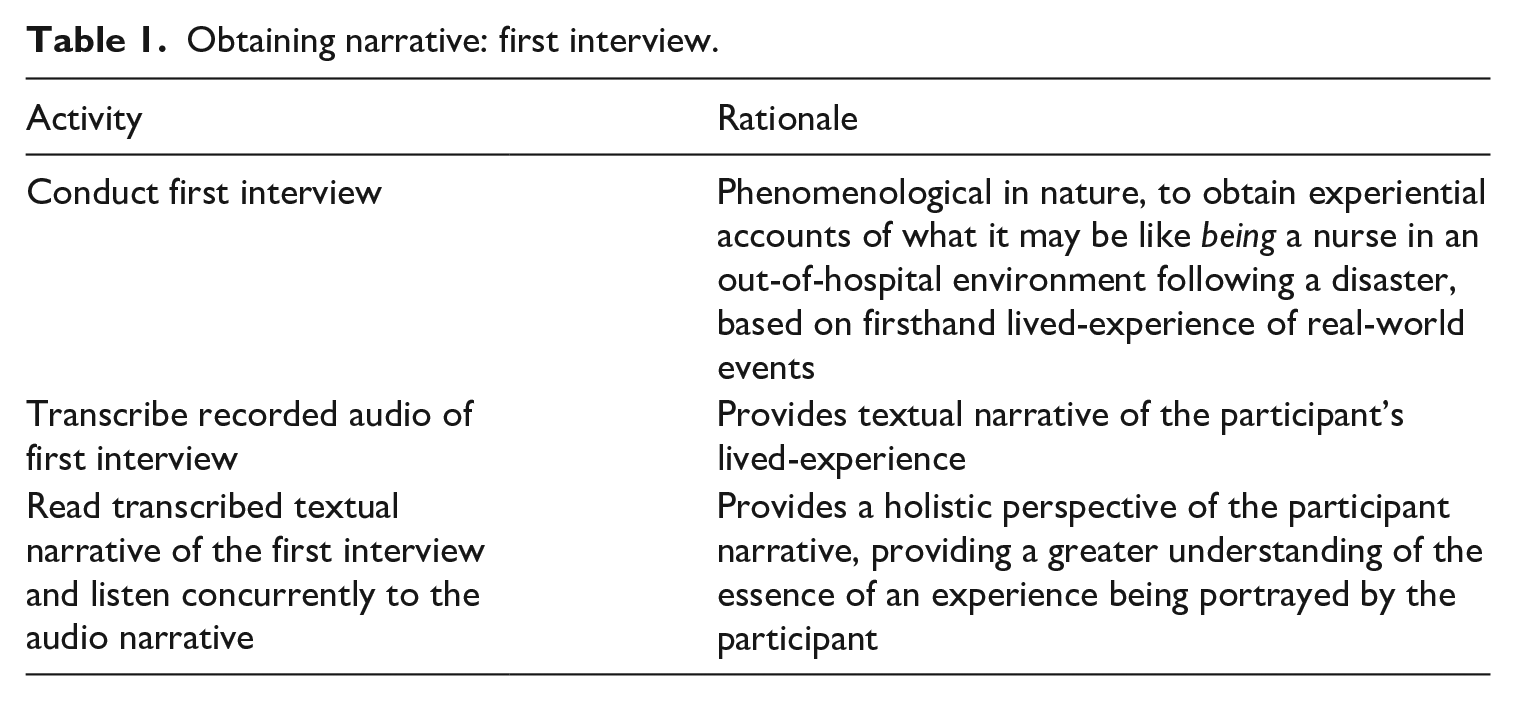
Participants were encouraged to engage in storytelling as a means of eliciting experiential anecdotes with depth in their description. The purpose was to generate in-depth anecdotes that resonate with what the experience may be like by describing what was happening in the experience, such as the time of day, who was around, what they saw, what they smelt (van Manen, 2014b). As the participants were retelling their experiences, the researcher was reserved in judgement, quiet and listening, allowing the participant to have an active and dominant role in the conversation. By using silence strategically, a participant may be more explicit in the description of an experience (Bengtsson and Fynbo, 2018).
Further depth to the participants’ stories was obtained throughout the interview when the researcher prompted participants to elaborate on their experiences with details of a specific situation, time or moment. For example:
So in the morning, for example, on a day-to-day basis, you’d leave your accommodation, congregate. Then what happened? (Researcher; 3.1:8)
Van Manen (2014b) suggested that it can be difficult to keep interview participants orientated to the phenomenon being uncovered, while participants relate an experiential account of their experience. To overcome this, if participant descriptions started to diverge from the experience of being a nurse in an out-of-hospital environment following a disaster, the researcher used questions to reorientate the participant to the phenomenon, such as the following:
Just going back a little bit, so you had your brief . . . what happened after that? (Researcher; 7.1:6)
Immediately following the interview, the interview audio was transcribed to generate textual narrative as outlined in Table 1.
Second interview: descriptive and interpretive
A second interview was undertaken with each participant, one week after the first interview. The activities related to obtaining narrative from participants in their second interview are outlined in Table 2. The second interview allowed participants to add or build on their experience elements which may have been omitted from the first interview. To begin this interview, the researcher asked questions such as the following:
Since our last time [the first interview], did you have anything else that you thought about, that you might want to add? (Researcher; 1.2:1) So last time [in the first interview] we did a lot of the story telling . . . chronologically what happened in the disaster . . . was there anything you wanted to add? (Researcher; 6.2:1)
Obtaining narrative: second interview.
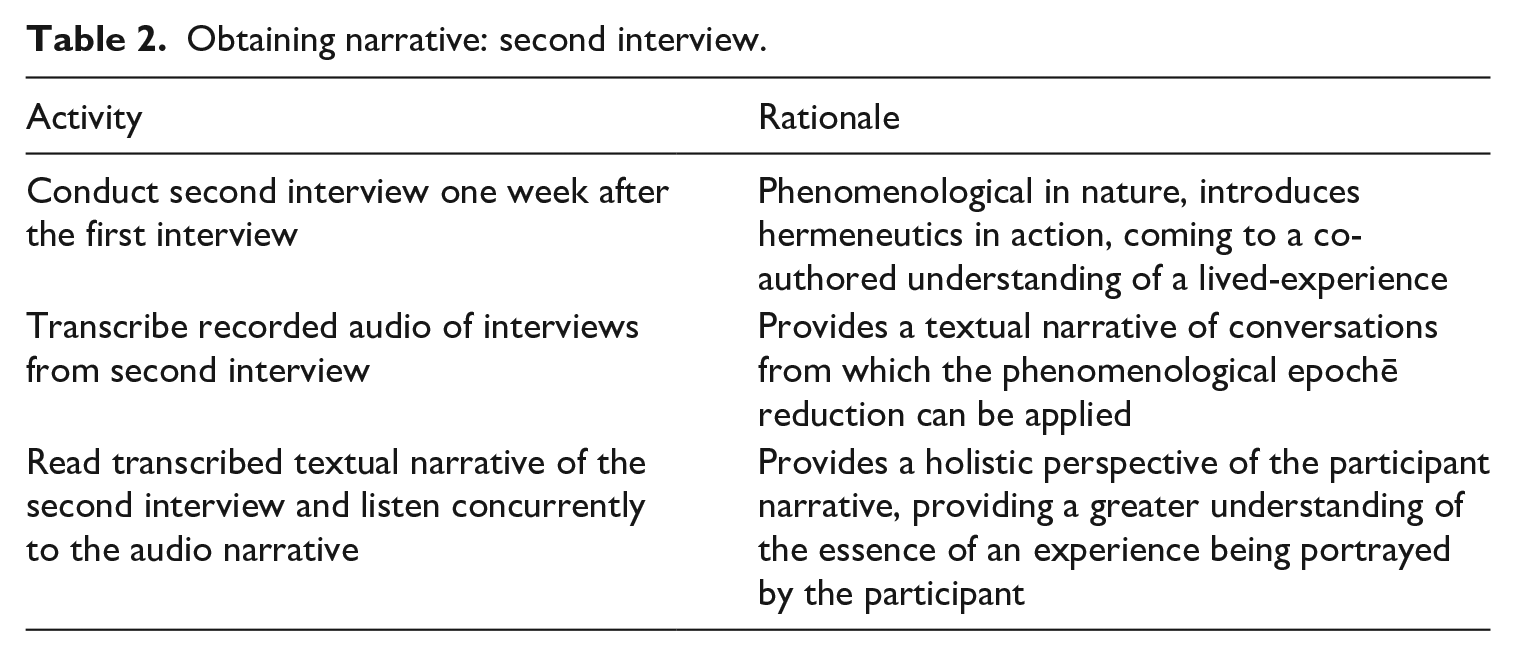
The second interview applied the theoretical underpinnings of hermeneutics and the hermeneutic circle in action during the interview, by encouraging reflection on previous stories. This interview technique was a way of leading to a co-authored understanding of the experience being discussed between the participant and the researcher (van Manen, 2013). This co-authored understanding provides clarity on what the participant is meaning to say, as the meaning of the experience is not always apparent to the participants who produce them, but meaning can be made from the narratives produced by them (Ranse and Arbon, 2008). This may be the case as participants may perceive being a nurse following a disaster differently, and the researcher is becoming increasingly positioned to understand an individual’s experience in a collective context, that being from multiple participants. As such, applying hermeneutics in action during the second interview does not leave the openness and retrospective application of hermeneutics and therefore the interpretation from the researcher alone. Instead, applying hermeneutics in action during the interviews allows for a mutual, co-authored, understanding of what is being said in action and reduces misunderstandings at a later point (van Manen, 2013). Questions relating to the understanding of the content from the first interview were asked in a semi-structured manner, becoming more unstructured as the interview progressed. For example:
As we go, I’ve made a few notes of what you said last time [during the first interview] . . . I’ve just got a couple of notes on things that I just wanted to clarify to make sure I understood what you were saying about what it was like [being a nurse in an out-of-hospital environment following a disaster]. (Researcher; 1.2:1)
As with the first interview, immediately following the second interview, participant audio narrative was transcribed to a textual narrative, as outlined in Table 2.
To a lived-experience description
To reach a lived-experience description, the researcher reflected on participant narratives of what it may be like being a nurse in an out-of-hospital environment following a disaster. This activity included the following: uncovering moments (see Table 3); identifying exemplars of these moments (see Table 4); and presenting a story as a lived-experience description of the phenomena (see Table 5).
A way of doing phenomenology: uncovering moments.
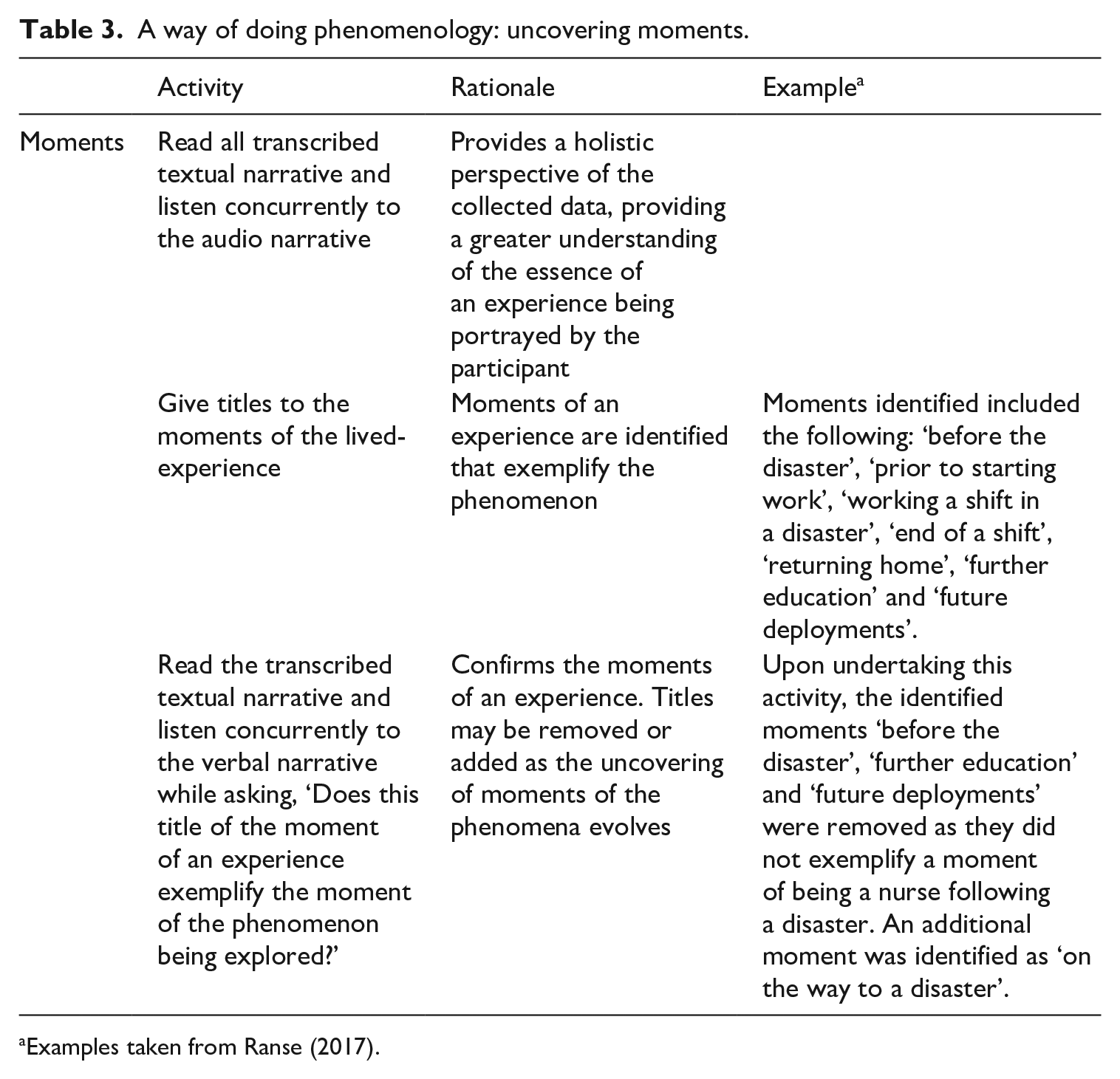
Examples taken from Ranse (2017).
A way of doing phenomenology: exemplars of moments.
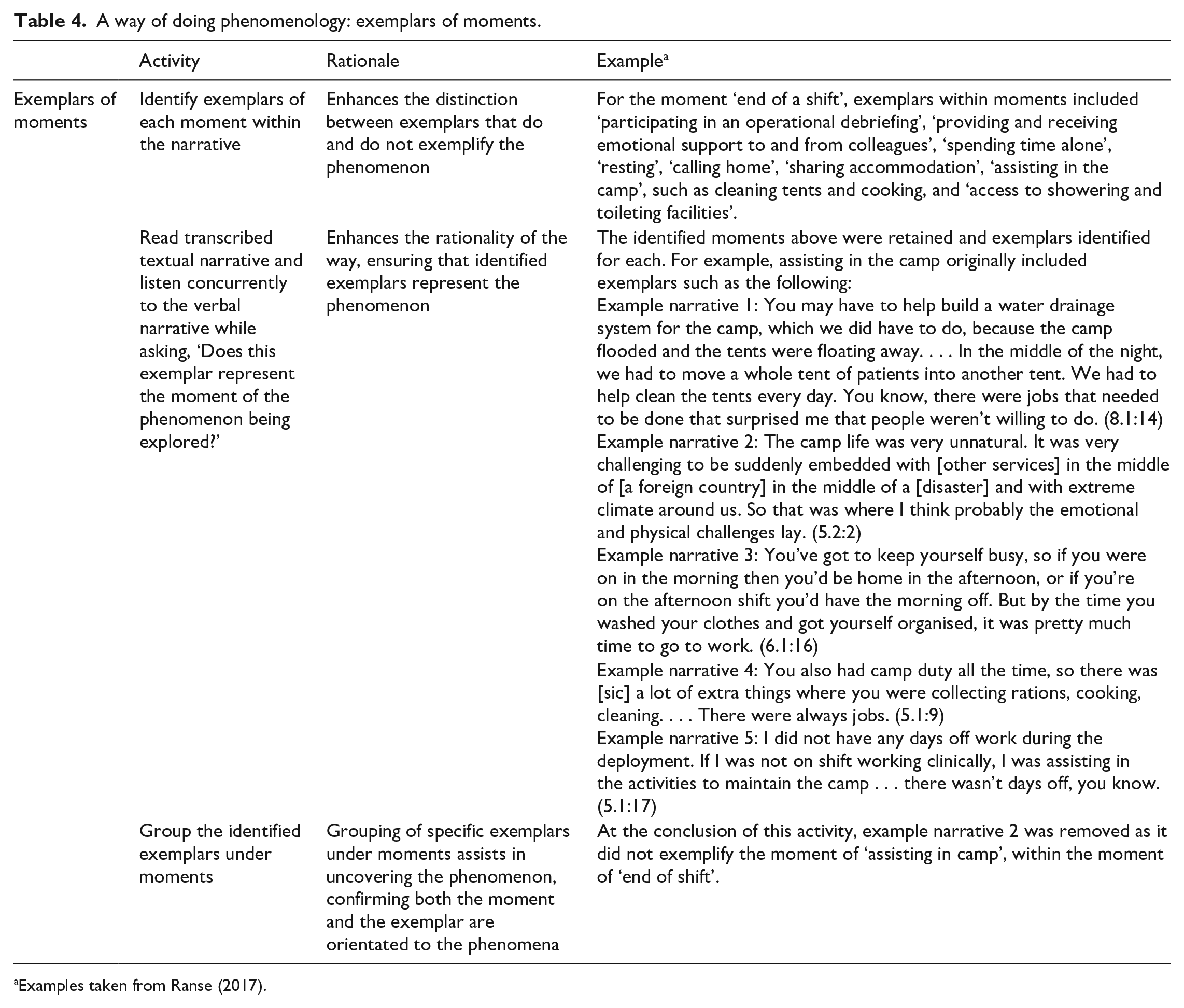
Examples taken from Ranse (2017).
A way of doing phenomenology: lived-experience description.
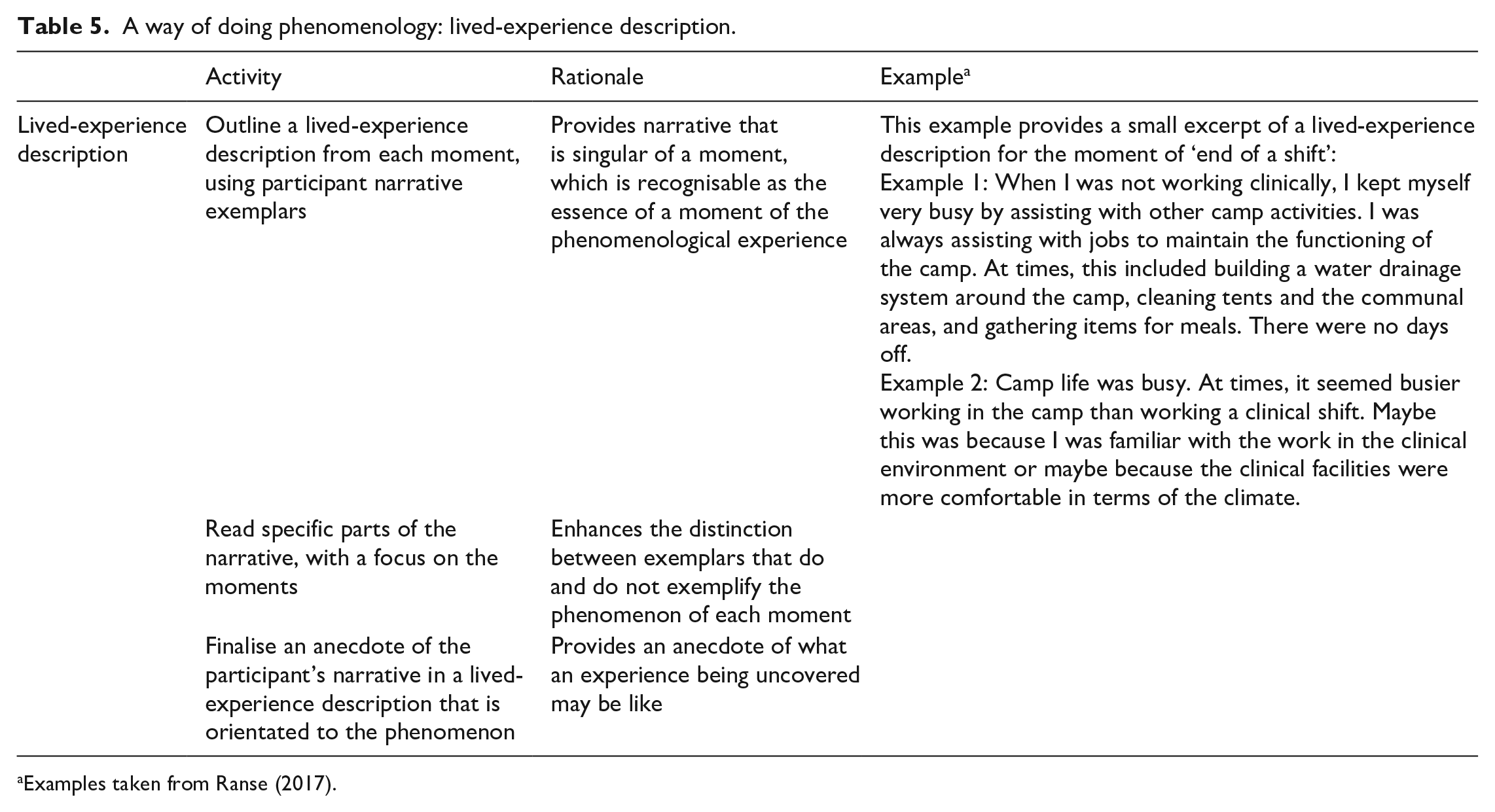
Examples taken from Ranse (2017).
Uncovering moments
Uncovering moments is the key for phenomenology, because phenomenology is always reflecting on moments (van Manen, 2014a). Moments can be described as micro-moments forming macro-moments, always describing a lived-experience of a thing in its thingness (van Manen, 2014b). Phenomenological moments of an experience have been reported in the literature, such as the touching moments of motor neurone disease (Allen-Collinson and Pavey, 2014) and the moments of disaster response in the emergency department (Hammad et al., 2017).
The identification of moments of an experience of what it may be like being a nurse in an out-of-hospital environment following a disaster is an important place to start when seeking to uncover the phenomenon. The uncovered moments of what it may be like being a nurse in an out-of-hospital environment following a disaster included ‘on the way to a disaster’, ‘prior to starting work’, ‘working a shift in a disaster’, ‘end of a shift’ and ‘returning home’ (Ranse, 2017). An example of a macro-moment is what it may be like being a nurse in an out-of-hospital environment following a disaster at the ‘end of a shift’. Continuing with the example above of the macro-moment ‘end of a shift’, an example of a micro-moment is what it may be like to ‘share accommodation’ in an out-of-hospital environment following a disaster. Furthermore, moments exist between these macro and micro-moments. The rationale against the activities for the identification of moments of an experience is presented in Table 3.
Exemplars of moments
Once the moments were uncovered, exemplars of those moments were identified from the participant narratives. These exemplars later formed part of the lived-experience description of the phenomena of the moments of what it may be like being a nurse in an out-of-hospital environment following a disaster. A way of identifying these exemplars is outlined in Table 4.
Lived-experience description
From the participant narratives, descriptive moments form a lived-experience description of the phenomena as an anecdote of what it may be like being a nurse in an out-of-hospital environment following a disaster. A lived-experience description is a recognisable anecdote of the singularity of an experience being uncovered. A lived-experience description presents aspects of the singularity of an experience, that is, what makes the experience unique and different from another experience. It is the uniqueness of experience that forms a singularity, and if an aspect of that uniqueness of an experience were taken away, the phenomena being explored would no longer hold true to its singularity. Instead, the experience would represent an alternative phenomenon with alternative singularity. For example, what differentiates being a nurse in an out-of-hospital environment following a disaster from being a nurse in a hospital on any given day? Perhaps, it is that at the ‘end of a shift’ in the hospital environment, nurses commonly return to their home. However, a uniqueness of being a nurse following a disaster is that a nurse continues to be embedded within the disaster where ‘work becomes home and home becomes work’.
According to van Manen (2013), a lived-experience description as an anecdote is grounded in experience, not leading to abstraction and theorising. Lived-experience descriptions add to our understanding of a phenomenon by accessing a collective co-authored lived world of research participants who have experienced the phenomenon. Lived-experience descriptions have been published relating to experiences such as being in a hotel room (Van Lennep, 1987), sharing a secret (Langeveld, 1944) or being at home sick (Van Den Berg, 1972). From these lived-experience descriptions, the reader has insight into what it may be like to be in a hotel room, sharing a secret or at home sick. As a reader, this provides insight into an understanding of other possibilities or interpretations. Being descriptive rather than interpretive, the reader interprets what it may be like based on the lived-experience description and from the natural attitude of the reader, rather than an attitude which is imposed upon the reader by the author. The natural attitude is the way in which the world presents to someone and this attitude is an individual stance. Therefore, being descriptive allows for the individual reader to understand the meaning from the reader’s stance rather than from the stance of the author. A way of moving to a lived-experience description of a phenomenon is outlined in Table 5.
The lived-experience description, as an anecdote, is not necessarily representative of a particular individual who was interviewed and therefore may not be the exact experience expressed by any one individual. Instead, the lived-experience description is representative, co-authored and orientated to what a specific moment of an experience may be like for an individual civilian hospital nurse in the out-of-hospital environment following a disaster. An introduction excerpt of a lived-experience description is shown in Figure 1.
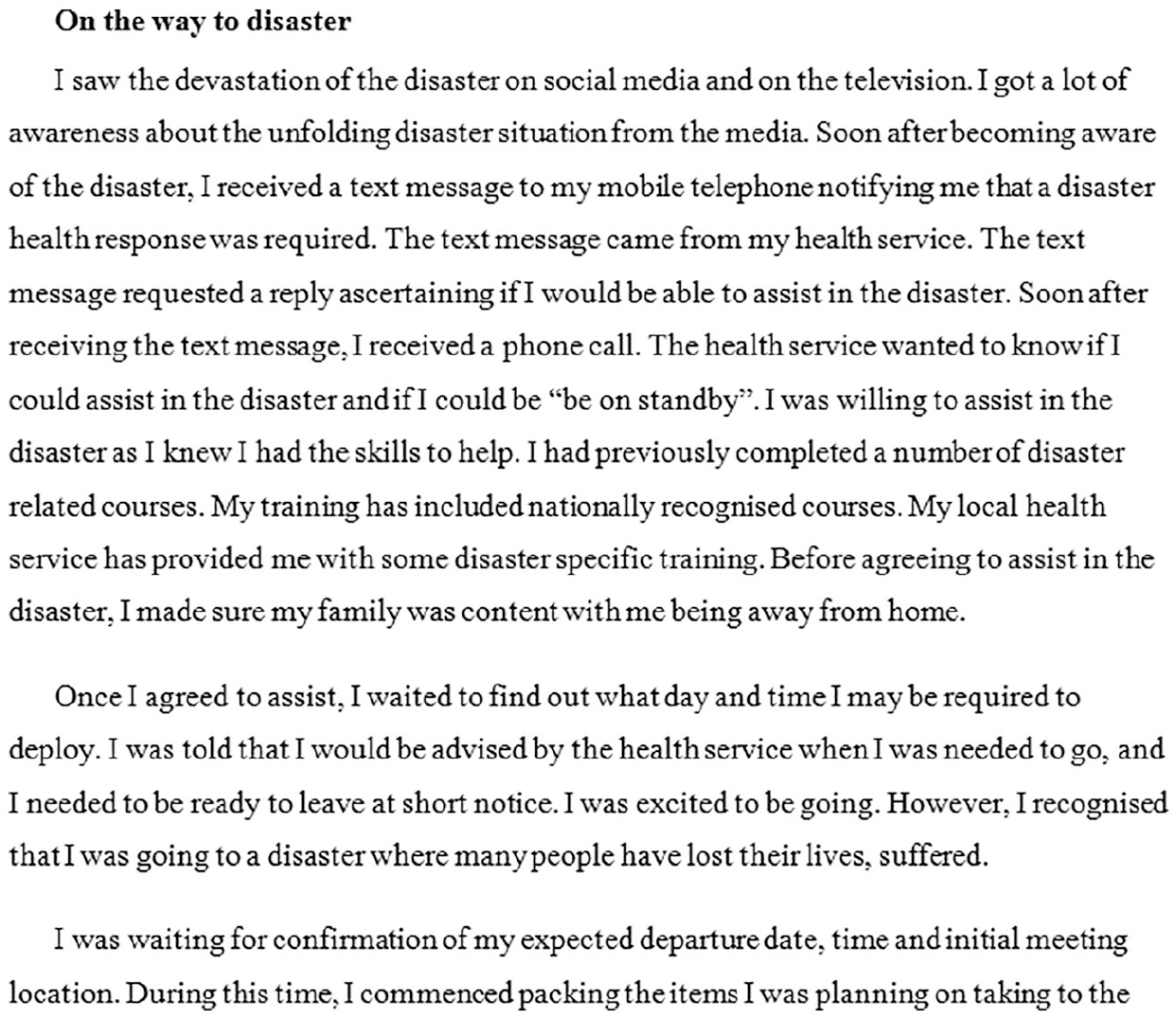
Exemplar of a lived-experience description (Ranse, 2017).
Beyond a lived-experience description
It is from this lived-experience description that phenomenological existentials such as spatiality (lived space), corporeality (lived body), communality (lived relationships) and temporality (lived time) can be overlaid to provide greater depth and insight into the phenomenon being studied. Spatiality goes behind the physical, visible and touchable spaces. Spatial reflection is concerned with felt space, that is, the way in which we find ourselves in the lived world through the spaces of our day-to-day existence (van Manen, 1990). Corporeality goes beyond the flesh of the physical, visible and touchable body. Merleau-Ponty (1945/2002) suggested that people position themselves in the world in a way that will help them to get an optimal grip on the world. Corporeal reflection is concerned with the way in which we are embodied in the world (van Manen, 2014b). Communality goes beyond a physical or touchable relationship to relationships as they are lived. In this study, communality was concerned with an experience of a nurse’s lived relationships with colleagues, patients and self. Temporality, or lived time, goes beyond the measurable chronos time to felt time – kairos time. Things or moments of significance seem to either speed up or slow down in kairos time (van Manen, 2014a). Providing description and examples of applying the above-mentioned phenomenological existentials to an intersubjective lived-experience description is beyond the scope of this paper. However, the above is provided as a brief introduction to these notions.
Conclusion
This paper has presented some fundamental philosophical ideas in phenomenology and hermeneutics. Further, a way of ‘doing phenomenology’ has been presented from the theoretical underpinnings of phenomenology and hermeneutics using excerpts from a study relating to Australian civilian hospital nurses’ lived-experience of the out-of-hospital environment following a disaster. In particular, doing phenomenology was discussed as a way of remaining orientated to the phenomenon by getting back to the thingness of the phenomenon. Doing phenomenology in this way commenced with interviewing appropriate participants on two occasions to generate participant textual narrative. This narrative is then a reservoir for phenomenological reflection, allowing the researcher to move in a hermeneutic manner from uncovering moments, identifying exemplars of these moments and leading to a lived-experience description of the phenomena. It is from this lived-experience description that phenomenological existentials, such as spatiality, corporeality, communality, and temporality can be overlaid to provide greater depth and insight into the phenomenon being studied.
Footnotes
Funding
The author(s) disclosed receipt of the following financial support for the research, authorship, and/or publication of this article: This research was supported by the Annie M Sage Memorial Scholarship, a competitive research scholarship from the Royal College of Nursing Australia [now Australian College of Nursing].
