



Abstract
This methodological paper considers how movement may be captured and expressed in qualitative data. Beginning with a history of movement as it has been represented in empirical studies, this paper posits that movement has been undertheorized in qualitative research (via video and photograph); theorizes movement under the Deleuzo–Bergsonian concept of duration; and wonders how movement as a kind of ‘dynamic unity’ might be expressed as visual data. Using photographs collected from a troupe of fire-manipulating circus performers, this study suggests the use of long-exposure camera technology as one practical means of thinking about movement (as duration) in qualitative research.
I recall an interview with a circus performer wherein I was asking about his craft: at one point in the interview, he made excited, broad circles with his arms, describing how he incorporated sacred geometry into his performance. The angles, the relationship between the circles, the movements: these were important to him. He could not answer my interview question without standing, gesturing, moving. My technological setup, an audio recording device, was incapable of capturing this movement. But what would be capable of capturing this? A recent publication in Qualitative Inquiry (Luttrell and Clark, 2018: 3) used photographs within a gymnasium to capture student perspectives. One of the authors, looking at the images, states: ‘I. . . moved from looking at the images as stills on the computer screen to imagining them in motion, as a video montage hoping to capture movement through time.’ The words ‘hoping’ and ‘imagining’ suggest that Luttrell and Clark experienced a similar dis-ease as myself regarding the relationship between movement and their data. What are the implications of imagining movement within qualitative data, and why should we have to imagine? Their problem is reminiscent of Zeno’s paradox, which claims that at any given moment, a body is suspended in space, immobile. If time is composed of moments, and movement cannot occur within a moment, how can movement ever occur? Photographs such as Luttrell and Clark’s capture moments in time, certainly; is movement in such photographic research simply an illusion, as described in Zeno’s paradox? Must it necessarily be imagined? Would video be a better option?
There exist various methods designed to capture visuals in research, however, in terms of movement per se—that is, the dynamism and liveliness that reside within movement, the embodiedness of movement, ‘movement as qualitative transformation’ (Massumi, 2002: 3)—research is only beginning to catch up. Nearly 20 years ago, Markula and Denison (2000: 406) asked ‘how does one research movement?’ And while movement appears as a specific focus in a number of studies (several of which are described below), only a few have attempted to answer Markula and Denison’s question explicitly. Still, Cruz (2016) and Pink (2011) encourage us to think movement into visual methods, especially with the proliferation of newly emerging digital tools used to capture images, as well as a theoretical shift in qualitative research toward the sensed, sensational, artistic, and embodied. Indeed, Rose (2016) suggests that movement is an essential aspect when thinking about representing bodies in visual research. Digital tools may help us to track trajectories, which in turn may help ‘to reflect on our own movement and encounters between people, objects, sensations and ourselves’ (Cruz, 2016: 338).
Given these observations, and inspired by blurred photographs present in Gao (2015), Heng (2018), and Jungnickel (2015), this paper proposes adopting a Deleuzo–Bergsonian perspective of movement and shows how that might be played out with the use of long-exposure technology; provides examples through images of circus performance/fire arts; and suggests that this may be a novel, intentional methodological avenue for visual methods and arts-based researchers interested in the question of movement in their work. As such, this paper focuses on how the photograph might be used to think about and present movement beyond traditional photographic methods or video/film. This rethinking of movement is especially important given the various artistic and performance-based studies that have emerged over the last decade (Flewitt et al., 2018). I begin this paper with a review of more conventional means of capturing movement in visual data (still phots and video) looking at a number of such performance-based studies, and further problematize their ability to capture the vibrancy that exists in movement as a form of ‘dynamic unity’ (Massumi, 2002: 6).
Literature review
In this section, I show how movement has been represented within the methodological traditions of photography and video. I then show how these methods limit our ability to describe movement in visual data.
Photography
The most common type of visual data exists in the form of photographs, and the uses of photography in research are broad and varied. Photography is often used in ethnographic research (Harper, 2012; Pink, 2012), and it came to prominence as a way to document social conditions during World War II (Harper, 2012). However, we see instances of photography being used for research much earlier than that, as far back as the late 1800s (Persohn, 2015). Beyond capturing visual data for researcher analysis, photographs have been used more recently to drive conversation during interviews with research participants via photo elicitation (Harper, 2012; Pink, 2012; Rose, 2016) and to provide participants a means of expression via photovoice (Nykiforuk et al., 2011; Wang and Burris, 1994). Photographs are well suited for showing how phenomena exist at a particular moment in time, and from a particular perspective. However, certain phenomena of researchers’ interests may transcend individual instances of time, such as changes, trajectories, or, in the case of this study, movement. If one seeks to study a phenomenon that can only emerge over time, photography can be limiting.
This is not to suggest that more traditional photography has not been used in innovative ways to capture movement. Photographs taken at one moment in time can be used as benchmarks to measure changes in the same phenomena photographed at a different time. This is particularly useful for geographical or geological research (Spinney, 2011), as seen in Webb et al. (2010), Chen et al. (2011), and Frankl et al. (2011). These scholars describe ‘repeat photography’ as a way to track environmental changes and movements. Webb et al. (2010) provide a definition of the technique: ‘in its simplest form, repeat photography involves finding the camera station of a previous photographer, aiming a camera, and taking a photograph’. Repeat photography often occurs over many years, and can be useful for showing stark contrasts in one location over time, for instance changes in water flow and riverbeds, forestation, or urbanization and development of a particular location. Similar to repeat photography is time-lapse photography, wherein the researcher generally takes many pictures of one phenomenon over a shorter period of time (e.g. Matsuoka, 2014; Ott, 1958). These images may be laid next to each other to show a progression, as in Ott’s (1958) landmark study showing the growth of plants, or the images may be spliced together using photoshop software to create a single image, as in Matsuoka’s (2014) observation of frost creep in the Japanese Alps.
Time-lapse photography has also been used in social research. For instance, Simpson (2012) used time-lapse photography to look at everyday rhythmic patterns as they occurred during a magician’s street performance in Bath, England, defining time lapse as a photographic technique produced using either a still or video camera whereby each frame or image is captured at a slower speed or greater interval compared to the speed at which it would usually be played back at in a film sequence. As such, this can be used to produce the appearance of events unfolding at a faster pace than they actually occurred. (Simpson, 2012: 430)
Simpson positioned a camera on a street corner and programmed it to take pictures every 15–20 seconds, until 151 photographs had been taken. By laying these images next to one another chronologically, Simpson was able to construct patterns of crowd movement, and describe the rhythmic ebb and flow of bystanders watching the street performance. In a similar vein, Persohn (2015) described the uses of time lapse in her research on classroom environments, citing an earlier time-lapse study on the ways teachers move from student to student (Withall, 1956) as her inspiration. Like Simpson and Withal, she found that she could identify patterns in her own classroom behaviors, her spatial orientations, and her movements that helped her reflect on her teaching practices using time-lapse data.
Another instance of the time-lapse method is found in Jungnickel’s (2015) study of cycling. While time lapse typically occurs from a fixed camera position, her camera was mounted on a bicycle, meaning the camera was moving as images were being captured during rides, taking a photo every 5 s. Like Luttrell and Clark (2018), she encourages imagining the movements that occurred between camera captures. However, her moving camera resulted in unexpected ‘flaws’ in many of her photographs: they were blurred. While she does not speak extensively about the blurring that occurred in her images, she embraces these distortions, noting that they are indicative of sudden movements, turns, or stops within cycling journeys. Others (Gao, 2015; Harper, 2012; Heng, 2018) also describe blurring as indicative of movement in photographic research. Gao (2015) describes his use of ‘long exposure’ technology, sometimes referred to as ‘open shutter’, for an arts-based education dissertation. He describes the process of taking a picture as exposing light-sensitive media to light over a period of time. Typically, this period is very short, roughly one thousandth of a second. The light gets ‘written’ as an image, and this is what occurs when the shutter of a camera closes. However, cameras can be manipulated to extend the length of light exposure time. In effect, light can be recorded into the camera/picture over an extended period—over seconds, minutes, or even hours. If an object in the camera image is moving, that movement is recorded as light reflecting off of the moving object and affects the ‘writing’ process, creating a trajectory of light over the course of the exposure. With long exposure, it is possible to record the movement of that light indefinitely, creating an image that shows the trajectory of any moving object as a more pronounced and intentional blur.
Gao (2015: 9) argues that ‘long-term exposure challenges the perception of time and trajectory of movement in photography, our beliefs, and existing knowledge. It indicates that there are many possibilities to create images using time. It challenges instantaneity as the only photographic exposure time’. We see such challenges to instantaneity briefly in the work of Heng (2018) and Harper (2012). Heng in his research on deathscapes suggests that there is ‘presence of movements’ (5) within his photographic data, due to a motion blur created by his camera and one of his participants. Specifically, he set his camera to a slower (one second) shutter speed in an attempt to allow more light to illuminate his surrounding landscape, when a participant in the study stood to walk. The effect, Heng notes, is ‘a precarious and shaky, almost ghost-like movement’ (5). Similarly, Harper (2012) notes that one can represent motion with a blur, although he does not specify why or when one would choose to do this. Unfortunately, this method has otherwise received little attention in the field of qualitative research, and it is my intention to draw greater focus to this method.
Film and video
While I ultimately wish to theorize and show how long-exposure photography is a useful way of conveying movement within qualitative research, I believe it important to briefly touch upon the use of video, as this method also provides a potentially practical (if not problematic) way of thinking through movement. Video research begins with the use of ‘animated photography’ (Wade, 2017), using a series of photographs taken with a very short span of time between each, to create the illusion of movement. One of the most well-known examples of this method was used in animal research by Muybridge, arguably the father of modern film, in his study of the movements of horses (Persohn, 2015; Premeaux, 2003). Muybridge combined many pictures taken sequentially of a galloping horse, showing each picture in quick succession, to study how a horse gallops. He was the first to show that a horse, in full gallop, will briefly be airborne as all of its hooves leave the ground (Premeaux).
Video is now often used as a way to record not only voice but gestures and movements during interviews (Rose, 2016) as well as activities that may be beyond the researcher’s immediate perception (Harper, 2012), such as horses’ hooves in full gallop. In general, a video can create ‘a visual record in a wide variety of ways that serve specific questions and studies’ (Harper 115), as a way to capture events as they occurred for smoother analysis. We see this in examples of dance and martial arts, for instance, in the work of Schindler (2018), who notes that body movements are integral to her ethnographic studies, and video is a particularly useful approach for capturing, analyzing, and learning about the movements present in such practices. Picart (2002) similarly used ‘frame grabs’ and videos of ballroom dance as a way of looking at the postures of her own body during dance. These video captures allow her to reflect on the feelings and positions of her body while she moves through the dance. Beyond grand gestures represented in dance, video can be used to capture more subtle, communicative movements with participants: gestures, facial expressions, and reactions (Cupitt et al., 2018; Ho, 2019). In sum, video can be used as a way to better parse out instances and reflect upon movements that occurred in the past (Garcez et al., 2011).
Occasionally, participants are asked to move and record video at the same time, a method often referred to as mobile or video ethnography (Lahlou, 2011; Pink, 2017; Spinney, 2011). These methods seek to evoke a sense of ‘being there’ (Jungnickel, 2015; Spinney), of capturing the embodied, lived qualities of a moving experience (Bates, 2013). Pink (2007), for instance, suggests that this approach is one way to ‘focus on the moving body’ (245), to ‘become aware of the rhythm of. . . movements’ (247) and to vicariously experience one’s moving relationship with place. It is through moving that one creates place, and the way that a body occupies and moves through space and time to create such place can be represented through video. Pink (2017) argue that this movement through space with participants is a means of developing empathy especially as related to the mundane and ordinary aspects of participants’ lives, certainly an important point for ethnographic work that seeks to understand the everyday experiences of participants. Spinney (2011) further claims that video data of this nature allow participants to relive the movements that they have already made and reflect upon them. Using videos recorded by cameras mounted to different cyclists’ helmets, Spinney explains how rewatching the videos allowed the cyclists to recount the embodied and ‘sensuous meanings’ (171) that existed in their cycling practices.
Problematizing visual research on movement
Movement has been represented in both photographic and video data collection methods; however, both present us with problems as we attempt to capture the moving image/body. For instance, in repeat and time-lapse methods for photography, all of these studies take place over the course of seconds to years. The photographs are useful for comparing phenomena over such periods of time, but what happened in-between is lost; even when the lapse between images is set to seconds, this method can miss more subtle movements (Persohn, 2015). An additional problem with this type of research is that the images are ultimately still, and Persohn notes when reflecting upon the method, ‘some of my thoughts could not be expressed in words, as they were embodied in the actions, behaviors, and emotions represented by the movement captured in still images’ (509). Despite their approximation of movement, the pictures themselves remain still, and something—thoughts, behaviors, emotions—are lost in the moments that occur within the laps of time. Viewers must guess at the dynamics of the movement that took place between one picture and another: how and when specifically did movement occur? The pictures themselves do not present the viewer with movement. Instead, movement only exists as a gestalt in the viewer’s mind; much like Luttrell and Clark’s (2018) gymnasium pictures, movement must be imagined.
Such a mode of capturing movement is reminiscent of Zeno’s arrow paradox, which suggests that movement never actually occurs (Huggett, 2010). Zeno was a pre-Socratic Greek philosophy who proposed that any object at rest, such as an arrow, takes up a particular area in space that is just the size and shape of that object. However, even when an arrow apparently moves, at any one instant in time it is taking up such an area in space, static. We cannot say that in any one instant of time the arrow moves forward; within an instant, an object is suspended in space–time. If time is only made up of instances, and no motion occurs within any instant, then it cannot be said that the arrow is moving because time itself is composed of that which does not move. In a similar critique of movement, Zeno describes the Achilles/tortoise paradox: imagine the hero Achilles in a foot race with a tortoise, and imagine the tortoise is given a ten-foot head start. If Achilles attempts to catch up to a tortoise, Achilles must first reach the halfway point between himself and the tortoise. Before reaching that halfway point, he must reach the quarter point, and the eighth point, and so on ad infinitum. Zeno proposed that because one must travel an infinity of points to any object, movement cannot actually happen. It might be said that within photographic research, we are capturing only a point within that infinity. Like Zeno’s arrow or Achilles, no movement has actually taken place in a photo.
We find similar problems with video data for movement studies. Wolfe (2017) argues that videos present themselves as transparent truth documents. As such, we often do not question video’s potential to document movement. However, as we begin to look at some of the affordances of video, we find that when considering movement, video becomes as theoretically problematic as photographic methods. Video has been lauded for its ability to portray the complex, to make it accessible to researchers. Garcez et al. (2011: 250–251) claim that ‘the proper use of the moving image, coupled with the audio, allows capturing aspects that may go unnoticed when other resources are used’, and further note that it is useful for examining those phenomena that are ‘full of liveliness and dynamism, which is influenced by several variables simultaneously’. How does video accomplish this? One of the major affordances of video, they state, is that there ‘exist different possibilities of viewing the recorded material, speeding, skipping parts, pausing, freezing the image, rewinding, fast forwarding, viewing it as many times as necessary for the proper understanding and interpretation of the material’ (Garcez et al., 2011: 252). Questions arise about what Garces et al. might mean by ‘proper understanding’; however, the takeaway from this is that video data can be manipulated in terms of its movement and the flow of time to present the researcher with a particular kind of image. Blikstad-Balas (2016: 512), echoing Garcez et al., suggests that when using video, the complexity of recorded events ‘can be “decomposed” into smaller entities’.
When we consider this ‘affordance’ of video, we immediately run into a similar issue as photographic research: the movements within a video, as we analyze them through a decompositional framework, become segmented, instances suspended within time. If this decompositional approach is a ‘proper’ way to describe movement, then as Zeno suggested, no movement actually occurs. What we are experiencing, instead, is a series of statics, one frozen image to the next, manipulated to approximate movement: we fast-forward; we skip over movement entirely, hurrying it along, as if to say ‘let’s get this over with’. We rewind; we acknowledge that movement as captured by video, just as in real time, is impermanent. The movement becomes removed from its context, or researchers hyperfocus upon one gesture, and we experience a ‘death by data’, which Blikstad-Balas (2016: 519) describes: ‘by systematically choosing only fragments of data. . . we may amplify events that are not representative of the participants and not a part of a larger pattern of events’. Lemke (2007) voices similar concerns about this overmagnification of data, especially in video. As we use the affordances of video (e.g. pausing, rewinding, rewatching) we interrupt the flow of the data, and Lemke (2007: 45) feels it important to remind video researchers that ‘meaning is not just made moment by moment’, but over a temporal duration.
In sum, what we see, particularly in the language of Blikstad-Balas (2016) is the opposite of movement in video data. Rather than dynamism and livelihood, we see decomposition and death, just as we see stagnation and stillness in the photographic images that are supposed to illustrate change and direction. However, I argue that the blurred images of Gao (2015), Heng (2018), and Jungnickel (2015) offer us a potentially useful direction for thinking about visual methods and describing/capturing movement. While these pieces offer examples of what such images look like, they do not explicitly address how such an approach might be used within qualitative research. As I consider this notion of the blur as a research method, I offer a theoretical perspective via Deleuze and Bergson that I believe justifies its use.
Retheorizing movement as durational: a Deleuzo–Bergsonian perspective
If we contest nonmovement, if we reject Zeno’s assertion that all objects are perpetually suspended in an instant of space–time, constantly trying to make a futile move through infinity, then how should we think of movement in research? Massumi (2002), relying heavily on Bergson, claims that movement must be thought of as one coherent phenomenon rather than a series of statics, referring to movement as a dynamic unity. Speaking of Zeno’s arrow, he wrestles with the idea of movement as a decomposable entity, that same aspect that Blikstad-Balas (2016) suggests is an affordance of video. Massumi states: A path is not composed of positions. It is nondecomposable: a dynamic unity. That continuity of movement is of another order of reality than the measurable, divisible space it can be confirmed as having crossed. It doesn’t stop until it stops: when it hits the target. Then, and only then, is the arrow is in position. It is only after the arrow hits it mark that its real trajectory be point-plotted (before, for all we know, the arrow could have taken a different path and missed). (Massumi, 2002: 6 emphasis mine)
In this case, movement must be thought of as an entity or object unto itself, a change that takes the form of an entity (Deleuze, 1991: 37). Drawing on Bergson (2001), movement is a series of interconnected instances, woven together in such a way that one begins before the other ends, creating uninterrupted overlap that counters the idea of movement as individual instances. Attempting to understand movement as constituent parts undermines the nature of movement itself. Movement is not made up of; it just ‘is’ while it moves across or through. Where Massumi describes movement as nondecomposable, Deleuze (1986: 1), also relying on Bergson, describes it as ‘indivisible’ and ‘irreducible’. From this perspective, movement should not be de- and then reconstructed, as many visual methodologies seem to encourage.
The common link between Deleuze and Massumi is the Bergsonian concept of duration, which we might describe as Bergson’s (2001) rejoinder to the commonly held understanding of time. For Bergson, humans are wont to project time into space, understanding time as occurring within space as a series of discrete units; Bergson’s notion of duration, on the other hand, suggests that time is independent of space, transcending the moment-to-moment or the idea of sequential progression. Time is a homogeneous environment, a plane within which movement occurs; when time itself is seriated, we are applying qualities of space to time. While space can be partitioned, Bergson tells us that time cannot. His concept of duration reconceptualizes time as ‘the form which the succession of our conscious states assumes when our ego lets itself live, when it refrains from separating its present state from its former states’ (100). For Bergson, movement occurs in the domain of duration as an entity that must endure over time, where traditionally seriated events cannot actually be seriated or separated.
Deleuze (1986), still drawing from Bergson, further develops this theory of movement as he considers movement as it occurs in film. Within film, Deleuze suggests, movements are not allowed to actually move. The movement we see is actually a series of poses, one after the other. Deleuze’s criticism of film and movement is similar to my own criticism of movement conceived via video in qualitative research. Film provides us poses (or a series of negligible movements that lead to a pose as seen in processes of rewinding, fast-forwarding, and pausing), segmented instances of prominence in the film, and we are left with an issue similar to that of death from data, a hyperfocusing on a particular still, which Deleuze refers to as a ‘Whole’. Within film, any movement perceived becomes part of the whole of the presentation—it is an immovable, unchangeable part of the context in which it is situated, doomed to repeat itself predictably. Deleuze (1986: 8) suggests, however, that movement ‘is a mobile section of the duration, that is, of the Whole’. When we look at movement from the standpoint of duration, that is, external to space, then the context, the background, the space may remain, but movement only needs a space within which to move (any space will do), and is not beholden to the space; movement is, rather, a translation in space. The movement that occurs within a film or a video is, in fact, its own immoving spatial object, playing out over and over again along a set track in relation to its background. For Deleuze, movement must escape and change the whole, something that cannot be done in the tracks upon which motion plays within video. Movement occurs despite its immutable background; it is unpredictable, as noted by Massumi (2002); it comes out of the Whole rather than occurring within it. In short, movement transcends the Whole, all the while changing the Whole, as we think of movement as a new body-entity being introduced to the Whole.
The Deleuzo–Bergsonian conception of movement as nondivisible provides us with a more theorized understanding of movement than that generally occurs in studies that collect movement data. But what are we to practically do with this theory, and how might it provide us direction in qualitative research? It would seem that we have limited technology with which to enact a theory of movement as transcending while transforming space. Photographs, as they have been conventionally conceived, capture instances in the same way that Zeno describes movement; they capture only a moment in time, an instant that is reducible to a measure of zero time. The same may be said for video when we begin to try to decompose it; the movement dissolves and we are left not with movement, trajectory, dynamism, but a static representation of movement—the illusion of movement, as series of any-instant-whatevers that lead to poses along immutable tracks. What would it mean, instead, to think of movement as ‘dynamic unity’ (Massumi, 2002: 6) when attempting to capture it as data? How do we show movement in its whole through something designed to capture the instant?
One recent example exists with Tillet (2018), who discovered that he could manipulate a document scanner to record documents (and non-documents) using unusual time registers—that is, within his document scanner, a roller determined the distance being covered by the scanner, and the scanner scanned according to the amount of distance measured by the roller. By slowing or speeding the rate at which the roller moved while scanning at variable speeds, he was able to create stretching and compression effects within the images scanned. Situating his observations in Bergson, he describes how a scanner became a durational recorder. Like with the blurring that appeared in Gao’s (2015), Heng’s (2018), and Jungnickel’s (2015) work, manipulating time in concert with movement when recording images creates a unique effect in visual data. Researchers might capitalize on this observation as an intentional way to go about collecting data around movement.
Method
To test the potential of durational movement in visual media, I recruited three participants at a monthly gathering of circus/fire performers. Each performed using a different fire prop: fans, flow wand, and staff. The atmosphere of this gathering was casual (and, as a regular attendee, many already knew me). Given the casual atmosphere and familiarity that I shared with these individuals, I simply asked participants if they wanted to be a part of a study investigating the artistic aspects of fire performance. They were additionally provided an IRB-approved notification of their rights as participants in the study. All agreed be a part of the study and to be photographed. At this gathering, there was little order, and individuals performed as they felt inclined in a dirt clearing. I set a Nikon Coolpix L29 camera atop a tripod, and waited for participants to begin performing in dirt clearing. The camera was set on ‘fireworks’ mode, the only long-exposure option available on this kind of camera, which sets the duration that the shutter closes to 4 s. Because even slight movement of the camera in this mode affects picture quality, I used the tripod to stabilize the camera roughly 8 feet from the performer, and took pictures at 10-s intervals until the conclusion of each participant’s performance, which were 2–5 minutes in length. Each participant chose an image as representative of their performance, and shortly after they were taken, we reflected upon their choice of exemplar pictures in an unstructured interview (excepting the first participant, Trish, who owned the venue and had managerial duties). For the interview, I only asked participants to explain why they had chosen the picture or to describe what they saw in the picture in an effort to ‘involve the interviewee actively. . . to provoke interviewees respectfully to bring contrasting perspectives to light’ (Brinkmann, 2018: 579 pun unintended). These 5–15-minute interviews were audio recorded and transcribed by the author.
Findings and discussion
Figures 1 to 3 are the pictures that participants chose as representative of their performance and practice. While these are only three images, I believe they offer a starting point for thinking about how long exposure invites us to see movement through this lens of duration, and I provide a description below of how such images offer us a technique other than time-lapse or walking video for creating a sense of being there as movement occurred.

Trish using fire fans.
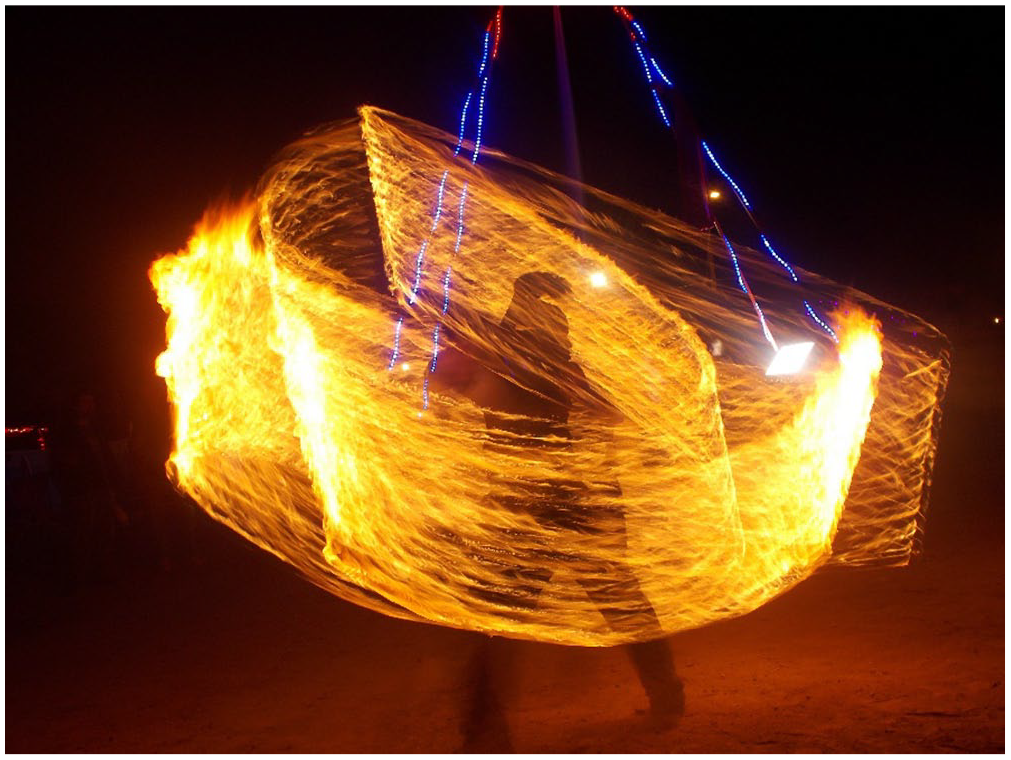
Lighteater using a fire-flow wand.
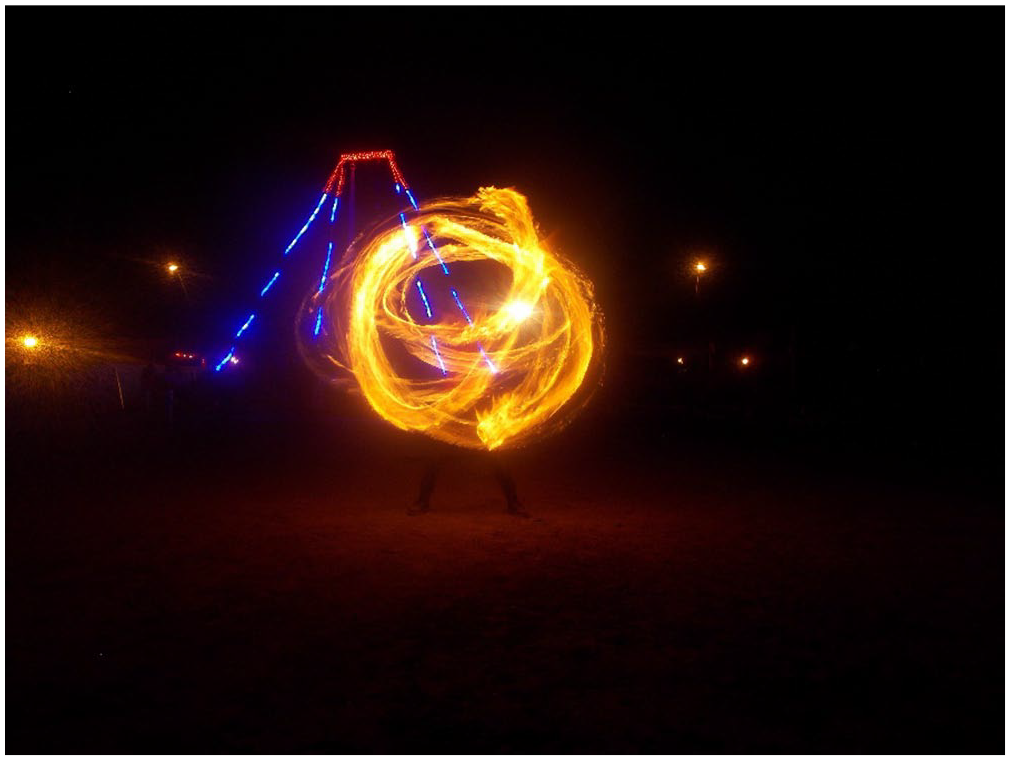
V-Heart using a fire staff.
The movements within the images bring light (literal and figurative) to the ‘lasting traces which they seem to have left in space on their passage through it’ (Bergson, 2001: 79). Instead of memory or imagination, the image of the movement remains, including trajectories and dynamics of the movement. We can begin to talk about movement data in a different way than a conventional photograph or video allows. Brighter and fuller flames indicate slower movements or pauses, whereas dimmer flames indicate quicker movements or a dying flame. The longer the flame stayed in a particular location, the more the camera was able to ‘write’ the light into the picture. Thus, in the picture of Trish, it becomes possible to see within a single image the progression of the fans as they pause above her head and then begin a descent. We can tell that when this image was taken, the fans started from the top and then moved downward because in the picture, the flames burn upward. Had she started low and moved the fans upward, we would see the flames trailing downward. The flames remain bright in the image, suggesting a slowness to her movements as they descend downward, and we see the light of other fire performers’ fans making the same motion, suggesting that this was a synchronized and choreographed routine. In Lighteater’s picture, a figure is dynamically silhouetted amidst flames as they dance about his body, stalling twice to his right and once to his left, even moving in a zigzag fashion behind him, stalling briefly there, only to change direction and come back around to the front of his body. In these behind-the-back instances, the movements were fast and fluid, as we see by the darker streaks of orange fire that flow there. He prefers to keep the fire in front of him, where the orange is brighter and more vibrant, and where he has greater control. Striking about V-Heart’s picture is the three-dimensional aspect of movement; that is, the flames move in circular motions counterclockwise around her body, but near the end of the shot, she has changed direction and the flames move on a different plane, extending outward toward the camera. In all cases, what we are examining here is not individual instances in time, but intensities of light that cannot be thought of as separate from one another, one moment overlapping into the next moment and becoming one, reminding us that duration cannot follow the same rules of space: in space, no two objects can exist in the same physical point—they must be individuated. In durational movement, on the other hand, instances ‘penetrate’ each other and form a whole (Bergson, 2001: 88).
In Lighteater’s picture, due to the erratic movement of his wand, it is difficult to tell the beginning and the end of the movement. However, this is not problematic, and from a Deleuzo–Bergsonian lens, we should anticipate this. Movement does not begin or end, but it continuously flows until it does not (Massumi, 2002); plotting out the beginning and the end is to ignore the duration in which movement itself occurs. In Lighteater’s image, the movements take place before and after the picture was taken, and the image only represent 4 s over the course of the performance. The difficulty associated with finding a beginning or end here reminds us that movement is constantly overlapping itself within the duration over which the image was taken (Bergson, 2001), and that the movement recorded is part of an unfolding of movement happening before and after the image was taken. Indeed, in the other two pictures where there are more definitive beginning and end points, it is only the beginning or end of the photo writing process. While it is easy to see the beginning point of a downward trajectory in Trish’s picture, the permanence and brightness of the flames above her head remind us that the fire itself had been burning, moving, and twisting in the wind before the photographic process began.
We also see three distinct contrasts in terms of movement: a stationary background space, the blurry shades of what appear to be human beings, and the vibrant movement of the fire itself. Under the Deleuzo–Bergsonian perspective of movement, movement under the perspective of duration is always in a process of becoming and changing as multiplicities of moments overlap, a contrast to space itself where only displacement of objects can happen. Change happens within the realm of duration/movement rather than the realm of space (Deleuze, 1986, 1991), and we see this in the images where the lights trail against the static spatial background of the circus venue. We see the course of change as we examine those objects that are moving—the fire props—but we also see it within those that are connected to the moving objects, namely the performers. Were there no change, no movement, we would clearly see their faces and bodies, but the fact that they are shades or suggestions of human bodies shows that as they manipulate their fire props, they are also moving and changing. Their blurred body-images are suggestive of their relationships to the static background and the dynamic fire props that they manipulate. Specifically, they show us how object in a given environment may become ‘mobile section[s] of the duration’ (Deleuze, 1986: 8) and change the overall dynamic of The Whole.
Additionally, the short photo-elicitation interviews with Lighteater and V-Heart suggest that durational data provide productive ways for movers to describe their craft. Lighteater, for instance, was able to plot out and relive his movements via the picture, and described it as a dance: comparing his prop to a magic wand, he stated that the wand ‘is a dancing tool, not a magical tool. . . the wand is something for me to play with while I’m dancing. I can’t dance otherwise without this’. In this case, the image elicited the idea of dance, and when we view the image, we can certainly see why. A figure (human) and another figure (flow wand) are involved in a physical negotiation with each other, moving (as I would later discover in the interview) to music that only Lighteater could hear. The image also allowed him to describe the fire as a dangerous partner, one that sometimes has a mind of its own and that needs to be reined in as well as respected. V-Heart, on the other hand, talked more about her emotive state and how that translates into movement. She identified what appears to be a ‘rising dragon’s head’ at the topmost circle of fire around her body, and for her, this dragon represented the anger, sensuality, and sexuality that she channels into her performances.
The purpose of this section is not to exhaustively describe participants’ interpretations of the images, and it is beyond the scope of this project to discuss the politics of representation present in visual methods. Instead, I wish to invite consideration into what such long-exposure images might offer in terms of a visual research method, and suggest that the interpretations as described by the participants in this study would not be possible with conventionally collected visual data. It is hard to imagine that Lighteater would have been reminded of dancing or of his wand/fire as a partner within the dance had he been looking at a still photo. It is possible of course that he would have seen himself as dancing if he had viewed a video of his performance, but his ability to plot each of his movements, to relive the dance, is dubious. In this capacity, these images create the sort of thereness that mobile ethnographies seek to generate (Pink, 2007; Pink et al., 2017; Spinney, 2011). But they do so in a single, nondecomposed instant, rather than a chronological account that invites decompositional analysis. Similarly, the image of the rising dragon’s head in V-Heart’s chosen image is a result of a specific imprint of light captured during the long-exposure writing process of the camera. It could not exist in video or conventional photographic media, and as such, this seems to be the only kind of image that would have elicited V-Heart’s response. Similar long-exposure images of such ‘fire dragons’ interacting with fire performers may be found across the internet (for instance, a fire breather ‘kissing’ a dragon).
Persohn (2015) noted that she felt at a loss for describing her emotions and embodied states in the time-lapse method because the still photos could not accurately approximate movement. With long-exposure images, however, the participants were able to reflect on their movement practices and attribute meaning to these movements. Admittedly, these two short interviews do not allow us to state conclusively that all participants will have similar reactions to such recorded media. However, the images clearly invite more reflection on the embodied qualities of the practice than Persohn suggests time lapse does. Further, these images capitalize on the blur that so often gets written off as a flaw of the image (Jungnickel, 2015), and extends the discussion of Heng (2018), who provides one instance of a long-exposure photograph in his own work, but only offers a line about the movement present in that blur.
Conclusion
This is a small study that provides only three images of a specific art form using long-exposure technology. Additionally, the means used to gather those images was limited to 4-s intervals. With slightly more sophisticated technology than my own camera, we might capture an entire performance, and we could plot out ways that performers navigate the spaces that they occupy over the course of their performance. Within my own study, longer durations could also show us how and when the fire starts to die on performers’ props (it would consistently become dimmer over the course of the performance) and it would be possible to see how performers react and move to compensate for this. But we could also apply this to studies beyond circus performance as well. As qualitative research continues to examine embodiment, physical practices, visual arts, multimodality, and various new semiotic resources (Flewitt et al., 2018), we see how newer methods for capturing movement in data might be useful for, say, dance, acrobatics, martial arts, or theater performance. It might also be used outside of social sciences research in geographical studies such as those mentioned near the beginning of this paper, or astronomical studies that hope to plot and describe the movements of distant planets, stars, or galaxies. Indeed, these latter objects are particularly well suited to the long-exposure method due to the light that they emit or reflect; however, even nonluminescent bodies, for instance, ballerinas dancing, reflect light, and lighting and clothing can be manipulated to work well with long-exposure technologies.
I do not claim that a long-exposure method places us any closer to discovering ‘truth’ than any other visual method. How long researchers choose to leave the shutter open, framing and angle (what is left in or out of the picture), and how the researcher chooses to manipulate light all produce a perspective, one which is no less perspectival than in conventional photography or video. On the other hand, this method can help researchers focus on a particular aspect of data collection, namely movement. Like Tillet (2018) suggests, we may adopt the Deleuzo–Bergsonian concept of duration as we approach visual research, and using advances in modern technology (Cruz, 2016; Pink, 2011), we can better represent the concept of durational movement using long-exposure photography. I leave it to the readers of this piece to determine how to go about capturing duration and what this might help them to understand within their own research; however, I believe that this is one answer to Markula and Denison’s (2000) question regarding how one researches movement.
Footnotes
Funding
The author(s) received no financial support for the research, authorship, and/or publication of this article.
