




Abstract
This paper discusses some opportunities and challenges of using objects in focus groups, to explore multicultural encounters and experiences of living together. Drawing on feminist approaches to human embodiment, it argues that material approaches hold the potential to investigate the embodied and relational experiences of encounters with/across difference of diverse participants in sensitive ways. The materials were touchable objects such as pens and papers that help connect across differences in identity, experience and opinion, share experiences and stories with unknown others, communicate across (non)verbal barriers, misunderstandings and tensions, and accommodate moments of silence and reflection. Originally meant to ease and structure discussion, objects emerged as a central ‘medium’ or ‘instrument’ of research encounters through which participants can capture, express and share complex narratives about encountering others and multicultural living, underscoring the use of objects as an impactful method in feminist and participatory research.
Keywords
Introduction
Embodied and creative methodologies have been receiving growing attention in geography, including sensory, arts-based and visual methods (e.g. Kindon, 2016; Rose, 2016; Yi’En, 2014). Feminist geographers, in particular, have done significant work on the importance of objects in shaping all forms of social-spatial relation and knowledge production (e.g. Tolia-Kelly, 2016), and research activities and practices involving and evolving around embodied encounters as ‘performative force’ (Lobo, 2013: 460). Specifically, their work emphasises the physical nature of encounters (e.g. Askins and Pain, 2011), and bodies as central ‘objects’ in assessing how encounters register on the body and how ‘differences’ are (re)made (Ahmed, 2000). Crucially, this underscores the physicalities of the body as also always embedded within wider unequal social relations (Butler, 1993; Colls, 2007; Longhurst, 2005). Responding to Peter Jackson’s (2000) call for critical (re)engagements with ‘the object’, many have thus been advocating for approaches that take seriously human embodiment and relationality in shaping, and being shaped by, research practices, interactions and activities. In doing so, they have also been shifting attention to the ways in which social interactions are actively shaped by ‘practices of a wide range of human and more-than-human agents, including animals, plants, places, emotions, things and flows’ (Wright, 2015: 392), extending agency into the nonhuman, to criticise and re-consider who and what constitutes objects of research.
Objects play a central role in embodied, sensuous and fleshy approaches. Rather than ‘dead product[s] of human labour and culture’ (Frers and Meier, 2007: 2), objects emerge as ‘active participants in influencing and constructing movements and actions’ (Yi’En, 2014: 216) and as part of ‘a process of exploration to communicate, collaborate and cooperate’ (Singh, 2011: 46). As such, these approaches take seriously the ‘social life of things’ (after Appadurai, 1986), emphasising that ‘the very materiality of an object – its physical attributes and its latent potentiality outside that ascribed to it by humans – must be appreciated in order to understand processes of inscription and the social relations attuned to them’ (Askins and Pain, 2011: 813). In my research, the ‘work done’ by the maps, photos, pens and labels I brought to focus groups was to provoke (inter)actions between participants, to better understand articulations of identity and belonging as they were being (re/un)made ‘in-between’ people and objects (cf. Roberts, 2012).
Material methods offer a range of exciting possibilities for social research yet also entail ethical challenges and difficulties. Researching with objects can generate impact beyond research encounters, as people’s interactions with objects may help ‘accessing emotion and disseminating the power of participants’ accounts’ (Mannay, 2016: 112). Simultaneously, people’s stories are often complicated, and material methods can open up sensitive areas of discussion. Participatory practice suggests that continually negotiating with participants who, and in what ways, may re-use materials can rebalance some of the affective impacts of research and the unequal power in research relationships (Cahill, 2007). Hoping to ensure ethical but impactful dissemination for this research, I asked permission to use participants’ objects, photos and narratives before and after focus groups, excluding those who wished their ‘objects’ to remain invisible. Objects are a powerful medium of communication and care is needed to explore ‘the landscapes of representation, interpretation, voice, trust, confidentiality, silence’ (Mannay, 2016: 123), including the intended and unintended consequences of research with objects, narratives and visual images.
In my research, 1 focus groups proved to be a sensitive method to gain insights into the experiences, feelings and opinions of people whose bodies and identities are frequently othered by formal political debates and popular media in contemporary Scotland (Peterson, 2020). Specifically, focus groups enabled women of diverse ethnic heritages and migratory histories to tell their stories of arrival and everyday life in Glasgow in their own words (Peterson, 2019b), by producing interactions, discussions and insights less accessible without a group (Peek and Fothergill, 2009). The use of objects was critical to help create space for such ‘counter stories’ and alternative narratives to be shared (Solórzano and Yosso, 2002); these women’s experiences being the stories of ‘others’ in society not often (enough) told. Importantly, focus groups are themselves encounters, taking place in spaces caught up in histories and geographies, with former experiences, discourses, meanings and debates all weaving through and shaping focus group discussions and relations (cf. Pratt, 2001). However, since participants with different identities – some of which marginalised and/or ‘othered’ within wider society – come together and are asked to openly discuss and share their experiences, focus groups can represent a daunting and unpredictable encounter (Wilson, 2016): feelings of fear and anxiety, hope and understanding interlink with wider geopolitical discourses and debates, collectively bearing down, and shaping, the specific context of the focus group. Similar to spaces of encounter, then, the focus group is a space of potential and vulnerability, opening up and closing down opportunities for different and multiple meanings and knowledges to be created, challenged and negotiated, in uneven ways for different people.
In this paper, I shift attention to the potential of material methods to ‘create a space for embodied, multilingual, marginalised experiences to be expressed in visual form’ (Tolia-Kelly, 2007: 133) and to ‘capture alternative vocabularies and visual grammars that are not always encountered or expressible in oral interviews’ (Tolia-Kelly, 2007: 135). The performative power of objects and their ‘thereness, that words cannot convey’ (Rose, 2008: 156) lies in provoking openings for participants to imagine, feel and describe events that ‘entangle humans, more-than-human forms of live, and material things’ (Lobo, 2016: 172) and moments ‘when the world is navigated in different ways’ (Lobo, 2016: 172). As such, embodied approaches centrally add to understanding relationships between people, objects and spaces (cf. Longhurst et al., 2008). While this growing literature, as Ben Anderson and Divya Tolia-Kelly (2004: 669) argue, has led to ‘multiple encounters’ with human, plant and animal worlds, challenging ‘any simple postulation of matter or materiality’, there is a need ‘for specificity as we encounter a material (re)turn that twists in numerous directions’. Attempting to carefully position my presented work, this paper seeks to explore the role of objects in shaping encounters in focus groups.
In what follows, I discuss several opportunities and challenges of using objects in focus groups, to explore the complexities of multicultural encounters and ways of living together. First, I reflect on the entanglements of objects and bodies in multicultural focus group encounters, linking this to the potential to more fully grasp felt, embodied and relational dimensions of people’s lives. Second, I foreground participants’ reflections on engaging with objects during focus groups and, finally, I draw some conclusions about the importance of the use of objects as a method for feminist and participatory research approaches.
Objects and exploring multicultural encounters in focus groups
Fieldwork for the project lasted between September 2016 and August 2017 and involved actively participating in the embodied activities and multicultural encounters of diverse community groups held at public libraries, local cafes and community centres in the north and west of Glasgow. These groups included, but were not limited to, a gardening club, a knitting group, a multicultural women’s group, a book club and a cooking group. Members had diverse ethnic, cultural, religious and class backgrounds and heritages, were of different ages, and had come to live in Glasgow for various reasons at the time of this research. My background as a young, mixed-race female researcher, born and raised in Germany and living in Glasgow at the point of this research, as well as doing research ‘at home’ (cf. Mannay, 2016) in neighbourhoods and communities that formed part of my everyday life, blurred spatio-temporal imaginaries of ‘the field’ and positionalities of researcher/researched. My identities and entanglements with people and places made it possible to relate to participants’ lives, to build empathy and trust, and to encourage some people to tell their stories. Feminist praxis has long been emphasising grounded and self-reflexive research and co-constructed knowledges as deeply personal and political (e.g. Cahill, 2007); I share the ethos behind this praxis and hope to orient my work towards it.
Initial observations and informal conversations at the research sites were followed by 27 in-depth interviews and three focus groups with diverse members of these groups (see Table 1). Most participants I got to know through becoming involved in the different community groups, my personal contact allowing me to invite them for interviews. Focus groups were held to further flesh out experiences and challenges of multicultural living in Glasgow reflected upon by many interviewees, and to identify similarities and differences across stories. Importantly, focus groups enabled me to invite people who wanted to continue to be involved such as focus group 1, and to encourage others reluctant to be interviewed to explore the themes of this research together with others. Some participants also approached me, hearing about the research through others and wanting to become involved, as did focus group 3. Throughout this research, objects emerged as crucial elements involved in performing and doing identities together with others, as it was through these material engagements that fragile relationships, identifications and connections began to emerge between group members, with critical consequences for senses of identity and belonging (Peterson, 2019b). Using objects as a method in focus groups emerged as an extension of these findings, as I hoped to gain a deeper understanding of the role of objects in areas of social interaction.
Characteristics of focus group participants.
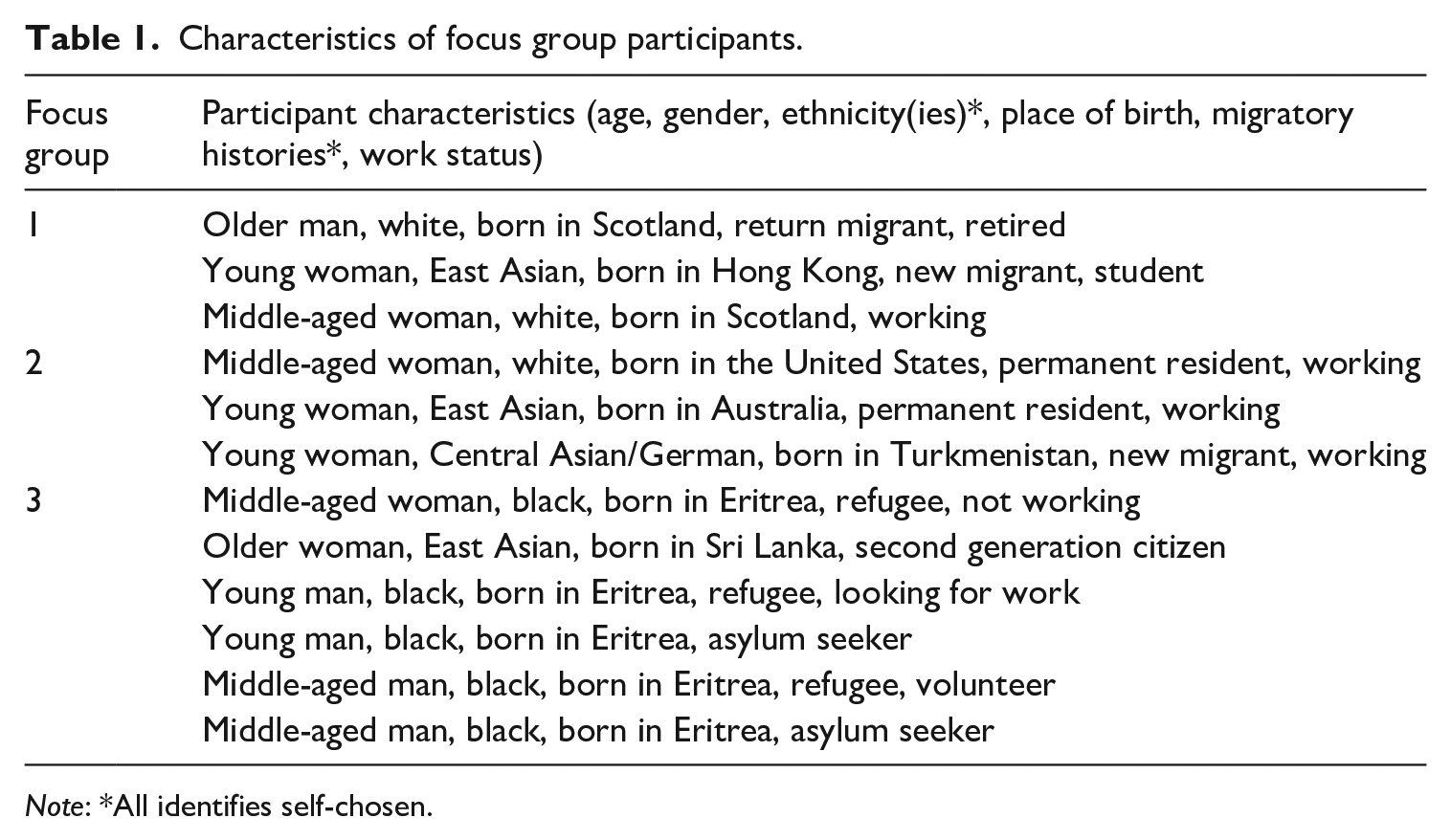
Note: *All identifies self-chosen.
During focus groups, I noticed that exchanges and the sharing of often personal and intimate stories and experiences involved and evolved around the photographs, maps, pens and labels initially intended to ease and encourage a discussion between the participants. The idea was that participants could draw or write their thoughts and experiences on labels and (re)arrange them on a map, that way sharing more detailed accounts of their lives with the focus group if they wished. Printouts of key questions also lay on the table. Photographs 1–3 below give an impression of the used objects. I perceived these objects primarily as technical and structural ‘tools’ whose functional design and ‘ordinary enough’ appearance would stimulate dialogue and mediate relations between people (cf. Mayblin et al., 2015). Yet, participants’ sensory and tactile engagements with objects – touching and moving around photos, seeing what others had written/drawn on labels and maps, and hearing what others had to say – centrally worked as ‘creative instruments’ (Tiwari, 2010: 103) that enabled many to ‘capture material, emotional, imaginary and eventful bodily engagements with public space and multicultural encounters’ (Lobo, 2019: 2). Objects also introduced a playful quality to focus groups (cf. Sutton, 2011), sparking people’s interest and curiosity, while writing and drawing on the labels and moving around their ideas.
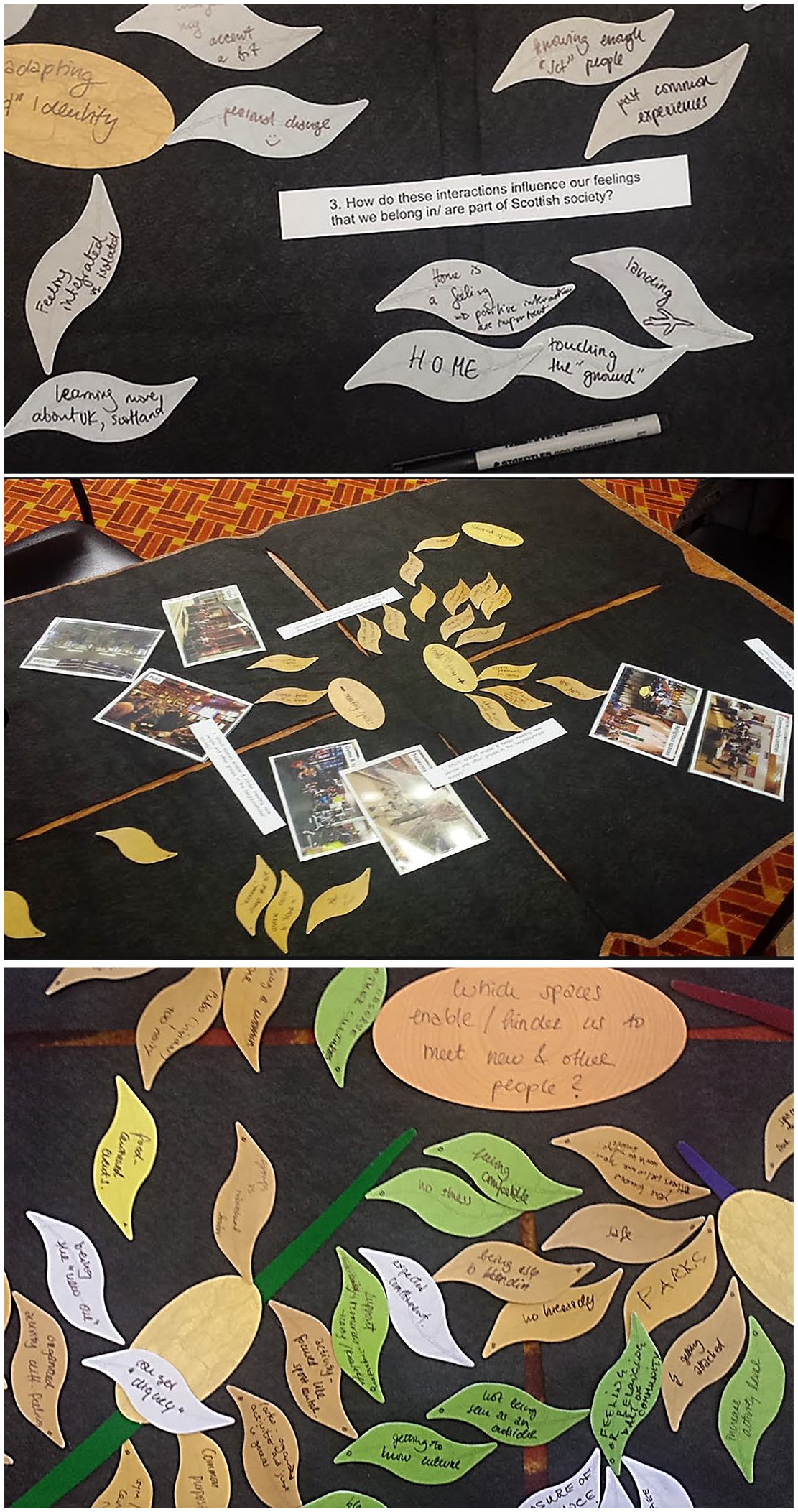
Objects used during focus groups.Source: author.
Crucially, Kye Askins and Rachel Pain (2011: 803, original emphasis) remind us that careful attention must be paid to what they call the ‘epistemological deployment of materials within areas of social interaction’, i.e. the ‘ways in which material objects are deployed/employed may be critical within planning and implementation of activity, art or otherwise’ (Askins and Pain, 2011: 818), since objects actively mediate relations between people (after Latour, 2004). Many of the objects I chose were perceived as ‘ordinary enough’ and not too specific to research settings, suggesting that their ‘very mundaneness’ might have contributed to ‘engender[ing] specific social relations, which direct[ed] us in ways we barely notice[d]’ (Askins and Pain, 2011: 813); crucial for many participants in my research to negotiate diverse barriers to (non)verbal communication, feelings and reactions as negative aspects of some multicultural encounters (Peterson, 2019b). In this light, participants’ material interactions during focus groups might indicate how ‘when objects are ‘everyday’, they become invisible while (still) making social practices, processes, and relations routine’ (Askins and Pain, 2011: 813, original emphasis). Other objects were less mundane and had ‘scripts for use’ (after Latour, 1992), evident in their design, textures, colours and flexibility. 2 Not hampering interactions in my research suggests that more can be done with exploring the design of specific ‘tools’ for imaginative, experimental and participatory ways of doing research (e.g. Mayblin et al., 2015).
Participants’ experiences of engaging with objects during research encounters
Feedback given at the end of focus groups suggested that the majority of participants experienced the material and tactile engagements as positive and helpful. Statements including ‘[Engaging with] the things made me feel more secure and confident [in the group, and] trusting in what I had to say’ (young woman, East Asian, born in Hong Kong, new migrant, student) were common, indicative of materials contributing to the emergence of a convivial and ‘safer’ atmosphere (Bennett et al., 2015) and to the performance of the focus group as a space of encounter (cf. Lobo, 2013). Specifically, participants mentioned the potential of objects to connect with others across differences (in identity, experience and opinion), to share intimate and sometimes difficult experiences and stories with unknown others, to communicate across (non)verbal barriers and negotiate moments of misunderstanding and tension, and to accommodate moments of silence and reflection.
Connecting with others across differences
The ‘doing-with-stuff’ (Askins and Pain, 2011: 815) may prompt and/or enable new social relations, connections and points of similarity and difference between individuals who may otherwise be very differently situated in society, potentially feeding into wider social changes (Peterson, 2019a). Akin to ‘activity spaces’ (cf. Massey, 1995) – the day-to-day situations and interactions that occur in environments and spaces at local level – material interactions between participants transformed focus groups in my research into spaces where something was ‘sparked [. . .] moved or created within and through moments of encounters’ (Curtis, 2016: 52) for some people:
It was really interesting to see that O had similar feelings when she first came to Scotland. . .it made me feel understood, I don’t know, it made me feel less alone in my experiences? So, when O put down [the label] on the map, I wanted to talk about my experiences as well [Laughs]. . .it felt good to do that, it made me feel connected to O, or at least to her story. (young woman, Central Asian/German, born in Turkmenistan, raised in Germany, new migrant working)
I suppose this map brings everything that we say out visually and the whole group can see it. [. . .] The map made me realise that we have a lot in common. I was surprised to see how similar a lot of our experiences [of coming to and living in Glasgow] are. . . (young woman, East Asian/Australian, born in Australia, permanent resident, working)
The women in this focus group seem to experience a sense of connectedness and ‘sharedness’, where their material engagements give them ‘the sense of something happening’ (Stewart, 2011: 445) that is ‘palpable, imaginary uncontained’ (Stewart, 2011: 445) but also material and tactile (Lobo, 2019). As their sensory moments ‘result in affective forces that charge atmospheres so that the world is animated through the engagement with things’ (Lobo, 2019: 632), the women appear to create connections and relationships that ‘do not just shape reality but are reality’ (Lobo, 2019: 632). The performative act of construction – visualising experiences and ‘touching’ thoughts on the map – may have contributed to physically reorienting these women’s bodies, so that they ‘engage with other beyond their normative – and often un-reflected upon or unconscious – patterns of relating to difference’ (Mayblin et al., 2015: 74), realising points of similarity and connection instead. As such, the above exchange illustrates how objects are both made of relations and make relations (cf. Hinchliffe, 2007), and how physical and embodied experiences of encounters during focus groups ‘are both remembered reflectively (discursively) and reflexively (through the body), as new social relations may be enabled/prompted through material engagements’ (Askins and Pain, 2011: 817).
Simultaneously, it is critical to remember that the outcomes of encounters are always unpredictable: objects may not necessarily bring about more inclusive and ‘safer’ research spaces, or help to mediate negative aspects of multicultural research encounters. Moreover, material engagements and doing research require emotional work, which can be something that people might not be willing or capable to give. In my research, some participants emphasised that ‘the materials require people to be willing to open up and share their experiences and feelings. . .which can be so personal, you might not want to do that.’ (young woman, East-Asian, born in Hongkong, new migrant, student), and that ‘using materials was very intense [and] sometimes it felt challenging to write down my thoughts and opinions for everybody to see’ (middle-aged woman, white, born in the United States, permanent resident, working). These statements echo feminist concerns regarding which stories are for researchers to explore, document and share, and which are not (Sharp, 2014). They also raise questions regarding what happens with emergent emotions and experiences as well as visual ‘artefacts’ that are also produced as part of research encounters (cf. Blakely, 2007). Engaging with objects should not be a ‘must’: in the context of my research, one focus group (see below) decided not to use the objects, instead discussing questions and themes verbally. This shows that these ‘things’ are tools, a support that may (not) be needed or wanted.
Sharing experiences and stories with unknown others
Focus groups are ‘contact zones’ (Pratt, 1991) that ‘throw together’ diverse and differently situated individuals who often do not know each other, with the effect of uneven power relations and geographies also always shaping conversations, exchanges and produced knowledges. This can transform the sharing of experiences and stories with (unknown) others in focus groups into a daunting encounter (Wilson, 2016). In my research, participants hinted at the potential to mediate power imbalances and, more specifically, feelings of uncertainty, stress, fear and insecurity through material engagements: Objects can make people less fearful to tell others what they are thinking. [. . .] talking can feel intimidating. I can be quite a shy person in conversations [and] discussions can make me feel stressed. . .especially because we don’t know each other very well [Smiles]. So, having these objects helped me to get around those feelings. [. . .] I could just hold up a label in front of me and have the others read it without looking at me directly. . .that made it easier to share my experiences with the group. [Laughs] (young woman, East-Asian, born in Hongkong, new migrant, student)
Power imbalances are clearly at play in this focus group, tied to the intersecting identities of participants (Peterson, 2019b) that may be mediated through the young woman’s ability to use objects as an ‘instrument’ (cf. Longhurst et al., 2008) or ‘medium’ through which she can share her thoughts and experiences with the group. While dominant power relations remain, the deployed objects may have helped to ‘suggest interactions, demand communications, and enable conversations across and between research participants, and researchers and participants’ (Askins and Pain, 2011: 813): as the objects were part of our contact, they ‘demand[ed] interaction of some kind’ (Askins and Pain, 2011: 813), perhaps further (dis)enabling encounters across difference and the creation of a more inclusive and enabling research space. The above statement also underscores the emotionality of research encounters (Askins, 2015), and the capacity of tactile engagements to negotiate more ‘difficult’ or ‘negative’ aspects of multicultural encounters. This was a central concern across my research, the following vignette capturing the sometimes subtle role of things in sharing emotional experiences with (unknown) others:
Around the table are sitting 4 women and 2 men, between the ages of 30–55, all born in Eritrea and with refugee or asylum status in Scotland. I ask them to share their experiences of when they first arrived in Glasgow. Silence falls, eyes glaze over and participants seem to retreat into their inner worlds. Yet, it is not a motion-less silence: One participant – a young man who recently arrived in Glasgow – takes some labels into his hands, arranges and rearranges them on the table, before gathering them up in one hand. He lifts his gaze and tells his story. It touches on experiences of violence, fear and the loss of family and friends, the shock of arriving in a foreign land and unknown city, as well as on hope and freedom found again in Glasgow. While sharing these intimate and sometimes painful memories, he passes the labels between his hands. Another participant – a middle-aged woman living in Glasgow for two years – listens, spinning a pen in her hand. With a quiet and halting voice, she then begins describing her memories of arrival, the pen never leaving her hand. (Extract field notes, Focus group 3, February 2017)
Although arguing that the ‘stuff’ got in the way of communication, this group still engaged with the objects, yet in subtler and perhaps unconscious ways: while talking, photos were moved around without being looked at, pens spun between fingers, and labels stacked into neat decks on the table. Bennett et al. (2015: 13) reflect that objects matter because they contribute texture to encounters and are also ‘sparky in their own right, hot-wiring social relations and interactions’, and can thus prove critical in fostering or foreclosing interaction. Their account illustrates the capacities of ‘things’ in mediating emotions that may surface in research encounters, as feelings such as anger and shame are projected onto objects and subsequently enable participants to discuss emotionally laden topics, crucial for both participants to share their stories in the above vignette. Sutton’s (2011: 183) use of playing cards further suggests that material methods can be crucial to explore ‘emotional worlds’ in sensitive ways and to let people ‘voice their experiences in their own terms’, highlighting the importance of embodied approaches that take seriously emotional and felt aspects of participants’ lives.
Communicating across (non)verbal barriers, misunderstandings and tensions
While language differences did not hamper discussion during focus groups in this research, it is critical to acknowledge that language is power. Post-colonial and feminist perspectives, in particular, have dissected language as rhetoric, logic and silence (Spivak, 1992) and power geometries tied to meaning construction (Barrett and Phillips, 1992; Derrida, 1978; Foucault, 1989; Simon, 1996). Bogusia Temple and Alys Young (2004: 164) observe that language equals power particularly ‘if you cannot give voice to your need [and] you become dependent on those who can speak the relevant language to speak for you’. As such, it was interesting to observe that the objects I used during focus groups seemed to provide openings for participants to communicate across (non)verbal barriers, and to negotiate moments of misunderstanding and tension (Peterson, 2019b) that also always shape multicultural encounters:
When somebody asks you something directly, you might respond [without] thinking [. . .] that can cause misunderstandings. But with this [touches map and picks up labels] you can come back to your thoughts [and those] of the group [. . .] to realise that your opinion is singular and ‘it is just me how thinks a certain way’ [Laughs]. That might avoid some tensions. (Middle-aged woman, white, born in the USA, permanent resident, working)
I think [the objects] do more than that. Seeing our opinions on the map can make it easier to discuss differences in opinion. . .because it is less personal, right? When you write something down, it becomes more abstract, like, less of your own personal thinking. . .which can be helpful [because] that person might feel less personally ‘attacked’ when you say that you think differently about that issue or think it is wrong. (Young woman, East Asian, born in Hongkong, new migrant, student)
Encounters are fraught with tensions and difficulties, and moments of disconnection, uneasiness and misunderstanding are also always present in ‘zones of encounter’ (cf. Wood and Landry, 2008). This exchange indicates that the negotiation of difference is often precarious and involves continuous effort in communicating and creating understanding (Neal and Vincent, 2013). Here, I want to shift attention to the notions of ‘abstraction’ and ‘visibility’ touched upon by both participants, who seem to suggest that the map and labels enabled them to express and learn about differences through the act of doing (cf. Mayblin et al., 2015), foregrounding the coproduction of knowledge rather than feelings of vulnerability or guilt for sharing certain opinions or experiences. In this situation, the group discussed inclusive meeting spaces, one participant writing down ‘no hierarchy’, by which he meant a space without obvious hierarchies allowing people to feel equal to one another. This opinion was opposed by the other two female participants, who had written down ‘feeling acceptance’ and ‘feeling normal’, arguing that spaces are always hierarchical, and gendered, something particularly felt by women (Peterson, 2019b). Engaging with the objects increased and changed interaction in this focus group, participants sharing their different views on the hierarchy and inclusivity of public spaces, and shifting the male participant’s opinion on the matter. As such, the use of objects in focus groups shares the ethos of participatory research, emphasising the need to work with participants to encourage greater understanding (Askins and Pain, 2011) and ‘counter narratives’ to be shared (Solórzano and Yosso, 2002).
The ‘things’ of the focus group above also seem to bring people together rather than set them apart, with the activity of physically (re)arranging participants’ thoughts, and bodies, getting on and around moments of disconnection and misunderstanding. Another participant emphasised the potential of objects for offering diverse forms of self-expression and communication, grasping ‘what words cannot convey’ (cf. Rose, 2008): Thoughts and opinions can be very difficult and complex, so I drew a plane [. . .] to symbolize my feelings of ‘touching the ground’ for the first time when I arrived in Scotland [Laughs]. . .I didn’t know how to describe those feelings using words. . .for people whose first language isn’t English [using objects/drawing] to symbolize their experiences might also be very important [to communicate] without needing to write something down. (young woman, Central-Asian/German, born in Turkmenistan, raised in Germany, new migrant, working)
The situated, site-specific practice of drawing seems to enable this participant to create a symbol of arrival that is felt by, and moves between the bodies of the other participants in the focus group, allowing her to communicate ‘material and affective worlds’ (Hawkins et al., 2015). It also underscores the potential of objects, and specifically acts of drawing, to express feelings and experiences without being constrained by the use of the English language and to coproduce knowledges that ‘go beyond talk’ (Garrett, 2014). The value of working with expanded sensory and material methods in focus groups, here, lies in the ability to make room for the ‘messiness’ and unpredictability of research encounters (cf. Askins and Pain, 2011) where something ‘happens to bodies’ (Saldanha, 2010: 2414), and to create shared research spaces characterised by ‘flickers of activity’ (Lobo, 2019: 634) that are ‘unintentionally intent’ (Dewsbury, 2014: 429), producing opportunities to think through felt and embodied dimensions of research encounters.
Silence and moments of reflection
Thinking through silences has a long tradition in feminist research (e.g. Haraway, 1991), importantly establishing silences as moments ‘full of ambivalence’ (Jaworski, 1993) that may ‘signal assent or dissent; may heal or wound; may inform or conceal; may signal power or submission’ (Hyams, 2004: 110), and ‘what can and cannot be said’ (Warin and Gunson, 2013: 1687) in research encounters. In terms of research practice, this work demands scholars to pay attention to practices of hearing ‘silences within voice’ (after Hazel, 1994), to realise the political potential of (focus) group discussions (Hyams, 2004). In the context of my research, participants linked the possibility of tactile engagements in focus groups to the importance of ‘being silent’ and for accommodating moments of reflection: The materials give everybody the chance to do their own thinking first, that is important: Using the labels helped me to look back and ask myself ‘what did I just say?’, ‘what did the others say or write down?’ and ‘what do I think on that point somebody else wrote down?’ I liked the possibility to ask myself these questions and think about them first, to reflect on what others had put on labels, where they put them on the map. . .it gave structure to my thinking, and the [group] discussion. (young woman, East Asian/Australian, born in Australia, permanent resident, working)
Silence does not always equal absence, and this participant highlights that silences can be full of meaning in particular interactions, as they become critical moments of reflection, recollection and relational thinking that shape research encounters. While silences can have a disruptive and unsettling impact on the flow of a conversation, and be a means to (de)construct power as part of the dialogue (cf. Torbenfeldt-Bengtsson and Fynbo, 2018), in my research, the ‘silent’ activity of exploring ambivalence in participants’ intimate daily lives, experiences and thoughts before sharing these with the group (cf. Harvey, 2011) helped to ‘offer a space for the unsaid, the indescribable and the incomprehensible’ (Ghorashi, 2008: 126), and to discover a deeper level of personal experiences and life stories. Participants’ ability to pause, reflect and be silent as part of their tactile engagements thus potentially shifts and deconstructs, in small and ‘quiet’ ways (Askins, 2015), ‘narratable subjects’ that ‘can and cannot be spoken [about]’ (Stanley and Temple, 2008: 278) in and beyond focus groups.
Further underscoring the significance of silence(s) through material research encounters, another participant emphasised that ‘[being silent] can be a moment of self-reflection [and] a moment when you can reflect on other people’s experiences in life and in the world’ (middle-aged woman, white, born in the United States, permanent resident, working), possibly contributing to the process of ‘renegotiating Selves’ (Askins and Pain, 2011: 18) and shifting positions of power during research encounters (Bennett et al., 2015). The notion of ‘structure’ further speaks to Barbara Sutton’s (2011: 186) observation that objects can encourage participants to organise themes in ways that make sense to them by establishing conceptual and experiential linkages between various topics, since objects’ physicality and concreteness may make ‘abstract categories and concepts more tangible and accessible than if they were just embedded in a spoken word exchange’.
Conclusion
When I decided to use objects, I thought that they would be helpful to encourage and ease interactions between participants in focus groups. Quickly, these objects emerged as crucial elements shaping research encounters, and as critical for many participants, including myself, to articulate, share and collectively make sense of often sensitive, emotional and complex stories of multicultural encounters and living together in Glasgow. People’s engagements with ‘stuff’ significantly contributed to the dynamics, ‘the flow and direction of interactions and meaning-making processes’ (Hyams, 2004: 109) in/through multicultural encounters and negotiations of living together that I had set out to study.
Material and visual methods offer many opportunities for insightful social research. Using objects and creating images, and thus ideas, in focus groups can enable participants to exercise greater control over the data production process, offering a chance ‘to share their own experiences of place, space and self’ (Mannay, 2016: 102). People can also reflect experiences and opinions without the direction of a research voice, as in entirely verbal approaches. In my research, using objects also made ‘the familiar strange’ (Mannay, 2010): new and unforeseen ways in which some participants used objects were an opportunity to observe and inquire about unseen and forgotten elements of our shared environments, and to re-consider and re-evaluate aspects of people’s lives. Yet, material and visual data are not stand-alone data sources, and require discussion and reflection through additional verbal approaches. Using objects in focus groups can also not eliminate the possible issue of consensus forming and people giving socially desirable answers. Participants’ responses are often influenced by what is shared in a group setting, spurring memories or opinions in others. Central here is that people’s interactions with the objects of the focus group often re-defined personal experiences as public problems (Peek and Fothergill, 2009) and promoted a sense of solidarity and support.
Feminist geographers have long been advocating for approaches that take seriously the role of things in structuring all forms of social–spatial relation, including those in research. This paper is an attempt to contribute to emergent work in feminist theory and practice that underscores the importance of ‘coming to our senses’ (Curtis, 2016: 325, original emphasis) through tactile and material engagements. Things matter, and activities that involve and evolve around objects can be a ‘performative force’ that may feed into gradual social transformation by making bodies more ‘permeable to change’ (Lobo, 2013: 460). As such, this paper speaks to debates which argue that more can be done with exploring the use of objects as a method in feminist and participatory research, developing practices that enable researchers to engage in research encounters with ‘fleshy bodies, sensory impulses and material objects’ (Lobo, 2013: 460), and ‘an openness [. . .] and ethical questioning that destabilises the relationship between power and knowledge’ (Lobo, 2010: 104) not possible with disembodied approaches.
Footnotes
Funding
The author(s) disclosed receipt of the following financial support for the research, authorship, and/or publication of this article: Research for this paper was supported by a Doctoral Scholarship by the Urban Studies Foundation.
