



Abstract
Contemporary everyday cultures are increasingly pervaded by digital platforms, making a rethinking of observational research into sociocultural phenomena necessary. Observational practices that remain confined to physical localities face various impasses in the era of digital platforms. Combining participant observation in workplaces where digital platforms are accessed with technical walkthroughs of their interfaces, I make a case for renewing interface ethnography. On one hand, technical walkthroughs reveal the sociocultural assumptions embedded in interfaces and the ways in which their affordances generate symbolic meanings. However, on the other hand, participant observation foregrounds emic perspectives on digital platforms within communities of practice. Based on an ethnographic study of a Norwegian software firm, I argue that the integration of the walkthrough method with participant observation enables researchers to trace the twofold meaning construction inherent in communities of practice whose skilled labor is orientated toward digital platforms. This fusion of methods expands the scope of ethnographic knowledge across the digital-physical continuum.
Keywords
Introduction
Although digital anthropology and digital sociology are now firmly established subdisciplines, and the interest in observation-based research into internet technologies has increased significantly in recent years, ethnographic investigations into digital cultures currently face many challenges which have not received sufficient scholarly attention. Digital platforms, such as Skype, Yammer, Slack, SharePoint, WhatsApp, and GitHub, have pervaded almost every layer of corporate life in the last decade thereby greatly affecting business operations, interpersonal communication, and work-based collaboration around the globe. Interfaces of digital platforms are integral to contemporary taskscapes, in which the everyday lives of an increasing number of professional groups are interwoven. Taskscapes can be seen as arrays of related activities performed in professional settings (Ingold, 1993: 158). Digital platforms have changed the day-to-day routines of employees across a myriad of industries. Indeed, the omnipresence of digital platforms has also shifted the conditions under which everyday practices can be observed. A digital platform can be conceived as an infrastructure on which applications can be built (Gillespie, 2010: 349). It is primarily a programmable architecture organizing exchanges between corporate owners, programmers, and end users. The process of platformization has been described as the penetration of economic, governmental, and infrastructural extensions of digital platforms into the web and apps, affecting the production, distribution, and circulation of cultural content (Nieborg and Poell, 2018: 4276).
The proliferation of digital platforms in everyday life calls orthodox observation-based research into question and throws ethnography into an epistemological crisis. Many, if not most, professional groups engaging in digital labor inhabit screen-centered offices, and their skilled practices are directed toward the interfaces of digital platforms. An analytical focus on everyday life casts light on their work routines and daily rhythms, which are situated in the local settings of their workplaces. Direct observations of everyday practices provide critical insights into how tacit knowledge and local meaning-making are constituted. The human and the technological are deeply intertwined in numerous contemporary everyday practices. A human world where individuals follow social interests and political agendas is not separate from a technological world consisting of everyday artifacts (Freeman, 2018: 2). Therefore, contemporary ethnographic research cannot be solely based on physical co-location with collaborators. Digital platforms, which are prevalent at many contemporary workplaces, generate multiple forms of co-presence across interlocking places (e.g. Beaulieu, 2010: 454). Moreover, natively digital data cannot be systematically gathered with the traditional methodological repertoire of ethnographic fieldwork. In this context, the word native refers to its computational meaning. For example, an app that is developed for a specific processor or operating system can be considered native. Natively digital data is accordingly not emulated or migrated, but emerges and is processed within a specific platform. Ethnographic research has been predominately reformed by re-conceptualizing space, which gave rise to multi-sited research designs (e.g. Marcus, 1995: 105), or by re-imagining time, which initiated multi-temporal research strategies (e.g. Lien, 2003: 99). It is furthermore necessary to gain a deeper understanding of the digital technologies used by the collaborators of ethnographers. The infrastructure of platforms can be experienced at interfaces, which in this context refer to techniques of mediation and effects at interstices (Galloway, 2012: 33). The main aim of this methodological reflection is to gain a better understanding of the possibilities and limitations of conducting observational research at the interfaces of digital platforms. Discussing insights from my ethnographic fieldwork in a Norwegian software firm, I raise a number of interrelated questions: Which participatory roles can ethnographic researchers adopt when immersed in work environments shaped by digital platforms? In what ways can observation-based research be reformed to sufficiently document everyday practices occurring at the interfaces of digital platforms? And finally, – based on answers to these practical questions – how is knowledge derived from both participant observation and walkthroughs possible?
Since the argument that I lay out in this article derives from my own fieldwork experiences, I refer to numerous ethnographic examples from an investigation into the shaping of skilled practices within a Norwegian firm producing business intelligence software (Ritter, 2019). Illustrating new ways of conducting observational research within interconnected digital platforms, I show that the current epistemological crisis of ethnographic research can be overcome by making interfaces units of analysis for ethnographic investigations. Based on an ethnographic study about the production of software, I make a case for anchoring technical walkthroughs that analyze interface affordances, including buttons, menus, and other visuals, to the places where interfaces are routinely accessed. In doing so, I demonstrate how emic perspectives on skilled practices, social relationships, and artifacts within the researched community of practice and the meanings that mediators generate within platform interfaces can be elicited. Drawing on evidence from the aforementioned firm, I argue that the integration of the walkthrough method with participant observation enables researchers to trace the twofold meaning construction inherent in communities of practice that engage in platform-orientated labor. This fusion of methods expands the scope of ethnographic knowledge across the digital-physical continuum. The first part of this article describes the role of shadowing sessions in observational research, while the second presents a technical walkthrough of the platform Slack. In the third section, I discuss observational tactics employed at onsite meetings. The final section elucidates how interfaces of the platform GitHub can be systematically observed.
Shadowing software developers
New methodologies integrating ethnographic research with digital methods and data were developed across the social sciences, and consequentially vigorous debates about the epistemological and ontological assumptions underlying digital social research emerged over the last decade. First and foremost, ethnographies of human-computer interactions at the workplace drew on numerical and video data to illuminate practices of design and artifacts-in-use (Suchman, 2011: 25). Computational methods, such as the Issue Crawler software, can furthermore enhance ethnographies by generating, for example, a hyperlink ecology of key actors establishing new digital music genres (Born and Haworth, 2017: 73). Based on the multi-layered ontology of field sites on digital platforms, ethnographers can distinguish between observations of ‘solid’, contextual fields of bounded online communities and observations of the ‘liquid’ meta-fields consisting of aggregated, communicative content (Airoldi, 2018: 665). Emphasizing the potential of transversal collaborations between social scientists and data scientists, a further epistemic strategy for combining ethnographic and computational data worlds involves the qualitative grounding of vast digital data sets (Madsen et al., 2018: 203). Digital methods and data play a constructive role in the social worlds in which they are embedded. While digital methods are shaped by social worlds consisting of analytical procedures, infrastructures, and personnel, they can, in turn, become agents that actively participate in those worlds (e.g. Ruppert et al., 2013: 31). Co-word analysis and other digital research techniques are deeply implemented in particular media and partly depend on the specific sociotechnical assemblies in which they are employed (Marres and Gerlitz, 2016: 42).
Contributing to recent debates on enhancing ethnographic research through digital methods, this article makes a case for a new type of interface ethnography that combines participant observation in physical settings with analyses of platform affordances. Whereas many previous investigations crucially indicated the possibilities of reinforcing ethnography with digital data, the approach undertaken here demonstrates the active role of platform interfaces in digital labor and reveals the sociocultural assumptions built into their affordances. This approach integrates technical walkthroughs, which can systematically capture the meanings that platform interfaces generate, with participant observation, which can elucidate how members of a given community of practice make sense of their skilled practices, social relationships, and artifacts. The combination of these two methods gives rise to a spiral dynamic between centering and decentering the digital. While the technical walkthrough is a media-centric technique of observation, participant observation in local places foregrounds surrounding actors and skilled practices and decenters digital media.
Conducting an ethnographic study of a Norwegian firm developing business intelligence software for oil and gas corporations, I primarily explored how built-in platform metrics shaped the internal evaluation of work performances among software developers. Overall, I conducted 16 months of fieldwork at intersections between the Norwegian software industry and the global oil and gas industry. Initially, I availed of industry events to research the rising demand for software applications among oil and gas corporations and to arrange subsequent interviews with attending software developers at their company sites. After attending numerous industry events, I finally negotiated access to the Norwegian software firm under study and conducted a 3-month secondment to its premises. In addition to participating in meetings and shadowing employees onsite, I conducted 30 in-depth interviews with industry experts, including 18 from said firm.
On the first day of my secondment to the Norwegian software firm, I was given a card that I could use to access the firm’s offices. Equipped with this card and a schedule of meetings with employees, I quickly immersed myself in the firm’s office culture and began arranging shadowing sessions with employees working in different departments of the firm. Drawing on Goffman’s theory of the performed self (1990), Nandhakumar and Jones (2002: 331) argue that ethnographic researchers greatly benefit from experiencing the back regions of field sites. Within these social settings, the disclosure constraints that shaped the initial relationship between the researcher and researched were at least partially relaxed, which facilitated crucial insights into the skilled practices of the studied employees. When I spent time with the employees in their offices, the atmosphere was more informal, encouraging them to slowly open up and talk about their personal relationships with other employees. My degree of involvement in the community of practice on the premises of the software firm largely corresponded with the role of an observer-as-participant, as I was assigned a desk in the main open-plan office of the firm and regularly attended meetings in the physical location of the company site.
The access story of my fieldwork at the Norwegian software firm has, however, a second strand. The main entrance to the firm’s offices was only one boundary of the field site; further boundaries were established inside the business’s digital infrastructures. In the second week of the secondment, I met the leader of one of the software teams. This ‘key collaborator’ proudly explained the various ‘tools and programs’ his team used to build software, including Jira, GitHub, and Huboard. Although somewhat basic, my understanding of developer platforms and programming languages proved invaluable when negotiating entry to access-regulated interfaces. Knowledge about a researched community and its practices can accelerate access to research participants and ethnographic data (Ferguson, 2017: 688). I was given access to the platforms GitHub, Slack, and Huboard, and also the cloud-based software sold by the firm. After accessing the interfaces in which employees routinely engaged, I could begin to study the firm as a microcosm consisting of a series of offices and a collection of platforms. Depending on their roles and assigned tasks, employees were granted different levels of access to internal platforms. Access varied from write roles to read-only. The two-tier access story reveals that my ethnographic fieldwork about knowledge practices of software developers involved two entry points to local places and interlocking platforms where the software was produced and distributed.
The ethnographic study of software development brought to light a transformative process which pervades numerous other professional groups, including journalists, human resource professionals, teachers, lecturers, tourism professionals, and healthcare professionals. The process of platformization is first and foremost a transformation within internet infrastructures, extending the logics of digital platforms into the rest of the Internet. Facebook and Twitter were initially designed as social networking sites, enabling their users to generate web content. By providing third-party developers with controlled access to their internal data, both companies turned into digital platforms. Third-parties can either connect add-on applications on top of a platform or collect platform data about the digital traces of users for empirical analysis from their application programming interfaces (APIs). The platform became the dominant governmental, economic, and infrastructural model of the Internet (Helmond, 2015: 1).
Although I conducted participant observation in the offices of the Norwegian software firm, these local places were deeply entangled with the sociotechnical infrastructures of software development. While acknowledging that infrastructure studies and platform studies emerged from different disciplinary contexts and follow differing disciplinary trajectories, a combination of both strands can facilitate complementing perspectives on phenomena fundamental to contemporary everyday life (Plantin et al., 2018: 306). Synthesizing theoretical understandings from both traditions casts light on the settings in which observations of digital platforms take place. Infrastructure can be seen as a built network that facilitates the flow of goods, services, people, or ideas and allows for exchange over space (Larkin, 2013: 328). Instead of conceiving infrastructures as static systems, I analyze the dynamic relationships between humans and technology in the situated contexts of interfaces within digital platforms. Digital technologies evolve in material worlds, generating complex orders and relationships among sociocultural artifacts themselves, and with people (Ritter, 2017: 56; Miller and Horst 2012: 24). Screens, processors, cables, and keyboards are not the only components of these material worlds; so too are the affordances of interfaces where symbolic exchanges are located. The affordances of a given interface can be broadly defined as the properties of an environment facilitating or constraining certain types of cultural practices (boyd, 2014: 10).
By drawing on the example of the platform Slack, I illustrate how observational techniques can elucidate the skilled practices of software developers. The rise of digital technologies has not only transformed multitudes of businesses in recent decades, it has also altered the conditions of participant observation on company sites. Participant observation has traditionally been defined as making inferences from what people do, make, and use (Spradley, 1980: 12). For instance, focused observation of such practices can be documented in comprehensive accounts capturing the making of sociocultural artifacts. The observational directedness of ethnographic research toward sociocultural artifacts or practices is a long-standing tradition. Such directedness can be rethought in the context of the ethnographic study of software development. Software is a type of cultural artifact with properties that are fundamentally different from traditional objects of study, such as, say, a teapot, a TV series, or a wedding dress. The shadowing session is an observational tactic through which researchers can elicit the subjective meanings software developers assign to their work. I arranged shadowing sessions with members from each department of firm, during which I asked the employees to explain their regular tasks. In addition to taking notes during the course of each session, I subsequently conducted interviews with the participants (e.g. Ventura and Keinan-Guy, 2018: 5). The informal setting of the shadowing sessions enabled me to transition from the first fieldwork phase, in which everything felt like the exciting experiences of a honeymoon, to the second fieldwork phase, in which I felt accepted by the employees (Wulff, 2008: 83).
In the shadowing sessions that I organized with software developers, the platform Slack was always discussed. In an interview that followed one of these sessions, the software developer Bjørn
1
described his perspective:
It's [Slack, Author] like a chat line kind of thing. We have topics, channels. It looks like. . . In the old days, we had something called IRC. It looks a little bit like that. Internet Relay Chat. Everybody else can see what you type in the channel. Or you can have a personal chat. It's a way of easily communicating things, and you put it in the channel that you know that you have an audience or you send it directly. It's a way of notifying someone with simple messages instead of sending an email. But it has a search and you can send some files in it. And you can integrate it. We have it integrated with the test results here for instance. I can see – there comes a message in a special channel – when these software tests are failing.
Delivering various narratives about the tasks discussed during the shadowing session, the interview solidified my understanding of the skilled practices needed to use Slack. The interview extract above shows how Bjørn made sense of the skilled practices attached to this platform. The piece of data contains a short register of its different local uses. Most of the software developers only wrote emails to communicate with external partners, clients, or the firm’s management. The search bar of Slack can for instance ease the coordination of tasks, as all conversations are stored. In comparison with email inboxes, it is relatively easy to find previous messages and files on a specific topic through the search bar. Slack was furthermore used to obtain information on software tests. Bjørn’s narratives revealed how Slack was locally appropriated and how he categorized its various features. Shadowing sessions and accompanying in-depth interviews with software developers enabled me to grasp their emic perspectives on skilled practices, tasks, social relationships, and internal tools.
A technical walkthrough of Slack
Although shadowing sessions can provide valuable insights into how software developers interpret their skilled practices, digital platforms pose elusive challenges to traditional observation-based research. Whereas my boots-on-the-ground presence was delineated by the physical boundaries of the offices, the employees under investigation spent the vast majority of their working time in front of their computer screens. While they stared in silence at their screens, I realized that my immersion in the local settings of the offices alone would not provide sufficient insight into Slack. I felt the need to assess the interfaces of this platform more closely. The locale, which consisted of the firm's offices, was interconnected in multiple ways with other actors through the interfaces of platforms. The digital infrastructures which I encountered during this investigation into software development could not be examined with observational methods traditionally employed in social and cultural anthropology to examine field sites enclosed by physical boundaries (e.g. Malinowski, 1922: 12; Marcus, 1995: 105; Lien, 2003: 99). The specific technologies underlying the labor of software developers required new forms of observation-based research. Since the production of software primarily involves screenwork (Boyer, 2013: 13), a rethinking of ethnographic research techniques is needed to complement the observations within physical sites, in this case in offices and meeting rooms, with knowledge of the interfaces constantly used by employees. By observing such interfaces, digital ethnographers can better understand everyday practices situated within interfaces.
My observations of the office compound did not provide sufficient evidence for analyzing the platform-oriented everyday practices of software developers in depth. Hence, I explored how place-based observational techniques could be integrated with the interface-oriented observations that technical walkthroughs provide. This qualitative method considers the web as a data source and incorporates the methods of the medium (Light et al., 2016: 885; Rogers, 2013: 5). Combining perspectives from science and technology studies with cultural studies, walkthroughs were initially developed for the systematic study of smartphone apps. Inspired by actor-network theory (e.g. Latour, 2005: 37), a core assumption of the walkthrough method is that technological and human actors mutually shape each other. Human or nonhuman actors can be assigned roles as mediators or intermediaries. While intermediaries passively transmit meanings within a network of relations, mediators can alter the meanings they carry. By conducting detailed walkthroughs, researchers can learn how affordances of interfaces configure relations among actors. The walkthrough method provides comprehensive understandings of interfaces as both nonhuman actors and mediators (Light et al., 2016: 886). The ways in which users can engage with an interface are primarily shaped by its affordances. A massive open online course (MOOC), for instance, contains various interfaces structuring the relationships between teachers and learners. In some cases, learners pay a fee to take exams online and accordingly receive a password to access the exam area. The entry field is an interface affordance which acts as a mediator. Depending on the entry in the field, the portal provides or denies access to the exam area.
In order to advance the ethnographic practice in the wake of the platformization of labor, I combine the method of participant observation at onsite locations with the data collection procedures of the technical walkthrough. In doing so, I can directly engage with the interfaces of the researched platforms to understand how they guide users and shape their everyday practices. A technical walkthrough is a systematic data-gathering procedure that can isolate vital data about mediators shaping the everyday uses of interfaces (Light et al., 2016: 893). This technique allows researchers to document the generation of symbolic meanings within platforms, navigational features of their interfaces, and the arrangement of key affordances, such as menus, icons, and buttons. By writing observation records, taking screenshots, or recording the navigational flow of interfaces, researchers can trace the dynamic interplay between users and other actors, including menus, buttons, and icons. Crucially, the agency to generate the meanings attached to the uses of platforms is not only attributed to humans, but also to nonhuman actors. For instance, the platform Slack is not simply a vessel of symbolic meanings, rather it consists of affordances that actively shape how software developers can collaborate.
Slack was used daily by the firm’s software developers and primarily served as a tool for team collaboration. A technical walkthrough of its frequently used interfaces illustrates how tasks were organized within the firm. To gather relevant data for the ethnographic study of software development, I engaged in extended observations of both places and interfaces. Moving between the physical places within the office compound and the interfaces of platforms, I noticed that I was collecting two different forms of observational data about the firm’s culture of expertise. The first form of data was collected in the physical settings of the premises wherein I documented the everyday practices and conversations of employees onsite by compiling observation records. The second form of observational data was gathered within the various interfaces in which employees routinely engaged. Such natively digital data was gathered through observation records, screenshots, and, to a certain extent, screen recording software. The interpretation of evidence from routinely used interfaces of platforms poses a substantial challenge to observation-based research. To understand the routines and knowledge practices of software developers, the direct observation of the interfaces of developer platforms is as important as the observation of their everyday practices in their offices. Because the object of study should shape its methodology and not vice versa, my discussion of observation-based research into interface-oriented labor is grounded in my fieldwork experiences within this software firm. In other words, the research problem of the investigation guided its methodological choices. My data set about the uses of the Slack interfaces contained various screenshots, short video recordings, and numerous observation records describing mediators. The following extract from a revised observation record exemplifies a technical walkthrough of Slack’s main menu:
After logging in, the first interface displayed a vertical menu bar and message feed. The menu bar on the left-hand side can be understood as a mediator of this interface since it guided users through the platform. A further central interface arrangement was the list of channels, which was also part of the side menu. By clicking on a ‘channel’, users could follow a private or public discussion between team members. For example, a team leader raised a question about support calls with clients in a private channel which could only be accessed by invited members. If the software developers had identified a bug in a software application, they often posted screenshots displaying the flaws in the firm’s channels. The private channels were mainly dedicated to specific projects. Similar to many other platforms, messages were time-stamped and listed from the top to the bottom on the right-hand side of the screen. The message feed was a further mediator shaping the interfaces of Slack, as it configured what type of media content the interlocutors could exchange. In contrast to other instant chat tools, Slack allows its users to enter textual messages, to drag-and-drop PDF files, spreadsheets, image files, or share hyperlinks directly on the message board. The integration buttons were further central mediators, allowing members of a workspace to access content from other platforms directly through Slack. In this particular software firm under study, GitHub was integrated with Slack. This feature of Slack enabled actors to receive immediate notifications on the private code repositories on their desktop computers or smartphones.
By writing down my thoughts in the observation record, I documented numerous affordances that configure how software developers can collaborate on Slack. This piece of data demonstrates how mediators can be identified by closely observing the affordances that enable or constrain everyday practices on digital platforms. Mediators construct meanings attributed to tasks, tools, and skilled practices. For instance, Slack configures the social relationships between a team leader and other team members through built-in administrator privileges for inviting users to closed channels. Another example is the integration button that configures relations between the different components of the digital infrastructures by establishing a flow of information between GitHub and Slack. The affordances of Slack play an active role in transferring the meanings attached to the digital labor of the software developers. The previously described mediators shape meanings by invoking specific skilled practices. Such embedded meanings of affordances construct conceptions of usage, such as sharing content, accessing channels, and integrating tools. The walkthrough method elucidates the agency of nonhuman actors and traces the ways they configure relations within a particular actor-network of software production. Combining an analysis of the affordances of Slack with a documentation of the subjective meanings of software developers significantly enhanced ethnographic research. While the shadowing sessions and accompanying interviews can document the emic perspectives on skilled practices, social relations, and artifacts within communities of practice, the walkthrough method can reveal how mediators generate meaning and shape platform labor. By drawing on both observational techniques, it is possible to illuminate the sociotechnical dynamics between human and nonhuman actors from different angles.
Inside a scrum meeting
The integration of participant observation and technical walkthroughs can also be demonstrated through an analysis of meetings held on the premises of the Norwegian firm. The software developers of the studied firm congregated at ‘daily scrum meetings’, which regularly revolved around the various digital platforms inherent in software development. While attending such meetings, I could learn how the software developers made sense of their internal events. The following revised observation record described a ‘daily scrum’ that I attended in the open office for the software teams: The daily meeting of the software developers began at 10 am, Norwegian time. I stood in a circle of software developers, next to the team leader Lucas who held notes in his hands. While the Trondheim-based employees were standing in the office, Oleksandr and Albert, two software developers based in Dnipro, Ukraine, where it was already 11 am, joined the conversation through a video conferencing system. Lucas announced that they had identified a new bug and were attempting to fix it. He asked everyone to speak about the tasks they planned for the day. For example, Arne intended to work on an import tool for a software application. He thought that he would be able to fix it in a few hours, but the other team members suggested that it would take much longer. All the developers quickly began to discuss their current tasks. The software leader referred to these tasks as ‘blocks’ and pointed to two boxes on the backlog Huboard, which was displayed on a large screen in the office. This service integrated with the GitHub API and listed ‘issues’ from GitHub in its own interface. Liv mentioned that she had a quick conversation with the product owner Maren that morning in which they had a discussion on a problem with a login for one user group. This issue needed to be fixed rapidly because several people were unable to access the software. A further topic of the meeting was a new database that the consultant Frank had planned to implement in the software. Lucas reported that the software developers should promptly begin to work on these suggestions and that they should ‘open a new branch’. By discussing all the daily tasks, they could report to each other on current problems, achievements, or plans. The daily scrum was very informal, with a relaxed sense of hierarchy. It lasted for about 20 minutes.
This observation record provides insights into the daily routines of software developers and indicates how they assign meanings to their work. For instance, I could elicit the different professional categories that employees used to refer to the internal hierarchy, including ‘programwareleder 2 ’ (software leader), ‘konsulent’ (consultant), and ‘produkteier’ (product owner). After the meeting, Liv worked on implementing a new database in the software, as suggested by Frank. That afternoon, she adjusted existing blocks of code and inserted them into a newly created branch, which I later noticed on GitHub. An essential part of the emic knowledge that software developers externalized during and after the daily scrum is an understanding of branches which structure the production of software. The permanent master branch reflected the production-ready state of the software, whereas sub-branches allowed software developers to isolate specific changes to the software code, such as bug fixes and new features. When such changes were approved by the software leader and product owner, the branch containing the newly developed code could be merged into the master branch and a new version could be released. Attending the daily scrums helped me gain a better understanding of the overarching production processes in which software developers were involved. I could learn about a specific branch system of GitHub at the Trondheim office meetings. In doing so, I documented how the software developers interpreted their tasks in GitHub and how they appropriated the platform for their own purposes.
Taking on the role of a participant-as-observer on the premises, I could get a strong sense of the democratic environment that the local meeting culture created. By attending onsite meetings, I could also learn how individual work performances were orally evaluated and how such discussions stimulated the sense of achievement among employees. My participant observations of local places, such as offices and meeting rooms, revealed how employees interpreted their digital labor and the different professional groups involved in software development. However, the omnipresence of interfaces in the production process of software indicated that nonhuman actors were equally relevant to the story of the software firm. While place-based observations can elicit emic perspectives on internal practices, social relationships, and artifacts, the walkthrough method can trace how built-in mediators of platform interfaces generate symbolic meanings. The interface ethnography demonstrated here, combining participant observation and technical walkthroughs, can capture this twofold meaning construction occurring within professional groups whose skilled practices revolve around digital platforms. By alternating between participant observation in local places and technical walkthroughs, the analysis of platform-based labor engages in the interplay between decentering and recentering the digital. In order to further illustrate the benefits of this fusion of methods, I shall proceed with a technical walkthrough of a central interface of GitHub.
Understanding interfaces
The built-in metrics of GitHub played an essential role in the internal evaluation of work performances among the software developers within the Norwegian software firm. By conducting a technical walkthrough of a central interface embedded in the developer platform, I demonstrate how this method can provide insights into the role of interfaces in internal appraisals. Coined in 1868 (Schaefer, 2011: 172), the term interface initially referred to the movement of heat, light, and electricity through different materials. The word interface also relates to walls, gates, doors, windows, and sockets. However, the window and door models do not adequately reflect the dynamic processes inherent in digital interfaces. Similar to buildings that are structured by physical boundaries, internet technologies are organized through, among other things, interfaces that serve as thresholds between an inside and an outside. Everyday socialities are framed by a huge variety of interfaces. Interfaces are colloquially referred to as interactions between a human body and a screen. Visual interfaces, such as online banking portals or checkouts pages of online shops, are deeply interwoven within everyday practices. However, interfaces do not necessarily require a screen and may even be non-optical. Keyboards, mice, sensors, and game controllers are interfaces that mediate between a user and computer hardware. The Wii Remote, for instance, was designed as an intuitive interface (Bogost and Montfort, 2007: 176), and although the console cannot mimic complex gestures, it detects motions, such as rotation and acceleration. Interfaces furthermore complicate the ways in which people navigate in public space (de Souza e Silva and Frith, 2012: 25). For example, mobile devices enable their users to rapidly access the interfaces of GPS navigation apps on the go.
Interfaces are first and foremost shared boundaries between the sociotechnical systems of computers, connecting hardware, software, and human users (Figure 1). Given the profusion of interfaces inscribed in everyday practices, observation-based research necessitates a firm understanding of the everyday cultures and sociotechnical processes involved in such technologies. Rejecting a static taxonomy of stable and clear-cut media objects, Galloway (2012: 33) describes interfaces as techniques of mediation and effects at the interstices of sociotechnical systems. In other words, interfaces are transmission points between effects, involving a multiplicity of dynamic processes. Maintaining a certain degree of autonomy, interfaces involve mediation practices (Galloway, 2012: 16). The walkthrough technique enables researchers to trace these mediation practices and unravel the dynamics of digital labor.
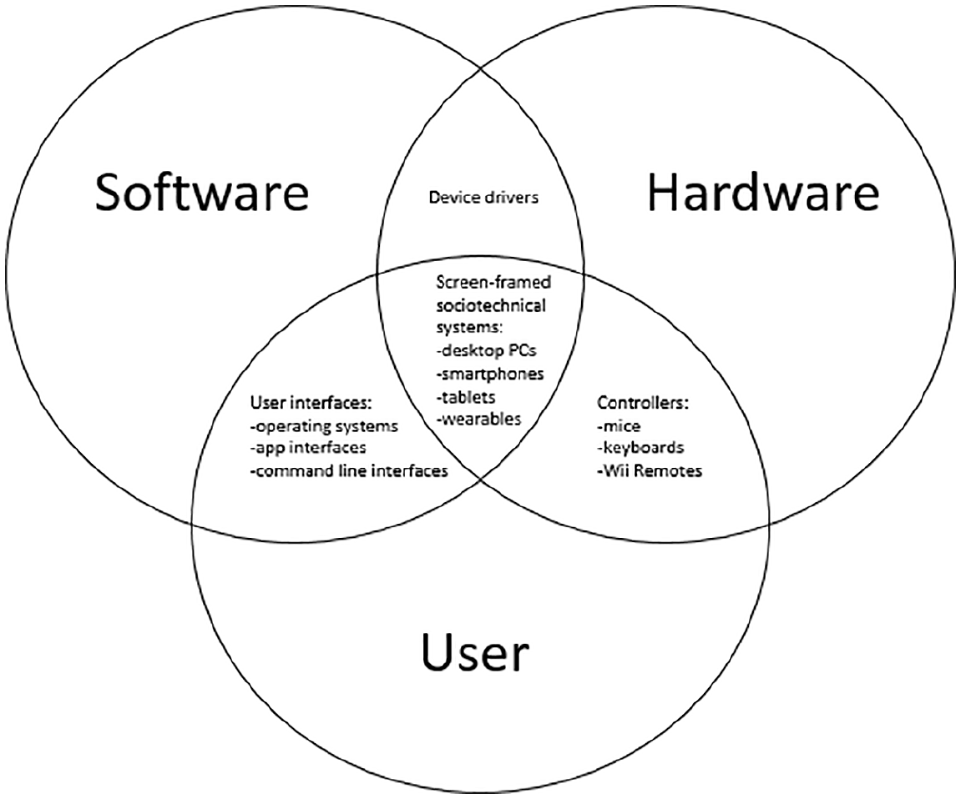
Interfaces between users, software, and hardware.
Interface ethnography emerged as a research strategy entailing personal attendance at events in which closed institutions present themselves to the public (Ortner, 2010: 211). However, given the seismic changes in modes of communication in recent years, this type of ethnographic research can be redefined in the context of interface-oriented labor. This new form of interface ethnography aims to describe the shared boundaries across which actors exchange symbolic meanings, and document the fleeting locations where mediation practices are constituted. Hence, interfaces can be conceived as units of analysis for ethnographic research. Directing observation-based research toward these built-in features of seamlessly designed digital technologies enables researchers to disclose the ideologies behind digital platforms and the hidden hierarchies coded into digital labor.
The interfaces of the developer platform GitHub played a crucial role in the everyday lives of the researched software developers. The popularity of this platform has grown significantly in recent years. Indeed, by 2018 more than 32 million users had opened a GitHub account (GH, 2018), and the hosting service for software version control was bought by Microsoft in the same year. The developer platform is part of the digital production infrastructure for software. While most members of GitHub are programmers who mainly use the platform to store computer code, alternative uses include crowdsourcing, blogging, and storing legal documents. Providing the functionalities for distributed version control, this web-based hosting service allows programmers to store and manage source code. The version control system Git keeps track of changes in computer files.
The term ‘commit’ was regularly used by the firm’s software developers, the purpose of which was to track changes to the files stored in a repository. A commit was primarily a recorded change containing three parts. Firstly, a list of files that were changed. Secondly, a short message describing the commit, which was entered by the software developer and could be viewed by other GitHub users. And thirdly, a reference to the previous commit. All the commits were saved in GitHub and visualized in an internal metric system, displaying charts and graphs.
The walkthrough method enables a systematic analysis of the metrics interfaces inherent in GitHub whilst tracing how the transformative mediators change the meanings that flow through its interfaces. After accessing the private repositories of the studied firm on GitHub, I could document the skilled practices that shaped the everyday life of its software developers.
In addition to taking screenshots of private repositories, I wrote observation records about their central interfaces. By employing the walkthrough method, I identify the mediators that constructed the meanings assigned to the various affordances of the above displayed interface. The following extract from a revised observation record describes a central dashboard tracking the digital traces of the skilled practices in which software developers engaged on GitHub:
In the beginning, I studied the order of menu systems, icons, and buttons. After clicking on the button of a private repository, I could engage in a top-level analysis and view the counts of commits, branches, releases, and contributors for a specific software project. I opened a submenu of the repository called ‘insights’ and navigated to the tab ‘contributors’. The large box on the top of the screenshot showed a line chart visualizing the number of commits for the entire repository over time. Additionally, a line chart for each software developer who worked on this repository was displayed in a smaller box. Each of the smaller boxes had a header which contained a profile picture of the software developers, their names, the number of their commits, and a numbered rank. The order of the smaller boxes reflected the ranking of the software developers. The line charts, rank numbers, and the order of the boxes displaying the performance of the software developers were central mediators of this interface.
Screenshots, such as Figure 2, and the accompanying observation record are important pieces of data, facilitating an empirically grounded reflection on the affordances of interfaces. Since the source code of software applications was stored, adjusted, and versioned on GitHub, the skilled practices in which software developers engaged on this platform underwent a process of datafication and were constantly displayed in ordinal rankings and classifications. Datafication can be seen as the ability to render qualitative aspects of the world into data (e.g. Ruckenstein and Schüll, 2017). The walkthrough method enables detailed analyses of central mediators, such as line charts, ranking numbers, and the dynamic ordering of boxes. This observational technique illuminates how conceptions of work performance were invoked among the users of the platform GitHub. Based on the number of commits per user, the combined effects of the mediators generated a ranking system of the firm’s software developers and assigned meanings to individual work performances. The social relationships among the software developers were recalibrated in accordance with their achievements on the platform GitHub. The automated, built-in metrics of GitHub played a substantial part in the internal evaluations of work performances and the culture of ranking among software developers.
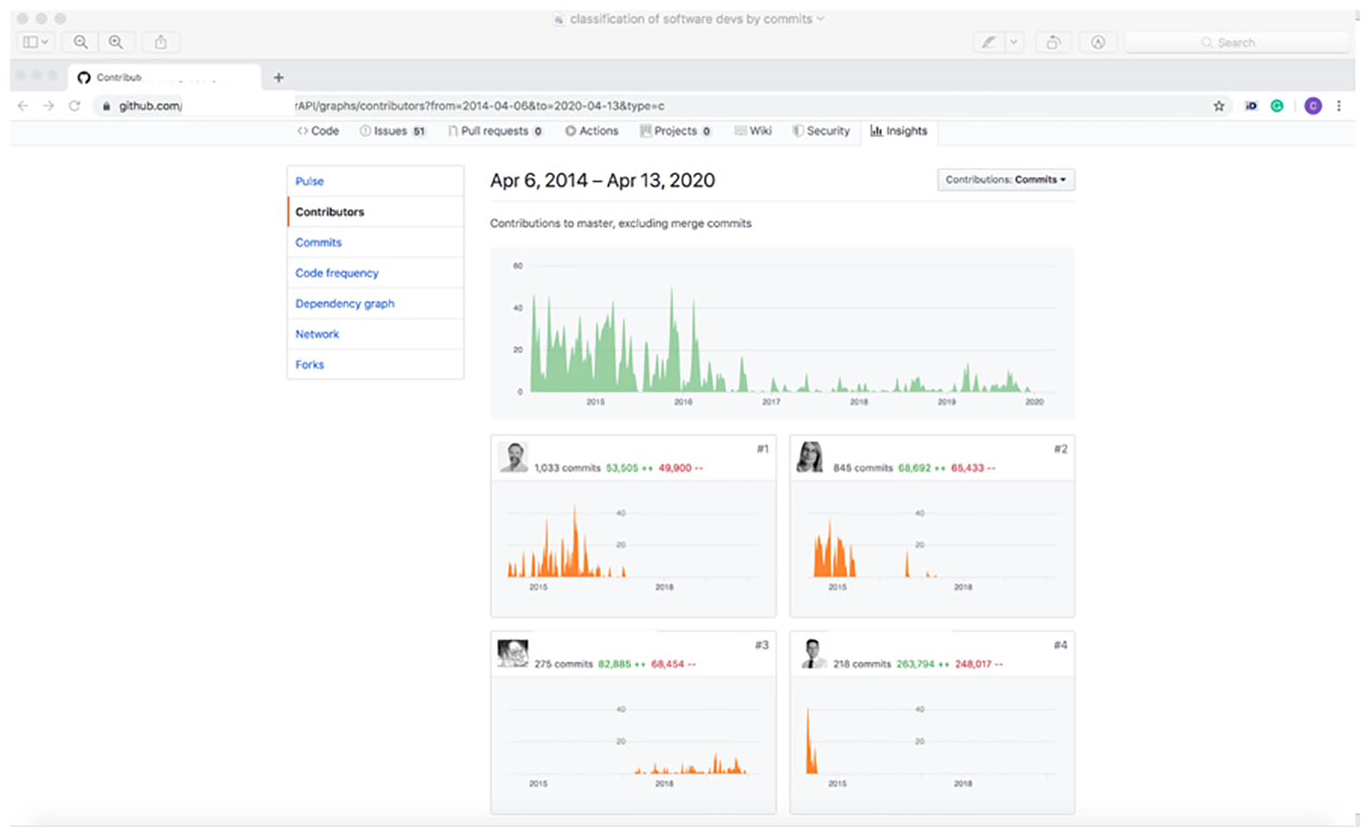
Interface illustrating how different software developers contributed to a private repository in GitHub.
Both observational techniques provided evidence for the evaluation of work performances within the firm. By conducting participant observation at meetings, I learned how the all-hands meetings served as a democratic space of collective sense-making. During such meetings, employees could negotiate their work performance, explain the reasoning behind project-related decisions, and express their resistance against the rankings. The walkthrough method, however, provided insights into how interface affordances invoked ways of evaluating work performances. This research technique demystifies how platform interfaces construct ideologies of achievement and competitiveness. Technical walkthroughs provide avenues for critiquing the sociocultural assumptions that are coded into platform affordances and govern the everyday practices of software developers. Combining the two observational techniques reinforces ethnographic investigations. The walkthrough method can capture the symbolic meanings circulating through the interfaces of digital technologies and fill the lacunas of participant observation directed toward places and events. The documentation of meanings that interfaces construct can, in turn, be grounded in the emic perspectives provided by participant observations. The research into internal evaluations of work performances within the studied firm benefitted from the integration of both methods in the sense that the symbolic meanings generated by interfaces could be localized in the contexts of their daily uses.
Conclusion
Based on evidence from an in-depth investigation into a Norwegian software firm, I discussed the need to reform ethnographic research techniques. In the course of my fieldwork at the company’s premises, I adopted various participatory roles, including attendee and presenter at internal meetings, temporary coworker operating in open-plan offices, shadowing session organizer, software tester, and user of internally trusted digital platforms. My immersion in the everyday culture of the software firm and my connectedness to digital platforms frequently used by the employees inspired thorough methodological reflections. Taking into account my ethnographic experiences onsite and my exposure to digital platforms, I argue that the integration of the walkthrough method with participant observation enables researchers to trace the twofold meaning construction shaping communities of practice whose skilled labor is directed toward digital platforms. This fusion of methods expands the scope of ethnographic knowledge across the digital-physical continuum. The main analytical rewards of this fusion of methods include (a) contrastive juxtapositions of the meanings that affordances of interfaces generate with emic perspectives on skilled practices occurring at interfaces, (b) cross-checks of evidence by contrasting interview transcripts and observation records detailing local places and interface affordances, (c) a localization of technical walkthroughs by researching mediation practices in situ, and (d) a cross-fertilization of knowledge from place-based observations with a systematic analysis of natively digital data providing insights into nonhuman actors embedded in digital platforms. Technical walkthroughs supplement participant observations in places with much-needed understandings of the role of mediators in interface-oriented everyday practices. Observation-based knowledge of an everyday life infused with interfaces is possible under the conditions that ethnographers make interfaces central units of analysis and that the collection of natively digital data is integrated with observations of local places where interfaces are accessed. Interface ethnography can be used in concert with multi-sited fieldwork designs since interfaces are components of transterritorial networks and mediate between different actors. The proposed fusion of two qualitative methods can further inspire mixed-method approaches to digital technologies. Observational research unraveling the multiple layers of the digital-physical continuum furthermore helps reclaim human agency and avoids the traps of technological determinism.
Footnotes
Author note
Christian S Ritter is also affiliated with the Erasmus School of History, Culture and Communication, Erasmus University Rotterdam.
Funding
The author received no financial support for the research, authorship, and publication of this article.
