




Abstract
Online research methods have risen in popularity over recent decades, particularly in the wake of COVID-19. We conducted five online workshops capturing the experiences of participatory health researchers in relation to power, as part of a collaborative project to develop global knowledge systems on power in participatory health research. These workshops included predominantly academic researchers working in 24 countries across Africa, Asia, Europe, and the Americas. Here, we reflect on the opportunities, limitations, and key considerations of using online workshops for knowledge generation and shared learning. The online workshop approach offers the potential for cross-continental knowledge exchange and for the amplification of global South voices. However, this study highlights the need for deeper exploration of power dynamics exposed by online platform use, particularly the ‘digital divide’ between academic partners and community co-researchers. Further research is needed to better understand the role of online platforms in generating more inclusive knowledge systems.
Keywords
Background
Online research methods have risen in popularity across all academic disciplines in recent decades. However, the Internet has impacted qualitative research in a particularly profound way, as it offers the technological means to address some previous limitations of face-to-face application (Lee et al., 2008). One key advantage of conducting research in an online setting is the extended access to participants; people from all over the globe, including those in hard-to-reach populations or in sites with closed access, can be engaged (Mann and Stewart, 2000).
In terms of discursive group methodology, which is the focus of this paper, the online setting provides an opportunity to bring together participants from remote areas and diverse settings, many of whom are often excluded from research activities due to resource or time constraints (Albayrak-Aydemir, 2020; Gratton and O'Donnell, 2011). While this setting can create space for underrepresented voices to be heard and for dynamic discussion, conducting such research online also comes with potentially negative implications which must be carefully considered. One underexplored consideration is the interplay of online research methods with power dynamics, particularly in qualitative data collection, and how these dynamics differ in comparison to face-to-face research.
This paper draws on the reflexive accounts of researchers involved in facilitating global online workshops on power, which were undertaken to explore how people involved in participatory health research (PHR) projects, from a variety of global contexts, understand power and empowerment. The research aimed to bring together knowledge from across the globe, without requiring participants to travel or commit significant amounts of time and money to participate. Incidentally, this aim became particularly pertinent during the COVID-19 pandemic, when worldwide restrictions on travel necessitated a shift toward online data collection. Here, we share our experiences of developing and coordinating this global online research project and discuss key considerations for applying an online approach to generate knowledge from researchers across countries, contexts, and projects. We also explore how online platforms intersect with cultural, social, and global power relations, presenting opportunities and challenges to participation in the development of new knowledge systems.
Project overview: developing new knowledge systems on power in PHR
PHR is understood as a research paradigm, rather than a research method, and assumes that participation of individuals whose lives or work are affected by the focus of study (who we define as community co-researchers for the purposes of this paper) is of fundamental importance in all aspects of the research (ICPHR, 2013). PHR aims to maximize participation of these individuals across the entire research process, which is believed to elicit positive transformation in society in the interest of improving people’s health (Abma et al., 2019; Khodyakov et al., 2013).
However, reaching a deep level of participation in health research is challenging and affected by several factors. Practical issues such as the need for childcare and transportation can determine the extent to which community co-researchers can participate, while issues with project funding may prevent researchers from being able to offer incentives and compensation for co-researcher involvement (Hoeft et al., 2014; Minkler et al., 2003). Time pressures faced by academics to publish quickly may lead them to take control over projects. Disruptive power within social hierarchies (Roura, 2021), which can differ based on factors such as age, class, race, ethnicity, religion, gender, political affiliation, income status, and educational background, also has a significant impact on participation levels (Asha et al., 2015; Muhammad et al., 2015; Wallerstein et al., 2019). Current public health models talk about public participation but fail to ensure that citizens are fully involved in designing and implementing policy, programs, and interventions (Kumar et al., 2016). This failure results in a lack of ownership by the citizens—and consequently, unsuccessful public health interventions.
PHR adopts principles of equity, where both academic researchers and community co-researchers are considered capable of contributing to knowledge building and practice transformation. However, the nuances of how research collaborations specifically address their own issues of power have remained largely unexplored (Muhammad et al., 2015; Wallerstein et al., 2019). We therefore sought to include academic and community co-researchers in this study, to generate new knowledge systems on power differentials within research partnerships.
Structural inequities in research
Historic abuses of research have magnified power imbalances, whereby research data have been extracted from communities, rather than co-created, shared, and owned for use by communities. Structural inequities (e.g. unequal access to knowledge and resources) have been sustained covertly by academic language that can obscure critical dialogue (Muhammad et al., 2015). The potential for tokenistic equality within collaborative research projects and knowledge generation is high if systems of privilege have not been explicitly analyzed and discussed (Rose, 2018), including, for example, academics or funders promoting ‘evidence-based intervention and research’ at the expense of interventions grounded in community or cultural knowledge bases.
Researchers around the globe are simultaneously attempting to redress the colonial legacy of research (Seehawer, 2018). Democratization, decolonization, and indigenization are all aimed at critiquing dominant Euro-Western language, thought, and academic imperialism (Chilisa et al., 2017). Through the lens of knowledge democracy (de Sousa Santos, 2007; Hall et al., 2015), theorists from the global South are questioning how to raise up community knowledge as equal to academic knowledge. Indigenous research scholars have pushed the demand for equity further, promoting culture-centered knowledge creation, oriented toward changing inequitable conditions through decolonizing, healing, and mobilizing. Within PHR, these worldviews are not only considered but are central principles. Participatory paradigms and methodologies have been designed to promote cultural humility, increase participation, and embrace diversity of knowledge production at the community level. Although PHR advances collaborative research agendas that are inclusive, there are ongoing barriers to addressing the prejudices and biases that privilege Western knowledge systems (Chilisa et al., 2017).
New avenues for global participation: using online research methods
While online methods were previously considered an inaccessible and difficult option compared to conducting interviews or focus group discussions face-to-face, these methods have gained considerable momentum in recent years as internet access has become cheaper and nearly ubiquitous (Karpf, 2012). Although research has been limited thus far, there have been initial explorations into the conduct of community-based participatory research (CBPR) online (Tamí-Maury et al., 2017; Valdez and Gubrium, 2020). The COVID-19 pandemic has also necessitated a shift to online ways of working, the implications of which have been discussed in relation to many fields, including international relations (Ashton-Hart, 2020), service research (Dodds and Hess, 2021) and education (Saavedra, 2021).
A decade ago, managing focus groups through online platforms was an ambitious endeavor, requiring specific telehealth communication technologies and trained staff (Gratton and O'Donnell, 2011). Today, multiple online platforms (e.g. Skype, Microsoft Teams, Zoom) are available and many have settings that facilitate conferencing, simultaneous communication, and different forms of interaction to better organize discussions. Features such as microphone mute, private and public chats, recording of sessions, and real-time surveys help to maintain the attention of participants and facilitate learning (Archibald et al., 2019). Many platforms can be used free of charge and accessed via smartphones, tablets, and computers, catering to different types of users’ needs (Archibald et al., 2019; Deakin and Wakefield, 2014).
Video conferencing, in contrast to other online communication technologies, provides social presence as an important construct to build trust and rapport between participants and researchers. These elements include: (1) the concept of being together, including co-presence, co-location, and mutual awareness; (2) psychological involvement, including saliency, immediacy, intimacy, and making oneself known; and (3) behavioral engagement, the immediacy behaviors through which social presence is realized (Gratton and O'Donnell, 2011). Online participatory research projects have also found that virtual communities can support CBPR efforts as they reduce the effects of geographical barriers, maximize the growth potential of the community, and provide portable and affordable channels for real-time communication (Tamí-Maury et al., 2017).
However, there are challenges to be considered when using online research methods. Shifting research online assumes that participants have the skills and ability to utilize and adapt to different software, which is not always the case (Azeem et al., 2020; Tamí-Maury et al., 2017). Logistical and technological considerations such as a lack of access to devices (e.g. smartphones, computers) or stable internet connections may pose a barrier to participation (Hokke et al., 2018). The online setting may affect dynamics and atmosphere within the group, hindering relationship formation, trust and cohesion (Tamí-Maury et al., 2017), with physical distance leading to less rapport-building and reduced feelings of closeness and privacy within the group compared to face-to-face meetings (Gratton and O'Donnell, 2011).
Research project positionality
This research is a collaboration between the Liverpool School of Tropical Medicine (LSTM) and members of the Evaluation Working Group of the International Collaboration for Participatory Health Research (ICPHR). The objective of this collaboration was to engage with and seek the perspectives of participatory researchers – particularly those from the global South – on power, to facilitate the generation of new, inclusive knowledge systems. The ultimate project aim is to conceptualize a framework for evaluating power and empowerment in PHR, which will be the focus of a future article.
The ICPHR was formed in 2009 by participatory researchers predominantly from Europe and the global North. Recognizing that academics from the global North have thus far dictated who has had the ‘power’ to define what the field of PHR is, ICPHR engaged in this research partly to challenge its own organizational dynamics. LSTM is an international health research institution with well-established participatory research networks across Africa, Asia, and the Americas. As such, this collaboration offered the opportunity and expertise to connect with a range of actors and perspectives from the global South. Together, we embraced the vision of Chilisa et al. (2017: 326) that: people of all worlds irrespective of geographic location, colour, race, ability, gender or socio-economic status should have equal rights in the research scholarship and research process to name their world views, apply them to define themselves and be heard.
Here, we use the term ‘workshop’ to describe the multivocal qualitative data collection technique utilized in this research. Caretta and Vacchelli (2015: 9) argue that the boundaries between focus group discussions and workshops are becoming less and less clear in qualitative research, although they suggest that: workshop is a tool eminently directed towards reciprocal learning among participants, while the starting point for a focus group discussion is the researcher's topic guide whose primary aim is to gather data and, secondly, to possibly create a space for knowledge construction among participants.
A main aim of the workshops described in this paper was to provide a space for the sharing of knowledge between participants, who were either participatory researchers or students looking to learn from the experiences of others. The discussions held in this research included different forms of participation (verbal and written), and although overarching questions were posed by meeting facilitators, participants were able to direct the flow of the conversation.
Methods and research process
In this qualitative exploratory study, outlined in Figure 1, five online workshops were conducted in which participatory researchers from different global contexts were able to share their knowledge and experiences relating to the concepts of power and empowerment. This section details the recruitment process, the conduct of the workshops, and the reflexivity sessions that were held after each workshop, as well as reflections from the authors on implementation of the workshops.

Overview of study methodology. Research stages outlined with a solid line are discussed in this paper; stages outlined with a dashed line are ongoing and will be discussed in a future publication.
Ethical considerations
This study received approval from the Research Ethics Committee at LSTM (20-041) in May 2020. Participant information sheets were provided, and written consent was obtained for all workshop participants and for those who provided written responses.
Recruitment
Recruitment began 5 days before the first workshop, in May 2020. A recruitment advert outlining the purpose of the workshops, the recruitment criteria, and the scheduled meeting times was displayed on the Accountability and Responsiveness in Informal Settlements for Equity (ARISE) website, and the ICPHR website. ARISE is a research consortium associated with LSTM. The advert stated that we aimed to recruit participants who had experience working on projects aligned with participatory principles (e.g. PHR, CBPR, participatory action research (PAR), participatory methods), including researchers from communities, nongovernmental organizations (NGOs), academic institutions, and health systems.
Twitter posts linked to this advert were posted on international consortia Twitter pages and retweeted by the research team. Other interested participants and organizations were also encouraged to retweet. Adverts were also circulated via email through various participatory research consortia including Calling time on Neglected Tropical Diseases (COUNTDOWN, 2020), REDRESS (REDRESS, 2020), PERFORM (PERFORM, 2020), Research in Gender and Ethics (RINGS, 2020), and networks including the Social Science Approaches for Research and Engagement in Health Policy & Systems (SHAPES) group, the ICPHR Evaluation Working Group, German Network for Participatory Health Research, and the INCAP Center for Prevention of Chronic Diseases (CIIPEC). Adverts were translated into Spanish to recruit for Workshop 5 (focused on Latin America).
In order to hold the workshops at reasonable times for participants, we initially suggested a ‘regional’ registration approach (e.g. a participant based in Africa would sign up to Workshop 3, scheduled to occur within working hours across Africa). However, some participants were unable to attend the workshop that aligned with their region of work and asked to attend an alternative workshop. This was encouraged, but as a result, although each workshop had a regional ‘focus’, it was not exclusive to that area.
Interested participants contacted the project leads, registered for their requested workshop session, and received a link to the online meeting. Participants were asked to provide information about where their research project was located, the topic of the project, their individual role in the project, and their affiliation as a partner (e.g. community, NGO, health system, academic). Participants were sent a list of the workshop questions in advance, giving them time to consider and discuss with colleagues. Workshop registration was initially capped at 20 participants, but was raised to 25 after observing that there was significant drop-out of registered participants in the first two workshops.
Potential participants who were unable to attend any of the workshops were invited to provide written responses to the workshop questions via email. These participants were sent the list of questions to fill in electronically. In addition, some participants submitted written responses as well as attending a workshop in person, to express thoughts they did not have an opportunity to share or to further explore ideas they discussed in the workshop.
Workshops
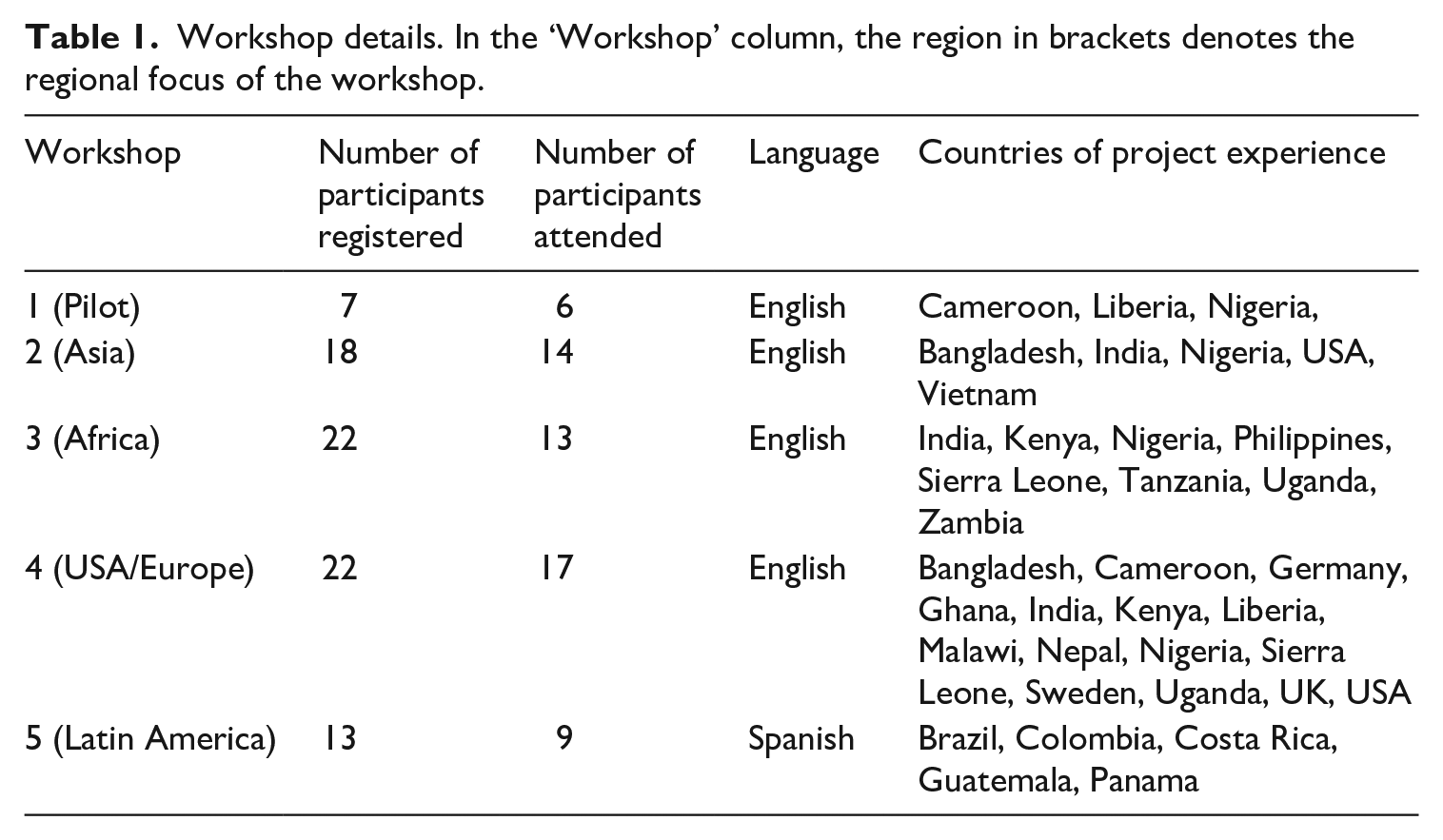
The five workshops were attended by a total of 59 participants who had worked on participatory projects across 24 different countries in Asia, Africa, Europe, and the Americas (see Table 1). Four of the workshops were conducted in English, and one in Spanish, although one participant contributed to the Spanish-speaking workshop in Portuguese.
Workshop details. In the ‘Workshop’ column, the region in brackets denotes the regional focus of the workshop.
The workshops were semi-structured and guided by seven key questions, which were developed in collaboration with members of the ICPHR Evaluation Working Group. These questions were used to generate discussion and covered three main themes: (1) defining and discussing power, (2) addressing power relations and empowerment, and (3) measuring and evaluating power. The questions posed in the workshops were informed by existing frameworks on power (Roura, 2021; Belone et al., 2016).
In Workshop 1, the questions were piloted on a small scale (n = 6) before conducting four workshops on a larger scale. Piloting was important to identify and address potential challenges with the online format. It also gave the facilitators an opportunity to modify the planned flow of the workshop, for example they could gauge participant response to questions, reword questions, or develop useful prompts.
Two authors facilitated each workshop, with a third author supporting facilitation via WhatsApp communication with the main facilitators. The workshops began with a 15-minute presentation to introduce the objectives of the study, set out the terminology to be used, and outline the process. Participants were encouraged to keep their cameras on for the discussion, although facilitators made it clear that this was not essential, particularly considering the bandwidth restrictions faced by some participants.
Facilitators displayed questions on a shared screen and posed them to the group, encouraging participants to respond verbally or in the chat box. Participants were able speak out if there was a gap in the discussion, or to indicate in the chat box or use the ‘raise hand’ function if they wanted to give a verbal contribution. Participants were also encouraged to respond to each other’s points and to prompt each other for additional information. The verbal discussion was facilitated in the style of a focus group and communication in the chat box was simultaneously facilitated to promote further discussion and seek additional detail.
Workshops were scheduled to last for 2 h, but due to technical difficulties actual workshop time ranged from 1 h 35 min to 2 h. The first two workshops were conducted using the GoToMeeting platform, but we switched to the Zoom platform during Workshop 3 after encountering some major issues with sound. Zoom then ran smoothly for the remainder of the workshops. Passwords were required to enter the meetings, and all workshops were video recorded within the online meeting platforms.
Eight written responses were received from participants with project experience in Brazil, Canada, Costa Rica, Honduras, Guatemala, and Nepal. Two of these responses were submitted on behalf of research teams and the other six were submitted by individuals.
Reflexivity sessions and development of key lessons learned
Facilitators took part in reflexivity sessions after each workshop with a subgroup of the ICPHR Evaluation Working Group. These sessions provided a space for facilitators to reflect on some of the ideas and arguments posed by participants. Discussions also addressed the workshop process, including how questions were received by participants, how participants responded to prompts, the dynamics within the group, and practicalities of using the online platform. Sharing this facilitation experience helped the group understand what was working well and what needed to be changed for the following workshops.
The reflexivity sessions lasted for up to 1 h and were audio recorded. One author listened to the recordings and summarized the main themes emerging from the reflexivity sessions. The themes were presented and validated in an online meeting, during which facilitators shared their personal notes taken throughout the process to add further detail. These themes were shared with the wider ICPHR Evaluation Working Group for discussion after all workshops were completed, in order to build on the reflexive process. Main themes included emerging challenges and opportunities, reflections on process and participation, power relations within workshops, and technological considerations. It is through these reflexive mechanisms that we developed the main themes for this paper.
Reflections on the research process
Workshops were attended by individuals with many different roles in participatory research, including principal investigators, research coordinators, research assistants, social scientists, and field coordinators. Additionally, about 12% of workshop participants were graduate students or academic researchers interested in or planning to conduct participatory research projects for the first time. Although we had initially intended to recruit people with direct experience working in participatory research, we supported the attendance of students and researchers who were new to the field. This created a strong atmosphere of knowledge sharing, as these participants asked questions of more experienced participants for their own learning purposes and provided prospective ideas on how they might address power issues in future projects.
Facilitators noted that sending out the workshop questions beforehand worked well, as it enabled participants to prepare for the workshop and to give well-formed responses to questions. During the recruitment period, several participants communicated that they appreciated receiving the questions in advance. This appeared to be particularly useful for participants whose first language was neither English nor Spanish, who felt more confident in contributing to the workshop discussion having had some preparation time. It also reduced the need for facilitators to give prompts, as participants had already considered questions in some depth and detail. Interestingly, despite some colloquial differences in the use of PHR terminology, there was a high level of mutual understanding between participants from different countries and continents.
Sharing facilitation between two facilitators helped to keep the workshop discussion fresh and varied. As facilitators had diverse backgrounds and positionalities, they were able to relate to participants in different ways, while distinctive styles of facilitation led to a dynamic workshop environment, which encouraged broad participation. Involving a third facilitator to support the process on WhatsApp helped the main facilitators respond to the multiple modes of communication.
Group size ranged from 6 to 17 participants in the workshops. The use of two communication avenues (verbal and chat box) and active facilitation helped to maximize participant engagement. However, in Workshop 4 (n = 17), it was difficult to provide enough space for everyone who wanted to give a verbal contribution, and there was less opportunity for participants to interact. However, this was not a significant issue in Workshops 2 (n = 14) and 3 (n = 13), where there was plentiful dialogue between participants, focused discussion, and greater use of the chat box. From this experience, we suggest that 15 participants should be the maximum participant number for conducting online workshops of this type.
Discussion
This study provides a practical example of how to engage a diverse group of participants from different global contexts to share knowledge online. While global recruitment can be challenging, increasing access to online platforms creates opportunities for collaboration with groups of people that are typically underrepresented in the generation of new knowledge. While there is literature exploring the use of online platforms for research, teaching, conferencing, and global collaborations, there is a clear gap in understanding of how the online approach can be used to advance knowledge systems and make them more inclusive. In this section, we progress discussions relating to the use of online platforms for knowledge sharing and generation, linking to relevant literature and drawing on our experiences of facilitating online workshops. Lessons learned and reflections are summarized in Box 1.
Lessons learned and reflections for future research using online platforms.

The online approach: opportunities and limitations for participation
The cost- and time-saving benefits of online research methods have been highlighted in the literature (Granello and Wheaton, 2004; Gratton and O'Donnell, 2011). Considering the global scope of this study, the online approach provided a significant opportunity in terms of maximizing reach and minimizing inconvenience to participants (Tamí-Maury et al., 2017). Had these workshops been conducted face-to-face, almost all participants would have had to travel internationally to a meeting location, which would have been time-consuming and costly; alternatively, the research team would have had to secure funding to reimburse participant travel costs. In fact, this project did not require any specific funding and participants were able to join for the 2-h workshop and then continue with their daily lives.
The major opportunity of using an online approach for this study was the creation of a space for global interaction (Achakulvisut et al., 2020; Ashton-Hart, 2020). Workshop participants were able to share experiences and opinions with participatory researchers from different contexts, creating rich and interesting dialogue. Many participants attended the workshops to learn more about participatory research, providing a valuable opportunity for knowledge exchange with more experienced researchers. This stimulated the idea of establishing a learning community with participants, in which dialogue, shared learning, and connection across the globe could continue. Plans for a learning community are under development at the time of writing.
The multiple communication avenues available in GoToMeeting and Zoom enabled participants to contribute either verbally or in the chat box, allowing them to choose which mode of participation to use. Features such as the ‘raise hand’ function also provided added value, helping to facilitate a smooth and balanced discussion in the absence of physical cues. Interestingly, preferred modes of participation differed across the workshops, influencing group dynamics. For example, in Workshop 2, the chat box was used by most participants to share brief thoughts and to ask questions of each other, fostering dialogue between participants. In Workshop 3, a few participants communicated solely through the chat box and gave longer, more detailed responses to questions, while others did not use the chat box at all. Facilitators in Workshop 5 observed that the chat box was utilized mainly by women while men dominated the verbal conversation, although this trend was not noted within other workshops. Further research is needed to understand the gender dimensions of online participation.
However, a major limitation of using an online format was that it may have restricted the range of participants who were able to attend the workshops. Online meetings essentially exclude people from areas with unstable internet connections, an issue which is common in regions of the global South, particularly beyond major urban centers (Galpaya et al., 2019). This is also an issue in high-income contexts in the global North, where there are socially excluded populations with limited access to the Internet or adequate bandwidth (Helsper and Galacz, 2009). Author NW reflected on the situation in the USA, where many tribal and rural community members, as well as those living in impoverished urban neighborhoods, do not have access to internet in their homes because there is no broadband connection (Graves et al., 2021), severely limiting the ability of these people to participate in online research.
The cost of purchasing data and necessary digital devices (e.g. smartphones, tablets) also limits participation in online activities, including online research projects, evidenced by a recent study in Africa which found that the cost of devices was a limiting factor to internet uptake despite extensive coverage in Lesotho, Rwanda, and South Africa (Galpaya et al., 2019). Urban–rural and gender gaps among internet users are often pronounced, and these digital inequalities create or compound existing societal inequalities by preventing people from fully benefitting from the opportunities and advantages that new technologies provide (Gillwald et al., 2019; Sanders, 2020).
In addition to the problems of uneven internet access, lack of technological skill and ability may also have curtailed participant involvement in this research (Ashton-Hart, 2020; Tamí-Maury et al., 2017). In all the workshops in this study, more people registered to attend than actually attended, potentially because of difficulties accessing or navigating the online communication platforms. While communication platforms such as Zoom or GoToMeeting are frequently used by academics and organizational employees, they may be less familiar to those living or working in underserved communities (Saavedra, 2021).
Epistemology, power, and participation in a global online setting
These workshops were held as part of our learning collaborative’s initiative to develop metrics related to power sharing and empowerment in PHR projects and partnerships. As a first step, we sought to understand the meaning of these terms and how power inequities might be addressed in different cultural, organizational, and geographic contexts. To gain a perspective on power considerations that includes a wide variety of experiences and voices, we invited people from different parts of the world to share their thoughts and experiences.
The epistemology of participatory research relies on an understanding of knowledge as experiential and situational communication that is reciprocal and open (Peralta, 2017). The online workshop format draws on a participatory epistemological stance by developing the concepts and metrics based on ‘community’ knowledge. However, the online workshops also had inherent limitations as a participatory method. For example, we invited people beyond our close networks to share their knowledge and perspectives; some joined (or chose not to join) the discussion, but without a shared foundation of trust, co-learning, or reciprocity. Some participants knew each other, while some did not know anyone; this may have influenced participation levels. People who have a strong relationship outside of the online setting might have an easier time with interactive, cohesive, and affective types of communication than people who do not (Lowenthal and Dunlap, 2020). Furthermore, participants were not involved in the design and implementation of the workshops. While acknowledging these limitations, the participatory approach is reflected in the multinational collaboration in our team (including authors from the global South and North), the intention to include diverse perspectives, and our plan to invite workshop participants back to interpret findings from the workshops.
Many research programs are moving toward remote data collection during the COVID-19 pandemic (Dodds and Hess, 2021; Valdez and Gubrium, 2020). There are an increasing number of resources available on how to continue conducting fieldwork and data collection in the most effective and appropriate ways, using methods such as audio messaging, live streaming, and social media (Hawkins et al., 2020). Understanding what this means in terms of participation will be a key to monitoring changes in research structures and their impacts on equity within research partnerships.
In our workshops, the online format enabled us to involve participatory researchers working in 24 countries, including 20 countries in the global South. This broad participation reflects positively on our recruitment strategy that relied on linking with existing organizations, networks, and participatory projects associated with international research institutions such as LSTM. This format allowed for greater academic inclusion and diversity in knowledge production compared with physical participation, which is often dominated by participants from universities based in high-income countries. Participatory research networks often hold annual meetings, conferences, and other knowledge-producing forums ‘in person’, meaning that funding or visas (often challenging to obtain) are required to attend. The difficulty and expense of participating in person can exclude academic partners from low- and middle-income countries (LMIC), resulting in knowledge products that are developed without diverse input (Albayrak-Aydemir, 2020; Arend and Bruijns, 2019; Settles and O’Connor, 2014). In these online workshops, the participants’ experiential and local knowledge and perceptions of power in PHR were shared and will support the development of new knowledge systems for measuring power sharing and empowerment.
While this research has taken an important step in centering voices from the global South, the extent to which this research is ‘decolonized’ is unclear. During the registration process, we asked participants to indicate the country/countries in which their research projects were based. However, we did not ask participants for information about their country of residence or origin, nor their positionality within these contexts. As such, from this data alone, we cannot confirm the extent to which the findings from this study are the product of counter-hegemonic knowledge systems. Given that many publications on CBPR in health systems in LMICs are first authored by researchers from high-income countries (Asha et al., 2015), it will be important moving forward to consider researcher background when generating new knowledge systems, rather than focusing solely on research project location.
While we recognize that the first author in this paper is from a high-income context, we have committed to engaging study participants in co-analyzing the data as much as is feasible. We have invited participants back to collaboratively interpret the workshop findings and decide what type of knowledge products should come from the research. We hope this will continue the process of involving global South researchers more genuinely in the evaluation and publication of participatory research.
Engaging community co-researchers
We had strong attendance from academic participatory researchers in the workshops and also some attendance from participatory researchers working in other organizations (e.g., NGOs, charities, private organizations). A small number of participants were health systems actors, but there was no representation of co-researchers from patient groups or those living or working directly in partnered communities.
Participatory research aims to include the voices of community co-researchers, peer researchers, and other nonacademic partners in the co-production of new knowledge (ICPHR, 2013). In developing new knowledge systems on power, the inclusion of these partners is particularly important because of their unique experiences of power, which differ from those of academic researchers (Wallerstein et al., 2019). In failing to sufficiently engage with community co-researchers in this research process, existing power differentials between academic and community co-researchers may have been reinforced by giving a voice to the those who already held more ‘privileged’ power. Participatory researchers have acknowledged the need to address these issues of power within academic-community research collaboratives (Gaventa and Cornwall, 2008), and thus it is essential here to consider the barriers to the valuable participation of community co-researchers.
The main barriers identified that may have limited community co-researcher engagement in this research were lack of access to the online platform, COVID-19 restrictions that made it difficult to access the Internet from shared spaces, issues with recruitment, language barriers, and power imbalances within the workshops. Many of the issues around access to the online platform, including poor internet coverage, cost of data and devices, and low technological capacity have been discussed earlier in this paper. However, it is important to consider how the COVID-19 pandemic could have exacerbated this problem and potentially limited community co-researcher participation even further (Azeem et al., 2020). For example, travel restrictions could have jeopardized the ability of individuals living in underserved communities to participate in online research projects, particularly if the workplace was their only point of internet access. Furthermore, the economic pressures of the COVID-19 pandemic might have prevented community co-researchers, who could have normally afforded the costs of participation, from participating. Pre-pandemic, we could have linked with community co-researchers through their academic partners, who could have provided support through joint participation in the workshops, or by sharing resources such as computers, fuel, and phone credit. However, these options for joint attendance were limited. Some of the academic researchers that took part in this study indicated that they had had difficulties keeping in contact with community co-researchers during lockdowns, and many academic researchers who frequently work with communities in-country had returned to their home countries.
We recruited participants by advertising predominantly to academic researchers via email and social media, encouraging them to circulate the adverts within their own networks. These researchers were thereby responsible for informing their community partners about the workshops. On reflection, co-researcher participation may have been improved if we had asked these academic partners which communication channels were best for contacting community co-researchers, and then used these channels to advertise a set of workshops specifically to and for community co-researchers.
Language may also have played a role in influencing participation in this research. The literature suggests that group research should be carried out in the first language of the participants, or with a bilingual moderator or translator if the researcher and participants’ languages are different (Dilshad and Latif, 2013; Krueger, 2014). This reduces the likelihood of misunderstandings and also increases the richness of the collected material. Since 24 countries were represented in this study, we had to choose a common language in which to conduct the workshops, which may have excluded community co-researchers who did not speak English or Spanish. We acknowledge that knowledge generation and dissemination in research occurs mainly in and through the English language (Gordin, 2017; Tietze and Dick, 2009), and recognize the need for further consideration of language to avoid promoting hegemonic patterns of knowledge production.
A global discussion environment with academic partners may have appeared intimidating to community co-researchers. As such, it is important to develop an environment in which community co-researchers can speak freely and to meaningfully contribute to discussions. Some scholars have investigated the concept of social presence within online learning fora, examining how emotional expression, open communication, and group cohesion adapt in response to different communication media (Lowenthal and Dunlap, 2020). However, there has been limited examination of these aspects in terms of knowledge generation. In order to move toward knowledge democracy, academic researchers must recognize that community co-researchers should have the opportunity to engage in dialogue among themselves and then to choose what they want to bring to the partnering process. In fact, we should work against the assumption that all stakeholders should engage in collective dialogue at every moment. Truly working toward decolonizing knowledge means not only recognizing narrative and other non-traditional knowledge, but recognizing that knowledge creation itself requires autonomy and the freedom to decide how to participate (Muhammad et al., 2015).
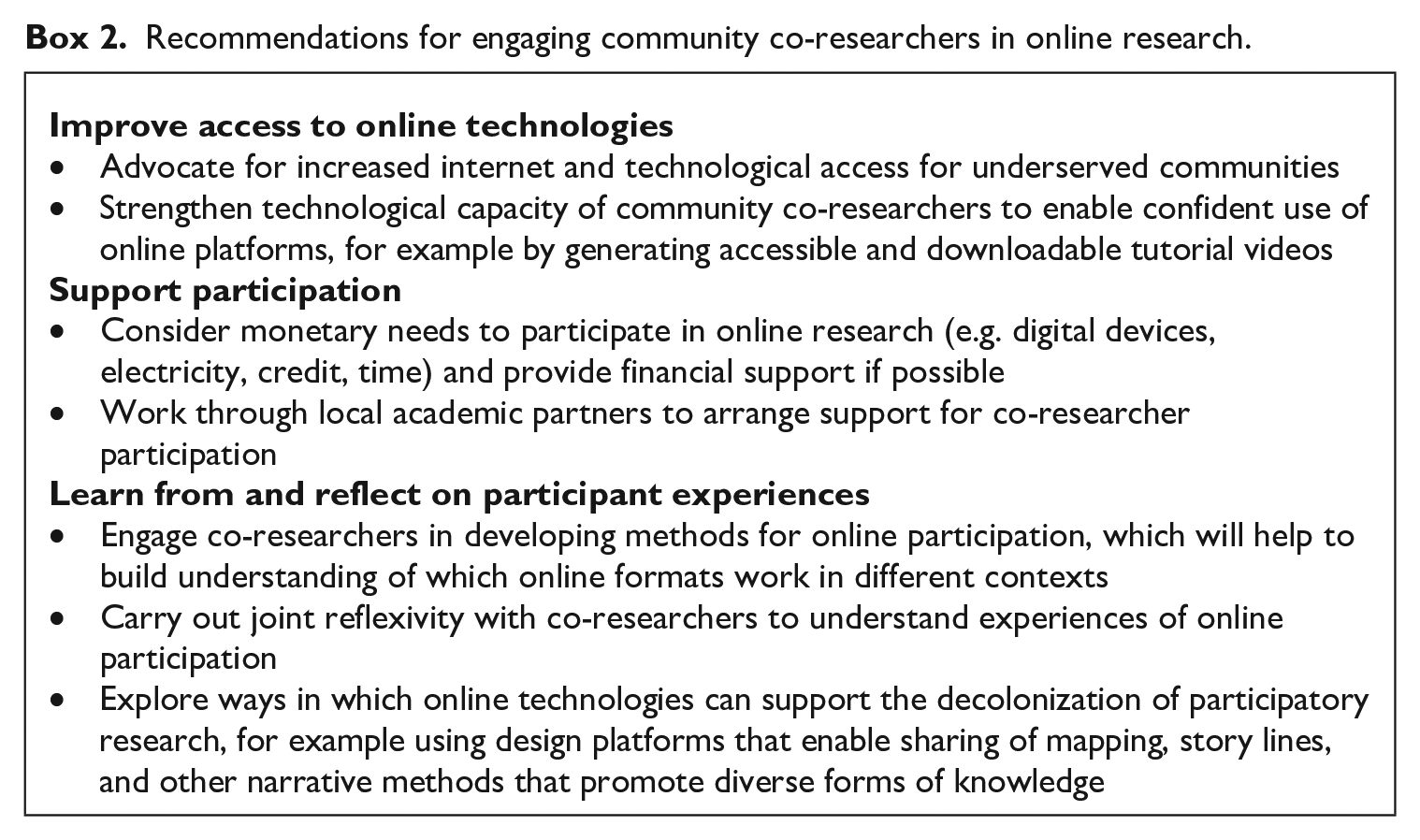
Online methods present an opportunity to participate in research in new and innovative ways. However, if we are not reflexive in our approach, we risk re-enforcing structural power differentials between academic researchers and community co-researchers (Muhammad et al., 2015). We also risk just accepting the structural power differentials, rather than engaging as activist scholars and taking positions of advocacy to broaden technological access and challenge the privilege of academics from the global North. With these caveats, we make recommendations to increase engagement of community co-researchers in global knowledge production (Box 2), developed from the literature referenced in this discussion and our own reflections.
Recommendations for engaging community co-researchers in online research.
Conclusions
Online workshops offer a unique opportunity to bring together participatory researchers from across the world to share and generate new forms of knowledge. By focusing on the recruitment of researchers working in the global South, this approach helped to provide a platform for perspectives and voices which often go unheard in research scholarship. Workshops required little time commitment from participants, and the multiple avenues of communication enabled participants to choose how they wanted to engage in discussions. Even so, conducting research online comes with several challenges, potentially limiting participation from community co-researchers and reinforcing power differentials between academic and community partners. Considering that barriers such as incomplete recruitment strategies, lack of internet access, financial constraints, and limited technological capacity may have reduced community participation, reflexive efforts must be made to better understand, and thereby facilitate, online participation of community co-researchers.
Footnotes
Funding
The author(s) disclosed receipt of the following financial support for the research, authorship, and/or publication of this article: This research was supported through the UKRI GCRF Accountability for Informal Urban Equity Hub (ARISE), a UKRI Collective Fund award; COUNTDOWN (Calling time on Neglected Tropical Diseases) funded by UKAID within the UK Foreign, Commonwealth and Development Office (FCDO); the ‘Governance and Accountability for Urban Health in Guatemala’ project funded by the Directors Catalyst Fund (LSTM) and the Centre for Health Systems Strengthening (CHESS) at LSTM. In addition, we would like to extend our thanks to Cintia Cansado-Utrilla for her support in translation and transcription and to Manuel Ramirez for helping to recruit participants in the Latin American region. We thank the Evaluation Working Group of the International Collaboration for Participatory Health Research for stimulating and supporting this research. Finally, we extend our deepest thanks to all the participants who took part in the workshops.
