




Abstract
In Summer 2018, I set out to find the feel of the places I have long studied as a historian, resulting in an expansion of my research process and ‘archive’. This article introduces and reflects on key moments and ideas from this research journey through historic strongholds of Finnish settlement in the U.S. Midwest. I discuss how following community leads and engaging with local knowledge-carriers made clear that my search for the past was intimately entangled with the present realities and future implications of demographic and economic change. I reflect on moments of being in place that allowed me to think through the inter-workings of historical memory and sensory imagination. This resulted in the integration of a photographic practice that serves as both a source and a tool for (re-)articulating feelings of particular moments in the field. I conclude by analyzing the fluid and multiple processes at play in the creation of research and archives. As a whole, this exploration aims to further embolden qualitative researchers to engage in sensitive research that makes space for feeling – both through emotions and senses – the productive and powerful pulls of time and place operating within our sites of research.
As a transdisciplinary historian of everyday life, I aim in my work to get at a feeling for the past – of a particular moment, a particular encounter, a particular place. My quest is one to ‘see and feel, and occasionally hear, taste, and smell’ the moments and experiences I am researching (Atteberry, 2007: 166). Most often, I turn to the archives in order to piece together documents and traces that may collectively offer some sense of the feelings of being present in a moment that is now past. Researching the histories of Finnish migrant communities in Canada and the United States in this way throughout my scholarly career, I have frequently encountered the same places, events, people, and organizations in the archives and in research literature. They have come to feel quite familiar and I have developed a strong mental map of Finnish migrant social, cultural, and physical landscapes. Yet, I found myself feeling increasingly unsettled. While a place name may trigger in mind a series of historical episodes and actors, how much can I know about the feel of a place and how its landscape works in relation to its people, economies, and structures if I have never physically been there? It became imperative for me to expand the ‘archive’ as I had known it by incorporating immersive fieldwork practice into my historical research. I wanted to know what, if anything, would change if I allowed myself to feel all the things that came from being in place.
From 2017 to 2020, as an Academy of Finland Postdoctoral Researcher, I conducted a research project on the histories of death, mourning, and grief in Finnish migrant communities in Canada and the United States in the period of 1860–1939. The project included extensive archival research at several large repositories in Finland, Canada, and the United States, 1 but also allowed me to visit historic Finnish settlement areas in search of research materials and for the places and feelings I sought to understand. With the hope that we will find ourselves again mobile in a not-too-distant post-pandemic future and the aim of further broadening and bridging modes of inquiry among/between historians and other qualitative researchers, this article introduces and reflects on key moments and ideas that emerged through the expansion of my research process and ‘archive.’ Here, I focus on a six-week and some 5,000-kilometer journey in the U.S. Midwest during the summer of 2018.
At the core of this work is an exploration of fluid temporalities, feelings, and experienced place. It is approached through transdisciplinary questions, methods, and production, meaning its conceptualization bridges multiple disciplines in order to explore how entirely new ways of thinking and doing may emerge. This work takes seriously Kirsch and Rohan’s (2008) call to ‘[attend] to the facets of the research process that might easily be marginalized and rarely mentioned because they seem merely intuitive, coincidental, or serendipitous’ (4). I begin by positioning myself in the research, followed by a brief overview of how I planned and adjusted my approach to the field and engagement with people I met. I, then, demonstrate ways the field re-oriented my original research objectives and perspectives, through the example of community cemeteries. I discuss how following community leads and engaging with local knowledge-carriers made clear that my search for the past was intimately entangled with the present realities and future implications of demographic and economic change. Using the example of significant Finnish migrant heritage sites under threat, I reflect on moments of being in place that allowed me to think through the inter-workings of historical memory and sensory imagination. I discuss the integration of photography into my research practice as both a source and a tool for (re-)articulating feelings of particular moments in the field. Some of these images can be found throughout the article. Integrating knowledges from immersive field study and the resultant photography collection with a significant body of documents gathered from archival repositories, I analyze the vastness, multiplicity, and fluidity of the archive of historical research and, thus, build on Maria Tamboukou’s (2017) conceptualization of ‘archival assemblages.’ As a whole, this exploration aims to further embolden qualitative researchers (and particularly historians), to engage in sensitive research 2 that makes space for feeling – both through emotions and senses – the productive and powerful pulls of time and place operating within our sites of research.
Positioning and planning
As this work has much to do with being attuned to the ways that I felt and viewed my encounters during and after this field work, I must begin by positioning myself within this research. I recognize that I bring to this study an emotional gravity that cannot be unbound from my own experiences as a first-generation Finnish immigrant settler in Canada (and now a returnee to Finland) and additionally a historian of Finnish migrant life in North America. I understand ‘Finnish North American’ culture and language, developing its own forms and meanings over 160 years, as distinct from the culture(s) and language(s) of Finland, which have flowed in waves across the Atlantic. It is a scholarly imperative for me to convey this through all of my work. The traditions, symbols, and vocabulary of the communities I research are very familiar, yet they are not my own. I know the sting of the losses that accompany migration – loss of connection to place, people, language – yet my own experience does not carry the transmitted weight of several generations (Saramo, 2018). The Finnish word vieras refers to both strangers as well as known guests; I feel myself to be an un/familiar vieras in the field. I was consciously aware and want to acknowledge here that I travelled through the traditional, ancestral, and unceded territories and homelands of Anishinaabeg, Cree, Oji-Cree, Ho-Chunk, Potawatomi, Dakota, Lakota, Dene, and Métis peoples and Nations. I am in the uneasy process of unlearning the colonial worldview and recognize that the history and presence of the Finnish migrant communities I visited and study are only possible because of on-going settler colonialism that relies on the forceful erasure of Indigenous people and knowledges. As a guest/vieras, I am grateful to visit these Indigenous lands.
With a motorhome and my family in tow, I had the opportunity to visit historic Finnish strongholds in Minnesota, Wisconsin, Michigan, South Dakota, and North Dakota (Image 1). Many of the places I went to were the very communities I had come to feel I knew through text, oral, and photographic sources, while I had rather little previous knowledge of other places visited during this field work period. Overall and quite thrillingly, it was a journey in following leads; it was intuitive and imaginative. Before setting out, I organized meetings, community presentations, and specific archival days that served to keep me on course. In practice this meant that if I knew I had a week to get from point A to point B, I could arrange the days in between to best benefit from the opportunities that arose along the way. A small community archive sometimes turned out to have so many treasures for my study of death and mourning that I stayed longer. Other times, people I met would tell me about a place I ‘just had to see,’ and we would alter our course to accommodate a stop there. At other points, I had leads on sources, to meet people, or to find old heritage sites, but then could not track them down and so we moved on sooner than anticipated. This approach allowed me to stay open to the unfolding of the fieldwork process, at times reminding me of Maria Tamboukou’s (2016) call to ‘drift along the rhythms of the documents’ in the archive (21).
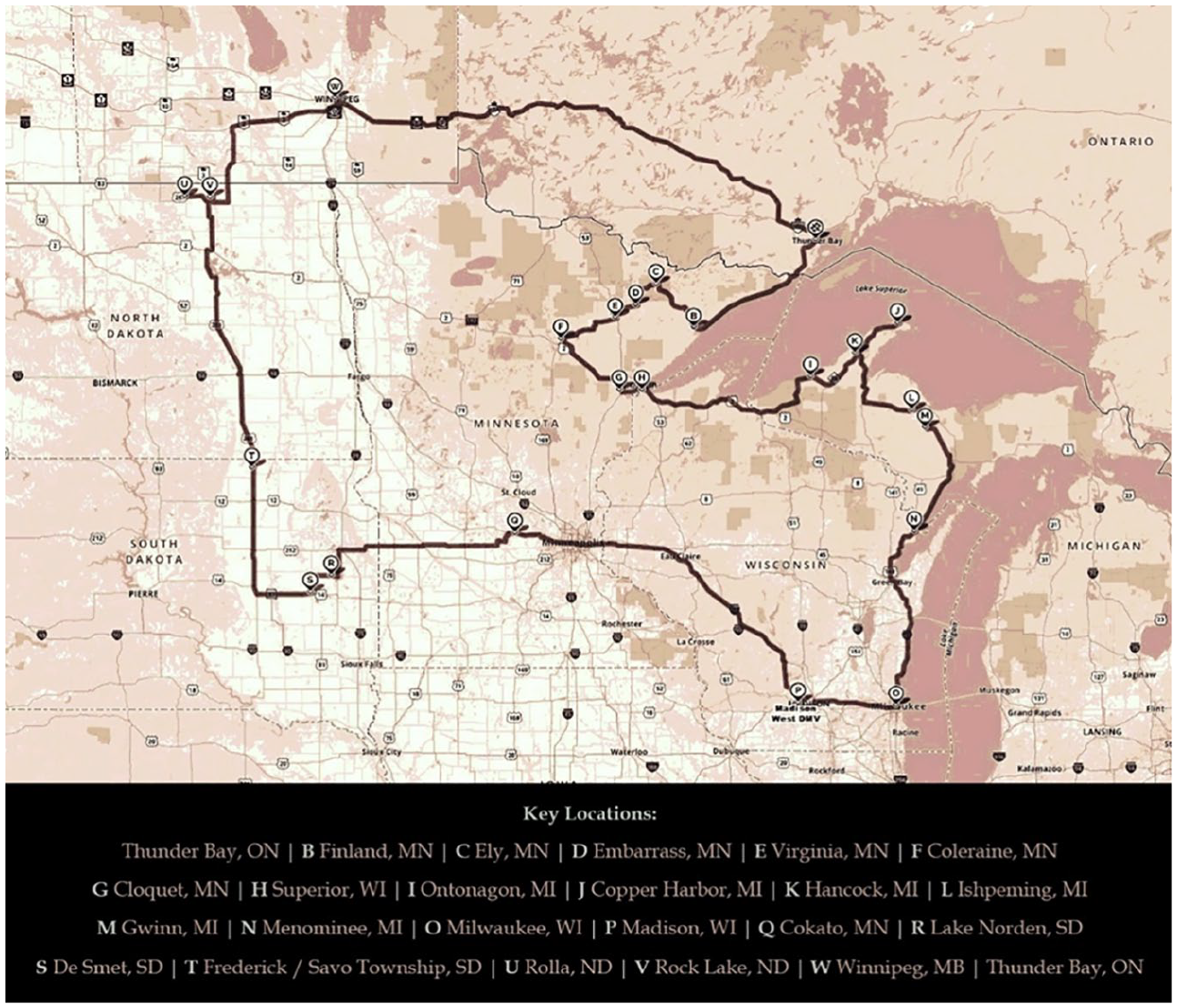
Map / Created by Author.
Admittedly, as a dive into new practices, I did not fully anticipate all what my research needs would be but, instead, engaged in it as ‘an ongoing process of understanding’ (Schmidt-Lauber, 2012: 563, italicized in original). Through self-reflexive practice I adjusted along the way. People I met during my field work journey were well aware that my role as a researcher had brought me to their community and I had a chance to share quite a lot about my research project with many of them. Therefore, I assume my time and interactions with people I met were shaped (to varying degrees) by this positioning (see for example Pink, 2004: 367), despite the informal tone and nature of these exchanges. Because of the fluid and living nature of my scholarly endeavour and as a historian far more accustomed to archival research than field research, I, unfortunately, did not come ready with an ethics certificate or an established framework for interviewing community members. As such, I have refrained from naming individuals in the present article. Now, trying to integrate the experiences I had and the information I learned into research writing, I wish I had kept better notes. Fortunately, where questions remain, I have been able to further research leads from a distance and follow-up with contacts in order to piece together more details about some of the people, places, and events I learned about in the field.
Retrospectively, I have come to see this multi-sited fieldwork period as an exercise in ‘short-term ethnography,’ which entailed intensive engagement, conscious attunement to the senses, and an ongoing ‘ethnographic-theoretical dialog’ that has continued well beyond the time in the field (Pink and Morgan, 2013: 353). Furthermore, I see it also as a type of ‘sensory ethnography,’ with an ‘aim to come closer to understanding how. . .other people experience, remember and imagine’ by feeling place (Pink, 2009: 23). Through this immersive research opportunity, I came to see ‘place as archive’ (Kirsch and Rohan, 2018: 5) but also the archive as a place of entangled connections and feelings.
Following cemetery paths
I learned a lot from the productive power of flexibility. By listening to the people I met and following the local history threads, my project took on new forms and, I would argue, has come to better stand for the community histories it tells. In designing the research project, cemeteries were not a central site for my analysis. Cemetery Studies is a rich field, led primarily by archeologists, landscape architects, and ethnologists (for example, Frihammer and Silverman: 2017; Francis et al., 2005; Galen, 2012; Petersson and Wingren, 2011), and, as a historian of life stories and the everyday, I did not see a place for myself there. However, as I visited Finnish migrant communities, I was led to the community burial grounds over and over again. Of course, cemeteries are often the first thing that comes to mind for people when they are asked to think about death, especially in a historical context. Cemeteries provide a frame for public and formalized views of death, where it is set in its own defined and controlled space. Yet, there is much more to it than simply the compartmentalization of death. A cemetery is an archive of histories, relations, and emotions. Moving through the space of the cemetery, webs of connection can be woven. The cemetery as archive informs us through its material objects, the sensory experience of being present there, and also through its powerful containment of pasts, presents, and futures.
Among these old graves, you can easily forget you are thousands of kilometres from Finland. The headstone names and inscriptions engraved in Finnish offer no hint of their placement on US soil. While more recent grave markers are now typically inscribed in English, Finnish surnames are further emphasized with other markers of Finnishness. In some cases, Finnish flags are placed alongside gravestones etched with the word ‘sisu,’ referring to the strong-willed and resilient Finnish character, a particularly important and mythologized marker of U.S. Finnish identity (Image 2). 3 Cemeteries are a powerful way to place communities and to draw connections. Steadfast Finnish names on tombstones serve to root Finnish settlers and their descendants in these particular landscapes. The names and dates show networks of family and marriage. They show growth and rootedness over time, linking the past with the present and so often the future, with pre-marked burial plots for those still living. The cemeteries reveal a community’s history of health and well-being, commemorating elders, as well as the infants and children lost too soon. In Finland, Minnesota, I was honoured to be entrusted overnight with the Crystal Bay cemetery record book, caringly maintained for over a century, with the responsibility passed down through a community family. The book adds layers of meaning to the generations of humble stones, writing a record of the community’s loss across a multi-sited archive.
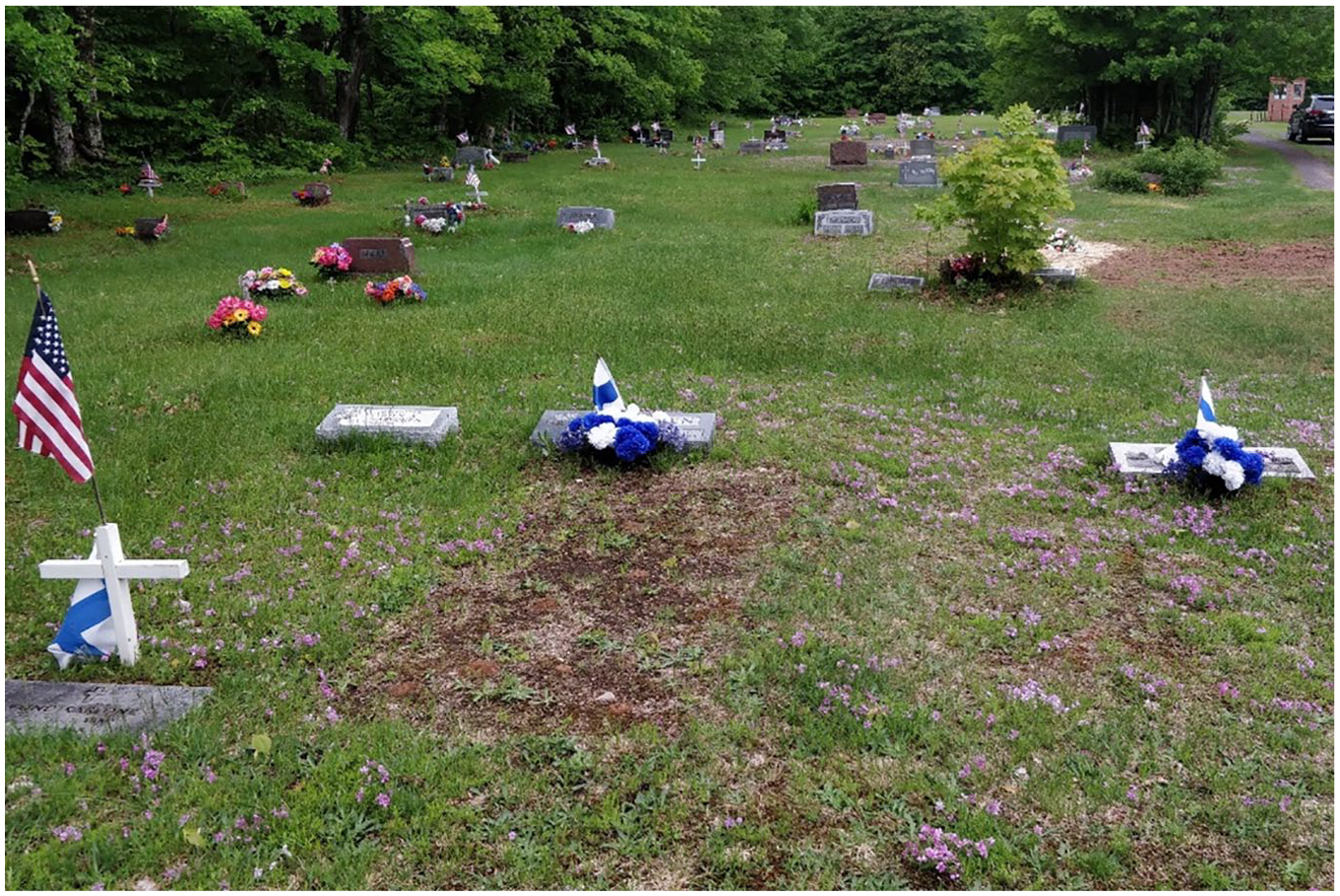
Toivola (Michigan) / Photo by Author.
I was offered many leads to visit Finnish burial grounds off the beaten path. Some were easy to find, while others were not. I failed to find ‘the old communist cemetery’ in the Minnesota Iron Range by following directions marked by natural landscapes (‘the bridge over the river, and a left at the big tree’). However, back at my university office desk, armed with familiar research tools, I was able to use satellite map imaging and internet searches to locate and further identify what was, in fact, the Finnish Cooperative’s cemetery, established in Kettle River in 1937 (for example, Lambert, 1990). Another time I found myself unable to locate the old Finnish cemetery in Suomi Location, Michigan, tucked away in the forest, now within the boundaries of private property – despite driving the large motorhome down potholed dirt country roads, knocking on doors, and trudging through bush. While active and preserved cemeteries provide clear ‘archived’ markers of community pasts and futures, even cemeteries that are now overgrown and out of use continue to hold ‘monumental’ places in the imaginaries of Finnish migrant pasts.
Community cemeteries offered important chances to reflect on place and being. The Indian Pinery Cemetery in L’Anse Indian Reservation (Keweenaw Bay Indian Community), Michigan, for example, is a beautiful and truly emotive site demonstrating long family histories of Anishinaabeg and Finnish intermarriage. Finnish surnames share space with Ojibwa spirit houses and strongly personal tokens of remembrance and offering. I followed community paths that brought me to these spirit houses at L’Anse, to timeless feeling forest cemeteries, where gravestones mixed with blueberry plants, ferns, and wildflowers, to cemeteries with perfectly orderly rows, to the Dakotas, where the sudden appearance of evergreen trees among endless fields of corn signal a cemetery. Despite their physical contrasts, each cemetery had the ability to make me feel undeniably in place. In each place, with my feet rooted to the ground, I could feel it –a visceral, sensory reaction that defies easy academic expression or analysis. The complexity of characterization may simply be that such feelings necessitate feeling, rather than the use of standard tools of quantification and qualification (Bondi et al., 2005: 11). Such emotional being in place is powerful and demands our attention, both scholarly and personal.
The commanding presence and complex unfoldings of time evoked by the cemetery became even more concretely apparent when I had the opportunity to be accompanied by a local community member. For example, in South Dakota, I was accompanied to Savo cemetery by a local history enthusiast and dedicated community booster. As we walked around, he told me about each person whose headstone we came to. In the cemetery, it was evident that his community’s history and his personal history were intricately interwoven with his daily life. There, Savo’s past movers and shakers were laid beside his parents, siblings, and even child. There, stories of the community’s big hopes and dreams and failures and disappointments mingled with his own. It was an honour to be in place and to bear witness to this emotive fluidity of time and belonging.
The community members I met along the journey made it clear that their cemeteries are significant and active sites of self and community placing, where histories, presents, and futures come together. I accepted that I, as a researcher, had to listen and acknowledge that while cemeteries were not my primary analytical interest (and still are not), they are nonetheless an essential part of the narratives and everyday practices of death and mourning in these Finnish Midwestern communities. By integrating community cemeteries into my research, my archive and understanding expanded.
Connecting with knoweldge-carriers and the weight of passing time
I am very grateful to have met many knowledgeable people, who graciously spent time offering ideas or sources for my project, showing me around, and sharing their own projects and historical interests. In addition to the opportunity to learn from some professional librarians, museum staff, and archivists, the people I spent the most time with were active members of volunteer-run historical societies. In addition to pursuing new information about their community’s history, these groups are often engaged in promoting Finnish heritage today. 4 As historical society members or directors, the people I met were often in the position to serve as ‘gatekeepers’ of their society and broader local community, and also of how their community history is publicly presented (Harrington, 2003; O’Reilly, 2009). While it is important to critically consider how and what kinds of access may be offered, rather than using ‘gatekeeper’ framing, I prefer to position these individuals as knowledge-carriers. Through their active involvement in local history and heritage projects and organizations, many of these individuals could be said to be working on ‘life review projects’ (Mullen, 1992: 18). By incorporating their own life narratives and experiences into traditional practices and knowledges, I gained ‘a cumulative view both of one life and of a segment of regional history’ (Mullen, 4). The knowledge-carriers I encountered are proud of where they come from and those who came before them. They are not researchers by formal training but rather had pursued various and most often blue-collar careers. Many of them actively pursue genealogical research. Many are excellent storytellers, passing down community lore (‘I remember hearing. . .’ or ‘They used to say. . .’). I was very taken by the people I had the privilege to learn from and felt ‘enveloped’ by their stories, lives, and places (Pink, 2004: 367).
By and large, most of the knowledge-carriers I had the chance to spend time with are already well into retirement age. I have been deeply impacted by the bodily, physical labour they have committed and continue to commit to preserving their local history and Finnish heritage. They paint walls, mow lawns, sweep and wash, haul boxes of archival treasures, bake Finnish coffee bread (pulla or nisu) and brew huge pots of coffee, put up decorations, plant trees and flowers, build monuments, and even transport and rebuild old schoolhouses, saunas, and log homes, among an endless list of tasks. Through their labour, they have placed themselves and their bodies on to their communities and histories. I felt such reverence and appreciation for the incredibly important work they do to keep these histories alive, so to speak. I was told about these labours of love and the pride of doing, especially the successfully completed big projects, but I was also told and deeply moved by their burden. In a lot of these small communities, built on boom and bust cycles of forestry, mining, or agriculture, local boosters are trying to retain and attract young workers and families. I heard over and over again about children moving away and the need for ‘fresh blood’ to take on the work. The common refrain echoed – sometimes with shame, sometimes with resignation, and sometimes simply matter-of-factly: ‘I can’t do as much as I used to’ or ‘I’m too tired.’ Many of these community knowledge-carriers continue to be highly active and very capable, but the bodily demand of the work undoubtedly takes its toll and, ultimately, is unsustainable (Image 3).
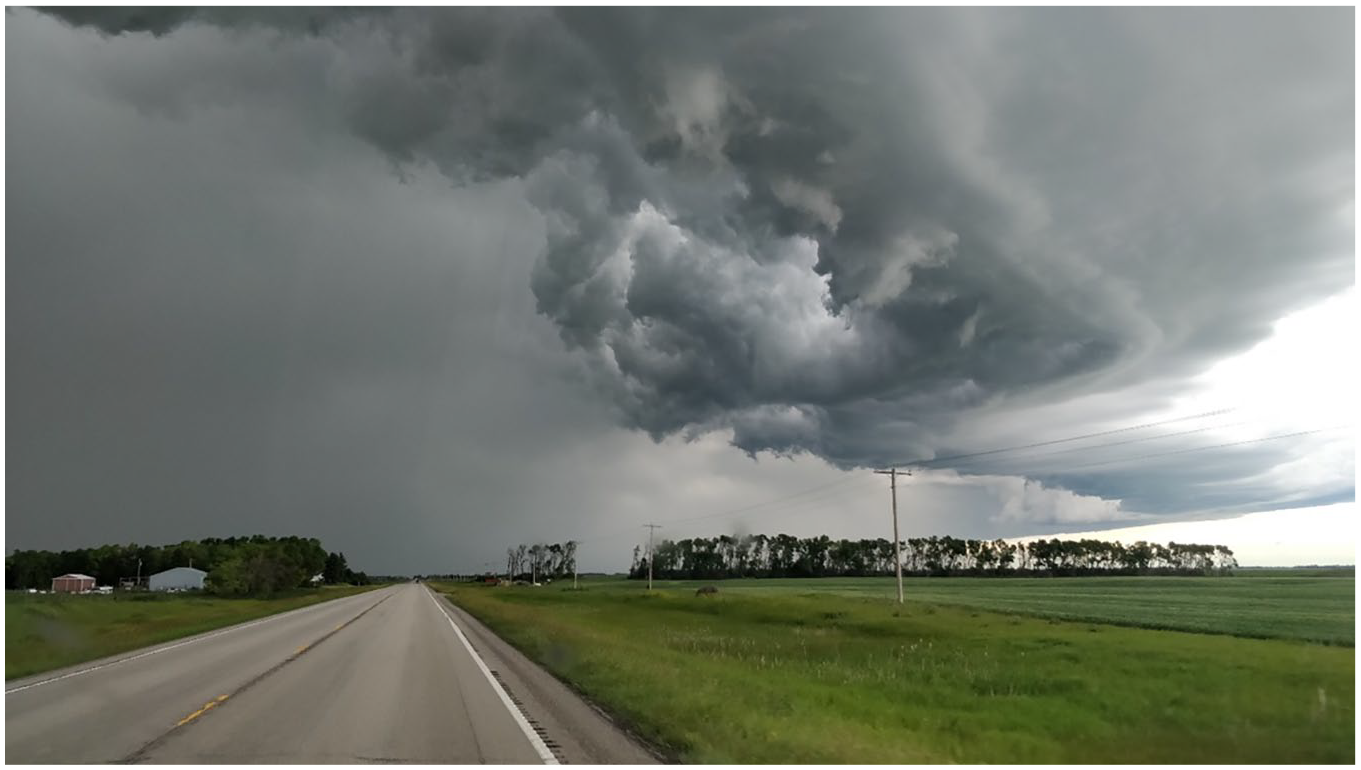
Ominous / Photo by Author.
With few younger people taking on the work of the historical societies, the local lore and histories may also be at risk of slowly being lost. The loss of the Finnish language is part of that. In Northshore Minnesota, for example, only some three generations ago, significant numbers of children knew no language other than Finnish or maybe hybridized ‘Finnglish’ (Virtaranta, 1992) until they entered the public school system. People could conduct their daily business in Finnish, shopping at the Finnish coop stores, or working alongside other Finns. The Finnish language also served people’s social and cultural needs, informally in homes and at the Finnish halls and churches (Kostiainen, 2014; Ross, 1978; Wasastjerna, 1957). Now Finnish has largely been relegated to names on postboxes and rural roads.
In Embarrass, Minnesota, I was invited to join a group who meets weekly at the Town Clerk’s office to speak and practice Finnish. On the day I visited, it was a group of about a dozen, only one under the age of 60, and mostly men. Between cups of kahvia (coffee) and candies, they used a Finnish Ministry of Education online tool to review vocabulary; on this week it was family relation words (veli, äiti, isoisä, etc.). They also spent a lot of time sharing memories of the past, surely, in part, for my sake. Many had spoken Finnish with their grandparents, some had Finnish as their home language as children. None of their children knew Finnish. This group represented the last remaining Finnish speakers in the area, and they were very aware of that fact. I was left feeling inspired and impressed by their earnest effort to maintain the Finnish language, but I also felt their loss deeply.
Shrinking and ageing membership in Finnish historical and heritage societies also means less collected dues. Not only are there fewer people who can put in the hours and effort themselves, the society coffers are also unable to support hiring for maintenance, let alone to keep up the work currently being done by the membership. Members invest a lot of their own, often scarce, income and resources to their heritage preservation projects, and still they can fall short. Take for example, the remarkable Savo Finnish Cultural Hall, in Savo Township, South Dakota, which was built in 1899 and is now the only Finnish hall remaining in the Dakotas (Image 4). The Hall was once a bustling community hub, and it was placed on the National Registry of Historical Places in 1995. In the past few years, though, despite the efforts of the small but active merged Historical Societies of Fredrick and Savo, the Hall has seen rather little activity, other than a few staple, annual events. I was told how the membership fees were unable to cover the costs of electricity and a few years ago, the electric company cut off power and removed the pole, making future electrification very costly and difficult. Now, when an event is held at the Hall, a community member has to loan their gas generator in order to simply brew coffee or to continue gatherings into the evening. Of course, the Hall had electricity for only a relatively short portion of its long history. However, electrification offers possibilities for continued and new uses that are important for this living community space to thrive now and into the future.
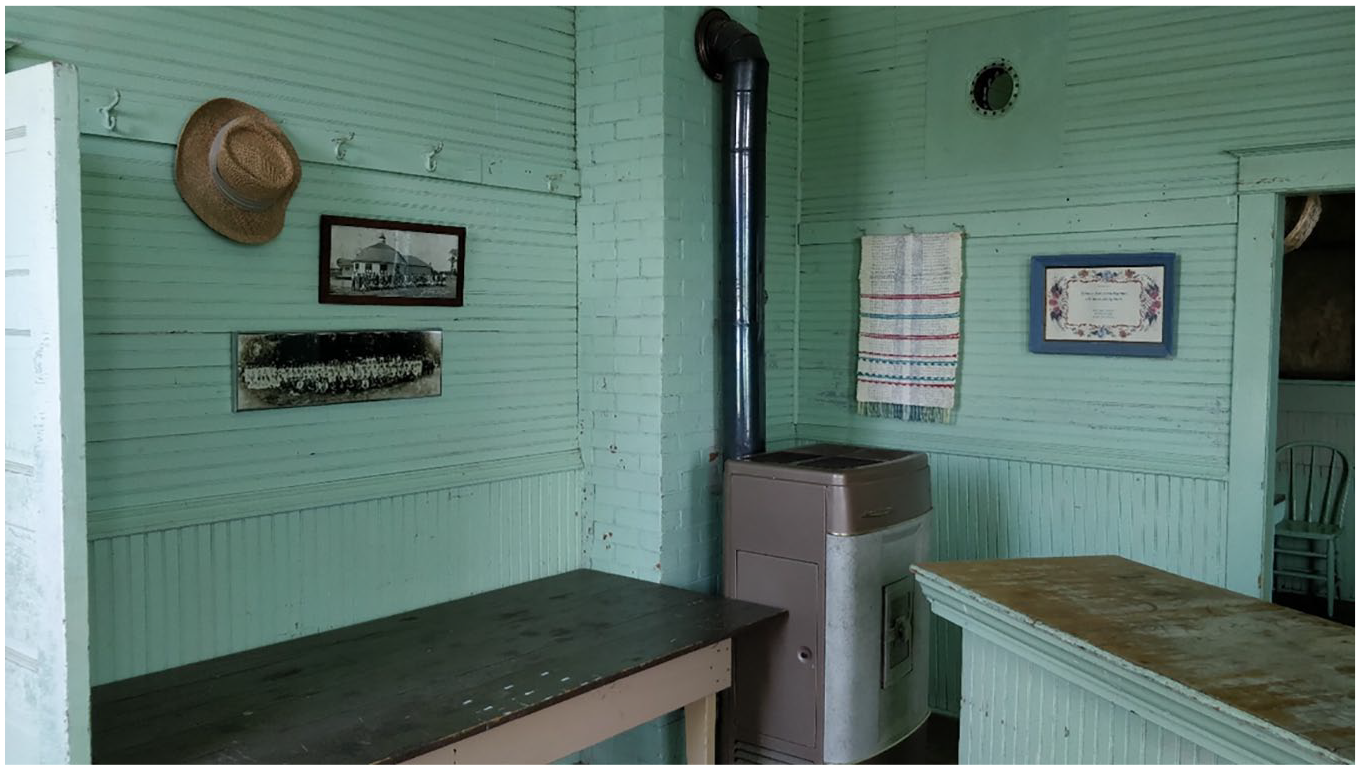
Savo Hall (South Dakota).
While I collected invaluable sources and information for my project on the history of death and mourning, I was learning from local knowledge-carriers much more than what can be encapsulated by a traditional historical research project. I was learning about the burden of preserving the past and the serious repercussions of demographic and economic change in these communities. I was learning about how through the stories people tell, they are telling us about their understanding of themselves in relation to the communities and landscapes they live in (see also Gerber, 2006; Smith and Watson, 2010). I was learning about histories, presents, and futures. I was learning about belonging and loss. It was clear that all of these are essential to the histories I write, but I was left needing to understand how to integrate them into my expanding archive and, furthermore, how to convey them.
Historical memory, sensory imagination, and photographic mediation
When visiting Savo Hall, I felt profoundly grateful and fortunate that people had and continue to make the effort, over all those years, to keep that Hall standing and now to open its doors to me and others who make their way to the border of the Dakotas. Learning about the Historical Society’s struggle to maintain electrical service comes with the sting of loss and the feeling that both the Hall’s past and future are slipping further out of our sensory grasp. Standing in Savo Hall, I was overcome with the connection and feeling of all that had happened in that place over all of its many years. It felt so familiar and so kindred to other rural Finnish halls I have visited. In that space, like in other halls, I can close my eyes, soak up the feel of the place, and open them again so that I swear I can hear the old hall band playing music, see young couples dancing, and children playing and running around.
It is as if I am remembering or experiencing a moment of reverie (Bachelard, 1971; Jones, 2005; Philo, 2003). In this state, our consciousness and imagination ‘somehow travel back’ or ‘‘drift’ back into all the remembered spaces, events and feelings which are in our minds’ (Jones, 208–209). While conceptually reverie has been tied to memories or imaginations of one’s own past (and childhood, in particular), I have begun to wonder if studied, assembled, and crafted historical knowledge can over time become so intimately part of the researcher or knowledge-carrier that they, too, can be triggered by the power of place and draw on the memory-imagination 5 of a communal past. By being present in its emotive force, the Hall reveals its disquiet and fluid temporalities, embodying our knowledge(s) of the past. Remaining open to the analytical possibilities of our historically situated imaginations can result in important new ways of seeing, sensing, and portraying research. It opens the possibility to feel and convey that which ‘could have been’ (Hartman, 2008: 7, 11–12). 6
This was not my first encounter with the overwhelmingly insistent presence of the past and the relentlessness of shifting time. Similarly, in Superior, Wisconsin, with great anticipation, I had sought out the old Työmies building. Työmies had been a radical socialist Finnish newspaper in the United States with wide circulation also in Canada. It began in Hancock, Michigan, in 1903, but was based in Superior from 1914 until the end of its publication in 1995. The building housed the printing press, offices, and, from the 1920s on, also apartments. The importance of this space for the history of the Finnish migrant Left (and Communists, in particular) cannot be denied. While writing my Ph.D. dissertation about the everyday lives and life writing of Finnish North Americans in 1930s Soviet Karelia, I spent a lot of time thinking about Työmies for its role in fuelling the mass Karelian ‘fever’ but also because one of the key subjects of my study, Mayme Sevander, lived in the building as a child (Saramo, 2014). The building still stands. The Työmies name remains on a faded ‘ghost sign’ still painted on the building’s side and on a centered third-floor stone engraving on the front. The main floor is now a candy shop. Though the young owner did not seem to share my enthusiasm for all the history contained within the building, she generously offered to bring me upstairs. As we headed up, I was swirling with emotions. I was actually in the building! The old office and apartment numbers were still painted on the door windows. The hallways were just as I had envisioned. I could imagine little Mayme and her brother playing in the halls as her father met with local Finnish communists, and the press whirred away below (see also Sutherland, 2008: 33). In that place, so viscerally and intellectually familiar yet completely new to me as an embodied experience, my historical knowledge-memory-imagination roamed free.
But the building is in terrible condition. While the first floor has been updated to accommodate a large storefront, bakery, and old-fashioned soda shop-café, it is separated from the second and third floors, which had been largely neglected. There were evident signs of the presence of pigeons and rodents and severe water damage. The third floor was even worse than the second, with floors decayed to the point that there were dangerous gaping holes revealing the floor below and the sky above. Though the owners were planning thorough repairs, I was overcome by the thought that this significant building may be close to being (if not already) beyond meaningful restoration. There is no acknowledgment of the building’s incredible history – it has no public designation or commemorative plaque. The current reality is that there is no funding to preserve these kinds of places, especially with Communist pasts. I grieve this loss.
Again, it is difficult to put into words the ways that I felt the intense presence of the past in that space, so on the cusp of being out of reach. Afterwards, looking at the photographs I took there, I found that I was brought back to those feelings with intensity (Image 5). They provided a counter for ‘the almost impossible task of putting it into words’ (Pink, 2004: 362). In the Työmies building, as in Savo, and elsewhere on the journey, photography proved one way to capture some of the complexity that I was encountering. The camera readily made room for the insistent presence (Smith et al., 2009: 3) and even intrusion of emotion. The photographs were shot on my cell phone and were not edited or filtered in any way. They are vernacular photographs that intentionally sought to document the everyday. Nonetheless, the photographs offer powerful mediations between/among/within place, time, emotion, and my body, imagination, and knowledge. As part of the process of working through the places I had been, what I had learned, and what I had felt – ‘the folding, unfolding, and refolding that is still going on,’ to quote Maria Tamboukou (2013: 624) – I put together a photographic exhibit of 35 field work images in the fall of 2018. As a way of bringing the field and the everyday into formal academic space, the photos were exhibited at the University of Turku and the University of Jyväskylä.
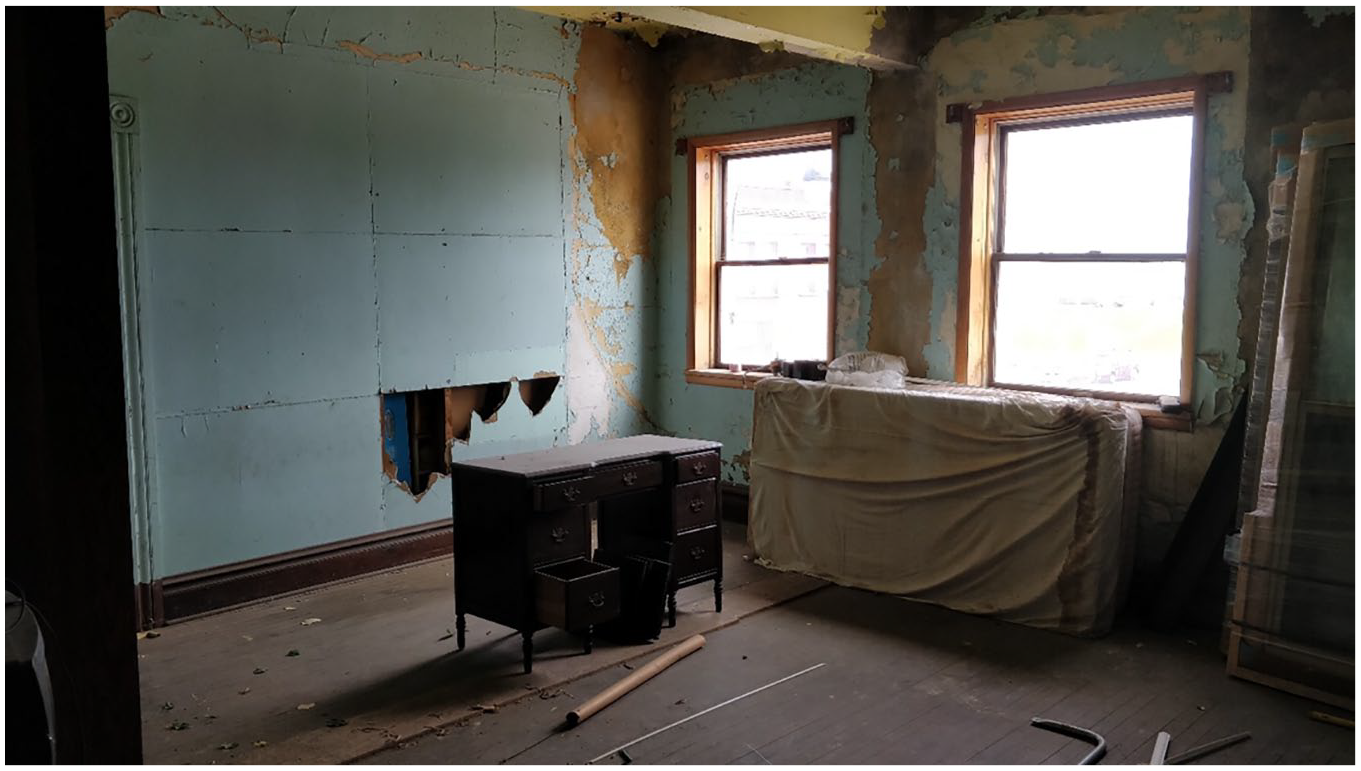
Työmies (Wisconsin) / Photo by Author.
The exhibit brings together three types of images: material heritage (such as gravestones and details of building interiors and exteriors), landscapes, and the archival experience. I did not photograph people. I am very drawn to landscapes as an analytical concept and have elsewhere examined the ways narrations of landscape in Finnish migrant autobiography have been used and the personal and collective purposes they may serve (Saramo, 2017). I am particularly interested in the agency of landscape as ‘deeply historicized’ and ‘imbued with emotion’ (Hastrup, 2008: 53–54). Now, in both taking photographs of landscapes and in their later viewing and exhibiting, I was able to further challenge myself to feel the temporal and emotive power of these places. The exhibit includes serene and even idyllic images that evoke common narratives of Finnish immigrant history in forestry and agriculture, and explore the feeling of timelessness.
Driving through the Great Plains, for example, in my mind’s eye, I could so clearly imagine Finnish migrants of yesteryear working the land. Within the landscape, I started to feel the hopes of so many to build prosperous farms – the optimism of each spring, the fatigue of the summer’s labour. But I also channelled the devastation of crop failures, the decline of markets, and the pain of children moving away. Now, these fields, thousands of kilometres of monoculture, genetically modified (GMO) corn and soy represent attempts to preserve farming livelihoods in new market realities, despite the destructive and likely irreversible costs to our environment and foodways. I later began to explore ways I could layer the photographs I took with archival images to further prod our entanglements with time, place, and emotion. For example, as seen in Image 6, our viewing of the Dakota Plains today makes room for the insistent presence of the migrant settler of the past. I have continued to push this exploratory practice and the feelings it evokes, by adding further layers, such as imposing a third image of fields devastated by drought (not pictured here). In this way, both the layering and simply ‘re-viewing’ of the photographs ‘enabl[es] us to re-encounter the sensorial and emotional reality of research situations’ (Pink, 2009: 121) and re-engages us to find new meanings (Pink and Morgan 2013: 358). The photographs have, on one hand, served the important function of documenting my field work concretely by creating a record of who, where, when, and what. On the other hand, they have also created an archive of feelings and paths through time.
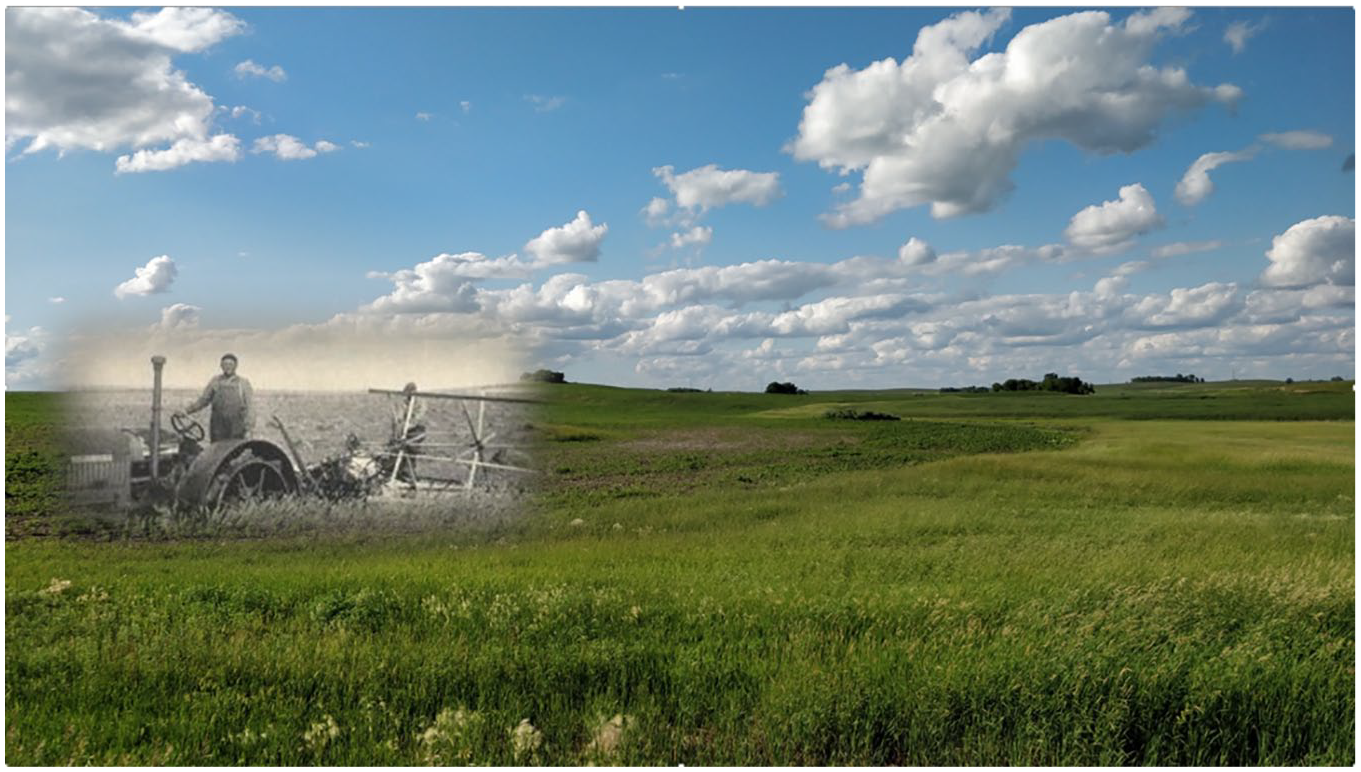
Layered Landscape / Photo and layering by Author.
Placing archives and creating research assemblages
The photographs encourage us to further consider the dynamic, entangled, and experienced enterprise of creating research. If ‘the idea that research is ‘‘embodied’ – in that the researcher learns and knows through her or his whole experiencing body’ has been recognized in ‘ethnographic disciplines’ (Pink, 2009: 25), it has still not been thoroughly adopted into understandings of historical research. Six of the exhibit photographs show archival documents, but instead of tidily cropped shots, these images zoom out to show the holding folder, the researcher’s notes, the unsticking tape, or the preservation glove (Image 7). They serve to counter the tendency when presenting archival documents to disembody the image or document from its archival origin. They give back the dimension of the object, suggesting its materiality and the presence and position of the researcher’s body. While photographing places can serve to archive moments and feelings, these photographs from/of the archive, in turn, place the process of archival research.
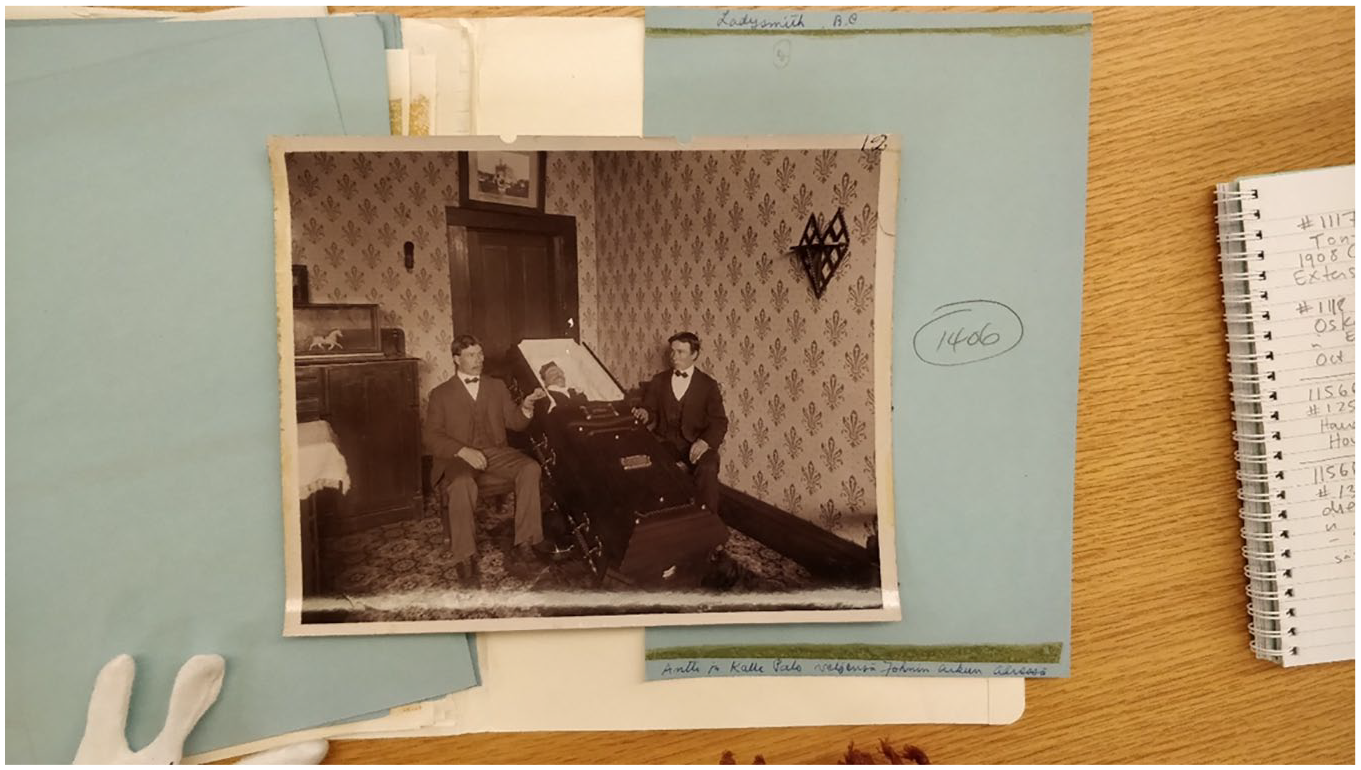
The Palo Brothers / Photo by Author / Archival Photo from Archives of Ontario, MHSO fonds, Finnish Canadian Photographs, Series F 1405-15.
Serendipity plays an important role in the paths we take and the connections we make, in the field, in the archive, and, ultimately, for what our research becomes (see for example, Kirsch and Rohan, 2008). In the case of my project on Finnish migrant histories of death and mourning, along with visiting communities, engaging in dialogue with knowledge-carriers, and creating this photographic record, I have collected materials from 13 archival repositories. I have gathered letter collections, autobiographies, diaries, historical photographs, organizational minutes, mining inspector’s reports, death certificates, cemetery records, insurance policies, financial ledgers, genealogical records, maps, court verdicts, and other bits of miscellany, including funeral receipts and newspaper clippings. I have selected each individual piece because it has something to do with deaths in a Finnish migrant community and/or expressions of private or collective grief and mourning. Someone else may very well have chosen the same document for their project on an entirely different topic, yet through conscious and reflexive ‘intentionality’ (Pink, 2001: 27 and 57), the corpus I have been assembling is now uniquely a window on to death and mourning in ‘Finnish North America.’ Maria Tamboukou, building on assemblage theory (Deleuze and Guattari, 1980/1987; De Landa, 2016), draws our attention to the processes of ‘archival assemblage’ and the ways that ‘documents continuously create new meanings through the connections they make’ (2017: 7). These are processes of creation and ‘invention’ (for example, Gomes da Cunha, 2006: 7). Marianne Hirsch has shown through the example of photographs, how, in our meaning-making and history-making, we continuously engage in an act ‘of adoption that transforms rectangular pieces of cardboard into telling details connecting lives and stories across continents and generations’ (1997: xii).
Archival research, as Arlette Farge (1989/2013), Natalie Zemon Davis (1987), Michel Foucault (1977/2001), and Tamboukou (2013), among others, have compellingly demonstrated, involves creative forces and the multifaceted entanglements between the researcher, the archival space, and historical records. These creative dynamics are present in all research fields, not only in the institutionalized, physical archive. As Kirsch and Rohan (2008) recognize, ‘the process of research itself creates new knowledge. . . Researchers change and change others when they engage and make meaning of data, as they encounter people and places, and as they interpret and make meaning from archival data. . .’ (6). Our unique presence in the field (wherever or whatever it may be) will lead to unique connections, questions, and interpretations, shaped by the ways we feel and sense ourselves in place. The more sensitive we are, the more rich and expansive the archives of our research may become.
Conclusion
Sarah Pink has encouraged researchers to think and work through ‘ethnographic place.’ Ethnographic place is not confined to the moment and space of the fieldwork location but, instead, refers to ‘the entanglements through which ethnographic knowing emerges’ (Pink and Morgan, 2013: 354). Pink further explains that ‘Ethnographic places are events that involve the strange combination and interweaving of memory, imagination, embodied experience, socialities, theory, power relations and more’ (Pink, 2009: 120). It is in such places that we may also unlock the potential of the archives. Through the immersive expansion of the archives, beyond disembodied documents in a repository, to seeking places, feelings, and connections, we bring new ways of knowing, sensing, and doing to historical research and knowledge.
Pursuing the feel of the places and communities I had long thought about in my historical research resulted in an enrichment beyond my expectations. I learned much more about these community histories and added significant new sources to my project on death and mourning in Finnish migrant communities. But by engaging in this sensitive research, I have become more aware of the emotional, temporal, and material worlds entangling ‘subject’ and researcher. Through presence, I found, as Lesa Lockford has eloquently written, ‘an understanding that seeps into the marrow that comes just by being present’ (2014: 285). Through the opportunity to listen to voices and sounds, to see, touch, and smell landscapes, monuments, buildings, and objects I had never experienced before, I came to better understand the profound ways in which we live with history.
Footnotes
Acknowledgements
I am grateful for postdoctoral funding from the Academy of Finland, which enabled this research (Grant 308314). With special thanks to the 2019 John Morton Center for North American Studies team and colleague Marta Laura Cenedese at the University of Turku for insightful comments on early versions of this draft. I am also thankful for engaged and constructive review feedback, which strengthened this work.
Funding
The author(s) disclosed receipt of the following financial support for the research, authorship, and/or publication of this article: This research was enabled through postdoctoral research funding from the Academy of Finland (Grant 308314).
