




Abstract
Within qualitative research, much can be learned from the influence of researcher positionality on the research process. Reflecting upon ethnographic fieldwork undertaken for a doctoral study, this paper explores how researcher positionality not only shapes research motivations but also situates the researcher and the ‘researched’, impacting how data is created and interpreted. There is a long history of engaging with positionality in qualitative research, however, oftentimes this engagement is purely descriptive, providing a ‘shopping list’ of characteristics and stating if these are shared or not with participants. It is important for engagement with reflexivity to go beyond providing a ‘shopping list’ of positionality statements to develop deeper discussions about the fluidity of positionality across the research process. Using the previously established concept of ‘kitchen table reflexivity’, I reflect on how talk allows researchers to outline shifts and adaptability in positionality as research progresses. I expand this concept to argue that kitchen table reflexivity can occur in conversations during fieldwork with participants, utilising a range of in/visible tools at the researcher’s disposal. For example, the spaces between fieldwork encounters, the ‘waiting field’, is often where observations and informal discussions with participants take place. Using fieldnotes and interview data, this paper outlines how positionality fluctuates and interweaves with the theoretical, methodological, and analytical approach taken. The paper concludes by restating the importance of meaningful engagement with positionality throughout qualitative research, in order to avoid static and hollow positionality statements.
Introduction
Encouraging qualitative researchers, especially ethnographers, to reflect upon their positionality and the impact of this on the research process has a long history within the social sciences (see Atkinson et al., 2007 for a thorough historical exploration of the development of the ethnographic method). Contemporary qualitative researchers and ethnographers have discussed at length the importance of positionality and reflexivity during the research process (Bourke, 2014; Dean et al., 2018; Haddow, 2021; and Rose, 1997). As Coffey (1999: 1, author’s emphasis) notes ‘fieldwork is personal, emotional and identity work’ and as such, detailed reflections of positionality should be included in academic writing to highlight this ongoing negotiation. The data that is created and the interpretation of that data is inextricably tied up within researcher subjectivity and the researcher’s ways of viewing the world (Burman, 1997). The motivations behind the research are also implicit in how, as social researchers, we interpret what happens in the field (Burr, 2003).
In a discipline such as Sociology where historically quantitative paradigms dominated, indulging in subjective writing around positionality can be discouraged as it further demonstrates how qualitative research does not fit into ‘scientific criterology’ (Mason, 2002:38). It has also been argued that engagement with reflexivity, particularly by postgraduate social scientists, is somehow shallow and performative (Macfarlane, 2021). Counter to this, it is arguably essential to the quality and rigour of qualitative research to be transparent about research processes, how they unfold and their inescapable linkage to researcher positionality (Mason, 2002; Pezalla et al., 2012; Rose, 2020). This article aims to develop this argument by reflecting on how positionality fluctuates throughout research, as it interweaves with the theoretical, methodological and analytical approach taken. By using the concept of ‘kitchen table reflexivity’ as discussed by Kohl and McCutcheon (2015), the article demonstrates how, through talk, positionality is fluid and shaped by both formal and informal interactions during the research process, for as Rose (2020: 3) notes: An ethnographer’s reflective development of one’s own positionality, as it dynamically transitions across the duration of an ethnographic project, begins to act as a form of analysis in and of itself; ethnographers and other qualitative researchers change as projects develop.
This paper examines my own changing positionality within a doctoral ethnographic study, reflecting specifically on how my position in the field became entangled and interwoven with the theoretical, methodological and analytical approach taken to the research (Rose, 2020). I begin by outlining some key conceptual tools within ethnographic research that have shaped my engagement with this topic. These tools are pivotal to theorising positionality as ‘in flux’ – shaped by social context and the everyday. The paper then explores what brought me to the doctoral project and the motivations behind the research topic, as well as detailing the research context and fieldsite. Next, drawing upon conversations with participants in the field, the paper reflects on how talk and ‘kitchen table reflexivity’ developed notions of geographical positionality, an often-overlooked element of researcher subjectivity (Heley, 2011). The article will then discuss the importance of the waiting field when entering the family home and how fieldnotes can provide additional insight into the changing subject positions of both the researcher and the ‘researched’. Reflecting on entering the family home evidences the transience and hybridity in the generation of ethnographic knowledge, as the researcher is situated within the private, everyday space of the participants.
Throughout, the paper weaves both interview data and fieldnote observations to present a purposeful, candid account of positionality throughout the research process and outlines the salience of continual reflexive practice in qualitative research. I conclude by reiterating the importance of ‘kitchen table reflexivity’ and talk in the development of positionality. This term, I argue, can be expanded to include talk that takes place within the field with research participants, in addition to in/formal discussions with others outside of the research. It is only through meaningful engagement with positionality throughout qualitative research that researchers can avoid static and hollow positionality statements. The paper aims to encourage qualitative researchers to engage continuously with their changing positionality and to ensure these observations are weaved into their theoretical, methodological and analytical writing.
Unpacking the ethnographic toolkit: In/visible tools, interpretive reflexivity and talk
Within qualitative research, particularly ethnographic research, there is no shortage of discussion around the role of positionality in the research process. Qualitative researchers who situate themselves within a particular community for their research inevitably consider, whether implicitly or explicitly, their access to the community and how they will be received by community members (Lichterman, 2017; Narayan, 1993; Rose, 2020). Ethnographers and those using ethnographic methods have debated the utility of the ‘insider/outsider’ dichotomy, and discussed the benefits of having some degree of ‘insider’ status. These may include pre-existing relationships and knowledge of a community which aids the research process, but also discussions on how to make the ‘familiar strange’ to ensure thorough exploration despite seeing the community through an ‘insider’ lens (see, for example, Skeggs, 1997; Mannay, 2010; and McKenzie, 2015). More recently, literature on positionality has developed to allow for the nuanced and everchanging nature of researcher positionality throughout the research process, moving beyond the dualistic insider/outsider debates (Barnes, 2021; Reyes, 2020; Rose, 2020).
Reyes (2020), for example, writes about the transience of positionality as researchers’ social positions change across social contexts and interactions. When conducting ethnographic research, Reyes (2020: 231) argues researchers are drawing upon their own ‘ethnographic toolkit’ which is built up of visible characteristics, such as gender presentation, age, race and appearance, and invisible characteristics, such as social capital resources and familial background. These characteristics can then be used strategically when negotiating access to the field, demonstrating how positionality is relational, contextual and continually evolving. Invisible characteristics such as sharing personal stories with participants can work to alleviate power differences between researcher and participant, as rapport can be established. Through the conceptualisation of the ‘ethnographic toolkit’ consisting of in/visible tools, Reyes (2020:226) argues that no researcher can ever truly be a complete ‘insider’ as no two people can fully share the same characteristics and experiences, alluding to the intersectional and situational nature of positionality. The fluid nature of positionality therefore shapes experiences in the field and the wider research process.
Situational understandings of positionality allow qualitative researchers to engage with reflexivity as a process that goes beyond the ‘shopping list’ positionality statement. By this, I mean a solely descriptive position statement of the researcher’s identity and characteristics, and how they are dis/similar to their participants’. Macfarlane (2021) has cast particularly strong criticism on postgraduate social scientists’ engagement with positionality, suggesting this is reserved to a brief discussion in a thesis methods chapter as an act of performativity. Although I do not subscribe to Macfarlane’s criticism, this paper does argue for researchers to lean into the transient nature of positionality as it shapes theoretical, methodological and analytical processes. A way to achieve this is through attuning to the situational and the everyday interactions and experiences that occur throughout the research process. Lichterman (2017:39) refers to this as interpretive reflexivity: People communicate in language, gesture, silence, and we don’t wear positional identity-tags on our backs when we do so. Ethnographers need a more setting-specific, nuanced map of cultural differences to reflect on how communication succeeded or failed.
Together with Reyes’ (2020) ethnographic toolkit and in/visible tools, the relational and transient nature of positionality is highlighted, demonstrating the need to engage with positionality as continual and fluid. Previous research has discussed the importance of reflexivity through formal and informal conversations with others throughout the research process, as often this helps researchers to understand their changing positionality and to provide/receive emotional support from others (Kohl and McCutcheon, 2015; Lisiak and Krzyżowski, 2018). This is what Kohl and McCutcheon (2015) refer to as ‘kitchen table reflexivity’ – where everyday talk with other researchers is used as a tool to interrogate positionalities. Although Kohl and McCutcheon (2015) discuss kitchen table reflexivity as occurring between researchers, this article aims to widen this understanding to explore how talk between the researcher and participants can aid meaningful engagement with transient positionality. Drawing upon the conceptual tools outlined above, I will explore how positionality fluctuates and interweaves with the theoretical, methodological and analytical approach taken to qualitative research. Next, I explore what brought me to the research area and the context of the research.
Motivations for the research and research context
When discussing positionality in qualitative research, it is impossible to ignore how the researcher came to their research area, which is often driven by personal experiences (our in/visible tools) and motivations. It can be argued, therefore, that consideration of positionality should be weaved in from the very beginning of the research process. What researchers bring to the research in terms of motivations, experiences, and interests will inevitably shape the methodological and analytical decisions made throughout the research (Dean et al., 2018). Within research theses and academic articles, for example, lengthy discussion about the impact of positionality on the research process is often absent as data exploration is prioritised, unless engaging in a form of autoethnography. Writing about autoethnography, Delamont (2009) warns of the fine line between personal reflections that help to develop the research and those which are self-indulgent. As a form of catharsis, it can be easy to slip into a diarised writing-style that fails to provide analytical insight. Being conscious of this, in what follows I will outline my personal motivations behind the doctoral research project and the impact of these on the theoretical, methodological and analytical decisions made in the research. This is an attempt to shift viewing the researcher as solely ‘an unfortunate necessity for the production of research’ to the ‘beating heart’ of research (Loughran & Mannay, 2018).
The research explored the social mobility narratives of working-class families who lived in an economically deprived and often forgotten suburb, Hiraeth. The pseudonym ‘Hiraeth’ is a Welsh word meaning nostalgia, yearning, or longing and was pertinent to the findings of the study. I came to research this topic based on my own experiences of social mobility as a working-class student from a single-parent family who lived in an economically marginalised community. Higher education was not something I had considered as a young adult finishing compulsory education. Attending a girls’ grammar school that consisted of a mostly middle-class intake, there was an implicit expectation to attend university. My difficult experiences adjusting as both a working-class pupil in a grammar school and as a first-generation academic echoed what Bourdieu (1990) described as disrupted habitus or habitus clivé. My journey through education as a working-class woman echoes the experiences of other female, working-class academics (see, for example, Reay, 1997; Walkerdine et al., 2001). Despite being a ‘good example’ of social mobility, I knew that this came at the cost of an unsettling and difficult emotional (and geographical) dislocation (Lawler, 1999; Loughran, 2018). The research therefore set out to explore how compelling dominant narratives of social mobility are amongst working-class families. As I had left my family home and community behind in pursuit of mobility, I wanted to learn whether this was a common aspiration amongst working-class families, or whether other notions of value came to the fore. The best way to achieve this was through an ethnographic study situated within one working-class community.
Introducing Hiraeth
Hiraeth is a small urban suburb of a south Wales city, home to around 8000 residents, primarily of white, Welsh working-class heritage. Unlike nearby suburbs and towns, Hiraeth was not a hub of industry, as it was known for housing small agricultural communities historically. As agriculture made way for more dominant forms of industry in the 20th century, such as coal mining and steelworks, Hiraeth became an ‘overspill’ suburb, with workers being transported in from Hiraeth to these key industries in nearby towns and cities. Today, Hiraeth ranks as one of the most deprived communities in Wales on the Welsh Index of Multiple Deprivation (Welsh Government, 2019). Apart from the main road that runs through the west of the community, hosting most of Hiraeth’s amenities, the suburb is mostly reserved for residential dwellings and some public buildings (such as churches, schools and a library). Both owner-occupier (around two-thirds of residences) and social renting (around a fifth of residences) are overrepresented in Hiraeth compared to nearby city averages, suggesting Hiraeth is an area of economic contrast. Unlike other marginalised areas that are often hyper-stigmatised and demonised (such as Merthyr Tydfil, highlighted in Byrne et al., 2016), Hiraeth is an area that has been overlooked and under-researched. As such, Hiraeth is distinct from heavily researched Welsh working-class communities, and due to its marginalised and ignored status, was deemed to be an appropriate location for this research.
The research was a small-scale, in-depth, multi-modal, qualitative study of Hiraeth, influenced by various ethnographic approaches and work (see Skeggs, 1997; McKenzie, 2015; Ward, 2016). Despite my own experience of social mobility being geographically situated in England, I was especially interested in working-class narratives of social mobility from a Welsh context as strong class solidarity and industrialisation features so strongly in Welsh working-class history (Walkerdine, 2010). I wanted to explore whether individualised narratives of mobility and improvement were invested in by Hiraeth residents, contrast to previous class-based, solidaristic notions of aspiration (Ward, 2016). Social class was subjectively theorised in this research, recognising the relational and dynamic aspects of class as it occurs in the everyday (Skeggs, 1997). This aligns with the approach taken to positionality in this paper, which is explored later.
Research methods and analysis
The research employed a variety of methods including participant observation, interviews (with families and community workers) and visual and creative methods, as well as amassing a large number of fieldnote reflections that were recorded after each encounter in the field. The aim was to garner narratives of social mobility from families and to explore how social class, place attachment and gender intersected within these. This paper will focus on fieldwork reflections and snippets collated from the family interviews that were undertaken in the research. The family interviews ensured generational breadth as nine families were interviewed across 13 interviews with 25 participants in total. This spanned over 20 hours of audio-recorded material and 204,398 transcribed words of data. Other forms of data including creative outputs and fieldnote reflections were also created in addition to the rich family interview data. Crucially, 11 of the 13 interviews took place within the family home, which is essential to consider when discussing researcher positionality, transience and hybridity as entering a private space usually off-limits to researchers has implications for the research encounter.
Fitting with the ontological approach taken to the research, fieldwork was not undertaken to reveal ‘truths’ about participants’ lives, but to explore the intersubjective performance of identity work that is inevitably influenced by the social and cultural context (Burr, 2003; Taylor, 2006). Accordingly, the data drawn upon throughout provides important analytical insights into both participants’ subjectivities and my own, as we responded to discursive positionings and shared social meanings within our interactions (Taylor, 2006). My positionality as a researcher has, unavoidably, directly impacted upon the data that has been created (Pezalla et al., 2012). As a young, white, female, working-class academic, these ‘visible’ tools from my ethnographic toolkit will have shaped my early interactions with participants in the field (Reyes, 2020). What this article aims to do is to move beyond this static ‘shopping list’ positionality statement to demonstrate the flux and fluidity of positionality, as it is negotiated between researcher and researched in context. The approach taken to data analysis was therefore a narrative-discursive approach (Taylor, 2006), with a key emphasis on the dynamic and transient nature of research encounters, and the subsequent adaptability of positionality. The fieldwork and data analysis were concerned with the situational and the everyday, with the focus of this paper being specifically on ‘kitchen table reflexivity’ that occurred organically during the research process. One key area of positionality that was negotiated in conversation with participants was geographical positionality and belonging, explored next.
The in/visibility of geographical positionality and belonging: negotiations over the kitchen table
When conducting community-based ethnographic work it is important not to overlook geographical elements of positionality and the opportunities and/or challenges this brings (Heley, 2011). I am cautious not to overstate the differences between Hiraeth residents and myself, however, both my local and national identities were a clear point of departure from any characteristics we may have shared. As an English researcher in a Welsh locale, one of the visible tools from my ethnographic toolkit was my accent, which is indicative of my national identity. This was notably distinct from the majority of residents’ accents who were Welsh nationals. As soon as I spoke with a South-West English accent, I was actively positioned as ‘not-Welsh’ and therefore ‘other’. In addition to this, an invisible tool which participants discovered early on in our interactions was that I was not local to Hiraeth. In this sense, my geographical positionality was twice removed from participants’. Although my local and national identities are immutable (I am not a Hiraeth local and I can never be Welsh), participants used these elements of geographical positionality to discursively construct categories of belonging in Hiraeth. It is these which I explore in this section.
My national identity had implications for how participants responded to me, in turn impacting the data that was created. When exploring the construction of Welsh identity, Scourfield et al. (2006) argue that ‘English’ is constructed as a significant ‘other’ in contrast to Welsh identity. In subtle ways, my status as ‘other’ was entrenched through conversations that I had with participants as we discussed devolved politics and legislation, or through reflections on how their children celebrated Eisteddfod and St David’s Day at their schools (Geraint, 2016). Being English meant I lacked the shared experiences and insider knowledge of family life in a Welsh community. These nationalistic differences sometimes led to difficulty in relating to the topics being discussed with participants, although they did not necessarily hinder the data creation or interpretation. It may have, however, shaped the kind of data that was created as participants shaped their narratives in response to my ‘other’ status. This became especially pertinent when participants discovered that not only am I English, but I also do not reside in Hiraeth.
As well as being unfamiliar with typical Welsh family traditions, not being a Hiraeth local meant I lacked an understanding of day-to-day life in the community. It is important to consider local and national identities in a relational manner (Scourfield et al., 2006), and so my distancing from the local and national identities of participants is notable, inducing particular responses and discussions in the field. A key technique used by some participants was their discursive negotiation of the category and boundaries of what it means to be ‘Welsh’. Towards the end of their family interview, as we sat in their kitchen around the dining table, Michael (50s) and his daughter Lucy (30s) began to negotiate the boundaries of Welsh identity, which inevitably has consequences for who can/not belong:
Using the label ‘Wenglish’, a term colloquially used for people who are English and reside in Wales, Michael outlines my position as ‘other’ and my inability to ever be Welsh. Contrastingly, Lucy constructs belonging and Welshness based on length of residence indicating that if you lived in Wales for a decade, then you could describe yourself as Welsh. Michael, however, refutes this when he states that you would only be considered ‘almost local’ if you lived in Wales for 10 years. Both Michael and Lucy as lifelong Welsh residents are actively constructing and negotiating the boundaries of ‘Welshness’ and belonging through shared experiences and discursive resources (Taylor, 2010). This snippet of conversation demonstrates kitchen table reflexivity in action, as contradictory and changing notions of what it means to be ‘Welsh’ are discussed, illustrating the transient nature of geographical positionality (Heley, 2011; Reyes, 2020). This negotiation and subsequent positioning of me as a geographical ‘other’ shaped our ongoing interaction and how Michael and Lucy presented themselves in the research encounter. This also required identity work on my part, as I accepted their subjective positioning of geographical and national ‘other’, allowing me to reflect upon my English, non-local status and the implications of this for future engagements in the field.
The majority of the families interviewed for this research were Welsh nationals, with the exception of one. Roger and Maureen (70s) were a retired couple who had lived in Wales for the majority of their working lives, and had lived in Hiraeth for over 10 years. Although their children were born and raised in Wales, both Roger and Maureen were brought up in England. Recognising our shared national identity, Roger used our interview to discuss occasions of not belonging, seeking reassurance from a fellow geographical ‘other’:
What Roger has highlighted here is the difficult, ongoing construction of belonging, and the impact of not being ‘truly’ Welsh as somebody living in Wales as a national ‘other’. The nationalistic camaraderie of sporting events is noted as an occasion where belonging seems possible, and this aligns with literature demonstrating the symbolic importance of sport as an essential part of Welsh identity and ‘Welshness’ (Clarke, 2009; Mackay, 2010). Despite outlining occasions such as these where he feels very Welsh, Roger’s belonging is carefully bounded as he describes his admiration for and desire ‘to be a part of’ Welsh identity, indicating exclusion. This illustrates the delicate and continual nature of constructing positionality and the implications of this for belonging (Kohl and McCutcheon, 2015; Reyes, 2020; Rose, 2020). Roger suggests that occasionally he can pass as Welsh, but can easily be ‘exposed’, as he states, as ‘other’ due to lacking a Welsh accent. Our English accents were an important visible tool that shaped our interactions in the community in the everyday. The significant difference being that for Roger, this was an ongoing experience whereas I was able to exit the field, highlighting the transient and situational nature of positionality and belonging (Reyes, 2020).
In this exchange, I was able to successfully utilise my ethnographic toolkit, drawing upon my national identity and accent as tools to connect with Roger and build rapport. Although shared characteristics, the way this was experienced in the everyday was different for Roger, further emphasising the inability to be a true ‘insider’ in ethnographic research, due to contextual variability (Reyes, 2020: 226). The strengthened relationship between Roger and myself is indicated by Roger prefacing his final comment with ‘I’d be very careful who I said this to’ – showing that he felt safe sharing his experiences with a fellow English national. Despite living in Hiraeth for over 10 years, and in Wales for much of his working life, Roger still struggled to belong both in Hiraeth and Wales. The conversations with both Michael and Lucy, and Roger, allowed me to reflexively engage with positionality and the impact of my geographical positionality as it plays out in different social contexts.
I have outlined the variety of identity construction practices amongst participants and myself as we negotiated the boundaries of Welshness and belonging during fieldwork encounters, expanding Kohl and McCutcheon’s concept of ‘kitchen table reflexivity’. This was relational, as we drew upon each other’s geographical positioning intersubjectively, providing continual and fluid definitions of Welshness and belonging. For Michael and Lucy, our discussion cemented their belonging in Hiraeth and Wales through comparison to my distancing, whilst for Roger, the research encounter allowed him to explore his marginal positioning alongside a fellow geographical ‘other’. These encounters provided the much-needed space to interrogate participants’ and my own geographical positionality. For the majority of participants in this research, geographical belonging was established, and so being able to situate me as the geographical ‘other’ shaped the narratives shared and the techniques used to do so (Pezalla et al., 2012). It was pivotal, especially when entering the family home, to utilise additional invisible tools such as sharing personal stories to be able to relate to participants. Next, I turn my attention to liminal spaces during research encounters and the reflexive insights that fieldnotes can garner.
The waiting field: Hybridity and transience when entering the family home
Entering a private space for research, such as the family home, has many implications in terms of social and spatial positioning during the research encounter. The home is often considered to be a space of safety and security, providing sanctuary from the outside world (Bowlby et al., 1997), with the exception of feminist literature that highlights how the home can be a dangerous space for women. It is usually is off-limits and resistant to the researcher’s gaze (Lincoln, 2012). There can be a sense of scepticism and fear of judgement when an unknown ‘other’ enters this private space. It was pivotal to ensure participants knew enough about me to feel comfortable to share their narratives, and often this was achieved prior to the official ‘beginning’ of the research encounter (for instance, before the voice recorder is switched on). Utilising this ‘waiting field’, I drew upon some invisible tools from the ethnographic toolkit to build rapport with participants. These tools included sharing some of my personal background and stories, using my social capital to demonstrate some commonalities between us. This was especially pertinent to counteract our distancing made clear by some visible tools that participants engaged with early on in our interactions, such as my English accent and the fact that I was a PhD researcher from an elite university. Through observations made during encounters in family homes, this section will explore how I negotiated my positioning in this private sphere, and how these observations provided reflexive insights outside of the ‘formal’ research encounter.
An important part of the ethnographic approach taken was the recording of fieldnote observations and reflections. Often this took place immediately before and after fieldwork encounters so that I could engage fully with participants in the moment as well as alleviating fears that I was a ‘judging other’. When I was approaching families’ homes, I would make a note of the appearance of the property, the surrounding properties on the street, the type of property, and the front garden. Once inside, I would observe the layout of the house, the décor and the ambiance of the home. It was important for me to record this rich level of detailing in my fieldnotes so that upon re-reading, I could be taken back to that encounter. One commonality across all homes was how immaculately they were kept, which shaped my early interactions with participants as I negotiated my entry into their private worlds. This may well reflect participants’ interpretation of my ‘visible tools’ that I am an educated researcher from a prestigious institution, and so it was important to participants to present themselves in a certain manner. This demonstrates the importance of positionality in shaping the research encounter (Lichterman, 2017; Reyes, 2020; Rose, 2020).
During our informal discussions both before and after the ‘formal’ interview, participants were actively (and understandably) trying to figure out more about me, the research, and why I was interested in hearing about their lives. It was not always easy to explain to participants what sociological research is about and what it means to be a sociologist. I discussed how I was interested in family and community life in Hiraeth but ran into further difficulties when participants asked about the subject area. They were keen to know what gaining a PhD would mean for my career and what PhD research entailed. When explaining that I was interested in community work, many participants incorrectly assumed I was training to be a social worker. I was anxious not to be perceived as an interfering and judging ‘other’ (such as the social worker and the often-negative connotations attached to this role). This became even more apparent in my fieldnote reflections from meeting Cathy, a mother and a nurse who worked night shifts, signifying the importance of cleanliness and dissociation from dirt that working-class women seek (Douglas, 1966; Skeggs, 1997).
‘She said twice to me: please don’t judge my house, it’s a right tip, you don’t do housework for one day and it looks like ten people have come over and trashed it!’
This was a commonality particularly amongst female participants who were especially conscious about the appearance of their homes to an unknown outsider. Alleviating this unease early on in the fieldwork encounter was crucial in ensuring a more comfortable interviewing experience. The waiting field provided the space for informal interactions such as offering to take my shoes off, asking where to sit and sharing personal information about myself. This allowed careful navigation of the private sphere, demonstrating respect and appreciation to participants for access to this personal setting, whilst also ameliorating concerns about judgement by an unknown other. These early interactions with participants were pivotal to the success of the research encounter. Nevertheless, there was still some scepticism, naturally, of what I was trying to achieve with the research and why there was an interest in their daily life in the community. I explore this scepticism of the unknown other later in this section.
Participants found it hard to understand why I would be interested in their everyday lives, perhaps due to the forgotten and under-researched status of Hiraeth. Parents also struggled to explain to their children what the research was about, largely due to the unstructured nature of the interviews. This is demonstrated in Figure 1 where Chloe (under 10) depicts me with a question mark above my head. It was a challenge explaining myself to participants and making sure that they did not feel that my already intrusive presence was in some way an official observation or judgement. Ethically, it was vital that participants understood the purpose of the research, what was expected of them, and what would be done with the data. This information was provided in the ethics materials; however, there was a need to carefully discuss and expand on this in situ. Chloe’s drawing of things that are important to her inside and outside of the family home. I am depicted with a ‘?’ above my head.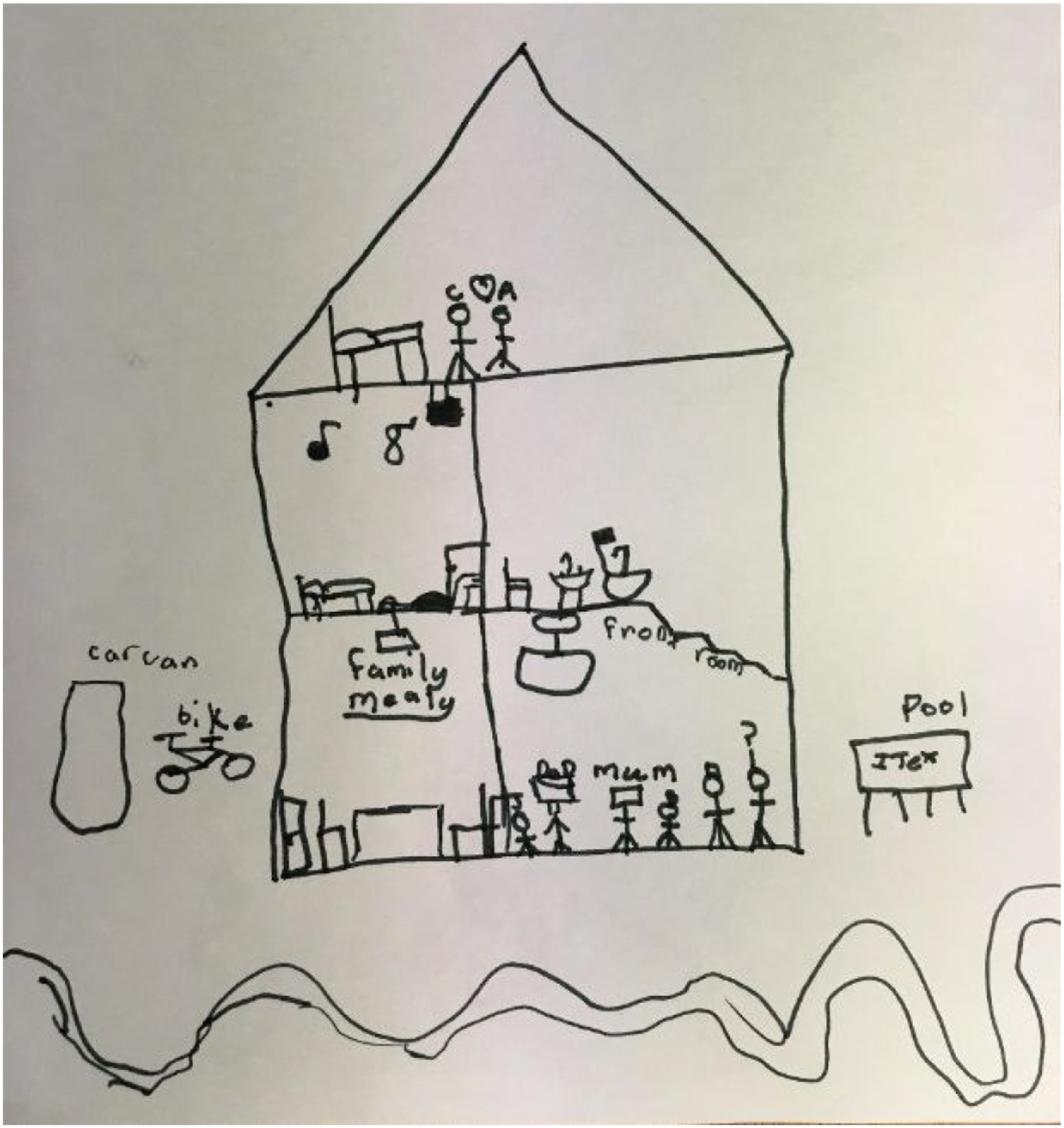
To try to overcome some of these concerns, I shared my personal background and experiences with families – my invisible tools (Reyes, 2020). These conversations often took place either prior to or during the interview, with a cup of tea in hand, and were important in building relationships with the families. For instance, I spoke to two mothers, a teaching assistant and a dinner-lady, who were very happy with their jobs as they fitted well around childcare commitments, meaning they could spend more time with their children at home. I shared with them that my mother did the same when I was growing up, working as a dinner-lady, and so I could appreciate the value placed on family life over career. Similarly, when participants shared stories about financial concerns, I could empathise as struggling for money was normalised during my childhood and subsequently as an adult in higher education. It was important to recognise the relationality embedded in the research process as I co-constructed narratives with participants. It was a reciprocal process, as Clendon (2007) explains in her work with mother/daughter dyads where she used a participatory interview style with participants, sharing information about herself with them. Through these kitchen table informal discussions, I was able to use my social capital and background to connect with families, bringing previously unseen elements of positionality to the fore. As this was achieved uniquely within each family interview depending on the context and conversational flow, the hybridity and transience of researcher positionality is highlighted as I navigated the private family home (Lichterman, 2017). It is hoped that sharing this information with families allowed them to see me as more like them as opposed to an intrusive, judging ‘other’.
In addition to sharing personal information with families, I employed other methods to help ameliorate perceived differences between us. The approach taken to family interviews was unstructured and ethnographic, as well as offering families the option of participating in creative techniques such as mapping and drawing. Some creative techniques used included asking participants to map out places they frequent in the community and things that are important to them inside and outside of the home; asking children to write or draw their aspirations; and asking participants to complete ‘suggestion clouds’ that showed what they liked/disliked about the community. The decision to keep interviews loosely structured was in part to attend to the unequal power dynamics between researcher and the researched, particularly when situated inside the family home. Using an unstructured approach gave autonomy back to the families who then had the space and freedom to shape research encounters. This loose approach alongside the above ‘kitchen table reflexivity’ (Kohl and McCutcheon, 2015) was conducive to the adaptability and flux in researcher positionality as each family interview differed. This allowed for reflection on positionality alongside participants as fieldwork unfolded, extending Kohl and McCutcheon’s original conceptualisation of ‘kitchen table reflexivity’.
Although it is impossible to ever be a complete ‘insider’, through using a variety of tools from the ethnographic toolkit in the waiting field, including informal conversations about personal background, I was able to connect with families over some of our common characteristics and experiences (Reyes, 2020). For a community such as Hiraeth where there was a clear scepticism towards unfamiliar faces in the community, using my in/visible tools helped to create richer data through shared experience, alleviating some preconceived assumptions participants may have held. Had I not been a white, working-class researcher, my experiences and the depth of data may have been different. Discussions around who can/cannot belong in the community were developed further in the final thesis which explored in closer detail constructions of place and place attachment (Folkes, 2019). Utilising my in/visible tools may have also helped to ameliorate ethical dilemmas ethnographic work often faces around researching the unfamiliar, exotic ‘other’ (Candea, 2018; Howell, 2018; Pennsylvania University, 2021). I discuss this further in the concluding discussion, highlighting the transience and permeance of the insider/outsider status.
Kitchen table reflexivity, in/visible tools and talk: Concluding discussion
Throughout I have explored my positionality in a multitude of ways: the influence of positionality on the research topic; kitchen table negotiations of geographical positionality; and the transience and situational nature of positionality when entering the family home. Importantly, I have discussed the omnipresence of positionality throughout the research process, from the very beginning and choosing the research topic, to the methodological choices made, analytical approach taken and theoretical underpinnings of the project. When conducting qualitative research, especially ethnographic research, there inevitably is an interest in situated meaning-making. What this paper proposes is that this be extended to include not only the participants, but the researcher, in reflection on their own positionality and how this varies across different social settings. It is only by engaging with positionality as in flux and relational that it is possible to move beyond ‘shopping list’ statements of positionality within methods sections of theses and research articles (Lichterman, 2017; Macfarlane, 2021; Reyes, 2020). Meaningful engagement with positionality in qualitative research avoids static and hollow positionality statements.
Developing the work of Kohl and McCutcheon (2015), this paper has used the notion of ‘kitchen table reflexivity’ to bring to the fore how positionality is shaped in talk during qualitative research. Although Kohl and McCutcheon argue this takes place with other researchers who are outside of the research, I have expanded this to include talk with participants in the field. It is here that researchers can draw upon their ethnographic toolkit of in/visible tools to develop rapport and relationships with participants (Reyes, 2020). The examples provided in this paper have drawn upon conversations during research encounters, as well as fieldnote observations, to demonstrate the transience of positionality as it plays out in different contexts. As family interviews were situated within the family home, most encounters began with a cup of tea and a chat before the interview ‘began’. This time gave the opportunity for participants to learn more about me beyond my visible tools on display, as well as giving me the opportunity to learn more about them. As Reyes (2020) notes, it is impossible to share all characteristics and experiences with participants, but by drawing upon our in/visible tools, we can strategically draw upon similarities as they become apparent.
Ethnography as a research approach, stemming from early anthropologic approaches, was centred around understanding outsiderliness and socio-cultural difference (Howell, 2018). As a comparative discipline, anthropology in particular is focused on understanding cultures and societies very different from ‘our’ own (Candea, 2018). Harnessing an ‘alien gaze’ and treating certain communities as an ‘exotic other’ has clear linkage to colonial and racist histories (Pennsylvania University, 2021). Contemporary ethnographers have attended to this critique by researching communities where they are members, exploring some of the benefits and challenges of insider research (for example, Mannay, 2010; McKenzie, 2015). As argued throughout, these simplistic notions of insider/outsider fail to recognise the transient and multifaceted nature of positionality. By using the concepts of kitchen table reflexivity and the ethnographic toolkit in this paper, I hope to have further emphasised the need to move away from insider/outsider binaries, as this dichotomy revives the notion that positionality is static.
Qualitative research is messy, complex and contradictory, echoing the nature of human behaviour. Yet when it comes to academic writing, this is often tidied up and presented in a linear fashion, leading to positionality receiving limited attention (Macfarlane, 2021). This paper has argued that positionality is not static or neat, as it is situational and relational, adapting over the course of the research. As such, it is crucial that positionality is engaged with not only in relation to methodology, but within wider theoretical and analytical writing. Kitchen table reflexivity and ethnographic in/visible tools are useful theoretical concepts to draw upon when reflecting on how positionality develops through talk throughout fieldwork encounters (Kohl and McCutcheon, 2015; Reyes, 2020). Qualitative researchers should be encouraged to employ these concepts in order to engage meaningfully with reflexivity throughout the research process.
Footnotes
Declaration of conflicting interests
The author(s) declared no potential conflicts of interest with respect to the research, authorship, and/or publication of this article.
Funding
The author(s) disclosed receipt of the following financial support for the research, authorship, and/or publication of this article: This research was funded by Cardiff University’s College of Arts, Humanities and Social Sciences ‘Investing in Excellence’ 1+3 doctoral scholarship.
