



Abstract
This methodological analysis traces the effects of the COVID-19 pandemic outbreak on two ethnographic studies in Chicago: a neighborhood fight for affordable housing, and an effort to increase local participation in the 2020 U.S. Census. We attend to the relationship between space and visibility after the onset of the pandemic as methodological and political challenges. Drawing on Haraway's seminal description of situated knowledge, this article explores the changes that the pandemic brought to our situated and partial perspective as ethnographers of political process. To do so, we present fieldwork from both studies before and after they became fully virtual. Finally, we discuss shared emergent methodological implications with a focus on embodiment in fieldwork, the dynamics of access, and the formalization of participation in online venues.
Keywords
Introduction
This article investigates the effects of the COVID-19 pandemic outbreak on two ethnographic studies involving political campaigns in Chicago—one a neighborhood fight for affordable housing, the other an effort to increase participation in the 2020 U.S. Census. When we designed our studies, we planned for fieldwork to primarily involve spatial copresence with our interlocutors. Direct and embedded observation would, we hoped, provide crucial insight into the emergent and evolving social processes and interactions that constituted the campaigns we were studying (DeWalt and DeWalt, 2011; Hammersley and Atkinson, 2007). However, this form of participant observation, predicated on a particular form of access to the field, was complicated by the pandemic.
At the time of the coronavirus outbreak, the first author had conducted 17 months of fieldwork while the second author was three months into her project. Thus, we both had experienced and benefited from prepandemic field access that anchored our transition into pandemic, online venues. We were presented with an opportunity to compare and analyze our methodological adjustments when the pandemic and subsequent lockdown in Chicago transformed the landscape for both the political campaigns at the center of our studies and for us as ethnographers.
We find that the relationship between space and visibility poses a particular methodological challenge in our studies. Our analysis therefore connects the challenges of the political campaigns—projects of visibility in their own right—and our ethnographic gaze. It is possible to thread these connections in part due to the virus’ extraordinarily uniform effects on social space. 1 To put it simply, what we could see and be part of as immersed researchers shifted as quickly and simultaneously for us as it did for our interlocutors in their political work.
In March 2020, following recommendations from the Centers for Disease Control, the City of Chicago, in line with Illinois Governor J.B. Pritzker, mandated that nonessential workers remain home for two weeks to slow the spread of the virus. What at first felt like a forced, short vacation for some turned into an indeterminate limbo of extended stay-at-home orders in an altered city. As our interlocutors scrambled to adapt their political activities to the new sociospatial circumstances, we adapted our own fieldwork alongside them. Since the outbreak of the pandemic we, as colleagues in the same doctoral program and as ethnographic researchers, have turned to each other for methodological reflection and support. Our reflexive analysis ranged from the introspective to the intersubjective while remaining attuned to the way power in our field sites was reshuffled through the pandemic (Finlay, 2002). This article is a product of those reflections. Unlike many researchers who experienced total disruption to their fieldwork from the pandemic (Staller et al., 2021), our projects continued in part due to the time-delimited, campaign-nature of our field sites. Because the campaigns we were studying were operating within a limited timeline and toward concrete goals with high political stakes, the actors at the center of our studies adapted their work to a virtual mode. As such, we were able to continue research in an altered, remote, and prolonged form.
Ethnographers and theorists have long challenged notions of fieldwork that suggest spatial proximity is necessary for meaningful encounter, that objectivity—a view from nowhere—is possible, and that disembodied knowledge is desirable (see Haraway, 1988; Jackson, 2013; Sunder Rajan, 2021). As Howlett (2022) recently pointed out, it is not online research that is new, but rather its necessity and the rapid nature of the methodological pivot that the pandemic brought to projects like ours—projects not initially designed with predominately online spaces in mind. Howlett (2022) argues that the pandemic has further problematized assumptions that colocation is necessary or realistic for engagement in field research. As we embarked on uncertain virtual fieldwork, though, we realized that our situated vision had shifted (Haraway, 1988). It is not the case that our field involvement before moving entirely to virtual media offered an impartial vision or that mediation was absent from our predominately in-person fieldwork. Rather than overly idealizing the “before” of our methods through comparative reflection, we aim to interrogate how our situated knowledge shifted with the redefinition of the field. How did the move from physical to virtual change our perspective? How did it limit or enhance the ways that we encountered our field sites and interlocutors? What did it reveal or conceal about the political processes at play?
In what follows, we present, in turn, fieldwork from two ethnographic projects. In doing so, we focus on experiences unique to each field site—a protest in a government building in one case and a car caravan seeking public awareness in the other—as well as features common to both of our studies (i.e., participation in meetings). We hold that the methodological challenges of pandemic ethnography are fruitfully explored in their contrast and overlaps. We conclude the paper with a discussion of some of the emerging methodological implications of these ethnographic experiences by focusing on three broad concerns: embodiment in fieldwork, the dynamics of access under pandemic conditions, and the formalization of participation in meeting interactions.
Fieldwork with community organizers
In this section, I explore the methodological challenges of conducting fieldwork in a community organizing campaign at the turn of the pandemic. I do so by drawing from two events that bookend the COVID-19 outbreak—a protest in city hall prior to the outbreak and online community meetings subsequent to the stay-at-home government orders. The effects of the pandemic on social space illuminated the consequential relationship between physical copresence and political activity by highlighting that the process of making collective political claims is: (1) in part a process of recognition, of being seen by the public, the state, and each other (i.e., other participants) and (2) a process buttressed by careful deliberation and collective meaning-making. Scholars have indeed recognized the need to incorporate an analysis of space in the study of social movements by considering relations of place and scale (Leitner et al., 2008; Martin and Miller, 2003). At the same time that this group's ability to be heard and seen politically was challenged, however, my own ability to observe and record its craft was also impacted. Also reshaped was residents’ ability to engage with each other and to conduct the necessary deliberation to strategize and make political claims.
I began fieldwork as a participant observer with the Obama Community Benefits Agreement Coalition (the CBA Coalition) in October of 2018. Interested in how coalition members understood their political situation, formed solutions, and strategically made their claims, over the following two years I participated in coalition meetings and joined activists in various public-facing activities including canvasing, press conferences, flyering, tabling, and various forms of protests (marches, sit-ins, traffic blocks). Composed of neighborhood-based organizations and Chicago South Side residents (primarily low-income Black tenants) the CBA Coalition sought to increase and protect existing affordable housing in Woodlawn, a neighborhood eight miles south of downtown Chicago. At the time, the area was experiencing a rise in residential displacement pressures in part as a result of the development of the nearby Obama Presidential Center (Institute for Housing Studies, 2018). The coalition's approach to community development involved relational organizing and disruptive protest (Alinsky, 1971; Smock, 2004).
One of the most high-profile and visible protests organized by the CBA Coalition—a sit-in at Mayor Lori Lightfoot's office—took place on 11 February 2020, just a few weeks before the steady news of a coronavirus crisis in China became a reality for life in Chicago. I was there both as a supporter and researcher (I am pictured second from the right in Figure 1). Chicago Mayor Lori Lighfoot was working on the introduction of affordable housing legislation and the CBA Coalition, its primary advocate, was trying a final push to make the policy as robust as possible. This protest was to be the culmination of a five-year campaign, or so we hoped. The following ethnographic moment illustrates the importance of access to a variety of social spaces and physical copresence to activists and me as a participant observer.
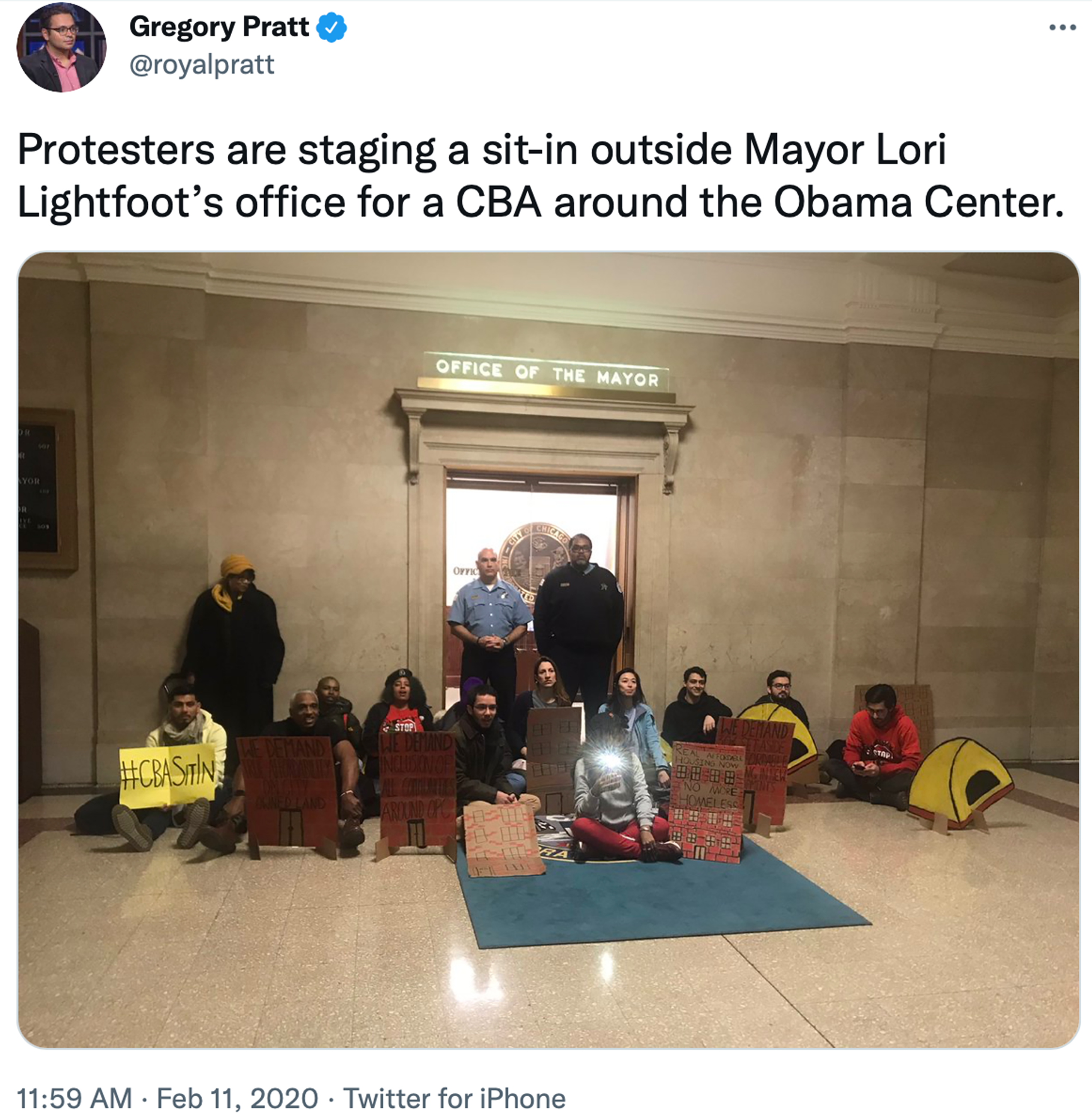
Tweet from Chicago Tribune reporter covering protest of the Obama CBA Coalition in Chicago City Hall on 11 February 2020.
11 February 2020 ethnographic vignette: We’ve told coalition members and supporters to assemble outside the enormous J.R. Thompson Center, across from City Hall, downtown at 11 on this cold February morning. While supporters and coalition members hang around, they find coffee and bathrooms inside the building's cavernous insides. Once the crowd reaches an impressive size and the media press becomes impatient enough, we hold a rally and lead a press conference on the building's large frontcourt. At the last minute, we reveal to the press and supporters that we plan to hold a sit-in protest in the mayor's office. On cue, a preselected group of us crosses the street and enters the Chicago City Hall building. We split into smaller groups to cram into the several elevators that take us to the fifth floor, the mayor's floor. As we step out of the elevators, we charge past a couple of police officers at a security check-point and make a beeline towards the large glass double-door entrance to her office. The objective is to block the entrance as swiftly and uniformly as possible so that any approaching law enforcement is unable to pick us off individually. We slide down onto a large rug hugging the entrance to the mayor's office and begin setting up cardboard signs and preparing chant sheets. As more police officers arrive and surround us, 50 or so additional supporters pour out of the elevators and fill the lobby with chanting. Among the crowd are several television cameras, microphones, and audio recorders, all capturing the scene that we have successfully staged in a matter of minutes. We have prepared ourselves to sit here until we are either arrested or the mayor negotiates with the coalition. To pass the time, we speak with reporters, argue with city officials, chant, live-stream our demands on social media, tell stories, joke, and read.
The protest caught the attention of the mayor as well as various media outlets throughout the day, including the Chicago Tribune, the most widely read newspaper in the city and one commonly read by political and business elites. It served a strong prefigurative function—it forcefully brought the “peoples’ business” from an outlying, poor, and Black neighborhood into the political heart of the city and disrupted the quotidian processes of City Hall. It forced elected officials to encounter people affected by the housing affordability crisis in the city. Indeed, one of the most important tasks of social movement groups is to make themselves seen and heard. Creating clear and directed collective political meaning in which problems and solutions are identified and a call to action comes through requires extensive discursive and extradiscursive work on the part of advocates.
Framing activity and the making of political claims are sometimes portrayed, implicitly or explicitly, as taking place in some abstract public sphere, or even more misleadingly as an individualized or atomic activity, as if it were something one can simply declare or Tweet. For marginalized groups, however, sending a press release to local media is often insufficient. They have to make themselves heard; they must force those in power to recognize them as a collective group. To interrogate, destabilize, or inflect a dominant political frame, and to be recognized as a legitimate political group, access to physical forms of social space over a period of time is necessary (though often not sufficient).
Through access to that space, members of the CBA Coalition and low-income residents of the South Side also reaffirmed their status as political subjects to each other. When activists were holding up phones to live stream, photograph, and record the protest (Figure 1), a double recognition of political subjectivity was at play. This propels community organizers and residents to continue their work once they return to their neighborhoods to speak with neighbors, recruit adherents, and make further claims.
Methodologically, joining the protest allowed me to experience directly how space and place are used in acts of political mobilization. I was also able to directly observe dialogue and power dynamics between coalition members and the mayor's office—processes that were otherwise often hidden behind telephone calls or emails. As a participant observer, furthermore, being part of such protest activities broadened my field access: I could identify new participants and later commiserate over the protest (“I was there, too!”) and then ask for an interview.
A few weeks after the sit-in, the pandemic closed Chicago City Hall to the public. The CBA Coalition was forced to limit some of its political activities including in-person meetings, public events, and protests. As the pandemic stretched on and we struggled to maintain communication, dread and anxiety began to permeate conversations: we were super close to the finish line, we were ON the finish line, lamented an activist during a phone call. 2 The virus was not merely prolonging the CBA Coalition's campaign for an affordable housing ordinance. It also made it difficult (and hazardous) to pressure elected officials, rally supporters in the neighborhood, and continue the arduous logistical and tactical work behind this community organizing campaign—activities that relied on various forms of flexible spatial copresence such as being in the same room, taking public transportation together, canvasing throughout the neighborhood, and standing close to each other to talk.
At the outset of the pandemic, I canceled all pending interviews and frantically read through my IRB protocol to determine how I could amend it to continue fieldwork in some way. Ethical considerations regarding me and my participants’ safety emerged, considerations that I never anticipated would be salient in my nonmedical research. Despite receiving the green light to continue research in an altered form from my institution's ethics board, anxiety began to take hold as I realized that I was losing access to spaces of physical copresence, and therefore to many of the social relations at the core of my research questions.
In the months following the outbreak, activists sought to approximate their prepandemic work by organizing virtual townhalls, sending letters and emails to elected officials, and making calls to the mayor's office. However, the new spatial conditions had dulled one of the core tools and strengths of the CBA Coalition's community organizing approach—their ability to organize poor people to physically disrupt social spaces and draw attention to their political concerns.
While it was clear that the capacity of CBA Coalition members to be politically seen and heard by the public and city government officials was affected, my ability to observe and record their craft was also impacted, particularly in community meeting spaces—a paradigmatic organizing venue. In the years leading up to the pandemic, for example, I had rarely observed coalition members opt for conference calls over in-person meetings to carry out their work, even in the middle of blustery Chicago winters. Major decisions on strategy, messaging, political demands, or focus were reserved for in-person meetings. Coalition membership was diverse along multiple axes of difference: it included older African American women who served in leadership roles in their buildings’ tenant associations, university students, Black professional young adults, and staff community organizers. In-person dialog and deliberation were valued because they were more universally accessible to members, and because they countered the social and economic fragmentation that can constitute urban life in Chicago.
When stay-at-home orders were issued by local governments, it felt absurd to connect with people via the internet who were only a few city blocks away, but the coalition soon turned to Zoom because it allowed for both video and phone call-in options. While those who tuned in through video could see and hear each other, those who called in could not always tell how many people were in attendance or who was speaking. I soon learned who owned a computer or a smartphone, who did not, and who did not feel comfortable using either.
As a participant observer, I began to worry that my experience in coalition meetings was not typical of all members’ and that I might systematically have access to some interactions over others. I wondered if participants were aware that meeting experiences were diverging, partly due to our new technologically-mediated interactions. Consider when Mrs. Reid, 3 an African American woman in her 70s, a tenant leader, and long-time resident of the South Side, joined a Zoom call via the phone line. As she joined, she stated her name, paused for a response, and upon hearing silence inquired impatiently, “Hello?!” I knew she was there, others who had joined via computer also knew, but joining the meeting on her phone, she couldn’t know who, if anyone, was on the call. Other Zoom software functions contributed to the diverging meeting experiences. Over time, members started using additional software features such as mirroring one's computer screen with other attendees and sharing internet links and documents through the chat function—material that would have been inaccessible to those who phoned in. This meant that some members were able to take a more prominent role in sharing and shaping political information.
To be sure, social experiences are always varied and inconsistent and power differences also permeate in-person meetings. However, this new form of community meeting complicated coalition member's objectives as well as mine. If the goal of meeting together is to engage in as much collaborative meaning-making as possible, so that people may make claims collectively, being technologically and systematically unable to view the meeting agenda on a screen, for example, or the list of elected officials we plan to contact, or the calendar of upcoming social media postings, worked to widen political disparities within the CBA Coalition. For me, it cut off access to part of the group, which was now differently defined by the various features of the Zoom meeting software. As a researcher, being able to view some people's facial reactions over others made me worry I was missing vital group interactions.
Though I typically logged on to Zoom meetings with video software on my computer (so that I could see other participants, screens, and the communal chat box) I once elected to tune in exclusively through the phone line. The “other” meeting, the one taking place among individuals who had access to the software, seemed to unfold at a different, faster, and untraceable pace: people were replying to others’ comments almost simultaneously through the chat box function, even through the use of a handful of available emojis (thumbs up, thumbs down, smiley face, etc.). Again, it is not unusual for overlapping exchanges to unfold in a social gathering or to have multiple discussions within a meeting, but pandemic meetings offered different contours of communication— depending in part on who you were and what technology you had access to. It was more difficult to contribute to the conversation when I phoned in because, in that instance, I could not see or really understand the contents of the shared screen (despite others’ best attempts to describe it for those of us who had phoned in). Most distracting of all, and unlike prepandemic meetings, everyone on video had simultaneous access to the internet and could reference and search the web while those of us who called in using a regular telephone were stuck staring at the receiver. Over the next few months, the CBA Coalition continued to adapt and experiment with the new form of pandemic meetings.
Making census counting visible
Despite its misleadingly simple objective, the U.S. Decennial Census has always been a deeply political and contested project (Anderson, 2015; Bouk, 2022). The population counts produced by the census are used to distribute federal funding, allocate congressional representation, redraw political boundaries, and contribute to public and private research. Before and throughout the 2020 Census, the Trump administration worked to depress census participation—infamously attempting to add a question about citizenship to the form. 4 Concern about a severe undercount, and its implications for resources and political power, mobilized local elected officials, civil rights organizations, community organizations, policy workers, and social service providers in a coordinated effort to reach groups they expected to be at risk of being undercounted. Community and local government mobilization is not new to the census, but well-placed worry about undercounting and the Trump administration produced an effort of staggering scale. I was only three months into full-time fieldwork following this counting campaign in Chicago when the pandemic transformed the social space of the city.
It was in early March of 2020 that online self-response to the census questionnaire was set to open. Funding had been allocated to organizations across the city, early outreach had begun, and I had been attending training and organizing my fieldwork around local government and coalition census working groups, neighborhood complete count commission meetings, parent events at Chicago Public Schools, and door-to-door canvasing days. The organizations involved in boosting counting across Chicago varied in terms of size, budget, services provided, and mission, but, alongside robust social media outreach, at the heart of their efforts to avert an undercount was in-person interaction, and, accordingly, the sense that Census Bureau mailers and digital advertising would not be enough. Their census plans included hosting neighborhood events, having computers and drop-in hours for census questionnaire assistance, knocking on doors, integrating census information into their classrooms and service-provision centers, setting up a table at a local public library or grocery store, speaking at religious institutions and training their own volunteer networks to further spread the word about the importance of the census.
When the COVID-19 pandemic caused the loss of those shared social spaces and the prospect of in-person interactions, the counting campaign faced an unanticipated challenge: how to make the census and its counting visible to those they feared might not participate. 5 Door knocking was replaced with calls to organizations’ member lists, Twitter thunderclaps were designed to get census hashtags trending on Chicago twitter (and thus, visible to more people), and rallies and in-person events became virtual live streams on Facebook. I built out a “tweet deck,” ready to follow Twitter thunderclaps and track posts using certain census hashtags, and found new field sites: phone calls, virtual meetings, live streamed rallies and events, and circulating media and advertising. The digital communication infrastructure that had already been planned as a key part of census outreach could indeed bring information about the census to millions of people, but could it really counter mistrust for historically undercounted groups? Could it really persuade the people that the campaign most worried would be excluded from the count and would not otherwise respond?
Those questions posed by the campaign mirrored my methodological insecurities, which nagged at me throughout this new mode of research—as I tracked the campaign through my computer screen, was I really a participant observer any longer?
In one sense, participating via the screen was apt for some of the absurd spectacles that arose around the census count in the summer of 2020. Take, for instance, Mayor Lori Lightfoot's census cowboy—astride a horse, toting a census flag, promising to travel both the streets of neighborhoods with low self-response rates as a physical icon and, perhaps primarily, to draw attention on social media (Figure 2). I watched the summer press conference that introduced the cowboy on a Facebook live stream, exclaiming in surprise to my kitchen when Mayor Lightfoot donned a lime green cowboy hat she had hidden in the podium. The audio and then the live stream cut off as I craned to get a short glimpse of the more casual dialog and hand-shaking after the press conference had concluded—the shift in the register after the regimented formality of a press conference was something I usually found illuminating.
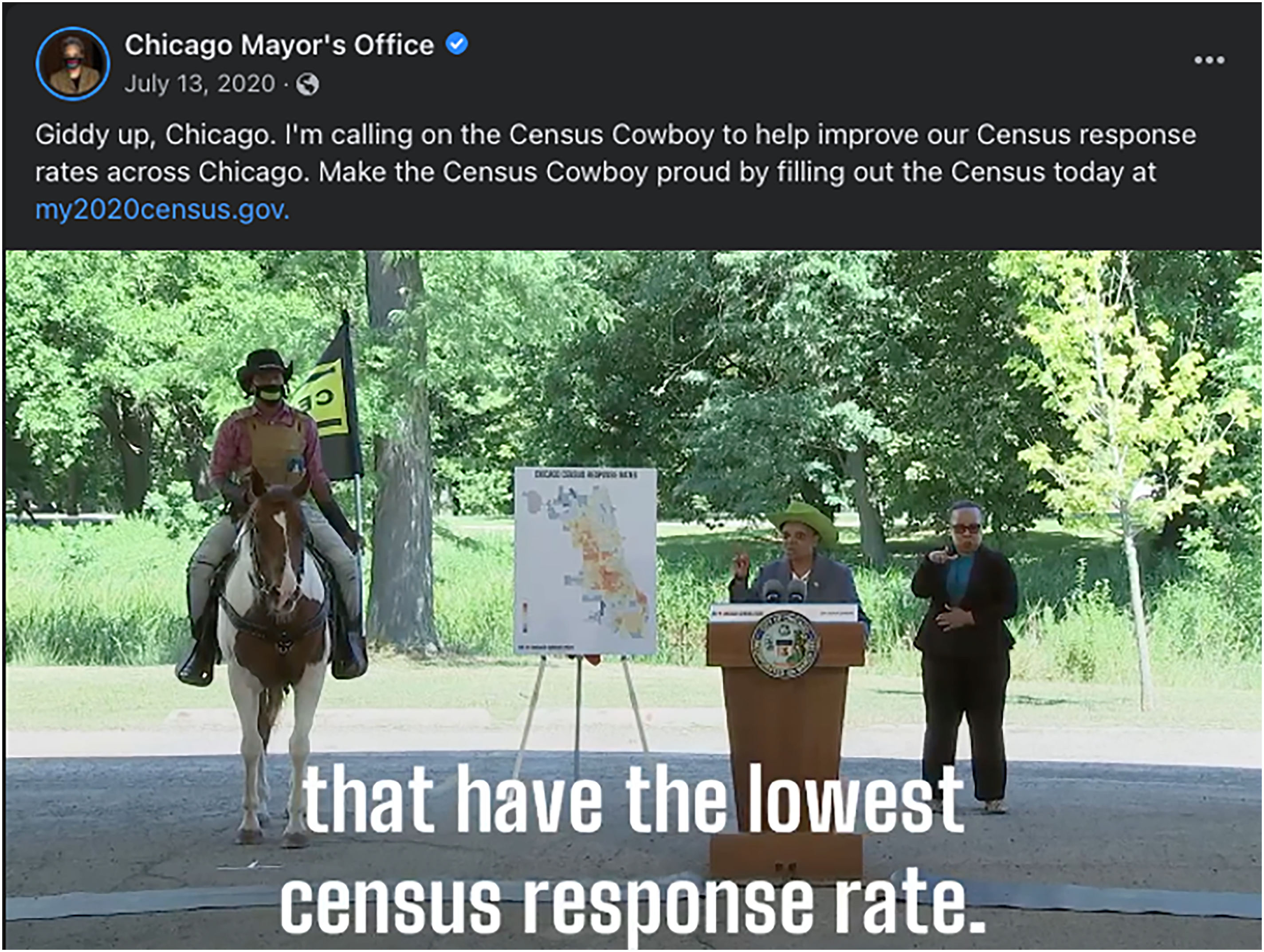
Live stream of Chicago Mayor Lori Lightfoot's press conference introducing the census cowboy—visible on the Chicago Mayor's Office facebook page. Screenshot by the second author.
During the summer of 2020, if you lived in a neighborhood where counting outreach was planned and had been sitting on your porch or looking out of your window, you might have seen a long line of slow-moving cars painted with “Census 2020!” and adorned with posters, balloon arrangements and streamers, horns blaring, and someone shouting from a rolled down window on a megaphone. One Chicago area caravan included a mini school bus, and another a police escort. On “Illinois Immigrant and Refugee Census Day,” at least six of these caravans snaked through Chicagoland neighborhoods.
Javier, an organizer at a small community organization with funding for census outreach discussed the challenge of competing for people's attention amidst the pandemic. The caravans, he explained, are high energy, full of positivity. … It does have an impact on how you’re feeling. He saw these caravans as a powerful way to ignite action around the census and convince people to participate. After the early weeks of isolation in the spring of 2020 Javier described the almost euphoric sense of collective action entailed in physically driving around the neighborhood, with people emerging from their houses and waving as they went by. Even if census caravans, and the Census Cowboy, indicated that it was important to continue to move through shared social space, they were also intended to travel further than their physical miles—to be recorded on phones and tweeted out, and ultimately picked up by local news media. And so it was that I encountered them, consistent with the IRB protocol I had reconfigured to be able to continue some fieldwork in a virtual mode, as an observer on a Facebook live stream and through Instagram stories.
Though they were indeed designed to move through virtual space, these attention grabbing agenda-setting efforts seemed to suggest that physical co-presence in shared space (driving, or riding, down neighborhood streets) is an irreplaceable site for visibility. It was not only this more spectacle-driven counting outreach that ultimately returned to shared physical space. The efforts by the campaign across Chicago to transform census outreach into a virtual mode were tireless and impressive. Before long, however, they had tapped out call lists, and it was unclear if the latest virtual rally on Facebook was reaching more than a couple of dozen of the same sort of viewers (this ethnographer included). Thus, in addition to the neighborhood car caravans, the census campaign added census tables at socially distanced food distribution events, tabled with iPads in front of grocery stores, and incporated census outreach in other essential services that had adapted to pandemic conditions and resumed in-person. My fieldwork at the time remained virtual-only, meaning that I followed this return to in-person outreach through the virtual meetings where it was planned or discussed, the occasional live stream of an in-person event, and the visual and textual material circulated before and after events.
Jaqueline, another neighborhood organizer focused on census outreach, talked about the importance of being in-person to both capture attention and gain the trust necessary to convince people who are hesitant to fill out the census form: I think that that has been the hardest job because you can call someone, but as soon as they get tired they can hang up on you, they don’t have to keep listening. If you will post something on Facebook, no one has to read the whole post. … in person is so different because even if they walk away, I can keep walking with you. I will follow you to your car. You can be more aggressive …. Again, I think its different too because on the phone, even though you can hear emotions and stuff it's so different to feed off someone in person. You can trust them more when you see them in person it's like, ‘trust it, or watch me fill mine out so you can see how easy it is.’ This is different.
Jaqueline suggests that being in a shared space facilitates trust and emotional connection, and prevents people from easily dismissing attempts at outreach.
The pandemic substantially shaped my sense of the core work of counting and political process, further deepening and centering issues of visibility, communication, and trust. At the same time, I struggled with the ways my own partial vision had shifted. I felt this particularly as the government meetings key to my fieldwork moved from in-person to virtual. Prior to the onset of the COVID-19 pandemic, the Cook County Complete Count Commission (CCC), met in the Cook County Board Room on the fifth floor of the County Building—one half of the building that also houses Chicago's City Hall. In early January of 2020, with census anticipation building, the gold elevator doors were adorned with census materials in the respective styles of the City of Chicago and Cook County's distinct census campaigns, suggesting which set of elevators belonged to which division of local government.
Not so tangible to the observer once the CCC was forced to meet virtually during the pandemic, the Board Room encoded the formal structure of its meetings, categorizing attendees’ roles in the physical meeting space. Perusing the ovular room from the double-doored public entrance, you could see the wood sectioned-off press box with a swinging entrance gate on the immediate left and the theater style rows of curved seating that make up the public section in the back, more dimly lit and sans microphones. At the far right of the room stood a lectern for guest speakers and public comments, in the center-front a section of cushy high-backed rolling chairs and microphoned desks intended for commissioners, and at center stage a curved wooden panel table in front of a large Cook County seal. It is there that Chairman Moore and the other co-chairs typically sat: Cook County Commissioners Deer, Arroyo, and Anaya. Occupying a theater-style seat in the public section, I was an observer. Vocally participating in the meeting beyond the occasional hushed side remark to someone sitting nearby would have been a violation of the roles formalized by the space. My fieldnotes from in-person meetings were more readily attentive to the spaces, objects, and interactions in the room that drew interest—facilitated perhaps by the way that my physical presence prompted a different cognitive attentiveness (Schulte-Römer and Gesing, 2022).
In May 2020, I was in my apartment attempting to stream the first virtual CCC meeting after the lockdown. I spent the first ten minutes after the listed starting time staring at a screen that proclaimed: “The live event hasn’t started.” This screen, and the many I would come to stare at over the following months of virtual fieldwork, felt like theatrical curtains—reminders of what I could not see. As I refreshed the page, I imagined the usual premeeting activities I had come to expect of in-person commission meetings that often started late: the slow filtering of people into the board room well after the meeting start time, staff members for different commissioners engaging in conversation in low voices, a wave or greeting directed at others I knew in the audience, the security guard chatting with someone sitting in the press box, and stuffing my Chicago winter coat into an adjacent folded theater seat.
I grew uneasy that I might be missing something—was I absolutely sure that this was the right link? Had I refreshed the page? Should I download the Microsoft Teams app instead of using an internet browser? When the meeting did finally appear, it immediately became clear that they were experiencing all sorts of technical difficulties in this first attempt to publicly live stream the monthly meeting. With only a few people visible on video, and audio coming through occasionally from people I couldn’t see on screen, someone named Jeff was trying to sort out the technical issues and indicate to Commissioner Moore whether he could proceed. It was unclear if they knew that the live stream was working at all, leaving me feeling especially voyeuristic. Jeff explained that “the difficulty is the public nature of it”—the version of Microsoft Teams that had been working for their general use did not seem to be well suited for the added step of public live streaming. Jeff could then be heard in the background: fuck! [sound of someone answering a phone call] yeah, I’m doing great! [voiced sarcastically] shit!
And then from another invisible speaker: [Jeff] you are … uh … not muted.
The meeting never started. They eventually decided to recess and reschedule.
I learned never to close out of an internet browser tab or turn off a recorder until a live stream had been shut down as breaks in the register of virtual public meetings were prone to pop up in periods of transition. The pandemic-era comedy of public meeting tech errors that characterized this initial attempt aside, future smoother virtual CCC meetings would continue to relegate any public participants (nonmembers of the commission) who might have sat in the back of the board room to live stream viewers. In many ways, this further formalized my already coded observational role in “the public section.” Though meeting participants might have been imagining and hailing a public viewer, the immediate interaction was unidirectional. If public viewing in the board room had functioned like a theater, I now felt more like I was watching a TV episode or live news segment unfold (though not without its stumbles in form). Every census “working group” meeting or public commission handled the transition from in-person to virtual meeting space differently—I shifted from participant-observer to observer according to meeting group, mediating technology, and meeting norms.
We turn now to a joint discussion to elaborate on and synthesize our methodological reflections in dialogue.
Discussion
We started this article by raising questions about the methodological implications of the pandemic on our ethnographic fieldwork. The surprise change or sudden pivot in ethnographic projects is a long-echoed refrain; one that we are trained to anticipate (Kumar, 2020). And yet, the pandemic introduced changes far more encompassing than what we could have anticipated. Practically, the pandemic shift did teach us much about the objects of our studies, as the refrain goes. The move to online communication illuminated how much of political activity, both among “insider” government and nonprofit circles and “outsider” community mobilization, relied on and made use of various forms of spatial copresence, as well as how much our own fieldwork relied on this access. Theoretically, we found ourselves facing changes of such tremendous proportion at the turn of the pandemic that they prompted a broader reflection on method. While this article focuses on our methodological adaptations, it is worthwhile to remember that researchers across the world, employing a variety of qualitative methodologies, were impacted by the pandemic both personally and professionally. Our very ability to adapt and continue our research safely was not an available or accessible option for many of them. For one, we did not have to unexpectedly relocate—we were conducting research in the same city where we lived. We were also following political actors who decided to move their activities to virtual spaces, making it possible for us to continue research in an altered and prolonged form. The pandemic's universal disruption of people's lives and research, and its potential long-term consequences, merit reflection beyond the assertion that all research involves adaptation and change.
Adapting to remote fieldwork presented a host of anxieties for us as participant observers: What were we missing? Would we be able to grasp what we experienced before, or would we have to shift our ethnographic focus? Would we be able to observe enough or at all?
The shifts in our vision and situatedness in virtual fieldwork changed our position as participant observers. To be sure, the balance between being a “participant” and “observer” in fieldwork can vary depending on the interaction and design of the study (Gold, 1958). We were, to varying degrees, participant observers and observers at different points and in different spaces during fieldwork well before the pandemic. But, as virtual fieldwork brought more formalized roles for participants in meetings and events, we found ourselves and some of our interlocutors to be in increasingly observational roles.
In acknowledging the host of concerns and anxieties introduced by the pandemic, we do not mean to suggest that we could unproblematically “see” in the prepandemic field, however. In many ways, the changed nature of our methodological vision underscored what is always true: perspective is situated and partial. As John Jackson (2013: 14) writes, “thick description, in a sense, has always been thin.” His critique of self-satisfied “thick” descriptions is an apt reminder of the danger in romanticizing what prepandemic fieldwork could “capture,” and the “romantic, authorial presence of the fieldworker, an ideological inheritance that is both colonial in provenance and masculinist in its ideal-typification of the ethnographer” (Sunder Rajan, 2021: 24). In her seminal contribution to feminist epistemologies, Donna Haraway reminds us that we should seek to understand knowledge- and meaning-making as “politics and epistemologies of location, positioning, and situating, where partiality and not universality is the condition of being heard to make rational knowledge claims” (Haraway, 1988: 589). We are all positioned in difference, and it is through this difference that we must work toward knowledge and communal projects. Our ethnographic vision was partial and situated both before and after the onset of the pandemic.
At the same time, we are not espousing a radically relativistic notion of fieldwork—online proximity was different than in-person encounters and we did lose access to some spaces and social relations. In large part, this is because our field sites were originally designed to encompass in-person engagement. A virtual ethnographic project, for example, might have experienced a different type of, or degree of, pandemic transition. In the rest of the discussion, we explore how the pandemic altered our roles as participant observers and changed our situated vision by reflecting briefly on three broad concerns: embodiment in fieldwork, the dynamics of access under pandemic conditions, and the formalization of participation in meeting interactions.
Embodied participation
The situated knowledge that comes from ethnographic fieldwork is not only socially situated (i.e., influenced by our race, class, gender, and various other axes of difference) but also entails the embodied nature of being somewhere, participating and observing (Vacchelli, 2018; Young, 2005). Though it is tempting to overlook the embodied nature of virtual fieldwork relative to its more obvious experience in spatial copresence, remote ethnography still brought many reminders of its qualities of location. Neck cramps at apartment desks as we refreshed a webpage, screen headaches, boredom in endless page doodles, or the journey from link to link searching for a meeting live stream. Albeit not travels through downtown Chicago, to the Cook County Board Room or staging a sit-in protest at the mayor's office, these experiences were nonetheless embodied ones. And to be sure, as our interlocutors transposed their political work to virtual spaces, they no doubt felt many of the same effects of Zoom meetings and live streams. It was at times hard to remember, logging onto Zoom from inside our apartments, that this was still fieldwork. The experience was different: sometimes more boring, more anxious, more difficult to differentiate, and in some ways more comfortable and convenient. Online engagement does entail a different “attention ecology” (Citton, 2017, as cited in Schulte-Römer and Gesing, 2022). These experiences formed the new contours of our access and visibility, as we discuss in the next section.
Access and visibility
When the pandemic broke out, we were concerned that our field access would be foreclosed, in part by our own lack of visibility as researchers. Gaining and maintaining access to the field is a core concern in ethnographic research. A lot of time and energy is invested in negotiating access by building rapport, convincing the main “gatekeepers,” and identifying core interlocutors. Access, along with consent, is an ongoing process rather than a one-time event (Klykken, 2021). The hope is that one's presence will not overly interrupt the activities of those with whom we interact while still maintaining the visibility as researchers necessary for both access and consent. Being in-person often facilitates this process, especially with interlocutors who work in fast-paced, demanding political fields, often in a state of crisis, with a perpetually full email inbox, or for those who do not have regular access to email at all.
When we took up virtual fieldwork, behind computer screens, changes to our participant observation also impacted our ability to negotiate access (Schulte-Römer and Gesing, 2022). On a very basic level, our visibility changed as interlocutors were not always able to see us or recognize us in online spaces. This was particularly true in cases when we attended live streamed or webinar-style events, which were unidirectional interactions where we could see presenters and speakers but not other attendees. Nor could presenters or speakers see us since the software settings were deliberately configured as such. What were the implications for both access and consent if we could not be seen at all? We could not approach speakers or attendees after the conclusion of the event to pitch an interview. On the other hand, interlocutors might have been more easily able to distance themselves from our studies if they preferred.
In some virtual ethnographic fieldwork, mediated approaches might allow a researcher to extend their field site and even move away from a more bounded notion of the field (Howlett, 2022). Virtual fieldwork did bring a host of rich audiovisual data to our projects. It also made access possible to events happening far from Chicago, prompting us to think carefully about how and where to bound our field sites in the virtual realm. At the same time, our fieldwork became increasingly event-bound as the pandemic complicated access to informal interaction.
Formalized participation
Schulte-Römer and Gesing (2022) bring attention to the different infrastructures of virtual events and the methodological challenges of event ethnography in hybrid and virtual fieldwork. Amid the numerous genres of events in both of our ethnographic field sites and the political campaigns, the meeting played an essential role before and after the start of the pandemic. Part of what attracted us to our respective topics, in fact, was the vibrancy and richness of political meetings in different spaces in the city. Because meetings played a key role in both of our projects and were substantially altered by the pandemic, they proved a fruitful site for reflecting together on the methodological challenges that we faced. As has already been evident in our examples, after the start of the pandemic in-person meetings—a hallmark of political activity (Polletta, 2002)—and other events in government offices and neighborhood spaces were initially postponed and then transferred to various forms of video- and phone-conferencing, including phone calls, FaceTime, Zoom, Skype, Google Meet, Microsoft Teams, WhatsApp, and GoToMeeting. The Illinois Open Meetings Act was amended to permit remote meetings, a contingency not yet codified into law. Access, as explored above, was directly tied to the different socio-materiality of in-person and virtual meetings, and similarly varied across these technological platforms (Schulte-Römer and Gesing, 2022).
The types of meetings that made up these campaigns differed. The CBA Coalition meetings were semiprivate in nature and informal; they were a community space where neighbors and friends met to strategize and mobilize politically. The Cook County CCC was a government body, ostensibly public, though generally frequented by those already heavily involved in census work: commission members, civil rights advocates, policy professionals, and reporters. While meetings to various degrees can already be spaces of formalized interaction—the Cook County Board Room being one example—these various remote technologies further formalized meeting interaction and participation.
The newly formalized meeting not only further codified our roles as sometimes participant observer, and sometimes observer, but also affected power imbalances and roles for many of our interlocutors. In the case of the CBA Coalition, some meeting attendees no longer had access to the same meeting experience as others. In government census meetings, already delineated roles resurfaced or deepened in some capacity in their virtual forms: virtual public speakers were automatically muted after their allotted 3 min, live streams prevented in-meeting interaction, and in some cases, public speakers had to email in advance if they wanted to speak at all during public comment. The degree to which meeting participants could see other attendees varied in both of our projects, depending on whether the participant was calling in or whether the technology allowed them that access. As Schulte-Römer and Gesing argued, “in virtual events, the socio-material aspects of infrastructuring can be even more powerful” (2022: 9).
Although power differences became more palpable or meaningful in our meetings in some ways, it was not because these dynamics were absent prior to the pandemic. It was always the case, for example, that Mrs. Reid, the senior tenant leader, had limited access to a computer and the internet, but this did not become visible—it didn’t become meaningful—until the virus changed Chicago. The degree to which we were participant observers or observer participants also varied based on the virtual technology. For census counting, the Illinois Department of Human Services Census Advisory Panel, which used to meet in a bland conference-style meeting room on the top floor of the sparsely populated Thompson Center shifted to using “GoToMeeting” software. Unlike the Cook County meetings described above, public attendees were in the meeting software and thus had the ability to turn on their video or microphone and interrupt the meeting. While in theory this allowed for more participation than the Cook County live stream, the second author kept her video off like most other attendees who were not speakers or elected officials, replicating the role of observer.
Conclusion
Reflexivity is always ongoing in fieldwork, but the intensity of the shifts brought by the pandemic imposed a radically different questioning of ourselves and our projects. The reconfiguration of our ethnographic vision—the reshuffling of our and our interlocutors’ situatedness—undoubtedly made different aspects of all of our positions more and less salient. These developments came about in part due to the redefinition of field boundaries at the outbreak of the pandemic, a process that we are still accounting for in our (post-)pandemic world and research.
Online qualitative and ethnographic research long predates the 2020 shutdowns. However, the proliferation of virtual software, and its increased incorporation into organizational and government activities as a result of the pandemic, likely means that research projects will increasingly adopt online venues in a variety of forms. While we are still teasing out the methodological implications of our altered positionality—our differently embodied sense of fieldwork, our transformed visibility in our field sites, and the formalization of participation roles—we can extrapolate some implications of the pandemic and its transformation of social space on future qualitative research.
There are important ways that virtual fieldwork might increase accessibility, comfort, and even safety for some researchers and interlocutors, due to, for example, disability, geography, or caregiving demands. Future fieldwork will also necessitate careful ethical considerations, particularly around consent in virtual and primarily observational spaces. Consent is an ongoing process that, at times, relies on the ability of participants to see or note the researcher, reminding participants that they are being observed. Future research should consider strategies to maintain an active and ongoing consent process in virtual contexts where the technological innovations of video-chatting software (e.g., being able to call into a meeting, watch a live stream, or host an event in a webinar mode) result in different forms of visibility for both researchers and those being researched.
Further, our ethnographic accounts highlighted some ways that power differentials deepened as virtual software encoded the roles of attendees and curbed some attendees’ participation. It will be important for researchers to attend to the ways that power hierarchies persist or transform in a virtual environment that might otherwise present itself as flat or as welcoming to all interested participants. This could involve, for example, diversifying the technology we use to access virtual events as researchers, tracing the way that the capabilities of different virtual software are used to codify participant roles, and advocating for more meaningful public access in virtual government meetings.
Ultimately, interlocutors in both of our studies chose to resume in-person activities once it was safe to do so, in some cases arguing that they could not fully replicate their core political methodologies in online spaces. They shared questions and concerns about the way their political work was hindered, or at times facilitated, by virtual technology and the lack of physical copresence that characterized the early months of the pandemic. We look forward to future work that considers not only how remote qualitative research is altered methodologically, but also how its participants make meaning of their own activities or projects in transformed virtual spaces.
Footnotes
Acknowledgments
We would like to thank Daniel Listoe, William Sites, and Emily Claypool for their thoughtful engagement with earlier versions of this article—its shortcomings remain our own. We are also greatly indebted to our research interlocutors for welcoming us into their political work and sharing their time and thoughtful insights. We gratefully acknowledge funding support from the University of Chicago Crown Family School of Social Work, Policy, and Practice.
Declaration of conflicting interests
The authors declared no potential conflicts of interest with respect to the research, authorship, and/or publication of this article.
Funding
The author(s) disclosed receipt of the following financial support for the research, authorship, and/or publication of this article: This research was funded in part by the Crown Family School Dissertation Research Grant, the Mansueto Urban Doctoral Fellowship, and the Center for the Study of Race, Politics and Culture at the University of Chicago.

Notes
Author biographies
Tadeo Weiner Davis studies neighborhood mobilization of communities responding to urban development processes that increase the risk of resident displacement, neighborhood gentrification, and the privatization of public goods. As such, he is also interested in how the dynamics of race, class, and power interact, materially and discursively, at the local level. He pays particular attention to the political strategies developed by low-income residents, especially in regard to their framing, messaging, and discourse, and how these relate to their understanding of their political situation.
Hannah Obertino-Norwood is an ethnographer who studies political process and policy implementation in the U.S. She examines the relationship between immigrants and the state and the affective and political dimensions of counting and quantification. Her research brings together social work, sociocultural anthropology, and science and technology studies through qualitative study of the 2020 Census and Chicago-area efforts to avert an undercount. She focuses on the activists, elected officials, organizers, and service providers engaged in enumeration and their contention with the Trump administration over questions of trust and visibility.