




Abstract
This interdisciplinary Research Note is a reflection on a community-engaged qualitative research project that sought to integrate feminist and anti-racist principles. This Note reflects on a community-engaged project, Park Perceptions and Racialized Realities, with racialized and underserved communities to examine experiences and health equity in public urban greenspaces in Toronto, Canada. Inspired by the photographs and stories of the residents who participated in the project, the author explores what it means to move off the paths commonly travelled in research, using desire lines as a metaphor for what it means to conduct interdisciplinary research in partnership with communities, tending to both processes and outcomes with care and thought. By unpacking the words, ideas and concepts of other feminist and anti-racist scholars, the author examines the alternate paths sometimes required of qualitative research and the embodied experiences of being both insider and outsider in conducting community-based participatory research.
Keywords
Introduction
In outdoor spaces, ‘desire lines’ are those unofficial paths, worn into grass, dirt or snow, where people meander despite the efforts of planners to guide their paths. Borrowing this term from landscape architecture, Ahmed (2006: 570) describes ‘desire lines’ as the alternative ‘unofficial paths, those marks left on the ground that show everyday comings and goings, where people deviate from the paths they are supposed to follow’. In qualitative research, desire lines often need to be carved as well: walking beside participants rather than in front of them, resisting institutional structures, weaving through disciplines and letting the landscape guide us. These desire lines in qualitative research can be theoretical, methodological and/or practical in nature. My own embodied experiences across place led me to begin the Park Perceptions and Racialized Realities project, which formed the basis of my dissertation (Hassen, 2023). This research, a photovoice and photo elicitation exploration of racialized residents’ experiences in public urban greenspaces in Toronto, Canada, was shaped by feminist ethics of care, anti-racist principles, negotiation and reciprocity. What emerged was not just data, but shared space, and new ways of understanding place, health, self and the approach to research itself.
When I first encountered the words of Black and Brown feminist scholars, it felt like an echo I had long been waiting to hear, helping me name, feel and make sense of how my intersecting identities influence my everyday realities (Ahmed, 2017; hooks, 1989; Lorde, 2012; Piepzna-Samarasinha, 2018). I am a racialized woman, a first-generation Sri Lankan immigrant, and settler who migrated to Canada as a teenager. I am now a Canadian citizen. Coming to terms with these layered, hyphenated identities has shaped how I understand place and belonging. My interdisciplinary academic path, weaving architectural design, public health and environmental studies, intertwines with a lifelong yearning for nature, perhaps shaped by growing up in dense urban environments. I spent my childhood in the United Arab Emirates, where I lived in an apartment with little access to natural environments. Access was further complicated by my identity as a young woman, restricted by deeply embedded, mostly unspoken, issues of misogyny that made many public spaces feel unsafe. Since moving to Toronto, I have found greater freedom in exploring parks, ravines and greenspaces on my own, especially after a cancer diagnosis in my twenties. As I learned to navigate life with chronic symptoms, I deepened my relationship to nature as spaces of healing, refuge and reflection. But even here, questions of belonging, safety and access remained.
In this journey across the world and in trying to find a sense of place and belonging, my migration story mirrors those of many others while also standing in stark contrast to those who were forced to move through slavery, genocide and colonization. This multitude of stories and journeys weave messy, contextual realities with varying levels of choice, autonomy and opportunity. From this positioning and place, combining my interdisciplinary academic pursuits and my lived experiences, I formed the Park Perceptions and Racialized Realities project to examine how intersecting social locations and social structures impact how people navigate and use public greenspaces.
Research project
The project used a community-based participatory action research (CBPAR) approach and visual methods (i.e. photovoice and photo elicitation) to explore how racialized residents (i.e. community members) in two underserved neighbourhoods in Toronto, Canada experience, navigate and use their local public greenspaces. This study was done in collaboration with two community organizations, the Jane/Finch Centre and the St. James Town Community Co-operative, with whom I had several conversations about how this work aligned with their interests. The full details on the project methodology have been published in a book chapter (Hassen and Flicker, 2025). Briefly, 18 racialized residents from two Toronto neighbourhoods took part in the study as resident photographers. Each participant visited two local greenspaces and responded to guided prompts by taking photographs that reflected their experiences and perspectives on themes such as access, safety, health and wellbeing (Wang and Burris, 1997; Wang and Hannes, 2020). Following these visits, each resident photographer engaged in a one-on-one photo elicitation interview with the author to reflect on their images and share personal narratives about navigating public greenspaces as racialized individuals (Horn and Casagrande, 2024). The project embraced a collaborative analysis process, bringing together community members, community advisory group members and academic researchers to interpret the photographs and stories. This collective ‘sensemaking’ surfaced several central themes (Hassen et al., 2022). Residents from both neighbourhoods highlighted persistent structural and systemic barriers that shape how racialized communities access and engage with greenspaces. These conversations extended beyond the greenspaces themselves, offering insight into broader social inequities (Wojnicka and Nowicka, 2024). While rooted in two specific communities, the findings resonate with experiences shared by racialized residents across Toronto's underserved and marginalized neighbourhoods. As part of the community-engaged approach, knowledge mobilization was an important aspect of the project resulting in several co-created products, a visual community report that was widely disseminated, community events, engaging photo exhibits, media uptake where community members spoke about neighbourhood issues, as well as meetings with interest holders and municipal staff to highlight community recommendations for policy and action.
In imagining what truly co-created, equitable and just greenspaces might look like, several ‘desire lines’ emerged as insights inspired by the photographs and narratives of the residents in the research project and my own reflections. Here, I highlight several meanderings, grounded in the voices and writings of feminist and anti-racist scholars and practitioners, to reflect on both the process and outcomes of this work.
Rest is a research ethic: Self-care is not a detour
Caring for myself is not self indulgence,
it is self-preservation, and that is an act of political warfare. (Lorde, 1988: 131)
Those words sparked a quiet revolution within me. I had been conditioned to see self-care as selfish, to believe rest must be earned – a distant line on the horizon, always just out of reach. For several reasons, including my season with cancer, the end of 2016 marked a turning point for me; I now call the time since my ‘bonus time’. Our time here is short, and we must each decide how we will move on this planet and how we will be in relationship to others. Ahmed (2017: 237) expands on hooks’ ‘revolutionary’ and ‘much-loved, much cited sentence’: When you are not supposed to live, as you are, where you are, with whom you are with, then survival is a radical action; a refusal not to exist until the very end; a refusal not to exist until you do not exist. We have to work out how to survive in a system that decides life for some requires the death or removal of others. Sometimes: to survive in a system is to survive a system. Some of us have to be inventive, Audre Lorde suggests, to survive.
Qualitative research often asks the researcher to bring their whole selves to their research (Hordge-Freeman, 2018), and in this project working alongside racialized residents, this commitment often brought up moments of tension, exhaustion and frustration. I battled the ongoing suspicion that this research would be extractive and not give back to the community. In practice, this meant continually reflecting on how to ethically and responsibly hold residents’ personal photographs and narratives, ensuring that their voices remained central and accurately represented throughout the research. In doing so, I often pushed my own boundaries, telling myself that it would be worth it and that I was working late just this one time. I had to continuously learn how to pull back, make space for rest and trust that the work was unfolding as it should. I softened into the insights and guidance of those who have been doing this work long before me, such as Tricia Hersey's commitment to rest as resistance (Hersey, 2022). Even so, to enact feminist and anti-racist principles in research also means to do the emotional labour that comes with the privilege of being a researcher and an outsider to this research as someone who did not reside in either of these neighbourhoods (Dwyer and Buckle, 2009; Kamlongera, 2023). I walked or cycled almost every day and in all seasons of this project, during data collection, data analysis, knowledge co-creation and mobilization, and while writing my dissertation. I replayed conversations with residents in my head while walking in greenspaces, read articles and books in the grass, and journaled and meditated on park benches. Over the five years of my doctorate, visiting greenspaces became a core personal practice of care, embodying and mirroring the research topic itself. Due to COVID-19 restrictions, I could not join residents on their greenspace visits (where they took photographs for the research study in response to prompts), so I visited the spaces alone, taking photographs and journaling my own experiences (Paquette and McCartney, 2012; Springgay and Truman, 2018). I now strive to spend time in nature when I can as part of a quiet resistance and commitment to tending to my own wellbeing.
In this project, the residents’ stories were those of survival, of seeking happiness and seeking the right to exist and be well. Ahmed (2017: 239) continues: This kind of caring for oneself is not about caring for one's own happiness. It is about finding ways to exist in a world that makes it difficult to exist. This is why, this is how: those who do not have to struggle for their own survival can very easily and rather quickly dismiss those who attend to their own survival as being self-indulgent. They do not need to attend to themselves; the world does it for them.
This research focus on urban greenspaces may be seen by some (not all), as a somewhat self-indulgent focus of study. A nice-to-have and not a need-to-have amidst perhaps more pressing concerns (and there are many). And yet this exploration of being in greenspaces is a telling and poignant indicator of how some people are forced to exist in, as Ahmed describes, ‘a world that makes it difficult to exist’. How difficult it is to set aside work as a part of a commitment to care, and yet this turning away, this quiet refusal and intentional divergence from an expected path, is an act of survival so we can continue our chosen journeys.
Co-creation as a method of wandering outside the research lines
The rising popularity of CBPAR and anti-racist work is double-edged; there is a need for community-led and engaged research but there are critical questions in terms of who is doing this work in ethical, iterative, non-tokenistic ways with attention to both processes and outcomes. The methodology of feminist and anti-racist CBPAR requires continuous reflexivity and reciprocal engagement with racialized communities, collaborative ‘sensemaking’ and co-creation, a recognition of the often-unseen labour, and a commitment to adaptability and accountability. It is because of these underlying tenets that Fleming et al. (2023) describe how CBPAR has been key in shifting institutional policies and results in anti-oppressive research that pushes for justice and equity. Residents photographed desire lines cutting through grass despite the presence of formal asphalt paths as well as images of ‘conflicting’ signs in ‘well-manicured’ greenspaces that prohibited certain uses, surfacing the persistent tensions around belonging, and asserting the need to not only question what is permitted, but to actively resist the exclusions that shape these spaces (see Figure 1) (Hassen, 2025).
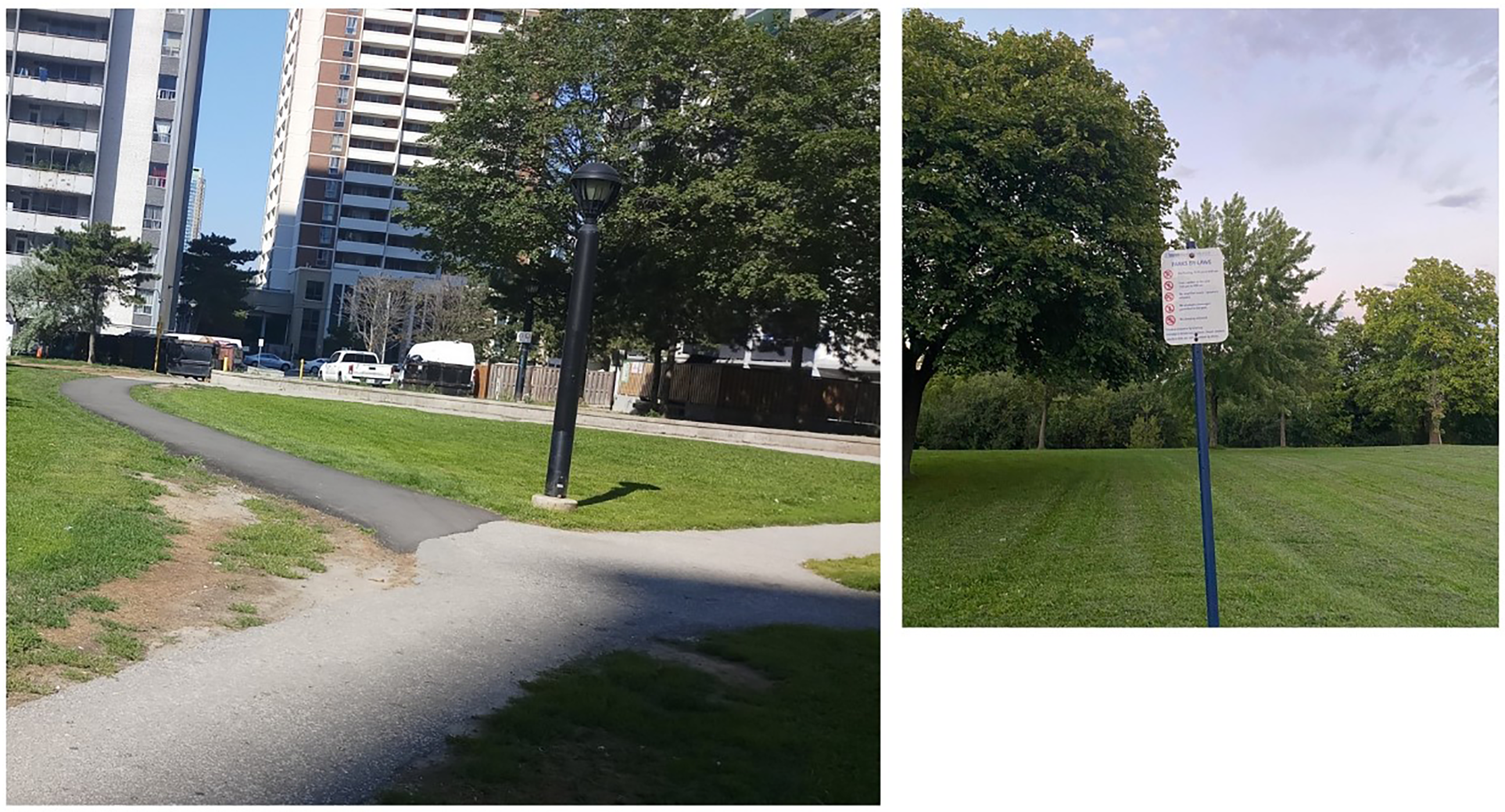
Photos by Nathan in St. James Town (left) and Kate in Jane-Finch (right).
I spent a significant portion of my degree on knowledge mobilization activities, prioritizing the importance of sharing findings with policymakers, practitioners and communities before focusing on writing my dissertation or publishing academic papers (Hassen, 2023). This commitment to knowledge mobilization and collaborative action was one of the central ways I enacted feminist and anti-racist principles. In addition to co-creating a community report with community members (Hassen et al., 2022), I curated a travelling photo exhibit with a modular, interactive design that allowed for easy transport and flexible installation. We launched the community report and showcased the travelling photo exhibit at two neighbourhood events, co-organized with community partners. 1 A series of enlarged photographs, printed on waterproof material, were displayed outdoors in a public space, amplifying residents’ visual stories and making them part of the landscape. At the events, six residents spoke publicly about the report findings and calls to action. Other residents chose to organize anonymously behind the scenes including procuring an ice cream truck sponsored by a local small business, designing the event flyer, supporting assembly of the photo exhibits, recommending local catering and taking event photographs among other important tasks. This centering of community indicated their ownership of the project and was a testament to the relationships that were built throughout the project. 2 The project received media attention on television, radio (including CBC Metro Morning) and print media (Hassen, 2022). Four residents spoke to the media about the importance of urban greenspaces in their neighbourhood and touched on the systemic issues and inequities. To support long-term knowledge sharing, I designed a university webpage for the project. While we noted the limitations of an academic webpage including the lack of editing access by community members, we acknowledged the value of this resource in amplifying the project and ensured that we clearly linked to the community organizations’ websites. 3 I strived to build in transparency and accountability in relationship-building, keeping residents informed of upcoming activities while ‘moving at the speed of trust’ (brown, 2017: 30). 4 I have written elsewhere about the process of navigating these multiple knowledge mobilization activities with residents and community organizations (Hassen and Flicker, 2025).
We presented the research findings in academic, policy and practitioner circles. I was encouraged by the warm reception of our findings by some of the staff at the City of Toronto and the Jane-Finch initiative, who understood the importance of equitable urban greenspaces and are managing competing priorities and limited budgets while trying to protect parkland amidst encroaching development. On the spectrum of reception, I did not hear back from others at the municipal level or only received a generic response. I have also presented this work at several conferences, including knowledge user conferences and the Canadian Public Health Association conference, highlighting the importance of interdisciplinarity.
Altogether, while leaning into feminist and anti-racist principles, I dedicated several months to this knowledge mobilization work.
5
In their urgent call to ‘green’ cities, Van Den Bosch and Nieuwenhuijsen (2017: 346) note that new ways of translating research for decision-making are needed, while acknowledging: Researchers might also need stronger incentives to engage in participatory studies and use new communication tools, such as research-to-practice websites, podcasts, mass-media, and practice networks (Taylor and Hurley, 2016). This would, however, require higher academic merits and recognition of such activities. (Van Den Bosch and Nieuwenhuijsen, 2017: 346)
This quote speaks volumes to the challenges of doing participatory community-engaged research in a competitive academic environment. Additionally, co-creation and knowledge mobilization with racialized and marginalized communities requires even greater intentionality, engagement and resources on top of the already substantial demands of CBPAR which include time, labour and funding. I would have been even more challenged to undertake this work without a supervisor who is acutely aware of the complexities of CBPAR, and understands the politics of supporting doctoral students, especially a racialized first-generation doctoral student (Flicker et al., 2007; Khobzi and Flicker, 2010; Rodney et al., 2024). Within academia, there are numerous accounts, both documented and anecdotal, of othering and exclusionary processes for Black, Indigenous and racialized students and those facing multiple oppressions (Ahmad, 2020; Choo, 2020; McAuliffe et al., 2023; Wilson et al., 2021). These additional barriers impede necessary and critical work. Racism pervades all institutions and all spaces, and many of the systemic barriers explored in the project were reflected in academia. So, how can researchers who are racialized work with communities in ways that ‘do no harm’ when harms are done to us? When Ahmed (2017: 237) talks about survival, she notes that ‘caring for ourselves becomes an expression of feminist care’. Throughout, I had to care for myself so I could do the work required and care for those in the project. The additional emotional labour required of a CBPAR dissertation is often unrecognized. I spent countless hours applying for funding for the residents and to cover research costs (and yet, I would have liked to have done and offered more) and to fund myself so I could dedicate the time and energy needed to this work. I balanced significant health issues over the course of the doctoral degree. Throughout, I oscillated between leaning into stillness (when my symptoms flared), shorter work sprints (when I felt well and energized), while trying to find an in-between daily pace that did not deplete me but allowed me to make some progress, however small. And still, I would not have done it any other way. Community-engaged research is an ever-growing, ever-necessary part of ethical, reciprocal research that attends to community need and positive social changes. And yet, explicitly incorporating feminist and anti-racist lenses is no simple task. Ahmed (2017: 11) says ‘To become a feminist is to stay a student’ and so this commitment has extended beyond my doctoral degree. Desire lines begin with a single step off the expected path. In research, as in the places and environments we occupy, those steps are often acts of refusal, care and imagination. By following in those steps, we make visible the landscapes of possibility that were always there.
Colouring outside the lines: Landscapes of belonging across race, nature and place
The pernicious character traits of racial constructs develop through spatial practices and intersect with ideas about ‘nature’ and belonging. (Brahinsky et al., 2014: 1135)
Desire lines describe the deviation from the official supposed path that one is supposed to follow in a landscape. This re-routing is about taking a different route in life that deviates from the norm and Ahmed (2006: 570) describes this in the context of ‘generating a queer landscape’. Similarly, in spaces where whiteness is prioritized and a colourblind approach often paints over the nuances of racialized people's experiences, racialized individuals experience public spaces differentially and may mitigate and manage their movements and actions through that lens (Jay Pitter Placemaking, 2025; Lipsitz, 2007; Rigolon and Németh, 2021). In the project, residents described not feeling comfortable or welcome in higher-income, predominantly white neighbourhoods, noting their comparative comfort and belonging in their own racialized, immigrant neighbourhoods (Hassen et al., 2022). Residents also described venturing away from their neighbourhoods with limited, poorly maintained greenspace to access high-quality public spaces. Negotiations are constantly made in mapping our personal landscapes and everyday realities, in relation to our own resources, our relationships and the spaces we occupy. Conceptualizing this socio-spatial dynamic in urban greenspaces warrants further exploration, unpacking the who, the where and the why. Conceptually, greenspace definitions also need to be expanded, guided by experiential knowledge and the voices of the people who use them. This is a shortcoming in the greenspace literature, which sometimes speaks at cross-purposes (Taylor and Hochuli, 2017). For instance, greenspace access is about more than simply physical access, but this is not always explicit. One example of expanding this definition is by the National Recreation and Park Association (NRPA) in the United States which defines park access as ‘the just and fair quantity, proximity and connections to quality parks, green spaces and recreation facilities, as well as programming that are safe, inclusive, culturally relevant and welcoming to everyone’ (National Recreation and Park Association, 2023). This is a path that requires thoughtful and deliberate treading. It requires thinking about where we want to go and why, in whose footsteps we might follow, who we will walk with and how we might support those who come after us. Just as desire lines cut through physical landscapes, they also trace their way through intellectual and disciplinary ones, carved by those who walk against the grain of dominant knowledge systems and the status quo.
Following the unmarked trail: On citing, remembering and blurring disciplinary borders
The metaphor of desire lines applies to the scholarly work that is relegated and exists in the margins. Desire lines aren’t only etched into physical landscapes; they trace through intellectual ones too. In academia, they mark the paths of thinkers, writers and researchers who move against the grain of dominant epistemologies. Feminist, anti-racist, Indigenous and decolonial scholars and activists have long carved these alternative routes, not by choice alone, but often out of necessity. Their work doesn’t follow the paved roads of objectivity, neutrality or methodological ‘rigour’ as traditionally defined. Instead, it meanders, dwells, doubles back. It stays close to lived experience, community and care. Black and Indigenous feminist thinkers have long insisted that knowledge lives in experience, and that theory must remain accountable to the lives and voices of those it seeks to represent (Collins, 2000; Crenshaw, 1989; hooks, 1989, 1994; Smith, 2021). This work demanded a shift – again, not just in what is researched, but how, why and with whom, attending to the histories behind these questions. These aren’t new ideas, but they are still often treated as peripheral in dominant academic spaces. This phenomenon speaks to what is at the heart of desire lines, traces of what many have always known, but institutions still fail to fully recognize. For emerging scholar-activists and practitioners who wish to engage in this work with care, in relationship, and without hurry or pressure, doing it well can sometimes feel impossible, constrained by a lack of time, resources, support, institutional rules, deadlines and more.
Ahmed (2017: 9) refers to the importance of citing work that has been ‘too quickly cast aside or left behind, work that lays out other paths, paths we can call desire lines, created by not following the official paths laid out by disciplines. These paths might have become fainter from not being traveled upon; so we might work harder to find them’. The Park Perceptions and Racialized Realities research project was inherently interdisciplinary, and while there is a vast history and depth behind each of these disciplines, I focused on drawing the connections between them, much like one might carve an unofficial path to access a greenspace. There has been a Western world bias in the nature and health research space and so there is a ways to go to learn and listen from underrepresented perspectives (Gallegos-Riofrío et al., 2022; Kimmerer, 2013). Some residents highlighted this (dis)connection to land, trying to reclaim ancestral knowledges around nature and medicine (see Ayesha's photos in Figure 2), and the complexities of living in a land different to your ancestors. At times, this divide can feel like an uncrossable chasm. The sheer enormity of shifting a cultural zeitgeist. In time, I am hopeful that these desire lines, these alternate paths, will become increasingly more visible.
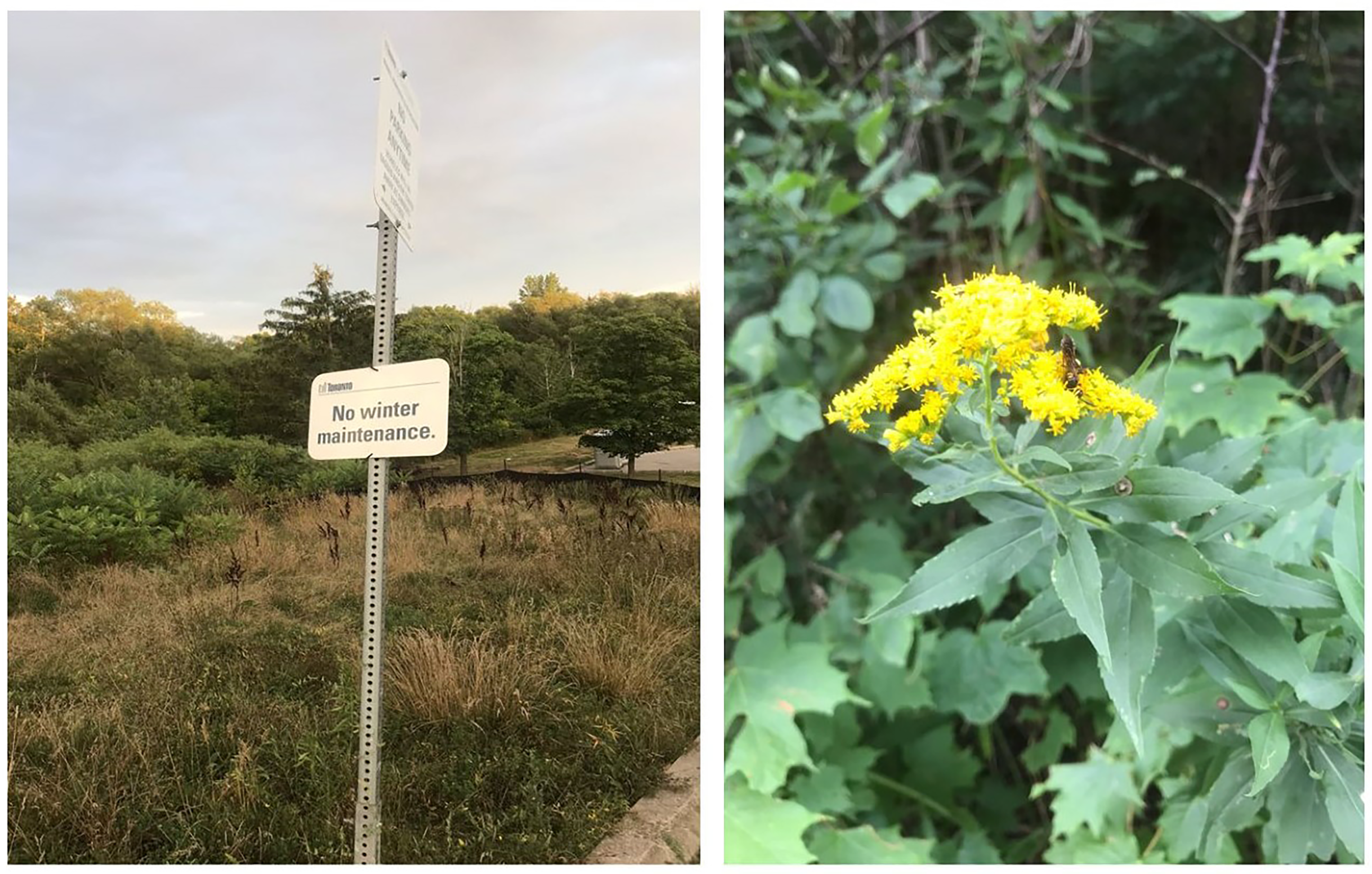
Photos by Ayesha from Jane-Finch.
This is how we make place: Resistance and informal spatial practice
The metaphor of desire lines and creating unofficial alternatives is directly applicable to how residents from the project engaged with urban greenspaces in informal ways that suited their needs, despite the official rules and existing infrastructure. Residents found ways to exist, interact and care for themselves and each other – through playing on makeshift cricket pitches and basketball courts (see Figure 3), hosting yoga sessions in the grass, conducting community initiatives in outdoor spaces due to lack of indoor space, setting up informal gathering spaces in less than desirable parks, making decisions to ‘turn back’ when they didn’t feel safe, and sharing limited children's infrastructure. Racialized residents still found ways to create and make (green)space. These unofficial, tactical-urbanism style endeavours were survival strategies. Desire lines become more visible when enough people do not take the ‘official’ route. In becoming more visible, they encourage even more people to tread these previously unfamiliar and unknown paths. But these processes should not have to exist on the fringes of urban greenspace design; greenspaces should be equitably and collaboratively planned, designed and maintained.
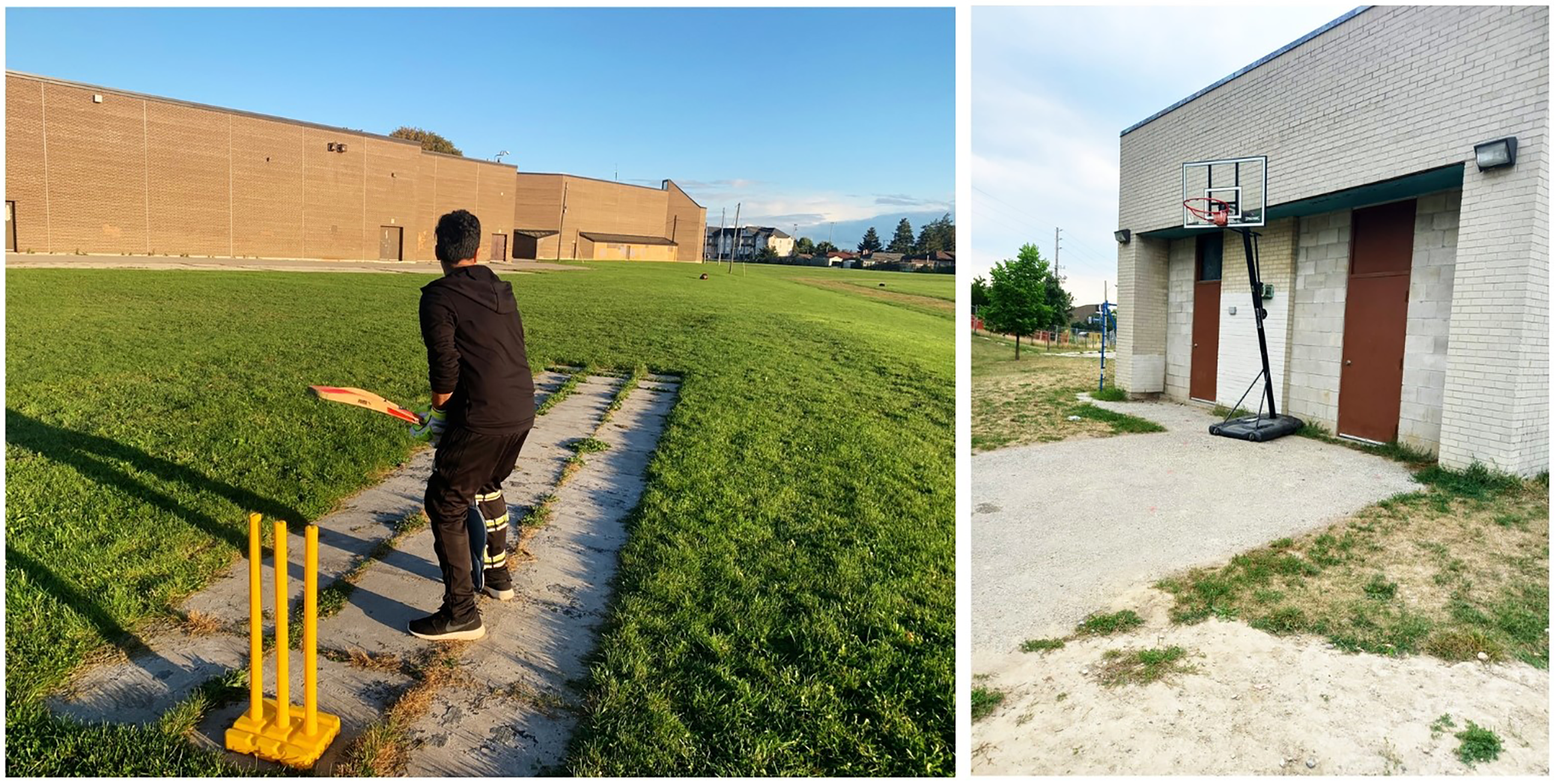
Photos by Sayem (left) and Constance (right) in Jane-Finch.
As Anguelovski and Corbera (2023: 50) note, we should be ‘building participation pathways for racialized communities’ towards justice in ecosystems. Furthermore, it does not matter how accessible, safe and high-quality a greenspace is, if residents do not have the time and resources to access it. The urban greenspace metrics and factors that promote/hinder social and health outcomes need to be put in conversation with design principles, resource allocation mechanisms and equity and justice considerations (Anguelovski et al., 2020; Fernandez et al., 2021; Kardan et al., 2015; Rigolon et al., 2018). Nonetheless, in the face of exclusion, the residents created desire lines for themselves and engaged with urban greenspaces in the ways they could. They granted me insights into their processes and brought me into that creation through the community events in St. James Town 6 and Jane-Finch. In returning to Lorde (1988) and Ahmed's (2017) words and as many marginalized bodies intuitively know – this inventiveness is survival, this creativity is self-preservation, and this reclaiming is power.
Conclusion: Embracing methodological detours
I’ve found that our immediate environments are mirrors for the spiritual turmoil inside of us that we inherited from our forebears. By reclaiming our relationship with the Earth, we can then start healing ourselves and our communities from the inside out and from the ground up. (Shane Bernardo – quoted in brown, 2017: 82)
This paper is a methodological detour, a way of moving outside the parameters of a typical research article to explore the nuances of doing qualitative research with communities. What does it mean to co-create research when ‘co’ isn’t easy, and ‘creation’ isn’t linear? How do feminist and anti-racist commitments pull us off mapped routes and into more collaborative, situated, and sometimes uncomfortable ways of working? I encountered multiple challenges in moving through this project. While I had the sense that pursuing a doctorate would change me, I had given little thought to how it might take me on a path different to the one I intended. Engaging feminist and anti-racist principles in place-based research is not a divergence from rigor, but a redefinition of it. It is a commitment to grounding in lived experiences, accountability to communities, histories and relational ethics. If we are to take equity and justice seriously in qualitative research, we must be willing to step off the paved paths and walk with, alongside, and behind those who have always known other ways through the field.
Footnotes
Acknowledgements
This paper draws on the author's doctoral dissertation and reflects on the Park Perceptions and Racialized Realities project. First, a warm thank you to all the community residents who participated in this project and who were all so generous with their time and insights. I will always be grateful for this work together. Thank you to the Jane/Finch Centre and the St James Town Community Co-operative as well as members of the community advisory group for your collaboration and partnership. This research and knowledge mobilization activities involved collaborations with many individuals from the St James Town Community Co-op, Jane/Finch Centre, Corner Commons, Auntie Amal Community Centre, and the Department of Imaginary Affairs. Finally, special thanks to my supervisor, Dr. Sarah Flicker, and committee for their support with this work.

Ethical considerations and informed consent
This study was approved by York University's Research Ethics Board (STU2021-087).
Funding
The author disclosed receipt of the following financial support for the research, authorship, and/or publication of this article: The author was supported through a Vanier Canada Graduate Scholarship by the Social Sciences and Humanities Research Council (SSHRC), the Charles Caccia Graduate Award in Sustainable Development (York University), the EUC Graduate Research Scholarship (York University) and the Susan Mann Dissertation Scholarship (York University). Community-based research costs were also supported through monetary and in-kind support by the York University-TD Community Engagement Centre's Catalyst Grant; the Jane/Finch Centre; and York University's Academic Excellence Fund. Knowledge mobilization activities also included in-kind collaborations with the St James Town Community Co-op, Jane/Finch Centre, Corner Commons, Auntie Amal Community Centre, and the Department of Imaginary Affairs.
Declaration of conflicting interests
The author declared no potential conflicts of interest with respect to the research, authorship, and/or publication of this article.
Data availability
The data that has been used is confidential due to the small sample size of the qualitative study.