




Abstract
The main objective of the paper is to identify the logic of the sociological field in the GDR, looking at how it was spatialized in the city of East Berlin. In this regard, I am less interested in providing an overview of the different research streams of the main sociologists operating in the scientific and academic institutes located in Berlin than in reconstructing some crucial dynamics at work there and highlighting their effects at the social and symbolic levels. The underlying idea is that, especially in East Berlin, the sociological knowledge produced was less homogeneous than it has been represented in the existing literature. Without negating the existence of shared aspects characterizing Marxist-Leninist sociology, also superimposed on the political elite, a field analysis enables us to see how the different positions and trajectories of GDR-sociologists had an impact on their approaches to theoretical, epistemological, and methodological questions, and on their understanding and uses of concepts deriving from both Marxist-Leninist and “bourgeois” sociology. In the analysis, I will first compare the social trajectories of two of my interview-partners as paradigmatic of two different sociological habitus depending on their different academic/political socialization, networks, and positions in the field. As a second step, I will present a sketch of the sociological field drawn from 63 curricula of sociologists active in East Berlin in an attempt to pinpoint, on a larger scale, the homologies between the social and symbolic spaces of the field. Thus, the underlying idea is to examine the intersection of the “quasi-structural properties” of the field with its “phenomenological aspects” concerning the “feel for the game.” While the two understandings of field are interdependent, it is in the second one that the physical space as a localized social space played a crucial role in defining the material, social, and cultural constraints and opportunities actors faced which, in turn, influenced their practices and choices.
Introduction
The main objective of this paper is to identify the logic of the sociological field in the GDR, looking at how it was spatialized in the city of East Berlin. In this regard, I am less interested in providing an overview of the different research streams of the main sociologists operating in the scientific and academic institutes located in Berlin, than in reconstructing some crucial dynamics at work here and highlighting their effects at the social and symbolic levels. The underlying idea is that, especially in East Berlin, the sociological knowledge produced was less homogeneous than it has been represented in the existing literature. Without negating the existence of shared aspects characterizing Marxist-Leninist (M-L) sociology, also superimposed on the political elite, a field analysis enables us to see how the different positions and trajectories of GDR-sociologists had an impact on their approaches to theoretical, epistemological, and methodological questions, and on their understanding and uses of concepts deriving from both Marxist-Leninist and “bourgeois” sociology.
A slight interest in the development of sociological research in the German Democratic Republic (GDR) began to flourish in West Germany in the mid 1960s, parallel to the increasing weight of Marxist and Neo-Marxist social theories. 1 Despite the fact that works on GDR-sociology covered three different political stages—during the Cold War (cf. Haug, 1969; Koch, 1976; Ludz, [1964]1971, 1972; Röder, 1972; Schmickl, 1973; Voigt, 1984; Wagner, 1989; Weymann, 1972), in the transition phase to a unified Germany (cf. Bafoil, 1991; Bertram, 1997; Best, 1992; Bollinger, 2003; Bollinger et al., 2004) Peter, 1990[2018]; Sparschuh, 1991; Sparschuh and Koch, 1997; Simon and Sparschuh, 1992; Thomas, 1991), and after German reunification (cf. Moebius, 2021; Pasternack, 2015, 2016; Schäfers, 2016; Schimunek, 2002)—they mostly share a similar epistemological and theoretical perspective.
First, they all stress how the political and ideological constraints of GDR-sociology not only delayed its institutionalization, but also limited its cognitive and theoretical development. In this regard, they mostly emphasize that the sociological knowledge produced in the GDR derived from historical and dialectical materialism, for which the legitimated keeper disciplines were, respectively, philosophy and political economics, the leading disciplines within the Gesellschaftswissenschaften (GW) which were established by law in 1951 as foundational disciplines (cf. Malycha, 2002; Weymann, 1972). Thus, while the cognitive subordination of sociology to State ideology is often remarked, little attention is devoted to its subordination within the GW-disciplinary hierarchy, which would entail considering that further dynamics were at stake beyond those defined by a more direct relationship with the political elite.
Second, the focus on the core concepts of M-L sociology has led to the presentation of GDR sociological production as little differentiated. We can identify, here, three main problems. The first is that this perspective obscures the fact that “other sociologies” flourished outside the GW-field. This means we need to consider how sociologists working outside the GW-institutes were more independent in using other (additional) theoretical premises than historical and/or dialectical materialism. Second, this perspective is mostly based on content analyses of published sociological works, though most research reports and projects were for “internal use” and belonged to the Graue Literatur (“grey literature”) (cf. Grüning, 2019). 2 Thus, despite their similar ideological and theoretical premises, the two kinds of products differed with respect to their recipients, their scientific and political functions and, consequently, with respect to their linguistic styles and approach to theory and empirical research. Finally, by speaking of a GDR-sociology, the concept is often used to indicate both scholarly production and its producers at the same time. Even though various studies (cf. Koch, 1976; Ludz, [1964]1971; Peter, 1990[2018]; Röder, 1972; Voigt, 1984) have noted how, in the 1970s, GDR-sociologists began to borrow methods and concepts from “bourgeois sociology” (i.e. the concepts of social groups, social strata, and social mobility, in addition to class) in order to explain and empirically investigate ongoing social and cultural changes in GDR-society, no attempt has been made to analyze who used these concepts and what their positions within the discipline were. Instead, one of the main differentiation criteria drawn among GDR-sociologists concerns generational belonging (cf. Sparschuh and Koch, 1997), using the different political and ideological beliefs and socialization between older and younger sociologists as an explanation for their different understandings of sociology as an instrument of the political project of founding a socialist state (cf. Ludz, 1972). Nevertheless, though the generational criterion does enable us to explain some macro-changes over time, it does not account for individual and collective trajectories for which other factors were meaningful, such as different disciplinary socialization, academic and political relationships/networks, and different academic/scientific and political experiences.
Finally, little attention has been paid to the influence of workplaces on scientific production. Thus, beyond describing the main research topics at different universities and institutes, it is a question of whether and how these differences resulted from the possession of what I call spatial resources. With this expression, I intend a field structural dimension (cf. Savage and Silva, 2013) which accounts for the influence of the relational arrangement (cf. Fuller and Löw, 2017; Halford, 2004) and structure of a material and cultural place to which social actors belong (that is, where they act daily) on their work practices and, consequently, ways of positioning themselves in the field.
Departing from these considerations, the use of field analysis to describe the development of sociology in the GDR (through the case study of sociology in East Berlin) aims first at avoiding a deterministic and linear narrative of its institutionalization and cognitive production. Following Bourdieu (cf. Bourdieu and Wacquant, 1992), this means taking into account the structural positions and positionings of sociologists within the sociological field from a historical perspective. This perspective enables us, for instance, to relativize questions about the lack of originality and scientific value of sociology in the GDR (cf. Simon and Sparschuh, 1992), as these criteria are (and were at the time) taken to be universal. In other words, using the field as an analytic tool means reflecting upon how:
categories and parameters are used by sociologists to describe and evaluate the sociological knowledge produced within a specific historical context;
the originality and scientific relevance of a theory or current of thought are to be considered together with other factors and dynamics which can explain the inception and maintenance of a discipline in a specific historical context;
each sociological field presents specific constraints, whether political, economic, social, or cultural, which influence the habitus, trajectories, scientific production, and work practices of sociologists. In this regard, while we may suppose that the more a sociological field is autonomous from heterodoxic criteria, the more sociologists have the possibility of creating new theories or experimenting with new methodologies, on the other hand, the internal disciplinary doxa may also produce constraints which prevent the development of new knowledge. Thus, the question of innovation and originality in a discipline cannot be defined a priori but is culturally and historically relative, and consequently it needs to be empirically analyzed from a comparative perspective (cf. Düller and Pawlak, 2017);
a national disciplinary field is never isolated, but it may be affected to varying degrees by what is occurring in the discipline at an international level. Furthermore, international influences may be differently received by sociologists according to the local social and cultural structure of their workplace and workspace.
Thus, focusing on sociology in East Berlin during the GDR is meaningful for several reasons. First, as the capital of the GDR, Berlin contained the highest number of institutes where sociology was carried out, and it therefore hosted the highest number of sociologists. 3 This was due less to the presence of Humboldt University than to other scientific institutes, especially the Akademie für Gesellschaftswissenschaften (Academy for Social Sciences) and the Akademie der Wissenschaft (Academy of Sciences)—which were mostly devoted to empirical research. 4
Furthermore, the main political scientific decisions regarding the future of the discipline were taken in Berlin. The decisional processes involved not only representatives of the sozialistische Einheitspartei Deutschlands (SED) (Socialist Unity Party) but also sociologists who mostly worked in Berlin institutes. A crucial role was especially played by the Academy for Social Sciences, 5 which was under the direct control of the Party and which, after 1965, hosted the Wissenschaftlicher Rat für Soziologische Forschung (Scientific Council for Sociological Research), responsible for the main decisions regarding the research agenda in sociological matters (cf. Weidig, 1997). If the fact that Berlin was the place with the highest concentration of political and state institutions makes us suppose a stronger influence of political power on sociologists working there, a deterministic understanding of this relationship would be misguided. In this regard, field theory, integrated with an actor-network and spatial-material perspective (cf. Beyes and Holt, 2020; Bottero and Crossley, 2011), may highlight how working as a sociologist in Berlin entailed more possibilities for weaving together different kinds of relationships and collaborations with actors working in different institutes, 6 or for participating at different levels (local or national) in the political and bureaucratic fields (cf. Bourdieu, 2000; Bourdieu et al., 1994; see also Grüning, 2022) as well as fields of cultural production other than the academic one (i.e. radio). In other words, it enabled a different accumulation of both political and scientific capitals with respect to the more peripheral areas of the GDR where sociology was carried out. This consequently meant having more chances, for instance, to negotiate one’s research topics, or whether and how to use “bourgeois concepts or methods.”
In the following sections, I will first provide an overview of the existing literature on GDR-sociology with a double goal: to present those theories, concepts, topics, and research areas which make it possible to recognize a nucleus of common aspects forming GDR-sociology, such as M-L sociology, and to more deeply discuss the critical aspects mentioned above so as to better outline my conceptual frame. After a short description of the empirical material collected between 2017 and 2021, as a second step, I will compare the social trajectories of two of my interview-partners. The purpose is to highlight, in a more inductive way, how their different positionings in the field affected their career paths, their understanding of the field game, as well as the ways of perceiving and thinking as a “sociologist.” Finally, I will present a sketch of the sociological field by looking at the homologies between its social and symbolic space.
Thus, the underlying idea is to investigate the logic of the GDR-sociological field by examining the intersections of its “quasi-structural properties,” regarding the objective relationships which structure the field, with its “phenomenological aspects,” concerning the “feel for the game” of actors embodied in forms of habitus according to their position in the field (cf. Savage and Silva, 2013: 116f.). While the two understandings of field are interdependent, it is in the second one that the physical space as a localized social space played a crucial role in defining the material, social and cultural constraints and opportunities actors faced which, in turn, influenced their practices and choices.
Studies on sociology in the GDR: An overview
The early phase of reception of GDR-sociology in West Germany was characterized by an internal political differentiation among: groups of non-Marxist scholars, who manifested a wholly critical attitude toward GDR-sociologists; anti-communist scholars, who looked at GDR-sociology mostly from a propagandistic perspective; Marxist scholars close to the Deutsche kommunistische Partei (German Communist Party), who mostly had an uncritical stance; neo-Marxist scholars, who wanted to differentiate their thoughts from those of GDR-sociologists (cf. Wagner, 1989).
One of the first works on sociology in the GDR was by the West German sociologist and activist Haug (1969) who, at the time, was close to the Sozialistischer Deutscher Studentenbund (Socialist Student Union) and wrote in the radical left cultural journal Das Argument. Her work stands out for the enthusiastic style through which she observed the institutional inception of the discipline in the GDR, focusing especially on the contrast between a “bourgeois sociology,” lacking in social questions, and a promising Marxist sociology, aimed at responding to the persistent social contradictions of GDR-society even by intervening in the consciousness-building processes of the workers. Coming from this perspective, Haug did not care to distinguish between the position of party representatives 7 and those of sociologists who occupied a core position in the discipline (i.e. Horst Taubert and Erich Hahn). Furthermore, while recognizing the centrality of historical materialism as a “sociological theory,” she stressed how sociology, as a young discipline, needed to be supported epistemologically and methodologically by philosophy and economics, what she interpreted in terms of “interdisciplinarity.”
A very different position was represented by Peter Christian Ludz, a student of Otto Stammer, who became Director of the Institute section on “The Soviet occupation zone” at the Free University of Berlin in 1958. In 1964, he published a first essay on sociology and philosophy in the GDR, where he highlighted three characteristics of M-L sociology. 8 First, it served political objectives by providing information to party leaders and facilitating their control over society by preparing and justifying political decisions in domestic affairs and foreign policy and removing the splits present in the ideological edifice. Second, it was the expression of the ideological axiom of the “friend-enemy” polarization. Third, from the 1970s, the political elite began to conceive of how the rational methods and techniques driving sociological research had been of increasing importance for social planning, control, and integration (Ludz, [1964]1971: 328ff). Furthermore, even though he stressed how sociology was almost exclusively defined from the top (the Party), he also pinpointed three different social actors involved in the “making of GDR-sociology”: Party ideologues, scholars representative of an orthodox conception of Marxist sociology (Hermann Scheler, Robert Schulz, Günther Heyden, Alfred Kosing), and reformer sociologists such as Kuczynski and Braunreuther. 9 Then, while he stresses how the foundations of the discipline relied on the former group of sociologists, it seems the latter groups of sociologists played a central role in the progressive emancipation of sociology from historical materialism thanks to an empirical and positivist approach which, however, always entailed a positive view of the GDR-State. It remains that this kind of narrative, rather than highlighting the internal dynamics among these three groups, enhanced an atomistic vision with the Party and the political apparatus on one side and individual sociologists more or less close to party ideology on the other.
Another significant essay on GDR-sociology by Ludz (1972) appeared in a collection of works written by core GDR-sociologists (Braunreuther, Stollberg, Aßmann, Friedrich, Erich Hahn; Bohring, Taubert, Meyer, and Bollhagen) 10 that he edited. Because of the different structure of the volume, the author framed GDR-sociology differently from his previous work, favoring a more descriptive analysis in open debate with the positions of GDR-sociologists. In this regard, he first outlined how GDR-sociology, as an instrument of the working class and its party, presented two main characteristics: because of its historical philosophical premises and political-ideological function, it was oriented toward the future, and, consequently, it expressed the viewpoint of a specific class, whose goal was to change social reality. He also reported some of the main criticisms GDR-sociologists directed toward “bourgeois authors” and currents of thought. So, according to Bollhagen, E. Hahn and Braunreuther’s neo-positivism reduced the content of reality to its logical structure, while behaviorism substituted a historical-sociological analysis of human actions for a psychological one. Furthermore, E. Hahn criticized the concept of roles because it prevented essential and non-essential relationships from being distinguished and evaded Durkheim’s concept of collective consciousness because it reduced sociology to social psychology (Ludz, 1972: XXVIIff.).
Finally, Ludz raised some methodological questions about the possibilities of connecting the theoretical (ideological) premises of GDR-sociology with empirical investigations. The critical point of his analysis was that he departed from a unified vision of GDR-sociology without considering how GDR-sociologists faced this question differently according to their disciplinary socialization, for which those with a philosophical curriculum were more interested in stressing the philosophical-ideological premises of M-L sociology, whereas those who studied economics were more oriented toward empirical research, leaving the ideological premises in the background.
Within this first phase of the reception of GDR-sociology, at least four further works are worthy of mentioning. In an essay published in 1972, Röder (1972) argued that, from the 1970s, the social transformations of the GDR-State impacted on both the sociological and ideological understanding of the social structure. Thus, Marxist (sociological) concepts, such as that of class, were no longer sufficient to capture the ongoing social transformations and new concepts, such as social groups, social strata, or social mobility were required, which sociologists borrowed from “bourgeois sociology.” Furthermore, he claimed that the strategy empirical sociologists used to fill the gap between ideological premises and empirical research was to operationalize the ideological principles. As a result, historical materialism went from being a conflict theory to a theory of consensus; the “revolutionary class struggle” went from being a conceptual category to a historical category, favoring the emergence of an evolutionary model of society; and the Marxian concept of conflict went from being a historical category to a supra-historical category with an integrative function aimed at nuancing the social contradictions within the GDR-State.
A similar stance is also present in Schmickl’s (1973) essay. According to him, the conceptual shift from a “relative revolutionary to an evolutionist development” of GDR-society in the early 1970s led the party to first redefine the role of social sciences: by strengthening the dependence of social research on the new economic reform; by postponing the verification of the compatibility between political goals and empirical investigations to the end of the research process; and by enhancing the socialist personality of social scientists. In turn, social scientists were asked to redefine the idea of society in a more integrative functional way, consequently favoring investigations of the “moral-political integrity” of the workforce, thus inaugurating a new research stream related to their “ways of life” (Lebensweise).
Weymann (1972) also stressed how the ways of practicing social research changed in the 1970s. Nevertheless, he mostly emphasized the increasing use of methods inspired by structural-functionalist theories and methodological individualism, which corresponded to a new understanding of society as primarily related to the micro-dimension of social interactions of people and groups.
The latter point was also stressed by Voigt (1984) for the following decade. According to him, in the 1980s, sociology made “considerable progress [. . .] in theoretical and empirical research” (Voigt, 1984: 110). 11 He explicitly related this progress to the reception of Western methods and theories, as favoring a partial autonomy of the discipline from historical and dialectical materialism (for instance in small group research), although its functions were still defined by the SED. Thus, while this kind of investigation should have still served political goals—“educating socialist personalities and increasing productivity through optimal group performance” (Voigt, 1984: 112)—the adoption of Western research methods also “harbored the danger for the SED that the findings could be uncomfortable” (Voigt, 1984: 117). Finally, he made it clear how the exponential increase of publications could weaken the power and control of the Party over sociology, not least because the chances of including Western authors in their works increased (Voigt, 1984: 120). This two-step argumentation has the merit of outlining a certain autonomous logic of the sociological field. Nevertheless, some problematic issues are still evident. Voigt indeed created a juxtaposition between a social group (the Party) and a discipline, mainly understood in terms of its scientific products. He then overlooked the fact that sociologists could follow different publication strategies and, above all, had different opportunities for publishing. Furthermore, it seems he took the mechanisms of political control on scientific products for granted, focusing especially on the more direct forms of control, such as censorship. In this way, the ongoing transformations which affected sociology appeared to derive from autopoietic processes of the discipline, excluding any form of agency on the part of sociologists.
The early years of the German reunification phase were dominated by two kinds of discourse: while the first further stressed the ideological aspects of GDR-sociology (cf. Bafoil, 1991), the second, mostly represented by ex-GDR-sociologists, pursued two goals: reflecting upon what East German sociology could produce as “original” given the political context, and the possibilities for East German sociologists to be integrated into the scientific and academic system of the reunified Germany (cf. Thomas, 1991). In the attempt to respond to the first question, documentary research was carried out which brought to light a large quantity of unpublished theoretical and empirical works produced by GDR-sociologists which were mostly unknown to Western sociologists (cf. Friedrichs, 1993; Koch, 1993, 1996; Koch and Schwefel, 1993; Schwefel and Koch, 1992, 1994, 1995; Schwefel and Mallock, 1992; Schwefel and Otto, 1992; Weidig, 1997). While this represents a meaningful source for understanding the research interests and projects carried out by GDR-sociologists, the analyses were limited to some general remarks. Broadly speaking, they return the perception that sociology in the GDR was essentially lacking in originality and international prestige.
In this regard, a very different position is represented by Peter (1990[2018]). First, in his essay, he claimed that sociology developed in a way that cannot be explained only or primarily through the influences of political (moral) factors not originating from disciplinary logics. In this regard, he considered how sociology itself produced political concepts that settled immobilism and authoritarian trends, thus contributing to the collapse of GDR-society (Peter, 1990[2018]: 387). Nevertheless, by stating this, he also traced clear-cut distinctions among sociologists and their sociological production. He mentioned, for instance, the work of Manfred Lötsch, Rudig Weidig, Frank Adler, Albrecht Kretschmar (Academy for Social Sciences), and Ingrid Lötsch (Academy of Sciences) that put into question the theorem of the socio-structural rapprochement between classes. Looking especially at the investigations of Manfred Lötsch (1985, 1988), he highlighted how the GDR-sociologist tried to investigate other forms of social differences and inequalities than those of an economic nature, departing from other theoretical premises than Marx and Engels (i.e. Gramsci), and developed the concept of social class in terms of a “living tangle of social relationships and interactions” (Peter, 1990[2018]: 402). A further innovative research field concerned women’s position in (GDR) society, which especially involved women sociologists, such as Hildegard Maria Nickel and Irene Dölling. While Nickel’s investigations focused on the spatialization of social differences at school, in sport associations, and at home, following a phenomenological perspective, Dölling was mainly interested in detecting the social construction of gender (Peter, 1990[2018]: 405f).
Despite the innovative characteristics of certain research fields, according to Peter, GDR-sociology was, overall, subjected to economic reductionism and abstract historical materialism (Peter, 1990[2018]: 391), and this mainly depended on the fact that most GDR-sociologists renounced their critical function as sociologists to instead serve the political apparatus. While Peter avoids a deterministic representation of the relationship between the political elite and sociology by inverting the attribution of responsibility to explain the limits of GDR-sociology, he fails to make clear what kind of relationship existed between them. This is due less to the fact that he does not recognize other forms of control being exerted on sociology than a repressive one, but rather on a specific way of “framing GDR-sociology.” Thus, even though he recognizes the existence of other ways of doing sociological research and theory, by focusing on sociological products, he neglects: first, to recognize other forms of “sociological criticism” than those expressed in a direct way, as was usual in the Western sociological tradition; second, to consider how the development of new research streams entailed the creation of often half-formal research-networks or even formalized research groups, such as the research group on women’s position in GDR-society within the Academy of Sciences established in 1977. 12
Recent studies on sociology in the GDR seem divided over a need to address issues of historicization (cf. Moebius, 2021; Schäfers, 2016) or morality (cf. Pasternack, 2015, 2016). Within this second sample of studies, the focus is almost exclusively on the instrumental political function of GDR-sociology, unveiling the endurance of a West-East juxtaposition, even though it is new, in some ways, with respect to previous studies. So, for instance, Pasternack (2016) adopts a systemic perspective to frame individual cases of social scientists and humanists whose ideas were in conflict with the GDR-regime. The fact that most of them escaped to West Germany reinforces the impression they were powerless in front of GDR political power. As a result, this kind of analysis seems somewhat aimed at corroborating the broader memory narratives on GDR-society (cf. Grüning, 2010) rather than searching for a more neutral perspective to reflect on the development and relationship of the two German sociologies during the Cold War.
The research material
The empirical material was collected in 2017 and 2021 through archival and documentary research and semi-structured, in-depth interviews with ex-GDR sociologists.
The archival research was carried out at the Bundesarchiv (Federal Archive), the Universitätsarchiv der Humboldt Universität (Archive of Humboldt University), the Archive of the Berlin-Brandeburgische Akademie der Wissenschaften (the Berlin-Brandenburg Academy of Sciences—BBAW), and the Archive of the Akademie der Pädagogischen Wissenschaften (Academy of Pedagogic Sciences —APW). About 400 documents were collected and analyzed. They concern: legislative proposals; communications among scholars and between politicians and scholars; research projects and reports; scholars’ curricula; evaluation proceedings for PhDs, habilitation theses, and career progression; prize awarding. As a result, the analysis also takes into account a plurality of actors: politicians working either in the central committee of the SED or the Ministry for University and Research; and sociologists with different academic standing, working in different academic/scientific institutions and organs (the Academy for Social Sciences, the Academy of Sciences, the Scientific Council for Sociological Research; the Academy of Pedagogic Sciences; Humboldt University), and fulfilling different offices (directors of institutes, faculties, disciplinary sections; members of scientific/academic commissions, etc.).
The purpose of the analysis was, therefore, twofold: to reconstruct the institutionalization processes of sociology and its official power (cf. on this topic: Best, 1992; Weidig, 1997) and bureaucratic structures, and to pinpoint different practices, trajectories, and strategies undertaken by sociologists, also in the face of the different spatialization of this bureaucratic structure in the everyday workplaces and occasional gathering places (i.e. conferences).
Finally, the in-depth, semi-structured interviews 13 enabled a better understanding of how sociologists dealt with government control and eventually circumvented it, in light of their academic and scientific socialization and experiences which, in turn, influenced their feel of the field game and strategies of positioning within it.
By crossing the two research methods, it has been possible to identify the forms of capital possessed by each sociologist, as well as other meaningful factors which had an impact on the logic of the GDR-sociological field and, in turn, on the social trajectories of those participating in it. Among the latter, it is worth mentioning:
the research topics and their closeness to either political goals or ideological stances;
the forms of dissemination of the scientific products. So, a scientific report was addressed to the Ministry and one’s own institute’s colleagues, while a PhD thesis would be evaluated by a specific commission of professors, thus entailing that different scientific, political, and ideological criteria were at stake;
the institute one was affiliated with, and its specific spatialized structures of power;
the main discipline of reference in one’s own workplace. Considering the delayed institutionalization of sociology, it made a difference whether one worked in an institute of philosophy, economics, cultural science, medicine, or sociology: not only could the topics change, but also the ways of understanding sociology, its functions, and relationships with other forms of knowledge.
Methodological notes on the field analysis
As sketched in the introduction, one of the first goals of adopting a field perspective is to bring to light possible internal differentiations among GDR-sociologists and, secondly, to better focus on the control mechanisms which ruled the discipline as the product of the objective structures of the sociological field, whose forms and intensity changed according to the position the sociologists occupied in the field.
Two forms of capital—academic and political—have been considered as structuring the sociological field, while the influence of institutional cultural capital (cf. Bourdieu, 1986) and scientific capital (cf. Bourdieu, 1988) on the sociologists’ social trajectories has been considered in a second step.
Academic capital is composed of two sub-forms, “institutional” and “political” academic capital. The first is related to academic rank, while the second is connected to the different leadership positions one could hold within an academic/scientific institute.
Political capital may also be divided into two sub-forms: institutional and delegated political capital (on the latter, see: Bourdieu, 1991). The centrality of these two sub-forms of capital in guiding the academic/scientific paths of scholars clearly emerges from their curricula, the evaluative proceedings regarding PhD and habilitation theses, and recruitment processes. Thus, all these documents highlight how affiliation with political organizations, the awarding of political prizes, the fulfillment of scientific and political functions in political organizations and of political offices in academic and scientific institutes were pivotal criteria, together with scientific and teaching posts, for positioning in the sociological field. However, we will see how the centrality of these forms of capital in structuring the sociological field changed according to a scholar’s disciplinary affiliation and workplace. So, for instance, at the Institutes of Philosophy and Marxism-Leninism of Humboldt University, not only was more attention paid to the ideological-political aspects of a curriculum, but they were sometimes blended with the evaluation of scholarly activities. Conversely, in the institutes of economics and sociology, scientific and political activities were presented separately and in a more objective way:
14
‘In the last three years as an assistant, X has carried out several seminars of high theoretical-scientific and political ideological level.’ [1971, Section Marxism-Leninism] ‘I appraise X as a capable young scholar with many practical experiences. He/she engages him/herself in our socialist university with a lot of intensity and a class perspective related to the party.’ [1970, Section Marxist-Leninist Philosophy] ‘In the context of his/her research work, X developed and took care of wide cooperative partnerships and operated actively in interdisciplinary workgroups [. . .] Since the beginning of his/her studies, X has been socially [gesellschaftlich] active, and in all his/her functions, X has exercised a positive influence on management processes and collective development. X has been member of the direction of the Society for German-Soviet Friendship [DSF], a scientific functionary with positive effects, and is currently President of the trade union directional group at the University [BGL] and of the directional basic group [GOL] of the SED.’ [1987, Institute of Sociology]
At the same time, political socialization and political activities were also seen as prerequisites for meliorating the integration of scholars within an institute and, consequently, its functioning. In other words, they increased the organizational value and relevance of an institute, which could in turn have an impact on the power position of individual scholars, as is clear from this excerpt from the planning draft of the Institute of Sociology of the Academy of Sciences: “For the qualification of the content-related work, it is important [. . .] to increase the political and professional qualification of the collaborators.” 15
However, a further sub-form of political capital should also be considered. During his visit to the GDR shortly before the fall of the Wall, in trying to apply his field concept to GDR-society, Bourdieu noticed how, in a society with a socialist economic system, the main principle of differentiation was the political capital “acquired through the apparatus” (Bourdieu, 1998: 16). He then defined political capital as a form of social capital which can increase through informal social relations. In short, with respect to the GDR-sociological field, social political capital accounts for the strategies followed by sociologists when facing formal political decisions controlling their academic/scientific life. On the other hand, the possibility of accumulating this form of capital changed according to the volume and set of their (institutional and delegated) political and (institutional and delegated) academic capitals, that were in turn related to the places where sociologists worked and their networks.
Summing up, based on the information collected in the interviews, the secondary literature, the curricula, and the evaluation proceedings, the forms of capitals can be indexed as follows:
the institutional academic capital index has been measured by attributing a different value to the highest academic rank reached in a career path; the continuity of the career within academic/scientific institutions (for which different negative values have been allocated in the case of interruption of the academic/scientific career), and the rapidity of the career.
the political academic capital index has been measured by attributing a different value to the number of assignments accumulated over time and the more important offices held (coordinator of a chair; coordinator of a disciplinary section; president of a faculty/director of an institute; founder of an institute; prorector; rector).
the delegated political capital index has been measured by attributing a different value to the number of assignments accumulated over time and the highest office held during a career (member of political scientific commission; role as president within the same commission; scientific assignment by political/state organizations).
the institutional political capital index has been measured by attributing a different value to the entire number of political assignments accumulated over time; the highest office held in a political organization (conversely, following a scalar logic, negative values have been allocated in the case of: expulsion from the party; suspension from academic offices; prohibition of publishing one’s work); and the highest office held in an academic/scientific institute (i.e. as party delegate or delegate of the GDR youth organization FDJ).
the institutional cultural capital index has been measured by attributing a different value to the number of qualifications accumulated (PhD and habilitation); the age at which the PhD was received; the prestige of the institutes where one studied; and having international study experiences.
the scientific capital index has been measured by putting together three sub-forms of scientific capital: institutional, which has been measured by summing the value attributed to the number of scientific assignments collected over time, and the value attributed to more prestigious scientific assignments/roles held (director of a workgroup; director of a research group; director of a research institute; founder of a research group/center or institute); political, which has been measured by attributing a different value to the number of memberships in scientific institutes and commissions not directly controlled by the Party or the State; and symbolic, related to international awards/recognition, such as membership in international sociological associations or research committees/groups.
This list of the indexes of the different capitals serves as the frame for the two stages of my analysis.
As a first step, I will compare the social trajectories in the sociological field of two of my interviewees, Jutta Begenau and Frank Adler. The aim is to better highlight the “field” and “site effects” produced by the interweaving of the sub-forms of political and academic capitals. I will then illustrate how their different career paths also depended on their belonging to different social academic networks (that is, on their different social academic/political capital), grounded and crossing different spatialized scientific/academic social spaces, each one presenting a slightly different logic and power structure. I will, furthermore, argue how the existence of different networks in the same territory was a specificity of Berlin as the capital of the GDR. This also entailed, not least, the largest range of ways sociologists and representatives of the political or bureaucratic apparatus could interact and have their relationships structured.
As a second step, I will analyze the logics of the GDR-sociological field from a structural perspective. I will first consider its social space based on the analysis of the curricula of 63 sociologists 16 belonging to different generations, who worked entirely or partially in Berlin academic/scientific institutes after the Second World War. For this purpose, I considered the GDR core-sociologists presented in the work of Sparschuh and Koch (1997) and further sociologists, chosen from a database of 740 items concerning PhD and habilitation theses in the social sciences, based on their research topics and disciplinary affiliation. 17 For the analysis of the symbolic space, I instead considered: first, whether and to what extent the sociologists of the sample were able to publish their works with scientific/academic publishers in the GDR or abroad in Western countries; 18 and second, whether and to what extent they participated in the two editions of the M-L sociological dictionaries (Wörterbuch der Marxistisch-Leninistischen Soziologie) issued, respectively, in 1969 (Eichorn et al., 1969) and 1977 (Aßmann et al., 1977). Given the specific political context, the possibility of publishing was not necessarily related to the scientific competences and prestige possessed but could depend on one’s position in the field. Dictionaries are instead a meaningful indicator of the institutional level reached by a discipline (Bourdieu, 1988; cf. Holzhauser, 2021).
Furthermore, their analyses provide information about the sociologists belonging to the core group of GDR-sociology and how they were networked. Finally, to better pinpoint the logic of the GDR-sociological field, two further aspects are contemplated: the disciplinary socialization of the scholars and their institutional affiliation(s). While the first variable marks the closeness of a scholar to the leading GW-disciplines and his/her theoretical versus empirical orientation, the second accounts for the different structure of power relationships spatialized in each institute.
Social trajectories and academic strategies in the spatialized GDR-sociological field of Berlin
Begenau began studying sociology at Humboldt University after working for 2 years, as she had not immediately obtained a study place. According to her, this delay was due to her political position on the Prague event in 1968, for which she was also monitored by the Ministerium für Staatssicherheit (Ministry for State Security—Stasi). During her studies, she felt distant from what she learnt, especially from the grounded teachings of philosophy: “of course we read Hegel, Kant, and the history of philosophy. . . generally it was interesting but also dry, and obviously there was no Western secondary literature, [these teachings] were very ideologized.” Conversely, she really appreciated the sociological teaching of Braunreuther, who also let the students think without preventing them from using “defined concepts, as was often the case.” After her studies, she thought she would encounter some difficulties in finding a position in an academic/scientific or cultural institute, and she feared she would be assigned to work as a sociologist in some random factory outside Berlin. In reality, a position at the Academy of Sciences had been reserved for her, but since her husband worked there, she was employed at the Institut für internationale Politik und Wirtschaft (Institute for International Politics and Economics) under the Political Office of the SED, but she found the articles published there “ideologized” and “distorting.” She worked in this institute for about 4 years before being informally “expelled,” even though “in the GDR you could not be unemployed.” After 6 months, she received a fixed-term position at the Institute of Sociology at Humboldt University, working on her PhD thesis while teaching Sociology of the Family. In this period, she was also involved in an academic research group on gender issues, founded by the cultural scientist and sociologist Irene Dölling, which had a half-formal recognition. In addition, she informally cooperated with another half-formal group, founded by the sociologist and jurist Anita Grandke, on family rights. The last step of her career during the GDR was at the Charité Institute of Humboldt University (in the research area of “Social Gynecology”). This unexpected opportunity was a “miracle” for her, not only because she feared losing her job again, but because the institute offered the possibility of undertaking empirical investigations which were not possible at the Institute of Sociology because it lacked autonomy: And when my chief [at the Charité] said ‘carry out an investigation on infertile couples,’ we did it [. . .] and that was decided neither by the central committee of the SED nor the ‘Science’ section. At the institute [of Sociology] it was different, you had to receive permission for everything, and for my work [the PhD thesis] I didn’t receive it, so I couldn’t write it because the empirical data were not available, and [in alternative] I had to find some theories [. . .] The role of the family in socialist society was always important . . . and my political ideas were. . . I spoke at the time with many Italian feminists
19
and they asserted that the family should be abolished, and I tried to develop this further. . . well, in this period sociology of the family was dominated by structural-functionalism [. . .] and I was against it, but there was no counterflow [. . .] these restrictions in the GDR. . . for example, phenomenology would have been the right approach for my PhD thesis, but there was no access at the institute [at Humboldt University]. Only later, when I was employed at the women’s clinical center, did I deal with phenomenology, Schütz and action theory. . . I was interested in how people take decisions.
Adler studied philosophy at Humboldt University several years before Begenau, and in 1969 the philosopher and sociologist Erich Hahn asked Adler to follow him to the Academy for Social Sciences. He followed a relatively linear career path, taking his PhD in 1972. On the other hand, over time he obtained different institutional offices, first as a member of the scientific secretary of the European Coordinating Center for Research and Documentation in the Social Sciences in Vienna (from 1975 to 1988), then as a member of the Scientific Council for Sociological Research (1976–1989), and finally as a member of the National Committee for Social Research (1986–1990, the latter under the Academy of Sciences). He also admitted that he stumbled onto a position as Research Director at his institute, adding immediately after that “the controllers should not be controlled.”
By focusing on the relationship between sociologists and political organs, Adler identifies five different dimensions affecting sociology’s degree of autonomy: ontological, ideological, organizational, practical, and spatial. He initially stresses how sociology was continuously questioned by a part of the SED-apparatus, hinting first of all how, within the political field, there were different stances on sociology. On the other hand, this questioning required significant efforts by the sociologists to not allow “the sociological space of the game” to be reduced and then prove, and obtain recognition of, the validity of their knowledge.
Beyond this existential condition of uncertainty, the political and ideological control over sociology was mostly driven by practical reasons. The fact that sociological investigations were dominated by “economistic thought” and followed a functional perspective derived less from a propagandistic ideology than from the idea of the need to modernize the GDR-economy and society to survive in international competition. As a consequence, the party prevented empirical investigations whose questions and findings could damage the “creditworthiness” of the GDR-State.
Conversely, according to Adler, the control of the party over the organizational life of the discipline was limited. While some scientific organs (i.e. the Scientific Council for Sociological Research) and institutes (i.e. The Academy for Social Sciences) were formally under the control either of the Party or the State, 20 they were actually headed by “political thinkers” or “leading” sociologists. To support this point, he gives the example of Voigt, a sociologist from the University of Rostock, who encountered problems with the local political authority of his university because of his research topics, problems which were later solved with the help of the Council for Sociological Research. Thus, those sociologists who filled a leadership position in political scientific organs could also act in a “conspiratorial” way to protect the sociological community.
This short example is rich in implications. First, Adler makes clear how the “will to change society” could be adjusted to the strategies which were possible according to one’s own position. Second, those sociologists possessing higher political and academic capitals had more opportunities to interact and negotiate with the political elite and to intervene in the decisional process to co-define the scientific agenda for the whole community. Third, the control by those in power was differently spatialized across the GDR-territory and therefore produced different field effects. Thus, in provincial locations, individual sociologists were subjected to a direct confrontation with the local political authorities, and there was no local internal political structure which sociologists participated in and which could operate “as a seatbelt.” Conversely, the hierarchical complexity and thickness of the spatialized social networks in the city of Berlin, partially built on half-formal relationships at the border between the academic/scientific and political fields, increased the possibility of preventing the effects of the formal controlling power within the localized sociological field.
This aspect also partially emerges in the interview with Begenau. Although she asserts that she was surprised that someone offered her a permanent position in a scientific institute, this fact indicates that her half-formal social-academic networks functioned to some degree. In this regard, the difference between Adler and Begenau mostly consists of a different perception of the sociological field, its logics and structure. That is, it concerns a different feel for the game, depending not least upon the different positions they occupied in the field itself and a different sense of belonging to their workplace.
Begenau was monitored by the Stasi several times and never held institutional offices. Furthermore, her social relationships in the first academic and scientific institutes where she worked remained at a formal level, so that she thought it would be hard to pursue an academic path. Nevertheless, she cultivated “half-formal” social relations that were easier to form in Berlin than in the provinces and through which she achieved a research position in a scientific institute. Even if it was marginal with respect to the core institutes where sociology was practiced (i.e. Humboldt University, the Academy for Social Sciences, and the Academy of Sciences), there she could experience a space of some autonomy.
Conversely, Adler had been inserted in powerful academic-scientific networks already as a student, as a pupil of Hahn (on the importance of Hahn in GDR-sociology, see also the second section: Haug, 1969; Ludz, 1972), so his professional path was more linear and rapid. The accumulation of institutional offices and his research work (he usually presented his research findings in political congresses) enabled him to cultivate political relationships and to negotiate with power thanks to his competences. This privileged position enabled him to participate in the political decisional processes regarding sociology and to feel freer in his research activities. On the other hand, this also meant developing a twofold sense of belonging toward the disciplinary community and the GDR-State. In both cases, he felt he filled a “role of responsibility” as a sociologist. In other words, while this entailed that his research interests were closer to the official “political goals” of the GDR-State (he mostly carried out investigations of the performances of working people), they were not perceived as superimposed. In this context, it was also possible to move beyond an ideological-propagandistic understanding of the discipline, without “criticizing the leadership,” but more concretely interviewing people about their real working conditions (see, in this regard, the analysis of Peter, 1990[2018] in the second section).
A further important point of comparison concerns their confrontation with “bourgeois sociology.” Begenau initially remarks how it was difficult to obtain Western literature. For this reason, in the 1970s she founded a library with a group of friends working outside academia which, according to GDR-law, was “a crime.” Furthermore, she also stresses that she found it difficult to use Western authors for her PhD thesis, even though it seems this depended more on the fact that she was mostly isolated while working. Indeed, she had studied with Braunreuther and had written her diploma thesis at the Institute for Sociology of Education (at the Academy of Pedagogical Sciences), directed by Meier who later, from the end of the 1970s to the early 1980s, carried out empirical investigations in GDR-schools by mixing Marxist and phenomenological perspectives (in which Hildegard Nickel also collaborated). 21 It seems, however, that she was not able, or not in the position, to build more informal relationships with them. Conversely, outside the official places of the academic power of the sociological field, she had no difficulty constructing informal networks which made it possible to widen her theoretical perspective and chances to engage in empirical investigations.
Differently from Begenau, in his interview Adler stresses how: For their PhD theses, students should also read Western literature, it was the default, the norm, a criterion, and it was also a trick [. . .] and it was stupid to consider the antagonist [theories] ideologically, it was a primitive idea, it was instead necessary to find substantive arguments. And it was hard work for the supervisors.
Thus, according to Adler, the “critical confrontation” with “bourgeois sociology” was a required criterion for “scientificity” in PhD evaluation proceedings but, at the same time, also evidence of another distinctive criterion of M-L sociology, that of “partiality” (Parteilichkeit). Furthermore, the supervisor played a crucial role, not only in transmitting specific theoretical sociological knowledge of Western literature, but also in indicating how this knowledge should be used and formally presented (in a politically and ideologically correct way). Nevertheless, the correct use of Western literature also depended on the disciplinary affiliation of the PhD candidate, his/her supervisor, and the reviewer: In the very detailed section (1) not only does X render a history of bourgeois sociology, but he also contributes to reworking a Marxist history of bourgeois sociology in Germany (evaluation of a sociological PhD thesis at the Economics Institute of Humboldt University, 1963; Reviewer: sociologist with an economics background). If it is right and important to show what is illusory behind the theoretical constructions of the German bourgeois used to carry out the bourgeois ideological fight against us, it would be dangerous if we did not pay sufficient attention to this unmasking of West German sociologists and make clear that, for three decades, we gravely neglected works concerning sociological problems, for which with respect to specific questions we have much to learn (same evaluation proceeding; Reviewer: chair in history of economics). The work of X, which lies on a good level of Marxist-Leninist theory, has as its central question the confrontation with [. . .] bourgeois ideology. [. . .] among the merits of the work is to count the different ways the author deals with Weber and his bourgeois reception [. . .] Thus, Weber’s thought is not simply reduced to ‘Anti-communism.’ Conversely, he tracks down Weber’s approach to reality. In particular, X notices the slight differentiation within the bourgeois ideological spectrum (evaluation of a PhD thesis on Weber, Institute of History at Humboldt University, 1986; Reviewer: chair in Marxism-Leninism). Positivistic sociology is not criticized enough, and the spontaneous theoretical standpoint (i.e., the element of nominalism) is not clearly demonstrated. Finally, it was also possible to connect a criticism towards neo-positivism in modern non-Marxist sociology with the elaboration of some rational elements [. . .] This especially concerns the polemics between Adorno and Popper (evaluation of a sociological work at the Philosophical Institute of Humboldt University, 1968; Reviewer: sociologist with a philosophical background).
In the PhD theses at the institutes of philosophy, history, and Marxism-Leninism, assessments of “bourgeois theory” generally appear either loyal to an ideological-propagandistic style or close to a dogmatic understanding of M-L sociology. Equally interesting is to notice how the writing of evaluative reports was also an occasion to express one’s own standpoint within the sociological field. This could mean either confirming the theoretical dogma of M-L sociology, as was often the case of scholars with philosophical backgrounds, or challenging its theoretical boundaries and political understanding, as was the case of scholars with economics backgrounds.
A final remark on the comparison between the trajectories of Begenau and Adler concerns their gender difference. While for reasons of space it is not possible to deal with the question deeply, two aspects are worth mentioning. The first regards the fact that Begenau’s career was mostly related to women’s academic networks which carried out innovative research streams (see, in this regard, the assessment of Peter, 1990[2018] in the second section) which, however, could not be ascribed to the core sociological topics. While this aspect cannot be generalized (for instance, Toni Hahn dealt with core sociological issues), it seems however, as also emerged in other interviews with women sociologists (Nickel, Dölling, and Sparschuh) that, for women, finding a space of autonomy was mainly possible, materially, in those workplaces, institutes, and networks where the chain of social and symbolic control on the discipline was less intense. In the interview with Adler, it instead emerges how his understanding of scientific autonomy was related to holding a position of power and responsibility. The second aspect can be better highlighted through a structural perspective of the field. Then, those women sociologists who belonged to the core institutes of the GDR-sociology generally occupied lower positions in the field than men (in part also due to the question of generational belonging).
The sociological field in East Berlin
The social and symbolic spaces: An overview
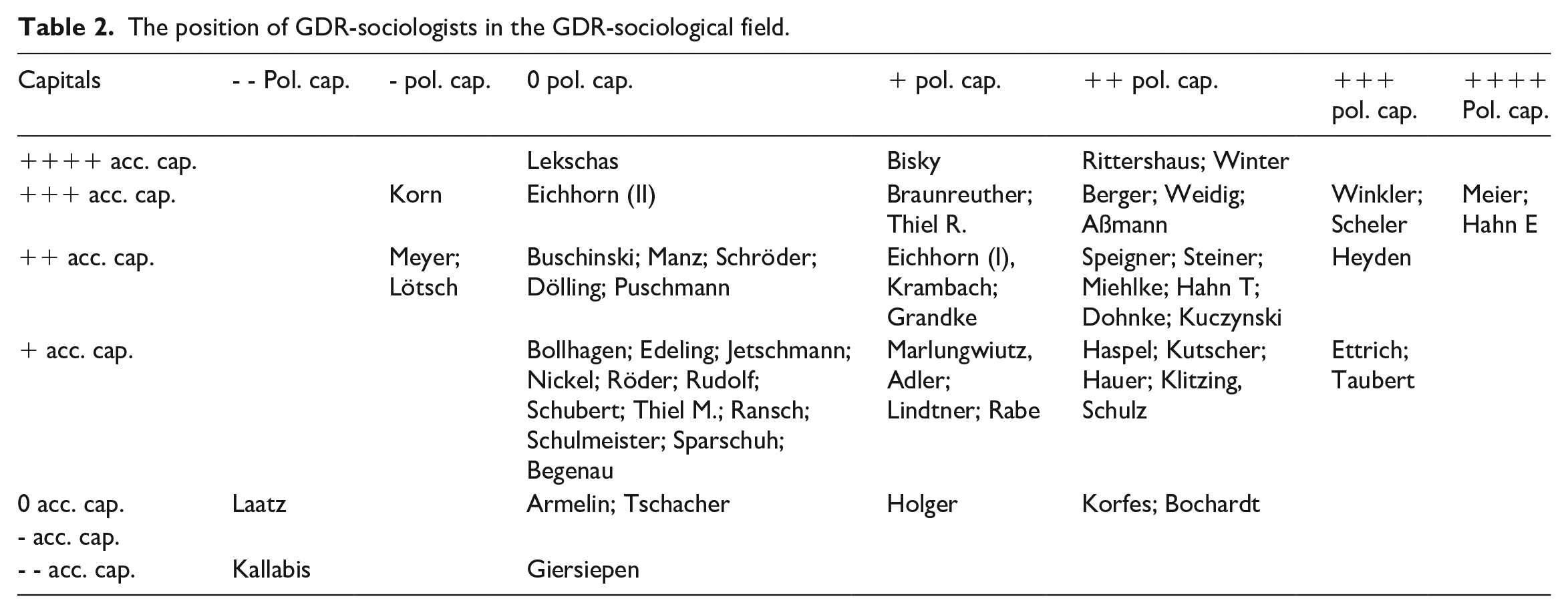
Table 1 lists the capitals for each author considered in the analysis, while Table 2 reports a synthesis of the different positions occupied by sociologists in the sociological field, according to the degree of their academic and political capitals (measured in terms of: extremely high; very high; high; moderate; null; negative; very negative), and Table 3 presents a list of authors who participated in the two editions of the M-L sociological dictionary.
The volume and set of capitals of GDR-sociologists.

The position of GDR-sociologists in the GDR-sociological field.
List of GDR-sociologists who participated in the two editions of the M-L sociological dictionary.

In the analysis, I will focus on the authors present in the positive area of the sociological field, considering multiple aspects together: the set and volume of their capitals, their career paths, their disciplinary (and in some cases political) socialization, their generational belonging, their research topics, and engagement in the sociological dictionary projects and textbook project. The main aim is to render a more dynamic image of the field structure, highlighting how belonging to the core of GDR-sociology did not correspond to occupying dominant positions in the broader field of the social sciences and humanities.
On the other hand, returning a dynamic picture also entails focusing on the structural changes of the field over time. Nevertheless, by taking the dictionary as the main tool for examining the symbolic space of the sociological field, I focus the analysis mostly on the period between the end of the 1960s to the end of the 1970s. However, the fact that no further editions of the sociological dictionary were issued testifies to how the bureaucratic structure of the sociological field—the chain of control on the organization of scientific work and the production of scientific output—delayed the institutionalization of the discipline. Other indicators are meaningful to mention here, such as the long process needed to reform the teaching programs at Humboldt University, which was nevertheless possible thanks the enterprise of Artur Meier, and the setting-up of a sociological journal, which happened only just before German reunification, thanks to the efforts, among others, of Artur Meier, Manfred Lötsch and Hansgünter Meyer (see Grüning, 2019; Sparschuh and Koch, 1997). While these slow-paced transformations let us reflect upon how the interplay between the scientific/academic field and the bureaucratic field (the GDR-State) also depended on the position of a discipline in the disciplinary hierarchy, they also provide some insights on certain trends in the final years of the GDR-State.
Turning now to Tables 1 and 2, the first general observation concerns the generational belonging of the sociologists positioned there. While, as it was supposed, most of the younger sociologists occupy the lowest positions in this sub-field, the lowest positions in the field are also occupied by scholars born before 1940, who are usually included within the group of the “founding fathers of GDR-sociology.” On the other hand, the higher positions also appear heterogeneous from a generational perspective, for which we can count four generations of scholars: those who studied during the Weimar Republic; those who began to study during the Nazi regime; those who began their studies in the early phase of the GDR-State, during the change from the old to the new academic system; and those who began to study when the new academic system had already been established. These data highlight, therefore, how the higher level of both political loyalty and socialization recognized for the older generations of sociologists (Sparschuh and Koch, 1997) did not have consequential effects on the accumulation of academic and political capitals.
It is equally interesting to notice that various scholars occupying the highest positions do not belong to the core group of GDR-sociologists, according to the existing literature and considering the sociological dictionaries as a parameter. Nevertheless, some of them held important offices in sociological institutes and organs, that is, they possessed very high academic political capital and delegated political capital. So, for instance, Hans Joachim Ritterhaus was initially Deputy Director of the sociological section and a chairholder of M-L sociology at the Institute for Social Sciences of the Central Committee of the SED-Party, then Director of the sociological section at the Central Institute of Philosophy (1976–1977) and, finally, Deputy Director of the Institute of Sociology and Social Politics (1978–1981) at the Academy of Sciences. Furthermore, he was Deputy President of the Scientific Council of Sociological Research from 1964 to 1976. He was also involved in the first and second edition of the M-L sociological dictionary, but only for one item—“the planning of social research” in 1969 and “social planning” in 1977—which may be considered relatively marginal topics with respect to other ones more strongly related to the cognitive and epistemic definition of M-L sociology. 22 Another meaningful example is the sociologist Gunnar Winkler who, like Ritterhaus, was trained in economics. He approached sociology relatively late when the discipline had already been partially institutionalized. He also had a delayed academic path, having worked in trade union schools until 1978 before becoming, in that same year, the Director of the Institute of Sociology and Social Sciences at the Academy of Sciences. In addition, he was President of the Scientific Council for Demography and Social Politics (two crucial topics in the 1970s in GDR-sociology) from 1974 to 1990.
In contrast, very different trajectories were experienced by Kurt Winter, Lothar Bisky, and Artur Meier. Apart from Meier who, in 1986, became Director of the Institute of M-L Sociology (IfS) at Humboldt University, none of them worked in or held representative offices in sociological or GW-institutions. Furthermore, they were far from the philosophical and economic disciplinary fields.
Winter had a medical training background and was the first Director of the Hygiene Institute at Humboldt University (1956–1975) and Rector of the Academy for Medical Progress (Akademie für ärtzliche Fortbildung) from 1967 to 1979. He was involved in various scientific commissions, also at the international level, and held offices at the Ministry of Health. Bisky studied philosophy first but later changed to cultural sciences and specialized in media studies which, at the time, was a very innovative research field. During his career, he moved among different prestigious institutes of the GDR: starting at the Institute for Cultural Sciences at Humboldt University, he later changed to the Central Institute for Youth Studies (Zentralinstitut für Jugendforschung) in Leipzig. In the meantime, he was appointed as an Honorary Professor (1979) at Humboldt University and, in 1980, he became a lecturer (Dozent) at the Academy for Social Sciences, where he remained until 1986 when he was called to lead the Film High School in Potsdam (Babelsberg). After having studied pedagogy and history, Meier began post-graduate studies (Aspirantur) at the HUB. In 1970, he obtained the habilitation and moved to the Academy of Pedagogical Sciences as the Director of the section on Sociology of Education. He maintained this position until 1986 before returning to Humboldt University as Director of the Institute of M-L Sociology. In that same year, he also became Deputy President of the Scientific Council for Sociological Research.
Thus, beyond the different disciplinary origins and affiliations, all three contributed to the establishment of specific sociological branches, respectively medical sociology (cf. Voigt, 1984), sociology of communication, and sociology of education, and achieved international prestige. So, for instance, in 1978 Bisky was elected to the board of the section “Sociology of Communication” of the International Sociological Association, while Meier was, in the same period (1978–1986), Vice-President of the section “Sociology of Education,” to be successively elected in 1986 as Vice-President of the same International Sociological Association.
The first core GDR-sociologists in the highest area of the field are Erich Hahn and Hermann Scheler, who occupied similar positions according to the sum and set of their political and academic capitals, and also possessed a similar scientific capital, but substantially differed with respect to their cultural capital and their involvement in the two dictionary projects. While Scheler did not participate in these projects, 23 Hahn contributed to both editions: in the first one with only a few items concerning key categories of general sociology (i.e. social roles, actions, socialization, behavior, relationships, as well as ideology), and in the second one also as an Editor, dealing with items either close to M-L sociology (objectivity and consciousness) or related to various “bourgeois sociological currents” (phenomenological method, positivism, structuralism, structural functional analysis, and sociology of knowledge), despite the fact that “bourgeois sociology” was not his research field. The question is even more interesting if we consider that other authors, such as Kurt Braunreuther, were specialized in these topics. However, Braunreuther contributed only two items to the first edition and eight to the second, concerning either definitional (bureaucracy, decisions, institutions, social control, pluralism) or technical concepts (analysis of the organization, social politics, sociography). It should be noted, however, that when the second edition of the dictionary was issued, he had already died.
Turning back to the comparison between Scheler and Hahn, the latter had a more solid philosophical socialization. By starting his career as Director of the section on Marxism-Leninism at Humboldt University (1964–1966), from 1966 he worked at the Institute for Social Sciences where he was first chosen as a chairholder of M-L sociology (1966–1971), and later of philosophy (1971–1990), becoming in the same year Director of the philosophical institute. Furthermore, from 1972 to 1990, he was President of the Scientific Council for Sociological Research and President of the Scientific Council of the General Commission of Philosophers of the GDR and USSR.
Conversely, Scheler did not follow a canonical career path. At the age of 35 years old, he attended a Party school for 3 years, studying dialectical and historical materialism. In 1955 he obtained a PhD, for which the GDR-ideologue Kurt Hager was among the reviewers. Five years later, he became a professor without holding the habilitation. He mostly held offices in the philosophical sections, respectively, of Humboldt University and the Academy of Sciences, while in the meantime he continued to have scientific and political assignments in political and State institutions. Though his number of published works is lower than Hahn’s, the topics were very similar: both worked mostly on historical materialism and pivotal concepts of Marxism-Leninism (i.e. consciousness process and lawfulness of the social process).
Summing up, having a different level of institutional cultural capital did not seem to play a meaningful role, either in determining academic career paths or the chances of publishing. Scheler’s exclusion from the first edition of the M-L dictionary was probably, in part, due to the fact that he belonged to an older generation (he was born in 1911) than most of the authors and editors, with a few exceptions, such as Braunreuther (1913), who wrote only two items in the first edition. It may be supposed that his socialization and delayed career probably had an impact on his possibilities of building meaningful networks with other scholars, not least because of the maintenance of a specific understanding of “scientific prestige” and scientific recognition among those who had “regular study paths,” as stressed by Adler: Q: And was it because of these personal relationships that Erich Hahn had a certain influence for legitimating sociology? A: In this case the personal relationships played a role. . . It was so, those belonging to the FDJ-generation were young people who, after the war, really thought that they could build an alternative. They went into the youth organizations and they rapidly became functionaries, but they wanted to do something scientific and then, through their political path, reached the academic world. And they knew each other more thanks to their political past. And amazingly, they studied philosophy and they also had direct contact with this super-ideologue who also had a chair in philosophy at Humboldt University, Kurt Hager, and through him trust. [. . .] Q: You have previously distinguished between dogmatic and naïve sociologists. You said that in your Institute [Academy for Social Sciences] there were mostly naïve sociologists, so where were the dogmatic sociologists concentrated? A: The dogmatics. . . it mostly depended on a certain spiritual horizon. Well, they were sometimes people of the oldest generation, who in some way entered the scientific world, the devil knows how.
In this excerpt, Adler pinpoints a specific group of sociologists belonging to the older generation who made career shifts from the political to the academic field thanks to their informal political relationships, and who mostly devoted themselves to philosophy. Furthermore, he implicitly associates a low level of cultural capital with a dogmatic view of the discipline. Beyond Scheler, the other scholars who shifted from the political to the scientific field were Günther Heyden, Horst Taubert, Heinz Kallabis, and Susanne Buschinski. Nevertheless, except for Heyden, who was closer to Scheler’s position, the academic paths of the other scholars were very different. As sketched above, it seems that political socialization and political relationships were not sufficient bases for pursuing a successful academic career (see also Table 2).
At a lower level than the sociologists mentioned above are several core GDR-sociologists, such as Horst Berger, Rudi Weidig, Georg Aßmann, Kurt Braunreuther, Günther Heyden, Wulfram Speigner, Helmut Steiner, Toni Hahn, Dieter Dohnke and Wolfgang Eichhorn I, together with scholars such as Jürgen Kuczinsky and John Lekschas, whose research areas were partially peripheral with respect to the core topics of GDR-sociology (see also Table 2). Kuczinsky, who began his academic career before WWII and quickly achieved an international reputation, was especially well-known for his works on the history of economics (most of all, he investigated the conditions of workers under capitalism) and science, but in the final years of the GDR-State he also wrote about the sociology of intellectuals, literature, and the arts. Lekschas, who instead had a background as a jurist and, starting in 1961, held several leading positions at the Faculty of Law at Humboldt University, contributed to the development of the research areas of criminology and medical sociology in the GDR.
On the other hand, sociologists who dealt with core topics of the discipline were not a homogeneous group. Sociologists with a philosophical background (or who had more generally attended a degree course in GW) paid more attention to the theoretical and/or ideological premises of the discipline, while sociologists with an economics background were more involved in empirical investigations. 24 The most representative of the first group were Heyden and Eichorn I. Heyden was one of the editors of the second edition of the M-L sociological dictionary, for which he wrote entries on historicism, idealism, utopic and scientific communism, materialism, objectivism, and the State. Eichhorn I was a co-editor of both editions and, in the second, he wrote several items such as: base, superstructure, historical materialism, morality, nation, production relations, value, social norms, freedom from value judgements, and contradictions. The other two relevant sociologists of this group are Weidig and Dohnke. Weidig pursued his scientific career exclusively at the Academy for Social Sciences and was one of the editors of the second edition of the dictionary, contributing with core concepts of M-L sociological theory, such as: work, socialist work community, creativity, and social driving forces. Conversely, Dohnke mostly worked at Humboldt University (at the end, in the Institute of M-L Sociology) except for 3 years working at the Ministry for University and Research. While he never co-edited the sociological dictionaries, he wrote several items for both editions, especially the second one, where his contributions concerned four areas: methodology (i.e. methodology, empirical social research, description), M-L categories and principles (i.e. social regularity, partiality), philosophical concepts (i.e. essence, phenomenon) and sociological theory. Despite being neither specialized in a sociological branch nor engaged in empirical investigation, he ranged across many topics, remaining however on a more abstract (philosophical) level.
Together with Braunreuther, the other most representative sociologist of the second group is Horst Berger. In both editions of the dictionary, Berger contributed mostly definitions concerning methods, research epistemology and techniques (in the second edition: survey, concept building, interpretation, focus group, case study, method, observation, documentary analysis). Wulfram Speigner and Helmut Steiner, in contrast, were not involved in either of the two editions, even though they published works on some crucial topics of GDR-sociology. Steiner in particular, beyond dealing with theoretical questions of M-L sociology and “bourgeois sociology” and clerical workers in the German Federal Republic (the latter was the topic of his Ph.D. dissertation), in the 1960s also carried out empirical investigations on GDR-social structure and youth studies. 25 Conversely, Speigner researched mostly on social questions regarding women and children in GDR-society. Finally, Georg Aßmann, a student of Braunreuther, was one of the editors of the second edition of the dictionary, mostly writing definitions pivotal to economic sociology, such as industrial society, organization, and leadership. 26 The fact that he was the only sociologist with an economics background who also co-edited one edition of the dictionary probably resulted from working at Humboldt University.
General remarks
Focusing especially on the scholars present at the top of the field, we can try to draw some general considerations.
First, looking at the symbolic space of the field, it is possible to identify a core group of sociologists who worked to build up M-L sociology, as well as sociologists who, instead, introduced new research branches within sociology in the GDR, for which in some cases they were also recognized at an international level. Nevertheless, despite their marginal role in M-L sociology, the representatives of the latter group mostly occupied dominant positions in the broader field of social sciences and humanities, filling leadership positions in institutes which were less controlled by scholars of the hegemonic GW-disciplines. In this regard, it can also be supposed that what they regularly published about their topics was closely related both to their scientific prestige and their high academic capital. However, this does not mean that their works were more ideologized, but rather that their position and symbolic capital provided them with more opportunities and freedom to publish, and sometimes to express criticism, even though this could entail clashes with censors. 27
Second, only in two cases did representatives of GDR-sociology occupy the highest dominant positions of the field, thanks to the fact they held offices in philosophical institutes and organs. This can be interpreted as resulting from the generally low and delayed institutionalization path of sociology which made it harder to undertake a career and reach the highest academic rank and offices as a sociologist.
Third, using sociological concepts borrowed from “bourgeois sociology” did not favor the accumulation of delegated academic and scientific capitals, but it did not undermine the possibility of publishing at all. A paradigmatic case is represented by Hansgünter Meyer (Academy of Science, background in social sciences) and Manfred Lötsch (Academy for Social Sciences, background in economics) whose habilitation thesis on social structure was forbidden to be published in 1970 for ideological reasons (interview with Edeling). The work approached the sociology of organizations from a functional-structuralist perspective, but it was written in a phase before functional-structuralism, as a “bourgeois theory,” would be accepted in the form of a book. Nevertheless, they published an article on this topic in the Deutsche Zeitschrift für Soziologie already in 1974 (Lötsch and Meyer 1974), and both were involved in the second edition of the M-L sociological dictionary (1977), contributing with topics related to their research fields and with concepts borrowed from “bourgeois sociology” (see Table 3).
Fourth, scholars with a philosophical background, independently from their academic rank and offices, played a central role in the two dictionary projects, both with respect to the number of items written and the centrality of those items in M-L sociology. Conversely, sociologists with an economics background mostly dealt with technical concepts or the definition of special sociology branches, even when they had more theoretical competences, such as Braunreuther. However, a further criterion was relevant to defining the possibility and ways of participating in the dictionary projects: institutional affiliation. Thus, in both editions, most of the sociologists involved worked either at Humboldt University or the Academy for Social Sciences, with some exceptions, such as the sociologist and economist Braunreuther who, however, for the first edition (when he was still alive) was asked to write only two items and Eichhorn I, who in 1973 had become Director of the Institute for Historical Materialism at the Academy for Social Sciences. This highlights how the decisions regarding what to include in the core of M-L sociology and how to include it was related to specific social groups and networks of sociologists localized in specific institutes and close to specific disciplines.
Fifth, the sociologists at Humboldt University who played a crucial role in the dictionary projects and occupied top positions in the field generally presented a lower level of publication than other sociologists, probably as a consequence of the progressive division of tasks between university (mostly teaching tasks) and research institute (mostly research tasks). However, the low level of publications mostly regarded sociologists who worked either within philosophical institutes or institutes of economics, but not scholars working in other institutes. This means that the subordination to philosophy and economics had more relevance than direct forms of political control.
Sixth, considering the different positions sociologists occupied in the field and their levels of publication together, no clear correlation between the political capital possessed and the orientation toward topics closer to Marxism-Leninism or historical materialism can be drawn. While scholars at the top of the field closer to historical materialism had no difficulty publishing, other scholars in similar positions dealing with more neutral concepts and topics also presented a high level of publication thanks to their recognized prestige. Thus, it seems here that disciplinary and organizational cultures played a more central role in facilitating the permeability to more propagandistic forms and use of ideology than did the possession of high degrees of political capital.
Conclusion
This article aims to reframe the relationship between politics and sociology in the GDR through the analytic concept of the field. While the interest of Western (especially German) scholars in sociology in the GDR has been motivated over time by different reasons (according to the different political climate before and after German reunification), we find a consistently similar interpretation of how the political elite influenced sociological production, focusing primarily on three points: the ideological premises of GDR-sociology, based on historical and dialectical materialism; its instrumentalization for political goals; and the increasing gap, especially from the 1970s, between Marxist theory and empirical findings. Furthermore, with the progressive political “normalization” of the German republic after 1990, general interest in GDR-sociology gradually declined with the justification that it was devoid of originality and scientific value.
While all these arguments are in themselves founded, it seems they catch only the surface since they limit themselves to analyzing the formal structure through which sociology was organized, mostly focusing on published works without considering that most of the scientific findings (especially of empirical investigations) remained unpublished and only available for internal use, and without considering how the bureaucratic structure of the field and its different spatialization in the various academic/scientific institutes impacted on both scientific practices and outputs. As a result, these studies mostly return a homogeneous image of sociology in the GDR based on a limited number of publications of those GDR-sociologists who were closer to Marxism-Leninism. Most of all, though, the absence of a perspective which first takes into account who the actors were makes it difficult to systematize the theoretical, epistemological, and political differences among them, even when they have sometimes been noted.
In this regard, a field analysis was useful first to pinpoint the different positions sociologists occupied in the sociological field, considering their academic and political capitals and their scientific achievements, and second to understand how these influenced their stances on sociology as a discipline, and on both Marxist and “bourgeois sociological theories.” For this purpose, it was also important to include in the sample those sociologists who operated in institutes which were not dominated by the leading social science disciplines, that is, philosophy and economics.
To carry out the field analysis, we chose to consider the sociologists active in Berlin for two main reasons: first, most GDR-sociologists were concentrated in the academic and scientific institutes of Berlin; second, most of the political decisional processes regarding the organization and definition of sociological teaching and research activities were taken within political organs settled in Berlin. As a result, working as sociologist in Berlin provided more possibilities for building academic and political social networks which could, in turn, impact the accumulation of both political and academic capitals, as the comparison between the social trajectories of Begenau and Adler especially highlights.
Summing up the main findings of the analysis, we can first notice how the dominant position in the field was not only occupied by core “GDR-sociologists” but also by sociologists who were more distant from the theoretical dominance of dialectical and historical materialism and had founded new sociological branches (sociology of education, sociology of communication, medical sociology, and criminology) and who also distinguished themselves at an international level for their scholarly achievements. Second, the fact that only a few GDR-sociologists closer to Marxism-Leninism occupied dominant positions (mostly those with a philosophical socialization) is a sign of the low level of the discipline’s institutionalization. This mostly derived from the subordination of sociology to philosophy, a condition which was still more evident at Humboldt University where an orientation toward theoretical questions prevailed. Third, by comparing the composition of those who participated in the two M-L sociological dictionary projects and the distribution of the items, it emerges that there was no direct correlation between the political capital possessed and closeness to Marxism-Leninism, that is, to more ideological-political topics (an aspect, moreover, that also emerges in the analysis of the career path of Adler). Rather, two other factors were meaningful: the disciplinary background of the sociologists and their institutional affiliation (Humboldt University and the Academy for Social Sciences), highlighting the existence of academic social networks which were only partially filtered by political actors and decisions. Finally, by focusing on the social trajectories of sociologists, it is also possible to shed light on some ongoing changes in the sociological field in the 1980s, even if no institutional changes followed, if not too late (i.e. the setting up of a sociological journal in 1990). It especially seems that internationalization increasingly became a scientific criterion for defining one’s career. So, for instance, whereas in the 1950s and 1960s the participation of GDR-social scientists in international sociological conferences first depended on political decisions, 28 in the following decades it was more related to the positioning strategies of individual actors whose (international) prestige became, in turn, politically meaningful for the GDR-State. In this regard, the move of Artur Meier from the Academy of Pedagogic Sciences to Humboldt University is paradigmatic. While in those same years his scientific and academic capitals increased in parallel, his move from a peripheral institute to a central institute of GDR-sociology not only enabled him to reform the teaching curricula there but also entailed new ways of thinking sociology and organizing academic work and networks (interviews with Nickel and Edeling).
Footnotes
Declaration of conflicting interests
The author declared no potential conflicts of interest with respect to the research, authorship, and/or publication of this article.
Funding
The author received no financial support for the research, authorship, and/or publication of this article.
