




Abstract
This article outlines the complex stories through which national belonging is made, and some ways in which class mediates the racialisation process. It is based on fieldwork on the ways in which white UK people in provincial cities construct identities based on positioning vis-à-vis other groups, communities and the nation. I argue that this relational identity work revolves around fixing a moral-ethical location against which the behaviour and culture of Others is measured, and that this has a temporal and spatial specificity. First, attitudinal trends by social class emerge in our work as being to do with emphasis and life experience rather than constituting absolute distinctions in attitudes. Second, in an era supposedly marked by the hegemony of ‘new’ or ‘cultural’ racism, bloodlines and phenotypes are still frequently utilised in race-making discursive work. Third, in provincial urban England, there is a marked ambivalence towards Britishness (as compromised by Others) and an openness to Englishness as a more authentic source of identification.
Introduction
The scholarly work that takes white racialised identities as a core problematic is less prevalent in the UK than in North America (Garner, 2006), where it has a far longer history as well as interdisciplinary sub-fields such as critical race theory and critical whiteness studies. The North American material includes theoretical interventions (Harris, 1993; Mills, 1997), ethnographies (Hartigan, 1999; Lewis, 2003; Perry, 2002), and qualitative interview-based material (Gallagher, 2003). Unimpressed American commentators often take issue with this work, to the point where they denounce it as outrageous, label it partisan and undermine its scientific validity (see Niemonen, 2010, for the most scholarly critique of this ilk). Sadly, this level of engagement and intensity of response are as yet absent from the UK landscape. Critiques from within, however, correctly identify lacunae in the gendered dimension (Ferber, 2007), while the research’s overconcentration on the working classes is equally applicable to the USA and the UK. The relatively strong input from empirical social scientists and ambivalence over referring explicitly to whiteness distinguishes the British field (Garner, 2009b). The literature suggests that the racialisation of white identities is as much a feature of the British social world as of the American; there are patterns in how this is expressed. There are discourses of identity that are both vernacular and international (covering loss, jealousy, pride and resentment) (Garner, 2009b). The norms of whiteness are in great part dictated by identification with a code: a set of behaviours that are viewed as constituting respectability. This is bound up with self-sufficiency, community orientation, civility and the work ethic. However, whiteness is also a paradigm, a way of understanding the social world, and supposes that white is a position of relative privilege, albeit highly uneven, contingent and situational.
Although the field is still small but growing, there are notable trends relevant to this essay, among which are the increasing focus on the middle-class habitus as a site for whiteness, and the subtle identification of ways of doing whiteness that involve not only racialised and inter-class distinctions, but also intra-class distinctions. There is also an area of overlap of whiteness with discursive representations of the nation. This article seeks to explore all these areas, but particularly the last. The use of the term ‘moral economy’ differs from that propounded by Thompson (1971), who designates a set of norms acting to regulate economic exchange by imposing ethical considerations that outweigh economic benefits. Rather, by using the model of ‘political economy’ (i.e. the rules concerning the production of wealth at a national level), I propose the ‘moral economy of whiteness’ to mean the non-economic rules concerning the reproduction of whiteness at national level. As will be discussed below, ethical behaviour is posited as distinguishing between the social location ‘white’ and its Others, that is between grades of whiteness, as well as between whiteness and non-whiteness.
Making ‘race’
Key paradigms in the literature for understanding contemporary racism are ‘new racism’ (Barker, 1981), ‘cultural racism’ (Modood, 1991), and ‘color-blind racism’ (Carr, 1997). Each of these avoids explicitly linking physical appearance and position in the social hierarchies, a contrario of what was the norm from the late eighteenth century through to the Second World War, in what can be termed the ‘long nineteenth century’ of ‘race’ theory. Instead the nurture-over-nature sets of arguments identified by Modood, Barker and Carr suggest that people’s cultures are read as determining levels of civilisation, intelligence and ways of doing things (in a form suggesting that culture is fixed and immutable). These theorists have identified the logics at play: it is not because black people are inferior per se, but that they have a poor work ethic that they are the major recipients of welfare in the USA (colour-blind racism); developing-world immigrants into Europe cannot successfully become Europeans because the gap between civilised Western Europe and their own backward cultures is unbridgeable (new racism); Islam is a threat to European values owing to its putative misogyny, disregard for democracy and incipient violence, inter alia (cultural racism).
However prevalent these discourses are, the emphasis on cultural rather than physical differences is not ‘new’. A focus on culture as the measure of civilisational hierarchy preceded the nineteenth-century infatuation with phenotypical difference, as demonstrated in the British colonisation of Ireland (Garner, 2004). Why is this relevant to a discussion about the racialisation of whiteness in contemporary England? Although I am focusing on the non-economic aspects, the ‘moral economy’, I also want to stress, by reference to class, the economic context in which this cultural reproduction of difference is made. Moreover, the fact that physical difference is not always explicitly invoked does not mean that racialisation is not taking place, or that the explicit object of discussion is actually what the discussion is about.
So where does the whiteness paradigm fit? Perfectly in this space where assumptions of culture are static and essentialised, and physical appearance is read directly from culture, so that in evoking ‘culture’ one is implicitly designating bodies. Note also that ‘white’ in this perspective is not a homogeneous group, but one with clear distinctions of class, gender, nation, religion and status. In other words, it is part of the local ‘contingent hierarchies’ (Garner, 2007), which will be explored below, using direct quotations from the interview material. The place of culture in these accounts is critical, not for ring-fencing the cultural from the material, but for demonstrating the intimacy of their relationship.
Moreover, my use of racialisation as a key concept follows the outline given elsewhere (Garner, 2004, 2009a), in which I stress that it is a process that can be about attributing innate characteristics and cultural values to a group and postulating a difference between these and those held by other groups (particularly the dominant one). Thus, this process can include collective relations between groups that are nominally all categorised together racially. For example, in the British context this might involve ‘Whites’ (white UK people, Polish migrants, Jews, Irish migrants), ‘Blacks’ (African-Caribbean, Somali, West Africans) or ‘Asians’ (Pakistani-origin Muslims, Indian-origin Sikhs). The key element is a contextual power relationship of some kind. I thus reject the notion that racialisation can apply only to relations between groups previously constructed as ‘races’: ‘Whites’, ‘Blacks’, ‘Asians’, etc. Indeed there is a long history of racialising nominally white groups in Britain, including Jews (Kushner, 2005), the Irish (Garner, 2004) and Poles (Burrell, 2009; Dawney, 2008; Lee-Treweek, 2010).
The primary material for this article is drawn from around 450 interviews, plus a few focus groups containing around 50 participants, carried out between 2005 and 2011 in provincial cities in England (especially Bristol and Birmingham). The author was part of the research teams in all these projects. 1 Respondents were recruited in community spaces (community centres, clubs, churches, associations, pubs, cafés, etc.; and through snowballing). While the focus, funding and interview questions differed slightly in each case, the core set of questions concentrated on attachments to place and the prioritisation of the respondents’ views on social identities. We start here with the assumption that whiteness is an outcome rather than a departure point. The question thus becomes ‘How do people make themselves “white” in contemporary England?’ Second, how does classed experience emerge as a factor in this whitening process? Linking these two strands is the discursive composition of the nation in relation to their own identities.
Culture
In our interviews, discussions of culture and space are constitutive of the racialisation discourse. In terms of culture, typical topics are clothing, language and behaviour. As the bulk of the fieldwork was carried out in the period after the terrorist attacks in London on 7 July 2005, one of the obvious patterns is that people refer to Muslims (especially women) as the touchstone for cultural difference. Note the framing of the following comments: This is our country and we were kind enough to let them in. In their country we couldn’t dress like this, we would have to respect their ways, but they don’t respect us and our ways. The younger people do, but now they want to have Sharia laws … they should adopt our ways. (Woman, Milton Keynes, in Garner et al., 2009: 24)
Molly, a former teacher in West Bristol, adds: You know, with Muslims, for example, they want their mosques, they want to keep their women at home, they want their girls to wear burqas and God knows what for school, well, okay, we've said they can do that, and then they say, we're different, you don't accept us, we're not integrated with you, and you think, well, just hang on a minute, you know, you want your cake and eat it, either you want to integrate and be part of the way this country lives or you don’t. ‘I have found that there are a lot of Africans on the Estate’, says Kath (Milton Keynes), ‘and they don’t seem to mix … I work in the shop and they are very ignorant, never say “please” or “thank you”, and I don’t like that. You know, it doesn’t cost anything to have manners’. (Garner et al., 2009: 24) I think Somalians do have a problem assimilating, I think they really do (…) And I’ve got people that I consider like good colleagues that are Somalians but sometimes I think ‘why did you say that? Or why did you do that?’ ‘cause they’re just rude (…) Somalians are just rude. (Hoggett et al., 2008: 10–11) You know, if I went to Japan, I would expect to take my shoes off or whatever it is when you go into somebody’s house, the same way. I think if people want to embrace our culture, they should embrace our culture, and if they don't want to, then don't live here. It’s simple.
Space
‘Space’ is another prism that enables the racialisation process to be seen (Sibley, 1995). In the following excerpts, space has been transformed from an unspecified, neutral and national status: When you leave London and then go on to Norfolk, as far as Stratford … it’s all sort of market […] and you don't really see an English person, it’s all like Muslims and you know. The first time I did that on that coach, I mean, I got a bit more used to it now, I thought, oh my, it was just as if you were in a different world, you know. (Lily, North Bristol)
Indeed, the foreignness of segments of urban space is frequently evoked. Simon (North Birmingham) is anxious about it: There’s these areas that have completely been took over … and you do feel very uneasy. Not just me, and I only drive into these areas, never actually walk into these areas, I just wouldn’t. Just in case I did do something that I … because of their culture or their religion it was a threat or it was … an insult or something.
Sometimes, there is an awareness of the demographic change in a specific area as a process, as in Denise’s account of a Northern city: the area where my Dad and his wife lived, slowly over the years, there was more Indians and Pakistanis moving into the area, and you know, that was a bit strange … Once one family moved in, a house came up for sale, they bought the next house and the next house, and it went on from there, and it was like living in a foreign country.
In these cases, the presence of Others is experienced as an invasion, an emotional trauma, and, as in the previous section, culture is seen as static, bounded, sometimes indecipherable and threatening. Although people in our interviews often refer to what could be understood as broader or structural processes in relation to housing, unemployment and education, for example, when it comes to the settlement of minority groups in specific areas, this strand of the discourse is absent.
Interviewees often use references to place as shorthand for the concentration of black and minority ethnic (BAME) people (Clarke and Garner, 2010), just as some white estates frequently become local bywords for pathological, almost racialised behaviour. I have chosen the theme of space because it combines key topics in this paper: culture, nation and physical appearance. In the narratives above, the space is understood to no longer resemble the nation it is part of. These understandings are based on observing people in a particular geographical space, yet conjecture on Britishness is always undermined by the fact that you cannot read somebody’s status from their body. As Nick (Plymouth) succinctly puts it: ‘Who is an immigrant? Nobody knows unless you talk to somebody, unless you question somebody, you obviously can’t tell from the colour of their skin or any other attribute.’
As Lewis (2005) finds, many people assume BAME people are foreigners and overestimate the proportion of asylum-seekers, immigrants or any group of non-whites. I contend that this is, first, because the distinctions between statuses are quite difficult to follow for anyone whose day-to-day work does not place them in direct contact with immigration issues, and, second, because one of the functions and privileges of whiteness, even for the most vulnerable socio-economic groups, is the option of homogenising people who are not white into an undifferentiated mass. Whiteness enables the interpretation of bodies in a particular place, and their association with cultural forms that are deemed ‘not like ours’. In this reductive equation, ‘us’ very often defaults to white; although there are exceptions to this, as we shall see below.
So the multidimensional problem that as an academic I understand as racialisation is viewed by these actors as a reasonable response to unreasonable behaviour (people who are not members of the nation changing the appearance and sometimes use of space; wearing different clothes; not joining in ‘properly’). The processes by which areas become associated with BAME settlement never take place in the abstract: they are always anchored in economic and historical forces. However, racialisation has to do with homogenising groups, de-historicising and not seeing their struggles, reducing their distinctiveness and viewing them as bearers of particular kinds of cultural norms. You can make ‘race’ without talking explicitly about physical appearance, but not without prior visual filtering.
Classed responses and experiences
Patterns emerging since the millennium from UK opinion polling on attitudes to minorities, asylum and immigration have fuelled an understanding of the (especially male) working class as the repository of the most hostile racist ideas. There is a relationship between type of newspaper read (tabloid or broadsheet) and type of opinion expressed toward immigration (CIC/MORI, 2007: 30, 54; McLaren and Johnson, 2007: 717), with greater hostility articulated by tabloid readers. The proportion of those with negative responses to minorities rises as the pollsters descend through the categories from A to E (professional to unemployed). This phenomenon is not restricted to the UK, being also observable at European Union (EU) level (Citrin and Sides, 2007), where decades of polls have produced a profile of those most hostile and most likely to vote for the far right: male, older, rural-based, but with the most significant variable being low levels of education. However, another trend complicates this picture. The gap between ‘liberal’ and ‘strict’ voters, on the question of immigration in Britain, shrank in the 1990s (McLaren and Johnson, 2007), as degree-educated Labour voters shifted rightwards. In recent years, there has been a smaller separation between middle and working classes. Moreover, the percentage differences often lie within the sample’s margin of error. In the Bristol and Plymouth Economic and Social Research Council (ESRC) project particularly, when we had the opportunity to split our sample between classes, an effort was made to explore the ‘why?’ and the ‘how?’ behind this pattern.
Indeed, some qualitative fieldwork (Lewis, 2005, for example) fleshes out this classed pattern. I suggest that middle-class people’s engagement with the discourses and practices of racialisation are also evident, but that the emphasis (in general) lies in different areas from those of working-class subjects. It is therefore not only the working classes who make themselves white in this process. Particular middle-class versions of whiteness, around belonging to a village community (Tyler, 2006), relating to empire (Knowles, 2008) and choice of schools (Byrne, 2006; Reay et al., 2007) have been observed and analysed. These versions compound class position and racialisation to demonstrate and preserve the moral and ethical validity of the speaker, as do the working-class versions.
My argument then is that, while there are areas of inter-class consensus about a perceived lack of integration by immigrants, and immigrant numbers producing strain on services, middle- and working-class respondents place their emphasis on distinct areas of concern, and from different perspectives (Clarke et al., 2009). Without suggesting that these classed positions are homogeneous, we will now look at some of these areas and emphases. 2
Some middle-class perspectives
With a few exceptions, the middle-class sample in the Bristol and Plymouth survey seemed to have little experience of social housing, or of employment history outside the professions. This grants a degree of abstraction, and a space to see a bigger picture. As James (Plymouth) states: I’m sorry but if you have come in here as a refugee, […] you’ve got to accept that till we can get housing for everybody, you’re going to have to be lower down the ladder […] People who can afford big houses live in big houses, people that can’t afford them don’t, and people that have lived in this country and have been part of the system, ought to benefit more than people … and it’s not about colour, creed, or anything it’s just about last in, last to be considered.
Other professionals (e.g. Brian, a probation officer) have dealt with ‘an enormous number, I’m saying enormous, more than I would have expected, of refugees’. The experiences are usually not based on equal standing, but of professional distance and the dominant place in a hierarchical relationship. Brian argues that in terms of housing: if you’re single, under 25, fit, not signed off on disability and you’re not a junkie, you’re very unlikely to get any help at all with housing. That’s male or female. But if you say, I’m a refugee or you threaten to go to the papers and say, this council is racist, you will get preferential treatment.
Moreover, it is only our middle-class respondents who explicitly refer to the use of ‘taxpayers’ money’ (a more abstract way to frame arguments about resources), pressures exerted on space and services, and the long-term implications of immigration. Indeed, for the middle classes the Others are just as likely to be white working-class people (see below). The white middle classes often whiten themselves by reference to a less sophisticated and excessively white working class. Indeed, a proportion of the public service middle classes (Reay et al., 2007) actively seek multicultural capital through education, while devaluing white working-classness.
Some working-class perspectives
Contrary to the middle classes’ capacity for analytical distance through experience drawn from the outside, our working-class interviewees usually demonstrate an insider’s’ perspective, with a very local focus. Usually this leads to the conclusion that the white working classes are now at a disadvantage vis-à-vis ethnic minorities. In this section we shall focus on housing to illustrate this idea, although a concentration on employment and integration could have been equally effective (Clarke et al., 2009).
The question of housing is particularly emotive. Old patterns of concentrated intergenerational family residence are seen as thwarted by the diminishing stock of social housing, and the even greater shortage of larger and smaller units, leading to the break-up of the extended family whose members lived in the same neighbourhood. In this discursive context, an association of resources are linked, as in the comments from Val in Runcorn, who says: You’ve now got towns which were predominantly white and now they’re not. And you’re expected to get on and not cause any waves, not look at people differently and be accepting. But at the same time how can you be accepting when they’re taking your house off you? (Garner et al., 2009: 7)
The item chosen to demonstrate unfair competition is a house, which we find quite often is a thematic hub from which other associations are developed. Leanne (North Bristol) starts a comment about Polish migrants: They get to come over here and they get a house, a job, a shop. I’m not being funny. Look at all our corner shops. All Asian people. You know what I mean. Obviously I’m not racist but it just seems that the growing community … they are wiping us out and taking our jobs and that’s one of the reasons why none of us can get a job … I think they should employ British people first.
The discursive movements, from Poles to Asians, from houses to shops, to jobs, to obliteration, is dramatically encapsulated in Leanne’s brief excerpt. The assumption here is that minorities/foreigners are all given preferential access to housing, a story with local variations across the country. Some people in Hillfields (Bristol) are convinced that Somalis have houses built for them, or at least altered in layout for religious practices. A woman in Thetford states: ‘I know of [foreign] families who have got start-up vouchers to help them with their housing and I never got that. They all seem to get their houses and points and have decent places to live’ (Garner et al., 2009: 28).
Polish migrants’ niche in the moral economy is revealed in Leanne’s comments as being parallel that of migrants of colour. While a common trope is the hard-working Pole, this can also be viewed as excessive: the low-paid, industrious Poles are also ‘usurpers’, and ‘noisy, heavy drinkers who ‘do not mix’’ (Lee-Treweek, 2010: 218). In the North-West, Polish men are often attacked, they work shifts mainly with other migrants, and both genders receive abuse from co-workers, as well as a variety of bullying and sexual abuse. The reduced options on the housing market make multiple occupancy and overcrowding commonplace (2010: 218–220). They are thus disrespected and badly treated like any other low-status migrants. Dawney (2008: 9) points out that during her fieldwork in Hereford she noticed schoolchildren using ‘Polish’ as a term of abuse. Polish workers’ whiteness then does not shield them from racialisation or degradation, but underscores the mechanisms as being available to the dominant group vis-à-vis any other national or racialised group.
All these representative comments and racialisation processes are premised on the idea of a national entitlement and priority, rather than locally determined needs-based housing (seen as favouring large-familied migrants) (Dench et al., 2006). In other words, the frame of reference for resentment is the nation, and more specifically the welfare state. The distinction between the kind of comments noted here and James’s detached summary of the way things are (above) illustrates our interviewees’ classed experiences. People who feel they are in the competition speak in a different way from those who feel they are observers of the competition, and this typically reflects class position.
Moreover, there is a further strand of ideological labour evident in the interviewees’ narratives, which aims to distinguish themselves as respectable (Skeggs, 1997) in relation to non-respectable people. We shall see this in more detail under ‘Entitlement’ (below). The respectable working classes draw a line around a set of values suggested as working-class; solidarity, community-mindedness, work ethic, cleanliness, strong parenting and respect for others. Other white working-class people who do not meet these standards are frequently referred to in the same line of argument as new migrants. Both are viewed as dragging down standards, but the former are still tolerated begrudgingly as members of the nation, while the latter’s status is often less generously regarded.
So the apparently firm attitudinal class distinction emerging from opinion polls is, on closer inspection, rather a question of emphasis and focus. People’s experiences necessarily filter and contour their understandings of social processes. Class and ‘race’ are always present in these evaluations of valid and valuable membership of local and national communities, as we shall see in the final section, in the construction of discourse around the nation.
Britishness, Englishness, entitlement
What we have investigated here are not the elite master-narratives of nationhood that have fascinated historians, political scientists and quantitative sociologists (Anderson, 1983; Breuilly, 1993; Curtice and Heath, 2009; Smith, 1998), and upon which they have written compellingly, but rather the messy, fragmented and sometimes contradictory bottom-up constructions of nation. These constructions are frequently articulated in interviews without a prompt about the nation. Indeed, on one of our projects, asking direct questions about Britishness produced a lot of silence and indifference (see also Fenton, 2007). The nation is usually invoked implicitly, as at the end of the previous section, as the context within which the hierarchies of worth are produced. It is in the discursive reproduction of social hierarchies, which often match but sometimes override the economic ones, that the rules of membership become clearest. The ideological labour invested in producing one’s character as ethically valid and competent, and therefore one’s positioning as deserving, is the moral economy of whiteness that appears in the title. How can this claim be substantiated?
Lamont (2000), Fine et al. (1997) and Weis and Fine (1996) all capture a white American working-class discourse in which class is centrally defined by references to respectability and work ethic. Lamont’s study, whose design enables more reflection on the middle classes, comes closest to our findings: the middle class is seen as culturally ‘other’, but neither as competition nor as a source of power outside the workplace. However, Weis and Fine’s (1996) studies of men in the 1990s reveal minorities as the unrespectable and competing working class. For their sample, competition is horizontal, not vertical. This lies at the heart of the representations of the nation we infer: the nation is formally invoked only as a hierarchical framework, on which people compete with those of similar economic levels. What is at stake is set of layered belongings (neighbourhood, estate, town, nation, etc.) defined by a combination of bloodlines and contributions granting entitlement to resources.
What is the nation?
If you’re English, or if you state you’re English … it flags up to some people, a lot of the people that I work with, that you’ve got some sort of racism going on. And I don’t see that. Q: You mean against the Scots and … A: Against anyone. They draw the distinction very quickly from British to English when you talk about colonialism and imperialism because they see it as English-led. Then they say, well, what’s English? That’s the classic line I get thrown at me. Well, I think, I’ve got, my name is pre-Norman Conquest English in East Anglia, the home of the English really [laughing]. I’d like the privilege really of being able to call myself English, because that’s what I feel I am. (Geoff, Plymouth)
The ‘English turn’: what’s wrong with Britishness?
In our provincial English contexts, preferring to identify as ‘English’ is part of a reaction to Britishness, which many of our respondents find unsatisfactorily vague, plural and ultimately disordering. Much of the material alluded to in the section on culture above emerges in such discussions. One of the questions in our ESRC project was ‘When does an immigrant stop being an immigrant?’ This was designed to elicit understandings of what successful integration meant. Answers ranged around familiar themes: not being different (customs and clothes); trying to muck in; and kids speaking with regional British accents. Yet it is noted elsewhere (Garner, 2007) that examples of good integrators often turn out to be British children of migrants rather than migrants. Denise (Plymouth), citing her husband’s Indian cousin, and their family’s clothing and cooking practices as a good example of integration, summarises that ‘They’re not trying to be different’. However, there is no clear consensus of exactly what being British entails. Moreover, while there is also relatively little explicit articulation of language that in the 1950s and 1960s might have been labelled ‘racial’, there is a constant tension between Britishness and Englishness that crystallises in Phil’s (North Birmingham) reflection on his recently deceased grandfather’s life. He had been part of the D-Day invasion in 1944, and sorting through his effects had made Phil reflect on a distinction between then and now. There had been what he terms a ‘necessary national identity’. All the photographs contained only white soldiers. Before the landings they were given prayers or psalms, as there were only two religions represented in his regiment. For Phil, the ‘influx of people from other countries’ means that his family has shifted from a strong identification with Britishness to thinking of it as ‘only a passport’ in three generations. The path to civic rather than racialised nationality thus appears to Phil as illegitimate. However, we should also note that, like many people, Phil harbours contradictions: his closest friends are African-Caribbean Brummies.
Our discussions of nationality across England are haunted by those who have taken the civic path, whom Denise (Plymouth) calls the ‘British who aren’t British’, an equation that she goes on to acknowledge immediately is not about skin colour. Again, she is a person whose life is intimately connected to black and brown English people: her best friend, daughter of Jamaican immigrants, is also her eldest child’s godmother, and she has Indian-origin relatives of whom she thinks highly. The main perceived pressure on Britishness recurs in her discussion as in many others: Islam. This exerts a cultural pressure that threatens for many to erode strands of what British life is about (hence disengagement with Britishness). It should be reiterated that the fieldwork for this interview took place weeks after the 7 July bombings, and reflects the ‘Muslim turn’ taken in the discourse on multicultural Britain since 2005, in which culture, dress, physical appearance and global acts of political violence generate a set of anxieties about security and the nation. The power to racialise then hovers between the options of homogenising ‘non-white’ people (e.g. ‘asylum seekers’ accessing housing ahead of ‘us’) and homogenising particular groups, most evidently Muslims.
Entitlement
Who gets what? What should they get? Why? Reference to entitlement pervades discussions on membership of local and national community. Indeed, in this form of portraying oneself as a moral and ethical agent capable of producing a good account of oneself, entitlement becomes property: a stake in diminishing resources. Skeggs (2005: 977) writes of this relationship: property is determined as a set of entitlements, which are exclusive to an owner, or to the holder of the proprietary interest. Exclusion from, and access to, objects, people and practices to propertize, are central to both the formation of middle-class subjectivity (in its various new configurations) and the exclusion of others from recognizable worth, that is, proper personhood.
Inclusion in, and exclusion from ‘majority’ communities in two research sites
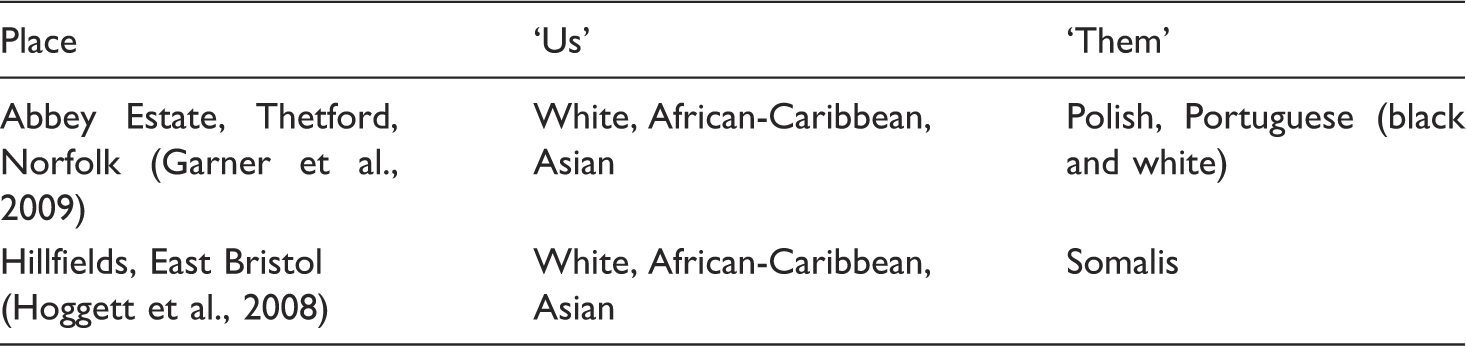
‘I’m not racist’, begins Claire (East Bristol): but I’m prejudiced. I am prejudiced, but I’m not only prejudiced against people that are black, I’m prejudiced against people who are on the dole who don’t do nothing, and still get it all. And there’s like me and my husband, who work hard … who keep our house nice … I mean we’re only council tenants … but we don’t get nothing.
This feeling of being stuck in the middle is not restricted to the middle class, as it is heard in various versions from our respectable working-class interviewees, such as Lisa (North Birmingham, 2009): I think you’ve got to be earning megabucks or be earning nothing. And if you’re earning nothing, there’s nothing to get you past that nothing stage. And if you’re earning megabucks you get as far away as possible from the reality checks. And it’s the majority of the people, the good hard-working people, and that’s not just in Birmingham, that’s in England and other countries, that are struggling.
Carl (North Bristol), a barman, is unimpressed by one element of the population on his estate: ‘Half of them are the sort of people you don’t see during the day because they sleep all day and are out all bleeding night, roaming the streets’. This colours his perception of contributions people make: There’s definitely more going out than goes in to it [the welfare system]. There’s too many people on it, for a start. I see them in this area, people who shouldn’t be on it, but they are. There’s too many young people. You go in the Post Office and they’re queuing out the door, nobody’s putting anything in, they’re all taking it out. I’m not on about the older ones who have retired. I’m on about the young ones who’ve never tried to get a job and things like that.
This squeeze on the hard-working middle is also articulated in relation to the other source of competition, migrants. Leanne’s conclusion (above) that ‘they are wiping us out and taking our jobs and that’s one of the reasons why none of us can get a job’, which began as a comment about housing for migrants, and ended as anxiety about British minorities, neatly demonstrates the slippage that underlies the construction of migrants as favoured beneficiaries of the new Welfare State. Much of the focus is not actually on migrants but on naturalised British nationals, and their British children or grandchildren. In other words, despite claims that we are living in times of ‘cultural racism’, ‘new racism’, ‘colour-blind racism’, etc., in which culture is the key theme of discourse, people still simultaneously make sense of difference through the old-school visual distinctions of skin tone, hair type, facial features, etc. So the reasonableness of economic and social protectionism – jobs and houses for locals first – rarely accommodates the possibility that not all long-standing locals are white, or that plenty of the migrant newcomers are white.
Some local white people are not contributing and are deemed not respectable, yet this is begrudgingly, resentfully accepted, as the representative quotes from Claire and Lisa (above) indicate. That is not the case for non-white Others. Broadly speaking, bloodlines hold sway over civic attachment (residence and acquired nationality); hence, in my interpretation, the retreat to Englishness, which seems more resistant to access through residence and contribution. Curtice and Heath (2009: 58–59) note that respondents opting for ‘English’ rather than ‘British’ identification hold a more ethnic than civic conception of belonging, while few BAME English people ‘feel able or are willing to state they are English’ (2009: 61). So not only is Britishness a separate, more remote layer of belonging than Englishness, but the latter is also whiter (a situation apparent to all the actors) and supposedly a position of relative weakness, a claim made by many white interviewees, such as Gwen: They’ve, they’ve got the Race Relations Officer at the Milton Keynes Council. They can phone him, or her, or whoever it is and say ‘well, look the white man down the road is calling my son names’. You get a letter then, to say that you’re a … racist. But we’re not!! We’re not! We’re trying to stick up for ourselves. We are white, we are … this is our country, and as they are coming in they should be taught, there should be said ‘alright, what can you offer, how do you feel … living among white people? Will it be, you know, a hindrance? Will you be able to get on with your neighbours if they are white?’ And if not, they shouldn’t be allowed to come. (Garner et al., 2009: 24)
4
Conclusion
In the absence of any statistical evidence that minorities per se are exceeding white UK people’s life chances (Hills et al., 2010), and given that even British National Party (BNP) voters criticise other white residents (Rhodes, 2011) as much as they express anxiety about migrants, two questions thus arise: What conditions render this kind of statement intelligible? How has ‘white’ come to appear a position of injury and beleagueredness? The national evidence that does exist quite strongly underscores class, ‘race’ and gender as compounding sources of impact on life chances, with class appearing as slightly more decisive (Rhodes, 2011). Yet the discourse our research teams identify submerges class to a great extent and concentrates on racialised understandings of the social world, in which to be an ethnic minority grants privilege that the white working class used to enjoy through a national framework of belonging. The nation-state is thus a presence framing the current racialisation discourse.
Our white middle-class respondents generally share the anxiety around immigration, integration and the detrimental social changes in Britain with which they are discursively associated. However, their engagement is expressed from a position of evaluation, either through professional experience in a supervisory position, or in the absence of direct experience.
In this context, the power available to white working-class UK people is relatively limited. However, they do share the power to discursively include or exclude from nation/community, for it is they who construct the ‘we’, just as the ‘we’ for our middle-class interviewees in West Bristol excludes people of all ethnic backgrounds resident in a large neighbouring council estate, for example. The power to reduce complex stories and individuals to single narratives and an undifferentiated group, while errant whites constitute individual examples of deviance, is still a power. Where there is so little obvious benefit in whiteness, it is sometimes easy to lose sight of the complexity of these power relationships. In covering the ground between class identification, racialisation and nation, I have distinguished a set of discursive themes. These all centre on reducing the significance of positioning in an economic hierarchy and opposing this with a moral/ethical standing characterised by industriousness, community-mindedness, fitting in to norms (not being different) and contributions (particularly, but not exclusively, through taxes). This alternative ‘moral economy’ is one way in which people make sense of their class position, and enables us to understand the blurred edges of this process: how whiteness (as constructed from this perspective) can also sometimes include people of colour while considering other white people marginal and begrudgingly tolerable. However, in the imagined structures of overlapping communities, the national – with its overarching affective, welfare and corporate bonds – trumps the local in terms of who is entitled to resources. The complicating factor is that allegiances to the British nation are severely ambivalent because of its relative openness. As people seek sanctuary in smaller imagined communities, it is the more exclusive lure of Englishness that appears to offer more ontological security to white UK people living in provincial England.
Footnotes
Funding
The first project (2005–2007) was funded by the Economic and Social Research Council (ESRC) (RES-148-25-0003) and covered Bristol and Plymouth; that in Hillfields Bristol (Hoggett et al., 2008) was funded by Bristol City Council; the study of areas in Birmingham, Milton Keynes, Thetford and Runcorn – Widnes (Garner et al., 2009) was funded by the National Community Forum (a consultative group set up by the Department for Communities and Local Government); a Connecting Communities project, funded by the CLG through Bristol City Council; and the latest work, 2010–2011 (Bhattacharyya et al., 2012), was funded by the Equalities Division of Birmingham City Council.